

I Should but I Won’t: Why Young Children Endorse Norms of Fair Sharing but Do Not Follow Them
Open accessThe DOI matches its Crossref record; 49 of the 49 references it cites were found in a registry or an index.
Abstract
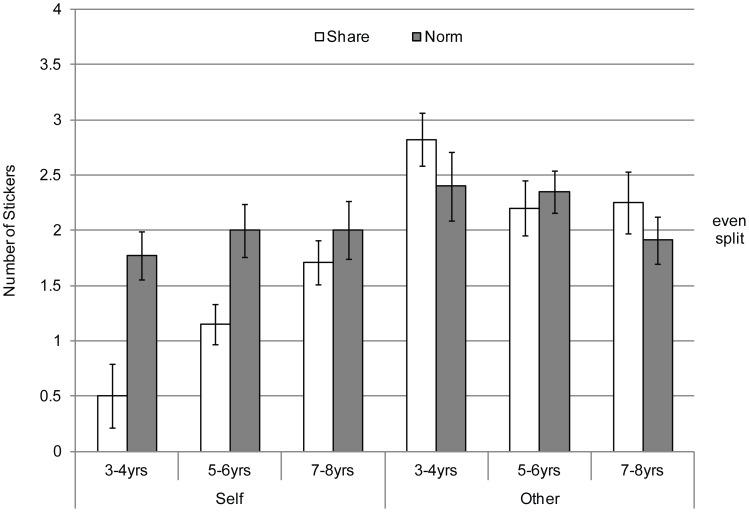
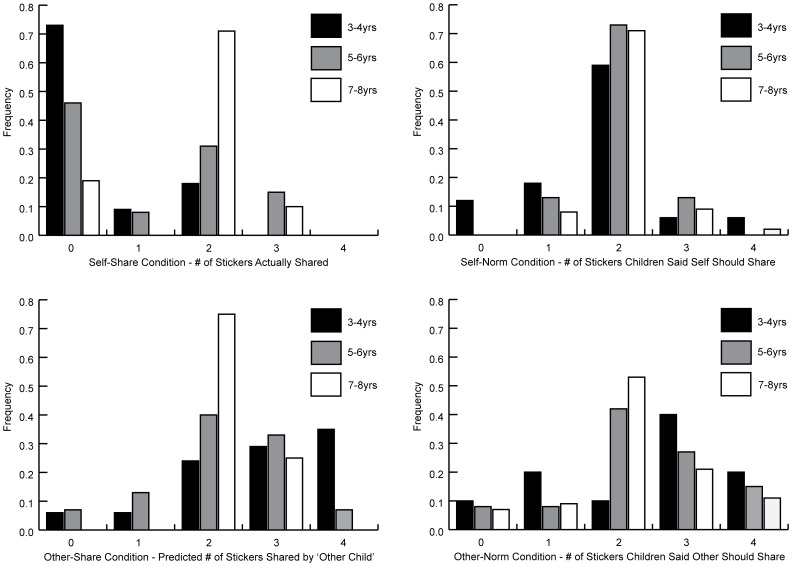
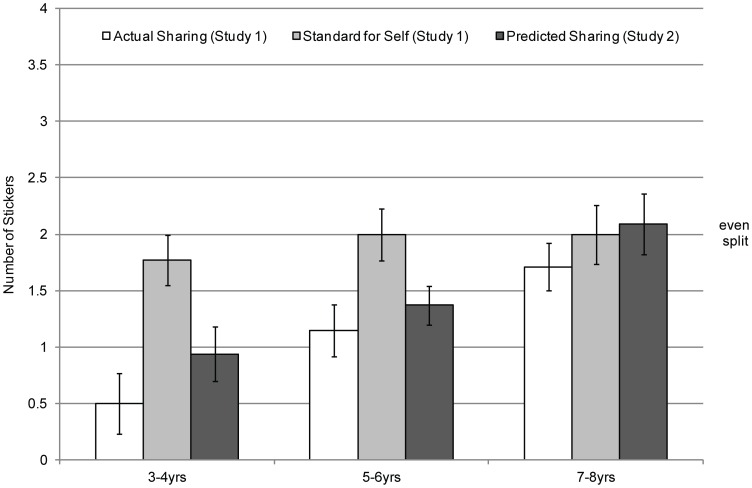
Young children endorse fairness norms related to sharing, but often act in contradiction to those norms when given a chance to share. This phenomenon has rarely been explored in the context of a single study. Using a novel approach, the research presented here offers clear evidence of this discrepancy and goes on to examine possible explanations for its diminution with age. In Study 1, 3-8-year-old children readily stated that they themselves should share equally, asserted that others should as well, and predicted that others had shared equally with them. Nevertheless, children failed to engage in equal sharing until ages 7-8. In Study 2, 7-8-year-olds correctly predicted that they would share equally, and 3-6-year-olds correctly predicted that they would favor themselves, ruling out a failure-of-willpower explanation for younger children's behavior. Similarly, a test of inhibitory control in Study 1 also failed to explain the shift with age toward adherence to the endorsed norm. The data suggest that, although 3-year-olds know the norm of equal sharing, the weight that children attach to this norm increases with age when sharing involves a cost to the self.
Overview
The claims and statistics of this paper haven’t been checked yet.
Free: it reads the open-access text and checks the first 5 claims that cite a source we can check. Create a free account to check every claim.
Integrity signals
Registry
Cites
Statistics
Figures
Verification
Claims the paper makes
The claims and statistics of this paper haven’t been checked yet.
Free: it reads the open-access text and checks the first 5 claims that cite a source we can check. Create a free account to check every claim.
Claims other papers make about this one
Each is checked against this paper’s own text: does it say what the citing paper says it does?
The source backs part of the claim, not all of it — or backs it for a different population, condition or comparison.
In the citing paper
“With increasing age, children typically share equally and sharing equally becomes affectively rewarding (Kogut, 2012; Smith, Blake, & Harris, 2013).”
From Emotion understanding and the moral self-concept as motivators of prosocial behavior in middle childhood (2020) · cites this paper as Smith et al., 2013
Experimental — accuracy not yet measuredThe cited source says what the claim attributes to it.
In the citing paper
“With increasing age, children typically share equally and sharing equally becomes affectively rewarding (Kogut, 2012; Smith, Blake, & Harris, 2013).”
From Emotion understanding and the moral self-concept as motivators of prosocial behavior in middle childhood (2020) · cites this paper as Smith et al., 2013
The cited source says what the claim attributes to it.
In the citing paper
“Our finding corresponds to work by Smith and colleagues (2013) who reported that younger children knew that sharing equally would be required, but actually shared less than half.”
From Emotion understanding and the moral self-concept as motivators of prosocial behavior in middle childhood (2020) · cites this paper as Smith et al., 2013
Self-check
Percentages, sums and reported differences re-computed from the paper’s own numbers.
The self-check needs the paper’s full text.
Citations
Cites
Baron, R. M., & Kenny, D. A. (1986) · Journal of Personality and Social Psychology · doi:10.1037/0022-3514.51.6.1173 · Cited by 91,532 · cited 1×
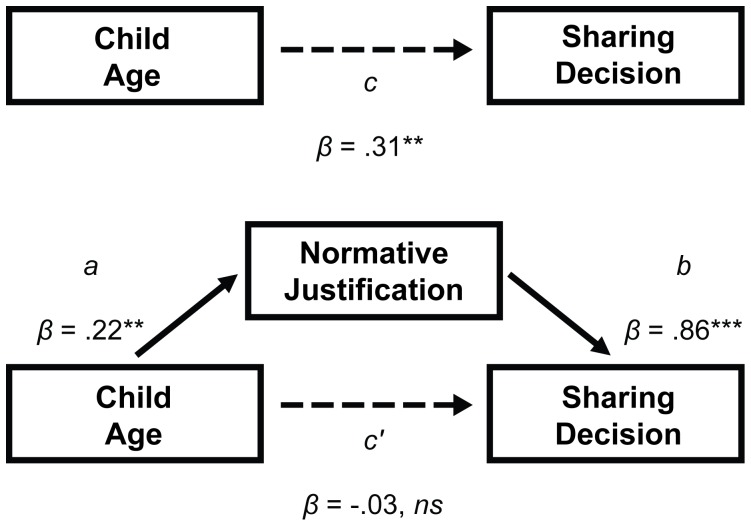
“Following Baron and Kenny [33], we tested the possibility that inhibitory control mediated the link between age and sharing.”
MethodThe emotional dog and its rational tail: A social intuitionist approach to moral judgment.
Haidt, J. (2001) · Psychological Review · doi:10.1037/0033-295x.108.4.814 · Cited by 8,048
Behavioral Game Theory: Experiments in Strategic Interaction
Camerer, C. F. (2003) · Cited by 3,722
Estimating Mediated Effects in Prevention Studies
Mackinnon, D. P., & Dwyer, J. H. (1993) · Evaluation Review · doi:10.1177/0193841x9301700202 · Cited by 1,937 · cited 1×
“Again, a series of regression models (see Figure 3) was calculated using equations designed for testing mediation models containing dichotomous mediators [34].”
MethodPreferences, property rights, and anonymity in bargaining games.
Hoffman, E., McCabe, K., Shachat, K., & Smith, V. (1994) · Games and Economic Behavior · doi:10.1006/game.1994.1056 · Cited by 1,674
Gerstadt, C. L., Hong, Y. J., & Diamond, A. (1994) · Cognition · doi:10.1016/0010-0277(94)90068-x · Cited by 1,598
Egalitarianism in young children
Fehr, E., Bernhard, H., & Rockenbach, B. (2008) · Nature · doi:10.1038/nature07155 · Cited by 1,475 · cited 4×
“Inhibitory control cannot fully explain age-related increases in fair sharing, because positive age-sharing associations are observed even when sharing is not costly for children [16,26].”
BackgroundInfluentialGod Is Watching You: Priming God Concepts Increases Prosocial Behavior in an Anonymous Economic Game
Shariff, A. F., & Norenzayan, A. (2007) · Psychological Science · doi:10.1111/j.1467-9280.2007.01983.x · Cited by 1,136
Inhibitory Control in Young Children and Its Role in Emerging Internalization
Kochanska, G., Murray, K. T., Jacques, T. Y., Koenig, A. L., & Vandegeest, K. A. (1996) · Child Development · doi:10.1111/j.1467-8624.1996.tb01747.x · Cited by 940 · cited 4×
“Next, children in the Self-Share/Other-Norm group received two measures of inhibitory control: the Day-Night Task [29] and the Bear-Dragon Task [30].”
MethodInfluentialNicholas Epley, A., & Dunning, D. A. (2000) · Journal of Personality and Social Psychology · doi:10.1037//0022-3514.79.6.861 · Cited by 820 · cited 1×
“, [43,44]).”
Research works printed but not linked: 1
- Burford HC, Foley LA, Rollins PG, Rosario KS (1996) Gender differences in preschoolers' sharing behavior. J Soc Behav Pers 11: 17– 25.
Cited by
Items 401–500 of 513
Social Processes in Young Children’s Developing Understanding of Fairness
Mei, P. (2021) · Lancaster EPrints (Lancaster University) · doi:10.17635/lancaster/thesis/1395
Mei, P., & Lewis, C. N. (2021) · SSRN Electronic Journal · doi:10.2139/ssrn.3990727
Lee, K. J. J. (2022) · DR-NTU (Nanyang Technological University) · doi:10.32657/10356/156813
The Development of Children’s Egalitarianism in the Context of Group Membership and Resource Valence
Zmyj, N., Rausch, A., Schröder, L., & Seehagen, S. (2022) · Zeitschrift für Entwicklungspsychologie und Pädagogische Psychologie · doi:10.1026/0049-8637/a000255
Characteristics and the Influencing Factors of Children’s Inequality Aversion
邹, 巧. (2022) · Advances in Psychology · doi:10.12677/ap.2022.129358
Early Education, Preferences, and Decision-Making Abilities
Cardim, J., Carneiro, P., Carvalho, L., & de Walque, D. (2022) · World Bank, Washington, DC eBooks · doi:10.1596/1813-9450-10187 · Cited by 1
“There is evidence for example that children often choose to be at a relative advantage (Rochat et al. 2009; LoBue et al. 2009; Blake & McAuliffe 2011; Smith et al. 2013; Sheskin et al. 2014; Qiu et al. 2017).”
BackgroundLewis, C. N., & Mei, P. (2022) · Human Development · doi:10.1159/000527601
“Yet, the few studies which asked children to justify their selfish or altruistic division questions suggest that they can and do make simple distinctions between desire and norm-based reasoning (Smith et al., 2013).”
Background6 to 7-Year-Old Children Are Sensitive to Opportunity Equity
舒, 睿. (2022) · Advances in Psychology · doi:10.12677/ap.2022.1212485
Schlotthauer, J., Aquino, A., Gattei, C., & González-Gadea, M. L. (2022) · PsyArXiv (OSF Preprints) · doi:10.31234/osf.io/g7emy
Beyond our Tribe: Developing a Normative Sense of Group-Transcendent FairnessPreprint
Yang, F., Yang, X., & Dunham, Y. C. (2023) · PsyArXiv (OSF Preprints) · doi:10.31234/osf.io/j63vf
Children’s Emerging Understanding of Anonymity Does Not Predict Reputation Enhancing Generosity
Richards, J., Hartlin, S., Moore, C. L., & Corbit, J. D. (2023) · Journal of Cognition and Development · doi:10.1080/15248372.2023.2216297
“Although 3-year-old children understand basic resource allocation tasks (Smith, Blake, & Harris, 2013), and show increased generosity in the presence of subtle cues of being watched (Kelsey, Grossmann, & Vaish, 2018), their ability to understand diverse perspectives and knowledge states is still…”
BackgroundUna Revisión teórica sobre la aversión a la inequidad
Guerra, P., & Mesurado, B. (2023) · Revista Iberoamericana ConCiencia. · doi:10.32654/conciencia.8-2.5 · Cited by 1
Early social experience: Impact on early and later social-cognitive development
(2023) · Frontiers research topics · doi:10.3389/978-2-8325-3331-4
A developmental perspective on the minimalist model: The case of respect for ownership
Blake, P. R. (2023) · Behavioral and Brain Sciences · doi:10.1017/s0140525x23001292
Self-citationPerceived injustice and pain-related outcomes in children with pain conditions: A systematic review
Alpdogan, N. Y., Miller, M. M., Benallal, L., Royer, M.-P., & Carrière, J. S. (2024) · Pain Medicine · doi:10.1093/pm/pnae048
“In fact, children as young as 3-years-old report that they should share resources equally with others, 34 and by age 8 children adhere to fairness norms concerning sharing.”
BackgroundMyślińska‐Szarek, K., Baryła, W., & Wojciszke, B. (2024) · SSRN Electronic Journal · doi:10.2139/ssrn.4875961
Understanding sibling influences on food parenting practices in families with children aged 1 to 5
Ayre, S. K. (2024) · Queensland University of Technology · doi:10.5204/thesis.eprints.249207
The Evolution of Fodor’s Case against Concept Learning
Laurence, S., & Margolis, E. (2024) · Oxford University Press eBooks · doi:10.1093/9780191925375.003.0024
Laurence, S., & Margolis, E. (2024) · Oxford University Press eBooks · doi:10.1093/9780191925375.003.0022
Fodor’s Biological Account of Concept Acquisition—and the Importance of Cultural Learning
Laurence, S., & Margolis, E. (2024) · Oxford University Press eBooks · doi:10.1093/9780191925375.003.0026
Laurence, S., & Margolis, E. (2024) · Oxford University Press eBooks · doi:10.1093/9780191925375.003.0023
Laurence, S., & Margolis, E. (2024) · Oxford University Press eBooks · doi:10.1093/9780191925375.003.0028
Laurence, S., & Margolis, E. (2024) · Oxford University Press eBooks · doi:10.1093/9780191925375.003.0025
The Argument from Early Development (2)
Laurence, S., & Margolis, E. (2024) · Oxford University Press eBooks · doi:10.1093/9780191925375.003.0009
Laurence, S., & Margolis, E. (2024) · Oxford University Press eBooks · doi:10.1093/9780191925375.003.0007
Artificial Neural Networks: From Connectionism to Deep Learning
Laurence, S., & Margolis, E. (2024) · Oxford University Press eBooks · doi:10.1093/9780191925375.003.0019
Laurence, S., & Margolis, E. (2024) · Oxford University Press eBooks · doi:10.1093/9780191925375.003.0004
The Argument from Universality
Laurence, S., & Margolis, E. (2024) · Oxford University Press eBooks · doi:10.1093/9780191925375.003.0011
Laurence, S., & Margolis, E. (2024) · Oxford University Press eBooks · doi:10.1093/9780191925375.002.0005
The Argument from Neural Wiring
Laurence, S., & Margolis, E. (2024) · Oxford University Press eBooks · doi:10.1093/9780191925375.003.0013
Laurence, S., & Margolis, E. (2024) · Oxford University Press eBooks · doi:10.1093/9780191925375.003.0010
Laurence, S., & Margolis, E. (2024) · Oxford University Press eBooks · doi:10.1093/9780191925375.003.0017
The Argument from Cognitive and Behavioural Quirks
Laurence, S., & Margolis, E. (2024) · Oxford University Press eBooks · doi:10.1093/9780191925375.003.0015
Why the Rationalism-Empiricism Debate Isn’t the Nature-Nurture Debate
Laurence, S., & Margolis, E. (2024) · Oxford University Press eBooks · doi:10.1093/9780191925375.003.0003
The Argument from Early Development (1)
Laurence, S., & Margolis, E. (2024) · Oxford University Press eBooks · doi:10.1093/9780191925375.003.0008
Abstraction and the Allure of Illusory Explanation
Laurence, S., & Margolis, E. (2024) · Oxford University Press eBooks · doi:10.1093/9780191925375.003.0005
Laurence, S., & Margolis, E. (2024) · Oxford University Press eBooks · doi:10.1093/9780191925375.003.0018
Introduction: Whatever Happened to the Debate over Innate Ideas?
Laurence, S., & Margolis, E. (2024) · Oxford University Press eBooks · doi:10.1093/9780191925375.003.0001
Laurence, S., & Margolis, E. (2024) · Oxford University Press eBooks · doi:10.1093/9780191925375.002.0007
Laurence, S., & Margolis, E. (2024) · Oxford University Press eBooks · doi:10.1093/9780191925375.003.0021
Laurence, S., & Margolis, E. (2024) · Oxford University Press eBooks · doi:10.1093/9780191925375.003.0027
The Argument from Initial Representational Access
Laurence, S., & Margolis, E. (2024) · Oxford University Press eBooks · doi:10.1093/9780191925375.003.0012
The Argument from Prepared Learning
Laurence, S., & Margolis, E. (2024) · Oxford University Press eBooks · doi:10.1093/9780191925375.003.014
Laurence, S., & Margolis, E. (2024) · Oxford University Press eBooks · doi:10.1093/9780191925375.003.0016
Laurence, S., & Margolis, E. (2024) · Oxford University Press eBooks · doi:10.1093/9780191925375.002.0006
What the Rationalism-Empiricism Debate Is Really About
Laurence, S., & Margolis, E. (2024) · Oxford University Press eBooks · doi:10.1093/9780191925375.003.0002
Laurence, S., & Margolis, E. (2024) · Oxford University Press eBooks · doi:10.1093/9780191925375.003.0020
Concepts, Innateness, and Why Concept Nativism Is about More Than Just Innate Concepts
Laurence, S., & Margolis, E. (2024) · Oxford University Press eBooks · doi:10.1093/9780191925375.003.0006
Fong, F. T. K., Kirkland, K., Nagesh, P., & Kirby, J. N. (2026) · Developmental Psychology · doi:10.1037/dev0002281
Children's consideration of effort and outcome in reward distribution tasks
Kim, E., & LoBue, V. (2024) · Social Development · doi:10.1111/sode.12778
“…we operationalize as an equitable distribution of resources—early in life, even in infancy (Blake et al., 2015; Blake & McAuliffe, 2011; DeJesus et al., 2014; Elenbaas et al., 2016; Geraci & Surian, 2011; Olson & Spelke, 2008; Schmidt & Sommerville, 2011; Sloane et al., 2012; Smith et al., 2013).”
Building a developmental science of redemption
Yonas, D., & Solomon, L. H. (2025) · Developmental Review · doi:10.1016/j.dr.2024.101183
González-Gadea, M. L., Schlotthauer, J., Aquino, A., & Gattei, C. (2025) · British Journal of Developmental Psychology · doi:10.1111/bjdp.12554 · Cited by 1
Reasoning Beyond Explicit Rules: Adults’ and Children's Use of Closure Principles in Novel Cases
Stegall, J., Mikhail, J., Nichols, S., & Kushnir, T. (2026) · Cognitive Science · doi:10.1111/cogs.70240
Fan, W., Wu, Y., & Li, Y. (2025) · Early Child Development and Care · doi:10.1080/03004430.2025.2487854
Early Neural Development of Social Interaction Perception in the Superior Temporal Sulcus
Sampaio, W. M. (2025) · Journal of Neuroscience · doi:10.1523/jneurosci.0253-25.2025
Zhang, W., Xu, R. H., Yu, K., Liao, X., & Fan, W. (2025) · Early Child Development and Care · doi:10.1080/03004430.2025.2507959
Farrukh, U., Stowe, L. M., & Chernyak, N. (2025) · Social Development · doi:10.1111/sode.70007 · Cited by 1
Is it fair to be unfair? Chinese secondborns’ sharing with firstborns, friends, and strangers
Song, Y., Zang, F., & Wan, X. (2025) · Early Child Development and Care · doi:10.1080/03004430.2025.2539872
“Another more plausible explanation is a ‘knowledge-behavior’ gap; specifically, children’s third-party judgments may be inconsistent with their first-party sharing (Kogut, 2012; Smith et al., 2013).”
Let Them Eat Plants! Two Arguments for Raising Children on a (Predominantly) Plant-Based Diet
Hohl, S., & Martin, A. K. (2025) · Res Publica · doi:10.1007/s11158-025-09728-9
“Footnote 15 (continued) they are violated (see Vaish and Tomasello (2014), Smith et al. (2013).”
Xiao, E., Tang, X., Chen, E. E., & Huang, C. H. O. (2025) · Journal of Cognition and Development · doi:10.1080/15248372.2025.2566079
“Yet, when given the opportunity to choose between the low-wealth and the high-wealth individuals, they demonstrate a bias toward the wealthy (Li et al., 2014; Smith et al., 2013).”
Chen, C., Zha, Z., He, R., Zhou, Y., & Zhang, W. (2025) · Frontiers in Psychology · doi:10.3389/fpsyg.2025.1676175 · Cited by 1
“…between children’s actual behavior and their verbal (or moral judgment) expressions (Smith et al., 2013), and further confirms the presence of a “moral judgment–behavior gap” among preschoolers, where fairness judgments and actual sharing behavior do not always correspond (Smith et al., 2013).”
When Does Sharing Cost Too Much? Peer Presence and Resource Acquisition in Young Children
Liu, X., & Gao, J. (2025) · The Journal of Genetic Psychology · doi:10.1080/00221325.2025.2571903
Giving or Taking: Children’s Development of Leadership Concepts in Group Contributions and RewardsPreprint
Wu, Z., Ma, S.-H., & Guo, Z. (2025) · Research Square · doi:10.21203/rs.3.rs-7984510/v1
Taking advantage: Predictions and moral judgments of leveraging outside options in ultimatum games
Sohail, S., & Dunham, Y. C. (2025) · Journal of Experimental Social Psychology · doi:10.1016/j.jesp.2025.104852
Preschoolers’ Altruistic Sharing Towards Prosocial and Antisocial Recipients
Kumaki, Y. (2025) · The Journal of Genetic Psychology · doi:10.1080/00221325.2025.2599537
How do children intervene in transgressions? The influence of apology and intervention costs
Toda, R., Toda, N., Hagihara, H., & Kanakogi, Y. (2026) · Journal of Experimental Child Psychology · doi:10.1016/j.jecp.2026.106654
Foti, F., Costanzo, F., Fabrizio, C., Termine, A., Menghini, D., Iaquinta, T., Vicari, S., Petrosini, L., & Blake, P. R. (2024) · Figshare · doi:10.6084/m9.figshare.26944596
Self-citationFoti, F., Costanzo, F., Fabrizio, C., Termine, A., Menghini, D., Iaquinta, T., Vicari, S., Petrosini, L., & Blake, P. R. (2024) · Figshare · doi:10.6084/m9.figshare.26944608
Self-citationRussell, S. J. (2023) · Lancaster EPrints (Lancaster University) · doi:10.17635/lancaster/thesis/2131
The early ontogeny of the moral self-concept
Söldner, L. (2024) · doi:10.5282/edoc.34159
Foti, F., Costanzo, F., Fabrizio, C., Termine, A., Menghini, D., Iaquinta, T., Vicari, S., Petrosini, L., & Blake, P. R. (2024) · Figshare · doi:10.6084/m9.figshare.26944602
Self-citationMapping the origins of the human moral sense
Drew, R. (2025) · cIRcle (University of British Columbia) · doi:10.14288/1.0447914 · Cited by 2
Foti, F., Costanzo, F., Fabrizio, C., Termine, A., Menghini, D., Iaquinta, T., Vicari, S., Petrosini, L., & Blake, P. R. (2024) · Figshare · doi:10.6084/m9.figshare.26944599
Self-citationFoti, F., Costanzo, F., Fabrizio, C., Termine, A., Menghini, D., Iaquinta, T., Vicari, S., Petrosini, L., & Blake, P. R. (2024) · Figshare · doi:10.6084/m9.figshare.26944605
Self-citationCooperation and the Development of Joint Commitment
Kachel, U. (2018) · Qucosa (Saxon State and University Library Dresden)
Bueno Guerra, N. (2017) · Dipòsit Digital de la Universitat de Barcelona (Universitat de Barcelona)
Garzón, C., Rada, C. A. G., García, L. N., García, M. P., Morales, J., Pérez, S., Remolina, P., Salinas, K., Álvarez-Leguizamón, L. J., Rodríguez-Garnica, N., et al. (2020) · Repositorio Institucional Universidad Católica de Colombia (Universidad Católica de Colombia)
Eight shared by three : When mathematical and ethical reasoning interplay
Eriksson, H., Hedefalk, M., Markkanen, P., & Sumpter, L. (2024) · KTH Publication Database DiVA (KTH Royal Institute of Technology)
"Mettersi nei panni degli altri": dalle misure alle applicazioni
RINALDI, T. (2020) · DocTA - Doctoral Theses Archive
Exploring the Relations Between Helping, Sharing, and Comforting in Childhood Prosocial Development
Beaulieu, S. (2023) · Spectrum Research Repository (Concordia University)
Memişoğlu Sanlı, A. (2023) · OpenMETU (Middle East Technical University)
Validation of the Career Planning Styles (SPK-21) tool
Jagielska, K. (2025) · Journal of Preschool and Elementary School Education/Multidisciplinary Journal of School Education · doi:10.35765/mjse.2025.1428.31
Chinese Young Children Engage in Social Role‐Based Sharing Behavior
Wu, X., Chai, Q., & He, J. (2026) · Developmental Science · doi:10.1111/desc.70140
Fraser, A. M., Busby, A. K., Reschke, P. J., Coleman, B. D., Jasperson, J., & Takamasa, E. J. (2026) · International Journal of Behavioral Development · doi:10.1177/01650254261416434
Lombardi, E., Dio, C. D., Castelli, I., Massaro, D., Marchetti, A., & Valle, A. (2026) · Frontiers in Psychology · doi:10.3389/fpsyg.2026.1708789
“Children begin rejecting disadvantageous inequity around 3–4 years of age, and by 8, they also reject advantageous inequity, where they receive more than others (Smith et al., 2013).”
Zhao, L., He, Y., & Heyman, G. D. (2026) · Child Development · doi:10.1093/chidev/aacaf047
Resource value influences distributive justice behaviors of three- to five-year-old Chinese children
Cheng, T., Lin, Q., & Fu, H. C. (2026) · Current Psychology · doi:10.1007/s12144-025-08739-2
“…situation, younger children tend to behave more selfishly, while older children still adhere to the principle of fairness in resource allocation; in the third-party situation, children believe that others should adhere to principles of fairness and exhibit fair behavior (Smith et al., 2013 ).”
Charity or Solidarity? How Donor Motives Shape Third-Party Perceptions of GivingPreprint
Trenfield, M., Szanton, E. C., Piecyk, N., & Young, L. (2026) · SSRN Electronic Journal · doi:10.2139/ssrn.6335971
Valcke, A., & Nilsen, E. S. (2026) · Journal of Applied Developmental Psychology · doi:10.1016/j.appdev.2026.101944
Yapay Zekâ Disiplinlerarası Yaklaşımlar
Yıldırım, B. F. (2023) · DSpace@29 Mayıs
Le rôle des préférences et interactions sociales dans la performance scolaire
Dagorn, E. (2021) · theses.fr (ABES) · doi:10.70675/d74e205ez2a0fz4200zb46ezb73d162df6bc
Altruisme et développement cognitif chez l'enfant d'âge scolaire
Rose, L. (2023) · theses.fr (ABES) · doi:10.70675/7415046fz655az47bdz95bfz23b61174a7e1
“No Fair!”: Children’s Perceptions of Fairness in Merit-Based Distributions
Yucel, M., Brence, M., & Vaish, A. (2026) · Behavioral Sciences · doi:10.3390/bs16040617
“These findings, along with prior work on early fairness reasoning (Baumard et al., 2012; Sloane et al., 2012; Smith et al., 2013), suggest that 4-year-olds are sensitive to unfair outcomes but have not yet differentiated fairness violations as being clearly part of the moral domain.”
The ontogeny of children's social emotions in response to (un)fairness.Preprint
Hepach, R., Blake, P. R., McAuliffe, K., Haun, D., & Gerdemann, S. C. (2022) · OSF Preprints (OSF Preprints)
Self-citationEnhancing Social Curiosity Drives Sharing in Young ChildrenPreprint
Lee, N., & Lucca, K. (2026) · Research Square · doi:10.21203/rs.3.rs-9444842/v1
Executive functions and decision making in childhood: A systematic review
Mendes, A., Tekampe, D. L., Greiff, S., & Bobrowicz, K. (2026) · Cognitive Development · doi:10.1016/j.cogdev.2026.101714
From children to toy trucks, and robots too: Exploring children’s fairness perceptions
Ayalon, O., Hok, H., Shaw, A., & Gordon, G. (2026) · Computers in Human Behavior Reports · doi:10.1016/j.chbr.2026.101136
Beyond resources: Children in India and Germany have a multifaceted concept of fairness
Yilmaz, S., Sunderarajan, J., Hepach, R., & Kanngießer, P. (2026) · Child Development · doi:10.1093/chidev/aacag110
Metadata
- Authors
- Smith, C. E., Blake, P. R., & Harris, P. L.
- Affiliations
- University of Michigan (US)
- Boston University (US)
- Harvard University (US)
- Corresponding author
- Smith, Craig E.
- Venue
- PLoS ONE
- Publisher
- Public Library of Science (PLoS)
- Published
- 2013-03-20
- Volume
- 8
- Issue
- 3
- Pages
- e59510
- ISSN
- 1932-6203 (ISSN-L)
- PMC
- PMC3603928
- OpenAlex
- W1965699991
- Semantic Scholar
- 6d59a9f7bcfc05d46d6df3cc23213408ce0137cc
- Cited by
- 482
- References
- 49
- Citations by year
- 2026: 30 · 2025: 31 · 2024: 73 · 2023: 41 · 2022: 42 · 2021: 40 · 2020: 40 · 2019: 30 · 2018: 40 · 2017: 36 · 2016: 28 · 2015: 26 · 2014: 21 · 2013: 4
- FWCI
- 54.44
- Type
- journal article
- Language
- en
- Update notices
- correction (2013-08-21)
- Open access
- gold
- doi.org
- Locations
- PLoS ONE (publishedVersion, cc-by)
- Europe PMC (PubMed Central) (publishedVersion, cc-by)
- PubMed Central (publishedVersion, cc-by)
- PubMed (publishedVersion)
- RePEc: Research Papers in Economics (submittedVersion)
- DOAJ (DOAJ: Directory of Open Access Journals) (submittedVersion)
- Funders
- John Templeton Foundation
- Topics
- Social Sciences › Psychology › Developmental and Educational Psychology › Child and Animal Learning Development
- Life Sciences › Neuroscience › Cognitive Neuroscience › Psychology of Moral and Emotional Judgment
- Social Sciences › Economics, Econometrics and Finance › Economics and Econometrics › Experimental Behavioral Economics Studies
- Keywords
- fair sharing, fairness norms, rule compliance, young children, age differences, self-other bias, self-serving bias, inhibitory control, willpower, moral development, prosocial behavior
- MeSH terms
- Age Factors, Analysis of Variance, Child, Child Development, Child, Preschool, Cooperative Behavior, Games, Experimental, Humans, Interpersonal Relations, Massachusetts, Surveys and Questionnaires, Social Behavior, Moral Development
About these checks
Registry, retraction, Cites and statistics results are computed, not judged, with one exception: a printed reference that no index lists is read once by a model before it counts as a citation error. Claims are extracted by a model and kept only when their quote appears verbatim in the text; each cited source is then checked, with a model’s help, for whether it says what the claim relies on. Those verdicts can be wrong — read the claim’s quote and the cited source before relying on one.
Statistics and arithmetic are recomputed, not judged.
Confidence bands are shown only for fields calibrated on our annotated test set. None is calibrated yet, so no band is shown.
What counts as a claim ›How we measure confidence ›How we check this ›
Are you an author, or do you see a problem with this page? Request a review
Data sources
Bibliographic data: Semantic Scholar, OpenAlex, Crossref.
Contains information from the Semantic Scholar Academic Graph Datasets, made available under the ODC Attribution License (ODC-BY 1.0).
Semantic Scholar’s data is described in: Kinney, R., et al. (2023). The Semantic Scholar Open Data Platform. arXiv:2301.10140.
