

The DOI matches its Crossref record; 66 of the 66 references it cites were found in a registry or an index.
Internet-Delivered Cognitive Behavior Therapy for Adolescents with Obsessive-Compulsive Disorder: An Open Trial
Open accessAbstract
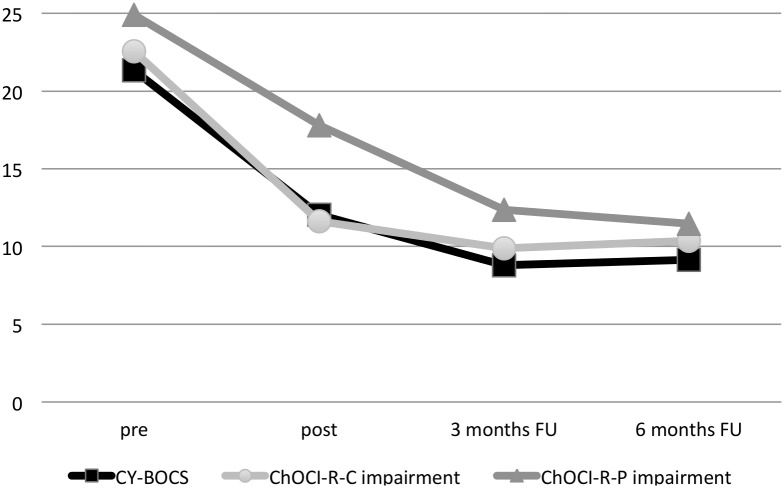
BACKGROUND: International guidelines recommend Cognitive Behavior Therapy (CBT) as the first line treatment for pediatric obsessive-compulsive disorder (OCD). However, a substantial proportion of patients do not have access to such treatment. We developed and tested the feasibility, efficacy and acceptability of a novel therapist-guided, Internet-delivered CBT (ICBT) platform for adolescents with OCD. METHODS: An interactive, age-appropriate ICBT platform ("BiP OCD") was developed. Twenty-one adolescents (12-17 years) with a DSM-IV diagnosis of OCD and their parents were enrolled in the study. All participants received 12 weeks of ICBT with therapist support. The primary outcome measure was the Children's Yale-Brown Obsessive-Compulsive Scale (CY-BOCS). Acceptability was assessed at post-treatment. RESULTS: Participants completed on average 8.29 (SD = 3.0) of the 12 treatment chapters. Treatment yielded significant improvements on all clinician-, parent- and most self-administered outcome measures, with a large effect size of d = 2.29 (95% CI 1.5-3.07) on the CY-BOCS. Patients continued to improve at follow-up. At 6-month follow-up, 71% were classified as responders (≥35% decrease on the CY-BOCS) and 76% as being in remission (CY-BOCS score ≤12). Average clinician support time was less than 20 minutes per patient per week. The majority of participants felt that BiP OCD was age-appropriate and rated the treatment as good or very good. CONCLUSIONS: ICBT could be efficacious, acceptable, and cost-effective for adolescents with OCD. More rigorously controlled studies are needed to further evaluate the treatment. TRIAL REGISTRATION: ClinicalTrials.gov; NCT01809990.
Overview
The claims and statistics of this paper haven’t been checked yet.
Run the check — free, no account needed. It reads the open-access text and checks the sources it cites.
Integrity signals
Registry
Cites
Statistics
Figures
Verification
Claims the paper makes
The claims and statistics of this paper haven’t been checked yet.
Run the check — free, no account needed. It reads the open-access text and checks the sources it cites.
Claims other papers make about this one
Each is checked against this paper’s own text: does it say what the citing paper says it does?
The source backs part of the claim, not all of it — or backs it for a different population, condition or comparison.
In the citing paper
“Adolescents and their parents generally expressed satisfaction with the intervention and the majority would recommend it to others, corresponding to what previous studies of similar interventions have found (Spence et al., 2011; Lenhard et al., 2014; Wuthrich et al., 2012).”
From Internet-based cognitive behavioral therapy for adolescents with anxiety disorders: A feasibility study (2018) · cites this paper as Lenhard et al., 2014
Experimental — accuracy not yet measured
Self-check
Percentages, sums and reported differences re-computed from the paper’s own numbers.
The self-check needs the paper’s full text.
Citations
Cites
Diagnostic and Statistical Manual of Mental Disorders
Williams, J. B. W., & First, M. B. (2013) · Oxford University Press eBooks · doi:10.1093/acrefore/9780199975839.013.104 · Cited by 109,845
Intraclass correlations: Uses in assessing rater reliability.
Shrout, P. E., & Fleiss, J. L. (1979) · Psychological Bulletin · doi:10.1037/0033-2909.86.2.420 · Cited by 24,532
Multiple Imputation for Nonresponse in Surveys
Rubin, D. B. (1987) · Wiley Series in Probability and Statistics · doi:10.1002/9780470316696 · Cited by 20,701
(1998) · The Journal of Clinical Psychiatry · Cited by 19,139
The Strengths and Difficulties Questionnaire: A research note
Goodman, R. (1997) · Journal of Child Psychology and Psychiatry · doi:10.1111/j.1469-7610.1997.tb01545.x · Cited by 14,908
(1998) · PubMed · Cited by 10,216
(1976) · Medical Entomology and Zoology · Cited by 8,899
The mini international neuropsychiatric interview
Lecrubier, Y., Sheehan, D. V., Hergueta, T., & Weiller, E. (1998) · European Psychiatry · doi:10.1016/s0924-9338(99)80239-9 · Cited by 5,899
A Children's Global Assessment Scale (CGAS)
Shaffer, D. (1983) · Archives of General Psychiatry · doi:10.1001/archpsyc.1983.01790100074010 · Cited by 3,716 · cited 1×
“Children’s Global Assessment Scale (CGAS [36]) is an instrument to quantify the overall level of functioning in children and adolescents.”
BackgroundChildren's Yale-Brown Obsessive Compulsive Scale: Reliability and Validity
SCAHILL, L., RIDDLE, M. A., McSWIGGIN-HARDIN, M., ORT, S. I., KING, R. A., GOODMAN, W. K., CICCHETTI, D., & LECKMAN, J. F. (1997) · Journal of the American Academy of Child & Adolescent Psychiatry · doi:10.1097/00004583-199706000-00023 · Cited by 2,045
Cited by
Sorted by citations
Vigerland, S., Lenhard, F., Bonnert, M., Lalouni, M., Hedman, E., Ahlen, J., Olén, O., Serlachius, E., & Ljótsson, B. (2016) · Clinical Psychology Review · doi:10.1016/j.cpr.2016.09.005 · Cited by 292
“Four of the included studies were written by coauthors of this review (Bonnert et al., 2014; Lenhard et al., 2014; Vigerland et al., 2013; Vigerland et al., 2016).”
BackgroundSelf-citationRemote cognitive-behavior therapy for obsessive-compulsive symptoms: A meta-analysis.
Wootton, B. M. (2016) · Clinical Psychology Review · doi:10.1016/j.cpr.2015.10.001 · Cited by 162
Obsessive-compulsive disorder in children and adolescents
Krebs, G., & Heyman, I. (2009) · Archives of Disease in Childhood · doi:10.1136/archdischild-2014-306934 · Cited by 304
Lenhard, F., Andersson, E., Mataix-Cols, D., Rück, C., Vigerland, S., Högström, J., Hillborg, M., Brander, G., Ljungström, M., Ljótsson, B., et al. (2017) · Journal of the American Academy of Child & Adolescent Psychiatry · doi:10.1016/j.jaac.2016.09.515 · Cited by 146
Neuroscience-informed psychoeducation for addiction medicine: A neurocognitive perspective
Ekhtiari, H., Rezapour, T., Aupperle, R. L., & Paulus, M. P. (2017) · Progress in brain research · doi:10.1016/bs.pbr.2017.08.013 · Cited by 134
Cipolletta, S., & Mocellin, D. (2018) · Psychotherapy Research · doi:10.1080/10503307.2016.1259533 · Cited by 122
“…counseling may provide improvements in various problem areas and psychological diseases such as pathological gambling, post-traumatic stress disorder, and obsessive-compulsive disorder (Abbott et al., 2008; Barak et al., 2009; Finn & Barak, 2010; Lenhard et al., 2014; Perle & Nierenberg, 2013).”
BackgroundDuPaul, G. J., Kern, L., Belk, G. D., Custer, B., Daffner, M. S., Hatfield, A., & Peek, D. (2017) · Journal of Clinical Child & Adolescent Psychology · doi:10.1080/15374416.2017.1342544 · Cited by 108
“, 2005), and obsessive-compulsive disorder (Lenhard et al., 2014).”
BackgroundFreeman, J., Benito, K., Herren, J. A., Kemp, J., Sung, J., Georgiadis, C., Arora, A., Walther, M. R., & Garcia, A. (2018) · Journal of Clinical Child & Adolescent Psychology · doi:10.1080/15374416.2018.1496443 · Cited by 73
“With the addition of these new interventions, which test Internet-delivered (Comer et al., 2016; Lenhard et al., 2017, 2014) and phone-delivered (Turner et al., 2014), non-face-to-face CBT is now considered probably efficacious.”
BackgroundLenhard, F., Sauer, S., Andersson, E., Månsson, K. N., Mataix‐Cols, D., Rück, C., & Serlachius, E. (2018) · International Journal of Methods in Psychiatric Research · doi:10.1002/mpr.1576 · Cited by 84
“The feasibility and efficacy of BiP OCD has previously been established in an open trial, a RCT and a qualitative interview study (Lenhard et al., 2014, 2016, 2017).”
BackgroundMethodSelf-citationOrsolini, L., Pompili, S., Salvi, V., & Volpe, U. (2021) · Medicina · doi:10.3390/medicina57080793 · Cited by 79
“In addition, a significant improvement in OCD symptomatology has been observed as well [70,71,75,76], also maintained over the time [70,76].”
BackgroundMethodResultInfluentialHollis, C. P., Hall, C. L., Jones, R., Marston, L., Novere, M. L., Hunter, R. M., Brown, B. J., Sanderson, C., Andrén, P., Bennett, S. D., et al. (2021) · The Lancet Psychiatry · doi:10.1016/s2215-0366(21)00235-2 · Cited by 78
Jolstedt, M., Ljótsson, B., Fredlander, S., Tedgård, T., Hallberg, A., Ekeljung, A., Högström, J., Mataix-Cols, D., Serlachius, E., & Vigerland, S. (2018) · Internet Interventions · doi:10.1016/j.invent.2017.11.003 · Cited by 75
Stjerneklar, S., Hougaard, E., McLellan, L. F., & Thastum, M. (2019) · PLOS ONE · doi:10.1371/journal.pone.0222485 · Cited by 71
Lenhard, F., Ssegonja, R., Andersson, E., Feldman, I., Rück, C., Mataix‐Cols, D., & Serlachius, E. (2017) · BMJ Open · doi:10.1136/bmjopen-2016-015246 · Cited by 68
Aspvall, K., Andersson, E., Melin, K., Norlin, L., Eriksson, V., Vigerland, S., Jolstedt, M., Silverberg-Mörse, M., Wallin, L., Sampaio, F., et al. (2021) · JAMA · doi:10.1001/jama.2021.3839 · Cited by 66
Dyadic Psychosocial eHealth Interventions: Systematic Scoping Review
Shaffer, K. M., Tigershtrom, A., Badr, H., Benvengo, S., Hernandez, M., & Ritterband, L. M. (2019) · Journal of Medical Internet Research · doi:10.2196/15509 · Cited by 63
Hall, C. L., Davies, E. B., Andrén, P., Murphy, T. L., Bennett, S. D., Brown, B. J., Brown, S., Chamberlain, L. R., Craven, M. P., Evans, A., et al. (2019) · BMJ Open · doi:10.1136/bmjopen-2018-027583 · Cited by 59
“The platform has been used to deliver therapist-supported ICBT for a range of different conditions, including phobia, 14 anxiety 15 and OCD.”
Ferreri, F., Bourla, A., Peretti, C.-S., Segawa, T., Jaafari, N., & Mouchabac, S. (2019) · JMIR Mental Health · doi:10.2196/11643 · Cited by 53
O'Neill, J., & Feusner, J. (2015) · Psychology Research and Behavior Management · doi:10.2147/prbm.s75106 · Cited by 48
Wootton, B. M., Karin, E., Titov, N., & Dear, B. F. (2019) · Journal of Anxiety Disorders · doi:10.1016/j.janxdis.2019.102111 · Cited by 51
Wozney, L., McGrath, P. J., Gehring, N. D., Bennett, K., Huguet, A., Hartling, L., Dyson, M. P., Soleimani, A., & Newton, A. S. (2018) · JMIR Mental Health · doi:10.2196/mental.9655 · Cited by 50
A novel approach to challenging OCD related beliefs using a mobile-app: An exploratory study
Roncero, M., Belloch, A., & Doron, G. (2018) · Journal of Behavior Therapy and Experimental Psychiatry · doi:10.1016/j.jbtep.2018.01.008 · Cited by 48
“Such alternative delivery systems for OCD-based CBT are consistent with the stepped-care approach for OCD (NICE, 2005) whereby clients with OCD may begin with low intensity interventions (e.g., self-help materials) and, if needed, gradually receive more intense and expert interventions (Tolin, Diefenbach, & Gilliam, 2…”
MethodInfluentialSchmitt, J. C., Valiente, R. M., García-Escalera, J., Arnáez, S., Espinosa, V., Sandín, B., & Chorot, P. (2022) · International Journal of Environmental Research and Public Health · doi:10.3390/ijerph19095365 · Cited by 45
“, [22,65], but, as far as we know, not yet in subclinical samples.”
BackgroundIniesta-Sepúlveda, M., Rosa-Alcázar, A., Sánchez-Meca, J., Parada-Navas, J., & Rosa-Alcázar, Á. (2017) · Journal of Anxiety Disorders · doi:10.1016/j.janxdis.2017.03.010 · Cited by 37
Aspvall, K., Sampaio, F., Lenhard, F., Melin, K., Norlin, L., Serlachius, E., Mataix-Cols, D., & Andersson, E. (2021) · JAMA Network Open · doi:10.1001/jamanetworkopen.2021.18516 · Cited by 39
“5) [8-17] Educational level of parenta Primary school 2 (3) 0 Secondary school 8 (11) 8 (10) College or university <2 y 8 (11) 8 (10) ≥2 y 53 (72) 60 (77) Doctorate 3 (4) 2 (3) Occupational status of parenta Working 68 (92) 75 (96) Student 0 3 (4) On sick leave 6 (8) 0 Comorbidity None 50 (68) 50 (64) Depressive episo…”
Self-citationStjerneklar, S., Hougaard, E., Nielsen, A. D., Gaardsvig, M. M., & Thastum, M. (2018) · Internet Interventions · doi:10.1016/j.invent.2018.01.001 · Cited by 36
“previous studies of similar interventions have found (Spence et al., 2011; Lenhard et al., 2014; Wuthrich et al., 2012).”
BackgroundResultLenhard, F., Vigerland, S., Engberg, H., Hallberg, A., Thermaenius, H., & Serlachius, E. (2016) · PLOS ONE · doi:10.1371/journal.pone.0164311 · Cited by 37
Self-citationRees, C. S., Anderson, R., Kane, R. T., & Finlay‐jones, A. L. (2016) · JMIR Mental Health · doi:10.2196/mental.5363 · Cited by 39
“To our knowledge, only one study has examined the efficacy of iCBT for OCD in young people [23].”
InfluentialBabiano-Espinosa, L., Wolters, L., Weidle, B., de Beek, V. O., Pedersen, S. A., Compton, S., & Skokauskas, N. (2019) · Systematic Reviews · doi:10.1186/s13643-019-1166-6 · Cited by 33
Internet-Based Cognitive Behavioral Therapy for Obsessive-Compulsive Disorder in Korea
Seol, S.-H., Kwon, J. S., Kim, Y. Y., Kim, S. N., & Shin, M.-S. (2016) · Psychiatry Investigation · doi:10.4306/pi.2016.13.4.373 · Cited by 35
Wootton, B. M., Dear, B. F., Johnston, L., Terides, M. D., & Titov, N. (2015) · Internet Interventions · doi:10.1016/j.invent.2015.05.003 · Cited by 34
Nordh, M., Vigerland, S., Öst, L., Ljótsson, B., Mataix‐Cols, D., Serlachius, E., & Högström, J. (2017) · BMJ Open · doi:10.1136/bmjopen-2017-018345 · Cited by 37
Three decades of telemedicine in obsessive-compulsive disorder: A review across platforms
Aboujaoude, E. (2017) · Journal of Obsessive-Compulsive and Related Disorders · doi:10.1016/j.jocrd.2017.06.003 · Cited by 23
Bonnert, M., Ljótsson, B., Hedman‐Lagerlöf, E., Andersson, J. K., Arnell, H., Benninga, M. A., Simrén, M., Thulin, H., Thulin, U., Vigerland, S., et al. (2014) · Internet Interventions · doi:10.1016/j.invent.2014.07.002 · Cited by 31
“Although themajority of ICBT studies have included adult participants, ICBT has been shown to lead to improvement for children and adolescents suffering from anxiety disorders (Richardson et al., 2010; Vigerland et al., 2013), OCD (Lenhard et al., 2014), chronic pain (Hicks et al., 2006; Palermo et al., 2009), and oth…”
BackgroundSilfvernagel, K., Gren‐Landell, M., Emanuelsson, M., Carlbring, P., & Andersson, G. (2015) · Internet Interventions · doi:10.1016/j.invent.2015.07.002 · Cited by 36
Efficacy of Cognitive-Behavioral Therapy in Pediatric Obsessive-Compulsive Disorder: A Meta-Analysis
Wu, Y.-Q., Lang, Z., & Zhang, H. (2016) · Medical Science Monitor · doi:10.12659/msm.895481 · Cited by 26
“One of the merits of the present study is that a number of very recent randomized clinical trials [15,17,19,20] have been for the first time included in our meta-analysis, which made the results very up-to-date.”
BackgroundAspvall, K., Andrén, P. E., Lenhard, F., Andersson, E., Mataix-Cols, D., & Serlachius, E. (2018) · BJPsych Open · doi:10.1192/bjo.2018.10 · Cited by 24
Technology at the Service of Pediatric Mental Health: Review and Assessment.
Aboujaoude, E., & Salame, W. (2016) · Jornal de Pediatria · doi:10.1016/j.jpeds.2015.12.009 · Cited by 22
Internet-Delivered Cognitive Behaviour Therapy
Richards, D., Enrique, Á., Palacios, J. E., & Duffy, D. J. (2018) · InTech eBooks · doi:10.5772/intechopen.71412 · Cited by 24
Obsessive–Compulsive Disorder in Children and Adolescents
Stiede, J. T., Spencer, S. D., Onyeka, O. “., Mangen, K. H., Church, M. J., Goodman, W. K., & Storch, E. A. (2023) · Annual Review of Clinical Psychology · doi:10.1146/annurev-clinpsy-080822-043910 · Cited by 27
Sookman, D., Phillips, K. A., Anholt, G. E., Bhar, S. S., Bream, V., Challacombe, F. L., Coughtrey, A. E., Craske, M. G., Foa, E. B., Gagné, J.-P., et al. (2021) · Psychiatry Research · doi:10.1016/j.psychres.2021.113752 · Cited by 23
Wolters, L., de Beek, V. O., Weidle, B., & Skokauskas, N. (2017) · BMC Psychiatry · doi:10.1186/s12888-017-1377-0 · Cited by 17
Aspvall, K., Lenhard, F., Melin, K., Krebs, G., Norlin, L., Näsström, K., Jassi, A. D., Turner, C. M., Knoetze, E., Serlachius, E., et al. (2020) · Internet Interventions · doi:10.1016/j.invent.2020.100308 · Cited by 23
“The 3-month outcomes on both primary and secondary outcome measures were largely comparable to those of the previous BIP OCD trials, with similar within-group effect sizes and an observed additional improvement between post-treatment and the 3-month follow-up (Aspvall et al., 2018; Lenhard, Andersson, et al., 2017; Le…”
BackgroundResultInfluentialO'Connor, K. A., Bagnell, A. L., McGrath, P. J., Wozney, L., Radomski, A. D., Rosychuk, R. J., Curtis, S. J., Jabbour, M., Fitzpatrick, E. A., Johnson, D. W., et al. (2020) · JMIR Mental Health · doi:10.2196/13356 · Cited by 19
Silfvernagel, K., Wassermann, C., & Andersson, G. (2017) · Internet Interventions · doi:10.1016/j.invent.2017.03.002 · Cited by 21
“The significant effects that were found on all dependent measures immediately following treatment and adherence rates for the 8 adolescents are consistent with previous trials on CBT and ICBT for adolescents (Spence et al., 2011; Tillfors et al., 2011; Lenhard et al., 2014), and with previous trials on tailored ICBT f…”
BackgroundResultWickberg, F., Lenhard, F., Aspvall, K., Serlachius, E., Andrén, P., Johansson, F., Silverberg-Mörse, M., & Mataix‐Cols, D. (2022) · Internet Interventions · doi:10.1016/j.invent.2022.100520 · Cited by 19
Piacentini, J. C., Wu, M. S., Rozenman, M. S., Bennett, S. M., Mcguire, J. F., Nadeau, J. M., Lewin, A. B., Sookman, D., Bergman, R. L., Storch, E. A., et al. (2021) · Psychiatry Research · doi:10.1016/j.psychres.2021.113854 · Cited by 19
Stiles-Shields, C., Ho, J., & Mohr, D. C. (2016) · DIGITAL HEALTH · doi:10.1177/2055207616675706 · Cited by 18
“Parental support was also a common feature, with four studies providing parent materials and encouraging parental engagement with the teen users around the treatment interventions.(46,50)”
BackgroundMethodResultBabiano-Espinosa, L., Wolters, L., Weidle, B., Compton, S., Lydersen, S., & Skokauskas, N. (2021) · Child and Adolescent Psychiatry and Mental Health · doi:10.1186/s13034-021-00400-7 · Cited by 16
Hollis, C. P., Hall, C. L., Khan, K., Novere, M. L., Marston, L., Jones, R., Hunter, R. M., Brown, B. J., Sanderson, C., Andrén, P., et al. (2023) · Health Technology Assessment · doi:10.3310/cpms3211 · Cited by 15
Bennett, S. D., Coughtrey, A. E., Heyman, I., Greally, S., Clarkson, H., Bhattacharyya, T., Lewis, C., Varadkar, S., & Shafran, R. (2018) · European Journal of Paediatric Neurology · doi:10.1016/j.ejpn.2018.02.011 · Cited by 15
Behavioral Intervention Technologies and Psychotherapy with Youth: A Review of the Literature
Bunge, E. L., Dickter, B., Jones, M. K., Alie, G., Spear, A., & Perales, R. (2015) · Current Psychiatry Reviews · doi:10.2174/1573400511666150930232254 · Cited by 14
Skarphedinsson, G., Melin, K., Valderhaug, R., Wentzel-Larsen, T., Højgaard, D., Thomsen, P., & Ivarsson, T. (2015) · Journal of Obsessive-Compulsive and Related Disorders · doi:10.1016/j.jocrd.2015.03.005 · Cited by 11
Lenhard, F., Andersson, E., Mataix‐Cols, D., Rück, C., Aspvall, K., & Serlachius, E. (2020) · npj Digital Medicine · doi:10.1038/s41746-020-00327-x · Cited by 12
Conzelmann, A., Hollmann, K., Haigis, A., Lautenbacher, H., Bizu, V., App, R., Nickola, M., Wewetzer, G., Wewetzer, C., Ivarsson, T., et al. (2022) · Trials · doi:10.1186/s13063-022-06062-w · Cited by 11
“iCBT could be especially attractive for pediatric patients as 90–96% of young people aged 12–24 have good internet accessibility and their ability to use new media platforms should be high [11].”
BackgroundRees, C. S., Anderson, R., & Finlay‐jones, A. L. (2015) · BMJ Open · doi:10.1136/bmjopen-2014-007486 · Cited by 12
Long-term telemental health prevention interventions for youth: A rapid review.
Abuwalla, Z., Clark, M. D., Burke, B. J., Tannenbaum, V., Patel, S., Mitacek, R., Gladstone, T. R. G., & Voorhees, B. W. V. (2017) · Internet Interventions · doi:10.1016/j.invent.2017.11.006 · Cited by 14
“…discussion boards (Richards et al., 2016; Hoek et al., 2011; Saulsberry et al., 2013a; Ip et al., 2016; Kramer et al., 2014; Stallman et al., 2016; Taylor et al., 2016; Day et al., 2013; Tillfors et al., 2011; Räsänen et al., 2016; Ruggiero et al., 2015; Lenhard et al., 2014; Turner et al., 2014).”
BackgroundMethodInfluentialStavropoulos, V., Wilson, P. H., Kuss, D. J., Griffiths, M. D., & Gentile, D. A. (2016) · Behaviour and Information Technology · doi:10.1080/0144929x.2016.1262900 · Cited by 12
“Third, interest in internet-delivered intervention has grown substantially, particularly in lieu of the range and severity of symptoms among adolescent clients including obsessive-compulsive behaviours, insomnia, and victimization (De Bruin et al., 2014; Jacobs et al., 2014; Lenhard et al., 2014).”
BackgroundAndrén, P., de la Cruz, L. F., Isomura, K., Lenhard, F., Hall, C. L., Davies, E. B., Murphy, T. L., Hollis, C. P., Sampaio, F., Feldman, I., et al. (2021) · Trials · doi:10.1186/s13063-021-05592-z · Cited by 12
Personalizing cognitive-behavioral treatment for pediatric obsessive-compulsive disorder
Wu, M. S., & Storch, E. (2016) · Expert Review of Precision Medicine and Drug Development · doi:10.1080/23808993.2016.1209972 · Cited by 8
Aspvall, K., Andersson, E., Lenhard, F., Melin, K., Norlin, L., Wallin, L., Silverberg-Mörse, M., Feldman, I., Bottai, M., Mataix‐Cols, D., et al. (2019) · JAMA Network Open · doi:10.1001/jamanetworkopen.2019.13810 · Cited by 8
Cwinn, E., Barry, E. A., Weisz, J. R., Bailin, A., Fitzpatrick, O. M., Venturo‐Conerly, K. E., & Crooks, C. V. (2022) · Canadian Journal of Community Mental Health · doi:10.7870/cjcmh-2022-026 · Cited by 8
“…(e.g., anxiety and depression) and externalizing (e.g., behavioural difficulties and substance use) difficulties among children and adolescents (Berg et al., 2020; Calear et al., 2009; Hoek et al., 2012; Lenhard et al., 2014; March et al., 2009; Vigerland et al., 2013; Vigerland et al., 2016).”
BackgroundDietvorst, E., de Vries, L. P., van Eijl, S., Mesman, E., Legerstee, J. S., Keijsers, L., Hillegers, M. H. J., & Vreeker, A. (2024) · Digital Health · doi:10.1177/20552076241294105 · Cited by 9
Skarphéðinsson, G., & Ivarsson, T. (2015) · Current Behavioral Neuroscience Reports · doi:10.1007/s40473-015-0047-0 · Cited by 8
Myers, K., & Stoep, A. V. (2016) · Journal of the American Academy of Child & Adolescent Psychiatry · doi:10.1016/j.jaac.2016.11.001 · Cited by 7
Zadeh, L. K., & Corso, G. (2024) · Cureus · doi:10.7759/cureus.68225 · Cited by 5
“A notable strategy involves age appropriate therapist-guided Internet-delivered CBT (ICBT), exemplified by the "BiP OCD" platform [20].”
BackgroundAnderson, R., Rees, C. S., & Finlay‐jones, A. L. (2017) · Journal of Obsessive-Compulsive and Related Disorders · doi:10.1016/j.jocrd.2017.08.001 · Cited by 5
Towards a Neuroscience-Informed Coaching Practice: Opportunities and Limitations
McKay, S. M., & Smith, S. C. (2021) · Springer eBooks · doi:10.1007/978-3-030-79952-6_21 · Cited by 6
Karbasi, Z., Eslami, P., Sabahi, A., & Zahmatkeshan, M. (2024) · Middle East Current Psychiatry · doi:10.1186/s43045-024-00421-w · Cited by 6
“The majority of the studies demonstrated effectiveness in terms of alleviating symptoms of depression, anxiety, and stress [16, 18–20, 24–26, 28, 30, 32, 34–36] and improving quality of life [20, 24, 26, 28, 32, 33, 35].”
BackgroundMethodInfluentialInternet-Based Therapies for Child and Adolescent Emotional and Behavioral Problems
Spence, S. H., March, S., Vigerland, S., & Serlachius, E. (2016) · Springer eBooks · doi:10.1007/978-3-319-06083-5_11 · Cited by 4
Silfvernagel, K. (2017) · Linköping studies in behavioural science · doi:10.3384/diss.diva-135823 · Cited by 3
“…treatment and adherence rates for the 8 adolescents are consistent with previous trials on CBT and ICBT for adolescents (Spence et al., 2011; Tillfors et al., 2011; Lenhard et al., 2014), and with previous trials on tailored ICBT for young adults and adults (Carlbring et al., 2011; Paper II).”
BackgroundAdapting a parent training program to the COVID-19 crisis in a mental health care setting in France
Maurice, V., Didillon, A., Purper‐Ouakil, D., & Kerbage, H. (2021) · L Encéphale · doi:10.1016/j.encep.2021.06.012 · Cited by 3
Paz, E. V., Giacchino, M., Leist, M., Chirilla, C., Petracca, L., & Agosta, G. E. (2022) · Revista Colombiana de Psiquiatría · doi:10.1016/j.rcp.2022.03.003 · Cited by 3
Vigerland, S., Fredlander, S., Aspvall, K., Jolstedt, M., Lenhard, F., Mataix‐Cols, D., Ljótsson, B., & Serlachius, E. (2024) · Internet Interventions · doi:10.1016/j.invent.2024.100738 · Cited by 3
“…a series of open and randomized controlled trials (Aspvall et al., 2018; Aspvall et al., 2020; Aspvall et al., 2021a, 2021b; Jolstedt et al., 2018a; Jolstedt et al., 2018b; Lenhard et al., 2014; Len-hard et al., 2017; Vigerland et al., 2013; Vigerland et al., 2016a, 2016b; Wickberg et al., 2022).”
BackgroundTechnological Interventions for Obsessive–Compulsive Disorder Management
Borgnis, F., & Pedroli, E. (2021) · Reference Module in Neuroscience and Biobehavioral Psychology · doi:10.1016/b978-0-12-818697-8.00096-0 · Cited by 2
Technology-based CBT in Reducing Symptoms of OCD in Children: A Systematic Review
Samson, F., Tafuto, B., Jose, N., & Kim, L. P. (2021) · Journal of Public Health Issues and Practices · doi:10.33790/jphip1100177 · Cited by 1
“The mean CY-BOCS score across all studies was 23.85 and ranged from 21.3 [13] to 29.1[11].”
InfluentialOkyere‐Twum, E. (2021) · Counselling and Psychotherapy Research · doi:10.1002/capr.12451 · Cited by 2
Hermida-Barros, L., Garcia-Delgar, B., Lera-Miguel, S., Forcadell, E., Moreno, E., Primé-tous, M., Jaurrieta, N., Segú, X., Vilajosana, E., Soriano-Mas, C., et al. (2025) · The Behavior Therapist · doi:10.1016/j.beth.2025.01.001 · Cited by 1
杨, 晨. (2024) · Advances in Psychology · doi:10.12677/ap.2024.144232 · Cited by 1
Gagnreynd meðferð við áráttu- og þráhyggjuröskun hjá börnum og unglingum: Yfirlitsgrein
Skarphedinsson, G., Lauth, B., Njardvik, U., & Ivarsson, T. (2016) · Læknablaðið · doi:10.17992/lbl.2016.04.75
Coste y ahorro potencial generado por una web de eSalud de pediatría para padres
Soriano, B. J. N., Duarte, S. G., Fernández‐Alonso, A. M., Perales, A. B., & Carreño, T. P. (2020) · Anales de Pediatría · doi:10.1016/j.anpedi.2020.03.014 · Cited by 1
“…tipo 22 Además, el cuestionario que se utilizó para la evaluación de la web y el dominio de utili-dad, utilizado para el cálculo de los costes potencialmente ahorrados, fue previamente validado mediante análisis factorial exploratorio y confirmatorio, lo que otorga una mayor validez a los resultados”
Using Technology to Enhance Treatment Outcomes for Pediatric OCD
Mennies, R. J., & Falk, A. (2024) · Current Developmental Disorders Reports · doi:10.1007/s40474-024-00302-1 · Cited by 1
“…finding significant reductions in CYBOCS scores at post-treatment with large effect sizes, significant symptom reductions relative to waitlist control conditions, improvements maintained at follow-up, and clinicians spending on average only 17.5 to 20 min per week per adolescent/family [16, 17].”
InfluentialCalvo, R. M., Ortiz, A. E., Moreno, E., Plana, M. T., Morer, Á., & Lázaro, L. (2022) · Child Psychiatry & Human Development · doi:10.1007/s10578-022-01386-9 · Cited by 1
“The COIS-R has been used in numerous treatment outcome studies of pediatric OCD [9, 17, 18] and the total score has been shown to predict outcome [19–22].”
Computer‐Aided Interventions for Obsessive‐Compulsive Spectrum Disorders
Andersson, E., Mataix‐Cols, D., & Rück, C. (2017) · Wiley eBooks · doi:10.1002/9781118890233.ch37 · Cited by 1
Hollis, C. P., Hall, C. L., Jones, R., Marston, L., Novere, M. L., Hunter, R. M., Brown, B. J., Sanderson, C., Andrén, P., Bennett, S. D., et al. (2021) · SSRN Electronic Journal · doi:10.2139/ssrn.3777196 · Cited by 1
Lenhard, F., Andersson, E., Mataix‐Cols, D., Rück, C., Aspvall, K., & Serlachius, E. (2020) · doi:10.31234/osf.io/3nk2s · Cited by 1
An Audit of Obsessive Compulsive Disorder in a Bedford [UK] Community Mental Health Team
Agius, M., Yi, K., Austin, J. T., & Zaman, R. (2014) · European psychiatry · doi:10.1016/s0924-9338(15)32054-x
New Technologies to Deliver CBT for Young Children with Obsessive-Compulsive Disorder
Aspvall, K., Lenhard, F., Serlachius, E., & Mataix‐Cols, D. (2019) · Cambridge University Press eBooks · doi:10.1017/9781108235655.017
Enhanced Family Approaches in Childhood OCD
Sapyta, J., & Cowperthwait, C. M. (2019) · Innovations in CBT for Childhood Anxiety, OCD, and PTSD · doi:10.1017/9781108235655.021
Cost and potential savings generated by a paediatrics e-Health web site for parents
Soriano, B. J. N., Duarte, S. G., Fernández‐Alonso, A. M., Perales, A. B., & Carreño, T. P. (2021) · Anales de Pediatría (English Edition) · doi:10.1016/j.anpede.2020.03.013
Challenges in Child and Adolescent Obsessive Compulsive Disorder
Chung, E., Kharod, A., & Heyman, I. (2017) · Wiley eBooks · doi:10.1002/9781119170235.ch31
李, 琦. (2019) · Advances in Psychology · doi:10.12677/ap.2019.912249
Fakunmoju, S. B. (2023) · Technium Social Sciences Journal · doi:10.47577/tssj.v42i1.8622
Zwangsstörungen bei Kindern und Jugendlichen
Döpfner, M., & Walitza, S. (2022) · Springer Reference Medizin · doi:10.1007/978-3-662-49289-5_104-1
Severo, M., Calvio, A., & Guillén, V. (2024) · Rivista di Psicologia Clinica · doi:10.3280/rpc2-2023oa15915
Telerehabilitation of subjects with neurodevelopmental disorders during confinement due to COVID-19
Paz, E. V., Giacchino, M., Leist, M., Chirilă, C., Petracca, L., & Agosta, G. E. (2024) · Revista Colombiana de Psiquiatría (English ed ) · doi:10.1016/j.rcpeng.2022.03.002
Zwangsstörungen bei Kindern und Jugendlichen
Döpfner, M., & Walitza, S. (2024) · Springer Reference Medizin · doi:10.1007/978-3-662-66744-6_104
Andrén, P., de la Cruz, L. F., Isomura, K., Lenhard, F., Hall, C. L., Davies, E. B., Murphy, T. L., Hollis, C., Sampaio, F., Feldman, I., et al. (2021) · Figshare · doi:10.6084/m9.figshare.16714142
Metadata
- Authors
- Lenhard, F., Vigerland, S., Andersson, E., Rück, C., Mataix-Cols, D., Thulin, U., Ljótsson, B., & Serlachius, E.
- Affiliations
- Karolinska Institutet (SE)
- Corresponding author
- Lenhard, Fabian
- Venue
- PLoS ONE
- Publisher
- Public Library of Science (PLoS)
- Published
- 2014-06-20
- Volume
- 9
- Issue
- 6
- Pages
- e100773
- ISSN
- 1932-6203 (ISSN-L)
- PMC
- PMC4065049
- OpenAlex
- W2116170399
- Cited by
- 104
- References
- 66
- Citations by year
- 2025: 1 · 2024: 9 · 2023: 3 · 2022: 8 · 2021: 21 · 2020: 5 · 2019: 10 · 2018: 7 · 2017: 16 · 2016: 12 · 2015: 10 · 2014: 2
- FWCI
- 20.73
- Type
- journal article
- Language
- en
- Open access
- gold
- doi.org
- Locations
- PLoS ONE (publishedVersion, cc-by)
- PubMed Central (publishedVersion, cc-by)
- PubMed (publishedVersion)
- DOAJ (DOAJ: Directory of Open Access Journals) (submittedVersion)
- Figshare (submittedVersion, cc-by)
- Funders
- Karolinska Institutet
- Stockholms Läns Landsting (20120167)
- Topics
- Social Sciences › Psychology › Applied Psychology › Digital Mental Health Interventions
- Social Sciences › Psychology › Clinical Psychology › Obsessive-Compulsive Spectrum Disorders
- Social Sciences › Psychology › Experimental and Cognitive Psychology › Anxiety, Depression, Psychometrics, Treatment, Cognitive Processes
- Keywords
- internet-based cognitive behavioral therapy, obsessive-compulsive disorder, adolescents, pediatric OCD, treatment acceptability, treatment efficacy, treatment feasibility, Children's Yale-Brown Obsessive Compulsive Scale, parental involvement
- MeSH terms
- Adolescent, Child, Female, Humans, Male, Obsessive-Compulsive Disorder, Parents, Severity of Illness Index, Cognitive Behavioral Therapy, Treatment Outcome, Telemedicine, Internet
About these checks
Registry, retraction, Cites and statistics results are computed, not judged, with one exception: a printed reference that no index lists is read once by a model before it counts as a citation error. Claims are extracted by a model and kept only when their quote appears verbatim in the text; each cited source is then checked, with a model’s help, for whether it says what the claim relies on. Those verdicts can be wrong — read the claim’s quote and the cited source before relying on one.
Statistics and arithmetic are recomputed, not judged.
Confidence bands are shown only for fields calibrated on our annotated test set. None is calibrated yet, so no band is shown.
What counts as a claim ›How we measure confidence ›How we check this ›
Are you an author, or do you see a problem with this page? Request a review
