

Statistically Controlling for Confounding Constructs Is Harder than You Think
Open accessThe DOI matches its Crossref record; 58 of the 58 references it cites were found in a registry or an index.
Abstract
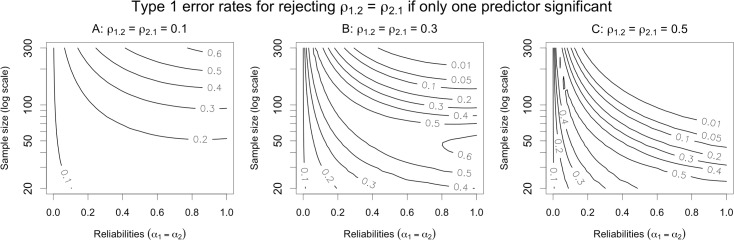
Social scientists often seek to demonstrate that a construct has incremental validity over and above other related constructs. However, these claims are typically supported by measurement-level models that fail to consider the effects of measurement (un)reliability. We use intuitive examples, Monte Carlo simulations, and a novel analytical framework to demonstrate that common strategies for establishing incremental construct validity using multiple regression analysis exhibit extremely high Type I error rates under parameter regimes common in many psychological domains. Counterintuitively, we find that error rates are highest--in some cases approaching 100%--when sample sizes are large and reliability is moderate. Our findings suggest that a potentially large proportion of incremental validity claims made in the literature are spurious. We present a web application (http://jakewestfall.org/ivy/) that readers can use to explore the statistical properties of these and other incremental validity arguments. We conclude by reviewing SEM-based statistical approaches that appropriately control the Type I error rate when attempting to establish incremental validity.
Overview
The claims and statistics of this paper haven’t been checked yet.
Free: it reads the open-access text and checks the first 5 claims that cite a source we can check. Create a free account to check every claim.
Integrity signals
Registry
Cites
Statistics
Figures
Verification
Claims the paper makes
The claims and statistics of this paper haven’t been checked yet.
Free: it reads the open-access text and checks the first 5 claims that cite a source we can check. Create a free account to check every claim.
Claims other papers make about this one
Each is checked against this paper’s own text: does it say what the citing paper says it does?
The source backs part of the claim, not all of it — or backs it for a different population, condition or comparison.
In the citing paper
“meaning that the association between loneliness and mental health outcomes in these studies is very likely to be inflated.16”
From Rapid Systematic Review: The Impact of Social Isolation and Loneliness on the Mental Health of Children and Adolescents in the Context of COVID-19 (2020) · cites this paper as [16]
Experimental — accuracy not yet measured
Self-check
Percentages, sums and reported differences re-computed from the paper’s own numbers.
The self-check needs the paper’s full text.
Citations
Cites
(1998) · Cited by 36,049
Structural Equations with Latent Variables.
Clogg, C. C., & Bollen, K. A. (1991) · Contemporary Sociology · doi:10.2307/2072165 · Cited by 17,442
Structural Equations with Latent Variables
Bollen, K. A. (1989) · Wiley series in probability and statistics · doi:10.1002/9781118619179 · Cited by 17,277
Construct validity in psychological tests.
Cronbach, L. J., & Meehl, P. E. (1955) · Psychological Bulletin · doi:10.1037/h0040957 · Cited by 11,195 · cited 2×
“After all, in any given analysis, there is a simple fact of the matter as to whether or not the unique contribution of one or more variables in a regression is statistically significant when controlling for other variables; what room is there for inferential error? Trouble arises, however, when researchers behave as i…”
BackgroundTHE BIG FIVE PERSONALITY DIMENSIONS AND JOB PERFORMANCE: A META‐ANALYSIS
BARRICK, M. R., & MOUNT, M. K. (1991) · Personnel Psychology · doi:10.1111/j.1744-6570.1991.tb00688.x · Cited by 8,689
Handbook of Personality: Theory and Research
Krueger, R. F., & Johnson, W. (2008) · Cited by 7,884
Implicit social cognition: Attitudes, self-esteem, and stereotypes
Greenwald, A. G., & Banaji, M. R. (1995) · Psychological Review · doi:10.1037/0033-295x.102.1.4 · Cited by 6,682
Handbook of Personality : Theory and Research
Pervin, L. A. (1992) · Cited by 4,543
Understanding and using the Implicit Association Test: III. Meta-analysis of predictive validity.
Greenwald, A. G., Poehlman, T. A., Uhlmann, E. L., & Banaji, M. R. (2009) · Journal of Personality and Social Psychology · doi:10.1037/a0015575 · Cited by 3,257
The New Statistics: Why and How
Cumming, G. (2014) · Psychological Science · doi:10.1177/0956797613504966 · Cited by 3,200 · cited 1×
“For example, suppose one takes the view that the null hypothesis is almost never exactly true, and that researchers should instead focus on parameter estimation [34,35].”
Background
Research works printed but not linked: 1
- Goldberg LR. The Eugene-Springfield community sample: Information available from the research participants. ORI Tech Rep. 2008; 45(1).
Cited by
Items 401–500 of 545
Aljarameez, F., Baumberger-Henry, M. L., Spurlock, D. R., & Kim, N. (2021) · Nursing & Primary Care · doi:10.33425/2639-9474.1169 · Cited by 4
“In nursing practice, in contrast to the findings of O’Brien (2010), psychological empowerment was found to have a mediating role between structural empowerment and burnout [29].”
BackgroundResultKirkegaard, E. O. W. (2019) · Mankind Quarterly · doi:10.46469/mq.2019.59.3.2 · Cited by 3
Exceptional Canadian contributions to research on cognitive vulnerability to depression.
Dozois, D. J. A., & Hayden, E. P. (2022) · Canadian Journal of Behavioural Science/Revue canadienne des sciences du comportement · doi:10.1037/cbs0000301 · Cited by 4
Wang, X., Gricius, M., & Zhang, W. (2023) · Criminal Justice and Behavior · doi:10.1177/00938548231180632 · Cited by 2
Armstrong, T., Kelly, S., Beard, C., Rifkin, L. S., & Björgvinsson, Þ. (2017) · Personality and Individual Differences · doi:10.1016/j.paid.2017.06.025 · Cited by 3
Bahník, Š., & Vranka, M. A. (2016) · OSF Preprints (OSF Preprints) · doi:10.31219/osf.io/nh88v · Cited by 2
King, K. M., & Jackson, K. M. (2019) · Addictive Behaviors · doi:10.1016/j.addbeh.2019.05.003 · Cited by 5
WorseThanMeasurementErrorPreprint
Rhemtulla, M., van Bork, R., & Borsboom, D. (2018) · OSF Preprints (OSF Preprints) · doi:10.31219/osf.io/42s8b · Cited by 2
Individual differences in musical training and executive functions: A latent variable approachPreprint
Okada, B. M., & Slevc, L. R. (2018) · PsyArXiv (OSF Preprints) · doi:10.31234/osf.io/ymn5c · Cited by 2
França, T. F. A., Cogo‐Moreira, H., & Pompéia, S. (2022) · PsyArXiv (OSF Preprints) · doi:10.31234/osf.io/nw26z · Cited by 4
Langton, C. M., Sheinin, G. D. B., & Worling, J. R. (2022) · Wiley eBooks · doi:10.1002/9781119166504.ch4 · Cited by 2
Crone, D. L., Shim, Y., Cotter, K. N., Tay, L., & Pawelski, J. O. (2022) · doi:10.31234/osf.io/vhq5m · Cited by 2
Rmus, M., He, M., Baribault, B., Walsh, E. G., Festa, E. K., Collins, A. G. E., & Nassar, M. R. (2022) · bioRxiv (Cold Spring Harbor Laboratory) · doi:10.1101/2022.11.28.518237 · Cited by 2
“muddying the interpretation of mediation analyses (Westfall and Yarkoni, 2016).”
BackgroundFinancial Mindfulness: A ScalePreprint
Garbinsky, E. N., Blanchard, S. J., & Kim, L. (2023) · SSRN Electronic Journal · doi:10.2139/ssrn.4564115 · Cited by 2
Assessing Diversity Dimensions in Environmental Psychology: Challenges and RecommendationsPreprint
Landmann, H., Kachel, S., Kommerscheidt, L., Lange, F., & Richter, I. (2023) · PsyArXiv (OSF Preprints) · doi:10.31234/osf.io/7cx4k · Cited by 3
Daily motivational underpinnings and outcomes of adolescent video gaming
Razum, J. (2023) · doi:10.17234/diss.2023.265864 · Cited by 4
Bambi: A simple interface for fitting Bayesian mixed effects modelsPreprint
Yarkoni, T., & Westfall, J. (2016) · OSF Preprints (OSF Preprints) · doi:10.31219/osf.io/rv7sn_v1 · Cited by 2
Self-citationMurtha, K. A., Dorfschmidt, L., Bethlehem, R. A. I., Kang, K., Vandekar, S., Alexander‐Bloch, A. F., Waller, R. E., & Seidlitz, J. (2025) · bioRxiv (Cold Spring Harbor Laboratory) · doi:10.1101/2025.05.23.655740 · Cited by 1
“This pattern of relationships among risk factors and outcomes creates a “third variable problem,” (Westfall & Yarkoni, 2016) in which the effect of a third variable (i.e., socioeconomic status) can obscure the relationship between hypothesized exposures (i.e., maturation of the executive function…”
De-Risking of Early-Stage Saline Aquifer CO2 Sequestration Projects Using a Data-Driven Approach
Pisarski, P., Chaikine, I., Romanov, A., Holst, R., & Hares, R. (2023) · SPE Canadian Energy Technology Conference and Exhibition (CET) · doi:10.2118/212804-ms · Cited by 1
Jones, A. M., & Roche, S. P. (2025) · Justice Quarterly · doi:10.1080/07418825.2025.2463414 · Cited by 2
“However, when confounders are measured with error, there will be “residual confounding” (Elwert & Winship, 2014, p. 43) even after controlling for them in a regression model (Pei et al., 2019; Westfall & Yarkoni, 2016).”
The AMP Reflects Gradual Differences in Attitude Extremity, Not Intensity: Initial Evidence
Roscher, O. M., & Neumann, R. (2025) · Social Psychology · doi:10.1027/1864-9335/a000576 · Cited by 1
Dyslexia Research and Replicability: Should We Be Worried?
Leung, A. Y., Logvinenko, T. I., & Schmalz, X. (2025) · Mind Brain and Education · doi:10.1111/mbe.70031 · Cited by 3
“Reliable measurement within individual studies will enable researchers to test if individual differences moderate the effect of interest (Westfall & Yarkoni, 2016).”
Chopik, W. J., Yang, H., & Lucas, R. E. (2025) · Research on Aging · doi:10.1177/01640275251408745 · Cited by 2
“As one simple example, the RI-CLPM assumes that there is no measurement error, but if that assumption is wrong, then estimates of lagged effects can be biased (Westfall & Yarkoni, 2016).”
Hansen, A., Heeralal, P. J. H., & Ndwandwe, N. D. (2026) · Discover Psychology · doi:10.1007/s44202-025-00541-2 · Cited by 2
“The Hansen J statistic (jp ≤ 0.05 in Models 7–12) confirms the validity of the instrument, while the R 2 values (0.141–0.415) indicate moderate explanatory power, which is typical in psychological studies [102].”
InfluentialEftedal, N. H., Kleppestø, T. H., Czajkowski, N. O., Eilertsen, E. M., Røysamb, E., Vassend, O. M., Sheehy-Skeffington, J. A., & Thomsen, L. (2026) · Personality and Social Psychology Bulletin · doi:10.1177/01461672251407779 · Cited by 2
dySEM: An R Package for Dyadic Structural Equation Modeling with Latent Variables
Sakaluk, J. K., & Camanto, O. J. (2026) · The Journal of Open Source Software · doi:10.21105/joss.10115 · Cited by 1
“…of these goals, while simultaneously mitigating the biasing (Cole & Preacher, 2014) and Type-I/false-positive boosting impact of measurement error (Westfall & Yarkoni, 2016) that is often present in survey data , and which is particularly pronounced under analytic conditions common to dyadic data…”
Confounders in epidemiological associations
Papageorgiou, S. N. (2019) · Journal of Orthodontics · doi:10.1177/1465312519869934 · Cited by 1
Bayesian estimation and inference
Edge, M. D. (2019) · Oxford University Press eBooks · doi:10.1093/oso/9780198827627.003.0012 · Cited by 1
Properties of random variables
Edge, M. D. (2019) · Oxford University Press eBooks · doi:10.1093/oso/9780198827627.003.0006 · Cited by 1
Sorjonen, K., Nilsonne, G., Melin, B., & Ingre, M. (2021) · BMC Research Notes · doi:10.1186/s13104-021-05545-4 · Cited by 1
Decision-Making in Psychological Assessment
Streiner, D. L. (2021) · Oxford University Press eBooks · doi:10.1093/oxfordhb/9780190092689.013.32 · Cited by 1
Latent Variable Structural Equation Modeling: A Flexible Tool for Establishing Validity and More
Altschul, D. (2021) · Journal of Methods and Measurement in the Social Sciences · doi:10.2458/jmmss.3065 · Cited by 2
“…the researchers to model traits and method effects as separate factors (e.g., Pohl & Steyer, 2010) as well as controlling for the systematic overestimation (Westfall & Yarkoni, 2016) and underestimation (Riemann et al., 1997) of correlations when measurement error is not effectively controlled for.”
BackgroundWill Home Quarantine Eventually Seize us in the Grip of Loneliness; a systematic Review Study
Firoozi, M., & irannejad, E. (2021) · Health Research Journal · doi:10.52547/hrjbaq.6.4.331 · Cited by 2
The harms of inequity are rarely overestimated: Comment on Marks and O'Connell (2021)
Debouwere, S. (2024) · Review of Education · doi:10.1002/rev3.3445 · Cited by 1
Su, T., & Ledermann, T. (2024) · Journal of Social and Personal Relationships · doi:10.1177/02654075241306125 · Cited by 1
“Firstly, using averaged scores for both RCI as a latent construct and other measures may lead to inaccurate estimates (Ledgerwood & Shrout, 2001; Wang & Eastwick, 2020; Westfall & Yarkoni, 2016).”
Are Danes’ Immigration Policy Preferences Based on Accurate Stereotypes?
Kirkegaard, E. O. W., Carl, N., & Bjerrekær, J. D. (2020) · Societies · doi:10.3390/soc10020029 · Cited by 1
“An analytical problem with examining mediation at the individual level is that our measures are not continuous, and may therefore be subject to measurement error related to the discretization [39,40].”
BackgroundSmart Fraction Theory: A Comprehensive Re-evaluation
Kirkegaard, E. O. W., & Carl, N. (2022) · Comparative Sociology · doi:10.1163/15691330-bja10063 · Cited by 3
Genomic ancestry, cognitive ability, and socioeconomic outcomesPreprint
Kirkegaard, E. O. W., Fuerst, J. G. R., & Meisenberg, G. (2017) · OSF Preprints (OSF Preprints) · doi:10.31219/osf.io/4an93 · Cited by 1
Implicit transgender attitudes independently predict gender and transgender-related beliefsPreprint
Conway, M. A., Axt, J. R., Westgate, E. C., & Buttrick, N. (2017) · Cited by 1
Brown, N. J. L., & Coyne, J. (2018) · PsyArXiv (OSF Preprints) · doi:10.31234/osf.io/dursw · Cited by 1
Brown, N. (2019) · University of Groningen research database (University of Groningen / Centre for Information Technology) · doi:10.33612/diss.99196913 · Cited by 2
From mother to Mother Nature: The role of interpersonal attachment in human–nature relations
Capaldi, C. A. (2020) · Carleton University's Institutional Repository (MacOdrum Library, Carleton University) · doi:10.22215/etd/2020-13953 · Cited by 1
“By doing this, one can have more confidence that personality is not able to completely explain the association between these constructs (but see Westfall & Yarkoni, 2016 for limitations with this statistical approach).”
BackgroundProbability and random variables
Edge, M. D. (2019) · Oxford University Press eBooks · doi:10.1093/oso/9780198827627.003.0005 · Cited by 2
Interpersonal Style and PTSD Symptoms in Female Victims of Dating ViolencePreprint
Bernard, N. K., Yalch, M. M., Lannert, B. K., & Levendosky, A. A. (2019) · PsyArXiv (OSF Preprints) · doi:10.31234/osf.io/puw48 · Cited by 2
Öberg, S. (2021) · SocArXiv (OSF Preprints) · doi:10.31235/osf.io/pkyue · Cited by 1
A Comparison of the Sensitivity of Four Indirect Evaluation Measures to Evaluative InformationPreprint
Bar‐Anan, Y., & Nosek, B. A. (2016) · OSF Preprints (OSF Preprints) · doi:10.31219/osf.io/p2akj · Cited by 5
França, T. F. A., Segura, I. A., Dias, N. M., Miranda, M. C., & Pompéia, S. (2022) · PsyArXiv (OSF Preprints) · doi:10.31234/osf.io/e2kjb · Cited by 2
Specific Within-Domain Cognitive Impairments Predict Depression Severity Six-Months After StrokePreprint
Kelleher, K., Demeyere, N., & Kusec, A. (2024) · medRxiv · doi:10.1101/2024.09.25.24314204 · Cited by 1
Dyslexia Research and Replicability: Should We Be Worried?Preprint
Logvinenko, T. I., Leung, A. Y., & Schmalz, X. (2025) · doi:10.35542/osf.io/qg9s4_v1 · Cited by 1
Kline, R. B. (2025) · Elsevier eBooks · doi:10.1016/b978-0-443-26629-4.00103-9 · Cited by 1
In-school arts education and academic achievement
Todhunter-Reid, A. (2017) · doi:10.7282/t3hh6ntt
James, A. N. (2017) · Illinois Digital Environment for Access to Learning and Scholarship (University of Illinois at Urbana-Champaign)
Iurino, K. (2018) · Scholars' Bank (University of Oregon)
Political protest in the Trump era
Careem, A. (2019) · doi:10.7282/t3-5qb7-cy66
Edge, M. D. (2019) · Oxford University Press eBooks · doi:10.1093/oso/9780198827627.003.0013
Properties of point estimators
Edge, M. D. (2019) · Oxford University Press eBooks · doi:10.1093/oso/9780198827627.003.0008
Edge, M. D. (2019) · Oxford University Press eBooks · doi:10.1093/oso/9780198827627.003.0004
Parametric estimation and inference
Edge, M. D. (2019) · Oxford University Press eBooks · doi:10.1093/oso/9780198827627.003.0011
R and exploratory data analysis
Edge, M. D. (2019) · Oxford University Press eBooks · doi:10.1093/oso/9780198827627.003.0003
Interval estimation and inference
Edge, M. D. (2019) · Oxford University Press eBooks · doi:10.1093/oso/9780198827627.003.0009
Semiparametric estimation and inference
Edge, M. D. (2019) · Oxford University Press eBooks · doi:10.1093/oso/9780198827627.003.0010
Dual Mechanisms of Cognitive Control: A Hierarchical Bayesian Approach to Test-Retest Reliability
Snijder, J.-P. (2021) · Scholarship - Claremont (Claremont Colleges) · doi:10.5642/cguetd/226
Jovičić, S. M. (2021) · African Journal of Urology · doi:10.1186/s12301-021-00239-6 · Cited by 3
Experimental Studies on Bargaining and Competitive Behavior
Montana, L. M. L. (2021) · Research Publications (Maastricht University) · doi:10.26481/dis.20210909ll
Thielmann, I., Rau, R., & Locke, K. D. (2022) · PsyArXiv (OSF Preprints) · doi:10.31234/osf.io/z78na
Edge, M. D. (2019) · Oxford University Press eBooks · doi:10.1093/oso/9780198827627.003.0002
Edge, M. D. (2019) · Oxford University Press eBooks · doi:10.1093/oso/9780198827627.003.0001
Decision letter for "Microstructural White Matter Abnormalities in Lesch‐Nyhan Disease"
(2021) · Publons reviews and discussion · doi:10.1111/ejn.15512/v3/decision1
Edge, M. D. (2019) · Oxford University Press eBooks · doi:10.1093/oso/9780198827627.003.0007
Support for Economic Inequality Scale: Development and AdjudicationPreprint
Wiwad, D., Mercier, B., Shariff, A., Aknin, L. B., & Robinson, A. R. (2018) · PsyArXiv (OSF Preprints) · doi:10.31234/osf.io/58e76 · Cited by 1
Family Income and School Readiness Skills
Portnow, S. (2017) · doi:10.18130/v3gw6w
Incremental validity of decision-making styles in predicting work-related outcomesPreprint
Erceg, N., & Galić, Z. (2022) · doi:10.31234/osf.io/nqdft
Edge, M. D. (2019) · Oxford University Press eBooks · doi:10.1093/oso/9780198827627.005.0002
Table of mathematical notation
(2019) · Oxford University Press eBooks · doi:10.1093/oso/9780198827627.002.0007
(2019) · Oxford University Press eBooks · doi:10.1093/oso/9780198827627.002.0004
Edge, M. D. (2019) · Oxford University Press eBooks · doi:10.1093/oso/9780198827627.005.0001
Edge, M. D. (2019) · Oxford University Press eBooks · doi:10.1093/oso/9780198827627.005.0003
(2019) · Oxford University Press eBooks · doi:10.1093/oso/9780198827627.002.0008
(2019) · Oxford University Press eBooks · doi:10.1093/oso/9780198827627.002.0003
Bignardi, G., Mareva, S., & Astle, D. E. (2022) · doi:10.31219/osf.io/kqtsd
Durkee, P. K. (2023) · SSRN Electronic Journal · doi:10.2139/ssrn.4482488
Decision-making skills and styles as predictors of managerial performance
Erceg, N. (2023) · doi:10.17234/diss.2023.222950 · Cited by 2
A Process-Oriented Analysis of Speech and Silent Intervals in Responses to Serial Naming TasksPreprint
Protopapas, A., Katopodi, K., Altani, A., Kolotoura, I., Sagris, D., Ziaka, L., & Georgiou, G. K. (2023) · doi:10.31234/osf.io/xe65t
Measuring Work Demands and Resources of Digitalisation: The ICT Resources and Stressors ScalePreprint
Cianci, J., Weibel, D., & Elfering, A. (2023) · PsyArXiv (OSF Preprints) · doi:10.31234/osf.io/6j8ak
The harms of inequity are rarely overestimated: Comment on Marks & O’Connell 2021Preprint
Debrouwere, S. (2023) · doi:10.31234/osf.io/mk5by
Examining the role of expectations in outsourcing success utilizing the hierarchy of effects model
Wolverton, C. C. (2024) · Journal of Systems and Information Technology · doi:10.1108/jsit-12-2023-0344 · Cited by 2
Zoh, R. S., Thomas, D. M., Tekwe, C. D., Yu, X. D., Vorland, C. J., Dhurandhar, N. V., Klurfeld, D. M., & Allison, D. B. (2024) · F1000Research · doi:10.12688/f1000research.152466.1 · Cited by 2
Murphy, S. L. (2024) · PsyArXiv (OSF Preprints) · doi:10.31234/osf.io/tw3pm
Kiel, L., Lind, M., Nissen, A. T., Bleidorn, W., & Hopwood, C. J. (2024) · Journal of Research in Personality · doi:10.1016/j.jrp.2024.104546 · Cited by 2
“To address measurement reliability, a latent variable approach was applied using structural equation modeling for the regression analyses (Westfall & Yarkoni, 2016).”
Regression analysis for cardiothoracic surgeons: part 5—predicting risks and outcomes in surgery
Ahmed, H. S. (2025) · Indian Journal of Thoracic and Cardiovascular Surgery · doi:10.1007/s12055-025-01901-2
“By using multiple predictors, researchers can control for confounding variables, isolating the effect of each individual predictor on the outcome variable [17].”
Metadata
- Authors
- Westfall, J., & Yarkoni, T.
- Affiliations
- The University of Texas at Austin (US)
- Corresponding author
- Westfall, Jacob
- Venue
- PLOS ONE
- Publisher
- Public Library of Science (PLoS)
- Published
- 2016-03-31
- Volume
- 11
- Issue
- 3
- Pages
- e0152719
- ISSN
- 1932-6203 (ISSN-L)
- PMC
- PMC4816570
- OpenAlex
- W2333692357
- Semantic Scholar
- 0a1e930a87c0f634549c6d0ed64fb6b7f2d07ca2
- Cited by
- 547
- References
- 57
- Citations by year
- 2026: 37 · 2025: 44 · 2024: 43 · 2023: 51 · 2022: 39 · 2021: 67 · 2020: 60 · 2019: 72 · 2018: 60 · 2017: 57 · 2016: 16
- FWCI
- 74.91
- Type
- journal article
- Language
- en
- Open access
- gold
- doi.org
- Licence
- Locations
- PLoS ONE (publishedVersion, cc-by)
- Europe PMC (PubMed Central) (publishedVersion, cc-by)
- PubMed Central (publishedVersion, cc-by)
- PubMed (publishedVersion)
- RePEc: Research Papers in Economics (submittedVersion)
- DOAJ (DOAJ: Directory of Open Access Journals) (submittedVersion, cc-by-sa)
- Funders
- National Institute of Mental Health (R01MH096906)
- Topics
- Social Sciences › Decision Sciences › Management Science and Operations Research › Psychometric Methodologies and Testing
- Physical Sciences › Mathematics › Statistics and Probability › Statistical Methods and Bayesian Inference
- Social Sciences › Decision Sciences › Statistics, Probability and Uncertainty › Meta-analysis and systematic reviews
- Keywords
- type I error rate, measurement error, multiple linear regression, structural equation modeling, statistical power
- MeSH terms
- Humans, Monte Carlo Method, Probability, Psychometrics, Social Sciences, Reproducibility of Results, Models, Statistical
About these checks
Registry, retraction, Cites and statistics results are computed, not judged, with one exception: a printed reference that no index lists is read once by a model before it counts as a citation error. Claims are extracted by a model and kept only when their quote appears verbatim in the text; each cited source is then checked, with a model’s help, for whether it says what the claim relies on. Those verdicts can be wrong — read the claim’s quote and the cited source before relying on one.
Statistics and arithmetic are recomputed, not judged.
Confidence bands are shown only for fields calibrated on our annotated test set. None is calibrated yet, so no band is shown.
What counts as a claim ›How we measure confidence ›How we check this ›
Are you an author, or do you see a problem with this page? Request a review
Data sources
Bibliographic data: Semantic Scholar, OpenAlex, Crossref.
Contains information from the Semantic Scholar Academic Graph Datasets, made available under the ODC Attribution License (ODC-BY 1.0).
Semantic Scholar’s data is described in: Kinney, R., et al. (2023). The Semantic Scholar Open Data Platform. arXiv:2301.10140.
