

Statistically Controlling for Confounding Constructs Is Harder than You Think
Open accessThe DOI matches its Crossref record; 58 of the 58 references it cites were found in a registry or an index.
Abstract
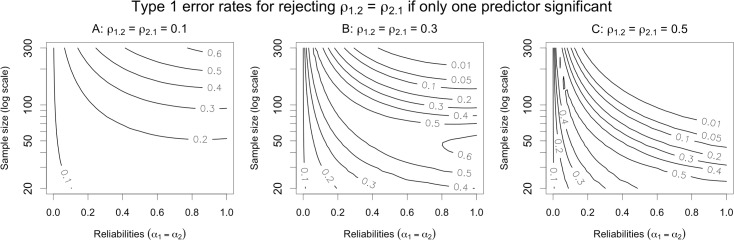
Social scientists often seek to demonstrate that a construct has incremental validity over and above other related constructs. However, these claims are typically supported by measurement-level models that fail to consider the effects of measurement (un)reliability. We use intuitive examples, Monte Carlo simulations, and a novel analytical framework to demonstrate that common strategies for establishing incremental construct validity using multiple regression analysis exhibit extremely high Type I error rates under parameter regimes common in many psychological domains. Counterintuitively, we find that error rates are highest--in some cases approaching 100%--when sample sizes are large and reliability is moderate. Our findings suggest that a potentially large proportion of incremental validity claims made in the literature are spurious. We present a web application (http://jakewestfall.org/ivy/) that readers can use to explore the statistical properties of these and other incremental validity arguments. We conclude by reviewing SEM-based statistical approaches that appropriately control the Type I error rate when attempting to establish incremental validity.
Overview
The claims and statistics of this paper haven’t been checked yet.
Free: it reads the open-access text and checks the first 5 claims that cite a source we can check. Create a free account to check every claim.
Integrity signals
Registry
Cites
Statistics
Figures
Verification
Claims the paper makes
The claims and statistics of this paper haven’t been checked yet.
Free: it reads the open-access text and checks the first 5 claims that cite a source we can check. Create a free account to check every claim.
Claims other papers make about this one
Each is checked against this paper’s own text: does it say what the citing paper says it does?
The source backs part of the claim, not all of it — or backs it for a different population, condition or comparison.
In the citing paper
“meaning that the association between loneliness and mental health outcomes in these studies is very likely to be inflated.16”
From Rapid Systematic Review: The Impact of Social Isolation and Loneliness on the Mental Health of Children and Adolescents in the Context of COVID-19 (2020) · cites this paper as [16]
Experimental — accuracy not yet measured
Self-check
Percentages, sums and reported differences re-computed from the paper’s own numbers.
The self-check needs the paper’s full text.
Citations
Cites
(1998) · Cited by 36,049
Structural Equations with Latent Variables.
Clogg, C. C., & Bollen, K. A. (1991) · Contemporary Sociology · doi:10.2307/2072165 · Cited by 17,442
Structural Equations with Latent Variables
Bollen, K. A. (1989) · Wiley series in probability and statistics · doi:10.1002/9781118619179 · Cited by 17,277
Construct validity in psychological tests.
Cronbach, L. J., & Meehl, P. E. (1955) · Psychological Bulletin · doi:10.1037/h0040957 · Cited by 11,195 · cited 2×
“After all, in any given analysis, there is a simple fact of the matter as to whether or not the unique contribution of one or more variables in a regression is statistically significant when controlling for other variables; what room is there for inferential error? Trouble arises, however, when researchers behave as i…”
BackgroundTHE BIG FIVE PERSONALITY DIMENSIONS AND JOB PERFORMANCE: A META‐ANALYSIS
BARRICK, M. R., & MOUNT, M. K. (1991) · Personnel Psychology · doi:10.1111/j.1744-6570.1991.tb00688.x · Cited by 8,689
Handbook of Personality: Theory and Research
Krueger, R. F., & Johnson, W. (2008) · Cited by 7,884
Implicit social cognition: Attitudes, self-esteem, and stereotypes
Greenwald, A. G., & Banaji, M. R. (1995) · Psychological Review · doi:10.1037/0033-295x.102.1.4 · Cited by 6,682
Handbook of Personality : Theory and Research
Pervin, L. A. (1992) · Cited by 4,543
Understanding and using the Implicit Association Test: III. Meta-analysis of predictive validity.
Greenwald, A. G., Poehlman, T. A., Uhlmann, E. L., & Banaji, M. R. (2009) · Journal of Personality and Social Psychology · doi:10.1037/a0015575 · Cited by 3,257
The New Statistics: Why and How
Cumming, G. (2014) · Psychological Science · doi:10.1177/0956797613504966 · Cited by 3,200 · cited 1×
“For example, suppose one takes the view that the null hypothesis is almost never exactly true, and that researchers should instead focus on parameter estimation [34,35].”
Background(1999) · Medical Entomology and Zoology · Cited by 3,151
Personality Psychology in Europe
Vera-Bermudez, J., Raad, D. B., de Vries, J., García, A. M. P., Sanchez-Elvita, A., & Heck, G. V. (1997) · University of Groningen research database (University of Groningen / Centre for Information Technology) · Cited by 2,462
Roberts, B. W., Kuncel, N. R., Shiner, R., Caspi, A., & Goldberg, L. R. (2007) · Perspectives on Psychological Science · doi:10.1111/j.1745-6916.2007.00047.x · Cited by 2,361
Psychometric Properties of the HEXACO Personality Inventory
Lee, K., & Ashton, M. C. (2004) · Multivariate Behavioral Research · doi:10.1207/s15327906mbr3902_8 · Cited by 1,961 · cited 1×
“Personality researchers have theorized a number of specific relationships between the six HEXACO factors and the Big Five factors [44].”
Background(2003) · doi:10.1146/annurev.psych.54.101601.145225 · Cited by 1,829
Convergent, discriminant, and incremental validity of competing measures of emotional intelligence
Brackett, M. A., & Mayer, J. D. (2003) · Personality and Social Psychology Bulletin · doi:10.1177/0146167203254596 · Cited by 1,351 · cited 1×
“Organizational psychologists advocate the use of measures such as Emotional Intelligence on the grounds that they incrementally predict job performance when controlling for standard personality and cognitive ability measures [14,15].”
BackgroundNeural Predictors of Purchases
Knutson, B., Rick, S., Wimmer, G. E., Prelec, D., & Loewenstein, G. (2007) · Neuron · doi:10.1016/j.neuron.2006.11.010 · Cited by 1,171 · cited 1×
“, product purchases or smoking cessation) above and beyond relevant self-report variables [19,20].”
BackgroundHandbook of implicit social cognition : measurement, theory,and applications
Gawronski, B., & Payne, B. K. (2010) · Cited by 1,048
Ashton, M. C., Lee, K., Perugini, M., Szarota, P., de Vries, R. E., Di Blas, L., Boies, K., & De Raad, B. (2004) · Journal of Personality and Social Psychology · doi:10.1037/0022-3514.86.2.356 · Cited by 1,044 · cited 1×
“More recently, however, some researchers have advanced a competing six-factor “HEXACO”model, which includes dimensions of Honesty-Humility, Emotionality, eXtraversion, Agreeableness, Conscientiousness, and Openness to experience [43].”
BackgroundBig Five personality predictors of post-secondary academic performance
O’Connor, M. C., & Paunonen, S. V. (2007) · Personality and Individual Differences · doi:10.1016/j.paid.2007.03.017 · Cited by 1,029
Red and Processed Meat and Colorectal Cancer Incidence: Meta-Analysis of Prospective Studies
Chan, D. S. M., Lau, R., Aune, D., Vieira, R., Greenwood, D. C., Kampman, E., & Norat, T. (2011) · PLoS ONE · doi:10.1371/journal.pone.0020456 · Cited by 903
Hein, G., Silani, G., Preuschoff, K., Batson, C. D., & Singer, T. (2010) · Neuron · doi:10.1016/j.neuron.2010.09.003 · Cited by 821 · cited 1×
“And in the neuroimaging literature, different brain regions or networks are often ascribed dissociable cognitive functions on the grounds that they each contribute unique variance to behavioral outcomes [31,32].”
BackgroundThe Impact of Residual and Unmeasured Confounding in Epidemiologic Studies: A Simulation Study
Fewell, Z., Davey Smith, G., & Sterne, J. A. C. (2007) · American Journal of Epidemiology · doi:10.1093/aje/kwm165 · Cited by 734 · cited 1×
“Of course, this general problem is not novel, and has been discussed in a number of literatures [8–10]—most extensively, under the heading of “residual confounding” in epidemiology [3,5].”
BackgroundEffect of measurement error on epidemiological studies of environmental and occupational exposures
Armstrong, B. G. (1998) · Occupational and Environmental Medicine · doi:10.1136/oem.55.10.651 · Cited by 682 · cited 1×
“Of course, this general problem is not novel, and has been discussed in a number of literatures [8–10]—most extensively, under the heading of “residual confounding” in epidemiology [3,5].”
BackgroundPredicting depressive symptoms with a new measure of shame: The Experience of Shame Scale
Andrews, B., Qian, M., & Valentine, J. D. (2002) · British Journal of Clinical Psychology · doi:10.1348/014466502163778 · Cited by 644 · cited 1×
“” For example, psychologists studying the relationship between feelings of shame and symptoms of depression have advanced a new measure of the construct of shame—the Experience of Shame Scale (ESS) —and argued for its utility in part by demonstrating that, when regressing a depressive symptom index on both ESS scores…”
ResultMeat consumption and risk of colorectal cancer: A meta‐analysis of prospective studies
Larsson, S. C., & Wolk, A. (2006) · International Journal of Cancer · doi:10.1002/ijc.22170 · Cited by 644 · cited 1×
“For example, epidemiologists have concluded that eating processed meat significantly increases colorectal cancer risk, on the basis of prospective studies that consistently find a positive association between the two variables when controlling for a host of confounding variables [12,13].”
Backgroundvan der Zee, K. I., & van Oudenhoven, J. P. (2000) · European Journal of Personality · doi:10.1002/1099-0984(200007/08)14:4<291::aid-per377>3.0.co;2-6 · Cited by 600
Hunsley, J., & Meyer, G. J. (2003) · Psychological Assessment · doi:10.1037/1040-3590.15.4.446 · Cited by 561 · cited 1×
“And because measured variables are typically viewed as proxies for latent constructs of substantive interest—for example, two cognitive ability measures might be taken to index spatial versus verbal ability—it is natural to generalize the operational conclusion to the latent variable level; that is, to conclude that t…”
BackgroundErrors of Measurement in Statistics
Cochran, W. G. (1968) · Technometrics · doi:10.1080/00401706.1968.10490621 · Cited by 479
On the criterion and incremental validity of trait emotional intelligence
Petrides, K. V., Pérez-González, J. C., & Furnham, A. (2007) · Cognition and Emotion · doi:10.1080/02699930601038912 · Cited by 471 · cited 1×
“Organizational psychologists advocate the use of measures such as Emotional Intelligence on the grounds that they incrementally predict job performance when controlling for standard personality and cognitive ability measures [14,15].”
BackgroundIncremental Validity : a Recommendation
Sechrest, L. (1963) · Educational and Psychological Measurement · doi:10.1177/001316446302300113 · Cited by 345 · cited 1×
“And because measured variables are typically viewed as proxies for latent constructs of substantive interest—for example, two cognitive ability measures might be taken to index spatial versus verbal ability—it is natural to generalize the operational conclusion to the latent variable level; that is, to conclude that t…”
BackgroundWhat's the Matter with What's the Matter with Kansas?
Bartels, L. M. (2006) · Quarterly Journal of Political Science · doi:10.1561/100.00000010 · Cited by 326
LISREL Issues, Debates and Strategies
Williams, R., & Hayduk, L. A. (1997) · Contemporary Sociology · doi:10.2307/2654075 · Cited by 321
Measurement error and latent variables in econometrics
Wansbeek, T. (2000) · Cited by 302
Risk Factors, Confounding, and the Illusion of Statistical Control
Christenfeld, N. J. S., Sloan, R. P., Carroll, D., & Greenland, S. (2004) · Psychosomatic Medicine · doi:10.1097/01.psy.0000140008.70959.41 · Cited by 260
Implicit and explicit prejudice in the 2008 American presidential election
Payne, B. K., Krosnick, J. A., Pasek, J., Lelkes, Y., Akhtar, O., & Tompson, T. (2010) · Journal of Experimental Social Psychology · doi:10.1016/j.jesp.2009.11.001 · Cited by 257
Neural activity during health messaging predicts reductions in smoking above and beyond self-report.
Falk, E. B., Berkman, E. T., Whalen, D., & Lieberman, M. D. (2011) · Health Psychology · doi:10.1037/a0022259 · Cited by 255 · cited 1×
“, product purchases or smoking cessation) above and beyond relevant self-report variables [19,20].”
BackgroundLISREL Issues, Debates and Strategies
Hayduk, L. (1996) · Johns Hopkins University Press eBooks · doi:10.56021/9780801853364 · Cited by 251
Rich State, Poor State, Red State, Blue State: What’s the Matter with Connecticut?
Gelman, A., Shor, B., Bafumi, J., & Park, D. (2008) · Quarterly Journal of Political Science · doi:10.1561/100.00006026 · Cited by 237
Grucza, R. A., & Goldberg, L. R. (2007) · Journal of Personality Assessment · doi:10.1080/00223890701468568 · Cited by 228 · cited 1×
“chewing gum, playing chess, or yelling at a stranger (for details, see [49]).”
BackgroundImplicit Race Attitudes Predicted Vote in the 2008 U.S. Presidential Election
Greenwald, A. G., Smith, C. T., Sriram, N., Bar‐Anan, Y., & Nosek, B. A. (2009) · Analyses of Social Issues and Public Policy · doi:10.1111/j.1530-2415.2009.01195.x · Cited by 220
Ashton, M. C., Lee, K., & Son, C. (2000) · European Journal of Personality · doi:10.1002/1099-0984(200007/08)14:4<359::aid-per382>3.0.co;2-y · Cited by 206 · cited 8×
“The Emotionality and Agreeableness factors, on the other hand, are thought to be similar, but not identical, to the Big Five’s Neuroticism and Agreeableness factors.”
BackgroundInfluentialA new trait on the market: Honesty–Humility as a unique predictor of job performance ratings
Johnson, M. K., Rowatt, W. C., & Petrini, L. (2011) · Personality and Individual Differences · doi:10.1016/j.paid.2011.01.011 · Cited by 199
Salomons, T. V., Johnstone, T., Backonja, M.-M., Shackman, A. J., & Davidson, R. J. (2007) · Journal of Cognitive Neuroscience · doi:10.1162/jocn.2007.19.6.993 · Cited by 195 · cited 1×
“And in the neuroimaging literature, different brain regions or networks are often ascribed dissociable cognitive functions on the grounds that they each contribute unique variance to behavioral outcomes [31,32].”
BackgroundSchroeder, M. L., Wormworth, J. A., & Livesley, W. J. (1992) · Psychological Assessment · doi:10.1037//1040-3590.4.1.47 · Cited by 192
Chirumbolo, A., & Leone, L. (2010) · Personality and Individual Differences · doi:10.1016/j.paid.2010.03.004 · Cited by 176
Income, Economic Voting, and Long-Term Political Change in the U.S., 1952- 1996
Brooks, C., & Brady, D. (1999) · Social Forces · doi:10.1093/sf/77.4.1339 · Cited by 88
Control of spurious association and the reliability of the controlled variable.
Kahneman, D. J. (1965) · Psychological Bulletin · doi:10.1037/h0022529 · Cited by 84
McMahon, S. D., Rose, D. S., & Parks, M. (2004) · The Journal of Experimental Education · doi:10.3200/jexe.71.1.41-52 · Cited by 73 · cited 1×
“In the individual differences literature, arguments for the existence of “multiple intelligences” often draw support from demonstrations that ability measures thought to tap different cognitive abilities make independent contributions to scholastic performance or other outcomes [29,30].”
BackgroundUsing analysis of covariance (ANCOVA) with fallible covariates.
Culpepper, S. A., & Aguinis, H. (2011) · Psychological Methods · doi:10.1037/a0023355 · Cited by 65
The earth is round (p < .05): Rejoinder.
Cohen, J. (1995) · American Psychologist · doi:10.1037/0003-066x.50.12.1103 · Cited by 59 · cited 1×
“For example, suppose one takes the view that the null hypothesis is almost never exactly true, and that researchers should instead focus on parameter estimation [34,35].”
BackgroundAghababaei, N. (2012) · Personality and Individual Differences · doi:10.1016/j.paid.2012.07.005 · Cited by 56
Shear, B. R., & Zumbo, B. D. (2013) · Educational and Psychological Measurement · doi:10.1177/0013164413487738 · Cited by 55 · cited 1×
“After all, in any given analysis, there is a simple fact of the matter as to whether or not the unique contribution of one or more variables in a regression is statistically significant when controlling for other variables; what room is there for inferential error? Trouble arises, however, when researchers behave as i…”
BackgroundBrunner, J., & Austin, P. C. (2009) · Canadian Journal of Statistics · doi:10.1002/cjs.10004 · Cited by 55
The Validity of a New, Self-report Measure of Multiple Intelligence
Furnham, A. F. (2009) · Current Psychology · doi:10.1007/s12144-009-9064-z · Cited by 48 · cited 1×
“In the individual differences literature, arguments for the existence of “multiple intelligences” often draw support from demonstrations that ability measures thought to tap different cognitive abilities make independent contributions to scholastic performance or other outcomes [29,30].”
BackgroundZinbarg, R. E., Suzuki, S., Uliaszek, A. A., & Lewis, A. R. (2010) · Journal of Abnormal Psychology · doi:10.1037/a0017552 · Cited by 45
Income, Economic Voting, and Long-Term Political Change in the U.S., 1952- 1996
Brooks, C., & Brady, D. (1999) · Social Forces · doi:10.2307/3005879 · Cited by 38
Rich State, Poor State, Red State, Blue State: What's the Matter with Connecticut?Preprint
Gelman, A., Shor, B., Bafumi, J., & Park, D. S. (2007) · SSRN Electronic Journal · doi:10.2139/ssrn.1010426 · Cited by 32
Research works printed but not linked: 1
- Goldberg LR. The Eugene-Springfield community sample: Information available from the research participants. ORI Tech Rep. 2008; 45(1).
Cited by
Advanced Bayesian Multilevel Modeling with the R Package brms
Bürkner, P.-C. (2018) · The R Journal · doi:10.32614/rj-2018-017 · Cited by 3,015
Loades, M. E., Chatburn, E., Higson-Sweeney, N., Reynolds, S., Shafran, R., Brigden, A., Linney, C., McManus, M. N., Borwick, C., & Crawley, E. (2020) · Journal of the American Academy of Child & Adolescent Psychiatry · doi:10.1016/j.jaac.2020.05.009 · Cited by 2,906
“In cross-sectional studies, likely confounders (eg, adversity, socioeconomic status [SES]) were rarely controlled for, meaning that the association between loneliness and mental health outcomes in these studies is very likely to be inflated.(16) Four longitudinal studies used multi-informant approaches, including self…”
BackgroundChoosing Prediction Over Explanation in Psychology: Lessons From Machine Learning
Yarkoni, T., & Westfall, J. (2017) · Perspectives on Psychological Science · doi:10.1177/1745691617693393 · Cited by 1,916
“For example, we and others have demonstrated that under typical measurement conditions, statistical significance patterns observed in fitted regression models are often very unstable and can produce highly misleading conclusions (Shear & Zumbo, 2013; Westfall & Yarkoni, 2016).”
BackgroundSelf-citationThinking Clearly About Correlations and Causation: Graphical Causal Models for Observational Data
Rohrer, J. M. (2018) · Advances in Methods and Practices in Psychological Science · doi:10.1177/2515245917745629 · Cited by 1,002
“Westfall and Yarkoni (2016) assessed how the false positive rate for an effect is affected by measurement error of covariates that are being controlled for.”
BackgroundInfluentialShort and extra-short forms of the Big Five Inventory–2: The BFI-2-S and BFI-2-XS
Soto, C. J., & John, O. P. (2017) · Journal of Research in Personality · doi:10.1016/j.jrp.2017.02.004 · Cited by 927
Metadata
- Authors
- Westfall, J., & Yarkoni, T.
- Affiliations
- The University of Texas at Austin (US)
- Corresponding author
- Westfall, Jacob
- Venue
- PLOS ONE
- Publisher
- Public Library of Science (PLoS)
- Published
- 2016-03-31
- Volume
- 11
- Issue
- 3
- Pages
- e0152719
- ISSN
- 1932-6203 (ISSN-L)
- PMC
- PMC4816570
- OpenAlex
- W2333692357
- Cited by
- 547
- References
- 57
- Citations by year
- 2026: 37 · 2025: 44 · 2024: 43 · 2023: 51 · 2022: 39 · 2021: 67 · 2020: 60 · 2019: 72 · 2018: 60 · 2017: 57 · 2016: 16
- FWCI
- 74.91
- Type
- journal article
- Language
- en
- Open access
- gold
- doi.org
- Licence
- Locations
- PLoS ONE (publishedVersion, cc-by)
- Europe PMC (PubMed Central) (publishedVersion, cc-by)
- PubMed Central (publishedVersion, cc-by)
- PubMed (publishedVersion)
- RePEc: Research Papers in Economics (submittedVersion)
- DOAJ (DOAJ: Directory of Open Access Journals) (submittedVersion, cc-by-sa)
- Funders
- National Institute of Mental Health (R01MH096906)
- Topics
- Social Sciences › Decision Sciences › Management Science and Operations Research › Psychometric Methodologies and Testing
- Physical Sciences › Mathematics › Statistics and Probability › Statistical Methods and Bayesian Inference
- Social Sciences › Decision Sciences › Statistics, Probability and Uncertainty › Meta-analysis and systematic reviews
- Keywords
- type I error rate, measurement error, multiple linear regression, structural equation modeling, statistical power
- MeSH terms
- Humans, Monte Carlo Method, Probability, Psychometrics, Social Sciences, Reproducibility of Results, Models, Statistical
About these checks
Registry, retraction, Cites and statistics results are computed, not judged, with one exception: a printed reference that no index lists is read once by a model before it counts as a citation error. Claims are extracted by a model and kept only when their quote appears verbatim in the text; each cited source is then checked, with a model’s help, for whether it says what the claim relies on. Those verdicts can be wrong — read the claim’s quote and the cited source before relying on one.
Statistics and arithmetic are recomputed, not judged.
Confidence bands are shown only for fields calibrated on our annotated test set. None is calibrated yet, so no band is shown.
What counts as a claim ›How we measure confidence ›How we check this ›
Are you an author, or do you see a problem with this page? Request a review
Data sources
Bibliographic data: Semantic Scholar, OpenAlex, Crossref.
Contains information from the Semantic Scholar Academic Graph Datasets, made available under the ODC Attribution License (ODC-BY 1.0).
Semantic Scholar’s data is described in: Kinney, R., et al. (2023). The Semantic Scholar Open Data Platform. arXiv:2301.10140.
