

The DOI matches its Crossref record; 89 of the 93 references it cites were found in a registry or an index; none of the 54 sources its claims cite is checked for support yet.
A Systematic Review and Meta-Analysis of Multiple Airborne Pollutants and Autism Spectrum Disorder
Open accessAbstract
BACKGROUND: Exposure to ambient air pollution is widespread and may be detrimental to human brain development and a potential risk factor for Autism Spectrum Disorder (ASD). We conducted a systematic review of the human evidence on the relationship between ASD and exposure to all airborne pollutants, including particulate matter air pollutants and others (e.g. pesticides and metals). OBJECTIVE: To answer the question: "is developmental exposure to air pollution associated with ASD?" METHODS: We conducted a comprehensive search of the literature, identified relevant studies using inclusion/exclusion criteria pre-specified in our protocol (registered in PROSPERO, CRD # 42015017890), evaluated the potential risk of bias for each included study and identified an appropriate subset of studies to combine in a meta-analysis. We then rated the overall quality and strength of the evidence collectively across all air pollutants. RESULTS: Of 1,158 total references identified, 23 human studies met our inclusion criteria (17 case-control, 4 ecological, 2 cohort). Risk of bias was generally low across studies for most domains; study limitations were related to potential confounding and accuracy of exposure assessment methods. We rated the quality of the body of evidence across all air pollutants as "moderate." From our meta-analysis, we found statistically significant summary odds ratios (ORs) of 1.07 (95% CI: 1.06, 1.08) per 10-μg/m3 increase in PM10 exposure (n = 6 studies) and 2.32 (95% CI: 2.15, 2.51) per 10-μg/m3 increase in PM2.5 exposure (n = 3 studies). For pollutants not included in a meta-analysis, we collectively evaluated evidence from each study in rating the strength and quality of overall evidence considering factors such as inconsistency, imprecision, and evidence of dose-response. All included studies generally showed increased risk of ASD with increasing exposure to air pollution, although not consistently across all chemical components. CONCLUSION: After considering strengths and limitations of the body of research, we concluded that there is "limited evidence of toxicity" for the association between early life exposure to air pollution as a whole and diagnosis of ASD. The strongest evidence was between prenatal exposure to particulate matter and ASD. However, the small number of studies in the meta-analysis and unexplained statistical heterogeneity across the individual study estimates means that the effect could be larger or smaller (including not significant) than these studies estimate. Our research supports the need for health protective public policy to reduce exposures to harmful airborne contaminants among pregnant women and children and suggests opportunities for optimizing future research.
Overview
AI snapshot
Written from the paper’s full text.
TL;DR
This systematic review and meta-analysis found generally increased ASD risk with air pollution exposure, with the strongest evidence for particulate matter, but rated the overall evidence as “limited evidence of toxicity.” Pooled random-effects estimates were statistically significant for PM10 and PM2.5, though based on few studies with unexplained heterogeneity.
Key findings
- Of 1,158 references, 23 human studies met inclusion criteria (17 case-control, 4 ecological, 2 cohort); risk of bias was generally low across most domains except confounding and exposure assessment.
- Meta-analysis found a summary OR of 1.07 (95% CI: 1.06, 1.08) per 10-μg/m3 increase in PM10 (n = 6 studies) and 2.32 (95% CI: 2.15, 2.51) per 10-μg/m3 increase in PM2.5 (n = 3 studies).
- The quality of the body of evidence across all air pollutants was rated “moderate,” and the overall strength of evidence was rated “limited evidence of toxicity.”
- All included studies generally showed increased ASD risk with increasing air pollution exposure, but not consistently across all chemical components; non-meta-analyzed pollutants had limited data and confidence intervals commonly overlapped the null.
Methods
- Applied the Navigation Guide systematic review methodology, based on Cochrane/GRADE, with a protocol registered in PROSPERO (CRD # 42015017890); searched PubMed, ISI Web of Science, Biosis Previews, Embase, Google Scholar, Toxline, grey literature, and expert consultation.
- Included human studies with original data, air pollution exposure prior to ASD diagnosis/assessment, and a comparator; 23 studies were included after duplicate screening and full-text review.
- For meta-analysis, standardized adjusted OR estimates per 10-μg/m3 increase in PM10 or PM2.5 and combined them in random-effects models with inverse variance weighting; heterogeneity assessed with Cochran’s Q and I2, with leave-one-out and hierarchical cluster analyses.
Limitations
- The paper states that the small number of studies in the meta-analysis and unexplained statistical heterogeneity mean the effect could be larger or smaller, including not significant; sensitivity analyses suggested a single added study could shift PM10 or PM2.5 summary estimates to overlap the null.
- The paper states that study limitations related to potential confounding and accuracy of exposure assessment methods, with many air pollutant chemicals or classes rated “high” or “probably high” risk of bias for exposure assessment.
- The paper states that publication bias could not be assessed quantitatively because fewer than 10 studies were included in the meta-analysis; evident from the text, the evidence base is observational and heterogeneous in exposure metrics, confounder adjustment, and outcome assessment.
Model-written summary. Check it against the paper before relying on it.
Integrity signals
Registry
Cites
Statistics
Figures
Verification
Claims the paper makes
31 Own interpretation · 30 Own result · 26 Own method · 23 Not checked yet · 16 No basis given
A result the paper reports from its own data — it cites no other source for it, so there is none to check. The quote shows it is in the paper.
In the paper
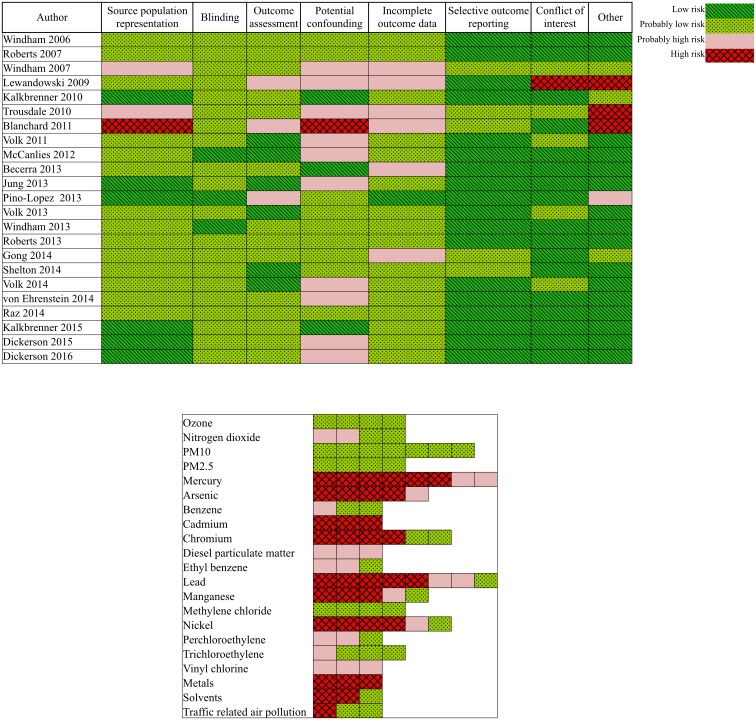
“Risk of bias was generally low across studies for most domains”
§ A Systematic Review and Meta-Analysis of Multiple Airborne Pollutants and Autism Spectrum Disorder > Abstract > Results
plain- Asserted: passes — The authors put it forward as true.
- Checkable: passes — It can be checked against evidence.
- Load-bearing: unclear — It is unclear whether the paper’s conclusions depend on it.
- Based: passes — The paper gives a reason why it holds.
The paper states this without a source or data behind it here, so there is nothing to check it against. The quote shows it is in the paper.
In the paper
“We rated the quality of the body of evidence across all air pollutants as “moderate.””
§ A Systematic Review and Meta-Analysis of Multiple Airborne Pollutants and Autism Spectrum Disorder > Abstract > Results
plain- Asserted: passes — The authors put it forward as true.
- Checkable: passes — It can be checked against evidence.
- Load-bearing: unclear — It is unclear whether the paper’s conclusions depend on it.
- Based: passes — The paper gives a reason why it holds.
A result the paper reports from its own data — it cites no other source for it, so there is none to check. The quote shows it is in the paper.
In the paper
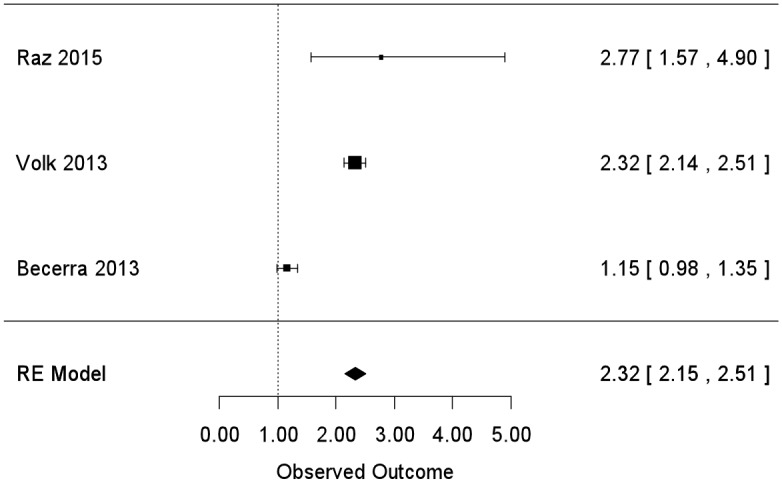
“2.32 (95% CI: 2.15, 2.51) per 10-μg/m3 increase in PM2.5 exposure (n = 3 studies)”
§ A Systematic Review and Meta-Analysis of Multiple Airborne Pollutants and Autism Spectrum Disorder > Abstract > Results
plaincorrelationaln = 3- Asserted: passes — The authors put it forward as true.
- Checkable: passes — It can be checked against evidence.
- Load-bearing: passes — The paper’s conclusions depend on it.
- Based: passes — The paper gives a reason why it holds.
A result the paper reports from its own data — it cites no other source for it, so there is none to check. The quote shows it is in the paper.
In the paper
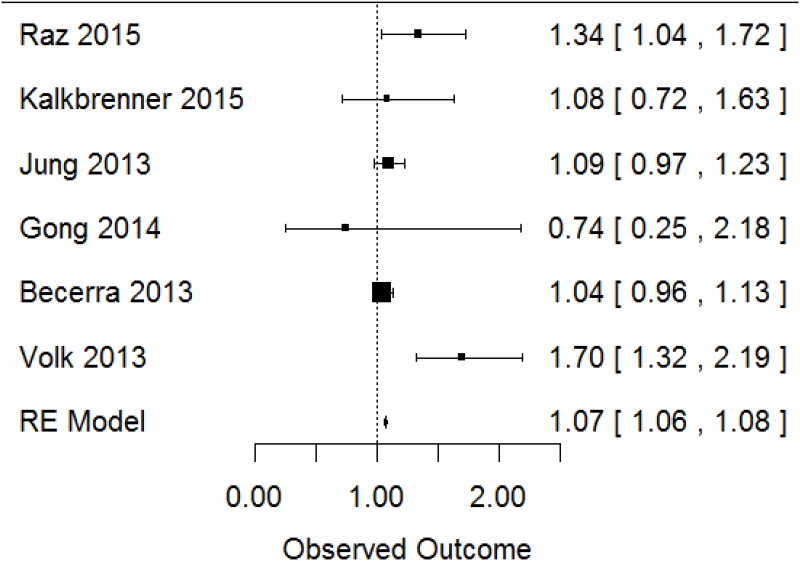
“we found statistically significant summary odds ratios (ORs) of 1.07 (95% CI: 1.06, 1.08) per 10-μg/m3 increase in PM10 exposure (n = 6 studies)”
§ A Systematic Review and Meta-Analysis of Multiple Airborne Pollutants and Autism Spectrum Disorder > Abstract > Results
plaincorrelationaln = 6- Asserted: passes — The authors put it forward as true.
- Checkable: passes — It can be checked against evidence.
- Load-bearing: passes — The paper’s conclusions depend on it.
- Based: passes — The paper gives a reason why it holds.
A result the paper reports from its own data — it cites no other source for it, so there is none to check. The quote shows it is in the paper.
In the paper
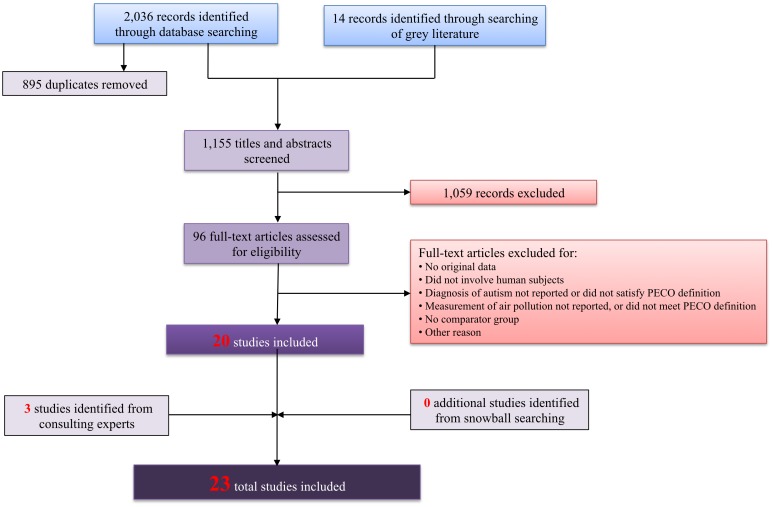
“Of 1,158 total references identified, 23 human studies met our inclusion criteria (17 case-control, 4 ecological, 2 cohort).”
- Also stated in: § Included studies · plain
“bringing the total number of screened references to 1,158 and the total number of included studies to 23”
§ A Systematic Review and Meta-Analysis of Multiple Airborne Pollutants and Autism Spectrum Disorder > Abstract > Results
plainn = 17- Asserted: passes — The authors put it forward as true.
- Checkable: passes — It can be checked against evidence.
- Load-bearing: passes — The paper’s conclusions depend on it.
- Based: passes — The paper gives a reason why it holds.
- Also stated in: § Included studies · plain
The paper states this without a source or data behind it here, so there is nothing to check it against. The quote shows it is in the paper.
In the paper
“study limitations were related to potential confounding and accuracy of exposure assessment methods”
§ A Systematic Review and Meta-Analysis of Multiple Airborne Pollutants and Autism Spectrum Disorder > Abstract > Results
plaincorrelational- Asserted: passes — The authors put it forward as true.
- Checkable: passes — It can be checked against evidence.
- Load-bearing: unclear — It is unclear whether the paper’s conclusions depend on it.
- Based: passes — The paper gives a reason why it holds.
A result the paper reports from its own data — it cites no other source for it, so there is none to check. The quote shows it is in the paper.
In the paper
“We added in a hierarchical cluster structure to include this study as a separate cluster from all other studies, and this greatly reduced the unexplained heterogeneity (I2 = 2%, p-value = 0.41), indicating that with this clustered analysis statistical heterogeneity was of minimal concern.”
§ A Systematic Review and Meta-Analysis of Multiple Airborne Pollutants and Autism Spectrum Disorder > Results > Statistical analysis
plaindirect- Asserted: passes — The authors put it forward as true.
- Checkable: passes — It can be checked against evidence.
- Load-bearing: passes — The paper’s conclusions depend on it.
- Based: passes — The paper gives a reason why it holds.
A result the paper reports from its own data — it cites no other source for it, so there is none to check. The quote shows it is in the paper.
In the paper
“Of the 23 included studies, six studies that measured PM10 and three that measured PM2.5 (a subset of the six with PM10 data) were amenable to meta-analyses.”
§ A Systematic Review and Meta-Analysis of Multiple Airborne Pollutants and Autism Spectrum Disorder > Results > Statistical analysis
plain- Asserted: passes — The authors put it forward as true.
- Checkable: passes — It can be checked against evidence.
- Load-bearing: passes — The paper’s conclusions depend on it.
- Based: passes — The paper gives a reason why it holds.
A result the paper reports from its own data — it cites no other source for it, so there is none to check. The quote shows it is in the paper.
In the paper
“Based on this clustered meta-analysis, we found a pooled effect estimate of OR = 2.32 (95% CI 2.15 to 2.51) per 10-μg/m3 increase in PM2.5 (Fig 4).”
§ A Systematic Review and Meta-Analysis of Multiple Airborne Pollutants and Autism Spectrum Disorder > Results > Statistical analysis
plaincorrelational- Asserted: passes — The authors put it forward as true.
- Checkable: passes — It can be checked against evidence.
- Load-bearing: passes — The paper’s conclusions depend on it.
- Based: passes — The paper gives a reason why it holds.
The paper states this without a source or data behind it here, so there is nothing to check it against. The quote shows it is in the paper.
In the paper
“There was no evidence that residual confounding influenced results.”
§ A Systematic Review and Meta-Analysis of Multiple Airborne Pollutants and Autism Spectrum Disorder > Results > Quality and strength of the overall body of evidence
plain- Asserted: passes — The authors put it forward as true.
- Checkable: passes — It can be checked against evidence.
- Load-bearing: unclear — It is unclear whether the paper’s conclusions depend on it.
- Based: unclear — It is unclear why the paper says it holds.
- It may state two separate claims as one. 44
- Probably not a substantial claim. 40
A result the paper reports from its own data — it cites no other source for it, so there is none to check. The quote shows it is in the paper.
In the paper
“The 23 included studies were all published between the years 2006 to 2015, included 174 to 4,057,712 participants born between the early 1990s through 2005, were based in 4 different countries, and involved case-control, cohort, and ecological study designs (Table 2).”
§ A Systematic Review and Meta-Analysis of Multiple Airborne Pollutants and Autism Spectrum Disorder > Results > Included studies
plain- Asserted: passes — The authors put it forward as true.
- Checkable: passes — It can be checked against evidence.
- Load-bearing: unclear — It is unclear whether the paper’s conclusions depend on it.
- Based: passes — The paper gives a reason why it holds.
It may state two separate claims as one.
A result the paper reports from its own data — it cites no other source for it, so there is none to check. The quote shows it is in the paper.
In the paper
“All included studies generally showed increased risk of ASD with increasing exposure to air pollution, although not consistently across all chemical components.”
§ A Systematic Review and Meta-Analysis of Multiple Airborne Pollutants and Autism Spectrum Disorder > Abstract > Results
plaincorrelational- Asserted: passes — The authors put it forward as true.
- Checkable: passes — It can be checked against evidence.
- Load-bearing: passes — The paper’s conclusions depend on it.
- Based: passes — The paper gives a reason why it holds.
It may state two separate claims as one.
In the paper
“Sensitivity analyses here (assuming the added hypothetical study would have a standard error of 0.04, equal to the smallest in our group of studies [39]) found that an added study would need an effect estimate of OR = 1.02 to enlarge the confidence interval to overlap 1, and an OR = 0.14 to shift the overall effect estimate to OR<1.”
§ A Systematic Review and Meta-Analysis of Multiple Airborne Pollutants and Autism Spectrum Disorder > Results > Statistical analysis
What the sources say
- Not checked yetcites [39] TA Becerra, 2013, Ambient air pollution and autism in Los Angeles county, California, Environmental Health Perspectives source
plain- Asserted: passes — The authors put it forward as true.
- Checkable: passes — It can be checked against evidence.
- Load-bearing: passes — The paper’s conclusions depend on it.
- Based: passes — The paper gives a reason why it holds.
It may state two separate claims as one.
The paper states this without a source or data behind it here, so there is nothing to check it against. The quote shows it is in the paper.
In the paper
“Study populations came from a variety of cohorts and regions, primarily in the U.S., such as the Nurses’ Health Study II, U.C. Davis’ Childhood Autism Risks from Genetics and the Environment (CHARGE) study, the Center for Diseases Control and Prevention’s (CDC) Autism and Developmental Disabilities Monitoring (ADDM) Network, Child and Adolescent Twin Study in Sweden (CATSS), or identified through”
§ A Systematic Review and Meta-Analysis of Multiple Airborne Pollutants and Autism Spectrum Disorder > Results > Statistical analysis
plain- Asserted: passes — The authors put it forward as true.
- Checkable: passes — It can be checked against evidence.
- Load-bearing: fails — The paper’s conclusions may not depend on it.
- Based: passes — The paper gives a reason why it holds.
Probably not a substantial claim. The paper’s conclusions may not depend on it. It may state two separate claims as one.
A result the paper reports from its own data — it cites no other source for it, so there is none to check. The quote shows it is in the paper.
In the paper
“We found that an additional new study would need to have an effect estimate of OR = 1.03 to enlarge our confidence interval to overlap 1, and OR = 0.44 to shift our overall effect estimate to OR<1.”
§ A Systematic Review and Meta-Analysis of Multiple Airborne Pollutants and Autism Spectrum Disorder > Results > Statistical analysis
plain- Asserted: passes — The authors put it forward as true.
- Checkable: passes — It can be checked against evidence.
- Load-bearing: passes — The paper’s conclusions depend on it.
- Based: passes — The paper gives a reason why it holds.
It may state two separate claims as one.
None of the sources cited for this claim have been checked yet.
In the paper
“One additional included study [53] also reported effect estimates for both PM10 and PM2.5 but ultimately was not included in the meta-analysis because upon personal communication with the study authors [64] it was determined that the study population was a subset of the population reported in a previous article [52] that was already included in the meta-analyses.”
§ A Systematic Review and Meta-Analysis of Multiple Airborne Pollutants and Autism Spectrum Disorder > Results > Statistical analysis
What the sources say
- Not checked yetcites [53] HE Volk, 2014, Autism Spectrum Disorder: Interaction of Air Pollution with the MET Receptor Tyrosine Kinase Gene., Epidemiology
- Not checked yetcites [64] Volk HE. Email correspondence. 2014.
- Not checked yetcites [52] HE Volk, 2013, Traffic-related air pollution, particulate matter, and autism, JAMA psychiatry source
plain- Asserted: passes — The authors put it forward as true.
- Checkable: passes — It can be checked against evidence.
- Load-bearing: unclear — It is unclear whether the paper’s conclusions depend on it.
- Based: passes — The paper gives a reason why it holds.
It may state two separate claims as one.
A result the paper reports from its own data — it cites no other source for it, so there is none to check. The quote shows it is in the paper.
In the paper
“We generally observed a trend towards positive effects (increasing exposure associated with increased autism risk), although there were limited data and confidence intervals commonly overlapped the null.”
§ A Systematic Review and Meta-Analysis of Multiple Airborne Pollutants and Autism Spectrum Disorder > Results > Statistical analysis
hedgedcorrelational- Asserted: passes — The authors put it forward as true.
- Checkable: passes — It can be checked against evidence.
- Load-bearing: passes — The paper’s conclusions depend on it.
- Based: passes — The paper gives a reason why it holds.
It may state two separate claims as one.
A result the paper reports from its own data — it cites no other source for it, so there is none to check. The quote shows it is in the paper.
In the paper
“We identified several findings from the grey literature through our comprehensive search, and two studies did find negative findings.”
§ A Systematic Review and Meta-Analysis of Multiple Airborne Pollutants and Autism Spectrum Disorder > Results > Quality and strength of the overall body of evidence
plain- Asserted: passes — The authors put it forward as true.
- Checkable: passes — It can be checked against evidence.
- Load-bearing: fails — The paper’s conclusions may not depend on it.
- Based: passes — The paper gives a reason why it holds.
Probably not a substantial claim. The paper’s conclusions may not depend on it. It may state two separate claims as one.
A result the paper reports from its own data — it cites no other source for it, so there is none to check. The quote shows it is in the paper.
In the paper
“All of the studies found null or minimal effects only (i.e., OR<2).”
§ A Systematic Review and Meta-Analysis of Multiple Airborne Pollutants and Autism Spectrum Disorder > Results > Quality and strength of the overall body of evidence
plain- Asserted: passes — The authors put it forward as true.
- Checkable: passes — It can be checked against evidence.
- Load-bearing: passes — The paper’s conclusions depend on it.
- Based: passes — The paper gives a reason why it holds.
It may state two separate claims as one.
The paper states this without a source or data behind it here, so there is nothing to check it against. The quote shows it is in the paper.
In the paper
“A positive relationship was observed between exposure and outcome where chance, bias, and confounding could not be ruled out with reasonable confidence.”
§ A Systematic Review and Meta-Analysis of Multiple Airborne Pollutants and Autism Spectrum Disorder > Results > Quality and strength of the overall body of evidence
hedgedcorrelational- Asserted: passes — The authors put it forward as true.
- Checkable: passes — It can be checked against evidence.
- Load-bearing: passes — The paper’s conclusions depend on it.
- Based: passes — The paper gives a reason why it holds.
It may state two separate claims as one.
In the paper
“Again using a leave-one-out analysis, we identified one study in particular [39] that was contributing to the majority of the heterogeneity and we could not identify particular methodological features driving the heterogeneity so we classified it as unexplained.”
§ A Systematic Review and Meta-Analysis of Multiple Airborne Pollutants and Autism Spectrum Disorder > Results > Statistical analysis
What the sources say
- Not checked yetcites [39] TA Becerra, 2013, Ambient air pollution and autism in Los Angeles county, California, Environmental Health Perspectives source
plain- Asserted: passes — The authors put it forward as true.
- Checkable: passes — It can be checked against evidence.
- Load-bearing: passes — The paper’s conclusions depend on it.
- Based: passes — The paper gives a reason why it holds.
It may state two separate claims as one.
A result the paper reports from its own data — it cites no other source for it, so there is none to check. The quote shows it is in the paper.
In the paper
“Effect estimates across studies were mostly positive (showing increased risk) and small (OR<2) and confidence intervals overlapped across studies for the majority of estimates.”
§ A Systematic Review and Meta-Analysis of Multiple Airborne Pollutants and Autism Spectrum Disorder > Results > Quality and strength of the overall body of evidence
plaincorrelational- Asserted: passes — The authors put it forward as true.
- Checkable: passes — It can be checked against evidence.
- Load-bearing: passes — The paper’s conclusions depend on it.
- Based: passes — The paper gives a reason why it holds.
It may state two separate claims as one.
The paper states this without a source or data behind it here, so there is nothing to check it against. The quote shows it is in the paper.
In the paper
“Coauthors felt there was some evidence of a dose-response relationship, but not enough to warrant upgrading of the evidence.”
§ A Systematic Review and Meta-Analysis of Multiple Airborne Pollutants and Autism Spectrum Disorder > Results > Quality and strength of the overall body of evidence
hedged- Asserted: passes — The authors put it forward as true.
- Checkable: passes — It can be checked against evidence.
- Load-bearing: fails — The paper’s conclusions may not depend on it.
- Based: passes — The paper gives a reason why it holds.
Probably not a substantial claim. The paper’s conclusions may not depend on it. It may state two separate claims as one.
A result the paper reports from its own data — it cites no other source for it, so there is none to check. The quote shows it is in the paper.
In the paper
“For PM2.5, the summary effect estimate was OR = 1.88 (95% CI: [1.11, 3.20]) but, similar to PM10 analyses, we found evidence of considerable statistical heterogeneity (I2 = 96%; p-value<0.0001).”
§ A Systematic Review and Meta-Analysis of Multiple Airborne Pollutants and Autism Spectrum Disorder > Results > Statistical analysis
plaincorrelational- Asserted: passes — The authors put it forward as true.
- Checkable: passes — It can be checked against evidence.
- Load-bearing: passes — The paper’s conclusions depend on it.
- Based: passes — The paper gives a reason why it holds.
It may state two separate claims as one.
A result the paper reports from its own data — it cites no other source for it, so there is none to check. The quote shows it is in the paper.
In the paper
“Study population sizes ranged from 524–83,229.”
§ A Systematic Review and Meta-Analysis of Multiple Airborne Pollutants and Autism Spectrum Disorder > Results > Statistical analysis
plain- Asserted: passes — The authors put it forward as true.
- Checkable: passes — It can be checked against evidence.
- Load-bearing: fails — The paper’s conclusions may not depend on it.
- Based: passes — The paper gives a reason why it holds.
Probably not a substantial claim. The paper’s conclusions may not depend on it.
A result the paper reports from its own data — it cites no other source for it, so there is none to check. The quote shows it is in the paper.
In the paper
“These studies reported effect estimates similar enough to be combined into a meta-analysis we found statistically significant pooled effect estimates for both PM components, with a stronger effect demonstrated for PM2.5 than for PM10.”
§ A Systematic Review and Meta-Analysis of Multiple Airborne Pollutants and Autism Spectrum Disorder > Discussion
boostedcorrelationaln = 9,557- Asserted: passes — The authors put it forward as true.
- Checkable: passes — It can be checked against evidence.
- Load-bearing: passes — The paper’s conclusions depend on it.
- Based: passes — The paper gives a reason why it holds.
It may state two separate claims as one.
None of the sources cited for this claim have been checked yet.
In the paper
“Our systematic review results were generally in concert with previous expert-based narrative reviews that addressed the association of ASD and environmental chemical exposures more broadly [18, 65–67].”
§ A Systematic Review and Meta-Analysis of Multiple Airborne Pollutants and Autism Spectrum Disorder > Discussion
What the sources say
- Not checked yetcites [18] K Lyall, 2014, Maternal lifestyle and environmental risk factors for autism spectrum disorders, International Journal of Epidemiology source
- Not checked yetcites [65] I Hertz-Picciotto, 2011, Autism Spectrum Disorders
- Not checked yetcites [66] AE Kalkbrenner, 2014, Environmental Chemical Exposures and Autism Spectrum Disorders: A Review of the Epidemiological Evidence, Current Problems in Pediatric and Adolescent Health Care source
- Not checked yetcites [67] DA Rossignol, 2014, Environmental toxicants and autism spectrum disorders: a systematic review, Translational Psychiatry source
hedged- Asserted: passes — The authors put it forward as true.
- Checkable: passes — It can be checked against evidence.
- Load-bearing: fails — The paper’s conclusions may not depend on it.
- Based: passes — The paper gives a reason why it holds.
Probably not a substantial claim. The paper’s conclusions may not depend on it.
The paper states this without a source or data behind it here, so there is nothing to check it against. The quote shows it is in the paper.
In the paper
“Generally, the other air pollutants that could not be combined into a meta-analysis (such as some of the metal air pollutants) supported positive and statistically significant effects, although the effects were generally small and not consistent.”
§ A Systematic Review and Meta-Analysis of Multiple Airborne Pollutants and Autism Spectrum Disorder > Discussion
plaincorrelational- Asserted: passes — The authors put it forward as true.
- Checkable: passes — It can be checked against evidence.
- Load-bearing: unclear — It is unclear whether the paper’s conclusions depend on it.
- Based: passes — The paper gives a reason why it holds.
It may state two separate claims as one.
The paper states this without a source or data behind it here, so there is nothing to check it against. The quote shows it is in the paper.
In the paper
“relatively few studies have been able to adequately power such analyses.”
§ A Systematic Review and Meta-Analysis of Multiple Airborne Pollutants and Autism Spectrum Disorder > Discussion > Advancing ASD and Air Pollution Research
plain- Asserted: passes — The authors put it forward as true.
- Checkable: passes — It can be checked against evidence.
- Load-bearing: fails — The paper’s conclusions may not depend on it.
- Based: passes — The paper gives a reason why it holds.
Probably not a substantial claim. The paper’s conclusions may not depend on it.
A result the paper reports from its own data — it cites no other source for it, so there is none to check. The quote shows it is in the paper.
In the paper
“We identified statistical heterogeneity in our meta-analysis that could be minimized through incorporating a clustered data analysis structure, but not explained through differences in study design.”
§ A Systematic Review and Meta-Analysis of Multiple Airborne Pollutants and Autism Spectrum Disorder > Discussion
hedgedn = 9,557- Asserted: passes — The authors put it forward as true.
- Checkable: passes — It can be checked against evidence.
- Load-bearing: unclear — It is unclear whether the paper’s conclusions depend on it.
- Based: passes — The paper gives a reason why it holds.
It may state two separate claims as one.
None of the sources cited for this claim have been checked yet.
In the paper
“This observation is consistent with our previous systematic reviews, [24, 27, 28, 30]”
§ A Systematic Review and Meta-Analysis of Multiple Airborne Pollutants and Autism Spectrum Disorder > Discussion > Synthesizing the Evidence for Decision-Making in Environmental Health
What the sources say
- Not checked yetcites [24] E Koustas, 2014, The Navigation Guide—evidence-based medicine meets environmental health: systematic review of nonhuman evidence for PFOA effects on fetal growth, Environmental Health Perspectives source
- Not checked yetcites [27] HM Vesterinen, 2014, Fetal growth and maternal glomerular filtration rate: a systematic review, Journal of Maternal-Fetal and Neonatal Medicine
- Not checked yetcites [28] PI Johnson, 2016, Application of the Navigation Guide Methodology: Systematic review of the evidence for developmental and reproductive toxicity of triclosan, Environment International
- Not checked yetcites [30] PI Johnson, 2014, The Navigation Guide—evidence-based medicine meets environmental health: systematic review of human evidence for PFOA effects on fetal growth, Environmental Health Perspectives source
plaincorrelational- Asserted: passes — The authors put it forward as true.
- Checkable: passes — It can be checked against evidence.
- Load-bearing: fails — The paper’s conclusions may not depend on it.
- Based: passes — The paper gives a reason why it holds.
Probably not a substantial claim. The paper’s conclusions may not depend on it.
A result the paper reports from its own data — it cites no other source for it, so there is none to check. The quote shows it is in the paper.
In the paper
“We utilized six robust studies (five case-control and one cohort) with minimal risk of bias concerns that represented a total of 9,557 children with autism and 143,997 controls reporting on PM10 exposure, and a subset of these that also reported on PM2.5.”
§ A Systematic Review and Meta-Analysis of Multiple Airborne Pollutants and Autism Spectrum Disorder > Discussion
plainn = 9,557- Asserted: passes — The authors put it forward as true.
- Checkable: passes — It can be checked against evidence.
- Load-bearing: passes — The paper’s conclusions depend on it.
- Based: passes — The paper gives a reason why it holds.
It may state two separate claims as one.
The paper states this without a source or data behind it here, so there is nothing to check it against. The quote shows it is in the paper.
In the paper
“The included studies varied in the adjusted confounders considered, the timing of exposure or outcome measurement, and the method used for assessing the ASD outcome.”
§ A Systematic Review and Meta-Analysis of Multiple Airborne Pollutants and Autism Spectrum Disorder > Discussion > Advancing ASD and Air Pollution Research
plain- Asserted: passes — The authors put it forward as true.
- Checkable: passes — It can be checked against evidence.
- Load-bearing: passes — The paper’s conclusions depend on it.
- Based: passes — The paper gives a reason why it holds.
It may state two separate claims as one.
In the paper
“We had completed our review but had not yet published our results when three new relevant studies were published [69].”
§ A Systematic Review and Meta-Analysis of Multiple Airborne Pollutants and Autism Spectrum Disorder > Discussion > Synthesizing the Evidence for Decision-Making in Environmental Health
What the sources say
- Not checked yetcites [69] M Guxens, 2016, Air Pollution Exposure during Pregnancy and Childhood Autistic Traits in Four European Population-Based Cohort Studies: The ESCAPE Project, Environmental Health Perspectives source
plain- Asserted: passes — The authors put it forward as true.
- Checkable: passes — It can be checked against evidence.
- Load-bearing: fails — The paper’s conclusions may not depend on it.
- Based: passes — The paper gives a reason why it holds.
Probably not a substantial claim. The paper’s conclusions may not depend on it. It may state two separate claims as one.
A conclusion the paper draws from its own results — it cites no other source for it, so there is none to check. The quote shows it is in the paper.
In the paper
“However, the small number of studies in the meta-analysis and unexplained statistical heterogeneity across the individual study estimates means that the effect could be larger or smaller (including not significant) than these studies estimate.”
§ A Systematic Review and Meta-Analysis of Multiple Airborne Pollutants and Autism Spectrum Disorder > Abstract > Conclusion
hedged- Asserted: passes — The authors put it forward as true.
- Checkable: passes — It can be checked against evidence.
- Load-bearing: passes — The paper’s conclusions depend on it.
- Based: passes — The paper gives a reason why it holds.
It may state two separate claims as one.
What the paper did — it cites no source for this, so there is none to check. The quote shows it is in the paper.
In the paper
“Two of the eight review authors with subject-matter expertise (GW, AH, CN, AK, CL, TW, PS, EK) independently recorded risk of bias determinations for each included study.”
§ A Systematic Review and Meta-Analysis of Multiple Airborne Pollutants and Autism Spectrum Disorder > Methods > The Navigation Guide Systematic Review Methodology
plain- Asserted: passes — The authors put it forward as true.
- Checkable: passes — It can be checked against evidence.
- Load-bearing: fails — The paper’s conclusions may not depend on it.
- Based: passes — The paper gives a reason why it holds.
Probably not a substantial claim. The paper’s conclusions may not depend on it.
What the paper did — it cites no source for this, so there is none to check. The quote shows it is in the paper.
In the paper
“An additional reviewer (PS) screened five percent of the titles/abstracts and full-texts for quality assurance.”
§ A Systematic Review and Meta-Analysis of Multiple Airborne Pollutants and Autism Spectrum Disorder > Methods > The Navigation Guide Systematic Review Methodology
plain- Asserted: passes — The authors put it forward as true.
- Checkable: passes — It can be checked against evidence.
- Load-bearing: fails — The paper’s conclusions may not depend on it.
- Based: passes — The paper gives a reason why it holds.
Probably not a substantial claim. The paper’s conclusions may not depend on it.
What the paper did — it cites no source for this, so there is none to check. The quote shows it is in the paper.
In the paper
“We screened references in duplicate for inclusion using structured forms in DRAGON (ICF International; available at: http://www.icfi.com/insights/products-and-tools/dragon-online-tool-systematic-review) and DistillerSR (Evidence Partners; available at: http://www.systematic-review.net).”
§ A Systematic Review and Meta-Analysis of Multiple Airborne Pollutants and Autism Spectrum Disorder > Methods > The Navigation Guide Systematic Review Methodology
plain- Asserted: passes — The authors put it forward as true.
- Checkable: passes — It can be checked against evidence.
- Load-bearing: fails — The paper’s conclusions may not depend on it.
- Based: passes — The paper gives a reason why it holds.
Probably not a substantial claim. The paper’s conclusions may not depend on it.
What the paper did — it cites no source for this, so there is none to check. The quote shows it is in the paper.
In the paper
“each reference from the literature search had the title and abstract independently reviewed by two of the five reviewers (ND, AH, AK, LD, GW) in a non-random assignment to ensure that the same two authors did not always screen the same references.”
§ A Systematic Review and Meta-Analysis of Multiple Airborne Pollutants and Autism Spectrum Disorder > Methods > The Navigation Guide Systematic Review Methodology
plain- Asserted: passes — The authors put it forward as true.
- Checkable: passes — It can be checked against evidence.
- Load-bearing: fails — The paper’s conclusions may not depend on it.
- Based: passes — The paper gives a reason why it holds.
Probably not a substantial claim. The paper’s conclusions may not depend on it.
What the paper did — it cites no source for this, so there is none to check. The quote shows it is in the paper.
In the paper
“Each member of the review team also filled out a conflict of interest statement at the initiation of their involvement with the protocol to document any potential financial or other conflicts of interest, and these were appended to the protocol.”
§ A Systematic Review and Meta-Analysis of Multiple Airborne Pollutants and Autism Spectrum Disorder > Methods > The Navigation Guide Systematic Review Methodology
plain- Asserted: passes — The authors put it forward as true.
- Checkable: passes — It can be checked against evidence.
- Load-bearing: fails — The paper’s conclusions may not depend on it.
- Based: passes — The paper gives a reason why it holds.
Probably not a substantial claim. The paper’s conclusions may not depend on it.
What the paper did — it cites no source for this, so there is none to check. The quote shows it is in the paper.
In the paper
“In particular, review authors had decided beforehand that different air pollutant chemicals or classes of compounds (i.e., heavy metals, pesticides, and criteria air pollutants) should be analyzed separately in the absence of empirical evidence to suggest that we could combine these effect estimates.”
§ A Systematic Review and Meta-Analysis of Multiple Airborne Pollutants and Autism Spectrum Disorder > Methods > The Navigation Guide Systematic Review Methodology
plain- Asserted: passes — The authors put it forward as true.
- Checkable: passes — It can be checked against evidence.
- Load-bearing: passes — The paper’s conclusions depend on it.
- Based: passes — The paper gives a reason why it holds.
Probably not a substantial claim.
What the paper did — it cites no source for this, so there is none to check. The quote shows it is in the paper.
In the paper
“Based on this discussion, two review authors (JL, EK) subsequently reviewed ratings for all included studies to ensure consistency across studies with similar study populations or study design.”
§ A Systematic Review and Meta-Analysis of Multiple Airborne Pollutants and Autism Spectrum Disorder > Methods > The Navigation Guide Systematic Review Methodology
plain- Asserted: passes — The authors put it forward as true.
- Checkable: passes — It can be checked against evidence.
- Load-bearing: fails — The paper’s conclusions may not depend on it.
- Based: passes — The paper gives a reason why it holds.
Probably not a substantial claim. The paper’s conclusions may not depend on it.
What the paper did — it cites no source for this, so there is none to check. The quote shows it is in the paper.
In the paper
“Four authors (ND, LD, PS, EK) and a UCSF research assistant (HT) independently extracted data relating to study characteristics and outcome measures (S3 Table) from all included articles into a DRAGON database.”
§ A Systematic Review and Meta-Analysis of Multiple Airborne Pollutants and Autism Spectrum Disorder > Methods > The Navigation Guide Systematic Review Methodology
plain- Asserted: passes — The authors put it forward as true.
- Checkable: passes — It can be checked against evidence.
- Load-bearing: fails — The paper’s conclusions may not depend on it.
- Based: passes — The paper gives a reason why it holds.
Probably not a substantial claim. The paper’s conclusions may not depend on it.
What the paper did — it cites no source for this, so there is none to check. The quote shows it is in the paper.
In the paper
“We held an in-person meeting to review rationales and ratings for each study and come to consensus.”
§ A Systematic Review and Meta-Analysis of Multiple Airborne Pollutants and Autism Spectrum Disorder > Methods > The Navigation Guide Systematic Review Methodology
plain- Asserted: passes — The authors put it forward as true.
- Checkable: passes — It can be checked against evidence.
- Load-bearing: fails — The paper’s conclusions may not depend on it.
- Based: passes — The paper gives a reason why it holds.
Probably not a substantial claim. The paper’s conclusions may not depend on it.
None of the sources cited for this claim have been checked yet.
In the paper
“The Navigation Guide systematic review methodology is based on Cochrane/GRADE methods [21, 22] and includes all the same elements (protocol, development, risk of bias evaluation, evidence evaluation, etc.) but accounts for the differences in evidence and decision context inherent to environmental health assessments”
§ A Systematic Review and Meta-Analysis of Multiple Airborne Pollutants and Autism Spectrum Disorder > Methods > The Navigation Guide Systematic Review Methodology
What the sources say
- Not checked yetcites [21] Higgins JPT, Green S. Cochrane Handbook for Systematic Reviews of Interventions. Version 5.1.0 [Updated March 2011] 2011 [May 1, 2016]. Available from: www.cochrane-handbook.org.
- Not checked yetcites [22] GH Guyatt, 2008, GRADE: an emerging consensus on rating quality of evidence and strength of recommendations, The BMJ source
plain- Asserted: passes — The authors put it forward as true.
- Checkable: passes — It can be checked against evidence.
- Load-bearing: fails — The paper’s conclusions may not depend on it.
- Based: passes — The paper gives a reason why it holds.
Probably not a substantial claim. The paper’s conclusions may not depend on it. It may state two separate claims as one.
What the paper did — it cites no source for this, so there is none to check. The quote shows it is in the paper.
In the paper
“registered in PROSPERO, CRD # 42015017890”
- Also stated in: § The Navigation Guide Systematic Review Methodology · plain
“We developed a protocol to outline the process for conducting the systematic review prior to initiating the study and registered the protocol with an international database for systematic reviews in March 2015.”
§ A Systematic Review and Meta-Analysis of Multiple Airborne Pollutants and Autism Spectrum Disorder > Abstract > Methods
plain- Asserted: passes — The authors put it forward as true.
- Checkable: passes — It can be checked against evidence.
- Load-bearing: fails — The paper’s conclusions may not depend on it.
- Based: passes — The paper gives a reason why it holds.
Probably not a substantial claim. The paper’s conclusions may not depend on it. It may state two separate claims as one.
- Also stated in: § The Navigation Guide Systematic Review Methodology · plain
What the paper did — it cites no source for this, so there is none to check. The quote shows it is in the paper.
In the paper
“Two of the five reviewers (ND, AH, AK, LD, GW) then independently performed a full-text review to evaluate inclusion criteria of each reference not excluded by title/abstract screening.”
§ A Systematic Review and Meta-Analysis of Multiple Airborne Pollutants and Autism Spectrum Disorder > Methods > The Navigation Guide Systematic Review Methodology
plain- Asserted: passes — The authors put it forward as true.
- Checkable: passes — It can be checked against evidence.
- Load-bearing: fails — The paper’s conclusions may not depend on it.
- Based: passes — The paper gives a reason why it holds.
Probably not a substantial claim. The paper’s conclusions may not depend on it.
What the paper did — it cites no source for this, so there is none to check. The quote shows it is in the paper.
In the paper
“Review authors were instructed to separately rate the exposure assessment risk of bias for each air pollutant chemical or classes of chemicals reported in the study under review.”
§ A Systematic Review and Meta-Analysis of Multiple Airborne Pollutants and Autism Spectrum Disorder > Methods > The Navigation Guide Systematic Review Methodology
plain- Asserted: passes — The authors put it forward as true.
- Checkable: passes — It can be checked against evidence.
- Load-bearing: passes — The paper’s conclusions depend on it.
- Based: passes — The paper gives a reason why it holds.
Probably not a substantial claim.
What the paper did — it cites no source for this, so there is none to check. The quote shows it is in the paper.
In the paper
“In the event that one of the review authors was a coauthor of the study in question, they recused themselves from rating the risk of bias for that particular study.”
§ A Systematic Review and Meta-Analysis of Multiple Airborne Pollutants and Autism Spectrum Disorder > Methods > The Navigation Guide Systematic Review Methodology
plain- Asserted: passes — The authors put it forward as true.
- Checkable: passes — It can be checked against evidence.
- Load-bearing: fails — The paper’s conclusions may not depend on it.
- Based: passes — The paper gives a reason why it holds.
Probably not a substantial claim. The paper’s conclusions may not depend on it.
None of the sources cited for this claim have been checked yet.
In the paper
“To date, the Navigation Guide method has been used in 3 case studies [25, 27, 28].”
§ A Systematic Review and Meta-Analysis of Multiple Airborne Pollutants and Autism Spectrum Disorder > Methods > The Navigation Guide Systematic Review Methodology
What the sources say
- Not checked yetcites [25] J Lam, 2014, The Navigation Guide-evidence-based medicine meets environmental health: Integration of animal and human evidence for PFOA effects on fetal growth, Environmental Health Perspectives source
- Not checked yetcites [27] HM Vesterinen, 2014, Fetal growth and maternal glomerular filtration rate: a systematic review, Journal of Maternal-Fetal and Neonatal Medicine
- Not checked yetcites [28] PI Johnson, 2016, Application of the Navigation Guide Methodology: Systematic review of the evidence for developmental and reproductive toxicity of triclosan, Environment International
plainn = 3- Asserted: passes — The authors put it forward as true.
- Checkable: passes — It can be checked against evidence.
- Load-bearing: fails — The paper’s conclusions may not depend on it.
- Based: passes — The paper gives a reason why it holds.
Probably not a substantial claim. The paper’s conclusions may not depend on it.
What the paper did — it cites no source for this, so there is none to check. The quote shows it is in the paper.
In the paper
“we ultimately developed a novel risk of bias instructions for exposure assessment that specified a list of important considerations, i.e., modeling, monitoring, biomarkers, etc.”
§ A Systematic Review and Meta-Analysis of Multiple Airborne Pollutants and Autism Spectrum Disorder > Methods > The Navigation Guide Systematic Review Methodology
plain- Asserted: passes — The authors put it forward as true.
- Checkable: passes — It can be checked against evidence.
- Load-bearing: passes — The paper’s conclusions depend on it.
- Based: passes — The paper gives a reason why it holds.
Probably not a substantial claim.
What the paper did — it cites no source for this, so there is none to check. The quote shows it is in the paper.
In the paper
“Our search was not limited by language or start-date of publication.”
§ A Systematic Review and Meta-Analysis of Multiple Airborne Pollutants and Autism Spectrum Disorder > Methods > The Navigation Guide Systematic Review Methodology
plain- Asserted: passes — The authors put it forward as true.
- Checkable: passes — It can be checked against evidence.
- Load-bearing: fails — The paper’s conclusions may not depend on it.
- Based: passes — The paper gives a reason why it holds.
Probably not a substantial claim. The paper’s conclusions may not depend on it. It may state two separate claims as one.
None of the sources cited for this claim have been checked yet.
In the paper
“We assessed risk of bias for each included study using a modified instrument we developed based on the Cochrane Collaboration’s “Risk of Bias” tool and the Agency for Healthcare Research and Quality’s (AHRQ) domains, i.e., selection bias, confounding, performance bias, attrition bias, detection bias, and reporting bias [21, 31].”
§ A Systematic Review and Meta-Analysis of Multiple Airborne Pollutants and Autism Spectrum Disorder > Methods > The Navigation Guide Systematic Review Methodology
What the sources say
- Not checked yetcites [21] Higgins JPT, Green S. Cochrane Handbook for Systematic Reviews of Interventions. Version 5.1.0 [Updated March 2011] 2011 [May 1, 2016]. Available from: www.cochrane-handbook.org.
- Not checked yetcites [31] M Viswanathan, 2012, Assessing the Risk of Bias of Individual Studies in Systematic Reviews of Health Care Interventions, Assessing the Risk of Bias of Individual Studies in Systematic Reviews of Health Care Interventions
plain- Asserted: passes — The authors put it forward as true.
- Checkable: passes — It can be checked against evidence.
- Load-bearing: passes — The paper’s conclusions depend on it.
- Based: passes — The paper gives a reason why it holds.
Probably not a substantial claim.
What the paper did — it cites no source for this, so there is none to check. The quote shows it is in the paper.
In the paper
“A third author (JL) performed QA/QC on all of the studies by reviewing the studies and its extracted data to check for accuracy.”
§ A Systematic Review and Meta-Analysis of Multiple Airborne Pollutants and Autism Spectrum Disorder > Methods > The Navigation Guide Systematic Review Methodology
plain- Asserted: passes — The authors put it forward as true.
- Checkable: passes — It can be checked against evidence.
- Load-bearing: fails — The paper’s conclusions may not depend on it.
- Based: passes — The paper gives a reason why it holds.
Probably not a substantial claim. The paper’s conclusions may not depend on it.
In the paper
“prenatal air pollution has been identified as having potentially greater impacts than adult exposures [6].”
§ A Systematic Review and Meta-Analysis of Multiple Airborne Pollutants and Autism Spectrum Disorder > Introduction
What the sources say
- Not checked yetcites [6] PJ Landrigan, 2005, Early environmental origins of neurodegenerative disease in later life, Environmental Health Perspectives source
hedgedconditional- Asserted: passes — The authors put it forward as true.
- Checkable: passes — It can be checked against evidence.
- Load-bearing: fails — The paper’s conclusions may not depend on it.
- Based: passes — The paper gives a reason why it holds.
Probably not a substantial claim. The paper’s conclusions may not depend on it.
What the paper did — it cites no source for this, so there is none to check. The quote shows it is in the paper.
In the paper
“Many of the studies rated as “probably high” (with one “high”) for potential confounding were due to the failure to adjust for many of the important confounders that we had established beforehand in our protocol.”
§ A Systematic Review and Meta-Analysis of Multiple Airborne Pollutants and Autism Spectrum Disorder > Results > Risk of bias assessment for individual studies
plaindirect- Asserted: passes — The authors put it forward as true.
- Checkable: passes — It can be checked against evidence.
- Load-bearing: unclear — It is unclear whether the paper’s conclusions depend on it.
- Based: passes — The paper gives a reason why it holds.
It may state two separate claims as one.
What the paper did — it cites no source for this, so there is none to check. The quote shows it is in the paper.
In the paper
“The majority of studies adjusted for maternal age, parental level of education, race/ethnicity, gender of child, household income, and some measure of socio-economic status.”
§ A Systematic Review and Meta-Analysis of Multiple Airborne Pollutants and Autism Spectrum Disorder > Results > Statistical analysis
plain- Asserted: passes — The authors put it forward as true.
- Checkable: passes — It can be checked against evidence.
- Load-bearing: fails — The paper’s conclusions may not depend on it.
- Based: passes — The paper gives a reason why it holds.
Probably not a substantial claim. The paper’s conclusions may not depend on it.
What the paper did — it cites no source for this, so there is none to check. The quote shows it is in the paper.
In the paper
“Exposures were not directly measured (lacking biomarkers or individual measurement of air pollutants); however this was accounted for in the ROB rating and no other areas of concern existed for indirectness.”
§ A Systematic Review and Meta-Analysis of Multiple Airborne Pollutants and Autism Spectrum Disorder > Results > Quality and strength of the overall body of evidence
plain- Asserted: passes — The authors put it forward as true.
- Checkable: passes — It can be checked against evidence.
- Load-bearing: passes — The paper’s conclusions depend on it.
- Based: passes — The paper gives a reason why it holds.
It may state two separate claims as one.
- Rests on an assumption: The risk-of-bias rating adequately accounts for the lack of direct exposure measurement, so no downgrade for indirectness is needed.
A conclusion the paper draws from its own results — it cites no other source for it, so there is none to check. The quote shows it is in the paper.
In the paper
“The former OR estimate is reasonably within the range of that reported by existing studies (thus, it might be possibly for a new study to easily shift our interpretation of statistical significance of the overall effect estimate), but the OR required to shift the overall effect estimate to OR<1 seemed rather unlikely.”
§ A Systematic Review and Meta-Analysis of Multiple Airborne Pollutants and Autism Spectrum Disorder > Results > Statistical analysis
hedged- Asserted: passes — The authors put it forward as true.
- Checkable: passes — It can be checked against evidence.
- Load-bearing: passes — The paper’s conclusions depend on it.
- Based: passes — The paper gives a reason why it holds.
It may state two separate claims as one.
A conclusion the paper draws from its own results — it cites no other source for it, so there is none to check. The quote shows it is in the paper.
In the paper
“With more information, the observed effect could change, and this change may be large enough to alter the conclusion.”
§ A Systematic Review and Meta-Analysis of Multiple Airborne Pollutants and Autism Spectrum Disorder > Results > Quality and strength of the overall body of evidence
hedged- Asserted: passes — The authors put it forward as true.
- Checkable: passes — It can be checked against evidence.
- Load-bearing: passes — The paper’s conclusions depend on it.
- Based: passes — The paper gives a reason why it holds.
It may state two separate claims as one.
A conclusion the paper draws from its own results — it cites no other source for it, so there is none to check. The quote shows it is in the paper.
In the paper
“Ultimately, although there was concern regarding the risk of bias domain, we did not judge this to be sufficient enough to warrant downgrading the evidence and therefore remained at the initial “moderate” rating.”
§ A Systematic Review and Meta-Analysis of Multiple Airborne Pollutants and Autism Spectrum Disorder > Results > Quality and strength of the overall body of evidence
plain- Asserted: passes — The authors put it forward as true.
- Checkable: passes — It can be checked against evidence.
- Load-bearing: passes — The paper’s conclusions depend on it.
- Based: passes — The paper gives a reason why it holds.
It may state two separate claims as one.
A conclusion the paper draws from its own results — it cites no other source for it, so there is none to check. The quote shows it is in the paper.
In the paper
“The former OR estimate is outside the range of that reported by existing studies, but not unreasonably so; however, the OR required to shift the overall effect estimate to OR<1 seems quite unlikely.”
§ A Systematic Review and Meta-Analysis of Multiple Airborne Pollutants and Autism Spectrum Disorder > Results > Statistical analysis
plain- Asserted: passes — The authors put it forward as true.
- Checkable: passes — It can be checked against evidence.
- Load-bearing: passes — The paper’s conclusions depend on it.
- Based: passes — The paper gives a reason why it holds.
It may state two separate claims as one.
None of the sources cited for this claim have been checked yet.
In the paper
““probably high” for those with “medium” confidence (i.e., coke oven emissions, vinyl chloride, chloroform, ethylene dibromide, etc.), and “high” for those with “lower” confidence (i.e., arsenic compounds, beryllium compounds, cadmium compounds, lead compounds, etc.).”
§ A Systematic Review and Meta-Analysis of Multiple Airborne Pollutants and Autism Spectrum Disorder > Results > Risk of bias assessment for individual studies
What the sources say
- Not checked yetcites [62] AS Rosenbaum, 1999, National estimates of outdoor air toxics concentrations, Journal of the Air & Waste Management Association source
- Not checked yetcites [63] Environmental Protection Agency U.S. (US EPA). Limitations in the 1996 National-Scale Air Toxics Assessment 2015. Available: https://archive.epa.gov/airtoxics/nata/web/html/conf.html.
plain- Asserted: fails — The authors may not put it forward as true.
- Checkable: passes — It can be checked against evidence.
- Load-bearing: fails — The paper’s conclusions may not depend on it.
- Based: passes — The paper gives a reason why it holds.
Probably not a substantial claim. The authors may not put it forward as true. The paper’s conclusions may not depend on it. It may state two separate claims as one.
In the paper
“More recently, the central nervous system was proposed as another organ negatively affected by air pollutants [5]”
§ A Systematic Review and Meta-Analysis of Multiple Airborne Pollutants and Autism Spectrum Disorder > Introduction
What the sources say
- Not checked yetcites [5] G Oberdorster, 2002, Ultrafine particles in the urban air: to the respiratory tract—and beyond?, Environmental Health Perspectives source
plaindirect- Asserted: passes — The authors put it forward as true.
- Checkable: passes — It can be checked against evidence.
- Load-bearing: fails — The paper’s conclusions may not depend on it.
- Based: passes — The paper gives a reason why it holds.
Probably not a substantial claim. The paper’s conclusions may not depend on it.
A conclusion the paper draws from its own results — it cites no other source for it, so there is none to check. The quote shows it is in the paper.
In the paper
“so we based our decision to not downgrade for publication bias on the fact that we conducted a comprehensive search, found studies from the grey literature, and found studies of variable sizes, designs, and funding sources that had similar findings.”
§ A Systematic Review and Meta-Analysis of Multiple Airborne Pollutants and Autism Spectrum Disorder > Results > Quality and strength of the overall body of evidence
plain- Asserted: passes — The authors put it forward as true.
- Checkable: passes — It can be checked against evidence.
- Load-bearing: passes — The paper’s conclusions depend on it.
- Based: passes — The paper gives a reason why it holds.
It may state two separate claims as one.
None of the sources cited for this claim have been checked yet.
In the paper
“While systematic review methods have been used for decades in the clinical sciences [21, 22]”
§ A Systematic Review and Meta-Analysis of Multiple Airborne Pollutants and Autism Spectrum Disorder > Introduction
What the sources say
- Not checked yetcites [21] Higgins JPT, Green S. Cochrane Handbook for Systematic Reviews of Interventions. Version 5.1.0 [Updated March 2011] 2011 [May 1, 2016]. Available from: www.cochrane-handbook.org.
- Not checked yetcites [22] GH Guyatt, 2008, GRADE: an emerging consensus on rating quality of evidence and strength of recommendations, The BMJ source
plain- Asserted: passes — The authors put it forward as true.
- Checkable: passes — It can be checked against evidence.
- Load-bearing: fails — The paper’s conclusions may not depend on it.
- Based: passes — The paper gives a reason why it holds.
Probably not a substantial claim. The paper’s conclusions may not depend on it.
None of the sources cited for this claim have been checked yet.
In the paper
“Studies in animals have also found that developmental exposure to air pollution is related to functional and structural brain effects [11–15].”
§ A Systematic Review and Meta-Analysis of Multiple Airborne Pollutants and Autism Spectrum Disorder > Introduction
What the sources say
- Not checked yetcites [11] L Calderon-Garciduenas, 2009, Effects of a cyclooxygenase-2 preferential inhibitor in young healthy dogs exposed to air pollution: a pilot study, Toxicologic Pathology source
- Not checked yetcites [12] A Campbell, 2009, Particulate matter induced enhancement of inflammatory markers in the brains of apolipoprotein E knockout mice, Journal of Nanoscience and Nanotechnology source
- Not checked yetcites [13] ME Gerlofs-Nijland, 2010, Effect of prolonged exposure to diesel engine exhaust on proinflammatory markers in different regions of the rat brain, Particle and Fibre Toxicology source
- Not checked yetcites [14] S Levesque, 2011, Diesel exhaust activates and primes microglia: air pollution, neuroinflammation, and regulation of dopaminergic neurotoxicity, Environmental Health Perspectives source
- Not checked yetcites [15] D van Berlo, 2010, Comparative evaluation of the effects of short-term inhalation exposure to diesel engine exhaust on rat lung and brain, Archives of Toxicology source
plaincorrelational- Asserted: passes — The authors put it forward as true.
- Checkable: passes — It can be checked against evidence.
- Load-bearing: fails — The paper’s conclusions may not depend on it.
- Based: passes — The paper gives a reason why it holds.
Probably not a substantial claim. The paper’s conclusions may not depend on it.
A conclusion the paper draws from its own results — it cites no other source for it, so there is none to check. The quote shows it is in the paper.
In the paper
“Collectively, these findings led to our conclusion that positive relationships were observed between air pollution exposures generally and ASD, but that chance, bias, and confounding could not be ruled out with reasonable confidence because of the limitations present in the available data.”
§ A Systematic Review and Meta-Analysis of Multiple Airborne Pollutants and Autism Spectrum Disorder > Discussion
hedgedcorrelational- Asserted: passes — The authors put it forward as true.
- Checkable: passes — It can be checked against evidence.
- Load-bearing: passes — The paper’s conclusions depend on it.
- Based: passes — The paper gives a reason why it holds.
It may state two separate claims as one.
A conclusion the paper draws from its own results — it cites no other source for it, so there is none to check. The quote shows it is in the paper.
In the paper
“However, our review additionally included a meta-analysis, the results of which further demonstrated an association between air pollution (PM) and ASD, but also revealed some uncertainties in the body of evidence that would not have been apparent except for the meta-analysis.”
§ A Systematic Review and Meta-Analysis of Multiple Airborne Pollutants and Autism Spectrum Disorder > Discussion
boostedcorrelational- Asserted: passes — The authors put it forward as true.
- Checkable: passes — It can be checked against evidence.
- Load-bearing: passes — The paper’s conclusions depend on it.
- Based: passes — The paper gives a reason why it holds.
It may state two separate claims as one.
A conclusion the paper draws from its own results — it cites no other source for it, so there is none to check. The quote shows it is in the paper.
In the paper
“There are possible study design characteristics that differed (for instance, the availability and quality of individual home addresses to estimate individual-level exposures), but it is difficult to assign an exact explanation for the observed heterogeneity in results.”
§ A Systematic Review and Meta-Analysis of Multiple Airborne Pollutants and Autism Spectrum Disorder > Discussion > Advancing ASD and Air Pollution Research
hedged- Asserted: passes — The authors put it forward as true.
- Checkable: passes — It can be checked against evidence.
- Load-bearing: unclear — It is unclear whether the paper’s conclusions depend on it.
- Based: passes — The paper gives a reason why it holds.
It may state two separate claims as one.
A conclusion the paper draws from its own results — it cites no other source for it, so there is none to check. The quote shows it is in the paper.
In the paper
“The available body of evidence on air pollution in general and ASD was wide, shallow, and except for PM, limited in their ability to strongly support a relationship if one exists.”
§ A Systematic Review and Meta-Analysis of Multiple Airborne Pollutants and Autism Spectrum Disorder > Conclusion
plain- Asserted: passes — The authors put it forward as true.
- Checkable: passes — It can be checked against evidence.
- Load-bearing: passes — The paper’s conclusions depend on it.
- Based: passes — The paper gives a reason why it holds.
It may state two separate claims as one.
A conclusion the paper draws from its own results — it cites no other source for it, so there is none to check. The quote shows it is in the paper.
In the paper
“This met our definition of “limited evidence of toxicity” for the association between early life exposure to air pollution generally and ASD.”
§ A Systematic Review and Meta-Analysis of Multiple Airborne Pollutants and Autism Spectrum Disorder > Discussion
plaincorrelational- Asserted: passes — The authors put it forward as true.
- Checkable: passes — It can be checked against evidence.
- Load-bearing: passes — The paper’s conclusions depend on it.
- Based: passes — The paper gives a reason why it holds.
Probably not a substantial claim.
A conclusion the paper draws from its own results — it cites no other source for it, so there is none to check. The quote shows it is in the paper.
In the paper
“this pattern of association is not unexpected.”
§ A Systematic Review and Meta-Analysis of Multiple Airborne Pollutants and Autism Spectrum Disorder > Discussion > Advancing ASD and Air Pollution Research
plain- Asserted: passes — The authors put it forward as true.
- Checkable: passes — It can be checked against evidence.
- Load-bearing: fails — The paper’s conclusions may not depend on it.
- Based: passes — The paper gives a reason why it holds.
Probably not a substantial claim. The paper’s conclusions may not depend on it.
What the paper did — it cites no source for this, so there is none to check. The quote shows it is in the paper.
In the paper
“Due to the complexity of assessing the risk of bias of air pollution exposure assessments, we developed a novel risk of bias tool and piloted its use for this study.”
§ A Systematic Review and Meta-Analysis of Multiple Airborne Pollutants and Autism Spectrum Disorder > Discussion > Synthesizing the Evidence for Decision-Making in Environmental Health
plaindirect- Asserted: passes — The authors put it forward as true.
- Checkable: passes — It can be checked against evidence.
- Load-bearing: passes — The paper’s conclusions depend on it.
- Based: passes — The paper gives a reason why it holds.
Probably not a substantial claim. It may state two separate claims as one.
None of the sources cited for this claim have been checked yet.
In the paper
“The authors of this review rated evidence based on IARC classifications and concluded that there was “sufficient” evidence for an association of ASD with PM2.5.”
§ A Systematic Review and Meta-Analysis of Multiple Airborne Pollutants and Autism Spectrum Disorder > Discussion
plaincorrelational- Asserted: passes — The authors put it forward as true.
- Checkable: passes — It can be checked against evidence.
- Load-bearing: passes — The paper’s conclusions depend on it.
- Based: passes — The paper gives a reason why it holds.
Probably not a substantial claim. It may state two separate claims as one.
In the paper
“The only prior review of air pollutants and neuropsychological development that followed a prescribed systematic methodology was limited to published English language studies appearing during or after 2012 and did not include a meta-analysis [68].”
§ A Systematic Review and Meta-Analysis of Multiple Airborne Pollutants and Autism Spectrum Disorder > Discussion
What the sources say
- Not checked yetcites [68] E Suades-González, 2015, Air pollution and neuropsychological development: a review of the latest evidence, Endocrinology source
plain- Asserted: passes — The authors put it forward as true.
- Checkable: passes — It can be checked against evidence.
- Load-bearing: passes — The paper’s conclusions depend on it.
- Based: passes — The paper gives a reason why it holds.
It may state two separate claims as one.
The paper states this without a source or data behind it here, so there is nothing to check it against. The quote shows it is in the paper.
In the paper
“The Navigation Guide classifications are based largely on the IARC classifications.”
§ A Systematic Review and Meta-Analysis of Multiple Airborne Pollutants and Autism Spectrum Disorder > Discussion
plaincorrelational- Asserted: passes — The authors put it forward as true.
- Checkable: passes — It can be checked against evidence.
- Load-bearing: fails — The paper’s conclusions may not depend on it.
- Based: fails — The paper may give no reason why it holds.
Probably not a substantial claim. The paper’s conclusions may not depend on it. The paper may give no reason why it holds.
In the paper
“Identifying the environmental contributors to ASD and neurodevelopment in general is a critical unmet clinical and public health need, as recognized by a recent consensus statement published by leading scientific and medical experts, along with children’s health advocates, which identifies the importance of environment as a risk factor for neurodevelopment [92].”
§ A Systematic Review and Meta-Analysis of Multiple Airborne Pollutants and Autism Spectrum Disorder > Conclusion
What the sources say
- Not checked yetcites [92] D Bennett, 2016, Project TENDR: Targeting Environmental Neuro-Developmental Risks The TENDR Consensus Statement, Environmental Health Perspectives source
boosted- Asserted: passes — The authors put it forward as true.
- Checkable: fails — It may be too vague to check against evidence.
- Load-bearing: fails — The paper’s conclusions may not depend on it.
- Based: passes — The paper gives a reason why it holds.
Probably not a substantial claim. It may be too vague to check against evidence. The paper’s conclusions may not depend on it.
What the paper did — it cites no source for this, so there is none to check. The quote shows it is in the paper.
In the paper
“Without the cooperation of individual study authors, it would have been impossible to complete the meta-analysis.”
§ A Systematic Review and Meta-Analysis of Multiple Airborne Pollutants and Autism Spectrum Disorder > Discussion > Synthesizing the Evidence for Decision-Making in Environmental Health
hedgeddirect- Asserted: passes — The authors put it forward as true.
- Checkable: passes — It can be checked against evidence.
- Load-bearing: fails — The paper’s conclusions may not depend on it.
- Based: passes — The paper gives a reason why it holds.
Probably not a substantial claim. The paper’s conclusions may not depend on it.
A conclusion the paper draws from its own results — it cites no other source for it, so there is none to check. The quote shows it is in the paper.
In the paper
“Further the occurrence of heterogeneity that lacked a clear methodological rationale is suggestive of randomness in the available data, was concerning to review authors, and this was influential in our final rating of “limited” overall evidence.”
§ A Systematic Review and Meta-Analysis of Multiple Airborne Pollutants and Autism Spectrum Disorder > Results > Quality and strength of the overall body of evidence
plain- Asserted: passes — The authors put it forward as true.
- Checkable: passes — It can be checked against evidence.
- Load-bearing: passes — The paper’s conclusions depend on it.
- Based: passes — The paper gives a reason why it holds.
It may state two separate claims as one.
A conclusion the paper draws from its own results — it cites no other source for it, so there is none to check. The quote shows it is in the paper.
In the paper
“While the meta-analysis suggested statistically significant effects for PM, these were based on very few studies and sensitivity analysis suggested that even a single added study within the range of ORs reported in the body of research to date could lead to a summary effect evidence that did not attain statistical significance (although an extreme OR estimate would be require to change the”
§ A Systematic Review and Meta-Analysis of Multiple Airborne Pollutants and Autism Spectrum Disorder > Results > Quality and strength of the overall body of evidence
hedgedcorrelational- Asserted: passes — The authors put it forward as true.
- Checkable: passes — It can be checked against evidence.
- Load-bearing: passes — The paper’s conclusions depend on it.
- Based: passes — The paper gives a reason why it holds.
It may state two separate claims as one.
A conclusion the paper draws from its own results — it cites no other source for it, so there is none to check. The quote shows it is in the paper.
In the paper
“We found the strongest available evidence was supporting associations between PM and ASD, which was supported by the results of our meta-analysis.”
§ A Systematic Review and Meta-Analysis of Multiple Airborne Pollutants and Autism Spectrum Disorder > Conclusion
boostedcorrelational- Asserted: passes — The authors put it forward as true.
- Checkable: passes — It can be checked against evidence.
- Load-bearing: passes — The paper’s conclusions depend on it.
- Based: passes — The paper gives a reason why it holds.
It may state two separate claims as one.
A conclusion the paper draws from its own results — it cites no other source for it, so there is none to check. The quote shows it is in the paper.
In the paper
“As such, with the exception of PM, where estimates could fairly easily be standardized, the body of evidence was disparate and largely not combinable.”
§ A Systematic Review and Meta-Analysis of Multiple Airborne Pollutants and Autism Spectrum Disorder > Discussion > Advancing ASD and Air Pollution Research
plain- Asserted: passes — The authors put it forward as true.
- Checkable: passes — It can be checked against evidence.
- Load-bearing: passes — The paper’s conclusions depend on it.
- Based: passes — The paper gives a reason why it holds.
It may state two separate claims as one.
None of the sources cited for this claim have been checked yet.
In the paper
“Because smaller particles have the ability to penetrate into the circulatory system and are thought to be more biologically active [83–86]”
§ A Systematic Review and Meta-Analysis of Multiple Airborne Pollutants and Autism Spectrum Disorder > Discussion > Advancing ASD and Air Pollution Research
What the sources say
- Not checked yetcites [83] M Lippmann, 1980, Deposition, retention, and clearance of inhaled particles, British Journal of Industrial Medicine
- Not checked yetcites [84] TM De Kok, 2006, Toxicological assessment of ambient and traffic-related particulate matter: a review of recent studies, Mutation Research source
- Not checked yetcites [85] N Englert, 2004, Fine particles and human health—a review of epidemiological studies, Toxicology Letters source
- Not checked yetcites [86] M Kampa, 2008, Human health effects of air pollution, Environmental Pollution source
hedgedconditional- Asserted: passes — The authors put it forward as true.
- Checkable: passes — It can be checked against evidence.
- Load-bearing: passes — The paper’s conclusions depend on it.
- Based: passes — The paper gives a reason why it holds.
It may state two separate claims as one.
The paper relies on this without support.
A systematic review and meta-analysis of the evidence for the relationship between air pollution and ASD had been lacking.
“However, a systematic review and meta-analysis of the evidence for the relationship between air pollution and ASD had been lacking.”
The paper relies on this without support.
The risk-of-bias rating adequately accounts for the lack of direct exposure measurement, so no downgrade for indirectness is needed.
“Exposures were not directly measured (lacking biomarkers or individual measurement of air pollutants); however this was accounted for in the ROB rating and no other areas of concern existed for indirectness.”
Claims other papers make about this one
Each is checked against this paper’s own text: does it say what the citing paper says it does?
The cited source says what the claim attributes to it.
In the citing paper
“However, the small number of studies (n = 3) in the meta-analysis and unexplained heterogeneity signified that the effect could be larger or smaller than those studies estimate, supporting the need for additional research on PM2.5 exposure and ASD risk.”
From Air pollution and children’s health—a review of adverse effects associated with prenatal exposure from fine to ultrafine particulate matter (2021) · cites this paper as [26]
In the citing paper
“concluding that modest evidence exists for the toxicity of air pollution during early development.”
From The contribution of environmental exposure to the etiology of autism spectrum disorder (2019) · cites this paper as [191]
In the citing paper
“Exposure to heavy metals can detrimentally impact many bodily functions, inducing neurological and behavioral impairment [191–195].”
From The contribution of environmental exposure to the etiology of autism spectrum disorder (2019) · cites this paper as [191]
In the citing paper
“a recent systematic review and meta-analysis identifying 23 studies examining its association with autism reporting ORs of 1.07 (95% CI 1.06–1.08) per 10-μg/m3 increase in PM10 exposure (k = 6 studies) and 2.32 (95% CI 2.15–2.51) per 10-μg/m3 increase in PM2.5 exposure (k = 3 studies) [191]”
From The contribution of environmental exposure to the etiology of autism spectrum disorder (2019) · cites this paper as [191]
In the citing paper
“For heavy metals in ambient air, positive and statistically significant effects have been found, although the effects are generally small and not consistent [191].”
From The contribution of environmental exposure to the etiology of autism spectrum disorder (2019) · cites this paper as [191]
Self-check
Percentages, sums and reported differences re-computed from the paper’s own numbers.
Each contradiction between two passages listed here was confirmed by an independent check.
Rated minor: it would not touch a result — a value no result rests on, a p-value that stays on the same side of the significance level, or a conflict that is clerical, resolved elsewhere in the paper, or outside its own findings.
In the paper
§ A Systematic Review and Meta-Analysis of Multiple Airborne Pollutants and Autism Spectrum Disorder > Results > Quality and strength of the overall body of evidence
“All of the studies found null or minimal effects only (i.e., OR<2).”
§ A Systematic Review and Meta-Analysis of Multiple Airborne Pollutants and Autism Spectrum Disorder > Results > Statistical analysis
“Based on this clustered meta-analysis, we found a pooled effect estimate of OR = 2.32 (95% CI 2.15 to 2.51) per 10-μg/m3 increase in PM2.5 (Fig 4).”
Rated minor: it would not touch a result — a value no result rests on, a p-value that stays on the same side of the significance level, or a conflict that is clerical, resolved elsewhere in the paper, or outside its own findings.
In the paper
§ A Systematic Review and Meta-Analysis of Multiple Airborne Pollutants and Autism Spectrum Disorder > Results > Included studies
“The 23 included studies were all published between the years 2006 to 2015”
§ A Systematic Review and Meta-Analysis of Multiple Airborne Pollutants and Autism Spectrum Disorder > Results > Included studies
“| Dickerson et al. 2016 [60] | Ecological |”
Rated minor: it would not touch a result — a value no result rests on, a p-value that stays on the same side of the significance level, or a conflict that is clerical, resolved elsewhere in the paper, or outside its own findings.
In the paper
§ A Systematic Review and Meta-Analysis of Multiple Airborne Pollutants and Autism Spectrum Disorder > Results > Quality and strength of the overall body of evidence
“We rated the final overall strength of the evidence as “limited” (Table 2).”
§ A Systematic Review and Meta-Analysis of Multiple Airborne Pollutants and Autism Spectrum Disorder > Results > Included studies
“Table: Table 2 Characteristics of included human studies on air pollution and ASD, by publication date and study design.”
Citations
Cites
Cochrane Handbook for Systematic Reviews of Interventions: Cochrane Book Series
(2008) · doi:10.1002/9780470712184 · Cited by 25,048
Dermyshi, E., Wang, Y., Yan, C., Hong, W., Qiu, G., Gong, X., & Zhang, T. (2017) · Neonatology · doi:10.1159/000454668 · Cited by 24,586
GRADE: an emerging consensus on rating quality of evidence and strength of recommendations
Guyatt, G. H., Oxman, A. D., Vist, G. E., Kunz, R., Falck-Ytter, Y., Alonso-Coello, P., & Schünemann, H. J. (2008) · BMJ · doi:10.1136/bmj.39489.470347.ad · Cited by 23,305
Meta-analysis of Observational Studies in Epidemiology<SUBTITLE>A Proposal for Reporting</SUBTITLE>
Stroup, D. F. (2000) · JAMA · doi:10.1001/jama.283.15.2008 · Cited by 20,623
GRADE guidelines: 3. Rating the quality of evidence
Balshem, H., Helfand, M., Schünemann, H. J., Oxman, A. D., Kunz, R., Brozek, J., Vist, G. E., Falck-Ytter, Y., Meerpohl, J., & Norris, S. (2011) · Journal of Clinical Epidemiology · doi:10.1016/j.jclinepi.2010.07.015 · Cited by 8,285 · cited 1×
“, by first assuming an initial quality rating to the body of evidence and then considering adjustments (“downgrades” or “upgrades”) based on the characteristics of the included studies to reach a final quality rating [34].”
Baio, J., Wiggins, L., Christensen, D. L., Maenner, M. J., Daniels, J., Warren, Z., Kurzius-Spencer, M., Zahorodny, W., Robinson, C., Rosenberg, et al. (2018) · MMWR. Surveillance Summaries · doi:10.15585/mmwr.ss6706a1 · Cited by 6,078
US Environmental Protection Agency
Liu, X. (1998) · Choice Reviews Online · doi:10.5860/choice.35-4455 · Cited by 5,887
Human health effects of air pollution
Kampa, M., & Castanas, E. (2008) · Environmental Pollution · doi:10.1016/j.envpol.2007.06.012 · Cited by 4,496
Developmental neurotoxicity of industrial chemicals
Grandjean, P., & Landrigan, P. (2006) · The Lancet · doi:10.1016/s0140-6736(06)69665-7 · Cited by 1,984
Genetic Heritability and Shared Environmental Factors Among Twin Pairs With Autism
Hallmayer, J. (2011) · Archives of General Psychiatry · doi:10.1001/archgenpsychiatry.2011.76 · Cited by 1,970
Neurobehavioural effects of developmental toxicity
Grandjean, P., & Landrigan, P. J. (2014) · The Lancet Neurology · doi:10.1016/s1474-4422(13)70278-3 · Cited by 1,886
Naarden Braun, K. V., Lopez, M., White, T., et al. (2023) · Carolina Digital Repository (University of North Carolina at Chapel Hill) · doi:10.17615/y3kk-5x30 · Cited by 1,381
Sandin, S., Lichtenstein, P., Kuja-Halkola, R., Larsson, H., Hultman, C. M., & Reichenberg, A. (2014) · JAMA · doi:10.1001/jama.2014.4144 · Cited by 1,073
Calderón-Garcidueñas, L., Solt, A. C., Henríquez-Roldán, C., Torres-Jardón, R., Nuse, B., Herritt, L., Villarreal-Calderón, R., Osnaya, N., Stone, I., García, R., et al. (2008) · Toxicologic Pathology · doi:10.1177/0192623307313011 · Cited by 937
Adverse cardiovascular effects of air pollution
Mills, N. L., Donaldson, K., Hadoke, P. W., Boon, N. A., MacNee, W., Cassee, F. R., Sandström, T., Blomberg, A., & Newby, D. E. (2008) · Nature Clinical Practice Cardiovascular Medicine · doi:10.1038/ncpcardio1399 · Cited by 801
Fine particles and human health—a review of epidemiological studies
Englert, N. (2004) · Toxicology Letters · doi:10.1016/j.toxlet.2003.12.035 · Cited by 674
Traffic-Related Air Pollution, Particulate Matter, and Autism
Volk, H. E., Lurmann, F., Penfold, B., Hertz-Picciotto, I., & McConnell, R. (2013) · JAMA Psychiatry · doi:10.1001/jamapsychiatry.2013.266 · Cited by 638
Deposition, retention, and clearance of inhaled particles.
Lippmann, M., Yeates, D. B., & Albert, R. E. (1980) · Occupational and Environmental Medicine · doi:10.1136/oem.37.4.337 · Cited by 557
Shelton, J. F., Geraghty, E. M., Tancredi, D. J., Delwiche, L. D., Schmidt, R. J., Ritz, B., Hansen, R. L., & Hertz-Picciotto, I. (2014) · Environmental Health Perspectives · doi:10.1289/ehp.1307044 · Cited by 536
The Changing Prevalence of Autism in California
Croen, L., Grether, J. K., Hoogstrate, J., & Selvin, S. (2002) · Journal of Autism and Developmental Disorders · doi:10.1023/a:1015453830880 · Cited by 511
de Kok, T. M. C. M., Driece, H. A. L., Hogervorst, J. G. F., & Briedé, J. J. (2006) · Mutation Research/Reviews in Mutation Research · doi:10.1016/j.mrrev.2006.07.001 · Cited by 489
Environmental toxicants and autism spectrum disorders: a systematic review
Rossignol, D. A., Genuis, S. J., & Frye, R. E. (2014) · Translational Psychiatry · doi:10.1038/tp.2014.4 · Cited by 458
Assessing the Risk of Bias of Individual Studies in Systematic Reviews of Health Care Interventions
Viswanathan, M., Patnode, C. D., Berkman, N. D., Bass, E. B., Chang, S., Hartling, L., Murad, M. H., Treadwell, J. R., & Kane, R. L. (2017) · doi:10.23970/ahrqepcmethguide2 · Cited by 454 · cited 1×
“, selection bias, confounding, performance bias, attrition bias, detection bias, and reporting bias [21, 31].”
Johnson, P. I., Sutton, P., Atchley, D. S., Koustas, E., Lam, J., Sen, S., Robinson, K. A., Axelrad, D. A., & Woodruff, T. J. (2014) · Environmental Health Perspectives · doi:10.1289/ehp.1307893 · Cited by 449 · cited 4×
“We assumed an initial rating of “moderate” quality to the human bodies of evidence (observational studies), based on previously described rationale [26] and consistent with previous case studies [27, 28, 30], based on consideration of both the values and limitations of observational data in assessing associations betw…”
InfluentialSelf-citationRoberts, E. M., English, P. B., Grether, J. K., Windham, G. C., Somberg, L., & Wolff, C. (2007) · Environmental Health Perspectives · doi:10.1289/ehp.10168 · Cited by 442 · cited 1×
“2007 [48] Casecontrol Children born between 1996–1998 in 19 counties in the Central Valley of California 465 children with ASD and 6,975 controls Modeled concentrations of 54 pesticides applied between 1995–1998, assigned by maternal residence of maternal residence at delivery (birth cert) ASD cases identified (by CDP…”
Self-citationRooney, A. A., Boyles, A. L., Wolfe, M. S., Bucher, J. R., & Thayer, K. A. (2014) · Environmental Health Perspectives · doi:10.1289/ehp.1307972 · Cited by 434
Woodruff, T. J., & Sutton, P. (2014) · Environmental Health Perspectives · doi:10.1289/ehp.1307175 · Cited by 427 · cited 3×
“We assumed an initial rating of “moderate” quality to the human bodies of evidence (observational studies), based on previously described rationale [26] and consistent with previous case studies [27, 28, 30], based on consideration of both the values and limitations of observational data in assessing associations betw…”
Self-citationMaternal lifestyle and environmental risk factors for autism spectrum disorders
Lyall, K., Schmidt, R. J., & Hertz-Picciotto, I. (2014) · International Journal of Epidemiology · doi:10.1093/ije/dyt282 · Cited by 427
Windham, G. C., Zhang, L., Gunier, R., Croen, L. A., & Grether, J. K. (2006) · Environmental Health Perspectives · doi:10.1289/ehp.9120 · Cited by 424
Self-citationNeurotoxicity of traffic-related air pollution
Costa, L. G., Cole, T. B., Coburn, J. L., Chang, Y., Dao, K., & Roqué, P. J. (2015) · NeuroToxicology · doi:10.1016/j.neuro.2015.11.008 · Cited by 416
Goldberg, M. (2008) · Reviews on Environmental Health · doi:10.1515/reveh.2008.23.4.243 · Cited by 398
Levesque, S., Taetzsch, T., Lull, M. E., Kodavanti, U., Stadler, K., Wagner, A., Johnson, J. A., Duke, L., Kodavanti, P., Surace, M. J., et al. (2011) · Environmental Health Perspectives · doi:10.1289/ehp.1002986 · Cited by 371 · cited 1×
“In contrast, other specific chemical constituents of air pollution, such as metals, may impact neurodevelopment of the developing fetus through direct exposure, or cause an elevation in inflammatory cytokines in the maternal circulation that subsequently impacts neurodevelopment [66, 78, 79].”
Raz, R., Roberts, A. L., Lyall, K., Hart, J. E., Just, A. C., Laden, F., & Weisskopf, M. G. (2014) · Environmental Health Perspectives · doi:10.1289/ehp.1408133 · Cited by 370 · cited 2×
“2014 [61] Casecontrol Children of Nurses’ Health Study II participants born between 1990–2002 in the US 245 children with ASD and 1,522 controls Modeled concentration from monitoring data for two pollutants (PM10 and PM10-2.”
Early Environmental Origins of Neurodegenerative Disease in Later Life
Landrigan, P. J., Sonawane, B., Butler, R. N., Trasande, L., Callan, R., & Droller, D. (2005) · Environmental Health Perspectives · doi:10.1289/ehp.7571 · Cited by 357 · cited 1×
“More recently, the central nervous system was proposed as another organ negatively affected by air pollutants [5], and prenatal air pollution has been identified as having potentially greater impacts than adult exposures [6].”
Ambient Air Pollution and Autism in Los Angeles County, California
Becerra, T. A., Wilhelm, M., Olsen, J., Cockburn, M., & Ritz, B. (2013) · Environmental Health Perspectives · doi:10.1289/ehp.1205827 · Cited by 355 · cited 4×
“smallest in our group of studies [39]) found that an added study would need an effect estimate of OR = 1.”
InfluentialKoustas, E., Lam, J., Sutton, P., Johnson, P. I., Atchley, D. S., Sen, S., Robinson, K. A., Axelrad, D. A., & Woodruff, T. J. (2014) · Environmental Health Perspectives · doi:10.1289/ehp.1307177 · Cited by 349 · cited 3×
“As with our previous systematic reviews, [24, 27, 28, 30], we found efficient ways to sort through a large number of studies captured through a broad search.”
Self-citationResidential Proximity to Freeways and Autism in the CHARGE Study
Volk, H. E., Hertz-Picciotto, I., Delwiche, L., Lurmann, F., & McConnell, R. (2011) · Environmental Health Perspectives · doi:10.1289/ehp.1002835 · Cited by 347 · cited 1×
“2011 [51] Casecontrol Children enrolled in the CHARGE study and born between 1997–2006 in California 304 children with ASD and 259 typically developing controls Distance to freeways and major roads as proxy for trafficrelated pollutant exposure; assigned by residential address during pregnancy and at birth ASD cases i…”
Calderón-Garcidueñas, L., Engle, R., Mora-Tiscareño, A., Styner, M., Gómez-Garza, G., Zhu, H., Jewells, V., Torres-Jardón, R., Romero, L., Monroy-Acosta, M. E., et al. (2011) · Brain and Cognition · doi:10.1016/j.bandc.2011.09.006 · Cited by 323
Global Noncommunicable Diseases — Where Worlds Meet
Narayan, K. M. V., Ali, M. K., & Koplan, J. P. (2010) · New England Journal of Medicine · doi:10.1056/nejmp1002024 · Cited by 313
Roberts, A. L., Lyall, K., Hart, J. E., Laden, F., Just, A. C., Bobb, J. F., Koenen, K. C., Ascherio, A., & Weisskopf, M. G. (2013) · Environmental Health Perspectives · doi:10.1289/ehp.1206187 · Cited by 306
Ultrafine Particles in the Urban Air: To the Respiratory Tract--And Beyond?
Oberdörster, G., & Utell, M. J. (2002) · Environmental Health Perspectives · doi:10.1289/ehp.110-a440 · Cited by 304
Public health and components of particulate matter: The changing assessment of black carbon
Grahame, T. J., Klemm, R., & Schlesinger, R. B. (2014) · Journal of the Air & Waste Management Association · doi:10.1080/10962247.2014.912692 · Cited by 294 · cited 1×
“5) are able to penetrate deep into the lungs and can enter blood circulation, where they can induce oxidative stress leading to inflammatory responses that subsequently result in the perturbation of neurodevelopment [77].”
Air Pollution and Neuropsychological Development: A Review of the Latest Evidence
Suades-González, E., Gascon, M., Guxens, M., & Sunyer, J. (2015) · Endocrinology · doi:10.1210/en.2015-1403 · Cited by 293
Ultrafine particles in the urban air: to the respiratory tract--and beyond?
Oberdörster, G., & Utell, M. J. (2002) · Environmental Health Perspectives · doi:10.1289/ehp.110-1240959 · Cited by 287
Mandy, W., & Lai, M. (2016) · Journal of Child Psychology and Psychiatry · doi:10.1111/jcpp.12501 · Cited by 283
Kalkbrenner, A. E., Schmidt, R. J., & Penlesky, A. C. (2014) · Current Problems in Pediatric and Adolescent Health Care · doi:10.1016/j.cppeds.2014.06.001 · Cited by 268
Self-citationKim, Y. S., & LEVENTHAL, B. L. (2014) · Biological Psychiatry · doi:10.1016/j.biopsych.2014.11.001 · Cited by 244
Lam, J., Koustas, E., Sutton, P., Johnson, P. I., Atchley, D. S., Sen, S., Robinson, K. A., Axelrad, D. A., & Woodruff, T. J. (2014) · Environmental Health Perspectives · doi:10.1289/ehp.1307923 · Cited by 214 · cited 1×
“To date, the Navigation Guide method has been used in 3 case studies [25, 27, 28].”
Self-citationCosta, L. G., Cole, T. B., Coburn, J. L., Chang, Y.-C., Dao, K., & Roqué, P. J. (2014) · BioMed Research International · doi:10.1155/2014/736385 · Cited by 211
Wang, S., Zhang, J., Zeng, X., Zeng, Y., Wang, S., & Chen, S. (2009) · Environmental Health Perspectives · doi:10.1289/ehp.0800023 · Cited by 210
Kalkbrenner, A. E., Windham, G. C., Serre, M. L., Akita, Y., Wang, X., Hoffman, K., Thayer, B. P., & Daniels, J. L. (2014) · Epidemiology · doi:10.1097/ede.0000000000000173 · Cited by 207 · cited 1×
“…on Nurses’ Health Study II participant’s response to questionnaire, and validated by administration of the ADI-R to a random subset of case mothers Kalkbrenner et al. 2015 [44] Casecontrol Children born in North Carolina in 1994 (8 counties), 1996 (8 counties), 1998 (9 counties), and 2000 (10…”
Self-citationScientific Frontiers in Developmental Toxicology and Risk Assessment
(2000) · doi:10.17226/9871 · Cited by 202
Guxens, M., Aguilera, I., Ballester, F., Estarlich, M., Fernández-Somoano, A., Lertxundi, A., Lertxundi, N., Mendez, M. A., Tardón, A., Vrijheid, M., et al. (2012) · Environmental Health Perspectives · doi:10.1289/ehp.1103469 · Cited by 189
Sawaya, G. F., Guirguis‐Blake, J., LeFevre, M. L., Harris, R., Petitti, D. B., & for the U.S. Preventive Services Task Force (2007) · Annals of Internal Medicine · doi:10.7326/0003-4819-147-12-200712180-00007 · Cited by 187
Perinatal exposure to hazardous air pollutants and autism spectrum disorders at age 8
Kalkbrenner, A. E., Daniels, J. L., Chen, J.-C., Poole, C., Emch, M., & Morrissey, J. (2010) · Epidemiology · doi:10.1097/ede.0b013e3181e65d76 · Cited by 184
Self-citationAssociation of traffic-related air pollution with cognitive development in children
Freire, C., Ramos, R., Puertas, R., Lopez-Espinosa, M.-J., Julvez, J., Aguilera, I., Cruz, F., Fernandez, M.-F., Sunyer, J., & Olea, N. (2010) · Journal of Epidemiology and Community Health · doi:10.1136/jech.2008.084574 · Cited by 183
Jung, C., Lin, Y.-T., & Hwang, B. (2013) · PLoS ONE · doi:10.1371/journal.pone.0075510 · Cited by 170
Gerlofs-Nijland, M. E., van Berlo, D., Cassee, F. R., Schins, R. P., Wang, K., & Campbell, A. (2010) · Particle and Fibre Toxicology · doi:10.1186/1743-8977-7-12 · Cited by 170
Project TENDR: Targeting Environmental Neuro-Developmental Risks The TENDR Consensus Statement
Bennett, D., Bellinger, D. C., Birnbaum, L. S., DABT, A.T.S, Bradman, A., Chen, A., Cory-Slechta, D. A., Engel, S. M., Fallin, M. D., et al. (2016) · Environmental Health Perspectives · doi:10.1289/ehp358 · Cited by 169
Self-citationAutism Spectrum Disorder: Interaction of Air Pollution with the MET Receptor Tyrosine Kinase Gene
Volk, H. E., Kerin, T., Lurmann, F., Hertz-Picciotto, I., McConnell, R., & Campbell, D. B. (2014) · Epidemiology · doi:10.1097/ede.0000000000000030 · Cited by 163 · cited 4×
“One of the included studies reported an elevated risk of ASD only in those with a mutation in the MET tyrosine kinase receptor and those in the highest exposure level category [53].”
InfluentialFine particulate matter and the risk of autism spectrum disorder
Talbott, E. O., Arena, V. C., Rager, J. R., Clougherty, J. E., Michanowicz, D. R., Sharma, R. K., & Stacy, S. L. (2015) · Environmental Research · doi:10.1016/j.envres.2015.04.021 · Cited by 159 · cited 1×
“5 and ASD [70] and between some air toxics and ASD [71].”
Guxens, M., Ghassabian, A., Gong, T., Garcia-Esteban, R., Porta, D., Giorgis-Allemand, L., Almqvist, C., Aranbarri, A., Beelen, R., Badaloni, C., et al. (2016) · Environmental Health Perspectives · doi:10.1289/ehp.1408483 · Cited by 144 · cited 2×
“We had completed our review but had not yet published our results when three new relevant studies were published [69].”
Johnson, P. I., Koustas, E., Vesterinen, H. M., Sutton, P., Atchley, D. S., Kim, A. N., Campbell, M. A., Donald, J. M., Sen, Ś., Bero, L. A., et al. (2016) · Environment International · doi:10.1016/j.envint.2016.03.009 · Cited by 143
Self-citationWoodruff, T. J., Sutton, P., & The Navigation Guide Work Group (2011) · Health Affairs · doi:10.1377/hlthaff.2010.1219 · Cited by 134
Self-citationIn Utero Exposure to Toxic Air Pollutants and Risk of Childhood Autism
Ehrenstein, O. S. V., Aralis, H. J., Cockburn, M., & Ritz, B. R. (2014) · Epidemiology · doi:10.1097/ede.0000000000000150 · Cited by 121
Exposure to Air Pollution From Traffic and Neurodevelopmental Disorders in Swedish Twins
Gong, T., Almqvist, C., Bölte, S., Lichtenstein, P., Anckarsäter, H., Lind, T., Lundholm, C., & Pershagen, G. (2014) · Twin Research and Human Genetics · doi:10.1017/thg.2014.58 · Cited by 116 · cited 1×
“2014 [41] Casecontrol Twins born after July 1, 1992 and enrolled in the CATSS longitudinal study in Stockholm, Sweden 109 children with ASD and 3,051 healthy controls Modeled historical emissions to estimate exposures for two pollutants (PM10 and NOx) between 1992–2009, assigned by residential address during pregnancy…”
National Estimates of Outdoor Air Toxics Concentrations
Rosenbaum, A. S., Axelrad, D. A., Woodruff, T. J., Wei, Y.-H., Ligocki, M. P., & Cohen, J. P. (1999) · Journal of the Air & Waste Management Association · doi:10.1080/10473289.1999.10463919 · Cited by 103
Self-citationDickerson, A. S., Rahbar, M. H., Han, I., Bakian, A. V., Bilder, D. A., Harrington, R. A., Pettygrove, S. D., Durkin, M. S., Kirby, R. S., Wingate, M. S., et al. (2015) · The Science of The Total Environment · doi:10.1016/j.scitotenv.2015.07.024 · Cited by 93 · cited 3×
“5), f Assigned by prenatal, pregnancy and birth residential address ASD cases identified based on Nurses’ Health Study II participant’s response to questionnaire, and validated by administration of the ADI-R to a random subset of case mothers Kalkbrenner et al. 2015 [44] Casecontrol Children born in North Carolina in…”
InfluentialCampbell, A., Araujo, J. A., Li, H., Sioutas, C., & Kleinman, M. (2009) · Journal of Nanoscience and Nanotechnology · doi:10.1166/jnn.2009.gr07 · Cited by 88
van Berlo, D., Albrecht, C., Knaapen, A. M., Cassee, F. R., Gerlofs-Nijland, M. E., Kooter, I. M., Palomero-Gallagher, N., Bidmon, H.-J., van Schooten, F.-J., Krutmann, J., et al. (2010) · Archives of Toxicology · doi:10.1007/s00204-010-0551-7 · Cited by 87
Dickerson, A. S., Rahbar, M. H., Bakian, A. V., Bilder, D. A., Harrington, R. A., Pettygrove, S. D., Kirby, R. S., Durkin, M. S., Han, I., Moyé, L. A., et al. (2016) · Environmental Monitoring and Assessment · doi:10.1007/s10661-016-5405-1 · Cited by 85 · cited 2×
“…using residence at the time of surveillance (8 years of age) ASD cases identified from records-based surveillance of children conducted by ADDM network Dickerson et al. 2016 [60] Ecological Children 8 years of age in 2000, 2002, 2004, 2006 and 2008 from Arizona, Maryland, New Jersey, South…”
Talbott, E. O., Marshall, L. P., Rager, J. R., Arena, V. C., Sharma, R. K., & Stacy, S. L. (2015) · Environmental Health · doi:10.1186/s12940-015-0064-1 · Cited by 79 · cited 2×
“Exposure to chemicals in air pollutionmay act through several potential pathophysiological mechanisms related to immune function, endocrine disruption, and epigenetic alterations [71].”
Parental Occupational Exposures and Autism Spectrum Disorder
McCanlies, E. C., Fekedulegn, D. B., Mnatsakanova, A., Burchfiel, C. M., Sanderson, W. T., Charles, L. E., & Hertz‐Picciotto, I. (2012) · Journal of Autism and Developmental Disorders · doi:10.1007/s10803-012-1468-1 · Cited by 52 · cited 1×
“2012 [46] Casecontrol Children enrolled in the CHARGE study and born between 1998–2003 in California 93 children with ASD and 81 typically developing controls Self-reported and industrial hygienist-assessed parental occupational exposures to 49 chemical agents from three months prior to conception through to either bi…”
Fetal growth and maternal glomerular filtration rate: a systematic review
Vesterinen, H., Johnson, P. I., Atchley, D. S., Sutton, P. M., Lam, J., Zlatnik, M., Sen, Ś., & Woodruff, T. (2015) · Journal of Maternal-Fetal & Neonatal Medicine · doi:10.3109/14767058.2014.980809 · Cited by 49 · cited 5×
“As with our previous systematic reviews, [24, 27, 28, 30], we found efficient ways to sort through a large number of studies captured through a broad search.”
InfluentialSelf-citationWindham, G. C., Sumner, A., Li, S. X., Anderson, M., Katz, E., Croen, L., & Grether, J. K. (2013) · Autism Research · doi:10.1002/aur.1275 · Cited by 39 · cited 1×
“2013 [57] Casecontrol Children born in 1994 in 6 counties in the San Francisco Bay area 284 children with ASD and 659 controls Self-reported parental occupation on birth certificate, coded by occupational medicine-certified physician to categorize broad chemical exposures ASD cases ascertained from multi-source record…”
Self-citationThe value of ecologic studies: mercury concentration in ambient air and the risk of autism
Blanchard, K. S., Palmer, R. F., & Stein, Z. W. (2011) · Reviews on Environmental Health · doi:10.1515/reveh.2011.015 · Cited by 36 · cited 1×
“2011 [40] Ecological Students in Bexar County, TX (all ages) and Santa Clara County, CA (elementary school ages) in 2008 Not reported Modeled concentrations of mercury in 2002, assigned by city block-level school districts ASD rates obtained from the Texas Education Association and from http://www.”
An Evaluation of Surrogate Chemical Exposure Measures and Autism Prevalence in Texas
Lewandowski, T. A., Bartell, S. M., Yager, J. W., & Levin, L. (2009) · Journal of Toxicology and Environmental Health · doi:10.1080/15287390903232483 · Cited by 29 · cited 1×
“2009 [45] Ecological Students in Texas school districts for academic years 2000–2001 through 2005– 2006 7,022 children with ASD and 4,050,690 controls for 2001; numbers not reported for other years Modeled concentrations of 11 toxic release pollutants in 2001 and of mercury only between 2000–2005, assigned by school d…”
Calderón-Garcidueñas, L., Mora-Tiscareño, A., Gómez-Garza, G., Carrasco-Portugal, M. D. C., Pérez-Guillé, B., Flores-Murrieta, F. J., Pérez-Guillé, G., Osnaya, N., Juárez-Olguín, H., Monroy, M. E., et al. (2009) · Toxicologic Pathology · doi:10.1177/0192623309340277 · Cited by 28
Informatics: Make sense of health data
Elliott, J., Grimshaw, J., Altman, R. B., Bero, L. A., Goodman, S. N., Henry, D. A., Macleod, M. R., Tovey, D. I., Tugwell, P., White, H., et al. (2015) · Nature · doi:10.1038/527031a · Cited by 24
(2012) · doi:10.1007/978-1-4419-1005-9_100133 · Cited by 23
The “environment” for autism research: signs of improvement?
Lawler, C. P. (2008) · Environmental Health Perspectives · doi:10.1289/ehp.12107 · Cited by 17
Self-citationTrastornos del espectro autista y exposiciones ocupacionales de los progenitores
Pino-López, M., & Ayuso, D. M. R. (2013) · Revista Española de Salud Pública · doi:10.4321/s1135-57272013000100008 · Cited by 16
Environmental Risk Factors in Autism: Results from Large-Scale Epidemiologic Studies
Hertz‐Picciotto, I. (2011) · Oxford University Press eBooks · doi:10.1093/med/9780195371826.003.0054 · Cited by 13
Reporting of Results from Animal Studies
Tilson, H. A., & Schroeder, J. C. (2013) · Environmental Health Perspectives · doi:10.1289/ehp.1307676 · Cited by 13
Trastornos del espectro autista y exposiciones ocupacionales de los progenitores
Pino-López, M., & Ayuso, D. M. R. (2013) · Revista Española de Salud Pública · doi:10.1590/s1135-57272013000100008 · Cited by 5
In Support of EHP ’s Proposal to Adopt the ARRIVE Guidelines
Vesterinen, H. M., Johnson, P. I., Koustas, E., Lam, J., Sutton, P., & Woodruff, T. J. (2013) · Environmental Health Perspectives · doi:10.1289/ehp.1307775 · Cited by 5 · cited 1×
“uk/ARRIVE/) [88, 89] or MOOSE guidelines for human observational studies [90].”
Self-citationAutism and Distribution of Hazardous Air Pollutants at Birth in California
Windham, G. C., King, G., Roberts, E., Croen, L., & Grether, J. K. (2007) · Epidemiology · doi:10.1097/01.ede.0000276871.78545.c6 · Cited by 1
Self-citation
Research works printed but not linked: 5
- M Pino-López, 2013, Autism Spectrum Disorders and Parental Occupational Exposures, Revista Española de Salud Pública, 87, 73
- AS Rosenbaum, 1999, National estimates of outdoor air toxics concentrations, Journal of the Air & Waste Management Association, 49, 1138, 10.1080/10473289.1999.10463919 · DOI · Paper page
- Environmental Protection Agency U.S. (US EPA). Limitations in the 1996 National-Scale Air Toxics Assessment 2015. Available: https://archive.epa.gov/airtoxics/nata/web/html/conf.html.
- S Levesque, 2011, Diesel exhaust activates and primes microglia: air pollution, neuroinflammation, and regulation of dopaminergic neurotoxicity, Environmental Health Perspectives, 119, 1149, 10.1289/ehp.1002986 · DOI · Paper page
- J Lam, 2014, Applying the Navigation Guide: Case Study #4. Association Between Developmental Exposures to Ambient Air Pollution and Autism, A Systematic Review of the Human Evidence Protocol
Cited by
Sorted by citations
Perera, F. P. (2017) · International Journal of Environmental Research and Public Health · doi:10.3390/ijerph15010016 · Cited by 1,328
Air Pollution and Noncommunicable Diseases
Schraufnagel, D. E., Balmes, J. R., Cowl, C. T., Matteis, S. D., Jung, S., Mortimer, K. J., Pérez‐Padilla, R., Rice, M. B., Riojas‐Rodríguez, H., Sood, A., et al. (2018) · CHEST Journal · doi:10.1016/j.chest.2018.10.041 · Cited by 894
Modabbernia, A., Velthorst, E., & Reichenberg, A. (2017) · Molecular Autism · doi:10.1186/s13229-017-0121-4 · Cited by 809
The contribution of environmental exposure to the etiology of autism spectrum disorder
Bölte, S., Girdler, S., & Marschik, P. B. (2019) · Cellular and Molecular Life Sciences · doi:10.1007/s00018-018-2988-4 · Cited by 509
SPARK: A US Cohort of 50,000 Families to Accelerate Autism Research
Feliciano, P., Daniels, A. M., Snyder, L. G., Beaumont, A. L., Camba, A., Esler, A., Gulsrud, A., Mason, A., Gutierrez, A., Nicholson, A. G., et al. (2018) · Neuron · doi:10.1016/j.neuron.2018.01.015 · Cited by 462
Metadata
- Authors
- Lam, J., Sutton, P., Kalkbrenner, A., Windham, G., Halladay, A., Koustas, E., Lawler, C., Davidson, L., Daniels, N., Newschaffer, C., & Woodruff, T.
- Affiliations
- University of California, San Francisco (US)
- University of Wisconsin–Milwaukee (US)
- California Department of Public Health (US)
- Rutgers, The State University of New Jersey (US)
- National Institutes of Health (US)
- Kaiser Permanente (US)
- Drexel University (US)
- Corresponding author
- Lam, Juleen
- Venue
- PLOS ONE
- Publisher
- Public Library of Science (PLoS)
- Published
- 2016-09-21
- Volume
- 11
- Issue
- 9
- Pages
- e0161851
- ISSN
- 1932-6203 (ISSN-L)
- PMC
- PMC5031428
- OpenAlex
- W2522738868
- Cited by
- 247
- References
- 93
- Citations by year
- 2026: 15 · 2025: 16 · 2024: 20 · 2023: 26 · 2022: 34 · 2021: 42 · 2020: 28 · 2019: 24 · 2018: 26 · 2017: 15 · 2016: 1
- FWCI
- 2.45
- Type
- journal article
- Language
- en
- Open access
- gold
- doi.org
- Licence
- public-domain
- creativecommons.org/publicdomain/zero/1.0/ (vor)
- Locations
- PLoS ONE (publishedVersion, public-domain)
- PubMed Central (publishedVersion, public-domain)
- PubMed (publishedVersion)
- eScholarship (California Digital Library) (submittedVersion)
- RePEc: Research Papers in Economics (submittedVersion)
- DOAJ (DOAJ: Directory of Open Access Journals) (submittedVersion, cc-by-sa)
- Figshare (submittedVersion, cc-by)
- Funders
- United States Environmental Protection Agency (P01 83543301)
- Autism Speaks (9337)
- National Institute of Environmental Health Sciences (PO1ES022841)
- Topics
- Physical Sciences › Environmental Science › Health, Toxicology and Mutagenesis › Air Quality and Health Impacts
- Life Sciences › Neuroscience › Cognitive Neuroscience › Autism Spectrum Disorder Research
- Physical Sciences › Environmental Science › Health, Toxicology and Mutagenesis › Indoor Air Quality and Microbial Exposure
- Keywords
- autism spectrum disorder, air pollution, particulate matter, PM10, PM2.5, prenatal exposure, early life exposure, developmental neurotoxicity, pesticides, heavy metals, ambient air pollution
About these checks
Registry, retraction, Cites and statistics results are computed, not judged, with one exception: a printed reference that no index lists is read once by a model before it counts as a citation error. Claims are extracted by a model and kept only when their quote appears verbatim in the text; each cited source is then checked, with a model’s help, for whether it says what the claim relies on. Those verdicts can be wrong — read the claim’s quote and the cited source before relying on one.
A language model drew the claims from the paper on 2026-10-06, under version 3 of the claim definition (model deepseek-v4.1-flash, prompt extract-v3).
A second model labelled each claim on 2026-10-06 (model jev-1.13-20260917, definition revision gold-guideline-v0.2).
Statistics and arithmetic are recomputed, not judged.
Confidence bands are shown only for fields calibrated on our annotated test set. None is calibrated yet, so no band is shown.
What counts as a claim ›How we measure confidence ›How we check this ›
Are you an author, or do you see a problem with this page? Request a review
