

Neutralizing misinformation through inoculation: Exposing misleading argumentation techniques reduces their influence
Open accessThe DOI matches its Crossref record; 78 of the 80 references it cites were found in a registry or an index.
Abstract
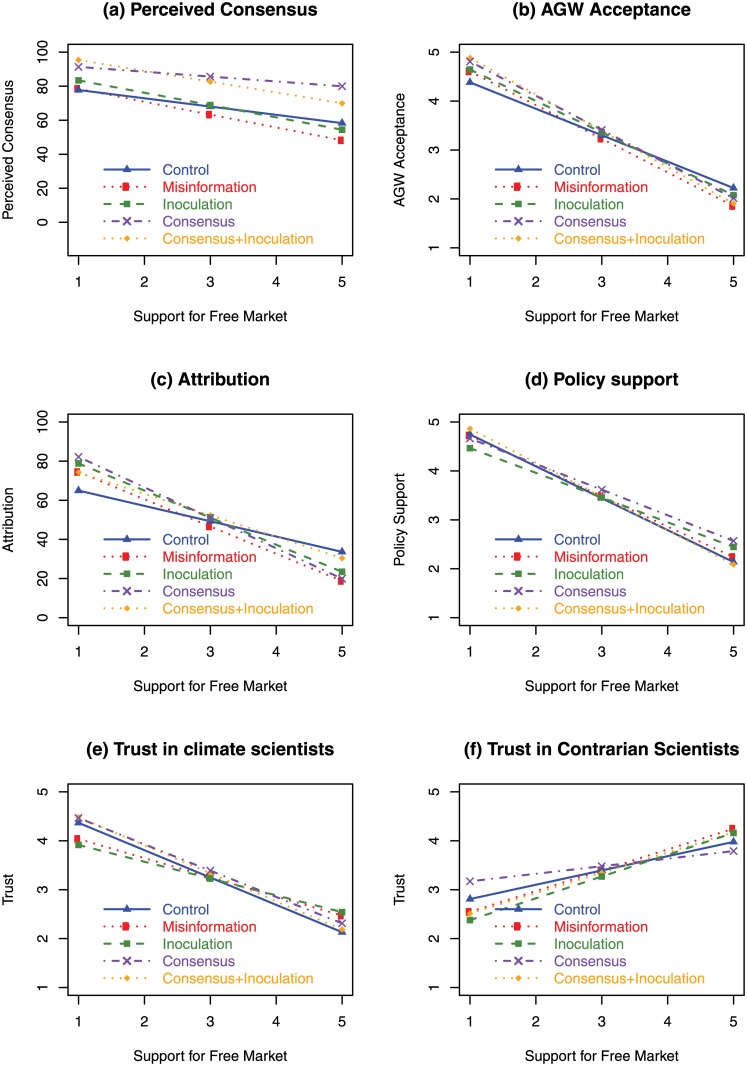
Misinformation can undermine a well-functioning democracy. For example, public misconceptions about climate change can lead to lowered acceptance of the reality of climate change and lowered support for mitigation policies. This study experimentally explored the impact of misinformation about climate change and tested several pre-emptive interventions designed to reduce the influence of misinformation. We found that false-balance media coverage (giving contrarian views equal voice with climate scientists) lowered perceived consensus overall, although the effect was greater among free-market supporters. Likewise, misinformation that confuses people about the level of scientific agreement regarding anthropogenic global warming (AGW) had a polarizing effect, with free-market supporters reducing their acceptance of AGW and those with low free-market support increasing their acceptance of AGW. However, we found that inoculating messages that (1) explain the flawed argumentation technique used in the misinformation or that (2) highlight the scientific consensus on climate change were effective in neutralizing those adverse effects of misinformation. We recommend that climate communication messages should take into account ways in which scientific content can be distorted, and include pre-emptive inoculation messages.
Overview
The claims and statistics of this paper haven’t been checked yet.
Free: it reads the open-access text and checks the first 5 claims that cite a source we can check. Create a free account to check every claim.
Integrity signals
Registry
Cites
Statistics
Figures

Verification
Claims the paper makes
The claims and statistics of this paper haven’t been checked yet.
Free: it reads the open-access text and checks the first 5 claims that cite a source we can check. Create a free account to check every claim.
Claims other papers make about this one
Each is checked against this paper’s own text: does it say what the citing paper says it does?
The check wasn’t confident either way, so it gives no verdict — never disputed.
In the citing paper
“Inoculation, while effective in preemptively refuting misinformation in specific domains (27–30), may not improve discernment when evaluating a diverse array of real-world news content.”
From A digital media literacy intervention increases discernment between mainstream and false news in the United States and India (2020) · cites this paper as [29]
Experimental — accuracy not yet measuredIn the citing paper
“focusing on the manipulation techniques and rhetorical strategies that underpin misinformation may significantly improve the potential scalability of inoculation interventions (17).”
From Psychological inoculation improves resilience against misinformation on social media (2022) · cites this paper as [17]
Self-check
Percentages, sums and reported differences re-computed from the paper’s own numbers.
The self-check needs the paper’s full text.
Citations
Cites
Maps of Bounded Rationality: Psychology for Behavioral Economics
Kahneman, D. (2003) · American Economic Review · doi:10.1257/000282803322655392 · Cited by 5,377
A Theory of Psychological Reactance
Torrance, E. P., & Brehm, J. W. (1968) · The American Journal of Psychology · doi:10.2307/1420824 · Cited by 4,759
Ohanian, R. (1990) · Journal of Advertising · doi:10.1080/00913367.1990.10673191 · Cited by 4,043
When Corrections Fail: The Persistence of Political Misperceptions
Nyhan, B., & Reifler, J. (2010) · Political Behavior · doi:10.1007/s11109-010-9112-2 · Cited by 3,173
Misinformation and Its Correction: Continued Influence and Successful Debiasing
Lewandowsky, S., Ecker, U. K. H., Seifert, C. M., Schwarz, N., & Cook, J. (2012) · Psychological Science in the Public Interest · doi:10.1177/1529100612451018 · Cited by 2,920
Self-citationMcCright, A. M., & Dunlap, R. E. (2011) · The Sociological Quarterly · doi:10.1111/j.1533-8525.2011.01198.x · Cited by 2,340
The Scientific Consensus on Climate Change
Oreskes, N. (2004) · Science · doi:10.1126/science.1103618 · Cited by 1,814
Balance as bias: global warming and the US prestige press
Boykoff, M. T., & Boykoff, J. M. (2004) · Global Environmental Change · doi:10.1016/j.gloenvcha.2003.10.001 · Cited by 1,699
Cultural cognition of scientific consensus.
Kahan, D. M., Jenkins‐Smith, H., & Braman, D. (2011) · Journal of Risk Research · doi:10.1080/13669877.2010.511246 · Cited by 1,686 · cited 1×
“Accordingly, climate change perceptions and attitudes have repeatedly been found to be strongly associated with political worldview [15,16,17,18].”
BackgroundConsensus on consensus: a synthesis of consensus estimates on human-caused global warming
Cook, J., Oreskes, N., Doran, P. T., Anderegg, W. R. L., Verheggen, B., Maibach, E. W., Carlton, J. S., Lewandowsky, S., Skuce, A. G., Green, S. A., et al. (2016) · Environmental Research Letters · doi:10.1088/1748-9326/11/4/048002 · Cited by 1,441
Self-citationQuantifying the consensus on anthropogenic global warming in the scientific literature
Cook, J., Nuccitelli, D., Green, S. A., Richardson, M., Winkler, B., Painting, R., Way, R., Jacobs, P., & Skuce, A. (2013) · Environmental Research Letters · doi:10.1088/1748-9326/8/2/024024 · Cited by 1,360
Self-citationInoculating the Public against Misinformation about Climate Change
van der Linden, S., Leiserowitz, A., Rosenthal, S., & Maibach, E. (2017) · Global Challenges · doi:10.1002/gch2.201600008 · Cited by 1,058
Expert credibility in climate change
Anderegg, W. R. L., Prall, J. W., Harold, J., & Schneider, S. H. (2010) · Proceedings of the National Academy of Sciences · doi:10.1073/pnas.1003187107 · Cited by 813
The Political Divide on Climate Change: Partisan Polarization Widens in the U.S.
Dunlap, R. E., McCright, A. M., & Yarosh, J. H. (2016) · Environment: Science and Policy for Sustainable Development · doi:10.1080/00139157.2016.1208995 · Cited by 786
Performance of Some Resistant Rules for Outlier Labeling
Hoaglin, D. C., Iglewicz, B., & Tukey, J. W. (1986) · Journal of the American Statistical Association · doi:10.1080/01621459.1986.10478363 · Cited by 773
The Role of Conspiracist Ideation and Worldviews in Predicting Rejection of Science
Lewandowsky, S., Gignac, G. E., & Oberauer, K. (2013) · PLoS ONE · doi:10.1371/journal.pone.0075637 · Cited by 693
Self-citationThe scientific consensus on climate change as a gateway belief: experimental evidence
van der Linden, S. L., Leiserowitz, A. A., Feinberg, G. D., & Maibach, E. W. (2015) · PLOS ONE · doi:10.1371/journal.pone.0118489 · Cited by 661
The SAGE Handbook of Persuasion: Developments in Theory and Practice
Dillard, J., & Shen, L. (2012) · Sage eBooks · doi:10.4135/9781452218410 · Cited by 650
Lewandowsky, S., Oberauer, K., & Gignac, G. E. (2013) · Psychological Science · doi:10.1177/0956797612457686 · Cited by 638 · cited 2×
“Rejection of climate change has been associated with conspiratorial thinking [17,20], and conspiratorial images are the most common reaction to climate change information amongst those who reject climate science [21].”
BackgroundSelf-citationMalka, A., Krosnick, J. A., & Langer, G. (2009) · Risk Analysis · doi:10.1111/j.1539-6924.2009.01220.x · Cited by 559
Examining the Scientific Consensus on Climate Change
Doran, P. T., & Zimmerman, M. K. (2009) · Eos, Transactions American Geophysical Union · doi:10.1029/2009eo030002 · Cited by 528
The pivotal role of perceived scientific consensus in acceptance of science
Lewandowsky, S., Gignac, G. E., & Vaughan, S. (2013) · Nature Climate Change · doi:10.1038/nclimate1720 · Cited by 527
Self-citationPerformance of Some Resistant Rules for Outlier Labeling
Hoaglin, D. C., Iglewicz, B., & Tukey, J. W. (1986) · Journal of the American Statistical Association · doi:10.2307/2289073 · Cited by 519
A Meta-Analysis of Research on Inoculation Theory
Banas, J. A., & Rains, S. A. (2010) · Communication Monographs · doi:10.1080/03637751003758193 · Cited by 510 · cited 1×
“, messages that promote accurate information without mentioning the misinformation) [44].”
BackgroundExplicit warnings reduce but do not eliminate the continued influence of misinformation
Ecker, U. K. H., Lewandowsky, S., & Tang, D. T. W. (2010) · Memory & Cognition · doi:10.3758/mc.38.8.1087 · Cited by 478
Self-citationMcGuire, W. J., & Papageorgis, D. (1961) · The Journal of Abnormal and Social Psychology · doi:10.1037/h0042026 · Cited by 476
Denialism: what is it and how should scientists respond?
Diethelm, P., & McKee, M. (2008) · The European Journal of Public Health · doi:10.1093/eurpub/ckn139 · Cited by 473
Free-Market Ideology and Environmental Degradation: The Case of Belief in Global Climate Change
Heath, Y., & Gifford, R. (2006) · Environment and Behavior · doi:10.1177/0013916505277998 · Cited by 473
Support for climate policy and societal action are linked to perceptions about scientific agreement
Ding, D., Maibach, E. W., Zhao, X., Roser-Renouf, C., & Leiserowitz, A. (2011) · Nature Climate Change · doi:10.1038/nclimate1295 · Cited by 441
Estimating the Lost Benefits of Antiretroviral Drug Use in South Africa
Chigwedere, P., Seage, G. R., Gruskin, S., Lee, T.-H., & Essex, M. (2008) · JAIDS Journal of Acquired Immune Deficiency Syndromes · doi:10.1097/qai.0b013e31818a6cd5 · Cited by 413
A Question of Balance: The Autism-Vaccine Controversy in the British and American Elite Press
Clarke, C. E. (2008) · Science Communication · doi:10.1177/1075547008320262 · Cited by 409
Berrens, R. P., Bohara, A. K., Jenkins-Smith, H., Silva, C., & Weimer, D. L. (2003) · Political Analysis · doi:10.1093/pan/11.1.1 · Cited by 364
Rational irrationality: modeling climate change belief polarization using Bayesian networks
Cook, J., & Lewandowsky, S. (2016) · Topics in Cognitive Science · doi:10.1111/tops.12186 · Cited by 332
Self-citationREFUTATION TEXT IN SCIENCE EDUCATION: A REVIEW OF TWO DECADES OF RESEARCH
Tippett, C. D. (2010) · International Journal of Science and Mathematics Education · doi:10.1007/s10763-010-9203-x · Cited by 324
Smith, N., & Leiserowitz, A. (2012) · Risk Analysis · doi:10.1111/j.1539-6924.2012.01801.x · Cited by 292
Reminders and Repetition of Misinformation: Helping or Hindering Its Retraction?
Ecker, U. K. H., Hogan, J. L., & Lewandowsky, S. (2017) · Journal of Applied Research in Memory and Cognition · doi:10.1016/j.jarmac.2017.01.014 · Cited by 280
Self-citationMcCright, A. M., Charters, M., Dentzman, K., & Dietz, T. (2016) · Topics in Cognitive Science · doi:10.1111/tops.12171 · Cited by 236
Cultural Cognition of Scientific Consensus
Kahan, D. M., Jenkins-Smith, H., & Braman, D. (2010) · SSRN Electronic Journal · doi:10.2139/ssrn.1549444 · Cited by 234
Banas, J. A., & Miller, G. (2013) · Human Communication Research · doi:10.1111/hcre.12000 · Cited by 233 · cited 1×
“Inoculation can reduce the influence of conspiracy theories by increasing the degree of scepticism towards conspiratorial claims [48], and has been shown to convey resistance to misinformation regarding agricultural biotechnology [49].”
BackgroundDixon, G. N., & Clarke, C. E. (2013) · Science Communication · doi:10.1177/1075547012458290 · Cited by 225
Conditioning effect of prior reputation on perception of corporate giving
Bae, J., & Cameron, G. T. (2006) · Public Relations Review · doi:10.1016/j.pubrev.2006.02.007 · Cited by 224
Rapp, D. N., & Braasch, J. L. G. (2014) · Cited by 216
Richter, T., Schroeder, S., & Wöhrmann, B. (2009) · Journal of Personality and Social Psychology · doi:10.1037/a0014038 · Cited by 212
Climate Change In The Media: Reporting Risk And Uncertainty
Painter, J. (2013) · I.B.Tauris eBooks · doi:10.5040/9780755694525 · Cited by 205
Can journalistic “false balance” distort public perception of consensus in expert opinion?
Koehler, D. J. (2016) · Journal of Experimental Psychology Applied · doi:10.1037/xap0000073 · Cited by 198
The Effect of Refuting Misconceptions in the Introductory Psychology Class
Kowalski, P., & Taylor, A. K. (2009) · Teaching of Psychology · doi:10.1080/00986280902959986 · Cited by 192
The Oxford Encyclopedia of Climate Change Communication
(2018) · Oxford Reference · doi:10.1093/acref/9780190498986.001.0001 · Cited by 192
Elsasser, S. W., & Dunlap, R. E. (2013) · American Behavioral Scientist · doi:10.1177/0002764212469800 · Cited by 175
Stocking, S. H., & Holstein, L. W. (2009) · Public Understanding of Science · doi:10.1177/0963662507079373 · Cited by 173
Smith, M. J., Ellenberg, S. S., Bell, L. M., & Rubin, D. M. (2008) · Pediatrics · doi:10.1542/peds.2007-1760 · Cited by 170
Poland, G. A., & Spier, R. (2010) · Vaccine · doi:10.1016/j.vaccine.2010.02.052 · Cited by 168
Memory for Fact, Fiction, and Misinformation: The Iraq War 2003
Lewandowsky, S., Stritzke, W. G. K., Oberauer, K., & Morales, M. (2005) · Psychological Science · doi:10.1111/j.0956-7976.2005.00802.x · Cited by 160
Self-citationUse of inoculation to promote resistance to smoking initiation among adolescents
Pfau, M. W., Bockern, S. V., & Kang, J. G. (1992) · Communication Monographs · doi:10.1080/03637759209376266 · Cited by 153
‘Ye Olde Hot Aire’: reporting on human contributions to climate change in the UK tabloid press
Boykoff, M., & Mansfield, M. R. (2008) · Environmental Research Letters · doi:10.1088/1748-9326/3/2/024002 · Cited by 152
The Effect of Information Provision on Public Consensus about Climate Change
Deryugina, T., & Shurchkov, O. (2016) · PLOS ONE · doi:10.1371/journal.pone.0151469 · Cited by 150
Miller, C. H., Ivanov, B., Sims, J. D., Compton, J., Harrison, K. J., Parker, K. A., Parker, J. L., & Averbeck, J. M. (2012) · Human Communication Research · doi:10.1111/j.1468-2958.2012.01438.x · Cited by 148
Saying the wrong thing: improving learning with multimedia by including misconceptions
Muller, D. A., Bewes, J., Sharma, M. D., & Reimann, P. (2008) · Journal of Computer Assisted Learning · doi:10.1111/j.1365-2729.2007.00248.x · Cited by 145 · cited 1×
“The research into the effectiveness of inoculating messages is consistent with education research suggesting that teaching approaches directly addressing misconceptions stimulate greater engagement with scientific concepts, which results in more effective and longer-lasting learning [70,71,72,73].”
BackgroundJohnson, T. J., Bichard, S. L., & Zhang, W. (2009) · Journal of Computer-Mediated Communication · doi:10.1111/j.1083-6101.2009.01492.x · Cited by 141
Substandard Vaccination Compliance and the 2015 Measles Outbreak
Majumder, M. S., Cohn, E. L., Mekaru, S. R., Huston, J. E., & Brownstein, J. S. (2015) · Archives of Pediatrics and Adolescent Medicine · doi:10.1001/jamapediatrics.2015.0384 · Cited by 134
Maibach, E. W., Myers, T. A., & Leiserowitz, A. (2014) · Earth s Future · doi:10.1002/2013ef000226 · Cited by 120
Rethinking the Inoculation Analogy: Effects on Subjects With Differing Preexisting Attitudes
Wood, M. L. M. (2007) · Human Communication Research · doi:10.1111/j.1468-2958.2007.00303.x · Cited by 103
Raising cognitive load with linear multimedia to promote conceptual change
Muller, D. A., Sharma, M. D., & Reimann, P. (2008) · Science Education · doi:10.1002/sce.20244 · Cited by 97
(2014) · The MIT Press eBooks · doi:10.7551/mitpress/9737.001.0001 · Cited by 97
“The Doctors’ Choice Is America’s Choice”
Gardner, M. N., & Brandt, A. M. (2006) · American Journal of Public Health · doi:10.2105/ajph.2005.066654 · Cited by 95
Measles still spreads in Europe: who is responsible for the failure to vaccinate?
Carrillo-Santisteve, P., & Lopalco, P. L. (2012) · Clinical Microbiology and Infection · doi:10.1111/j.1469-0691.2012.03982.x · Cited by 92
Climate Change in the Media: Reporting Risk and Uncertainty
PAINTER, J. E. (2013) · Oxford University Research Archive (ORA) (University of Oxford) · Cited by 91
Countering Climate Science Denial and Communicating Scientific Consensus
Cook, J. (2016) · Oxford University Press eBooks · doi:10.1093/acrefore/9780190228620.013.314 · Cited by 88
Self-citationAgnotology as a Teaching Tool: Learning Climate Science by Studying Misinformation
Bedford, D. (2010) · Journal of Geography · doi:10.1080/00221341.2010.498121 · Cited by 74
Kortenkamp, K. V., & Basten, B. (2015) · Science Communication · doi:10.1177/1075547015574016 · Cited by 68
Inoculation in Competitive Framing
Niederdeppe, J., Gollust, S. E., & Barry, C. L. (2014) · Public Opinion Quarterly · doi:10.1093/poq/nfu026 · Cited by 63
Cook, J., Bedford, D., & Mandia, S. A. (2014) · Journal of Geoscience Education · doi:10.5408/13-071.1 · Cited by 62
Self-citationDuryea, E. J. (1983) · Journal of School Health · doi:10.1111/j.1746-1561.1983.tb01139.x · Cited by 49
Mccuin, J. L., Hayhoe, K., & Hayhoe, D. (2014) · Journal of Geoscience Education · doi:10.5408/13-068.1 · Cited by 49
Stenhouse, N., Maibach, E. W., Cobb, S., Ban, R. J., Bleistein, A. J., Croft, P., Bierly, E., Seitter, K., Rasmussen, G., & Leiserowitz, A. (2013) · Bulletin of the American Meteorological Society · doi:10.1175/bams-d-13-00091.1 · Cited by 43
Cook, J., & Jacobs, P. (2015) · Figshare · doi:10.6084/m9.figshare.1534562.v1 · Cited by 25
Self-citationCook, J., & Jacobs, P. (2015) · Figshare · doi:10.6084/m9.figshare.1534562 · Cited by 25
Self-citationThe scientific consensus on climate change
Cook, J. (2013) · Europhysics news · doi:10.1051/epn/2013602 · Cited by 11
Self-citationMemory for fact, fiction and misinformation: The Iraq war 2003
Lewandowsky, S., Stritzke, W. G. K., Oberauer, K. (. D. )., & Morales, M. (2004) · Bristol Research (University of Bristol) · Cited by 3
Self-citation
Cited by
Pennycook, G., & Rand, D. G. (2019) · Cognition · doi:10.1016/j.cognition.2018.06.011 · Cited by 2,022
“Alternatively, adding a pre-emptive inoculation statement (Cook et al., 2017), such as a warning that not all news stories are accurate, may further increase the strength of the correlation between analytic thinking and media truth discernment.”
Beyond misinformation: Understanding and coping with the “post-truth” era.
Lewandowsky, S., Ecker, U. K. H., & Cook, J. (2017) · Journal of Applied Research in Memory and Cognition · doi:10.1016/j.jarmac.2017.07.008 · Cited by 1,985
“…for correcting misnformation are bound to remain helpful and necessary, and ffectively pointing out logical flaws in argumentation will coninue to be valuable in inoculating people against potential isinformation campaigns (Cook et al., 2017; Ecker, Hogan, & ewandowsky, 2017; Schwarz et al., 2016).”
BackgroundSelf-citationThe psychological drivers of misinformation belief and its resistance to correction
Ecker, U. K. H., Lewandowsky, S., Cook, J., Schmid, P., Fazio, L. K., Brashier, N., Kendeou, P., Vraga, E. K., & Amazeen, M. A. (2022) · Nature Reviews Psychology · doi:10.1038/s44159-021-00006-y · Cited by 1,372
Self-citationPennycook, G., & Rand, D. G. (2021) · Trends in Cognitive Sciences · doi:10.1016/j.tics.2021.02.007 · Cited by 1,360
“, in the context of climate change [103]) may be more scalable.”
BackgroundGuess, A. M., Lerner, M., Lyons, B., Montgomery, J. M., Nyhan, B., Reifler, J., & Sircar, N. (2020) · Proceedings of the National Academy of Sciences · doi:10.1073/pnas.1920498117 · Cited by 773
Metadata
- Authors
- Cook, J., Lewandowsky, S., & Ecker, U. K. H.
- Affiliations
- George Mason University (US)
- The University of Western Australia (AU)
- Corresponding author
- Cook, John
- Lewandowsky, Stephan
- Ecker, Ullrich K. H.
- Venue
- PLOS ONE
- Publisher
- Public Library of Science (PLoS)
- Published
- 2017-05-05
- Volume
- 12
- Issue
- 5
- Pages
- e0175799
- ISSN
- 1932-6203 (ISSN-L)
- PMC
- PMC5419564
- OpenAlex
- W2610353045
- Cited by
- 971
- References
- 80
- Citations by year
- 2026: 120 · 2025: 124 · 2024: 110 · 2023: 129 · 2022: 135 · 2021: 116 · 2020: 130 · 2019: 59 · 2018: 29 · 2017: 19
- FWCI
- 165.41
- Type
- journal article
- Language
- en
- Open access
- gold
- doi.org
- Licence
- Locations
- PLoS ONE (publishedVersion, cc-by)
- PubMed Central (publishedVersion, cc-by)
- UWA Profiles and Research Repository (UWA) (publishedVersion, cc-by)
- PubMed (publishedVersion)
- RePEc: Research Papers in Economics (submittedVersion)
- DOAJ (DOAJ: Directory of Open Access Journals) (submittedVersion, cc-by-sa)
- Figshare (submittedVersion, cc-by)
- Bristol Research (University of Bristol) (submittedVersion, cc-by)
- Explore Bristol Research (submittedVersion, cc-by)
- George Mason University (cc-by)
- Funders
- Australian Research Council
- Royal Society
- Psychonomics Society
- Topics
- Social Sciences › Sociology and Political Science › Climate Change Communication and Perception
- Social Sciences › Sociology and Political Science › Misinformation and Its Impacts
- Social Sciences › Economics, Econometrics and Finance › Economics and Econometrics › Climate Change Policy and Economics
- Keywords
- misinformation, inoculation, climate change misinformation, false balance, scientific consensus, anthropogenic climate change, free market ideology, political polarization, argumentation techniques, climate change communication
- MeSH terms
- Information Services, Climate Change
About these checks
Registry, retraction, Cites and statistics results are computed, not judged, with one exception: a printed reference that no index lists is read once by a model before it counts as a citation error. Claims are extracted by a model and kept only when their quote appears verbatim in the text; each cited source is then checked, with a model’s help, for whether it says what the claim relies on. Those verdicts can be wrong — read the claim’s quote and the cited source before relying on one.
Statistics and arithmetic are recomputed, not judged.
Confidence bands are shown only for fields calibrated on our annotated test set. None is calibrated yet, so no band is shown.
What counts as a claim ›How we measure confidence ›How we check this ›
Are you an author, or do you see a problem with this page? Request a review
Data sources
Bibliographic data: Semantic Scholar, OpenAlex, Crossref.
Contains information from the Semantic Scholar Academic Graph Datasets, made available under the ODC Attribution License (ODC-BY 1.0).
Semantic Scholar’s data is described in: Kinney, R., et al. (2023). The Semantic Scholar Open Data Platform. arXiv:2301.10140.
