

Candida auris: Epidemiology, biology, antifungal resistance, and virulence
Open accessThe DOI matches its Crossref record; 86 of the 86 references it cites were found in a registry or an index.
Abstract
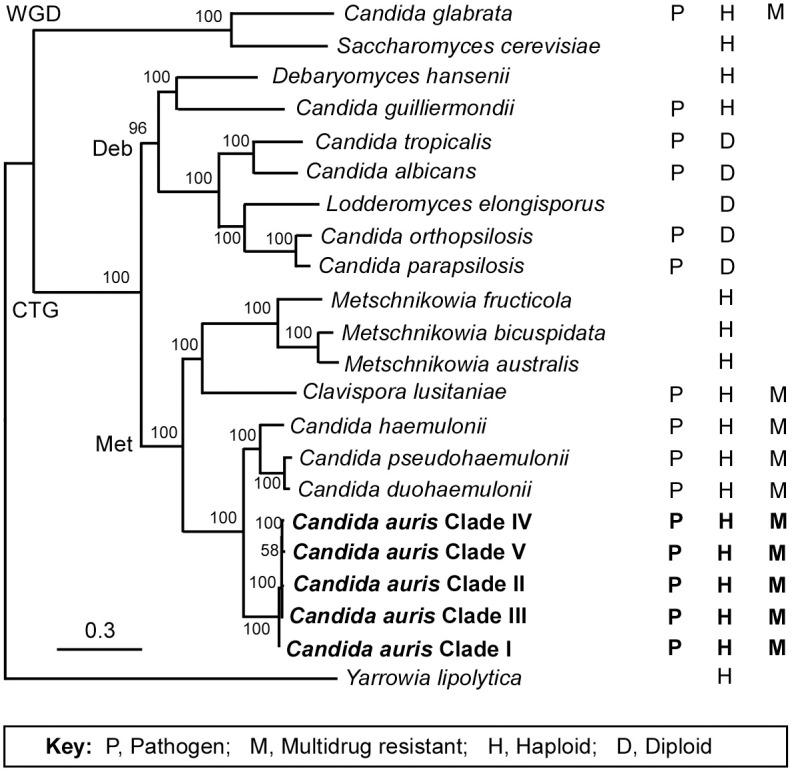
First described in 2009 in Japan, the emerging multidrug-resistant fungal pathogen Candida auris is becoming a worldwide public health threat that has been attracting considerable attention due to its rapid and widespread emergence over the past decade. The reasons behind the recent emergence of this fungus remain a mystery to date. Genetic analyses indicate that this fungal pathogen emerged simultaneously in several different continents, where 5 genetically distinct clades of C. auris were isolated from distinct geographical locations. Although C. auris belongs to the CTG clade (its constituent species translate the CTG codon as serine instead of leucine, as in the standard code), C. auris is a haploid fungal species that is more closely related to the haploid and often multidrug-resistant species Candida haemulonii and Candida lusitaniae and is distantly related to the diploid and clinically common fungal pathogens Candida albicans and Candida tropicalis. Infections and outbreaks caused by C. auris in hospitals settings have been rising over the past several years. Difficulty in its identification, multidrug resistance properties, evolution of virulence factors, associated high mortality rates in patients, and long-term survival on surfaces in the environment make C. auris particularly problematic in clinical settings. Here, we review progress made over the past decade on the biological and clinical aspects of C. auris. Future efforts should be directed toward understanding the mechanistic details of its biology, epidemiology, antifungal resistance, and pathogenesis with a goal of developing novel tools and methods for the prevention, diagnosis, and treatment of C. auris infections.
Overview
The claims and statistics of this paper haven’t been checked yet.
Free: it reads the open-access text and checks the first 5 claims that cite a source we can check. Create a free account to check every claim.
Integrity signals
Registry
Cites
Statistics
Figures
Verification
Claims the paper makes
The claims and statistics of this paper haven’t been checked yet.
Free: it reads the open-access text and checks the first 5 claims that cite a source we can check. Create a free account to check every claim.
Claims other papers make about this one
Each is checked against this paper’s own text: does it say what the citing paper says it does?
The source backs part of the claim, not all of it — or backs it for a different population, condition or comparison.
In the citing paper
“While resistance to FCZ or AmB is frequently observed among clade I isolates, the frequency of ECN resistance remains low at the moment (11, 12, 35).”
From Transcriptomics and Phenotyping Define Genetic Signatures Associated with Echinocandin Resistance in Candida auris (2022) · cites this paper as [35]
Experimental — accuracy not yet measuredThe source backs part of the claim, not all of it — or backs it for a different population, condition or comparison.
In the citing paper
“Since biofilms are often associated with increased persistence on the environmental surfaces and colonization on host skin4,5,11,49, this mutation could contribute to the prevalence and rapid transmission of C. auris.”
From The Wor2 phenotypic switching regulator controls biofilm formation in Candida auris (2026) · cites this paper as [4]
Experimental — accuracy not yet measuredThe cited source says what the claim attributes to it.
In the citing paper
“While resistance to FCZ or AmB is frequently observed among clade I isolates, the frequency of ECN resistance remains low at the moment (11, 12, 35).”
From Transcriptomics and Phenotyping Define Genetic Signatures Associated with Echinocandin Resistance in Candida auris (2022) · cites this paper as [35]
The cited source says what the claim attributes to it.
In the citing paper
“Clinical isolates of C. auris can exhibit different morphotypes such as filamentous, pseudohyphal, and yeast forms (8–14).”
From Yeast and filamentous Candida auris stimulate distinct immune responses in the skin (2024) · cites this paper as [11]
The cited source says what the claim attributes to it.
In the citing paper
“Clinical isolates of C. auris can exhibit different morphotypes, such as yeast, filamentous, and aggregative forms (9–13).”
From Cell aggregation mediated by ACE2 deletion in Candida auris modulates fungal colonization and host immune responses in the skin (2024) · cites this paper as [12]
1 more claim about this paper
Create a free account to see every claim other papers make about this one.
Self-check
Percentages, sums and reported differences re-computed from the paper’s own numbers.
The self-check needs the paper’s full text.
Citations
Cites
Bacterial biofilms: from the Natural environment to infectious diseases
Hall-Stoodley, L., Costerton, J. W., & Stoodley, P. (2004) · Nature Reviews Microbiology · doi:10.1038/nrmicro821 · Cited by 7,143
Wisplinghoff, H., Bischoff, T., Tallent, S. M., Seifert, H., Wenzel, R. P., & Edmond, M. B. (2004) · Clinical Infectious Diseases · doi:10.1086/421946 · Cited by 4,496 · cited 1×
“Candida species are the predominant cause of nosocomial fungal infections and are the fourth leading cause of all hospital-acquired infections [2].”
BackgroundHidden Killers: Human Fungal Infections
Brown, G. D., Denning, D. W., Gow, N. A. R., Levitz, S. M., Netea, M. G., & White, T. C. (2012) · Science Translational Medicine · doi:10.1126/scitranslmed.3004404 · Cited by 4,284
Epidemiology of Invasive Candidiasis: a Persistent Public Health Problem
Pfaller, M. A., & Diekema, D. J. (2007) · Clinical Microbiology Reviews · doi:10.1128/cmr.00029-06 · Cited by 4,174 · cited 1×
“Candida species is Candida albicans; however, the incidence of non-albicans species, such as Candida tropicalis, Candida parapsilosis, and Candida glabrata, has increased over recent decades due to the long-term use and limited options of antifungal drugs [3,4].”
BackgroundEmerging fungal threats to animal, plant and ecosystem health
Fisher, M. C., Henk, D. A., Briggs, C. J., Brownstein, J. S., Madoff, L. C., McCraw, S. L., & Gurr, S. J. (2012) · Nature · doi:10.1038/nature10947 · Cited by 3,310 · cited 1×
“It seems likely that novel fungal pathogens will similarly emerge in the future due to changes in global temperatures, atmospheric CO2 levels, humidity, and other alterations to natural environmental niches [84].”
BackgroundLockhart, S. R., Etienne, K. A., Vallabhaneni, S., Farooqi, J., Chowdhary, A., Govender, N. P., Colombo, A. L., Calvo, B., Cuomo, C. A., Desjardins, C. A., et al. (2017) · Clinical Infectious Diseases · doi:10.1093/cid/ciw691 · Cited by 1,662 · cited 14×
“The genome of C. auris B8441 was sequenced by the CDC [10], and its sequence information and annotation is available on the Candida Genome Database (CGD) database (https://www.candidagenome.org).”
BackgroundMethodInfluentialSatoh, K., Makimura, K., Hasumi, Y., Nishiyama, Y., Uchida, K., & Yamaguchi, H. (2009) · Microbiology and Immunology · doi:10.1111/j.1348-0421.2008.00083.x · Cited by 1,381 · cited 3×
“auris belongs to the Metschnikowiaceae family within the Candida/Clavispora clade (Fig 3) [5,13,14].”
BackgroundThe Fungi: 1, 2, 3 … 5.1 million species?
Blackwell, M. (2011) · American Journal of Botany · doi:10.3732/ajb.1000298 · Cited by 1,324
Candida albicans Biofilms and Human Disease
Nobile, C. J., & Johnson, A. D. (2015) · Annual Review of Microbiology · doi:10.1146/annurev-micro-091014-104330 · Cited by 1,057 · cited 1×
“Biofilms are structured microbial communities that form on abiotic and biotic surfaces and are embedded in an extracellular matrix [64].”
BackgroundSelf-citationFirst hospital outbreak of the globally emerging Candida auris in a European hospital
Schelenz, S., Hagen, F., Rhodes, J. L., Abdolrasouli, A., Chowdhary, A., Hall, A., Ryan, L., Shackleton, J., Trimlett, R., Meis, J. F., et al. (2016) · Antimicrobial Resistance & Infection Control · doi:10.1186/s13756-016-0132-5 · Cited by 768
Cited by
Items 501–600 of 619
Minlekib, C. P., Sow, D., Manga, I. A., Dia, M., Diouf, M. P. F., Lam, A., Fall, C. B., Lélo, S., Ndiaye, M., Sylla, K., et al. (2023) · Advances in Infectious Diseases · doi:10.4236/aid.2023.134044
Sousa, N. M. F., Ribeiro, A. M., & de Almeida, P. N. S. (2023) · doi:10.22533/at.ed.61723191021
CARACTERIZAÇÃO DOS CASOS NOTIFICADOS DE NEGLIGÊNCIA INFANTOJUVENIL NA REGIÃO DA FOZ DO RIO ITAJAÍ
Macedo, I. T. S. D., & de Quadros, D. C. R. (2023) · doi:10.22533/at.ed.6172319104
Candida auris – BIOLOGIA E CARACTERÍSTICAS
de Araújo, A. H. A., Silva, B. Y. V., Magalhães, H. I. F., & Ferreira, J. R. D. O. (2023) · doi:10.22533/at.ed.6172319108
BENEFÍCIOS IMUNOLÓGICOS DA VITAMINA D: UMA REVISÃO DA LITERATURA
Hernandes, E. L., Cardoso, A. B. C., da Silva, M. V. N., Mangiarini, C. B., Cezar, G. F. D. G., Júnior, P. R. H., Rosa, J. D. S., Hernandes, N. N. F., Machado, J. G. L. A., dos Santos, L. L. R., et al. (2023) · doi:10.22533/at.ed.61723191019
Neto, A. M. B., MOURA, A. L. G. D., Tavares, D. V., Costa, E. D. S., de Melo, L. V., Pereira, M. L. R., Pereira, N. S., VASCONCELOS, R. F. G. D., LIMA, R. I. B., Rodrigues, T. V. D. S., et al. (2023) · doi:10.22533/at.ed.61723191013
AUDITORIA HOSPITALAR E A DIMINUIÇÃO DAS GLOSAS HOSPITALARES
Borges, M. M., Carcuchinski, A. P. N., da Rocha, M. N. C., Träsel, M. J., Pastoriza, D. K., Mandicaju, A. D. A., Costa, F. B., Martins, E. J., Boniatti, B., de Melo, T. C., et al. (2023) · doi:10.22533/at.ed.6172319106
Ramos, I. F. D. S., Ramalho, T. C., Guedes, I. L., Carvalho, I. P. S., & Carvalho, A. L. M. (2023) · doi:10.22533/at.ed.6172319109
TRANSTORNO DE PERSONALIDADE LIMÍTROFE: UMA REVISÃO ABRANGENTE DA LITERATURA
de Almeida, M. C. D. M., de Oliveira, C. M. S., Júnior, P. R. H., Hernandes, N. N. F., & Sousa, N. B. E. (2023) · doi:10.22533/at.ed.6172319107
EFEITOS DOS ÓLEOS VEGETAIS SOBRE A FIBRA CAPILAR
Melo, J. G. D. S., Maciel, R. D. A., de Vasconcelos, T. C. L., & Lima, C. G. (2023) · doi:10.22533/at.ed.61723191014
Vitorio, E. O., Moita, M. D. D. C., Marinho, R. B., Branco, R. F. M. E., Vasconcelos, Y. A., Granato, R. R., Pereira, T. D. S., Sato, D. A., Zaffalon, J. R., Costa, P. M., et al. (2023) · doi:10.22533/at.ed.61723191012
MANIFESTAÇÕES DERMATOLÓGICAS ASSOCIADAS ÀS HEPATITES VIRAIS: UMA REVISÃO DA LITERATURA
dos Santos, V. O., de Oliveira, G. Q., Silva, M. A. D. S., de Paiva, Á. T., da Cunha, A. C. B. G., Júnior, P. R. H., Rosa, J. D. S., Hernandes, N. N. F., Bastos, R. M., & Ambrosio, R. D. (2023) · doi:10.22533/at.ed.61723191011
ESQUISTOSSOMOSE MANSÔNICA: COMPORTAMENTO ESPAÇOTEMPORAL EM UMA REGIÃO BRASILEIRA
Cafieiro, T. M., Sodré, N. S., Périco, E., da Silveira, E. F., & Schröder, N. T. (2023) · doi:10.22533/at.ed.61723191016
Amorim, A. C. A., Duarte, R. H., Leite, H. H. B., Duarte, W. E., Sousa, E. D. L. S., Palmeira, M. D. S., de Oliveira, J. C. C., de Sousa, L. R., Barbosa, E. D. S., & Pinho, J. D. (2023) · doi:10.22533/at.ed.6172319103
da Cunha, A. C. B. G., Silva, M. A. D. S., de Oliveira, G. Q., de Paiva, Á. T., dos Santos, V. O., Júnior, P. R. H., Rosa, J. D. S., Hernandes, N. N. F., Bastos, R. M., & Ambrosio, R. D. (2023) · doi:10.22533/at.ed.61723191010
IMUNOTERAPIA EM NEOPLASIAS HEMATOLÓGICAS: AVANÇOS E PERSPECTIVAS
Santos, J. S., Lima, L. B., Júnior, P. R. H., Hernandes, N. N. F., & Ferreira, C. V. (2023) · doi:10.22533/at.ed.61723191020
Dabbur, F. S., Omena, A. G. D. C., Vale, J. D. R., & Costa, J. R. D. M. (2023) · doi:10.22533/at.ed.6172319105
Lima, Y. P., Bastos, L. Q. D. A., Bastos, V. Q. D. A., Bastos, R. V., Bastos, Y. S., Bastos, A. N., MACHADO, A. B. F., WATANABE, A. S. A., DINIZ, C. G., da Silva, V. L., et al. (2023) · Editora Pasteur eBooks · doi:10.59290/978-65-6029-048-8.22 · Cited by 2
Eficiência de tecnologias limpas no controle da podridão azeda em laranja 'Lima'
da Silva, A. M. (2022) · doi:10.47749/t/unicamp.2022.1249746 · Cited by 1
The C. auris Epidemic: Understanding its Impact on ICU Patients
Ugemuge, P., Ugemuge, S., Mishra, V. H., & Tidake, A. A. (2023) · Journal of Pure and Applied Microbiology · doi:10.22207/jpam.17.4.57
Cornely, O. A., & Wisplinghoff, H. (2023) · Springer Reference Medizin · doi:10.1007/978-3-642-54676-1_539-3
Candida auris: um novo patógeno globalmente emergente
Perez, C. B. C., & Clímaco, E. C. (2024) · Revista Interdisciplinar de Saúde e Educação · doi:10.56344/2675-4827.v4n2a2023.9
Texis, A. P. E., Ocotitla, J. L., Olea, M. D. R. S., Gómez, E. V., & Mazzocco, T. S. (2024) · International Journal of Biological and Natural Sciences · doi:10.22533/at.ed.1594132423017
An overview of Candida auris in Iraq: the silent killer
Samaka, H. M. A., Mutlag, N. H., & Kareem, H. A. (2023) · Acta Scientiarum Biological Sciences · doi:10.4025/actascibiolsci.v45i1.68778
Geoenvironmental variables as causal cofactors of diseases of unknown etiology
Davies, T. C. (2024) · Elsevier eBooks · doi:10.1016/b978-0-12-818748-7.00013-7
Diverse Strategies and Evolutionary Histories of Fungal Pathogens
Gostinčar, C., & Gunde‐Cimerman, N. (2024) · Elsevier eBooks · doi:10.1016/b978-0-443-28818-0.00020-3
Role of biotechnology as a theranostic tool in infectious diseases
Singh, S., Hameed, S., & Ruwali, M. (2024) · Elsevier eBooks · doi:10.1016/b978-0-443-13337-4.00003-3
Chheda, P., Gupta, N., Shivaprakash, S., & Dama, T. (2024) · Journal of The Academy of Clinical Microbiologists · doi:10.5005/jacm-11020-0005
Schulz-Stübner, S. (2024) · Springer eBooks · doi:10.1007/978-3-662-68836-6_13
Erganiş, S., Şahin, E. A., Öztürk, A., Yıldız, P. A., Şahin, C., Top, Ö. Ö., & Tunçcan, Ö. G. (2024) · Akademisyen Kitabevi eBooks · doi:10.37609/akya.3202
RESISTÊNCIA DA CANDIDA AURIS AÓS AZÓLICOS
CHAGAS, R. M., & SILVA, L. V. D. S. (2024) · Congresso Brasileiro de Bacteriologia · doi:10.51161/bacterion2024/35560
Effectiveness of recombinant interferon alpha in prevention of candida infection in patients at risk
Zlobin, D. E., Gureeva, М. А., Molochkov, A. V., Мисникова, И. В., Yakubovskaya, E. S., Васильевна, П. И., Molochkov, V. A., & Гусева, Т. С. (2024) · Russian Journal of Clinical Dermatology and Venereology · doi:10.17116/klinderma202423041405
Vambe, M., Coopoosamy, R. M., Naidoo, K., & Theophilus, D. (2024) · Student s Journal of Health Research Africa · doi:10.51168/sjhrafrica.v5i9.1287
Alam, N., Emon, T. H., Hossain, M. A., Miah, M. A., Akter, F., Kader, M. A., Islam, M. N., & Mia, M. E. (2024) · Journal of Clinical and Experimental Investigations · doi:10.29333/jcei/15040
Science in Pharmacotherapy and Clinical Pharmacy in Brazil as Part of the Latin American Perspective
Bottacin, W. E., de Souza, T. T., & Reis, W. C. T. (2024) · doi:10.62922/4cbffc.cp001
Review of the Use of Phytotherapy as a Complement to the Treatment of Periodontal Diseases
Cypriano, G. F., Frickmann, F. D. S. E. S., & Souza, A. A. E. (2024) · doi:10.62922/4cbffc.cp080
Brito, S. P. D., Guimaraes, T. P., Coutinho, A. C. D. A., Sousa, M. H. A. D., & Moreno, M. (2024) · doi:10.62922/4cbffc.cp118
Biosocial Profile of Patients with Age-Related Macular Degeneration (AMD) Undergoing Ranibizumab
Gomes, B. A. Q., Silva, A. R. M. D., Maria, A. C. C. D., Melo, A. S., & Lima, J. G. B. (2024) · doi:10.62922/4cbffc.cp057
Новикова, В. В., Бобровская, О. В., & Гейн, В. Л. (2024) · Сибирский журнал клинической и экспериментальной медицины · doi:10.29001/2073-8552-2024-39-3-150-155
Antifungal treatment for oral candidiasis
Godoy, M. R., & Brusca, M. I. (2024) · Interamerican Journal of Health Sciences · doi:10.59471/ijhsc2025258
Oral candidiasis: differentiation of Candida spp strains and antifungal treatments
Godoy, M., & Brusca, M. I. (2024) · Interamerican Journal of Health Sciences · doi:10.59471/ijhsc2025249
Humadi, A. A., Sabeeh, S. I., Aldossary, A. T. Y., & Al-Kaisei, B. I. (2024) · Journal of Animal Health and Production · doi:10.17582/journal.jahp/2024/12.s1.61.66
Dissemination of Candida auris Biofilms: A Medical Abrosia
Gangwar, G., Singh, B., & Puria, R. (2024) · Springer eBooks · doi:10.1007/978-981-97-4909-6_10
Belfakir, M., Sherif, M., & Ádám, B. (2024) · medRxiv · doi:10.1101/2024.12.20.24319367
Features of Candida Auris: Pathogenicity, Risk Factors, Antibiotic Resistance, Preventive Measures
Chuvinova, I. V., & Belova, V. V. (2024) · Medicina · doi:10.29234/2308-9113-2024-12-4-133-148
Isolate Specific Transcriptome Changes Exerted by Isavuconazole Treatment in Candida auris
Balla, N., Kovács, F., Tóth, Z., Harmath, A., Bozó, A., Majoros, L., Kovács, R., & Jakab, Á. (2024) · Mycopathologia · doi:10.1007/s11046-024-00919-1 · Cited by 2
Domínguez, G. C. S., Gaona, N. B. O., Alfonso, L., Aguilar, G., & Quintero, L. (2024) · Pediatría (Asunción) · doi:10.31698/ped.51032024005 · Cited by 1
Bohner, F. (2024) · SZTE Repository of Dissertations (University of Szeged) · doi:10.14232/phd.12031
Editorial: Chemical-genetics to study microbial pathogen basis of infection and drug targets
Paul, A. S. (2025) · Frontiers in Cellular and Infection Microbiology · doi:10.3389/fcimb.2025.1582879
Neutrophils against pathogens of invasive mycoses: Conventional and nontraditional fighting tools
Анатольевна, М. Е., & Dolgushin, I. I. (2025) · Medical Immunology (Russia) · doi:10.15789/1563-0625-nap-3135
Das, S., Rawat, D., Ravinder, K., Praveen, K., & Ashish, W. (2025) · Journal of Clinical Microbiology and Biochemical Technology · doi:10.17352/jcmbt.000059
Unveiling the molecular architecture of Candida auris ribosome
Atamas, A., Stetsenko, A., Incarnato, D., Valero, A. M., Rogachev, A. V., Billerbeck, S., & Guskov, A. (2026) · Structure · doi:10.1016/j.str.2026.08.005
A Metalless and Fungicide-Free Material Against Candida: Glass-Loaded Hydrogels
Peiter, G. C., Salvador, E. D. S., Ayma, F. C., Teixeira, K. N., Jaerger, S., Bini, R. A., Busso, C., de Oliveira, R. J., & Schneider, R. (2025) · Pharmaceutics · doi:10.3390/pharmaceutics17070836
Prinzipien von Antimicrobial Stewardship
Sonnenberg, J., Keimburg, A. S., Krus, F., Wöhler, P., Vollenberg, R., Trebicka, J., Tepasse, P., & Fischer, J. (2025) · Die Dermatologie · doi:10.1007/s00105-025-05530-z
Multidrug resistance mechanisms and therapeutic strategies in Candida auris
Alkaabi, S. (2025) · International Journal of Research in Medical Sciences · doi:10.18203/2320-6012.ijrms20252187
Garcia-Diosa, J. A., Pothineni, B. K., & Keller, A. (2025) · bioRxiv (Cold Spring Harbor Laboratory) · doi:10.1101/2025.08.18.670777
Bacillus velezensis NC-B4 as a promising antifungal agent for biocontrol of Candida auris
Yang, C., Cui, C., Chen, Y., & Peng, Z. (2025) · Frontiers in Cellular and Infection Microbiology · doi:10.3389/fcimb.2025.1515537
Molecular Identification of Candida Species among Iranian Patients: Pursuing Candida auris
Safari, F., Madani, M., Zare, F., Ghahremanzadeh, A., Vaez, A., & Morovati, H. (2025) · Advanced Biomedical Research · doi:10.4103/abr.abr_678_24
Bader, S. J., Hamied, A. S., & Baqer, N. N. (2025) · Journal of Molecular Histology · doi:10.1007/s10735-025-10650-w
Almehdar, A. A. (2024) · Journal of International Crisis and Risk Communication Research · doi:10.63278/jicrcr.vi.3291
Morales-Ramírez, K. D. C., Cid-Pérez, T. S., Duarte-Escalante, E., Avelino-Flores, M. D. C. G., Ávila-Sosa, R., & Munguía-Pérez, R. (2025) · Journal of Health Population and Nutrition · doi:10.1186/s41043-025-01153-1
Epidemiology and Management of Antifungal-Resistant Bloodstream Infections in Healthcare Settings
Sayyouh, O. (2025) · Infectious diseases · doi:10.5772/intechopen.1012710 · Cited by 1
The Rise of Candida auris: A Global Health Threat
Warrier, A. R., & Moses, S. S. (2025) · Infectious diseases · doi:10.5772/intechopen.1012838 · Cited by 1
Imunologia & Doenças Infecciosas e Parasitárias - Ed IX
de Almeida, C. C., Freitas, G. B. L. D., Lopes, J. F. L., Lobato, G. C., Pereira, A. C. M., Silva, D. C. E., & de Oliveira, K. L. (2026) · Editora Pasteur eBooks · doi:10.59290/978-65-6029-315-1
Candida auris: vigilância, prevenção e manejo terapêutico frente à resistência emergente
PIRES, A. C., LIMA, C. B. D., Vicenzi, F. J., & RODRIGUES, R. S. D. A. (2026) · Editora Pasteur eBooks · doi:10.59290/5020619424
The macroevolution of filamentation morphology across the Saccharomycotina yeast subphylum
Chavez, C. M., Harrison, M., Danis, T., Groenewald, M., Hittinger, C. T., & Rokas, A. (2026) · FEMS Yeast Research · doi:10.1093/femsyr/foag001 · Cited by 2
Synergistic Effect of Moringa Leaves and Antifungal on Candida tropicalis
Hassan, H. E., & Alsheikly, A. M. (2025) · Medical Journal of Ahl al-Bayt University · doi:10.66068/mjaabu.v4i1.180
Turan, D., Sarmış, A., Adaleti, R., & Aksaray, S. (2026) · Infection and Drug Resistance · doi:10.2147/idr.s585235
Ji, Y., Gao, S., Zhang, Y., Zhang, Z., Liu, C., Shen, H., & Zhou, W. (2026) · BMC Microbiology · doi:10.1186/s12866-026-04976-y
Sowar, S. F., Acunin, R., Cabanalan, H. C., AlKhawaja, S. A. A., Dakheel, M. A., Darwish, H. I., Ahmed, J. A., & Naser, A. S. (2026) · Cureus · doi:10.7759/cureus.105859 · Cited by 1
Charlet, R. (2022) · theses.fr (ABES) · doi:10.70675/11b08f90z8d0dz43efz96ffzf2527c076034
The Epidemiology and Infection Control of Candida Auris in Shanghai
Wei, M., Guo, J., Li, L., ZHU, J., Xue, Y., Chen, G., Yang, F., Wu, W., & Zhu, M. (2026) · Mycoses · doi:10.1111/myc.70176
Schnell, N. A., Sickbert-Bennett, E. E., & Weber, D. J. (2026) · Current Epidemiology Reports · doi:10.1007/s40471-026-00392-y
Photoinactivation of Endogenous Chromophores in Wide-Ranging Pathogenic Microbes
Jusuf, S., Hui, J., & Dong, P. (2026) · Springer eBooks · doi:10.1007/978-3-031-55858-0_115-1
Liu, L. L., Niu, T., Zhang, T., Tan, D., Duan, X., & Li, X. (2026) · Microbiological Research · doi:10.1016/j.micres.2026.128542
A case report and review of diabetes foot infection caused by Candida duobushaemulonii
Men, W., & Shen, J. (2026) · Heliyon · doi:10.1016/j.heliyon.2026.e45031
Gupta, K. D., Quintanilla, D., Youssef, E. G., Gupta, K., Ibrahim, A. S., & Singh, S. (2026) · bioRxiv (Cold Spring Harbor Laboratory) · doi:10.64898/2026.05.24.727467 · Cited by 1
Marena, G. D., de Lima, L. C., do Nascimento, A. L. C. S., Carvalho, G. C., de Toledo, L. G., Chorilli, M., & Bauab, T. M. (2026) · Revista Iberoamericana de Micología · doi:10.1016/j.riam.2026.03.003
Candidozyma auris utilizes transferrin, but not heme-bound iron for in vivo virulencePreprint
Arekar, T., Katikaneni, D. S., Acharya, T., Horst, K., Zhao, G., Garcia, G., Hernalsteen, S., Weber, C. K., Gour, A., Punshnon, T., et al. (2026) · bioRxiv (Cold Spring Harbor Laboratory) · doi:10.64898/2026.06.09.731159
Candidiasis in the Era of COVID-19: Challenges, Treatment Approaches, and Research Priorities
Mallick, U., Sahu, B. K., Ray, A., Hegde, R., & Sahu, M. C. (2026) · Current Biotechnology · doi:10.2174/0122115501427698260608072051
Hameed, T., John, L. L. H., Bignell, E., & Tanaka, R. J. (2026) · bioRxiv (Cold Spring Harbor Laboratory) · doi:10.64898/2026.06.19.733372
Response to Wu et al “Clinical Potential of Antimicrobial Photodynamic Therapy”
Liu, X., Fang, W., & Ran, Y. (2026) · Journal of the American Academy of Dermatology · doi:10.1016/j.jaad.2026.06.095
Sepehri, S., Schindel, B., Silbert, S., Rowe, L., Marchese, A., Willison, E., Garner, O. B., Chandrasekaran, S., Berry, G. J., Chandrasekaran, A., et al. (2026) · Journal of Clinical Microbiology · doi:10.1128/jcm.01741-25
Amelia, R., Ahadi, G., & Firmansyah, D. (2026) · Medimuh Jurnal Kesehatan Muhammadiyah · doi:10.37874/mh.v7i1.2053
Awadh, A. A., Alsharif, A. A., Alahmari, S., Bannani, A. A., Albogami, M. F., Alzahrani, A. A., & Ghazali, A. Y. (2026) · Open Forum Infectious Diseases · doi:10.1093/ofid/ofag403
Pawlicki, B., Biernasiuk, A., Baj, T., Suśniak, K., & Malm, A. (2026) · Current Issues in Pharmacy and Medical Sciences · doi:10.12923/cipms-2026-0013
Sung, M., Chang, S., Leem, A. Y., Lee, C. H., Chung, K. S., Kim, Y. S., Kim, J. M., & Lee, S. H. (2026) · Journal of Fungi · doi:10.3390/jof12070495
Schelhorn, A., Achhammer, J., Hirsch, D., Walter, J.-C., Gruber, D., Kissmann, A., Rosenau, F., & Ziener, U. (2026) · ACS Omega · doi:10.1021/acsomega.6c02434
Şenol, F. F., Toraman, Z. A., Vural, U., Çelik, Z., Akkaya, Y., Çılkız, M., Erdin, B. N., Kırbağ, S., & Kılıç, İ. H. (2026) · Antibiotics · doi:10.3390/antibiotics15070692
da Rocha, I. F. M., Ennis, C. L., Romagnoli, B. A. A., Almeida, K. S., Rossi, S. A., da Costa, A. T., de Oliveira, H. C., Nobile, C. J., & Alves, L. R. (2026) · Current Research in Microbial Sciences · doi:10.1016/j.crmicr.2026.100645
Self-citationKöşker, C. F., Taşkın, G., Erdemir, M., Bozdaş, Ş., Gümral, R., Duyan, S., Özdemir, Ö. F., & Yamanel, L. (2026) · BMC Infectious Diseases · doi:10.1186/s12879-026-14028-5
Carneiro, J. N. P., dos Santos, A. G., Santos, E. D. S., Silva, F. D. S., de Freitas, M. A., da Silva, M. L. Q., dos Santos, A. T. L., Fonseca, V. J. A., Souza, G. G. D. O., da Silva, M. I., et al. (2026) · Microbial Pathogenesis · doi:10.1016/j.micpath.2026.108725
Osama, D., Alsedawy, M., Hussein, M. S., Hassan, M. A., Elrefaey, S. M., & Tawfick, M. M. (2026) · Antonie van Leeuwenhoek · doi:10.1007/s10482-026-02393-9
Circulation of fluconazole-resistant Candida auris in Peru confirmed by genomic analysis
Gago, R. P., Núñez-Llanos, A., Céspedes-Román, C., Izarra, V., Hurtado, V., Padilla, C., Cáceres, O., & Lizárraga, W. C. (2026) · Memórias do Instituto Oswaldo Cruz · doi:10.1590/0074-02760260027
Lagojda, L., Chambers, D., Cantrell, A. J., Bastounis, A., Booth, A., van Leeuwen, E., Mirfenderesky, M., & Manuel, R. J. (2026) · NIHR Open Research · doi:10.3310/nihropenres.14366.1
Ma, E. S.-K., Lai, R. W., Chuang, V. W., Shing, B. S.-Y., Lui, L., Hsu, E. K., Kiu, E., Chen, H., & Tsui, E. (2026) · Frontiers in Public Health · doi:10.3389/fpubh.2026.1899016
Liu, F.-Y., Chen, X.-F., Wang, Q., Dai, R.-C., Zhang, H., Zhu, H.-Q., Huang, Y.-Y., Zhao, Y.-Y., Liu, K.-Y., Kang, W., et al. (2026) · BMC Microbiology · doi:10.1186/s12866-026-05475-w
Metadata
- Authors
- Du, H., Bing, J., Hu, T., Ennis, C. L., Nobile, C. J., & Huang, G.
- Affiliations
- Fudan University (CN)
- University of California, Merced (US)
- Corresponding author
- Huang, Guanghua
- Venue
- PLOS Pathogens
- Publisher
- Public Library of Science (PLoS)
- Published
- 2020-10-22
- Volume
- 16
- Issue
- 10
- Pages
- e1008921
- ISSN
- 1553-7366 (ISSN-L)
- 1553-7374
- PMC
- PMC7581363
- OpenAlex
- W3093683101
- Cited by
- 609
- References
- 86
- Citations by year
- 2026: 76 · 2025: 105 · 2024: 110 · 2023: 139 · 2022: 126 · 2021: 53
- FWCI
- 3.77
- Type
- journal article
- Language
- en
- Open access
- gold
- doi.org
- Licence
- Locations
- PLoS Pathogens (publishedVersion, cc-by)
- PubMed Central (publishedVersion, cc-by)
- PubMed (publishedVersion)
- eScholarship (California Digital Library) (submittedVersion, cc-by)
- DOAJ (DOAJ: Directory of Open Access Journals) (submittedVersion, cc-by-sa)
- eScholarship (California Digital Library) (submittedVersion)
- Funders
- Natural Science Foundation of Shanghai (19ZR1405100)
- National Natural Science Foundation of China (31625002, 31930005)
- National Institutes of Health
- National Institute of General Medical Sciences (R35GM124594)
- National Institute of Allergy and Infectious Diseases (R21AI125801)
- National Institute of Dental and Craniofacial Research (F31DE028488)
- Topics
- Health Sciences › Medicine › Infectious Diseases › Antifungal resistance and susceptibility
- Life Sciences › Immunology and Microbiology › Microbiology › Yeasts and Rust Fungi Studies
- Health Sciences › Medicine › Infectious Diseases › Fungal Infections and Studies
- Keywords
- Candida auris, multidrug resistance, antifungal resistance, virulence factors, fungal pathogenesis, Candida haemulonii, Candida lusitaniae, Candida albicans, Candida tropicalis, hospital outbreak, fungal epidemiology, environmental survival, fungal identification, emerging fungal pathogens
- MeSH terms
- Antifungal Agents, Candida, Candidiasis, Saccharomycetales, Humans, Virulence, Drug Resistance, Fungal
About these checks
Registry, retraction, Cites and statistics results are computed, not judged, with one exception: a printed reference that no index lists is read once by a model before it counts as a citation error. Claims are extracted by a model and kept only when their quote appears verbatim in the text; each cited source is then checked, with a model’s help, for whether it says what the claim relies on. Those verdicts can be wrong — read the claim’s quote and the cited source before relying on one.
Statistics and arithmetic are recomputed, not judged.
Confidence bands are shown only for fields calibrated on our annotated test set. None is calibrated yet, so no band is shown.
What counts as a claim ›How we measure confidence ›How we check this ›
Are you an author, or do you see a problem with this page? Request a review
Data sources
Bibliographic data: Semantic Scholar, OpenAlex, Crossref.
Contains information from the Semantic Scholar Academic Graph Datasets, made available under the ODC Attribution License (ODC-BY 1.0).
Semantic Scholar’s data is described in: Kinney, R., et al. (2023). The Semantic Scholar Open Data Platform. arXiv:2301.10140.
