

The DOI matches its Crossref record; 52 of the 52 references it cites were found in a registry or an index.
Functional Magnetic Resonance Imaging Shows Oxytocin Activates Brain Regions Associated with Mother–Pup Bonding during Suckling
Open accessAbstract
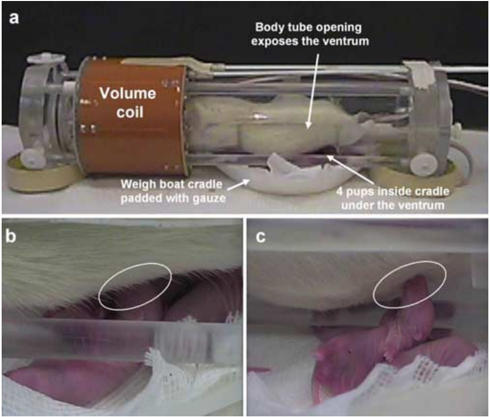
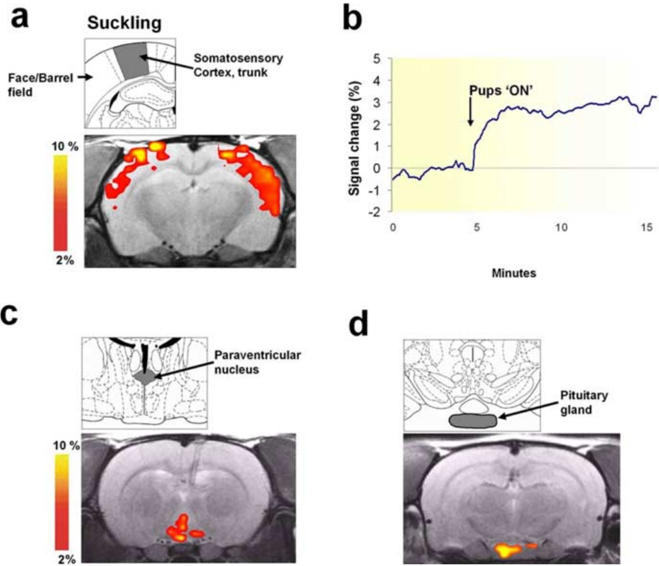
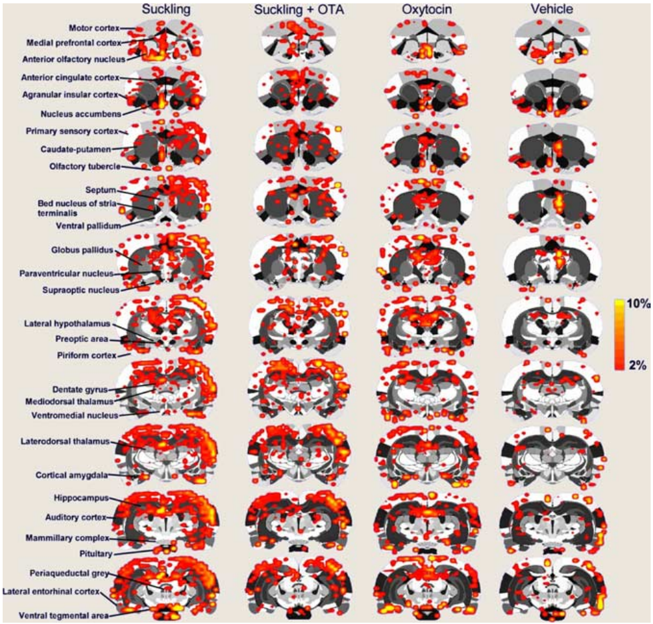
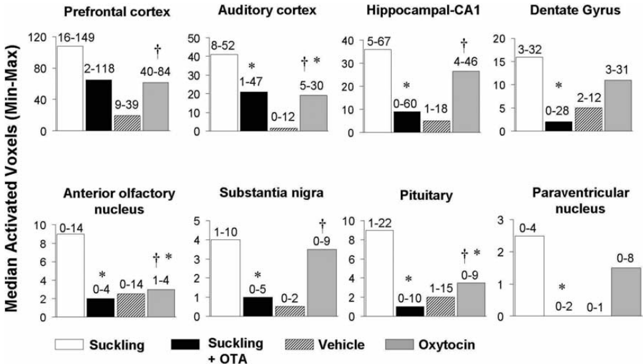
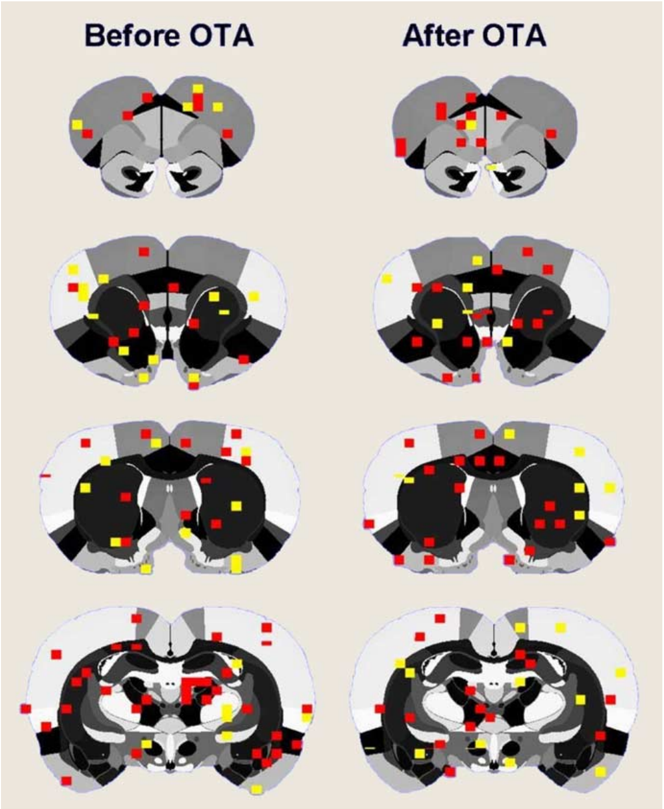
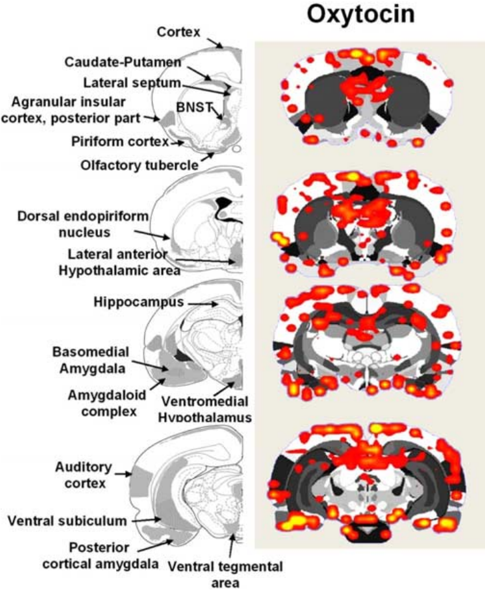
Oxytocin is released in the maternal brain during breastfeeding and may help strengthen the mother–infant relationship. Here, we used functional magnetic resonance imaging to determine whether oxytocin modulates brain activity in postpartum day 4–8 dams receiving suckling stimulation. During imaging sessions, dams were exposed to pup suckling before and after administration of an oxytocin receptor antagonist. Another group of dams received oxytocin alone. Changes in brain activation in response to suckling closely matched that elicited by oxytocin administration. The overlapping brain areas included the olfactory system, nucleus accumbens, insular cortex, prefrontal cortex, ventral tegmental area, cortical amygdala, and several cortical and hypothalamic nuclei. Blockade of oxytocin receptors largely attenuated activation in these regions. The data suggest that oxytocin may strengthen mother–infant bond formation partly by acting through brain areas involved in regulating olfactory discrimination, emotions, and reward.
Overview
The claims and statistics of this paper haven’t been checked yet.
Run the check — free, no account needed. It reads the open-access text and checks the sources it cites.
Integrity signals
Registry
Cites
Statistics
Figures
Verification
Claims the paper makes
The claims and statistics of this paper haven’t been checked yet.
Run the check — free, no account needed. It reads the open-access text and checks the sources it cites.
Claims other papers make about this one
Each is checked against this paper’s own text: does it say what the citing paper says it does?
In the citing paper
“The neuropeptide oxytocin can selectively gate cortical responses to infant stimuli to subsequently enable maternal care”
From Neuromodulation of maternal circuits by oxytocin (2019) · cites this paper as Febo et al., 2005
In the citing paper
“Brain imaging in rats when pup-suckling shows activations in the paraventricular nucleus of hypothalamus, olfactory tubercle, anterior olfactory nucleus, piriform cortex, amygdala, medial preoptic area, ventral tegmentum area, insular cortex and prefrontal cortex (27).”
From Neuroendocrinology of Parental Response to Baby‐Cry (2011) · cites this paper as [27]
Self-check
Percentages, sums and reported differences re-computed from the paper’s own numbers.
The self-check needs the paper’s full text.
Citations
Cites
The Rat Brain in Stereotaxic Coordinates
Paxinos, G., & Watson, C. (1983) · Elsevier eBooks · doi:10.1016/c2009-0-63235-9 · Cited by 28,585
Thresholding of statistical maps in functional neuroimaging using the false discovery rate
Genovese, C. R., Lazar, N. A., & Nichols, T. (2002) · NeuroImage · doi:10.1006/nimg.2001.1037 · Cited by 4,923
Brain Maps: Structure of the Rat Brain
Swanson, L. W. (1992) · Medical Entomology and Zoology · Cited by 1,878
Pedersen, C. A., & Prange, A. J. (1979) · Proceedings of the National Academy of Sciences · doi:10.1073/pnas.76.12.6661 · Cited by 841
Champagne, F., Diorio, J., Sharma, S., & Meaney, M. J. (2001) · Proceedings of the National Academy of Sciences · doi:10.1073/pnas.221224598 · Cited by 707
The Neurobiology of Parental Behavior
(2003) · Hormones, Brain, and Behavior · doi:10.1007/b97533 · Cited by 684
Self-citationSimerly, R. B., & Swanson, L. W. (1988) · The Journal of Comparative Neurology · doi:10.1002/cne.902700205 · Cited by 592
Price, J. L. (1973) · The Journal of Comparative Neurology · doi:10.1002/cne.901500105 · Cited by 530
Francis, D. D., Champagne, F. C., & Meaney, M. J. (2000) · Journal of Neuroendocrinology · doi:10.1046/j.1365-2826.2000.00599.x · Cited by 496
Pedersen, C. A., Caldwell, J. D., Walker, C., Ayers, G., & Mason, G. A. (1994) · Behavioral Neuroscience · doi:10.1037/0735-7044.108.6.1163 · Cited by 475
Research works printed but not linked: 5
- 1998, Neuroscience, 82, 267
- 10.1210/en.134.1.141 · DOI
- 1994, Acta Paediatr Suppl, 397, 19
- 10.1210/en.139.12.5015 · DOI · Paper page
- 10.1210/en.133.3.1239 · DOI · Paper page
Cited by
Sorted by citations
Lasting epigenetic influence of early-life adversity on the BDNF gene
Roth, T. L., Lubin, F. D., Funk, A. J., & Sweatt, J. D. (2009) · Biological Psychiatry · doi:10.1016/j.biopsych.2008.11.028 · Cited by 1,273
Insel, T. R. (2010) · Neuron · doi:10.1016/j.neuron.2010.03.005 · Cited by 1,044
Social touch and human development
Cascio, C. J., Moore, D., & McGlone, F. P. (2018) · Developmental Cognitive Neuroscience · doi:10.1016/j.dcn.2018.04.009 · Cited by 554
Swain, J. E., Lorberbaum, J. P., Kose, S., & Strathearn, L. (2007) · Journal of Child Psychology and Psychiatry · doi:10.1111/j.1469-7610.2007.01731.x · Cited by 499
Scott‐Van Zeeland, A. A., Dapretto, M., Ghahremani, D. G., Poldrack, R. A., & Bookheimer, S. Y. (2010) · Autism Research · doi:10.1002/aur.122 · Cited by 458
Metadata
- Authors
- Febo, M., Numan, M., & Ferris, C. F.
- Affiliations
- University of Massachusetts Chan Medical School (US)
- Boston College (US)
- Corresponding author
- Febo, Marcelo
- Venue
- The Journal of Neuroscience
- Publisher
- Society for Neuroscience
- Published
- 2005-12-14
- Volume
- 25
- Issue
- 50
- Pages
- 11637-11644
- ISSN
- 0270-6474 (ISSN-L)
- 1529-2401
- PMC
- PMC6726012
- OpenAlex
- W2168959320
- Cited by
- 197
- References
- 51
- Citations by year
- 2026: 3 · 2025: 4 · 2024: 2 · 2023: 5 · 2022: 7 · 2021: 8 · 2020: 3 · 2019: 5 · 2018: 9 · 2017: 9 · 2016: 10 · 2015: 12 · 2014: 21 · 2013: 10 · 2012: 14
- FWCI
- 7.15
- Type
- journal article
- Language
- en
- Open access
- hybrid
- doi.org
- Licence
- Locations
- Journal of Neuroscience (publishedVersion, cc-by-nc-sa)
- Europe PMC (PubMed Central) (publishedVersion)
- PubMed Central (publishedVersion)
- PubMed (publishedVersion)
- The Journal of the American Medical Association (JAMA) Network (American Medical Association) (submittedVersion)
- Funders
- National Science Foundation (0312380)
- National Institute on Drug Abuse (R01 DA13517, R01DA013517)
- Topics
- Life Sciences › Neuroscience › Endocrine and Autonomic Systems › Neuroendocrine regulation and behavior
- Health Sciences › Medicine › Pediatrics, Perinatology and Child Health › Infant Health and Development
- Life Sciences › Neuroscience › Sensory Systems › Olfactory and Sensory Function Studies
- Keywords
- oxytocin, suckling, mother-infant relationship, oxytocin receptor antagonist, olfactory system, nucleus accumbens, insula, prefrontal cortex, ventral tegmental area, cortical amygdala, hypothalamus, odor discrimination, reward, maternal behavior
- MeSH terms
- Animals, Animals, Suckling, Brain Mapping, Emotions, Female, Magnetic Resonance Imaging, Maternal Behavior, Object Attachment, Oxytocin, Reward, Rats, Sprague-Dawley, Receptors, Oxytocin, Rats
About these checks
Registry, retraction, Cites and statistics results are computed, not judged, with one exception: a printed reference that no index lists is read once by a model before it counts as a citation error. Claims are extracted by a model and kept only when their quote appears verbatim in the text; each cited source is then checked, with a model’s help, for whether it says what the claim relies on. Those verdicts can be wrong — read the claim’s quote and the cited source before relying on one.
Statistics and arithmetic are recomputed, not judged.
Confidence bands are shown only for fields calibrated on our annotated test set. None is calibrated yet, so no band is shown.
What counts as a claim ›How we measure confidence ›How we check this ›
Are you an author, or do you see a problem with this page? Request a review
