

The DOI matches its Crossref record; 7 of the 7 references it cites were found in a registry or an index.
Performance of the Cas9 Nickase System in Drosophila melanogaster
Abstract
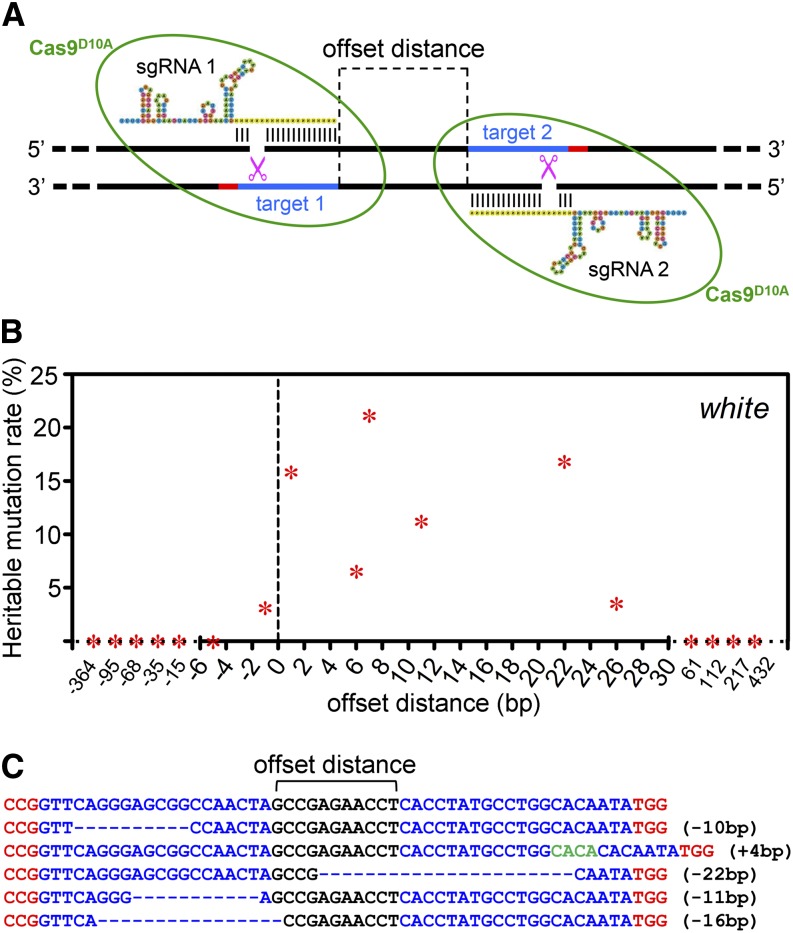
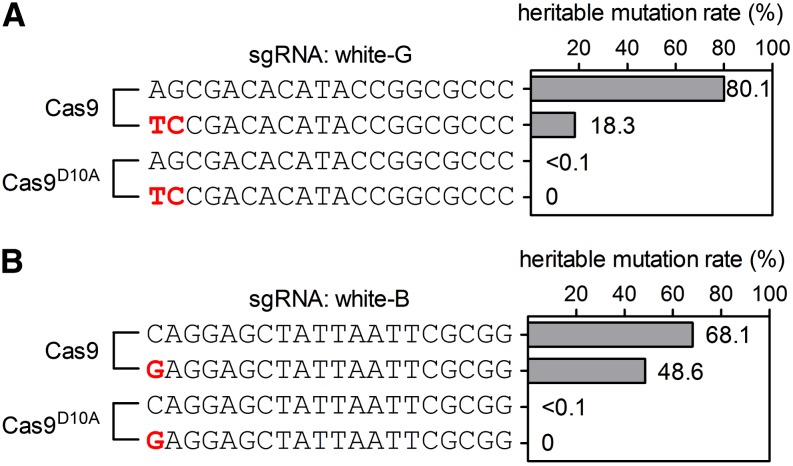
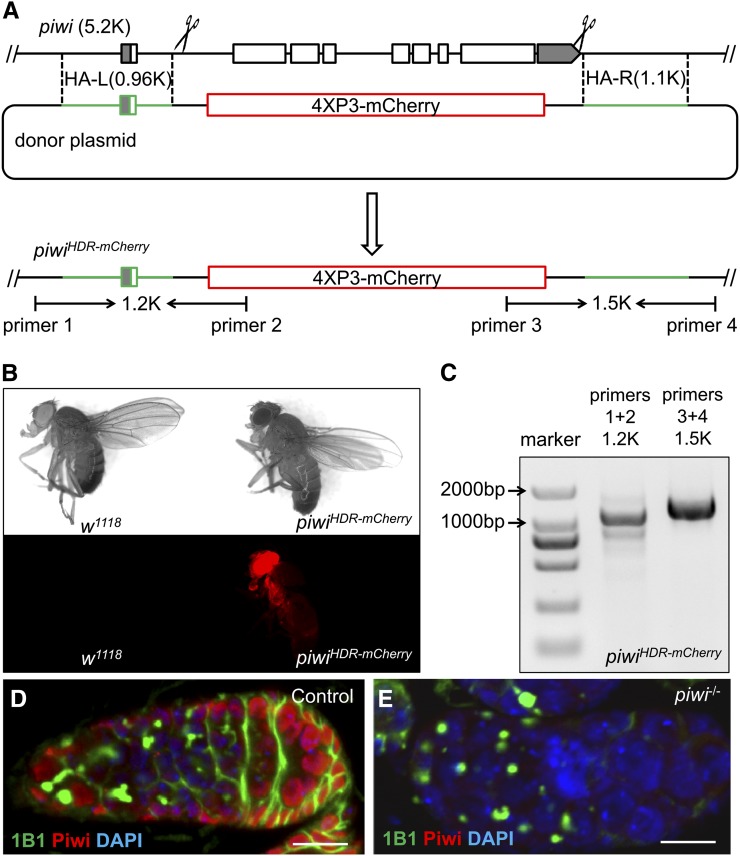
Recent studies of the Cas9/sgRNA system in Drosophila melanogaster genome editing have opened new opportunities to generate site-specific mutant collections in a high-throughput manner. However, off-target effects of the system are still a major concern when analyzing mutant phenotypes. Mutations converting Cas9 to a DNA nickase have great potential for reducing off-target effects in vitro. Here, we demonstrated that injection of two plasmids encoding neighboring offset sgRNAs into transgenic Cas9D10A nickase flies efficiently produces heritable indel mutants. We then determined the effective distance between the two sgRNA targets and their orientations that affected the ability of the sgRNA pairs to generate mutations when expressed in the transgenic nickase flies. Interestingly, Cas9 nickase greatly reduces the ability to generate mutants with one sgRNA, suggesting that the application of Cas9 nickase and sgRNA pairs can almost avoid off-target effects when generating indel mutants. Finally, a defined piwi mutant allele is generated with this system through homology-directed repair. However, Cas9D10A is not as effective as Cas9 in replacing the entire coding sequence of piwi with two sgRNAs.
Overview
The claims and statistics of this paper haven’t been checked yet.
Run the check — free, no account needed. It reads the open-access text and checks the sources it cites.
Integrity signals
Registry
Cites
Statistics
Figures
Verification
Claims the paper makes
The claims and statistics of this paper haven’t been checked yet.
Run the check — free, no account needed. It reads the open-access text and checks the sources it cites.
Claims other papers make about this one
Each is checked against this paper’s own text: does it say what the citing paper says it does?
The source backs part of the claim, not all of it — or backs it for a different population, condition or comparison.
In the citing paper
“which can lead to highly specific gene edits when combined with HDR, or originate precise deletions in critical alleles through NHEJ [128,129].”
From CRISPR-Cas: Converting A Bacterial Defence Mechanism into A State-of-the-Art Genetic Manipulation Tool (2019) · cites this paper as [128]
Experimental — accuracy not yet measuredThe source backs part of the claim, not all of it — or backs it for a different population, condition or comparison.
In the citing paper
“The pairing of Cas9n systems results in DSBs with gRNA-defined overhangs”
From CRISPR-Cas: Converting A Bacterial Defence Mechanism into A State-of-the-Art Genetic Manipulation Tool (2019) · cites this paper as [128]
Experimental — accuracy not yet measured
Self-check
Percentages, sums and reported differences re-computed from the paper’s own numbers.
The self-check needs the paper’s full text.
Citations
Cites
CRISPR RNA Maturation by Trans-Encoded Small RNA and Host Factor RNase III
Deltcheva, E., Chylinski, K., Sharma, C. M., Gonzales, K., Chao, Y., Pirzada, Z. A., Eckert, M. R., Vogel, J., & Charpentier, E. (2011) · Nature · doi:10.1038/nature09886 · Cited by 2,563
Crystal structure of Cas9 in complex with guide RNA and target DNA
Nishimasu, H., Ran, F. A., Hsu, P. D., Konermann, S., Shehata, S. I., Dohmae, N., Ishitani, R., Zhang, F., & Nureki, O. (2014) · Cell · doi:10.1016/j.cell.2014.02.001 · Cited by 2,306
RNA-guided genetic silencing systems in bacteria and archaea
Wiedenheft, B., Sternberg, S. H., & Doudna, J. A. (2012) · Nature · doi:10.1038/nature10886 · Cited by 1,851
A germline-specific class of small RNAs binds mammalian Piwi proteins
Girard, A., Sachidanandam, R., Hannon, G. J., & Carmell, M. A. (2006) · Nature · doi:10.1038/nature04917 · Cited by 1,762
Mali, P., Aach, J., Stranges, P. B., Esvelt, K. M., Moosburner, M., Kosuri, S., Yang, L., & Church, G. M. (2013) · Nature Biotechnology · doi:10.1038/nbt.2675 · Cited by 1,752 · cited 17×
“In addition, we have observed that one sgRNA does not trigger mutations in Cas9 nickase transgenic flies, suggesting that the Cas9 nickase system significantly prevents offtarget effects.”
BackgroundInfluentialStructures of Cas9 endonucleases reveal RNA-mediated conformational activation
Jinek, M., Jiang, F., Taylor, D. W., Sternberg, S. H., Kaya, E., Ma, E., Anders, C., Hauer, M., Zhou, K., Lin, S., et al. (2014) · Science · doi:10.1126/science.1247997 · Cited by 1,230
Optimized CRISPR/Cas tools for efficient germline and somatic genome engineering in Drosophila
Port, F., Chen, H.-M., Lee, T., & Bullock, S. L. (2014) · Proceedings of the National Academy of Sciences · doi:10.1073/pnas.1405500111 · Cited by 1,046
Research works printed but not linked: 43
- Aravin, 2006, A novel class of small RNAs bind to MILI protein in mouse testes., Nature, 442, 203, 10.1038/nature04916 · DOI · Paper page
- Baena-Lopez, 2013, Accelerated homologous recombination and subsequent genome modification in Drosophila., Development, 140, 4818, 10.1242/dev.100933 · DOI
- Bassett, 2013, Highly efficient targeted mutagenesis of Drosophila with the CRISPR/Cas9 system., Cell Reports, 4, 220, 10.1016/j.celrep.2013.06.020 · DOI
- Bhaya, 2011, CRISPR-Cas systems in bacteria and archaea: versatile small RNAs for adaptive defense and regulation., Annu. Rev. Genet., 45, 273, 10.1146/annurev-genet-110410-132430 · DOI · Paper page
- Certo, 2011, Tracking genome engineering outcome at individual DNA breakpoints., Nat. Methods, 8, 671, 10.1038/nmeth.1648 · DOI
- Chan, 2011, Natural and engineered nicking endonucleases–from cleavage mechanism to engineering of strand-specificity., Nucleic Acids Res., 39, 1, 10.1093/nar/gkq742 · DOI
- Cho, 2014, Analysis of off-target effects of CRISPR/Cas-derived RNA-guided endonucleases and nickases., Genome Res., 24, 132, 10.1101/gr.162339.113 · DOI · Paper page
- Cong, 2013, Multiplex genome engineering using CRISPR/Cas systems., Science, 339, 819, 10.1126/science.1231143 · DOI · Paper page
- Cox, 1998, A novel class of evolutionarily conserved genes defined by piwi are essential for stem cell self-renewal., Genes Dev., 12, 3715, 10.1101/gad.12.23.3715 · DOI
- Davis, 2011, DNA nicks promote efficient and safe targeted gene correction., PLoS ONE, 6, e23981, 10.1371/journal.pone.0023981 · DOI
- Deveau, 2010, CRISPR/Cas system and its role in phage-bacteria interactions., Annu. Rev. Microbiol., 64, 475, 10.1146/annurev.micro.112408.134123 · DOI
- Fu, 2013, High-frequency off-target mutagenesis induced by CRISPR-Cas nucleases in human cells., Nat. Biotechnol., 31, 822, 10.1038/nbt.2623 · DOI · Paper page
- Gabsalilow, 2013, Site- and strand-specific nicking of DNA by fusion proteins derived from MutH and I-SceI or TALE repeats., Nucleic Acids Res., 41, e83, 10.1093/nar/gkt080 · DOI
- Gasiunas, 2012, Cas9-crRNA ribonucleoprotein complex mediates specific DNA cleavage for adaptive immunity in bacteria., Proc. Natl. Acad. Sci. USA, 109, E2579, 10.1073/pnas.1208507109 · DOI · Paper page
- Gratz, 2013, Genome engineering of Drosophila with the CRISPR RNA-guided Cas9 nuclease., Genetics, 194, 1029, 10.1534/genetics.113.152710 · DOI
- Gratz, 2014, Highly specific and efficient CRISPR/Cas9-catalyzed homology-directed repair in Drosophila., Genetics, 196, 961, 10.1534/genetics.113.160713 · DOI
- Grivna, 2006, A novel class of small RNAs in mouse spermatogenic cells., Genes Dev., 20, 1709, 10.1101/gad.1434406 · DOI
- Horn, 2000, Highly sensitive, fluorescent transformation marker for Drosophila transgenesis., Dev. Genes Evol., 210, 623, 10.1007/s004270000111 · DOI
- Hsu, 2013, DNA targeting specificity of RNA-guided Cas9 nucleases., Nat. Biotechnol., 31, 827, 10.1038/nbt.2647 · DOI · Paper page
- Jin, 2013, Drosophila piwi mutants exhibit germline stem cell tumors that are sustained by elevated Dpp signaling., Curr. Biol., 23, 1442, 10.1016/j.cub.2013.06.021 · DOI
- Jinek, 2012, A programmable dual-RNA-guided DNA endonuclease in adaptive bacterial immunity., Science, 337, 816, 10.1126/science.1225829 · DOI · Paper page
- Katz, 2014, To nick or not to nick: Comparison of I-SceI single- and double-strand break-induced recombination in yeast and human cells., PLoS ONE, 9, e88840, 10.1371/journal.pone.0088840 · DOI
- Kim, 2012, Precision genome engineering with programmable DNA-nicking enzymes., Genome Res., 22, 1327, 10.1101/gr.138792.112 · DOI
- Kondo, 2013, Highly improved gene targeting by germline-specific cas9 expression in Drosophila., Genetics, 195, 715, 10.1534/genetics.113.156737 · DOI
- Lau, 2006, Characterization of the piRNA complex from rat testes., Science, 313, 363, 10.1126/science.1130164 · DOI
- Lin, 1997, A novel group of pumilio mutations affects the asymmetric division of germline stem cells in the Drosophila ovary., Development, 124, 2463, 10.1242/dev.124.12.2463 · DOI
- Ma, 2014, Piwi is required in multiple cell types to control germline stem cell lineage development in the Drosophila ovary., PLoS ONE, 9, e90267, 10.1371/journal.pone.0090267 · DOI
- Mali, 2013, RNA-guided human genome engineering via Cas9., Science, 339, 823, 10.1126/science.1232033 · DOI · Paper page
- Malone, 2009, Specialized piRNA pathways act in germline and somatic tissues of the Drosophila ovary., Cell, 137, 522, 10.1016/j.cell.2009.03.040 · DOI
- McConnell, 2009, Generation of a nicking enzyme that stimulates site-specific gene conversion from the I-AniI LAGLIDADG homing endonuclease., Proc. Natl. Acad. Sci. USA, 106, 5099, 10.1073/pnas.0810588106 · DOI
- Megosh, 2006, The role of PIWI and the miRNA machinery in Drosophila germline determination., Curr. Biol., 16, 1884, 10.1016/j.cub.2006.08.051 · DOI
- Metzger, 2011, Single-strand nicks induce homologous recombination with less toxicity than double-strand breaks using an AAV vector template., Nucleic Acids Res., 39, 926, 10.1093/nar/gkq826 · DOI
- Ni, 2008, Vector and parameters for targeted transgenic RNA interference in Drosophila melanogaster., Nat. Methods, 5, 49, 10.1038/nmeth1146 · DOI
- Ramirez, 2012, Engineered zinc finger nickases induce homology-directed repair with reduced mutagenic effects., Nucleic Acids Res., 40, 5560, 10.1093/nar/gks179 · DOI
- Ran, 2013, Double nicking by RNA-guided CRISPR Cas9 for enhanced genome editing specificity., Cell, 154, 1380, 10.1016/j.cell.2013.08.021 · DOI · Paper page
- Ren, 2013, Optimized gene editing technology for Drosophila melanogaster using germ line-specific Cas9., Proc. Natl. Acad. Sci. USA, 110, 19012, 10.1073/pnas.1318481110 · DOI
- Sebo, 2013, A simplified and efficient germline-specific CRISPR/Cas9 system for Drosophila genomic engineering., Fly (Austin), 8, 52–57
- Szakmary, 2005, Regulatory relationship among piwi, pumilio, and bag-of-marbles in Drosophila germline stem cell self-renewal and differentiation., Curr. Biol., 15, 171, 10.1016/j.cub.2005.01.005 · DOI
- Terns, 2011, CRISPR-based adaptive immune systems., Curr. Opin. Microbiol., 14, 321, 10.1016/j.mib.2011.03.005 · DOI
- van Nierop, 2009, Stimulation of homology-directed gene targeting at an endogenous human locus by a nicking endonuclease., Nucleic Acids Res., 37, 5725, 10.1093/nar/gkp643 · DOI
- Xu, 2013, Natural zinc ribbon HNH endonucleases and engineered zinc finger nicking endonuclease., Nucleic Acids Res., 41, 378, 10.1093/nar/gks1043 · DOI
- Yu, 2014, Various applications of TALEN- and CRISPR/Cas9-mediated homologous recombination to modify the Drosophila genome., Biol. Open, 3, 271, 10.1242/bio.20147682 · DOI
- Yu, 2013, Highly efficient genome modifications mediated by CRISPR/Cas9 in Drosophila., Genetics, 195, 289, 10.1534/genetics.113.153825 · DOI
Cited by
Sorted by citations
A CRISPR/Cas9 Toolbox for Multiplexed Plant Genome Editing and Transcriptional Regulation
Lowder, L. G., Zhang, D., Baltes, N. J., Paul, J. W., Tang, X., Zheng, X., Voytas, D. F., Hsieh, T.-F., Zhang, Y., & Qi, Y. (2015) · Plant Physiology · doi:10.1104/pp.15.00636 · Cited by 707
Molecular recording of mammalian embryogenesis
Chan, M. M., Smith, Z. D., Grosswendt, S., Kretzmer, H., Norman, T. M., Adamson, B., Jost, M., Quinn, J. J., Yang, D., Jones, M. G., et al. (2019) · Nature · doi:10.1038/s41586-019-1184-5 · Cited by 364
Loureiro, A., & da Silva, G. J. (2019) · Antibiotics · doi:10.3390/antibiotics8010018 · Cited by 129
Metadata
- Authors
- Ren, X., Yang, Z., Mao, D., Chang, Z., Qiao, H.-H., Wang, X., Sun, J., Hu, Q., Cui, Y., Liu, L.-P., Ji, J.-Y., Xu, J., & Ni, J.-Q.
- Affiliations
- Gene Regulatory Lab, School of Medicine, Tsinghua University, Beijing 100084, China
- School of Life Sciences, Tsinghua University, Beijing 100084, China
- Tsinghua Fly Center, Tsinghua University, Beijing 100084, China
- Department of Molecular and Cellular Medicine, College of Medicine, Texas A&M Health Science Center, College Station, Texas 77843
- Venue
- G3 Genes|Genomes|Genetics
- Publisher
- Oxford University Press (OUP)
- Published
- 2014-10-01
- Volume
- 4
- Issue
- 10
- Pages
- 1955-1962
- ISSN
- 2160-1836
- PMC
- PMC4199701
- Cited by
- 40
- References
- 7
- Language
- en
About these checks
Registry, retraction, Cites and statistics results are computed, not judged, with one exception: a printed reference that no index lists is read once by a model before it counts as a citation error. Claims are extracted by a model and kept only when their quote appears verbatim in the text; each cited source is then checked, with a model’s help, for whether it says what the claim relies on. Those verdicts can be wrong — read the claim’s quote and the cited source before relying on one.
Statistics and arithmetic are recomputed, not judged.
Confidence bands are shown only for fields calibrated on our annotated test set. None is calibrated yet, so no band is shown.
What counts as a claim ›How we measure confidence ›How we check this ›
Are you an author, or do you see a problem with this page? Request a review
