

Is Attention Interpretable?
Open accessThe DOI matches its Crossref record; 43 of the 43 references it cites were found in a registry or an index.
Abstract
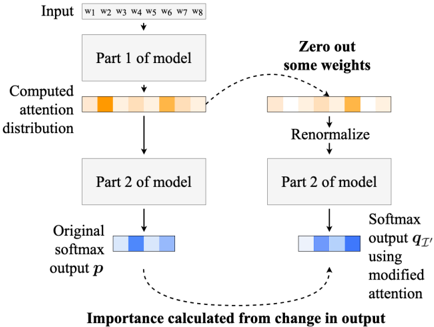
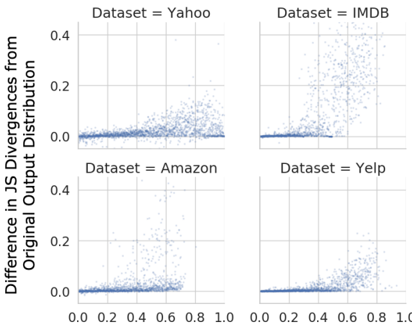
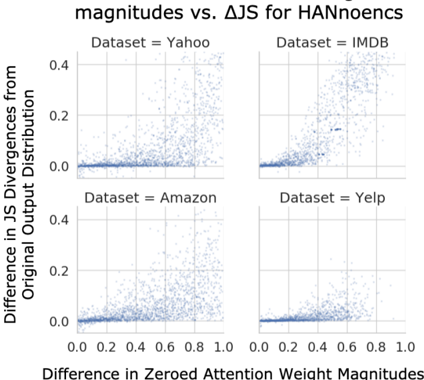
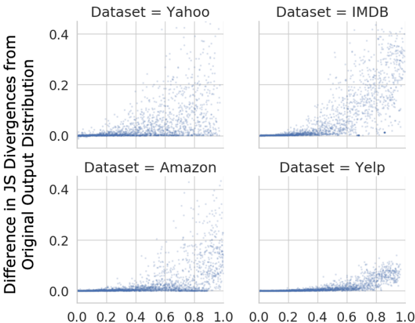
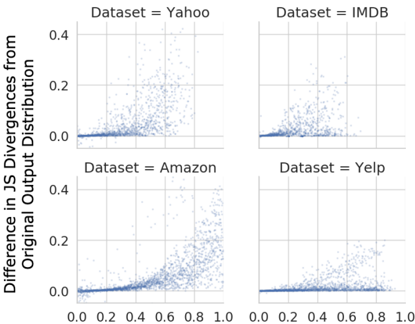
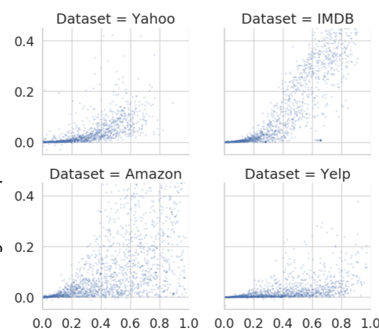
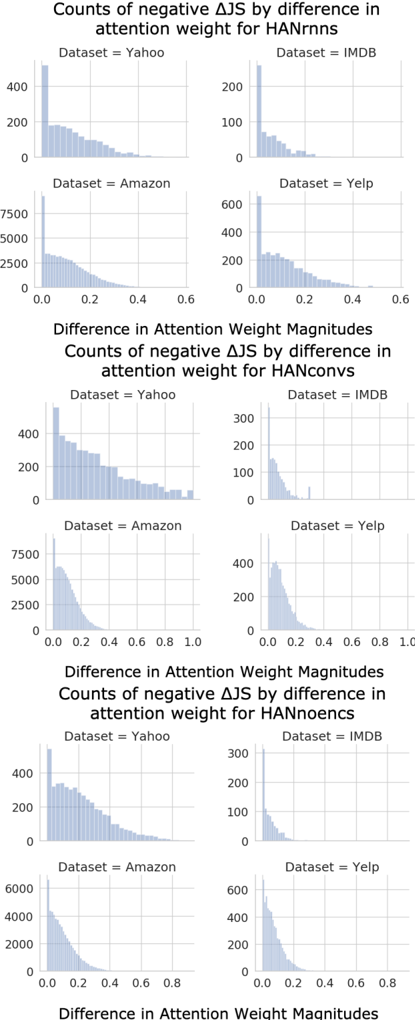
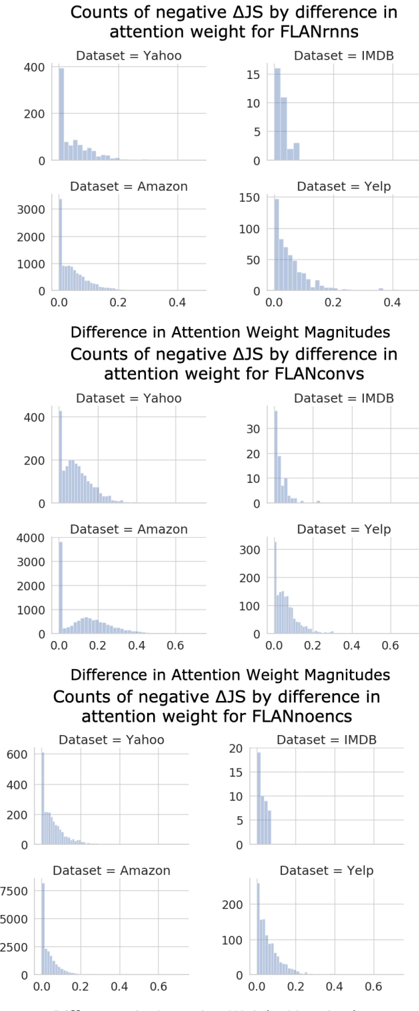
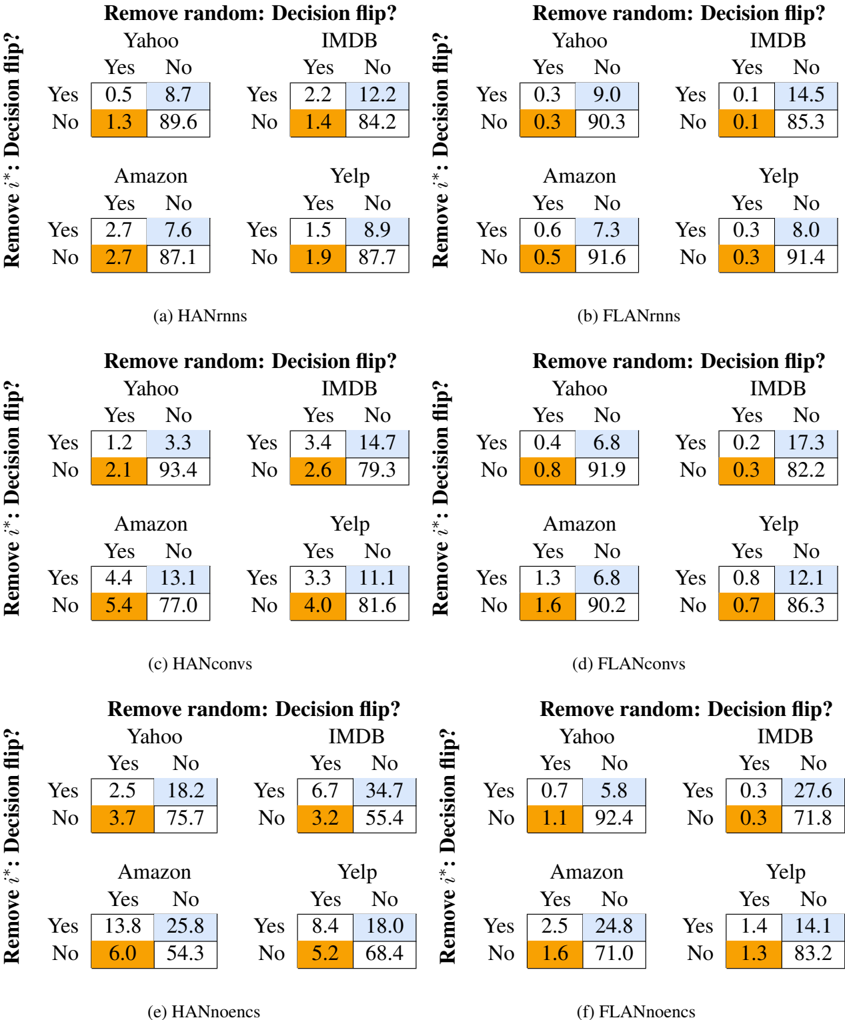
Attention mechanisms have recently boosted performance on a range of NLP tasks.Because attention layers explicitly weight input components' representations, it is also often assumed that attention can be used to identify information that models found important (e.g., specific contextualized word tokens).We test whether that assumption holds by manipulating attention weights in already-trained text classification models and analyzing the resulting differences in their predictions.While we observe some ways in which higher attention weights correlate with greater impact on model predictions, we also find many ways in which this does not hold, i.e., where gradient-based rankings of attention weights better predict their effects than their magnitudes.We conclude that while attention noisily predicts input components' overall importance to a model, it is by no means a fail-safe indicator.1
Overview
The claims and statistics of this paper haven’t been checked yet.
Free: it reads the open-access text and checks the first 5 claims that cite a source we can check. Create a free account to check every claim.
Integrity signals
Registry
Cites
Statistics
Figures
Verification
Claims the paper makes
The claims and statistics of this paper haven’t been checked yet.
Free: it reads the open-access text and checks the first 5 claims that cite a source we can check. Create a free account to check every claim.
Claims other papers make about this one
Each is checked against this paper’s own text: does it say what the citing paper says it does?
The source backs part of the claim, not all of it — or backs it for a different population, condition or comparison.
In the citing paper
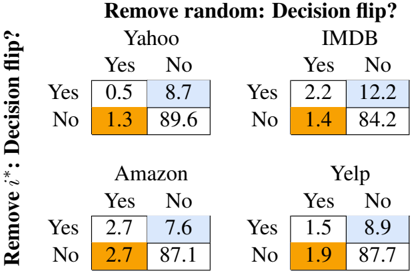
“Besides using Incremental Deletion/Addition to evaluate correctness and output-completeness, compactness can be evaluated by counting how many features of the explanation need to be removed, perturbed or added to change the decision of the predictive model [7,34,70,123,165,221].”
From From Anecdotal Evidence to Quantitative Evaluation Methods: A Systematic Review on Evaluating Explainable AI (2023) · cites this paper as [221]
Experimental — accuracy not yet measuredIn the citing paper
“In [85], the attention mechanism weights were seen as at best noisy predictors of the relative importance of specific regions of the input sequence, and they should not be treated as justifications for the model’s decisions.”
From Survey of Explainable AI Techniques in Healthcare (2023) · cites this paper as [85]
In the citing paper
“Although this is typically the case for softmax scores [221], there might be cases where this assumption is invalid.”
From From Anecdotal Evidence to Quantitative Evaluation Methods: A Systematic Review on Evaluating Explainable AI (2023) · cites this paper as [221]
Self-check
Percentages, sums and reported differences re-computed from the paper’s own numbers.
The self-check needs the paper’s full text.
Citations
Cites
Vaswani, A., Shazeer, N., Parmar, N., Uszkoreit, J., Jones, L., Gomez, A. N., Kaiser, L., & Polosukhin, I. (2017) · arXiv · doi:10.48550/arxiv.1706.03762 · Cited by 120,404
Adam: A Method for Stochastic Optimization
Kingma, D. P., & Ba, J. (2014) · arXiv · doi:10.48550/arxiv.1412.6980 · Cited by 98,946 · cited 1×
“Unless otherwise noted, to train each model, we used Adam (Kingma and Ba, 2014) with gradient clipping of 10.0 and a patience value of 5, so we would stop training a model if five epochs elapsed without any improvement in validation set accuracy.”
MethodInfluential"Why Should I Trust You?": Explaining the Predictions of Any Classifier
Ribeiro, M. T., Singh, S., & Guestrin, C. (2016) · Proceedings of the 22nd ACM SIGKDD International Conference on Knowledge Discovery and Data Mining · doi:10.1145/2939672.2939778 · Cited by 17,555 · cited 4×
“Note, however, that we still do not take either as a gold-standard indicator of importance to the model, as with the gradient in Ross et al. (2017) and Melis and Jaakkola (2018), but merely as an alternative ordering method.”
BackgroundMethodInfluentialNeural Machine Translation by Jointly Learning to Align and Translate
Bahdanau, D., Cho, K., & Bengio, Y. (2014) · arXiv · doi:10.48550/arxiv.1409.0473 · Cited by 16,213 · cited 2×
“Specifically, we use the additive formulation originally defined in Bahdanau et al. (2015).”
BackgroundMethodConvolutional Neural Networks for Sentence Classification
Kim, Y. (2014) · Proceedings of the 2014 Conference on Empirical Methods in Natural Language Processing (EMNLP) · doi:10.3115/v1/d14-1181 · Cited by 14,831 · cited 2×
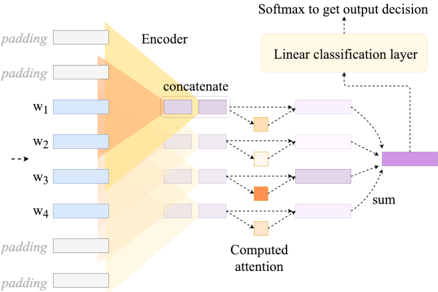
“Aside from biRNNs, we also experiment with models that instead contextualize word vectors by convolutions on only a token’s close neighbors, inspired by Kim (2014). See Figure 2 for a diagram of the FLAN architecture using a convolutional encoder.”
MethodEffective Approaches to Attention-based Neural Machine Translation
Luong, T., Pham, H., & Manning, C. D. (2015) · Proceedings of the 2015 Conference on Empirical Methods in Natural Language Processing · doi:10.18653/v1/d15-1166 · Cited by 8,382 · cited 1×
“For many different problems — to name a few, machine translation (Luong et al., 2015), syntactic parsing (Vinyals et al., 2015), reading comprehension (Hermann et al., 2015), and language modeling (Liu and Lapata, 2018) — incorporating attention mechanisms into models has proven beneficial for…”
BackgroundLipton, Z. C. (2018) · Queue · doi:10.1145/3236386.3241340 · Cited by 5,427 · cited 1×
“Lipton (2016) describes a model as “transparent” if “a person can contemplate the entire model at once.””
BackgroundHierarchical Attention Networks for Document Classification
Yang, Z., Yang, D., Dyer, C., He, X., Smola, A., & Hovy, E. (2016) · Proceedings of the 2016 Conference of the North American Chapter of the Association for Computational Linguistics: Human Language Technologies · doi:10.18653/v1/n16-1174 · Cited by 4,712 · cited 6×
“Our model architectures are inspired by the hierarchical attention network (HAN; Yang et al., 2016), a text classification model with two layers of attention, first to the word tokens in each sentence and then to the resulting sentence representations.”
BackgroundMethodResultInfluentialCharacter-level Convolutional Networks for Text Classification
Zhang, X., Zhao, J., & LeCun, Y. (2015) · arXiv (Cornell University) · doi:10.48550/arxiv.1509.01626 · Cited by 3,205 · cited 3×
“We investigate four model architectures on a topic classification dataset (Yahoo Answers; Zhang et al., 2015) and on three review ratings datasets: IMDB (Diao et al.”
MethodTeaching Machines to Read and Comprehend
Hermann, K. M., Kočiský, T., Grefenstette, E., Espeholt, L., Kay, W., Suleyman, M., & Blunsom, P. (2015) · arXiv (Cornell University) · doi:10.48550/arxiv.1506.03340 · Cited by 2,521 · cited 1×
“For many different problems—to name a few, machine translation (Luong et al., 2015), syntactic parsing (Vinyals et al., 2015), reading comprehension (Hermann et al., 2015), and language modeling (Liu and Lapata, 2018)—incorporating attention mechanisms into models has proven benefi-cial for…”
Background
Research works printed but not linked: 4
- Philipp Koehn and Rebecca Knowles. 2017. Six chal- lenges for neural machine translation. In Pro- ceedings of the First Workshop on Neural Machine Translation.
- Zachary C Lipton. 2016. The mythos of model inter- pretability. arXiv preprint arXiv:1606.03490. · arXiv
- Yang Liu and Mirella Lapata. 2018. Learning struc- tured text representations. Transactions of the Asso- ciation of Computational Linguistics, 6:63-75.
- Oriol Vinyals, Łukasz Kaiser, Terry Koo, Slav Petrov, Ilya Sutskever, and Geoffrey Hinton. 2015. Gram- mar as a foreign language. In Advances in Neural Information Processing Systems.
Cited by
Items 601–699 of 699
Easy to Decide, Hard to Agree: Reducing Disagreements Between Saliency Methods
Jukić, J., Tutek, M., & Šnajder, J. (2023) · Findings of the Association for Computational Linguistics: ACL (Findings of ACL) · doi:10.18653/v1/2023.findings-acl.582 · Cited by 2
How (Un)Faithful is Attention?
Amini, H., & Kosseim, L. (2022) · BlackboxNLP Workshop on Analyzing and Interpreting Neural Networks for NLP (BlackboxNLP) · doi:10.18653/v1/2022.blackboxnlp-1.10 · Cited by 2
“…the use of attention weights as explanations has been widely challenged, with regards to the observation that they are not faithful , meaning that different attention weights can result in similar model predictions (Jain and Wallace, 2019; Serrano and Smith, 2019; Wiegreffe and Pinter, 2019).”
BackgroundResultExplore Unsupervised Structures in Pretrained Models for Relation Extraction
Yang, X., Ji, T., & Wu, Y. (2022) · Findings of the Association for Computational Linguistics: EMNLP (Findings of EMNLP) · doi:10.18653/v1/2022.findings-emnlp.453
Traumatic Brain Injury Classification Based on Slice Feature Selection and Transformer
Liu, J., Ye, T., Huang, L., & Li, C. (2023) · International Conference on Intelligent Computing and Signal Processing (ICSP) · doi:10.1109/icsp58490.2023.10248715
“Assuming that the model has K self-attention heads, the attention weights of the above layers can be written as: Previous work[10][11] showed that due to the lack of token discriminability of embeddings, raw attention weights do not necessarily correspond to the relative importance of input tokens,…”
BackgroundEmpirical Analysis of Methods for Evaluating Faithfulness of Explanations by Feature Attribution
Asazuma, Y., Hanawa, K., & Inui, K. (2023) · Transactions of the Japanese Society for Artificial Intelligence · doi:10.1527/tjsai.38-6_c-n22
Beinborn, L., & Hollenstein, N. (2023) · Synthesis lectures on human language technologies · doi:10.1007/978-3-031-43260-6_6
Disentangling the Linguistic Competence of Privacy-Preserving BERT
Arnold, S., Kemmerzell, N., & Schreiner, A. (2023) · BlackboxNLP Workshop on Analyzing and Interpreting Neural Networks for NLP (BlackboxNLP) · doi:10.18653/v1/2023.blackboxnlp-1.5
Mickus, T., Zosa, E., & Paperno, D. (2023) · Findings of the Association for Computational Linguistics: EMNLP (Findings of EMNLP) · doi:10.18653/v1/2023.findings-emnlp.736 · Cited by 2
Roles of Scaling and Instruction Tuning in Language Perception: Model vs. Human Attention
Gao, C., Huang, S., Li, J., & Chen, J. (2023) · Findings of the Association for Computational Linguistics: EMNLP (Findings of EMNLP) · doi:10.18653/v1/2023.findings-emnlp.868 · Cited by 12
Atanasova, P. (2024) · Springer eBooks · doi:10.1007/978-3-031-51518-7_1
McInerney, D. J. (2024) · Digital Repository Service (Northeastern University) · doi:10.17760/d20653001
Local Interpretability Methods for Time Series Modeling
Ozyegen, O. (2024) · doi:10.32920/26052709.v1 · Cited by 1
Mesbah, A., Shao, K., Lele, A. D., Shi, Z., Miller, V. A., & Ju, Y. (2024) · Research Square · doi:10.21203/rs.3.rs-4574727/v1
Explainable Evidence-Based Veracity Assessment of Textual Claim
Shankar, A., Kulathuramaiyer, N., Abdullah, J., & Pakkirisamy, M. (2024) · Journal of Computer Science · doi:10.3844/jcssp.2024.1009.1019 · Cited by 1
“However, conventional attention weights may not reliably serve as explanations due to intricate input interactions in encoder structures, as noted by Jain and Wallace (2019); Serrano et al .”
BackgroundK-Nearest neighbor smart contract classification with semantic feature enhancement
Tian, G., Zhao, G., Wang, R., Wang, J., & He, C. (2024) · The Computer Journal · doi:10.1093/comjnl/bxae070
SkipPLUS: Skip the First Few Layers to Better Explain Vision Transformers
Mehri, F., Fayyaz, M., Baghshah, M. S., & Pilehvar, M. T. (2024) · IEEE/CVF Conference on Computer Vision and Pattern Recognition Workshops (CVPRW) · doi:10.1109/cvprw63382.2024.00025 · Cited by 8
“Recent studies have questioned the reliability of this approach, given that self-attention is only a small part of a Transformer block [14, 34, 63, 72].”
Liu, T., Zhuang, S., Nie, J., Chen, G., Guo, Y., Zhou, G., Coatrieux, J.-L., & Chen, Y. (2024) · Lecture notes in computer science · doi:10.1007/978-3-031-72751-1_21
Bi, L., Shuai, B., Liu, Z., Sun, Y., & Yang, F. (2025) · SSRN Electronic Journal · doi:10.2139/ssrn.5085277
Shimono, M. (2026) · Algorithms · doi:10.3390/a19040305
ADNPPro: Enhanced Promoter Prediction in Nannochloropsis Using Attention-Based Densenet
Liu, G.-L., Li, H., Wei, P.-J., & Zheng, C.-H. (2024) · International Conference on Bioinformatics and Computational Biology (ICBCB) · doi:10.1109/icbcb61507.2024.11011997
“Although the self-attention mechanism’s query vector weights in the trained model provide some explanatory power, debate persists regarding the efficacy of the attention mechanism in elucidating deep learning models [14].”
Li, K., Shi, Z., Hu, M.-J., Jin, Y., Yan, X., He, F., & Wu, X. (2025) · Expert Systems with Applications · doi:10.1016/j.eswa.2025.128726 · Cited by 2
A Survey of Static and Temporal Explainable Methods and Their Applications in Knowledge Tracing
Li, F., Zhang, T., Yin, Y.-F., Fan, D., Yu, M., & Yu, G. (2025) · Journal of Computer Science and Technology · doi:10.1007/s11390-025-4239-0 · Cited by 1
Shimono, M. (2025) · SSRN Electronic Journal · doi:10.2139/ssrn.5370146
Ouyang, Y., Xie, S., & Xie, Y. (2025) · Chinese Control and Decision Conference (CCDC) · doi:10.1109/ccdc65474.2025.11090794
“However, it is still controversial whether the attention mechanism can be directly applied to model interpretation [18,19].”
Mf-Mamba: Multi-Module Feature Selection Mamba for Metro Origin-Destination Matrix PredictionPreprint
Bi, L., Shuai, B., Liu, Z., Sun, Y., & Yang, F. (2025) · SSRN Electronic Journal · doi:10.2139/ssrn.5387695
You Might Not Need Attention Diagonals
Cui, Y., Yao, X., Wang, S., & Hu, G. (2025) · IEEE Signal Processing Letters · doi:10.1109/lsp.2025.3601497
“However, prior studies have observed repetitive patterns: models often over-attend to diagonal elements (self-tokens) and special tokens [9], [10], [11], and such effects are not fully explainable or reliable as model explanations [12], [13].”
Fang, X., Yuan, H. R., Li, H., Kou, J., Gu, C., Zhang, W., Duan, X., & Fang, Y. (2024) · International Conference on Universal Village (UV) · doi:10.1109/uv63228.2024.11189217 · Cited by 5
“Since attention governs how input tokens are weighted and contex-tualized [81], its failure directly impacts factual fidelity.”
Exploring Hate Speech Classification in Low-Resource Languages: A Comprehensive Review
Yadav, S., Kaushik, A., & McDaid, K. (2025) · Advances in computational intelligence and robotics book series · doi:10.4018/979-8-3373-3063-1.ch008 · Cited by 1
Hogea, E., Onchiş, D. M., Coporan, A., Florea, A. M., & Istin, C. (2025) · Machine Vision and Applications · doi:10.1007/s00138-025-01766-w · Cited by 1
Can Visual Attention Serve as an Explanation?
Kluczyński, P., El-Qoraychy, F.-Z., Mualla, Y., Dridi, M., Tebourbi, H., & Nouzri, S. (2025) · Procedia Computer Science · doi:10.1016/j.procs.2025.10.200
Enhancing molecular property prediction of transformer models with dual graph representation
Zhang, S., & Lapkin, A. A. (2026) · Nature Communications · doi:10.21203/rs.3.rs-8164763/v1 · Cited by 2
Distributed attention synchronization networks for advanced social media interaction analytics
Karunamurthy, A. (2025) · Scientific Reports · doi:10.1038/s41598-025-30959-6
Weis, C., Grazioli, F., Visonà, G., Kania, A., Burg, M. F., Horn, M., Golob, J. L., & Schwab, P. (2026) · medRxiv · doi:10.64898/2026.01.23.26344677
Beyond Technical Transparency: Explainability as a Safeguard Against Manipulative AI*
Petrocchi, E., Tiribelli, S., Buzcu, B., Pacioni, E., & Calvaresi, D. (2025) · IEEE International Conference on Metrology for eXtended Reality, Artificial Intelligence and Neural Engineering (MetroXRAINE) · doi:10.1109/metroxraine66377.2025.11340252
“Attention matrices and semantic abstractions learned in the upper layers do not always allow us to understand how a specific output is produced [9].”
Explaining Pre-Trained Language Models in the Context of Higher Education
Chovanec, K., Fields, J., & Madiraju, P. (2025) · IEEE International Conference on Big Data (BigData) · doi:10.1109/bigdata66926.2025.11402656
“[51] note that attention often does not identify the most important features for prediction [52], and the same can be true of saliency/gradient-based approaches such as IG.”
A Theoretical Framework Bridging Attention and SVM Optimization Dynamics and Sparsity
Li, Z., Song, Z., & Zhao, J. (2025) · IEEE International Conference on Big Data (BigData) · doi:10.1109/bigdata66926.2025.11402021
“[25] also focus on text classification, concluding that while attention weights indicates the potential importance of tokens, they fall short as definitive indicators for decision-making.”
SHARP Parameter-driven Solar Flare Forecasting via a Dual-branch Adversarial Framework
Chen, X., Tao, Y., & Deng, H. (2026) · Publications of the Astronomical Society of the Pacific · doi:10.1088/1538-3873/ae4cc9
Punchihewa, Y. (2026) · International Conference on Advanced Research in Computing (ICARC) · doi:10.1109/icarc68737.2026.11454006
“While their attention weights are often interpreted as measures of token relationships, research by Jain and Wallace [6] and Serrano and Smith [7] has cautioned against simplistic interpretations, noting that attention weights may not always correspond to meaningful explanations.”
The impact of network preprocessing structure design on XAI explanation quality
Son, J., Cho, H., Hong, J., & Kim, Y. (2026) · Applied Network Science · doi:10.1007/s41109-026-00793-4 · Cited by 1
“For example, subword-level tokenization may distort attribution patterns compared to sentence-level segmentation in Transformer-based language models (Jain and Wallace 2019; Serrano and Smith 2019).”
Neural Transfer Learning for Domain Adaptation in Natural Language Processing
Meftah, S. (2021) · theses.fr (ABES) · doi:10.70675/9111562bzfa37z4fd8zae6bz2e8ae8d5d403 · Cited by 2
On the Status of Word Embeddings as Implementations of the Distributional Hypothesis
Mickus, T. (2022) · theses.fr (ABES) · doi:10.70675/cfc2b3e0zdc1dz4f02za2cezd8116a4bd01e · Cited by 2
Bourgeade, T. (2022) · theses.fr (ABES) · doi:10.70675/6610d333zd0eez4db5z8c67zfa30bac6acf3 · Cited by 2
Boito, M. Z. (2021) · theses.fr (ABES) · doi:10.70675/cf5278e0z9870z47ffz84bezce871966446d · Cited by 2
Deep learning approaches to assess speech intelligibility of head and neck cancer
Quintas, S. (2022) · theses.fr (ABES) · doi:10.70675/0ad67499zbd0cz4b29zb8f0zcaf21d84613e · Cited by 4
Transfer learning for abusive language detection
Bose, T. (2023) · theses.fr (ABES) · doi:10.70675/6b663c61zb592z4422zbc5fza68cbc285104 · Cited by 1
Metheniti, E. (2023) · theses.fr (ABES) · doi:10.70675/2f81071bz4724z44ecz999dz1acee85d8951 · Cited by 5
Advancing fairness in natural language processing : from traditional methods to explainability
Jourdan, F. (2024) · theses.fr (ABES) · doi:10.70675/b8535a05z82f1z46f7z9688z3cd35cea8381 · Cited by 5
Multimodal learning to predict breast cancer prognosis
Mbaye, N. M. (2024) · theses.fr (ABES) · doi:10.70675/cdccc54az52f7z4e20za5a4z3ec09cd3a564
Interpretable Music Recommender Systems
Afchar, D. (2023) · theses.fr (ABES) · doi:10.70675/acfb6676z8613z4e08zad14z98d4a9c2ee74 · Cited by 3
Nuñez, J. R. (2023) · theses.fr (ABES) · doi:10.70675/f8949afezdad2z4991z8aeez848d2abea5f5 · Cited by 1
Nguyen, D. H. (2024) · theses.fr (ABES) · doi:10.70675/97b1b150zc009z4f96z9ec6z2790870387a0
Intelligibility of Recurrent Neural Networks via Finite State Machines
Marzouk, M. R. (2024) · theses.fr (ABES) · doi:10.70675/67c57743zf027z4a51zbd70zddd2e546358f
Towards explainable and interpretable deep neural networks
Jeanneret, G. (2024) · theses.fr (ABES) · doi:10.70675/ed07566bze7a3z4daazb9d7z03fd028f66ce
Leveraging multi-dimensional context & data augmentation for NER
Luiggi, T. (2025) · theses.fr (ABES) · doi:10.70675/75128aa5z75b0z4644z96b1z04406ee442f3
Sparsity-Constrained NMF Tokenization for Interpretable Medical Signal Classification
Sankaran, S. (2026) · IEEE Signal Processing Letters · doi:10.1109/lsp.2026.3685918
Artificial intelligence and multi-omics integration in Alzheimer’s disease: translational challenges
Tan, A. C. M., Woon, E. P. H., & Wang, J. D. J. (2026) · Academia molecular biology and genomics. · doi:10.20935/acadmolbiogen8272 · Cited by 1
Class-disentangled attribution with gradient guidance for CLIP
Li, F., Meng, Z., Tan, C., & Yin, Y. (2026) · Journal of King Saud University - Computer and Information Sciences · doi:10.1007/s44443-026-00779-3 · Cited by 1
“Serrano and Smith (2019) later showed that the magnitude of attention weights does not reliably reflect the importance of input features for model decisions.”
TRuST-M: Evaluating User Trust and Explainability in LLM-Based Web Moderation Systems
Ravi, K., Surale, H. B., & Yuan, J.-S. (2026) · ACM International Conference on Web Search and Data Mining (WSDM) · doi:10.1145/3779211.3793172
Reddy, N. A., & Kiran, P. (2026) · International Conference on Innovative Trends in Information Technology (ICITIIT) · doi:10.1109/icitiit68860.2026.11499510
“Serrano and Smith [3] also found that outputs are preserved across perturbations of attended tokens, suggesting these models may violate basic faithfulness expectations.”
Consistent attributions for transformer-based reversible comparison classifiers
Le, T.-P., & Lauw, H. W. (2026) · Data Mining and Knowledge Discovery · doi:10.1007/s10618-026-01205-y
“However, attention alone does not reliably capture the true impact of features on predictions (Serrano and Smith 2019 ; Hao et al. 2021).”
A Case Study in Explainable AI for Drug-Drug Interaction Prediction: A SHAP-Based Approach
Shati, M., Rugolon, F., & Kuratomi, A. (2026) · Communications in computer and information science · doi:10.1007/978-3-032-19099-4_17
Claret, S. P. A., Krishnan, S. R. L., & Kumar, J. P. (2026) · Lecture notes in networks and systems · doi:10.1007/978-3-032-21013-5_5
Arous, I., Chehbouni, K., Cheng, Z., & Dossou, B. F. P. (2026) · Springer eBooks · doi:10.1007/978-981-95-3658-0_85
XCrime-LLM: An Explainable Spatio-Temporal Crime Prediction Framework
Baz, B., Attiah, A., Hakeem, A., & Almani, N. (2026) · Computers · doi:10.3390/computers15050325 · Cited by 1
Zhang, L., Sun, L., Zhang, C., & Xia, Y. (2026) · Developments in the Built Environment · doi:10.1016/j.dibe.2026.100962
Cognitive-affective configuration of university students’ continuance intention in online learning
Wang, Y., & Chen, X. (2026) · Frontiers in Psychology · doi:10.3389/fpsyg.2026.1816375
“The attention mechanism is interpreted cautiously as a model-internal component of the BiLSTM-Attention architecture rather than as an independent source of psychological evidence (Jain and Wallace, 2019; Serrano and Smith, 2019; Wiegreffe and Pinter, 2019).”
Benguessoum, K., Sylvain Kubler, A., Lourenço, R., & Traon, Y. L. (2026) · SSRN Electronic Journal · doi:10.2139/ssrn.6962198
Jeon, B. (2026) · Journal of Cheminformatics · doi:10.1186/s13321-026-01249-8 · Cited by 1
“To test whether attention weights causally influence predictions (faithfulness), we performed a feature-masking experiment adapted from occlusion-based analysis [36].”
What Helps—and What Hurts: Bidirectional Explanations for Vision Transformers
Su, Q., & Luo, T. (2026) · Lecture notes in computer science · doi:10.1007/978-981-92-1947-6_41
AttnTrace: Contextual Attribution of Prompt Injection and Knowledge Corruption
Wang, Y., Geng, R., Chen, Y., & Jia, J. (2026) · IEEE Symposium on Security and Privacy (S&P) · doi:10.1109/sp63933.2026.00198 · Cited by 17
“By calculating the average attention weight of X i across all tokens in Y , A TTN ( X || Y ; X i , Y ) can be used to measure the overall contribution of X i to the generation of Y [57], [58].”
Attention-Pruned SHAP: Accelerating SHAP-Based Explainability with Attention-Guided Feature Pruning
Shafik, H., Sherif, A., & Sabty, C. (2026) · Lecture notes in computer science · doi:10.1007/978-3-032-29532-3_20
Beyond Token Attention: Contiguous and Interpretable Payload Identification for Web Attacks
Yang, Y., Zhao, J. Z., Pei, C., Wan, W., Long, C., Du, G., Liu, Y., & Li, J. (2026) · International Conference on Dependable Systems & Networks/Proceedings · doi:10.1109/dsn69566.2026.00044
“Some studies argue they are unreliable, as they lack exclusivity and often disagree with other methods (e.g., gradients, perturbations) [9], [10].”
Chen, T., Huang, J., Yaosen, H., Luo, X., & Tang, H. (2026) · Lecture notes in computer science · doi:10.1007/978-3-032-22264-0_23
Evaluating Explanation Stability in Sentiment Analysis Using Counterfactual Perturbations
Sunderam, S. S., Garg, A., & Dubey, S. (2026) · IEEE International Conference on Computing, Power and Communication Technologies (IC2PCT) · doi:10.1109/ic2pct68894.2026.11584445
“While attention mechanisms were initially considered a form of explanation [1], subsequent studies demonstrated that attention weights are often weakly correlated with feature importance, raising concerns about their faithfulness [6], [15].”
Contextual Misogyny Detection in Code-Mixed Hindi-English
Yadav, S., Kaushik, A., & McDaid, K. (2026) · IFIP advances in information and communication technology · doi:10.1007/978-3-032-30612-8_17
If attention scaled intelligence, can it scale morality?
Bombaerts, G. J. T., Delisse, B., & Kaymak, U. (2026) · AI and Ethics · doi:10.1007/s43681-026-01239-4
“Caution against interpreting attention weights as explanations of model behaviour is of utmost importance [44, 76].”
Hybrid Explainable Fake News Detection Using CNNs and Frequent Pattern Mining
Skafi, M., & Daher, J. B. (2026) · International Conference on Smart Applications, Communications and Networking (SmartNets) · doi:10.1109/smartnets69662.2026.11604623 · Cited by 1
“Jain and Wallace [14] and Serrano and Smith [15] discussed that attention weights do not reliably reflect model reasoning, calling into question attention-based explanations.”
DMQ: Direct Mixed-Precision Quantization for Fixed-Memory-Constrained GPU LLM Deployment
Zhang, Z., & Li, Z. (2026) · Lecture notes in computer science · doi:10.1007/978-981-92-3410-3_42
Gao, Y., & Kuruoğlu, E. E. (2026) · Multidimensional Signal Processing Workshop · doi:10.1109/ivmsp68335.2026.11618778
“Serrano & Smith [9] take a middle ground, showing that ze-roing out high-attention tokens changes predictions more than zeroing low-attention tokens—suggesting partial faithfulness.”
Multi-Seed XAI Validation for Reliable LSTM Irrigation Control
Lamhour, M. A., Msalek, M., Ardchir, S., Mohamed, G., & Azouazi, M. (2026) · IEEE Access · doi:10.1109/access.2026.3720462 · Cited by 1
“Restrictions apply. common criticisms of attention-based explanations [23], [24]: concentration analysis (testing for over-peaky or uniform attention), deviation from baseline (measuring information gain), and sample-level consistency (detecting attention collapse or instability).”
Reamil: Reasoning- and Evidence-Aware Multiple Instance Learning for Whole-Slide Histopathology
Jung, H. D., Choi, J., & Kim, H. (2026) · IEEE/CVF Winter Conference on Applications of Computer Vision Workshops (WACVW) · doi:10.1109/wacvw68408.2026.00009 · Cited by 2
“However, attention as explanation has well-known limitations [16]: attention scores are shaped by end-to-end training and may not reflect causal importance; high-attention tiles can be redundant or partially spurious; and there is no guarantee that the attended subset alone suffices to recover the…”
BulkShield: A Proactive Framework for Detecting Bulk Refund Booking in Ticketing Systems
Shin, S., Oh, D., Jeon, Y., Noh, J., Joo, I., & Noh, Y. (2026) · ACM SIGKDD Conference on Knowledge Discovery and Data Mining (KDD) · doi:10.1145/3770855.3818875
“Foreachusersequence, we extract attention weights from the final Transformer encoder layer and compute head-averaged attention from the [ CLS ] to-ken to each event token [33].”
Which chemical features are captured by ChemBERTa’s attention?
Alavi, S. H., Zare‐Mirakabad, F., & Gharaghani, S. (2026) · Journal of Computer-Aided Molecular Design · doi:10.1007/s10822-026-00889-0
“Prior studies have cautioned that attention weights should not be regarded as definitive causal explanations of model decisions, as attention distributions may not always correspond to feature importance or faithful attribution [31, 32].”
Wavelength-Aware Local-Frame Attention Retrieval Network for Hyperspectral Mineral Identification
Liu, W., Tan, J., Pan, J., Yi, B., & Zhang, X. (2026) · IEEE Journal of Selected Topics in Applied Earth Observations and Remote Sensing · doi:10.1109/jstars.2026.3722583
Interpretable prediction of nucleic acid-binding proteins using a protein language model
Kim, H., Lee, S., Oh, J., Kim, K. K., Kim, E., & Park, C. (2026) · Bioinformatics Advances · doi:10.1093/bioadv/vbag235
“Meanwhile, attention weights should be interpreted with caution, as these weights reflect correlation rather than causation (Serrano and Smith 2019).”
Zhu, K., Wei, X., Wang, X., & Geng, N. (2026) · Decision Support Systems · doi:10.1016/j.dss.2026.114756
Jung, J. W., Souihi, S., Heidet, M., & In, H. P. (2026) · International Journal of Medical Informatics · doi:10.1016/j.ijmedinf.2026.106682
Enhancing Model Explainability and Performance via Attention-Guided Gradient Restriction
Nguyen, H.-C., Lê, H., & Nguyen, T. (2026) · Lecture notes in computer science · doi:10.1007/978-3-032-37676-3_6
Tahmin, N., Chinthala, L. K., Baye, T. M., Davis, R. L., & Khojandi, A. (2026) · medRxiv · doi:10.64898/2026.09.03.26362179
Zhang, R., Feng, Q., Zhang, Y., Yang, C., Chong, N., Mai, J., & Liang, T. (2026) · Ecological Indicators · doi:10.1016/j.ecolind.2026.115485
Beyond Engineered Features: Evaluating Learning Paradigms for Smart Contract Vulnerability DetectionPreprint
Lashkari, A. H., & HajiHosseinKhani, S. (2026) · SSRN Electronic Journal · doi:10.2139/ssrn.7467341
Tyagi, S., Rawat, P., Yadav, D., & Upadhyay, P. (2026) · Expert Systems · doi:10.1111/exsy.70422
“Even though the use of Transformers in language processing has been extensively discussed in several studies (Serrano and Smith 2019; Wiegreffe and Pinter 2019), it is still difficult to understand why Transformers perform effectively in visual tasks.”
DPBERT: A domain-specific pre-trained model for Chinese data policy texts and its interpretability
Zhang, T., Ce, Z., Hangong, W., Haiqun, M., & Lei, J. (2026) · Journal of Information Science · doi:10.1177/01655515261489505
Grammatical Representations in Transformer Attention: A Multidomain Study of Portuguese via UD
de Oliveira, R. G., Claro, D. B., & Cavalcante, R. (2026) · Lecture notes in computer science · doi:10.1007/978-3-032-39895-6_40
Kochery, S. T., Das, D., & Kanna, R. R. (2026) · International Conference on Next-Gen Intelligent Computing and Applications (ICONICA) · doi:10.1109/iconica70605.2026.11736848
“Serrano and Smith contributed a further distinction, asking whether removing the most attended element produces a change in prediction comparable to removing the input identified by a different importance measure; they conclude attention is not always the signal that induces the greatest change [5].”
Explainable AI in Neural Poetry Generation: Beyond Attention
Desta, A. B., Meshesha, M., Tesema, A. T., Degife, W. A., & Mekonen, M. A. (2026) · Applied AI Letters · doi:10.1002/ail2.70049
Prior Specification Bounds What Spectral Attention Can LearnPreprint
Coelho, G., & Coelho, C. J. (2026) · SSRN Electronic Journal · doi:10.2139/ssrn.7661497
Ramu, A., Baiganova, A., Sowjanya Lakshmi, A., & Yerekesheva, M. (2026) · SSRN Electronic Journal · doi:10.2139/ssrn.7675023
MoPFormer: Motion-Primitive Transformer for Wearable-Sensor Activity Recognition
Zhang, H., Zhuang, Z., Wang, X., Yang, X., & Zhang, Y. (2025) · arXiv · doi:10.48550/arxiv.2505.20744
“The principle behind deep attention models is to weight input components, with the assumption that components assigned higher weights are more relevant to the recognition task and exert greater influence on the model’s decisions [43].”
Metadata
- Authors
- Serrano, S., & Smith, N. A.
- Affiliations
- University of Washington (US)
- Venue
- Proceedings of the 57th Annual Meeting of the Association for Computational Linguistics
- Published
- 2019
- Pages
- 2931-2951
- ISSN
- 0736-587X (ISSN-L)
- OpenAlex
- W2948140294
- Cited by
- 690
- References
- 39
- Citations by year
- 2026: 63 · 2025: 85 · 2024: 82 · 2023: 102 · 2022: 119 · 2021: 143 · 2020: 80 · 2019: 15
- FWCI
- 34.15
- Type
- conference paper
- Language
- en
- Open access
- hybrid
- doi.org
- Licence
- cc-by
- Locations
- Proceedings of the conference - Association for Computational Linguistics. Meeting (publishedVersion, cc-by)
- arXiv (Cornell University) (submittedVersion)
- arXiv (Cornell University)
- Topics
- Physical Sciences › Computer Science › Artificial Intelligence › Explainable Artificial Intelligence (XAI)
- Physical Sciences › Computer Science › Artificial Intelligence › Topic Modeling
- Physical Sciences › Computer Science › Artificial Intelligence › Natural Language Processing Techniques
- Keywords
- attention mechanism, interpretability, text classification, model interpretability, feature importance, explainable AI
About these checks
Registry, retraction, Cites and statistics results are computed, not judged, with one exception: a printed reference that no index lists is read once by a model before it counts as a citation error. Claims are extracted by a model and kept only when their quote appears verbatim in the text; each cited source is then checked, with a model’s help, for whether it says what the claim relies on. Those verdicts can be wrong — read the claim’s quote and the cited source before relying on one.
Statistics and arithmetic are recomputed, not judged.
Confidence bands are shown only for fields calibrated on our annotated test set. None is calibrated yet, so no band is shown.
What counts as a claim ›How we measure confidence ›How we check this ›
Are you an author, or do you see a problem with this page? Request a review
Data sources
Bibliographic data: Semantic Scholar, OpenAlex, Crossref.
Contains information from the Semantic Scholar Academic Graph Datasets, made available under the ODC Attribution License (ODC-BY 1.0).
Semantic Scholar’s data is described in: Kinney, R., et al. (2023). The Semantic Scholar Open Data Platform. arXiv:2301.10140.
