

Tet-On Systems For Doxycycline-inducible Gene Expression
Open accessThe DOI matches its Crossref record; 90 of the 90 references it cites were found in a registry or an index; 31 of the 64 sources its claims cite were checked for support.
Abstract
The tetracycline-controlled Tet-Off and Tet-On gene expression systems are used to regulate the activity of genes in eukaryotic cells in diverse settings, varying from basic biological research to biotechnology and gene therapy applications. These systems are based on regulatory elements that control the activity of the tetracycline-resistance operon in bacteria. The Tet-Off system allows silencing of gene expression by administration of tetracycline (Tc) or tetracycline-derivatives like doxycycline (dox), whereas the Tet-On system allows activation of gene expression by dox. Since the initial design and construction of the original Tet-system, these bacterium-derived systems have been significantly improved for their function in eukaryotic cells. We here review how a dox-controlled HIV-1 variant was designed and used to greatly improve the activity and dox-sensitivity of the rtTA transcriptional activator component of the Tet-On system. These optimized rtTA variants require less dox for activation, which will reduce side effects and allow gene control in tissues where a relatively low dox level can be reached, such as the brain.
Overview
CoChat Summary
TL;DR
This review describes how a doxycycline-controlled HIV-1 variant was used to evolve and improve the rtTA component of the Tet-On system, yielding rtTA variants with greater activity and dox sensitivity. It compares optimized variants (M2, V10, V16) and discusses when each is preferable in vitro and in vivo.
Key findings
- Viral evolution of HIV-rtTA selected tetO-LTR deletions (6 of 8 tetO elements deleted, plus a 14–15 nt spacer deletion) and rtTA mutations including F86Y; F86Y increased transcriptional activity and dox sensitivity without affecting background activity, whereas A209T had no effect.
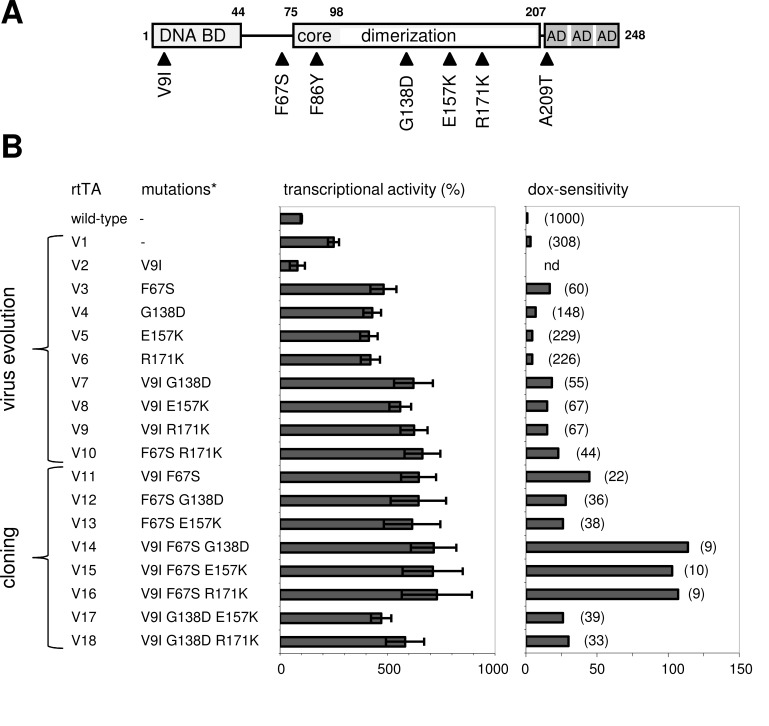
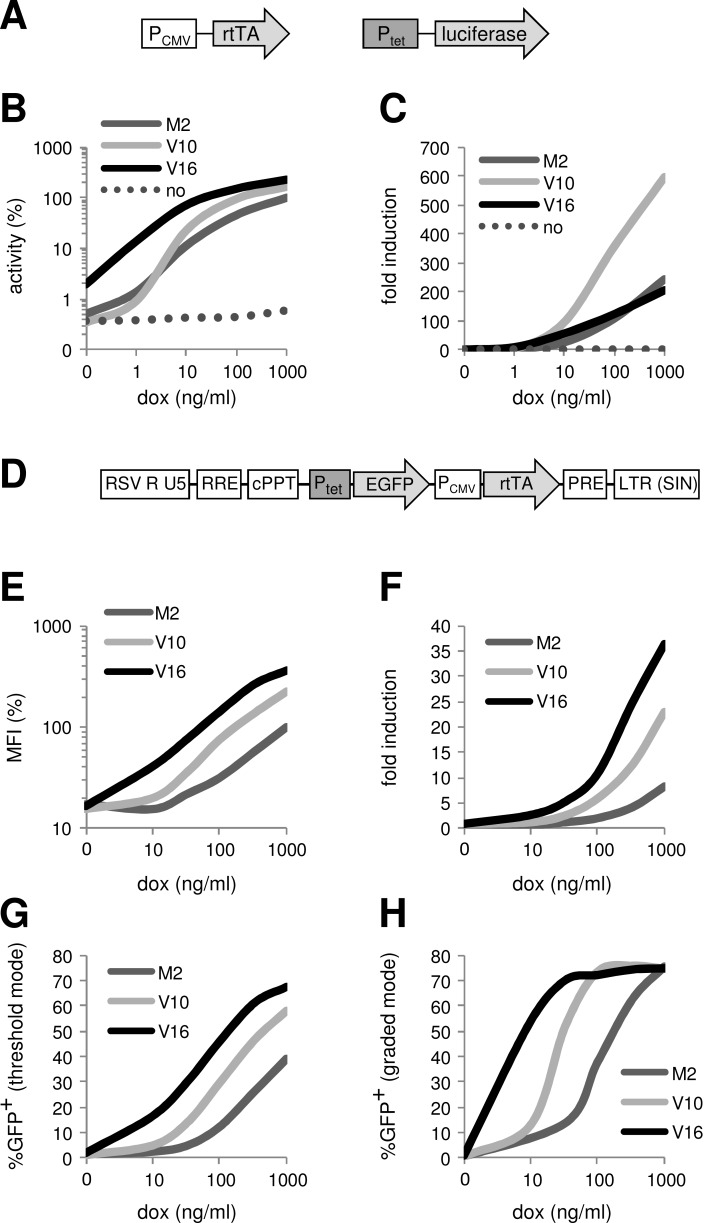
- rtTA3 (S12G+F86Y+A209T) was 5-fold more active at high dox and required 25-fold less dox than rtTA2S-S2; V16 was 7-fold more active at high dox and 100-fold more sensitive than rtTA2S-S2, with no activity without dox in integrated pTet-reporter assays.
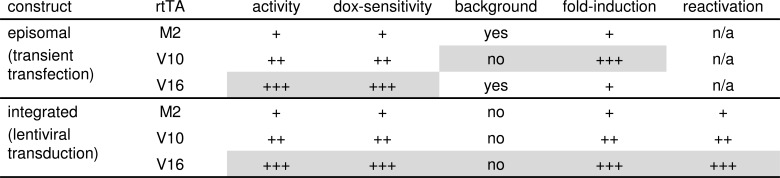
- In transient transfection, V16 had highest dox-induced activity but low detectable background; V10 had no background and superior fold-induction, making V10 optimal for most transient/episomal applications, while V16 is preferred when high activity at low dox is needed.
- In stably transduced cells, V16 showed highest dox-induced activity, fold-induction, and reactivation after dox withdrawal; V16 outperformed M2 for AAV-delivered GDNF in rat brain at clinically-approved sub-antimicrobial dox doses.
Methods
- Narrative review of Tet-Off/Tet-On systems, focusing on optimization of rtTA via a dox-controlled HIV-1 variant (HIV-rtTA) and comparison of rtTA variants.
- Data/sample: synthesis of referenced in vitro, ex vivo, animal, and clinical/preclinical studies; includes comparison of M2, V10, and V16 in transiently transfected and lentivirally transduced cells.
- Main analysis: qualitative synthesis and comparison of dox sensitivity, activity, background, fold-induction, and in vivo applicability; no new primary experimental methods are reported for the review itself.
Limitations
- Stated: direct comparison of new Tet-On systems was limited to in vitro cell culture; optimal rtTA for complex in vivo situations is unknown and may depend on cell/tissue type.
- Stated: in vivo use can be complicated by immune responses against rtTA in rodents and non-human primates, and toxic side effects of tTA/rtTA in transgenic mice; more dox-sensitive rtTA like V16 may show prolonged activity after dox withdrawal.
- Stated: whether S12G and V9I DBD mutations affect rtTA interaction with cellular promoter regions and cellular gene expression remains to be determined. Evident: as a review, it relies on prior studies and includes some unpublished data, so conclusions about variant superiority are context-dependent.
Model-written summary. Check it against the paper before relying on it.
Integrity signals
Registry
Cites
Statistics
Figures
Verification
Claims the paper makes
22 Valid · 0 Not valid · 15 Not checked · 21 Own results and interpretations
The cited sources support only part of this claim — read each source’s verdict below.
In the paper
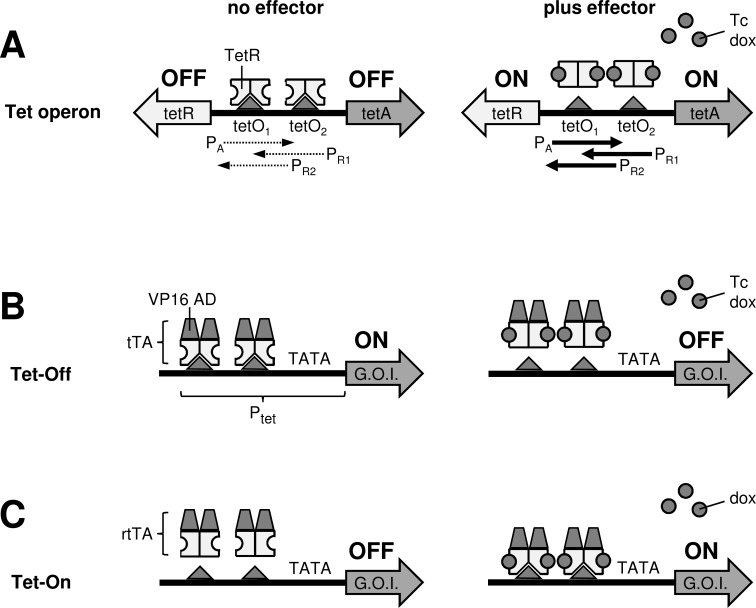
“The Tet-Off and Tet-On systems are based on the Tet repressor protein (TetR) and tet operator (tetO) DNA elements that control the Tn10-encoded tetracycline resistance operon of Escherichia coli.”
- Also stated in: § The Bacterial Tet Operon · plain
“In the Tn10-encoded Tet operon, the tetA and tetR genes are oriented in opposite direction and their expression is regulated at the transcription level by a shared regulatory region (Fig. 1A).”
§ Tet-On Systems For Doxycycline-inducible Gene Expression > Introduction
What the sources say
- Partly supportedcites [7] Bertram R. Hillen W. The application of Tet repressor in prokaryotic gene regulation and expression. Microb. Biotechnol. 2008 1 1 2 16 21261817 PMC3864427 sourceExperimental — accuracy not yet measured
The ‘Origin of tet regulation’ section (page unavailable) describes TetR binding tetO to regulate the Tn10 tetracycline-resistance genes, supporting the claim about the underlying components. Our copy does not establish that the specifically named Tet-Off and Tet-On systems are based on those components. (LLM, conf=0.82)
- Partly supportedcites [8] Meier I. Wray L.V. Hillen W. Differential regulation of the Tn10-encoded tetracycline resistance genes tetA and tetR by the tandem tet operators O1 and O2. EMBO J. 1988 7 2 567 572 2835235 PMC454355 sourceExperimental — accuracy not yet measured
The Abstract reports that Tet repressor binds the Tn10 tet operators and regulates expression of the tetracycline-resistance gene tetA. Our copy does not discuss Tet-Off or Tet-On systems or establish that they are based on these elements. (LLM, conf=0.86)
plainstates a cause- Asserted: passes — The authors put it forward as true.
- Checkable: passes — It can be checked against evidence.
- Load-bearing: unclear — It is unclear whether the paper’s conclusions depend on it.
- Based: passes — The paper gives a reason why it holds.
- Also stated in: § The Bacterial Tet Operon · plain
The sources with a verdict support this claim; the rest weren’t checked yet, have no full text we could read, or their verdicts aren’t rated yet.
In the paper
“The pTet promoter has been optimized through systematic modification, which resulted in novel promoter configurations that minimized intrinsic background activity while maintaining high induced expression [13, 14].”
§ Tet-On Systems For Doxycycline-inducible Gene Expression > Introduction > Improvements of the TET-On system
What the sources say
- Supportedcites [13] Loew R. Heinz N. Hampf M. Bujard H. Gossen M. Improved Tet-responsive promoters with minimized background expression. BMC Biotechnol. 2010 10 81 10.1186/1472-6750-10-81 21106052 PMC3002914 source
The Background describes stepwise modifications of Ptet-1 to create novel promoter variants with low intrinsic background activity and high induced expression. It reports that several variants had lower off-state background than Ptet-1 and Ptet-14 while retaining high activation potential. (LLM, conf=0.94)
- Not checked — no full text of the sourcecites [14] Agha-Mohammadi S. OMalley M. Etemad A. Wang Z. Xiao X. Lotze M.T. Second-generation tetracycline-regulatable promoter: repositioned tet operator elements optimize transactivator synergy while shorter minimal promoter offers tight basal leakiness. J. Gene Med. 2004 6 7 817 828 10.1002/jgm.566 15241789 source
plainstates a cause- Asserted: passes — The authors put it forward as true.
- Checkable: passes — It can be checked against evidence.
- Load-bearing: unclear — It is unclear whether the paper’s conclusions depend on it.
- Based: passes — The paper gives a reason why it holds.
- Supported
Every source the paper cites for this claim was checked and supports it.
In the paper
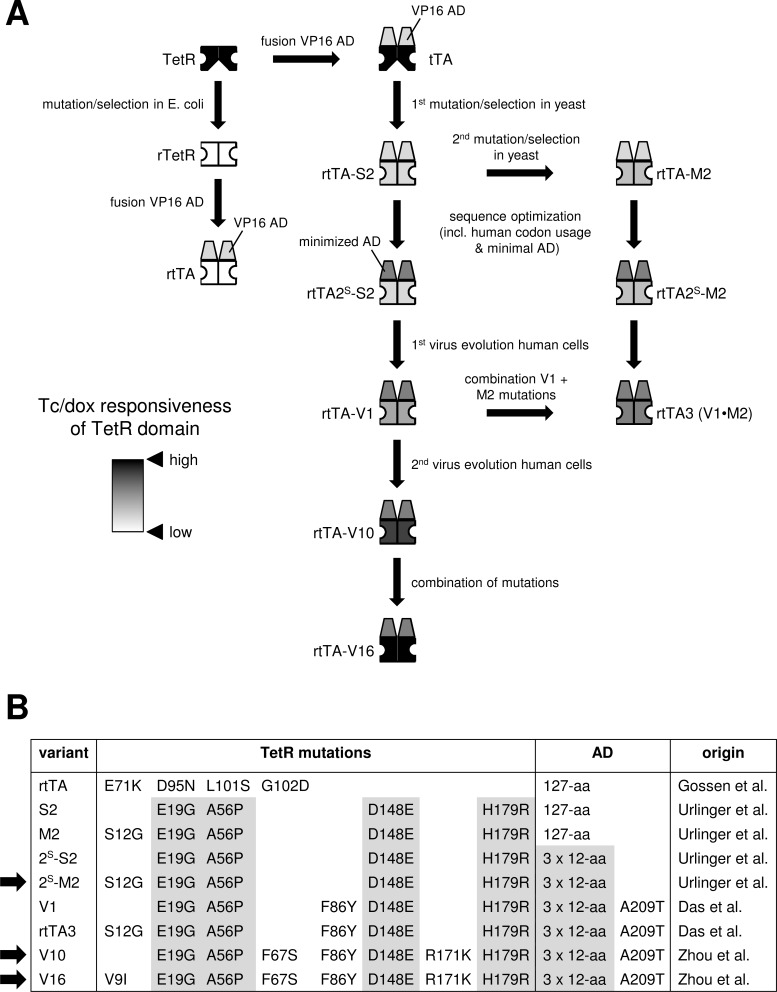
“A second round of mutagenesis and screening in S. cerevisiae yielded an additional DBD mutation (S12G) that increased the activity of rtTA-S2, in particular at low dox concentrations.”
§ Tet-On Systems For Doxycycline-inducible Gene Expression > Introduction > Improvements of the TET-On system
What the sources say
- Supportedcites [15] Urlinger S. Baron U. Thellmann M. Hasan M.T. Bujard H. Hillen W. Exploring the sequence space for tetracycline-dependent transcriptional activators: novel mutations yield expanded range and sensitivity. Proc. Natl. Acad. Sci. USA 2000 97 14 7963 7968 10.1073/pnas.130192197 10859354 PMC16653 source
The Results (page not provided) say a second round of mutagenesis and screening in S. cerevisiae identified a serine-to-glycine change at position 12 in the DNA reading head. The screened variant was rtTA-19/56, derived from rtTA-S2; restoring rtTA-S2’s other two mutations produced rtTA-M2. The Discussion (page not provided) reports that rtTA2S-M2 is fully induced at about a tenfold lower Dox concentration than rtTA2S-S2. (LLM, conf=0.88)
plainstates a cause- Asserted: passes — The authors put it forward as true.
- Checkable: passes — It can be checked against evidence.
- Load-bearing: unclear — It is unclear whether the paper’s conclusions depend on it.
- Based: passes — The paper gives a reason why it holds.
- Supported
Every source the paper cites for this claim was checked and supports it.
In the paper
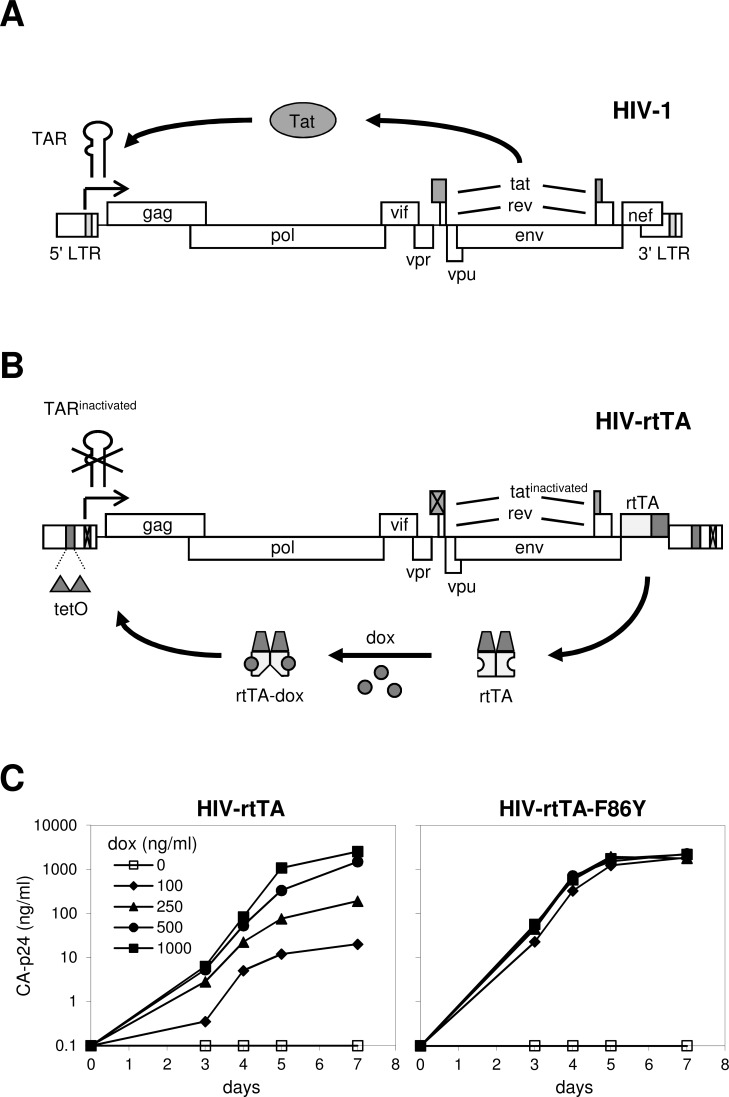
“We used the Tet-On system to generate an HIV-1 variant that replicates exclusively in the presence of dox [42].”
§ Tet-On Systems For Doxycycline-inducible Gene Expression > A dox-controlled HIV-1 variant as a tool to improve the TET-On system
What the sources say
- Supportedcites [42] Verhoef K. Marzio G. Hillen W. Bujard H. Berkhout B. Strict control of human immunodeficiency virus type 1 replication by a genetic switch: Tet for Tat. J. Virol. 2001 75 2 979 987 10.1128/JVI.75.2.979-987.2001 11134311 PMC113994 source
The Abstract describes HIV-rtTA variants made by replacing the Tat-TAR system with the Tet system and says they replicate exclusively upon addition of doxycycline. The Results section reports no replication without dox, supporting the claim's “exclusively” qualifier. (LLM, conf=0.94)
plainstates a cause- Asserted: passes — The authors put it forward as true.
- Checkable: passes — It can be checked against evidence.
- Load-bearing: passes — The paper’s conclusions depend on it.
- Based: passes — The paper gives a reason why it holds.
- Supported
The cited sources support only part of this claim — read each source’s verdict below.
In the paper
“Recent studies successfully applied V16 to control transgene expression in mice [85, 86] and non-human primates [62, 87].”
§ Tet-On Systems For Doxycycline-inducible Gene Expression > Optimal TET-On system for in vivo applications
What the sources say
- Supportedcites [85] Sooksawate T. Isa K. Matsui R. Kato S. Kinoshita M. Kobayashi K. Watanabe D. Kobayashi K. Isa T. Viral vector-mediated selective and reversible blockade of the pathway for visual orienting in mice. Front. Neural Circuits 2013 7 162 10.3389/fncir.2013.00162 24130520 PMC3795302 source
This citation is attached to the mouse portion of the sentence, not the non-human-primate portion. The Methods identify rtTAV16 as the switch controlling the transgene construct, and the Results (Histological analysis; page unavailable) show doxycycline-dependent GFP expression in the mice. (LLM, conf=0.93)
- Not checked — no full text of the sourcecites [86] Tian X. Wang G. Xu Y. Wang P. Chen S. Yang H. Gao F. Xu A. Cao F. Jin X. Manyande A. Tian Y. An improved tet-on system for gene expression in neurons delivered by a single lentiviral vector. Hum. Gene Ther. 2009 20 2 113 123 10.1089/hum.2008.018 20377365 source
- Partly supportedcites [62] Manoussaka M.S. Berry N. Ferguson D. Stebbings R. Robinson M. Ham C. Page M. Li B. Das A.T. Berkhout B. Almond N. Cranage M.P. Conditionally-live attenuated SIV upregulates global T effector memory cell frequency under replication permissive conditions. Retrovirology 2013 10 1 59 10.1186/1742-4690-10-59 23738926 PMC3706341 sourceExperimental — accuracy not yet measured
The Methods (Animals and viruses; page unavailable) identify rtTA-V16 in the doxycycline-dependent SIV used to infect rhesus macaques. The Results (Differential localisation of SIV-rtTAΔnef and SIVΔnef in tissues; page unavailable) report viral transcripts in sampled tissues of doxycycline-treated macaques but not in those from which doxycycline was withdrawn. This supports V16-associated control of viral expression in non-human primates, but the paper does not demonstrate control of a separate transgene; the mice portion is attributed to other citations. (LLM, conf=0.83)
- Not checked — no full text of the sourcecites [87] Kinoshita M. Matsui R. Kato S. Hasegawa T. Kasahara H. Isa K. Watakabe A. Yamamori T. Nishimura Y. Alstermark B. Watanabe D. Kobayashi K. Isa T. Genetic dissection of the circuit for hand dexterity in primates. Nature 2012 487 7406 235 238 10.1038/nature11206 22722837 source
plainstates a cause- Asserted: passes — The authors put it forward as true.
- Checkable: passes — It can be checked against evidence.
- Load-bearing: passes — The paper’s conclusions depend on it.
- Based: passes — The paper gives a reason why it holds.
- Supported
20 more claims · 2 with their cited sources checked
Create a free account to see all 58 claims and every source verdict.
- It may state two separate claims as one. 31
- The quote only partly states this claim. 1
- Probably not a substantial claim. 2
Citations
Cites
Tight control of gene expression in mammalian cells by tetracycline-responsive promoters.
Gossen, M., & Bujard, H. (1992) · Proceedings of the National Academy of Sciences · doi:10.1073/pnas.89.12.5547 · Cited by 4,943 · cited 2×
“1B), the 127-amino acid (127-aa) transcription activation domain (AD) of the herpes simplex virus VP16 protein was fused to the 207-aa TetR, which resulted in the tetracyclinecontrolled transcriptional activator (tTA) [11].”
BackgroundMethodChopra, I., & Roberts, M. (2001) · Microbiology and Molecular Biology Reviews · doi:10.1128/mmbr.65.2.232-260.2001 · Cited by 4,517 · cited 6×
“In Gram-negative bacteria, tetracycline resistance is mostly mediated by efflux of the drug by the membrane protein TetA [6, 7] and the TetA level is controlled by the tetracycline-responsive repressor protein TetR.”
BackgroundInfluentialTranscriptional Activation by Tetracyclines in Mammalian Cells
Gossen, M., Freundlieb, S., Bender, G., Müller, G., Hillen, W., & Bujard, H. (1995) · Science · doi:10.1126/science.7792603 · Cited by 2,488 · cited 2×
“Subsequent fusion of the VP16 activation domain resulted in a reverse-tTA (rtTA) that binds Ptet and activates transcription exclusively in the presence of dox [12].”
BackgroundUpdate on acquired tetracycline resistance genes
Roberts, M. C. (2005) · FEMS Microbiology Letters · doi:10.1016/j.femsle.2005.02.034 · Cited by 1,010 · cited 1×
“nl tetracycline resistance: tetracycline efflux, ribosome protection and tetracycline modification [5].”
Urlinger, S., Baron, U., Thellmann, M., Hasan, M. T., Bujard, H., & Hillen, W. (2000) · Proceedings of the National Academy of Sciences · doi:10.1073/pnas.130192197 · Cited by 928 · cited 2×
“Furthermore, the rtTA coding sequence was optimized for human codon usage and putative toxic mRNA elements were removed: splice donor and acceptor sites, motifs for endonuclease cleavage sites and sequences inducing hairpin structures [15].”
BackgroundMethodRandomized, double-blind trial of glial cell line-derived neurotrophic factor (GDNF) in PD
Nutt, J. G., Burchiel, K. J., Comella, C. L., Jankovic, J., Lang, A. E., Laws, E. R., Lozano, A. M., Penn, R. D., Simpson, R. K., Stacy, M., et al. (2003) · Neurology · doi:10.1212/wnl.60.1.69 · Cited by 824 · cited 1×
“Because adverse effects of uncontrolled delivery of neurotrophic factors have been described [22-24], the ability to modulate transgene expression is crucial for these applications [25, 26].”
BackgroundMarks, W. J., Bartus, R. T., Siffert, J., Davis, C. S., Lozano, A., Boulis, N., Vitek, J., Stacy, M., Turner, D., Verhagen, L., et al. (2010) · The Lancet Neurology · doi:10.1016/s1474-4422(10)70254-4 · Cited by 684 · cited 1×
“Parkinson’s disease patients using an AAV vector [19].”
BackgroundMECHANISMS UNDERLYING EXPRESSION OF TN 10 ENCODED TETRACYCLINE RESISTANCE
Hillen, W., & Berens, C. (1994) · Annual Review of Microbiology · doi:10.1146/annurev.mi.48.100194.002021 · Cited by 511 · cited 1×
“The TetR proteins form dimers that recognize and bind the tetO elements, thus suppressing the activity of the PA and PR promoters and shutting off TetA and TetR production [9].”
BackgroundPathogenicity of Live, Attenuated SIV After Mucosal Infection of Neonatal Macaques
Baba, T. W., Jeong, Y. S., Pennick, D., Bronson, R., Greene, M. F., & Ruprecht, R. M. (1995) · Science · doi:10.1126/science.7892606 · Cited by 489 · cited 1×
“Evolution of the vaccine virus to a pathogenic variant did indeed cause disease in a minority of the vaccinated animals [46-49].”
BackgroundMoullan, N., Mouchiroud, L., Wang, X., Ryu, D., Williams, E. G., Mottis, A., Jovaisaite, V., Frochaux, M. V., Quiros, P. M., Deplancke, B., et al. (2015) · Cell Reports · doi:10.1016/j.celrep.2015.02.034 · Cited by 470 · cited 1×
“For example, rtTAs with an increased dox-sensitivity will require less dox, which will avoid cellular side effects due to the inhibitory effect of high tetracycline levels on mitochondrial translation [17].”
BackgroundSilencing and Variegation of Gammaretrovirus and Lentivirus Vectors
Ellis, J. (2005) · Human Gene Therapy · doi:10.1089/hum.2005.16.1241 · Cited by 379 · cited 1×
“These results indicate that the integrated reporter gene construct is sensitive to transcriptional silencing and variegation effects upon dox withdrawal, which are likely caused by the cellular DNA sequences surrounding the integration site [71].”
BackgroundBaba, T. W., Liska, V., Khimani, A. H., Ray, N. B., Dailey, P. J., Penninck, D., Bronson, R., Greene, M. F., McClure, H. M., Martin, L. N., et al. (1999) · Nature Medicine · doi:10.1038/5557 · Cited by 356 · cited 1×
“Evolution of the vaccine virus to a pathogenic variant did indeed cause disease in a minority of the vaccinated animals [46-49].”
BackgroundClinical Pharmacokinetics of Doxycycline and Minocycline
Saivin, S., & Houin, G. (1988) · Clinical Pharmacokinetics · doi:10.2165/00003088-198815060-00001 · Cited by 350 · cited 1×
“Brain applications of the Tet-On system could also benefit from rtTAs that are responsive to the tetracyclinederivative minocycline (Mc), because Mc has an increased bioavailability and a greater lipophilicity, which results in a better tissue penetration [39].”
BackgroundBaron, U., & Bujard, H. (2000) · Methods in Enzymology · doi:10.1016/s0076-6879(00)27292-3 · Cited by 335
Baron, U. (1997) · Nucleic Acids Research · doi:10.1093/nar/25.14.2723 · Cited by 335 · cited 1×
“This AD minimization removed potential targets for interactions with cellular transcription factors, which reduced toxic squelching effects [16].”
BackgroundNerve Growth Factor Gene Therapy: Activation of Neuronal Responses in Alzheimer Disease
Tuszynski, M. H., Yang, J. H., Barba, D., U, H.-S., Bakay, R. A. E., Pay, M. M., Masliah, E., Conner, J. M., Kobalka, P., Roy, S., et al. (2015) · JAMA Neurology · doi:10.1001/jamaneurol.2015.1807 · Cited by 287 · cited 1×
“Specifically, nerve growth factor (NGF) has been delivered in the brain of patients with Alzheimer disease either via direct intracerebral injection of an AAV vector or via transplantation of genetically-modified cells [20] and neurturin, a member of the glial cell linederived neurotrophic factor (GDNF) family ligands…”
MethodPathak, V. K., & Temin, H. M. (1990) · Proceedings of the National Academy of Sciences · doi:10.1073/pnas.87.16.6019 · Cited by 280 · cited 1×
“Sequence repeats can indeed trigger recombination events [65, 66] or cause aberrant folding of the viral RNA, which may reduce viral replication fitness.”
BackgroundBerens, C., & Hillen, W. (2003) · European Journal of Biochemistry · doi:10.1046/j.1432-1033.2003.03694.x · Cited by 261
Genetic dissection of the circuit for hand dexterity in primates
Kinoshita, M., Matsui, R., Kato, S., Hasegawa, T., Kasahara, H., Isa, K., Watakabe, A., Yamamori, T., Nishimura, Y., Alstermark, B., et al. (2012) · Nature · doi:10.1038/nature11206 · Cited by 259 · cited 1×
“Recent studies successfully applied V16 to control transgene expression in mice [85, 86] and non-human primates [62, 87].”
BackgroundImproved Tet-responsive promoters with minimized background expression
Loew, R., Heinz, N., Hampf, M., Bujard, H., & Gossen, M. (2010) · BMC Biotechnology · doi:10.1186/1472-6750-10-81 · Cited by 246 · cited 1×
“The pTet promoter has been optimized through systematic modification, which resulted in novel promoter configurations that minimized intrinsic background activity while maintaining high induced expression [13, 14].”
BackgroundImmune responses to AAV in a phase I study for Canavan disease
McPhee, S. W. J., Janson, C. G., Li, C., Samulski, R. J., Camp, A. S., Francis, J., Shera, D., Lioutermann, L., Feely, M., Freese, A., et al. (2006) · The Journal of Gene Medicine · doi:10.1002/jgm.885 · Cited by 241 · cited 1×
“Whereas immune reactions directed against the viral vector or transgene may limit systemic gene therapy applications [18], gene therapy in immunologically-privileged sites, like the central nervous system (CNS), are not restricted by such deleterious immune responses [19].”
BackgroundOptimization of the Tet-On system for regulated gene expression through viral evolution
Zhou, X., Vink, M., Klaver, B., Berkhout, B., & Das, A. T. (2006) · Gene Therapy · doi:10.1038/sj.gt.3302780 · Cited by 224 · cited 4×
“Reproduced from [69] ( © 2006, Zhou et al.”
BackgroundMethodInfluentialSelf-citationRepair and evolution of nef in vivo modulates simian immunodeficiency virus virulence
Whatmore, A. M., Cook, N., Hall, G. A., Sharpe, S., Rud, E. W., & Cranage, M. P. (1995) · Journal of Virology · doi:10.1128/jvi.69.8.5117-5123.1995 · Cited by 180 · cited 1×
“Evolution of the vaccine virus to a pathogenic variant did indeed cause disease in a minority of the vaccinated animals [46-49].”
BackgroundFussenegger, M. (2001) · Biotechnology Progress · doi:10.1021/bp000129c · Cited by 174 · cited 1×
“Several regulatory mechanisms have been developed that allow both quantitative and temporal control of gene expression in eukaryotic cells by an exogenous effector molecule [1].”
BackgroundThe application of Tet repressor in prokaryotic gene regulation and expression
Bertram, R., & Hillen, W. (2008) · Microbial Biotechnology · doi:10.1111/j.1751-7915.2007.00001.x · Cited by 160 · cited 8×
“In Gram-negative bacteria, tetracycline resistance is mostly mediated by efflux of the drug by the membrane protein TetA [6, 7] and the TetA level is controlled by the tetracycline-responsive repressor protein TetR.”
BackgroundInfluentialClinical Potential of Minocycline for Neurodegenerative Disorders
BLUM, D., CHTARTO, A., TENENBAUM, L., BROTCHI, J., & LEVIVIER, M. (2004) · Neurobiology of Disease · doi:10.1016/j.nbd.2004.07.012 · Cited by 157 · cited 1×
“In addition, Mc and dox exhibit anti-inflammatory properties which could be of interest when treating neurodegenerative diseases [40, 41].”
BackgroundSelf-citationFavre, D., Blouin, V., Provost, N., Spisek, R., Porrot, F., Bohl, D., Marmé, F., Chérel, Y., Salvetti, A., Hurtrel, B., et al. (2002) · Journal of Virology · doi:10.1128/jvi.76.22.11605-11611.2002 · Cited by 150 · cited 1×
“In vivo application of the systems can be complicated by immune responses against rtTA, as reported in rodents and non-human primates [73-78].”
Background(1989) · Molecular Biology and Evolution · doi:10.1093/oxfordjournals.molbev.a040545 · Cited by 142 · cited 1×
“The high affinity of TetR for the tetO sequence allows efficient repression of TetA, which is important because even low TetA levels are disadvantageous for bacterial cells in the absence of tetracycline [10].”
BackgroundGasmi, M., Brandon, E. P., Herzog, C. D., Wilson, A., Bishop, K. M., Hofer, E. K., Cunningham, J. J., Printz, M. A., Kordower, J. H., & Bartus, R. T. (2007) · Neurobiology of Disease · doi:10.1016/j.nbd.2007.04.003 · Cited by 141 · cited 1×
“viral genomes/mm 3 , the dose approved for the AAVneurturin clinical trial [34].”
BackgroundYim, C. W., Flynn, N. M., & Fitzgerald, F. T. (1985) · Antimicrobial Agents and Chemotherapy · doi:10.1128/aac.28.2.347 · Cited by 133 · cited 2×
“For example, in the rat/AAV-tetbidi-On study, administration of 600 mg/l dox in drinking water, which resulted in a dox concentration of ~5.3 g/ml in blood and ~0.4 g/ml in CSF, was required to activate gene expression in the brain (unpublished data).”
BackgroundInfluentialSchlichtenbrede, F. C., MacNeil, A., Bainbridge, J. W., Tschernutter, M., Thrasher, A. J., Smith, A. J., & Ali, R. R. (2003) · Gene Therapy · doi:10.1038/sj.gt.3301929 · Cited by 132 · cited 1×
“Because adverse effects of uncontrolled delivery of neurotrophic factors have been described [22-24], the ability to modulate transgene expression is crucial for these applications [25, 26].”
BackgroundViral Evolution as a Tool to Improve the Tetracycline-regulated Gene Expression System
Das, A. T., Zhou, X., Vink, M., Klaver, B., Verhoef, K., Marzio, G., & Berkhout, B. (2004) · Journal of Biological Chemistry · doi:10.1074/jbc.m313895200 · Cited by 129 · cited 3×
“4A), at a position that directly interacts with Tc in the TetR-Tc crystal structure [67].”
BackgroundMethodSelf-citationLatta-Mahieu, M., Rolland, M., Caillet, C., Wang, M., Kennel, P., Mahfouz, I., Loquet, I., Dedieu, J.-F., Mahfoudi, A., Trannoy, E., et al. (2002) · Human Gene Therapy · doi:10.1089/10430340260201707 · Cited by 114 · cited 1×
“In vivo application of the systems can be complicated by immune responses against rtTA, as reported in rodents and non-human primates [73-78].”
BackgroundSu, X., Kells, A. P., Huang, E. J., Lee, H. S., Hadaczek, P., Beyer, J., Bringas, J., Pivirotto, P., Penticuff, J., Eberling, J., et al. (2009) · Human Gene Therapy · doi:10.1089/hum.2009.103 · Cited by 112 · cited 1×
“Several inducible or repressible genetic systems to regulate intracerebral delivery of GDNF, which is envisaged for the treatment of Parkinson’s disease [27] (https://clinical trials.”
BackgroundAgha‐Mohammadi, S., O'Malley, M., Etemad, A., Wang, Z., Xiao, X., & Lotze, M. T. (2004) · The Journal of Gene Medicine · doi:10.1002/jgm.566 · Cited by 110 · cited 1×
“The pTet promoter has been optimized through systematic modification, which resulted in novel promoter configurations that minimized intrinsic background activity while maintaining high induced expression [13, 14].”
BackgroundHan, H. J., Allen, C. C., Buchovecky, C. M., Yetman, M. J., Born, H. A., Marin, M. A., Rodgers, S. P., Song, B. J., Lu, H.-C., Justice, M. J., et al. (2012) · Journal of Neuroscience · doi:10.1523/jneurosci.0893-12.2012 · Cited by 105 · cited 1×
“In transgenic mice, toxic side-effects of tTA and rtTA have also been reported [79-83].”
BackgroundManfredsson, F. P., Tumer, N., Erdos, B., Landa, T., Broxson, C. S., Sullivan, L. F., Rising, A. C., Foust, K. D., Zhang, Y., Muzyczka, N., et al. (2009) · Molecular Therapy · doi:10.1038/mt.2009.45 · Cited by 100 · cited 1×
“Because adverse effects of uncontrolled delivery of neurotrophic factors have been described [22-24], the ability to modulate transgene expression is crucial for these applications [25, 26].”
BackgroundStrict Control of Human Immunodeficiency Virus Type 1 Replication by a Genetic Switch: Tet for Tat
Verhoef, K., Marzio, G., Hillen, W., Bujard, H., & Berkhout, B. (2001) · Journal of Virology · doi:10.1128/jvi.75.2.979-987.2001 · Cited by 88 · cited 3×
“To improve the safety of live-attenuated HIV vaccine candidates, we and others previously presented a conditionally replicating HIV variant, with replication that can be switched on and off at will by the administration and removal of an exogenous effector, respectively [42, 52-55].”
BackgroundMethodSelf-citationGenetic Instability of Live, Attenuated Human Immunodeficiency Virus Type 1 Vaccine Strains
Berkhout, B., Verhoef, K., van Wamel, J. L. B., & Back, N. K. T. (1999) · Journal of Virology · doi:10.1128/jvi.73.2.1138-1145.1999 · Cited by 84
Self-citationMarzio, G., Verhoef, K., Vink, M., & Berkhout, B. (2001) · Proceedings of the National Academy of Sciences · doi:10.1073/pnas.111031498 · Cited by 81 · cited 1×
“We did frequently observe specific deletions in the viral tetO-LTR promoter [63, 64].”
BackgroundSelf-citationMarkusic, D. (2005) · Nucleic Acids Research · doi:10.1093/nar/gni062 · Cited by 78 · cited 1×
“rtTA3 [68]) was 5-fold more active at high dox levels and required 25-fold less dox to be similarly active (25-fold more sensitive to dox).”
BackgroundKarlsson, M., Hammers, S., Nilsson-Ehle, I., Malmborg, A. S., & Wretlind, B. (1996) · Antimicrobial Agents and Chemotherapy · doi:10.1128/aac.40.5.1104 · Cited by 76 · cited 2×
“For example, in the rat/AAV-tetbidi-On study, administration of 600 mg/l dox in drinking water, which resulted in a dox concentration of ~5.3 g/ml in blood and ~0.4 g/ml in CSF, was required to activate gene expression in the brain (unpublished data).”
BackgroundInfluentialMeier, I., Wray, L. V., & Hillen, W. (1988) · The EMBO Journal · doi:10.1002/j.1460-2075.1988.tb02846.x · Cited by 75 · cited 1×
“This regulatory region consists of overlapping promoters PA and PR1/PR2 (driving tetA and tetR transcription, respectively) and two superimposed tetO operator sequences [7, 8].”
BackgroundExpression of the Reverse Tetracycline-Transactivator Gene Causes Emphysema-Like Changes in Mice
Sisson, T. H., Hansen, J. M., Shah, M., Hanson, K. E., Du, M., Ling, T., Simon, R. H., & Christensen, P. J. (2006) · American Journal of Respiratory Cell and Molecular Biology · doi:10.1165/rcmb.2005-0378oc · Cited by 75 · cited 1×
“In transgenic mice, toxic side-effects of tTA and rtTA have also been reported [79-83].”
BackgroundThe HIV-1 repeated sequence R as a robust hot-spot for copy-choice recombination
Moumen, A., Polomack, L., Roques, B., Buc, H., & Negroni, M. (2001) · Nucleic Acids Research · doi:10.1093/nar/29.18.3814 · Cited by 73 · cited 1×
“Sequence repeats can indeed trigger recombination events [65, 66] or cause aberrant folding of the viral RNA, which may reduce viral replication fitness.”
BackgroundA Single Lentivirus Vector Mediates Doxycycline-Regulated Expression of Transgenes in the Brain
Vogel, R., Amar, L., Thi, A. D., Saillour, P., & Mallet, J. (2004) · Human Gene Therapy · doi:10.1089/104303404772679968 · Cited by 68 · cited 1×
“However, this and other studies [35] demonstrated that daily administration of a very high dox dose was required to induce rtTA2 S -M2 driven transgene expression in the brain, which is mainly due to the bloodbrain barrier that causes a relatively low dox concentration in the cerebrospinal fluid (CSF) [36-38].”
BackgroundTight Long-term Dynamic Doxycycline Responsive Nigrostriatal GDNF Using a Single rAAV Vector
Manfredsson, F. P., Burger, C., Rising, A. C., Zuobi-Hasona, K., Sullivan, L. F., Lewin, A. S., Huang, J., Piercefield, E., Muzyczka, N., & Mandel, R. J. (2009) · Molecular Therapy · doi:10.1038/mt.2009.196 · Cited by 67 · cited 1×
“Efficient on/off kinetics with a single-cassette AAV-TetOff vector in the rat brain has been demonstrated [31].”
BackgroundrtTA toxicity limits the usefulness of the SP-C-rtTA transgenic mouse
Morimoto, M., & Kopan, R. (2009) · Developmental Biology · doi:10.1016/j.ydbio.2008.10.013 · Cited by 62 · cited 1×
“In transgenic mice, toxic side-effects of tTA and rtTA have also been reported [79-83].”
BackgroundTereshchenko, J., Maddalena, A., Bähr, M., & Kügler, S. (2014) · Neurobiology of Disease · doi:10.1016/j.nbd.2014.01.009 · Cited by 60 · cited 1×
“In a preclinical study, the mifepristone-regulated Gene Switch system provided neuroprotective effects of GDNF at a clinically-acceptable dose of mifepristone [28].”
BackgroundLive attenuated AIDS vaccines: Hazards and hopes
Johnson, R. P. (1999) · Nature Medicine · doi:10.1038/5515 · Cited by 55 · cited 4×
“Vaccination of macaques with attenuated, non-pathogenic SIV strains did indeed induce effective protection against a challenge with wild-type, pathogenic SIV [43-45].”
InfluentialThe gene therapy journey for hemophilia: are we there yet?
High, K. A. (2012) · Blood · doi:10.1182/blood-2012-05-423210 · Cited by 55
Chtarto, A., Yang, X., Bockstael, O., Melas, C., Blum, D., Lehtonen, E., Abeloos, L., Jaspar, J.-M., Levivier, M., Brotchi, J., et al. (2007) · Experimental Neurology · doi:10.1016/j.expneurol.2006.11.014 · Cited by 55 · cited 1×
“Using an auto-regulated AAV-Tet-On vector containing the rtTA2 S -M2 transactivator (AAV-tetbidi-On) [32], a transgene expression efficiency could be reached that was only slightly lower than the level obtained with a constitutively active CMV enhancer/promoter [33].”
BackgroundSelf-citationGinhoux, F., Turbant, S., Gross, D. A., Poupiot, J., Marais, T., Lone, Y., Lemonnier, F. A., Firat, H., Perez, N., Danos, O., et al. (2004) · Molecular Therapy · doi:10.1016/j.ymthe.2004.05.012 · Cited by 49 · cited 2×
“In vivo application of the systems can be complicated by immune responses against rtTA, as reported in rodents and non-human primates [73-78].”
BackgroundThe gene therapy journey for hemophilia: are we there yet?
High, K. A. (2012) · PubMed · doi:10.1182/asheducation-2012.1.375 · Cited by 48 · cited 1×
“Whereas immune reactions directed against the viral vector or transgene may limit systemic gene therapy applications [18], gene therapy in immunologically-privileged sites, like the central nervous system (CNS), are not restricted by such deleterious immune responses [19].”
BackgroundViral vector-mediated selective and reversible blockade of the pathway for visual orienting in mice
Sooksawate, T., Isa, K., Matsui, R., Kato, S., Kinoshita, M., Kobayashi, K., Watanabe, D., Kobayashi, K., & Isa, T. (2013) · Frontiers in Neural Circuits · doi:10.3389/fncir.2013.00162 · Cited by 46 · cited 1×
“Recent studies successfully applied V16 to control transgene expression in mice [85, 86] and non-human primates [62, 87].”
BackgroundImmune Responses to Gene Product of Inducible Promoters
Guiner, C., Stieger, K., Snyder, R., Rolling, F., & Moullier, P. (2007) · Current Gene Therapy · doi:10.2174/156652307782151461 · Cited by 46 · cited 2×
“In vivo application of the systems can be complicated by immune responses against rtTA, as reported in rodents and non-human primates [73-78].”
BackgroundChakrabarti, L. A., Metzner, K. J., Ivanovic, T., Cheng, H., Louis-Virelizier, J., Connor, R. I., & Cheng-Mayer, C. (2003) · Journal of Virology · doi:10.1128/jvi.77.2.1245-1256.2003 · Cited by 45 · cited 1×
“Evolution of the vaccine virus to a pathogenic variant did indeed cause disease in a minority of the vaccinated animals [46-49].”
BackgroundLive Attenuated HIV Vaccines: A Proposal for Further Research and Development
MILLS, J. S., Desrosiers, R. C., Rud, E. W., & Almond, N. M. (2000) · AIDS Research and Human Retroviruses · doi:10.1089/088922200750005976 · Cited by 45 · cited 4×
“Vaccination of macaques with attenuated, non-pathogenic SIV strains did indeed induce effective protection against a challenge with wild-type, pathogenic SIV [43-45].”
BackgroundInfluentialChtarto, A., Humbert-Claude, M., Bockstael, O., Das, A. T., Boutry, S., Breger, L. S., Klaver, B., Melas, C., Barroso-Chinea, P., Gonzalez-Hernandez, T., et al. (2016) · Molecular Therapy - Methods & Clinical Development · doi:10.1038/mtm.2016.27 · Cited by 43 · cited 1×
“In a direct comparison, V16 outperformed the M2 variant when used to control the expression of an AAV-delivered GDNF gene in the rat brain, resulting in therapeutically-relevant biological effects of the transgene at clinically-approved sub-antimicrobial dox doses [88].”
Self-citationDoxycycline 40 mg Capsules (30 mg Immediate-Release/10 mg Delayed-Release Beads)
McKeage, K., & Deeks, E. D. (2010) · American Journal of Clinical Dermatology · doi:10.2165/11204850-000000000-00000 · Cited by 42 · cited 1×
“In addition, Mc and dox exhibit anti-inflammatory properties which could be of interest when treating neurodegenerative diseases [40, 41].”
BackgroundThe Sydney Blood Bank Cohort: implications for viral fitness as a cause of elite control
Zaunders, J. J., Dyer, W. B., & Churchill, M. J. (2011) · Current Opinion in HIV and AIDS · doi:10.1097/coh.0b013e3283454d5b · Cited by 41 · cited 2×
“There is also some in vivo evidence as some of the long-term survivors of the Sydney Blood Bank Cohort, all infected with a naturally Nef-deleted HIV-1 variant, did eventually progress to AIDS [51].”
BackgroundA Conditionally Replicating Virus as a Novel Approach Toward an HIV Vaccine
Das, A. T., Verhoef, K., & Berkhout, B. (2004) · Methods in enzymology on CD-ROM/Methods in enzymology · doi:10.1016/s0076-6879(04)88028-5 · Cited by 39 · cited 2×
“To improve the safety of live-attenuated HIV vaccine candidates, we and others previously presented a conditionally replicating HIV variant, with replication that can be switched on and off at will by the administration and removal of an exogenous effector, respectively [42, 52-55].”
BackgroundMethodSelf-citationDas, A. T., Zhou, X., Metz, S. W., Vink, M. A., & Berkhout, B. (2016) · Biotechnology Journal · doi:10.1002/biot.201500236 · Cited by 36 · cited 10×
“However, V16 caused very low, but detectable background expression in the absence of dox, which becomes particularly noticeable when high amounts of DNA were transfected.”
BackgroundInfluentialSelf-citationProspects for live attenuated HIV
Desrosiers, R. C. (1998) · Nature Medicine · doi:10.1038/1949 · Cited by 36 · cited 4×
“Vaccination of macaques with attenuated, non-pathogenic SIV strains did indeed induce effective protection against a challenge with wild-type, pathogenic SIV [43-45].”
BackgroundInfluentialChtarto, A., Bockstael, O., Tshibangu, T., Witte, O. D., Levivier, M., & Tenenbaum, L. (2013) · British Journal of Clinical Pharmacology · doi:10.1111/bcp.12065 · Cited by 36 · cited 1×
“Because adverse effects of uncontrolled delivery of neurotrophic factors have been described [22-24], the ability to modulate transgene expression is crucial for these applications [25, 26].”
BackgroundSelf-citationAdeno-associated Virus-mediated, Mifepristone-regulated Transgene Expression in the Brain
Maddalena, A., Tereshchenko, J., Bähr, M., & Kügler, S. (2013) · Molecular Therapy — Nucleic Acids · doi:10.1038/mtna.2013.35 · Cited by 36 · cited 1×
“However, this system was tightly regulated only in a 2-vector configuration [29], which limits applicability and clinical feasibility.”
BackgroundConstitutively Dead, Conditionally Live HIV-1 Genomes
Smith, S. M., Khoroshev, M., Marx, P. A., Orenstein, J., & Jeang, K.-T. (2001) · Journal of Biological Chemistry · doi:10.1074/jbc.m101604200 · Cited by 35 · cited 1×
“To improve the safety of live-attenuated HIV vaccine candidates, we and others previously presented a conditionally replicating HIV variant, with replication that can be switched on and off at will by the administration and removal of an exogenous effector, respectively [42, 52-55].”
BackgroundEfficient Human Immunodeficiency Virus Replication Requires a Fine-Tuned Level of Transcription
Marzio, G., Vink, M., Verhoef, K., de Ronde, A., & Berkhout, B. (2002) · Journal of Virology · doi:10.1128/jvi.76.6.3084-3088.2002 · Cited by 35 · cited 1×
“We did frequently observe specific deletions in the viral tetO-LTR promoter [63, 64].”
BackgroundSelf-citationMcCloskey, D. T., Turnbull, L., Swigart, P. M., Zambon, A. C., Turcato, S., Joho, S., Grossman, W., Conklin, B. R., Simpson, P. C., & Baker, A. J. (2005) · Physiological Genomics · doi:10.1152/physiolgenomics.00016.2005 · Cited by 33 · cited 1×
“In transgenic mice, toxic side-effects of tTA and rtTA have also been reported [79-83].”
BackgroundOptimization of the doxycycline-dependent simian immunodeficiency virus through in vitro evolution
Das, A. T., Klaver, B., Centlivre, M., Harwig, A., Ooms, M., Page, M., Almond, N., Yuan, F., Piatak, M., Lifson, J. D., et al. (2008) · Retrovirology · doi:10.1186/1742-4690-5-44 · Cited by 31 · cited 1×
“A dox-controlled SIV-rtTA variant [60, 61] was employed in vaccination studies in macaques to study whether continuous low-level replication of the vaccine virus is required for protection and to determine the protective correlates that are induced by an effective vaccine [62].”
MethodSelf-citationCentlivre, M., Zhou, X., Pouw, S. M., Weijer, K., Kleibeuker, W., Das, A. T., Blom, B., Seppen, J., Berkhout, B., & Legrand, N. (2010) · Gene Therapy · doi:10.1038/gt.2009.109 · Cited by 30 · cited 2×
“For example, in the rat/AAV-tetbidi-On study, administration of 600 mg/l dox in drinking water, which resulted in a dox concentration of ~5.3 g/ml in blood and ~0.4 g/ml in CSF, was required to activate gene expression in the brain (unpublished data).”
BackgroundInfluentialSelf-citationManfredsson, F. P., Bloom, D. C., & Mandel, R. J. (2012) · Neurobiology of Disease · doi:10.1016/j.nbd.2012.03.001 · Cited by 29 · cited 1×
“Because adverse effects of uncontrolled delivery of neurotrophic factors have been described [22-24], the ability to modulate transgene expression is crucial for these applications [25, 26].”
BackgroundTetracyclines in the control of gene expression in eukaryotes
Gossen, M., & Bujard, H. (2001) · Tetracyclines in Biology, Chemistry and Medicine · doi:10.1007/978-3-0348-8306-1_5 · Cited by 29 · cited 1×
“) by administration or withdrawal of tetracyclines [2-4].”
BackgroundDas, A. T., Klaver, B., Harwig, A., Vink, M., Ooms, M., Centlivre, M., & Berkhout, B. (2007) · Journal of Virology · doi:10.1128/jvi.01354-07 · Cited by 28 · cited 1×
“A dox-controlled SIV-rtTA variant [60, 61] was employed in vaccination studies in macaques to study whether continuous low-level replication of the vaccine virus is required for protection and to determine the protective correlates that are induced by an effective vaccine [62].”
MethodSelf-citationLena, A. M., Giannetti, P., Sporeno, E., Ciliberto, G., & Savino, R. (2005) · The Journal of Gene Medicine · doi:10.1002/jgm.758 · Cited by 27 · cited 1×
“In vivo application of the systems can be complicated by immune responses against rtTA, as reported in rodents and non-human primates [73-78].”
BackgroundBarton, M. D., Dunlop, J. W., Psaltis, G., Kulik, J., DeGennaro, L., & Kwak, S. P. (2002) · Molecular Brain Research · doi:10.1016/s0169-328x(02)00170-5 · Cited by 23 · cited 1×
“In transgenic mice, toxic side-effects of tTA and rtTA have also been reported [79-83].”
BackgroundMarkusic, D. M., de Waart, D. R., & Seppen, J. (2010) · PLoS ONE · doi:10.1371/journal.pone.0009974 · Cited by 22 · cited 1×
“In vivo application of the systems can be complicated by immune responses against rtTA, as reported in rodents and non-human primates [73-78].”
BackgroundBockstael, O., Chtarto, A., Wakkinen, J., Yang, X. L., Melas, C., Levivier, M., Brotchi, J., & Tenenbaum, L. (2008) · Human Gene Therapy · doi:10.1089/hum.2008.099 · Cited by 22 · cited 1×
“Using an auto-regulated AAV-Tet-On vector containing the rtTA2 S -M2 transactivator (AAV-tetbidi-On) [32], a transgene expression efficiency could be reached that was only slightly lower than the level obtained with a constitutively active CMV enhancer/promoter [33].”
BackgroundSelf-citationHadaczek, P., Beyer, J., Kells, A., Narrow, W., Bowers, W., Federoff, H. J., Forsayeth, J., & Bankiewicz, K. S. (2011) · PLoS ONE · doi:10.1371/journal.pone.0027728 · Cited by 21 · cited 1×
“The rapamycin-regulated system also allowed tight regulation of GDNF transgene expression, but the level of expression was low when compared with expression driven by a constitutively active promoter [30].”
BackgroundAn Improved Tet-On System for Gene Expression in Neurons Delivered by a Single Lentiviral Vector
Tian, X., Wang, G., Xu, Y., Wang, P., Chen, S., Yang, H., Gao, F., Xu, A., Cao, F., Jin, X., et al. (2009) · Human Gene Therapy · doi:10.1089/hum.2008.018 · Cited by 21 · cited 1×
“Recent studies successfully applied V16 to control transgene expression in mice [85, 86] and non-human primates [62, 87].”
BackgroundDas, A. T., Baldwin, C. E., Vink, M. A., & Berkhout, B. (2005) · Journal of Virology · doi:10.1128/jvi.79.6.3855-3858.2005 · Cited by 21 · cited 15×
“In HIV-rtTA, the Tat-TAR transcription activation mechanism was functionally replaced by the rtTA-tetO components of the Tet-On system [42, 55].”
MethodInfluentialSelf-citationHeinz, N., Hennig, K., & Loew, R. (2013) · BMC Biotechnology · doi:10.1186/1472-6750-13-5 · Cited by 21 · cited 1×
“increasing the dox concentration activated GFP expression in more cells, rather than that it increased the fluorescence intensity of the GFP + cells [89]; original data published in [70]).”
BackgroundA Sensitive Cell-Based Assay to Measure the Doxycycline Concentration in Biological Samples
Kleibeuker, W., Zhou, X., Centlivre, M., Legrand, N., Page, M., Almond, N., Berkhout, B., & Das, A. T. (2009) · Human Gene Therapy · doi:10.1089/hum.2008.182 · Cited by 20 · cited 1×
“The high doxsensitivity of V16 also allowed us to develop a sensitive bioassay for measuring the dox concentration in biological samples [72].”
BackgroundSelf-citationBerkhout, B., Marzio, G., & Verhoef, K. (2001) · Virus Research · doi:10.1016/s0168-1702(01)00399-9 · Cited by 18 · cited 1×
“To improve the safety of live-attenuated HIV vaccine candidates, we and others previously presented a conditionally replicating HIV variant, with replication that can be switched on and off at will by the administration and removal of an exogenous effector, respectively [42, 52-55].”
BackgroundSelf-citationConditional live virus as a novel approach towards a safe live attenuated HIV vaccine
Das, A. T., Zhou, X., Vink, M., Klaver, B., & Berkhout, B. (2002) · Expert Review of Vaccines · doi:10.1586/14760584.1.3.293 · Cited by 17 · cited 1×
“To improve the safety of live-attenuated HIV vaccine candidates, we and others previously presented a conditionally replicating HIV variant, with replication that can be switched on and off at will by the administration and removal of an exogenous effector, respectively [42, 52-55].”
BackgroundSelf-citationManoussaka, M. S., Berry, N., Ferguson, D., Stebbings, R., Robinson, M., Ham, C., Page, M., Li, B., Das, A. T., Berkhout, B., et al. (2013) · Retrovirology · doi:10.1186/1742-4690-10-59 · Cited by 16 · cited 2×
“A dox-controlled SIV-rtTA variant [60, 61] was employed in vaccination studies in macaques to study whether continuous low-level replication of the vaccine virus is required for protection and to determine the protective correlates that are induced by an effective vaccine [62].”
BackgroundMethodSelf-citationDepot formation of doxycycline impairs Tet-regulated gene expression in vivo
Anders, K., Buschow, C., Charo, J., & Blankenstein, T. (2012) · Transgenic Research · doi:10.1007/s11248-011-9580-0 · Cited by 13 · cited 1×
“Another obvious issue to take into consideration is that a more dox-sensitive rtTA variant, like V16, may demonstrate prolonged activity when the dox level drops after dox-withdrawal [84].”
BackgroundKiselyeva, Y., Ito, Y., Lima, R. G., Grivel, J.-C., Das, A. T., Berkhout, B., & Margolis, L. B. (2004) · Virology · doi:10.1016/j.virol.2004.07.014 · Cited by 13 · cited 1×
“Dox-dependent HIV-rtTA replication was shown in T cell line infections in vitro, ex vivo in human lymphoid tissue [56] and in vivo in a humanized mouse model [57, 58].”
BackgroundSelf-citationLegrand, N., van der Velden, G. J., Fang, R. H. T., Douaisi, M., Weijer, K., Das, A. T., Blom, B., Uittenbogaart, C. H., Berkhout, B., & Centlivre, M. (2012) · Journal of General Virology · doi:10.1099/vir.0.042796-0 · Cited by 8 · cited 2×
“Dox-dependent HIV-rtTA replication was shown in T cell line infections in vitro, ex vivo in human lymphoid tissue [54] and in vivo in a humanized mouse model [55].”
BackgroundSelf-citationvan der Velden, Y. U., Kleibeuker, W., Harwig, A., Klaver, B., Siteur-van Rijnstra, E., Frankin, E., Berkhout, B., & Das, A. T. (2016) · Virology · doi:10.1016/j.virol.2015.11.004 · Cited by 3 · cited 1×
“Dox-dependent HIV-rtTA replication was shown in T cell line infections in vitro, ex vivo in human lymphoid tissue [56] and in vivo in a humanized mouse model [57, 58].”
BackgroundSelf-citation
Cited by
Yang, B., Li, M., Tang, W., Liu, W., Zhang, S., Chen, L., & Xia, J. (2018) · Nature Communications · doi:10.1038/s41467-018-03024-2 · Cited by 243
Comprehensive Overview of Bottom-Up Proteomics Using Mass Spectrometry
Jiang, Y., Rex, D. A. B., Schuster, D., Neely, B. A., Rosano, G. L., Volkmar, N., Momenzadeh, A., Peters-Clarke, T. M., Egbert, S. B., Kreimer, S., et al. (2024) · ACS Measurement Science Au · doi:10.1021/acsmeasuresciau.3c00068 · Cited by 190
Recording development with single cell dynamic lineage tracing
McKenna, A., & Gagnon, J. A. (2019) · Development · doi:10.1242/dev.169730 · Cited by 169
“Alternatively, environmental stimuli can be used to drive expression by coupling recorder components to drug- or heatinducible promoters (Das et al., 2016; Raj et al., 2018).”
BackgroundAn evolving view of copy number variants
Lauer, S. L., & Gresham, D. (2019) · Current Genetics · doi:10.1007/s00294-019-00980-0 · Cited by 151
Next-generation AAV vectors—Do not judge a virus (only) by its cover
Domenger, C., & Grimm, D. (2019) · Human Molecular Genetics · doi:10.1093/hmg/ddz148 · Cited by 147
Metadata
- Authors
- T. Das, A., Tenenbaum, L., & Berkhout, B.
- Venue
- Current Gene Therapy
- Publisher
- Bentham Science Publishers Ltd.
- Published
- 2016-06-16
- Volume
- 16
- Issue
- 3
- Pages
- 156-167
- ISSN
- 1566-5232 (ISSN-L)
- PMC
- PMC5070417
- OpenAlex
- W2398436462
- Cited by
- 434
- References
- 89
- Citations by year
- 2026: 41 · 2025: 58 · 2024: 67 · 2023: 81 · 2022: 57 · 2021: 39 · 2020: 38 · 2019: 22 · 2018: 27 · 2017: 3
- FWCI
- 13.96
- Type
- journal article
- Language
- en
- Open access
- green
- www.ncbi.nlm.nih.gov
- Licence
- cc-by-nc
- Locations
- Current Gene Therapy (publishedVersion)
- PubMed Central (publishedVersion, cc-by-nc)
- PubMed (publishedVersion)
- Pure Amsterdam UMC (publishedVersion)
- SERVAL (Université de Lausanne) (publishedVersion, other-oa)
- Data Archiving and Networked Services (DANS) (submittedVersion)
- IRIS (submittedVersion)
- Funders
- Stichting voor de Technische Wetenschappen
- Topics
- Life Sciences › Biochemistry, Genetics and Molecular Biology › Genetics › Virus-based gene therapy research
- Life Sciences › Biochemistry, Genetics and Molecular Biology › Molecular Biology › CRISPR and Genetic Engineering
- Life Sciences › Biochemistry, Genetics and Molecular Biology › Molecular Biology › Gene Regulatory Network Analysis
- Keywords
- Tet-On system, Tet-off system, doxycycline-inducible expression, gene therapy vectors
- MeSH terms
- Bacterial Proteins, Carrier Proteins, Doxycycline, Escherichia coli, Gene Expression Regulation, Humans, Operon, Promoter Regions, Genetic, Tetracycline, Transfection, Vaccines, Attenuated, Genetic Therapy, HIV-1, AIDS Vaccines
About these checks
Registry, retraction, Cites and statistics results are computed, not judged, with one exception: a printed reference that no index lists is read once by a model before it counts as a citation error. Claims are extracted by a model and kept only when their quote appears verbatim in the text; each cited source is then checked, with a model’s help, for whether it says what the claim relies on. Those verdicts can be wrong — read the claim’s quote and the cited source before relying on one.
The claim verdicts this report counts are experimental: their accuracy is not yet measured.
A language model drew the claims from the paper on 2026-09-30, under version 3 of the claim definition (model deepseek-v4.1-flash, prompt extract-v3).
A second model labelled each claim on 2026-09-30 (model jev-1.13-20260917, definition revision gold-guideline-v0.2).
Cited sources are checked with a language model’s help (gpt-6-sol).
Statistics and arithmetic are recomputed, not judged.
Confidence bands are shown only for fields calibrated on our annotated test set. None is calibrated yet, so no band is shown.
What counts as a claim ›How we measure confidence ›How we check this ›
Are you an author, or do you see a problem with this page? Request a review
Data sources
Bibliographic data: Semantic Scholar, OpenAlex, Crossref.
Contains information from the Semantic Scholar Academic Graph Datasets, made available under the ODC Attribution License (ODC-BY 1.0).
Semantic Scholar’s data is described in: Kinney, R., et al. (2023). The Semantic Scholar Open Data Platform. arXiv:2301.10140.
