

Brain-derived Neurotrophic Factor (BDNF)-TrkB Signaling in Inflammation-related Depression and Potential Therapeutic Targets
Open accessThe DOI matches its Crossref record; 129 of the 131 references it cites were found in a registry or an index.
Abstract
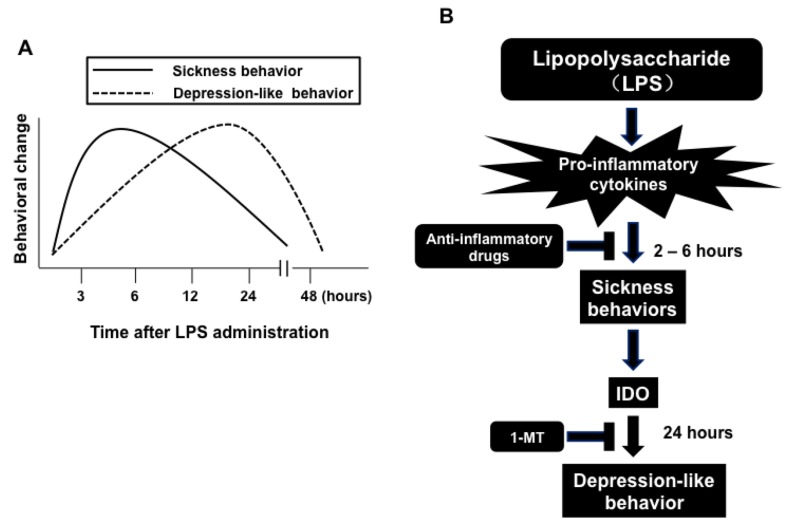
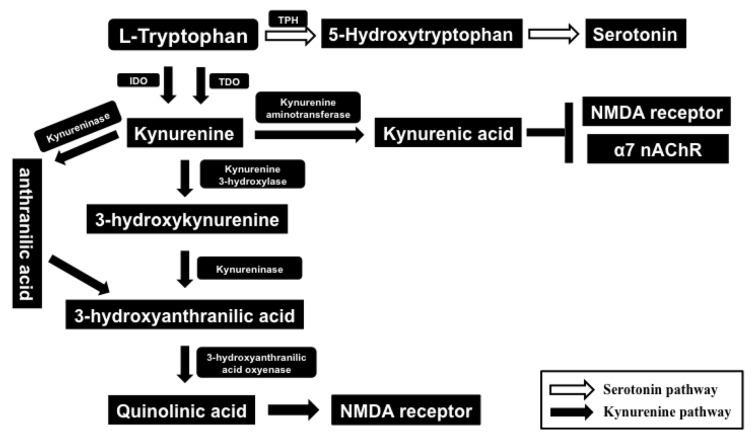
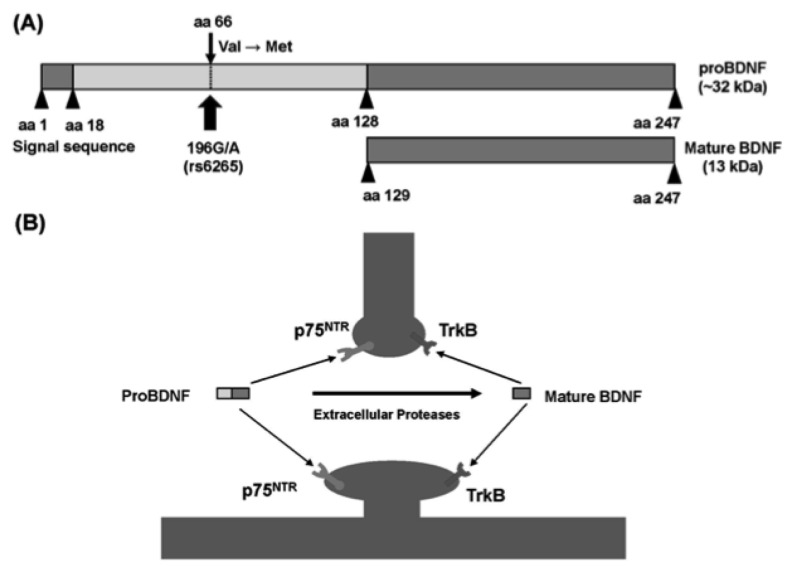
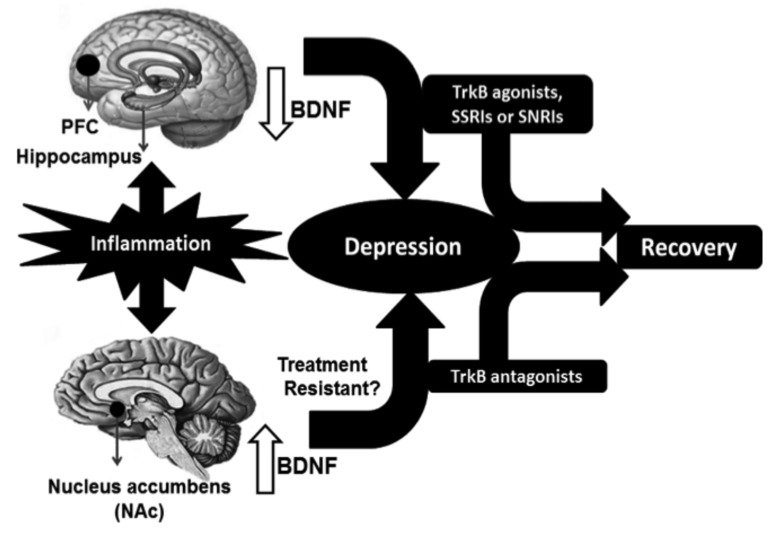
Depression is the most prevalent and among the most debilitating of psychiatric disorders. The precise neurobiology of this illness is unknown. Several lines of evidence suggest that peripheral and central inflammation plays a role in depressive symptoms, and that anti-inflammatory drugs can improve depressive symptoms in patients with inflammation-related depression. Signaling via brain-derived neurotrophic factor (BDNF) and its receptor, tropomycin receptor kinase B (TrkB) plays a key role in the pathophysiology of depression and in the therapeutic mechanisms of antidepressants. A recent paper showed that lipopolysaccharide (LPS)-induced inflammation gave rise to depression-like phenotype by altering BDNF-TrkB signaling in the prefrontal cortex, hippocampus, and nucleus accumbens, areas thought to be involved in the antidepressant effects of TrkB agonist, 7,8-dihydroxyflavone (7,8-DHF) and TrkB antagonist, ANA-12. Here we provide an overview of the tryptophan-kynurenine pathway and BDNF-TrkB signaling in the pathophysiology of inflammation-induced depression, and propose mechanistic actions for potential therapeutic agents. Additionally, the authors discuss the putative role of TrkB agonists and antagonists as novel therapeutic drugs for inflammation-related depression.
Overview
The claims and statistics of this paper haven’t been checked yet.
Free: it reads the open-access text and checks the first 5 claims that cite a source we can check. Create a free account to check every claim.
Integrity signals
Registry
Cites
Statistics
Figures
Verification
Claims the paper makes
The claims and statistics of this paper haven’t been checked yet.
Free: it reads the open-access text and checks the first 5 claims that cite a source we can check. Create a free account to check every claim.
Claims other papers make about this one
Each is checked against this paper’s own text: does it say what the citing paper says it does?
The source backs part of the claim, not all of it — or backs it for a different population, condition or comparison.
In the citing paper
“For the treatment of depression, targeting signaling transduction by BDNF and its receptor, tropomycin receptor kinase B (TrkB), is essential. 143 , 144”
From Major depressive disorder: hypothesis, mechanism, prevention and treatment (2024) · cites this paper as [144]
Experimental — accuracy not yet measured
Self-check
Percentages, sums and reported differences re-computed from the paper’s own numbers.
The self-check needs the paper’s full text.
Citations
Cites
1 retracted
Yang, C., Shirayama, Y., Zhang, J.-C., Ren, Q., & Hashimoto, K. (2015) · International Journal of Neuropsychopharmacology · doi:10.1093/ijnp/pyu121 · Cited by 103 · cited 2×
“In the rat learned helplessness model, we found that BDNF levels in the NAc were significantly higher in depressed rats compared with control and resilient rats, suggesting again that regional differences in BDNF levels may promote resilience to inescapable stress [113].”
Self-citationRetractedYaşlı Kadınlarda Üreme Sağlığı
Kokanalı, D., & Engin Üstün, Y. (n.d.) · DergiPark (Istanbul University) · Cited by 170,090
Yaşlı Kadınlarda Üreme Sağlığı
Kokanalı, D., & Üstün, Y. E. (2019) · Jinekoloji-Obstetrik ve Neonatoloji Tıp Dergisi · Cited by 169,629
Kessler, R. C. (1994) · Archives of General Psychiatry · doi:10.1001/archpsyc.1994.03950010008002 · Cited by 12,370
Molecular Mechanisms of Depression: Perspectives on New Treatment Strategies
Lang, U. E., & Borgwardt, S. (2013) · Cellular Physiology and Biochemistry · doi:10.1159/000350094 · Cited by 8,475
From inflammation to sickness and depression: when the immune system subjugates the brain
Dantzer, R., O'Connor, J. C., Freund, G. G., Johnson, R. W., & Kelley, K. W. (2008) · Nature Reviews Neuroscience · doi:10.1038/nrn2297 · Cited by 7,395 · cited 7×
“IDO activation results in decreased tryptophan levels and increased production of kynurenine and other tryptophanderived metabolites [36, 45].”
InfluentialA Meta-Analysis of Cytokines in Major Depression
Dowlati, Y., Herrmann, N., Swardfager, W., Liu, H., Sham, L., Reim, E. K., & Lanctôt, K. L. (2010) · Biological Psychiatry · doi:10.1016/j.biopsych.2009.09.033 · Cited by 4,729 · cited 1×
“Metaanalysis showed higher serum levels of TNF-α in drug-free depressed patients relative to healthy controls [26].”
Raetz, C. R. H., & Whitfield, C. (2002) · Annual Review of Biochemistry · doi:10.1146/annurev.biochem.71.110601.135414 · Cited by 4,404 · cited 1×
“Administration of LPS or pro-inflammatory cytokines results in a significant reduction of BDNF gene and protein expression [38, 92].”
Neurotrophins: Roles in Neuronal Development and Function
Huang, E. J., & Reichardt, L. F. (2001) · Annual Review of Neuroscience · doi:10.1146/annurev.neuro.24.1.677 · Cited by 4,394 · cited 2×
“It is well known that BDNF is integral to use-dependent plasticity mechanisms, such as long-term potentiation, learning and memory [80-85].”
Domingos da Silveira da Luz, A. C., Pereira Dias, G., do Nascimento Bevilaqua, M. C., Cocks, G., Gardino, P. F., Thuret, S., & Nardi, A. E. (2013) · Neuropsychobiology · doi:10.1159/000353269 · Cited by 3,995
Research works printed but not linked: 2
- [97]Duman R.S. Heninger G.R. Nestler E.J. A molecular and cellular theory of depression. Arch. Gen. Psychiatry 1997 54 7 597 606 [http://dx.doi.org/10.1001/archpsyc.1997.01830190015002]. [PMID: 9236543]. 9236543 · DOI · Paper page
- [102]Hashimoto K. Sigma-1 receptor chaperone and brain-derived neurotrophic factor: emerging links between cardiovascular disease and depression. Prog. Neurobiol. 2013 100 15 29 [pneurobio.].[http://dx.doi.org/10.1016/j.pneurobio.2012.09.001]. [PMID: 23044468]. 23044468 · DOI · Paper page
Cited by
Items 501–561 of 561
Insights In Adolescent and Young Adult Psychiatry: 2023
(2024) · Frontiers research topics · doi:10.3389/978-2-8325-5356-5
Brain-Derived Neurotrophic Factor in Bipolar Disorder
Hashimoto, K. (2024) · Springer eBooks · doi:10.1007/978-3-031-32035-4_20-1
Self-citationChaïb, S. (2023) · theses.fr (ABES) · doi:10.70675/00e3b294z3b0az4a32zb1c5z3c09edd92416 · Cited by 1
Inflammatory Mediators in Major Depression and Bipolar Disorder (Russian Translation)
Sara, P., de Gennaro, M. E., & Francesco, B. (2024) · Juvenis scientia · doi:10.32415/jscientia_2024_10_5_28-55
Bibliometric analysis on the research trends in neurotrophic factors
Zhao, Q. (2025) · New cell · doi:10.61958/ncjx4036
CRISPR-Edited DPSCs, Constitutively Expressing BDNF Enhance Dentin Regeneration in Injured TeethPreprint
Kim, J. H., Irfan, M., Sreekumar, S., Kim, S., Atsawasuwan, P., & Chung, S. (2025) · eLife · doi:10.7554/elife.105153.1
Depression: The Vagus Nerve and Gut-Brain Axis
Hashimoto, K. (2024) · Springer eBooks · doi:10.1007/978-3-031-32035-4_31-1
Self-citationThe Current Status of Antidepressant Drugs and the Exploration of New Targets
张, 陈. (2025) · Hans Journal of Medicinal Chemistry · doi:10.12677/hjmce.2025.132021
Brain-Derived Neurotrophic Factor in Bipolar Disorder
Hashimoto, K. (2025) · Springer eBooks · doi:10.1007/978-3-031-73368-0_20
Self-citationAlonso, V. R. Z., & Prado, R. D. C. G. G. (2025) · Revista Contemporânea · doi:10.56083/rcv5n10-038
He, Y., Hiutung, C., Tian, D., Han, Z., & Hu, W. (2025) · European journal of medical research · doi:10.1186/s40001-025-03360-2
“Reduced contractile strength of skeletal muscle can diminish brain-derived neurotrophic factor (BDNF) levels, impair hippocampal neurogenesis, and weaken synaptic plasticity, thereby promoting the onset of depression [36, 37].”
Serpa, J. J. V. (2025) · Ibero Ciencias - Revista Científica y Académica · doi:10.63371/ic.v4.n4.a563
Kim, H. R., Lee, Y.-J., Kim, T.-W., Lim, R.-N., Hwang, D. Y., Moffat, J. J., Kim, S., Seo, J.-W., & Ka, M. (2020) · Figshare · doi:10.6084/m9.figshare.13152013
Han, S.-K., Kim, J.-K., Park, H.-S., Shin, Y.-J., & Kim, D.-H. (2021) · Figshare · doi:10.6084/m9.figshare.15178938
Phillips, A. (2019) · ResearchWorks at the University of Washington (University of Washington)
Brogi, A. (2020) · Electronic Theses and Dissertations Repository (University of Pisa)
Opanković, A. (2023) · National Repository of Dissertations in Serbia
Fontana, T. (2024) · LA Referencia (Red Federada de Repositorios Institucionales de Publicaciones Científicas)
de Freitas, M. E. (2024) · LA Referencia (Red Federada de Repositorios Institucionales de Publicaciones Científicas)
Yu, F., Gao, Y., Du, X., Liu, S., & Xu, Y. (2026) · Neuropsychiatric Disease and Treatment · doi:10.2147/ndt.s586668
“10,11 This cascade leads to synaptic dysfunction, reduced neuroplasticity, and neuronal damage, especially in stress-sensitive regions such as the hippocampus and prefrontal cortex.”
Zortul, H. (2024) · Dspace Repository (Marmara Üniversitesi)
PDCD4: A Double-Edged Sword in Neurological Diseases
Li, C., Zheng, K., Qiu, M. S., & Yang, J. (2026) · Molecular Neurobiology · doi:10.1007/s12035-026-05768-1
“Abnormal BDNF and excessive activation of microglia are recognized as key pathological processes in depression [97, 98].”
Song, Y., Song, J., Liu, S., Zhang, J., Liu, Z., Chen, H., Wang, S., Zhuang, T., & Zhang, G. (2026) · International Immunopharmacology · doi:10.1016/j.intimp.2026.116456
Self-citationLiu, Y., Liu, Y., Wang, G., Zhang, H., Li, Z., & Zhang, G. (2026) · American Heart Journal Plus Cardiology Research and Practice · doi:10.1016/j.ahjo.2026.100767
“…process then results in the release of the NF-κ B dimer, allowing for its translocation to the nucleus, where it binds to the promoter regions of target genes and initiates the transcription of inflammatory factors and chemokines, ultimately leading to apoptosis of neurons and glial cells [36,37].”
Potential muscular doping effects of anti-depressants
Tutakhail, A. (2019) · theses.fr (ABES) · doi:10.70675/f3cbba2dza035z4ef0zaebbz68fe16432b48
Feng, Y., Zhang, Y., Lian, J., Dong, K., Peng, Z., Shan, G., Zhu, Y., Zhu, Y., Shi, J., Liu, P., et al. (2025) · International Journal of Food Science & Technology · doi:10.1093/ijfood/vvag079
Chen, S., Shang, B., Bi, Y., Xu, R., Li, Q., Zhang, W., Yang, Y., & Hu, S. (2026) · International Journal of COPD · doi:10.2147/copd.s578054
“40 Studies show exercise training effectively reduces inflammation and upregulates BDNF, possibly alleviating or reversing inflammation’s negative brain impact and promoting emotional health.”
Gao, C., Zhu, S., Sun, Y., Luo, F.-Y., Feng, T., Yang, Y., Li, C., Liu, C. H., & Zhang, Y. (2026) · Chemistry & Biodiversity · doi:10.1002/cbdv.71322
Akintunde, J. K., Salami, S. O., Eteng, E. O., Adeleye, O. O., Folayan, A. D., Fadare, D. A., & Oladele, T. E. (2026) · Medicine in Omics · doi:10.1016/j.meomic.2026.100060
He, Y., Sun, Q., Hu, K., Xiao, Z., Zhao, H., zhou, L., Cao, S., & Tang, B. (2026) · Colloids and Surfaces B Biointerfaces · doi:10.1016/j.colsurfb.2026.115841
Aubin, C., Blais, J., Petkova, Y., & Lordkipanidzé, M. (2026) · Current Opinion in Hematology · doi:10.1097/moh.0000000000000936
Mechanism of endocannabinoid system activation in regulating depression
Xin-Sheng, L. I. U., Liang, J., & Yan, L. I. (2026) · Shengming kexue · doi:10.3724/cbls.2026090
Dey, S., Adhish, M., & Mitra, P. (2026) · Computational Biology and Chemistry · doi:10.1016/j.compbiolchem.2026.109210
Zhu, X., Zhang, P., Liu, C., Zhang, Y., Wang, X., Li, X., Lu, D., Guo, F., Yao, Y., Zhu, J., et al. (2026) · BMC Psychiatry · doi:10.1186/s12888-026-08342-0
“Serum BDNF levels were significantly correlated with the severity of depression [14].”
Hasanzadeh, M., Beirami, A. D., Alinezhad, A., Fatemian, F., Rafiei, M. A., Zare, F., Navaei, F., Parvardeh, S., Sarkala, H. B., Sadr, M., et al. (2026) · Neuropeptides · doi:10.1016/j.npep.2026.102641
Kotlęga, D., Peda, B., Zembroń-Łacny, A., Baldy-Chudzik, K., & Szczuko, M. (2026) · Neurologia i Neurochirurgia Polska · doi:10.5603/pjnns.110718
Cunha, E. S., Alonso, V. R. Z., & Prado, R. D. C. G. G. (2026) · Revista Contemporânea · doi:10.56083/rcv6n7-033
Alonso, V. R. Z., & Prado, R. D. C. G. G. (2026) · Revista Contemporânea · doi:10.56083/rcv6n7-038
Potential of Saliva in Stroke Patients: A Review
Forszt, D., Gerreth, K., Bielas, M., & Maciejczyk, M. (2026) · International Journal of Molecular Sciences · doi:10.3390/ijms27156871
“In adulthood, BDNF promotes differentiation and development of central and peripheral neurons [164].”
Thakur, A., Jain, P., Sharma, M. K., Chauhan, N. S., Khatoon, N., Sahu, D., Ajazuddin, & Tamrakar, S. (2026) · Current Behavioral Neuroscience Reports · doi:10.1007/s40473-026-00331-7
Wang, L., Shang, R., Zhang, C., Wang, S., & Xian, J. (2026) · Neuropsychiatric Disease and Treatment · doi:10.2147/ndt.s625958
“30 Together with broader evidence linking SCFAs and histone regulation with neuroplasticity, 15,16,41 these findings support direct investigation of microbial metabolites.”
Kavuran, İ. B., Önalan, E., Turk, Z. I., & Eröksüz, H. (2026) · Frontiers in Pharmacology · doi:10.3389/fphar.2026.1910199
Chen, L., Zheng, D., Wei, S., Chen, G., Shen, Y., Liu, L., & Lin, H. (2026) · Environmental Toxicology and Pharmacology · doi:10.1016/j.etap.2026.105144
Min, M. A. (2019) · Institutional Repositories DataBase (IRDB) · doi:10.20776/106527
Jia, X., Gong, Q., Xiong, B., Hu, Y., Ali, T., Zheng, C., Wei, S., Huang, J., Wang, Z., Feng, J., et al. (2026) · Brain Behavior and Immunity · doi:10.1016/j.bbi.2026.106988
Castro, E. T., Zanatta, Â., Carvalho, A. V. S., de Moraes, A. U., Netto, C. A., Leipnitz, G., Amaral, A. U., Vargas, C. R., Ribeiro, R. T., & Wajner, M. (2026) · Metabolic Brain Disease · doi:10.1007/s11011-026-01973-y
Okuyucu, B., TÜRKDÖNMEZ, E., Tiryaki, E. S., Ayyıldız, M., Ağar, E., & Arslan, G. (2026) · Research Square · doi:10.21203/rs.3.rs-10829503/v1
Yang, L., He, J., Li, D., Li, Y., Su, Q., Liang, H., Yuan, J., Lai, K., & Wei, G. (2026) · Chemistry & Biodiversity · doi:10.1002/cbdv.71695
Jin, C., Zhang, Y., Li, B., Cheng, Z., Zheng, M., Song, K., & Ai, Y. (2026) · Current Issues in Molecular Biology · doi:10.3390/cimb48090944
“The BDNF-TrkB axis enhances synaptic expansion, nerve plasticity, connectivity; supports neuronal preservation; and thwarts apoptosis within the central nervous system [57].”
Wang, X., Ding, Y., He, L., Kang, X.-Z., Geng, X., Sakaue, F., Yokota, T., Zhang, L., Yao, W., & Zhang, J. (2026) · Aging Cell · doi:10.1111/acel.70717
“BDNF, a key member of the neurotrophin (NT) family (Huang and Reichardt 2003; Kang et al. 2017a; Mizui et al. 2016; Zhang et al. 2016), is co-colocalized with and promotes the survival of dopaminergic neurons in the SNc (Baydyuk and Xu 2014; Seroogy et al. 1994).”
Self-citationMolecular Pathways and Biomarkers for the Diagnosis and Treatment of Major Depressive Disorder
Jafari, D. A. (2026) · IGI Global eBooks · doi:10.4018/979-8-2600-4270-0.ch004
Guo, Z., Dong, L., Lin, J., Duan, Y., Liu, W., Jiang, W., Liu, C., Jia, S., Song, Y., Ding, F., et al. (2026) · European Journal of Sport Science · doi:10.1002/ejsc.70272
“This molecular deficit directly undermines synaptic plasticity and Long‐Term Potentiation (LTP) in the hippocampus and PFC, thereby impeding neurogenesis and memory consolidation (Molendijk et al. 2014; Zhang et al. 2016).”
Liu, Y., Tan, Y., & Hashimoto, K. (2026) · European Journal of Pharmacology · doi:10.1016/j.ejphar.2026.179414
Self-citationDuan, X., Tian, F., Liu, W., Yang, Y., Gao, Y., Hashimoto, K., Wang, S., & Zhang, H. (2026) · European Journal of Pharmacology · doi:10.1016/j.ejphar.2026.179444
Self-citationQuan, S., Xu, W., Du, H., Xu, Z., Zhao, T., Zhao, M., 林小伟, & Chen, X. (2026) · Frontiers in Psychiatry · doi:10.3389/fpsyt.2026.1936946
Postnatal Immune Activation: A Hidden Trigger for Mood Disorders?
Shen, D., Ji, G., Sun, X., Ma, S., & Zhao, T. (2026) · International Journal of Molecular Sciences · doi:10.3390/ijms27219757
New horizons in stroke management, volume II
(2026) · Frontiers research topics · doi:10.3389/978-2-8325-8984-7
The Red Berry and the Brain: Lycium barbarum Polysaccharides in Neuroprotection
Yang, C., En-qiang, D., Luo, J.-N., Zhang, M.-H., Cui, D., Lv, J., & Chang, J. (2026) · Cells · doi:10.3390/cells15222051
Ilavská, L., Morvová, M., Jr., Paduchová, Z., Muchová, J., Garaiova, I., Ďuračková, Z., Šikurová, L., & Trebatická, J. (2024) · doi:10.3389/fpsyt.2024.1347178.s003
Metadata
- Authors
- Zhang, J.-C., Yao, W., & Hashimoto, K.
- Affiliations
- Chiba University (JP)
- Corresponding author
- Hashimoto, Kenji
- Venue
- Current Neuropharmacology
- Publisher
- Bentham Science Publishers Ltd.
- Published
- 2016-08-26
- Volume
- 14
- Issue
- 7
- Pages
- 721-731
- ISSN
- 1570-159X (ISSN-L)
- PMC
- PMC5050398
- OpenAlex
- W2309165118
- Semantic Scholar
- 8c9bc4382355e7e712e5e9cf698e36fc7516725f
- Cited by
- 538
- References
- 131
- Citations by year
- 2026: 46 · 2025: 71 · 2024: 70 · 2023: 71 · 2022: 65 · 2021: 60 · 2020: 64 · 2019: 37 · 2018: 22 · 2017: 18 · 2016: 14
- FWCI
- 1.81
- Type
- journal article
- Language
- en
- Open access
- bronze
- doi.org
- Locations
- Current Neuropharmacology (publishedVersion)
- PubMed Central (publishedVersion, cc-by-nc)
- PubMed (publishedVersion)
- Funders
- Ministry of Education, Culture, Sports, Science and Technology (24116006)
- Japan Society for the Promotion of Science (15K19711)
- Topics
- Life Sciences › Neuroscience › Biological Psychiatry › Tryptophan and brain disorders
- Health Sciences › Medicine › Pharmacology (medical) › Treatment of Major Depression
- Life Sciences › Neuroscience › Cellular and Molecular Neuroscience › Nerve injury and regeneration
- Keywords
- brain-derived neurotrophic factor, TrkB signaling, neuroinflammation, kynurenine pathway, lipopolysaccharide-induced inflammation, antidepressant mechanism, 7,8-dihydroxyflavone, ANA-12, TrkB agonist, prefrontal cortex, hippocampus, nucleus accumbens
- MeSH terms
- Animals, Anti-Inflammatory Agents, Antidepressive Agents, Brain, Depressive Disorder, Humans, Inflammation, Brain-Derived Neurotrophic Factor, Receptor, trkB
About these checks
Registry, retraction, Cites and statistics results are computed, not judged, with one exception: a printed reference that no index lists is read once by a model before it counts as a citation error. Claims are extracted by a model and kept only when their quote appears verbatim in the text; each cited source is then checked, with a model’s help, for whether it says what the claim relies on. Those verdicts can be wrong — read the claim’s quote and the cited source before relying on one.
Statistics and arithmetic are recomputed, not judged.
Confidence bands are shown only for fields calibrated on our annotated test set. None is calibrated yet, so no band is shown.
What counts as a claim ›How we measure confidence ›How we check this ›
Are you an author, or do you see a problem with this page? Request a review
Data sources
Bibliographic data: Semantic Scholar, OpenAlex, Crossref.
Contains information from the Semantic Scholar Academic Graph Datasets, made available under the ODC Attribution License (ODC-BY 1.0).
Semantic Scholar’s data is described in: Kinney, R., et al. (2023). The Semantic Scholar Open Data Platform. arXiv:2301.10140.
