

Scaling of variational quantum circuit depth for condensed matter systems
Open accessThe DOI matches its Crossref record; 70 of the 71 references it cites were found in a registry or an index.
Abstract
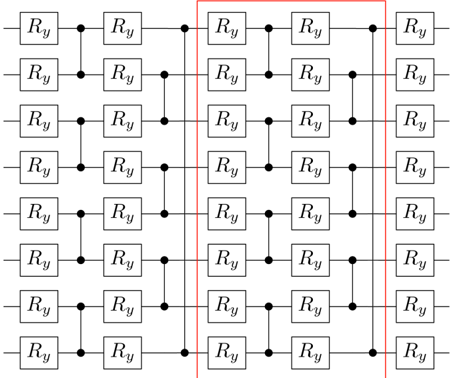
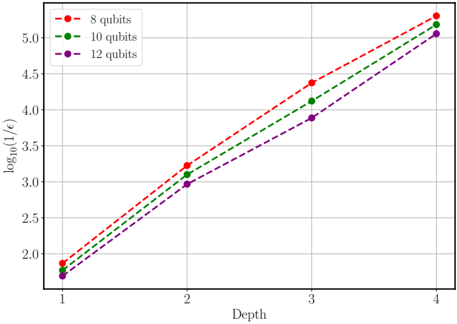
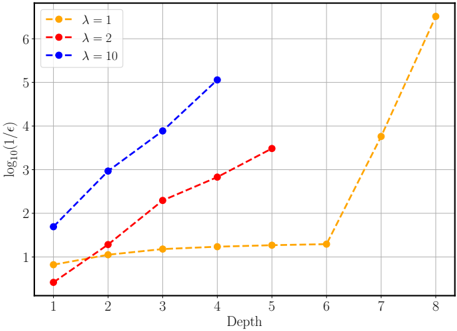
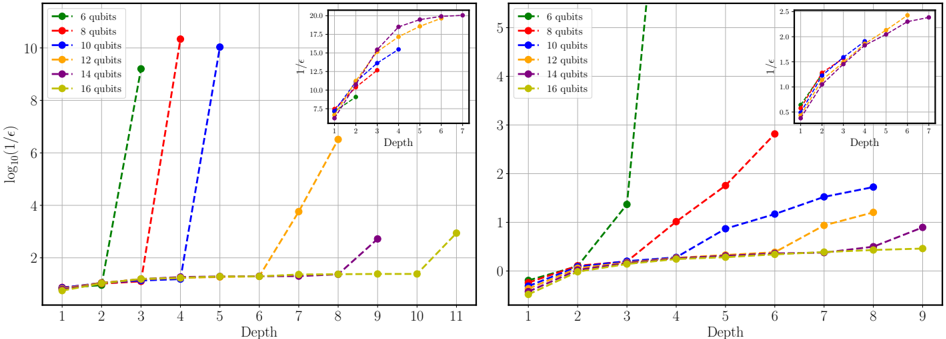
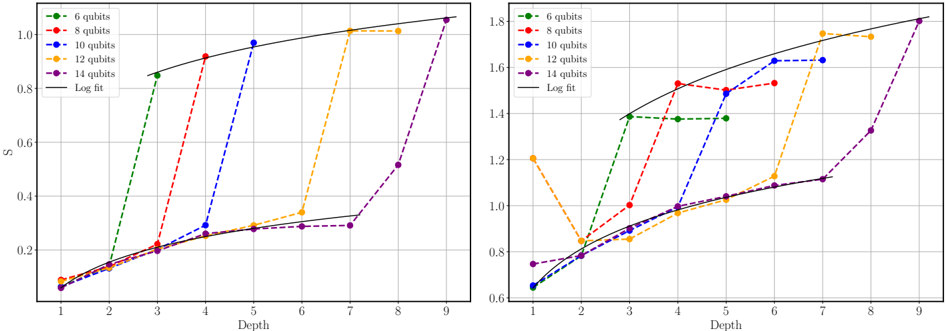
We benchmark the accuracy of a variational quantum eigensolver based on a finite-depth quantum circuit encoding ground state of local Hamiltonians. We show that in gapped phases, the accuracy improves exponentially with the depth of the circuit. When trying to encode the ground state of conformally invariant Hamiltonians, we observe two regimes. A finite-depth regime, where the accuracy improves slowly with the number of layers, and a finite-size regime where it improves again exponentially. The cross-over between the two regimes happens at a critical number of layers whose value increases linearly with the size of the system. We discuss the implication of these observations in the context of comparing different variational ansatz and their effectiveness in describing critical ground states.
Overview
The claims and statistics of this paper haven’t been checked yet.
Free: it reads the open-access text and checks the first 5 claims that cite a source we can check. Create a free account to check every claim.
Integrity signals
Registry
Cites
Statistics
Figures
Verification
Claims the paper makes
The claims and statistics of this paper haven’t been checked yet.
Free: it reads the open-access text and checks the first 5 claims that cite a source we can check. Create a free account to check every claim.
Self-check
Percentages, sums and reported differences re-computed from the paper’s own numbers.
The self-check needs the paper’s full text.
Citations
Cites
SciPy 1.0: fundamental algorithms for scientific computing in Python
Virtanen, P., Gommers, R., Oliphant, T. E., Haberland, M., Reddy, T., Cournapeau, D., Burovski, E., Peterson, P., Weckesser, W., Bright, J., et al. (2020) · Nature Methods · doi:10.1038/s41592-019-0686-2 · Cited by 38,430
Quantum Computing in the NISQ era and beyond
Preskill, J. (2018) · Quantum · doi:10.22331/q-2018-08-06-79 · Cited by 8,830
Quantum Computation and Quantum Information: 10th Anniversary Edition
Nielsen, M. A., & Chuang, I. L. (2012) · doi:10.1017/cbo9780511976667 · Cited by 8,436
A Limited Memory Algorithm for Bound Constrained Optimization
Byrd, R. H., Lu, P., Nocedal, J., & Zhu, C. (1995) · SIAM Journal on Scientific Computing · doi:10.1137/0916069 · Cited by 6,221
A variational eigenvalue solver on a photonic quantum processor
Peruzzo, A., McClean, J., Shadbolt, P., Yung, M.-H., Zhou, X.-Q., Love, P. J., Aspuru-Guzik, A., & O’Brien, J. L. (2014) · Nature Communications · doi:10.1038/ncomms5213 · Cited by 4,552
Entanglement entropy and quantum field theory
Calabrese, P., & Cardy, J. (2004) · Journal of Statistical Mechanics: Theory and Experiment · doi:10.1088/1742-5468/2004/06/p06002 · Cited by 3,275
Entanglement Entropy and Quantum Field Theory
Calabrese, P., & Cardy, J. (2004) · arXiv · doi:10.48550/arxiv.hep-th/0405152 · Cited by 3,275
Georgescu, I. M., Ashhab, S., & Nori, F. (2014) · Reviews of Modern Physics · doi:10.1103/revmodphys.86.153 · Cited by 2,932
Colloquium : Area laws for the entanglement entropy
Eisert, J., Cramer, M., & Plenio, M. B. (2010) · Reviews of Modern Physics · doi:10.1103/revmodphys.82.277 · Cited by 2,873
Barren plateaus in quantum neural network training landscapes
McClean, J. R., Boixo, S., Smelyanskiy, V. N., Babbush, R., & Neven, H. (2018) · Nature Communications · doi:10.1038/s41467-018-07090-4 · Cited by 2,329
QuTiP 2: A Python framework for the dynamics of open quantum systems
Johansson, J. R., Nation, P. D., & Nori, F. (2013) · Computer Physics Communications · doi:10.1016/j.cpc.2012.11.019 · Cited by 2,242
Operator content of two-dimensional conformally invariant theories
Cardy, J. L. (1986) · Nuclear Physics B · doi:10.1016/0550-3213(86)90552-3 · Cited by 1,955
A Quantum Approximate Optimization Algorithm
Farhi, E., Goldstone, J., & Gutmann, S. (2014) · arXiv · doi:10.48550/arxiv.1411.4028 · Cited by 1,789
Geometric and renormalized entropy in conformal field theory
Holzhey, C., Larsen, F., & Wilczek, F. (1994) · Nuclear Physics B · doi:10.1016/0550-3213(94)90402-2 · Cited by 1,769
Quantum Chemistry in the Age of Quantum Computing
Cao, Y., Romero, J., Olson, J. P., Degroote, M., Johnson, P. D., Kieferová, M., Kivlichan, I. D., Menke, T., Peropadre, B., Sawaya, N. P. D., et al. (2019) · Chemical Reviews · doi:10.1021/acs.chemrev.8b00803 · Cited by 1,560
Classical and Quantum Computation
Kitaev, A., Shen, A., & Vyalyi, M. (2002) · Graduate Studies in Mathematics · doi:10.1090/gsm/047 · Cited by 1,387
Universal term in the free energy at a critical point and the conformal anomaly
Affleck, I. (1986) · Physical Review Letters · doi:10.1103/physrevlett.56.746 · Cited by 1,222
The One-Dimensional Hubbard Model
Essler, F. H. L., Frahm, H., Göhmann, F., Klümper, A., & Korepin, V. E. (2005) · Cambridge University Press eBooks · doi:10.1017/cbo9780511534843 · Cited by 1,203 · cited 1×
“From the point of view of a Fermionic model, ∆ induces a density-density interaction, and thus the model, even if still exactly solvable via the Bethe ansats, is not anymore a model for free fermions [50].”
An area law for one-dimensional quantum systems
Hastings, M. B. (2007) · Journal of Statistical Mechanics: Theory and Experiment · doi:10.1088/1742-5468/2007/08/p08024 · Cited by 1,131
Cost function dependent barren plateaus in shallow parametrized quantum circuits
Cerezo, M., Sone, A., Volkoff, T., Cincio, L., & Coles, P. J. (2021) · Nature Communications · doi:10.1038/s41467-021-21728-w · Cited by 1,047
Two-Dimensional Ising Model as a Soluble Problem of Many Fermions
SCHULTZ, T. D., MATTIS, D. C., & LIEB, E. H. (1964) · Reviews of Modern Physics · doi:10.1103/revmodphys.36.856 · Cited by 936
Buluta, I., & Nori, F. (2009) · Science · doi:10.1126/science.1177838 · Cited by 876
Callan, C., & Wilczek, F. (1994) · Physics Letters B · doi:10.1016/0370-2693(94)91007-3 · Cited by 826
Quantum Algorithm Providing Exponential Speed Increase for Finding Eigenvalues and Eigenvectors
Abrams, D. S., & Lloyd, S. (1999) · Physical Review Letters · doi:10.1103/physrevlett.83.5162 · Cited by 817
Quantum entanglement in condensed matter systems
Laflorencie, N. (2016) · Physics Reports · doi:10.1016/j.physrep.2016.06.008 · Cited by 765
Matrix product states represent ground states faithfully
Verstraete, F., & Cirac, J. I. (2006) · Physical Review B · doi:10.1103/physrevb.73.094423 · Cited by 730
Data re-uploading for a universal quantum classifier
Pérez-Salinas, A., Cervera-Lierta, A., Gil-Fuster, E., & Latorre, J. I. (2020) · Quantum · doi:10.22331/q-2020-02-06-226 · Cited by 713
Self-citationFlow‐equations for Hamiltonians
Wegner, F. (1994) · Annalen der Physik · doi:10.1002/andp.19945060203 · Cited by 694
Efficient Variational Quantum Simulator Incorporating Active Error Minimization
Li, Y., & Benjamin, S. C. (2017) · Physical Review X · doi:10.1103/physrevx.7.021050 · Cited by 686
Lieb-Robinson Bounds and the Generation of Correlations and Topological Quantum Order
Bravyi, S., Hastings, M. B., & Verstraete, F. (2006) · Physical Review Letters · doi:10.1103/physrevlett.97.050401 · Cited by 664
Self-verifying variational quantum simulation of lattice models
Kokail, C., Maier, C., van Bijnen, R., Brydges, T., Joshi, M. K., Jurcevic, P., Muschik, C. A., Silvi, P., Blatt, R., Roos, C. F., et al. (2019) · Nature · doi:10.1038/s41586-019-1177-4 · Cited by 594
Quantum autoencoders for efficient compression of quantum data
Romero, J., Olson, J. P., & Aspuru-Guzik, A. (2017) · Quantum Science and Technology · doi:10.1088/2058-9565/aa8072 · Cited by 559
Variational ansatz-based quantum simulation of imaginary time evolution
McArdle, S., Jones, T., Endo, S., Li, Y., Benjamin, S. C., & Yuan, X. (2019) · npj Quantum Information · doi:10.1038/s41534-019-0187-2 · Cited by 557
Quantum Computation as Geometry
Nielsen, M. A., Dowling, M. R., Gu, M., & Doherty, A. C. (2006) · Science · doi:10.1126/science.1121541 · Cited by 539
Quantum Algorithms for Quantum Field Theories
Jordan, S. P., Lee, K. S. M., & Preskill, J. (2012) · Science · doi:10.1126/science.1217069 · Cited by 517
Renormalization of Hamiltonians
Głazek, S. D., & Wilson, K. G. (1993) · Physical Review D · doi:10.1103/physrevd.48.5863 · Cited by 494
Variational Quantum Computation of Excited States
Higgott, O., Wang, D., & Brierley, S. (2019) · Quantum · doi:10.22331/q-2019-07-01-156 · Cited by 463
Hastings, M. B., & Wen, X.-G. (2005) · Physical Review B · doi:10.1103/physrevb.72.045141 · Cited by 406
Conformal Invariance and Critical Phenomena
Henkel, M. (1999) · Springer eBooks · doi:10.1007/978-3-662-03937-3 · Cited by 386 · cited 1×
“The large distance behavior of the transverse field Ising model is described by a CFT with central charge c = 1/2, one of the well known minimal model [48, 49].”
Quantum-assisted quantum compiling
Khatri, S., LaRose, R., Poremba, A., Cincio, L., Sornborger, A. T., & Coles, P. J. (2019) · Quantum · doi:10.22331/q-2019-05-13-140 · Cited by 382
Theory of Finite-Entanglement Scaling at One-Dimensional Quantum Critical Points
Pollmann, F., Mukerjee, S., Turner, A. M., & Moore, J. E. (2009) · Physical Review Letters · doi:10.1103/physrevlett.102.255701 · Cited by 364
Infinite conformal symmetry of critical fluctuations in two dimensions
Belavin, A. A., Polyakov, A. M., & Zamolodchikov, A. B. (1984) · Journal of Statistical Physics · doi:10.1007/bf01009438 · Cited by 355
Perturbative renormalization group for Hamiltonians
Glazek, S. D., & Wilson, K. G. (1994) · Physical Review D · doi:10.1103/physrevd.49.4214 · Cited by 330
Scaling of entanglement support for matrix product states
Tagliacozzo, L., de Oliveira, T. R., Iblisdir, S., & Latorre, J. I. (2008) · Physical Review B · doi:10.1103/physrevb.78.024410 · Cited by 314
Self-citationTemme, K., Osborne, T. J., Vollbrecht, K. G., Poulin, D., & Verstraete, F. (2011) · Nature · doi:10.1038/nature09770 · Cited by 305
Dawson, C. M., & Nielsen, M. A. (2006) · Quantum Information and Computation · doi:10.26421/qic6.1-6 · Cited by 288
Variational Quantum Linear Solver
Bravo-Prieto, C., LaRose, R., Cerezo, M., Subasi, Y., Cincio, L., & Coles, P. J. (2019) · arXiv · doi:10.48550/arxiv.1909.05820 · Cited by 284
Self-citationVariational quantum algorithms for discovering Hamiltonian spectra
Jones, T., Endo, S., McArdle, S., Yuan, X., & Benjamin, S. C. (2019) · Physical Review A · doi:10.1103/physreva.99.062304 · Cited by 256
The Power of Quantum Systems on a Line
Aharonov, D., Gottesman, D., Irani, S., & Kempe, J. (2009) · Communications in Mathematical Physics · doi:10.1007/s00220-008-0710-3 · Cited by 210
Variational quantum state diagonalization
LaRose, R., Tikku, A., O’Neel-Judy, É., Cincio, L., & Coles, P. J. (2019) · npj Quantum Information · doi:10.1038/s41534-019-0167-6 · Cited by 199
Noise resilience of variational quantum compiling
Sharma, K., Khatri, S., Cerezo, M., & Coles, P. J. (2020) · New Journal of Physics · doi:10.1088/1367-2630/ab784c · Cited by 196
Many-Body Quantum Chaos: Analytic Connection to Random Matrix Theory
Kos, P., Ljubotina, M., & Prosen, T. (2018) · Physical Review X · doi:10.1103/physrevx.8.021062 · Cited by 176
Matrix product unitaries: structure, symmetries, and topological invariants
Cirac, J. I., Pérez-García, D., Schuch, N., & Verstraete, F. (2017) · Journal of Statistical Mechanics Theory and Experiment · doi:10.1088/1742-5468/aa7e55 · Cited by 169
Osborne, T. J. (2012) · Reports on Progress in Physics · doi:10.1088/0034-4885/75/2/022001 · Cited by 165
Quantum circuits for strongly correlated quantum systems
Verstraete, F., Cirac, J. I., & Latorre, J. I. (2009) · Physical Review A · doi:10.1103/physreva.79.032316 · Cited by 158
Self-citationImproved techniques for preparing eigenstates of fermionic Hamiltonians
Berry, D. W., Kieferová, M., Scherer, A., Sanders, Y. R., Low, G. H., Wiebe, N., Gidney, C., & Babbush, R. (2018) · npj Quantum Information · doi:10.1038/s41534-018-0071-5 · Cited by 140
Matrix product states for critical spin chains: Finite-size versus finite-entanglement scaling
Pirvu, B., Vidal, G., Verstraete, F., & Tagliacozzo, L. (2012) · Physical Review B · doi:10.1103/physrevb.86.075117 · Cited by 136
Self-citationUsing Quantum Computers for Quantum Simulation
Brown, K. L., Munro, W. J., & Kendon, V. M. (2010) · Entropy · doi:10.3390/e12112268 · Cited by 129
Efficient discrete approximations of quantum gates
Harrow, A. W., Recht, B., & Chuang, I. L. (2002) · Journal of Mathematical Physics · doi:10.1063/1.1495899 · Cited by 122
Numerical renormalization group at criticality
Nishino, T., Okunishi, K., & Kikuchi, M. (1996) · Physics Letters A · doi:10.1016/0375-9601(96)00128-4 · Cited by 88
Variational quantum unsampling on a quantum photonic processor
Carolan, J., Mohseni, M., Olson, J. P., Prabhu, M., Chen, C., Bunandar, D., Niu, M. Y., Harris, N. C., Wong, F. N. C., Hochberg, M., et al. (2020) · Nature Physics · doi:10.1038/s41567-019-0747-6 · Cited by 88
Quantum circuit complexity of one-dimensional topological phases
Huang, Y., & Chen, X. (2015) · Physical Review B · doi:10.1103/physrevb.91.195143 · Cited by 79
Quantum Criticality with the Multi-scale Entanglement Renormalization Ansatz
Evenbly, G., & Vidal, G. (2013) · Springer Series in Solid-State Sciences · doi:10.1007/978-3-642-35106-8_4 · Cited by 76
Conformal data from finite entanglement scaling
Stojevic, V., Haegeman, J., McCulloch, I. P., Tagliacozzo, L., & Verstraete, F. (2015) · Physical Review B · doi:10.1103/physrevb.91.035120 · Cited by 72
Self-citationVariational consistent histories as a hybrid algorithm for quantum foundations
Arrasmith, A., Cincio, L., Sornborger, A. T., Zurek, W. H., & Coles, P. J. (2019) · Nature Communications · doi:10.1038/s41467-019-11417-0 · Cited by 66
Quantum singular value decomposer
Bravo-Prieto, C., García-Martín, D., & Latorre, J. I. (2020) · Physical Review A · doi:10.1103/physreva.101.062310 · Cited by 64
Self-citationBridging Perturbative Expansions with Tensor Networks
Vanderstraeten, L., Mariën, M., Haegeman, J., Schuch, N., Vidal, J., & Verstraete, F. (2017) · Physical Review Letters · doi:10.1103/physrevlett.119.070401 · Cited by 55
The quartic oscillator: a non-perturbative study by continuous unitary transformations
Dusuel, S., & Uhrig, G. S. (2004) · Journal of Physics A: Mathematical and General · doi:10.1088/0305-4470/37/39/014 · Cited by 38
Quantum Annealing: a journey through Digitalization, Control, and hybrid Quantum Variational schemes
Mbeng, G. B., Fazio, R., & Santoro, G. E. (2019) · arXiv (Cornell University) · doi:10.48550/arxiv.1906.08948 · Cited by 35
Addressing hard classical problems with Adiabatically Assisted Variational Quantum Eigensolvers
Garcia-Saez, A., & Latorre, J. I. (2018) · arXiv · doi:10.48550/arxiv.1806.02287 · Cited by 28
Self-citationVariational Fast Forwarding for Quantum Simulation Beyond the Coherence TimePreprint
Cîrstoiu, C., Holmes, Z., Iosue, J. T., Cincio, Ł., Coles, P. J., & Sornborger, A. T. (2019) · arXiv (Cornell University) · doi:10.48550/arxiv.1910.04292 · Cited by 7
Research works printed but not linked: 6
- C. Bravo-Prieto, D. García-Martín, and J. I. Latorre, (2019), arXiv:1905.01353 [quant- ph] . · arXiv
- C. M. Dawson and M. A. Nielsen, Quantum Info. Comput. 6, 81 (2006).
- E. H. Lieb and D. W. Robinson, Comm. Math. Phys. 28, 251 (1972).
- J. I. Latorre, E. Rico, and G. Vidal, Quan- tum Info. Comput. 4, 48 (2004).
- M. Collura, L. Dell'Anna, T. Felser, and S. Montangero, (2019), arXiv:1905.11351 [quant-ph] . · arXiv
- M. Cerezo, A. Sone, T. Volkoff, L. Cincio, and P. J. Coles, (2020), arXiv:2001.00550 [quant-ph] . · arXiv
Cited by
Variational quantum algorithms
Cerezo, M., Arrasmith, A., Babbush, R., Benjamin, S. C., Endo, S., Fujii, K., McClean, J. R., Mitarai, K., Yuan, X., Cincio, L., et al. (2021) · Nature Reviews Physics · doi:10.1038/s42254-021-00348-9 · Cited by 3,385
Noisy intermediate-scale quantum algorithms
Bharti, K., Cervera-Lierta, A., Kyaw, T. H., Haug, T., Alperin-Lea, S., Anand, A., Degroote, M., Heimonen, H., Kottmann, J. S., Menke, T., et al. (2022) · Reviews of Modern Physics · doi:10.1103/revmodphys.94.015004 · Cited by 2,231
The Variational Quantum Eigensolver: A review of methods and best practices
Tilly, J., Chen, H., Cao, S., Picozzi, D., Setia, K., Li, Y., Grant, E., Wossnig, L., Rungger, I., Booth, G. H., et al. (2022) · Physics Reports · doi:10.1016/j.physrep.2022.08.003 · Cited by 1,031
Exploring Entanglement and Optimization within the Hamiltonian Variational Ansatz
Wiersema, R., Zhou, C., de Sereville, Y., Carrasquilla, J. F., Kim, Y. B., & Yuen, H. (2020) · PRX Quantum · doi:10.1103/prxquantum.1.020319 · Cited by 235
Qibo : a framework for quantum simulation with hardware acceleration
Efthymiou, S., Ramos-Calderer, S., Bravo-Prieto, C., Pérez-Salinas, A., García-Martín, D., García-Sáez, A., Latorre, J. I., & Carrazza, S. (2021) · Quantum Science and Technology · doi:10.1088/2058-9565/ac39f5 · Cited by 215
“Particularly, the example may be used to explore how the accuracy of the VQE ansatz scales with the underlying circuit depth, as presented in [74].”
MethodSelf-citation
Metadata
- Authors
- Bravo-Prieto, C., Lumbreras-Zarapico, J., Tagliacozzo, L., & Latorre, J. I.
- Affiliations
- Barcelona Supercomputing Center (ES)
- Institut de Ciències del Cosmos (ES)
- Centre for Quantum Technologies (SG)
- Venue
- Quantum
- Published
- 2020-05-28
- Volume
- 4
- Pages
- 272
- ISSN
- 2521-327X (ISSN-L)
- OpenAlex
- W3032358338
- Cited by
- 66
- References
- 61
- Citations by year
- 2026: 5 · 2025: 12 · 2024: 9 · 2023: 14 · 2022: 14 · 2021: 9 · 2020: 3
- FWCI
- 3.93
- Type
- journal article
- Language
- en
- Open access
- gold
- doi.org
- Locations
- Quantum (publishedVersion, cc-by)
- arXiv (Cornell University) (submittedVersion)
- National University of Singapore (submittedVersion, cc-by)
- DOAJ (DOAJ: Directory of Open Access Journals) (submittedVersion, cc-by-sa)
- arXiv (Cornell University) (cc-by)
- Funders
- Ministerio de Ciencia, Innovación y Universidades (PGC2018-095862-B-C22, PGC 2018)
- Barcelona Supercomputing Center
- Agencia Estatal de Investigación (PGC2018-095862-B-C22)
- Topics
- Physical Sciences › Computer Science › Artificial Intelligence › Quantum Computing Algorithms and Architecture
- Physical Sciences › Physics and Astronomy › Atomic and Molecular Physics, and Optics › Quantum many-body systems
- Physical Sciences › Physics and Astronomy › Atomic and Molecular Physics, and Optics › Quantum Information and Cryptography
- Keywords
- variational quantum eigensolver, quantum circuit depth, local Hamiltonians, gapped phases, conformal invariance, finite-size scaling, variational ansatz, quantum many-body systems
About these checks
Registry, retraction, Cites and statistics results are computed, not judged, with one exception: a printed reference that no index lists is read once by a model before it counts as a citation error. Claims are extracted by a model and kept only when their quote appears verbatim in the text; each cited source is then checked, with a model’s help, for whether it says what the claim relies on. Those verdicts can be wrong — read the claim’s quote and the cited source before relying on one.
Statistics and arithmetic are recomputed, not judged.
Confidence bands are shown only for fields calibrated on our annotated test set. None is calibrated yet, so no band is shown.
What counts as a claim ›How we measure confidence ›How we check this ›
Are you an author, or do you see a problem with this page? Request a review
Data sources
Bibliographic data: Semantic Scholar, OpenAlex, Crossref.
Contains information from the Semantic Scholar Academic Graph Datasets, made available under the ODC Attribution License (ODC-BY 1.0).
Semantic Scholar’s data is described in: Kinney, R., et al. (2023). The Semantic Scholar Open Data Platform. arXiv:2301.10140.
