

How to factor 2048 bit RSA integers in 8 hours using 20 million noisy qubits
Open accessThe DOI matches its Crossref record; 85 of the 87 references it cites were found in a registry or an index, and 2 are not checked yet; 66 of the 87 sources its claims cite were checked for support.
Abstract
We significantly reduce the cost of factoring integers and computing discrete logarithms in finite fields on a quantum computer by combining techniques from Shor 1994, Griffiths-Niu 1996, Zalka 2006, Fowler 2012, Ekerå-Håstad 2017, Ekerå 2017, Ekerå 2018, Gidney-Fowler 2019, Gidney 2019. We estimate the approximate cost of our construction using plausible physical assumptions for large-scale superconducting qubit platforms: a planar grid of qubits with nearest-neighbor connectivity, a characteristic physical gate error rate of 10−3, a surface code cycle time of 1 microsecond, and a reaction time of 10 microseconds. We account for factors that are normally ignored such as noise, the need to make repeated attempts, and the spacetime layout of the computation. When factoring 2048 bit RSA integers, our construction's spacetime volume is a hundredfold less than comparable estimates from earlier works (Van Meter et al. 2009, Jones et al. 2010, Fowler et al. 2012, Gheorghiu et al. 2019). In the abstract circuit model (which ignores overheads from distillation, routing, and error correction) our construction uses 3n+0.002nlgn logical qubits, 0.3n3+0.0005n3lgn Toffolis, and 500n2+n2lgn measurement depth to factor n-bit RSA integers. We quantify the cryptographic implications of our work, both for RSA and for schemes based on the DLP in finite fields.
Verified 2026-11-22 · 2 references not checked yet
Overview
CoChat Summary
TL;DR
Gidney and Ekerå combine several optimizations to Shor’s algorithm and its Ekerå–Håstad derivatives to sharply reduce the cost of factoring RSA integers and computing finite-field discrete logarithms on a fault-tolerant quantum computer. Their headline estimate is factoring a 2048-bit RSA integer in 8 hours using 20 million noisy qubits, with spacetime volume about a hundredfold lower than comparable earlier estimates.
Key findings
- The construction reduces the abstract-circuit cost for factoring an \(n\)-bit RSA integer to \(3n + 0.002n\lg n\) logical qubits, \(0.3n^3 + 0.0005n^3\lg n\) Toffolis, and \(500n^2 + n^2\lg n\) measurement depth.
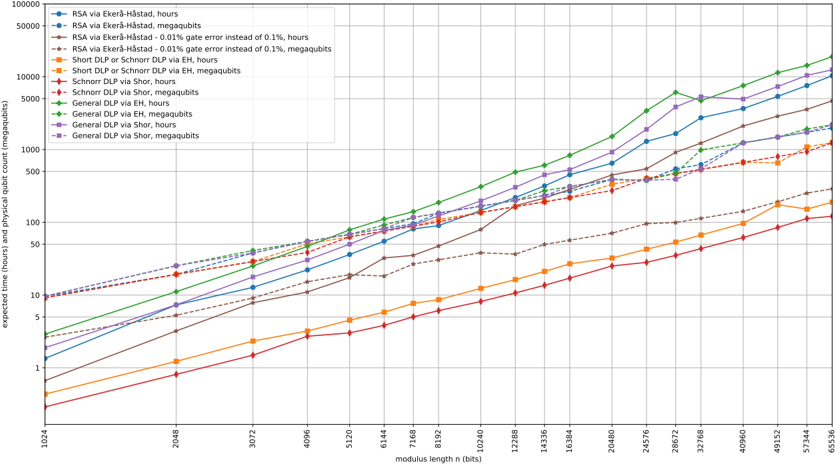
- For \(n=2048\), Table 3 reports 20 megaqubits, 5.1 hours per run, 5.9 expected megaqubitdays, and a 31% retry risk; the title/abstract advertise 8 hours using 20 million noisy qubits.
- The paper estimates the spacetime volume is a hundredfold less than comparable earlier works (Van Meter et al. 2009, Jones et al. 2010, Fowler et al. 2012, Gheorghiu et al. 2019), and the Toffoli count is over 10× lower than previous works.
- For \(n=2048\), the implementation needs approximately 3 billion CCZ states, with total distillation error 6.4% using level 1 code distance 17 and level 2 code distance 27; at code distance 27 the topological error probability is approximately 27%, implying roughly 1.4 repeats on average.
Methods
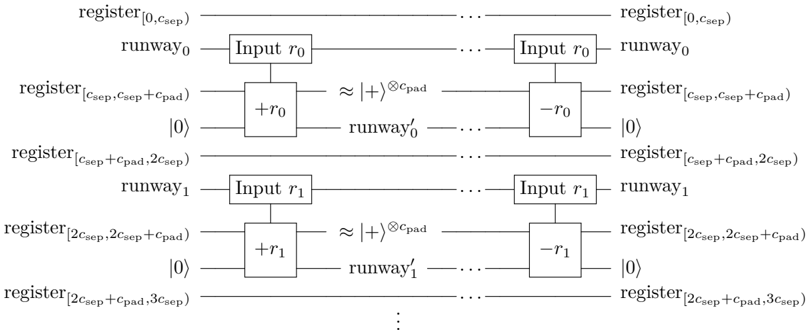
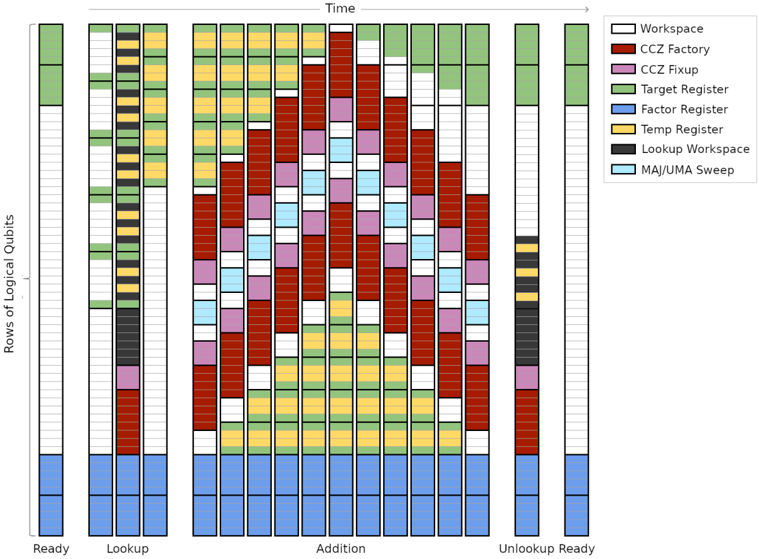
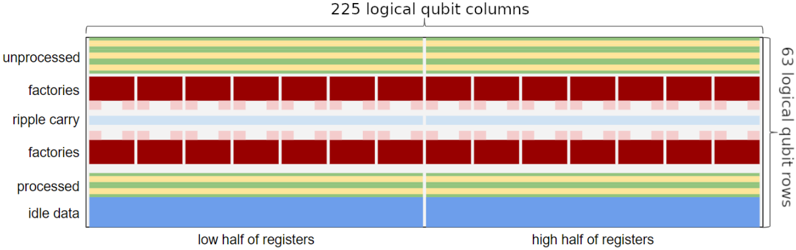
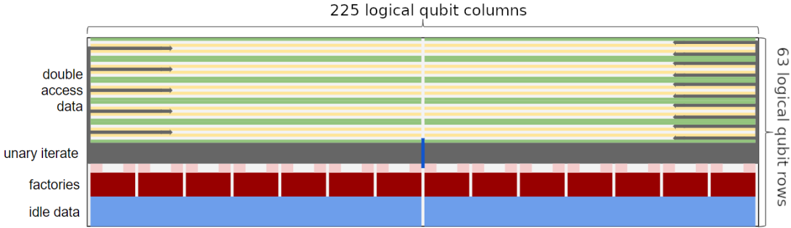
- The construction starts from Shor’s algorithm and Ekerå–Håstad’s short-discrete-logarithm algorithm, then applies windowed arithmetic, Zalka’s coset representation of modular integers, oblivious carry runways, and a reaction-limited spacetime layout for lookup additions.
- Cost estimates are given in the abstract circuit model and under physical assumptions for superconducting qubits: planar nearest-neighbor connectivity, physical gate error rate \(10^{-3}\), surface-code cycle time 1 microsecond, and reaction time 10 microseconds.
- Parameters such as code distances, window sizes, runway spacing, and padding offset are optimized by minimizing a skewed expected spacetime volume \(s^{1.2} \cdot t/(1-\epsilon)\) over enumerated combinations; estimates cover RSA moduli from 1024 to 16384 bits and finite-field discrete logarithms.
Limitations
- The paper states large systemic uncertainties: doubling or halving the physical gate error rate would change the required qubit count by more than 10%, and the estimates are intended as ballpark figures, not exact predictions.
- The paper notes that the runtime estimate ignores that at larger problem sizes lookups become slower because the minimum code distance increases.
- The paper states that code distance 27 at \(n=2048\) is “pushing the limits of feasibility” with about 27% topological error and roughly 1.4 expected repeats; increasing to distance 29 would raise qubit count by 15% but reduce error by about a factor of 10. The text also makes evident that no hardware demonstration is performed and that not all optimizations are directly applicable to elliptic-curve arithmetic.
Model-written summary. Check it against the paper before relying on it.
Integrity signals
Registry
Cites
Statistics
Figures
Verification
Claims the paper makes
42 Valid · 16 Not valid · 10 Not checked · 76 Own results and interpretations
The cited sources support only part of this claim — read each source’s verdict below.
In the paper
“It is also reduced by using Eker˚ a and H˚ astad's derivatives [21, 23-25] of Shor's algorithms, that require fewer multiplications to be performed compared to Shor's original algorithms.”
What the sources say
- Partly supportedcites [21] [21] M. Eker˚ a. Modifying Shor's algorithm to compute short discrete logarithms. Cryptology ePrint Archive, Report 2016/1128 , 2016. URL https://eprint.iacr.org/2016/1128 . - sourceExperimental — accuracy not yet measured
Section 2.1 says tradeoffs in Ekerå–Håstad’s algorithm reduce the quantum group operations needed per run, supporting a qualified version of the claim. But §1.2.5 says Ekerå’s general discrete-logarithm algorithm without tradeoffs requires approximately 3m operations versus 2m for Shor’s; the blanket claim that the derivatives require fewer multiplications is therefore too broad. (LLM, conf=0.88)
- Partly supportedcites [23] [23] M. Eker˚ a. On post-processing in the quantum algorithm for computing short discrete logarithms. Designs, Codes and Cryptography , 88(11):2313-2335, 2020. DOI: 10.1007/s10623-02000783-2. iacr:2017/1122. - sourceExperimental — accuracy not yet measured
Section 1.2 says the Ekerå–Håstad derivatives reduce the number of controlled group operations in each run compared with Shor’s algorithms, supporting the claim’s comparison of quantum computation costs. But the claim does not limit the comparison to each run: Appendix A.2 (RSA) says that, for some tradeoffs, the total number of operations across runs is greater than for a single run of Shor’s algorithm. (LLM, conf=0.86)
- Partly supportedcites [24] [24] M. Eker˚ a. Quantum algorithms for computing general discrete logarithms and orders with tradeoffs. Journal of Mathematical Cryptology , 15(1):359-407, 2021. DOI: 10.1515/jmc-20200006. (To appear.) iacr:2018/797. - sourceExperimental — accuracy not yet measured
Section 2 says the tradeoff algorithm can use fewer group operations than Shor’s algorithm per run, by up to a factor of two, but requires multiple runs. It also says that without tradeoffs it uses 3m operations versus Shor’s 2m, so the unqualified claim that the derivatives require fewer multiplications is too broad. Page numbers are unavailable in our copy. (LLM, conf=0.85)
- Could not verifycites [25] [25] M. Eker˚ a and J. H˚ astad. Quantum Algorithms for Computing Short Discrete Logarithms and Factoring RSA Integers. In Post-Quantum Cryptography , volume 10346 of Lecture Notes in Computer Science (LNCS) , pages 347-363. Springer, 2017. DOI: 10.1007/978-3-319-598796˙20. - sourceExperimental — accuracy not yet measured
In Time-optimal quantum computation (p. 3), Fowler discusses the time required for a factoring computation, while the references (p. 4) list Shor's original work. Our copy does not discuss Ekerå and Håstad's derivatives or compare their multiplication counts with Shor's; searches for those names and for modular-multiplication comparisons found no supporting passage. (LLM, conf=0.75)
states a cause- Asserted: passes — The authors put it forward as true.
- Checkable: passes — It can be checked against evidence.
- Load-bearing: unclear — It is unclear whether the paper’s conclusions depend on it.
- Based: passes — The paper gives a reason why it holds.
- Partly supported
The cited sources support only part of this claim — read each source’s verdict below.
In the paper
“When factoring 2048 bit RSA integers, our construction's spacetime volume is a hundredfold less than comparable estimates from earlier works (Van Meter et al. 2009, Jones et al. 2010, Fowler et al. 2012, Gheorghiu et al. 2019).”
What the sources say
- Supportedcites Van Meter et al. 2009 matched to “DISTRIBUTED QUANTUM COMPUTATION ARCHITECTURE USING SEMICONDUCTOR NANOPHOTONICS” (2010) source
Section 5.2 (pp. 20–22) estimates both the qubits required and the execution time for factoring a 2,048-bit number, so this paper supplies an earlier space-and-time estimate of the kind cited. The hundredfold comparison is the citing authors’ conclusion about their own construction, not a result attributed to Van Meter et al. (LLM, conf=0.89)
- Not matchedcites Jones et al. 2010
An author–year citation the paper’s reference list doesn’t settle. We don’t search these by name.
- Supportedcites Fowler et al. 2012 matched to “Surface codes: Towards practical large-scale quantum computation” (2012) source
The citation identifies Fowler et al. as an earlier resource estimate, not as the source of the citing authors’ hundredfold comparison. In I. Background (p. 2), Fowler et al. estimate about a billion physical qubits operating for about one day to factor a 2,000-bit number, a closely comparable factoring task. (LLM, conf=0.86)
plainstates a cause- Asserted: passes — The authors put it forward as true.
- Checkable: passes — It can be checked against evidence.
- Load-bearing: passes — The paper’s conclusions depend on it.
- Based: passes — The paper gives a reason why it holds.
- Supported
The cited sources that could be checked couldn’t confirm or dispute this claim.
In the paper
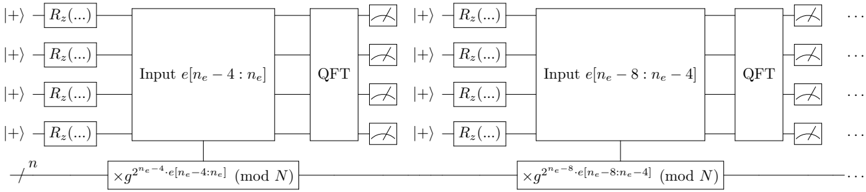
“In terms of space, we are using 3 n + O (lg n ) logical qubits. The qubits are distributed as follows: n + O (lg n ) for the accumulation register storing the product, n + O (lg n ) for a workspace register during the multiplication, n + O (lg n ) for the lookup output register, and O (lg n ) qubits to hold the part of the exponent needed for the current stage of the semi-classical Fourier trans”
What the sources say
- Could not verifycites [40] [40] R. B. Griffiths and C.-S. Niu. Semiclassical Fourier Transform for Quantum Computation. Physical Review Letters , 76(17):3228-3231, April 1996. DOI: 10.1103/PhysRevLett.76.3228. arXiv:quant-ph/9511007. - sourceExperimental — accuracy not yet measured
The discussion of Fig. 2 (p. 4) describes a semiclassical Fourier transform using measurements and classically controlled one-bit gates. Our copy does not address the claimed 3n + O(lg n) logical-qubit total or its allocation among accumulation, workspace, lookup-output, and exponent registers; searches for those terms found no supporting passage. (LLM, conf=0.76)
plain- Asserted: passes — The authors put it forward as true.
- Checkable: passes — It can be checked against evidence.
- Load-bearing: passes — The paper’s conclusions depend on it.
- Based: passes — The paper gives a reason why it holds.
- Could not verify
The cited sources support only part of this claim — read each source’s verdict below.
In the paper
“We improve on their estimates by over 100x (see Table 2) when accounting for slight remaining differences in the cost model.”
What the sources say
- Supportedcites [46] [46] N. C. Jones, R. Van Meter, A. G. Fowler, P. L. McMahon, J. Kim, T. D. Ladd, and Y. Yamamoto. Layered Architecture for Quantum Computing. Physical Review X , 2(3):031007, 2012. DOI: 10.1103/PhysRevX.2.031007. arXiv:1010.5022. - source
The citation is offered for the baseline estimate the citing authors compare against, and our copy of Jones et al. does report exactly that kind of resource estimate under an explicit cost model: Table IX (VII. Timing Considerations, p. 20) gives 4.54 × 10^8 quantum dots (4.54 cm²) for 1024-bit Shor's algorithm, built from 10^5 logical qubits, code distance 31, and two-level |A⟩ distillation factories (Appendix B 1, pp. 21-22; Table IV, p. 14). The '>100x improvement' itself is the citing paper's own conclusion and is not stated by, nor checkable in, this source; what this source supplies is the prior estimate and cost model being improved upon. (LLM, conf=0.82)
- Supportedcites [28] [28] A. G. Fowler, M. Mariantoni, J. M. Martinis, and A. N. Cleland. Surface codes: Towards practical large-scale quantum computation. Physical Review A , 86(3):032324, 2012. DOI: 10.1103/PhysRevA.86.032324. arXiv:1208.0928. - source
Appendix M (pp. 52–53) estimates the time and physical-qubit resources for a factoring circuit, so this paper is an estimate of the kind the citing authors compare against. The “over 100x” improvement is presented in the citing sentence as the citing authors’ own result, not as a finding attributed to Fowler et al. (LLM, conf=0.86)
- Could not verifycites [30] [30] V. Gheorghiu and M. Mosca. Benchmarking the quantum cryptanalysis of symmetric, publickey and hash-based cryptographic schemes. arXiv preprint arXiv:1902.02332 , 2019. URL https://arxiv.org/abs/1902.02332 . - sourceExperimental — accuracy not yet measured
The Overview and Improvements section (p. 12) discusses Gidney’s own gate costs and says their constant factors are worse than previous work. It does not assess the citing authors’ construction against estimates by Jones, Fowler, or Gheorghiu, or report an improvement of over 100x after cost-model adjustments. Searches for those names, the 100x figure, and cost-model differences found no supporting passage. (LLM, conf=0.76)
plainstates a cause- Asserted: passes — The authors put it forward as true.
- Checkable: passes — It can be checked against evidence.
- Load-bearing: passes — The paper’s conclusions depend on it.
- Based: passes — The paper gives a reason why it holds.
- Supported
The cited sources support only part of this claim — read each source’s verdict below.
In the paper
“In [21, 23, 25], Eker˚ a and H˚ astad explain how to factor RSA integers N = pq in a different way; namely by computing a short discrete logarithm.”
What the sources say
- Supportedcites [21] [21] M. Eker˚ a. Modifying Shor's algorithm to compute short discrete logarithms. Cryptology ePrint Archive, Report 2016/1128 , 2016. URL https://eprint.iacr.org/2016/1128 . - source
Section 1.2.3, “Breaking RSA,” explicitly says that Ekerå and Håstad describe factoring RSA integers by computing a short discrete logarithm. The citing sentence makes that attribution; it does not state the additional formula d ≡ p+q (mod r). (LLM, conf=0.93)
- Partly supportedcites [23] [23] M. Eker˚ a. On post-processing in the quantum algorithm for computing short discrete logarithms. Designs, Codes and Cryptography , 88(11):2313-2335, 2020. DOI: 10.1007/s10623-02000783-2. iacr:2017/1122. - sourceExperimental — accuracy not yet measured
Section 1.1 (Earlier works) confirms the citing sentence’s main point: Ekerå and Håstad express RSA factoring as a short discrete-logarithm problem. But the more specific equation in the supplied claim is not the one given in Appendix A.2 (RSA): the paper defines the short logarithm using a shifted sum of (p−1)/2 and (q−1)/2, not d ≡ p+q (mod r). (LLM, conf=0.88)
- Could not verifycites [25] [25] M. Eker˚ a and J. H˚ astad. Quantum Algorithms for Computing Short Discrete Logarithms and Factoring RSA Integers. In Post-Quantum Cryptography , volume 10346 of Lecture Notes in Computer Science (LNCS) , pages 347-363. Springer, 2017. DOI: 10.1007/978-3-319-598796˙20. - sourceExperimental — accuracy not yet measured
The discussion of factoring in “Time-optimal quantum computation” (p. 3) estimates hardware requirements for factoring a 2000-bit integer; it does not describe a short-discrete-logarithm algorithm. Searches for Ekerå and Håstad, RSA integers, and d = log_g y found no passage in our copy addressing the attributed method. (LLM, conf=0.77)
plainstates a cause- Asserted: passes — The authors put it forward as true.
- Checkable: passes — It can be checked against evidence.
- Load-bearing: passes — The paper’s conclusions depend on it.
- Based: passes — The paper gives a reason why it holds.
- Supported
47 more claims · 15 with their cited sources checked
Create a free account to see all 144 claims and to verify the 2 references still open.
- It may state two separate claims as one. 52
- Probably not a substantial claim. 55
- The quote only partly states this claim. 1
Claims other papers make about this one
Each is checked against this paper’s own text: does it say what the citing paper says it does?
The cited source doesn’t support the claim as written.
In the citing paper
“However, executing large-scale, useful algorithms on quantum processors requires very low gate error rates (generally below about 10−10)23, far below those that will probably ever be achievable with any physical device2.”
From Logical quantum processor based on reconfigurable atom arrays (2024) · cites this paper as [23]
Checked by a reasoning model — may be wrong.
Experimental — accuracy not yet measuredThe source backs part of the claim, not all of it — or backs it for a different population, condition or comparison.
In the citing paper
“In [182] it was demonstrated that 2048-bit RSA can be easily cracked in around eight hours by a quantum computer consisting of 20 million qbits.”
From Zero Trust Architecture (ZTA): A Comprehensive Survey (2022) · cites this paper as [182]
Experimental — accuracy not yet measuredThe source backs part of the claim, not all of it — or backs it for a different population, condition or comparison.
In the citing paper
“These results indicate that superconducting processors can remain stable for the hours-long timescales required for large-scale fault-tolerant algorithms21.”
From Quantum error correction below the surface code threshold (2025) · cites this paper as [21]
Experimental — accuracy not yet measuredThe source backs part of the claim, not all of it — or backs it for a different population, condition or comparison.
In the citing paper
“Although this logical error per cycle might permit certain fault-tolerant applications11, it is still many orders of magnitude higher than expected and precludes larger fault-tolerant circuits12,21.”
From Quantum error correction below the surface code threshold (2025) · cites this paper as [21]
Experimental — accuracy not yet measuredThe source backs part of the claim, not all of it — or backs it for a different population, condition or comparison.
In the citing paper
“Recent advancements suggest that within the next decade, quantum computing hardware may reach the threshold required to break 2048-bit RSA and comparable ECC implementations [2,3].”
From A Practical Performance Benchmark of Post-Quantum Cryptography Across Heterogeneous Computing Environments (2025) · cites this paper as [2]
Experimental — accuracy not yet measured
6 more claims about this paper
Create a free account to see every claim other papers make about this one.
Citations
Cites
New directions in cryptography
Diffie, W., & Hellman, M. (1976) · IEEE Transactions on Information Theory · doi:10.1109/tit.1976.1055638 · Cited by 14,713
A method for obtaining digital signatures and public-key cryptosystems
Rivest, R. L., Shamir, A., & Adleman, L. (1978) · Communications of the ACM · doi:10.1145/359340.359342 · Cited by 13,462 · cited 2×
“In particular, Shor’s algorithms may be used to break the RSA cryptosystem [3] based on the hardness of factoring integers that are the product of two similarly-sized primes (hereafter “RSA integers”), and cryptosystems based on the discrete logarithm problem (DLP), such as the Diffie-Hellman key agreement protocol [4…”
MethodA method for obtaining digital signatures and public-key cryptosystems
Rivest, R. L., Shamir, A., & Adleman, L. (1983) · Communications of the ACM · doi:10.1145/357980.358017 · Cited by 13,012
Algorithms for quantum computation: discrete logarithms and factoring
Shor, P. W. (2002) · Proceedings 35th Annual Symposium on Foundations of Computer Science · doi:10.1109/sfcs.1994.365700 · Cited by 8,713 · cited 4×
“…for computing general discrete logarithms in safe-prime groups and Schnorr groups when not making tradeoffs is to use Shor’s original algorithm [1], modified to work in the order r subgroup rather than in the whole multiplicative group Z ∗ N , and to start with a uniform superposition of all…”
BackgroundMethodInfluentialSurface codes: Towards practical large-scale quantum computation
Fowler, A. G., Mariantoni, M., Martinis, J. M., & Cleland, A. N. (2012) · Physical Review A · doi:10.1103/physreva.86.032324 · Cited by 3,059 · cited 7×
“2012 [9] 3n+O(1) 40n +O(n) 40n +O(n) 43 340 1200 53 850 4600 Häner et al.”
BackgroundMethodInfluentialSuperconducting quantum circuits at the surface code threshold for fault tolerance
Barends, R., Kelly, J., Megrant, A., Veitia, A., Sank, D., Jeffrey, E., White, T. C., Mutus, J., Fowler, A. G., Campbell, B., et al. (2014) · Nature · doi:10.1038/nature13171 · Cited by 1,733 · cited 2×
“The modular exponentiation in Shor’s algorithm is performed over a superposition of exponents, meaning a quantum computer is required, and quantum hardware is expected to be many orders of magnitude noisier than classical hardware [6–8].”
MethodUniversal quantum computation with ideal Clifford gates and noisy ancillas
Bravyi, S., & Kitaev, A. (2005) · Physical Review A · doi:10.1103/physreva.71.022316 · Cited by 1,525
Pohlig, S., & Hellman, M. (1978) · IEEE Transactions on Information Theory · doi:10.1109/tit.1978.1055817 · Cited by 1,199
Schnelle Multiplikation großer Zahlen
Schönhage, A., & Strassen, V. (1971) · Computing · doi:10.1007/bf02242355 · Cited by 1,107 · cited 2×
“For example, the Karatsuba algorithm [65] has a Toffoli count of O(n ) and the Schönhage–Strassen algorithm [66] has a Toffoli count of O(n lg n lg lgn).”
MethodMonte Carlo methods for index computation (𝑚𝑜𝑑𝑝)
Pollard, J. M. (1978) · Mathematics of Computation · doi:10.1090/s0025-5718-1978-0491431-9 · Cited by 825
Research works printed but not linked: 4
- [47] A. A. Karatsuba and Y. P. Ofman. Multiplication of many-digital numbers by automatic computers. Doklady Akademii Nauk SSSR , 145(2):293-294, 1962. URL http://mi.mathnet. ru/eng/dan/v145/i2/p293 . -
- [52] A. K. Lenstra. Key Lengths. In The Handbook of Information Security , chapter 6. 2004. URL https://infoscience.epfl.ch/record/164539/files/NPDF-32.pdf . -
- [72] C. Pomerance. A Tale of Two Sieves. Notices of the AMS , 43(12):1473-1485, 1996. URL https://www.ams.org/notices/199612/pomerance.pdf . -
- [75] O. Schirokauer. On pro-finite groups and on discrete logarithms . PhD thesis, University of California, Berkeley, May 1992. -
Cited by
Items 301–400 of 722
Quantum Shifts: The Societal Implications of Quantum Computing on Security, Privacy, and the Economy
Wheatley, M. C. (2024) · Premier Journal of Computer Science · doi:10.70389/pjcs.100002 · Cited by 5
Universal quantum control with dynamical correction
Jin, Z.-Y., & Jing, J. (2025) · Physical Review A · doi:10.1103/vfrs-fyzw · Cited by 6
Modular architectures and entanglement schemes for error-corrected distributed quantum computation
Singh, S., Gu, F., de Bone, S., Villaseñor, E., Elkouss, D., & Borregaard, J. (2025) · npj Quantum Information · doi:10.1038/s41534-025-01146-2 · Cited by 46
Engineering bosonic codes with quantum lattice gates
Guo, L., Huang, T., & Du, L. (2025) · Communications Physics · doi:10.1038/s42005-025-02354-0 · Cited by 10
Hacking Cryptographic Protocols with Advanced Variational Quantum Attacks
Aizpurua, B., Bermejo, P., Martínez, J. E., & Orús, R. (2025) · ACM Transactions on Quantum Computing · doi:10.1145/3718349 · Cited by 16
Quantum error correction with an Ising machine under circuit-level noise
Fujisaki, J., Maruyama, K., Oshima, H., Sato, S., Sakashita, T., Takeuchi, Y., & Fujii, K. (2023) · Physical Review Research · doi:10.1103/physrevresearch.5.043261 · Cited by 5
“However, the processing time for the number of qubits N on a classical computer is proportional to N 3 for MWPM, and the overhead is too large to be practical in the region of one million qubits or more that are required by FTQC [15, 16].”
MethodA Highly Efficient ECPM Quantum Circuit for Binary Elliptic Curve Cryptanalysis
Wardhani, R. W., Putranto, D. S. C., Cho, J., & Kim, H. (2024) · IEEE Access · doi:10.1109/access.2024.3489552 · Cited by 6
Evaluation of Quantum Key Distribution for Secure Satellite-integrated IoT Networks
Edwards, A., Law, Y. W., Mulinde, R., & Slay, J. (2023) · International Conference on Cyber Warfare and Security · doi:10.34190/iccws.18.1.982 · Cited by 7
How to factor 2048 bit RSA integers with less than a million noisy qubits
Gidney, C. (2025) · arXiv · Cited by 7
“This paper uses notably fewer logical qubits than [GE21] (points labeled “GE21”) and notably fewer Toffolis than [CFS24] (points labeled “CFS24”).”
InfluentialSelf-citationHow to compute a 256-bit elliptic curve private key with only 50 million Toffoli gates
Litinski, D. (2023) · arXiv · doi:10.48550/arxiv.2306.08585 · Cited by 5
Scalable set of reversible parity gates for integer factorization
Lanthaler, M., Niehoff, B. E., & Lechner, W. (2023) · Communications Physics · doi:10.1038/s42005-023-01191-3 · Cited by 4
Beyond the Buzz: Strategic Paths for Enabling Useful NISQ Applications
Hegde, P. R., Kyriienko, O., Heimonen, H., Tolias, P. B., Netzer, G., Barkoutsos, P. K., Vinuesa, R., Peng, I. B., & Markidis, S. (2024) · ACM International Conference on Computing Frontiers (CF) · doi:10.1145/3649153.3649182 · Cited by 11
Improved Estimation of Key Enumeration with Applications to Solving LWE
Budroni, A., & Mårtensson, E. (2023) · IEEE International Symposium on Information Theory (ISIT) · doi:10.1109/isit54713.2023.10206474 · Cited by 6
LSQCA: Resource-Efficient Load/Store Architecture for Limited-Scale Fault-Tolerant Quantum Computing
Kobori, T., Suzuki, Y., Ueno, Y., Tanimoto, T., Todo, S., & Tokunaga, Y. (2025) · IEEE International Symposium on High-Performance Computer Architecture (HPCA) · doi:10.1109/hpca61900.2025.00033 · Cited by 26
Mandev, R., & Kavun, E. B. (2023) · IEEE International Conference on Omni-layer Intelligent Systems (COINS) · doi:10.1109/coins57856.2023.10189254 · Cited by 7
Progress on ion trap quantum computation and simulation using two-dimensional ion crystals
Wu, Y., & Duan, L.-M. (2024) · 中国科学通报:英文版 · doi:10.1016/j.scib.2024.09.025 · Cited by 4
Pitfalls of the Sublinear QAOA-Based Factorization Algorithm
Grebnev, S. V., Gavreev, M. A., Kiktenko, E. O., Guglya, A. P., Efimov, A., & Fedorov, A. K. (2023) · IEEE Access · doi:10.1109/access.2023.3336989 · Cited by 13
A pragma based C++ framework for hybrid quantum/classical computation
Gazda, A., & Koska, O. (2024) · Science of Computer Programming · doi:10.1016/j.scico.2024.103119 · Cited by 8
Locality-Aware Pauli-Based Computation for Local Magic State Preparation
Hirano, Y., & Fujii, K. (2025) · IEEE International Conference on Quantum Computing and Engineering (QCE) · doi:10.1109/qce65121.2025.00078 · Cited by 23
Short two-qubit pulse sequences for exchange-only spin qubits in two-dimensional layouts
Chadwick, J. D., Guerreschi, G. G., Luthi, F., Mądzik, M. T., Mohiyaddin, F. A., Prabhu, P., Schmitz, A. T., Litteken, A., Premaratne, S., Bishop, N. C., et al. (2025) · Physical Review A · doi:10.1103/physreva.111.052616 · Cited by 8
Low-overhead defect-adaptive surface code with bandage-like super-stabilizers
Wei, Z., He, T., Ye, Y., Wu, D., Zhang, Y., Zhao, Y., Lin, W., Huang, H.-L., Zhu, X., & Pan, J.-W. (2025) · npj Quantum Information · doi:10.1038/s41534-025-01023-y · Cited by 20
Power networks SCADA communication cybersecurity, a Qiskit implementation
Biswas, H. (2025) · The Journal of Supercomputing · doi:10.1007/s11227-025-07758-x · Cited by 5
Identifying Obstacles of PQC Migration in E-Estonia
Vakarjuk, J., Snetkov, N., & Laud, P. (2024) · International Conference on Cyber Conflict · doi:10.23919/cycon62501.2024.10685570 · Cited by 6
Shadan, H. H., & Islam, S. M. N. (2025) · FinTech · doi:10.3390/fintech4040052 · Cited by 11
A Prototype For Quantum Database In Hybrid Quantum: A Complete EcosystemPreprint
chakraborty, S. (2022) · Research Square · doi:10.21203/rs.3.rs-2156463/v1 · Cited by 3
Quantum Snakes on a Plane: Mobile, Low-Dimensional Logical Qubits on a 2D Surface
Siegel, A., Cai, Z., Jnane, H., Koczor, B., Pexton, S., Strikis, A., & Benjamin, S. C. (2026) · PRX Quantum · doi:10.1103/494s-jd8h · Cited by 32
Warm-start adaptive-bias quantum approximate optimization algorithm
Yu, Y., Wang, X., Shannon, N., & Joynt, R. (2025) · Physical Review A · doi:10.1103/nt3w-j4mj · Cited by 12
Quantum modular multiplier via binary-exponent-based recombination
He, Y., Zhao, C., Dai, G., He, K., Geng, X., Liu, J., & Chen, W. (2022) · Quantum Information Processing · doi:10.1007/s11128-022-03736-x · Cited by 4
An optimization approach for a milling dynamics simulation based on Quantum Computing
Schröder, S., Danz, S., Kienast, P., König, V., Ganser, P., & Bergs, T. (2024) · Procedia CIRP · doi:10.1016/j.procir.2023.09.223 · Cited by 5
Wavelet correlation noise analysis for qubit operation variable time series
Seedhouse, A. E., Stuyck, N. D., Serrano, S., Gilbert, W., Huang, J. Y., Hudson, F. E., Itoh, K. M., Laucht, A., Lim, W. H., Yang, C. H., et al. (2025) · Scientific Reports · doi:10.1038/s41598-024-79553-2 · Cited by 8
Optimization Tools for Distance-Preserving Flag Fault-Tolerant Error Correction
Pató, B., Tansuwannont, T., Huang, S., & Brown, K. R. (2024) · PRX Quantum · doi:10.1103/prxquantum.5.020336 · Cited by 9
Experiments and Resource Analysis of Shor’s Factorization Using a Quantum Simulator
Yamaguchi, J., Yamazaki, M., Tabuchi, A., Honda, T., Izu, T., & Kunihiro, N. (2024) · Lecture notes in computer science · doi:10.1007/978-981-97-1235-9_7 · Cited by 6
Wang, C., Hu, Q., Yao, H., Wang, S., & Pei, Z. (2023) · Tsinghua Science & Technology · doi:10.26599/tst.2023.9010059 · Cited by 7
Faster computation of nonstabilizerness
Hamaguchi, H., Hamada, K., Marumo, N., & Yoshioka, N. (2025) · Physical Review Applied · doi:10.1103/physrevapplied.23.014069 · Cited by 5
Vittal, S., Javadi-Abhari, A., Cross, A. W., Bishop, L. S., & Qureshi, M. K. (2024) · IEEE/ACM International Symposium on Microarchitecture (MICRO) · doi:10.1109/micro61859.2024.00059 · Cited by 18
Distributed Quantum Error Correction Based on Hyperbolic Floquet Codes
Sutcliffe, E., Jonnadula, B., Gall, C. L., Moylett, A. E., & Westoby, C. M. (2025) · IEEE International Conference on Quantum Computing and Engineering (QCE) · doi:10.1109/qce65121.2025.00076 · Cited by 52
Encoding a magic state with beyond break-even fidelity
(2023) · doi:10.21203/rs.3.rs-3025370/v1 · Cited by 115
“Quantum memory” quantum computers and noiseless phton echoes
(2022) · doi:10.7498/aps.71.20212245 · Cited by 3
Experimental quantum digital signature based on heralded single-photon sources
Zhan, L., Zhang, C., Lu, N., et al. (2024) · Quantum Information Processing · doi:10.1007/s11128-023-04235-3 · Cited by 3
Quantum-secured distributed measurement systems for critical infrastructures operations
Angrisani, L., D’Arco, M., D’Iorio, M., & Regio, F. L. (2026) · Measurement · doi:10.1016/j.measurement.2026.121738 · Cited by 3
Interleaved Logical Qubits in Atom Arrays
Viszlai, J., Lin, S. F., Dangwal, S., Bradley, C. E., Ramesh, V., Baker, J. M., Bernien, H., & Chong, F. T. (2025) · IEEE International Symposium on High-Performance Computer Architecture (HPCA) · doi:10.1109/hpca61900.2025.00030 · Cited by 9
The Quantum Panopticon: A Theory of Surveillance for the Quantum Era
Olsson, E., & Öhman, C. (2025) · Minds and Machines · doi:10.1007/s11023-025-09723-2 · Cited by 9
An Analysis on the Variants of the RSA Cryptography
Patgiri, R., & Singh, L. D. (2022) · International Conference on Information Networking · doi:10.1109/icoin53446.2022.9687262 · Cited by 3
Optimized Quantum-Resistant Cryptosystem: Integrating Kyber-KEM with Hardware TRNG on Zynq Platform
Zhang, K., Yang, M., Yuan, Z., Zhang, Y., & Liu, W. (2025) · Electronics · doi:10.3390/electronics14132591 · Cited by 6
Towards Discovering Quantum-Threats for Applications Using Open-Source Libraries
Ye, X., Tan, T. G., & Zhou, J. (2024) · Lecture notes in computer science · doi:10.1007/978-3-031-61486-6_17 · Cited by 5
A New Approach to Generic Lower Bounds: Classical/Quantum MDL, Quantum Factoring, and More
Hhan, M. (2025) · Lecture notes in computer science · doi:10.1007/978-3-031-91098-2_13 · Cited by 6
POSTER: Stealthy SWAP-Based Side-Channel Attack on Multi-Tenant Quantum Cloud Systems
Lee, W. J. B., Wang, S., Dutta, S., Maouaki, W. E., & Chattopadhyay, A. (2025) · ACM Asia Conference on Computer and Communications Security (ASIA CCS) · doi:10.1145/3708821.3735339 · Cited by 3
Manipulations of a transmon qubit with a null-biased electro-optic fiber link
Xu, W., Guo, T., Zhang, K., Li, Z., Zhou, T., Zuo, Q., Sheng, Y., Jing, L., Ma, H., Yu, M., et al. (2025) · Nature Communications · doi:10.1038/s41467-025-57820-8 · Cited by 10
An Operator's View on Opportunities and Challenges of Quantum Internet of Things
Z., L. A. G., Yin, M., Hopfmann, C., Sena, M. R., Geitz, M., Holschke, O., Bassoli, R., & Fitzek, F. H. P. (2023) · IEEE World Forum on Internet of Things (WF-IoT) · doi:10.1109/wf-iot58464.2023.10539574 · Cited by 3
Design and Analysis of a Scalable and Efficient Quantum Circuit for LWE Matrix Arithmetic
Lu, C., Banerjee, U., & Basu, K. (2022) · IEEE International Conference on Computer Design: VLSI in Computers and Processors (ICCD) · doi:10.1109/iccd56317.2022.00026 · Cited by 3
Quantum Gate Decomposition: A Study of Compilation Time vs. Execution Time Trade-offs
Rosa, E. C. R., Marchi, J., Duzzioni, E. I., & de Santiago, R. (2025) · doi:10.5753/sblp.2025.10459 · Cited by 5
On Forging SPHINCS$$^{+}$$-Haraka Signatures on a Fault-Tolerant Quantum Computer
Berger, R., & Tiepelt, M. (2021) · Lecture notes in computer science · doi:10.1007/978-3-030-88238-9_3 · Cited by 6
Guevel, L. L., Billiot, G., Franceschi, S. D., Morel, A., Jehl, X., Jansen, A. G. M., & Pillonnet, G. (2023) · Chip · doi:10.1016/j.chip.2023.100068 · Cited by 5
Fight or Flight: Cosmic Ray-Induced Phonons and the Quantum Surface Code*
Sane, B. O., Meter, R. V., & Hajdušek, M. (2023) · IEEE International Conference on Quantum Computing and Engineering (QCE) · doi:10.1109/qce57702.2023.00156 · Cited by 7
Measurement-based uncomputation of quantum circuits for modular arithmetic
Luongo, A., Miti, A. M., Narasimhachar, V., & Sireesh, A. (2025) · ACM/IEEE Design Automation Conference (DAC) · doi:10.1109/dac63849.2025.11132981 · Cited by 22
Efficient Magic State Cultivation on R P 2
Chen, Z.-H., Chen, M.-C., Lu, C., & Pan, J.-W. (2026) · PRX Quantum · doi:10.1103/9kys-3whh · Cited by 65
Research on Quantum Materials and Quantum Technology at RIKEN
Ishibashi, K., Yorozu, S., Arima, T., Kawamura, M., Tokura, Y., Karube, K., Yu, X., Taguchi, Y., Hanaguri, T., Machida, T., et al. (2025) · ACS Nano · doi:10.1021/acsnano.4c15409 · Cited by 4
End-to-end switchless architecture for fault-tolerant photonic quantum computing
Renault, P., Yard, P., Pooser, R. C., Eaton, M., & Zaidi, H. (2025) · Quantum · doi:10.22331/q-2025-07-14-1796 · Cited by 16
A high-level comparison of state-of-the-art quantum algorithms for breaking asymmetric cryptography
Ekerå, M., & Gärtner, J. (2025) · IACR Communications in Cryptology · doi:10.62056/ayzojb0kr · Cited by 13
Self-citationPost-Quantum Digital Signatures for Bitcoin
León-Chávez, M. Á., Perin, L. P., & Rodríguez‐Henríquez, F. (2022) · Springer eBooks · doi:10.1007/978-3-031-10507-4_11 · Cited by 4
de Oliveira, M., Subramanian, S., Mendes, L. R. D. S., & Hsieh, M.-H. (2025) · Nature Communications · doi:10.1038/s41467-025-58545-4 · Cited by 13
Performance Evaluation of Shor Algorithm on Simulated Quantum Hardware with Circuit Level Analysis
Thamaraimanalan, T., Haldorai, A., Ramu, A., & Mariyappan, K. (2025) · Journal of Machine and Computing · doi:10.53759/7669/jmc202505152 · Cited by 3
Network-Integrated Decoding System for Real-Time Quantum Error Correction with Lattice Surgery
Liyanage, N., Wu, Y., Houghton, E., & Zhong, L. (2025) · IEEE International Conference on Quantum Computing and Engineering (QCE) · doi:10.1109/qce65121.2025.00129 · Cited by 20
Wroński, M., Burek, E., Dzierzkowski, Ł., & Żołnierczyk, O. (2024) · Journal of Telecommunications and Information Technology · doi:10.26636/jtit.2024.1.1463 · Cited by 5
Dobbs, E. E., Friedman, J. S., & Paler, A. (2025) · ACM Transactions on Quantum Computing · doi:10.1145/3670417 · Cited by 5
Secure Cryptography with ngDH protocol along with RSA & AES Algorithm
Rajput, V. S. (2022) · INTERANTIONAL JOURNAL OF SCIENTIFIC RESEARCH IN ENGINEERING AND MANAGEMENT · doi:10.55041/ijsrem11503 · Cited by 3
Further improvements of the estimation of key enumeration with applications to solving LWE
Budroni, A., & Mårtensson, E. (2024) · Cryptography and Communications · doi:10.1007/s12095-024-00722-1 · Cited by 4
Threshold for Fault-tolerant Quantum Advantage with the Quantum Approximate Optimization Algorithm
Omanakuttan, S., He, Z., Zhang, Z., Hao, T., Babakhani, A., Boulebnane, S., Chakrabarti, S., Herman, D., Sullivan, J., Perlin, M. A., et al. (2025) · arXiv · doi:10.48550/arxiv.2504.01897 · Cited by 3
“For reference, we find that code distances d ≈ 30 are sufficient for all crossovers reported in this work (see Section IV D), in agreement with findings elsewhere in the literature [17, 60].”
New circuits and an open source decoder for the color code
Gidney, C., & Jones, C. (2023) · arXiv · doi:10.48550/arxiv.2312.08813 · Cited by 3
Self-citationA memristive neural decoder for cryogenic fault-tolerant quantum error correction
Yon, V., Marcotte, F., Mouny, P.-A., Dagnew, G. A., Kulchytskyy, B., Rochette, S., Beilliard, Y., Drouin, D., & Ronagh, P. (2025) · Quantum Science and Technology · doi:10.1088/2058-9565/adc3ba · Cited by 11
kNN classification using Hausdorff metric with quantum-based Euclidean distance
Luna-Márquez, D. C., Pinto-Elías, R., Pérez-Becerra, T., Magadán-Salazar, A., González-Franco, N., & Fuentes-Pacheco, J. (2025) · Quantum Machine Intelligence · doi:10.1007/s42484-025-00275-3 · Cited by 4
Primitive Elements in the Finite Field of Square Matrices of Order 2 for Cryptographic Applications
Shcherba, A., Фауре, Е. В., Vartiainen, T., & Khaliavka, V. (2024) · Lecture notes on data engineering and communications technologies · doi:10.1007/978-3-031-71804-5_17 · Cited by 3
Post-quantum readiness and cryptographic transition planning for enterprise cloud
Gupta, A., & Mittal, S. (2026) · Cybersecurity · doi:10.1186/s42400-026-00579-2 · Cited by 7
Szreder, P., & Stolarski, P. (2025) · Lecture notes in business information processing · doi:10.1007/978-3-031-94193-1_15 · Cited by 2
Gupta, N., Punia, D., Gautam, K., Sikka, G., Sharma, A. K., & Farouk, A. (2026) · Computer Science Review · doi:10.1016/j.cosrev.2026.100942 · Cited by 4
Reworkable Superconducting Qubit Package for Quantum Computing
Das, R. N., Cummings, J., Hazard, T., Rosenberg, D., Conway, D., Warnock, S. M., Gingras, M., Huffman, B., Hirjibehedin, C. F., Weber, S. J., et al. (2024) · IEEE Electronic Components and Technology Conference (ECTC) · doi:10.1109/ectc51529.2024.00075 · Cited by 2
Secret-Extraction Attacks against Obfuscated Instantaneous Quantum Polynomial-Time Circuits
Gross, D., & Hangleiter, D. (2025) · PRX Quantum · doi:10.1103/prxquantum.6.020314 · Cited by 11
Concrete quantum cryptanalysis of binary elliptic curves via addition chain
Taguchi, R., & Takayasu, A. (2024) · Quantum Information Processing · doi:10.1007/s11128-024-04323-y · Cited by 5
A Review of Quantum Computing Systems and Software
Yin, J.-W., Chen, Z.-R., Peng, S., Luo, H.-C., Tao, C.-N., Tan, S.-W., & Lu, L.-Q. (2026) · Journal of Computer Science and Technology · doi:10.1007/s11390-025-5953-3 · Cited by 4
Application of quantum fourier transform in cryptology
Petrenko, A., Petrenko, S., Gnidko, K. O., Popova, K., & Grigorieva, N. M. (2025) · Journal of Computer Virology and Hacking Techniques · doi:10.1007/s11416-025-00563-3 · Cited by 2
Educational Issues Raised by the Availability of the Quantum Computer
Koczka, F., Prantner, C. K., & Bíró, C. (2023) · Central-European Journal of New Technologies in Research Education and Practice · doi:10.36427/cejntrep.5.1.5051 · Cited by 3
Effects of Post Quantum Cryptography on Financial Blockchains
Başol, A. E., Bahtıyar, Ş., & Sandıkkaya, M. T. (2025) · International Conference on Computer Science and Engineering (UBMK) · doi:10.1109/ubmk67458.2025.11206837 · Cited by 2
Mesman, K. J., Battistel, F., Reehuis, E., de Jong, D., Tiggelman, M. J., Gloudemans, J., van Oven, J. C., & Bultink, C. C. (2024) · IEEE International Conference on Quantum Software (QSW) · doi:10.1109/qsw62656.2024.00026 · Cited by 5
Dynamic Transitive Closure-based Static Analysis through the Lens of Quantum Search
Ren, J., Sui, Y., Cheng, X. Y., Feng, Y., & Zhao, J. (2024) · ACM Transactions on Software Engineering and Methodology · doi:10.1145/3644389 · Cited by 5
Kim, J., Cho, J., Jeong, H., Min, D., Choi, J., Hong, J., & Kim, J. (2025) · IEEE/ACM International Symposium on Microarchitecture (MICRO) · doi:10.1145/3725843.3756026 · Cited by 1
Dependable classical-quantum computing systems engineering
Giusto, E., Núñez-Corrales, S., Smith, K. N., Cao, P., Younis, E., Rech, P., Vella, F., Baheri, B., Cilardo, A., Montrucchio, B., et al. (2025) · Frontiers in Computer Science · doi:10.3389/fcomp.2025.1520903 · Cited by 5
Exponential Distillation of Dominant Eigenproperties
Bakó, B., Araki, T., & Koczor, B. (2026) · PRX Quantum · doi:10.1103/bglh-9snd · Cited by 4
Netzer, G., & Markidis, S. (2023) · ACM International Conference on Computing Frontiers (CF) · doi:10.1145/3587135.3592191 · Cited by 4
Kumar, A., Hedabou, M., & Pacheco, D. A. D. J. (2024) · IET Quantum Communication · doi:10.1049/qtc2.12102 · Cited by 3
Activities toward New-principle Computers
(2021) · doi:10.53829/ntr202105fa1 · Cited by 2
Universal quantum control over Majorana zero modes
Jin, Z.-Y., & Jing, J. (2025) · Physical Review A · doi:10.1103/sf19-3dc4 · Cited by 2
Optimal T-depth Quantum Circuits for Implementing Arbitrary Boolean Functions
Dutta, S., Bhaumik, A., Chattopadhyay, A., & Maitra, S. (2025) · Quantum Information and Computation · doi:10.2478/qic-2025-0032 · Cited by 5
Prospects for NMR spectral prediction on fault-tolerant quantum computers
Elenewski, J. E., Camara, C. M., & Kalev, A. (2026) · Physical Review Research · doi:10.1103/km66-ltpl · Cited by 3
Implementation Efficiency of Falcon Digital Signature Scheme on Arty-7 XC7A35T Board
Nguyen, T. T., Nguyen, D.-D., Dao, T. T., & Luc, N.-Q. (2025) · Electronics · doi:10.3390/electronics14224504 · Cited by 8
(2023) · doi:10.1007/978-3-031-33386-6_9 · Cited by 2
Metadata
- Authors
- Gidney, C., & Ekerå, M.
- Affiliations
- Google (United States) (US)
- Swedish Armed Forces (SE)
- ORCID
- Ekerå, Martin
- Venue
- Quantum
- Published
- 2021-04-15
- Volume
- 5
- Pages
- 433
- ISSN
- 2521-327X (ISSN-L)
- OpenAlex
- W2946582523
- Cited by
- 830
- References
- 69
- Citations by year
- 2026: 149 · 2025: 195 · 2024: 151 · 2023: 140 · 2022: 87 · 2021: 63
- FWCI
- 38.76
- Type
- journal article
- Language
- en
- Open access
- gold
- doi.org
- Locations
- Quantum (publishedVersion, cc-by)
- arXiv (Cornell University) (submittedVersion)
- DOAJ (DOAJ: Directory of Open Access Journals) (submittedVersion, cc-by-sa)
- arXiv (Cornell University) (cc-by)
- Topics
- Physical Sciences › Computer Science › Artificial Intelligence › Quantum Computing Algorithms and Architecture
- Physical Sciences › Physics and Astronomy › Atomic and Molecular Physics, and Optics › Quantum Information and Cryptography
- Physical Sciences › Computer Science › Information Systems › Cryptography and Residue Arithmetic
- Keywords
- integer factorization, discrete logarithm problem, quantum algorithms, Shor's algorithm, noisy qubits, superconducting qubits, surface code, Toffoli gate, measurement depth
About these checks
Registry, retraction, Cites and statistics results are computed, not judged, with one exception: a printed reference that no index lists is read once by a model before it counts as a citation error. Claims are extracted by a model and kept only when their quote appears verbatim in the text; each cited source is then checked, with a model’s help, for whether it says what the claim relies on. Those verdicts can be wrong — read the claim’s quote and the cited source before relying on one.
The claim verdicts this report counts are experimental: their accuracy is not yet measured.
A language model drew the claims from the paper on 2026-09-29, under version 3 of the claim definition (model deepseek-v4.1-flash, prompt extract-v3).
A second model labelled each claim on 2026-09-29 (model jev-1.13-20260917, definition revision gold-guideline-v0.2).
Cited sources are checked with a language model’s help (gpt-6-sol and qwen3.8-omni-flash).
Statistics and arithmetic are recomputed, not judged.
Confidence bands are shown only for fields calibrated on our annotated test set. None is calibrated yet, so no band is shown.
What counts as a claim ›How we measure confidence ›How we check this ›
Are you an author, or do you see a problem with this page? Request a review
Data sources
Bibliographic data: Semantic Scholar, OpenAlex, Crossref.
Contains information from the Semantic Scholar Academic Graph Datasets, made available under the ODC Attribution License (ODC-BY 1.0).
Semantic Scholar’s data is described in: Kinney, R., et al. (2023). The Semantic Scholar Open Data Platform. arXiv:2301.10140.
