

How to factor 2048 bit RSA integers in 8 hours using 20 million noisy qubits
Open accessThe DOI matches its Crossref record; 85 of the 87 references it cites were found in a registry or an index, and 2 are not checked yet; 66 of the 87 sources its claims cite were checked for support.
Abstract
We significantly reduce the cost of factoring integers and computing discrete logarithms in finite fields on a quantum computer by combining techniques from Shor 1994, Griffiths-Niu 1996, Zalka 2006, Fowler 2012, Ekerå-Håstad 2017, Ekerå 2017, Ekerå 2018, Gidney-Fowler 2019, Gidney 2019. We estimate the approximate cost of our construction using plausible physical assumptions for large-scale superconducting qubit platforms: a planar grid of qubits with nearest-neighbor connectivity, a characteristic physical gate error rate of 10−3, a surface code cycle time of 1 microsecond, and a reaction time of 10 microseconds. We account for factors that are normally ignored such as noise, the need to make repeated attempts, and the spacetime layout of the computation. When factoring 2048 bit RSA integers, our construction's spacetime volume is a hundredfold less than comparable estimates from earlier works (Van Meter et al. 2009, Jones et al. 2010, Fowler et al. 2012, Gheorghiu et al. 2019). In the abstract circuit model (which ignores overheads from distillation, routing, and error correction) our construction uses 3n+0.002nlgn logical qubits, 0.3n3+0.0005n3lgn Toffolis, and 500n2+n2lgn measurement depth to factor n-bit RSA integers. We quantify the cryptographic implications of our work, both for RSA and for schemes based on the DLP in finite fields.
Verified 2026-11-22 · 2 references not checked yet
Overview
CoChat Summary
TL;DR
Gidney and Ekerå combine several optimizations to Shor’s algorithm and its Ekerå–Håstad derivatives to sharply reduce the cost of factoring RSA integers and computing finite-field discrete logarithms on a fault-tolerant quantum computer. Their headline estimate is factoring a 2048-bit RSA integer in 8 hours using 20 million noisy qubits, with spacetime volume about a hundredfold lower than comparable earlier estimates.
Key findings
- The construction reduces the abstract-circuit cost for factoring an \(n\)-bit RSA integer to \(3n + 0.002n\lg n\) logical qubits, \(0.3n^3 + 0.0005n^3\lg n\) Toffolis, and \(500n^2 + n^2\lg n\) measurement depth.
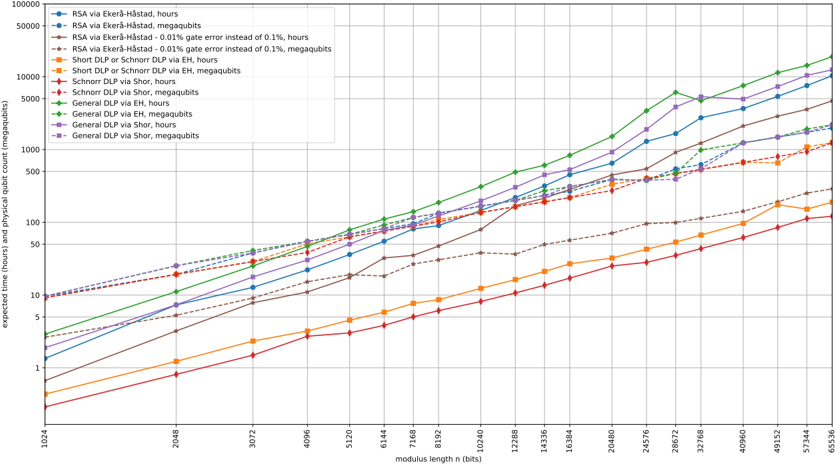
- For \(n=2048\), Table 3 reports 20 megaqubits, 5.1 hours per run, 5.9 expected megaqubitdays, and a 31% retry risk; the title/abstract advertise 8 hours using 20 million noisy qubits.
- The paper estimates the spacetime volume is a hundredfold less than comparable earlier works (Van Meter et al. 2009, Jones et al. 2010, Fowler et al. 2012, Gheorghiu et al. 2019), and the Toffoli count is over 10× lower than previous works.
- For \(n=2048\), the implementation needs approximately 3 billion CCZ states, with total distillation error 6.4% using level 1 code distance 17 and level 2 code distance 27; at code distance 27 the topological error probability is approximately 27%, implying roughly 1.4 repeats on average.
Methods
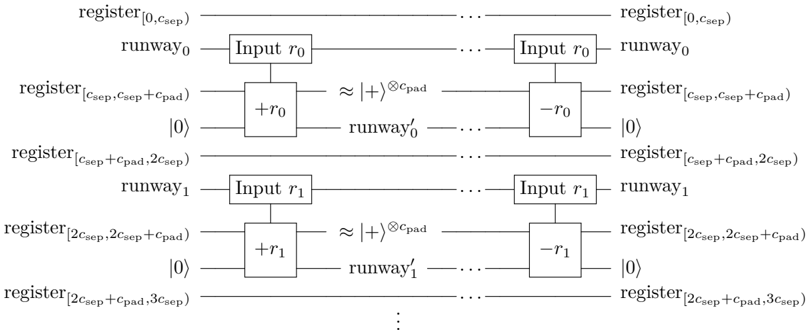
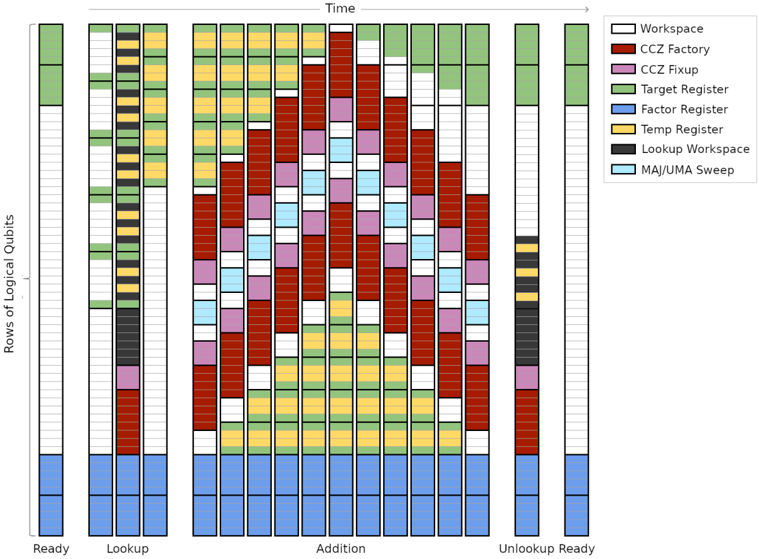
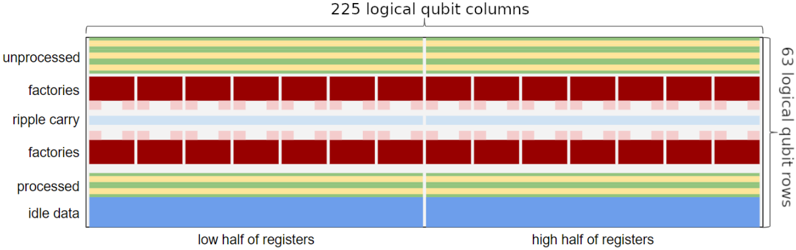
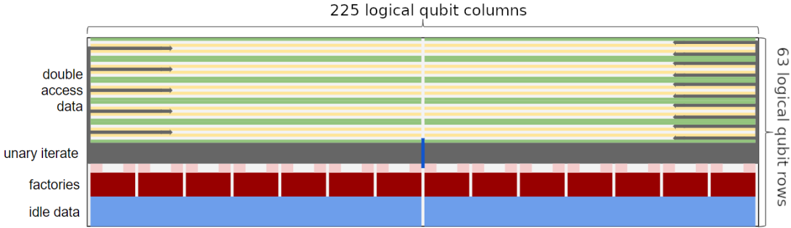
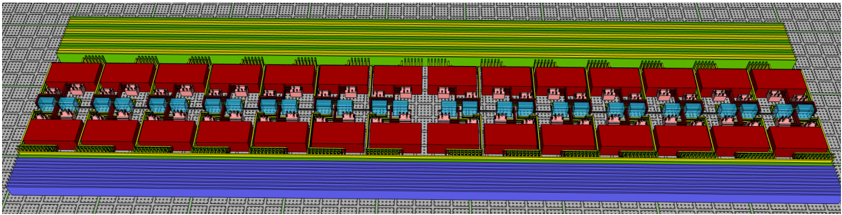
- The construction starts from Shor’s algorithm and Ekerå–Håstad’s short-discrete-logarithm algorithm, then applies windowed arithmetic, Zalka’s coset representation of modular integers, oblivious carry runways, and a reaction-limited spacetime layout for lookup additions.
- Cost estimates are given in the abstract circuit model and under physical assumptions for superconducting qubits: planar nearest-neighbor connectivity, physical gate error rate \(10^{-3}\), surface-code cycle time 1 microsecond, and reaction time 10 microseconds.
- Parameters such as code distances, window sizes, runway spacing, and padding offset are optimized by minimizing a skewed expected spacetime volume \(s^{1.2} \cdot t/(1-\epsilon)\) over enumerated combinations; estimates cover RSA moduli from 1024 to 16384 bits and finite-field discrete logarithms.
Limitations
- The paper states large systemic uncertainties: doubling or halving the physical gate error rate would change the required qubit count by more than 10%, and the estimates are intended as ballpark figures, not exact predictions.
- The paper notes that the runtime estimate ignores that at larger problem sizes lookups become slower because the minimum code distance increases.
- The paper states that code distance 27 at \(n=2048\) is “pushing the limits of feasibility” with about 27% topological error and roughly 1.4 expected repeats; increasing to distance 29 would raise qubit count by 15% but reduce error by about a factor of 10. The text also makes evident that no hardware demonstration is performed and that not all optimizations are directly applicable to elliptic-curve arithmetic.
Model-written summary. Check it against the paper before relying on it.
Integrity signals
Registry
Cites
Statistics
Figures
Verification
Claims the paper makes
42 Valid · 16 Not valid · 10 Not checked · 76 Own results and interpretations
The cited sources support only part of this claim — read each source’s verdict below.
In the paper
“It is also reduced by using Eker˚ a and H˚ astad's derivatives [21, 23-25] of Shor's algorithms, that require fewer multiplications to be performed compared to Shor's original algorithms.”
What the sources say
- Partly supportedcites [21] [21] M. Eker˚ a. Modifying Shor's algorithm to compute short discrete logarithms. Cryptology ePrint Archive, Report 2016/1128 , 2016. URL https://eprint.iacr.org/2016/1128 . - sourceExperimental — accuracy not yet measured
Section 2.1 says tradeoffs in Ekerå–Håstad’s algorithm reduce the quantum group operations needed per run, supporting a qualified version of the claim. But §1.2.5 says Ekerå’s general discrete-logarithm algorithm without tradeoffs requires approximately 3m operations versus 2m for Shor’s; the blanket claim that the derivatives require fewer multiplications is therefore too broad. (LLM, conf=0.88)
- Partly supportedcites [23] [23] M. Eker˚ a. On post-processing in the quantum algorithm for computing short discrete logarithms. Designs, Codes and Cryptography , 88(11):2313-2335, 2020. DOI: 10.1007/s10623-02000783-2. iacr:2017/1122. - sourceExperimental — accuracy not yet measured
Section 1.2 says the Ekerå–Håstad derivatives reduce the number of controlled group operations in each run compared with Shor’s algorithms, supporting the claim’s comparison of quantum computation costs. But the claim does not limit the comparison to each run: Appendix A.2 (RSA) says that, for some tradeoffs, the total number of operations across runs is greater than for a single run of Shor’s algorithm. (LLM, conf=0.86)
- Partly supportedcites [24] [24] M. Eker˚ a. Quantum algorithms for computing general discrete logarithms and orders with tradeoffs. Journal of Mathematical Cryptology , 15(1):359-407, 2021. DOI: 10.1515/jmc-20200006. (To appear.) iacr:2018/797. - sourceExperimental — accuracy not yet measured
Section 2 says the tradeoff algorithm can use fewer group operations than Shor’s algorithm per run, by up to a factor of two, but requires multiple runs. It also says that without tradeoffs it uses 3m operations versus Shor’s 2m, so the unqualified claim that the derivatives require fewer multiplications is too broad. Page numbers are unavailable in our copy. (LLM, conf=0.85)
- Could not verifycites [25] [25] M. Eker˚ a and J. H˚ astad. Quantum Algorithms for Computing Short Discrete Logarithms and Factoring RSA Integers. In Post-Quantum Cryptography , volume 10346 of Lecture Notes in Computer Science (LNCS) , pages 347-363. Springer, 2017. DOI: 10.1007/978-3-319-598796˙20. - sourceExperimental — accuracy not yet measured
In Time-optimal quantum computation (p. 3), Fowler discusses the time required for a factoring computation, while the references (p. 4) list Shor's original work. Our copy does not discuss Ekerå and Håstad's derivatives or compare their multiplication counts with Shor's; searches for those names and for modular-multiplication comparisons found no supporting passage. (LLM, conf=0.75)
states a cause- Asserted: passes — The authors put it forward as true.
- Checkable: passes — It can be checked against evidence.
- Load-bearing: unclear — It is unclear whether the paper’s conclusions depend on it.
- Based: passes — The paper gives a reason why it holds.
- Partly supported
The cited sources support only part of this claim — read each source’s verdict below.
In the paper
“When factoring 2048 bit RSA integers, our construction's spacetime volume is a hundredfold less than comparable estimates from earlier works (Van Meter et al. 2009, Jones et al. 2010, Fowler et al. 2012, Gheorghiu et al. 2019).”
What the sources say
- Supportedcites Van Meter et al. 2009 matched to “DISTRIBUTED QUANTUM COMPUTATION ARCHITECTURE USING SEMICONDUCTOR NANOPHOTONICS” (2010) source
Section 5.2 (pp. 20–22) estimates both the qubits required and the execution time for factoring a 2,048-bit number, so this paper supplies an earlier space-and-time estimate of the kind cited. The hundredfold comparison is the citing authors’ conclusion about their own construction, not a result attributed to Van Meter et al. (LLM, conf=0.89)
- Not matchedcites Jones et al. 2010
An author–year citation the paper’s reference list doesn’t settle. We don’t search these by name.
- Supportedcites Fowler et al. 2012 matched to “Surface codes: Towards practical large-scale quantum computation” (2012) source
The citation identifies Fowler et al. as an earlier resource estimate, not as the source of the citing authors’ hundredfold comparison. In I. Background (p. 2), Fowler et al. estimate about a billion physical qubits operating for about one day to factor a 2,000-bit number, a closely comparable factoring task. (LLM, conf=0.86)
plainstates a cause- Asserted: passes — The authors put it forward as true.
- Checkable: passes — It can be checked against evidence.
- Load-bearing: passes — The paper’s conclusions depend on it.
- Based: passes — The paper gives a reason why it holds.
- Supported
The cited sources that could be checked couldn’t confirm or dispute this claim.
In the paper
“In terms of space, we are using 3 n + O (lg n ) logical qubits. The qubits are distributed as follows: n + O (lg n ) for the accumulation register storing the product, n + O (lg n ) for a workspace register during the multiplication, n + O (lg n ) for the lookup output register, and O (lg n ) qubits to hold the part of the exponent needed for the current stage of the semi-classical Fourier trans”
What the sources say
- Could not verifycites [40] [40] R. B. Griffiths and C.-S. Niu. Semiclassical Fourier Transform for Quantum Computation. Physical Review Letters , 76(17):3228-3231, April 1996. DOI: 10.1103/PhysRevLett.76.3228. arXiv:quant-ph/9511007. - sourceExperimental — accuracy not yet measured
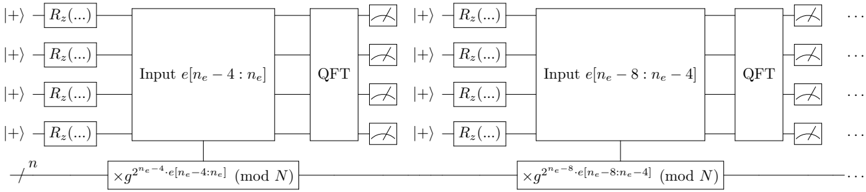
The discussion of Fig. 2 (p. 4) describes a semiclassical Fourier transform using measurements and classically controlled one-bit gates. Our copy does not address the claimed 3n + O(lg n) logical-qubit total or its allocation among accumulation, workspace, lookup-output, and exponent registers; searches for those terms found no supporting passage. (LLM, conf=0.76)
plain- Asserted: passes — The authors put it forward as true.
- Checkable: passes — It can be checked against evidence.
- Load-bearing: passes — The paper’s conclusions depend on it.
- Based: passes — The paper gives a reason why it holds.
- Could not verify
The cited sources support only part of this claim — read each source’s verdict below.
In the paper
“We improve on their estimates by over 100x (see Table 2) when accounting for slight remaining differences in the cost model.”
What the sources say
- Supportedcites [46] [46] N. C. Jones, R. Van Meter, A. G. Fowler, P. L. McMahon, J. Kim, T. D. Ladd, and Y. Yamamoto. Layered Architecture for Quantum Computing. Physical Review X , 2(3):031007, 2012. DOI: 10.1103/PhysRevX.2.031007. arXiv:1010.5022. - source
The citation is offered for the baseline estimate the citing authors compare against, and our copy of Jones et al. does report exactly that kind of resource estimate under an explicit cost model: Table IX (VII. Timing Considerations, p. 20) gives 4.54 × 10^8 quantum dots (4.54 cm²) for 1024-bit Shor's algorithm, built from 10^5 logical qubits, code distance 31, and two-level |A⟩ distillation factories (Appendix B 1, pp. 21-22; Table IV, p. 14). The '>100x improvement' itself is the citing paper's own conclusion and is not stated by, nor checkable in, this source; what this source supplies is the prior estimate and cost model being improved upon. (LLM, conf=0.82)
- Supportedcites [28] [28] A. G. Fowler, M. Mariantoni, J. M. Martinis, and A. N. Cleland. Surface codes: Towards practical large-scale quantum computation. Physical Review A , 86(3):032324, 2012. DOI: 10.1103/PhysRevA.86.032324. arXiv:1208.0928. - source
Appendix M (pp. 52–53) estimates the time and physical-qubit resources for a factoring circuit, so this paper is an estimate of the kind the citing authors compare against. The “over 100x” improvement is presented in the citing sentence as the citing authors’ own result, not as a finding attributed to Fowler et al. (LLM, conf=0.86)
- Could not verifycites [30] [30] V. Gheorghiu and M. Mosca. Benchmarking the quantum cryptanalysis of symmetric, publickey and hash-based cryptographic schemes. arXiv preprint arXiv:1902.02332 , 2019. URL https://arxiv.org/abs/1902.02332 . - sourceExperimental — accuracy not yet measured
The Overview and Improvements section (p. 12) discusses Gidney’s own gate costs and says their constant factors are worse than previous work. It does not assess the citing authors’ construction against estimates by Jones, Fowler, or Gheorghiu, or report an improvement of over 100x after cost-model adjustments. Searches for those names, the 100x figure, and cost-model differences found no supporting passage. (LLM, conf=0.76)
plainstates a cause- Asserted: passes — The authors put it forward as true.
- Checkable: passes — It can be checked against evidence.
- Load-bearing: passes — The paper’s conclusions depend on it.
- Based: passes — The paper gives a reason why it holds.
- Supported
The cited sources support only part of this claim — read each source’s verdict below.
In the paper
“In [21, 23, 25], Eker˚ a and H˚ astad explain how to factor RSA integers N = pq in a different way; namely by computing a short discrete logarithm.”
What the sources say
- Supportedcites [21] [21] M. Eker˚ a. Modifying Shor's algorithm to compute short discrete logarithms. Cryptology ePrint Archive, Report 2016/1128 , 2016. URL https://eprint.iacr.org/2016/1128 . - source
Section 1.2.3, “Breaking RSA,” explicitly says that Ekerå and Håstad describe factoring RSA integers by computing a short discrete logarithm. The citing sentence makes that attribution; it does not state the additional formula d ≡ p+q (mod r). (LLM, conf=0.93)
- Partly supportedcites [23] [23] M. Eker˚ a. On post-processing in the quantum algorithm for computing short discrete logarithms. Designs, Codes and Cryptography , 88(11):2313-2335, 2020. DOI: 10.1007/s10623-02000783-2. iacr:2017/1122. - sourceExperimental — accuracy not yet measured
Section 1.1 (Earlier works) confirms the citing sentence’s main point: Ekerå and Håstad express RSA factoring as a short discrete-logarithm problem. But the more specific equation in the supplied claim is not the one given in Appendix A.2 (RSA): the paper defines the short logarithm using a shifted sum of (p−1)/2 and (q−1)/2, not d ≡ p+q (mod r). (LLM, conf=0.88)
- Could not verifycites [25] [25] M. Eker˚ a and J. H˚ astad. Quantum Algorithms for Computing Short Discrete Logarithms and Factoring RSA Integers. In Post-Quantum Cryptography , volume 10346 of Lecture Notes in Computer Science (LNCS) , pages 347-363. Springer, 2017. DOI: 10.1007/978-3-319-598796˙20. - sourceExperimental — accuracy not yet measured
The discussion of factoring in “Time-optimal quantum computation” (p. 3) estimates hardware requirements for factoring a 2000-bit integer; it does not describe a short-discrete-logarithm algorithm. Searches for Ekerå and Håstad, RSA integers, and d = log_g y found no passage in our copy addressing the attributed method. (LLM, conf=0.77)
plainstates a cause- Asserted: passes — The authors put it forward as true.
- Checkable: passes — It can be checked against evidence.
- Load-bearing: passes — The paper’s conclusions depend on it.
- Based: passes — The paper gives a reason why it holds.
- Supported
47 more claims · 15 with their cited sources checked
Create a free account to see all 144 claims and to verify the 2 references still open.
- It may state two separate claims as one. 52
- Probably not a substantial claim. 55
- The quote only partly states this claim. 1
Claims other papers make about this one
Each is checked against this paper’s own text: does it say what the citing paper says it does?
The cited source doesn’t support the claim as written.
In the citing paper
“However, executing large-scale, useful algorithms on quantum processors requires very low gate error rates (generally below about 10−10)23, far below those that will probably ever be achievable with any physical device2.”
From Logical quantum processor based on reconfigurable atom arrays (2024) · cites this paper as [23]
Checked by a reasoning model — may be wrong.
Experimental — accuracy not yet measuredThe source backs part of the claim, not all of it — or backs it for a different population, condition or comparison.
In the citing paper
“In [182] it was demonstrated that 2048-bit RSA can be easily cracked in around eight hours by a quantum computer consisting of 20 million qbits.”
From Zero Trust Architecture (ZTA): A Comprehensive Survey (2022) · cites this paper as [182]
Experimental — accuracy not yet measuredThe source backs part of the claim, not all of it — or backs it for a different population, condition or comparison.
In the citing paper
“These results indicate that superconducting processors can remain stable for the hours-long timescales required for large-scale fault-tolerant algorithms21.”
From Quantum error correction below the surface code threshold (2025) · cites this paper as [21]
Experimental — accuracy not yet measuredThe source backs part of the claim, not all of it — or backs it for a different population, condition or comparison.
In the citing paper
“Although this logical error per cycle might permit certain fault-tolerant applications11, it is still many orders of magnitude higher than expected and precludes larger fault-tolerant circuits12,21.”
From Quantum error correction below the surface code threshold (2025) · cites this paper as [21]
Experimental — accuracy not yet measuredThe source backs part of the claim, not all of it — or backs it for a different population, condition or comparison.
In the citing paper
“Recent advancements suggest that within the next decade, quantum computing hardware may reach the threshold required to break 2048-bit RSA and comparable ECC implementations [2,3].”
From A Practical Performance Benchmark of Post-Quantum Cryptography Across Heterogeneous Computing Environments (2025) · cites this paper as [2]
Experimental — accuracy not yet measured
6 more claims about this paper
Create a free account to see every claim other papers make about this one.
Citations
Cites
New directions in cryptography
Diffie, W., & Hellman, M. (1976) · IEEE Transactions on Information Theory · doi:10.1109/tit.1976.1055638 · Cited by 14,713
A method for obtaining digital signatures and public-key cryptosystems
Rivest, R. L., Shamir, A., & Adleman, L. (1978) · Communications of the ACM · doi:10.1145/359340.359342 · Cited by 13,462 · cited 2×
“In particular, Shor’s algorithms may be used to break the RSA cryptosystem [3] based on the hardness of factoring integers that are the product of two similarly-sized primes (hereafter “RSA integers”), and cryptosystems based on the discrete logarithm problem (DLP), such as the Diffie-Hellman key agreement protocol [4…”
MethodA method for obtaining digital signatures and public-key cryptosystems
Rivest, R. L., Shamir, A., & Adleman, L. (1983) · Communications of the ACM · doi:10.1145/357980.358017 · Cited by 13,012
Algorithms for quantum computation: discrete logarithms and factoring
Shor, P. W. (2002) · Proceedings 35th Annual Symposium on Foundations of Computer Science · doi:10.1109/sfcs.1994.365700 · Cited by 8,713 · cited 4×
“…for computing general discrete logarithms in safe-prime groups and Schnorr groups when not making tradeoffs is to use Shor’s original algorithm [1], modified to work in the order r subgroup rather than in the whole multiplicative group Z ∗ N , and to start with a uniform superposition of all…”
BackgroundMethodInfluentialSurface codes: Towards practical large-scale quantum computation
Fowler, A. G., Mariantoni, M., Martinis, J. M., & Cleland, A. N. (2012) · Physical Review A · doi:10.1103/physreva.86.032324 · Cited by 3,059 · cited 7×
“2012 [9] 3n+O(1) 40n +O(n) 40n +O(n) 43 340 1200 53 850 4600 Häner et al.”
BackgroundMethodInfluentialSuperconducting quantum circuits at the surface code threshold for fault tolerance
Barends, R., Kelly, J., Megrant, A., Veitia, A., Sank, D., Jeffrey, E., White, T. C., Mutus, J., Fowler, A. G., Campbell, B., et al. (2014) · Nature · doi:10.1038/nature13171 · Cited by 1,733 · cited 2×
“The modular exponentiation in Shor’s algorithm is performed over a superposition of exponents, meaning a quantum computer is required, and quantum hardware is expected to be many orders of magnitude noisier than classical hardware [6–8].”
MethodUniversal quantum computation with ideal Clifford gates and noisy ancillas
Bravyi, S., & Kitaev, A. (2005) · Physical Review A · doi:10.1103/physreva.71.022316 · Cited by 1,525
Pohlig, S., & Hellman, M. (1978) · IEEE Transactions on Information Theory · doi:10.1109/tit.1978.1055817 · Cited by 1,199
Schnelle Multiplikation großer Zahlen
Schönhage, A., & Strassen, V. (1971) · Computing · doi:10.1007/bf02242355 · Cited by 1,107 · cited 2×
“For example, the Karatsuba algorithm [65] has a Toffoli count of O(n ) and the Schönhage–Strassen algorithm [66] has a Toffoli count of O(n lg n lg lgn).”
MethodMonte Carlo methods for index computation (𝑚𝑜𝑑𝑝)
Pollard, J. M. (1978) · Mathematics of Computation · doi:10.1090/s0025-5718-1978-0491431-9 · Cited by 825
Research works printed but not linked: 4
- [47] A. A. Karatsuba and Y. P. Ofman. Multiplication of many-digital numbers by automatic computers. Doklady Akademii Nauk SSSR , 145(2):293-294, 1962. URL http://mi.mathnet. ru/eng/dan/v145/i2/p293 . -
- [52] A. K. Lenstra. Key Lengths. In The Handbook of Information Security , chapter 6. 2004. URL https://infoscience.epfl.ch/record/164539/files/NPDF-32.pdf . -
- [72] C. Pomerance. A Tale of Two Sieves. Notices of the AMS , 43(12):1473-1485, 1996. URL https://www.ams.org/notices/199612/pomerance.pdf . -
- [75] O. Schirokauer. On pro-finite groups and on discrete logarithms . PhD thesis, University of California, Berkeley, May 1992. -
Cited by
Items 501–600 of 722
Naito, S., Suzuki, Y., & Tokunaga, Y. (2026) · IEEE Transactions on Quantum Engineering · doi:10.1109/tqe.2026.3722428 · Cited by 8
Post Quantum Signature for Blockchain
Razdan, R., & Nene, M. J. (2025) · International Conference on Advancement in Futuristic Technologies (ICAFT) · doi:10.1109/icaft66710.2025.11453249 · Cited by 1
The resource cost of large scale quantum computing
Fellous-Asiani, M. (2021) · theses.fr (ABES) · doi:10.70675/d1a944bez79cez43e1zaefcz785bf1e97f74 · Cited by 13
Miriyala, S., & Chirra, V. R. (2026) · Advanced Quantum Technologies · doi:10.1002/qute.70310 · Cited by 1
Search Space Reduction for Efficient Quantum Compilation
Srivastava, A., Lu, C., Choudhury, N., Arunachalam, A., & Basu, K. (2023) · ACM Great Lakes Symposium on VLSI (GLSVLSI) · doi:10.1145/3583781.3590223 · Cited by 1
Manenti, R., & Motta, M. (2023) · Oxford University Press eBooks · doi:10.1093/oso/9780198787488.005.0006
Quantum Computer Using Neutral Atoms
NAKAJIMA, S. (2025) · Vacuum and Surface Science · doi:10.1380/vss.68.167
Teleporting Qubits Between Participants by Third-Party Center
Abushgra, A. A. (2022) · International Conference on Cryptography, Security and Privacy (CSP) · doi:10.1109/csp55486.2022.00008
Reducing the Number of Qubits in Quantum Discrete Logarithms on Elliptic Curves
Chevignard, C., Fouque, P.-A., & Schrottenloher, A. (2026) · Lecture notes in computer science · doi:10.1007/978-3-032-25291-3_13 · Cited by 6
(2023) · Oxford University Press eBooks · doi:10.1093/oso/9780198787488.002.0004
Exploration of Key Challenges and Features of Quantum Computing
Tripathi, A., Mishra, G. R., Srivastava, G., Singh, S. K., & Dubey, V. (2026) · Springer proceedings in physics · doi:10.1007/978-3-032-15441-5_28
Manenti, R., & Motta, M. (2023) · Oxford University Press eBooks · doi:10.1093/oso/9780198787488.003.0002
Graph Neural Network Decoding of Surface Codes with Diagonally Correlated Two-Qubit Z Errors
Ge, Y., Wang, S., & Li, M. (2025) · International Symposium on Computer and Information Processing Technology (ISCIPT) · doi:10.1109/iscipt67144.2025.11265469
Petrenko, S., Petrenko, A., Grigorieva, N. M., & Balyabin, A. A. (2026) · Research Square · doi:10.21203/rs.3.rs-9445777/v1 · Cited by 1
On Quantum Transition in Cryptography through the Lens of Bibliometrics
Terekhov, A. I. (2025) · Automatic Documentation and Mathematical Linguistics · doi:10.3103/s0005105525700591
Hardness results for decoding the surface code with Pauli noise
Fischer, A., & Miyake, A. (2024) · Quantum · doi:10.22331/q-2024-10-28-1511 · Cited by 6
Hybrid Approach to Public-Key Algorithms in the Near-Quantum Era
Cinal, A., Wechta, G., & Wroński, M. (2024) · Lecture notes in computer science · doi:10.1007/978-3-031-63778-0_27
Manenti, R., & Motta, M. (2023) · Oxford University Press eBooks · doi:10.1093/oso/9780198787488.003.0005
Shandilya, S. K., Datta, A., Kartik, Y., & Nagar, A. K. (2024) · EAI/Springer Innovations in Communication and Computing · doi:10.1007/978-3-031-53290-0_7 · Cited by 1
Quantum Algorithms: Application and Feasibility
Bui, D., Halunen, K., Nguyen, N., & Röning, J. (2024) · Lecture notes in computer science · doi:10.1007/978-3-031-78392-0_10 · Cited by 1
Meunier, A. (2026) · SSRN Electronic Journal · doi:10.2139/ssrn.6596818
The molecular Hamiltonian in second quantization
Manenti, R., & Motta, M. (2023) · Oxford University Press eBooks · doi:10.1093/oso/9780198787488.005.0004
Quantum Signcryption: A Hybrid Quantum-Resistant Secure Communication System
Al-Jubouri, D., & Al-Haija, Q. S. A. (2026) · International Conference on Information and Communication Systems (ICICS) · doi:10.1145/3812734.3813708
Creating qubit states with degenerate two-level systems
Bao, Z., & James, D. F. V. (2026) · Physical Review A · doi:10.1103/n284-bpds
Baradziej, S. (2026) · Frontiers in Quantum Science and Technology · doi:10.3389/frqst.2026.1918786 · Cited by 1
Toward Creation of a System Architecture for Quantum Computers
Sakauchi, S. (2023) · NTT technical review · doi:10.53829/ntr202311fa1
Manenti, R., & Motta, M. (2023) · Oxford University Press eBooks · doi:10.1093/oso/9780198787488.003.0014
Parallel Equivalence Checking of Stabilizer Quantum Circuits on GPUs
Osama, M., Thanos, D., & Laarman, A. (2025) · Lecture notes in computer science · doi:10.1007/978-3-031-90660-2_6 · Cited by 6
Engineering Long-Range and Multibody Interactions via Global Kinetic Constraints
Wu, R., Yang, B., Claeys, P. W., & Zhao, H. (2026) · Physical Review Letters · doi:10.1103/4l1s-kkw7 · Cited by 8
What makes a good quantum outreach video? An evaluation framework for a quantum video playlist
Anttila, D., Bitzenbauer, P., Scheer, S., Tartaglia, D., Folkers, B., Goorney, S., Vartak, S., Sherson, J. F., & Toninelli, C. (2026) · EPJ Quantum Technology · doi:10.21203/rs.3.rs-8047505/v1 · Cited by 1
RESCQ: Realtime Scheduling for Continuous Angle Quantum Error Correction Architectures
Sethi, S., & Baker, J. M. (2025) · International Conference on Architectural Support for Programming Languages and Operating Systems (ASPLOS) · doi:10.1145/3676641.3716018 · Cited by 14
Zarin, A. T., Radee, O., Azad, M. S., & Mahdy, M. R. C. (2026) · Journal of Information Security and Applications · doi:10.1016/j.jisa.2026.104449
Quantum Key Recovery Attacks on 4-Round Iterated Even-Mansour with Two Keys
Anand, R., Ghosh, S., Isobe, T., & Shiba, R. (2024) · Lecture notes in computer science · doi:10.1007/978-3-031-75757-0_5 · Cited by 2
A Prototype For Quantum Database In Hybrid QuantumPreprint
chakraborty, S. (2022) · Research Square · doi:10.21203/rs.3.rs-1900782/v1 · Cited by 1
Post-Quantum Cryptography Migration for Enterprise Security
Mini, T., V (2026) · International Journal of Information Technology Research Studies (IJITRS) · doi:10.63090/ijitrs/3139.3209.0032
A High-Throughput and Efficient Hardware Architecture for SPHINCS+
Sun, Y., Li, D., Wei, B., Wang, B., Wang, C., Cui, Y., & Liu, W. (2026) · ACM Transactions on Reconfigurable Technology and Systems · doi:10.1145/3831712 · Cited by 1
Manenti, R., & Motta, M. (2023) · Oxford University Press eBooks · doi:10.1093/oso/9780198787488.003.0010
Enhancing Quantum-Safe Cryptography in TLS: The Role of Pre-Shared Keys
Frauenschläger, T., Füreder, L., & Mottok, J. (2025) · International Conference on Applied Electronics · doi:10.1109/ae66163.2025.11197762 · Cited by 1
DC-MBQC: A Distributed Compilation Framework for Measurement-Based Quantum Computing
Xue, Y., Yang, R., Liang, Z., & Li, T. (2026) · IEEE International Symposium on High-Performance Computer Architecture (HPCA) · doi:10.1109/hpca68181.2026.11408612 · Cited by 1
Niu, Y.-F., Zhang, S., Ding, C., et al. (2022) · SciPost Physics · doi:10.21468/scipost.report.6023
Experimental evaluation of PQ-WireGuard and PQ-IPsec over LEO satellite networks
Hong, G. H., Lee, Y., Lee, C., & Park, J. H. (2026) · ICT Express · doi:10.1016/j.icte.2026.03.005 · Cited by 1
Quantum Technologies and Cybersecurity in Economy and Industry: A Review and Main Challenges
Rivas, G., Rodríguez-Almazán, A., Falcó-Pomares, D., Valdeolmillos, D., & Alonso, R. S. (2025) · Lecture notes in networks and systems · doi:10.1007/978-3-031-83117-1_34
Architecting a Full-Stack Superconducting Fault-Tolerant Quantum Computer
Kim, J., Kim, J., Choi, J., Cho, J., Hong, J., JEONG, H., Min, D., Byun, I., Tanaka, M., & Inoue, K. (2026) · IEEE Micro · doi:10.1109/mm.2026.3665565 · Cited by 1
Device variability of Josephson junctions induced by interface roughness
Zhu, Y., Beaudoin, F., & Guo, H. (2026) · Applied Physics Letters · doi:10.1063/5.0326249 · Cited by 1
Data Secrecy: Why Does It Matter in the Cloud Computing Paradigm?
Patgiri, R., Borah, M. D., & Singh, L. D. (2022) · Smart innovation, systems and technologies · doi:10.1007/978-981-19-0836-1_42
Anderson, D. Z., Chomaz, P., Takeuchi, S., Arakawa, Y., Baba, Y., Benson, O. J., Soderberg, K.-A., Diamanti, E., Elkouss, D., Fujii, K., et al. (2026) · Journal of Physics B Atomic Molecular and Optical Physics · doi:10.1088/1361-6455/ae271a
Toward Scalable Quantum Computing: A Comparative Review of Qubit Platforms
Zhang, Y. (2025) · International Conference on Communication Technology and Information Technology (ICCTIT) · doi:10.1109/icctit68197.2025.11406484
Multimode Quantum Communications and Hybrid Cryptography
Mazzoncini, F. (2024) · theses.fr (ABES) · doi:10.70675/ac2f8f17z80faz4276za40fzfe7c124fb9fc · Cited by 2
Du, Y., Wang, X., Guo, N., Yu, Z., Qian, Y., Zhang, K., Hsieh, M.-H., Rebentrost, P., & Tao, D. (2025) · Springer eBooks · doi:10.1007/978-981-95-1284-3_1
Bedford, Q., & Shukla, S. K. (2025) · IEEE International Conference on Quantum Computing and Engineering (QCE) · doi:10.1109/qce65121.2025.20529
How Quantum Computing Breaks RSA? - A Study of Shor's Algorithm
Jain, A. (2025) · IEEE MIT Undergraduate Research Technology Conference (URTC) · doi:10.1109/urtc68753.2025.11533064 · Cited by 1
Governance for Quantum Technologies: A Necessity for Responsible Technology Development
Leopold, H. (2026) · Contributions to security and defence studies · doi:10.1007/978-3-032-23622-7_9
Optimizing windowed arithmetic for quantum attacks against RSA-2048
Luongo, A., Narasimhachar, V., & Sireesh, A. (2025) · ACM/IEEE Design Automation Conference (DAC) · doi:10.1109/dac63849.2025.11132436 · Cited by 4
Sinaga, R., Samsinar, S., & Othman, M. S. (2026) · INTENSIF Jurnal Ilmiah Penelitian dan Penerapan Teknologi Sistem Informasi · doi:10.29407/intensif.v10i1.26424
Quantum3Enabled Cybercrime: A Portfolio Analysis of Cryptocurrency Theft and Double-Spending
Li, Z., & Liao, Q. (2025) · APWG Symposium on Electronic Crime Research (eCrime) · doi:10.1109/ecrime66972.2025.11327811 · Cited by 1
Hybrid Classical-Quantum Systems: The Unsung Heroes of the NISQ EraPreprint
Amiri, S. M. H., & Zahan, A. (2026) · SSRN Electronic Journal · doi:10.20944/preprints202608.1044.v1
100 Years Since the Birth of Quantum Mechanics : The Developmental Trajectory of Quantum Computers
Fujii, K. (2025) · Vacuum and Surface Science · doi:10.1380/vss.68.129
Olayinka, T. C., & Adewara, S. O. (2026) · Nigerian Journal of Theoretical and Environmental Physics · doi:10.62292/njtep.v4i3.2026.146
Quantum-Safe Fuzzy Transformers for Crossborder Settlement in Decentralized Finance
Lakshmanan, M. (2025) · IEEE World Conference on Applied Intelligence and Computing (AIC) · doi:10.1109/aic66080.2025.11212014 · Cited by 1
A Prototype For Quantum Database in Hybrid QuantumPreprint
chakraborty, S. (2022) · doi:10.36227/techrxiv.20237202.v6
Latency-Optimal Quantum Circuits for IoT Networks
Glisic, S., & Lorenzo, B. (2025) · IEEE Access · doi:10.1109/access.2025.3649805
Applications of Gaussian Boson Sampling to Solve Some Chemistry Problems
Novir, S. B. (2025) · Quantum Reports · doi:10.3390/quantum7040056 · Cited by 1
SQUIRE - A Global Quantum Resistant Communication Service for IoT
Yin, M., Geitz, M., Albanese, I., Gnaust, T., Holschke, O., Njoku, B., Bassoli, R., & Fitzek, F. H. P. (2026) · International Conference on Quantum Communications, Networking, and Computing (QCNC) · doi:10.1109/qcnc69040.2026.00015
Biochain-Id: a Quantum-Resistant Blockchain-Based Genomic Authentication Framework
Bhat, S., Sreeja, C. S., & Vinod, S. (2026) · International Conference on Trends in Quantum Computing and Emerging Business Technologies (TQCEBT) · doi:10.1109/tqcebt67648.2026.11681273
iSwitch: QEC on Demand via In-Situ Encoding of Bare Qubits for Ion Trap Architectures
Yin, K., Fang, X., Chen, Z., Hayes, D., Kaur, E., Nejabati, R., Häffner, H., Campbell, W. C., Hudson, E. R., Palsberg, J., et al. (2026) · International Conference on Architectural Support for Programming Languages and Operating Systems (ASPLOS) · doi:10.1145/3779212.3790177 · Cited by 14
Klug, F. (2026) · Physica A Statistical Mechanics and its Applications · doi:10.1016/j.physa.2026.131649 · Cited by 1
Transversal Injection: Using the Surface Code to Prepare Non-Pauli Eigenstates
Gavriel, J., Herr, D., Shaw, A., Bremner, M. J., Paler, A., & Devitt, S. J. (2023) · IEEE International Conference on Quantum Computing and Engineering (QCE) · doi:10.1109/qce57702.2023.00105 · Cited by 2
Directions for enhancing quantum resilience of blockchain platforms and ecosystems
Petrenko, S., Petrenko, A., Kazak, A., Makoveichuk, K. A., & Oleinikov, N. (2026) · International Journal of Information Management Data Insights · doi:10.1016/j.jjimei.2026.100390 · Cited by 1
Manenti, R., & Motta, M. (2023) · Oxford University Press eBooks · doi:10.1093/oso/9780198787488.003.0004
Optimal Dependency-Aware Qubit Reuse for Scheduled Quantum Circuits
Liu, P.-W., Zhan, K.-X., & Kuo, J.-J. (2025) · Globecom · doi:10.1109/globecom59602.2025.11431734
Truncated phase-based quantum arithmetic: Error propagation and resource reduction
White, G. A. L., Hill, C. D., & Hollenberg, L. C. L. (2023) · Physical Review A · doi:10.1103/physreva.108.052608 · Cited by 2
Milyen változásokat hozhatnak a kvantumszámítógépek az oktatás területén?
Prantner, C. K., Koczka, F., & Bíró, C. (2023) · Eszterházy Károly Katolikus Egyetem Líceum Kiadó eBooks · doi:10.46403/modszerekafenntarthatosagjegyeben.2023.143 · Cited by 1
Feasibility of Quantum Key Distribution Between Supersonic Aircraft
McKiernan, S., & Collins, R. J. (2025) · IET Quantum Communication · doi:10.1049/qtc2.70018
A Learning-Oriented Quantum Circuit Simulator with Classical Problem Extensions
Navyasri, J. (2025) · International Journal for Research in Applied Science and Engineering Technology · doi:10.22214/ijraset.2025.72898
Shen, Y., & Zhang, F. (2025) · Physics Letters A · doi:10.1016/j.physleta.2025.131175
Simulating Quantum Threats to Web3 Cryptographic Primitives using Qiskit
Kumar, V., Sharma, R., Aggarwal, I., & Ghosh, D. (2025) · International Conference on Contemporary Computing · doi:10.1109/ic366947.2025.11290415 · Cited by 1
Benchmarking engineered exchange interactions on NISQ hardware
AbuGhanem, M. (2026) · Scientific Reports · doi:10.1038/s41598-026-53082-6
Quantum supremacy through Fock state q -boson sampling with transmon qubits
Kam, C., & Kuo, E.-J. (2025) · New Journal of Physics · doi:10.1088/1367-2630/ae2539 · Cited by 2
(2023) · Oxford University Press eBooks · doi:10.1093/oso/9780198787488.002.0005
Criptografía en la administración pública: una perspectiva integral
Caballero‐Gil, P. (2024) · Revista Canaria de Administración Pública · doi:10.36151/rcap.2.9 · Cited by 1
Quantencomputer heute und in naher Zukunft: eine realistische Perspektive
Faehrmann, P. K., Meyer, J. J., & Eisert, J. (2022) · Springer eBooks · doi:10.1007/978-3-658-37534-8_6
Manenti, R., & Motta, M. (2023) · Oxford University Press eBooks · doi:10.1093/oso/9780198787488.003.0001
A Prototype For Quantum Database In Hybrid Quantum: A Complete EcosystemPreprint
chakraborty, S. (2022) · Research Square · doi:10.21203/rs.3.rs-2156463/v3
Strengthened Key Method in Transition to Quantum Cryptology
Selvi, F., & Alkan, M. (2025) · Gazi Üniversitesi Fen Bilimleri Dergisi Part C Tasarım ve Teknoloji · doi:10.29109/gujsc.1682989
Oblivious amplitude amplification lemma
Manenti, R., & Motta, M. (2023) · Oxford University Press eBooks · doi:10.1093/oso/9780198787488.005.0005
Cross-Platform Benchmarking of Shor's Algorithm for Quantum Cryptanalysis
UbaidurRahman, N. H., Jayavijayan, V., & Rajarajan, M. (2025) · IEEE International Conference on Public Key Infrastructure and its Applications (PKIA) · doi:10.1109/pkia67529.2025.11347220
Hybrid quantum–classical AI models for secure communications: a systematic review
Kyiewu, B., Amponsah, C., Henry, O., Bessa-Simons, L., & Komba, R. (2026) · Journal of Electrical Systems and Information Technology · doi:10.1186/s43067-026-00390-6 · Cited by 1
The Bridge to the Quantum Fortress: How Do Hybrid Cloud Attacks Exploit the Quantum Core?
Lamichhane, P., & Lee, K. H. (2026) · Lecture notes of the Institute for Computer Sciences, Social Informatics and Telecommunications Engineering · doi:10.1007/978-3-032-32764-2_25
Comparative study of high-$J_{c}$ and low-$J_{c}$ SFQ microwave generators for transmon control
Shen, H., Luo, W., & Yoshikawa, N. (2026) · EPJ Quantum Technology · doi:10.1140/epjqt/s40507-026-00514-x · Cited by 1
A hardware-efficient Berkeley gate for superconducting quantum processors
AbuGhanem, M. (2026) · Scientific Reports · doi:10.1038/s41598-026-56236-8
Security Evaluations of Post-Quantum Cryptographic Primitives Against Quantum and AI-Based Attacks
Zeydan, E., Aydeger, A., Yadav, A. K., & Liyanage, M. (2026) · International Conference on Communications · doi:10.1109/icc59461.2026.11587016
Integrating a fibre cavity with an ion trap for scalable quantum computing
Gao, S., Kassa, E., Kavungal, V., Oya, S., Okuno, D., Teh, S., & Takahashi, H. (2024) · Quantum 2.0 Conference and Exhibition · doi:10.1364/quantum.2024.qth2c.3
Quantum Computing Research Lines in the Italian Center for Supercomputing
Barenghi, A., Cremonesi, P., & Pelosi, G. (2023) · Lecture notes in computer science · doi:10.1007/978-3-031-46077-7_28
Metadata
- Authors
- Gidney, C., & Ekerå, M.
- Affiliations
- Google (United States) (US)
- Swedish Armed Forces (SE)
- ORCID
- Ekerå, Martin
- Venue
- Quantum
- Published
- 2021-04-15
- Volume
- 5
- Pages
- 433
- ISSN
- 2521-327X (ISSN-L)
- OpenAlex
- W2946582523
- Cited by
- 830
- References
- 69
- Citations by year
- 2026: 149 · 2025: 195 · 2024: 151 · 2023: 140 · 2022: 87 · 2021: 63
- FWCI
- 38.76
- Type
- journal article
- Language
- en
- Open access
- gold
- doi.org
- Locations
- Quantum (publishedVersion, cc-by)
- arXiv (Cornell University) (submittedVersion)
- DOAJ (DOAJ: Directory of Open Access Journals) (submittedVersion, cc-by-sa)
- arXiv (Cornell University) (cc-by)
- Topics
- Physical Sciences › Computer Science › Artificial Intelligence › Quantum Computing Algorithms and Architecture
- Physical Sciences › Physics and Astronomy › Atomic and Molecular Physics, and Optics › Quantum Information and Cryptography
- Physical Sciences › Computer Science › Information Systems › Cryptography and Residue Arithmetic
- Keywords
- integer factorization, discrete logarithm problem, quantum algorithms, Shor's algorithm, noisy qubits, superconducting qubits, surface code, Toffoli gate, measurement depth
About these checks
Registry, retraction, Cites and statistics results are computed, not judged, with one exception: a printed reference that no index lists is read once by a model before it counts as a citation error. Claims are extracted by a model and kept only when their quote appears verbatim in the text; each cited source is then checked, with a model’s help, for whether it says what the claim relies on. Those verdicts can be wrong — read the claim’s quote and the cited source before relying on one.
The claim verdicts this report counts are experimental: their accuracy is not yet measured.
A language model drew the claims from the paper on 2026-09-29, under version 3 of the claim definition (model deepseek-v4.1-flash, prompt extract-v3).
A second model labelled each claim on 2026-09-29 (model jev-1.13-20260917, definition revision gold-guideline-v0.2).
Cited sources are checked with a language model’s help (gpt-6-sol and qwen3.8-omni-flash).
Statistics and arithmetic are recomputed, not judged.
Confidence bands are shown only for fields calibrated on our annotated test set. None is calibrated yet, so no band is shown.
What counts as a claim ›How we measure confidence ›How we check this ›
Are you an author, or do you see a problem with this page? Request a review
Data sources
Bibliographic data: Semantic Scholar, OpenAlex, Crossref.
Contains information from the Semantic Scholar Academic Graph Datasets, made available under the ODC Attribution License (ODC-BY 1.0).
Semantic Scholar’s data is described in: Kinney, R., et al. (2023). The Semantic Scholar Open Data Platform. arXiv:2301.10140.
