

How to factor 2048 bit RSA integers in 8 hours using 20 million noisy qubits
Open accessThe DOI matches its Crossref record; 85 of the 87 references it cites were found in a registry or an index, and 2 are not checked yet; 66 of the 87 sources its claims cite were checked for support.
Abstract
We significantly reduce the cost of factoring integers and computing discrete logarithms in finite fields on a quantum computer by combining techniques from Shor 1994, Griffiths-Niu 1996, Zalka 2006, Fowler 2012, Ekerå-Håstad 2017, Ekerå 2017, Ekerå 2018, Gidney-Fowler 2019, Gidney 2019. We estimate the approximate cost of our construction using plausible physical assumptions for large-scale superconducting qubit platforms: a planar grid of qubits with nearest-neighbor connectivity, a characteristic physical gate error rate of 10−3, a surface code cycle time of 1 microsecond, and a reaction time of 10 microseconds. We account for factors that are normally ignored such as noise, the need to make repeated attempts, and the spacetime layout of the computation. When factoring 2048 bit RSA integers, our construction's spacetime volume is a hundredfold less than comparable estimates from earlier works (Van Meter et al. 2009, Jones et al. 2010, Fowler et al. 2012, Gheorghiu et al. 2019). In the abstract circuit model (which ignores overheads from distillation, routing, and error correction) our construction uses 3n+0.002nlgn logical qubits, 0.3n3+0.0005n3lgn Toffolis, and 500n2+n2lgn measurement depth to factor n-bit RSA integers. We quantify the cryptographic implications of our work, both for RSA and for schemes based on the DLP in finite fields.
Verified 2026-11-22 · 2 references not checked yet
Overview
CoChat Summary
TL;DR
Gidney and Ekerå combine several optimizations to Shor’s algorithm and its Ekerå–Håstad derivatives to sharply reduce the cost of factoring RSA integers and computing finite-field discrete logarithms on a fault-tolerant quantum computer. Their headline estimate is factoring a 2048-bit RSA integer in 8 hours using 20 million noisy qubits, with spacetime volume about a hundredfold lower than comparable earlier estimates.
Key findings
- The construction reduces the abstract-circuit cost for factoring an \(n\)-bit RSA integer to \(3n + 0.002n\lg n\) logical qubits, \(0.3n^3 + 0.0005n^3\lg n\) Toffolis, and \(500n^2 + n^2\lg n\) measurement depth.
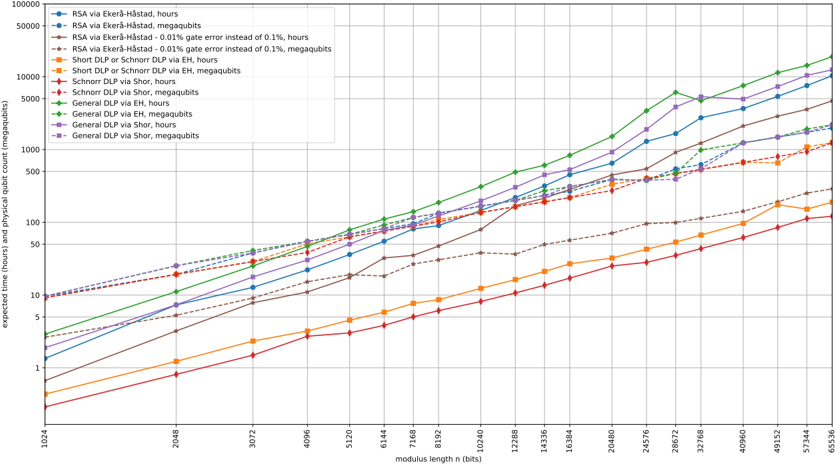
- For \(n=2048\), Table 3 reports 20 megaqubits, 5.1 hours per run, 5.9 expected megaqubitdays, and a 31% retry risk; the title/abstract advertise 8 hours using 20 million noisy qubits.
- The paper estimates the spacetime volume is a hundredfold less than comparable earlier works (Van Meter et al. 2009, Jones et al. 2010, Fowler et al. 2012, Gheorghiu et al. 2019), and the Toffoli count is over 10× lower than previous works.
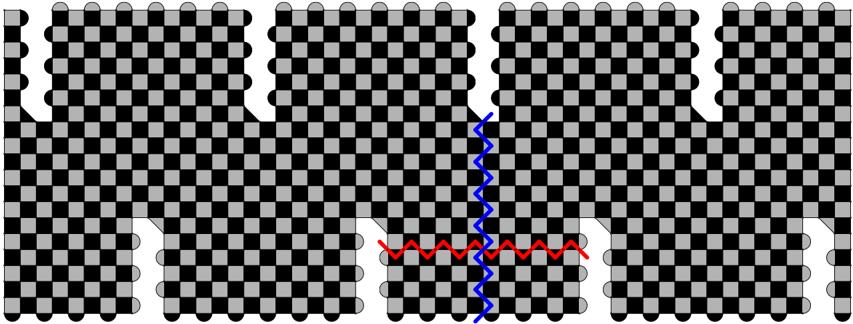
- For \(n=2048\), the implementation needs approximately 3 billion CCZ states, with total distillation error 6.4% using level 1 code distance 17 and level 2 code distance 27; at code distance 27 the topological error probability is approximately 27%, implying roughly 1.4 repeats on average.
Methods
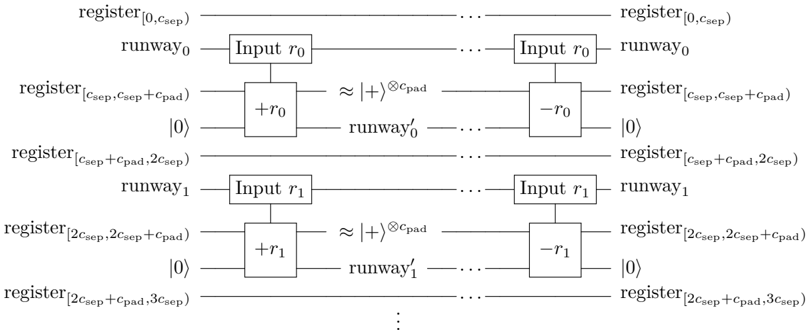
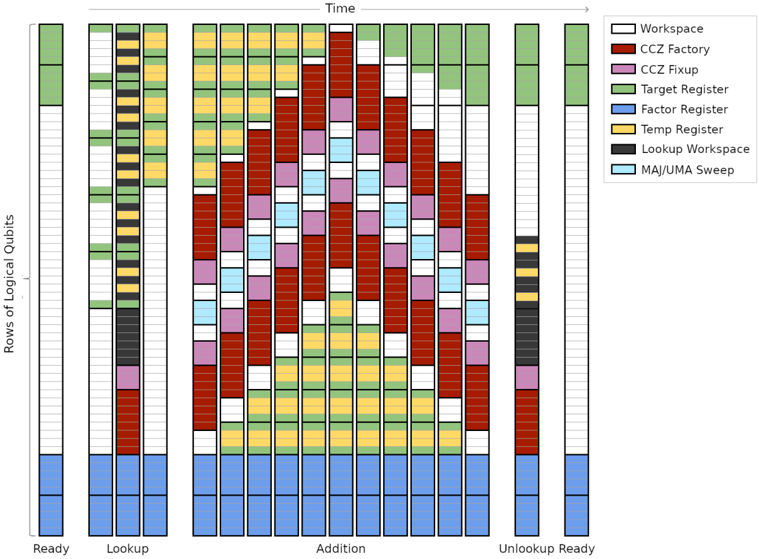
- The construction starts from Shor’s algorithm and Ekerå–Håstad’s short-discrete-logarithm algorithm, then applies windowed arithmetic, Zalka’s coset representation of modular integers, oblivious carry runways, and a reaction-limited spacetime layout for lookup additions.
- Cost estimates are given in the abstract circuit model and under physical assumptions for superconducting qubits: planar nearest-neighbor connectivity, physical gate error rate \(10^{-3}\), surface-code cycle time 1 microsecond, and reaction time 10 microseconds.
- Parameters such as code distances, window sizes, runway spacing, and padding offset are optimized by minimizing a skewed expected spacetime volume \(s^{1.2} \cdot t/(1-\epsilon)\) over enumerated combinations; estimates cover RSA moduli from 1024 to 16384 bits and finite-field discrete logarithms.
Limitations
- The paper states large systemic uncertainties: doubling or halving the physical gate error rate would change the required qubit count by more than 10%, and the estimates are intended as ballpark figures, not exact predictions.
- The paper notes that the runtime estimate ignores that at larger problem sizes lookups become slower because the minimum code distance increases.
- The paper states that code distance 27 at \(n=2048\) is “pushing the limits of feasibility” with about 27% topological error and roughly 1.4 expected repeats; increasing to distance 29 would raise qubit count by 15% but reduce error by about a factor of 10. The text also makes evident that no hardware demonstration is performed and that not all optimizations are directly applicable to elliptic-curve arithmetic.
Model-written summary. Check it against the paper before relying on it.
Integrity signals
Registry
Cites
Statistics
Figures
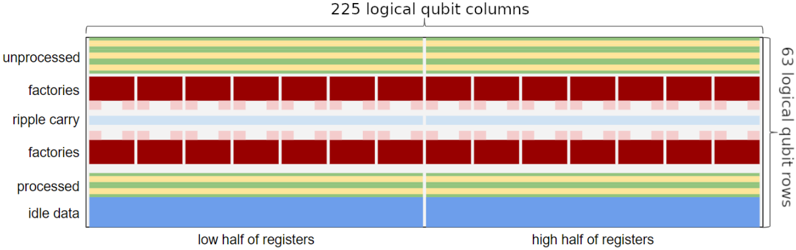
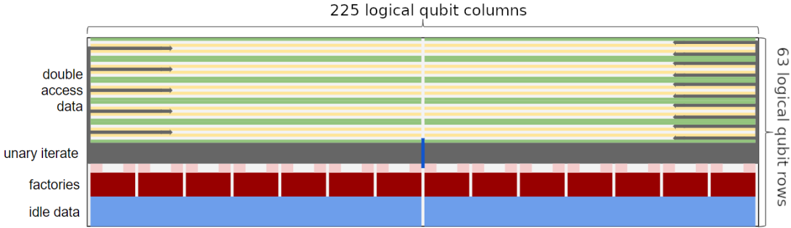
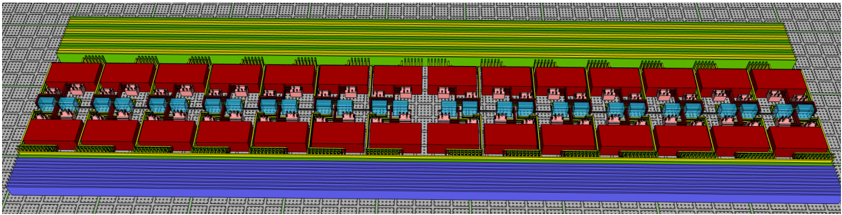
Verification
Claims the paper makes
42 Valid · 16 Not valid · 10 Not checked · 76 Own results and interpretations
The cited sources support only part of this claim — read each source’s verdict below.
In the paper
“It is also reduced by using Eker˚ a and H˚ astad's derivatives [21, 23-25] of Shor's algorithms, that require fewer multiplications to be performed compared to Shor's original algorithms.”
What the sources say
- Partly supportedcites [21] [21] M. Eker˚ a. Modifying Shor's algorithm to compute short discrete logarithms. Cryptology ePrint Archive, Report 2016/1128 , 2016. URL https://eprint.iacr.org/2016/1128 . - sourceExperimental — accuracy not yet measured
Section 2.1 says tradeoffs in Ekerå–Håstad’s algorithm reduce the quantum group operations needed per run, supporting a qualified version of the claim. But §1.2.5 says Ekerå’s general discrete-logarithm algorithm without tradeoffs requires approximately 3m operations versus 2m for Shor’s; the blanket claim that the derivatives require fewer multiplications is therefore too broad. (LLM, conf=0.88)
- Partly supportedcites [23] [23] M. Eker˚ a. On post-processing in the quantum algorithm for computing short discrete logarithms. Designs, Codes and Cryptography , 88(11):2313-2335, 2020. DOI: 10.1007/s10623-02000783-2. iacr:2017/1122. - sourceExperimental — accuracy not yet measured
Section 1.2 says the Ekerå–Håstad derivatives reduce the number of controlled group operations in each run compared with Shor’s algorithms, supporting the claim’s comparison of quantum computation costs. But the claim does not limit the comparison to each run: Appendix A.2 (RSA) says that, for some tradeoffs, the total number of operations across runs is greater than for a single run of Shor’s algorithm. (LLM, conf=0.86)
- Partly supportedcites [24] [24] M. Eker˚ a. Quantum algorithms for computing general discrete logarithms and orders with tradeoffs. Journal of Mathematical Cryptology , 15(1):359-407, 2021. DOI: 10.1515/jmc-20200006. (To appear.) iacr:2018/797. - sourceExperimental — accuracy not yet measured
Section 2 says the tradeoff algorithm can use fewer group operations than Shor’s algorithm per run, by up to a factor of two, but requires multiple runs. It also says that without tradeoffs it uses 3m operations versus Shor’s 2m, so the unqualified claim that the derivatives require fewer multiplications is too broad. Page numbers are unavailable in our copy. (LLM, conf=0.85)
- Could not verifycites [25] [25] M. Eker˚ a and J. H˚ astad. Quantum Algorithms for Computing Short Discrete Logarithms and Factoring RSA Integers. In Post-Quantum Cryptography , volume 10346 of Lecture Notes in Computer Science (LNCS) , pages 347-363. Springer, 2017. DOI: 10.1007/978-3-319-598796˙20. - sourceExperimental — accuracy not yet measured
In Time-optimal quantum computation (p. 3), Fowler discusses the time required for a factoring computation, while the references (p. 4) list Shor's original work. Our copy does not discuss Ekerå and Håstad's derivatives or compare their multiplication counts with Shor's; searches for those names and for modular-multiplication comparisons found no supporting passage. (LLM, conf=0.75)
states a cause- Asserted: passes — The authors put it forward as true.
- Checkable: passes — It can be checked against evidence.
- Load-bearing: unclear — It is unclear whether the paper’s conclusions depend on it.
- Based: passes — The paper gives a reason why it holds.
- Partly supported
The cited sources support only part of this claim — read each source’s verdict below.
In the paper
“When factoring 2048 bit RSA integers, our construction's spacetime volume is a hundredfold less than comparable estimates from earlier works (Van Meter et al. 2009, Jones et al. 2010, Fowler et al. 2012, Gheorghiu et al. 2019).”
What the sources say
- Supportedcites Van Meter et al. 2009 matched to “DISTRIBUTED QUANTUM COMPUTATION ARCHITECTURE USING SEMICONDUCTOR NANOPHOTONICS” (2010) source
Section 5.2 (pp. 20–22) estimates both the qubits required and the execution time for factoring a 2,048-bit number, so this paper supplies an earlier space-and-time estimate of the kind cited. The hundredfold comparison is the citing authors’ conclusion about their own construction, not a result attributed to Van Meter et al. (LLM, conf=0.89)
- Not matchedcites Jones et al. 2010
An author–year citation the paper’s reference list doesn’t settle. We don’t search these by name.
- Supportedcites Fowler et al. 2012 matched to “Surface codes: Towards practical large-scale quantum computation” (2012) source
The citation identifies Fowler et al. as an earlier resource estimate, not as the source of the citing authors’ hundredfold comparison. In I. Background (p. 2), Fowler et al. estimate about a billion physical qubits operating for about one day to factor a 2,000-bit number, a closely comparable factoring task. (LLM, conf=0.86)
plainstates a cause- Asserted: passes — The authors put it forward as true.
- Checkable: passes — It can be checked against evidence.
- Load-bearing: passes — The paper’s conclusions depend on it.
- Based: passes — The paper gives a reason why it holds.
- Supported
The cited sources that could be checked couldn’t confirm or dispute this claim.
In the paper
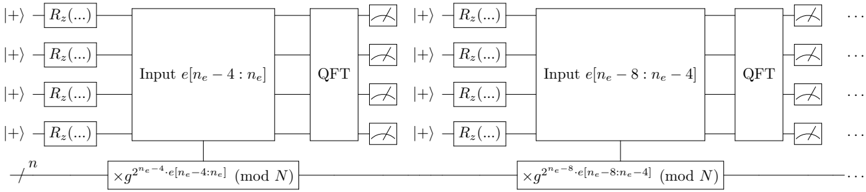
“In terms of space, we are using 3 n + O (lg n ) logical qubits. The qubits are distributed as follows: n + O (lg n ) for the accumulation register storing the product, n + O (lg n ) for a workspace register during the multiplication, n + O (lg n ) for the lookup output register, and O (lg n ) qubits to hold the part of the exponent needed for the current stage of the semi-classical Fourier trans”
What the sources say
- Could not verifycites [40] [40] R. B. Griffiths and C.-S. Niu. Semiclassical Fourier Transform for Quantum Computation. Physical Review Letters , 76(17):3228-3231, April 1996. DOI: 10.1103/PhysRevLett.76.3228. arXiv:quant-ph/9511007. - sourceExperimental — accuracy not yet measured
The discussion of Fig. 2 (p. 4) describes a semiclassical Fourier transform using measurements and classically controlled one-bit gates. Our copy does not address the claimed 3n + O(lg n) logical-qubit total or its allocation among accumulation, workspace, lookup-output, and exponent registers; searches for those terms found no supporting passage. (LLM, conf=0.76)
plain- Asserted: passes — The authors put it forward as true.
- Checkable: passes — It can be checked against evidence.
- Load-bearing: passes — The paper’s conclusions depend on it.
- Based: passes — The paper gives a reason why it holds.
- Could not verify
The cited sources support only part of this claim — read each source’s verdict below.
In the paper
“We improve on their estimates by over 100x (see Table 2) when accounting for slight remaining differences in the cost model.”
What the sources say
- Supportedcites [46] [46] N. C. Jones, R. Van Meter, A. G. Fowler, P. L. McMahon, J. Kim, T. D. Ladd, and Y. Yamamoto. Layered Architecture for Quantum Computing. Physical Review X , 2(3):031007, 2012. DOI: 10.1103/PhysRevX.2.031007. arXiv:1010.5022. - source
The citation is offered for the baseline estimate the citing authors compare against, and our copy of Jones et al. does report exactly that kind of resource estimate under an explicit cost model: Table IX (VII. Timing Considerations, p. 20) gives 4.54 × 10^8 quantum dots (4.54 cm²) for 1024-bit Shor's algorithm, built from 10^5 logical qubits, code distance 31, and two-level |A⟩ distillation factories (Appendix B 1, pp. 21-22; Table IV, p. 14). The '>100x improvement' itself is the citing paper's own conclusion and is not stated by, nor checkable in, this source; what this source supplies is the prior estimate and cost model being improved upon. (LLM, conf=0.82)
- Supportedcites [28] [28] A. G. Fowler, M. Mariantoni, J. M. Martinis, and A. N. Cleland. Surface codes: Towards practical large-scale quantum computation. Physical Review A , 86(3):032324, 2012. DOI: 10.1103/PhysRevA.86.032324. arXiv:1208.0928. - source
Appendix M (pp. 52–53) estimates the time and physical-qubit resources for a factoring circuit, so this paper is an estimate of the kind the citing authors compare against. The “over 100x” improvement is presented in the citing sentence as the citing authors’ own result, not as a finding attributed to Fowler et al. (LLM, conf=0.86)
- Could not verifycites [30] [30] V. Gheorghiu and M. Mosca. Benchmarking the quantum cryptanalysis of symmetric, publickey and hash-based cryptographic schemes. arXiv preprint arXiv:1902.02332 , 2019. URL https://arxiv.org/abs/1902.02332 . - sourceExperimental — accuracy not yet measured
The Overview and Improvements section (p. 12) discusses Gidney’s own gate costs and says their constant factors are worse than previous work. It does not assess the citing authors’ construction against estimates by Jones, Fowler, or Gheorghiu, or report an improvement of over 100x after cost-model adjustments. Searches for those names, the 100x figure, and cost-model differences found no supporting passage. (LLM, conf=0.76)
plainstates a cause- Asserted: passes — The authors put it forward as true.
- Checkable: passes — It can be checked against evidence.
- Load-bearing: passes — The paper’s conclusions depend on it.
- Based: passes — The paper gives a reason why it holds.
- Supported
The cited sources support only part of this claim — read each source’s verdict below.
In the paper
“In [21, 23, 25], Eker˚ a and H˚ astad explain how to factor RSA integers N = pq in a different way; namely by computing a short discrete logarithm.”
What the sources say
- Supportedcites [21] [21] M. Eker˚ a. Modifying Shor's algorithm to compute short discrete logarithms. Cryptology ePrint Archive, Report 2016/1128 , 2016. URL https://eprint.iacr.org/2016/1128 . - source
Section 1.2.3, “Breaking RSA,” explicitly says that Ekerå and Håstad describe factoring RSA integers by computing a short discrete logarithm. The citing sentence makes that attribution; it does not state the additional formula d ≡ p+q (mod r). (LLM, conf=0.93)
- Partly supportedcites [23] [23] M. Eker˚ a. On post-processing in the quantum algorithm for computing short discrete logarithms. Designs, Codes and Cryptography , 88(11):2313-2335, 2020. DOI: 10.1007/s10623-02000783-2. iacr:2017/1122. - sourceExperimental — accuracy not yet measured
Section 1.1 (Earlier works) confirms the citing sentence’s main point: Ekerå and Håstad express RSA factoring as a short discrete-logarithm problem. But the more specific equation in the supplied claim is not the one given in Appendix A.2 (RSA): the paper defines the short logarithm using a shifted sum of (p−1)/2 and (q−1)/2, not d ≡ p+q (mod r). (LLM, conf=0.88)
- Could not verifycites [25] [25] M. Eker˚ a and J. H˚ astad. Quantum Algorithms for Computing Short Discrete Logarithms and Factoring RSA Integers. In Post-Quantum Cryptography , volume 10346 of Lecture Notes in Computer Science (LNCS) , pages 347-363. Springer, 2017. DOI: 10.1007/978-3-319-598796˙20. - sourceExperimental — accuracy not yet measured
The discussion of factoring in “Time-optimal quantum computation” (p. 3) estimates hardware requirements for factoring a 2000-bit integer; it does not describe a short-discrete-logarithm algorithm. Searches for Ekerå and Håstad, RSA integers, and d = log_g y found no passage in our copy addressing the attributed method. (LLM, conf=0.77)
plainstates a cause- Asserted: passes — The authors put it forward as true.
- Checkable: passes — It can be checked against evidence.
- Load-bearing: passes — The paper’s conclusions depend on it.
- Based: passes — The paper gives a reason why it holds.
- Supported
47 more claims · 15 with their cited sources checked
Create a free account to see all 144 claims and to verify the 2 references still open.
- It may state two separate claims as one. 52
- Probably not a substantial claim. 55
- The quote only partly states this claim. 1
Claims other papers make about this one
Each is checked against this paper’s own text: does it say what the citing paper says it does?
The cited source doesn’t support the claim as written.
In the citing paper
“However, executing large-scale, useful algorithms on quantum processors requires very low gate error rates (generally below about 10−10)23, far below those that will probably ever be achievable with any physical device2.”
From Logical quantum processor based on reconfigurable atom arrays (2024) · cites this paper as [23]
Checked by a reasoning model — may be wrong.
Experimental — accuracy not yet measuredThe source backs part of the claim, not all of it — or backs it for a different population, condition or comparison.
In the citing paper
“In [182] it was demonstrated that 2048-bit RSA can be easily cracked in around eight hours by a quantum computer consisting of 20 million qbits.”
From Zero Trust Architecture (ZTA): A Comprehensive Survey (2022) · cites this paper as [182]
Experimental — accuracy not yet measuredThe source backs part of the claim, not all of it — or backs it for a different population, condition or comparison.
In the citing paper
“These results indicate that superconducting processors can remain stable for the hours-long timescales required for large-scale fault-tolerant algorithms21.”
From Quantum error correction below the surface code threshold (2025) · cites this paper as [21]
Experimental — accuracy not yet measuredThe source backs part of the claim, not all of it — or backs it for a different population, condition or comparison.
In the citing paper
“Although this logical error per cycle might permit certain fault-tolerant applications11, it is still many orders of magnitude higher than expected and precludes larger fault-tolerant circuits12,21.”
From Quantum error correction below the surface code threshold (2025) · cites this paper as [21]
Experimental — accuracy not yet measuredThe source backs part of the claim, not all of it — or backs it for a different population, condition or comparison.
In the citing paper
“Recent advancements suggest that within the next decade, quantum computing hardware may reach the threshold required to break 2048-bit RSA and comparable ECC implementations [2,3].”
From A Practical Performance Benchmark of Post-Quantum Cryptography Across Heterogeneous Computing Environments (2025) · cites this paper as [2]
Experimental — accuracy not yet measured
6 more claims about this paper
Create a free account to see every claim other papers make about this one.
Citations
Cites
New directions in cryptography
Diffie, W., & Hellman, M. (1976) · IEEE Transactions on Information Theory · doi:10.1109/tit.1976.1055638 · Cited by 14,713
A method for obtaining digital signatures and public-key cryptosystems
Rivest, R. L., Shamir, A., & Adleman, L. (1978) · Communications of the ACM · doi:10.1145/359340.359342 · Cited by 13,462 · cited 2×
“In particular, Shor’s algorithms may be used to break the RSA cryptosystem [3] based on the hardness of factoring integers that are the product of two similarly-sized primes (hereafter “RSA integers”), and cryptosystems based on the discrete logarithm problem (DLP), such as the Diffie-Hellman key agreement protocol [4…”
MethodA method for obtaining digital signatures and public-key cryptosystems
Rivest, R. L., Shamir, A., & Adleman, L. (1983) · Communications of the ACM · doi:10.1145/357980.358017 · Cited by 13,012
Algorithms for quantum computation: discrete logarithms and factoring
Shor, P. W. (2002) · Proceedings 35th Annual Symposium on Foundations of Computer Science · doi:10.1109/sfcs.1994.365700 · Cited by 8,713 · cited 4×
“…for computing general discrete logarithms in safe-prime groups and Schnorr groups when not making tradeoffs is to use Shor’s original algorithm [1], modified to work in the order r subgroup rather than in the whole multiplicative group Z ∗ N , and to start with a uniform superposition of all…”
BackgroundMethodInfluentialSurface codes: Towards practical large-scale quantum computation
Fowler, A. G., Mariantoni, M., Martinis, J. M., & Cleland, A. N. (2012) · Physical Review A · doi:10.1103/physreva.86.032324 · Cited by 3,059 · cited 7×
“2012 [9] 3n+O(1) 40n +O(n) 40n +O(n) 43 340 1200 53 850 4600 Häner et al.”
BackgroundMethodInfluentialSuperconducting quantum circuits at the surface code threshold for fault tolerance
Barends, R., Kelly, J., Megrant, A., Veitia, A., Sank, D., Jeffrey, E., White, T. C., Mutus, J., Fowler, A. G., Campbell, B., et al. (2014) · Nature · doi:10.1038/nature13171 · Cited by 1,733 · cited 2×
“The modular exponentiation in Shor’s algorithm is performed over a superposition of exponents, meaning a quantum computer is required, and quantum hardware is expected to be many orders of magnitude noisier than classical hardware [6–8].”
MethodUniversal quantum computation with ideal Clifford gates and noisy ancillas
Bravyi, S., & Kitaev, A. (2005) · Physical Review A · doi:10.1103/physreva.71.022316 · Cited by 1,525
Pohlig, S., & Hellman, M. (1978) · IEEE Transactions on Information Theory · doi:10.1109/tit.1978.1055817 · Cited by 1,199
Schnelle Multiplikation großer Zahlen
Schönhage, A., & Strassen, V. (1971) · Computing · doi:10.1007/bf02242355 · Cited by 1,107 · cited 2×
“For example, the Karatsuba algorithm [65] has a Toffoli count of O(n ) and the Schönhage–Strassen algorithm [66] has a Toffoli count of O(n lg n lg lgn).”
MethodMonte Carlo methods for index computation (𝑚𝑜𝑑𝑝)
Pollard, J. M. (1978) · Mathematics of Computation · doi:10.1090/s0025-5718-1978-0491431-9 · Cited by 825
Quantum networks for elementary arithmetic operations
Vedral, V., Barenco, A., & Ekert, A. (1996) · Physical Review A · doi:10.1103/physreva.54.147 · Cited by 806
Selecting Cryptographic Key Sizes
Lenstra, A. K., & Verheul, E. R. (2001) · Journal of Cryptology · doi:10.1007/s00145-001-0009-4 · Cited by 784
(2020) · Lecture Notes in Computer Science · doi:10.1007/978-3-030-56880-1 · Cited by 628
Surface code quantum computing by lattice surgery
Horsman, D., Fowler, A. G., Devitt, S., & Meter, R. V. (2012) · New Journal of Physics · doi:10.1088/1367-2630/14/12/123011 · Cited by 598 · cited 2×
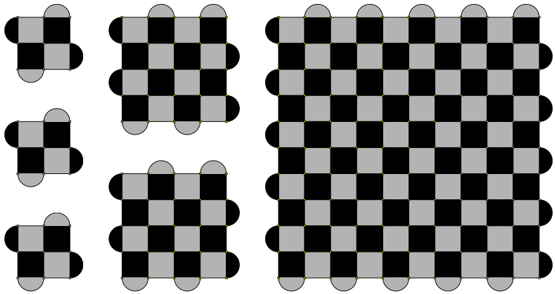
“We assume distance-d logical qubits are stored using square patches of 2(d+1) physical qubits (see Figure 8) and are operated on via lattice surgery [12, 29] (see Figure 9).”
Cybersecurity in an Era with Quantum Computers: Will We Be Ready?
Mosca, M. (2018) · IEEE Security & Privacy · doi:10.1109/msp.2018.3761723 · Cited by 581 · cited 2×
“[72] M.”
BackgroundThe development of the number field sieve
(1993) · Lecture Notes in Mathematics · doi:10.1007/bfb0091534 · Cited by 574
DRAM errors in the wild: a large-scale field study
Schroeder, B., Pinheiro, E., & Weber, W.-D. (2009) · Proceedings of the eleventh international joint conference on Measurement and modeling of computer systems · doi:10.1145/1555349.1555372 · Cited by 557 · cited 2×
“[6] B.”
MethodFlipping bits in memory without accessing them: An experimental study of DRAM disturbance errors
Kim, Y., Daly, R., Kim, J., Fallin, C., Lee, J. H., Lee, D., Wilkerson, C., Lai, K., & Mutlu, O. (2014) · 2014 ACM/IEEE 41st International Symposium on Computer Architecture (ISCA) · doi:10.1109/isca.2014.6853210 · Cited by 465
Semiclassical Fourier Transform for Quantum Computation
Griffiths, R. B., & Niu, C.-S. (1996) · Physical Review Letters · doi:10.1103/physrevlett.76.3228 · Cited by 431 · cited 6×
“The other part of the algorithm, the quantum Fourier transform (QFT), can be implemented semi-classically [33] and interleaved with the controlled modular multiplications.”
BackgroundMethodInfluentialFactorization of a 768-Bit RSA Modulus
Kleinjung, T., Aoki, K., Franke, J., Lenstra, A. K., Thomé, E., Bos, J. W., Gaudry, P., Kruppa, A., Montgomery, P. L., Osvik, D. A., et al. (2010) · Lecture Notes in Computer Science · doi:10.1007/978-3-642-14623-7_18 · Cited by 423 · cited 2×
“The best published academic record is the factorization of a 768 bit RSA modulus in 2009, see [44] for details.”
BackgroundEncoding Electronic Spectra in Quantum Circuits with Linear T Complexity
Babbush, R., Gidney, C., Berry, D. W., Wiebe, N., McClean, J., Paler, A., Fowler, A., & Neven, H. (2018) · Physical Review X · doi:10.1103/physrevx.8.041015 · Cited by 383
Self-citationAdvances in Cryptology – CRYPTO 2010
(2010) · Lecture Notes in Computer Science · doi:10.1007/978-3-642-14623-7 · Cited by 370
Status report on the first round of the NIST post-quantum cryptography standardization process
Alagic, G., Alperin-Sheriff, J., Apon, D., Cooper, D., Dang, Q., Liu, Y.-K., Miller, C., Moody, D., Peralta, R., Perlner, R., et al. (2019) · doi:10.6028/nist.ir.8240 · Cited by 364 · cited 1×
“Post-quantum cryptosystems are in the process of being standardized [1], and small-scale experiments with deploying such systems on the internet have been performed [12].”
BackgroundA new quantum ripple-carry addition circuit
Cuccaro, S. A., Draper, T. G., Kutin, S. A., & Moulton, D. P. (2004) · arXiv · doi:10.48550/arxiv.quant-ph/0410184 · Cited by 344
Layered architecture for quantum computing
Jones, N. C., Van Meter, R., Fowler, A. G., McMahon, P. L., Kim, J., Ladd, T. D., & Yamamoto, Y. (2012) · Physical Review X · doi:10.1103/physrevx.2.031007 · Cited by 332
Discrete Logarithms in $GF ( P )$ Using the Number Field Sieve
Gordon, D. M. (1993) · SIAM Journal on Discrete Mathematics · doi:10.1137/0406010 · Cited by 322
Lenstra, A. K., Lenstra, H. W., Manasse, M. S., & Pollard, J. M. (1990) · Proceedings of the twenty-second annual ACM symposium on Theory of computing - STOC '90 · doi:10.1145/100216.100295 · Cited by 285
Halving the cost of quantum addition
Gidney, C. (2018) · Quantum · doi:10.22331/q-2018-06-18-74 · Cited by 279
Self-citationEfficient networks for quantum factoring
Beckman, D., Chari, A. N., Devabhaktuni, S., & Preskill, J. (1996) · Physical Review A · doi:10.1103/physreva.54.1034 · Cited by 268
Digital signature standard (DSS)
National Institute of Standards and Technology (US) (2013) · doi:10.6028/nist.fips.186-4 · Cited by 246
Qubitization of Arbitrary Basis Quantum Chemistry Leveraging Sparsity and Low Rank Factorization
Berry, D. W., Gidney, C., Motta, M., McClean, J. R., & Babbush, R. (2019) · Quantum · doi:10.22331/q-2019-12-02-208 · Cited by 222
Self-citationMagic State Distillation: Not as Costly as You Think
Litinski, D. (2019) · Quantum · doi:10.22331/q-2019-12-02-205 · Cited by 220 · cited 1×
“In fact, in the week before we first released this paper, Daniel Litinsky made [65] available.”
BackgroundFast parallel circuits for the quantum Fourier transform
Cleve, R., & Watrous, J. (2002) · Proceedings 41st Annual Symposium on Foundations of Computer Science · doi:10.1109/sfcs.2000.892140 · Cited by 215
Quantum Resource Estimates for Computing Elliptic Curve Discrete Logarithms
Roetteler, M., Naehrig, M., Svore, K. M., & Lauter, K. (2017) · Lecture Notes in Computer Science · doi:10.1007/978-3-319-70697-9_9 · Cited by 212 · cited 2×
“In particular, consider the Toffoli count for computing discrete logarithms over elliptic curves reported by [17].”
BackgroundMethodCircuit for Shor's algorithm using 2n+3 qubits
Beauregard, S. (2003) · Quantum Information and Computation · doi:10.26421/qic3.2-8 · Cited by 206
Factoring integers with the number field sieve
Buhler, J. P., Lenstra, H. W., & Pomerance, C. (1993) · Lecture Notes in Mathematics · doi:10.1007/bfb0091539 · Cited by 188 · cited 1×
“[49], Lenstra et al.”
(1999) · Lecture Notes in Computer Science · doi:10.1007/3-540-49208-9 · Cited by 185
Fast quantum modular exponentiation
Van Meter, R., & Itoh, K. M. (2005) · Physical Review A · doi:10.1103/physreva.71.052320 · Cited by 181 · cited 2×
“The number of multiplications is reduced by using windowed arithmetic [20, 21], which uses small table lookups to fuse several multiplications together.”
Method(1996) · Lecture notes in computer science · doi:10.1007/3-540-68339-9 · Cited by 168
Recommendation for pair-wise key-establishment schemes using discrete logarithm cryptography
Barker, E., Chen, L., Roginsky, A., Vassilev, A., & Davis, R. (2018) · doi:10.6028/nist.sp.800-56ar3 · Cited by 158 · cited 3×
“NIST changed this recommendation in the 3rd revision of SP800-56A [4], and are now advocating using a fixed set of safe-prime groups with moduli of length up to 8192 bits, with short or full length exponents.”
BackgroundMethodQuantum computation with realistic magic-state factories
O'Gorman, J., & Campbell, E. T. (2017) · Physical Review A · doi:10.1103/physreva.95.032338 · Cited by 158 · cited 3×
“(2017) [18]: Numbers are derived from table I of [18].”
BackgroundInfluentialOn Diffie-Hellman Key Agreement with Short Exponents
van Oorschot, P. C., & Wiener, M. J. (1996) · Lecture notes in computer science · doi:10.1007/3-540-68339-9_29 · Cited by 156
Efficient magic state factories with a catalyzed | C C Z ⟩ to 2 | T ⟩ transformation
Gidney, C., & Fowler, A. G. (2019) · Quantum · doi:10.22331/q-2019-04-30-135 · Cited by 152 · cited 6×
“According to the spreadsheet included in [36], using a level 1 code distance 17 and a level 2 code distance of 27, this corresponds to a total distillation error of 6.”
BackgroundMethodInfluentialSelf-citationEfficient Synthesis of Universal Repeat-Until-Success Quantum Circuits
Bocharov, A., Roetteler, M., & Svore, K. M. (2015) · Physical Review Letters · doi:10.1103/physrevlett.114.080502 · Cited by 142 · cited 3×
“using the technique in [38].”
MethodInfluentialA practical architecture for reliable quantum computers
Oskin, M., Chong, F. T., & Chuang, I. L. (2002) · Computer · doi:10.1109/2.976922 · Cited by 137
Discrete logarithms and local units
Schirokauer, O. (1993) · Philosophical Transactions of the Royal Society of London. Series A: Physical and Engineering Sciences · doi:10.1098/rsta.1993.0139 · Cited by 133
Efficient Factorization with a Single Pure Qubit andlogNMixed Qubits
Parker, S., & Plenio, M. B. (2000) · Physical Review Letters · doi:10.1103/physrevlett.85.3049 · Cited by 130 · cited 4×
“Working through the qubits representing an exponent in Shor’s algorithm with a window size cexp of four, while using a semi-classical Fourier transform [33] with recycling [34, 35].”
MethodInfluentialThe Hidden Subgroup Problem and Eigenvalue Estimation on a Quantum Computer
Mosca, M., & Ekert, A. (1999) · Lecture Notes in Computer Science · doi:10.1007/3-540-49208-9_15 · Cited by 118
DISTRIBUTED QUANTUM COMPUTATION ARCHITECTURE USING SEMICONDUCTOR NANOPHOTONICS
VAN METER, R., LADD, T. D., FOWLER, A. G., & YAMAMOTO, Y. (2010) · International Journal of Quantum Information · doi:10.1142/s0219749910006435 · Cited by 109
Pollard, J. M. (1993) · Lecture notes in mathematics · doi:10.1007/bfb0091538 · Cited by 107
More Modular Exponential (MODP) Diffie-Hellman groups for Internet Key Exchange (IKE)
Kivinen, T., & Kojo, M. (2003) · doi:10.17487/rfc3526 · Cited by 101
A logarithmic-depth quantum carry-lookahead adder
Draper, T. G., Kutin, S. A., Rains, E. M., & Svore, K. M. (2006) · Quantum Information and Computation · doi:10.26421/qic6.4-5-4 · Cited by 101
Surface code implementation of block code state distillation
Fowler, A. G., Devitt, S. J., & Jones, C. (2013) · Scientific Reports · doi:10.1038/srep01939 · Cited by 99 · cited 2×
“In [43] it is stated that, for a physical gate error rate of 10−3, the probability of error in a logical qubit of distance d, per surface code cycle, is approximately 10−dd/2+1e.”
BackgroundToward a scalable, silicon-based quantum computing architecture
Copsey, D., Oskin, M., Impens, F., Metodiev, T., Cross, A., Chong, F. T., Chuang, I. L., & Kubiatowicz, J. (2003) · IEEE Journal of Selected Topics in Quantum Electronics · doi:10.1109/jstqe.2003.820922 · Cited by 92
Factoring using $2n+2$ qubits with Toffoli based modular multiplication
Haner, T., Roetteler, M., & Svore, K. M. (2017) · Quantum Information and Computation · doi:10.26421/qic17.7-8-7 · Cited by 90 · cited 1×
“2016 [16] 2n+ 2 52n(3) +O(n(2)) 64n(3) lgn+O(n(3)) 580 5200 19000 230 2800 13000 (ours) 2019 3n + 0.”
Recommendation for pair-wise key establishment using integer factorization cryptography
Barker, E., Chen, L., Roginsky, A., Vassilev, A., Davis, R., & Simon, S. (2019) · doi:10.6028/nist.sp.800-56br2 · Cited by 81
Codes and Protocols for Distilling T , controlled- S , and Toffoli Gates
Haah, J., & Hastings, M. B. (2018) · Quantum · doi:10.22331/q-2018-06-07-71 · Cited by 79
Applying quantum algorithms to constraint satisfaction problems
Campbell, E., Khurana, A., & Montanaro, A. (2019) · Quantum · doi:10.22331/q-2019-07-18-167 · Cited by 76
Fast versions of Shor's quantum factoring algorithm
Zalka, C. (1998) · arXiv · doi:10.48550/arxiv.quant-ph/9806084 · Cited by 73 · cited 3×
“• Zalka 1998 (fft mult) [14]: – Toffoli+T/2 Count: Paper says 2 17 n 2 (section 5, middle of page 19).”
InfluentialComparing the Difficulty of Factorization and Discrete Logarithm: A 240-Digit Experiment
Boudot, F., Gaudry, P., Guillevic, A., Heninger, N., Thomé, E., & Zimmermann, P. (2020) · Lecture Notes in Computer Science · doi:10.1007/978-3-030-56880-1_3 · Cited by 71
Low overhead quantum computation using lattice surgery
Fowler, A. G., & Gidney, C. (2018) · arXiv · doi:10.48550/arxiv.1808.06709 · Cited by 69
Self-citationArithmetic on a distributed-memory quantum multicomputer
Meter, R. V., Munro, W. J., Nemoto, K., & Itoh, K. M. (2008) · ACM Journal on Emerging Technologies in Computing Systems · doi:10.1145/1324177.1324179 · Cited by 65
Quantum Algorithms for Computing Short Discrete Logarithms and Factoring RSA Integers
Ekerå, M., & Håstad, J. (2017) · Lecture Notes in Computer Science · doi:10.1007/978-3-319-59879-6_20 · Cited by 62 · cited 7×
“[23] M.”
BackgroundMethodResultInfluentialSelf-citationA fault tolerant, area efficient architecture for Shor's factoring algorithm
Whitney, M., Isailovic, N., Patel, Y., & Kubiatowicz, J. D. (2009) · Proceedings - International Symposium on Computer Architecture/Proceedings · doi:10.1145/1555754.1555802 · Cited by 53
Pollard, J. M. (1993) · Lecture Notes in Mathematics · doi:10.1007/bfb0091536 · Cited by 49
Shor's algorithm on a nearest-neighbor machine
Kutin, S. A. (2006) · arXiv · doi:10.48550/arxiv.quant-ph/0609001 · Cited by 47
Time-optimal quantum computation
Fowler, A. G. (2012) · arXiv · doi:10.48550/arxiv.1210.4626 · Cited by 45
Scalable error correction in distributed ion trap computers
Oi, D. K. L., Devitt, S. J., & Hollenberg, L. C. L. (2006) · Physical Review A · doi:10.1103/physreva.74.052313 · Cited by 40
Negotiated Finite Field Diffie-Hellman Ephemeral Parameters for Transport Layer Security (TLS)
Gillmor, D. (2016) · doi:10.17487/rfc7919 · Cited by 39
Fast quantum modular exponentiation architecture for Shor's factoring alogrithm
Pavlidis, A., & Gizopoulos, D. (2014) · Quantum Information and Computation · doi:10.26421/qic14.7-8-8 · Cited by 38
Benchmarking the quantum cryptanalysis of symmetric, public-key and hash-based cryptographic schemes
Gheorghiu, V., & Mosca, M. (2019) · arXiv · doi:10.48550/arxiv.1902.02332 · Cited by 28
Factoring with n+2 clean qubits and n-1 dirty qubits
Gidney, C. (2017) · arXiv · doi:10.48550/arxiv.1706.07884 · Cited by 28
Self-citationReduced space-time and time costs Ising dislocation codes and arbitrary ancillas
Hastings, M. B., & Geller, A. (2015) · Quantum Information and Computation · doi:10.26421/qic15.11-12-6 · Cited by 25 · cited 1×
“For example, qubits stored using dislocations [66] could be denser than qubits stored using lattice surgery.”
(2017) · Lecture Notes in Computer Science · doi:10.1007/978-3-319-70697-9 · Cited by 25
Improved reversible and quantum circuits for Karatsuba-based integer multiplication
Parent, A., Roetteler, M., & Mosca, M. (2018) · Schloss Dagstuhl – Leibniz-Zentrum für Informatik · doi:10.4230/lipics.tqc.2017.7 · Cited by 24
On post-processing in the quantum algorithm for computing short discrete logarithms
Ekerå, M. (2020) · Designs, Codes and Cryptography · doi:10.1007/s10623-020-00783-2 · Cited by 23
Self-citation(2017) · Lecture Notes in Computer Science · doi:10.1007/978-3-319-59879-6 · Cited by 20
Shor's algorithm with fewer (pure) qubits
Zalka, C. (2006) · arXiv · doi:10.48550/arxiv.quant-ph/0601097 · Cited by 20
Asymptotically Efficient Quantum Karatsuba Multiplication
Gidney, C. (2019) · arXiv · doi:10.48550/arxiv.1904.07356 · Cited by 18
Self-citationSCALABLE QUANTUM NETWORKS BASED ON FEW-QUBIT REGISTERS
Jiang, L., Taylor, J. M., Sørensen, A. S., & Lukin, M. D. (2010) · International Journal of Quantum Information · doi:10.1142/s0219749910006058 · Cited by 12
Flexible layout of surface code computations using AutoCCZ states
Gidney, C., & Fowler, A. G. (2019) · arXiv · doi:10.48550/arxiv.1905.08916 · Cited by 12
Self-citationGidney, C. (2019) · arXiv · doi:10.48550/arxiv.1905.07682 · Cited by 11
Self-citationModifying Shor's algorithm to compute short discrete logarithms.Preprint
Ekerå, M. (2016) · IACR Cryptology ePrint Archive · Cited by 9
Self-citationRevisiting Shor's quantum algorithm for computing general discrete logarithms
Ekerå, M. (2019) · arXiv · doi:10.48550/arxiv.1905.09084 · Cited by 9 · cited 3×
“The modified algorithm is described by Eker̊a in [21] in the section on general logarithms, and in [59] where a heuristic analysis is also provided.”
MethodInfluentialSelf-citationQuantum algorithms for computing general discrete logarithms and orders with tradeoffs
Ekerå, M. (2021) · Journal of Mathematical Cryptology · doi:10.1515/jmc-2020-0006 · Cited by 3 · cited 5×
“Computing discrete logarithms using Eker̊a-H̊astad’s [23, 24] and Eker̊a’s [25] algorithms.”
MethodInfluentialSelf-citationA #QuantumComputerArchitecture Tweetstorm
Van Meter, R. (2019) · Zenodo · doi:10.5281/zenodo.3496597 · Cited by 3
Approximate encoded permutations and piecewise quantum adders
Gidney, C. (2019) · arXiv · doi:10.48550/arxiv.1905.08488 · Cited by 3
Self-citation
Research works printed but not linked: 4
- [47] A. A. Karatsuba and Y. P. Ofman. Multiplication of many-digital numbers by automatic computers. Doklady Akademii Nauk SSSR , 145(2):293-294, 1962. URL http://mi.mathnet. ru/eng/dan/v145/i2/p293 . -
- [52] A. K. Lenstra. Key Lengths. In The Handbook of Information Security , chapter 6. 2004. URL https://infoscience.epfl.ch/record/164539/files/NPDF-32.pdf . -
- [72] C. Pomerance. A Tale of Two Sieves. Notices of the AMS , 43(12):1473-1485, 1996. URL https://www.ams.org/notices/199612/pomerance.pdf . -
- [75] O. Schirokauer. On pro-finite groups and on discrete logarithms . PhD thesis, University of California, Berkeley, May 1992. -
Cited by
Quantum computational chemistry
McArdle, S., Endo, S., Aspuru-Guzik, A., Benjamin, S. C., & Yuan, X. (2020) · Reviews of Modern Physics · doi:10.1103/revmodphys.92.015003 · Cited by 1,621
Logical quantum processor based on reconfigurable atom arrays
Bluvstein, D., Evered, S. J., Geim, A. A., Li, S. H., Zhou, H., Manovitz, T., Ebadi, S., Cain, M., Kalinowski, M., Hangleiter, D., et al. (2024) · Nature · doi:10.1038/s41586-023-06927-3 · Cited by 1,119
“Similar techniques can be used to move logical degrees of freedom to implement nonlocal logical gates 23 .”
BackgroundSuppressing quantum errors by scaling a surface code logical qubit
Google Quantum, A. I., Acharya, R., Aleiner, I., Allen, R., Andersen, T. I., Ansmann, M., Arute, F., Arya, K., Asfaw, A., Atalaya, J., et al. (2023) · Nature · doi:10.1038/s41586-022-05434-1 · Cited by 1,103
Self-citationQuantum error correction below the surface code threshold
Collaborators, G. Q. A. A., Acharya, R., Abanin, D. A., Aghababaie-Beni, L., Aleiner, I., Andersen, T. I., Ansmann, M., Arute, F., Arya, K., Asfaw, A., et al. (2025) · Nature · doi:10.1038/s41586-024-08449-y · Cited by 778
“3b-c, observing good agreement with O ( p ( d +1) / 2 ) error suppression.”
Self-citationExponential suppression of bit or phase errors with cyclic error correction
Google Quantum, A. I., Chen, Z., Satzinger, K. J., Atalaya, J., Korotkov, A. N., Dunsworth, A., Sank, D., Quintana, C., McEwen, M., Barends, R., et al. (2021) · Nature · doi:10.1038/s41586-021-03588-y · Cited by 393
Self-citation
Metadata
- Authors
- Gidney, C., & Ekerå, M.
- Affiliations
- Google (United States) (US)
- Swedish Armed Forces (SE)
- ORCID
- Ekerå, Martin
- Venue
- Quantum
- Published
- 2021-04-15
- Volume
- 5
- Pages
- 433
- ISSN
- 2521-327X (ISSN-L)
- OpenAlex
- W2946582523
- Cited by
- 830
- References
- 69
- Citations by year
- 2026: 149 · 2025: 195 · 2024: 151 · 2023: 140 · 2022: 87 · 2021: 63
- FWCI
- 38.76
- Type
- journal article
- Language
- en
- Open access
- gold
- doi.org
- Locations
- Quantum (publishedVersion, cc-by)
- arXiv (Cornell University) (submittedVersion)
- DOAJ (DOAJ: Directory of Open Access Journals) (submittedVersion, cc-by-sa)
- arXiv (Cornell University) (cc-by)
- Topics
- Physical Sciences › Computer Science › Artificial Intelligence › Quantum Computing Algorithms and Architecture
- Physical Sciences › Physics and Astronomy › Atomic and Molecular Physics, and Optics › Quantum Information and Cryptography
- Physical Sciences › Computer Science › Information Systems › Cryptography and Residue Arithmetic
- Keywords
- integer factorization, discrete logarithm problem, quantum algorithms, Shor's algorithm, noisy qubits, superconducting qubits, surface code, Toffoli gate, measurement depth
About these checks
Registry, retraction, Cites and statistics results are computed, not judged, with one exception: a printed reference that no index lists is read once by a model before it counts as a citation error. Claims are extracted by a model and kept only when their quote appears verbatim in the text; each cited source is then checked, with a model’s help, for whether it says what the claim relies on. Those verdicts can be wrong — read the claim’s quote and the cited source before relying on one.
The claim verdicts this report counts are experimental: their accuracy is not yet measured.
A language model drew the claims from the paper on 2026-09-29, under version 3 of the claim definition (model deepseek-v4.1-flash, prompt extract-v3).
A second model labelled each claim on 2026-09-29 (model jev-1.13-20260917, definition revision gold-guideline-v0.2).
Cited sources are checked with a language model’s help (gpt-6-sol and qwen3.8-omni-flash).
Statistics and arithmetic are recomputed, not judged.
Confidence bands are shown only for fields calibrated on our annotated test set. None is calibrated yet, so no band is shown.
What counts as a claim ›How we measure confidence ›How we check this ›
Are you an author, or do you see a problem with this page? Request a review
Data sources
Bibliographic data: Semantic Scholar, OpenAlex, Crossref.
Contains information from the Semantic Scholar Academic Graph Datasets, made available under the ODC Attribution License (ODC-BY 1.0).
Semantic Scholar’s data is described in: Kinney, R., et al. (2023). The Semantic Scholar Open Data Platform. arXiv:2301.10140.
