

The effects of low-load vs. high-load resistance training on muscle fiber hypertrophy: a meta-analysis.
Open accessThe DOI matches its Crossref record; 27 of the 27 references it cites were found in a registry or an index; 4 of the 17 sources its claims cite were checked for support.
Abstract
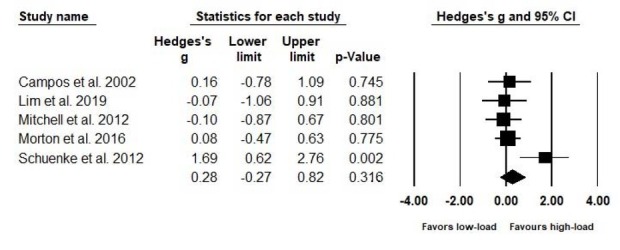
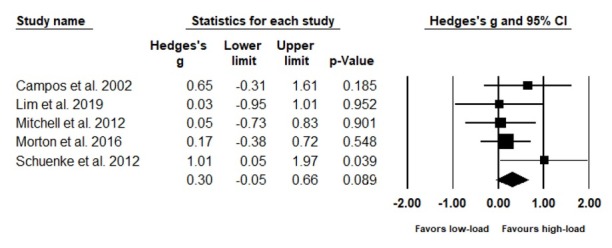
The aim of this meta-analysis was to explore the effects of low-load vs. high-load resistance training on type I and type II muscle fiber hypertrophy. Searches for studies were performed through ten databases. Studies were included if they: (a) compared the effects of low-load vs. high-load resistance training (performed to momentary muscular failure); and, (b) assessed muscle fiber hypertrophy. A random-effects meta-analysis was performed to analyze the data. Ten study groups were included in the analysis. In the meta-analysis for the effects of low-load vs. high-load resistance training on type I muscle fiber hypertrophy, there was no significant difference between the training conditions (standardized mean difference: 0.28; 95% confidence interval: –0.27, 0.82; p = 0.316; I 2 = 18%; 95% prediction interval: –0.71, 1.28). In the meta-analysis for the effects of low-load vs. high-load resistance training on type II muscle fiber hypertrophy, there was no significant difference between the training conditions (standardized mean difference: 0.30; 95% confidence interval: –0.05, 0.66; p = 0.089; I 2 = 0%; 95% prediction interval: –0.28, 0.88). In this meta-analysis, there were no significant differences between low-load and high-load resistance training on hypertrophy of type I or type II muscle fibers. The 95% confidence and prediction intervals were very wide, suggesting that the true effect in the population and the effect reported in a future study conducted on this topic could be in different directions and anywhere from trivial to very large. Therefore, there is a clear need for future research on this topic.
Overview
CoChat Summary
TL;DR
This meta-analysis found no significant differences between low-load and high-load resistance training performed to momentary muscular failure for type I or type II muscle fiber hypertrophy. However, the confidence and prediction intervals were wide, so the paper concludes there is insufficient data to determine whether either load is superior.
Key findings
- Type I muscle fiber hypertrophy: low-load vs. high-load showed no significant difference (SMD: 0.28; 95% CI: –0.27, 0.82; p = 0.316; I² = 18%; 95% prediction interval: –0.71, 1.28).
- Type II muscle fiber hypertrophy: low-load vs. high-load showed no significant difference (SMD: 0.30; 95% CI: –0.05, 0.66; p = 0.089; I² = 0%; 95% prediction interval: –0.28, 0.88).
- In the type II analysis, the pooled SMD favored high-loads but was not statistically significant; after excluding Schuenke et al. (2012), the pooled estimate was reduced to 0.20 (95% CI: –0.18, 0.57; p = 0.310).
- Methodological quality scores ranged from 19 to 25 on the Downs and Black checklist; four studies were rated good quality and one moderate quality.
Methods
- Systematic search of ten databases, plus secondary searches, conducted on February 1st, 2020; inclusion required English-language human studies comparing low-load (≤60% 1RM) vs. high-load (>60% 1RM) resistance training performed to momentary muscular failure and assessing muscle fiber hypertrophy.
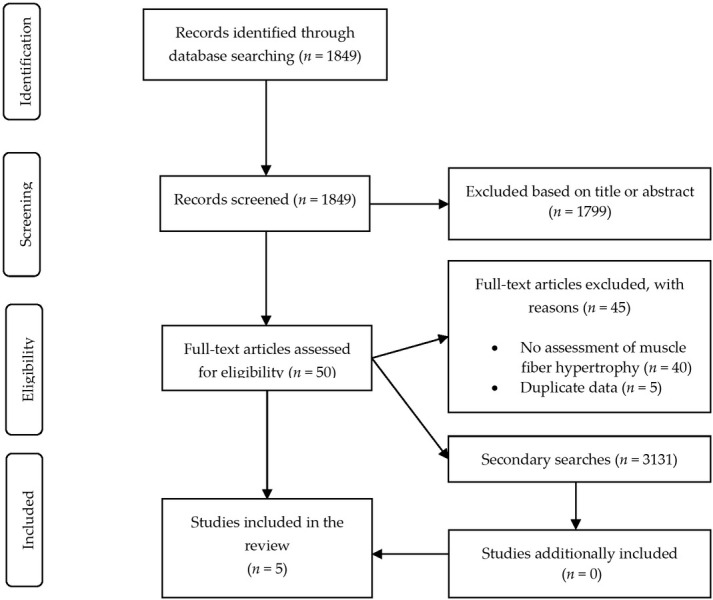
- Five studies with 10 study groups were included, with a pooled total of 120 participants; samples ranged from 14 to 49 participants (median: 17), training programs lasted 6 to 12 weeks, and all muscle biopsies were taken from the quadriceps.
- Random-effects meta-analyses used standardized mean differences (Hedges’s g) separately for type I and type II fiber cross-sectional area, with 95% CIs, I² heterogeneity, and 95% prediction intervals; analyses used Comprehensive Meta-analysis software version 2.
Limitations
- The paper states that the 95% confidence and prediction intervals were very wide, suggesting the true population effect and future study effects could range from trivial to very large and in different directions.
- The paper states that all biopsy samples came from the quadriceps femoris, so results cannot necessarily be generalized to upper-body musculature.
- The paper states that adherence was reported in only one study (Morton et al., 2016), and notes that one included study used females while all others used males, with sensitivity analysis suggesting possible sex differences; evident from the text, the meta-analysis is based on only five studies/10 study groups, mostly untrained males, with short 6–12 week training durations.
Model-written summary. Check it against the paper before relying on it.
Integrity signals
Registry
Cites
Statistics
Figures
Verification
Claims the paper makes
4 Valid · 0 Not valid · 13 Not checked · 22 Own results and interpretations
The sources with a verdict support this claim; the rest weren’t checked yet, have no full text we could read, or their verdicts aren’t rated yet.
In the paper
“However, recent research has established that both low-load and high-load resistance training may produce similar muscle hypertrophy at the whole muscle level when the training is performed to momentary muscular failure (Schoenfeld et al., 2017; Schoenfeld et al., 2020).”
§ The Effects of Low-Load Vs. High-Load Resistance Training on Muscle Fiber Hypertrophy: A Meta-Analysis > Introduction
What the sources say
- Not checked — no full text of the sourcecites Schoenfeld et al., 2017 matched to “Strength and hypertrophy adaptations between low- vs. high-load resistance training: a systematic review and meta-analysis.” (2017) source
- Supportedcites Schoenfeld et al., 2020 matched to “Do the anatomical and physiological properties of a muscle determine its adaptive response to different loading protocols?” (2020) source
The Discussion reports similar muscle-thickness increases with heavy and light loads in all three triceps surae muscles (9.2% and 10.7%, respectively). It also states that participants were pushed to momentary muscle failure on each set, supporting the claim's condition. (LLM, conf=0.92)
hedgedstates a possible cause- Asserted: passes — The authors put it forward as true.
- Checkable: passes — It can be checked against evidence.
- Load-bearing: passes — The paper’s conclusions depend on it.
- Based: passes — The paper gives a reason why it holds.
Every source the paper cites for this claim was checked and supports it.
In the paper
“However, it also needs to be mentioned that adherence to the training programs was reported only in one study (Morton et al., 2016).”
§ The Effects of Low-Load Vs. High-Load Resistance Training on Muscle Fiber Hypertrophy: A Meta-Analysis > Discussion
What the sources say
- Supportedcites Morton et al., 2016 matched to “Neither load nor systemic hormones determine resistance training-mediated hypertrophy or strength gains in resistance-trained young men” (2016) source
The Methods (Experimental design) report session attendance of 97 ± 2% in the high-repetition group and 96 ± 2% in the low-repetition group. This confirms that Morton et al. reported training attendance; “only in one study” is the citing authors’ comparison across their included studies, not a finding attributed to Morton et al. (LLM, conf=0.92)
plain- Asserted: passes — The authors put it forward as true.
- Checkable: passes — It can be checked against evidence.
- Load-bearing: passes — The paper’s conclusions depend on it.
- Based: passes — The paper gives a reason why it holds.
- Supported
Every source the paper cites for this claim was checked and supports it.
In the paper
“Even though it might be tempting to conclude that these results indicate that muscle fiber hypertrophy is not resistance training load-dependent, non-significant test results are generally not indicative of the absence of a true effect in the population (Lakens, 2017).”
§ The Effects of Low-Load Vs. High-Load Resistance Training on Muscle Fiber Hypertrophy: A Meta-Analysis > Discussion
What the sources say
- Supportedcites Lakens, 2017 matched to “Equivalence Tests: A Practical Primer for t Tests, Correlations, and Meta-Analyses” (2017) source
The passage labeled Abstract states that a nonsignificant result does not permit the conclusion that there is no effect: the test may have lacked power to detect a true effect. The Discussion likewise describes treating nonsignificant p values as evidence of no effect as a common misinterpretation. (LLM, conf=0.94)
plain- Asserted: passes — The authors put it forward as true.
- Checkable: passes — It can be checked against evidence.
- Load-bearing: passes — The paper’s conclusions depend on it.
- Based: passes — The paper gives a reason why it holds.
- Supported
A result the paper reports from its own data — it cites no other source for it, so there is none to check. The quote shows it is in the paper.
In the paper
“The 95% prediction intervals ranged from –0.71 to 1.28.”
§ The Effects of Low-Load Vs. High-Load Resistance Training on Muscle Fiber Hypertrophy: A Meta-Analysis > Results > Meta-analysis results
plain- Asserted: passes — The authors put it forward as true.
- Checkable: passes — It can be checked against evidence.
- Load-bearing: unclear — It is unclear whether the paper’s conclusions depend on it.
- Based: passes — The paper gives a reason why it holds.
None of the sources cited for this claim have been checked yet.
In the paper
“In all studies, muscle biopsy samples were taken from the quadriceps muscle.”
- Also stated in: § Discussion · plain
“Specifically, all studies collected muscle biopsy samples from the quadriceps femoris muscle group, which is the most common location because of its mixed fiber type composition, trainability, and accessibility (Staron et al., 2000).”
§ The Effects of Low-Load Vs. High-Load Resistance Training on Muscle Fiber Hypertrophy: A Meta-Analysis > Results > Search results and study characteristics
plain- Asserted: passes — The authors put it forward as true.
- Checkable: passes — It can be checked against evidence.
- Load-bearing: passes — The paper’s conclusions depend on it.
- Based: passes — The paper gives a reason why it holds.
- Also stated in: § Discussion · plain
14 more claims
Create a free account to see all 39 claims and every source verdict.
- Probably not a substantial claim. 12
- It may state two separate claims as one. 12
- The quote only partly states this claim. 1
Claims other papers make about this one
Each is checked against this paper’s own text: does it say what the citing paper says it does?
The cited source says what the claim attributes to it.
In the citing paper
“While the effects favored high-load training for type II muscle fiber CSA, they were not statistically significant (effect size: 0.30; 95% confidence interval: −0.05, 0.66; p = 0.089), possibly because only five studies were included in the analysis.”
From Loading recommendations for muscle strength, hypertrophy, and local endurance: a re-examination of the repetition continuum. (2021) · cites this paper as [76]
The cited source says what the claim attributes to it.
In the citing paper
“The analysis found no significant difference between low-load vs. high-load for type I muscle fiber CSA.”
From Loading recommendations for muscle strength, hypertrophy, and local endurance: a re-examination of the repetition continuum. (2021) · cites this paper as [76]
The cited source says what the claim attributes to it.
In the citing paper
“A recent meta-analysis included studies that performed muscle biopsies and compared the effects of low-load vs. high-load on type I and type II muscle fiber CSA with training carried out to muscular failure [76].”
From Loading recommendations for muscle strength, hypertrophy, and local endurance: a re-examination of the repetition continuum. (2021) · cites this paper as [76]
In the citing paper
“RT did not influence hypertrophy performed with low (1 d/wk) versus high (>5 d/wk) frequency when total volume was equated; low (30% 1RM) to high (100% 1RM) loads; contractions to muscle failure/fatigue; blood flow restriction; varying loads during repetitions; fast (0.5 s) versus slow (8 s) repetitions; power training techniques; periodization (linear, undulating, and nonperiodized); or exercise”
Self-check
Percentages, sums and reported differences re-computed from the paper’s own numbers.
Each contradiction between two passages listed here was confirmed by an independent check.
Rated minor: it would not touch a result — a value no result rests on, a p-value that stays on the same side of the significance level, or a conflict that is clerical, resolved elsewhere in the paper, or outside its own findings.
In the paper
§ The Effects of Low-Load Vs. High-Load Resistance Training on Muscle Fiber Hypertrophy: A Meta-Analysis > Methods > Methodological quality
“The methodological quality of included studies was assessed using the Downs and Black (2000) checklist.”
§ The Effects of Low-Load Vs. High-Load Resistance Training on Muscle Fiber Hypertrophy: A Meta-Analysis > References
“Downs SH Black N The feasibility of creating a checklist for the assessment of the methodological quality both of randomised and non-randomised studies of health care interventions J Epidemiol Commun Health 1998”
Rated minor: it would not touch a result — a value no result rests on, a p-value that stays on the same side of the significance level, or a conflict that is clerical, resolved elsewhere in the paper, or outside its own findings.
In the paper
§ The Effects of Low-Load Vs. High-Load Resistance Training on Muscle Fiber Hypertrophy: A Meta-Analysis > Results > Search results and study characteristics
“Study samples ranged from 14 to 49 participants (median: 17 participants).”
§ The Effects of Low-Load Vs. High-Load Resistance Training on Muscle Fiber Hypertrophy: A Meta-Analysis > Results > Search results and study characteristics
“Mitchell et al. (2012) | 12 young untrained men”
Citations
Cites
Borenstein, M., Hedges, L. V., Higgins, J. P. T., & Rothstein, H. R. (2009) · doi:10.1002/9780470743386 · Cited by 14,225 · cited 2×
“In a narrative review, there is no statistical mechanism for assessing the dispersion in effect size from study to study (Borenstein et al., 2009).”
BackgroundBorenstein, M., Hedges, L. V., Higgins, J. P. T., & Rothstein, H. R. (2021) · doi:10.1002/9781119558378 · Cited by 9,799
Downs, S. H., & Black, N. (1998) · Journal of Epidemiology and Community Health · doi:10.1136/jech.52.6.377 · Cited by 8,252
Progression Models in Resistance Training for Healthy Adults
(2009) · Medicine & Science in Sports & Exercise · doi:10.1249/mss.0b013e3181915670 · Cited by 4,332 · cited 2×
“In a narrative review, there is no statistical mechanism for assessing the dispersion in effect size from study to study (Borenstein et al., 2009).”
BackgroundEquivalence Tests: A Practical Primer for t Tests, Correlations, and Meta-Analyses
Lakens, D. (2017) · Social Psychological and Personality Science · doi:10.1177/1948550617697177 · Cited by 3,001 · cited 1×
“Even though it might be tempting to conclude that these results indicate that muscle fiber hypertrophy is not resistance training load-dependent, non-significant test results are generally not indicative of the absence of a true effect in the population (Lakens, 2017).”
Progression Models in Resistance Training for Healthy Adults
(2002) · Medicine and Science in Sports and Exercise · doi:10.1097/00005768-200202000-00027 · Cited by 2,979
FUNCTIONAL SIGNIFICANCE OF CELL SIZE IN SPINAL MOTONEURONS
Henneman, E., Somjen, G., & Carpenter, D. O. (1965) · Journal of Neurophysiology · doi:10.1152/jn.1965.28.3.560 · Cited by 2,294 · cited 1×
“According to Henneman's size principle, motor units are recruited in an orderly fashion (Henneman et al., 1965).”
Folland, J. P., & Williams, A. G. (2007) · Sports Medicine · doi:10.2165/00007256-200737020-00004 · Cited by 1,347 · cited 1×
“In contrast, high-load training is suggested to predominantly impact type II muscle fiber hypertrophy (Folland and Williams, 2007).”
BackgroundCampos, G., Luecke, T., Wendeln, H., Toma, K., Hagerman, F., Murray, T., Ragg, K., Ratamess, N., Kraemer, W., & Staron, R. (2002) · European Journal of Applied Physiology · doi:10.1007/s00421-002-0681-6 · Cited by 1,066 · cited 1×
“Of this number of search results, a total of 50 full-text papers were read, and five studies (Campos et al., 2002; Lim et al., 2019; Mitchell et al., 2012; Morton et al., 2016; Schuenke et al., 2012), with a total of 10 study groups were included in the review.”
BackgroundSchoenfeld, B. J., Grgic, J., Ogborn, D., & Krieger, J. W. (2017) · Journal of Strength and Conditioning Research · doi:10.1519/jsc.0000000000002200 · Cited by 851 · cited 3×
“However, recent research has established that both low-load and high-load resistance training may produce similar muscle hypertrophy at the whole muscle level when the training is performed to momentary muscular failure (Schoenfeld et al., 2017; Schoenfeld et al., 2020).”
BackgroundFiber Type Composition of the Vastus Lateralis Muscle of Young Men and Women
Staron, R. S., Hagerman, F. C., Hikida, R. S., Murray, T. F., Hostler, D. P., Crill, M. T., Ragg, K. E., & Toma, K. (2000) · Journal of Histochemistry & Cytochemistry · doi:10.1177/002215540004800506 · Cited by 730 · cited 1×
“Specifically, all studies collected muscle biopsy samples from the quadriceps femoris muscle group, which is the most common location because of its mixed fiber type composition, trainability, and accessibility (Staron et al., 2000).”
BackgroundResistance exercise load does not determine training-mediated hypertrophic gains in young men
Mitchell, C. J., Churchward-Venne, T. A., West, D. W. D., Burd, N. A., Breen, L., Baker, S. K., & Phillips, S. M. (2012) · Journal of Applied Physiology · doi:10.1152/japplphysiol.00307.2012 · Cited by 627 · cited 2×
“Four studies were classified as being of good methodological quality, and one study was classified as being of moderate methodological quality (Mitchell et al., 2012).”
BackgroundMorton, R. W., Oikawa, S. Y., Wavell, C. G., Mazara, N., McGlory, C., Quadrilatero, J., Baechler, B. L., Baker, S. K., & Phillips, S. M. (2016) · Journal of Applied Physiology · doi:10.1152/japplphysiol.00154.2016 · Cited by 404 · cited 2×
“However, it also needs to be mentioned that adherence to the training programs was reported only in one study (Morton et al., 2016).”
BackgroundTraining adaptations in the behavior of human motor units
Duchateau, J., Semmler, J. G., & Enoka, R. M. (2006) · Journal of Applied Physiology · doi:10.1152/japplphysiol.00543.2006 · Cited by 354
Muscular adaptations in low- versus high-load resistance training: a meta-analysis.
Schoenfeld, B. J., Wilson, J. M., Lowery, R. P., & Krieger, J. W. (2016) · European Journal of Sport Science · doi:10.1080/17461391.2014.989922 · Cited by 249 · cited 1×
“…list of all studies included in the review; (b) screening the studies that cited the included studies (i.e., forward citation tracking), through Scopus and Google Scholar databases; and (c) examining the reference list of previous related reviews (Schoenfeld et al., 2016; Schoenfeld et al., 2017).”
BackgroundHaun, C. T., Vann, C. G., Roberts, B. M., Vigotsky, A. D., Schoenfeld, B. J., & Roberts, M. D. (2019) · Frontiers in Physiology · doi:10.3389/fphys.2019.00247 · Cited by 192 · cited 2×
“According to Haun et al. (2019), muscle hypertrophy can be assessed at the whole-muscle level (macroscopic methods) or the muscle fiber level (microscopic methods).”
BackgroundMethodGrgić, J., Schoenfeld, B. J., Skrepnik, M., Davies, T. B., & Mikulić, P. (2017) · Sports Medicine · doi:10.1007/s40279-017-0788-x · Cited by 190 · cited 1×
“As performed in other reviews (Davies et al., 2017; Grgic et al., 2018b) that focused on the effects of resistance training on muscular adaptations, two additional items were included on the checklist (item 28 and item 29).”
BackgroundMorton, R. W., Sonne, M. W., Farias Zuniga, A., Mohammad, I. Y. Z., Jones, A., McGlory, C., Keir, P. J., Potvin, J. R., & Phillips, S. M. (2019) · The Journal of Physiology · doi:10.1113/jp278056 · Cited by 139
Davies, T. B., Kuang, K., Orr, R., Halaki, M., & Hackett, D. (2017) · Sports Medicine · doi:10.1007/s40279-017-0676-4 · Cited by 117 · cited 1×
“As performed in other reviews (Davies et al., 2017; Grgic et al., 2018b) that focused on the effects of resistance training on muscular adaptations, two additional items were included on the checklist (item 28 and item 29).”
BackgroundSchuenke, M. D., Herman, J. R., Gliders, R. M., Hagerman, F. C., Hikida, R. S., Rana, S. R., Ragg, K. E., & Staron, R. S. (2012) · European Journal of Applied Physiology · doi:10.1007/s00421-012-2339-3 · Cited by 102 · cited 2×
“Of this number of search results, a total of 50 full-text papers were read, and five studies (Campos et al., 2002; Lim et al., 2019; Mitchell et al., 2012; Morton et al., 2016; Schuenke et al., 2012), with a total of 10 study groups were included in the review.”
BackgroundResistance exercise–induced changes in muscle phenotype are load dependent
LIM, C., KIM, H. J., MORTON, R. W., HARRIS, R., PHILLIPS, S. M., JEONG, T. S., & KIM, C. K. (2019) · Medicine & Science in Sports & Exercise · doi:10.1249/mss.0000000000002088 · Cited by 81
Grgic, J., & Schoenfeld, B. J. (2018) · Frontiers in Physiology · doi:10.3389/fphys.2018.00402 · Cited by 64 · cited 2×
“Grgic and Schoenfeld (2018) recently performed a narrative review on this topic.”
BackgroundSchoenfeld, B. J., Vigotsky, A. D., Grgic, J., Haun, C., Contreras, B., Delcastillo, K., Francis, A., Cote, G., & Alto, A. (2020) · Physiological Reports · doi:10.14814/phy2.14427 · Cited by 56 · cited 2×
“However, recent research has established that both low-load and high-load resistance training may produce similar muscle hypertrophy at the whole muscle level when the training is performed to momentary muscular failure (Schoenfeld et al., 2017; Schoenfeld et al., 2020).”
BackgroundResultEffects of Training Attendance on Muscle Strength of Young Men after 11 Weeks of Resistance Training
Gentil, P., & Bottaro, M. (2013) · Asian Journal of Sports Medicine · doi:10.5812/asjsm.34489 · Cited by 51 · cited 1×
“Adherence to any training program is one of the critical variables that will determine its effectiveness (Gentil and Bottaro, 2013).”
BackgroundGrgić, J., Homolak, J., Mikulić, P., Botella, J., & Schoenfeld, B. J. (2018) · Medical Hypotheses · doi:10.1016/j.mehy.2018.01.012 · Cited by 46 · cited 2×
“As compared to high-load training, some authors have hypothesized that low-load resistance training may produce greater Journal of Human Kinetics - volume 74/2020 http://www.johk.pl hypertrophy of type I muscle fibers (Grgic et al., 2018a; Ogborn and Schoenfeld, 2014).”
BackgroundResultThe Role of Fiber Types in Muscle Hypertrophy: Implications for Loading Strategies
Ogborn, D., & Schoenfeld, B. J. (2014) · Strength & Conditioning Journal · doi:10.1519/ssc.0000000000000030 · Cited by 45 · cited 1×
“As compared to high-load training, some authors have hypothesized that low-load resistance training may produce greater Journal of Human Kinetics - volume 74/2020 http://www.johk.pl hypertrophy of type I muscle fibers (Grgic et al., 2018a; Ogborn and Schoenfeld, 2014).”
ResultAcute Effects of Different Training Loads on Affective Responses in Resistance-trained Men
Ribeiro, A. S., dos Santos, E. D., Nunes, J. P., & Schoenfeld, B. J. (2019) · International Journal of Sports Medicine · doi:10.1055/a-0997-6680 · Cited by 30 · cited 1×
“In this context, one acute study reported that low-load training (20 to 25 RM) produced higher degrees of effort, discomfort, and displeasure, as compared to high-load training (8 to 12 RM) (Ribeiro et al., 2019).”
Result
Cited by
Schoenfeld, B. J., Grgic, J., Van Every, D. W., & Plotkin, D. L. (2021) · Sports · doi:10.3390/sports9020032 · Cited by 334
“high-load on type I and type II muscle fiber CSA with training carried out to muscular failure [76].”
BackgroundEgan, B., & Sharples, A. P. (2023) · Physiological Reviews · doi:10.1152/physrev.00054.2021 · Cited by 278
Currier, B. S., Mcleod, J. C., Banfield, L., Beyene, J., Welton, N. J., D'Souza, A. C., Keogh, J. A. J., Lin, L., Coletta, G., Yang, A., et al. (2023) · British Journal of Sports Medicine · doi:10.1136/bjsports-2023-106807 · Cited by 179
“The lack of importance of load for hypertrophy is supported by other analyses, 16 17 35 62 but performing RT to momentary muscular failure (fatigue) has been posited as a key component for RT-induced hypertrophy with lower loads.”
Mcleod, J. C., Currier, B. S., Lowisz, C. V., & Phillips, S. M. (2024) · Journal of Sport and Health Science · doi:10.1016/j.jshs.2023.06.005 · Cited by 176
Coratella, G. (2022) · Sports Medicine - Open · doi:10.1186/s40798-022-00492-1 · Cited by 91
Metadata
- Authors
- Grgic, J.
- Affiliations
- Institute for Health and Sport (IHES) , Victoria University , Melbourne , Australia
- Venue
- Journal of Human Kinetics
- Publisher
- Termedia Sp. z.o.o.
- Published
- 2020-08-31
- Volume
- 74
- Issue
- 1
- Pages
- 51-58
- ISSN
- 1640-5544 (ISSN-L)
- 1899-7562
- PMC
- PMC7706639
- OpenAlex
- W3114064374
- Cited by
- 45
- References
- 27
- Citations by year
- 2026: 6 · 2025: 6 · 2024: 10 · 2023: 12 · 2022: 5 · 2021: 6
- FWCI
- 1.13
- Type
- journal article
- Language
- en
- Open access
- diamond
- doi.org
- Locations
- Journal of Human Kinetics (publishedVersion, cc-by)
- PubMed Central (publishedVersion, cc-by-nc-nd)
- PubMed (publishedVersion)
- Victoria University Research Repository (Victoria University) (submittedVersion, cc-by-nc-nd)
- Topics
- Health Sciences › Medicine › Orthopedics and Sports Medicine › Sports Performance and Training
- Health Sciences › Medicine › Physiology (medical) › Cardiovascular and exercise physiology
- Health Sciences › Nursing › Nutrition and Dietetics › Muscle metabolism and nutrition
- Keywords
- resistance training, low-load training, high-load training, muscle fiber hypertrophy, type I muscle fibers, fast-twitch muscle, muscle hypertrophy
About these checks
Registry, retraction, Cites and statistics results are computed, not judged, with one exception: a printed reference that no index lists is read once by a model before it counts as a citation error. Claims are extracted by a model and kept only when their quote appears verbatim in the text; each cited source is then checked, with a model’s help, for whether it says what the claim relies on. Those verdicts can be wrong — read the claim’s quote and the cited source before relying on one.
The claim verdicts this report counts are experimental: their accuracy is not yet measured.
A language model drew the claims from the paper on 2026-11-02, under version 3 of the claim definition (model deepseek-v4.1-flash, prompt extract-v3).
A second model labelled each claim on 2026-11-02 (model jev-1.13-20260917, definition revision gold-guideline-v0.2).
Cited sources are checked with a language model’s help (gpt-6-sol).
Statistics and arithmetic are recomputed, not judged.
Confidence bands are shown only for fields calibrated on our annotated test set. None is calibrated yet, so no band is shown.
What counts as a claim ›How we measure confidence ›How we check this ›
Are you an author, or do you see a problem with this page? Request a review
Data sources
Bibliographic data: Semantic Scholar, OpenAlex, Crossref.
Contains information from the Semantic Scholar Academic Graph Datasets, made available under the ODC Attribution License (ODC-BY 1.0).
Semantic Scholar’s data is described in: Kinney, R., et al. (2023). The Semantic Scholar Open Data Platform. arXiv:2301.10140.
