

Synthesizing Results From Empirical Research on Computer-Based Scaffolding in STEM Education
Open accessThe DOI matches its Crossref record; 124 of the 127 references it cites were found in a registry or an index, and 2 are not checked yet; 4 of the 45 sources its claims cite were checked for support.
Abstract
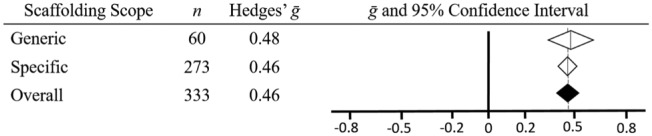
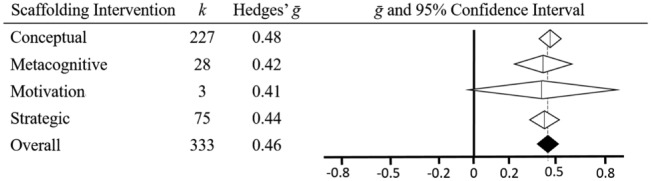
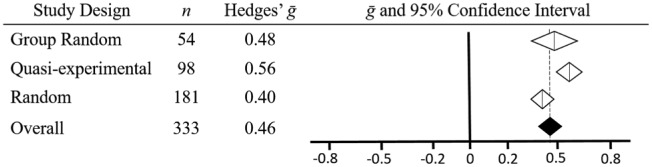
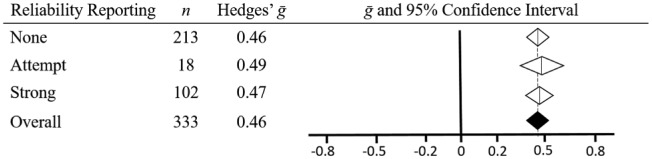
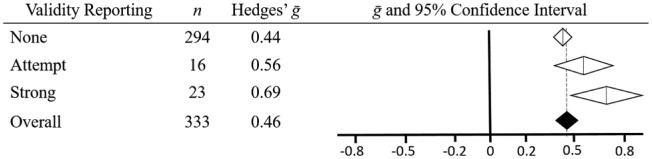
Computer-based scaffolding assists students as they generate solutions to complex problems, goals, or tasks, helping increase and integrate their higher order skills in the process. However, despite decades of research on scaffolding in STEM (science, technology, engineering, and mathematics) education, no existing comprehensive meta-analysis has synthesized the results of these studies. This review addresses that need by synthesizing the results of 144 experimental studies (333 outcomes) on the effects of computer-based scaffolding designed to assist the full range of STEM learners (primary through adult education) as they navigated ill-structured, problem-centered curricula. Results of our random effect meta-analysis (a) indicate that computer-based scaffolding showed a consistently positive (ḡ = 0.46) effect on cognitive outcomes across various contexts of use, scaffolding characteristics, and levels of assessment and (b) shed light on many scaffolding debates, including the roles of customization (i.e., fading and adding) and context-specific support. Specifically, scaffolding's influence on cognitive outcomes did not vary on the basis of context-specificity, presence or absence of scaffolding change, and logic by which scaffolding change is implemented. Scaffolding's influence was greatest when measured at the principles level and among adult learners. Still scaffolding's effect was substantial and significantly greater than zero across all age groups and assessment levels. These results suggest that scaffolding is a highly effective intervention across levels of different characteristics and can largely be designed in many different ways while still being highly effective.
Verified 2026-11-22 · 2 references not checked yet
Overview
CoChat Summary
TL;DR
This comprehensive random-effects meta-analysis of 144 experimental studies (333 outcomes) found that computer-based scaffolding in STEM education produced a consistently positive effect on cognitive outcomes (ḡ = 0.46). Effects were substantial across learner populations, contexts, and assessment levels, with no significant moderation by context-specificity, scaffolding change, or scaffolding logic.
Key findings
- Computer-based scaffolding significantly improved cognitive outcomes versus no scaffolding: overall ḡ = 0.46, z = 18.19, p < .01, across 333 outcomes from 144 studies.
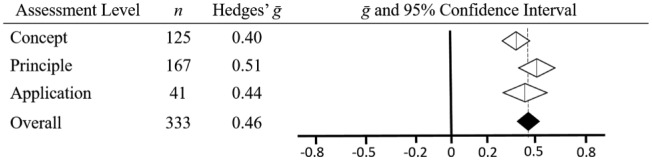
- Assessment-level effects were concept ḡ = 0.40, principles ḡ = 0.51, and application ḡ = 0.44; scaffolding’s influence was greater at the principles level than at the concept level (z = 2.17, p < .05).
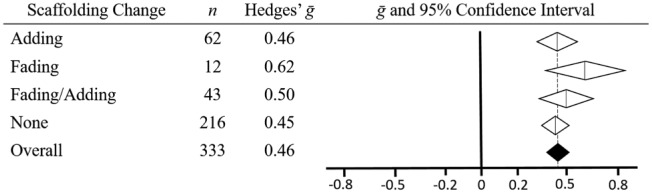
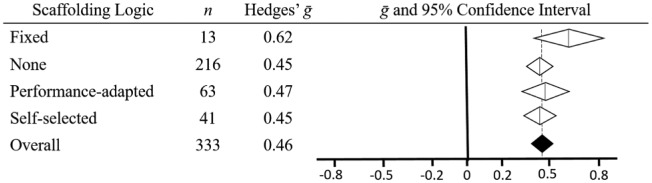
- No statistically significant differences were found for context-specific versus generic scaffolding (z = −0.281, p = .778), scaffolding change/fading (p > .05), or scaffolding logic (p > .05).
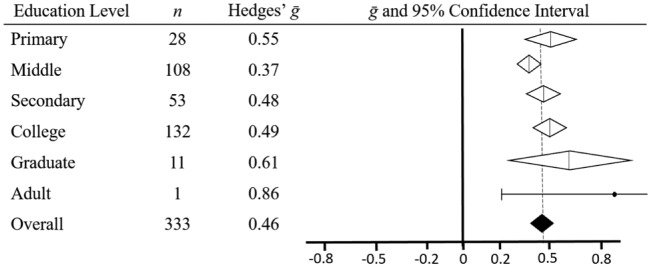
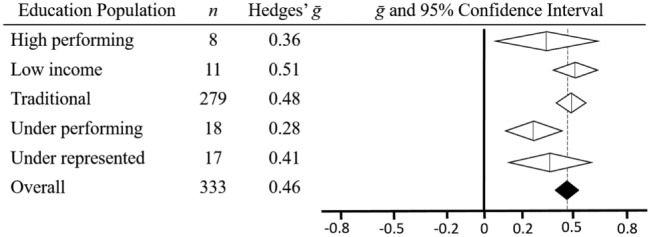
- Effects were significantly greater than zero across education levels, but adult learners had the highest estimate based on only one outcome; traditional versus underperforming learners differed significantly (z = 2.29, p < .05). Motivation scaffolding (n = 3), design-based learning (n = 3), and adult population (n = 1) estimates were not significantly greater than zero, with caution due to small samples.
Methods
- Meta-analysis of studies published January 1, 1993–December 31, 2014, with a control condition receiving an educational intervention but no scaffolding, cognitive outcomes, sufficient effect-size information, Wood et al. (1976) scaffolding, and ill-structured STEM problems. Searches covered databases including Education Source, PsychINFO, ERIC, PubMed, IEEE, and Google Scholar, plus hand searches and reference-list searches.
- Four coders independently coded studies, reached consensus, and achieved Krippendorff’s alphas greater than .667; 333 data points were used for interrater reliability.
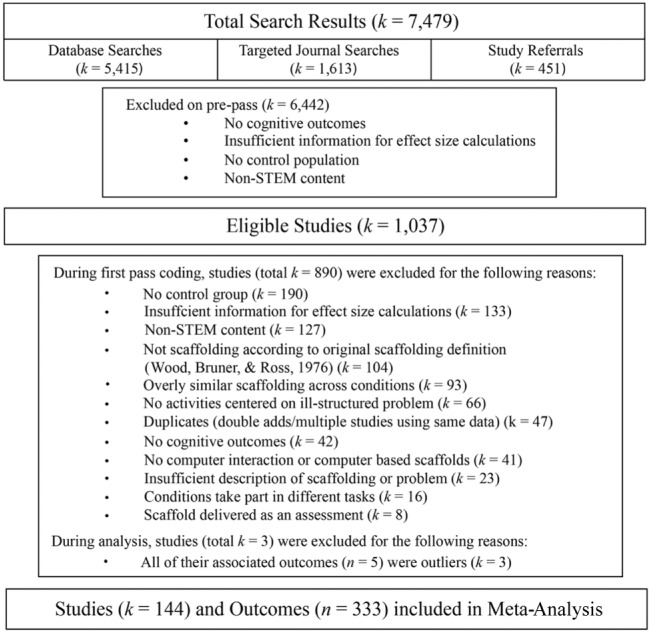
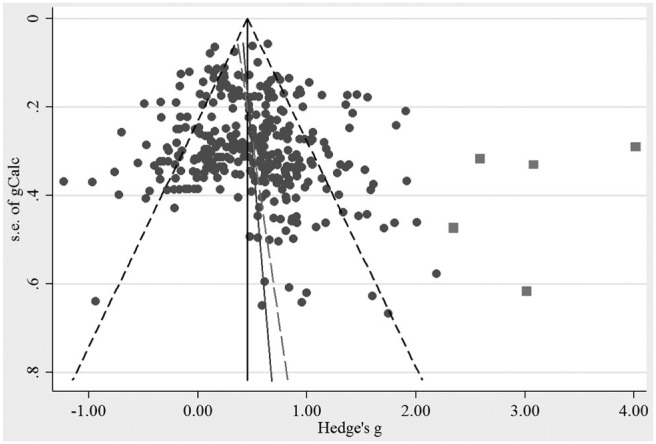
- Random-effects meta-analysis used Hedges’ g and STATA 14 metan; publication bias was assessed via funnel plot, Egger’s regression, and trim-and-fill. Five outlier outcomes and three associated studies were removed, reducing 338 outcomes/147 studies to 333 outcomes/144 studies. Effect-size dependency was addressed with composites (515 to 333 outcomes) and robust variance estimation.
Limitations
- The paper states meta-analyses cannot include all empirical research; qualitative studies and quantitative studies without control groups were excluded, so effect sizes do not reflect all empirical research on computer-based scaffolding.
- The coding scheme could not perfectly reflect every construct; it assigned a single value for scaffolding logic, and codes such as “none,” “traditional,” or “problem solving” may indicate lack of description as much as positive identification.
- Several moderator estimates relied on very small samples—motivation scaffolding (n = 3), design-based learning (n = 3), and adult population (n = 1)—producing wide confidence intervals and warranting caution; no primary research on preschool populations met inclusion criteria.
Model-written summary. Check it against the paper before relying on it.
Integrity signals
Registry
Cites
Statistics
Figures
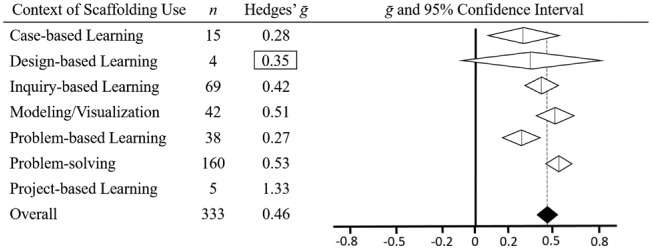
Verification
Claims the paper makes
4 Valid · 2 Not valid · 30 Not checked · 74 Own results and interpretations
Every source the paper cites for this claim was checked and supports it.
In the paper
“Scaffolding in these contexts also has the potential to help problem-centered instructional models overcome criticisms that they do not lead to adequate content learning (Kirschner, Sweller, & Clark, 2006).”
§ Synthesizing Results From Empirical Research on Computer-Based Scaffolding in STEM Education > Discussion > Expansion of the Scaffolding Metaphor
What the sources say
- Supportedcites Kirschner, Sweller, & Clark, 2006 matched to “Why Minimal Guidance During Instruction Does Not Work: An Analysis of the Failure of Constructivist, Discovery, Problem-Based, Experiential, and Inquiry-Based Teaching” (2006) source
The paper criticizes minimally guided problem-based learning for weak knowledge acquisition in its Medical Problem-Based Learning Research section. Its Current Research Supporting Direct Guidance section also describes teachers using scaffolding while teaching content when students were not making progress. The sentence’s proposal that scaffolding may help address that criticism is consistent with these passages. (LLM, conf=0.90)
hedgedstates a possible cause- Asserted: passes — The authors put it forward as true.
- Checkable: passes — It can be checked against evidence.
- Load-bearing: passes — The paper’s conclusions depend on it.
- Based: passes — The paper gives a reason why it holds.
- Supported
A result the paper reports from its own data — it cites no other source for it, so there is none to check. The quote shows it is in the paper.
In the paper
“Scaffolding’s influence was greatest when measured at the principles level and among adult learners.”
§ Synthesizing Results From Empirical Research on Computer-Based Scaffolding in STEM Education > Abstract
plainstates a cause- Asserted: passes — The authors put it forward as true.
- Checkable: passes — It can be checked against evidence.
- Load-bearing: passes — The paper’s conclusions depend on it.
- Based: passes — The paper gives a reason why it holds.
A result the paper reports from its own data — it cites no other source for it, so there is none to check. The quote shows it is in the paper.
In the paper
“Specifically, scaffolding’s influence on cognitive outcomes did not vary on the basis of context-specificity, presence or absence of scaffolding change, and logic by which scaffolding change is implemented.”
§ Synthesizing Results From Empirical Research on Computer-Based Scaffolding in STEM Education > Abstract
plain- Asserted: passes — The authors put it forward as true.
- Checkable: passes — It can be checked against evidence.
- Load-bearing: passes — The paper’s conclusions depend on it.
- Based: passes — The paper gives a reason why it holds.
A result the paper reports from its own data — it cites no other source for it, so there is none to check. The quote shows it is in the paper.
In the paper
“Results of our random effect meta-analysis (a) indicate that computer-based scaffolding showed a consistently positive (ḡ = 0.46) effect on cognitive outcomes across various contexts of use, scaffolding characteristics, and levels of assessment”
§ Synthesizing Results From Empirical Research on Computer-Based Scaffolding in STEM Education > Abstract
hedgedstates a cause- Asserted: passes — The authors put it forward as true.
- Checkable: passes — It can be checked against evidence.
- Load-bearing: passes — The paper’s conclusions depend on it.
- Based: passes — The paper gives a reason why it holds.
59 more claims
Create a free account to see all 110 claims and to verify the 2 references still open.
- Probably not a substantial claim. 18
- It may state two separate claims as one. 32
- The quote only partly states this claim. 2
Claims other papers make about this one
Each is checked against this paper’s own text: does it say what the citing paper says it does?
In the citing paper
“Meta-analyses show that scaffolding enhances cognitive outcomes in digital learning environments (Belland et al., 2017;Chernikova et al., 2020).”
From Looking Beyond the Hype: Understanding the Effects of AI on Learning (2025) · cites this paper as Belland et al., 2017
Statistics recomputed
Every reported test result, recomputed from its test statistic and degrees of freedom. A result shows as not adding up only once an independent check has confirmed it.
- Consistentz = 18.19reported p < .01 · recomputed p < .001
“z = 18.19, p < .01”
- Consistentz = 2.29reported p < .05 · recomputed p = .022
“z = 2.29, p < .05”
- Consistentz = 4.69reported p < .01 · recomputed p < .001
“z = 4.69, p < .01”
- Consistentz = 5.09reported p < .01 · recomputed p < .001
“z = 5.09, p < .01”
- Consistentz = 5.36reported p < .01 · recomputed p < .001
“z = 5.36, p < .01”
8 more recomputed tests
Create a free account to see every test the Stats check recomputed.
Self-check
Percentages, sums and reported differences re-computed from the paper’s own numbers.
Each contradiction between two passages listed here was confirmed by an independent check.
Rated major: it would touch a result — a value a result rests on, reported and recomputed p-values on opposite sides of the significance level, two passages that conflict with no sign which is right, or a cited work retracted before this paper was published.
In the paper
§ Synthesizing Results From Empirical Research on Computer-Based Scaffolding in STEM Education > Results > Do Learner Characteristics Moderate Cognitive Student Outcomes?
“Hedges’ ḡ estimates were significantly greater than zero and substantial across all education levels”
§ Synthesizing Results From Empirical Research on Computer-Based Scaffolding in STEM Education > Discussion > Areas in Which More Empirical Work Is Needed
“when the effect size estimate was not significantly different from zero, the sample size was very small (i.e., three or fewer outcomes were used to calculate the effect size estimate). These circumstances included motivation scaffolding (n = 3), design-based learning (n = 3), and the adult population (n = 1).”
Rated minor: it would not touch a result — a value no result rests on, a p-value that stays on the same side of the significance level, or a conflict that is clerical, resolved elsewhere in the paper, or outside its own findings.
In the paper
§ Synthesizing Results From Empirical Research on Computer-Based Scaffolding in STEM Education > Discussion > Expansion of the Scaffolding Metaphor
“the effect size estimates for all three were above 0.40”
§ Synthesizing Results From Empirical Research on Computer-Based Scaffolding in STEM Education > Discussion
“The effect size estimates for scaffolding at the assessment levels of concept, principles, and application were 0.40, 0.51, and 0.44, respectively.”
Rated minor: it would not touch a result — a value no result rests on, a p-value that stays on the same side of the significance level, or a conflict that is clerical, resolved elsewhere in the paper, or outside its own findings.
In the paper
“86% (42% African American, 34% Hispanic, 4% Native American, 1% Filipino, 1% Pacific Islander/Other)”
§ Synthesizing Results From Empirical Research on Computer-Based Scaffolding in STEM Education > Method > Study Feature Coding
Reported 86 · recomputed 82
Citations
Cites
Statistical Power Analysis for the Behavioral Sciences
Muller, K. (1989) · Technometrics · doi:10.1080/00401706.1989.10488618 · Cited by 99,167
Bias in meta-analysis detected by a simple, graphical test
Egger, M., Smith, G. D., Schneider, M., & Minder, C. (1997) · BMJ · doi:10.1136/bmj.315.7109.629 · Cited by 56,722 · cited 1×
“These include visual inspection of a funnel plot, the trim and fill approach (Borenstein et al., 2009), and Egger’s regression test (Egger, Smith, Schneider, & Minder, 1997).”
MethodStatistical Power Analysis for the Behavioral Sciences (2nd ed.).
Lachenbruch, P. A., & Cohen, J. (1989) · Journal of the American Statistical Association · doi:10.2307/2290095 · Cited by 37,395
Content Analysis: An Introduction to its Methodology.
Shelley, M., & Krippendorff, K. (1984) · Journal of the American Statistical Association · doi:10.2307/2288384 · Cited by 24,312
Borenstein, M., Hedges, L. V., Higgins, J. P. T., & Rothstein, H. R. (2009) · doi:10.1002/9780470743386 · Cited by 14,225
Duval, S., & Tweedie, R. (2000) · Biometrics · doi:10.1111/j.0006-341x.2000.00455.x · Cited by 14,099 · cited 1×
“We also used trim-and-fill analysis (Duval & Tweedie, 2000) to compare the observed value and adjusted value as simulating a perfect symmetry but there was no significant difference between observed and adjusted effect sizes.”
MethodTHE ROLE OF TUTORING IN PROBLEM SOLVING *
Wood, D., Bruner, J. S., & Ross, G. (1976) · Journal of Child Psychology and Psychiatry · doi:10.1111/j.1469-7610.1976.tb00381.x · Cited by 8,851 · cited 13×
“In its original definition, scaffolding was intended to enhance problem-solving skill (Wood et al., 1976).”
BackgroundMethodInfluentialKirschner, P. A., Sweller, J., & Clark, R. E. (2006) · Educational Psychologist · doi:10.1207/s15326985ep4102_1 · Cited by 7,776 · cited 1×
“Scaffolding in these contexts also has the potential to help problem-cen-tered instructional models overcome criticisms that they do not lead to adequate content learning (Kirschner, Sweller, & Clark, 2006).”
BackgroundProblem-Based Learning: What and How Do Students Learn?
Hmelo-Silver, C. E. (2004) · Educational Psychology Review · doi:10.1023/b:edpr.0000034022.16470.f3 · Cited by 5,212 · cited 1×
“In problem-based learning, students produce a conceptual solution to the problem (Hmelo-Silver, 2004).”
BackgroundReciprocal Teaching of Comprehension-Fostering and Comprehension-Monitoring Activities
Palinscar, A. S., & Brown, A. L. (1984) · Cognition and Instruction · doi:10.1207/s1532690xci0102_1 · Cited by 5,186 · cited 1×
“One-to-one scaffolding soon began to be used among many populations (van de Pol et al., 2010) and across contexts (Palincsar & Brown, 1984).”
Background
Research works printed but not linked: 7
- Hannafin M. Land S. Oliver K. (1999). Open-ended learning environments: Foundations, methods, and models. In Reigeluth C. M. (Ed.), Instructional design theories and models: Volume II. A new paradigm of instructional theory (pp. 115– 140). Mahwah, NJ: Erlbaum.
- Knowles M. S. (1984). Andragogy in action. Applying modern principles of adult education. San Francisco, CA: Jossey-Bass.
- 10.1002/(sici)1098-2736(199909)36:7 · doi:10.1002/(sici)1098-2736(199909)36:7
- National Research Council. (2011). Successful K-12 STEM education: Identifying effective approaches in science, technology, engineering, and mathematics. Washington, DC: National Academies Press.
- National Science Board. (2010). Preparing the next generation of STEM innovators: Identifying and developing our nation’s human capital. Arlington, VA: National Science Foundation.
- Stark D. M. (2013). Ill-structured problems, scaffolding and problem-solving ability of novice nursing students (Doctoral dissertation). Available from ProQuest Dissertations & Theses database. (UMI No. 3553778)
- Zhang J. Chen Q. Reid D. J. (2000). Simulation-based scientific discovery learning: a research on the effects of experimental support and learners’ reasoning ability. In Proceedings IFIP World Computer Congress, Educational Uses of Communication and Information Technologies (pp. 344– 351). Beijing, China: ICEUT.
Cited by
Simulation-Based Learning in Higher Education: A Meta-Analysis
Chernikova, O., Heitzmann, N., Stadler, M., Holzberger, D., Seidel, T., & Fischer, F. (2020) · Review of Educational Research · doi:10.3102/0034654320933544 · Cited by 1,072
“Belland et al. (2017) found moderate to large effects of scaffolding in computer-based learning environments.”
BackgroundResultInfluentialHillmayr, D., Ziernwald, L., Reinhold, F., Hofer, S. I., & Reiss, K. M. (2020) · Computers & Education · doi:10.1016/j.compedu.2020.103897 · Cited by 574
“…reported in prior studies, we apply a rule of thumb that is used frequently in other meta-analyses within the field (e.g., Bayraktar, 2001/2002; Belland et al., 2017; Sung et al., 2017): values for Cohen ’ s d and Hedges ’ s g between 0.20 and 0.50 can be considered small effects, values…”
BackgroundMethodResultInfluentialKim, N. J., & Kim, M. K. (2022) · Frontiers in Education · doi:10.3389/feduc.2022.755914 · Cited by 298
“, 2007) and to help students improve their deep content knowledge and higher-order thinking skills (Belland et al., 2017).”
BackgroundInfluentialSelf-citationTransdisciplinarity in STEM education: a critical review
Takeuchi, M. A., Sengupta, P., Shanahan, M.-C., Adams, J. D., & Hachem, M. (2020) · Studies in Science Education · doi:10.1080/03057267.2020.1755802 · Cited by 244
Kim, N. J., Belland, B. R., & Walker, A. E. (2018) · Educational Psychology Review · doi:10.1007/s10648-017-9419-1 · Cited by 220
“…customization methods (i.e., performance-adapted, self-selected, and fixed), performance-adapted scaffolding customization was the most frequent (Belland et al. 2017), but there have been few studies that investigated which scaffolding customization method have the highest effects on students ’…”
BackgroundMethodResultInfluentialSelf-citationA Meta-Analysis of Scaffolding Effects in Online Learning in Higher Education
Doo, M. Y., Bonk, C., & Heo, H. (2020) · The International Review of Research in Open and Distributed Learning · doi:10.19173/irrodl.v21i3.4638 · Cited by 188
“In particular, Belland et al. (2017) analyzed 144 experimental studies examining the effects of computer-based scaffolding on STEM learners’ cognitive learning and reported a small-to-moderate effect size (g = 0.46).”
BackgroundResultInfluentialLet's talk evidence – The case for combining inquiry-based and direct instruction
de Jong, T., Lazonder, A. W., Chinn, C. A., Fischer, F., Gobert, J., Hmelo-Silver, C. E., Koedinger, K. R., Krajcik, J. S., Kyza, E. A., Linn, M. C., et al. (2023) · Educational Research Review · doi:10.1016/j.edurev.2023.100536 · Cited by 190
Looking Beyond the Hype: Understanding the Effects of AI on Learning
Bauer, E., Greiff, S., Graesser, A. C., Scheiter, K., & Sailer, M. (2025) · Educational Psychology Review · doi:10.1007/s10648-025-10020-8 · Cited by 153
Wang, Y., Wang, H., Wang, S., Wind, S. A., & Gill, C. (2024) · Learning and Motivation · doi:10.1016/j.lmot.2024.102015 · Cited by 335
“When Egger ’ s Y. Wang et al. test was significant (i.e., there is publication bias), we adopted the trim-and-fill procedure to estimate the actual effect size (Belland et al., 2017; Duval & Tweedie, 2000; Schwarzer et al., 2015).”
DFG Research group COSIMA, Chernikova, O., Heitzmann, N., Fink, M. C., Timothy, V., Seidel, T., & Fischer, F. (2020) · Educational Psychology Review · doi:10.1007/s10648-019-09492-2 · Cited by 124
Radkowitsch, A., Vogel, F., & Fischer, F. (2020) · International Journal of Computer-Supported Collaborative Learning · doi:10.1007/s11412-020-09316-4 · Cited by 143
Moving towards engaged learning in STEM domains; there is no simple answer, but clearly a road ahead
de Jong, T. (2019) · Journal of Computer Assisted Learning · doi:10.1111/jcal.12337 · Cited by 163
“A recent meta‐analysis by Belland et al. (2017) indicated that students performing below and above average profited equally from computer‐based scaffolding (of ill‐structured problem‐based curricula in STEM), whereas in other”
BackgroundResultInfluentialCai, Z., Mao, P., Wang, D., He, J., Chen, X., & Fan, X. (2022) · Educational Psychology Review · doi:10.1007/s10648-021-09655-0 · Cited by 183
Zheng, L., Li, X., Zhang, X., & Sun, W. (2019) · The Internet and Higher Education · doi:10.1016/j.iheduc.2019.03.002 · Cited by 117
Guo, Y., Wang, Y., & Ortega-Martín, J. L. (2023) · Porta Linguarum Revista Interuniversitaria de Didáctica de las Lenguas Extranjeras · doi:10.30827/portalin.vi40.27061 · Cited by 153
“Scaffolding has been the subject of multiple studies as a useful educational strategy since it enables learners to engage in learning, thus improving learning outcomes (Belland et al., 2017). In the context of L2 teaching, scaffolding can take various forms that should be provided based on learners’ needs. Indeed, sca…”
BackgroundScaffolding Computational Thinking With ChatGPT
Liao, J., Zhong, L., Zhe, L., Xu, H., Liu, M., & Xie, T. (2024) · IEEE Transactions on Learning Technologies · doi:10.1109/tlt.2024.3392896 · Cited by 108
“Scaffolding has received considerable attention in education because it helps students to acquire knowledge and skills gradually in the learning process [36].”
BackgroundExploring augmented reality for worker assistance versus training
Moghaddam, M., Wilson, N. C., Modestino, A., Jona, K., & Marsella, S. (2021) · Advanced Engineering Informatics · doi:10.1016/j.aei.2021.101410 · Cited by 105
AI-based avatars are changing the way we learn and teach: benefits and challenges
Fink, M. C., Robinson, S. A., & Ertl, B. (2024) · Frontiers in Education · doi:10.3389/feduc.2024.1416307 · Cited by 196
Meta-Analysis and Meta-Synthesis Methodologies: Rigorously Piecing Together Research
Leary, H., & Walker, A. E. (2018) · TechTrends · doi:10.1007/s11528-018-0312-7 · Cited by 138
“For those interested in how to conduct a BNMA using mean gains, Belland et al. (2017b) contains supplemental materials including a sample data set and video walkthrough of formatting data and analysis using Lunn et al.’s (2009) WinBUGS software tool.”
BackgroundMethodInfluentialSelf-citationScaffolding for Optimal Challenge in K–12 Problem-Based Learning
Kim, N. J., Belland, B. R., & Axelrod, D. B. (2018) · Interdisciplinary Journal of Problem-based Learning · doi:10.7771/1541-5015.1712 · Cited by 132
Self-citationSailer, M., Maier, R., Berger, S., Kastorff, T., & Stegmann, K. (2024) · Learning and Individual Differences · doi:10.1016/j.lindif.2024.102446 · Cited by 205
Tawfik, A. A., Law, V., Ge, X., Xing, W., & Kim, K. (2018) · Computers in Human Behavior · doi:10.1016/j.chb.2018.01.035 · Cited by 91
Scaffolding design thinking in online STEM preservice teacher training
Wu, B., Hu, Y., & Wang, M. (2019) · British Journal of Educational Technology · doi:10.1111/bjet.12873 · Cited by 77
Chang, D., Hwang, G., Chang, S., & Wang, S. (2021) · Educational Technology Research and Development · doi:10.1007/s11423-021-10062-z · Cited by 102
Closing the loop – The human role in artificial intelligence for education
Ninaus, M., & Sailer, M. (2022) · Frontiers in Psychology · doi:10.3389/fpsyg.2022.956798 · Cited by 67
“The basic idea of scaffolding is to support learners in their problem solving, thus promoting their acquisition of knowledge and skills (Belland et al., 2017).”
BackgroundBelland, B. R., Walker, A. E., & Kim, N. J. (2017) · Review of Educational Research · doi:10.3102/0034654317723009 · Cited by 104
“Previous meta-analysis work implied that computer-based scaffolding leads to between-subjects differences that were statistically greater than zero and above ḡ = 0.4 across concept, principles, and application-level assessment (Belland et al., 2017).”
BackgroundMethodResultInfluentialSelf-citationA meta-analysis of the impact of mobile learning on mathematics achievement
Güler, M., Bütüner, S. Ö., Danışman, Ş., & Gürsoy, K. (2021) · Education and Information Technologies · doi:10.1007/s10639-021-10640-x · Cited by 110
“This effect size value was excluded from the analysis because it distorted the symmetrical structure (Belland et al., 2017, p. 322).”
MethodComputer-supported Collaborative Learning in Programming Education: A Systematic Literature Review
Silva, L., Mendes, A. J., & Gomes, A. (2020) · IEEE Global Engineering Education Conference (EDUCON) · doi:10.1109/educon45650.2020.9125237 · Cited by 87
“Many solutions have been proposed, and the use of computers in education (Computer-based Learning Environment - CBLE) is one example, with a growing body of statistical evidence that supports its efficacy [3].”
BackgroundWang, H., Wang, C., Chen, Z., Liu, F., Bao, C., & Xu, X. (2025) · Education and Information Technologies · doi:10.1007/s10639-025-13487-8 · Cited by 105
Holzberger, D., Reinhold, S., Lüdtke, O., & Seidel, T. (2020) · Studies in Science Education · doi:10.1080/03057267.2020.1735758 · Cited by 78
Sergis, S., Sampson, D. G., Rodríguez‐Triana, M. J., Gillet, D., Pelliccione, L., & de Jong, T. (2017) · Computers in Human Behavior · doi:10.1016/j.chb.2017.12.014 · Cited by 79
“Such guidance is commonly supported by tools (such as online labs) which can be planned in advance of the IED delivery, so as to be available to the students throughout the learning process (Belland, 2017).”
BackgroundICT integration in teachers’ lesson plans: A scoping review of empirical studies
König, J., Heine, S., Jäger-Biela, D., & Rothland, M. (2024) · European Journal of Teacher Education · doi:10.1080/02619768.2022.2138323 · Cited by 55
Kim, N. J., Belland, B. R., Lefler, M., Andreasen, L., Walker, A. E., & Axelrod, D. B. (2019) · Educational Psychology Review · doi:10.1007/s10648-019-09502-3 · Cited by 73
“The effectiveness of computer-based scaffolding in enhancing problem-solving skills and other cognitive skills (Belland et al. 2017a, 2017b) and in improving collaboration (Chen et al. 2018; Vogel et al. 2016b) is well documented.”
BackgroundMethodResultInfluentialSelf-citationA Qualitative Analysis of Implementing E-Learning during the COVID-19 Lockdown
Lozano, C. P., Bergés, M. S., Gil, M. L., & Bustamante, J. C. (2021) · Sustainability · doi:10.3390/su13063317 · Cited by 72
“Furthermore, this whole framework covering direction, aids, and information has a positive effect on learning [78,79].”
BackgroundOuyang, F., Dai, X., & Chen, S. (2022) · International Journal of STEM Education · doi:10.1186/s40594-022-00361-z · Cited by 51
“Third, social scaffolding aims to facilitate social interactions and promote social emotions during collaborative learning (Belland et al., 2017; Ouy-ang & Xu, 2022).”
BackgroundDai, C., Ke, F., Pan, Y., & Liu, Y. (2022) · Computers & Education · doi:10.1016/j.compedu.2022.104698 · Cited by 85
The End is the Beginning is the End: The closed-loop learning analytics framework
Sailer, M., Ninaus, M., Huber, S. E., Bauer, E., & Greiff, S. (2024) · Computers in Human Behavior · doi:10.1016/j.chb.2024.108305 · Cited by 53
Tawfik, A., Graesser, A., Gatewood, J. D., & Gishbaugher, J. J. (2020) · Educational technology research and development · doi:10.1007/s11423-020-09738-9 · Cited by 2
Utilizing AI models to optimize blended teaching effectiveness in college-level English education
Shi, L., Umer, A. M., & Shi, Y. (2023) · Cogent Education · doi:10.1080/2331186x.2023.2282804 · Cited by 91
“Belland et al. (2017) conducted a comprehensive meta-analysis of empirical studies and found that incorporating deep learning strategies.”
BackgroundShort-Term and Long-Term Effects of POGIL in a Large-Enrollment General Chemistry Course
Vincent‐Ruz, P., Meyer, T. Y., Garrett-Roe, S., & Schunn, C. D. (2020) · Journal of Chemical Education · doi:10.1021/acs.jchemed.9b01052 · Cited by 59
Xie, C., Cheung, A., Lau, W. W. F., & Slavin, R. E. (2020) · International Journal of Educational Research · doi:10.1016/j.ijer.2020.101565 · Cited by 54
Lämsä, J., Hämäläinen, R., Koskinen, P., Viiri, J., & Mannonen, J. (2019) · Computers & Education · doi:10.1016/j.compedu.2019.103674 · Cited by 60
Song, H., & Zhou, M. (2020) · Journal of Science Education and Technology · doi:10.1007/s10956-020-09881-1 · Cited by 63
Edgar, A. K., Macfarlane, S., Kiddell, E. J., Armitage, J. A., & Wood‐Bradley, R. J. (2022) · BMC Medical Education · doi:10.1186/s12909-022-03912-8 · Cited by 62
Zhu, G., Xing, W., & Popov, V. (2019) · The Internet and Higher Education · doi:10.1016/j.iheduc.2019.02.001 · Cited by 51
Coordinating scaffolds for collaborative inquiry in a game‐based learning environment
Saleh, A., Chen, Y., Hmelo‐Silver, C. E., Glazewski, K. D., Mott, B., & Lester, J. C. (2020) · Journal of Research in Science Teaching · doi:10.1002/tea.21656 · Cited by 54
“Scaffolding the PBL inquiry cycle is well-suited for game-based learning environments because the inquiry process itself can be embedded as hard scaffolds, either as part of the game play or visual representations (Belland, Walker, Kim, & Lefler, 2017).”
BackgroundProblem solving through digital game design: A quantitative content analysis
Ruggiero, D. N., & Green, L. (2017) · Computers in Human Behavior · doi:10.1016/j.chb.2017.03.024 · Cited by 54
Williams, R. T., Citkowicz, M., Miller, D. I., Lindsay, J., & Walters, K. (2022) · Journal of Research on Educational Effectiveness · doi:10.1080/19345747.2021.2009072 · Cited by 60
Koskinen, A., McMullen, J. A., Ninaus, M., & Kiili, K. J. M. (2022) · Journal of Computer Assisted Learning · doi:10.1111/jcal.12728 · Cited by 71
Xie, C., Wang, M., & Hu, H. (2018) · Frontiers in Psychology · doi:10.3389/fpsyg.2018.01923 · Cited by 49
“, 2010), computer-assisted learning (Liao, 2007; Hattie, 2008; Slavin and Lake, 2008; Slavin et al., 2009; Li and Ma, 2010; Rakes et al., 2010; Cheung and Slavin, 2013; Belland et al., 2017), peer tutoring (Hattie, 2008; Leung, 2015; Alegre-Ansuategui et al.”
Resultde Jong, T., Lazonder, A. W., Chinn, C. A., Fischer, F., Gobert, J. D., Hmelo‐Silver, C. E., Koedinger, K. R., Krajcik, J. S., Kyza, E. Α., Linn, M. C., et al. (2024) · Educational Research Review · doi:10.1016/j.edurev.2024.100623 · Cited by 83
Instructional Scaffolding: Foundations and Evolving Definition
Belland, B. R. (2017) · Instructional Scaffolding in STEM Education · doi:10.1007/978-3-319-02565-0_2 · Cited by 40
Self-citationInstructors’ conceptualization and implementation of scaffolding in online higher education courses
Richardson, J. C., Caskurlu, S., Castellanos-Reyes, D., Duan, S., Duha, M. S. U., Fiock, H. S., & Long, Y. (2021) · Journal of Computing in Higher Education · doi:10.1007/s12528-021-09300-3 · Cited by 57
“While the practice of fading has been noted as “a necessary component of scaffolding” (Belland et al., 2017, p. 330), many studies conducted on the topic disregarded the use of fading or did not include fading in their research (Belland et al., 2017; Chernik-ova et al., 2019).”
BackgroundKranz, D., Schween, M., & Graulich, N. (2023) · Chemistry Education Research and Practice · doi:10.1039/d2rp00132b · Cited by 41
Aytaç, T., & Kula, S. S. (2022) · International Journal of Contemporary Educational Research · doi:10.33200/ijcer.723894 · Cited by 71
Sommerhoff, D., Codreanu, E., Nickl, M., Ufer, S., & Seidel, T. (2022) · Learning and Instruction · doi:10.1016/j.learninstruc.2022.101689 · Cited by 60
Thomann, H., & Deutscher, V. (2025) · Educational Research Review · doi:10.1016/j.edurev.2025.100686 · Cited by 40
Chernikova, O., Sommerhoff, D., Stadler, M. J., Holzberger, D., Nickl, M., Seidel, T., Kasneci, E., Küchemann, S., Kühn, J., Fischer, F., et al. (2024) · Educational Research Review · doi:10.1016/j.edurev.2024.100662 · Cited by 61
“However, empirical research also highlights that (i) simulations – as many other types of learning environments – do not show uniform effects for all learners and (ii) that learning effects can be further increased by additional instructional support (Chernikova et al., 2020; Belland et al., 2017).”
InfluentialThe impact of metacognitive scaffolding on deep learning in a GenAI-supported learning environment
Wu, J., Wang, J., Lei, S., Wu, F., & Gao, X. (2025) · Interactive Learning Environments · doi:10.1080/10494820.2025.2479162 · Cited by 36
The Effects of Using Scaffolding in Online Learning: A Meta-Analysis
Zuo, M., Kong, S., Ma, Y., Hu, Y., & Xiao, M. (2023) · Education Sciences · doi:10.3390/educsci13070705 · Cited by 105
“This result is similar with the findings of Belland, Walker, Kim, and Lefler [37], although their research focused on SETM education.”
ResultBödding, R., Schriek, S. A., & Maier, G. W. (2025) · Virtual Reality · doi:10.1007/s10055-025-01118-z · Cited by 78
Fendt, M., Nistor, N., Scheibenzuber, C., & Artmann, B. (2023) · Computers in Human Behavior · doi:10.1016/j.chb.2023.107820 · Cited by 50
Gidalevich, S., & Kramarski, B. (2018) · Instructional Science · doi:10.1007/s11251-018-9475-z · Cited by 41
A meta-analysis on STEM studies in early childhood education
Yücelyiğit, S., & Toker, Z. (2021) · Turkish Journal of Education · doi:10.19128/turje.783724 · Cited by 41
Azevedo, R., Taub, M., Mudrick, N. V., Millar, G. C., Bradbury, A. E., & Price, M. J. (2017) · Springer eBooks · doi:10.1007/978-3-319-64274-1_10 · Cited by 39
The impacts of scaffolding e-assessment English learning: a cognitive style perspective
Chen, S. Y., & Tseng, Y.-F. (2019) · Computer Assisted Language Learning · doi:10.1080/09588221.2019.1661853 · Cited by 37
“Belland, Walker, Kim, and Lefler (2017) undertook a meta-analysis for 144 studies on computer-based scaffolding and their results showed that students with computer-based scaffolding performed better on cognitive tests than those without computer-based scaffolding.”
BackgroundLin, T., Tang, K., Lin, S., Changlai, M.-L., & Hsu, Y. (2022) · Frontiers in Psychology · doi:10.3389/fpsyg.2022.844425 · Cited by 49
Oren, M., Pedersen, S., & Butler-Purry, K. L. (2020) · IEEE Transactions on Education · doi:10.1109/te.2020.3000955 · Cited by 36
Peng, J., Yuan, B., Sun, M., Jiang, M., & Wang, M. (2022) · Sustainability · doi:10.3390/su141912907 · Cited by 47
“In view of the complexity of working with real-world problem-solving tasks or projects, researchers highlight the importance of providing learners with necessary support to facilitate or scaffold learning in such contexts [15,16,21].”
BackgroundMethodPeng, J., Wang, M., Sampson, D. G., & van Merriënboer, J. J. G. (2019) · Australasian Journal of Educational Technology · doi:10.14742/ajet.4676 · Cited by 34
Concept map as a tool to assess and enhance students' system thinking skills
Khajeloo, M., & Siegel, M. A. (2022) · Instructional Science · doi:10.1007/s11251-022-09586-5 · Cited by 40
The Effects of Integrated STEM Education on K12 Students’ Achievements: A Meta-Analysis
Chen, B., Chen, J., Wang, M., Tsai, C., & Kirschner, P. A. (2025) · Review of Educational Research · doi:10.3102/00346543251318297 · Cited by 54
“…STEM program for the experimental group possessed all the core characteristics of integrated STEM education and employed essential strategies for integrated STEM education, such as project-based learning, inquiry-based learning, and design-based learning (Belland et al., 2017; Gyasi et al., 2021).”
InfluentialRadkowitsch, A., Sailer, M., Schmidmaier, R., Fischer, M. R., & Fischer, F. (2021) · Learning and Instruction · doi:10.1016/j.learninstruc.2021.101487 · Cited by 42
“However, prior research has repeatedly shown that unsupported problem solving is likely to overwhelm learners, particularly during early phases of skill development (Belland, Walker, Kim, & Lefler, 2017; Kirschner, Sweller, & Clark, 2006).”
Thomas, D. R., & Larwin, K. H. (2023) · International Journal of STEM Education · doi:10.1186/s40594-023-00425-8 · Cited by 41
Wang, T., Zheng, J., Tan, C., & Lajoie, S. P. (2023) · Journal of Computer Assisted Learning · doi:10.1111/jcal.12824 · Cited by 42
Automated Analysis of Middle School Students’ Written Reflections During Game-Based Learning
Carpenter, D., Geden, M., Rowe, J., Azevedo, R., & Lester, J. C. (2020) · Lecture notes in computer science · doi:10.1007/978-3-030-52237-7_6 · Cited by 27
Li, X., & Wang, W. (2020) · Science & Education · doi:10.1007/s11191-020-00167-x · Cited by 40
STEAM-Project-Based Learning: A Catalyst for Elementary School Students’ Scientific Literacy Skills
Suryanti, S., Nursalim, M., Choirunnisa, N. L., & Yuliana, I. (2024) · European Journal of Educational Research · doi:10.12973/eu-jer.13.1.1 · Cited by 84
A meta-analysis of AI-enabled personalized STEM education in schools
Li, S., Zeng, C., Liu, H., Jia, J., Liang, M., Cha, Y., Lim, C. P., & Wu, X. (2025) · International Journal of STEM Education · doi:10.1186/s40594-025-00566-y · Cited by 61
“Belland et al. (2017) synthesized 144 experimental studies (333 effect size calculations) between 1993 and 2014 and found that computer-based scaffolding in STEM disciplines might be highly effective (g = 0.46).”
InfluentialBackward Design of Chemistry Laboratories: A Primer
Neiles, K. Y., & Arnett, K. (2021) · Journal of Chemical Education · doi:10.1021/acs.jchemed.1c00443 · Cited by 30
Hsu, Y., Tang, K., & Lin, T. (2023) · Science & Education · doi:10.1007/s11191-023-00419-6 · Cited by 32
Research Methods in Learning Design and Technology
Romero‐Hall, E. (2020) · Routledge eBooks · doi:10.4324/9780429260919 · Cited by 25
Tu, H.-Y., & Lee, S. W. (2024) · Journal of Educational Computing Research · doi:10.1177/07356331241277904 · Cited by 38
Chernikova, O., Holzberger, D., Heitzmann, N., Stadler, M. J., Seidel, T., & Fischer, F. (2023) · Zeitschrift für Pädagogische Psychologie · doi:10.1024/1010-0652/a000357 · Cited by 48
Child-driven, machine-guided: Automatic scaffolding of constructionist-inspired early literacy play
Sysoev, I., Gray, J. H., Fine, S., Makini, S. P., & Roy, D. K. (2022) · Computers & Education · doi:10.1016/j.compedu.2022.104434 · Cited by 34
Debugging behaviors of early childhood teacher candidates with or without scaffolding
Kim, C., Vasconcelos, L., Belland, B. R., Umutlu, D., & Gleasman, C. (2022) · International Journal of Educational Technology in Higher Education · doi:10.1186/s41239-022-00319-9 · Cited by 27
Self-citationZhang, B. (2023) · Journal of Psycholinguistic Research · doi:10.1007/s10936-023-09954-3 · Cited by 43
“The constructivist perspective is highly relevant to the context of online learning as in this theory, scaffolding can capture the contribution of the teacher to effective learning that enhance students’ engagement (Belland et al., 2017; Nguyen, 2022) characterizes scaffolding as a kind of assistance given by a more c…”
BackgroundHoe, A. V., Wiebe, J. P., Rotsaert, T., & Schellens, T. (2024) · International Journal of STEM Education · doi:10.1186/s40594-024-00465-8 · Cited by 51
What Does It Mean to Think Like a Chemist?
Vincent‐Ruz, P. (2020) · ACS symposium series · doi:10.1021/bk-2020-1365.ch005 · Cited by 28
“First, scaffolding is associated with positive affective engagement and increased perceived success (130, 131).”
BackgroundUsing Digital Technology to Improve Learning: Evidence Review
Lewin, C., Smith, A. J. M., Morris, S., & Craig, E. (2019) · e-space (Manchester Metropolitan University) · Cited by 42
Mapping the Contributions of the Review of Educational Research to Education, 1931–2020
Hallinger, P. (2022) · Review of Educational Research · doi:10.3102/00346543221132771 · Cited by 25
Ouaazki, A., Bergram, K., Farah, J. C., Gillet, D., & Holzer, A. (2024) · ACM Conference on Conversational User Interfaces (CUI) · doi:10.1145/3640794.3665542 · Cited by 38
STEM education in academic achievement: a meta-analysis of its moderating effects
Chang, S.-H., Yang, L.-J., Chen, C., Shih, C.-C., Shu, Y., & Chen, Y.-T. (2022) · Interactive Learning Environments · doi:10.1080/10494820.2022.2147956 · Cited by 34
Bertoletti, A., Soncin, M., Cannistrà, M., & Agasisti, T. (2023) · PLoS ONE · doi:10.1371/journal.pone.0280494 · Cited by 32
Kirchhoff, T., Randler, C., & Großmann, N. (2023) · Journal of Research in Science Teaching · doi:10.1002/tea.21859 · Cited by 30
Zhou, X., Li, Q., Xu, D., Li, X., & Fischer, C. (2023) · The Internet and Higher Education · doi:10.1016/j.iheduc.2023.100912 · Cited by 24
Effects of case library recommendation system on problem solving and knowledge structure development
Tawfik, A. A., Kim, K., & Kim, D. (2020) · Educational Technology Research and Development · doi:10.1007/s11423-020-09737-w · Cited by 25
Zheng, J., Lajoie, S. P., Wang, T., & Li, S. (2023) · Metacognition and Learning · doi:10.1007/s11409-023-09352-z · Cited by 20
“Computer-based scaffolding can enhance different forms of learning outcomes, including deep content learning, argumenta - tion ability, and problem-solving ability (Belland et al., 2017 ).”
BackgroundInfluentialNickl, M., Sommerhoff, D., Radkowitsch, A., Huber, S. A., Bauer, E., Ufer, S., Plass, J. L., & Seidel, T. (2024) · Learning and Instruction · doi:10.1016/j.learninstruc.2024.101994 · Cited by 34
“These findings align with the meta-analysis of Belland et al. (2017), which similarly did not corroborate the advantages of adaptive scaffolding suggested by prior theoretical (e.g., Corno, 2008) and empirical work in different contexts (e.g., Ma, Adesope, Nesbit, & Liu, 2014).”
InfluentialSpitzer, M., Moeller, K., & Musslick, S. (2023) · PLoS ONE · doi:10.1371/journal.pone.0284868 · Cited by 19
Metadata
- Authors
- Belland, B. R., Walker, A. E., Kim, N. J., & Lefler, M.
- Affiliations
- Utah State University (US)
- Venue
- Review of Educational Research
- Published
- 2016-10-11
- Volume
- 87
- Issue
- 2
- Pages
- 309-344
- ISSN
- 0034-6543 (ISSN-L)
- 1935-1046
- PMC
- PMC5347356
- OpenAlex
- W2530735505
- Cited by
- 346
- References
- 127
- Citations by year
- 2026: 62 · 2025: 44 · 2024: 35 · 2023: 46 · 2022: 52 · 2021: 31 · 2020: 29 · 2019: 22 · 2018: 11 · 2017: 9 · 2016: 5
- FWCI
- 36.56
- Type
- journal article
- Language
- en
- Open access
- hybrid
- doi.org
- Licence
- Locations
- Review of Educational Research (publishedVersion, cc-by-nc)
- Europe PMC (PubMed Central) (publishedVersion, cc-by-nc)
- PubMed Central (publishedVersion, cc-by-nc)
- PubMed (publishedVersion)
- Topics
- Social Sciences › Psychology › Developmental and Educational Psychology › Innovative Teaching and Learning Methods
- Social Sciences › Psychology › Experimental and Cognitive Psychology › Visual and Cognitive Learning Processes
- Physical Sciences › Computer Science › Artificial Intelligence › Intelligent Tutoring Systems and Adaptive Learning
- Keywords
- STEM education, cognitive outcomes, ill-structured problems, adult learners, primary education, educational technology effectiveness
About these checks
Registry, retraction, Cites and statistics results are computed, not judged, with one exception: a printed reference that no index lists is read once by a model before it counts as a citation error. Claims are extracted by a model and kept only when their quote appears verbatim in the text; each cited source is then checked, with a model’s help, for whether it says what the claim relies on. Those verdicts can be wrong — read the claim’s quote and the cited source before relying on one.
The claim verdicts this report counts are experimental: their accuracy is not yet measured.
A language model drew the claims from the paper on 2026-10-05, under version 3 of the claim definition (model deepseek-v4.1-flash, prompt extract-v3).
A second model labelled each claim on 2026-10-05 (model jev-1.13-20260917, definition revision gold-guideline-v0.2).
Cited sources are checked with a language model’s help (gpt-6-sol).
Statistics and arithmetic are recomputed, not judged.
Confidence bands are shown only for fields calibrated on our annotated test set. None is calibrated yet, so no band is shown.
What counts as a claim ›How we measure confidence ›How we check this ›
Are you an author, or do you see a problem with this page? Request a review
Data sources
Bibliographic data: Semantic Scholar, OpenAlex, Crossref.
Contains information from the Semantic Scholar Academic Graph Datasets, made available under the ODC Attribution License (ODC-BY 1.0).
Semantic Scholar’s data is described in: Kinney, R., et al. (2023). The Semantic Scholar Open Data Platform. arXiv:2301.10140.
