

Synthesizing Results From Empirical Research on Computer-Based Scaffolding in STEM Education
Open accessThe DOI matches its Crossref record; 124 of the 127 references it cites were found in a registry or an index, and 2 are not checked yet; 4 of the 45 sources its claims cite were checked for support.
Abstract
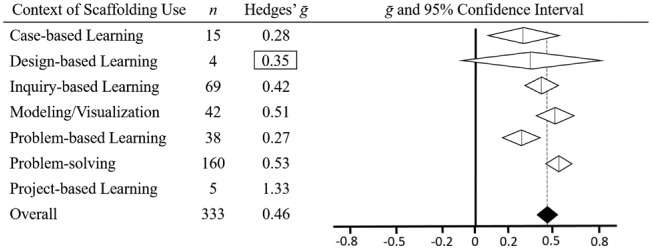
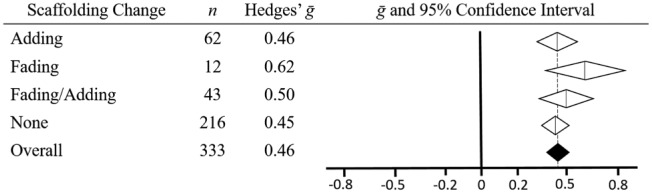
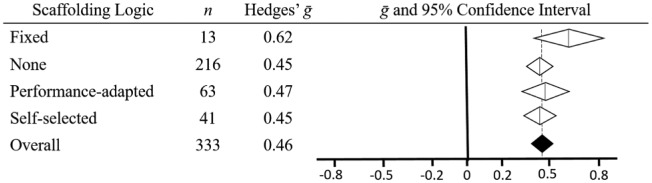
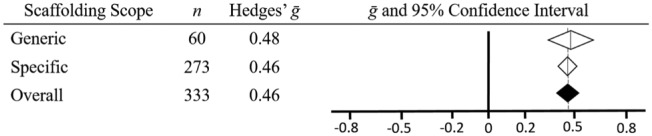
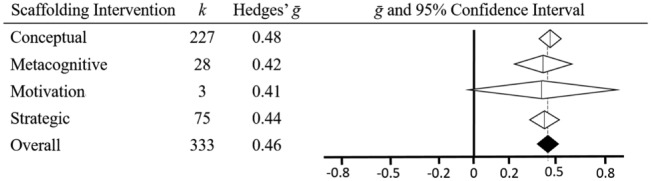
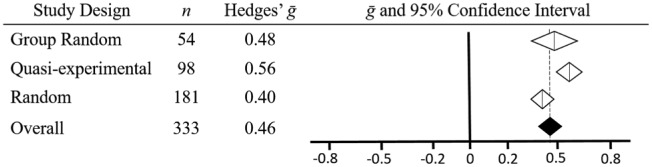
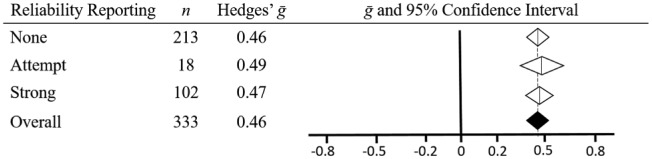
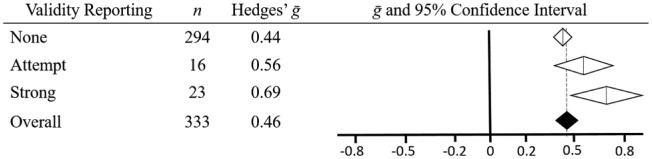
Computer-based scaffolding assists students as they generate solutions to complex problems, goals, or tasks, helping increase and integrate their higher order skills in the process. However, despite decades of research on scaffolding in STEM (science, technology, engineering, and mathematics) education, no existing comprehensive meta-analysis has synthesized the results of these studies. This review addresses that need by synthesizing the results of 144 experimental studies (333 outcomes) on the effects of computer-based scaffolding designed to assist the full range of STEM learners (primary through adult education) as they navigated ill-structured, problem-centered curricula. Results of our random effect meta-analysis (a) indicate that computer-based scaffolding showed a consistently positive (ḡ = 0.46) effect on cognitive outcomes across various contexts of use, scaffolding characteristics, and levels of assessment and (b) shed light on many scaffolding debates, including the roles of customization (i.e., fading and adding) and context-specific support. Specifically, scaffolding's influence on cognitive outcomes did not vary on the basis of context-specificity, presence or absence of scaffolding change, and logic by which scaffolding change is implemented. Scaffolding's influence was greatest when measured at the principles level and among adult learners. Still scaffolding's effect was substantial and significantly greater than zero across all age groups and assessment levels. These results suggest that scaffolding is a highly effective intervention across levels of different characteristics and can largely be designed in many different ways while still being highly effective.
Verified 2026-11-22 · 2 references not checked yet
Overview
CoChat Summary
TL;DR
This comprehensive random-effects meta-analysis of 144 experimental studies (333 outcomes) found that computer-based scaffolding in STEM education produced a consistently positive effect on cognitive outcomes (ḡ = 0.46). Effects were substantial across learner populations, contexts, and assessment levels, with no significant moderation by context-specificity, scaffolding change, or scaffolding logic.
Key findings
- Computer-based scaffolding significantly improved cognitive outcomes versus no scaffolding: overall ḡ = 0.46, z = 18.19, p < .01, across 333 outcomes from 144 studies.
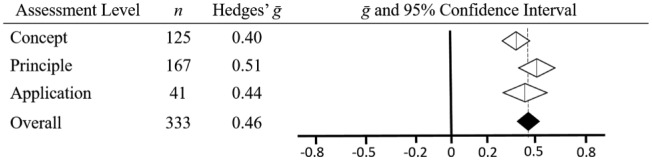
- Assessment-level effects were concept ḡ = 0.40, principles ḡ = 0.51, and application ḡ = 0.44; scaffolding’s influence was greater at the principles level than at the concept level (z = 2.17, p < .05).
- No statistically significant differences were found for context-specific versus generic scaffolding (z = −0.281, p = .778), scaffolding change/fading (p > .05), or scaffolding logic (p > .05).
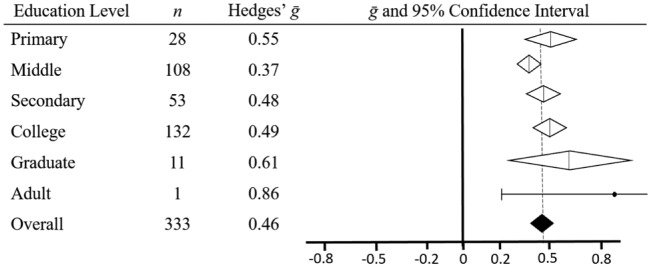
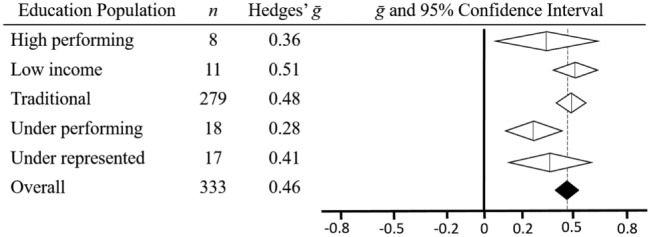
- Effects were significantly greater than zero across education levels, but adult learners had the highest estimate based on only one outcome; traditional versus underperforming learners differed significantly (z = 2.29, p < .05). Motivation scaffolding (n = 3), design-based learning (n = 3), and adult population (n = 1) estimates were not significantly greater than zero, with caution due to small samples.
Methods
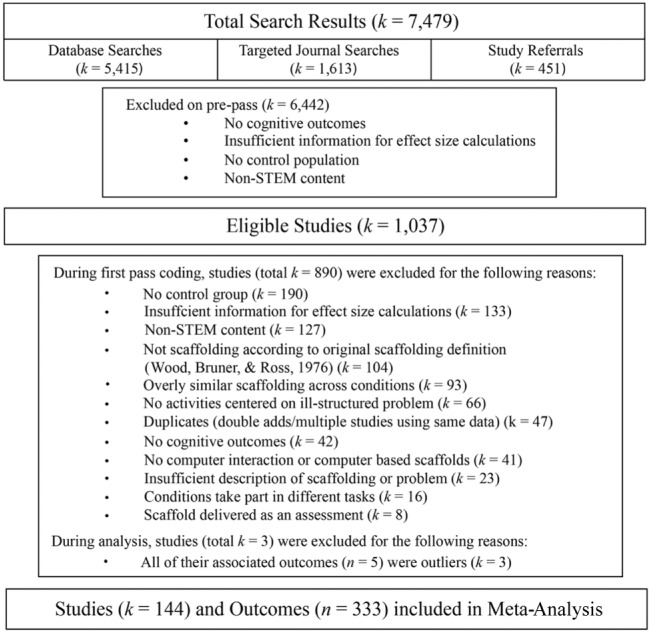
- Meta-analysis of studies published January 1, 1993–December 31, 2014, with a control condition receiving an educational intervention but no scaffolding, cognitive outcomes, sufficient effect-size information, Wood et al. (1976) scaffolding, and ill-structured STEM problems. Searches covered databases including Education Source, PsychINFO, ERIC, PubMed, IEEE, and Google Scholar, plus hand searches and reference-list searches.
- Four coders independently coded studies, reached consensus, and achieved Krippendorff’s alphas greater than .667; 333 data points were used for interrater reliability.
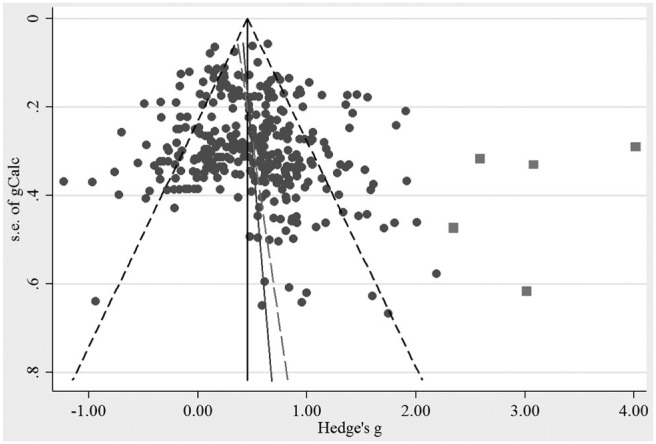
- Random-effects meta-analysis used Hedges’ g and STATA 14 metan; publication bias was assessed via funnel plot, Egger’s regression, and trim-and-fill. Five outlier outcomes and three associated studies were removed, reducing 338 outcomes/147 studies to 333 outcomes/144 studies. Effect-size dependency was addressed with composites (515 to 333 outcomes) and robust variance estimation.
Limitations
- The paper states meta-analyses cannot include all empirical research; qualitative studies and quantitative studies without control groups were excluded, so effect sizes do not reflect all empirical research on computer-based scaffolding.
- The coding scheme could not perfectly reflect every construct; it assigned a single value for scaffolding logic, and codes such as “none,” “traditional,” or “problem solving” may indicate lack of description as much as positive identification.
- Several moderator estimates relied on very small samples—motivation scaffolding (n = 3), design-based learning (n = 3), and adult population (n = 1)—producing wide confidence intervals and warranting caution; no primary research on preschool populations met inclusion criteria.
Model-written summary. Check it against the paper before relying on it.
Integrity signals
Registry
Cites
Statistics
Figures
Verification
Claims the paper makes
4 Valid · 2 Not valid · 30 Not checked · 74 Own results and interpretations
Every source the paper cites for this claim was checked and supports it.
In the paper
“Scaffolding in these contexts also has the potential to help problem-centered instructional models overcome criticisms that they do not lead to adequate content learning (Kirschner, Sweller, & Clark, 2006).”
§ Synthesizing Results From Empirical Research on Computer-Based Scaffolding in STEM Education > Discussion > Expansion of the Scaffolding Metaphor
What the sources say
- Supportedcites Kirschner, Sweller, & Clark, 2006 matched to “Why Minimal Guidance During Instruction Does Not Work: An Analysis of the Failure of Constructivist, Discovery, Problem-Based, Experiential, and Inquiry-Based Teaching” (2006) source
The paper criticizes minimally guided problem-based learning for weak knowledge acquisition in its Medical Problem-Based Learning Research section. Its Current Research Supporting Direct Guidance section also describes teachers using scaffolding while teaching content when students were not making progress. The sentence’s proposal that scaffolding may help address that criticism is consistent with these passages. (LLM, conf=0.90)
hedgedstates a possible cause- Asserted: passes — The authors put it forward as true.
- Checkable: passes — It can be checked against evidence.
- Load-bearing: passes — The paper’s conclusions depend on it.
- Based: passes — The paper gives a reason why it holds.
- Supported
A result the paper reports from its own data — it cites no other source for it, so there is none to check. The quote shows it is in the paper.
In the paper
“Scaffolding’s influence was greatest when measured at the principles level and among adult learners.”
§ Synthesizing Results From Empirical Research on Computer-Based Scaffolding in STEM Education > Abstract
plainstates a cause- Asserted: passes — The authors put it forward as true.
- Checkable: passes — It can be checked against evidence.
- Load-bearing: passes — The paper’s conclusions depend on it.
- Based: passes — The paper gives a reason why it holds.
A result the paper reports from its own data — it cites no other source for it, so there is none to check. The quote shows it is in the paper.
In the paper
“Specifically, scaffolding’s influence on cognitive outcomes did not vary on the basis of context-specificity, presence or absence of scaffolding change, and logic by which scaffolding change is implemented.”
§ Synthesizing Results From Empirical Research on Computer-Based Scaffolding in STEM Education > Abstract
plain- Asserted: passes — The authors put it forward as true.
- Checkable: passes — It can be checked against evidence.
- Load-bearing: passes — The paper’s conclusions depend on it.
- Based: passes — The paper gives a reason why it holds.
A result the paper reports from its own data — it cites no other source for it, so there is none to check. The quote shows it is in the paper.
In the paper
“Results of our random effect meta-analysis (a) indicate that computer-based scaffolding showed a consistently positive (ḡ = 0.46) effect on cognitive outcomes across various contexts of use, scaffolding characteristics, and levels of assessment”
§ Synthesizing Results From Empirical Research on Computer-Based Scaffolding in STEM Education > Abstract
hedgedstates a cause- Asserted: passes — The authors put it forward as true.
- Checkable: passes — It can be checked against evidence.
- Load-bearing: passes — The paper’s conclusions depend on it.
- Based: passes — The paper gives a reason why it holds.
59 more claims
Create a free account to see all 110 claims and to verify the 2 references still open.
- Probably not a substantial claim. 18
- It may state two separate claims as one. 32
- The quote only partly states this claim. 2
Claims other papers make about this one
Each is checked against this paper’s own text: does it say what the citing paper says it does?
In the citing paper
“Meta-analyses show that scaffolding enhances cognitive outcomes in digital learning environments (Belland et al., 2017;Chernikova et al., 2020).”
From Looking Beyond the Hype: Understanding the Effects of AI on Learning (2025) · cites this paper as Belland et al., 2017
Statistics recomputed
Every reported test result, recomputed from its test statistic and degrees of freedom. A result shows as not adding up only once an independent check has confirmed it.
- Consistentz = 18.19reported p < .01 · recomputed p < .001
“z = 18.19, p < .01”
- Consistentz = 2.29reported p < .05 · recomputed p = .022
“z = 2.29, p < .05”
- Consistentz = 4.69reported p < .01 · recomputed p < .001
“z = 4.69, p < .01”
- Consistentz = 5.09reported p < .01 · recomputed p < .001
“z = 5.09, p < .01”
- Consistentz = 5.36reported p < .01 · recomputed p < .001
“z = 5.36, p < .01”
8 more recomputed tests
Create a free account to see every test the Stats check recomputed.
Self-check
Percentages, sums and reported differences re-computed from the paper’s own numbers.
Each contradiction between two passages listed here was confirmed by an independent check.
Rated major: it would touch a result — a value a result rests on, reported and recomputed p-values on opposite sides of the significance level, two passages that conflict with no sign which is right, or a cited work retracted before this paper was published.
In the paper
§ Synthesizing Results From Empirical Research on Computer-Based Scaffolding in STEM Education > Results > Do Learner Characteristics Moderate Cognitive Student Outcomes?
“Hedges’ ḡ estimates were significantly greater than zero and substantial across all education levels”
§ Synthesizing Results From Empirical Research on Computer-Based Scaffolding in STEM Education > Discussion > Areas in Which More Empirical Work Is Needed
“when the effect size estimate was not significantly different from zero, the sample size was very small (i.e., three or fewer outcomes were used to calculate the effect size estimate). These circumstances included motivation scaffolding (n = 3), design-based learning (n = 3), and the adult population (n = 1).”
Rated minor: it would not touch a result — a value no result rests on, a p-value that stays on the same side of the significance level, or a conflict that is clerical, resolved elsewhere in the paper, or outside its own findings.
In the paper
§ Synthesizing Results From Empirical Research on Computer-Based Scaffolding in STEM Education > Discussion > Expansion of the Scaffolding Metaphor
“the effect size estimates for all three were above 0.40”
§ Synthesizing Results From Empirical Research on Computer-Based Scaffolding in STEM Education > Discussion
“The effect size estimates for scaffolding at the assessment levels of concept, principles, and application were 0.40, 0.51, and 0.44, respectively.”
Rated minor: it would not touch a result — a value no result rests on, a p-value that stays on the same side of the significance level, or a conflict that is clerical, resolved elsewhere in the paper, or outside its own findings.
In the paper
“86% (42% African American, 34% Hispanic, 4% Native American, 1% Filipino, 1% Pacific Islander/Other)”
§ Synthesizing Results From Empirical Research on Computer-Based Scaffolding in STEM Education > Method > Study Feature Coding
Reported 86 · recomputed 82
Citations
Cites
Statistical Power Analysis for the Behavioral Sciences
Muller, K. (1989) · Technometrics · doi:10.1080/00401706.1989.10488618 · Cited by 99,167
Bias in meta-analysis detected by a simple, graphical test
Egger, M., Smith, G. D., Schneider, M., & Minder, C. (1997) · BMJ · doi:10.1136/bmj.315.7109.629 · Cited by 56,722 · cited 1×
“These include visual inspection of a funnel plot, the trim and fill approach (Borenstein et al., 2009), and Egger’s regression test (Egger, Smith, Schneider, & Minder, 1997).”
MethodStatistical Power Analysis for the Behavioral Sciences (2nd ed.).
Lachenbruch, P. A., & Cohen, J. (1989) · Journal of the American Statistical Association · doi:10.2307/2290095 · Cited by 37,395
Content Analysis: An Introduction to its Methodology.
Shelley, M., & Krippendorff, K. (1984) · Journal of the American Statistical Association · doi:10.2307/2288384 · Cited by 24,312
Borenstein, M., Hedges, L. V., Higgins, J. P. T., & Rothstein, H. R. (2009) · doi:10.1002/9780470743386 · Cited by 14,225
Duval, S., & Tweedie, R. (2000) · Biometrics · doi:10.1111/j.0006-341x.2000.00455.x · Cited by 14,099 · cited 1×
“We also used trim-and-fill analysis (Duval & Tweedie, 2000) to compare the observed value and adjusted value as simulating a perfect symmetry but there was no significant difference between observed and adjusted effect sizes.”
MethodTHE ROLE OF TUTORING IN PROBLEM SOLVING *
Wood, D., Bruner, J. S., & Ross, G. (1976) · Journal of Child Psychology and Psychiatry · doi:10.1111/j.1469-7610.1976.tb00381.x · Cited by 8,851 · cited 13×
“In its original definition, scaffolding was intended to enhance problem-solving skill (Wood et al., 1976).”
BackgroundMethodInfluentialKirschner, P. A., Sweller, J., & Clark, R. E. (2006) · Educational Psychologist · doi:10.1207/s15326985ep4102_1 · Cited by 7,776 · cited 1×
“Scaffolding in these contexts also has the potential to help problem-cen-tered instructional models overcome criticisms that they do not lead to adequate content learning (Kirschner, Sweller, & Clark, 2006).”
BackgroundProblem-Based Learning: What and How Do Students Learn?
Hmelo-Silver, C. E. (2004) · Educational Psychology Review · doi:10.1023/b:edpr.0000034022.16470.f3 · Cited by 5,212 · cited 1×
“In problem-based learning, students produce a conceptual solution to the problem (Hmelo-Silver, 2004).”
BackgroundReciprocal Teaching of Comprehension-Fostering and Comprehension-Monitoring Activities
Palinscar, A. S., & Brown, A. L. (1984) · Cognition and Instruction · doi:10.1207/s1532690xci0102_1 · Cited by 5,186 · cited 1×
“One-to-one scaffolding soon began to be used among many populations (van de Pol et al., 2010) and across contexts (Palincsar & Brown, 1984).”
Background
Research works printed but not linked: 7
- Hannafin M. Land S. Oliver K. (1999). Open-ended learning environments: Foundations, methods, and models. In Reigeluth C. M. (Ed.), Instructional design theories and models: Volume II. A new paradigm of instructional theory (pp. 115– 140). Mahwah, NJ: Erlbaum.
- Knowles M. S. (1984). Andragogy in action. Applying modern principles of adult education. San Francisco, CA: Jossey-Bass.
- 10.1002/(sici)1098-2736(199909)36:7 · doi:10.1002/(sici)1098-2736(199909)36:7
- National Research Council. (2011). Successful K-12 STEM education: Identifying effective approaches in science, technology, engineering, and mathematics. Washington, DC: National Academies Press.
- National Science Board. (2010). Preparing the next generation of STEM innovators: Identifying and developing our nation’s human capital. Arlington, VA: National Science Foundation.
- Stark D. M. (2013). Ill-structured problems, scaffolding and problem-solving ability of novice nursing students (Doctoral dissertation). Available from ProQuest Dissertations & Theses database. (UMI No. 3553778)
- Zhang J. Chen Q. Reid D. J. (2000). Simulation-based scientific discovery learning: a research on the effects of experimental support and learners’ reasoning ability. In Proceedings IFIP World Computer Congress, Educational Uses of Communication and Information Technologies (pp. 344– 351). Beijing, China: ICEUT.
Cited by
Items 101–200 of 338
Peng, J., Sun, M., Yuan, B., Lim, C. P., van Merriënboer, J. J. G., & Wang, M. (2023) · Education and Information Technologies · doi:10.1007/s10639-023-11896-1 · Cited by 31
“…for thinking and reasoning, structuring or decomposing complex tasks, using prompts or hints to facilitate the task process, and encouraging collaborative inquiry and problem-solving (Belland et al., 2016; Hmelo-Silver et al., 2007; Lazonder & Harmsen, 2016; Reiser, 2004; White & Frederikse, 1998).”
Who’s in Charge?—Dealing with the Self-regulation Dilemma in Digital Learning Environments
Bergamin, P. B., & Hirt, F. S. (2018) · Progress in IS · doi:10.1007/978-3-319-73546-7_14 · Cited by 28
Huang, S.-K., & Chen, C. (2025) · Journal of Computer Assisted Learning · doi:10.1111/jcal.70094 · Cited by 36
Winarno, N., Rusdiana, D., Samsudin, A., Susilowati, E., Ahmad, N. J., & Afifah, R. M. A. (2020) · Eurasia Journal of Mathematics Science and Technology Education · doi:10.29333/ejmste/9129 · Cited by 27
Joshi, D. R., Adhikari, K. P., Khanal, J., Belbase, S., & Khanal, B. P. (2023) · Cogent Education · doi:10.1080/2331186x.2023.2230394 · Cited by 31
Moon, J. A., & Brockway, D. (2019) · Journal of Research on Technology in Education · doi:10.1080/15391523.2019.1566038 · Cited by 21
West, R. E., Tawfik, A. A., Gishbaugher, J. J., & Gatewood, J. D. (2020) · TechTrends · doi:10.1007/s11528-020-00531-2 · Cited by 21
Law, V., Ge, X., & Huang, S.-K. (2020) · Springer eBooks · doi:10.1007/978-3-030-36119-8_14 · Cited by 31
Leuders, T., Loibl, K., Sommerhoff, D., Herppich, S., & Praetorius, A. (2022) · Journal für Mathematik-Didaktik · doi:10.1007/s13138-022-00199-6 · Cited by 31
“Other premises are mostly related to (i) the differential effectiveness of certain support mechanisms (see, e.g., Belland et al. 2017; Chernikova et al. 2020b), (ii) more or less general learning theories (e.g., cognitive load theory), and (iii) the effects of support mechanisms on diagnostic…”
BackgroundKnogler, M., Hetmanek, A., & Seidel, T. (2022) · Frontiers in Psychology · doi:10.3389/fpsyg.2022.873995 · Cited by 28
“The resulting complexity of effect size comparisons, highlighted in the literature (see e.g., Coe, 2002; Hill et al., 2008; Ferguson, 2009; Dunlosky et al., 2013; Belland et al., 2017; Schneider and Preckel, 2017; Simpson, 2018), does not favor rank-ordering effect sizes on a single scale in terms of their magnitude.”
BackgroundHildreth, A. F., Maggio, L. A., Iteen, A., Wojahn, A. L., Cook, D. A., & Battista, A. (2023) · AEM Education and Training · doi:10.1002/aet2.10848 · Cited by 20
Kong, S. C., & Wang, Y.-Q. (2024) · Computers & Education · doi:10.1016/j.compedu.2024.105126 · Cited by 39
Exploring Effectiveness of Classroom Assessments for Students’ Learning in High School Chemistry
İzci, K., Muslu, N., Burcks, S. M., & Siegel, M. A. (2018) · Research in Science Education · doi:10.1007/s11165-018-9757-0 · Cited by 21
The Effects of STEM Education on Students’ Academic Achievement In Science Courses: A Meta-Analysis
ÇAKICI, Ş. K., Özge, K. O. L., & Yaman, S. (2021) · Kuramsal Eğitimbilim · doi:10.30831/akukeg.810989 · Cited by 28
Fahrni, D. D. D., Iten, G. H., Prasse, D., & Hascher, T. (2025) · Teaching and Teacher Education · doi:10.1016/j.tate.2025.105150 · Cited by 39
The effect of using STEM education on students mathematics achievement
Eshaq, H. A. (2023) · Journal of Pedagogical Research · doi:10.33902/jpr.202423476 · Cited by 41
“Some researchers conducted meta-analyses, which allowed the impact of some moderators to be measured (e.g. Belland et al., 2017; Santhosh et al., 2023).”
Belland, B. R., Weiss, D. M., Kim, N. J., Piland, J. C., & Gu, J. (2018) · International Journal of Science and Mathematics Education · doi:10.1007/s10763-017-9872-9 · Cited by 24
Self-citationAutomated Feedback Can Improve Hypothesis Quality
Kroeze, K. A., van den Berg, S. M., Lazonder, A. W., Veldkamp, B. P., & de Jong, T. (2019) · Frontiers in Education · doi:10.3389/feduc.2018.00116 · Cited by 15
Vasconcelos, L., & Kim, C. (2022) · Educational Technology Research and Development · doi:10.1007/s11423-022-10119-7 · Cited by 23
High school students’ agentic responses to modeling during problem-based learning
Belland, B. R., Weiss, D. M., & Kim, N. J. (2020) · The Journal of Educational Research · doi:10.1080/00220671.2020.1838407 · Cited by 20
Self-citationFarmer, E. C., Catalano, A. J., & Halpern, A. J. (2019) · TechTrends · doi:10.1007/s11528-019-00435-w · Cited by 20
Investigating Student Reflection during Game-Based Learning in Middle Grades Science
Carpenter, D., Cloude, E. B., Rowe, J., Azevedo, R., & Lester, J. C. (2021) · International Conference on Learning Analytics and Knowledge (LAK) · doi:10.1145/3448139.3448166 · Cited by 20
“However, challenges remain because students must utilize a range of selfregulation strategies such as monitoring their level of understanding to determine if they are making progress toward successful problem-solving outcomes [2, 31, 36].”
BackgroundJones, L., Smith, S. L., & Durham, C. (2022) · Computers & Education · doi:10.1016/j.compedu.2022.104592 · Cited by 21
Corves, C., Stadler, M. J., & Fischer, M. R. (2024) · European Journal of Psychology of Education · doi:10.1007/s10212-024-00826-5 · Cited by 15
Rampf, S., Gehrig, H., Möltner, A., Fischer, M., Schwendicke, F., & Huth, K. C. (2024) · European Journal Of Dental Education · doi:10.1111/eje.13028 · Cited by 29
AI-Integrated AR as an Intelligent Companion for Industrial Workers: A Systematic Review
Yoo, D. W., Reza, S., Tarashiyoun, H., Ajikumar, A., & Moghaddam, M. (2024) · IEEE Access · doi:10.1109/access.2024.3516536 · Cited by 22
“Research in learning sciences highlights the need for adaptive scaffolding and fading mechanisms [110], [111], [112] that match the cognitive processes of the learner to help build knowledge [87], [113], [114].”
A Theoretical Framework for Fostering Diagnostic Competences with Simulations in Higher Education
Chernikova, O., Heitzmann, N., Opitz, A., Seidel, T., & Fischer, F. (2022) · Springer eBooks · doi:10.1007/978-3-030-89147-3_2 · Cited by 26
PBL Group Autonomy in a High School Environmental Science Class
Weiss, D. M., & Belland, B. R. (2017) · Technology Knowledge and Learning · doi:10.1007/s10758-016-9297-5 · Cited by 14
Self-citationFerty, Z. N., Wilujeng, İ., Jumadi, J., & Kuswanto, H. (2019) · Journal of Physics Conference Series · doi:10.1088/1742-6596/1233/1/012062 · Cited by 23
“Learning scaffolding by giving concept understanding can improve cognitive abilities [9].”
BackgroundDesigning and Developing Interactive Narratives for Collaborative Problem-Based Learning
Mott, B., Taylor, R. G., Lee, S., Rowe, J., Saleh, A., Glazewski, K. D., Hmelo‐Silver, C. E., & Lester, J. C. (2019) · Lecture notes in computer science · doi:10.1007/978-3-030-33894-7_10 · Cited by 18
“These approaches rely on scaffolded student engagement, including different forms of learning cycles that help provide norms, routines, and teacher guidance [19,20].”
Borchers, C., Fleischer, H., Schanze, S., Scheiter, K., & Aleven, V. A. W. M. M. (2025) · Computers & Education · doi:10.1016/j.compedu.2025.105364 · Cited by 26
Personalizing simulation-based learning in higher education
Bauer, E., Heitzmann, N., Bannert, M., Chernikova, O., Fischer, M. R., Frenzel, A. C., Gartmeier, M., Hofer, S. I., Holzberger, D., Kasneci, E., et al. (2025) · Learning and Individual Differences · doi:10.1016/j.lindif.2025.102746 · Cited by 33
Grundgeiger, T., Ertle, F., Diethei, D., Mengelkamp, C., & Held, V. (2022) · Advances in Health Sciences Education · doi:10.1007/s10459-022-10148-0 · Cited by 21
Relationships between self-regulation, social skills and writing achievement in digital schools
McNaughton, S., Rosedale, N. A., Zhu, T., Siryj, J., Oldehaver, J., Teng, S. L., Williamson, R., & Jesson, R. (2022) · Reading and Writing · doi:10.1007/s11145-021-10232-8 · Cited by 16
Tabak, I., & Reiser, B. J. (2022) · Cambridge University Press eBooks · doi:10.1017/9781108888295.005 · Cited by 22
Schons, C., Obersteiner, A., Reinhold, F., Fischer, F., & Reiss, K. M. (2022) · Journal für Mathematik-Didaktik · doi:10.1007/s13138-022-00210-0 · Cited by 26
Inquiry learning behaviors captured through screencasts in problem-based learning
Kwon, K., Shin, S., Brush, T. A., Glazewski, K. D., Edelberg, T., Park, S. J., Khlaif, Z. N., Nadir, H., & Alangari, H. (2017) · Interactive Learning Environments · doi:10.1080/10494820.2017.1419496 · Cited by 15
Predicting high school students’ argumentation skill using information literacy and trace data
Belland, B. R., & Kim, N. J. (2021) · The Journal of Educational Research · doi:10.1080/00220671.2021.1897967 · Cited by 16
“…can be wide variation in scaffolding engagement (Saye & Brush, 2002; Simons & Ertmer, 2006) and ultimate outcomes (Belland, Walker, & Kim, 2017; Belland, Walker, Kim, & Lefler, 2017) which begs for a closer look at predictors of argumentation quality when high school students are provided…”
BackgroundMethodInfluentialSelf-citationLiu, M., Cai, Y. C., Han, S., & Shao, P. (2023) · Journal of Educational Technology Systems · doi:10.1177/00472395231174034 · Cited by 21
“Some researchers have pointed out that this high demand makes young K-12 students struggle with tasks, which can negatively in fl u-ence their learning experiences (Belland et al., 2017).”
BackgroundKuang, X., Eysink, T. H. S., & de Jong, T. (2023) · Journal of Research in Science Teaching · doi:10.1002/tea.21865 · Cited by 16
Computer-Based Scaffolding Strategy
Belland, B. R. (2016) · Springer eBooks · doi:10.1007/978-3-319-02565-0_5 · Cited by 14
Self-citationLee, A. (2020) · Computers in the Schools · doi:10.1080/07380569.2020.1720553 · Cited by 15
“…144 experimental studies provided evidence that computer-based scaffolding was associated positively with student cognitive test scores in the domain of STEM-related concepts, principles, and applications across levels spanning from primary to adult education (Belland, Walker, Kim, & Lefler, 2017).”
BackgroundUsing Technology to Address Individual Differences in Learning
Antonenko, P., Dawson, K., Cheng, L., & Wang, J. (2020) · Springer eBooks · doi:10.1007/978-3-030-36119-8_6 · Cited by 18
Wan, H., Zhang, X. H., Yang, X., & Li, S. (2024) · Education and Information Technologies · doi:10.1007/s10639-024-12550-0 · Cited by 15
Urgo, K., & Arguello, J. (2025) · Foundations and Trends® in Information Retrieval · doi:10.1561/1500000084 · Cited by 21
Lu, J., Si, H., Xu, J., & Xu, T.-G. (2025) · Educational Research Review · doi:10.1016/j.edurev.2025.100712 · Cited by 18
Fink, M. C., Heitzmann, N., Siebeck, M., Fischer, F., & Fischer, M. R. (2021) · BMC Medical Education · doi:10.1186/s12909-021-02937-9 · Cited by 14
FLoRA: An advanced AI-powered engine to facilitate hybrid human-AI regulated learning
Li, X., Li, T., Yan, L., Li, Y., Zhao, L., Raković, M., Molenaar, I., Gašević, D., & Fan, Y. (2025) · Computers & Education · doi:10.1016/j.compedu.2025.105527 · Cited by 34
“Beyond ethics, the risk of learner over-reliance on AI support warrants attention: novice learners may risk becoming dependent on external scaffolds, while more advanced learners may benefit from complementary support (Koedinger and Aleven, 2007; Belland et al., 2017).”
Rates, C. A., Mulvey, B. K., Chiu, J. L., & Stenger, K. (2022) · Instructional Science · doi:10.1007/s11251-021-09573-2 · Cited by 12
“Research demonstrates that students who plan and reflect on their understanding can learn more from simulations (Belland et al., 2017; White & Frederiksen, 1998).”
BackgroundA Comparison of Hints vs. Scaffolding in a MOOC with Adult Learners
Zhou, Y., Andres-Bray, J. M. L., Hutt, S. J., Ostrow, K., & Baker, R. S. (2021) · Lecture notes in computer science · doi:10.1007/978-3-030-78270-2_76 · Cited by 11
Borchers, C., Fleischer, H., Yaron, D., McLaren, B. M., Scheiter, K., Aleven, V. A. W. M. M., & Schanze, S. (2025) · Journal of Science Education and Technology · doi:10.1007/s10956-024-10197-7 · Cited by 18
Belland, B. R., Lee, E., Zhang, A. Y., & Kim, C. (2022) · Computer Applications in Engineering Education · doi:10.1002/cae.22556 · Cited by 21
Self-citationLyndgaard, S. F., & Kanfer, R. (2024) · Journal of the Learning Sciences · doi:10.1080/10508406.2024.2303777 · Cited by 15
“When new information is encountered, learners connect prior knowledge to new concepts (e.g., scaffolding; Belland et al., 2017).”
BackgroundModernizing Training in Psychotherapy Competencies With Adaptive Learning Systems: Proof of Concept
Renn, B. N., Areán, P. A., Raue, P. J., Aisenberg, E., Friedman, E. C., & Popović, Z. (2020) · Research on Social Work Practice · doi:10.1177/1049731520964854 · Cited by 10
Jaipal-Jamani, K. (2023) · Frontiers in Education · doi:10.3389/feduc.2023.979709 · Cited by 20
A Meta-Analysis of the Effectiveness of Digital Technology-Assisted STEM Education
ÖZTOP, F. (2023) · Journal of Science Learning · doi:10.17509/jsl.v6i2.52316 · Cited by 28
“Belland, Walker, Kim & Lefler (2017) examined the impact of computer-based scaffolding in STEM education.”
BackgroundChen, D., Zhang, Y., Luo, H., Gao, Z., Yu, L., & Lin, Y. (2025) · Journal of Educational Computing Research · doi:10.1177/07356331251386618 · Cited by 16
“…level, according to cognitive development theory, higher educational levels often associate with individuals being at more advanced stages of cognitive development, allowing them to engage with scaffolding in more sophisticated ways (Belland et al., 2016; Fischer, 1980; Lai & Wong, 2022).”
Learning Recursion from Music and Music from Recursion
Sharma, N., & Chimalakonda, S. (2018) · IEEE International Conference on Advanced Learning Technologies (ICALT) · doi:10.1109/icalt.2018.00066 · Cited by 7
“Recursion is a common technique used in divide and conquer algorithms and is a core component of STEM education today [15].”
MethodLarson, B., Bohler, J. A., & Krishnamoorthy, A. (2021) · Journal of Information Technology Education Innovations in Practice · doi:10.28945/4694 · Cited by 11
“In STEM-related fields, scaffolding has been useful but best utilized in specific problem-based ta sks (Belland et al., 2017).”
MethodThe Guided Inquiry Principle in Multimedia Learning
de Jong, T. (2021) · Cambridge University Press eBooks · doi:10.1017/9781108894333.041 · Cited by 11
Developing Prospective Teachers’ Beliefs about Digital Tools and Digital Feedback
Speer, A., & Eichler, A. (2022) · Mathematics · doi:10.3390/math10132192 · Cited by 12
Evaluating an automated mediator for joint narratives in a conflict situation
Zancanaro, M., Stock, O., Schiavo, G., Cappelletti, A., Gehrmann, S., Canetti, D., Shaked, O., Fachter, S., Yifat, R., Mimran, R., et al. (2019) · Behaviour and Information Technology · doi:10.1080/0144929x.2019.1637940 · Cited by 11
“In general, cognitive tutors are designed to support single users by providing adequate scaffolding in learning tasks (Belland et al. 2017).”
BackgroundSimulations in Teacher Education: Learning to Diagnose Cognitive Engagement
Roeben, M., Vejvoda, J., Murböck, J., Fischer, F., Schultz-Pernice, F., Lohr, A., Stadler, M. J., Sailer, M., & Heitzmann, N. (2025) · Education Sciences · doi:10.3390/educsci15030261 · Cited by 9
Student Perception of Journaling as an Assessment for an Engagement Experience
Dinç, E., Wherley, M. S., & Sankey, H. (2023) · Journal of Experiential Education · doi:10.1177/10538259231203671 · Cited by 14
Peer Tutoring and Scaffolding Principle for Inclusive Teaching
Nardacchione, G., & Peconio, G. (2022) · Elementa Intersections between Philosophy Epistemology and Empirical Perspectives · doi:10.7358/elem-2021-0102-nape · Cited by 21
Pan, Z., & Liu, M. (2022) · Journal of Educational Technology Systems · doi:10.1177/00472395221133855 · Cited by 10
“On the one hand, learners in PBL activities need scaffoldings as cognitive guidance to tackle complex, ill-structured problems (Belland et al., 2017).”
BackgroundInstructional Efficiency of STEM Approach in Biology Teaching in Primary School in Serbia
Županec, V. D., Radulović, B. N., & Lazarević, T. (2022) · Sustainability · doi:10.3390/su142416416 · Cited by 16
Gozali, I., Istiqomah, F., & Widiati, U. (2022) · Journal of Information Technology Education Research · doi:10.28945/5033 · Cited by 17
Wiriani, N. M. A., & Ardana, I. M. (2022) · MIMBAR PGSD Undiksha · doi:10.23887/jjpgsd.v10i2.48515 · Cited by 6
“Learning with the STEM approach does not only require students to have competence in the cognitive domain, but students are also expected to have other competencies (Belland et al., 2017; Beswick & Fraser, 2019).”
BackgroundHillmayr, D., Reinhold, F., Holzberger, D., & Reiss, K. M. (2024) · Frontiers in Education · doi:10.3389/feduc.2023.1261086 · Cited by 13
Peng, J., Sergis, S., Wang, M., & Sampson, D. G. (2017) · International World Wide Web Conference (WWW) · doi:10.1145/3041021.3054158 · Cited by 7
“Indeed, evidence has shown that providing such guidance to support learners’ engagement in complex tasks is essential for effective learning [25].”
BackgroundSTEM-education in the mirror of sociological research
Бутурліна, О. В., Lysokolenko, T., & Довгаль, С. (2019) · Grani · doi:10.15421/171963 · Cited by 6
“With a wide range of directions, STEM research is the most diverse [1; 2; 3; 4;5;10].”
BackgroundUsing an Assessment Tool to Create Sandboxes for Computer Graphics Teaching in an Online Environment
Wuensche, B. C., Leung, K., Dimalen, D., van der Mark, W., Suselo, T., Alex, M., Shaw, A., Luxton-Reilly, A., & Lobb, R. (2021) · doi:10.1145/3507923.3507929 · Cited by 11
Junker, R., Janeczko, J. M., Lehmkuhl, A., Zucker, V., Holodynski, M., & Meschede, N. (2025) · Education and Information Technologies · doi:10.1007/s10639-025-13559-9 · Cited by 14
“While much of the existing research focuses on cognitive and motivational outcomes in simpler domains (Belland et al., 2017 ; Schmidt-Weigand et al., 2009 ), our findings underscore the importance of context-specific scaffold design for addressing the dual challenges of cognitive load and learner…”
Bach, K. M., Reinhold, F., & Hofer, S. I. (2025) · npj Science of Learning · doi:10.1038/s41539-025-00358-7 · Cited by 20
“Scaffolding 142 is a form of instructional support to guide students in their learning and problem-solving 143 – 145 .”
Zwischen Mensch und Maschine: Künstliche Intelligenz zur Förderung von Lernprozessen
Ninaus, M., & Sailer, M. (2022) · Lernen und Lernstörungen · doi:10.1024/2235-0977/a000386 · Cited by 14
Conducting Problem-Based Learning Meta-Analysis: Complexities, Implications, and Best Practices
Walker, A. E., & Leary, H. (2023) · Interdisciplinary Journal of Problem-based Learning · doi:10.14434/ijpbl.v17i2.35844 · Cited by 13
Self-citationIrmer, M., Traub, D., Kramer, M., Förtsch, C., & Neuhaus, B. J. (2022) · International Journal of Science Education · doi:10.1080/09500693.2022.2083253 · Cited by 10
Supporting Project-Based Learning Through the Virtual Internship Author (VIA)
Tawfik, A. A., Graesser, A. C., & Love, J. B. (2018) · Technology Knowledge and Learning · doi:10.1007/s10758-018-9392-x · Cited by 10
Belland, B. R. (2019) · Wiley eBooks · doi:10.1002/9781119173243.ch18 · Cited by 7
Self-citationMakerspace and robotics as/for STEM education
Jaipal-Jamani, K. (2022) · Elsevier eBooks · doi:10.1016/b978-0-12-818630-5.13034-9 · Cited by 13
Teachers’ and students’ needs for supporting digital research skills in secondary STEM education
Blankendaal-Tran, K. N., Meulenbroeks, R. R., & van Joolingen, W. (2026) · European Journal of STEM Education · doi:10.20897/ejsteme/17755 · Cited by 6
“This scaffolding framework was, for example, effective in helping increase and integrate higher-order skills in STEM education (Belland et al., 2017) and fostering secondary school students’ intrinsic motivation towards performing science practicals (Meulenbroeks et al., 2023).”
Odunga, J. O., Musuva, P. M. W., & Ndiege, J. R. (2025) · IST-Africa Conference (IST-Africa) · doi:10.23919/ist-africa67297.2025.11060558 · Cited by 9
“Creating a supportive learning environment for all students, especially those with Learning Disabilities, remains complex [21].”
A meta-analysis on the effect of learning analytics interventions on students’ academic performance
Kokoç, M., Bütüner, S. Ö., & Güler, M. (2025) · Journal of Research on Technology in Education · doi:10.1080/15391523.2025.2536571 · Cited by 13
Irmer, M., Traub, D., & Neuhaus, B. J. (2024) · Cogent Education · doi:10.1080/2331186x.2024.2422272 · Cited by 6
“…in a high cognitive load, therefore scaffolding is considered to be an effective intervention (Belland, 2017; Belland et al., 2017; Quintana et al., 2004) when working on the DiKoBi simulation (Belland, 2017; Belland et al., 2017; Irmer et al., 2023; Irmer et al., 2022; Quintana et al., 2004).”
InfluentialSchulz, A. L., & Voermanek, J. (2025) · Computers and Education Open · doi:10.1016/j.caeo.2025.100247 · Cited by 5
Rincón, Y. R., Munárriz, A., Campión, M. J., & Goicoechea, M. I. (2025) · Educational Technology Research and Development · doi:10.1007/s11423-025-10516-8 · Cited by 15
“Based on the evidence shown by these authors and others such as Doo et al. (2020a) or Belland et al. (2017), through this instructional process, where the complexity increases as questions of lesser difficulty are correctly answered, the demotivation inherent in having to solve problems that do not…”
Using a Recommendation System to Support Problem Solving and Case-Based Reasoning Retrieval
Tawfik, A. A., Alhoori, H., Keene, C. W., Bailey, C., & Hogan, M. (2017) · Technology Knowledge and Learning · doi:10.1007/s10758-017-9335-y · Cited by 9
“To date, comparison studies have found significant learning gains when properly supported in inquiry based settings (Belland et al. 2016; Lazonder and Harmsen 2016; Leary and Walker 2009).”
BackgroundBelland, B. R., Kim, C., Zhang, A. Y., Baabdullah, A., & Lee, E. (2021) · IEEE Transactions on Education · doi:10.1109/te.2021.3059258 · Cited by 5
Self-citationWidajati, W., & Mahmudah, S. (2022) · JPI (Jurnal Pendidikan Indonesia) · doi:10.23887/jpi-undiksha.v11i1.33962 · Cited by 23
“intellectual disabilities, including scaffolding can improve student abilities and help students complete tasks in learning (Belland et al., 2017).”
BackgroundARTIFICIAL INTELLIGENCE IN EDUCATION: TOOL, OBJECT, “SUBJECT” OF LEARNING
VARYNSKYI, V. O., Доннікова, І. А., & Savinova, N. (2023) · The Journal of International Legal Communication · doi:10.32612/uw.27201643.2023.10.3.pp.46-55 · Cited by 5
Hofer, E., & Steininger, R. (2023) · Chemistry Teacher International · doi:10.1515/cti-2022-0046 · Cited by 5
STEM Education in English of Early Childhood in China
Zhao, W. (2018) · Eurasia Journal of Mathematics Science and Technology Education · doi:10.29333/ejmste/89596 · Cited by 5
“Computer based scaffolding can also aid students as they strive to utilize STEM-oriented skills (Belland et al., 2017).”
BackgroundRetractedÉvaluation des apprentissages en formation à distance : les situations authentiques à la rescousse
Kozanitis, A. (2021) · Revue internationale des technologies en pédagogie universitaire · doi:10.18162/ritpu-2021-v18n1-24 · Cited by 12
Virtual Scaffolded Instruction for Students with Disabilities
Smith, C. M., & Juergensen, R. L. (2021) · Journal of Special Education Technology · doi:10.1177/01626434211054433 · Cited by 3
The effects of learning analytics hint system in supporting students problem-solving
Pan, Z., & Liu, M. (2022) · International Conference on Learning Analytics and Knowledge (LAK) · doi:10.1145/3506860.3506871 · Cited by 4
“Student 1 4/23/2021 [1, 3, 2, 1, 4] Student 1 4/26/2021 [1, 3, 1, 3, 1, 4, 1, 1, 1, 3, 1, 1, 1, 1, 4, 1] Student 2 4/27/2021 [1, 1, 2, 1, 3, 1, 1, 3, 1, 2, 1, 3, 1, 3, 1, 3, 1, 2, 3]”
MethodHagos, T., & Lemma, A. (2025) · Chemistry Education Research and Practice · doi:10.1039/d5rp00209e · Cited by 10
The types of scaffolding used by EFL Teachers in Isfahan
Safdari, S., Ghadiri, M., & Kashkouli, Z. (2021) · DOAJ (DOAJ: Directory of Open Access Journals) · doi:10.30479/jmrels.2020.11753.1462 · Cited by 3
Hillmayr, D., Reinhold, F., Ziernwald, L., Hofer, S. I., & Reiss, K. M. (2023) · Edition ZfE · doi:10.1007/978-3-658-37895-0_5 · Cited by 5
The Effects of Scaffolding on Learning Outcomes in K-12 Programming Education: A Meta-Analysis
Zhou, P., Li, Y., Zhang, Y., Yu, Y., & Tang, Y. (2023) · International Conference of Educational Innovation through Technology (EITT) · doi:10.1109/eitt61659.2023.00016 · Cited by 7
Metadata
- Authors
- Belland, B. R., Walker, A. E., Kim, N. J., & Lefler, M.
- Affiliations
- Utah State University (US)
- Venue
- Review of Educational Research
- Published
- 2016-10-11
- Volume
- 87
- Issue
- 2
- Pages
- 309-344
- ISSN
- 0034-6543 (ISSN-L)
- 1935-1046
- PMC
- PMC5347356
- OpenAlex
- W2530735505
- Cited by
- 346
- References
- 127
- Citations by year
- 2026: 62 · 2025: 44 · 2024: 35 · 2023: 46 · 2022: 52 · 2021: 31 · 2020: 29 · 2019: 22 · 2018: 11 · 2017: 9 · 2016: 5
- FWCI
- 36.56
- Type
- journal article
- Language
- en
- Open access
- hybrid
- doi.org
- Licence
- Locations
- Review of Educational Research (publishedVersion, cc-by-nc)
- Europe PMC (PubMed Central) (publishedVersion, cc-by-nc)
- PubMed Central (publishedVersion, cc-by-nc)
- PubMed (publishedVersion)
- Topics
- Social Sciences › Psychology › Developmental and Educational Psychology › Innovative Teaching and Learning Methods
- Social Sciences › Psychology › Experimental and Cognitive Psychology › Visual and Cognitive Learning Processes
- Physical Sciences › Computer Science › Artificial Intelligence › Intelligent Tutoring Systems and Adaptive Learning
- Keywords
- STEM education, cognitive outcomes, ill-structured problems, adult learners, primary education, educational technology effectiveness
About these checks
Registry, retraction, Cites and statistics results are computed, not judged, with one exception: a printed reference that no index lists is read once by a model before it counts as a citation error. Claims are extracted by a model and kept only when their quote appears verbatim in the text; each cited source is then checked, with a model’s help, for whether it says what the claim relies on. Those verdicts can be wrong — read the claim’s quote and the cited source before relying on one.
The claim verdicts this report counts are experimental: their accuracy is not yet measured.
A language model drew the claims from the paper on 2026-10-05, under version 3 of the claim definition (model deepseek-v4.1-flash, prompt extract-v3).
A second model labelled each claim on 2026-10-05 (model jev-1.13-20260917, definition revision gold-guideline-v0.2).
Cited sources are checked with a language model’s help (gpt-6-sol).
Statistics and arithmetic are recomputed, not judged.
Confidence bands are shown only for fields calibrated on our annotated test set. None is calibrated yet, so no band is shown.
What counts as a claim ›How we measure confidence ›How we check this ›
Are you an author, or do you see a problem with this page? Request a review
Data sources
Bibliographic data: Semantic Scholar, OpenAlex, Crossref.
Contains information from the Semantic Scholar Academic Graph Datasets, made available under the ODC Attribution License (ODC-BY 1.0).
Semantic Scholar’s data is described in: Kinney, R., et al. (2023). The Semantic Scholar Open Data Platform. arXiv:2301.10140.
