

Synthesizing Results From Empirical Research on Computer-Based Scaffolding in STEM Education
Open accessThe DOI matches its Crossref record; 124 of the 127 references it cites were found in a registry or an index, and 2 are not checked yet; 4 of the 45 sources its claims cite were checked for support.
Abstract
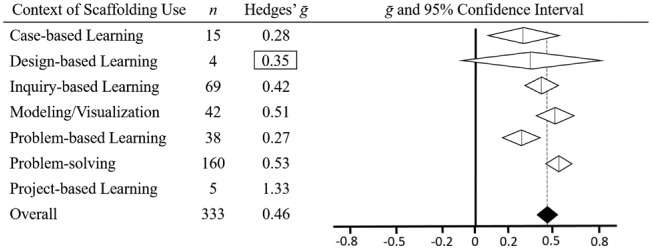
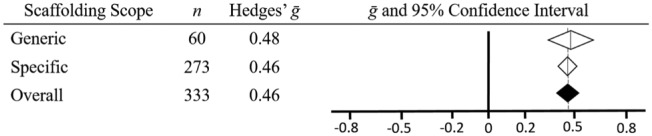
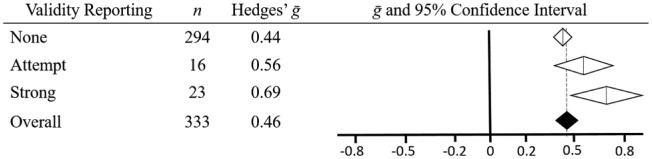
Computer-based scaffolding assists students as they generate solutions to complex problems, goals, or tasks, helping increase and integrate their higher order skills in the process. However, despite decades of research on scaffolding in STEM (science, technology, engineering, and mathematics) education, no existing comprehensive meta-analysis has synthesized the results of these studies. This review addresses that need by synthesizing the results of 144 experimental studies (333 outcomes) on the effects of computer-based scaffolding designed to assist the full range of STEM learners (primary through adult education) as they navigated ill-structured, problem-centered curricula. Results of our random effect meta-analysis (a) indicate that computer-based scaffolding showed a consistently positive (ḡ = 0.46) effect on cognitive outcomes across various contexts of use, scaffolding characteristics, and levels of assessment and (b) shed light on many scaffolding debates, including the roles of customization (i.e., fading and adding) and context-specific support. Specifically, scaffolding's influence on cognitive outcomes did not vary on the basis of context-specificity, presence or absence of scaffolding change, and logic by which scaffolding change is implemented. Scaffolding's influence was greatest when measured at the principles level and among adult learners. Still scaffolding's effect was substantial and significantly greater than zero across all age groups and assessment levels. These results suggest that scaffolding is a highly effective intervention across levels of different characteristics and can largely be designed in many different ways while still being highly effective.
Verified 2026-11-22 · 2 references not checked yet
Overview
CoChat Summary
TL;DR
This comprehensive random-effects meta-analysis of 144 experimental studies (333 outcomes) found that computer-based scaffolding in STEM education produced a consistently positive effect on cognitive outcomes (ḡ = 0.46). Effects were substantial across learner populations, contexts, and assessment levels, with no significant moderation by context-specificity, scaffolding change, or scaffolding logic.
Key findings
- Computer-based scaffolding significantly improved cognitive outcomes versus no scaffolding: overall ḡ = 0.46, z = 18.19, p < .01, across 333 outcomes from 144 studies.
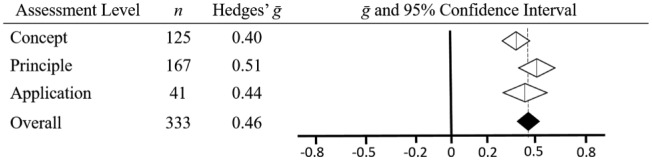
- Assessment-level effects were concept ḡ = 0.40, principles ḡ = 0.51, and application ḡ = 0.44; scaffolding’s influence was greater at the principles level than at the concept level (z = 2.17, p < .05).
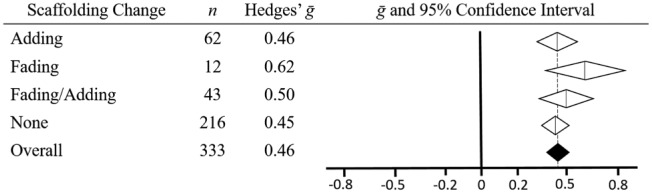
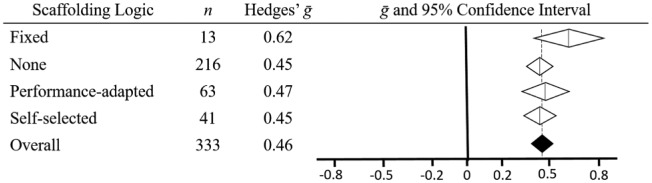
- No statistically significant differences were found for context-specific versus generic scaffolding (z = −0.281, p = .778), scaffolding change/fading (p > .05), or scaffolding logic (p > .05).
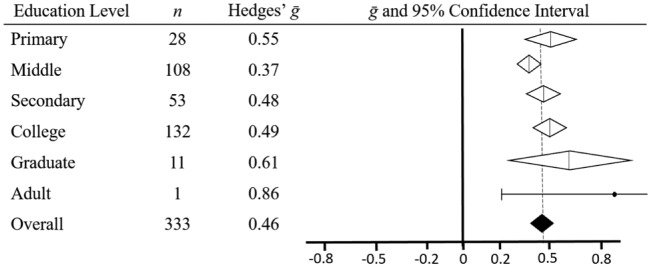
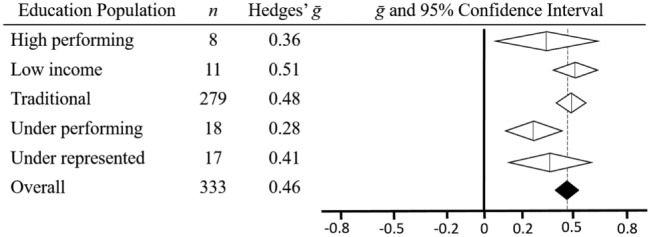
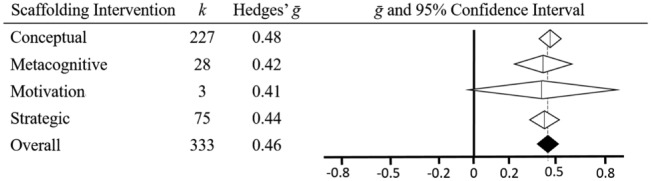
- Effects were significantly greater than zero across education levels, but adult learners had the highest estimate based on only one outcome; traditional versus underperforming learners differed significantly (z = 2.29, p < .05). Motivation scaffolding (n = 3), design-based learning (n = 3), and adult population (n = 1) estimates were not significantly greater than zero, with caution due to small samples.
Methods
- Meta-analysis of studies published January 1, 1993–December 31, 2014, with a control condition receiving an educational intervention but no scaffolding, cognitive outcomes, sufficient effect-size information, Wood et al. (1976) scaffolding, and ill-structured STEM problems. Searches covered databases including Education Source, PsychINFO, ERIC, PubMed, IEEE, and Google Scholar, plus hand searches and reference-list searches.
- Four coders independently coded studies, reached consensus, and achieved Krippendorff’s alphas greater than .667; 333 data points were used for interrater reliability.
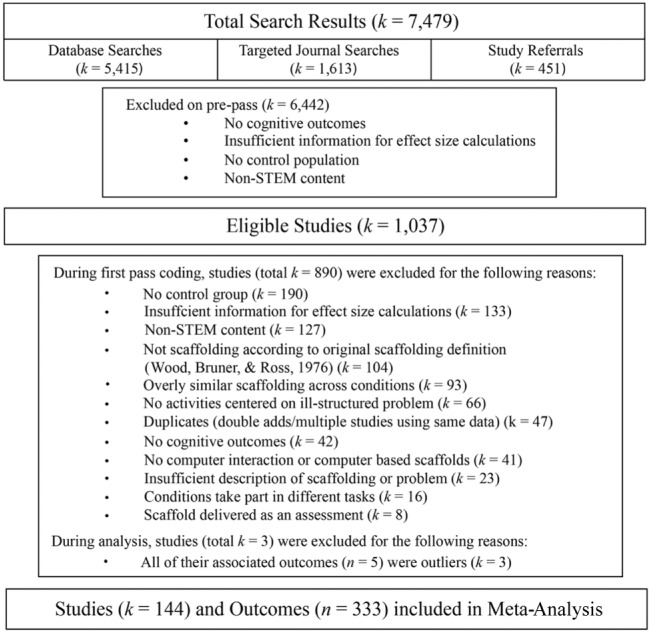
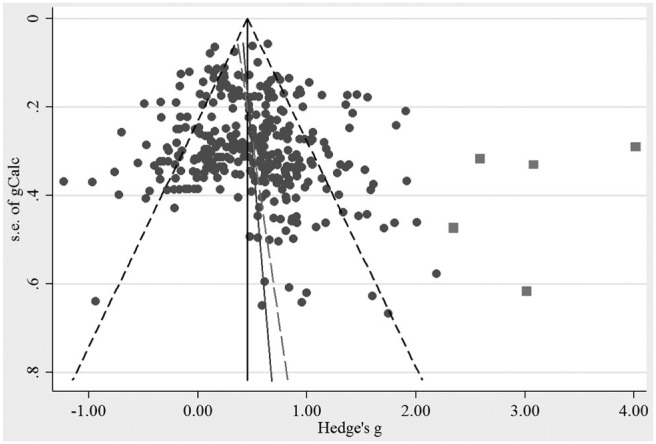
- Random-effects meta-analysis used Hedges’ g and STATA 14 metan; publication bias was assessed via funnel plot, Egger’s regression, and trim-and-fill. Five outlier outcomes and three associated studies were removed, reducing 338 outcomes/147 studies to 333 outcomes/144 studies. Effect-size dependency was addressed with composites (515 to 333 outcomes) and robust variance estimation.
Limitations
- The paper states meta-analyses cannot include all empirical research; qualitative studies and quantitative studies without control groups were excluded, so effect sizes do not reflect all empirical research on computer-based scaffolding.
- The coding scheme could not perfectly reflect every construct; it assigned a single value for scaffolding logic, and codes such as “none,” “traditional,” or “problem solving” may indicate lack of description as much as positive identification.
- Several moderator estimates relied on very small samples—motivation scaffolding (n = 3), design-based learning (n = 3), and adult population (n = 1)—producing wide confidence intervals and warranting caution; no primary research on preschool populations met inclusion criteria.
Model-written summary. Check it against the paper before relying on it.
Integrity signals
Registry
Cites
Statistics
Figures
Verification
Claims the paper makes
4 Valid · 2 Not valid · 30 Not checked · 74 Own results and interpretations
Every source the paper cites for this claim was checked and supports it.
In the paper
“Scaffolding in these contexts also has the potential to help problem-centered instructional models overcome criticisms that they do not lead to adequate content learning (Kirschner, Sweller, & Clark, 2006).”
§ Synthesizing Results From Empirical Research on Computer-Based Scaffolding in STEM Education > Discussion > Expansion of the Scaffolding Metaphor
What the sources say
- Supportedcites Kirschner, Sweller, & Clark, 2006 matched to “Why Minimal Guidance During Instruction Does Not Work: An Analysis of the Failure of Constructivist, Discovery, Problem-Based, Experiential, and Inquiry-Based Teaching” (2006) source
The paper criticizes minimally guided problem-based learning for weak knowledge acquisition in its Medical Problem-Based Learning Research section. Its Current Research Supporting Direct Guidance section also describes teachers using scaffolding while teaching content when students were not making progress. The sentence’s proposal that scaffolding may help address that criticism is consistent with these passages. (LLM, conf=0.90)
hedgedstates a possible cause- Asserted: passes — The authors put it forward as true.
- Checkable: passes — It can be checked against evidence.
- Load-bearing: passes — The paper’s conclusions depend on it.
- Based: passes — The paper gives a reason why it holds.
- Supported
A result the paper reports from its own data — it cites no other source for it, so there is none to check. The quote shows it is in the paper.
In the paper
“Scaffolding’s influence was greatest when measured at the principles level and among adult learners.”
§ Synthesizing Results From Empirical Research on Computer-Based Scaffolding in STEM Education > Abstract
plainstates a cause- Asserted: passes — The authors put it forward as true.
- Checkable: passes — It can be checked against evidence.
- Load-bearing: passes — The paper’s conclusions depend on it.
- Based: passes — The paper gives a reason why it holds.
A result the paper reports from its own data — it cites no other source for it, so there is none to check. The quote shows it is in the paper.
In the paper
“Specifically, scaffolding’s influence on cognitive outcomes did not vary on the basis of context-specificity, presence or absence of scaffolding change, and logic by which scaffolding change is implemented.”
§ Synthesizing Results From Empirical Research on Computer-Based Scaffolding in STEM Education > Abstract
plain- Asserted: passes — The authors put it forward as true.
- Checkable: passes — It can be checked against evidence.
- Load-bearing: passes — The paper’s conclusions depend on it.
- Based: passes — The paper gives a reason why it holds.
A result the paper reports from its own data — it cites no other source for it, so there is none to check. The quote shows it is in the paper.
In the paper
“Results of our random effect meta-analysis (a) indicate that computer-based scaffolding showed a consistently positive (ḡ = 0.46) effect on cognitive outcomes across various contexts of use, scaffolding characteristics, and levels of assessment”
§ Synthesizing Results From Empirical Research on Computer-Based Scaffolding in STEM Education > Abstract
hedgedstates a cause- Asserted: passes — The authors put it forward as true.
- Checkable: passes — It can be checked against evidence.
- Load-bearing: passes — The paper’s conclusions depend on it.
- Based: passes — The paper gives a reason why it holds.
59 more claims
Create a free account to see all 110 claims and to verify the 2 references still open.
- Probably not a substantial claim. 18
- It may state two separate claims as one. 32
- The quote only partly states this claim. 2
Claims other papers make about this one
Each is checked against this paper’s own text: does it say what the citing paper says it does?
In the citing paper
“Meta-analyses show that scaffolding enhances cognitive outcomes in digital learning environments (Belland et al., 2017;Chernikova et al., 2020).”
From Looking Beyond the Hype: Understanding the Effects of AI on Learning (2025) · cites this paper as Belland et al., 2017
Statistics recomputed
Every reported test result, recomputed from its test statistic and degrees of freedom. A result shows as not adding up only once an independent check has confirmed it.
- Consistentz = 18.19reported p < .01 · recomputed p < .001
“z = 18.19, p < .01”
- Consistentz = 2.29reported p < .05 · recomputed p = .022
“z = 2.29, p < .05”
- Consistentz = 4.69reported p < .01 · recomputed p < .001
“z = 4.69, p < .01”
- Consistentz = 5.09reported p < .01 · recomputed p < .001
“z = 5.09, p < .01”
- Consistentz = 5.36reported p < .01 · recomputed p < .001
“z = 5.36, p < .01”
8 more recomputed tests
Create a free account to see every test the Stats check recomputed.
Self-check
Percentages, sums and reported differences re-computed from the paper’s own numbers.
Each contradiction between two passages listed here was confirmed by an independent check.
Rated major: it would touch a result — a value a result rests on, reported and recomputed p-values on opposite sides of the significance level, two passages that conflict with no sign which is right, or a cited work retracted before this paper was published.
In the paper
§ Synthesizing Results From Empirical Research on Computer-Based Scaffolding in STEM Education > Results > Do Learner Characteristics Moderate Cognitive Student Outcomes?
“Hedges’ ḡ estimates were significantly greater than zero and substantial across all education levels”
§ Synthesizing Results From Empirical Research on Computer-Based Scaffolding in STEM Education > Discussion > Areas in Which More Empirical Work Is Needed
“when the effect size estimate was not significantly different from zero, the sample size was very small (i.e., three or fewer outcomes were used to calculate the effect size estimate). These circumstances included motivation scaffolding (n = 3), design-based learning (n = 3), and the adult population (n = 1).”
Rated minor: it would not touch a result — a value no result rests on, a p-value that stays on the same side of the significance level, or a conflict that is clerical, resolved elsewhere in the paper, or outside its own findings.
In the paper
§ Synthesizing Results From Empirical Research on Computer-Based Scaffolding in STEM Education > Discussion > Expansion of the Scaffolding Metaphor
“the effect size estimates for all three were above 0.40”
§ Synthesizing Results From Empirical Research on Computer-Based Scaffolding in STEM Education > Discussion
“The effect size estimates for scaffolding at the assessment levels of concept, principles, and application were 0.40, 0.51, and 0.44, respectively.”
Rated minor: it would not touch a result — a value no result rests on, a p-value that stays on the same side of the significance level, or a conflict that is clerical, resolved elsewhere in the paper, or outside its own findings.
In the paper
“86% (42% African American, 34% Hispanic, 4% Native American, 1% Filipino, 1% Pacific Islander/Other)”
§ Synthesizing Results From Empirical Research on Computer-Based Scaffolding in STEM Education > Method > Study Feature Coding
Reported 86 · recomputed 82
Citations
Cites
Statistical Power Analysis for the Behavioral Sciences
Muller, K. (1989) · Technometrics · doi:10.1080/00401706.1989.10488618 · Cited by 99,167
Bias in meta-analysis detected by a simple, graphical test
Egger, M., Smith, G. D., Schneider, M., & Minder, C. (1997) · BMJ · doi:10.1136/bmj.315.7109.629 · Cited by 56,722 · cited 1×
“These include visual inspection of a funnel plot, the trim and fill approach (Borenstein et al., 2009), and Egger’s regression test (Egger, Smith, Schneider, & Minder, 1997).”
MethodStatistical Power Analysis for the Behavioral Sciences (2nd ed.).
Lachenbruch, P. A., & Cohen, J. (1989) · Journal of the American Statistical Association · doi:10.2307/2290095 · Cited by 37,395
Content Analysis: An Introduction to its Methodology.
Shelley, M., & Krippendorff, K. (1984) · Journal of the American Statistical Association · doi:10.2307/2288384 · Cited by 24,312
Borenstein, M., Hedges, L. V., Higgins, J. P. T., & Rothstein, H. R. (2009) · doi:10.1002/9780470743386 · Cited by 14,225
Duval, S., & Tweedie, R. (2000) · Biometrics · doi:10.1111/j.0006-341x.2000.00455.x · Cited by 14,099 · cited 1×
“We also used trim-and-fill analysis (Duval & Tweedie, 2000) to compare the observed value and adjusted value as simulating a perfect symmetry but there was no significant difference between observed and adjusted effect sizes.”
MethodTHE ROLE OF TUTORING IN PROBLEM SOLVING *
Wood, D., Bruner, J. S., & Ross, G. (1976) · Journal of Child Psychology and Psychiatry · doi:10.1111/j.1469-7610.1976.tb00381.x · Cited by 8,851 · cited 13×
“In its original definition, scaffolding was intended to enhance problem-solving skill (Wood et al., 1976).”
BackgroundMethodInfluentialKirschner, P. A., Sweller, J., & Clark, R. E. (2006) · Educational Psychologist · doi:10.1207/s15326985ep4102_1 · Cited by 7,776 · cited 1×
“Scaffolding in these contexts also has the potential to help problem-cen-tered instructional models overcome criticisms that they do not lead to adequate content learning (Kirschner, Sweller, & Clark, 2006).”
BackgroundProblem-Based Learning: What and How Do Students Learn?
Hmelo-Silver, C. E. (2004) · Educational Psychology Review · doi:10.1023/b:edpr.0000034022.16470.f3 · Cited by 5,212 · cited 1×
“In problem-based learning, students produce a conceptual solution to the problem (Hmelo-Silver, 2004).”
BackgroundReciprocal Teaching of Comprehension-Fostering and Comprehension-Monitoring Activities
Palinscar, A. S., & Brown, A. L. (1984) · Cognition and Instruction · doi:10.1207/s1532690xci0102_1 · Cited by 5,186 · cited 1×
“One-to-one scaffolding soon began to be used among many populations (van de Pol et al., 2010) and across contexts (Palincsar & Brown, 1984).”
Background
Research works printed but not linked: 7
- Hannafin M. Land S. Oliver K. (1999). Open-ended learning environments: Foundations, methods, and models. In Reigeluth C. M. (Ed.), Instructional design theories and models: Volume II. A new paradigm of instructional theory (pp. 115– 140). Mahwah, NJ: Erlbaum.
- Knowles M. S. (1984). Andragogy in action. Applying modern principles of adult education. San Francisco, CA: Jossey-Bass.
- 10.1002/(sici)1098-2736(199909)36:7 · doi:10.1002/(sici)1098-2736(199909)36:7
- National Research Council. (2011). Successful K-12 STEM education: Identifying effective approaches in science, technology, engineering, and mathematics. Washington, DC: National Academies Press.
- National Science Board. (2010). Preparing the next generation of STEM innovators: Identifying and developing our nation’s human capital. Arlington, VA: National Science Foundation.
- Stark D. M. (2013). Ill-structured problems, scaffolding and problem-solving ability of novice nursing students (Doctoral dissertation). Available from ProQuest Dissertations & Theses database. (UMI No. 3553778)
- Zhang J. Chen Q. Reid D. J. (2000). Simulation-based scientific discovery learning: a research on the effects of experimental support and learners’ reasoning ability. In Proceedings IFIP World Computer Congress, Educational Uses of Communication and Information Technologies (pp. 344– 351). Beijing, China: ICEUT.
Cited by
Items 301–338 of 338
Ding, C. (2026) · Educational Research and Evaluation · doi:10.1080/13803611.2026.2655309
A domain-specific perspective on adaptivity
Strohmaier, A., Depaepe, F., Nickl, M., & Obersteiner, A. (2026) · Learning and Instruction · doi:10.1016/j.learninstruc.2026.102364
Carlino, F., & Searight, H. R. (2026) · International and cultural psychology/International and cultural psychology series · doi:10.1007/978-3-032-09977-8_13
Effects of Digital Scaffolding on Students' Conceptual Knowledge of Radiation and Radioactivity
Siersma, P. T., Visscher, A. J., Pol, H. J., Luyten, H., & van Joolingen, W. (2026) · Journal of Computer Assisted Learning · doi:10.1002/jcal.70248 · Cited by 1
A Bibliometric Analysis of Trends in Artificial Intelligence and STEM Education
Utami, A., & Winarno, N. (2026) · Pan-African journal of education and social sciences · doi:10.56893/pajes2025v06i03.01
Toward Just-in-Time Scaffolding: Predicting High-Risk Moments in iVR Speaking Tasks
Tao, L., & Song, Y. (2026) · International Conference on Learning Analytics and Knowledge (LAK) · doi:10.1145/3785022.3785123
Quandour, N., & Dabaj, F. (2026) · Sustainability · doi:10.3390/su18094452 · Cited by 4
Yusrina, H., Surama, Sutopo, A., & Muhibbin, A. (2026) · Frontiers in Education · doi:10.3389/feduc.2026.1767445 · Cited by 3
Fecko, B., Dziak, J., Vince, T., & Molnár, J. (2026) · Computers and Education Artificial Intelligence · doi:10.1016/j.caeai.2026.100611 · Cited by 1
Sarmiento, A. E. C., Jimenez, J. A., & Capili, L. J. C. (2026) · Psychology and Education A Multidisciplinary Journal · doi:10.70838/pemj.560503
KAGE: A Knowledge-Augmented Generative Engine for Cognitively Sustainable Cultural Heritage Design
Shi, G., & Zhang, J. (2026) · International Journal of Human-Computer Interaction · doi:10.1080/10447318.2026.2676217
Factors that explain simulation-based inquiry performance in physics learning
Gerdesmann, D., Schwichow, M., & Koerber, S. (2026) · Instructional Science · doi:10.1007/s11251-026-09806-2 · Cited by 1
A Framework for an Educational Multi-Agent System
Sharma, J., Gaur, V., & Saini, S. (2026) · Advances in computational intelligence and robotics book series · doi:10.4018/979-8-2600-2163-7.ch006
Human-Centric Generative AI Literacy in Business Education CurriculumPreprint
Reynolds, J. (2026) · SSRN Electronic Journal · doi:10.2139/ssrn.6883290
Gómez, A. S. V., Olfos, R., & Estrella, S. (2026) · Discover Education · doi:10.1007/s44217-026-01783-5
“Research on training for teaching mathematics shows the importance of providing training and scaffolding to teachers using technologies, video clips, smartphone applications and/or websites [8, 58].”
Murali, R., Dhanalakshmy, D. M., Sunny, S., & Rajagopal, V. (2026) · IEEE Global Engineering Education Conference (EDUCON) · doi:10.1109/educon67543.2026.11574453
Bian, Y., & Jiang, Y. (2026) · International Journal of Mechanical Engineering Education · doi:10.1177/03064190261464478
Schaaf, J., Rolfes, T., Nagy, G., & Heinze, A. (2026) · Frontiers in Education · doi:10.3389/feduc.2026.1842708
Schroeder, N. L., Zhang, S., Gladstone, J. R., & Bhat, S. (2026) · Journal of Educational Computing Research · doi:10.1177/07356331261467266
Anugrah, S., Kurnia, R., Hendri, N., & Rayendra, R. (2026) · European Journal of Educational Research · doi:10.12973/eu-jer.15.4.1131
Stoeger, H., & Ziegler, A. (2026) · Education Sciences · doi:10.3390/educsci16081224
Alulema, D., & Montenegro, E. (2026) · Applied Sciences · doi:10.3390/app16157774
Luo, J., Li, S., Chiu, T. K. F., & Xiaoming, C. (2026) · Interactive Learning Environments · doi:10.1080/10494820.2026.2685803
Chen, M., Wang, H., Chen, Z., Zhang, Q., & Xu, X. (2026) · Educational Studies · doi:10.1080/03055698.2026.2716064
Effects of Instructional Guidance on Modeling Causal Loop Diagrams in Climate Change Education
Tuncel, N., Beege, M., & Rieß, W. (2026) · Education Sciences · doi:10.3390/educsci16081326
“In a meta-analysis of computer-based scaffolding, Belland et al. (2017) found no significant differences in learning outcomes between scaffolds incorporating fading, adding, fading combined with adding, or no customization at all.”
InfluentialChen, Q., & Zhao, L. (2026) · International Conference on Computer Science and Technologies in Education (CSTE) · doi:10.1109/cste69562.2026.11649623
“Low-complexity tasks focus on memory and comprehension and can be completed independently by students; excessive scaffolding may lead to redundancy [18].”
Dallal, A. H. (2026) · ASEE Annual Conference & Exposition · doi:10.18260/1-2--59338
Biomedical Engineering: Staying hands-on in an online world
Donovan, K. J., Walker, T. W., & Brunmaier, L. A. E. (2026) · ASEE Annual Conference & Exposition · doi:10.18260/1-2--59166
Toward a framework of uncertainty in ill-structured problem solving
Clark-Stallkamp, R., & Lockee, B. B. (2026) · Educational Technology Research and Development · doi:10.1007/s11423-026-10680-5 · Cited by 1
Suparjan, S., Purwanta, E., Salido, A., Ismiyani, N., Akbar, A., Kiptiyah, S. M., Nurzaman, I., & Sesmiyanti, S. (2026) · International Journal of Learning Teaching and Educational Research · doi:10.26803/ijlter.25.8.46
Exploring the Effects of Generative AI on Learning Using the ISAR Model
Bauer, E., Greiff, S., Graesser, A. C., Scheiter, K., & Sailer, M. (2026) · Springer eBooks · doi:10.1007/978-3-032-24819-0_3
Putri, K. E., Setyosarı, P., & Ekawati, R. (2026) · Journal of Baltic Science Education · doi:10.33225/jbse/26.25.695
Cho, N., Li, H., Zhang, X., & Li, Y. (2026) · Journal of Science Education and Technology · doi:10.1007/s10956-026-10359-9
Zhao, W., Guo, Z., Zhou, Y., Tu, Y., Huang, C., & Huang, Q. (2026) · International Journal of STEM Education · doi:10.1186/s40594-026-00647-6
“Inquiry learning often benefits from well-designed guidance and scaffolding, especially when students need to plan procedures, monitor progress, and revise strategies during complex tasks (Belland et al., 2017; Lazonder & Harmsen, 2016).”
Smink, J. A. (2026) · Journal of Microbiology and Biology Education · doi:10.1128/jmbe.00201-26
Moju, M., Adejumo, B. M., & Shakiru, J. I. (2026) · Interdisciplinary Journal of Environmental and Science Education · doi:10.29333/ijese/19450
“…most effective when thoughtfully designed and strategically facilitated, with teachers playing a critical role in moderating cognitive demand, clarifying task goals, and supporting students as they move from initial confusion toward understanding (Belland et al., 2017; Hmelo-Silver et al., 2007).”
Тулученко, Г., Білоусова, Т. П., & Vygodner, I. V. (2026) · International Conference on Advanced Computer Information Technologies (ACIT) · doi:10.1109/acit69831.2026.11700178
“In this context, scaffolding serves as an effective pedagogical tool — a system of step-by-step support that adapts task complexity to the student’s current cognitive capabilities [8], [9].”
Santosa, I., Sadikin, I. S., Cinantia, I. G., Iskandar, I., & Dinihari, Y. (2026) · Berkala Ilmiah Pendidikan · doi:10.51214/bip.v6i2.2304
Metadata
- Authors
- Belland, B. R., Walker, A. E., Kim, N. J., & Lefler, M.
- Affiliations
- Utah State University (US)
- Venue
- Review of Educational Research
- Published
- 2016-10-11
- Volume
- 87
- Issue
- 2
- Pages
- 309-344
- ISSN
- 0034-6543 (ISSN-L)
- 1935-1046
- PMC
- PMC5347356
- OpenAlex
- W2530735505
- Cited by
- 346
- References
- 127
- Citations by year
- 2026: 62 · 2025: 44 · 2024: 35 · 2023: 46 · 2022: 52 · 2021: 31 · 2020: 29 · 2019: 22 · 2018: 11 · 2017: 9 · 2016: 5
- FWCI
- 36.56
- Type
- journal article
- Language
- en
- Open access
- hybrid
- doi.org
- Licence
- Locations
- Review of Educational Research (publishedVersion, cc-by-nc)
- Europe PMC (PubMed Central) (publishedVersion, cc-by-nc)
- PubMed Central (publishedVersion, cc-by-nc)
- PubMed (publishedVersion)
- Topics
- Social Sciences › Psychology › Developmental and Educational Psychology › Innovative Teaching and Learning Methods
- Social Sciences › Psychology › Experimental and Cognitive Psychology › Visual and Cognitive Learning Processes
- Physical Sciences › Computer Science › Artificial Intelligence › Intelligent Tutoring Systems and Adaptive Learning
- Keywords
- STEM education, cognitive outcomes, ill-structured problems, adult learners, primary education, educational technology effectiveness
About these checks
Registry, retraction, Cites and statistics results are computed, not judged, with one exception: a printed reference that no index lists is read once by a model before it counts as a citation error. Claims are extracted by a model and kept only when their quote appears verbatim in the text; each cited source is then checked, with a model’s help, for whether it says what the claim relies on. Those verdicts can be wrong — read the claim’s quote and the cited source before relying on one.
The claim verdicts this report counts are experimental: their accuracy is not yet measured.
A language model drew the claims from the paper on 2026-10-05, under version 3 of the claim definition (model deepseek-v4.1-flash, prompt extract-v3).
A second model labelled each claim on 2026-10-05 (model jev-1.13-20260917, definition revision gold-guideline-v0.2).
Cited sources are checked with a language model’s help (gpt-6-sol).
Statistics and arithmetic are recomputed, not judged.
Confidence bands are shown only for fields calibrated on our annotated test set. None is calibrated yet, so no band is shown.
What counts as a claim ›How we measure confidence ›How we check this ›
Are you an author, or do you see a problem with this page? Request a review
Data sources
Bibliographic data: Semantic Scholar, OpenAlex, Crossref.
Contains information from the Semantic Scholar Academic Graph Datasets, made available under the ODC Attribution License (ODC-BY 1.0).
Semantic Scholar’s data is described in: Kinney, R., et al. (2023). The Semantic Scholar Open Data Platform. arXiv:2301.10140.
