

Synthesizing Results From Empirical Research on Computer-Based Scaffolding in STEM Education
Open accessThe DOI matches its Crossref record; 124 of the 127 references it cites were found in a registry or an index, and 2 are not checked yet; 4 of the 45 sources its claims cite were checked for support.
Abstract
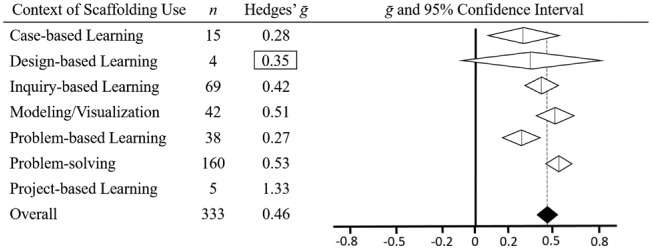
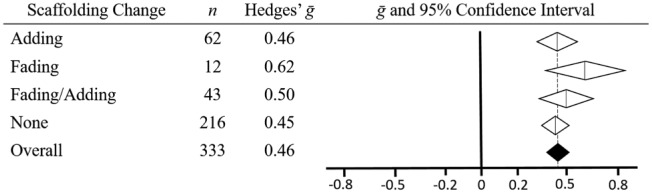
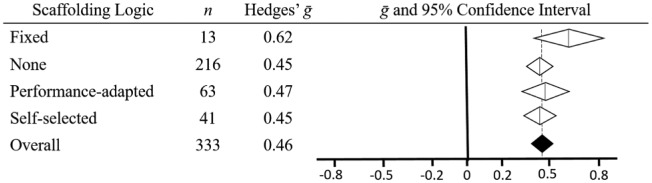
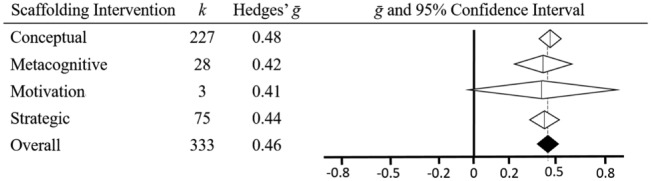
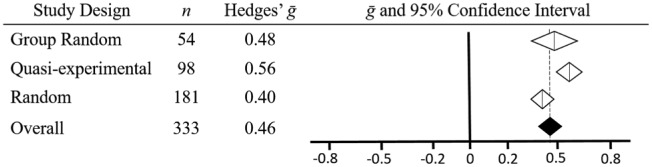
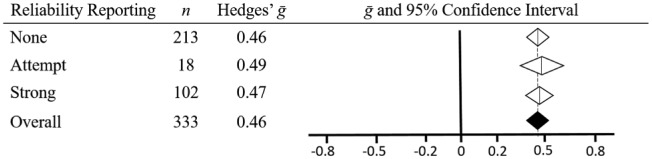
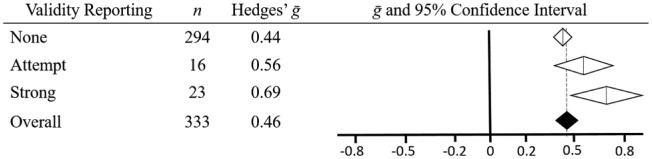
Computer-based scaffolding assists students as they generate solutions to complex problems, goals, or tasks, helping increase and integrate their higher order skills in the process. However, despite decades of research on scaffolding in STEM (science, technology, engineering, and mathematics) education, no existing comprehensive meta-analysis has synthesized the results of these studies. This review addresses that need by synthesizing the results of 144 experimental studies (333 outcomes) on the effects of computer-based scaffolding designed to assist the full range of STEM learners (primary through adult education) as they navigated ill-structured, problem-centered curricula. Results of our random effect meta-analysis (a) indicate that computer-based scaffolding showed a consistently positive (ḡ = 0.46) effect on cognitive outcomes across various contexts of use, scaffolding characteristics, and levels of assessment and (b) shed light on many scaffolding debates, including the roles of customization (i.e., fading and adding) and context-specific support. Specifically, scaffolding's influence on cognitive outcomes did not vary on the basis of context-specificity, presence or absence of scaffolding change, and logic by which scaffolding change is implemented. Scaffolding's influence was greatest when measured at the principles level and among adult learners. Still scaffolding's effect was substantial and significantly greater than zero across all age groups and assessment levels. These results suggest that scaffolding is a highly effective intervention across levels of different characteristics and can largely be designed in many different ways while still being highly effective.
Verified 2026-11-22 · 2 references not checked yet
Overview
CoChat Summary
TL;DR
This comprehensive random-effects meta-analysis of 144 experimental studies (333 outcomes) found that computer-based scaffolding in STEM education produced a consistently positive effect on cognitive outcomes (ḡ = 0.46). Effects were substantial across learner populations, contexts, and assessment levels, with no significant moderation by context-specificity, scaffolding change, or scaffolding logic.
Key findings
- Computer-based scaffolding significantly improved cognitive outcomes versus no scaffolding: overall ḡ = 0.46, z = 18.19, p < .01, across 333 outcomes from 144 studies.
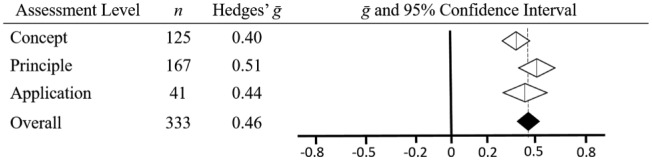
- Assessment-level effects were concept ḡ = 0.40, principles ḡ = 0.51, and application ḡ = 0.44; scaffolding’s influence was greater at the principles level than at the concept level (z = 2.17, p < .05).
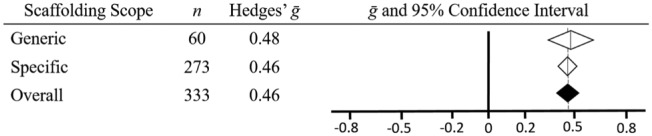
- No statistically significant differences were found for context-specific versus generic scaffolding (z = −0.281, p = .778), scaffolding change/fading (p > .05), or scaffolding logic (p > .05).
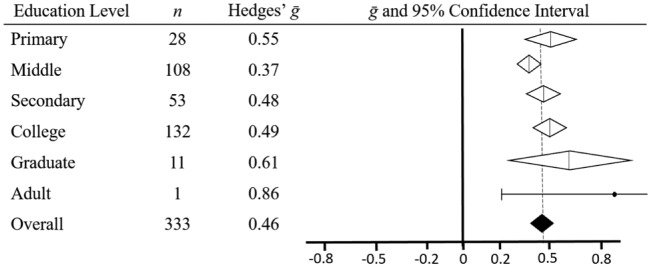
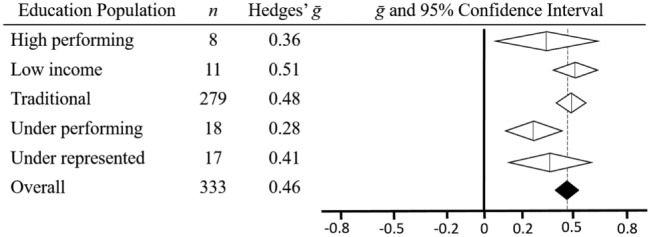
- Effects were significantly greater than zero across education levels, but adult learners had the highest estimate based on only one outcome; traditional versus underperforming learners differed significantly (z = 2.29, p < .05). Motivation scaffolding (n = 3), design-based learning (n = 3), and adult population (n = 1) estimates were not significantly greater than zero, with caution due to small samples.
Methods
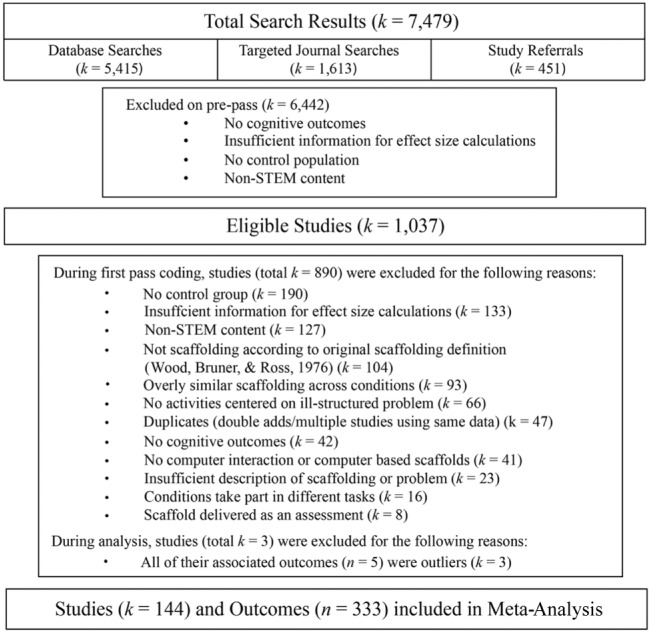
- Meta-analysis of studies published January 1, 1993–December 31, 2014, with a control condition receiving an educational intervention but no scaffolding, cognitive outcomes, sufficient effect-size information, Wood et al. (1976) scaffolding, and ill-structured STEM problems. Searches covered databases including Education Source, PsychINFO, ERIC, PubMed, IEEE, and Google Scholar, plus hand searches and reference-list searches.
- Four coders independently coded studies, reached consensus, and achieved Krippendorff’s alphas greater than .667; 333 data points were used for interrater reliability.
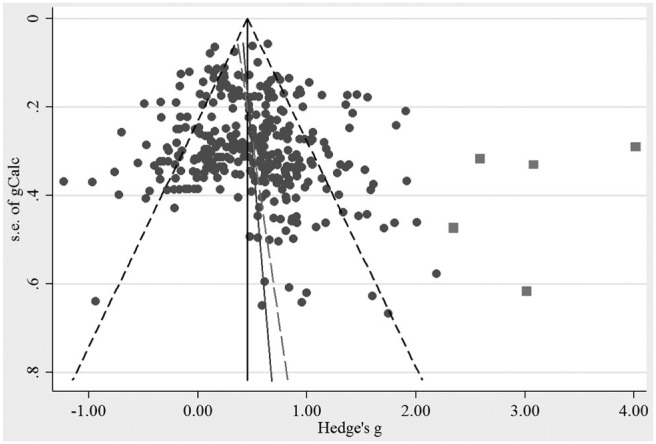
- Random-effects meta-analysis used Hedges’ g and STATA 14 metan; publication bias was assessed via funnel plot, Egger’s regression, and trim-and-fill. Five outlier outcomes and three associated studies were removed, reducing 338 outcomes/147 studies to 333 outcomes/144 studies. Effect-size dependency was addressed with composites (515 to 333 outcomes) and robust variance estimation.
Limitations
- The paper states meta-analyses cannot include all empirical research; qualitative studies and quantitative studies without control groups were excluded, so effect sizes do not reflect all empirical research on computer-based scaffolding.
- The coding scheme could not perfectly reflect every construct; it assigned a single value for scaffolding logic, and codes such as “none,” “traditional,” or “problem solving” may indicate lack of description as much as positive identification.
- Several moderator estimates relied on very small samples—motivation scaffolding (n = 3), design-based learning (n = 3), and adult population (n = 1)—producing wide confidence intervals and warranting caution; no primary research on preschool populations met inclusion criteria.
Model-written summary. Check it against the paper before relying on it.
Integrity signals
Registry
Cites
Statistics
Figures
Verification
Claims the paper makes
4 Valid · 2 Not valid · 30 Not checked · 74 Own results and interpretations
Every source the paper cites for this claim was checked and supports it.
In the paper
“Scaffolding in these contexts also has the potential to help problem-centered instructional models overcome criticisms that they do not lead to adequate content learning (Kirschner, Sweller, & Clark, 2006).”
§ Synthesizing Results From Empirical Research on Computer-Based Scaffolding in STEM Education > Discussion > Expansion of the Scaffolding Metaphor
What the sources say
- Supportedcites Kirschner, Sweller, & Clark, 2006 matched to “Why Minimal Guidance During Instruction Does Not Work: An Analysis of the Failure of Constructivist, Discovery, Problem-Based, Experiential, and Inquiry-Based Teaching” (2006) source
The paper criticizes minimally guided problem-based learning for weak knowledge acquisition in its Medical Problem-Based Learning Research section. Its Current Research Supporting Direct Guidance section also describes teachers using scaffolding while teaching content when students were not making progress. The sentence’s proposal that scaffolding may help address that criticism is consistent with these passages. (LLM, conf=0.90)
hedgedstates a possible cause- Asserted: passes — The authors put it forward as true.
- Checkable: passes — It can be checked against evidence.
- Load-bearing: passes — The paper’s conclusions depend on it.
- Based: passes — The paper gives a reason why it holds.
- Supported
A result the paper reports from its own data — it cites no other source for it, so there is none to check. The quote shows it is in the paper.
In the paper
“Scaffolding’s influence was greatest when measured at the principles level and among adult learners.”
§ Synthesizing Results From Empirical Research on Computer-Based Scaffolding in STEM Education > Abstract
plainstates a cause- Asserted: passes — The authors put it forward as true.
- Checkable: passes — It can be checked against evidence.
- Load-bearing: passes — The paper’s conclusions depend on it.
- Based: passes — The paper gives a reason why it holds.
A result the paper reports from its own data — it cites no other source for it, so there is none to check. The quote shows it is in the paper.
In the paper
“Specifically, scaffolding’s influence on cognitive outcomes did not vary on the basis of context-specificity, presence or absence of scaffolding change, and logic by which scaffolding change is implemented.”
§ Synthesizing Results From Empirical Research on Computer-Based Scaffolding in STEM Education > Abstract
plain- Asserted: passes — The authors put it forward as true.
- Checkable: passes — It can be checked against evidence.
- Load-bearing: passes — The paper’s conclusions depend on it.
- Based: passes — The paper gives a reason why it holds.
A result the paper reports from its own data — it cites no other source for it, so there is none to check. The quote shows it is in the paper.
In the paper
“Results of our random effect meta-analysis (a) indicate that computer-based scaffolding showed a consistently positive (ḡ = 0.46) effect on cognitive outcomes across various contexts of use, scaffolding characteristics, and levels of assessment”
§ Synthesizing Results From Empirical Research on Computer-Based Scaffolding in STEM Education > Abstract
hedgedstates a cause- Asserted: passes — The authors put it forward as true.
- Checkable: passes — It can be checked against evidence.
- Load-bearing: passes — The paper’s conclusions depend on it.
- Based: passes — The paper gives a reason why it holds.
59 more claims
Create a free account to see all 110 claims and to verify the 2 references still open.
- Probably not a substantial claim. 18
- It may state two separate claims as one. 32
- The quote only partly states this claim. 2
Claims other papers make about this one
Each is checked against this paper’s own text: does it say what the citing paper says it does?
In the citing paper
“Meta-analyses show that scaffolding enhances cognitive outcomes in digital learning environments (Belland et al., 2017;Chernikova et al., 2020).”
From Looking Beyond the Hype: Understanding the Effects of AI on Learning (2025) · cites this paper as Belland et al., 2017
Statistics recomputed
Every reported test result, recomputed from its test statistic and degrees of freedom. A result shows as not adding up only once an independent check has confirmed it.
- Consistentz = 18.19reported p < .01 · recomputed p < .001
“z = 18.19, p < .01”
- Consistentz = 2.29reported p < .05 · recomputed p = .022
“z = 2.29, p < .05”
- Consistentz = 4.69reported p < .01 · recomputed p < .001
“z = 4.69, p < .01”
- Consistentz = 5.09reported p < .01 · recomputed p < .001
“z = 5.09, p < .01”
- Consistentz = 5.36reported p < .01 · recomputed p < .001
“z = 5.36, p < .01”
8 more recomputed tests
Create a free account to see every test the Stats check recomputed.
Self-check
Percentages, sums and reported differences re-computed from the paper’s own numbers.
Each contradiction between two passages listed here was confirmed by an independent check.
Rated major: it would touch a result — a value a result rests on, reported and recomputed p-values on opposite sides of the significance level, two passages that conflict with no sign which is right, or a cited work retracted before this paper was published.
In the paper
§ Synthesizing Results From Empirical Research on Computer-Based Scaffolding in STEM Education > Results > Do Learner Characteristics Moderate Cognitive Student Outcomes?
“Hedges’ ḡ estimates were significantly greater than zero and substantial across all education levels”
§ Synthesizing Results From Empirical Research on Computer-Based Scaffolding in STEM Education > Discussion > Areas in Which More Empirical Work Is Needed
“when the effect size estimate was not significantly different from zero, the sample size was very small (i.e., three or fewer outcomes were used to calculate the effect size estimate). These circumstances included motivation scaffolding (n = 3), design-based learning (n = 3), and the adult population (n = 1).”
Rated minor: it would not touch a result — a value no result rests on, a p-value that stays on the same side of the significance level, or a conflict that is clerical, resolved elsewhere in the paper, or outside its own findings.
In the paper
§ Synthesizing Results From Empirical Research on Computer-Based Scaffolding in STEM Education > Discussion > Expansion of the Scaffolding Metaphor
“the effect size estimates for all three were above 0.40”
§ Synthesizing Results From Empirical Research on Computer-Based Scaffolding in STEM Education > Discussion
“The effect size estimates for scaffolding at the assessment levels of concept, principles, and application were 0.40, 0.51, and 0.44, respectively.”
Rated minor: it would not touch a result — a value no result rests on, a p-value that stays on the same side of the significance level, or a conflict that is clerical, resolved elsewhere in the paper, or outside its own findings.
In the paper
“86% (42% African American, 34% Hispanic, 4% Native American, 1% Filipino, 1% Pacific Islander/Other)”
§ Synthesizing Results From Empirical Research on Computer-Based Scaffolding in STEM Education > Method > Study Feature Coding
Reported 86 · recomputed 82
Citations
Cites
Statistical Power Analysis for the Behavioral Sciences
Muller, K. (1989) · Technometrics · doi:10.1080/00401706.1989.10488618 · Cited by 99,167
Bias in meta-analysis detected by a simple, graphical test
Egger, M., Smith, G. D., Schneider, M., & Minder, C. (1997) · BMJ · doi:10.1136/bmj.315.7109.629 · Cited by 56,722 · cited 1×
“These include visual inspection of a funnel plot, the trim and fill approach (Borenstein et al., 2009), and Egger’s regression test (Egger, Smith, Schneider, & Minder, 1997).”
MethodStatistical Power Analysis for the Behavioral Sciences (2nd ed.).
Lachenbruch, P. A., & Cohen, J. (1989) · Journal of the American Statistical Association · doi:10.2307/2290095 · Cited by 37,395
Content Analysis: An Introduction to its Methodology.
Shelley, M., & Krippendorff, K. (1984) · Journal of the American Statistical Association · doi:10.2307/2288384 · Cited by 24,312
Borenstein, M., Hedges, L. V., Higgins, J. P. T., & Rothstein, H. R. (2009) · doi:10.1002/9780470743386 · Cited by 14,225
Duval, S., & Tweedie, R. (2000) · Biometrics · doi:10.1111/j.0006-341x.2000.00455.x · Cited by 14,099 · cited 1×
“We also used trim-and-fill analysis (Duval & Tweedie, 2000) to compare the observed value and adjusted value as simulating a perfect symmetry but there was no significant difference between observed and adjusted effect sizes.”
MethodTHE ROLE OF TUTORING IN PROBLEM SOLVING *
Wood, D., Bruner, J. S., & Ross, G. (1976) · Journal of Child Psychology and Psychiatry · doi:10.1111/j.1469-7610.1976.tb00381.x · Cited by 8,851 · cited 13×
“In its original definition, scaffolding was intended to enhance problem-solving skill (Wood et al., 1976).”
BackgroundMethodInfluentialKirschner, P. A., Sweller, J., & Clark, R. E. (2006) · Educational Psychologist · doi:10.1207/s15326985ep4102_1 · Cited by 7,776 · cited 1×
“Scaffolding in these contexts also has the potential to help problem-cen-tered instructional models overcome criticisms that they do not lead to adequate content learning (Kirschner, Sweller, & Clark, 2006).”
BackgroundProblem-Based Learning: What and How Do Students Learn?
Hmelo-Silver, C. E. (2004) · Educational Psychology Review · doi:10.1023/b:edpr.0000034022.16470.f3 · Cited by 5,212 · cited 1×
“In problem-based learning, students produce a conceptual solution to the problem (Hmelo-Silver, 2004).”
BackgroundReciprocal Teaching of Comprehension-Fostering and Comprehension-Monitoring Activities
Palinscar, A. S., & Brown, A. L. (1984) · Cognition and Instruction · doi:10.1207/s1532690xci0102_1 · Cited by 5,186 · cited 1×
“One-to-one scaffolding soon began to be used among many populations (van de Pol et al., 2010) and across contexts (Palincsar & Brown, 1984).”
Background
Research works printed but not linked: 7
- Hannafin M. Land S. Oliver K. (1999). Open-ended learning environments: Foundations, methods, and models. In Reigeluth C. M. (Ed.), Instructional design theories and models: Volume II. A new paradigm of instructional theory (pp. 115– 140). Mahwah, NJ: Erlbaum.
- Knowles M. S. (1984). Andragogy in action. Applying modern principles of adult education. San Francisco, CA: Jossey-Bass.
- 10.1002/(sici)1098-2736(199909)36:7 · doi:10.1002/(sici)1098-2736(199909)36:7
- National Research Council. (2011). Successful K-12 STEM education: Identifying effective approaches in science, technology, engineering, and mathematics. Washington, DC: National Academies Press.
- National Science Board. (2010). Preparing the next generation of STEM innovators: Identifying and developing our nation’s human capital. Arlington, VA: National Science Foundation.
- Stark D. M. (2013). Ill-structured problems, scaffolding and problem-solving ability of novice nursing students (Doctoral dissertation). Available from ProQuest Dissertations & Theses database. (UMI No. 3553778)
- Zhang J. Chen Q. Reid D. J. (2000). Simulation-based scientific discovery learning: a research on the effects of experimental support and learners’ reasoning ability. In Proceedings IFIP World Computer Congress, Educational Uses of Communication and Information Technologies (pp. 344– 351). Beijing, China: ICEUT.
Cited by
Items 201–300 of 338
Das Beurteilen von Lernprodukten als Facette diagnostischer Kompetenz fördern
Eichler, A., Rathgeb-Schnierer, E., & Volkmer, J. P. (2022) · Journal für Mathematik-Didaktik · doi:10.1007/s13138-022-00216-8 · Cited by 5
Doğru, M. S. (2023) · Research on Education and Psychology · doi:10.54535/rep.1340404 · Cited by 3
Liu, M., Han, S., Shao, P., & Cai, Y. C. (2025) · Educational Technology Research and Development · doi:10.1007/s11423-025-10465-2 · Cited by 3
“Yet, research on PBL has documented many challenges (Belland et al., 2017; Ertmer & Simons, 2006; Wijnen et al., 2018).”
Schaaf, J., Rolfes, T., Nagy, G., & Heinze, A. (2026) · Frontiers in Education · doi:10.3389/feduc.2025.1738655 · Cited by 3
“Belland et al. (2017) concluded in their meta-analysis that scaffolding, a form of guided activity, has a significant positive effect ( g 1 = 0.46) on learning outcomes in STEM education.”
InfluentialA hybrid AI framework for engineering risk management under data scarcity and high uncertainty
Ataei, B., & Nazari, A. (2026) · International Journal of Construction Management · doi:10.1080/15623599.2026.2636004 · Cited by 4
“Therefore, the performance of the proposed model should not be viewed as an automatic substitute for engineering expertise, but rather as a ‘Cognitive Scaffold’ that enhances managers’ manual and mental evaluation processes through the systematic recycling of past experiences (Belland et al. 2017).”
ARPG+: a simulation-based study of real-time coaching for educational LLM prompting
Ye, P.-G., Mo, K., Long, Y., Liu, M., Sang, H., & Zheng, J. (2026) · International Journal of Educational Technology in Higher Education · doi:10.1186/s41239-026-00606-9 · Cited by 4
“Prior work has operationalised each construct in isolation (Belland et al., 2017; Kulik & Fletcher, 2016; Martin et al., 2025); what ARPG+ shows is that they can be combined into a sub-turn-latency control law that decides when to intervene, at what granularity, and when to withdraw.”
The Notion of Arts in STEAM Concept: A Semi-Systematic Literature Review
Girdzijauskienė, R., & Šmitienė, G. (2021) · Pedagogika · doi:10.15823/p.2020.140.9 · Cited by 2
Exploring the Differences Between Experts and Novices on Inquiry-Based Learning Cases
Tawfik, A. A., Gatewood, J. D., Gish-Lieberman, J. J., & Keene, C. W. (2021) · Journal of Formative Design in Learning · doi:10.1007/s41686-021-00062-w · Cited by 3
“If learners struggle to identify the concepts in the case, this is also problematic for those that argue that learners generate a rich set of cases from which they can reference from IBL (Belland et al., 2017; Tawfik & Kolodner, 2016).”
BackgroundGenerating Pedagogical Questions to Help Students Learn
Александрович, С. О., & Gumerov, M. F. (2023) · Lecture notes in computer science · doi:10.1007/978-3-031-32883-1_17 · Cited by 3
Lee, Y.-H., & Peng, S.-W. (2023) · Lecture notes in computer science · doi:10.1007/978-3-031-34550-0_10 · Cited by 2
Scaffolding principles of content-based science instruction in an international elementary school
Kamrani, Z., Tajeddin, Z., & Alemi, M. (2023) · Pedagogies An International Journal · doi:10.1080/1554480x.2023.2222716 · Cited by 8
Unterrichtsqualität und Instruktionsstrategien
Ufer, S., Heinze, A., & Lipowsky, F. (2023) · Springer eBooks · doi:10.1007/978-3-662-66604-3_15 · Cited by 5
Aikawa, N., Maeda, S., Mogi, T., Koike, K., Tomoto, T., Imai, I., Horiguchi, T., & Hirashima, T. (2023) · Research and Practice in Technology Enhanced Learning · doi:10.58459/rptel.2024.19026 · Cited by 3
“Scaffolding is a teacher-supported process that enables learners to perform tasks they cannot complete independently (Wood et al., 1976), and meta-analyses have shown that it improves individual academic performance (Belland et al. 2017).”
BackgroundUtilizing Automated Scaffolding Strategies to Improve Students' Reflections Writing Process
Anwar, S., Butt, A. A., & Menekşe, M. (2023) · IEEE Frontiers in Education Conference (FIE) · doi:10.1109/fie58773.2023.10343485 · Cited by 3
“Scaffolding in the literature indicates the support provided to students while performing a task [18], [19].”
Student Ratings of Instruction: Updating Measures to Reflect Recent Scholarship
Dyer, K. D., & Donnelly-Hermosillo, D. F. (2024) · Research in Higher Education · doi:10.1007/s11162-024-09804-8 · Cited by 2
Understanding teacher ICT usage: Insights from ICILS 2018 Korea data
Cho, N., & Huang, C. (2024) · Social Sciences & Humanities Open · doi:10.1016/j.ssaho.2024.101120 · Cited by 6
Zeng, Y., Liu, D., Mao, Y., & Kang, R. (2024) · Exceptionality · doi:10.1080/09362835.2024.2409078 · Cited by 3
“Belland et al. (2017) examined the effects of computer-based instruction for STEM learners.”
Wang, R., Li, X., Hu, W., Li, Y., & Tian, J. (2025) · Thinking Skills and Creativity · doi:10.1016/j.tsc.2025.101753 · Cited by 5
The impact of different types of self-regulation scaffolds on learning science with hypermedia
Gril, A., Podlešek, A., Komidar, L., Kavčič, A., Steiner, K. D., Pečjak, S., Pirc, T., Levpušček, M. P., Podgornik, B. B., Hladnik, A., et al. (2025) · Computers in Human Behavior · doi:10.1016/j.chb.2025.108670 · Cited by 7
Al-Makhzoomy, A. K., Zhang, K., & Spannaus, T. W. (2019) · Advances in educational technologies and instructional design book series · doi:10.4018/978-1-7998-0249-5.ch012 · Cited by 2
Психолого-педагогічні засади формування професійних компетентностей майбутніх офіцерів-психологів
Babak, S., Stadnik, A. V., & Мельник, Ю. Б. (2020) · International Journal of Education and Science · doi:10.26697/ijes.2020.3.4 · Cited by 2
Aquino, K. C. (2022) · Journal of Experiential Education · doi:10.1177/10538259221115813 · Cited by 2
“In addition to integrating technology to best support the intended audience of the students’ academic service learning project, it was important to integrate various tech tools to maximize the student engagement, collaboration, and learning in course collaboration and project development (Belland et al., 2017; Higgins…”
BackgroundSu, K.-D., & Chen, H.-Y. (2022) · Lecture notes in computer science · doi:10.1007/978-3-031-15273-3_39 · Cited by 3
Principles Based on Generative Activity in Multimedia Learning
Mayer, R. E., & Fiorella, L. (2021) · Cambridge University Press eBooks · doi:10.1017/9781108894333.035 · Cited by 4
Opitz, A., Fischer, M. R., Seidel, T., & Fischer, F. (2022) · Springer eBooks · doi:10.1007/978-3-030-89147-3_11 · Cited by 2
Perspectives on learning from the learning sciences
Fischer, F., Sommerhoff, D., & Keune, A. (2022) · Elsevier eBooks · doi:10.1016/b978-0-12-818630-5.14007-2 · Cited by 7
Alam, S. S., & Dubé, A. K. (2023) · Springer eBooks · doi:10.1007/978-3-031-31848-1_7 · Cited by 1
Volkmer, J. P., Eichler, A., & Rathgeb-Schnierer, E. (2023) · Frontiers in Psychology · doi:10.3389/fpsyg.2023.1285919 · Cited by 1
ICT Skills for Future Professional Performance of Biology Education Students of Papua
Nurbaya, N. (2024) · Jurnal Penelitian Pendidikan IPA · doi:10.29303/jppipa.v10i7.7208 · Cited by 5
“Using and integrating ICT in teaching-learning process can be benefit for (Belland et al., 2017; Legrain et al., 2015; Li & Ranieri, 2010; Sung et al., 2017).”
How can Scaffolding Effectively Promote Students’ Problem-Solving Ability: A Meta-Analysis
Gou, P., Li, W., & Teng, T. (2025) · The Asia-Pacific Education Researcher · doi:10.1007/s40299-025-01022-9 · Cited by 5
Zhao, J., Yu, L., Fu, X., et al. (2025) · International Conference on Distance Education and Learning (ICDEL) · doi:10.1109/icdel65868.2025.11193557 · Cited by 1
Bauer, M., Witti, M. J., Stadler, M. J., Weiß, A., Fischer, M. R., & Richters, C. (2026) · JMIR Medical Education · doi:10.2196/85139 · Cited by 4
Jang, H., Kim, S., & So, H. (2025) · Learning Research and Practice · doi:10.1080/23735082.2025.2591403 · Cited by 4
Rincón, Y. R., Munárriz, A., & Magreñán, Á. A. (2026) · International Journal of Educational Technology in Higher Education · doi:10.1186/s41239-025-00576-4 · Cited by 10
Habig, B., Geller, F., Gupta, P., Adams, J. D., & Holford, M. (2026) · Frontiers in Education · doi:10.3389/feduc.2025.1717945 · Cited by 3
Ayan, B., & Üstündağ, M. T. (2026) · Applied Sciences · doi:10.3390/app16062998 · Cited by 1
Rexhäuser, D., Radkowitsch, A., Richters, C., Glogger‐Frey, I., Vogel, D., Meier, J., & Abele, S. (2026) · International Journal of Computer-Supported Collaborative Learning · doi:10.1007/s11412-026-09468-9 · Cited by 4
An, R., Zhu, W., Zhao, Q., Laaksonen, A., & Lan, S. (2026) · Computers and Education Artificial Intelligence · doi:10.1016/j.caeai.2026.100591 · Cited by 2
Olea, F. E. P., & Villacís-Macías, C. D. (2026) · Frontiers in Education · doi:10.3389/feduc.2026.1791361 · Cited by 5
Dai, Z., Huang, F., Xiong, J., Yang, Y., Zhang, Q., & Peng, X. (2026) · International Journal of STEM Education · doi:10.1186/s40594-026-00631-0 · Cited by 8
“Based on these differences, this study expects that, when supporting students’ problem posing, the two types of technological scaffolds will produce different scaffolding outcomes through different forms of guidance (Belland et al., 2017).”
Metricized Scaffolds: AI-Enabled Simulation Training and Transfer in Human Resource Development
Xie, N., Liu, Y., Wang, Y., & Wang, Y. (2026) · Administrative Sciences · doi:10.3390/admsci16080372 · Cited by 1
The Effectiveness of Inquiry and Computer Based Learning in Remediation of Science Students
Caras, K. (2019) · Digital Commons (Liberty University) · Cited by 6
E-učno okolje z oporami za samoregulacijo učenja
Kavčič, A., Podgornik, B. B., Bohak, C., Steiner, K. D., Gril, A., Hladnik, A., Klopčič, V., Komidar, L., Lesar, Ž., Marolt, M., et al. (2021) · Uporabna informatika · doi:10.31449/upinf.119 · Cited by 1
Weili, H. (2021) · Noble International Journal of Social Sciences Research · doi:10.51550/nijssr.65.61.70 · Cited by 2
Cognitive Linguistics and Vietnamese Language Teaching
Hoang, P. N. (2021) · Noble International Journal of Social Sciences Research · doi:10.51550/nijssr.65.56.60 · Cited by 1
A Virtual Reality Scaffolding Prototype for College Students Self-directed Learning in STEAM
Xu, J., Weng, J., Xu, Y., & Xin, Y. (2022) · Lecture notes in computer science · doi:10.1007/978-3-031-05431-0_14 · Cited by 1
Embedding Prompts to Facilitate Small Groups’ Computer-Supported Collaborative Concept Mapping
Ouyang, F., & Zheng, L. (2023) · International Journal of Human-Computer Interaction · doi:10.1080/10447318.2023.2233124 · Cited by 4
“…openers) are usually used to activate students ’ higher-order thinking or cognitive strategies (Kim et al., 2020; Loibl & Leuders, 2019; Shin et al., 2020; Xun & Land, 2004) and to improve small groups ’ collaborative learning quality (Avc ı , 2020; Belland et al., 2017; Y € ucel & Usluel, 2016).”
Augmenting Human-Machine Teaming Through Industrial AR: Trends and Challenges
Moghaddam, M. (2023) · Automation, collaboration, and e-services · doi:10.1007/978-3-031-44373-2_22 · Cited by 1
Gupta, V. K., Belland, B. R., Billups, A., & Passonneau, R. J. (2023) · Lecture notes on data engineering and communications technologies · doi:10.1007/978-981-99-7947-9_2 · Cited by 1
Self-citationThe Importance of Project-Scale Scaffolding for Retention and Experience in Computing Courses
Souza, J. G. D., Flavell, M., Suleiman, A. D., et al. (2023) · 2022 IEEE Frontiers in Education Conference (FIE) · doi:10.1109/fie58773.2023.10343225 · Cited by 1
Assessment of Students’ 4C Skills in Research Article Writing Projects for Publication
Marwa, M., Nurfaisal, N., Muliardi, M., Awal, R., Putri, A. Y., Irawan, H., Kadir, R. A., & Ramli, F. (2024) · E3S Web of Conferences · doi:10.1051/e3sconf/202459304003 · Cited by 4
Alanazi, A. A., Osman, K., & Halim, L. (2025) · LUMAT International Journal on Math Science and Technology Education · doi:10.31129/lumat.12.4.2329 · Cited by 12
Namukasa, M., Chauhan, B. B., Swords, C., Gough, C., Dymanus, W., Diresta, C., Vitali, J., Sharma, V., OConnor, T., & Carroll, M. B. (2025) · Journal of Cybersecurity Education Research and Practice · doi:10.62915/2472-2707.1232 · Cited by 2
“Moreover, scaffolding was reported to improve higher achievement and critical thinking skills needed for problem solving [53], [55], and better acquisition and transfer of Computational skills [47].”
Context of Use of Computer-Based Scaffolding
Belland, B. R. (2016) · Springer eBooks · doi:10.1007/978-3-319-02565-0_3 · Cited by 2
Self-citationJohnson, R. T. (2020) · Digital Commons (Liberty University) · Cited by 1
Learning to Diagnose with Simulations: Introduction
Fischer, F., Chernikova, O., & Opitz, A. (2022) · Springer eBooks · doi:10.1007/978-3-030-89147-3_1 · Cited by 6
Dampson, D. G., Mahama, I., Antwi-Danso, S., Eshun, P. A., & Addai-Mununkum, R. (2021) · Noble International Journal of Social Sciences Research · doi:10.51550/nijssr.65.71.85 · Cited by 2
“Students' engagement in learning and learning outcomes are enhanced when scaffolding is used as an instructional method, which has gained great attention as an effective instructional strategy (Belland et al., 2017).”
BackgroundPengembangan Modul Elektronik Terintegrasi STEM pada Materi Sistem Respirasi Kelas XI
Hindrasti, N. E. K., Basit, A., & Nevrita, N. (2022) · Jurnal Kiprah · doi:10.31629/kiprah.v10i1.4553 · Cited by 1
Matiso, N. H., & Ayoola, M. O. (2023) · E-Journal of Humanities Arts and Social Sciences · doi:10.38159/ehass.202345312 · Cited by 1
FraidyRat: A Virtual Module Examining the Neural Circuitry Underlying Fear Conditioning.
Grisham, W., Schottler, N., Soto, J., et al. (2022) · PubMed · doi:10.5939/kysi6629 · Cited by 1
“Our approach provides problem-based learning with scaffolded instruction and formative assessments, which are all considered strong pedagogical approaches (Belland et al., 2017).”
BackgroundAguilar, R. (2019) · Scholars Archive - University at Albany (University at Albany, State University of New York) · doi:10.54014/knqr-dze3 · Cited by 7
Intended Learning Outcomes and Assessment of Computer-Based Scaffolding
Belland, B. R. (2016) · Springer eBooks · doi:10.1007/978-3-319-02565-0_4 · Cited by 1
Self-citationSpecialized social media platform for integrated thematic based science learning
Subhan, S., Astra, I. M., & Paristiowati, M. (2020) · Journal of Physics Conference Series · doi:10.1088/1742-6596/1469/1/012064
Choirurijal, L., Sukoriyanto, S., & Irawati, S. (2021) · AIP conference proceedings · doi:10.1063/5.0044021
Sawyer, R. K. (2022) · Cambridge University Press eBooks · doi:10.1017/9781108888295.003
Students' view toward biology as a complex system
Khajeloo, M. (2021) · MOspace Institutional Repository (University of Missouri) · doi:10.32469/10355/90072
Quantitative Meta-Analyses: A Review of Current Practice
Park, S.-Y. (2019) · American Educational Research Association Annual Meeting (AERA) · doi:10.3102/1436798
Tremblay, C., Poëllhuber, B., & Kozanitis, A. (2022) · Revue internationale des technologies en pédagogie universitaire · doi:10.18162/ritpu-2022-v19n3-02 · Cited by 2
“Les recherches récentes sur l’échafaudage substituent au tuteur des outils d’échafaudage numériques (OÉN), qui sont souvent intégrés à une application numérique ou à un tuteur intelligent (Belland et al., 2017; Doo et al., 2020; N. J. Kim et al., 2018; Zheng, 2016).”
BackgroundHypothesis generation: how to put students in motion?
Kuang, X. (2022) · doi:10.3990/1.9789036554886 · Cited by 8
A Meta-Analysis of the Effectiveness of Digital Technology-Assisted STEM EducationPreprint
ÖZTOP, F. (2023) · doi:10.31235/osf.io/jmekz
Panorama actual de las revistas en linea de comunicación indexadas a la base de datos “Latindex”
Esteva, A. M., & Garrido, W. (2022) · Razón y Palabra · doi:10.26807/rp.v26i114.1747
Using e-scaffolding to develop students’ scientific reasoning through inquiry-based learning
Handayanto, S. K., Fawaiz, S., & Taufiq, A. (2024) · The Education and science journal · doi:10.17853/1994-5639-2024-3-12-33 · Cited by 11
Chernikova, O., Heitzmann, N., Stadler, M. J., Holzberger, D., Seidel, T., & Fischer, F. (2023) · Proceedings. · doi:10.22318/icls2023.403402
L’usage d’outils d’échafaudage numériques : comment et pourquoi
Tremblay, C., Poëllhuber, B., & Kozanitis, A. (2024) · Revue internationale de pédagogie de l’enseignement supérieur · doi:10.4000/ripes.5529 · Cited by 1
Fawaiz, S., Handayanto, S. K., & Wisodo, H. (2024) · Jurnal Ilmiah Pendidikan Fisika · doi:10.20527/jipf.v8i1.9823 · Cited by 4
“Actually, the term scaffolding pertains to the tutorial process by an adult or expert to someone younger or a beginner (Belland et al., 2017; Kim et al., 2020; Wood et al., 1976).”
BackgroundModelling as an Instructional Strategy in Multilingual Classrooms
Matiso, N. H. (2024) · IntechOpen eBooks · doi:10.5772/intechopen.1005099 · Cited by 4
Tech for Student Well-Being: Exploring Data-Generated Insights in K-12 Education
Sjöberg, J., Bergdahl, N., Sjödén, B., & Nouri, J. (2024) · Lecture notes of the Institute for Computer Sciences, Social Informatics and Telecommunications Engineering · doi:10.1007/978-3-031-67307-8_2
Bethke, E., Ansari, A., Bradley, J. A., et al. (2024) · ASEE Annual Conference & Exposition · doi:10.18260/1-2--46542
Lin, Y., Zhang, Y., & Chen, D. (2024) · International Symposium on Educational Technology · doi:10.1109/iset61814.2024.00086
“Scaffolding has been found to impact student engagement [4].”
BackgroundValidity of a Learning Experience Design Survey Instrument
Tawfik, A. A., Payne, L., McKinney, R., & Ketter, H. (2024) · Educational communications and technology: issues and innovations · doi:10.1007/978-3-031-76293-2_17 · Cited by 1
Carstensen, B., Asbury, K., Benckwitz, L., Hilz, A., & Guill, K. (2025) · SSRN Electronic Journal · doi:10.2139/ssrn.5092847 · Cited by 1
Mawati, Y., Faqori, Y. B., Sulaeman, W., Suryani, Y., & Risman, M. (2025) · ETNOPEDAGOGI Jurnal Pendidikan dan Kebudayaan · doi:10.62945/etnopedagogi.v2i2.725
Cheng, Y., Hsiao, I., & Starčič, A. I. (2025) · Lecture notes in computer science · doi:10.1007/978-3-031-98197-5_30 · Cited by 4
AI-Driven Coding: Transforming Education and Industry
Azeroual, O. (2025) · Advances in computational intelligence and robotics book series · doi:10.4018/979-8-3373-5097-4.ch015
Junpeng, P. (2025) · SSRN Electronic Journal · doi:10.2139/ssrn.5388725
Loeber, J., Kazakou, E., Rajasekhar, Y., Hui, A., & Collins, N. (2025) · ASEE Annual Conference & Exposition · doi:10.18260/1-2--57601
Task-oriented reading in higher education: effects of two types of scripted collaboration
Okkinga, M., & van Gelderen, A. J. S. (2025) · Frontiers in Education · doi:10.3389/feduc.2025.1631174 · Cited by 3
The effect of STEM practices on students' attitudes and achievements: A meta-analysis study
Kurt, A., & Akıncı, M. (2025) · International Journal of Assessment Tools in Education · doi:10.21449/ijate.1459076 · Cited by 1
“Reflecting on STEM practices in education involves not only understanding its core components but also considering how these practices can be effectively implemented and evaluated to enhance learning outcomes (Belland et al ., 2017; Lestari et al ., 2018).”
Alter Wein in neuen Schläuchen? KI-basierte Lernsysteme und Lernavatare
Ertl, B., & Fink, M. C. (2025) · Springer eBooks · doi:10.1007/978-3-658-48522-1_7 · Cited by 3
Park, S., & Weng, W. (2025) · Advances in computational intelligence and robotics book series · doi:10.4018/979-8-3373-7729-2.ch005
Khojasteh, L., Nasiri, E., & Moslehi, S. (2025) · Research Square · doi:10.21203/rs.3.rs-7829698/v1
Junpeng, P. (2026) · Social Sciences & Humanities Open · doi:10.1016/j.ssaho.2025.102277 · Cited by 3
Ding, J., Liu, H., & Slotta, J. D. (2026) · Interactive Learning Environments · doi:10.1080/10494820.2026.2616415 · Cited by 2
“Simply presenting complex problems is insufficient to promote effective learning; well-designed scaffolds are essential to support and reduce extraneous cognitive load (Belland et al., 2017; Kim et al., 2018).”
de Droog, S. M., Ligthart, M. E. U., Bossema, M., de Haas, M., Smakman, M., Elloumi, L., Hindriks, K. V., & Allouch, S. B. (2026) · International Journal of Social Robotics · doi:10.1007/s12369-025-01338-y
PRINCIPIOS PEDAGÓGICOS CLAVE PARA LA INNOVACIÓN EDUCATIVA: UNA REVISIÓN SISTEMÁTICA
Cabrera, P. R. (2025) · Investigación y Postgrado · doi:10.56219/investigacinypostgrado.v40i2.4457 · Cited by 1
Case 1: Reflecting on Assessment and Feedback Strategies in the Foundation Year Psychology Programme
Yue, Y. (2025) · Emerald Group Publishing Limited eBooks · doi:10.1108/978-1-83549-958-020251016
Ho, Y., Chien, C., & Hou, H. (2026) · Education and Information Technologies · doi:10.1007/s10639-026-13893-6 · Cited by 2
“Additionally, Belland et al. (2017) distinguished between generic scaffolding (pro - vided to all learners) and adaptive scaffolding (adjusted for individual needs), find - ing that adaptive approaches yielded better outcomes in complex problem-solving.”
Process Management for Learning from Professional Source Code: Cultivating Experts in the Age of AI
Dasu, G., O’Rourke, E., Zhang, H., Whitely, M., Wilcox, R. G., Rosenberg, L., Mulat, M., Liu, J. L., & Brewster, N. (2026) · ACM Transactions on Computing Education · doi:10.1145/3796525 · Cited by 1
LitPilot: A Human-Centered Platform for Transparent and Interactive Systematic Literature Reviews
Pei, B., Sun, X., Guo, R., & Zhang, Z. (2026) · International Journal of Human-Computer Interaction · doi:10.1080/10447318.2026.2646419
Abate, M., Tilahun, G., Bedewi, Z., & Wasyhun, A. (2026) · School Science and Mathematics · doi:10.1111/ssm.70020
Metadata
- Authors
- Belland, B. R., Walker, A. E., Kim, N. J., & Lefler, M.
- Affiliations
- Utah State University (US)
- Venue
- Review of Educational Research
- Published
- 2016-10-11
- Volume
- 87
- Issue
- 2
- Pages
- 309-344
- ISSN
- 0034-6543 (ISSN-L)
- 1935-1046
- PMC
- PMC5347356
- OpenAlex
- W2530735505
- Cited by
- 346
- References
- 127
- Citations by year
- 2026: 62 · 2025: 44 · 2024: 35 · 2023: 46 · 2022: 52 · 2021: 31 · 2020: 29 · 2019: 22 · 2018: 11 · 2017: 9 · 2016: 5
- FWCI
- 36.56
- Type
- journal article
- Language
- en
- Open access
- hybrid
- doi.org
- Licence
- Locations
- Review of Educational Research (publishedVersion, cc-by-nc)
- Europe PMC (PubMed Central) (publishedVersion, cc-by-nc)
- PubMed Central (publishedVersion, cc-by-nc)
- PubMed (publishedVersion)
- Topics
- Social Sciences › Psychology › Developmental and Educational Psychology › Innovative Teaching and Learning Methods
- Social Sciences › Psychology › Experimental and Cognitive Psychology › Visual and Cognitive Learning Processes
- Physical Sciences › Computer Science › Artificial Intelligence › Intelligent Tutoring Systems and Adaptive Learning
- Keywords
- STEM education, cognitive outcomes, ill-structured problems, adult learners, primary education, educational technology effectiveness
About these checks
Registry, retraction, Cites and statistics results are computed, not judged, with one exception: a printed reference that no index lists is read once by a model before it counts as a citation error. Claims are extracted by a model and kept only when their quote appears verbatim in the text; each cited source is then checked, with a model’s help, for whether it says what the claim relies on. Those verdicts can be wrong — read the claim’s quote and the cited source before relying on one.
The claim verdicts this report counts are experimental: their accuracy is not yet measured.
A language model drew the claims from the paper on 2026-10-05, under version 3 of the claim definition (model deepseek-v4.1-flash, prompt extract-v3).
A second model labelled each claim on 2026-10-05 (model jev-1.13-20260917, definition revision gold-guideline-v0.2).
Cited sources are checked with a language model’s help (gpt-6-sol).
Statistics and arithmetic are recomputed, not judged.
Confidence bands are shown only for fields calibrated on our annotated test set. None is calibrated yet, so no band is shown.
What counts as a claim ›How we measure confidence ›How we check this ›
Are you an author, or do you see a problem with this page? Request a review
Data sources
Bibliographic data: Semantic Scholar, OpenAlex, Crossref.
Contains information from the Semantic Scholar Academic Graph Datasets, made available under the ODC Attribution License (ODC-BY 1.0).
Semantic Scholar’s data is described in: Kinney, R., et al. (2023). The Semantic Scholar Open Data Platform. arXiv:2301.10140.
