

The role of astroglia in neuroprotection
Open accessThe DOI matches its Crossref record; 165 of the 165 references it cites were found in a registry or an index.
Abstract
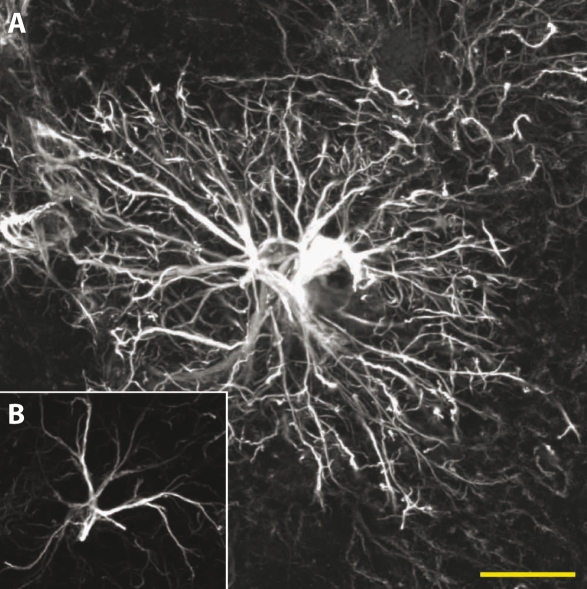
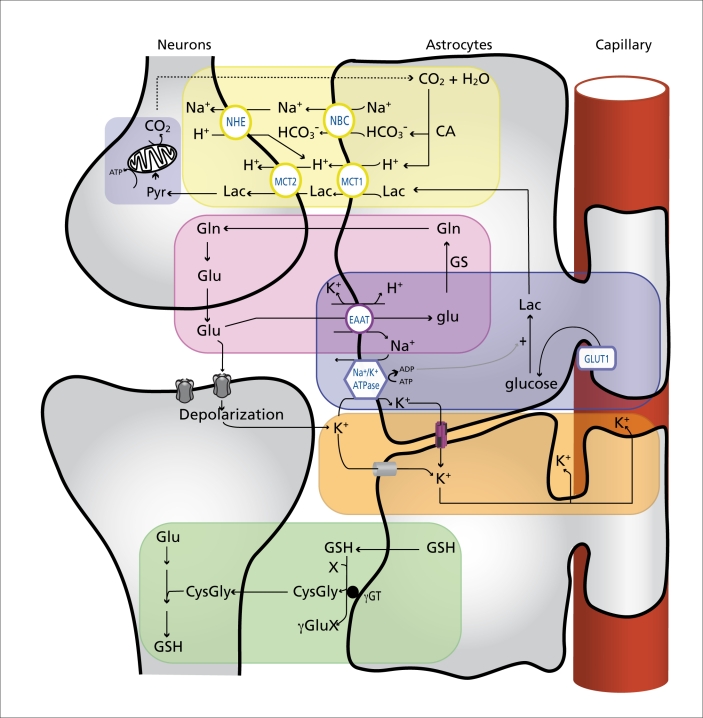
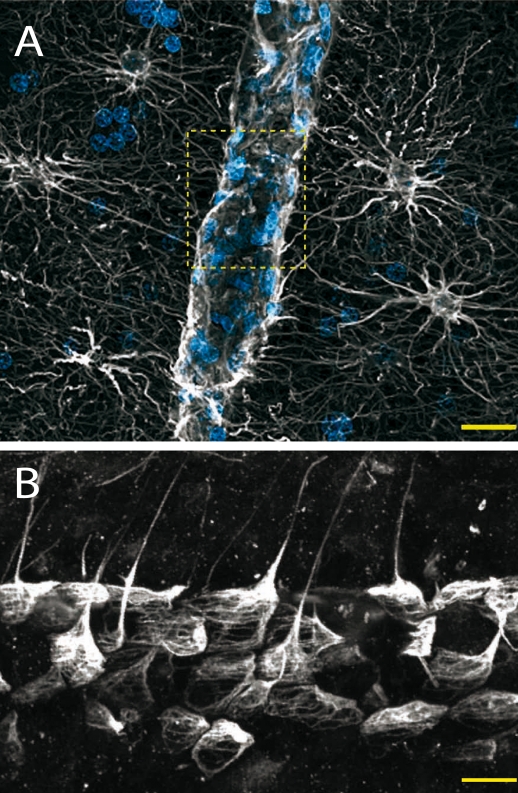
Astrocytes are the main neural cell type responsible for the maintenance of brain homeostasis. They form highly organized anatomical domains that are interconnected into extensive networks. These features, along with the expression of a wide array of receptors, transporters, and ion channels, ideally position them to sense and dynamically modulate neuronal activity. Astrocytes cooperate with neurons on several levels, including neurotransmitter trafficking and recycling, ion homeostasis, energy metabolism, and defense against oxidative stress. The critical dependence of neurons upon their constant support confers astrocytes with intrinsic neuroprotective properties which are discussed here. Conversely, pathogenic stimuli may disturb astrocytic function, thus compromising neuronal functionality and viability. Using neuroinflammation, Alzheimer's disease, and hepatic encephalopathy as examples, we discuss how astrocytic defense mechanisms may be overwhelmed in pathological conditions, contributing to disease progression.
Overview
The claims and statistics of this paper haven’t been checked yet.
Free: it reads the open-access text and checks the first 5 claims that cite a source we can check. Create a free account to check every claim.
Integrity signals
Registry
Cites
Statistics
Figures
Verification
Claims the paper makes
The claims and statistics of this paper haven’t been checked yet.
Free: it reads the open-access text and checks the first 5 claims that cite a source we can check. Create a free account to check every claim.
Claims other papers make about this one
Each is checked against this paper’s own text: does it say what the citing paper says it does?
The cited source doesn’t support the claim as written.
In the citing paper
“Astrocytes are the major producers of glutathione in the brain because they express a system xc-cyttine/glutamate antiporter, which does not exist in neurons; hence, neurons cannot synthesize glutathione.”
From Major depressive disorder: hypothesis, mechanism, prevention and treatment (2024) · cites this paper as [135]
Checked by a reasoning model — may be wrong.
Experimental — accuracy not yet measuredThe source backs part of the claim, not all of it — or backs it for a different population, condition or comparison.
In the citing paper
“Notably, astrocytes can protect nearby neurons against toxic dosages of NO, H 2 O 2 , and superoxide anion in combination with NO, iron, or 6-hydroxydopamine in coculture systems, 135”
From Major depressive disorder: hypothesis, mechanism, prevention and treatment (2024) · cites this paper as [135]
Experimental — accuracy not yet measuredThe check wasn’t confident either way, so it gives no verdict — never disputed.
In the citing paper
“As the major lipid carrier in the brain, secreted ApoE is generally presumed to be converted into HDL-like LNPs by astrocytes.”
From ApoE is Secreted as a Lipid Nanoparticle by Mammalian Cells: Implications for Alzheimer’s Disease Pathogenesis (2025) · cites this paper as [46]
Experimental — accuracy not yet measuredThe check wasn’t confident either way, so it gives no verdict — never disputed.
In the citing paper
“In turn, these LNPs undergo receptor-mediated endocytosis in neurons and glia cells where their lipid constituents are disassembled in lysosomes to supply these constituents to the recipient cells.22, 44–47”
From ApoE is Secreted as a Lipid Nanoparticle by Mammalian Cells: Implications for Alzheimer’s Disease Pathogenesis (2025) · cites this paper as [46]
Experimental — accuracy not yet measured
Self-check
Percentages, sums and reported differences re-computed from the paper’s own numbers.
The self-check needs the paper’s full text.
Citations
Cites
McKhann, G., Drachman, D., Folstein, M., Katzman, R., Price, D., & Stadlan, E. M. (1984) · Neurology · doi:10.1212/wnl.34.7.939 · Cited by 27,915
Danbolt, N. C. (2001) · Progress in Neurobiology · doi:10.1016/s0301-0082(00)00067-8 · Cited by 4,227 · cited 2×
“This is primarily achieved by the astrocyte-specific sodium-dependent high-affinity glutamate transporters GLT-1 and GLAST (corresponding to human EAAT2 and EAAT1, respectively) and to a lesser extent by the neuronal glutamate transporters EAAC1 (human EAAT3) and EAAT4.”
Microglia-mediated neurotoxicity: uncovering the molecular mechanisms
Block, M. L., Zecca, L., & Hong, J.-S. (2007) · Nature Reviews Neuroscience · doi:10.1038/nrn2038 · Cited by 4,110 · cited 1×
“Activated microglial cells release high levels of proinflammatory cytokines and toxic ROS which may negatively impact neuronal survival.(114) Several in vitro studies have demonstrated that astrocyte-conditioned medium or the presence of astrocytes attenuates microglial activation in response to various proinflammator…”
Rothstein, J. D., Dykes-Hoberg, M., Pardo, C. A., Bristol, L. A., Jin, L., Kuncl, R. W., Kanai, Y., Hediger, M. A., Wang, Y., Schielke, J. P., et al. (1996) · Neuron · doi:10.1016/s0896-6273(00)80086-0 · Cited by 2,534
Glutamate Induces Calcium Waves in Cultured Astrocytes: Long-Range Glial Signaling
Cornell-Bell, A. H., Finkbeiner, S. M., Cooper, M. S., & Smith, S. J. (1990) · Science · doi:10.1126/science.1967852 · Cited by 1,846 · cited 1×
“Indeed, astrocytes can respond to neurotransmitters with transient increases in their intracellular Ca levels, which can travel through the astrocytic syncytium in a wavelike fashion.(14,15) These Ca signals can trigger the release of neuroactive molecules from astrocytes (or gliotransmitters), such as glutamate, D-se…”
Reactive astrocytes: cellular and molecular cues to biological function
Ridet, J. L., Privat, A., Malhotra, S. K., & Gage, F. H. (1997) · Trends in Neurosciences · doi:10.1016/s0166-2236(97)01139-9 · Cited by 1,766 · cited 1×
“Like microglia, astrocytes can become activated— a process known as astrogliosis, which is characterized by altered gene expression, hypertrophy, and proliferation.(92) Activated astrocytes can release a wide array of immune mediators such as cytokines, chemokines, and growth factors, that may exert either neuroprotec…”
Epilepsy and Exacerbation of Brain Injury in Mice Lacking the Glutamate Transporter GLT-1
Tanaka, K., Watase, K., Manabe, T., Yamada, K., Watanabe, M., Takahashi, K., Iwama, H., Nishikawa, T., Ichihara, N., Kikuchi, T., et al. (1997) · Science · doi:10.1126/science.276.5319.1699 · Cited by 1,752
Metabolism and functions of glutathione in brain
Dringen, R. (2000) · Progress in Neurobiology · doi:10.1016/s0301-0082(99)00060-x · Cited by 1,702 · cited 1×
“This can be explained by the brain’s high rate of oxidative energy metabolism (which inevitably generates ROS), combined with a relatively low intrinsic antioxidant capacity.(67) Compared with neurons, astrocytes display a much more effective artillery against ROS.”
Reactive Astrocytes Protect Tissue and Preserve Function after Spinal Cord Injury
Faulkner, J. R., Herrmann, J. E., Woo, M. J., Tansey, K. E., Doan, N. B., & Sofroniew, M. V. (2004) · The Journal of Neuroscience · doi:10.1523/jneurosci.3547-03.2004 · Cited by 1,598
β-Lactam antibiotics offer neuroprotection by increasing glutamate transporter expression
Rothstein, J. D., Patel, S., Regan, M. R., Haenggeli, C., Huang, Y. H., Bergles, D. E., Jin, L., Dykes Hoberg, M., Vidensky, S., Chung, D. S., et al. (2005) · Nature · doi:10.1038/nature03180 · Cited by 1,518
Research works printed but not linked: 1
- Magistretti PJ. Brain energy metabolism. In: Squire LR, Bloom FE, McConnell SK, Roberts JL, Spitzer NC, Zigmond MJ, eds. Fundamental Neuroscience. 3rd ed. San Diego, CAL: Academic Press 2008 271 292
Cited by
Items 401–470 of 470
Barron, M. (2018) · Nottingham ePrints (University of Nottingham)
Seady, M. (2018) · LA Referencia (Red Federada de Repositorios Institucionales de Publicaciones Científicas)
Investigating the molecular, metabolic, and psychological effects of minocycline
Chan, S. Y. (2018) · Oxford University Research Archive (ORA) (University of Oxford) · doi:10.5287/ora-4jpqvy674
DI FRANCESCO, S. (2017) · Archivio Istituzionale della Ricerca (Universita Degli Studi Di Milano) · doi:10.13130/s-di-francesco_phd2017-11-21
Efeito da curcumina, composto presente no curry, em células astrogliais
Seady, M. (2016) · Lume (Universidade Federal do Rio Grande do Sul)
Guerra, M. C. (2010) · LA Referencia (Red Federada de Repositorios Institucionales de Publicaciones Científicas)
Patient-specific iPSC-derived NESC for Machado-Joseph Disease treatment
Fernandes, V. A. C. (2019) · Portuguese National Funding Agency for Science, Research and Technology (RCAAP Project by FCT)
Centellas, C., & Lídia (2019) · Repositori digital de la UPF (Universitat Pompeu Fabra)
Gaviano, L. (2020) · Florence Research (University of Florence)
Kütük, O. (2020) · Demiroglu Science University Florence Nightingale Journal of Medicine · doi:10.5606/fng.btd.2020.25027
“[11-13] Removal of glutamate from the extracellular site is vital for protection against excitotoxicity, as well as initiating the glutamate-glutamine cycle, an essential cycle for re-synthesis in neurons.[4,11] Astrocytes, which are steadfast helpers of neurons in carrying out several functions in the brain, sometime…”
Modulation of the Endocannabinoid System By Hiv Tat Protein
Wu, M. M. (2020) · University of Minnesota Digital Conservancy (University of Minnesota)
Cerebrovascular Dysfunction and Degeneration in Alzheimer’s Disease Pathophysiology
Quintana, D. D. (2020) · The Research Repository @ WVU (West Virginia University) · doi:10.33915/etd.7941
Bandeira, B. S. (2020) · LA Referencia (Red Federada de Repositorios Institucionales de Publicaciones Científicas)
THE INFLUENCE OF MITOCHONDRIA IN ALZHEIMER DISEASE AND POSSIBLE ALTERNATIVE THERAPIES
(2021) · International Journal of Neuroscience Research · doi:10.28933/ijnr-2021-04-0606
A Novel Method for Transplanting Astrocytes to Promote Recovery from Traumatic Brain Injury
Anant, S., Lum, N., & Wu, T. (2021) · Undergraduate Research in Natural and Clinical Science and Technology (URNCST) Journal · doi:10.26685/urncst.276
Amyloid beta resistance and the Warburg effect: Re-examining Alzheimer's disease
Newington, J. T. (2013) · Scholarship@Western (Western University)
The Role of Glia in Huntington’s Disease
Joshi, T., & Jana, N. R. (2022) · Springer eBooks · doi:10.1007/978-981-16-8313-8_24
Wang, X. (2019) · Faculty Opinions – Post-Publication Peer Review of the Biomedical Literature · doi:10.3410/f.736650668.793565579
Correale, J. D., & Marrodán, M. (2024) · Springer eBooks · doi:10.1007/978-3-031-24297-7_10-1
Correale, J. D., & Marrodán, M. (2024) · Springer eBooks · doi:10.1007/978-3-031-60006-7_10
ApoE and Cerebrovascular Disease
Belayev, L., Vieira, C. M., Oriá, R. B., & Bazan, N. G. (2025) · Springer eBooks · doi:10.1007/978-3-031-52641-1_60-1
Inorganic nitrate stores, astrocyte metabolism and brain health: An emerging paradigm
Siervo, M., Verdile, G., & Piknova, B. (2025) · Nitric Oxide · doi:10.1016/j.niox.2025.06.005
Zhang, P., Dan-chun, L. A. N., Ting-ting, G. U., Wu, J., Rui-rui, T. A. O., Tang, C., Li, Z., & Li-ming, L. U. (2025) · 世界针灸杂志:英文版 · doi:10.1016/j.wjam.2025.09.001
Aβ(1-42) induced metabolic effects in a stem cell derived neuron and astrocyte network.
Tarczyluk, M. A. (2013) · Aston Publications Explorer (Aston University) · doi:10.48780/publications.aston.ac.uk.00020809
Astrocytic diversity in the mouse brain: a RiboTag-based approach
Treshin, V. (2025) · Common Library Network (Der Gemeinsame Bibliotheksverbund) · doi:10.22032/dbt.64681
Ibrahim, E. (2016) · King Abdullah University of Science and Technology Repository (King Abdullah University of Science and Technology) · doi:10.25781/kaust-lgr2h
King, M. (2021) · Aston Publications Explorer (Aston University) · doi:10.48780/publications.aston.ac.uk.00043265
Slota, J. A., Sajesh, B. V., Frost, K. F., Medina, S. J., & Booth, S. A. (2022) · Figshare · doi:10.6084/m9.figshare.21532645
Tumbleson, D. M. (2023) · Purdue University Indianapolis (Indiana University) · doi:10.7912/c2/3138
Almeida Silva, L. F. (2020) · Figshare · doi:10.25419/rcsi.12793898
Zhao, W., Gasterich, N., Clarner, T., Voelz, C., Behrens, V., Beyer, C., Fragoulis, A., & Zendedel, A. (2022) · Figshare · doi:10.6084/m9.figshare.20012451
Heilman, P. L. (2017) · OhioLink ETD Center (Ohio Library and Information Network)
Tivadar, N. (2023) · Repository of the University of Ljubljana (University of Ljubljana)
Mancic, B. (2020) · National Repository of Dissertations in Serbia
C6 glioma neuronal interactions and their moderation by the tryptophan-kynurenine metabolism pathway
Rakovets, Y. (2021) · Arrow@dit (Dublin Institute of Technology)
Souza, D. G. (2016) · LA Referencia (Red Federada de Repositorios Institucionales de Publicaciones Científicas)
Sovrani, V. (2022) · Lume (Universidade Federal do Rio Grande do Sul)
Efeitos da melatonina em cultura de astrócitos de ratos Wistar adultos
Pinto, E. D. C. R. (2023) · LA Referencia (Red Federada de Repositorios Institucionales de Publicaciones Científicas)
Eraso‐Pichot, A., & Molecular, U. A. D. B. D. D. B. I. D. B. (2018) · LA Referencia (Red Federada de Repositorios Institucionales de Publicaciones Científicas)
Soni, N. (2023) · eScholarship (California Digital Library)
A dual approach to brain health
Ranzini, G. (2025) · publish.UP (University of Potsdam) · doi:10.25932/publishup-68994
Rojas, D. B. (2025) · LA Referencia (Red Federada de Repositorios Institucionales de Publicaciones Científicas)
Antika, G. (2022) · Çanakkale Onsekiz Mart University AVESIS
Characterizing the ZC3H14-Dependent Neuroprotective Effect of PDGF Signaling
D'Ercole, J. (2024) · TSpace (University of Toronto)
Brain energy metabolism biomarkers in canine cerebrospinal fluid
Benzal, A. S. (2021) · Universidad de Córdoba Insitutional Repository (Universidad de Córdoba)
Terunuma, M. (2019) · 新潟歯学会雑誌
Rodriguez, A. G. (2016) · theses.fr (ABES) · doi:10.70675/ecd0f3cbz19d7z406bza88eze6d1c4e9be0e
Amri, F. (2016) · theses.fr (ABES) · doi:10.70675/42d94807zca99z426cz9a48z9145b88c6878
Vautheny, A. (2019) · theses.fr (ABES) · doi:10.70675/1812d71aze8d9z48d6z87d1z5a23a4e81953
Roles of astroglial cannabinoid type 1 receptors (CB1) in memory and synaptic plasticity
Robin, L. M. (2018) · theses.fr (ABES) · doi:10.70675/1fd1dda8z3f4bz404azbdf6z5b648e4c4053
Abdelouahab, O. B. (2021) · theses.fr (ABES) · doi:10.70675/97f4885fz3f5cz4234zb8e2ze3fa7c4e3d41
Importance du microenvironnement dans les modèles cérébraux in vitro pour le criblage phénotypique
Conto, V. D. (2021) · theses.fr (ABES) · doi:10.70675/606ac668z75f8z481bz8e6dzb481873e2253
Trottmann, M.-M. (2023) · theses.fr (ABES) · doi:10.70675/cc10b281z56f8z4b5ezb2b6za8c5c5122239
Experimental Therapeutic Approaches: Molecular, Genetic, and Behavioral
Selimovic, A., Soles, A., & Cvetanović, M. (2026) · Contemporary clinical neuroscience · doi:10.1007/978-3-032-18296-8_26
Subba, P., Shankar, V., Williams, K., Mackay, T. F. C., Freymuth, P., Shay, N. A., Rees, A. M., Liedl, S. R., Roberts, J., Clayton, D. F., et al. (2026) · bioRxiv (Cold Spring Harbor Laboratory) · doi:10.64898/2026.06.01.729058
Welty, S., Bagnell, M., Ma, F., Herrup, K., & Levine, A. S. (2026) · Journal of Alzheimer s Disease · doi:10.1177/13872877261476036
Effects of Cadmium, Lead and Mercury on Glial Cells in a Rat Model: A Systematic Review
Gajocha, N., Kosik-Bogacka, D. I., & Piotrowska, K. (2026) · International Journal of Molecular Sciences · doi:10.3390/ijms27198457
Sanz‐Alcázar, A., Portillo-Carrasquer, M., Manjarrés-Raza, I., Pazos-Gil, M., Delaspre, F., Tamarit, J., Bolaños, J. P., Ros, J., & Cabiscol, E. (2026) · Redox Biology · doi:10.1016/j.redox.2026.104437 · Cited by 1
Gao, C., Shi, R., Jiang, X., Chai, H., & He, X. (2026) · Journal of the Neurological Sciences · doi:10.1016/j.jns.2026.126237
Kakade, D. M., & Patil, M. D. (. ). D. S. A. (2026) · Genetics and Molecular Research · doi:10.4238/be3ts446
Konings, S. C., Torres-Garcia, L., and, I. M., & Gouras, G. K. (2021) · doi:10.3389/fnins.2021.734001.s001
Warren, K. (2010) · VCU Scholars Compass (Virginia Commonwealth University) · doi:10.25772/d4x1-et86
Metadata
- Authors
- Bélanger, M., & Magistretti, P. J.
- Affiliations
- École Polytechnique Fédérale de Lausanne (CH)
- Centre Hospitalier Universitaire Vaudois (CH)
- Corresponding author
- Magistretti, Pierre J.
- Venue
- Dialogues in Clinical Neuroscience
- Publisher
- Informa UK Limited
- Published
- 2009-09-30
- Volume
- 11
- Issue
- 3
- Pages
- 281-295
- ISSN
- 1294-8322 (ISSN-L)
- 1958-5969
- PMC
- PMC3181926
- OpenAlex
- W1858755391
- Cited by
- 396
- References
- 161
- Citations by year
- 2026: 13 · 2025: 24 · 2024: 26 · 2023: 22 · 2022: 26 · 2021: 40 · 2020: 38 · 2019: 29 · 2018: 44 · 2017: 30 · 2016: 18 · 2015: 25 · 2014: 12 · 2013: 16 · 2012: 10
- FWCI
- 7.03
- Type
- journal article
- Language
- en
- Open access
- diamond
- doi.org
- Licence
- Locations
- Dialogues in Clinical Neuroscience (publishedVersion, cc-by-nc-nd)
- Europe PMC (PubMed Central) (publishedVersion, cc-by-nc-nd)
- PubMed Central (publishedVersion, cc-by-nc-nd)
- PubMed (publishedVersion)
- IRIS (submittedVersion)
- Infoscience (Ecole Polytechnique Fédérale de Lausanne) (submittedVersion)
- Infoscience (Ecole Polytechnique Fédérale de Lausanne) (submittedVersion, cc-by-nc-nd)
- SERVAL (Université de Lausanne) (submittedVersion, other-oa)
- Funders
- National Science Foundation
- Schweizerischer Nationalfonds zur Förderung der Wissenschaftlichen Forschung (3100AO, 108336)
- Topics
- Life Sciences › Neuroscience › Neurology › Neuroinflammation and Neurodegeneration Mechanisms
- Life Sciences › Neuroscience › Cellular and Molecular Neuroscience › Neuroscience and Neuropharmacology Research
- Health Sciences › Medicine › Clinical Neurology › Traumatic Brain Injury and Neurovascular Disturbances
- Keywords
- astrocytes, neuroprotection, brain homeostasis, astrocyte-neuron interaction, ion homeostasis, energy metabolism, oxidative stress, neuroinflammation, Alzheimer's disease, hepatic encephalopathy
- MeSH terms
- Animals, Astrocytes, Brain, Brain Diseases, Homeostasis, Humans, Models, Biological, Neurons, Neuroprotective Agents
About these checks
Registry, retraction, Cites and statistics results are computed, not judged, with one exception: a printed reference that no index lists is read once by a model before it counts as a citation error. Claims are extracted by a model and kept only when their quote appears verbatim in the text; each cited source is then checked, with a model’s help, for whether it says what the claim relies on. Those verdicts can be wrong — read the claim’s quote and the cited source before relying on one.
Statistics and arithmetic are recomputed, not judged.
Confidence bands are shown only for fields calibrated on our annotated test set. None is calibrated yet, so no band is shown.
What counts as a claim ›How we measure confidence ›How we check this ›
Are you an author, or do you see a problem with this page? Request a review
Data sources
Bibliographic data: Semantic Scholar, OpenAlex, Crossref.
Contains information from the Semantic Scholar Academic Graph Datasets, made available under the ODC Attribution License (ODC-BY 1.0).
Semantic Scholar’s data is described in: Kinney, R., et al. (2023). The Semantic Scholar Open Data Platform. arXiv:2301.10140.
