

The DOI matches its Crossref record; 58 of the 59 references it cites were found in a registry or an index; none of the 50 sources its claims cite is checked for support yet.
Domains of cognition and their assessment
Open accessAbstract
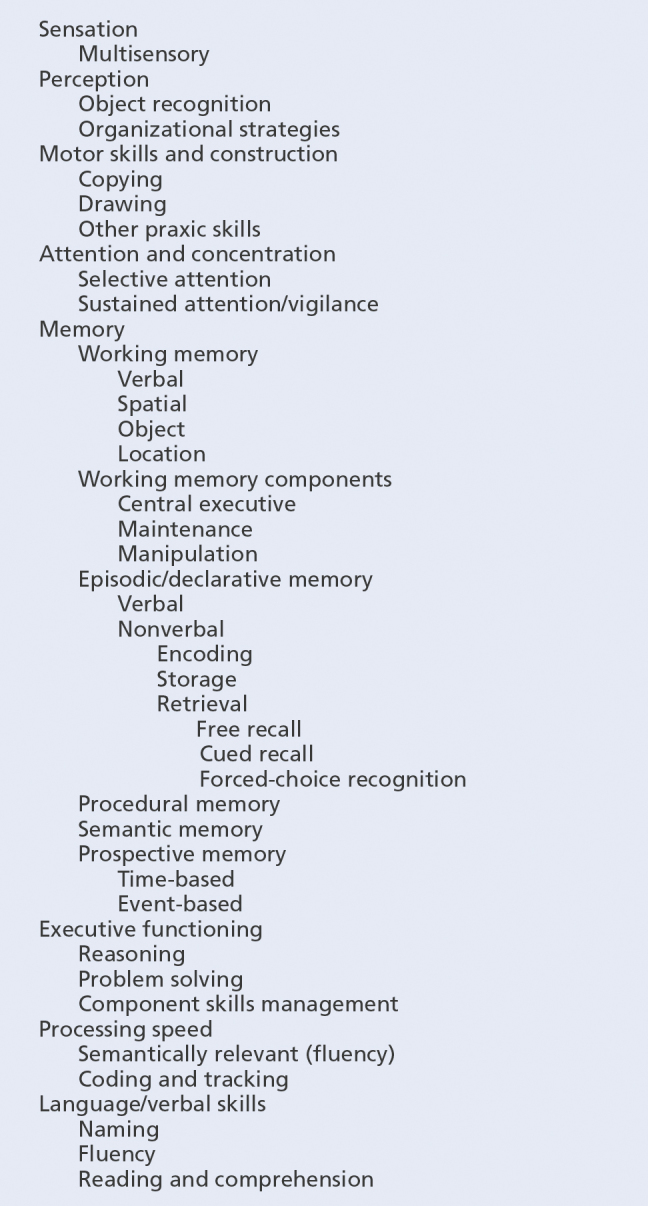
Cognitive performance is typically conceptualized in terms of domains of functioning. These domains are hierarchical in nature, with the bottom referring to more basic sensory and perceptual processes and the top referring to elements of executive functioning and cognitive control. Domains are not independent of each other and executive functioning exerts control over the utilization of more basic processes. Assessments are typically targeted at subdomains of each ability area and careful combination of tasks can reveal patterns of performance consistent with a variety of different neurological and neuropsychiatric conditions. This review covers the general structures of domains, the patterns of impairments across domains seen in common neuropsychiatric conditions, and use of assessment strategies to differentiate, to the extent possible, between different types of conditions manifesting cognitive impairment. .
Overview
AI snapshot
Written from the paper’s full text.
TL;DR
This review describes cognitive performance as organized into hierarchical domains, from basic sensation/perception to executive functioning and cognitive control, and reviews how assessments target subdomains to reveal patterns across neurological and neuropsychiatric conditions. It emphasizes that domains are intercorrelated, executive functioning supervises simpler processes, and processing speed is often the most impaired and functionally relevant domain in conditions such as schizophrenia.
Key findings
- Cognitive domains are hierarchical and not independent: basic sensory/perceptual operations are least complex, while executive functioning/reasoning and problem solving are most complex and coordinate multiple lower-level abilities.
- Assessment patterns can differentiate conditions: in cortical dementia and amnestic conditions, encoding, delayed recall, cued recall, and delayed recognition are all impaired; in frontostriatal conditions, encoding and delayed recall are impaired but delayed recognition and cued recall are typically spared. Similar patterns are reported in schizophrenia spectrum conditions.
- Attention profiles differ by condition: psychotic populations commonly show increased CPT errors of omission and reduced d′ without increased errors of commission, whereas ADHD is associated with increased errors of commission and greater B; schizophrenia spectrum individuals fail to develop the normal bias to respond to nontargets when target frequency is high.
- Processing speed is particularly important: coding-task performance is the most significant impairment in schizophrenia and the cognitive domain most strongly correlated with everyday functioning, and it tends to be the strongest predictor of overall cognitive performance. The paper also gives task examples such as digit span forward about 6 digits versus backward about 5 digits, HVLT with 12 items and 3 learning trials, CVLT with 16 items and 5 trials, and RAVLT with 15 unorganized items and 5 trials.
Methods
- Narrative review of cognitive domains and their assessment, organized by general ability area and commenting on top-down versus bottom-up structure and regional brain functioning.
- No primary data, systematic sample, or quantitative synthesis are reported; the paper synthesizes cited neuropsychological tests, clinical populations, and prior literature.
- Main analysis is conceptual: it reviews performance-based assessments and then observational/self-reported functioning, with focus on humans.
Limitations
- The paper states that fully addressing assessment of memory-disordered populations is beyond its scope, and it notes inconsistencies in the clinical/research literature about whether some processes belong in broader domains such as executive functioning or simpler domains such as processing speed.
- The paper also states that some cognitive abilities may not be clearly separable into one domain or another.
- Evident from the text: this is a narrative review without a systematic search, meta-analysis, or empirical sample, and the paper itself notes that larger factor-analytic studies often find a single global ability factor, raising questions about the separability of conventional cognitive domains.
Model-written summary. Check it against the paper before relying on it.
Integrity signals
Registry
Cites
Statistics
Figures
Verification
Claims the paper makes
44 Not checked yet · 37 No basis given · 26 Own interpretation
The paper states this without a source or data behind it here, so there is nothing to check it against. The quote shows it is in the paper.
In the paper
“Further, selective attention is also impaired, particularly when the selective attention test requires adhering to instructions to ignore some stimuli and respond to others.”
§ Domains of cognition and their assessment > Neuropsychiatric conditions commonly show attentional problems
plaincorrelational- Asserted: passes — The authors put it forward as true.
- Checkable: passes — It can be checked against evidence.
- Load-bearing: unclear — It is unclear whether the paper’s conclusions depend on it.
- Based: passes — The paper gives a reason why it holds.
In the paper
“For instance psychotic populations are commonly associated with increases in errors of omission and reduced d’ without increased errors of commission. 32”
§ Domains of cognition and their assessment > Neuropsychiatric conditions commonly show attentional problems
What the sources say
- Not checked yetcites [32] Cornblatt BA, 1989, Psychiatry Res source
plaincorrelational- Asserted: passes — The authors put it forward as true.
- Checkable: passes — It can be checked against evidence.
- Load-bearing: unclear — It is unclear whether the paper’s conclusions depend on it.
- Based: passes — The paper gives a reason why it holds.
In the paper
“There is evidence of specialized CNS processing for object, location, action, verbal, and spatial working memory. 39”
§ Domains of cognition and their assessment > Working memory
What the sources say
- Not checked yetcites [39] Adcock RA, 2000, Proc Nat Acad Sci U S A source
plaincorrelational- Asserted: passes — The authors put it forward as true.
- Checkable: passes — It can be checked against evidence.
- Load-bearing: unclear — It is unclear whether the paper’s conclusions depend on it.
- Based: passes — The paper gives a reason why it holds.
The paper states this without a source or data behind it here, so there is nothing to check it against. The quote shows it is in the paper.
In the paper
“High target frequency on the CPT leads to a normal bias to respond to nontargets.”
§ Domains of cognition and their assessment > Neuropsychiatric conditions commonly show attentional problems
plaindirect- Asserted: passes — The authors put it forward as true.
- Checkable: passes — It can be checked against evidence.
- Load-bearing: unclear — It is unclear whether the paper’s conclusions depend on it.
- Based: passes — The paper gives a reason why it holds.
The paper states this without a source or data behind it here, so there is nothing to check it against. The quote shows it is in the paper.
In the paper
“Controlled processes, those that require resource costs, can become automated after practice.”
§ Domains of cognition and their assessment > Selective attention
plaindirect- Asserted: passes — The authors put it forward as true.
- Checkable: passes — It can be checked against evidence.
- Load-bearing: passes — The paper’s conclusions depend on it.
- Based: passes — The paper gives a reason why it holds.
The paper states this without a source or data behind it here, so there is nothing to check it against. The quote shows it is in the paper.
In the paper
“Further, implicit strategies can facilitate encoding.”
§ Domains of cognition and their assessment > Encoding
plainconditional- Asserted: passes — The authors put it forward as true.
- Checkable: passes — It can be checked against evidence.
- Load-bearing: unclear — It is unclear whether the paper’s conclusions depend on it.
- Based: passes — The paper gives a reason why it holds.
In the paper
“Manipulations aimed at enforcing semantic encoding (eg, make up a story with these words) lead to more encoding than simple instructions to attend. 44”
§ Domains of cognition and their assessment > Encoding
What the sources say
- Not checked yetcites [44] Barrett TR, 1981, J Gerontol source
plaindirect- Asserted: passes — The authors put it forward as true.
- Checkable: passes — It can be checked against evidence.
- Load-bearing: unclear — It is unclear whether the paper’s conclusions depend on it.
- Based: passes — The paper gives a reason why it holds.
The paper states this without a source or data behind it here, so there is nothing to check it against. The quote shows it is in the paper.
In the paper
“The more complex the secondary task (eg, text messaging compared with using a push-button radio control), the more likely it is to be associated with traffic accidents.”
§ Domains of cognition and their assessment > Selective attention
hedgedcorrelational- Asserted: passes — The authors put it forward as true.
- Checkable: passes — It can be checked against evidence.
- Load-bearing: unclear — It is unclear whether the paper’s conclusions depend on it.
- Based: passes — The paper gives a reason why it holds.
In the paper
“These domains are hierarchical in nature, with the bottom referring to more basic sensory and perceptual processes and the top referring to elements of executive functioning and cognitive control.”
- Also stated in: § Global structure of cognitive ability domains · plain
“An additional organizational structure is hierarchical and based on the complexity of the operations. Often referred to as top-down versus bottom-up, the idea is that basic sensory and perceptional operations are least complex and reasoning and problem solving, referred to as executive functioning, are most complex. 6”
§ Domains of cognition and their assessment > Abstract
What the sources say
- Not checked yetcites [6] Al-Aidroos N, 2012, Proc Natl Acad Sci U S A source
plain- Asserted: passes — The authors put it forward as true.
- Checkable: passes — It can be checked against evidence.
- Load-bearing: passes — The paper’s conclusions depend on it.
- Based: passes — The paper gives a reason why it holds.
- Also stated in: § Global structure of cognitive ability domains · plain
In the paper
“Procedural memory can be dissociated from episodic memory, in that individuals with amnesia who cannot recall essentially any verbal information can learn and retain procedural skills. 45”
§ Domains of cognition and their assessment > Procedural memory
What the sources say
- Not checked yetcites [45] Oudman E, 2015, Neuropsychol Rev source
plain- Asserted: passes — The authors put it forward as true.
- Checkable: passes — It can be checked against evidence.
- Load-bearing: unclear — It is unclear whether the paper’s conclusions depend on it.
- Based: passes — The paper gives a reason why it holds.
- Probably not a substantial claim. 53
- It may state two separate claims as one. 32
The paper states this without a source or data behind it here, so there is nothing to check it against. The quote shows it is in the paper.
In the paper
“However, with aging, resource availability typically declines and older drivers are involved in many more accidents than younger experienced drivers.”
§ Domains of cognition and their assessment > Selective attention
plaindirect- Asserted: passes — The authors put it forward as true.
- Checkable: passes — It can be checked against evidence.
- Load-bearing: fails — The paper’s conclusions may not depend on it.
- Based: fails — The paper may give no reason why it holds.
Probably not a substantial claim. The paper’s conclusions may not depend on it. The paper may give no reason why it holds. It may state two separate claims as one.
The paper states this without a source or data behind it here, so there is nothing to check it against. The quote shows it is in the paper.
In the paper
“Maintenance working memory can handle information from multiple sensory modalities at the same time and storage capacity of maintenance working memory is capacity limited across all aspects of information.”
§ Domains of cognition and their assessment > Working memory
plain- Asserted: passes — The authors put it forward as true.
- Checkable: passes — It can be checked against evidence.
- Load-bearing: fails — The paper’s conclusions may not depend on it.
- Based: fails — The paper may give no reason why it holds.
Probably not a substantial claim. The paper’s conclusions may not depend on it. The paper may give no reason why it holds. It may state two separate claims as one.
The paper states this without a source or data behind it here, so there is nothing to check it against. The quote shows it is in the paper.
In the paper
“The more common the target, up to about 50% frequency, the easier the task.”
§ Domains of cognition and their assessment > Sustained attention/vigilance
plaindirect- Asserted: passes — The authors put it forward as true.
- Checkable: passes — It can be checked against evidence.
- Load-bearing: fails — The paper’s conclusions may not depend on it.
- Based: passes — The paper gives a reason why it holds.
Probably not a substantial claim. The paper’s conclusions may not depend on it.
In the paper
“Typically global stimuli are perceived more rapidly than local stimuli, much like a reader recognizes words more efficiently than their component letters. 23”
§ Domains of cognition and their assessment > Selective attention
What the sources say
- Not checked yetcites [23] Navon D, 1977, Cognitive Psychol source
plaincorrelational- Asserted: passes — The authors put it forward as true.
- Checkable: passes — It can be checked against evidence.
- Load-bearing: fails — The paper’s conclusions may not depend on it.
- Based: passes — The paper gives a reason why it holds.
Probably not a substantial claim. The paper’s conclusions may not depend on it.
The paper states this without a source or data behind it here, so there is nothing to check it against. The quote shows it is in the paper.
In the paper
“Storage is typically affected only by changes in brain functioning”
§ Domains of cognition and their assessment > Storage
plaindirect- Asserted: passes — The authors put it forward as true.
- Checkable: passes — It can be checked against evidence.
- Load-bearing: fails — The paper’s conclusions may not depend on it.
- Based: fails — The paper may give no reason why it holds.
Probably not a substantial claim. The paper’s conclusions may not depend on it. The paper may give no reason why it holds.
In the paper
“Attention deficit hyperactivity disorder (ADHD) is associated with increases in errors of commission and greater B, based on impulsive responses to nontarget stimuli. 33”
§ Domains of cognition and their assessment > Neuropsychiatric conditions commonly show attentional problems
What the sources say
- Not checked yetcites [33] Bedi GC, 1994, Int J Neurosci source
plaincorrelational- Asserted: passes — The authors put it forward as true.
- Checkable: passes — It can be checked against evidence.
- Load-bearing: unclear — It is unclear whether the paper’s conclusions depend on it.
- Based: passes — The paper gives a reason why it holds.
It may state two separate claims as one.
The paper states this without a source or data behind it here, so there is nothing to check it against. The quote shows it is in the paper.
In the paper
“Presenting stimuli as a stem to be completed (__ __ imal) facilitates encoding and subsequent recall of information.”
§ Domains of cognition and their assessment > Encoding
plaindirect- Asserted: passes — The authors put it forward as true.
- Checkable: passes — It can be checked against evidence.
- Load-bearing: fails — The paper’s conclusions may not depend on it.
- Based: fails — The paper may give no reason why it holds.
Probably not a substantial claim. The paper’s conclusions may not depend on it. The paper may give no reason why it holds.
In the paper
“Construction deficits are commonly found in individuals with dementia, with right hemisphere damage, or with identified lesions to the parietal cortex. 20”
§ Domains of cognition and their assessment > Construction
What the sources say
- Not checked yetcites [20] GoodglassHKaplanE1983 Philadelphia Lea and Febiger
plaincorrelational- Asserted: passes — The authors put it forward as true.
- Checkable: passes — It can be checked against evidence.
- Load-bearing: unclear — It is unclear whether the paper’s conclusions depend on it.
- Based: passes — The paper gives a reason why it holds.
It may state two separate claims as one.
The paper states this without a source or data behind it here, so there is nothing to check it against. The quote shows it is in the paper.
In the paper
“Information successfully encoded can be recalled at fairly long post encoding time periods.”
§ Domains of cognition and their assessment > Storage
plaindirect- Asserted: passes — The authors put it forward as true.
- Checkable: passes — It can be checked against evidence.
- Load-bearing: fails — The paper’s conclusions may not depend on it.
- Based: fails — The paper may give no reason why it holds.
Probably not a substantial claim. The paper’s conclusions may not depend on it. The paper may give no reason why it holds.
The paper states this without a source or data behind it here, so there is nothing to check it against. The quote shows it is in the paper.
In the paper
“Drawing objects makes them easier to recall than simply visualizing them.”
§ Domains of cognition and their assessment > Encoding
plaindirect- Asserted: passes — The authors put it forward as true.
- Checkable: passes — It can be checked against evidence.
- Load-bearing: fails — The paper’s conclusions may not depend on it.
- Based: fails — The paper may give no reason why it holds.
Probably not a substantial claim. The paper’s conclusions may not depend on it. The paper may give no reason why it holds.
The paper states this without a source or data behind it here, so there is nothing to check it against. The quote shows it is in the paper.
In the paper
“The ability to respond to instructions to shift focus across global and local properties is a critical feature of this task and is impaired in many populations with problems in attentional control.”
§ Domains of cognition and their assessment > Selective attention
plaincorrelational- Asserted: passes — The authors put it forward as true.
- Checkable: passes — It can be checked against evidence.
- Load-bearing: fails — The paper’s conclusions may not depend on it.
- Based: fails — The paper may give no reason why it holds.
Probably not a substantial claim. The paper’s conclusions may not depend on it. The paper may give no reason why it holds.
The paper states this without a source or data behind it here, so there is nothing to check it against. The quote shows it is in the paper.
In the paper
“Simple maintenance working memory can be measured in drosophila, whose executive functioning ability is clearly limited.”
§ Domains of cognition and their assessment > Working memory
boosted- Asserted: passes — The authors put it forward as true.
- Checkable: passes — It can be checked against evidence.
- Load-bearing: fails — The paper’s conclusions may not depend on it.
- Based: fails — The paper may give no reason why it holds.
Probably not a substantial claim. The paper’s conclusions may not depend on it. The paper may give no reason why it holds. It may state two separate claims as one.
The paper states this without a source or data behind it here, so there is nothing to check it against. The quote shows it is in the paper.
In the paper
“Dual-task processing is particularly impaired in neuropsychiatric conditions, with people with schizophrenia manifesting considerable challenges in dual-task demands.”
§ Domains of cognition and their assessment > Neuropsychiatric conditions commonly show attentional problems
plaincorrelational- Asserted: passes — The authors put it forward as true.
- Checkable: passes — It can be checked against evidence.
- Load-bearing: fails — The paper’s conclusions may not depend on it.
- Based: fails — The paper may give no reason why it holds.
Probably not a substantial claim. The paper’s conclusions may not depend on it. The paper may give no reason why it holds. It may state two separate claims as one.
The paper states this without a source or data behind it here, so there is nothing to check it against. The quote shows it is in the paper.
In the paper
“However, when the target frequency does over 50%, difficulty increases because inhibition of the dominant response to respond on all stimuli is required and even completely healthy people have an increase in errors.”
§ Domains of cognition and their assessment > Sustained attention/vigilance
plaindirect- Asserted: passes — The authors put it forward as true.
- Checkable: passes — It can be checked against evidence.
- Load-bearing: unclear — It is unclear whether the paper’s conclusions depend on it.
- Based: passes — The paper gives a reason why it holds.
It may state two separate claims as one.
The paper states this without a source or data behind it here, so there is nothing to check it against. The quote shows it is in the paper.
In the paper
“Generally, there is a “resource cost” for such operations and typically performance in digits backward is about one item less than performance on digit span forward (6 digits forward = 5 digits backwards).”
§ Domains of cognition and their assessment > Working memory
plaindirect- Asserted: passes — The authors put it forward as true.
- Checkable: passes — It can be checked against evidence.
- Load-bearing: fails — The paper’s conclusions may not depend on it.
- Based: fails — The paper may give no reason why it holds.
Probably not a substantial claim. The paper’s conclusions may not depend on it. The paper may give no reason why it holds. It may state two separate claims as one.
In the paper
“There are formal indices of the ability to divide attention, which can identify impairments in the ability to divide attention which are common in several neuropsychiatric conditions. 25”
§ Domains of cognition and their assessment > Selective attention
What the sources say
- Not checked yetcites [25] Granholm E, 1996, Neuropsychology source
plaincorrelational- Asserted: passes — The authors put it forward as true.
- Checkable: passes — It can be checked against evidence.
- Load-bearing: unclear — It is unclear whether the paper’s conclusions depend on it.
- Based: passes — The paper gives a reason why it holds.
It may state two separate claims as one.
In the paper
“Beginning drivers can tolerate many fewer concurrent tasks while maintaining adequate performance and have the highest rates of accidents. 28”
§ Domains of cognition and their assessment > Selective attention
What the sources say
- Not checked yetcites [28] Gershon P, 2017, J Safety Res source
plaincorrelational- Asserted: passes — The authors put it forward as true.
- Checkable: passes — It can be checked against evidence.
- Load-bearing: unclear — It is unclear whether the paper’s conclusions depend on it.
- Based: passes — The paper gives a reason why it holds.
It may state two separate claims as one.
The paper states this without a source or data behind it here, so there is nothing to check it against. The quote shows it is in the paper.
In the paper
“information that is never detected consciously may be stored (unconscious processing) but typically cannot be retrieved volitionally although it may be available with the right implicit prompt.”
§ Domains of cognition and their assessment > Working memory
hedgedconditional- Asserted: passes — The authors put it forward as true.
- Checkable: passes — It can be checked against evidence.
- Load-bearing: fails — The paper’s conclusions may not depend on it.
- Based: fails — The paper may give no reason why it holds.
Probably not a substantial claim. The paper’s conclusions may not depend on it. The paper may give no reason why it holds. It may state two separate claims as one.
The paper states this without a source or data behind it here, so there is nothing to check it against. The quote shows it is in the paper.
In the paper
“These strategies re commonly applied across different versions of verbal and visual-spatial memory tests.”
§ Domains of cognition and their assessment > Retrieval
plain- Asserted: passes — The authors put it forward as true.
- Checkable: passes — It can be checked against evidence.
- Load-bearing: fails — The paper’s conclusions may not depend on it.
- Based: fails — The paper may give no reason why it holds.
Probably not a substantial claim. The paper’s conclusions may not depend on it. The paper may give no reason why it holds.
The paper states this without a source or data behind it here, so there is nothing to check it against. The quote shows it is in the paper.
In the paper
“Some information is clearly permanent (eg, new vocabulary words).”
§ Domains of cognition and their assessment > Storage
boosted- Asserted: passes — The authors put it forward as true.
- Checkable: passes — It can be checked against evidence.
- Load-bearing: fails — The paper’s conclusions may not depend on it.
- Based: fails — The paper may give no reason why it holds.
Probably not a substantial claim. The paper’s conclusions may not depend on it. The paper may give no reason why it holds.
The paper states this without a source or data behind it here, so there is nothing to check it against. The quote shows it is in the paper.
In the paper
“More complex operations, such as storage of multiple items then retrieval of a selected set, have even greater capacity cost.”
§ Domains of cognition and their assessment > Working memory
plaindirect- Asserted: passes — The authors put it forward as true.
- Checkable: passes — It can be checked against evidence.
- Load-bearing: fails — The paper’s conclusions may not depend on it.
- Based: fails — The paper may give no reason why it holds.
Probably not a substantial claim. The paper’s conclusions may not depend on it. The paper may give no reason why it holds.
The paper states this without a source or data behind it here, so there is nothing to check it against. The quote shows it is in the paper.
In the paper
“Interestingly, distracted driving is a major cause of accidents in the US and distracted driving is specifically the attempt to perform other tasks while driving.”
§ Domains of cognition and their assessment > Selective attention
plaindirect- Asserted: passes — The authors put it forward as true.
- Checkable: passes — It can be checked against evidence.
- Load-bearing: fails — The paper’s conclusions may not depend on it.
- Based: passes — The paper gives a reason why it holds.
Probably not a substantial claim. The paper’s conclusions may not depend on it.
The paper states this without a source or data behind it here, so there is nothing to check it against. The quote shows it is in the paper.
In the paper
“For instance, asking the participant to evaluate stimuli for various semantic characteristics (living/nonliving) facilitates encoding.”
§ Domains of cognition and their assessment > Encoding
plaindirect- Asserted: passes — The authors put it forward as true.
- Checkable: passes — It can be checked against evidence.
- Load-bearing: fails — The paper’s conclusions may not depend on it.
- Based: fails — The paper may give no reason why it holds.
Probably not a substantial claim. The paper’s conclusions may not depend on it. The paper may give no reason why it holds.
In the paper
“Performance on the UFOV has been shown to predict driving problems and interventions aimed at speed dual-task processing have been shown to reduce accidents in older drivers. 30”
§ Domains of cognition and their assessment > Selective attention
What the sources say
- Not checked yetcites [30] Roenker DL, 2003, Hum Factors source
plaindirect- Asserted: passes — The authors put it forward as true.
- Checkable: passes — It can be checked against evidence.
- Load-bearing: unclear — It is unclear whether the paper’s conclusions depend on it.
- Based: passes — The paper gives a reason why it holds.
It may state two separate claims as one.
In the paper
“Interestingly, people in the schizophrenia spectrum fail to develop this normal bias and do not have an increase in errors of commission with increased frequency of targets. 34”
§ Domains of cognition and their assessment > Neuropsychiatric conditions commonly show attentional problems
What the sources say
- Not checked yetcites [34] Barch DM, 2003, J Abnorm Psychol source
plain- Asserted: passes — The authors put it forward as true.
- Checkable: passes — It can be checked against evidence.
- Load-bearing: unclear — It is unclear whether the paper’s conclusions depend on it.
- Based: passes — The paper gives a reason why it holds.
It may state two separate claims as one.
The paper states this without a source or data behind it here, so there is nothing to check it against. The quote shows it is in the paper.
In the paper
“Information can be transferred from working memory to longer-term storage, but that process requires either active processing or salience of the stimulus in working memory for encoding.”
§ Domains of cognition and their assessment > Working memory
plaindirect- Asserted: passes — The authors put it forward as true.
- Checkable: passes — It can be checked against evidence.
- Load-bearing: fails — The paper’s conclusions may not depend on it.
- Based: fails — The paper may give no reason why it holds.
Probably not a substantial claim. The paper’s conclusions may not depend on it. The paper may give no reason why it holds. It may state two separate claims as one.
The paper states this without a source or data behind it here, so there is nothing to check it against. The quote shows it is in the paper.
In the paper
“For visual learning, familiar and namable objects are easier to learn.”
§ Domains of cognition and their assessment > Encoding
plaindirect- Asserted: passes — The authors put it forward as true.
- Checkable: passes — It can be checked against evidence.
- Load-bearing: fails — The paper’s conclusions may not depend on it.
- Based: fails — The paper may give no reason why it holds.
Probably not a substantial claim. The paper’s conclusions may not depend on it. The paper may give no reason why it holds.
The paper states this without a source or data behind it here, so there is nothing to check it against. The quote shows it is in the paper.
In the paper
“Different populations make different patterns of errors on the CPT.”
§ Domains of cognition and their assessment > Sustained attention/vigilance
plaincorrelational- Asserted: passes — The authors put it forward as true.
- Checkable: passes — It can be checked against evidence.
- Load-bearing: fails — The paper’s conclusions may not depend on it.
- Based: fails — The paper may give no reason why it holds.
Probably not a substantial claim. The paper’s conclusions may not depend on it. The paper may give no reason why it holds.
The paper states this without a source or data behind it here, so there is nothing to check it against. The quote shows it is in the paper.
In the paper
“Both iconic (visual) and auditory (echoic) storage are duration and capacity limited and processing of new information can lead to the loss of memory currently in storage.”
§ Domains of cognition and their assessment > Working memory
plaindirect- Asserted: passes — The authors put it forward as true.
- Checkable: passes — It can be checked against evidence.
- Load-bearing: fails — The paper’s conclusions may not depend on it.
- Based: fails — The paper may give no reason why it holds.
Probably not a substantial claim. The paper’s conclusions may not depend on it. The paper may give no reason why it holds. It may state two separate claims as one.
In the paper
“On word list tests, semantically organized lists (subsets of animals, colors, etc) 43 are easier to learn and telling the participant that the list is organized also facilitates encoding.”
§ Domains of cognition and their assessment > Encoding
What the sources say
- Not checked yetcites [43] DelisDCKramerJKaplanEOberBA1987 New York, NY Psychological Corporation
plaindirect- Asserted: passes — The authors put it forward as true.
- Checkable: passes — It can be checked against evidence.
- Load-bearing: unclear — It is unclear whether the paper’s conclusions depend on it.
- Based: passes — The paper gives a reason why it holds.
It may state two separate claims as one.
The paper states this without a source or data behind it here, so there is nothing to check it against. The quote shows it is in the paper.
In the paper
“After practice, many functions required for driving become automated and accident rates decline.”
§ Domains of cognition and their assessment > Selective attention
plaindirect- Asserted: passes — The authors put it forward as true.
- Checkable: passes — It can be checked against evidence.
- Load-bearing: unclear — It is unclear whether the paper’s conclusions depend on it.
- Based: passes — The paper gives a reason why it holds.
It may state two separate claims as one.
The paper states this without a source or data behind it here, so there is nothing to check it against. The quote shows it is in the paper.
In the paper
“Most inconsistencies are in broad domains that may include multiple component processes.”
§ Domains of cognition and their assessment > Introduction
plain- Asserted: passes — The authors put it forward as true.
- Checkable: passes — It can be checked against evidence.
- Load-bearing: fails — The paper’s conclusions may not depend on it.
- Based: fails — The paper may give no reason why it holds.
Probably not a substantial claim. The paper’s conclusions may not depend on it. The paper may give no reason why it holds.
The paper states this without a source or data behind it here, so there is nothing to check it against. The quote shows it is in the paper.
In the paper
“Assessments are typically targeted at subdomains of each ability area”
§ Domains of cognition and their assessment > Abstract
plain- Asserted: passes — The authors put it forward as true.
- Checkable: passes — It can be checked against evidence.
- Load-bearing: passes — The paper’s conclusions depend on it.
- Based: fails — The paper may give no reason why it holds.
Probably not a substantial claim. The paper may give no reason why it holds.
A conclusion the paper draws from its own results — it cites no other source for it, so there is none to check. The quote shows it is in the paper.
In the paper
“executive functioning exerts control over the utilization of more basic processes.”
§ Domains of cognition and their assessment > Abstract
plaindirect- Asserted: passes — The authors put it forward as true.
- Checkable: passes — It can be checked against evidence.
- Load-bearing: passes — The paper’s conclusions depend on it.
- Based: fails — The paper may give no reason why it holds.
Probably not a substantial claim. The paper may give no reason why it holds.
A conclusion the paper draws from its own results — it cites no other source for it, so there is none to check. The quote shows it is in the paper.
In the paper
“careful combination of tasks can reveal patterns of performance consistent with a variety of different neurological and neuropsychiatric conditions.”
§ Domains of cognition and their assessment > Abstract
plaincorrelational- Asserted: passes — The authors put it forward as true.
- Checkable: passes — It can be checked against evidence.
- Load-bearing: passes — The paper’s conclusions depend on it.
- Based: fails — The paper may give no reason why it holds.
Probably not a substantial claim. The paper may give no reason why it holds.
The paper states this without a source or data behind it here, so there is nothing to check it against. The quote shows it is in the paper.
In the paper
“there are clear inconsistencies in the clinical and research literature.”
§ Domains of cognition and their assessment > Introduction
boosted- Asserted: passes — The authors put it forward as true.
- Checkable: passes — It can be checked against evidence.
- Load-bearing: passes — The paper’s conclusions depend on it.
- Based: passes — The paper gives a reason why it holds.
Probably not a substantial claim.
A conclusion the paper draws from its own results — it cites no other source for it, so there is none to check. The quote shows it is in the paper.
In the paper
“Domains are not independent of each other”
§ Domains of cognition and their assessment > Abstract
plaincorrelational- Asserted: passes — The authors put it forward as true.
- Checkable: passes — It can be checked against evidence.
- Load-bearing: passes — The paper’s conclusions depend on it.
- Based: fails — The paper may give no reason why it holds.
Probably not a substantial claim. The paper may give no reason why it holds.
A conclusion the paper draws from its own results — it cites no other source for it, so there is none to check. The quote shows it is in the paper.
In the paper
“Thus, executive functioning tasks often involve the co-ordination of multiple sensory, perceptual, attentional, and other less complex functions, while simple sensory tasks require minimal higher-level processing.”
§ Domains of cognition and their assessment > Global structure of cognitive ability domains
plaincorrelational- Asserted: passes — The authors put it forward as true.
- Checkable: passes — It can be checked against evidence.
- Load-bearing: fails — The paper’s conclusions may not depend on it.
- Based: passes — The paper gives a reason why it holds.
Probably not a substantial claim. The paper’s conclusions may not depend on it. It may state two separate claims as one.
A conclusion the paper draws from its own results — it cites no other source for it, so there is none to check. The quote shows it is in the paper.
In the paper
“manipulation working memory is clearly associated with executive functioning.”
§ Domains of cognition and their assessment > Working memory
boostedcorrelational- Asserted: passes — The authors put it forward as true.
- Checkable: passes — It can be checked against evidence.
- Load-bearing: fails — The paper’s conclusions may not depend on it.
- Based: passes — The paper gives a reason why it holds.
Probably not a substantial claim. The paper’s conclusions may not depend on it.
The paper states this without a source or data behind it here, so there is nothing to check it against. The quote shows it is in the paper.
In the paper
“Multiple factors are known affect encoding.”
§ Domains of cognition and their assessment > Encoding
boostedcorrelational- Asserted: passes — The authors put it forward as true.
- Checkable: passes — It can be checked against evidence.
- Load-bearing: fails — The paper’s conclusions may not depend on it.
- Based: passes — The paper gives a reason why it holds.
Probably not a substantial claim. The paper’s conclusions may not depend on it.
None of the sources cited for this claim have been checked yet.
In the paper
“The origin of these domains was originally linked (ie, localized) to the areas of the brain in which these processes were seen to be occurring, 2 a perspective that is still important today. 3”
§ Domains of cognition and their assessment > Introduction
What the sources say
- Not checked yetcites [2] Babcock HA, 1930, Arch Psychol
- Not checked yetcites [3] DamasioHDamasioAR1989 New York, NY Oxford University Press
plaincorrelational- Asserted: passes — The authors put it forward as true.
- Checkable: passes — It can be checked against evidence.
- Load-bearing: fails — The paper’s conclusions may not depend on it.
- Based: passes — The paper gives a reason why it holds.
Probably not a substantial claim. The paper’s conclusions may not depend on it. It may state two separate claims as one.
A conclusion the paper draws from its own results — it cites no other source for it, so there is none to check. The quote shows it is in the paper.
In the paper
“These three tests are considerably different in difficulty which needs to be considered when selecting assessment instruments.”
§ Domains of cognition and their assessment > Encoding
plain- Asserted: passes — The authors put it forward as true.
- Checkable: passes — It can be checked against evidence.
- Load-bearing: passes — The paper’s conclusions depend on it.
- Based: passes — The paper gives a reason why it holds.
It may state two separate claims as one.
The paper states this without a source or data behind it here, so there is nothing to check it against. The quote shows it is in the paper.
In the paper
“Whether these processes belong in more general domains (executive functioning) or a simpler domain (processing speed) is often unclear.”
§ Domains of cognition and their assessment > Introduction
plain- Asserted: passes — The authors put it forward as true.
- Checkable: passes — It can be checked against evidence.
- Load-bearing: fails — The paper’s conclusions may not depend on it.
- Based: fails — The paper may give no reason why it holds.
Probably not a substantial claim. The paper’s conclusions may not depend on it. The paper may give no reason why it holds.
A conclusion the paper draws from its own results — it cites no other source for it, so there is none to check. The quote shows it is in the paper.
In the paper
“This component of the memory system interacts with working memory storage processes to encode, maintain, and retrieve information into and out of longer-term storage.”
§ Domains of cognition and their assessment > Episodic/declarative/explicit memory
plaindirect- Asserted: passes — The authors put it forward as true.
- Checkable: passes — It can be checked against evidence.
- Load-bearing: fails — The paper’s conclusions may not depend on it.
- Based: fails — The paper may give no reason why it holds.
Probably not a substantial claim. The paper’s conclusions may not depend on it. The paper may give no reason why it holds.
A conclusion the paper draws from its own results — it cites no other source for it, so there is none to check. The quote shows it is in the paper.
In the paper
“All of these attentional skills have executive functioning components that are described below.”
§ Domains of cognition and their assessment > Attention and concentration
plaincorrelational- Asserted: passes — The authors put it forward as true.
- Checkable: passes — It can be checked against evidence.
- Load-bearing: fails — The paper’s conclusions may not depend on it.
- Based: fails — The paper may give no reason why it holds.
Probably not a substantial claim. The paper’s conclusions may not depend on it. The paper may give no reason why it holds.
The paper states this without a source or data behind it here, so there is nothing to check it against. The quote shows it is in the paper.
In the paper
“Memory functioning is the most complex and multifaceted of cognitive domains.”
§ Domains of cognition and their assessment > Memory
plain- Asserted: passes — The authors put it forward as true.
- Checkable: fails — It may be too vague to check against evidence.
- Load-bearing: fails — The paper’s conclusions may not depend on it.
- Based: fails — The paper may give no reason why it holds.
Probably not a substantial claim. It may be too vague to check against evidence. The paper’s conclusions may not depend on it. The paper may give no reason why it holds.
In the paper
“Contemporary circuit-based conceptions focus on activation and interaction of these circuits. 4”
§ Domains of cognition and their assessment > Introduction
What the sources say
- Not checked yetcites [4] Lopez-GarciaPLeshTASaloTet alThe neural circuitry supporting goal maintenance during cognitive control: a comparison of expectancy AX-CPT and dot probe expectancy paradigms Cogn Affect Behav Neurosci2016161164175
plain- Asserted: passes — The authors put it forward as true.
- Checkable: passes — It can be checked against evidence.
- Load-bearing: fails — The paper’s conclusions may not depend on it.
- Based: passes — The paper gives a reason why it holds.
Probably not a substantial claim. The paper’s conclusions may not depend on it.
A conclusion the paper draws from its own results — it cites no other source for it, so there is none to check. The quote shows it is in the paper.
In the paper
“The maintenance of information in working memory requires intact sensation, perception, and attention”
§ Domains of cognition and their assessment > Working memory
plaindirect- Asserted: passes — The authors put it forward as true.
- Checkable: passes — It can be checked against evidence.
- Load-bearing: fails — The paper’s conclusions may not depend on it.
- Based: fails — The paper may give no reason why it holds.
Probably not a substantial claim. The paper’s conclusions may not depend on it. The paper may give no reason why it holds.
A conclusion the paper draws from its own results — it cites no other source for it, so there is none to check. The quote shows it is in the paper.
In the paper
“In addition, impairments in different elements of the system can lead to the same general outcome of poor memory output.”
§ Domains of cognition and their assessment > Episodic/declarative/explicit memory
plaindirect- Asserted: passes — The authors put it forward as true.
- Checkable: passes — It can be checked against evidence.
- Load-bearing: fails — The paper’s conclusions may not depend on it.
- Based: fails — The paper may give no reason why it holds.
Probably not a substantial claim. The paper’s conclusions may not depend on it. The paper may give no reason why it holds.
The paper states this without a source or data behind it here, so there is nothing to check it against. The quote shows it is in the paper.
In the paper
“There are several different ways that information can be retrieved after encoding.”
§ Domains of cognition and their assessment > Retrieval
plain- Asserted: passes — The authors put it forward as true.
- Checkable: passes — It can be checked against evidence.
- Load-bearing: fails — The paper’s conclusions may not depend on it.
- Based: fails — The paper may give no reason why it holds.
Probably not a substantial claim. The paper’s conclusions may not depend on it. The paper may give no reason why it holds.
In the paper
“The development of automatic processing is a critical feature of much complex skill learning, with driving being a primary example. 27”
§ Domains of cognition and their assessment > Selective attention
What the sources say
- Not checked yetcites [27] Engstrom J, 2017, Human Factors source
plaindirect- Asserted: passes — The authors put it forward as true.
- Checkable: passes — It can be checked against evidence.
- Load-bearing: unclear — It is unclear whether the paper’s conclusions depend on it.
- Based: passes — The paper gives a reason why it holds.
It may state two separate claims as one.
A conclusion the paper draws from its own results — it cites no other source for it, so there is none to check. The quote shows it is in the paper.
In the paper
“The HVLT may be too easy for screening younger populations and the RAVLT may be too hard demanding as a dementia screen in order people.”
§ Domains of cognition and their assessment > Encoding
hedgedconditional- Asserted: passes — The authors put it forward as true.
- Checkable: passes — It can be checked against evidence.
- Load-bearing: fails — The paper’s conclusions may not depend on it.
- Based: passes — The paper gives a reason why it holds.
Probably not a substantial claim. The paper’s conclusions may not depend on it. It may state two separate claims as one.
In the paper
“Further, working memory is conceptualized to include two separable components: maintenance of information and manipulation of information. 35”
§ Domains of cognition and their assessment > Working memory
What the sources say
- Not checked yetcites [35] Baddeley AD, 1999 source
plain- Asserted: passes — The authors put it forward as true.
- Checkable: passes — It can be checked against evidence.
- Load-bearing: fails — The paper’s conclusions may not depend on it.
- Based: passes — The paper gives a reason why it holds.
Probably not a substantial claim. The paper’s conclusions may not depend on it.
The paper states this without a source or data behind it here, so there is nothing to check it against. The quote shows it is in the paper.
In the paper
“Attention and concentration is a multifaceted construct and is generally divided into two global subdomains: selective attention and sustained attention (or vigilance).”
§ Domains of cognition and their assessment > Attention and concentration
plain- Asserted: passes — The authors put it forward as true.
- Checkable: passes — It can be checked against evidence.
- Load-bearing: fails — The paper’s conclusions may not depend on it.
- Based: fails — The paper may give no reason why it holds.
Probably not a substantial claim. The paper’s conclusions may not depend on it. The paper may give no reason why it holds.
A conclusion the paper draws from its own results — it cites no other source for it, so there is none to check. The quote shows it is in the paper.
In the paper
“Encoding manipulations are important in the context of who is being tested.”
§ Domains of cognition and their assessment > Encoding
plaincorrelational- Asserted: passes — The authors put it forward as true.
- Checkable: passes — It can be checked against evidence.
- Load-bearing: fails — The paper’s conclusions may not depend on it.
- Based: passes — The paper gives a reason why it holds.
Probably not a substantial claim. The paper’s conclusions may not depend on it.
The paper states this without a source or data behind it here, so there is nothing to check it against. The quote shows it is in the paper.
In the paper
“They include encoding, storage, and retrieval, all of which are required for successful memory performance.”
§ Domains of cognition and their assessment > Episodic/declarative/explicit memory
plaindirect- Asserted: passes — The authors put it forward as true.
- Checkable: passes — It can be checked against evidence.
- Load-bearing: fails — The paper’s conclusions may not depend on it.
- Based: fails — The paper may give no reason why it holds.
Probably not a substantial claim. The paper’s conclusions may not depend on it. The paper may give no reason why it holds. It may state two separate claims as one.
In the paper
“If cognitive speed is excessively slow, then performance of “non-speeded” tasks acquire an additional challenge and may lead to challenges in access correct strategies in a timely manner. 64”
§ Domains of cognition and their assessment > Processing speed
What the sources say
- Not checked yetcites [64] Knowles EE, 2015, Biol Psychiatry source
hedgedconditional- Asserted: passes — The authors put it forward as true.
- Checkable: passes — It can be checked against evidence.
- Load-bearing: unclear — It is unclear whether the paper’s conclusions depend on it.
- Based: passes — The paper gives a reason why it holds.
It may state two separate claims as one.
A conclusion the paper draws from its own results — it cites no other source for it, so there is none to check. The quote shows it is in the paper.
In the paper
“Semantic memory is often accessed in the performance of new declarative memory tasks, in that information that is previously stored in semantic memory is more easily attended to, encoded, and recalled for short-term use than completely novel information.”
§ Domains of cognition and their assessment > Semantic memory
plaindirect- Asserted: passes — The authors put it forward as true.
- Checkable: passes — It can be checked against evidence.
- Load-bearing: fails — The paper’s conclusions may not depend on it.
- Based: fails — The paper may give no reason why it holds.
Probably not a substantial claim. The paper’s conclusions may not depend on it. The paper may give no reason why it holds. It may state two separate claims as one.
A conclusion the paper draws from its own results — it cites no other source for it, so there is none to check. The quote shows it is in the paper.
In the paper
“Within neuropsychiatric conditions, language deficits may be associated with either deficits in executive functioning (eg, the ability to successfully access semantic storage) or slowed processing speed.”
§ Domains of cognition and their assessment > Language skills
hedgedcorrelational- Asserted: passes — The authors put it forward as true.
- Checkable: passes — It can be checked against evidence.
- Load-bearing: fails — The paper’s conclusions may not depend on it.
- Based: passes — The paper gives a reason why it holds.
Probably not a substantial claim. The paper’s conclusions may not depend on it.
None of the sources cited for this claim have been checked yet.
In the paper
“in cortical dementia and amnestic conditions encoding, delayed recall, cued recall, and delayed recognition are all impaired”
§ Domains of cognition and their assessment > Assessments of memory-disordered populations
What the sources say
plaincorrelational- Asserted: passes — The authors put it forward as true.
- Checkable: passes — It can be checked against evidence.
- Load-bearing: unclear — It is unclear whether the paper’s conclusions depend on it.
- Based: passes — The paper gives a reason why it holds.
It may state two separate claims as one.
In the paper
“semantic memory appears to remain intact over the lifespan and continue to accrue new information even into late life. 47”
§ Domains of cognition and their assessment > Semantic memory
What the sources say
- Not checked yetcites [47] Czaja SJ, 2006, Psychol Aging source
hedged- Asserted: passes — The authors put it forward as true.
- Checkable: passes — It can be checked against evidence.
- Load-bearing: unclear — It is unclear whether the paper’s conclusions depend on it.
- Based: passes — The paper gives a reason why it holds.
It may state two separate claims as one.
In the paper
“performance on various coding tasks is not only the most significant impairment in schizophrenia 63 but is also the cognitive ability domain that is most strongly correlated with impairments in everyday functioning.”
§ Domains of cognition and their assessment > Processing speed
What the sources say
- Not checked yetcites [63] Dickinson D, 2007, Arch Gen Psychiatry source
plaincorrelational- Asserted: passes — The authors put it forward as true.
- Checkable: passes — It can be checked against evidence.
- Load-bearing: unclear — It is unclear whether the paper’s conclusions depend on it.
- Based: passes — The paper gives a reason why it holds.
It may state two separate claims as one.
A conclusion the paper draws from its own results — it cites no other source for it, so there is none to check. The quote shows it is in the paper.
In the paper
“By virtue of the fact that fluency tasks are speeded in terms of their instructions, cognitive slowing can have an adverse impact on performance.”
§ Domains of cognition and their assessment > Language skills
plaindirect- Asserted: passes — The authors put it forward as true.
- Checkable: passes — It can be checked against evidence.
- Load-bearing: fails — The paper’s conclusions may not depend on it.
- Based: passes — The paper gives a reason why it holds.
Probably not a substantial claim. The paper’s conclusions may not depend on it.
A conclusion the paper draws from its own results — it cites no other source for it, so there is none to check. The quote shows it is in the paper.
In the paper
“Following instructions such as ignoring distractors, dividing attention to process one of two concurrent information streams, or following other instructions in processing speed tasks (eg, alternate between letters and numbers) are clearly executive or “cognitive control” demands as described above.”
§ Domains of cognition and their assessment > Executive functioning
boosted- Asserted: passes — The authors put it forward as true.
- Checkable: passes — It can be checked against evidence.
- Load-bearing: fails — The paper’s conclusions may not depend on it.
- Based: passes — The paper gives a reason why it holds.
Probably not a substantial claim. The paper’s conclusions may not depend on it.
In the paper
“Large-scale studies of cognition over the lifespan have found increasers in wisdom and semantic memory over the lifespan, with decreases in processing speed and working memory span tasks. 47”
§ Domains of cognition and their assessment > Executive functioning
What the sources say
- Not checked yetcites [47] Czaja SJ, 2006, Psychol Aging source
plaindirect- Asserted: passes — The authors put it forward as true.
- Checkable: passes — It can be checked against evidence.
- Load-bearing: unclear — It is unclear whether the paper’s conclusions depend on it.
- Based: passes — The paper gives a reason why it holds.
It may state two separate claims as one.
In the paper
“These include ADHD, mental illnesses such as schizophrenia and depression, and obsessive-compulsive disorder (OCD). 61”
§ Domains of cognition and their assessment > Populations with executive functioning deficits
What the sources say
- Not checked yetcites [61] Kuelz AK, 2004, Biol Psychol source
plaincorrelational- Asserted: passes — The authors put it forward as true.
- Checkable: passes — It can be checked against evidence.
- Load-bearing: unclear — It is unclear whether the paper’s conclusions depend on it.
- Based: passes — The paper gives a reason why it holds.
It may state two separate claims as one.
In the paper
“both cortical and frontostriatal conditions adversely impact verbal fluency, but naming deficits are more commonly seen in cortical dementia. 50”
§ Domains of cognition and their assessment > Language skills
What the sources say
- Not checked yetcites [50] Paulsen JS, 1995, Neurology source
plaindirect- Asserted: passes — The authors put it forward as true.
- Checkable: passes — It can be checked against evidence.
- Load-bearing: unclear — It is unclear whether the paper’s conclusions depend on it.
- Based: passes — The paper gives a reason why it holds.
It may state two separate claims as one.
None of the sources cited for this claim have been checked yet.
In the paper
“while in frontostriatal conditions encoding and delayed recall are impaired, but delayed recognition and cued recall are typically spared. 50 - 51”
§ Domains of cognition and their assessment > Assessments of memory-disordered populations
What the sources say
plain- Asserted: passes — The authors put it forward as true.
- Checkable: passes — It can be checked against evidence.
- Load-bearing: unclear — It is unclear whether the paper’s conclusions depend on it.
- Based: passes — The paper gives a reason why it holds.
It may state two separate claims as one.
A conclusion the paper draws from its own results — it cites no other source for it, so there is none to check. The quote shows it is in the paper.
In the paper
“many working memory tasks, such as simple delayed response tasks, involve essentially no problem solving or management of cognitive resources.”
§ Domains of cognition and their assessment > Executive functioning
plain- Asserted: passes — The authors put it forward as true.
- Checkable: passes — It can be checked against evidence.
- Load-bearing: passes — The paper’s conclusions depend on it.
- Based: fails — The paper may give no reason why it holds.
Probably not a substantial claim. The paper may give no reason why it holds.
A conclusion the paper draws from its own results — it cites no other source for it, so there is none to check. The quote shows it is in the paper.
In the paper
“Prospective memory is certainly one of the tasks on the boundary of executive functioning, because of the strong planning component associated with task outcomes.”
§ Domains of cognition and their assessment > Executive functioning
boostedcorrelational- Asserted: passes — The authors put it forward as true.
- Checkable: passes — It can be checked against evidence.
- Load-bearing: fails — The paper’s conclusions may not depend on it.
- Based: passes — The paper gives a reason why it holds.
Probably not a substantial claim. The paper’s conclusions may not depend on it.
None of the sources cited for this claim have been checked yet.
In the paper
“the two major compendia for neuropsychological assessment (Lezak et al 1 and Strauss et al 15 ) do not list procedural memory in their index sections”
§ Domains of cognition and their assessment > Procedural memory
What the sources say
- Not checked yetcites Lezak et al 1
- Not checked yetcites Strauss et al 15
plain- Asserted: passes — The authors put it forward as true.
- Checkable: passes — It can be checked against evidence.
- Load-bearing: passes — The paper’s conclusions depend on it.
- Based: passes — The paper gives a reason why it holds.
Probably not a substantial claim.
A conclusion the paper draws from its own results — it cites no other source for it, so there is none to check. The quote shows it is in the paper.
In the paper
“Historical domains of cognitive functioning are still examined to this day, but now through the lens of a considerably more information about underlying brain structure and function.”
§ Domains of cognition and their assessment > Conclusion
plain- Asserted: passes — The authors put it forward as true.
- Checkable: passes — It can be checked against evidence.
- Load-bearing: passes — The paper’s conclusions depend on it.
- Based: passes — The paper gives a reason why it holds.
Probably not a substantial claim.
- Rests on an assumption: Brain imaging allows for the differentiation of impairments in different brain regions.
The paper relies on this without support.
Cognitive performance is typically conceptualized in terms of domains of functioning.
“Cognitive performance is typically conceptualized in terms of domains of functioning.”
The paper relies on this without support.
The nature of most cognitive domains is generally agreed upon.
“Although the nature of most of these domains is generally agreed upon”
The paper relies on this without support.
An intact frontal cortex is critical for performance of executive functions.
“An intact frontal cortex is certainly critical for performance of executive functions”
The paper relies on this without support.
Processing speed tends to be the strongest predictor of overall cognitive performance on cognitive assessment batteries, loading most highly on single factor solutions of cognitive ability.
“Another critical feature of processing speed is that it tends to be the strongest predictor of overall cognitive performance, on cognitive assessment batteries, loading most highly on single factor solutions of cognitive ability.”
The paper relies on this without support.
Populations with challenges in processing speed include major depression, severe mental illnesses, Parkinson’s disease, and both cortical and frontostriatal degenerative conditions.
“Populations with challenges in processing speed include major depression, severe mental illnesses, Parkinson’s disease, and both cortical and frontostriatal degenerative conditions.”
The paper relies on this without support.
Language abilities can be impaired in neuropsychiatric conditions but are much more commonly impaired in conditions involving brain damage, stroke, or degenerative dementia.
“Language abilities can be impaired in neuropsychiatric conditions but are much more commonly impaired in conditions involving brain damage, stroke, or degenerative dementia.”
The paper relies on this without support.
The rapid forgetting of adequately learned information, specifically defined as lack of perseveration of recognition and cued recall, is a robust finding in populations who have medial temporal lobe brain dysfunction.
“Most importantly, the rapid forgetting of adequately learned information, specifically defined as lack of perseveration of recognition and cued recall, is a robust finding in populations who have medial temporal lobe brain dysfunction.”
The paper relies on this without support.
Brain imaging allows for the differentiation of impairments in different brain regions.
“Also, brain imaging allows for the differentiation of impairments in different brain regions.”
Claims other papers make about this one
Each is checked against this paper’s own text: does it say what the citing paper says it does?
The source backs part of the claim, not all of it — or backs it for a different population, condition or comparison.
In the citing paper
“There are several ways to classify cognitive development, one of them being general processes involved, such as memory, attention, executive function and language development [8].”
From Impact of social media on cognitive development of children and young adults: a systematic review (2025) · cites this paper as [8]
Experimental — accuracy not yet measured
Self-check
Percentages, sums and reported differences re-computed from the paper’s own numbers.
Each contradiction between two passages listed here was confirmed by an independent check.
Rated minor: it would not touch a result — a value no result rests on, a p-value that stays on the same side of the significance level, or a conflict that is clerical, resolved elsewhere in the paper, or outside its own findings.
In the paper
§ Domains of cognition and their assessment > Prospective memory
“Time-based procedural memories are triggered by specific times, such as “take my medicine in the morning.””
§ Domains of cognition and their assessment > Prospective memory
“Prospective memory operates in two different formats: event-based and time-based.”
Citations
Cites
Folstein, M. F., Folstein, S. E., & McHugh, P. R. (1975) · Journal of Psychiatric Research · doi:10.1016/0022-3956(75)90026-6 · Cited by 88,282
The Montreal Cognitive Assessment, MoCA: a brief screening tool for mild cognitive impairment
Nasreddine, Z. S., Phillips, N. A., Bédirian, V., Charbonneau, S., Whitehead, V., Collin, I., Cummings, J. L., & Chertkow, H. (2005) · Journal of the American Geriatrics Society · doi:10.1111/j.1532-5415.2005.53221.x · Cited by 25,553
Hirono, N., Mori, E., Ikejiri, Y., Imamura, T., Shimomura, T., Hashimoto, M., Yamashita, H., & Ikeda, M. (1997) · PubMed · Cited by 21,012
Kok, J. S., Berg, I. J., & Scherder, E. J. A. (2013) · Dementia and Geriatric Cognitive Disorders Extra · doi:10.1159/000353441 · Cited by 20,589
Older Adults' Reasons for Using Technology while Aging in Place
Peek, S. T. M., Luijkx, K. G., Rijnaard, M. D., Nieboer, M. E., van der Voort, C. S., Aarts, S., van Hoof, J., Vrijhoef, H. J., & Wouters, E. (2015) · Gerontology · doi:10.1159/000430949 · Cited by 19,852
Sensitivity and False Alarm Rate of a Fall Sensor in Long-Term Fall Detection in the Elderly
Kangas, M., Korpelainen, R., Vikman, I., Nyberg, L., & Jämsä, T. J. (2014) · Gerontology · doi:10.1159/000362720 · Cited by 19,007
Diamond, A. (2013) · Annual Review of Psychology · doi:10.1146/annurev-psych-113011-143750 · Cited by 13,268
Forest before trees: The precedence of global features in visual perception
Navon, D. (1977) · Cognitive Psychology · doi:10.1016/0010-0285(77)90012-3 · Cited by 4,005
On data-limited and resource-limited processes
Norman, D. A., & Bobrow, D. G. (1975) · Cognitive Psychology · doi:10.1016/0010-0285(75)90004-3 · Cited by 2,403
Czaja, S. J., Charness, N., Fisk, A. D., Hertzog, C., Nair, S. N., Rogers, W. A., & Sharit, J. (2006) · Psychology and Aging · doi:10.1037/0882-7974.21.2.333 · Cited by 2,113
Research works printed but not linked: 13
- LezakMDHowiesonDBBiglerEDTranelD2012 New York, NY Oxford University Press
- Babcock HA, 1930, Arch Psychol, 117, 105
- DamasioHDamasioAR1989 New York, NY Oxford University Press
- CoslettHBGottfriedJASensory agnosias2011 Boca Raton, F CRC Press/Taylor & Francis
- Warrington E, 1991, The Visual and Object and Space Perception Battery
- ReitanRMWolfsonD1983 Tuscon, AZ Neuropsychology Press
- StraussEShermanEMSSpreenO2006 New York, NY Oxford University Press
- Corwin JL, 1993, Clin Neuropsychologist, 12, 47
- Ball K, 1993, J Am Optom Assoc, 64, 71
- Connors C.K, 1985, Psychopharmacol Bull, 21, 891
- Wechsler D, 1997, .
- Dickinson D, 2008, Psychiatry, 64, 823
- Harvey PD, 2016, Neuropsychology, 30, 28, 10.1037/neu0000245 · DOI · Paper page
Cited by
Sorted by citations
Items 101–200 of 693
Cognitive dysfunction after covid-19
Ladds, E. C., Darbyshire, J. L., Bakerly, N. D., Falope, Z., & Tucker-Bell, I. (2024) · BMJ · doi:10.1136/bmj-2023-075387 · Cited by 22
Payne, E. R., Aceves-Martins, M., Dubost, J., Greyling, A., & de Roos, B. (2025) · Nutrition Reviews · doi:10.1093/nutrit/nuaf054 · Cited by 19
Laurent, C. W. S., Rasmussen, C. L., Holmes, J. F., Cremone‐Caira, A., Kurdziel, L. B. F., Desrochers, P. C., & Spencer, R. M. C. (2023) · Journal of Activity Sedentary and Sleep Behaviors · doi:10.1186/s44167-023-00016-6 · Cited by 19
“Receptive vocabulary is the ability to understand words and phrases and falls under the umbrella of language skills [15].”
BackgroundTorregrossa, W., Torrisi, M., Luca, R. D., Casella, C., Rifici, C., Bonanno, M., & Calabrò, R. S. (2023) · Biomedicines · doi:10.3390/biomedicines11071991 · Cited by 19
“The different cognitive domains may be investigated using a wide range of psychodiagnostics tools that the neuropsychologist can choose based on the clinical picture and the patient’s needs [47].”
BackgroundCristi‐Montero, C., Hernández-Jaña, S., Zavala-Crichton, J. P., Tremblay, M. S., Ortega, F. B., Feter, N., Mota, J. A. P. S., Aguilar-Farías, N., Ferrari, G., Sadarangani, K. P., et al. (2023) · Mental health and physical activity · doi:10.1016/j.mhpa.2023.100561 · Cited by 20
Domain‐specific cognitive impairment in multiple sclerosis: A systematic review and meta‐analysis
Lugosi, K., Engh, M. A., Huszár, Z., Hegyi, P. J., Mátrai, P., Csukly, G., Molnár, Z., Horváth, K., Mátis, D., & Mezei, Z. (2024) · Annals of Clinical and Translational Neurology · doi:10.1002/acn3.51976 · Cited by 22
“17 For all these reasons, only a few studies have conducted comprehensive population-level or meta-analysis studies of cognitive domain-specific impairment using sophisticated neuropsychological batteries.”
BackgroundA review of methods for assessment of cognitive function in high‐altitude hypoxic environments
Fan, H., Meng, Y., Zhu, L., Fan, M., Wang, D., & Zhao, Y. (2024) · Brain and Behavior · doi:10.1002/brb3.3418 · Cited by 19
Sun, H., Bai, W., Chen, P., Zhang, L., Smith, R. D., Su, Z., Cheung, T. C. C., Ungvari, G. S., Ng, C. H., Zhang, Q., et al. (2024) · Age and Ageing · doi:10.1093/ageing/afae054 · Cited by 21
Li, C., Song, J.-R., Zhao, J., Wang, C., Zhang, C., Wang, H.-D., Zhang, Q., Liu, D.-F., Ma, Z., Yuan, J., et al. (2022) · Surgery for Obesity and Related Diseases · doi:10.1016/j.soard.2022.07.007 · Cited by 21
Bauer, K., & Malek-Ahmadi, M. (2021) · Applied neuropsychology. Adult · doi:10.1080/23279095.2021.1952590 · Cited by 17
“It is noted that there can be significant overlap between cognitive domains (Harvey, 2019); therefore, it is difficult to classify a single cognitive test as a pure measure of one particular domain.”
BackgroundPetrofsky, L. A., Heffernan, C. M., Gregg, B. T., & Smith-Forbes, E. V. (2021) · Military Behavioral Health · doi:10.1080/21635781.2021.1982088 · Cited by 21
“While this measure yielded significant findings in the majority of included studies, reaction time, or psychomotor ability, is only one of the previously mentioned domains of cognitive performance, and therefore generalizability of SD on cognitive performance is limited (Harvey, 2019).”
BackgroundThe Validity of the Norwegian Version of the Cognitive Function Instrument
Michelet, M., Engedal, K., Selbæk, G., Lund, A. D., Bjørkløf, G. H., Horndalsveen, P. O., & Bergh, S. (2018) · Dementia and Geriatric Cognitive Disorders · doi:10.1159/000493463 · Cited by 18
Hauer, K. A., Dutzi, I., Gordt, K., & Schwenk, M. (2020) · Sensors · doi:10.3390/s20185385 · Cited by 17
“However performance on this test also relies upon the integrity of executive functions (organization and planning), which means that the task can be seen to have executive functioning demands as well [70,71].”
BackgroundShen, J., Zhao, S., Horn, T., Benkart, R. A., Busch, T. A., Vrabec, A., & Taylor, H. G. (2022) · Clinical Psychology Review · doi:10.1016/j.cpr.2022.102218 · Cited by 20
Effects of acceptance and commitment therapy on cognitive function: A systematic review
Liu, H., Liu, N., Chong, S. T., Koh, E. B. Y., & Badayai, A. R. A. (2023) · Heliyon · doi:10.1016/j.heliyon.2023.e14057 · Cited by 25
“Cognitive outcomes were evaluated in individual and group ACT intervention experiments using cognitive scales and behavioral ratings [65,66].”
MethodPless, S., Woelfle, T., Naegelin, Y., Lorscheider, J., Wiencierz, A., Reyes, Ó., Calabrese, P., & Kappos, L. (2023) · Journal of Neurology · doi:10.1007/s00415-023-11671-9 · Cited by 19
“Both the investigated cognitive games and the established reference tests seem to cover a broader spectrum of interdependent cognitive domains [32].”
BackgroundMobile applications for cognitive training: Content analysis and quality review
Bang, M., Jang, C. W., Kim, H. S., Park, J. H., & Cho, H. E. (2023) · Internet Interventions · doi:10.1016/j.invent.2023.100632 · Cited by 17
Parkinson’s disease psychosis associated with accelerated multidomain cognitive decline
Pisani, S., Gosse, L., Aarsland, D., Chaudhuri, К. R., Ballard, C. G., Ffytche, D. H., Velayudhan, L., & Bhattacharyya, S. (2024) · BMJ Mental Health · doi:10.1136/bmjment-2024-301062 · Cited by 17
Baghcheghi, Y., Razazpour, F., Mirzaee, F., Dalfardi, M., Pourfridoni, M., & Hedayati‐Moghadam, M. (2024) · Molecular Biology Reports · doi:10.1007/s11033-024-10115-5 · Cited by 17
“Impairments in memory can impact various cognitive domains, including working memory, episodic memory, and spatial memory [45].”
Mindfulness, cognition, and long-term meditators: Toward a science of advanced meditation
Ehmann, S., Sezer, I., Treves, I. N., Gabrieli, J. D. E., & Sacchet, M. D. (2025) · Imaging Neuroscience · doi:10.1162/imag.a.82 · Cited by 29
“Cognition is a multifaceted construct comprising various domains, including sensation, perception, motor skills, attention, memory, executive functioning, processing speed, and language ( Harvey, 2019).”
Allemann-Su, Y.-Y., Vetter, M. H. F., Koechlin, H., Paul, S. M., Cooper, B. A., Oppegaard, K. R., Melisko, M., Levine, J. D., Conley, Y. P., Miaskowski, C. A., et al. (2022) · Cancers · doi:10.3390/cancers14133281 · Cited by 16
Cognition in the course of ALS—a meta-analysis
Finsel, J., Uttner, I., Vázquez, C., Ludolph, A. C., & Lulé, D. E. (2022) · Amyotrophic Lateral Sclerosis and Frontotemporal Degeneration · doi:10.1080/21678421.2022.2101379 · Cited by 16
“Neuropsychological test results were categorized in 10 cognitive domains fundamentally based on the bottom-up conceptualization of Harvey (22): visuospatial functions, attention, verbal memory, nonverbal memory, executive functions, fluency, language, social cognition, verbal IQ, and global cognition (see supplemental…”
MethodDivandari, N., Bird, M., Vakili, M., & Jaberzadeh, S. (2024) · Current Neurology and Neuroscience Reports · doi:10.1007/s11910-024-01340-3 · Cited by 17
“In cases where the names were not specified, classifications were based on a systematic review of clinical tests of balance used in older adults and recent articles detailing subdomains of executive function and their assessments [51, 52].”
MethodEarly-childhood cytomegalovirus infection and children’s neurocognitive development
Lee, S. M., Mitchell, R. E., Knight, J. A., Mazzulli, T., Relton, C. L., Moez, E. K., & Hung, R. J. (2020) · International Journal of Epidemiology · doi:10.1093/ije/dyaa232 · Cited by 14
Bonnechère, B. (2022) · Games for Health Journal · doi:10.1089/g4h.2021.0144 · Cited by 16
“16 So far, measures of reaction time are still performed using so-called simple reaction time tasks or more complex methods such as the flanker reaction time task.”
Impact of social media on cognitive development of children and young adults: a systematic review
Naik, V. S., Mathias, E. G., Krishnan, P., & Jagannath, V. (2025) · BMC Pediatrics · doi:10.1186/s12887-025-06041-5 · Cited by 16
George, K. M., Peterson, R. L., Gilsanz, P., Barnes, L. L., Mayeda, E. R., Glymour, M. M., Mungas, D., DeCarli, C. S., & Whitmer, R. A. (2021) · Annals of Epidemiology · doi:10.1016/j.annepidem.2021.09.001 · Cited by 16
Proportional Changes in Cognitive Subdomains During Normal Brain Aging
Statsenko, Y. A., Habuza, T., Gorkom, K., Zaki, N., Almansoori, T. M., Zahmi, F. A., Ljubisavljević, M., & Belghali, M. (2021) · Frontiers in Aging Neuroscience · doi:10.3389/fnagi.2021.673469 · Cited by 16
“Language deficits may be associated with a deficit in EF (e.g., the ability to access semantic storage successfully) or with a slowed processing speed (Harvey, 2019).”
BackgroundInfluentialGreenfield, E. A., Reynolds, A., & Moorman, S. M. (2021) · Social Science & Medicine · doi:10.1016/j.socscimed.2021.114673 · Cited by 15
Bliss, E., Wong, R. H. X., Howe, P. R. C., & Mills, D. E. (2022) · Frontiers in Aging Neuroscience · doi:10.3389/fnagi.2022.892343 · Cited by 21
“Rarely is only a single individual cognitive domain or subtype used in isolation and the domains are interdependent (Harvey, 2019).”
BackgroundLi, J., Yan, W., Yi, M., Lin, R., Huang, Z., & Zhang, Y. (2022) · Sleep And Breathing · doi:10.1007/s11325-022-02687-y · Cited by 16
“visuomotor and information processing speed; trail making test-part B (TMT-B) for executive function and the speed of information processing; digit span (DS) for attention and working memory; digital symbol substitution (DSS) for perceptual and graphomotor speed; digit span forward (DSF) for short-term memory; digit s…”
BackgroundInfluence of Fatigue on Cognitive-Motor Function During Unanticipated Landings
Bertozzi, F., Fischer, P. D., Aflatounian, F., Hutchison, K. A., Sforza, C., & Monfort, S. M. (2023) · The American Journal of Sports Medicine · doi:10.1177/03635465231180612 · Cited by 15
“AC has been defined as the cognitive subdomain responsible for focusing on relevant information while ignoring other nonrelevant stimuli, as during the dual-task paradigm.(25,26,28) Interestingly, our findings suggest that patients with larger decrements in AC performance due to the fatigue protocol exhibited less har…”
BackgroundResultLin, C., Chang, M.-C., & Jhou, H. (2023) · CNS Drugs · doi:10.1007/s40263-023-01058-9 · Cited by 19
“In PWOE, including healthy or elderly patients, patients with asthma on corticosteroids, alcohol use disorder, schizophrenia, and Alzheimer’s disease (AD), subgroup analysis using the Stroop test revealed potential executive function improvements [31, 34–37], except in healthy adults.”
Classification of Mild Cognitive Impairment and Alzheimer’s Disease Using Manual Motor Measures
Koppelmans, V., Ruitenberg, M. F. L., Schaefer, S. Y., King, J. B., Jacobo, J. M., Silvester, B., Mejia, A. F., van der Geest, J. N., Hoffman, J. M., Taşdizen, T., et al. (2024) · Neurodegenerative Diseases · doi:10.1159/000539800 · Cited by 15
“While clinical neuropsychological test batteries do yield quantitative outcomes, they usually do not include motor measures beyond psychomotor speed and dexterity [32].”
Dietary patterns and intrinsic capacity in older adults: a 6-year prospective cohort study
Kim, J. H., Lee, Y., Kim, M., Won, C. W., Kim, M. K., & Shim, J. (2024) · The journal of nutrition health & aging · doi:10.1016/j.jnha.2024.100314 · Cited by 18
“There are various domains of cognitive functioning, such as sensation and perception, motor skills and construction, attention and concentration, memory, executivefunctioning,processingspeed,andlanguage/verbalskills[37].”
Cognition in cerebellar disorders: What’s in the profile? A systematic review and meta-analysis
Reumers, S. F. I., Bongaerts, F. L. P., de Leeuw, F., van de Warrenburg, B. P. C., Schutter, D. J. L. G., & Kessels, R. P. C. (2025) · Journal of Neurology · doi:10.1007/s00415-025-12967-8 · Cited by 15
“For example, verbal fluency tests touch both domains of language and executive function.”
Rehman, Y., Zhang, C., Ye, H., Fernandes, L., Marek, M., Cretu, A., & Parkinson, W. L. (2020) · AIMS neuroscience · doi:10.3934/neuroscience.2021003 · Cited by 16
Happy and sad music acutely modulate different types of attention in older adults
Dovorany, N., Brannick, S. F., Johnson, N., Ratiu, I., & LaCroix, A. N. (2023) · Frontiers in Psychology · doi:10.3389/fpsyg.2023.1029773 · Cited by 17
“Attention is a multifaceted construct that moderates our interactions with the world (Petersen and Posner, 2012; Harvey, 2019).”
BackgroundDriving Assessment for Persons with Dementia: How and when?
Camilleri, L., & Whitehead, D. C. (2023) · Aging and Disease · doi:10.14336/ad.2022.1126 · Cited by 14
Arumuham, A., Nour, M. M., Veronese, M., Onwordi, E. C., Rabiner, E. A., & Howes, O. D. (2023) · Journal of Psychopharmacology · doi:10.1177/02698811231177287 · Cited by 15
“The dorsolateral prefrontal cortex is a key region for executive function (Nejati et al., 2018; Panikra-tova et al., 2020; Salehinejad et al., 2021), and impairments in executive function are a central component of the cognitive dysfunction seen in schizophrenia (Harvey, 2019).”
BackgroundHow cognition has been assessed in research with people with aphasia: a systematic scoping review
Tessaro, B., Salis, C., Hameau, S., & Nickels, L. (2024) · Speech Language and Hearing · doi:10.1080/2050571x.2024.2315801 · Cited by 14
“…include further domains such as social cognition (Sachdev et al., 2014), motor skills (Harvey, 2019; Sachdev et al., 2014), visual construction (Harvey, 2019; Sachdev et al., 2014), visuospatial (Helm-Estabrooks, 2002), and/or perceptual skills (Sachdev et al., 2014; Sternberg & Sternberg,…”
InfluentialAssessment tools for cognitive performance in Parkinson’s disease and its genetic contributors
Cao, L., Kong, W. L., Chan, P., Zhang, W., Morris, M. J., & Huang, Y. M. (2024) · Frontiers in Neurology · doi:10.3389/fneur.2024.1413187 · Cited by 14
“Eventually, multiple domains were reported to be impaired in PD with cognitive impairment, especially executive function, followed by memory, attention, and visuospatial functions (39, 40).”
BackgroundBehavioral neuroscience in zebrafish: unravelling the complexity of brain-behavior relationships
Firdous, S. M., Pal, S., Khanam, S., & Zakir, F. (2024) · Naunyn-Schmiedeberg s Archives of Pharmacology · doi:10.1007/s00210-024-03275-5 · Cited by 14
“The cognitive process is comprised of several different aspects, including sensation, perception, motor ability, attention, memory, executive function, language, and processing speed (Harvey 2019).”
Associations of Cognitively Active Versus Passive Sedentary Behaviors and Cognition in Older Adults
Wingood, M., Gell, N., Rosenberg, D. E., Stoddard, G. J., & Bouldin, E. D. (2024) · Journal of Physical Activity and Health · doi:10.1123/jpah.2024-0003 · Cited by 15
He, Z., Li, G., Chen, Z., Hu, Z., Wang, Q., Huang, G., & Luo, Q. (2024) · Age and Ageing · doi:10.1093/ageing/afae183 · Cited by 16
Using network analysis to validate domains of the modified telephone interview for cognitive status
Truong, Q. C., Cervin, M., Choo, C. C., Numbers, K. T., Bentvelzen, A. C., Merkin, A., Sachdev, P. S., Feigin, V. L., Brodaty, H., Kochan, N. A., et al. (2023) · European Journal of Clinical Investigation · doi:10.1111/eci.14016 · Cited by 13
Cognition and Cognitive Changes in a Low-Income Sub-Saharan African Aging Population
Kohler, I. V., Kämpfen, F., Bandawe, C., & Kohler, H. (2023) · Journal of Alzheimer s Disease · doi:10.3233/jad-230271 · Cited by 13
Iyizoba-Ebozue, Z., Prestwich, R., Brown, S., Hall, E., Lilley, J., Lowe, M., Thomson, D. J., Slevin, F., Boele, F. W., & Murray, L. J. (2023) · Radiotherapy and Oncology · doi:10.1016/j.radonc.2023.109863 · Cited by 13
Chen, Y., Zekelman, L., Zhang, C., Xue, T., Song, Y., Makris, N., Yogesh Rathi, A., Golby, A. J., Cai, W., Zhang, F., et al. (2024) · Medical Image Analysis · doi:10.1016/j.media.2024.103120 · Cited by 13
Enhanced Recognition Memory through Dual Modulation of Brain Carbonic Anhydrases and Cholinesterases
Nocentini, A., Costa, A., Bonardi, A., Ammara, A., Giovannuzzi, S., Petreni, A., Bartolucci, G., Rani, B., Leri, M., Bucciantini, M., et al. (2024) · Journal of Medicinal Chemistry · doi:10.1021/acs.jmedchem.4c01866 · Cited by 13
Measuring working memory span with WAIS-IV: Digit sequence is the superior span test
Egeland, J., Lund, O., & Raudeberg, R. (2025) · Applied Neuropsychology Adult · doi:10.1080/23279095.2024.2330998 · Cited by 13
“Since DSF predominately measures storage capacity it has been referred to as echoic WM (Harvey, 2022), while DSB and DSS introduce an element of manipulation: The subject must remember the numbers and simultaneously perform a mental operation, that is, rear-range the sequence.”
Cognitive Mobile Design Guidelines for the Elderly: A Preliminary Study
Chirayus, K., & Nanthaamornphong, A. (2020) · International Conference on Electrical Engineering/Electronics, Computer, Telecommunications and Information Technology (ECTI-CON) · doi:10.1109/ecti-con49241.2020.9157905 · Cited by 13
“• Processing speed is the main factor in forecasting the overall performance of executive functions [30].”
BackgroundInfluentialAlchalabi, T., & Prather, C. P. (2021) · Clinics in Geriatric Medicine · doi:10.1016/j.cger.2021.05.006 · Cited by 12
Justo, A. F. O., Toscano, E. C. D. B., Farias‐Itao, D. S., & Suemoto, C. K. (2023) · Life Sciences · doi:10.1016/j.lfs.2023.121570 · Cited by 12
Longinetti, E., Englund, S., Burman, J., Fink, K., Fogdell‐Hahn, A., Gunnarsson, M., Hillert, J. A., Langer-Gould, A. M., Lycke, J., Nilsson, P., et al. (2023) · Journal of Neurology Neurosurgery & Psychiatry · doi:10.1136/jnnp-2023-331784 · Cited by 12
Chen, Y., Guan, L., Chen, J., Han, K., Yu, Q., Zhou, J. J., Wang, X., Ma, Y., Ji, X., Zhao, Z., et al. (2023) · Trials · doi:10.1186/s13063-023-07813-z · Cited by 12
“Cognitive evaluations Cognitive function encompasses various domains, including basic sensory and perceptual processes, as well as advanced executive function and cognitive control abilities [53].”
BackgroundCognitive reserve, cortisol, and Alzheimer's disease biomarkers: A memory clinic study
Yerramalla, M. S., Darin‐Mattsson, A., Udeh‐Momoh, C. T., Holleman, J., Kåreholt, I., Aspö, M., Hagman, G., Kivipelto, M., Solomon, A., Marseglia, A., et al. (2024) · Alzheimer s & Dementia · doi:10.1002/alz.13866 · Cited by 12
“We did not find an association between CR and episodic/short-term memory, 56 although it is possible that CR operates by allowing more flexible strategy usage, an ability believed to be assessedbyexecutivefunctionstasks,whichincludesworkingmemory and perceptual reasoning.”
Cai, F., Xue, S., Zhou, Z., Zhang, X., Kang, Y., Zhang, J., & Zhang, M. (2024) · The Science of The Total Environment · doi:10.1016/j.scitotenv.2024.174202 · Cited by 14
Adams, M. S., Mensink, R. P., & Joris, P. J. (2024) · Nutrition Research Reviews · doi:10.1017/s0954422424000271 · Cited by 12
A systematic review of neurocognition and social cognition in body dysmorphic disorder
Court, K. H. À., Malcolm, A., Toh, W. L., & Rossell, S. L. (2025) · Australian & New Zealand Journal of Psychiatry · doi:10.1177/00048674241309747 · Cited by 12
“Specifically, we aimed to examine a comprehensive range of neurocognitive investigations performed in BDD as viewed through the perspective of a hierarchically organised framework of neurocognition (Harvey, 2019).”
InfluentialExecutive function deficit in patients with long COVID syndrome: A systematic review
Nasir, S. M., Yahya, N. A., Yap, K. H., & Manan, H. A. (2025) · Heliyon · doi:10.1016/j.heliyon.2025.e41987 · Cited by 14
“Current cognitive assessment applications are useful because they are frequently utilised to assess cognitive impairment and potential therapies in long COVID patients [13].”
Life course socioeconomic position and cognitive aging in later life: A scoping review
Cheng, M., Herreweghe, L. V., Gireesh, A., Sieber, S., Ferraro, K. F., & Cullati, S. (2025) · Advances in Life Course Research · doi:10.1016/j.alcr.2025.100670 · Cited by 14
“Yet , individual differences in various cognitive domains are correlated (Tucker-Drob, 2009), suggesting that individuals experiencing weaknesses in one domain will tend to have weaknesses in other domains as well (Harvey, 2019; Tucker-Drob, 2019).”
Lachowicz, M., Klichowski, M., Serweta-Pawlik, A., Rosciszewska, A., & Żurek, G. (2025) · Virtual Reality · doi:10.1007/s10055-025-01161-w · Cited by 14
“This cognitive skill is termed sequential processing (con - nected with the term processing speed), which recognizes and sorts stimuli into the correct order and integrates their meaning (Harvey 2019 ).”
Gao, J., Zhao, L., Zhong, T., Li, C., He, Z., Wei, Y., Zhang, S., Guo, L., Liu, T., Han, J., et al. (2023) · Psychoradiology · doi:10.1093/psyrad/kkad011 · Cited by 12
Capetti, B., Conti, L., Ferrari, M. V., Coppini, V., Ferraris, G., Marzorati, C., Monzani, D., Grasso, R., & Pravettoni, G. (2025) · Health Psychology Review · doi:10.1080/17437199.2025.2536071 · Cited by 11
Harsa, H. Ş., González-Domenech, C. M., Prvulović, M., Ağırbaşlı, Z., Bagherzadehsurbagh, E., Simeunovic, V., Naziri, E., Adesemoye, E. T., Çınar, A., Mukherjee, A., et al. (2025) · Frontiers in Nutrition · doi:10.3389/fnut.2025.1682419 · Cited by 12
“…in one or more of its domains is considered a beneficial physiological effect” (29) and we evaluated several domains related to cognition: episodic memory (verbal and visual), executive functions (attention, alertness, working memory, problem-solving), speed processing and global cognition (30).”
Executive Functions in Alzheimer’s Disease: A Systematic Review
Silva, P. C. D., Oliveira, L. L. V. D., Teixeira, R. L. P., Brito, M. L. D. A., & Filiipe, A. R. T. M. (2022) · Journal of Alzheimer s Disease Reports · doi:10.3233/adr-210059 · Cited by 12
“Cognitive performance is usually defined in terms of functioning domains [7].”
Kim, N., Parolin, B., Renshaw, D. W., Deb, S. K., & Zariwala, M. G. (2024) · Nutrients · doi:10.3390/nu16040489 · Cited by 12
“Cognitive function encompasses a spectrum of mental processes such as attention, memory, executive function, and information processing speed, which collectively influ-ence an individual’s ability to tackle complex tasks, solve problems, and adapt to novel situations [1].”
BackgroundVerveen, A., Verfaillie, S. C. J., Visser, D., Koch, D. W., Verwijk, E., Geurtsen, G. J., Roor, J. J., Appelman, B., Boellaard, R., Heugten, C. M. V., et al. (2024) · The Clinical Neuropsychologist · doi:10.1080/13854046.2024.2379508 · Cited by 11
“Subsequently, neuropsychological assessment was performed for the following cognitive domains (Harvey, 2019): Attention , measured with the D2 test (Bates & Lemay, 2004) and Digit-span forward (Cullum, 1998).”
Sobott, N., Crowther, M. E., Vincent, G. E., Belavý, D. L., Buntine, P., Ferguson, S. A., Mundell, N. L., Sprajcer, M. A., Tagliaferri, S. D., Tait, J. L., et al. (2025) · Journal of Pain · doi:10.1016/j.jpain.2025.105475 · Cited by 11
Zhao, M., Jiang, C., Lai, Y., Wang, Y., Li, S., He, L., Tang, R., Sang, C., Long, D., Du, X., et al. (2022) · Circulation Journal · doi:10.1253/circj.cj-22-0224 · Cited by 11
Alberts, J. L., Kaya, R. D., Scelina, K., Scelina, L., Zimmerman, E. M., Walter, B. L., & Rosenfeldt, A. B. (2022) · Sensors · doi:10.3390/s22228756 · Cited by 11
“Cognitive performance is typically classified into domains of functioning [34].”
BackgroundFiamingo, G., Capittini, C., SILVESTRI, A. D., Rebuffi, C., Cerami, C., Arnaldi, D., & Terzaghi, M. (2023) · Journal of Sleep Research · doi:10.1111/jsr.13873 · Cited by 12
“, data derived from lesion studies) or hierarchical criteria, that is, complexity of operations (Harvey, 2019).”
InfluentialCognitive Impairment in Liver Transplant Recipients With a History of Cirrhosis: A Systematic Review
Siddiqui, O., Baskaran, A. B., Lin, K. A., Najam, N., Shah, T., Beestrum, M., Thuluvath, A. J., Bonakdarpour, B., Kim, M., Dietch, Z. C., et al. (2023) · Transplantation Direct · doi:10.1097/txd.0000000000001479 · Cited by 11
Men, L., Liang, L.-L., Wu, S.-W., Sun, Y., Liu, H., Mi, Q., Mazhar, M., Luo, G., Liu, Q., & Liu, M. (2025) · Complementary Therapies in Medicine · doi:10.1016/j.ctim.2025.103261 · Cited by 16
Connectivity Patterns in the Core Resting-State Networks and Their Influence on Cognition
Veselinović, T., Rajkumar, R., Amort, L., Junger, J., Shah, N. J., Fimm, B., & Neuner, I. (2021) · Brain Connectivity · doi:10.1089/brain.2020.0943 · Cited by 10
“The neurocognitive test-battery was composed to examine the following cognitive domains (Harvey et al., 2019): memory, executive functioning, processing speed, attention, and visual perception.”
Arachchige, S. N. K. K., Chander, H., Turner, A. J., Shojaei, A., Knight, A. C., Griffith, A., Burch, R. F. V., & Chen, C. (2023) · Safety and Health at Work · doi:10.1016/j.shaw.2023.07.005 · Cited by 10
“The number of hazards identi fi ed in the present study was considered a measure of cognitive processing [23].”
Prinz, A., Schumacher, A., & Witte, K. (2023) · American Journal of Alzheimer s Disease & Other Dementias® · doi:10.1177/15333175231191022 · Cited by 17
“44 To prevent overwhelming dementia patients with the number of test procedures used, the patients performed the motor tests on one day and the cognitive tests on another.”
BackgroundMethodSaywell, I., Foreman, L. M., Child, B., Phillips‐Hughes, A. L., Collins‐Praino, L. E., & Baetu, I. (2024) · Neuroscience & Biobehavioral Reviews · doi:10.1016/j.neubiorev.2024.105672 · Cited by 13
“General consensus across review included records, recent literature (Harvey, 2019), and opinion from experts in cognition and psychometrics guided classification of cognitive tests.”
BackgroundAssessing neurocognitive outcomes in PTSD: a multilevel meta-analytical approach
Aspelund, S. G., Lorange, H. L., Halldorsdottir, T., Baldursdottir, B., Valdimarsdottir, H. B., Valdimarsdóttir, U. A., & Jónsdóttir, H. L. (2025) · European Journal of Psychotraumatology · doi:10.1080/20008066.2025.2469978 · Cited by 11
“For example, impairments in executive function can adversely affect performance across various other domains (Harvey, 2019).”
Zhao, Y., Cai, J., Song, J. G., Shi, H., Kong, W., Li, X., Wei, W., & Xue, X. (2025) · Frontiers in Neuroscience · doi:10.3389/fnins.2025.1575815 · Cited by 10
“PD patients with cognitive impairment (PDCOG) may experience deficits across multiple cognitive domains (Harvey, 2019).”
Domensino, A.-F., Evans, J. J., & Heugten, C. M. V. (2022) · Applied Neuropsychology Adult · doi:10.1080/23279095.2022.2079087 · Cited by 11
“The apparent interrelatedness of different cognitive domains and the need to examine single domains in light of other domains has been acknowledged previously (Harvey, 2019), however, no consensus exists on the subdomains of which cognitive functioning is comprised.”
Unraveling the cognitive correlates of heart rate variability with the drift diffusion model
Spangler, D. P., Yang, X., Weidler, B. J., Thayer, J. F., & McGinley, J. J. (2022) · International Journal of Psychophysiology · doi:10.1016/j.ijpsycho.2022.08.003 · Cited by 12
Abdolmaleky, H. M., Sheng, Y., & Zhou, J. (2023) · Frontiers in Nutrition · doi:10.3389/fnut.2023.1116278 · Cited by 10
“org development: (1) negative control (NC): PBS injection and PBS oral gavage daily; (2) model control (MC): adenine injection intraperitoneally (i.”
BackgroundMethodReaction time and cognitive strategies: The role of education in task performance
Nucci, L., Miraglia, F., Alù, F., Pappalettera, C., Judica, E., Manenti, R., Rossini, P. M., & Vecchio, F. (2023) · Learning and Motivation · doi:10.1016/j.lmot.2023.101884 · Cited by 10
Röttgering, J. G., Taylor, J. W., Brie, M. S., Luks, T. L., Hervey‐Jumper, S. L., Phan, S., Bracci, P. M., Smith, E., Hamer, P. C. D. W., Douw, L., et al. (2024) · Neuro-Oncology Practice · doi:10.1093/nop/npae011 · Cited by 11
“34,35 See Table 1.”
Yuen, K., Beaton, D., Bingham, K. S., Katz, P., Su, J., Martinez, J. P. D., Tartaglia, M. C., Ruttan, L., Wither, J., Kakvan, M., et al. (2021) · Lupus · doi:10.1177/09612033211062530 · Cited by 10
“This is suggested as half of the reported discriminatory ANAM tests represent attention and processing speed, which is considered a lower-level function that affects, and can compromise, executive function (25, 26).”
BackgroundWorking memory, sustained attention, and physical activity: An intraindividual study
Trevillion, C., Malmberg, L., & Esser, P. (2022) · Psychology of sport and exercise · doi:10.1016/j.psychsport.2022.102161 · Cited by 11
Redondo‐Camós, M., Cattaneo, G., Perellón‐Alfonso, R., Alviarez‐Schulze, V., Morris, T. P., Sánchez, J. S., España‐Irla, G., Delgado‐Gallén, S., Pachón‐García, C., Albu, S., et al. (2022) · Frontiers in Psychology · doi:10.3389/fpsyg.2022.813444 · Cited by 10
“…profiles is typically carried out through specific domains referring to different processes and abilities within the global term “cognition” (Harvey, 2019), such as attention, episodic memory, working memory, reasoning, fluid intelligence, language, cognitive flexibility, visuospatial…”
BackgroundLey, J. M. (2023) · Elsevier eBooks · doi:10.1016/b978-0-323-90541-1.00013-3 · Cited by 10
Deemer, K. S., Myhre, B., Oviatt, S., Parsons, M., Watson, M., Zjadewicz, K., Soo, A., Fiest, K. M., & Posadas-Calleja, J. G. (2022) · Canadian Journal of Anesthesia/Journal canadien d anesthésie · doi:10.1007/s12630-022-02351-9 · Cited by 9
“We identified eight major cognitive domains targeted during each cognitive intervention session: sensation, perception, motor skills, attention and concentration, memory, executive functioning, processing speed, and language skills.(15) The most frequently targeted cognitive domains were sensation (99/110 sessions, 90…”
Effects of additive sensory noise on cognition
Sherman, S. O., Greenstein, M., Basner, M., Clark, T. K., & Anderson, A. P. (2023) · Frontiers in Human Neuroscience · doi:10.3389/fnhum.2023.1092154 · Cited by 9
“Cognitive domains are individual cognitive processes, like working memory, which are employed when synthesizing information for decision making and behavior control (Harvey, 2019).”
BackgroundChen, I.-C., Chuang, I., Chang, K., Chang, C.-H., & Wu, C. (2023) · BMC Geriatrics · doi:10.1186/s12877-023-04390-3 · Cited by 9
“Regarding the other dual task of FD and BBT, FD involves sustained attention [49, 50], which is a fundamental cognitive ability [57, 58].”
BackgroundRingin, E., Dunstan, D. W., Meyer, D., McIntyre, R. S., Owen, N. G., Berk, M., Hallgren, M. Å., Rossell, S. L., & Rheenen, T. E. V. (2024) · Psychological Medicine · doi:10.1017/s0033291724000722 · Cited by 11
“A global cognitive score was used rather than individual domain scores, as aggregate scores are known to have greater validity in sampling the construct of interest and are more reliable (Harvey, 2019).”
MethodLi, Q., Xing, Y., Zhu, Z., Fei, X., Tang, Y., & Lu, J. (2024) · CNS Neuroscience & Therapeutics · doi:10.1111/cns.14779 · Cited by 9
Piva, A., Benvegnù, G., Negri, S., Commisso, M., Ceccato, S., Avesani, L., Guzzo, F., & Chiamulera, C. (2024) · Nutrients · doi:10.3390/nu16183156 · Cited by 9
“Moreover, the authors declared that they had previously demonstrated PG extract efficacy on middle-aged rats in MWM and against SCO alterations in T-maze on rats [113].”
BackgroundBoondam, Y., Saefoong, C., Niltup, N., Monteil, A., & Kitphati, W. (2024) · ACS Pharmacology & Translational Science · doi:10.1021/acsptsci.4c00373 · Cited by 11
Cognitive Function in Individuals with Chronic Hypoparathyroidism—A Prospective Observational Study
Tmava‐Berisha, A., Fahrleitner‐Pammer, A., Stross, T. M., Geiger, S., Geiger, C., Fellendorf, F. T., Scherkl, M., Finner, A., Holl, A. K., Dalkner, N., et al. (2024) · The Journal of Clinical Endocrinology & Metabolism · doi:10.1210/clinem/dgae800 · Cited by 10
Oleksy, P., Zieliński, K., Buczkowski, B., Sikora, D., Góralczyk, E., Zając, A., Mąka, M., Papież, Ł. S., & Kamiński, J. (2024) · Quality in Sport · doi:10.12775/qs.2024.34.56285 · Cited by 10
Zhang, W., Redline, S. S., Viswanathan, A., Ascher, S. B., Hari, D., Juraschek, S. P., Tzourio, C., Drawz, P. E., Lipsitz, L. A., Mittleman, M. A., et al. (2025) · Hypertension · doi:10.1161/hypertensionaha.124.24222 · Cited by 9
“45 Processing speed is a domain at an upper level of cognitive functioning conceptualization potentially involving the frontal lobe, 46,47 which was suggested to have the highest ischemic vulnerability to hypoperfusion.”
Metadata
- Authors
- Harvey, P. D.
- Affiliations
- University of Miami (US)
- Corresponding author
- Harvey, Philip D.
- ORCID
- Harvey, Philip D.
- Venue
- Dialogues in Clinical Neuroscience
- Publisher
- Informa UK Limited
- Published
- 2019-09-30
- Volume
- 21
- Issue
- 3
- Pages
- 227-237
- ISSN
- 1294-8322 (ISSN-L)
- 1958-5969
- PMC
- PMC6829170
- OpenAlex
- W2991049508
- Semantic Scholar
- 44055c7055b7c05c39ef7319e8dc4df387e1c8ae
- Cited by
- 695
- References
- 59
- Citations by year
- 2026: 112 · 2025: 154 · 2024: 142 · 2023: 128 · 2022: 85 · 2021: 61 · 2020: 12
- FWCI
- 6.25
- Type
- journal article
- Language
- en
- Open access
- diamond
- doi.org
- Licence
- Locations
- Dialogues in Clinical Neuroscience (publishedVersion, cc-by-nc-nd)
- Europe PMC (PubMed Central) (publishedVersion, cc-by-nc-nd)
- PubMed Central (publishedVersion, cc-by-nc-nd)
- PubMed (publishedVersion)
- Funders
- Sanofi
- Teva Pharmaceutical Industries
- Sunovion
- Otsuka America
- Topics
- Social Sciences › Psychology › Clinical Psychology › Historical and Modern Theater Studies
- Health Sciences › Medicine › Psychiatry and Mental health › Dementia and Cognitive Impairment Research
- Social Sciences › Psychology › Applied Psychology › Psychological Testing and Assessment
- Keywords
- cognitive domain, executive function, cognitive control, neuropsychiatric disorders, cognitive impairment, neuropsychological assessment, differential diagnosis
- MeSH terms
- Attention, Cognition, Cognition Disorders, Humans, Memory, Motor Skills, Neuropsychological Tests, Executive Function
About these checks
Registry, retraction, Cites and statistics results are computed, not judged, with one exception: a printed reference that no index lists is read once by a model before it counts as a citation error. Claims are extracted by a model and kept only when their quote appears verbatim in the text; each cited source is then checked, with a model’s help, for whether it says what the claim relies on. Those verdicts can be wrong — read the claim’s quote and the cited source before relying on one.
A language model drew the claims from the paper on 2026-10-10, under version 3 of the claim definition (model deepseek-v4.1-flash, prompt extract-v3).
A second model labelled each claim on 2026-10-10 (model jev-1.13-20260917, definition revision gold-guideline-v0.2).
Statistics and arithmetic are recomputed, not judged.
Confidence bands are shown only for fields calibrated on our annotated test set. None is calibrated yet, so no band is shown.
What counts as a claim ›How we measure confidence ›How we check this ›
Are you an author, or do you see a problem with this page? Request a review
