

The DOI matches its Crossref record; 58 of the 59 references it cites were found in a registry or an index; none of the 50 sources its claims cite is checked for support yet.
Domains of cognition and their assessment
Open accessAbstract
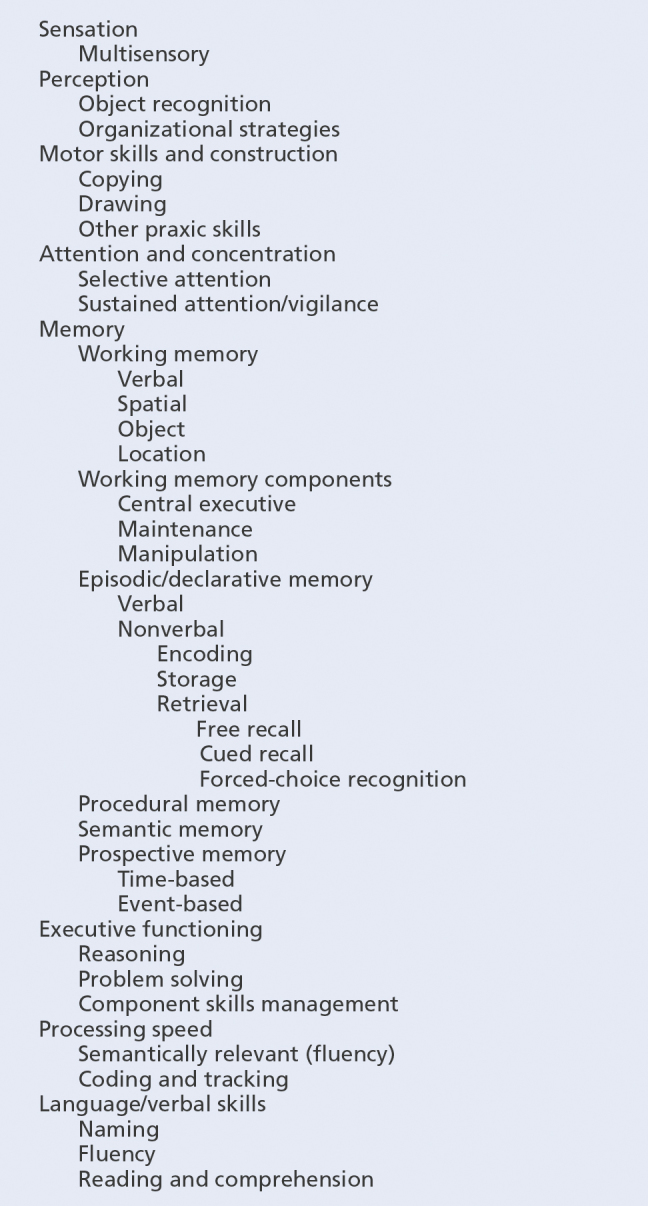
Cognitive performance is typically conceptualized in terms of domains of functioning. These domains are hierarchical in nature, with the bottom referring to more basic sensory and perceptual processes and the top referring to elements of executive functioning and cognitive control. Domains are not independent of each other and executive functioning exerts control over the utilization of more basic processes. Assessments are typically targeted at subdomains of each ability area and careful combination of tasks can reveal patterns of performance consistent with a variety of different neurological and neuropsychiatric conditions. This review covers the general structures of domains, the patterns of impairments across domains seen in common neuropsychiatric conditions, and use of assessment strategies to differentiate, to the extent possible, between different types of conditions manifesting cognitive impairment. .
Overview
AI snapshot
Written from the paper’s full text.
TL;DR
This review describes cognitive performance as organized into hierarchical domains, from basic sensation/perception to executive functioning and cognitive control, and reviews how assessments target subdomains to reveal patterns across neurological and neuropsychiatric conditions. It emphasizes that domains are intercorrelated, executive functioning supervises simpler processes, and processing speed is often the most impaired and functionally relevant domain in conditions such as schizophrenia.
Key findings
- Cognitive domains are hierarchical and not independent: basic sensory/perceptual operations are least complex, while executive functioning/reasoning and problem solving are most complex and coordinate multiple lower-level abilities.
- Assessment patterns can differentiate conditions: in cortical dementia and amnestic conditions, encoding, delayed recall, cued recall, and delayed recognition are all impaired; in frontostriatal conditions, encoding and delayed recall are impaired but delayed recognition and cued recall are typically spared. Similar patterns are reported in schizophrenia spectrum conditions.
- Attention profiles differ by condition: psychotic populations commonly show increased CPT errors of omission and reduced d′ without increased errors of commission, whereas ADHD is associated with increased errors of commission and greater B; schizophrenia spectrum individuals fail to develop the normal bias to respond to nontargets when target frequency is high.
- Processing speed is particularly important: coding-task performance is the most significant impairment in schizophrenia and the cognitive domain most strongly correlated with everyday functioning, and it tends to be the strongest predictor of overall cognitive performance. The paper also gives task examples such as digit span forward about 6 digits versus backward about 5 digits, HVLT with 12 items and 3 learning trials, CVLT with 16 items and 5 trials, and RAVLT with 15 unorganized items and 5 trials.
Methods
- Narrative review of cognitive domains and their assessment, organized by general ability area and commenting on top-down versus bottom-up structure and regional brain functioning.
- No primary data, systematic sample, or quantitative synthesis are reported; the paper synthesizes cited neuropsychological tests, clinical populations, and prior literature.
- Main analysis is conceptual: it reviews performance-based assessments and then observational/self-reported functioning, with focus on humans.
Limitations
- The paper states that fully addressing assessment of memory-disordered populations is beyond its scope, and it notes inconsistencies in the clinical/research literature about whether some processes belong in broader domains such as executive functioning or simpler domains such as processing speed.
- The paper also states that some cognitive abilities may not be clearly separable into one domain or another.
- Evident from the text: this is a narrative review without a systematic search, meta-analysis, or empirical sample, and the paper itself notes that larger factor-analytic studies often find a single global ability factor, raising questions about the separability of conventional cognitive domains.
Model-written summary. Check it against the paper before relying on it.
Integrity signals
Registry
Cites
Statistics
Figures
Verification
Claims the paper makes
44 Not checked yet · 37 No basis given · 26 Own interpretation
The paper states this without a source or data behind it here, so there is nothing to check it against. The quote shows it is in the paper.
In the paper
“Further, selective attention is also impaired, particularly when the selective attention test requires adhering to instructions to ignore some stimuli and respond to others.”
§ Domains of cognition and their assessment > Neuropsychiatric conditions commonly show attentional problems
plaincorrelational- Asserted: passes — The authors put it forward as true.
- Checkable: passes — It can be checked against evidence.
- Load-bearing: unclear — It is unclear whether the paper’s conclusions depend on it.
- Based: passes — The paper gives a reason why it holds.
In the paper
“For instance psychotic populations are commonly associated with increases in errors of omission and reduced d’ without increased errors of commission. 32”
§ Domains of cognition and their assessment > Neuropsychiatric conditions commonly show attentional problems
What the sources say
- Not checked yetcites [32] Cornblatt BA, 1989, Psychiatry Res source
plaincorrelational- Asserted: passes — The authors put it forward as true.
- Checkable: passes — It can be checked against evidence.
- Load-bearing: unclear — It is unclear whether the paper’s conclusions depend on it.
- Based: passes — The paper gives a reason why it holds.
In the paper
“There is evidence of specialized CNS processing for object, location, action, verbal, and spatial working memory. 39”
§ Domains of cognition and their assessment > Working memory
What the sources say
- Not checked yetcites [39] Adcock RA, 2000, Proc Nat Acad Sci U S A source
plaincorrelational- Asserted: passes — The authors put it forward as true.
- Checkable: passes — It can be checked against evidence.
- Load-bearing: unclear — It is unclear whether the paper’s conclusions depend on it.
- Based: passes — The paper gives a reason why it holds.
The paper states this without a source or data behind it here, so there is nothing to check it against. The quote shows it is in the paper.
In the paper
“High target frequency on the CPT leads to a normal bias to respond to nontargets.”
§ Domains of cognition and their assessment > Neuropsychiatric conditions commonly show attentional problems
plaindirect- Asserted: passes — The authors put it forward as true.
- Checkable: passes — It can be checked against evidence.
- Load-bearing: unclear — It is unclear whether the paper’s conclusions depend on it.
- Based: passes — The paper gives a reason why it holds.
The paper states this without a source or data behind it here, so there is nothing to check it against. The quote shows it is in the paper.
In the paper
“Controlled processes, those that require resource costs, can become automated after practice.”
§ Domains of cognition and their assessment > Selective attention
plaindirect- Asserted: passes — The authors put it forward as true.
- Checkable: passes — It can be checked against evidence.
- Load-bearing: passes — The paper’s conclusions depend on it.
- Based: passes — The paper gives a reason why it holds.
The paper states this without a source or data behind it here, so there is nothing to check it against. The quote shows it is in the paper.
In the paper
“Further, implicit strategies can facilitate encoding.”
§ Domains of cognition and their assessment > Encoding
plainconditional- Asserted: passes — The authors put it forward as true.
- Checkable: passes — It can be checked against evidence.
- Load-bearing: unclear — It is unclear whether the paper’s conclusions depend on it.
- Based: passes — The paper gives a reason why it holds.
In the paper
“Manipulations aimed at enforcing semantic encoding (eg, make up a story with these words) lead to more encoding than simple instructions to attend. 44”
§ Domains of cognition and their assessment > Encoding
What the sources say
- Not checked yetcites [44] Barrett TR, 1981, J Gerontol source
plaindirect- Asserted: passes — The authors put it forward as true.
- Checkable: passes — It can be checked against evidence.
- Load-bearing: unclear — It is unclear whether the paper’s conclusions depend on it.
- Based: passes — The paper gives a reason why it holds.
The paper states this without a source or data behind it here, so there is nothing to check it against. The quote shows it is in the paper.
In the paper
“The more complex the secondary task (eg, text messaging compared with using a push-button radio control), the more likely it is to be associated with traffic accidents.”
§ Domains of cognition and their assessment > Selective attention
hedgedcorrelational- Asserted: passes — The authors put it forward as true.
- Checkable: passes — It can be checked against evidence.
- Load-bearing: unclear — It is unclear whether the paper’s conclusions depend on it.
- Based: passes — The paper gives a reason why it holds.
In the paper
“These domains are hierarchical in nature, with the bottom referring to more basic sensory and perceptual processes and the top referring to elements of executive functioning and cognitive control.”
- Also stated in: § Global structure of cognitive ability domains · plain
“An additional organizational structure is hierarchical and based on the complexity of the operations. Often referred to as top-down versus bottom-up, the idea is that basic sensory and perceptional operations are least complex and reasoning and problem solving, referred to as executive functioning, are most complex. 6”
§ Domains of cognition and their assessment > Abstract
What the sources say
- Not checked yetcites [6] Al-Aidroos N, 2012, Proc Natl Acad Sci U S A source
plain- Asserted: passes — The authors put it forward as true.
- Checkable: passes — It can be checked against evidence.
- Load-bearing: passes — The paper’s conclusions depend on it.
- Based: passes — The paper gives a reason why it holds.
- Also stated in: § Global structure of cognitive ability domains · plain
In the paper
“Procedural memory can be dissociated from episodic memory, in that individuals with amnesia who cannot recall essentially any verbal information can learn and retain procedural skills. 45”
§ Domains of cognition and their assessment > Procedural memory
What the sources say
- Not checked yetcites [45] Oudman E, 2015, Neuropsychol Rev source
plain- Asserted: passes — The authors put it forward as true.
- Checkable: passes — It can be checked against evidence.
- Load-bearing: unclear — It is unclear whether the paper’s conclusions depend on it.
- Based: passes — The paper gives a reason why it holds.
- Probably not a substantial claim. 53
- It may state two separate claims as one. 32
The paper states this without a source or data behind it here, so there is nothing to check it against. The quote shows it is in the paper.
In the paper
“However, with aging, resource availability typically declines and older drivers are involved in many more accidents than younger experienced drivers.”
§ Domains of cognition and their assessment > Selective attention
plaindirect- Asserted: passes — The authors put it forward as true.
- Checkable: passes — It can be checked against evidence.
- Load-bearing: fails — The paper’s conclusions may not depend on it.
- Based: fails — The paper may give no reason why it holds.
Probably not a substantial claim. The paper’s conclusions may not depend on it. The paper may give no reason why it holds. It may state two separate claims as one.
The paper states this without a source or data behind it here, so there is nothing to check it against. The quote shows it is in the paper.
In the paper
“Maintenance working memory can handle information from multiple sensory modalities at the same time and storage capacity of maintenance working memory is capacity limited across all aspects of information.”
§ Domains of cognition and their assessment > Working memory
plain- Asserted: passes — The authors put it forward as true.
- Checkable: passes — It can be checked against evidence.
- Load-bearing: fails — The paper’s conclusions may not depend on it.
- Based: fails — The paper may give no reason why it holds.
Probably not a substantial claim. The paper’s conclusions may not depend on it. The paper may give no reason why it holds. It may state two separate claims as one.
The paper states this without a source or data behind it here, so there is nothing to check it against. The quote shows it is in the paper.
In the paper
“The more common the target, up to about 50% frequency, the easier the task.”
§ Domains of cognition and their assessment > Sustained attention/vigilance
plaindirect- Asserted: passes — The authors put it forward as true.
- Checkable: passes — It can be checked against evidence.
- Load-bearing: fails — The paper’s conclusions may not depend on it.
- Based: passes — The paper gives a reason why it holds.
Probably not a substantial claim. The paper’s conclusions may not depend on it.
In the paper
“Typically global stimuli are perceived more rapidly than local stimuli, much like a reader recognizes words more efficiently than their component letters. 23”
§ Domains of cognition and their assessment > Selective attention
What the sources say
- Not checked yetcites [23] Navon D, 1977, Cognitive Psychol source
plaincorrelational- Asserted: passes — The authors put it forward as true.
- Checkable: passes — It can be checked against evidence.
- Load-bearing: fails — The paper’s conclusions may not depend on it.
- Based: passes — The paper gives a reason why it holds.
Probably not a substantial claim. The paper’s conclusions may not depend on it.
The paper states this without a source or data behind it here, so there is nothing to check it against. The quote shows it is in the paper.
In the paper
“Storage is typically affected only by changes in brain functioning”
§ Domains of cognition and their assessment > Storage
plaindirect- Asserted: passes — The authors put it forward as true.
- Checkable: passes — It can be checked against evidence.
- Load-bearing: fails — The paper’s conclusions may not depend on it.
- Based: fails — The paper may give no reason why it holds.
Probably not a substantial claim. The paper’s conclusions may not depend on it. The paper may give no reason why it holds.
In the paper
“Attention deficit hyperactivity disorder (ADHD) is associated with increases in errors of commission and greater B, based on impulsive responses to nontarget stimuli. 33”
§ Domains of cognition and their assessment > Neuropsychiatric conditions commonly show attentional problems
What the sources say
- Not checked yetcites [33] Bedi GC, 1994, Int J Neurosci source
plaincorrelational- Asserted: passes — The authors put it forward as true.
- Checkable: passes — It can be checked against evidence.
- Load-bearing: unclear — It is unclear whether the paper’s conclusions depend on it.
- Based: passes — The paper gives a reason why it holds.
It may state two separate claims as one.
The paper states this without a source or data behind it here, so there is nothing to check it against. The quote shows it is in the paper.
In the paper
“Presenting stimuli as a stem to be completed (__ __ imal) facilitates encoding and subsequent recall of information.”
§ Domains of cognition and their assessment > Encoding
plaindirect- Asserted: passes — The authors put it forward as true.
- Checkable: passes — It can be checked against evidence.
- Load-bearing: fails — The paper’s conclusions may not depend on it.
- Based: fails — The paper may give no reason why it holds.
Probably not a substantial claim. The paper’s conclusions may not depend on it. The paper may give no reason why it holds.
In the paper
“Construction deficits are commonly found in individuals with dementia, with right hemisphere damage, or with identified lesions to the parietal cortex. 20”
§ Domains of cognition and their assessment > Construction
What the sources say
- Not checked yetcites [20] GoodglassHKaplanE1983 Philadelphia Lea and Febiger
plaincorrelational- Asserted: passes — The authors put it forward as true.
- Checkable: passes — It can be checked against evidence.
- Load-bearing: unclear — It is unclear whether the paper’s conclusions depend on it.
- Based: passes — The paper gives a reason why it holds.
It may state two separate claims as one.
The paper states this without a source or data behind it here, so there is nothing to check it against. The quote shows it is in the paper.
In the paper
“Information successfully encoded can be recalled at fairly long post encoding time periods.”
§ Domains of cognition and their assessment > Storage
plaindirect- Asserted: passes — The authors put it forward as true.
- Checkable: passes — It can be checked against evidence.
- Load-bearing: fails — The paper’s conclusions may not depend on it.
- Based: fails — The paper may give no reason why it holds.
Probably not a substantial claim. The paper’s conclusions may not depend on it. The paper may give no reason why it holds.
The paper states this without a source or data behind it here, so there is nothing to check it against. The quote shows it is in the paper.
In the paper
“Drawing objects makes them easier to recall than simply visualizing them.”
§ Domains of cognition and their assessment > Encoding
plaindirect- Asserted: passes — The authors put it forward as true.
- Checkable: passes — It can be checked against evidence.
- Load-bearing: fails — The paper’s conclusions may not depend on it.
- Based: fails — The paper may give no reason why it holds.
Probably not a substantial claim. The paper’s conclusions may not depend on it. The paper may give no reason why it holds.
The paper states this without a source or data behind it here, so there is nothing to check it against. The quote shows it is in the paper.
In the paper
“The ability to respond to instructions to shift focus across global and local properties is a critical feature of this task and is impaired in many populations with problems in attentional control.”
§ Domains of cognition and their assessment > Selective attention
plaincorrelational- Asserted: passes — The authors put it forward as true.
- Checkable: passes — It can be checked against evidence.
- Load-bearing: fails — The paper’s conclusions may not depend on it.
- Based: fails — The paper may give no reason why it holds.
Probably not a substantial claim. The paper’s conclusions may not depend on it. The paper may give no reason why it holds.
The paper states this without a source or data behind it here, so there is nothing to check it against. The quote shows it is in the paper.
In the paper
“Simple maintenance working memory can be measured in drosophila, whose executive functioning ability is clearly limited.”
§ Domains of cognition and their assessment > Working memory
boosted- Asserted: passes — The authors put it forward as true.
- Checkable: passes — It can be checked against evidence.
- Load-bearing: fails — The paper’s conclusions may not depend on it.
- Based: fails — The paper may give no reason why it holds.
Probably not a substantial claim. The paper’s conclusions may not depend on it. The paper may give no reason why it holds. It may state two separate claims as one.
The paper states this without a source or data behind it here, so there is nothing to check it against. The quote shows it is in the paper.
In the paper
“Dual-task processing is particularly impaired in neuropsychiatric conditions, with people with schizophrenia manifesting considerable challenges in dual-task demands.”
§ Domains of cognition and their assessment > Neuropsychiatric conditions commonly show attentional problems
plaincorrelational- Asserted: passes — The authors put it forward as true.
- Checkable: passes — It can be checked against evidence.
- Load-bearing: fails — The paper’s conclusions may not depend on it.
- Based: fails — The paper may give no reason why it holds.
Probably not a substantial claim. The paper’s conclusions may not depend on it. The paper may give no reason why it holds. It may state two separate claims as one.
The paper states this without a source or data behind it here, so there is nothing to check it against. The quote shows it is in the paper.
In the paper
“However, when the target frequency does over 50%, difficulty increases because inhibition of the dominant response to respond on all stimuli is required and even completely healthy people have an increase in errors.”
§ Domains of cognition and their assessment > Sustained attention/vigilance
plaindirect- Asserted: passes — The authors put it forward as true.
- Checkable: passes — It can be checked against evidence.
- Load-bearing: unclear — It is unclear whether the paper’s conclusions depend on it.
- Based: passes — The paper gives a reason why it holds.
It may state two separate claims as one.
The paper states this without a source or data behind it here, so there is nothing to check it against. The quote shows it is in the paper.
In the paper
“Generally, there is a “resource cost” for such operations and typically performance in digits backward is about one item less than performance on digit span forward (6 digits forward = 5 digits backwards).”
§ Domains of cognition and their assessment > Working memory
plaindirect- Asserted: passes — The authors put it forward as true.
- Checkable: passes — It can be checked against evidence.
- Load-bearing: fails — The paper’s conclusions may not depend on it.
- Based: fails — The paper may give no reason why it holds.
Probably not a substantial claim. The paper’s conclusions may not depend on it. The paper may give no reason why it holds. It may state two separate claims as one.
In the paper
“There are formal indices of the ability to divide attention, which can identify impairments in the ability to divide attention which are common in several neuropsychiatric conditions. 25”
§ Domains of cognition and their assessment > Selective attention
What the sources say
- Not checked yetcites [25] Granholm E, 1996, Neuropsychology source
plaincorrelational- Asserted: passes — The authors put it forward as true.
- Checkable: passes — It can be checked against evidence.
- Load-bearing: unclear — It is unclear whether the paper’s conclusions depend on it.
- Based: passes — The paper gives a reason why it holds.
It may state two separate claims as one.
In the paper
“Beginning drivers can tolerate many fewer concurrent tasks while maintaining adequate performance and have the highest rates of accidents. 28”
§ Domains of cognition and their assessment > Selective attention
What the sources say
- Not checked yetcites [28] Gershon P, 2017, J Safety Res source
plaincorrelational- Asserted: passes — The authors put it forward as true.
- Checkable: passes — It can be checked against evidence.
- Load-bearing: unclear — It is unclear whether the paper’s conclusions depend on it.
- Based: passes — The paper gives a reason why it holds.
It may state two separate claims as one.
The paper states this without a source or data behind it here, so there is nothing to check it against. The quote shows it is in the paper.
In the paper
“information that is never detected consciously may be stored (unconscious processing) but typically cannot be retrieved volitionally although it may be available with the right implicit prompt.”
§ Domains of cognition and their assessment > Working memory
hedgedconditional- Asserted: passes — The authors put it forward as true.
- Checkable: passes — It can be checked against evidence.
- Load-bearing: fails — The paper’s conclusions may not depend on it.
- Based: fails — The paper may give no reason why it holds.
Probably not a substantial claim. The paper’s conclusions may not depend on it. The paper may give no reason why it holds. It may state two separate claims as one.
The paper states this without a source or data behind it here, so there is nothing to check it against. The quote shows it is in the paper.
In the paper
“These strategies re commonly applied across different versions of verbal and visual-spatial memory tests.”
§ Domains of cognition and their assessment > Retrieval
plain- Asserted: passes — The authors put it forward as true.
- Checkable: passes — It can be checked against evidence.
- Load-bearing: fails — The paper’s conclusions may not depend on it.
- Based: fails — The paper may give no reason why it holds.
Probably not a substantial claim. The paper’s conclusions may not depend on it. The paper may give no reason why it holds.
The paper states this without a source or data behind it here, so there is nothing to check it against. The quote shows it is in the paper.
In the paper
“Some information is clearly permanent (eg, new vocabulary words).”
§ Domains of cognition and their assessment > Storage
boosted- Asserted: passes — The authors put it forward as true.
- Checkable: passes — It can be checked against evidence.
- Load-bearing: fails — The paper’s conclusions may not depend on it.
- Based: fails — The paper may give no reason why it holds.
Probably not a substantial claim. The paper’s conclusions may not depend on it. The paper may give no reason why it holds.
The paper states this without a source or data behind it here, so there is nothing to check it against. The quote shows it is in the paper.
In the paper
“More complex operations, such as storage of multiple items then retrieval of a selected set, have even greater capacity cost.”
§ Domains of cognition and their assessment > Working memory
plaindirect- Asserted: passes — The authors put it forward as true.
- Checkable: passes — It can be checked against evidence.
- Load-bearing: fails — The paper’s conclusions may not depend on it.
- Based: fails — The paper may give no reason why it holds.
Probably not a substantial claim. The paper’s conclusions may not depend on it. The paper may give no reason why it holds.
The paper states this without a source or data behind it here, so there is nothing to check it against. The quote shows it is in the paper.
In the paper
“Interestingly, distracted driving is a major cause of accidents in the US and distracted driving is specifically the attempt to perform other tasks while driving.”
§ Domains of cognition and their assessment > Selective attention
plaindirect- Asserted: passes — The authors put it forward as true.
- Checkable: passes — It can be checked against evidence.
- Load-bearing: fails — The paper’s conclusions may not depend on it.
- Based: passes — The paper gives a reason why it holds.
Probably not a substantial claim. The paper’s conclusions may not depend on it.
The paper states this without a source or data behind it here, so there is nothing to check it against. The quote shows it is in the paper.
In the paper
“For instance, asking the participant to evaluate stimuli for various semantic characteristics (living/nonliving) facilitates encoding.”
§ Domains of cognition and their assessment > Encoding
plaindirect- Asserted: passes — The authors put it forward as true.
- Checkable: passes — It can be checked against evidence.
- Load-bearing: fails — The paper’s conclusions may not depend on it.
- Based: fails — The paper may give no reason why it holds.
Probably not a substantial claim. The paper’s conclusions may not depend on it. The paper may give no reason why it holds.
In the paper
“Performance on the UFOV has been shown to predict driving problems and interventions aimed at speed dual-task processing have been shown to reduce accidents in older drivers. 30”
§ Domains of cognition and their assessment > Selective attention
What the sources say
- Not checked yetcites [30] Roenker DL, 2003, Hum Factors source
plaindirect- Asserted: passes — The authors put it forward as true.
- Checkable: passes — It can be checked against evidence.
- Load-bearing: unclear — It is unclear whether the paper’s conclusions depend on it.
- Based: passes — The paper gives a reason why it holds.
It may state two separate claims as one.
In the paper
“Interestingly, people in the schizophrenia spectrum fail to develop this normal bias and do not have an increase in errors of commission with increased frequency of targets. 34”
§ Domains of cognition and their assessment > Neuropsychiatric conditions commonly show attentional problems
What the sources say
- Not checked yetcites [34] Barch DM, 2003, J Abnorm Psychol source
plain- Asserted: passes — The authors put it forward as true.
- Checkable: passes — It can be checked against evidence.
- Load-bearing: unclear — It is unclear whether the paper’s conclusions depend on it.
- Based: passes — The paper gives a reason why it holds.
It may state two separate claims as one.
The paper states this without a source or data behind it here, so there is nothing to check it against. The quote shows it is in the paper.
In the paper
“Information can be transferred from working memory to longer-term storage, but that process requires either active processing or salience of the stimulus in working memory for encoding.”
§ Domains of cognition and their assessment > Working memory
plaindirect- Asserted: passes — The authors put it forward as true.
- Checkable: passes — It can be checked against evidence.
- Load-bearing: fails — The paper’s conclusions may not depend on it.
- Based: fails — The paper may give no reason why it holds.
Probably not a substantial claim. The paper’s conclusions may not depend on it. The paper may give no reason why it holds. It may state two separate claims as one.
The paper states this without a source or data behind it here, so there is nothing to check it against. The quote shows it is in the paper.
In the paper
“For visual learning, familiar and namable objects are easier to learn.”
§ Domains of cognition and their assessment > Encoding
plaindirect- Asserted: passes — The authors put it forward as true.
- Checkable: passes — It can be checked against evidence.
- Load-bearing: fails — The paper’s conclusions may not depend on it.
- Based: fails — The paper may give no reason why it holds.
Probably not a substantial claim. The paper’s conclusions may not depend on it. The paper may give no reason why it holds.
The paper states this without a source or data behind it here, so there is nothing to check it against. The quote shows it is in the paper.
In the paper
“Different populations make different patterns of errors on the CPT.”
§ Domains of cognition and their assessment > Sustained attention/vigilance
plaincorrelational- Asserted: passes — The authors put it forward as true.
- Checkable: passes — It can be checked against evidence.
- Load-bearing: fails — The paper’s conclusions may not depend on it.
- Based: fails — The paper may give no reason why it holds.
Probably not a substantial claim. The paper’s conclusions may not depend on it. The paper may give no reason why it holds.
The paper states this without a source or data behind it here, so there is nothing to check it against. The quote shows it is in the paper.
In the paper
“Both iconic (visual) and auditory (echoic) storage are duration and capacity limited and processing of new information can lead to the loss of memory currently in storage.”
§ Domains of cognition and their assessment > Working memory
plaindirect- Asserted: passes — The authors put it forward as true.
- Checkable: passes — It can be checked against evidence.
- Load-bearing: fails — The paper’s conclusions may not depend on it.
- Based: fails — The paper may give no reason why it holds.
Probably not a substantial claim. The paper’s conclusions may not depend on it. The paper may give no reason why it holds. It may state two separate claims as one.
In the paper
“On word list tests, semantically organized lists (subsets of animals, colors, etc) 43 are easier to learn and telling the participant that the list is organized also facilitates encoding.”
§ Domains of cognition and their assessment > Encoding
What the sources say
- Not checked yetcites [43] DelisDCKramerJKaplanEOberBA1987 New York, NY Psychological Corporation
plaindirect- Asserted: passes — The authors put it forward as true.
- Checkable: passes — It can be checked against evidence.
- Load-bearing: unclear — It is unclear whether the paper’s conclusions depend on it.
- Based: passes — The paper gives a reason why it holds.
It may state two separate claims as one.
The paper states this without a source or data behind it here, so there is nothing to check it against. The quote shows it is in the paper.
In the paper
“After practice, many functions required for driving become automated and accident rates decline.”
§ Domains of cognition and their assessment > Selective attention
plaindirect- Asserted: passes — The authors put it forward as true.
- Checkable: passes — It can be checked against evidence.
- Load-bearing: unclear — It is unclear whether the paper’s conclusions depend on it.
- Based: passes — The paper gives a reason why it holds.
It may state two separate claims as one.
The paper states this without a source or data behind it here, so there is nothing to check it against. The quote shows it is in the paper.
In the paper
“Most inconsistencies are in broad domains that may include multiple component processes.”
§ Domains of cognition and their assessment > Introduction
plain- Asserted: passes — The authors put it forward as true.
- Checkable: passes — It can be checked against evidence.
- Load-bearing: fails — The paper’s conclusions may not depend on it.
- Based: fails — The paper may give no reason why it holds.
Probably not a substantial claim. The paper’s conclusions may not depend on it. The paper may give no reason why it holds.
The paper states this without a source or data behind it here, so there is nothing to check it against. The quote shows it is in the paper.
In the paper
“Assessments are typically targeted at subdomains of each ability area”
§ Domains of cognition and their assessment > Abstract
plain- Asserted: passes — The authors put it forward as true.
- Checkable: passes — It can be checked against evidence.
- Load-bearing: passes — The paper’s conclusions depend on it.
- Based: fails — The paper may give no reason why it holds.
Probably not a substantial claim. The paper may give no reason why it holds.
A conclusion the paper draws from its own results — it cites no other source for it, so there is none to check. The quote shows it is in the paper.
In the paper
“executive functioning exerts control over the utilization of more basic processes.”
§ Domains of cognition and their assessment > Abstract
plaindirect- Asserted: passes — The authors put it forward as true.
- Checkable: passes — It can be checked against evidence.
- Load-bearing: passes — The paper’s conclusions depend on it.
- Based: fails — The paper may give no reason why it holds.
Probably not a substantial claim. The paper may give no reason why it holds.
A conclusion the paper draws from its own results — it cites no other source for it, so there is none to check. The quote shows it is in the paper.
In the paper
“careful combination of tasks can reveal patterns of performance consistent with a variety of different neurological and neuropsychiatric conditions.”
§ Domains of cognition and their assessment > Abstract
plaincorrelational- Asserted: passes — The authors put it forward as true.
- Checkable: passes — It can be checked against evidence.
- Load-bearing: passes — The paper’s conclusions depend on it.
- Based: fails — The paper may give no reason why it holds.
Probably not a substantial claim. The paper may give no reason why it holds.
The paper states this without a source or data behind it here, so there is nothing to check it against. The quote shows it is in the paper.
In the paper
“there are clear inconsistencies in the clinical and research literature.”
§ Domains of cognition and their assessment > Introduction
boosted- Asserted: passes — The authors put it forward as true.
- Checkable: passes — It can be checked against evidence.
- Load-bearing: passes — The paper’s conclusions depend on it.
- Based: passes — The paper gives a reason why it holds.
Probably not a substantial claim.
A conclusion the paper draws from its own results — it cites no other source for it, so there is none to check. The quote shows it is in the paper.
In the paper
“Domains are not independent of each other”
§ Domains of cognition and their assessment > Abstract
plaincorrelational- Asserted: passes — The authors put it forward as true.
- Checkable: passes — It can be checked against evidence.
- Load-bearing: passes — The paper’s conclusions depend on it.
- Based: fails — The paper may give no reason why it holds.
Probably not a substantial claim. The paper may give no reason why it holds.
A conclusion the paper draws from its own results — it cites no other source for it, so there is none to check. The quote shows it is in the paper.
In the paper
“Thus, executive functioning tasks often involve the co-ordination of multiple sensory, perceptual, attentional, and other less complex functions, while simple sensory tasks require minimal higher-level processing.”
§ Domains of cognition and their assessment > Global structure of cognitive ability domains
plaincorrelational- Asserted: passes — The authors put it forward as true.
- Checkable: passes — It can be checked against evidence.
- Load-bearing: fails — The paper’s conclusions may not depend on it.
- Based: passes — The paper gives a reason why it holds.
Probably not a substantial claim. The paper’s conclusions may not depend on it. It may state two separate claims as one.
A conclusion the paper draws from its own results — it cites no other source for it, so there is none to check. The quote shows it is in the paper.
In the paper
“manipulation working memory is clearly associated with executive functioning.”
§ Domains of cognition and their assessment > Working memory
boostedcorrelational- Asserted: passes — The authors put it forward as true.
- Checkable: passes — It can be checked against evidence.
- Load-bearing: fails — The paper’s conclusions may not depend on it.
- Based: passes — The paper gives a reason why it holds.
Probably not a substantial claim. The paper’s conclusions may not depend on it.
The paper states this without a source or data behind it here, so there is nothing to check it against. The quote shows it is in the paper.
In the paper
“Multiple factors are known affect encoding.”
§ Domains of cognition and their assessment > Encoding
boostedcorrelational- Asserted: passes — The authors put it forward as true.
- Checkable: passes — It can be checked against evidence.
- Load-bearing: fails — The paper’s conclusions may not depend on it.
- Based: passes — The paper gives a reason why it holds.
Probably not a substantial claim. The paper’s conclusions may not depend on it.
None of the sources cited for this claim have been checked yet.
In the paper
“The origin of these domains was originally linked (ie, localized) to the areas of the brain in which these processes were seen to be occurring, 2 a perspective that is still important today. 3”
§ Domains of cognition and their assessment > Introduction
What the sources say
- Not checked yetcites [2] Babcock HA, 1930, Arch Psychol
- Not checked yetcites [3] DamasioHDamasioAR1989 New York, NY Oxford University Press
plaincorrelational- Asserted: passes — The authors put it forward as true.
- Checkable: passes — It can be checked against evidence.
- Load-bearing: fails — The paper’s conclusions may not depend on it.
- Based: passes — The paper gives a reason why it holds.
Probably not a substantial claim. The paper’s conclusions may not depend on it. It may state two separate claims as one.
A conclusion the paper draws from its own results — it cites no other source for it, so there is none to check. The quote shows it is in the paper.
In the paper
“These three tests are considerably different in difficulty which needs to be considered when selecting assessment instruments.”
§ Domains of cognition and their assessment > Encoding
plain- Asserted: passes — The authors put it forward as true.
- Checkable: passes — It can be checked against evidence.
- Load-bearing: passes — The paper’s conclusions depend on it.
- Based: passes — The paper gives a reason why it holds.
It may state two separate claims as one.
The paper states this without a source or data behind it here, so there is nothing to check it against. The quote shows it is in the paper.
In the paper
“Whether these processes belong in more general domains (executive functioning) or a simpler domain (processing speed) is often unclear.”
§ Domains of cognition and their assessment > Introduction
plain- Asserted: passes — The authors put it forward as true.
- Checkable: passes — It can be checked against evidence.
- Load-bearing: fails — The paper’s conclusions may not depend on it.
- Based: fails — The paper may give no reason why it holds.
Probably not a substantial claim. The paper’s conclusions may not depend on it. The paper may give no reason why it holds.
A conclusion the paper draws from its own results — it cites no other source for it, so there is none to check. The quote shows it is in the paper.
In the paper
“This component of the memory system interacts with working memory storage processes to encode, maintain, and retrieve information into and out of longer-term storage.”
§ Domains of cognition and their assessment > Episodic/declarative/explicit memory
plaindirect- Asserted: passes — The authors put it forward as true.
- Checkable: passes — It can be checked against evidence.
- Load-bearing: fails — The paper’s conclusions may not depend on it.
- Based: fails — The paper may give no reason why it holds.
Probably not a substantial claim. The paper’s conclusions may not depend on it. The paper may give no reason why it holds.
A conclusion the paper draws from its own results — it cites no other source for it, so there is none to check. The quote shows it is in the paper.
In the paper
“All of these attentional skills have executive functioning components that are described below.”
§ Domains of cognition and their assessment > Attention and concentration
plaincorrelational- Asserted: passes — The authors put it forward as true.
- Checkable: passes — It can be checked against evidence.
- Load-bearing: fails — The paper’s conclusions may not depend on it.
- Based: fails — The paper may give no reason why it holds.
Probably not a substantial claim. The paper’s conclusions may not depend on it. The paper may give no reason why it holds.
The paper states this without a source or data behind it here, so there is nothing to check it against. The quote shows it is in the paper.
In the paper
“Memory functioning is the most complex and multifaceted of cognitive domains.”
§ Domains of cognition and their assessment > Memory
plain- Asserted: passes — The authors put it forward as true.
- Checkable: fails — It may be too vague to check against evidence.
- Load-bearing: fails — The paper’s conclusions may not depend on it.
- Based: fails — The paper may give no reason why it holds.
Probably not a substantial claim. It may be too vague to check against evidence. The paper’s conclusions may not depend on it. The paper may give no reason why it holds.
In the paper
“Contemporary circuit-based conceptions focus on activation and interaction of these circuits. 4”
§ Domains of cognition and their assessment > Introduction
What the sources say
- Not checked yetcites [4] Lopez-GarciaPLeshTASaloTet alThe neural circuitry supporting goal maintenance during cognitive control: a comparison of expectancy AX-CPT and dot probe expectancy paradigms Cogn Affect Behav Neurosci2016161164175
plain- Asserted: passes — The authors put it forward as true.
- Checkable: passes — It can be checked against evidence.
- Load-bearing: fails — The paper’s conclusions may not depend on it.
- Based: passes — The paper gives a reason why it holds.
Probably not a substantial claim. The paper’s conclusions may not depend on it.
A conclusion the paper draws from its own results — it cites no other source for it, so there is none to check. The quote shows it is in the paper.
In the paper
“The maintenance of information in working memory requires intact sensation, perception, and attention”
§ Domains of cognition and their assessment > Working memory
plaindirect- Asserted: passes — The authors put it forward as true.
- Checkable: passes — It can be checked against evidence.
- Load-bearing: fails — The paper’s conclusions may not depend on it.
- Based: fails — The paper may give no reason why it holds.
Probably not a substantial claim. The paper’s conclusions may not depend on it. The paper may give no reason why it holds.
A conclusion the paper draws from its own results — it cites no other source for it, so there is none to check. The quote shows it is in the paper.
In the paper
“In addition, impairments in different elements of the system can lead to the same general outcome of poor memory output.”
§ Domains of cognition and their assessment > Episodic/declarative/explicit memory
plaindirect- Asserted: passes — The authors put it forward as true.
- Checkable: passes — It can be checked against evidence.
- Load-bearing: fails — The paper’s conclusions may not depend on it.
- Based: fails — The paper may give no reason why it holds.
Probably not a substantial claim. The paper’s conclusions may not depend on it. The paper may give no reason why it holds.
The paper states this without a source or data behind it here, so there is nothing to check it against. The quote shows it is in the paper.
In the paper
“There are several different ways that information can be retrieved after encoding.”
§ Domains of cognition and their assessment > Retrieval
plain- Asserted: passes — The authors put it forward as true.
- Checkable: passes — It can be checked against evidence.
- Load-bearing: fails — The paper’s conclusions may not depend on it.
- Based: fails — The paper may give no reason why it holds.
Probably not a substantial claim. The paper’s conclusions may not depend on it. The paper may give no reason why it holds.
In the paper
“The development of automatic processing is a critical feature of much complex skill learning, with driving being a primary example. 27”
§ Domains of cognition and their assessment > Selective attention
What the sources say
- Not checked yetcites [27] Engstrom J, 2017, Human Factors source
plaindirect- Asserted: passes — The authors put it forward as true.
- Checkable: passes — It can be checked against evidence.
- Load-bearing: unclear — It is unclear whether the paper’s conclusions depend on it.
- Based: passes — The paper gives a reason why it holds.
It may state two separate claims as one.
A conclusion the paper draws from its own results — it cites no other source for it, so there is none to check. The quote shows it is in the paper.
In the paper
“The HVLT may be too easy for screening younger populations and the RAVLT may be too hard demanding as a dementia screen in order people.”
§ Domains of cognition and their assessment > Encoding
hedgedconditional- Asserted: passes — The authors put it forward as true.
- Checkable: passes — It can be checked against evidence.
- Load-bearing: fails — The paper’s conclusions may not depend on it.
- Based: passes — The paper gives a reason why it holds.
Probably not a substantial claim. The paper’s conclusions may not depend on it. It may state two separate claims as one.
In the paper
“Further, working memory is conceptualized to include two separable components: maintenance of information and manipulation of information. 35”
§ Domains of cognition and their assessment > Working memory
What the sources say
- Not checked yetcites [35] Baddeley AD, 1999 source
plain- Asserted: passes — The authors put it forward as true.
- Checkable: passes — It can be checked against evidence.
- Load-bearing: fails — The paper’s conclusions may not depend on it.
- Based: passes — The paper gives a reason why it holds.
Probably not a substantial claim. The paper’s conclusions may not depend on it.
The paper states this without a source or data behind it here, so there is nothing to check it against. The quote shows it is in the paper.
In the paper
“Attention and concentration is a multifaceted construct and is generally divided into two global subdomains: selective attention and sustained attention (or vigilance).”
§ Domains of cognition and their assessment > Attention and concentration
plain- Asserted: passes — The authors put it forward as true.
- Checkable: passes — It can be checked against evidence.
- Load-bearing: fails — The paper’s conclusions may not depend on it.
- Based: fails — The paper may give no reason why it holds.
Probably not a substantial claim. The paper’s conclusions may not depend on it. The paper may give no reason why it holds.
A conclusion the paper draws from its own results — it cites no other source for it, so there is none to check. The quote shows it is in the paper.
In the paper
“Encoding manipulations are important in the context of who is being tested.”
§ Domains of cognition and their assessment > Encoding
plaincorrelational- Asserted: passes — The authors put it forward as true.
- Checkable: passes — It can be checked against evidence.
- Load-bearing: fails — The paper’s conclusions may not depend on it.
- Based: passes — The paper gives a reason why it holds.
Probably not a substantial claim. The paper’s conclusions may not depend on it.
The paper states this without a source or data behind it here, so there is nothing to check it against. The quote shows it is in the paper.
In the paper
“They include encoding, storage, and retrieval, all of which are required for successful memory performance.”
§ Domains of cognition and their assessment > Episodic/declarative/explicit memory
plaindirect- Asserted: passes — The authors put it forward as true.
- Checkable: passes — It can be checked against evidence.
- Load-bearing: fails — The paper’s conclusions may not depend on it.
- Based: fails — The paper may give no reason why it holds.
Probably not a substantial claim. The paper’s conclusions may not depend on it. The paper may give no reason why it holds. It may state two separate claims as one.
In the paper
“If cognitive speed is excessively slow, then performance of “non-speeded” tasks acquire an additional challenge and may lead to challenges in access correct strategies in a timely manner. 64”
§ Domains of cognition and their assessment > Processing speed
What the sources say
- Not checked yetcites [64] Knowles EE, 2015, Biol Psychiatry source
hedgedconditional- Asserted: passes — The authors put it forward as true.
- Checkable: passes — It can be checked against evidence.
- Load-bearing: unclear — It is unclear whether the paper’s conclusions depend on it.
- Based: passes — The paper gives a reason why it holds.
It may state two separate claims as one.
A conclusion the paper draws from its own results — it cites no other source for it, so there is none to check. The quote shows it is in the paper.
In the paper
“Semantic memory is often accessed in the performance of new declarative memory tasks, in that information that is previously stored in semantic memory is more easily attended to, encoded, and recalled for short-term use than completely novel information.”
§ Domains of cognition and their assessment > Semantic memory
plaindirect- Asserted: passes — The authors put it forward as true.
- Checkable: passes — It can be checked against evidence.
- Load-bearing: fails — The paper’s conclusions may not depend on it.
- Based: fails — The paper may give no reason why it holds.
Probably not a substantial claim. The paper’s conclusions may not depend on it. The paper may give no reason why it holds. It may state two separate claims as one.
A conclusion the paper draws from its own results — it cites no other source for it, so there is none to check. The quote shows it is in the paper.
In the paper
“Within neuropsychiatric conditions, language deficits may be associated with either deficits in executive functioning (eg, the ability to successfully access semantic storage) or slowed processing speed.”
§ Domains of cognition and their assessment > Language skills
hedgedcorrelational- Asserted: passes — The authors put it forward as true.
- Checkable: passes — It can be checked against evidence.
- Load-bearing: fails — The paper’s conclusions may not depend on it.
- Based: passes — The paper gives a reason why it holds.
Probably not a substantial claim. The paper’s conclusions may not depend on it.
None of the sources cited for this claim have been checked yet.
In the paper
“in cortical dementia and amnestic conditions encoding, delayed recall, cued recall, and delayed recognition are all impaired”
§ Domains of cognition and their assessment > Assessments of memory-disordered populations
What the sources say
plaincorrelational- Asserted: passes — The authors put it forward as true.
- Checkable: passes — It can be checked against evidence.
- Load-bearing: unclear — It is unclear whether the paper’s conclusions depend on it.
- Based: passes — The paper gives a reason why it holds.
It may state two separate claims as one.
In the paper
“semantic memory appears to remain intact over the lifespan and continue to accrue new information even into late life. 47”
§ Domains of cognition and their assessment > Semantic memory
What the sources say
- Not checked yetcites [47] Czaja SJ, 2006, Psychol Aging source
hedged- Asserted: passes — The authors put it forward as true.
- Checkable: passes — It can be checked against evidence.
- Load-bearing: unclear — It is unclear whether the paper’s conclusions depend on it.
- Based: passes — The paper gives a reason why it holds.
It may state two separate claims as one.
In the paper
“performance on various coding tasks is not only the most significant impairment in schizophrenia 63 but is also the cognitive ability domain that is most strongly correlated with impairments in everyday functioning.”
§ Domains of cognition and their assessment > Processing speed
What the sources say
- Not checked yetcites [63] Dickinson D, 2007, Arch Gen Psychiatry source
plaincorrelational- Asserted: passes — The authors put it forward as true.
- Checkable: passes — It can be checked against evidence.
- Load-bearing: unclear — It is unclear whether the paper’s conclusions depend on it.
- Based: passes — The paper gives a reason why it holds.
It may state two separate claims as one.
A conclusion the paper draws from its own results — it cites no other source for it, so there is none to check. The quote shows it is in the paper.
In the paper
“By virtue of the fact that fluency tasks are speeded in terms of their instructions, cognitive slowing can have an adverse impact on performance.”
§ Domains of cognition and their assessment > Language skills
plaindirect- Asserted: passes — The authors put it forward as true.
- Checkable: passes — It can be checked against evidence.
- Load-bearing: fails — The paper’s conclusions may not depend on it.
- Based: passes — The paper gives a reason why it holds.
Probably not a substantial claim. The paper’s conclusions may not depend on it.
A conclusion the paper draws from its own results — it cites no other source for it, so there is none to check. The quote shows it is in the paper.
In the paper
“Following instructions such as ignoring distractors, dividing attention to process one of two concurrent information streams, or following other instructions in processing speed tasks (eg, alternate between letters and numbers) are clearly executive or “cognitive control” demands as described above.”
§ Domains of cognition and their assessment > Executive functioning
boosted- Asserted: passes — The authors put it forward as true.
- Checkable: passes — It can be checked against evidence.
- Load-bearing: fails — The paper’s conclusions may not depend on it.
- Based: passes — The paper gives a reason why it holds.
Probably not a substantial claim. The paper’s conclusions may not depend on it.
In the paper
“Large-scale studies of cognition over the lifespan have found increasers in wisdom and semantic memory over the lifespan, with decreases in processing speed and working memory span tasks. 47”
§ Domains of cognition and their assessment > Executive functioning
What the sources say
- Not checked yetcites [47] Czaja SJ, 2006, Psychol Aging source
plaindirect- Asserted: passes — The authors put it forward as true.
- Checkable: passes — It can be checked against evidence.
- Load-bearing: unclear — It is unclear whether the paper’s conclusions depend on it.
- Based: passes — The paper gives a reason why it holds.
It may state two separate claims as one.
In the paper
“These include ADHD, mental illnesses such as schizophrenia and depression, and obsessive-compulsive disorder (OCD). 61”
§ Domains of cognition and their assessment > Populations with executive functioning deficits
What the sources say
- Not checked yetcites [61] Kuelz AK, 2004, Biol Psychol source
plaincorrelational- Asserted: passes — The authors put it forward as true.
- Checkable: passes — It can be checked against evidence.
- Load-bearing: unclear — It is unclear whether the paper’s conclusions depend on it.
- Based: passes — The paper gives a reason why it holds.
It may state two separate claims as one.
In the paper
“both cortical and frontostriatal conditions adversely impact verbal fluency, but naming deficits are more commonly seen in cortical dementia. 50”
§ Domains of cognition and their assessment > Language skills
What the sources say
- Not checked yetcites [50] Paulsen JS, 1995, Neurology source
plaindirect- Asserted: passes — The authors put it forward as true.
- Checkable: passes — It can be checked against evidence.
- Load-bearing: unclear — It is unclear whether the paper’s conclusions depend on it.
- Based: passes — The paper gives a reason why it holds.
It may state two separate claims as one.
None of the sources cited for this claim have been checked yet.
In the paper
“while in frontostriatal conditions encoding and delayed recall are impaired, but delayed recognition and cued recall are typically spared. 50 - 51”
§ Domains of cognition and their assessment > Assessments of memory-disordered populations
What the sources say
plain- Asserted: passes — The authors put it forward as true.
- Checkable: passes — It can be checked against evidence.
- Load-bearing: unclear — It is unclear whether the paper’s conclusions depend on it.
- Based: passes — The paper gives a reason why it holds.
It may state two separate claims as one.
A conclusion the paper draws from its own results — it cites no other source for it, so there is none to check. The quote shows it is in the paper.
In the paper
“many working memory tasks, such as simple delayed response tasks, involve essentially no problem solving or management of cognitive resources.”
§ Domains of cognition and their assessment > Executive functioning
plain- Asserted: passes — The authors put it forward as true.
- Checkable: passes — It can be checked against evidence.
- Load-bearing: passes — The paper’s conclusions depend on it.
- Based: fails — The paper may give no reason why it holds.
Probably not a substantial claim. The paper may give no reason why it holds.
A conclusion the paper draws from its own results — it cites no other source for it, so there is none to check. The quote shows it is in the paper.
In the paper
“Prospective memory is certainly one of the tasks on the boundary of executive functioning, because of the strong planning component associated with task outcomes.”
§ Domains of cognition and their assessment > Executive functioning
boostedcorrelational- Asserted: passes — The authors put it forward as true.
- Checkable: passes — It can be checked against evidence.
- Load-bearing: fails — The paper’s conclusions may not depend on it.
- Based: passes — The paper gives a reason why it holds.
Probably not a substantial claim. The paper’s conclusions may not depend on it.
None of the sources cited for this claim have been checked yet.
In the paper
“the two major compendia for neuropsychological assessment (Lezak et al 1 and Strauss et al 15 ) do not list procedural memory in their index sections”
§ Domains of cognition and their assessment > Procedural memory
What the sources say
- Not checked yetcites Lezak et al 1
- Not checked yetcites Strauss et al 15
plain- Asserted: passes — The authors put it forward as true.
- Checkable: passes — It can be checked against evidence.
- Load-bearing: passes — The paper’s conclusions depend on it.
- Based: passes — The paper gives a reason why it holds.
Probably not a substantial claim.
A conclusion the paper draws from its own results — it cites no other source for it, so there is none to check. The quote shows it is in the paper.
In the paper
“Historical domains of cognitive functioning are still examined to this day, but now through the lens of a considerably more information about underlying brain structure and function.”
§ Domains of cognition and their assessment > Conclusion
plain- Asserted: passes — The authors put it forward as true.
- Checkable: passes — It can be checked against evidence.
- Load-bearing: passes — The paper’s conclusions depend on it.
- Based: passes — The paper gives a reason why it holds.
Probably not a substantial claim.
- Rests on an assumption: Brain imaging allows for the differentiation of impairments in different brain regions.
The paper relies on this without support.
Cognitive performance is typically conceptualized in terms of domains of functioning.
“Cognitive performance is typically conceptualized in terms of domains of functioning.”
The paper relies on this without support.
The nature of most cognitive domains is generally agreed upon.
“Although the nature of most of these domains is generally agreed upon”
The paper relies on this without support.
An intact frontal cortex is critical for performance of executive functions.
“An intact frontal cortex is certainly critical for performance of executive functions”
The paper relies on this without support.
Processing speed tends to be the strongest predictor of overall cognitive performance on cognitive assessment batteries, loading most highly on single factor solutions of cognitive ability.
“Another critical feature of processing speed is that it tends to be the strongest predictor of overall cognitive performance, on cognitive assessment batteries, loading most highly on single factor solutions of cognitive ability.”
The paper relies on this without support.
Populations with challenges in processing speed include major depression, severe mental illnesses, Parkinson’s disease, and both cortical and frontostriatal degenerative conditions.
“Populations with challenges in processing speed include major depression, severe mental illnesses, Parkinson’s disease, and both cortical and frontostriatal degenerative conditions.”
The paper relies on this without support.
Language abilities can be impaired in neuropsychiatric conditions but are much more commonly impaired in conditions involving brain damage, stroke, or degenerative dementia.
“Language abilities can be impaired in neuropsychiatric conditions but are much more commonly impaired in conditions involving brain damage, stroke, or degenerative dementia.”
The paper relies on this without support.
The rapid forgetting of adequately learned information, specifically defined as lack of perseveration of recognition and cued recall, is a robust finding in populations who have medial temporal lobe brain dysfunction.
“Most importantly, the rapid forgetting of adequately learned information, specifically defined as lack of perseveration of recognition and cued recall, is a robust finding in populations who have medial temporal lobe brain dysfunction.”
The paper relies on this without support.
Brain imaging allows for the differentiation of impairments in different brain regions.
“Also, brain imaging allows for the differentiation of impairments in different brain regions.”
Claims other papers make about this one
Each is checked against this paper’s own text: does it say what the citing paper says it does?
The source backs part of the claim, not all of it — or backs it for a different population, condition or comparison.
In the citing paper
“There are several ways to classify cognitive development, one of them being general processes involved, such as memory, attention, executive function and language development [8].”
From Impact of social media on cognitive development of children and young adults: a systematic review (2025) · cites this paper as [8]
Experimental — accuracy not yet measured
Self-check
Percentages, sums and reported differences re-computed from the paper’s own numbers.
Each contradiction between two passages listed here was confirmed by an independent check.
Rated minor: it would not touch a result — a value no result rests on, a p-value that stays on the same side of the significance level, or a conflict that is clerical, resolved elsewhere in the paper, or outside its own findings.
In the paper
§ Domains of cognition and their assessment > Prospective memory
“Time-based procedural memories are triggered by specific times, such as “take my medicine in the morning.””
§ Domains of cognition and their assessment > Prospective memory
“Prospective memory operates in two different formats: event-based and time-based.”
Citations
Cites
Folstein, M. F., Folstein, S. E., & McHugh, P. R. (1975) · Journal of Psychiatric Research · doi:10.1016/0022-3956(75)90026-6 · Cited by 88,282
The Montreal Cognitive Assessment, MoCA: a brief screening tool for mild cognitive impairment
Nasreddine, Z. S., Phillips, N. A., Bédirian, V., Charbonneau, S., Whitehead, V., Collin, I., Cummings, J. L., & Chertkow, H. (2005) · Journal of the American Geriatrics Society · doi:10.1111/j.1532-5415.2005.53221.x · Cited by 25,553
Hirono, N., Mori, E., Ikejiri, Y., Imamura, T., Shimomura, T., Hashimoto, M., Yamashita, H., & Ikeda, M. (1997) · PubMed · Cited by 21,012
Kok, J. S., Berg, I. J., & Scherder, E. J. A. (2013) · Dementia and Geriatric Cognitive Disorders Extra · doi:10.1159/000353441 · Cited by 20,589
Older Adults' Reasons for Using Technology while Aging in Place
Peek, S. T. M., Luijkx, K. G., Rijnaard, M. D., Nieboer, M. E., van der Voort, C. S., Aarts, S., van Hoof, J., Vrijhoef, H. J., & Wouters, E. (2015) · Gerontology · doi:10.1159/000430949 · Cited by 19,852
Sensitivity and False Alarm Rate of a Fall Sensor in Long-Term Fall Detection in the Elderly
Kangas, M., Korpelainen, R., Vikman, I., Nyberg, L., & Jämsä, T. J. (2014) · Gerontology · doi:10.1159/000362720 · Cited by 19,007
Diamond, A. (2013) · Annual Review of Psychology · doi:10.1146/annurev-psych-113011-143750 · Cited by 13,268
Forest before trees: The precedence of global features in visual perception
Navon, D. (1977) · Cognitive Psychology · doi:10.1016/0010-0285(77)90012-3 · Cited by 4,005
On data-limited and resource-limited processes
Norman, D. A., & Bobrow, D. G. (1975) · Cognitive Psychology · doi:10.1016/0010-0285(75)90004-3 · Cited by 2,403
Czaja, S. J., Charness, N., Fisk, A. D., Hertzog, C., Nair, S. N., Rogers, W. A., & Sharit, J. (2006) · Psychology and Aging · doi:10.1037/0882-7974.21.2.333 · Cited by 2,113
Research works printed but not linked: 13
- LezakMDHowiesonDBBiglerEDTranelD2012 New York, NY Oxford University Press
- Babcock HA, 1930, Arch Psychol, 117, 105
- DamasioHDamasioAR1989 New York, NY Oxford University Press
- CoslettHBGottfriedJASensory agnosias2011 Boca Raton, F CRC Press/Taylor & Francis
- Warrington E, 1991, The Visual and Object and Space Perception Battery
- ReitanRMWolfsonD1983 Tuscon, AZ Neuropsychology Press
- StraussEShermanEMSSpreenO2006 New York, NY Oxford University Press
- Corwin JL, 1993, Clin Neuropsychologist, 12, 47
- Ball K, 1993, J Am Optom Assoc, 64, 71
- Connors C.K, 1985, Psychopharmacol Bull, 21, 891
- Wechsler D, 1997, .
- Dickinson D, 2008, Psychiatry, 64, 823
- Harvey PD, 2016, Neuropsychology, 30, 28, 10.1037/neu0000245 · DOI · Paper page
Cited by
Sorted by citations
Items 401–500 of 693
Almueed, S. M. (2024) · Sohag University International Journal of Educational Research (SUIJER) /Sohag University International Journal of Educational Research (SUIJER) · doi:10.21608/suijer.2024.339392 · Cited by 1
Cognitive Functions and Subjective Hearing in Cochlear Implant Users
Zhang, F., McGuire, K., Skeeters, M., Barbara, M., Chang, P. F., Zhang, N., Xiang, J., & Huang, B. (2024) · Journal of Audiology & Otology · doi:10.7874/jao.2023.00276 · Cited by 1
“The top-down cognitive function consists of skills in a series of domains (e.g., memory, attention, executive function, etc.) and assessment for separate domains can reveal patterns of performance that are associated with specific neurological deficits [9,10].”
BackgroundZhang, W., Fu, W., & Zhang, Y. (2024) · Journal of Alzheimer s Disease Reports · doi:10.3233/adr-240007 · Cited by 1
“For cognitive domain assessment, CDT was used for evaluating visuospatial and executive function, SCWT and TMT-B mainly for executive function, DST and TMT-A mainly for attention, AVLT for memory, BNT for naming ability[11, 12].”
MethodEnriquez, C. S., Rodakowski, J. L., Casey, K. S., Friedman, L. A., Young, D. L., & Hoyer, E. H. (2024) · Journal of Brown Hospital Medicine · doi:10.56305/001c.116954 · Cited by 1
Papageorgiou, N. A., Papageorgiou, P. S., Kotroni, A., & Vasiliadis, E. S. (2024) · Cureus · doi:10.7759/cureus.70071 · Cited by 1
“The types of mental functions are attention, memory, visuospatial functions, language and verbal skills, executive functioning, etc. [8].”
BackgroundLoss, G. J., Cummins, H., Gutapaka, N., Nyandele, J. P., Jebiwott, S., Sumari, D., Athuman, T., Juma, O., Martin-Herz, S. P., Olotu, A., et al. (2024) · PLoS ONE · doi:10.1371/journal.pone.0315058 · Cited by 1
Psychopathology and the Mental Status Examination
Sanches, M. (2025) · Cambridge University Press eBooks · doi:10.1017/9781009334730.005 · Cited by 1
Sam, S. P., Jose, R., Poojary, B., Wilson, M. M., George, A. E., & Jeeragi, M. (2024) · Indian Journal of Health Sciences and Biomedical Research (KLEU) · doi:10.4103/kleuhsj.kleuhsj_456_23 · Cited by 1
Shahidi, R., Golmohammadi, R., Darvishi, E., Aliabadi, M., Babmiri, M., & Faradmal, J. (2025) · Human Factors and Ergonomics in Manufacturing & Service Industries · doi:10.1002/hfm.21061 · Cited by 2
“Cognitive performance comprises mental activities that include attention, perception, memory, decision ‐ making, problem ‐ solving, and reaction time (Harvey 2019).”
Social factors associated with everyday functioning in older Black adults
Davis, K., & Calamia, M. R. (2025) · Journal of the International Neuropsychological Society · doi:10.1017/s1355617725000037 · Cited by 1
“Although, perceptual speed can be viewed as visual processing speed, which shares a strong relationship with executive functioning, and was included in the global cognition composite score (Harvey, 2019).”
Developmental change of prefrontal cortex activity during handwriting tasks in children and adults
Megumi, A., Suzuki, A., Yano, K., Qian, Y., Uchida, Y., Shin, J., & Yasumura, A. (2025) · Brain and Development · doi:10.1016/j.braindev.2025.104338 · Cited by 1
The Role of Neuropsychology in Legal Contexts
Reddy, K. J. (2025) · Springer eBooks · doi:10.1007/978-3-031-83771-5_3 · Cited by 1
Sexual Dimorphism in Learning and Memory: A Zebrafish Model Using Fear Conditioning
Mok, S. Y., Liow, E. W.-S., Tang, P.-Y., Ogawa, S., & Ng, D. W.-K. (2024) · IEEE-EMBS Conference on Biomedical Engineering and Sciences · doi:10.1109/iecbes61011.2024.10991301 · Cited by 1
“Cognition includes all the mental processes of acquiring knowledge and understanding involved in thinking, learning, memorizing, and sensing [1].”
Verma, A., Arun, N., Choudhary, A., & Ansari, M. P. H. (2025) · Indian Journal of Anaesthesia · doi:10.4103/ija.ija_78_25 · Cited by 1
“[1] The full restoration of cognitive functions is influenced by individual variables and the particular anaesthetic agents used.”
Analysis of cognitive profiles in schizophrenia and NSAID-induced psychosis
Alekseev, I. A., Tkhostov, A. S., & Шустов, А. Д. (2025) · Психология и Психотехника · doi:10.7256/2454-0722.2025.2.74811 · Cited by 1
Li, H., Zhang, J., Cheng, P., Guo, L., & Sui, X. (2025) · Medicine · doi:10.1097/md.0000000000043587 · Cited by 1
“[1] When an impairment occurs in one or more of these areas, it is referred to as cognitive dysfunction.”
Kridawati, A., Indrawati, L., Hadisaputra, S., & Adawiyah, A. R. (2025) · Journal of Alzheimer s Disease Reports · doi:10.1177/25424823251371284 · Cited by 1
Slot, M. I. E., van Hell, H. H., Rossum, I. W.-V., Gifford, G., Dazzan, P., Maat, A., de Haan, L., Crespo‐Facorro, B., Glenthoj, B. Y., McDonald, C., et al. (2025) · Schizophrenia Research Cognition · doi:10.1016/j.scog.2025.100391 · Cited by 1
“The reverse spatial span task invokes complex cognitive processes such as the manipulation of information stored in working memory (Harvey, 2019).”
Saak, T. M., Tervo, J. P., Motter, J. N., & Overdevest, J. B. (2025) · Journal of Alzheimer s Disease · doi:10.1177/13872877251389113 · Cited by 1
“134 These key cognitive functions are associated with several structural brain areas impacted in AD/ADRD, including the medial prefrontal cortex, 135 dor-somedial prefrontal cortex, 136 entorhinal cortex, 137 anterior cingulate cortex, thalamus, amygdala, 138 and hippocampus.”
Biological Mechanisms Linking Social Adversity and Cognition
Liang, A., Watt, E., & Gomaa, N. A. (2025) · Public health reviews · doi:10.3389/phrs.2025.1608740 · Cited by 1
“Cognitive measures included any studies who assessed either general cognition or a speci fi c cognitive domain [3, 28].”
Zhao, C., & Dev, R. D. O. (2025) · Journal of Human Sport and Exercise · doi:10.55860/mds5x068 · Cited by 2
“Cognitive function is typically divided into several core areas, including global cognition, memory, attention, language, executive function, visuomotor coordination, and processing speed (Harvey, 2019).”
Ji, X., & Deng, S. (2025) · Population Health Management · doi:10.1177/19427891251395738 · Cited by 1
“18 Similarly, depressive symptoms are often assessed using aggregate scores, failing to distinguish the potentially asymmetrical effects of positive and negative affect.”
Discerning cognitive domains through online assessment in aging participants in Norwegian Cohort 50+
Ushakova, A., Corbett, A., Ballard, C. G., Aakre, J. A., Gjestsen, M. T., Aarsland, D., & Testad, I. (2025) · Scientific Reports · doi:10.1038/s41598-025-26437-8 · Cited by 5
Cognitive Status Classification Among Older Adults: A Study from SHARE-HCAP
Sanz, A., Galiana, L., & Fernández, I. (2025) · Journal of Clinical Medicine · doi:10.3390/jcm14248625 · Cited by 1
“This impairment includes cognitive domains, such as perception, attention, learning and memory, language, executive function, and social recognition; however, it also affects an individual’s affective and behavioural areas [11,17,18].”
Gu, Y., Li, X., Chen, N., & Wang, F. (2026) · Frontiers in Aging Neuroscience · doi:10.3389/fnagi.2025.1708268 · Cited by 1
“Cognitive function comprises multiple domains of cognitive abilities, including memory, perception, orientation, executive function, attention, processing speed, and language skills (Harvey, 2019).”
Machine learning enables efficient neurocognitive profiling in patients with schizophrenia
Chen, R. Y., Greenwood, T. A., BRAFF, D. L., Lazzeroni, L. C., Swerdlow, N. R., Calkins, M. E., Freedman, R., Green, M. F., Gur, R. C., Gur, R. E., et al. (2026) · Nature Mental Health · doi:10.1038/s44220-025-00568-3 · Cited by 1
“Unlike clinical symptoms that are based on subjective assessments prone to inter-rater variability, cognition can be measured objectively and quantitatively 5 .”
Ban, Y., Lee, H. H., Lim, J.-S., & Kang, Y. (2026) · Dementia and Neurocognitive Disorders · doi:10.12779/dnd.2026.25.1.69 · Cited by 1
“9, 14-15 However, this aggregation inherently involves a trade-off between stability and sensitivity, as focal or subtle deficits reflected in individual subtests may be attenuated when combined into a single domain score.”
Impaired Cognitive Domains in Surgical Patients: A Systematic Review and Meta-Analysis
Park, S., Yan, E., Martinez‐Rodriguez, R., Desai, B., Chung, J., Saripella, A., Englesakis, M. F., Fishman, K. N., & Chung, F. F. (2026) · Anesthesia & Analgesia · doi:10.1213/ane.0000000000007948 · Cited by 1
Cognitive dysfunction associated with cellular immunotherapy for cancer
Hauswirth, A. G., Parsons, M. W., & Dietrich, J. (2026) · Neuro-Oncology Advances · doi:10.1093/noajnl/vdag021 · Cited by 1
Frank, B. E., Gurnani, A. S., Hurley, L., Guan, C., Andersen, S. L., Devine, S., O’Connor, M. K., Budson, A. E., Liu, C., Lin, H., et al. (2026) · Journal of the International Neuropsychological Society · doi:10.1017/s1355617726101921 · Cited by 1
“Taken together, these findings challenge the one-test-one-domain framework, and highlight the BPA ’ s utility in capturing the full cognitive profile needed to inform diagnosis (Ashendorf et al., 2013; Casaletto & Heaton, 2017; Harvey, 2019).”
Rajalakshmi, R., M., R. C., Naaz, R., Madhunapantula, S. V., Uthaiah, C. A., & Salimath, P. V. (2026) · Frontiers in Aging · doi:10.3389/fragi.2026.1696711 · Cited by 1
“Cognition, a psychological domain, encompasses a spectrum of cognitive functions, including attention capacity, learning mechanisms, memory retention, language skills, visuospatial abilities, and executive functions such as decision-making, planning, and judgment (Harvey, 2019).”
Silva, T. R. D. J., Damião, E. P., Barbosa, V. S., Alcantara, L. D. M., dos Santos, R. G., & Júnior, J. S. V. (2026) · Health Promotion Journal of Australia · doi:10.1002/hpja.70190 · Cited by 1
“Concurrently, cognitive function comprises multiple subdo-mains such as language, memory, executive function and attention, each supported by specific neural circuits and susceptible to different influences throughout ageing [10].”
Psychiatric and Functional Outcomes in Preterm School-Aged Children in Greece
Daskalou, S. D., Sergentanis, T. Ν., Gerosideris, N., Ouzouni, C., Stratou, E., & Katsouri, I.-G. (2026) · Psychiatry International · doi:10.3390/psychiatryint7030092 · Cited by 1
Behrouzi, R., Shahinfar, H., & Jazayeri, S. (2026) · Nutrition Reviews · doi:10.1093/nutrit/nuaf284 · Cited by 1
Zhang, S., Ban, Y., & Feng, S. (2026) · Journal of Epidemiology and Global Health · doi:10.1007/s44197-026-00586-z · Cited by 1
“Cognitive function was evaluated via standardized neuropsychological tests covering multiple cognitive domains, including immediate and delayed word recall (memory), orientation to time (temporal awareness), and serial sevens subtraction (attention and working memory) [20, 21].”
Li, B., Yu, L., Li, N., Ye, K. X., Guo, J., Cao, L., Shan, J., Li, Y., Wang, X., Lee, T.-S., et al. (2026) · Age and Ageing · doi:10.1093/ageing/afag168 · Cited by 1
“Cognitive performance is commonly assessed using distinct domains in clinical neuropsychology [ 40].”
Karr, J. E., & Fagle, T. R. (2026) · Archives of Clinical Neuropsychology · doi:10.1093/arclin/acag043 · Cited by 1
Zhuang, M., Yin, M., Liu, Z., Xiao, N., Qing, Y., Fan, Z., Yan, H., Li, X. Q., Wu, B., Qiu, S., et al. (2026) · International Journal of Behavioral Nutrition and Physical Activity · doi:10.1186/s12966-026-01953-6 · Cited by 1
“Global cognition was reserved for composite indices or overall cognitive scores that were explicitly reported as reflecting general cognitive performance [34].”
Cognitive–motor training – a narrative cornerstone review and systematic classification approach
Weike, L., Toepper, M., Voelcker‐Rehage, C., Dotson, V. M., & Reinsberger, C. (2026) · Journal of science and medicine in sport · doi:10.1016/j.jsams.2026.07.007 · Cited by 1
Treister‐Goltzman, Y., & Peleg, R. (2026) · Nutrition Reviews · doi:10.1093/nutrit/nuag104 · Cited by 1
Kang, S. J., Gustat, J., Tang, W., Hwang, P. H., Carmichael, O. T., Anda‐Duran, I. D., & Bazzano, L. (2026) · Journal of the American Heart Association · doi:10.1161/jaha.125.048189 · Cited by 1
Effects of Cognitive-Motor Demands and Baseline Function on ACL Injury-Related Landing Biomechanics
Brunetti, C., Monfort, S. M., Maver, P., Tarabini, M., & Bertozzi, F. (2026) · Sports Health A Multidisciplinary Approach · doi:10.1177/19417381261473724 · Cited by 1
Cognitive impairment in patients with schizophrenia: A comparative study from western Rajasthan
Awasthi, A., Dhaka, N., Koolwal, A., Agarwal, A., & Koolwal, G. (2020) · Advances in Human Biology · doi:10.4103/aihb.aihb_47_20 · Cited by 1
ConVRgence (VRIC) Virtual Reality International Conference Proceedings
Richir, S. (2022) · International Journal of Virtual Reality · doi:10.20870/ijvr.2022.1.1.5503 · Cited by 3
Rossignoli-Palomeque, T., & Pérez-Hernández, E. (2022) · Journal of Psychoeducational Assessment · doi:10.1177/07342829221104349 · Cited by 2
“In some disorders, such as Attention-Deficit/Hyperactivity Disorder (ADHD), conduct behavior disorder, and autism, EFs seem to be particularly affected (Barkley, 1997; Ciesielski & y Harris, 1997; Graziano & Hart, 2016; Harvey, 2019).”
BackgroundOgunniyi, A. O. (2020) · Nigerian Journal of Health Sciences · doi:10.4103/njhs.njhs_24_20 · Cited by 1
The Relationship Between Telomeres, Cognition, Mood, and Physical Function: A Systematic Review
Sheikh-Wu, S. F., Liang, Z., & Downs, C. A. (2022) · Biological Research For Nursing · doi:10.1177/10998004221132287 · Cited by 1
“…(understanding, expressing oneself, and naming), (e) perceptualmotor (recognition, hand-eye coordination, and motor tasks), and (f) social cognition (recognition/respond to non-verbal cues, emotion, and social norms) (Alhareeri et al., 2020; Harvey, 2019; Leibel et al., 2020; Yaffe et al., 2011).”
BackgroundCognitive Function Tools/Robot Design for Elderly Using Image-Processing
Handayani, A. N., Lestari, D., Muladi, M., Ahmad, W., Asmara, R. A., & Fukuda, O. (2022) · International Conference on Electrical and Information Technology (IEIT) · doi:10.1109/ieit56384.2022.9967856 · Cited by 1
“Therefore, the elderly need special attention to carry out daily activities because of the limited cognitive function they have [1][3][6][14].”
BackgroundCapacidad funcional y rendimiento cognitivo de adultos argentinos en rehabilitación cardiopulmonar
Martino, P., Kerbage, S., Cervigni, M., Lowenstein, R., Lirio, C., Brandani, L., Gorodetzky, B., Bellotti, M., Martin, L., Segal, S., et al. (2022) · Vertex Revista Argentina de Psiquiatría · doi:10.53680/vertex.v33i158.316 · Cited by 1
Assessment for learning and cognitive process dimensions literacy of instructors in English
Olayvar, S. R., & Francisco, C. D. C. (2023) · International Journal of Evaluation and Research in Education (IJERE) · doi:10.11591/ijere.v12i1.22714 · Cited by 1
Competing factor models of cognition of healthy older adults: Support for SuperAgers identification
NUDZ, C. R., Heissler, R., Georgi, H. S., Kožený, J., & Kopeček, M. (2023) · Ceskoslovenska psychologie · doi:10.51561/cspsych.67.1.30 · Cited by 1
Pediatric Rehabilitation evaluation protocol
la Cerna‐Luna, R. D., Castillo, A. A., & Rado‐Triveno, J. (2023) · PM&R · doi:10.1002/pmrj.13059 · Cited by 1
“3 In 2019, Harvey presented a general organizational structure of cognitive functioning as domains, 4 and we believe it could be assessed in that manner.”
BackgroundThabtah, F., Mohammad, H., Lu, Y., & Zhang, B. (2023) · Intelligent Decision Technologies · doi:10.3233/idt-230141 · Cited by 1
Hong, C.-S., Shen, Y., Chang, E., Hou, H.-C., & Chen, Y. (2023) · Tzu Chi Medical Journal · doi:10.4103/tcmj.tcmj_128_23 · Cited by 2
“Each area has certain operations that offer people both fundamental and sophisticated talents [43].”
BackgroundChuang, I., Chen, I.-C., Wu, Y., & Li, K. (2024) · Scientific Reports · doi:10.1038/s41598-024-61407-6 · Cited by 3
Thuesen, J., Mikkelsen, T. B., Juel, K., Backmann, T., Winge, K., & Wæhrens, E. E. (2024) · Journal of Ageing and Longevity · doi:10.3390/jal4020009 · Cited by 1
“Executive functions include mental flexibility, set-shifting, switching, efficiently planning future actions, and solving problems [12].”
BackgroundHow Do Nurses Assess Cognition in Adults With Neurological Conditions? A Scoping Review
Xiong, J., Bhimani, R., McMahon, S., Chi, C., & Anderson, L. C. (2024) · Rehabilitation Nursing · doi:10.1097/rnj.0000000000000470 · Cited by 1
Downs, T. L., Whiteside, E., Denham, J., Mills, D. E., & Bliss, E. (2024) · Journal of Clinical Medicine · doi:10.3390/jcm13247841 · Cited by 1
“Cognition is one of the most highly ordered and complex functions of the brain and reflects the ability of the brain to acquire, process, store and retrieve information in order to guide thoughts, actions and behaviours [32].”
Creating dementia-friendly travel: enhancing accessibility and inclusion
Solis-López, S., Durón-Reyes, D. E., Gutiérrez-Zúñiga, R., Migeot, J., LAWLOR, B. A., & Romero‐Ortuño, R. (2025) · Age and Ageing · doi:10.1093/ageing/afaf016 · Cited by 1
Rukmana, N. N. F. S., Komalasari, O., & Saraswati, D. A. S. (2025) · Jurnal Kesehatan STIKes IMC Bintaro · doi:10.63448/p1qkc619 · Cited by 1
Chai, Y., Gu, Y., Wu, X., Wang, Y., Lin, P., Ye, Q., & Li, L. (2025) · Frontiers in Aging · doi:10.3389/fragi.2025.1505847 · Cited by 1
“Concentration would generally fall under the rubric of sustained attention (Harvey, 2019).”
Rekers, S., Meyer, T. C., & Finke, C. (2025) · Computers in Human Behavior Reports · doi:10.1016/j.chbr.2025.100730 · Cited by 2
Garofalo, M., Vansenne, F., van Hoorn, J. F., Tijssen, M. A. J., Verbeek, D. S., & Sival, D. A. (2025) · Developmental Medicine & Child Neurology · doi:10.1111/dmcn.16413 · Cited by 1
“15 We collected data on the presence of neurodevelopmental disorders frequently co-occurring with DCD, including attention-deficit/hyperactivity disorder, autism spectrum disorder, and behavioural problems.”
Jones, A., Weaver, N., So, M. E., Jaffri, A., & Heckman, R. L. (2025) · NeuroSci · doi:10.3390/neurosci6030071 · Cited by 1
“RT has been used as a measure of cognitive function along with other motor skills, such as manual dexterity and balance [11], and cognitive load can be varied through choice and complex motor tasks used to measure RT.”
InfluentialA music-based protocol for memory stimulation in elderly people
Bencivenni, A., Figini, C., & Raglio, A. (2025) · Musicae Scientiae · doi:10.1177/10298649251337681 · Cited by 1
“Here, we consider classification according to the general processes involved, such as memory, attention, language, and executive function (Harvey, 2019).”
Diagnosis and Management of Cognitive Dysfunction In Systemic Lupus Erythematosus Patients
Rahman, P. A., Mahardini, E., Wahono, C. S., & Kalim, H. (2022) · Clinical and Research Journal in Internal Medicine · doi:10.21776/ub.crjim.2022.003.01.6 · Cited by 1
Saldanha, M. F., de Moraes, E. N., dos Santos, R. R., & Jansen, A. K. (2022) · Revista Brasileira de Geriatria e Gerontologia · doi:10.1590/1981-22562022025.220077.en · Cited by 1
Desarrollo de un nuevo test de funciones ejecutivas libre de sesgo por escolaridad (Tele).
Ramos‐Henderson, M., Ledezma-Dames, A., Devia-Henríquez, C., & Hernandez-Gallardo, D. (2022) · Praxis Psy · doi:10.32995/praxispsy.v23i37.180 · Cited by 1
Metabolic health, vascular function and cognition
Gravesteijn, E. (2022) · Research Publications (Maastricht University) · doi:10.26481/dis.20221019eg · Cited by 1
Diminished Self Reference Effect in Memory for Individuals with DementiaPreprint
Briscoe, F., & Kumar, S. (2023) · Preprints.org · doi:10.20944/preprints202308.1991.v1
Ringin, E., Dunstan, D. W., Meyer, D., McIntyre, R. S., Owen, N. G., Berk, M., Hallgren, M. Å., Rossell, S. L., & Rheenen, T. E. V. (2023) · doi:10.31234/osf.io/gpnmd · Cited by 1
Lorenzini, P. A., & Langley, S. R. (2024) · medRxiv · doi:10.1101/2024.05.30.24307732 · Cited by 1
“To have a comprehensive assessment of cognitive health status, we selected cognitive traits covering all the four major cognitive domains (episodic and working memory, executive function, processing speed and attention) 37 (Table S1).”
MethodCognitive Deficits in Major Depression
Ahern, E. (2025) · doi:10.1002/9781394179909.ch4 · Cited by 1
Cognitive Impairment in Paediatric PCNS: A Systematic Review and Meta-analysisPreprint
Falcone, L., Riddell, N., & Murphy, M. (2025) · medRxiv · doi:10.1101/2025.05.29.25328543 · Cited by 1
Human Factors in Virtual Reality
Burdea, G. C., & Coiffet, P. (2024) · doi:10.1002/9781119512608.ch8
Upgrading Bedside Skills - A Must in Caring for the Elderly
Naschitz, J. E. (2021) · Acta Scientific Medical Sciences · doi:10.31080/asms.2020.05.0877
Objective Assessment Application for Preschool Child Development
Odendaal, G., Clay, A. M., & Vandenheever, D. (2022) · American Journal of Science & Engineering · doi:10.15864/ajse.3201
Yoo, S. S. (2021) · UWSpace (University of Waterloo)
Studi Literatur: Pengaruh Fungsi Kognitif Terhadap Activities of Daily Living Pasca Stroke
Sandrawati, D. P. (2021) · Media Gizi Kesmas · doi:10.20473/mgk.v10i1.2021.113-117
Beattie, J. M., Higginson, I. J., McDonagh, T. A., & Gao, W. (2021) · Research Square · doi:10.21203/rs.3.rs-636124/v1
Loureiro, C. M. (2021) · Digital Library of Theses and Dissertations (Universidade de São Paulo) · doi:10.11606/t.17.2021.tde-04082021-134444
Aportes de la enfermería a la valoración de la funcionalidad mental en rehabilitación comunitaria
Niño, M. B. (2021) · Paradigmas Socio-Humanísticos · doi:10.26752/revistaparadigmassh.v3isupl.1.606
“…funciones mentales a partir de perspectivas conocidas como top-down, cuya idea central “es que las operaciones sensoriales y perceptuales básicas son menos complejas y el razonamiento y la resolución de problemas, conocidos como funciones ejecutivas, son las más complejas” (Harvey, 2019, p. 227).”
BackgroundFernandes-Magalhaes, R., González, C., Ferrera, D., Peláez, I., Carpio, A., Lahoz, M. E. D., Barjola, P., & Mercado, F. (2022) · Praxis Psy · doi:10.32995/praxispsy.v22i36.168
Sleeper, T. (2021) · Journal of Comprehensive Nursing Research and Care · doi:10.33790/jcnrc1100176
“The assessment of cognitive function represents a complex multi-dimensional process influenced by many factors [12].”
BackgroundMemória, C. M. (2021) · Digital Library of Theses and Dissertations (Universidade de São Paulo) · doi:10.11606/t.5.2021.tde-25032022-123849
Heinrichs, J.-H., Rüther, M., Stake, M., & Ihde, J. (2022) · Verlag Karl Alber eBooks · doi:10.5771/9783495999615-9
I. Neuroenhancement – a short introduction on medical options
Heinrichs, J.-H., Rüther, M., Stake, M., & Ihde, J. (2022) · Verlag Karl Alber eBooks · doi:10.5771/9783495999615-13
II. Ethics of Neuroenhancement
Heinrichs, J.-H., Rüther, M., Stake, M., & Ihde, J. (2022) · Verlag Karl Alber eBooks · doi:10.5771/9783495999615-33
Heinrichs, J.-H., Rüther, M., Stake, M., & Ihde, J. (2022) · Verlag Karl Alber eBooks · doi:10.5771/9783495999615-1
Heinrichs, J.-H., Rüther, M., Stake, M., & Ihde, J. (2022) · Verlag Karl Alber eBooks · doi:10.5771/9783495999615-118
Isayan, M., Hovakimyan, H., Վարդանյան, Լ. Վ., Khachatryan, S. G., & Tavadyan, Z. D. (2021) · Armenian Journal of Health & Medical Sciences · doi:10.54235/27382737-2021.v1.2-27
Huffels, C. F. M., van Dijk, R. E., Karst, H., Meye, F. J., Hol, E. M., & Middeldorp, J. (2022) · Journal of Alzheimer s Disease · doi:10.3233/jad-220337
Riese, F. (2022) · Springer eBooks · doi:10.1007/978-3-662-64347-1_17
Identification of Mild Cognitive Impairments in Elderly Indian Subjects
Khanna, N., & Arora, A. (2022) · International Journal of Physiotherapy Research and Clinical Practice · doi:10.54839/ijprcp.v1i1.22.10
Wangi, P. H., Handajani, Y. S., & Turana, Y. (2021) · Majalah Kedokteran Neurosains Perhimpunan Dokter Spesialis Saraf Indonesia · doi:10.52386/neurona.v39i1.313
Program Brain Jogging: Dampak pada Perkembangan Kefasihan Matematika dan Fungsi Eksekutif pada Anak
Fendrian, F., Ma’mun, A., Hendrayana, Y., Ray, H. R. D., Alif, M. N., & Setiawan, E. (2023) · Jurnal Obsesi Jurnal Pendidikan Anak Usia Dini · doi:10.31004/obsesi.v7i2.4379 · Cited by 1
PAK3 downregulation induces cognitive impairment following cranial irradiationPreprint
Lee, H., Kang, H., Moon, C., & Youn, B. (2023) · bioRxiv (Cold Spring Harbor Laboratory) · doi:10.1101/2023.06.30.547296
“Cognition is a complex mental process that involves the acquisition, processing, and application of knowledge ( Harvey, 2019 ; Jessen et al., 2020 ).”
BackgroundHuda, N. N. (2023) · Thesis Commons (OSF Preprints) · doi:10.31237/osf.io/2tjwz
Ley, J. M. (2023) · Elsevier eBooks · doi:10.1016/b978-0-323-90541-1.00023-6
Elin, M. N. Z. (2023) · International Journal of Interdisciplinary Research Methods · doi:10.37745/ijirm.14/vol10n24963
Metadata
- Authors
- Harvey, P. D.
- Affiliations
- University of Miami (US)
- Corresponding author
- Harvey, Philip D.
- ORCID
- Harvey, Philip D.
- Venue
- Dialogues in Clinical Neuroscience
- Publisher
- Informa UK Limited
- Published
- 2019-09-30
- Volume
- 21
- Issue
- 3
- Pages
- 227-237
- ISSN
- 1294-8322 (ISSN-L)
- 1958-5969
- PMC
- PMC6829170
- OpenAlex
- W2991049508
- Semantic Scholar
- 44055c7055b7c05c39ef7319e8dc4df387e1c8ae
- Cited by
- 695
- References
- 59
- Citations by year
- 2026: 112 · 2025: 154 · 2024: 142 · 2023: 128 · 2022: 85 · 2021: 61 · 2020: 12
- FWCI
- 6.25
- Type
- journal article
- Language
- en
- Open access
- diamond
- doi.org
- Licence
- Locations
- Dialogues in Clinical Neuroscience (publishedVersion, cc-by-nc-nd)
- Europe PMC (PubMed Central) (publishedVersion, cc-by-nc-nd)
- PubMed Central (publishedVersion, cc-by-nc-nd)
- PubMed (publishedVersion)
- Funders
- Sanofi
- Teva Pharmaceutical Industries
- Sunovion
- Otsuka America
- Topics
- Social Sciences › Psychology › Clinical Psychology › Historical and Modern Theater Studies
- Health Sciences › Medicine › Psychiatry and Mental health › Dementia and Cognitive Impairment Research
- Social Sciences › Psychology › Applied Psychology › Psychological Testing and Assessment
- Keywords
- cognitive domain, executive function, cognitive control, neuropsychiatric disorders, cognitive impairment, neuropsychological assessment, differential diagnosis
- MeSH terms
- Attention, Cognition, Cognition Disorders, Humans, Memory, Motor Skills, Neuropsychological Tests, Executive Function
About these checks
Registry, retraction, Cites and statistics results are computed, not judged, with one exception: a printed reference that no index lists is read once by a model before it counts as a citation error. Claims are extracted by a model and kept only when their quote appears verbatim in the text; each cited source is then checked, with a model’s help, for whether it says what the claim relies on. Those verdicts can be wrong — read the claim’s quote and the cited source before relying on one.
A language model drew the claims from the paper on 2026-10-10, under version 3 of the claim definition (model deepseek-v4.1-flash, prompt extract-v3).
A second model labelled each claim on 2026-10-10 (model jev-1.13-20260917, definition revision gold-guideline-v0.2).
Statistics and arithmetic are recomputed, not judged.
Confidence bands are shown only for fields calibrated on our annotated test set. None is calibrated yet, so no band is shown.
What counts as a claim ›How we measure confidence ›How we check this ›
Are you an author, or do you see a problem with this page? Request a review
