

The DOI matches its Crossref record; 58 of the 59 references it cites were found in a registry or an index; none of the 50 sources its claims cite is checked for support yet.
Domains of cognition and their assessment
Open accessAbstract
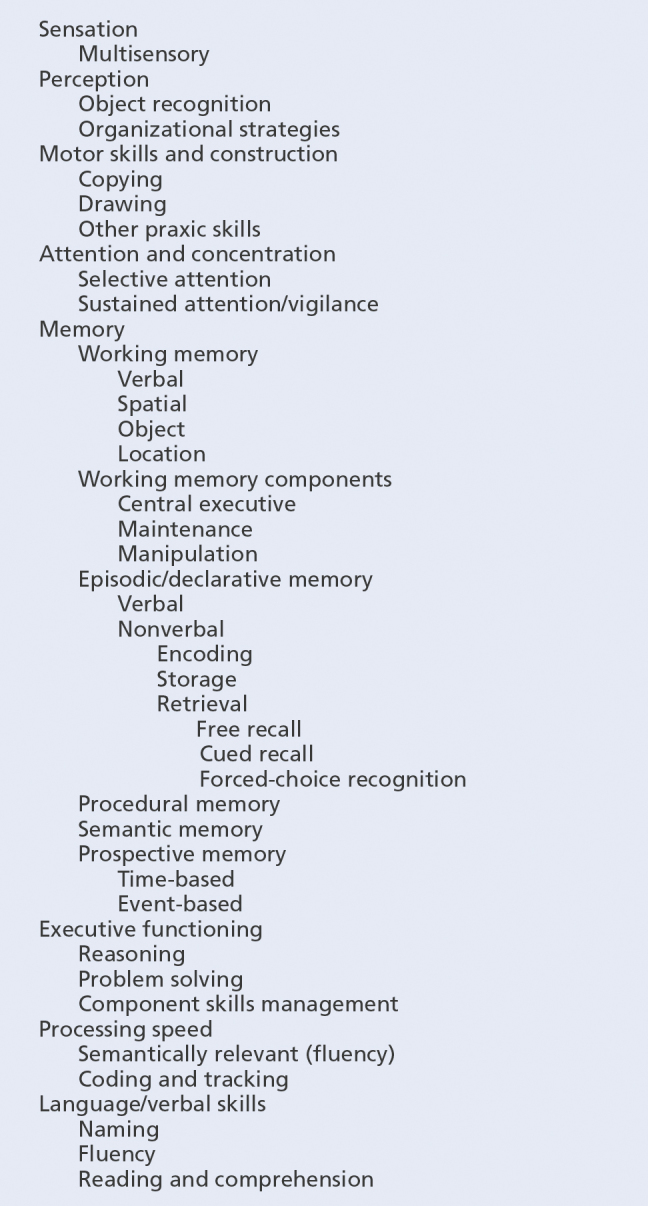
Cognitive performance is typically conceptualized in terms of domains of functioning. These domains are hierarchical in nature, with the bottom referring to more basic sensory and perceptual processes and the top referring to elements of executive functioning and cognitive control. Domains are not independent of each other and executive functioning exerts control over the utilization of more basic processes. Assessments are typically targeted at subdomains of each ability area and careful combination of tasks can reveal patterns of performance consistent with a variety of different neurological and neuropsychiatric conditions. This review covers the general structures of domains, the patterns of impairments across domains seen in common neuropsychiatric conditions, and use of assessment strategies to differentiate, to the extent possible, between different types of conditions manifesting cognitive impairment. .
Overview
AI snapshot
Written from the paper’s full text.
TL;DR
This review describes cognitive performance as organized into hierarchical domains, from basic sensation/perception to executive functioning and cognitive control, and reviews how assessments target subdomains to reveal patterns across neurological and neuropsychiatric conditions. It emphasizes that domains are intercorrelated, executive functioning supervises simpler processes, and processing speed is often the most impaired and functionally relevant domain in conditions such as schizophrenia.
Key findings
- Cognitive domains are hierarchical and not independent: basic sensory/perceptual operations are least complex, while executive functioning/reasoning and problem solving are most complex and coordinate multiple lower-level abilities.
- Assessment patterns can differentiate conditions: in cortical dementia and amnestic conditions, encoding, delayed recall, cued recall, and delayed recognition are all impaired; in frontostriatal conditions, encoding and delayed recall are impaired but delayed recognition and cued recall are typically spared. Similar patterns are reported in schizophrenia spectrum conditions.
- Attention profiles differ by condition: psychotic populations commonly show increased CPT errors of omission and reduced d′ without increased errors of commission, whereas ADHD is associated with increased errors of commission and greater B; schizophrenia spectrum individuals fail to develop the normal bias to respond to nontargets when target frequency is high.
- Processing speed is particularly important: coding-task performance is the most significant impairment in schizophrenia and the cognitive domain most strongly correlated with everyday functioning, and it tends to be the strongest predictor of overall cognitive performance. The paper also gives task examples such as digit span forward about 6 digits versus backward about 5 digits, HVLT with 12 items and 3 learning trials, CVLT with 16 items and 5 trials, and RAVLT with 15 unorganized items and 5 trials.
Methods
- Narrative review of cognitive domains and their assessment, organized by general ability area and commenting on top-down versus bottom-up structure and regional brain functioning.
- No primary data, systematic sample, or quantitative synthesis are reported; the paper synthesizes cited neuropsychological tests, clinical populations, and prior literature.
- Main analysis is conceptual: it reviews performance-based assessments and then observational/self-reported functioning, with focus on humans.
Limitations
- The paper states that fully addressing assessment of memory-disordered populations is beyond its scope, and it notes inconsistencies in the clinical/research literature about whether some processes belong in broader domains such as executive functioning or simpler domains such as processing speed.
- The paper also states that some cognitive abilities may not be clearly separable into one domain or another.
- Evident from the text: this is a narrative review without a systematic search, meta-analysis, or empirical sample, and the paper itself notes that larger factor-analytic studies often find a single global ability factor, raising questions about the separability of conventional cognitive domains.
Model-written summary. Check it against the paper before relying on it.
Integrity signals
Registry
Cites
Statistics
Figures
Verification
Claims the paper makes
44 Not checked yet · 37 No basis given · 26 Own interpretation
The paper states this without a source or data behind it here, so there is nothing to check it against. The quote shows it is in the paper.
In the paper
“Further, selective attention is also impaired, particularly when the selective attention test requires adhering to instructions to ignore some stimuli and respond to others.”
§ Domains of cognition and their assessment > Neuropsychiatric conditions commonly show attentional problems
plaincorrelational- Asserted: passes — The authors put it forward as true.
- Checkable: passes — It can be checked against evidence.
- Load-bearing: unclear — It is unclear whether the paper’s conclusions depend on it.
- Based: passes — The paper gives a reason why it holds.
In the paper
“For instance psychotic populations are commonly associated with increases in errors of omission and reduced d’ without increased errors of commission. 32”
§ Domains of cognition and their assessment > Neuropsychiatric conditions commonly show attentional problems
What the sources say
- Not checked yetcites [32] Cornblatt BA, 1989, Psychiatry Res source
plaincorrelational- Asserted: passes — The authors put it forward as true.
- Checkable: passes — It can be checked against evidence.
- Load-bearing: unclear — It is unclear whether the paper’s conclusions depend on it.
- Based: passes — The paper gives a reason why it holds.
In the paper
“There is evidence of specialized CNS processing for object, location, action, verbal, and spatial working memory. 39”
§ Domains of cognition and their assessment > Working memory
What the sources say
- Not checked yetcites [39] Adcock RA, 2000, Proc Nat Acad Sci U S A source
plaincorrelational- Asserted: passes — The authors put it forward as true.
- Checkable: passes — It can be checked against evidence.
- Load-bearing: unclear — It is unclear whether the paper’s conclusions depend on it.
- Based: passes — The paper gives a reason why it holds.
The paper states this without a source or data behind it here, so there is nothing to check it against. The quote shows it is in the paper.
In the paper
“High target frequency on the CPT leads to a normal bias to respond to nontargets.”
§ Domains of cognition and their assessment > Neuropsychiatric conditions commonly show attentional problems
plaindirect- Asserted: passes — The authors put it forward as true.
- Checkable: passes — It can be checked against evidence.
- Load-bearing: unclear — It is unclear whether the paper’s conclusions depend on it.
- Based: passes — The paper gives a reason why it holds.
The paper states this without a source or data behind it here, so there is nothing to check it against. The quote shows it is in the paper.
In the paper
“Controlled processes, those that require resource costs, can become automated after practice.”
§ Domains of cognition and their assessment > Selective attention
plaindirect- Asserted: passes — The authors put it forward as true.
- Checkable: passes — It can be checked against evidence.
- Load-bearing: passes — The paper’s conclusions depend on it.
- Based: passes — The paper gives a reason why it holds.
The paper states this without a source or data behind it here, so there is nothing to check it against. The quote shows it is in the paper.
In the paper
“Further, implicit strategies can facilitate encoding.”
§ Domains of cognition and their assessment > Encoding
plainconditional- Asserted: passes — The authors put it forward as true.
- Checkable: passes — It can be checked against evidence.
- Load-bearing: unclear — It is unclear whether the paper’s conclusions depend on it.
- Based: passes — The paper gives a reason why it holds.
In the paper
“Manipulations aimed at enforcing semantic encoding (eg, make up a story with these words) lead to more encoding than simple instructions to attend. 44”
§ Domains of cognition and their assessment > Encoding
What the sources say
- Not checked yetcites [44] Barrett TR, 1981, J Gerontol source
plaindirect- Asserted: passes — The authors put it forward as true.
- Checkable: passes — It can be checked against evidence.
- Load-bearing: unclear — It is unclear whether the paper’s conclusions depend on it.
- Based: passes — The paper gives a reason why it holds.
The paper states this without a source or data behind it here, so there is nothing to check it against. The quote shows it is in the paper.
In the paper
“The more complex the secondary task (eg, text messaging compared with using a push-button radio control), the more likely it is to be associated with traffic accidents.”
§ Domains of cognition and their assessment > Selective attention
hedgedcorrelational- Asserted: passes — The authors put it forward as true.
- Checkable: passes — It can be checked against evidence.
- Load-bearing: unclear — It is unclear whether the paper’s conclusions depend on it.
- Based: passes — The paper gives a reason why it holds.
In the paper
“These domains are hierarchical in nature, with the bottom referring to more basic sensory and perceptual processes and the top referring to elements of executive functioning and cognitive control.”
- Also stated in: § Global structure of cognitive ability domains · plain
“An additional organizational structure is hierarchical and based on the complexity of the operations. Often referred to as top-down versus bottom-up, the idea is that basic sensory and perceptional operations are least complex and reasoning and problem solving, referred to as executive functioning, are most complex. 6”
§ Domains of cognition and their assessment > Abstract
What the sources say
- Not checked yetcites [6] Al-Aidroos N, 2012, Proc Natl Acad Sci U S A source
plain- Asserted: passes — The authors put it forward as true.
- Checkable: passes — It can be checked against evidence.
- Load-bearing: passes — The paper’s conclusions depend on it.
- Based: passes — The paper gives a reason why it holds.
- Also stated in: § Global structure of cognitive ability domains · plain
In the paper
“Procedural memory can be dissociated from episodic memory, in that individuals with amnesia who cannot recall essentially any verbal information can learn and retain procedural skills. 45”
§ Domains of cognition and their assessment > Procedural memory
What the sources say
- Not checked yetcites [45] Oudman E, 2015, Neuropsychol Rev source
plain- Asserted: passes — The authors put it forward as true.
- Checkable: passes — It can be checked against evidence.
- Load-bearing: unclear — It is unclear whether the paper’s conclusions depend on it.
- Based: passes — The paper gives a reason why it holds.
- Probably not a substantial claim. 53
- It may state two separate claims as one. 32
The paper states this without a source or data behind it here, so there is nothing to check it against. The quote shows it is in the paper.
In the paper
“However, with aging, resource availability typically declines and older drivers are involved in many more accidents than younger experienced drivers.”
§ Domains of cognition and their assessment > Selective attention
plaindirect- Asserted: passes — The authors put it forward as true.
- Checkable: passes — It can be checked against evidence.
- Load-bearing: fails — The paper’s conclusions may not depend on it.
- Based: fails — The paper may give no reason why it holds.
Probably not a substantial claim. The paper’s conclusions may not depend on it. The paper may give no reason why it holds. It may state two separate claims as one.
The paper states this without a source or data behind it here, so there is nothing to check it against. The quote shows it is in the paper.
In the paper
“Maintenance working memory can handle information from multiple sensory modalities at the same time and storage capacity of maintenance working memory is capacity limited across all aspects of information.”
§ Domains of cognition and their assessment > Working memory
plain- Asserted: passes — The authors put it forward as true.
- Checkable: passes — It can be checked against evidence.
- Load-bearing: fails — The paper’s conclusions may not depend on it.
- Based: fails — The paper may give no reason why it holds.
Probably not a substantial claim. The paper’s conclusions may not depend on it. The paper may give no reason why it holds. It may state two separate claims as one.
The paper states this without a source or data behind it here, so there is nothing to check it against. The quote shows it is in the paper.
In the paper
“The more common the target, up to about 50% frequency, the easier the task.”
§ Domains of cognition and their assessment > Sustained attention/vigilance
plaindirect- Asserted: passes — The authors put it forward as true.
- Checkable: passes — It can be checked against evidence.
- Load-bearing: fails — The paper’s conclusions may not depend on it.
- Based: passes — The paper gives a reason why it holds.
Probably not a substantial claim. The paper’s conclusions may not depend on it.
In the paper
“Typically global stimuli are perceived more rapidly than local stimuli, much like a reader recognizes words more efficiently than their component letters. 23”
§ Domains of cognition and their assessment > Selective attention
What the sources say
- Not checked yetcites [23] Navon D, 1977, Cognitive Psychol source
plaincorrelational- Asserted: passes — The authors put it forward as true.
- Checkable: passes — It can be checked against evidence.
- Load-bearing: fails — The paper’s conclusions may not depend on it.
- Based: passes — The paper gives a reason why it holds.
Probably not a substantial claim. The paper’s conclusions may not depend on it.
The paper states this without a source or data behind it here, so there is nothing to check it against. The quote shows it is in the paper.
In the paper
“Storage is typically affected only by changes in brain functioning”
§ Domains of cognition and their assessment > Storage
plaindirect- Asserted: passes — The authors put it forward as true.
- Checkable: passes — It can be checked against evidence.
- Load-bearing: fails — The paper’s conclusions may not depend on it.
- Based: fails — The paper may give no reason why it holds.
Probably not a substantial claim. The paper’s conclusions may not depend on it. The paper may give no reason why it holds.
In the paper
“Attention deficit hyperactivity disorder (ADHD) is associated with increases in errors of commission and greater B, based on impulsive responses to nontarget stimuli. 33”
§ Domains of cognition and their assessment > Neuropsychiatric conditions commonly show attentional problems
What the sources say
- Not checked yetcites [33] Bedi GC, 1994, Int J Neurosci source
plaincorrelational- Asserted: passes — The authors put it forward as true.
- Checkable: passes — It can be checked against evidence.
- Load-bearing: unclear — It is unclear whether the paper’s conclusions depend on it.
- Based: passes — The paper gives a reason why it holds.
It may state two separate claims as one.
The paper states this without a source or data behind it here, so there is nothing to check it against. The quote shows it is in the paper.
In the paper
“Presenting stimuli as a stem to be completed (__ __ imal) facilitates encoding and subsequent recall of information.”
§ Domains of cognition and their assessment > Encoding
plaindirect- Asserted: passes — The authors put it forward as true.
- Checkable: passes — It can be checked against evidence.
- Load-bearing: fails — The paper’s conclusions may not depend on it.
- Based: fails — The paper may give no reason why it holds.
Probably not a substantial claim. The paper’s conclusions may not depend on it. The paper may give no reason why it holds.
In the paper
“Construction deficits are commonly found in individuals with dementia, with right hemisphere damage, or with identified lesions to the parietal cortex. 20”
§ Domains of cognition and their assessment > Construction
What the sources say
- Not checked yetcites [20] GoodglassHKaplanE1983 Philadelphia Lea and Febiger
plaincorrelational- Asserted: passes — The authors put it forward as true.
- Checkable: passes — It can be checked against evidence.
- Load-bearing: unclear — It is unclear whether the paper’s conclusions depend on it.
- Based: passes — The paper gives a reason why it holds.
It may state two separate claims as one.
The paper states this without a source or data behind it here, so there is nothing to check it against. The quote shows it is in the paper.
In the paper
“Information successfully encoded can be recalled at fairly long post encoding time periods.”
§ Domains of cognition and their assessment > Storage
plaindirect- Asserted: passes — The authors put it forward as true.
- Checkable: passes — It can be checked against evidence.
- Load-bearing: fails — The paper’s conclusions may not depend on it.
- Based: fails — The paper may give no reason why it holds.
Probably not a substantial claim. The paper’s conclusions may not depend on it. The paper may give no reason why it holds.
The paper states this without a source or data behind it here, so there is nothing to check it against. The quote shows it is in the paper.
In the paper
“Drawing objects makes them easier to recall than simply visualizing them.”
§ Domains of cognition and their assessment > Encoding
plaindirect- Asserted: passes — The authors put it forward as true.
- Checkable: passes — It can be checked against evidence.
- Load-bearing: fails — The paper’s conclusions may not depend on it.
- Based: fails — The paper may give no reason why it holds.
Probably not a substantial claim. The paper’s conclusions may not depend on it. The paper may give no reason why it holds.
The paper states this without a source or data behind it here, so there is nothing to check it against. The quote shows it is in the paper.
In the paper
“The ability to respond to instructions to shift focus across global and local properties is a critical feature of this task and is impaired in many populations with problems in attentional control.”
§ Domains of cognition and their assessment > Selective attention
plaincorrelational- Asserted: passes — The authors put it forward as true.
- Checkable: passes — It can be checked against evidence.
- Load-bearing: fails — The paper’s conclusions may not depend on it.
- Based: fails — The paper may give no reason why it holds.
Probably not a substantial claim. The paper’s conclusions may not depend on it. The paper may give no reason why it holds.
The paper states this without a source or data behind it here, so there is nothing to check it against. The quote shows it is in the paper.
In the paper
“Simple maintenance working memory can be measured in drosophila, whose executive functioning ability is clearly limited.”
§ Domains of cognition and their assessment > Working memory
boosted- Asserted: passes — The authors put it forward as true.
- Checkable: passes — It can be checked against evidence.
- Load-bearing: fails — The paper’s conclusions may not depend on it.
- Based: fails — The paper may give no reason why it holds.
Probably not a substantial claim. The paper’s conclusions may not depend on it. The paper may give no reason why it holds. It may state two separate claims as one.
The paper states this without a source or data behind it here, so there is nothing to check it against. The quote shows it is in the paper.
In the paper
“Dual-task processing is particularly impaired in neuropsychiatric conditions, with people with schizophrenia manifesting considerable challenges in dual-task demands.”
§ Domains of cognition and their assessment > Neuropsychiatric conditions commonly show attentional problems
plaincorrelational- Asserted: passes — The authors put it forward as true.
- Checkable: passes — It can be checked against evidence.
- Load-bearing: fails — The paper’s conclusions may not depend on it.
- Based: fails — The paper may give no reason why it holds.
Probably not a substantial claim. The paper’s conclusions may not depend on it. The paper may give no reason why it holds. It may state two separate claims as one.
The paper states this without a source or data behind it here, so there is nothing to check it against. The quote shows it is in the paper.
In the paper
“However, when the target frequency does over 50%, difficulty increases because inhibition of the dominant response to respond on all stimuli is required and even completely healthy people have an increase in errors.”
§ Domains of cognition and their assessment > Sustained attention/vigilance
plaindirect- Asserted: passes — The authors put it forward as true.
- Checkable: passes — It can be checked against evidence.
- Load-bearing: unclear — It is unclear whether the paper’s conclusions depend on it.
- Based: passes — The paper gives a reason why it holds.
It may state two separate claims as one.
The paper states this without a source or data behind it here, so there is nothing to check it against. The quote shows it is in the paper.
In the paper
“Generally, there is a “resource cost” for such operations and typically performance in digits backward is about one item less than performance on digit span forward (6 digits forward = 5 digits backwards).”
§ Domains of cognition and their assessment > Working memory
plaindirect- Asserted: passes — The authors put it forward as true.
- Checkable: passes — It can be checked against evidence.
- Load-bearing: fails — The paper’s conclusions may not depend on it.
- Based: fails — The paper may give no reason why it holds.
Probably not a substantial claim. The paper’s conclusions may not depend on it. The paper may give no reason why it holds. It may state two separate claims as one.
In the paper
“There are formal indices of the ability to divide attention, which can identify impairments in the ability to divide attention which are common in several neuropsychiatric conditions. 25”
§ Domains of cognition and their assessment > Selective attention
What the sources say
- Not checked yetcites [25] Granholm E, 1996, Neuropsychology source
plaincorrelational- Asserted: passes — The authors put it forward as true.
- Checkable: passes — It can be checked against evidence.
- Load-bearing: unclear — It is unclear whether the paper’s conclusions depend on it.
- Based: passes — The paper gives a reason why it holds.
It may state two separate claims as one.
In the paper
“Beginning drivers can tolerate many fewer concurrent tasks while maintaining adequate performance and have the highest rates of accidents. 28”
§ Domains of cognition and their assessment > Selective attention
What the sources say
- Not checked yetcites [28] Gershon P, 2017, J Safety Res source
plaincorrelational- Asserted: passes — The authors put it forward as true.
- Checkable: passes — It can be checked against evidence.
- Load-bearing: unclear — It is unclear whether the paper’s conclusions depend on it.
- Based: passes — The paper gives a reason why it holds.
It may state two separate claims as one.
The paper states this without a source or data behind it here, so there is nothing to check it against. The quote shows it is in the paper.
In the paper
“information that is never detected consciously may be stored (unconscious processing) but typically cannot be retrieved volitionally although it may be available with the right implicit prompt.”
§ Domains of cognition and their assessment > Working memory
hedgedconditional- Asserted: passes — The authors put it forward as true.
- Checkable: passes — It can be checked against evidence.
- Load-bearing: fails — The paper’s conclusions may not depend on it.
- Based: fails — The paper may give no reason why it holds.
Probably not a substantial claim. The paper’s conclusions may not depend on it. The paper may give no reason why it holds. It may state two separate claims as one.
The paper states this without a source or data behind it here, so there is nothing to check it against. The quote shows it is in the paper.
In the paper
“These strategies re commonly applied across different versions of verbal and visual-spatial memory tests.”
§ Domains of cognition and their assessment > Retrieval
plain- Asserted: passes — The authors put it forward as true.
- Checkable: passes — It can be checked against evidence.
- Load-bearing: fails — The paper’s conclusions may not depend on it.
- Based: fails — The paper may give no reason why it holds.
Probably not a substantial claim. The paper’s conclusions may not depend on it. The paper may give no reason why it holds.
The paper states this without a source or data behind it here, so there is nothing to check it against. The quote shows it is in the paper.
In the paper
“Some information is clearly permanent (eg, new vocabulary words).”
§ Domains of cognition and their assessment > Storage
boosted- Asserted: passes — The authors put it forward as true.
- Checkable: passes — It can be checked against evidence.
- Load-bearing: fails — The paper’s conclusions may not depend on it.
- Based: fails — The paper may give no reason why it holds.
Probably not a substantial claim. The paper’s conclusions may not depend on it. The paper may give no reason why it holds.
The paper states this without a source or data behind it here, so there is nothing to check it against. The quote shows it is in the paper.
In the paper
“More complex operations, such as storage of multiple items then retrieval of a selected set, have even greater capacity cost.”
§ Domains of cognition and their assessment > Working memory
plaindirect- Asserted: passes — The authors put it forward as true.
- Checkable: passes — It can be checked against evidence.
- Load-bearing: fails — The paper’s conclusions may not depend on it.
- Based: fails — The paper may give no reason why it holds.
Probably not a substantial claim. The paper’s conclusions may not depend on it. The paper may give no reason why it holds.
The paper states this without a source or data behind it here, so there is nothing to check it against. The quote shows it is in the paper.
In the paper
“Interestingly, distracted driving is a major cause of accidents in the US and distracted driving is specifically the attempt to perform other tasks while driving.”
§ Domains of cognition and their assessment > Selective attention
plaindirect- Asserted: passes — The authors put it forward as true.
- Checkable: passes — It can be checked against evidence.
- Load-bearing: fails — The paper’s conclusions may not depend on it.
- Based: passes — The paper gives a reason why it holds.
Probably not a substantial claim. The paper’s conclusions may not depend on it.
The paper states this without a source or data behind it here, so there is nothing to check it against. The quote shows it is in the paper.
In the paper
“For instance, asking the participant to evaluate stimuli for various semantic characteristics (living/nonliving) facilitates encoding.”
§ Domains of cognition and their assessment > Encoding
plaindirect- Asserted: passes — The authors put it forward as true.
- Checkable: passes — It can be checked against evidence.
- Load-bearing: fails — The paper’s conclusions may not depend on it.
- Based: fails — The paper may give no reason why it holds.
Probably not a substantial claim. The paper’s conclusions may not depend on it. The paper may give no reason why it holds.
In the paper
“Performance on the UFOV has been shown to predict driving problems and interventions aimed at speed dual-task processing have been shown to reduce accidents in older drivers. 30”
§ Domains of cognition and their assessment > Selective attention
What the sources say
- Not checked yetcites [30] Roenker DL, 2003, Hum Factors source
plaindirect- Asserted: passes — The authors put it forward as true.
- Checkable: passes — It can be checked against evidence.
- Load-bearing: unclear — It is unclear whether the paper’s conclusions depend on it.
- Based: passes — The paper gives a reason why it holds.
It may state two separate claims as one.
In the paper
“Interestingly, people in the schizophrenia spectrum fail to develop this normal bias and do not have an increase in errors of commission with increased frequency of targets. 34”
§ Domains of cognition and their assessment > Neuropsychiatric conditions commonly show attentional problems
What the sources say
- Not checked yetcites [34] Barch DM, 2003, J Abnorm Psychol source
plain- Asserted: passes — The authors put it forward as true.
- Checkable: passes — It can be checked against evidence.
- Load-bearing: unclear — It is unclear whether the paper’s conclusions depend on it.
- Based: passes — The paper gives a reason why it holds.
It may state two separate claims as one.
The paper states this without a source or data behind it here, so there is nothing to check it against. The quote shows it is in the paper.
In the paper
“Information can be transferred from working memory to longer-term storage, but that process requires either active processing or salience of the stimulus in working memory for encoding.”
§ Domains of cognition and their assessment > Working memory
plaindirect- Asserted: passes — The authors put it forward as true.
- Checkable: passes — It can be checked against evidence.
- Load-bearing: fails — The paper’s conclusions may not depend on it.
- Based: fails — The paper may give no reason why it holds.
Probably not a substantial claim. The paper’s conclusions may not depend on it. The paper may give no reason why it holds. It may state two separate claims as one.
The paper states this without a source or data behind it here, so there is nothing to check it against. The quote shows it is in the paper.
In the paper
“For visual learning, familiar and namable objects are easier to learn.”
§ Domains of cognition and their assessment > Encoding
plaindirect- Asserted: passes — The authors put it forward as true.
- Checkable: passes — It can be checked against evidence.
- Load-bearing: fails — The paper’s conclusions may not depend on it.
- Based: fails — The paper may give no reason why it holds.
Probably not a substantial claim. The paper’s conclusions may not depend on it. The paper may give no reason why it holds.
The paper states this without a source or data behind it here, so there is nothing to check it against. The quote shows it is in the paper.
In the paper
“Different populations make different patterns of errors on the CPT.”
§ Domains of cognition and their assessment > Sustained attention/vigilance
plaincorrelational- Asserted: passes — The authors put it forward as true.
- Checkable: passes — It can be checked against evidence.
- Load-bearing: fails — The paper’s conclusions may not depend on it.
- Based: fails — The paper may give no reason why it holds.
Probably not a substantial claim. The paper’s conclusions may not depend on it. The paper may give no reason why it holds.
The paper states this without a source or data behind it here, so there is nothing to check it against. The quote shows it is in the paper.
In the paper
“Both iconic (visual) and auditory (echoic) storage are duration and capacity limited and processing of new information can lead to the loss of memory currently in storage.”
§ Domains of cognition and their assessment > Working memory
plaindirect- Asserted: passes — The authors put it forward as true.
- Checkable: passes — It can be checked against evidence.
- Load-bearing: fails — The paper’s conclusions may not depend on it.
- Based: fails — The paper may give no reason why it holds.
Probably not a substantial claim. The paper’s conclusions may not depend on it. The paper may give no reason why it holds. It may state two separate claims as one.
In the paper
“On word list tests, semantically organized lists (subsets of animals, colors, etc) 43 are easier to learn and telling the participant that the list is organized also facilitates encoding.”
§ Domains of cognition and their assessment > Encoding
What the sources say
- Not checked yetcites [43] DelisDCKramerJKaplanEOberBA1987 New York, NY Psychological Corporation
plaindirect- Asserted: passes — The authors put it forward as true.
- Checkable: passes — It can be checked against evidence.
- Load-bearing: unclear — It is unclear whether the paper’s conclusions depend on it.
- Based: passes — The paper gives a reason why it holds.
It may state two separate claims as one.
The paper states this without a source or data behind it here, so there is nothing to check it against. The quote shows it is in the paper.
In the paper
“After practice, many functions required for driving become automated and accident rates decline.”
§ Domains of cognition and their assessment > Selective attention
plaindirect- Asserted: passes — The authors put it forward as true.
- Checkable: passes — It can be checked against evidence.
- Load-bearing: unclear — It is unclear whether the paper’s conclusions depend on it.
- Based: passes — The paper gives a reason why it holds.
It may state two separate claims as one.
The paper states this without a source or data behind it here, so there is nothing to check it against. The quote shows it is in the paper.
In the paper
“Most inconsistencies are in broad domains that may include multiple component processes.”
§ Domains of cognition and their assessment > Introduction
plain- Asserted: passes — The authors put it forward as true.
- Checkable: passes — It can be checked against evidence.
- Load-bearing: fails — The paper’s conclusions may not depend on it.
- Based: fails — The paper may give no reason why it holds.
Probably not a substantial claim. The paper’s conclusions may not depend on it. The paper may give no reason why it holds.
The paper states this without a source or data behind it here, so there is nothing to check it against. The quote shows it is in the paper.
In the paper
“Assessments are typically targeted at subdomains of each ability area”
§ Domains of cognition and their assessment > Abstract
plain- Asserted: passes — The authors put it forward as true.
- Checkable: passes — It can be checked against evidence.
- Load-bearing: passes — The paper’s conclusions depend on it.
- Based: fails — The paper may give no reason why it holds.
Probably not a substantial claim. The paper may give no reason why it holds.
A conclusion the paper draws from its own results — it cites no other source for it, so there is none to check. The quote shows it is in the paper.
In the paper
“executive functioning exerts control over the utilization of more basic processes.”
§ Domains of cognition and their assessment > Abstract
plaindirect- Asserted: passes — The authors put it forward as true.
- Checkable: passes — It can be checked against evidence.
- Load-bearing: passes — The paper’s conclusions depend on it.
- Based: fails — The paper may give no reason why it holds.
Probably not a substantial claim. The paper may give no reason why it holds.
A conclusion the paper draws from its own results — it cites no other source for it, so there is none to check. The quote shows it is in the paper.
In the paper
“careful combination of tasks can reveal patterns of performance consistent with a variety of different neurological and neuropsychiatric conditions.”
§ Domains of cognition and their assessment > Abstract
plaincorrelational- Asserted: passes — The authors put it forward as true.
- Checkable: passes — It can be checked against evidence.
- Load-bearing: passes — The paper’s conclusions depend on it.
- Based: fails — The paper may give no reason why it holds.
Probably not a substantial claim. The paper may give no reason why it holds.
The paper states this without a source or data behind it here, so there is nothing to check it against. The quote shows it is in the paper.
In the paper
“there are clear inconsistencies in the clinical and research literature.”
§ Domains of cognition and their assessment > Introduction
boosted- Asserted: passes — The authors put it forward as true.
- Checkable: passes — It can be checked against evidence.
- Load-bearing: passes — The paper’s conclusions depend on it.
- Based: passes — The paper gives a reason why it holds.
Probably not a substantial claim.
A conclusion the paper draws from its own results — it cites no other source for it, so there is none to check. The quote shows it is in the paper.
In the paper
“Domains are not independent of each other”
§ Domains of cognition and their assessment > Abstract
plaincorrelational- Asserted: passes — The authors put it forward as true.
- Checkable: passes — It can be checked against evidence.
- Load-bearing: passes — The paper’s conclusions depend on it.
- Based: fails — The paper may give no reason why it holds.
Probably not a substantial claim. The paper may give no reason why it holds.
A conclusion the paper draws from its own results — it cites no other source for it, so there is none to check. The quote shows it is in the paper.
In the paper
“Thus, executive functioning tasks often involve the co-ordination of multiple sensory, perceptual, attentional, and other less complex functions, while simple sensory tasks require minimal higher-level processing.”
§ Domains of cognition and their assessment > Global structure of cognitive ability domains
plaincorrelational- Asserted: passes — The authors put it forward as true.
- Checkable: passes — It can be checked against evidence.
- Load-bearing: fails — The paper’s conclusions may not depend on it.
- Based: passes — The paper gives a reason why it holds.
Probably not a substantial claim. The paper’s conclusions may not depend on it. It may state two separate claims as one.
A conclusion the paper draws from its own results — it cites no other source for it, so there is none to check. The quote shows it is in the paper.
In the paper
“manipulation working memory is clearly associated with executive functioning.”
§ Domains of cognition and their assessment > Working memory
boostedcorrelational- Asserted: passes — The authors put it forward as true.
- Checkable: passes — It can be checked against evidence.
- Load-bearing: fails — The paper’s conclusions may not depend on it.
- Based: passes — The paper gives a reason why it holds.
Probably not a substantial claim. The paper’s conclusions may not depend on it.
The paper states this without a source or data behind it here, so there is nothing to check it against. The quote shows it is in the paper.
In the paper
“Multiple factors are known affect encoding.”
§ Domains of cognition and their assessment > Encoding
boostedcorrelational- Asserted: passes — The authors put it forward as true.
- Checkable: passes — It can be checked against evidence.
- Load-bearing: fails — The paper’s conclusions may not depend on it.
- Based: passes — The paper gives a reason why it holds.
Probably not a substantial claim. The paper’s conclusions may not depend on it.
None of the sources cited for this claim have been checked yet.
In the paper
“The origin of these domains was originally linked (ie, localized) to the areas of the brain in which these processes were seen to be occurring, 2 a perspective that is still important today. 3”
§ Domains of cognition and their assessment > Introduction
What the sources say
- Not checked yetcites [2] Babcock HA, 1930, Arch Psychol
- Not checked yetcites [3] DamasioHDamasioAR1989 New York, NY Oxford University Press
plaincorrelational- Asserted: passes — The authors put it forward as true.
- Checkable: passes — It can be checked against evidence.
- Load-bearing: fails — The paper’s conclusions may not depend on it.
- Based: passes — The paper gives a reason why it holds.
Probably not a substantial claim. The paper’s conclusions may not depend on it. It may state two separate claims as one.
A conclusion the paper draws from its own results — it cites no other source for it, so there is none to check. The quote shows it is in the paper.
In the paper
“These three tests are considerably different in difficulty which needs to be considered when selecting assessment instruments.”
§ Domains of cognition and their assessment > Encoding
plain- Asserted: passes — The authors put it forward as true.
- Checkable: passes — It can be checked against evidence.
- Load-bearing: passes — The paper’s conclusions depend on it.
- Based: passes — The paper gives a reason why it holds.
It may state two separate claims as one.
The paper states this without a source or data behind it here, so there is nothing to check it against. The quote shows it is in the paper.
In the paper
“Whether these processes belong in more general domains (executive functioning) or a simpler domain (processing speed) is often unclear.”
§ Domains of cognition and their assessment > Introduction
plain- Asserted: passes — The authors put it forward as true.
- Checkable: passes — It can be checked against evidence.
- Load-bearing: fails — The paper’s conclusions may not depend on it.
- Based: fails — The paper may give no reason why it holds.
Probably not a substantial claim. The paper’s conclusions may not depend on it. The paper may give no reason why it holds.
A conclusion the paper draws from its own results — it cites no other source for it, so there is none to check. The quote shows it is in the paper.
In the paper
“This component of the memory system interacts with working memory storage processes to encode, maintain, and retrieve information into and out of longer-term storage.”
§ Domains of cognition and their assessment > Episodic/declarative/explicit memory
plaindirect- Asserted: passes — The authors put it forward as true.
- Checkable: passes — It can be checked against evidence.
- Load-bearing: fails — The paper’s conclusions may not depend on it.
- Based: fails — The paper may give no reason why it holds.
Probably not a substantial claim. The paper’s conclusions may not depend on it. The paper may give no reason why it holds.
A conclusion the paper draws from its own results — it cites no other source for it, so there is none to check. The quote shows it is in the paper.
In the paper
“All of these attentional skills have executive functioning components that are described below.”
§ Domains of cognition and their assessment > Attention and concentration
plaincorrelational- Asserted: passes — The authors put it forward as true.
- Checkable: passes — It can be checked against evidence.
- Load-bearing: fails — The paper’s conclusions may not depend on it.
- Based: fails — The paper may give no reason why it holds.
Probably not a substantial claim. The paper’s conclusions may not depend on it. The paper may give no reason why it holds.
The paper states this without a source or data behind it here, so there is nothing to check it against. The quote shows it is in the paper.
In the paper
“Memory functioning is the most complex and multifaceted of cognitive domains.”
§ Domains of cognition and their assessment > Memory
plain- Asserted: passes — The authors put it forward as true.
- Checkable: fails — It may be too vague to check against evidence.
- Load-bearing: fails — The paper’s conclusions may not depend on it.
- Based: fails — The paper may give no reason why it holds.
Probably not a substantial claim. It may be too vague to check against evidence. The paper’s conclusions may not depend on it. The paper may give no reason why it holds.
In the paper
“Contemporary circuit-based conceptions focus on activation and interaction of these circuits. 4”
§ Domains of cognition and their assessment > Introduction
What the sources say
- Not checked yetcites [4] Lopez-GarciaPLeshTASaloTet alThe neural circuitry supporting goal maintenance during cognitive control: a comparison of expectancy AX-CPT and dot probe expectancy paradigms Cogn Affect Behav Neurosci2016161164175
plain- Asserted: passes — The authors put it forward as true.
- Checkable: passes — It can be checked against evidence.
- Load-bearing: fails — The paper’s conclusions may not depend on it.
- Based: passes — The paper gives a reason why it holds.
Probably not a substantial claim. The paper’s conclusions may not depend on it.
A conclusion the paper draws from its own results — it cites no other source for it, so there is none to check. The quote shows it is in the paper.
In the paper
“The maintenance of information in working memory requires intact sensation, perception, and attention”
§ Domains of cognition and their assessment > Working memory
plaindirect- Asserted: passes — The authors put it forward as true.
- Checkable: passes — It can be checked against evidence.
- Load-bearing: fails — The paper’s conclusions may not depend on it.
- Based: fails — The paper may give no reason why it holds.
Probably not a substantial claim. The paper’s conclusions may not depend on it. The paper may give no reason why it holds.
A conclusion the paper draws from its own results — it cites no other source for it, so there is none to check. The quote shows it is in the paper.
In the paper
“In addition, impairments in different elements of the system can lead to the same general outcome of poor memory output.”
§ Domains of cognition and their assessment > Episodic/declarative/explicit memory
plaindirect- Asserted: passes — The authors put it forward as true.
- Checkable: passes — It can be checked against evidence.
- Load-bearing: fails — The paper’s conclusions may not depend on it.
- Based: fails — The paper may give no reason why it holds.
Probably not a substantial claim. The paper’s conclusions may not depend on it. The paper may give no reason why it holds.
The paper states this without a source or data behind it here, so there is nothing to check it against. The quote shows it is in the paper.
In the paper
“There are several different ways that information can be retrieved after encoding.”
§ Domains of cognition and their assessment > Retrieval
plain- Asserted: passes — The authors put it forward as true.
- Checkable: passes — It can be checked against evidence.
- Load-bearing: fails — The paper’s conclusions may not depend on it.
- Based: fails — The paper may give no reason why it holds.
Probably not a substantial claim. The paper’s conclusions may not depend on it. The paper may give no reason why it holds.
In the paper
“The development of automatic processing is a critical feature of much complex skill learning, with driving being a primary example. 27”
§ Domains of cognition and their assessment > Selective attention
What the sources say
- Not checked yetcites [27] Engstrom J, 2017, Human Factors source
plaindirect- Asserted: passes — The authors put it forward as true.
- Checkable: passes — It can be checked against evidence.
- Load-bearing: unclear — It is unclear whether the paper’s conclusions depend on it.
- Based: passes — The paper gives a reason why it holds.
It may state two separate claims as one.
A conclusion the paper draws from its own results — it cites no other source for it, so there is none to check. The quote shows it is in the paper.
In the paper
“The HVLT may be too easy for screening younger populations and the RAVLT may be too hard demanding as a dementia screen in order people.”
§ Domains of cognition and their assessment > Encoding
hedgedconditional- Asserted: passes — The authors put it forward as true.
- Checkable: passes — It can be checked against evidence.
- Load-bearing: fails — The paper’s conclusions may not depend on it.
- Based: passes — The paper gives a reason why it holds.
Probably not a substantial claim. The paper’s conclusions may not depend on it. It may state two separate claims as one.
In the paper
“Further, working memory is conceptualized to include two separable components: maintenance of information and manipulation of information. 35”
§ Domains of cognition and their assessment > Working memory
What the sources say
- Not checked yetcites [35] Baddeley AD, 1999 source
plain- Asserted: passes — The authors put it forward as true.
- Checkable: passes — It can be checked against evidence.
- Load-bearing: fails — The paper’s conclusions may not depend on it.
- Based: passes — The paper gives a reason why it holds.
Probably not a substantial claim. The paper’s conclusions may not depend on it.
The paper states this without a source or data behind it here, so there is nothing to check it against. The quote shows it is in the paper.
In the paper
“Attention and concentration is a multifaceted construct and is generally divided into two global subdomains: selective attention and sustained attention (or vigilance).”
§ Domains of cognition and their assessment > Attention and concentration
plain- Asserted: passes — The authors put it forward as true.
- Checkable: passes — It can be checked against evidence.
- Load-bearing: fails — The paper’s conclusions may not depend on it.
- Based: fails — The paper may give no reason why it holds.
Probably not a substantial claim. The paper’s conclusions may not depend on it. The paper may give no reason why it holds.
A conclusion the paper draws from its own results — it cites no other source for it, so there is none to check. The quote shows it is in the paper.
In the paper
“Encoding manipulations are important in the context of who is being tested.”
§ Domains of cognition and their assessment > Encoding
plaincorrelational- Asserted: passes — The authors put it forward as true.
- Checkable: passes — It can be checked against evidence.
- Load-bearing: fails — The paper’s conclusions may not depend on it.
- Based: passes — The paper gives a reason why it holds.
Probably not a substantial claim. The paper’s conclusions may not depend on it.
The paper states this without a source or data behind it here, so there is nothing to check it against. The quote shows it is in the paper.
In the paper
“They include encoding, storage, and retrieval, all of which are required for successful memory performance.”
§ Domains of cognition and their assessment > Episodic/declarative/explicit memory
plaindirect- Asserted: passes — The authors put it forward as true.
- Checkable: passes — It can be checked against evidence.
- Load-bearing: fails — The paper’s conclusions may not depend on it.
- Based: fails — The paper may give no reason why it holds.
Probably not a substantial claim. The paper’s conclusions may not depend on it. The paper may give no reason why it holds. It may state two separate claims as one.
In the paper
“If cognitive speed is excessively slow, then performance of “non-speeded” tasks acquire an additional challenge and may lead to challenges in access correct strategies in a timely manner. 64”
§ Domains of cognition and their assessment > Processing speed
What the sources say
- Not checked yetcites [64] Knowles EE, 2015, Biol Psychiatry source
hedgedconditional- Asserted: passes — The authors put it forward as true.
- Checkable: passes — It can be checked against evidence.
- Load-bearing: unclear — It is unclear whether the paper’s conclusions depend on it.
- Based: passes — The paper gives a reason why it holds.
It may state two separate claims as one.
A conclusion the paper draws from its own results — it cites no other source for it, so there is none to check. The quote shows it is in the paper.
In the paper
“Semantic memory is often accessed in the performance of new declarative memory tasks, in that information that is previously stored in semantic memory is more easily attended to, encoded, and recalled for short-term use than completely novel information.”
§ Domains of cognition and their assessment > Semantic memory
plaindirect- Asserted: passes — The authors put it forward as true.
- Checkable: passes — It can be checked against evidence.
- Load-bearing: fails — The paper’s conclusions may not depend on it.
- Based: fails — The paper may give no reason why it holds.
Probably not a substantial claim. The paper’s conclusions may not depend on it. The paper may give no reason why it holds. It may state two separate claims as one.
A conclusion the paper draws from its own results — it cites no other source for it, so there is none to check. The quote shows it is in the paper.
In the paper
“Within neuropsychiatric conditions, language deficits may be associated with either deficits in executive functioning (eg, the ability to successfully access semantic storage) or slowed processing speed.”
§ Domains of cognition and their assessment > Language skills
hedgedcorrelational- Asserted: passes — The authors put it forward as true.
- Checkable: passes — It can be checked against evidence.
- Load-bearing: fails — The paper’s conclusions may not depend on it.
- Based: passes — The paper gives a reason why it holds.
Probably not a substantial claim. The paper’s conclusions may not depend on it.
None of the sources cited for this claim have been checked yet.
In the paper
“in cortical dementia and amnestic conditions encoding, delayed recall, cued recall, and delayed recognition are all impaired”
§ Domains of cognition and their assessment > Assessments of memory-disordered populations
What the sources say
plaincorrelational- Asserted: passes — The authors put it forward as true.
- Checkable: passes — It can be checked against evidence.
- Load-bearing: unclear — It is unclear whether the paper’s conclusions depend on it.
- Based: passes — The paper gives a reason why it holds.
It may state two separate claims as one.
In the paper
“semantic memory appears to remain intact over the lifespan and continue to accrue new information even into late life. 47”
§ Domains of cognition and their assessment > Semantic memory
What the sources say
- Not checked yetcites [47] Czaja SJ, 2006, Psychol Aging source
hedged- Asserted: passes — The authors put it forward as true.
- Checkable: passes — It can be checked against evidence.
- Load-bearing: unclear — It is unclear whether the paper’s conclusions depend on it.
- Based: passes — The paper gives a reason why it holds.
It may state two separate claims as one.
In the paper
“performance on various coding tasks is not only the most significant impairment in schizophrenia 63 but is also the cognitive ability domain that is most strongly correlated with impairments in everyday functioning.”
§ Domains of cognition and their assessment > Processing speed
What the sources say
- Not checked yetcites [63] Dickinson D, 2007, Arch Gen Psychiatry source
plaincorrelational- Asserted: passes — The authors put it forward as true.
- Checkable: passes — It can be checked against evidence.
- Load-bearing: unclear — It is unclear whether the paper’s conclusions depend on it.
- Based: passes — The paper gives a reason why it holds.
It may state two separate claims as one.
A conclusion the paper draws from its own results — it cites no other source for it, so there is none to check. The quote shows it is in the paper.
In the paper
“By virtue of the fact that fluency tasks are speeded in terms of their instructions, cognitive slowing can have an adverse impact on performance.”
§ Domains of cognition and their assessment > Language skills
plaindirect- Asserted: passes — The authors put it forward as true.
- Checkable: passes — It can be checked against evidence.
- Load-bearing: fails — The paper’s conclusions may not depend on it.
- Based: passes — The paper gives a reason why it holds.
Probably not a substantial claim. The paper’s conclusions may not depend on it.
A conclusion the paper draws from its own results — it cites no other source for it, so there is none to check. The quote shows it is in the paper.
In the paper
“Following instructions such as ignoring distractors, dividing attention to process one of two concurrent information streams, or following other instructions in processing speed tasks (eg, alternate between letters and numbers) are clearly executive or “cognitive control” demands as described above.”
§ Domains of cognition and their assessment > Executive functioning
boosted- Asserted: passes — The authors put it forward as true.
- Checkable: passes — It can be checked against evidence.
- Load-bearing: fails — The paper’s conclusions may not depend on it.
- Based: passes — The paper gives a reason why it holds.
Probably not a substantial claim. The paper’s conclusions may not depend on it.
In the paper
“Large-scale studies of cognition over the lifespan have found increasers in wisdom and semantic memory over the lifespan, with decreases in processing speed and working memory span tasks. 47”
§ Domains of cognition and their assessment > Executive functioning
What the sources say
- Not checked yetcites [47] Czaja SJ, 2006, Psychol Aging source
plaindirect- Asserted: passes — The authors put it forward as true.
- Checkable: passes — It can be checked against evidence.
- Load-bearing: unclear — It is unclear whether the paper’s conclusions depend on it.
- Based: passes — The paper gives a reason why it holds.
It may state two separate claims as one.
In the paper
“These include ADHD, mental illnesses such as schizophrenia and depression, and obsessive-compulsive disorder (OCD). 61”
§ Domains of cognition and their assessment > Populations with executive functioning deficits
What the sources say
- Not checked yetcites [61] Kuelz AK, 2004, Biol Psychol source
plaincorrelational- Asserted: passes — The authors put it forward as true.
- Checkable: passes — It can be checked against evidence.
- Load-bearing: unclear — It is unclear whether the paper’s conclusions depend on it.
- Based: passes — The paper gives a reason why it holds.
It may state two separate claims as one.
In the paper
“both cortical and frontostriatal conditions adversely impact verbal fluency, but naming deficits are more commonly seen in cortical dementia. 50”
§ Domains of cognition and their assessment > Language skills
What the sources say
- Not checked yetcites [50] Paulsen JS, 1995, Neurology source
plaindirect- Asserted: passes — The authors put it forward as true.
- Checkable: passes — It can be checked against evidence.
- Load-bearing: unclear — It is unclear whether the paper’s conclusions depend on it.
- Based: passes — The paper gives a reason why it holds.
It may state two separate claims as one.
None of the sources cited for this claim have been checked yet.
In the paper
“while in frontostriatal conditions encoding and delayed recall are impaired, but delayed recognition and cued recall are typically spared. 50 - 51”
§ Domains of cognition and their assessment > Assessments of memory-disordered populations
What the sources say
plain- Asserted: passes — The authors put it forward as true.
- Checkable: passes — It can be checked against evidence.
- Load-bearing: unclear — It is unclear whether the paper’s conclusions depend on it.
- Based: passes — The paper gives a reason why it holds.
It may state two separate claims as one.
A conclusion the paper draws from its own results — it cites no other source for it, so there is none to check. The quote shows it is in the paper.
In the paper
“many working memory tasks, such as simple delayed response tasks, involve essentially no problem solving or management of cognitive resources.”
§ Domains of cognition and their assessment > Executive functioning
plain- Asserted: passes — The authors put it forward as true.
- Checkable: passes — It can be checked against evidence.
- Load-bearing: passes — The paper’s conclusions depend on it.
- Based: fails — The paper may give no reason why it holds.
Probably not a substantial claim. The paper may give no reason why it holds.
A conclusion the paper draws from its own results — it cites no other source for it, so there is none to check. The quote shows it is in the paper.
In the paper
“Prospective memory is certainly one of the tasks on the boundary of executive functioning, because of the strong planning component associated with task outcomes.”
§ Domains of cognition and their assessment > Executive functioning
boostedcorrelational- Asserted: passes — The authors put it forward as true.
- Checkable: passes — It can be checked against evidence.
- Load-bearing: fails — The paper’s conclusions may not depend on it.
- Based: passes — The paper gives a reason why it holds.
Probably not a substantial claim. The paper’s conclusions may not depend on it.
None of the sources cited for this claim have been checked yet.
In the paper
“the two major compendia for neuropsychological assessment (Lezak et al 1 and Strauss et al 15 ) do not list procedural memory in their index sections”
§ Domains of cognition and their assessment > Procedural memory
What the sources say
- Not checked yetcites Lezak et al 1
- Not checked yetcites Strauss et al 15
plain- Asserted: passes — The authors put it forward as true.
- Checkable: passes — It can be checked against evidence.
- Load-bearing: passes — The paper’s conclusions depend on it.
- Based: passes — The paper gives a reason why it holds.
Probably not a substantial claim.
A conclusion the paper draws from its own results — it cites no other source for it, so there is none to check. The quote shows it is in the paper.
In the paper
“Historical domains of cognitive functioning are still examined to this day, but now through the lens of a considerably more information about underlying brain structure and function.”
§ Domains of cognition and their assessment > Conclusion
plain- Asserted: passes — The authors put it forward as true.
- Checkable: passes — It can be checked against evidence.
- Load-bearing: passes — The paper’s conclusions depend on it.
- Based: passes — The paper gives a reason why it holds.
Probably not a substantial claim.
- Rests on an assumption: Brain imaging allows for the differentiation of impairments in different brain regions.
The paper relies on this without support.
Cognitive performance is typically conceptualized in terms of domains of functioning.
“Cognitive performance is typically conceptualized in terms of domains of functioning.”
The paper relies on this without support.
The nature of most cognitive domains is generally agreed upon.
“Although the nature of most of these domains is generally agreed upon”
The paper relies on this without support.
An intact frontal cortex is critical for performance of executive functions.
“An intact frontal cortex is certainly critical for performance of executive functions”
The paper relies on this without support.
Processing speed tends to be the strongest predictor of overall cognitive performance on cognitive assessment batteries, loading most highly on single factor solutions of cognitive ability.
“Another critical feature of processing speed is that it tends to be the strongest predictor of overall cognitive performance, on cognitive assessment batteries, loading most highly on single factor solutions of cognitive ability.”
The paper relies on this without support.
Populations with challenges in processing speed include major depression, severe mental illnesses, Parkinson’s disease, and both cortical and frontostriatal degenerative conditions.
“Populations with challenges in processing speed include major depression, severe mental illnesses, Parkinson’s disease, and both cortical and frontostriatal degenerative conditions.”
The paper relies on this without support.
Language abilities can be impaired in neuropsychiatric conditions but are much more commonly impaired in conditions involving brain damage, stroke, or degenerative dementia.
“Language abilities can be impaired in neuropsychiatric conditions but are much more commonly impaired in conditions involving brain damage, stroke, or degenerative dementia.”
The paper relies on this without support.
The rapid forgetting of adequately learned information, specifically defined as lack of perseveration of recognition and cued recall, is a robust finding in populations who have medial temporal lobe brain dysfunction.
“Most importantly, the rapid forgetting of adequately learned information, specifically defined as lack of perseveration of recognition and cued recall, is a robust finding in populations who have medial temporal lobe brain dysfunction.”
The paper relies on this without support.
Brain imaging allows for the differentiation of impairments in different brain regions.
“Also, brain imaging allows for the differentiation of impairments in different brain regions.”
Claims other papers make about this one
Each is checked against this paper’s own text: does it say what the citing paper says it does?
The source backs part of the claim, not all of it — or backs it for a different population, condition or comparison.
In the citing paper
“There are several ways to classify cognitive development, one of them being general processes involved, such as memory, attention, executive function and language development [8].”
From Impact of social media on cognitive development of children and young adults: a systematic review (2025) · cites this paper as [8]
Experimental — accuracy not yet measured
Self-check
Percentages, sums and reported differences re-computed from the paper’s own numbers.
Each contradiction between two passages listed here was confirmed by an independent check.
Rated minor: it would not touch a result — a value no result rests on, a p-value that stays on the same side of the significance level, or a conflict that is clerical, resolved elsewhere in the paper, or outside its own findings.
In the paper
§ Domains of cognition and their assessment > Prospective memory
“Time-based procedural memories are triggered by specific times, such as “take my medicine in the morning.””
§ Domains of cognition and their assessment > Prospective memory
“Prospective memory operates in two different formats: event-based and time-based.”
Citations
Cites
Folstein, M. F., Folstein, S. E., & McHugh, P. R. (1975) · Journal of Psychiatric Research · doi:10.1016/0022-3956(75)90026-6 · Cited by 88,282
The Montreal Cognitive Assessment, MoCA: a brief screening tool for mild cognitive impairment
Nasreddine, Z. S., Phillips, N. A., Bédirian, V., Charbonneau, S., Whitehead, V., Collin, I., Cummings, J. L., & Chertkow, H. (2005) · Journal of the American Geriatrics Society · doi:10.1111/j.1532-5415.2005.53221.x · Cited by 25,553
Hirono, N., Mori, E., Ikejiri, Y., Imamura, T., Shimomura, T., Hashimoto, M., Yamashita, H., & Ikeda, M. (1997) · PubMed · Cited by 21,012
Kok, J. S., Berg, I. J., & Scherder, E. J. A. (2013) · Dementia and Geriatric Cognitive Disorders Extra · doi:10.1159/000353441 · Cited by 20,589
Older Adults' Reasons for Using Technology while Aging in Place
Peek, S. T. M., Luijkx, K. G., Rijnaard, M. D., Nieboer, M. E., van der Voort, C. S., Aarts, S., van Hoof, J., Vrijhoef, H. J., & Wouters, E. (2015) · Gerontology · doi:10.1159/000430949 · Cited by 19,852
Sensitivity and False Alarm Rate of a Fall Sensor in Long-Term Fall Detection in the Elderly
Kangas, M., Korpelainen, R., Vikman, I., Nyberg, L., & Jämsä, T. J. (2014) · Gerontology · doi:10.1159/000362720 · Cited by 19,007
Diamond, A. (2013) · Annual Review of Psychology · doi:10.1146/annurev-psych-113011-143750 · Cited by 13,268
Forest before trees: The precedence of global features in visual perception
Navon, D. (1977) · Cognitive Psychology · doi:10.1016/0010-0285(77)90012-3 · Cited by 4,005
On data-limited and resource-limited processes
Norman, D. A., & Bobrow, D. G. (1975) · Cognitive Psychology · doi:10.1016/0010-0285(75)90004-3 · Cited by 2,403
Czaja, S. J., Charness, N., Fisk, A. D., Hertzog, C., Nair, S. N., Rogers, W. A., & Sharit, J. (2006) · Psychology and Aging · doi:10.1037/0882-7974.21.2.333 · Cited by 2,113
Research works printed but not linked: 13
- LezakMDHowiesonDBBiglerEDTranelD2012 New York, NY Oxford University Press
- Babcock HA, 1930, Arch Psychol, 117, 105
- DamasioHDamasioAR1989 New York, NY Oxford University Press
- CoslettHBGottfriedJASensory agnosias2011 Boca Raton, F CRC Press/Taylor & Francis
- Warrington E, 1991, The Visual and Object and Space Perception Battery
- ReitanRMWolfsonD1983 Tuscon, AZ Neuropsychology Press
- StraussEShermanEMSSpreenO2006 New York, NY Oxford University Press
- Corwin JL, 1993, Clin Neuropsychologist, 12, 47
- Ball K, 1993, J Am Optom Assoc, 64, 71
- Connors C.K, 1985, Psychopharmacol Bull, 21, 891
- Wechsler D, 1997, .
- Dickinson D, 2008, Psychiatry, 64, 823
- Harvey PD, 2016, Neuropsychology, 30, 28, 10.1037/neu0000245 · DOI · Paper page
Cited by
Sorted by citations
Parkinson disease-associated cognitive impairment
Aarsland, D., Batzu, L., Halliday, G. M., Geurtsen, G. J., Ballard, C. G., Chaudhuri, К. R., & Weintraub, D. A. (2021) · Nature Reviews Disease Primers · doi:10.1038/s41572-021-00280-3 · Cited by 1,540
Cognitive impairment in schizophrenia: aetiology, pathophysiology, and treatment
McCutcheon, R. A., Keefe, R. S. E., & McGuire, P. K. (2023) · Molecular Psychiatry · doi:10.1038/s41380-023-01949-9 · Cited by 861
Huang, X., Zhao, X., Li, B., Cai, Y., Zhang, S., Wan, Q., & Yu, F. (2021) · Journal of sport and health science/Journal of Sport and Health Science · doi:10.1016/j.jshs.2021.05.003 · Cited by 421
“Executive function is commonly referred to as the ability to reason and problem solve, which includes a set of processes, such as planning, strategizing, decision making, inhibiting irrelevant information, and switching flexibly between 2 tasks.(32) Memory function refers to the process of holding and fetching informa…”
BackgroundResultPathogenesis, diagnostics, and therapeutics for Alzheimer's disease: Breaking the memory barrier
Tryphena, K. P., Shukla, R., Khatri, D. K., & Vora, L. K. (2024) · Ageing Research Reviews · doi:10.1016/j.arr.2024.102481 · Cited by 438
“(Harvey, 2019).”
Thompson, R., Smith, R. B., Karim, Y. B., Shen, C., Drummond, K., Teng, C., & Toledano, M. B. (2021) · Environment International · doi:10.1016/j.envint.2021.106905 · Cited by 282
Zhang, M., Jia, J., Yang, Y., Zhang, L., & Wang, X. (2023) · Ageing Research Reviews · doi:10.1016/j.arr.2023.102116 · Cited by 157
Chen, X., Lee, C., & Huang, H. (2021) · Social Science & Medicine · doi:10.1016/j.socscimed.2021.114560 · Cited by 134
Raimo, S., Maggi, G., Ilardi, C. R., Cavallo, N. D., Torchia, V., Pilgrom, M. A., Cropano, M., Roldán-Tapia, L., & Santangelo, G. (2024) · Neurological Sciences · doi:10.1007/s10072-024-07366-2 · Cited by 168
“This choice was derived from the need to reduce heterogeneity among the studies and carried out following an accurate classification of tests in cognitive domains [33–39].”
Leso, V., Fontana, L., Caturano, A., Vetrani, I., Fedele, M., & Iavicoli, I. (2021) · International Journal of Environmental Research and Public Health · doi:10.3390/ijerph18126540 · Cited by 111
Zhang, L., Ssewanyana, D., Martin, M., Lye, S. J., Moran, G., Abubakar, A. A., Marfo, K., Marangu, J., Proulx, K., & Malti, T. (2021) · Frontiers in Public Health · doi:10.3389/fpubh.2021.671988 · Cited by 124
Aderinto, N., Olatunji, G. D., Muili, A. O., Ashinze, P. T., Faturoti, O., Ajagbe͓, A. O., Ukoaka, B. M., & Aboderin, G. (2023) · Medicine · doi:10.1097/md.0000000000035557 · Cited by 100
“[7,8]”
Sex differences in frailty among older adults
Zeidan, R. S., McElroy, T., Rathor, L., Martenson, M. S., Lin, Y., & Mankowski, R. T. (2023) · Experimental Gerontology · doi:10.1016/j.exger.2023.112333 · Cited by 79
“The cognitive axis refers to the interconnectedness of various cognitive domains, including memory, attention, language, and executive function (Harvey, 2019).”
Clinical Trial Endpoints and Their Clinical Meaningfulness in Early Stages of Alzheimer's Disease
Cohen, S., Cummings, J. L., Knox, S., Potashman, M. H., & Harrison, J. (2022) · The Journal of Prevention of Alzheimer s Disease · doi:10.14283/jpad.2022.41 · Cited by 71
“While executive function may be the most relevant cognitive domain in determining function (21, 22), reliance on specific cognitive domains will vary depending on the demands of the IADL in question.”
BackgroundIto, E., Nouchi, R., Dinet, J., Cheng, C., & Husebo, B. S. (2022) · Healthcare · doi:10.3390/healthcare10081462 · Cited by 70
“In terms of the subdomains of cognitive function, some show specific deterioration of memory while others show decline in executive function [21].”
BackgroundParkinson disease-associated cognitive impairment
(2021) · Nature Reviews Disease Primers · doi:10.1038/s41572-021-00286-x · Cited by 73
Donoghue, M. O., Leahy, S., Boland, P., Galvin, R., McManus, J., & Hayes, S. (2022) · Stroke · doi:10.1161/strokeaha.121.034218 · Cited by 71
Exposure to heavy metals and neurocognitive function in adults: a systematic review
Althomali, R. H., Abbood, M. A., Saleh, E. A. M., Djuraeva, L., Abdullaeva, B. S., Habash, R. T., Alhassan, M. S., Alawady, A. H. R., Alsaalamy, A. H., & Najafi, M. L. (2024) · Environmental Sciences Europe · doi:10.1186/s12302-024-00843-7 · Cited by 64
“Neurocognitive function refers to a set of interconnected cognitive processes, including memory, attention, executive function, language, and visuospatial abilities, that collectively enable individuals to perceive, process, and respond to information from their environment [24].”
BackgroundKosti, R. I., Kasdagli, M., Kyrozis, A., Orsini, N., Λάγιου, Π., Taiganidou, F., & Naska, A. (2021) · Nutrition Reviews · doi:10.1093/nutrit/nuab078 · Cited by 63
A Review of Cognitive Changes During Acute Aerobic Exercise
Cantelon, J. A., & Giles, G. E. (2021) · Frontiers in Psychology · doi:10.3389/fpsyg.2021.653158 · Cited by 77
“Motor Speed Motor speed includes several basic elements of motor activity, such as fine motor abilities (dexterity and speed) and reaction time (Harvey, 2019).”
BackgroundAhles, S., Joris, P. J., & Plat, J. (2021) · International Journal of Molecular Sciences · doi:10.3390/ijms22126482 · Cited by 64
“Introduction Cognitive performance encompasses multiple mental abilities that can be categorized into various domains, such as attention and psychomotor speed, memory, and executive function [1].”
BackgroundZebrafish: A Pharmacological Model for Learning and Memory Research
Tan, J. K., Nazar, F. H., Makpol, S., & Teoh, S. L. (2022) · Molecules · doi:10.3390/molecules27217374 · Cited by 62
“The cognitive process includes sensation, perception, motor skills, attention, memory, executive function, language and processing speed [15].”
BackgroundYildirim, M., Globa, A., Göçer, Ö., & Brambilla, A. (2024) · Building and Environment · doi:10.1016/j.buildenv.2024.111841 · Cited by 63
Truong, Q. C., Cervin, M., Choo, C. C., Numbers, K. T., Bentvelzen, A. C., Kochan, N. A., Brodaty, H., Sachdev, P. S., & Medvedev, O. N. (2023) · Psychogeriatrics · doi:10.1111/psyg.13069 · Cited by 64
“48 These data add more empirical evidence that neuropsychological domains, including attention/processing speed, language, executive function, visuospatial ability, and memory, may share features.”
BackgroundPostoperative cognitive dysfunction: a concept analysis
Varpaei, H. A., Farhadi, K., Mohammadi, M., khamseh, A. K. P., & Mokhtari, T. (2024) · Aging Clinical and Experimental Research · doi:10.1007/s40520-024-02779-7 · Cited by 70
“Cognitive functioning is an evolving process encompassing human life and is a continuous endeavor of learning, maintaining short-and long-term memory, and electing to facilitate executive functioning [1].”
BackgroundAlzheimer’s disease: a review on the current trends of the effective diagnosis and therapeutics
Manap, A. S. A., Almadodi, R., Sultana, S., Sebastian, M. G., Kavani, K. S., Lyenouq, V. E., & Shankar, A. (2024) · Frontiers in Aging Neuroscience · doi:10.3389/fnagi.2024.1429211 · Cited by 66
“There are various forms of cognition-based therapies that have been described that are focusing on reasoning, speed of processing information and memory (Harvey, 2019).”
McIntyre, R. S., Daniel, D. G., Vieta, E., Laszlovszky, I., Goetghebeur, P., Earley, W. R., & Patel, M. (2022) · CNS Spectrums · doi:10.1017/s109285292200013x · Cited by 57
“For example, MADRS item 6 (Concentration Item) was used in post hoc analyses of the bipolar depression studies since concentration is considered a subdomain of higher-level cognitive processes (ie, executive function).(69) As global cognitive functioning requires the coordination and effective use of component cogniti…”
MethodAssociations Between Cognitive Function and ACL Injury-Related Biomechanics: A Systematic Review
Bertozzi, F., Fischer, P., Hutchison, K. A., Zago, M., Sforza, C., & Monfort, S. M. (2023) · Sports Health A Multidisciplinary Approach · doi:10.1177/19417381221146557 · Cited by 58
“12,29,63 Working memory relates to the subject-specific ability to maintain and manipulate relevant information within a complex environment.”
BackgroundMethodInfluentialTalar, K., Vetrovsky, T., van Haren, M., Négyesi, J., Granacher, U., Váczi, M., Martín-Arévalo, E., Del Olmo, M. F., Kałamacka, E., & Hortobágyi, T. (2022) · Ageing Research Reviews · doi:10.1016/j.arr.2022.101738 · Cited by 59
“This last is critical factor as there is not a generic classification of cognitive processes (Harvey, 2019; Hay et al., 2017) and differences in cognitive categories could lead to different assessment.”
Schumacher, A., Campisi, S. C., Khalfan, A. F., Merriman, K., Williams, T. S., & Korczak, D. J. (2023) · European Neuropsychopharmacology · doi:10.1016/j.euroneuro.2023.11.005 · Cited by 61
Migraine and cognitive dysfunction: a narrative review
Fernandes, C., Dapkutė, A., Watson, E., Kazaishvili, I., Chądzyński, P. R., Varanda, S., Antonio, S. D., Munday, V., MaassenVanDenBrink, A., & Lampl, C. (2024) · The Journal of Headache and Pain · doi:10.1186/s10194-024-01923-y · Cited by 60
Divandari, N., Bird, M., Vakili, M., & Jaberzadeh, S. (2023) · Current Neurology and Neuroscience Reports · doi:10.1007/s11910-023-01305-y · Cited by 58
“If the name of those was not specified in a study, that was classified based on a systematic review about clinical tests of balance used in seniors and recent articles about domains of cognition and their assessments [27, 28].”
BackgroundArnoriaga‐Rodríguez, M., Mayneris‐Perxachs, J., Contreras‐Rodríguez, O., Burokas, A., Ortega-Sanchez, J.-A., Blasco, G., Coll, C., Biarnés, C., Castells‐Nobau, A., Puig, J., et al. (2021) · Gut · doi:10.1136/gutjnl-2020-323371 · Cited by 48
Gamma-Range Auditory Steady-State Responses and Cognitive Performance: A Systematic Review
Parčiauskaitė, V., Bjekić, J., & Griškova-Bulanova, I. (2021) · Brain Sciences · doi:10.3390/brainsci11020217 · Cited by 47
“A large range of cognitive functions, such as information‐processing speed, working memory, abstract reasoning, and verbal abilities [7], which are related to gamma activity [8,9], are impaired in patients with neuropsychiatric and developmental disorders like schizophrenia [10], Alzheimer’s disease [11,12], dyslexia…”
BackgroundDillon, K., Morava, A., Harry Prapavessis, A., Grigsby‐Duffy, L., Nović, A., & Gardiner, P. A. (2022) · Sports Medicine - Open · doi:10.1186/s40798-022-00507-x · Cited by 48
“However, it is noted as the domain most strongly correlated with impairments in everyday functions [30].”
BackgroundMethodLifetime air pollution exposure, cognitive deficits, and brain imaging outcomes: A systematic review
Yuan, A., Halabicky, O. M., Rao, H., & Liu, J. (2023) · NeuroToxicology · doi:10.1016/j.neuro.2023.03.006 · Cited by 43
Blomstrand, P., Tesan, D., Nylander, E. M., & Ramstrand, N. (2023) · European Review of Aging and Physical Activity · doi:10.1186/s11556-023-00325-4 · Cited by 48
“These include executive functions, memory, attention, and processing speed [4].”
BackgroundSevigny, E. L. (2021) · Current Opinion in Psychology · doi:10.1016/j.copsyc.2021.03.003 · Cited by 42
Guo, J., Wang, J., Liang, P., Tian, E., Liu, D., Guo, Z., Chen, J., Zhang, Y., Zhou, Z., Kong, W., et al. (2024) · International Journal of Molecular Medicine · doi:10.3892/ijmm.2024.5360 · Cited by 43
“Various classification schemes for cognitive functions exist in the literature; however, a predominant approach in the majority of studies encompasses executive function, attention, memory and spatial ability (16).”
BackgroundTsai, I., Hsu, C., Chang, C.-H., Tseng, P., & Chang, K. C. (2021) · Pharmaceuticals · doi:10.3390/ph14121235 · Cited by 40
“Cognitive function tests were categorized into nine domains, including overall performance, working memory, processing speed, language, episodic memory/visual learning, verbal memory, cognitive flexibility/problem solving, social cognition, and fluid cognition [90].”
Marotta, N., Calafiore, D., Curci, C., Lippi, L., Ammendolia, V., Ferraro, F., Invernizzi, M., & Alessandro de, S. I. R. E. (2022) · European Journal of Physical and Rehabilitation Medicine · doi:10.23736/s1973-9087.22.07643-2 · Cited by 38
Effect of low-frequency noise exposure on cognitive function: a systematic review and meta-analysis
Liang, P., Li, J., Li, Z., Wei, J., Li, J., Zhang, S., Xu, S., Liu, Z., & Wang, J. (2024) · BMC Public Health · doi:10.1186/s12889-023-17593-5 · Cited by 38
“Cognition refers to the abilities related to the acquisition, processing, utilization, and understanding of information, which involves various functions, such as attention, learning, memory, execution, reasoning, and calculation [14].”
BackgroundCognitive systems and interoperability in the enterprise: A systematic literature review
Ali, J. A. H., Gaffinet, B., Panetto, H., & Naudet, Y. (2024) · Annual Reviews in Control · doi:10.1016/j.arcontrol.2024.100954 · Cited by 38
Lopez, D. A., Foxe, J. J., Mao, Y., Thompson, W., Martin, H., & Freedman, E. (2021) · Frontiers in Public Health · doi:10.3389/fpubh.2021.657422 · Cited by 33
“Memory is a multifaceted cognitive domain that includes subdomains like declarative memory and episodic memory (19).”
BackgroundSerum sodium in relation to various domains of cognitive function in the elderly US population
Lee, S., Min, J., Kim, B. K., Ha, S., Han, J. H., & Min, K. (2021) · BMC Geriatrics · doi:10.1186/s12877-021-02260-4 · Cited by 37
Zhang, Q., Li, J., Bian, M., He, Q., Shen, Y., Lan, Y., & Huang, D. F. (2021) · Neuropsychiatric Disease and Treatment · doi:10.2147/ndt.s333833 · Cited by 36
“Among the domains, learning and memory is considered to be the most vulnerable.(3) In the past, MCI was thought simply to be a “precursor” phase of Alzheimer’s disease (AD).”
BackgroundDietary Patterns and Intrinsic Capacity in Community-Dwelling Older Adults: A Cross-Sectional Study
Yeung, S. S. Y., Sin, D., Yu, R., Leung, J. C. S., & Woo, J. (2022) · The journal of nutrition health & aging · doi:10.1007/s12603-022-1742-7 · Cited by 36
“There are various domains of cognitive function, such as attention and concentration, memory, executive functioning, processing speed and language/ verbal skills (58).”
Systematic review of data‐driven cognitive subtypes in Parkinson disease
Pourzinal, D., Yang, J., Lawson, R. A., McMahon, K. L., Byrne, G. J., & Dissanayaka, N. N. (2022) · European Journal of Neurology · doi:10.1111/ene.15481 · Cited by 36
“Implications Cautious selection of measures within domains The assignment of measures to cognitive domains is limited by the intricate interconnectedness of cognitive processes [41].”
BackgroundBloomberg, M., Terrera, G. M., Brocklebank, L. A., & Steptoe, A. (2024) · Nature Communications · doi:10.1038/s41467-024-49262-5 · Cited by 38
“These cognitive domains show decline with ageing 39 , and dementia 40 , making them appropriate cognitive domains to examine risk factors for cognitive decline.”
Allergic Asthma-Induced Cognitive Impairment is Alleviated by Dexamethasone
Ren, M., Feng, M. H., Long, Z., Ma, J., Peng, X., & He, G. (2021) · Frontiers in Pharmacology · doi:10.3389/fphar.2021.680815 · Cited by 35
“Cognitive dysfunction is a condition in which abnormalities in the brain’s higher intellectual processing lead to severe learning and memory problems (Harvey, 2019).”
Dietary Lutein and Cognitive Function in Adults: A Meta-Analysis of Randomized Controlled Trials
Li, J., & Abdel‐Aal, E. M. (2021) · Molecules · doi:10.3390/molecules26195794 · Cited by 38
“Cognitive function, in clinical neuropsychology, is conceptualized as several domains of cognition [14,15].”
BackgroundLongitudinal episodic memory trajectories in older adults with normal cognition
Liampas, I., Folia, V., Ntanasi, E., Yannakoulia, M., Sakka, P., Hadjigeorgiou, G., Scarmeas, N., Dardiotis, E., & Kosmidis, M. (2022) · Clinical Neuropsychologist · doi:10.1080/13854046.2022.2059011 · Cited by 32
“Typically, neuropsychological tests evaluate episodic memory by assessing an individual’s learning and recall of verbal or non-verbal input over both short (approximately 3-min) and long (20 to 30-min) delays (Harvey, 2019).”
BackgroundInfluentialOtt, L. R., Schantell, M. D., Willett, M. P., Johnson, H. J., Eastman, J. A., Okelberry, H. J., Wilson, T. W., Taylor, B. K., & May, P. E. (2022) · Neuropsychology · doi:10.1037/neu0000813 · Cited by 40
Tao, R., Yang, Y., Wilson, M., Chang, J. R., Liu, C., & Sit, C. H. P. (2025) · International Journal of Behavioral Nutrition and Physical Activity · doi:10.1186/s12966-024-01702-7 · Cited by 44
Yildirim, M., Globa, A., Göçer, Ö., & Brambilla, A. (2025) · Building and Environment · doi:10.1016/j.buildenv.2025.112608 · Cited by 34
Garés-Caballer, M., Sánchez‐Ortí, J. V., Correa‐Ghisays, P., Balanzá‐Martínez, V., Selva‐Vera, G., Vila‐Francés, J., Magdalena‐Benedito, R., Valenzuela, C. S. M., Víctor, V. M., Escribano‐López, I., et al. (2022) · Frontiers in Neurology · doi:10.3389/fneur.2022.883927 · Cited by 33
“Among the neurocognitive domains, executive functioning defines the effective coordination of simpler, interdependent processes which enable real-world adaptive success (29).”
BackgroundCostache, A. D., Ignat, B. E., Grosu, C., Maștaleru, A., Abdulan, I. M., Oancea, A., Roca, M., Leon, M. M., Bădescu, M. C., Avadanei-Luca, S., et al. (2023) · Biomedicines · doi:10.3390/biomedicines11123233 · Cited by 31
Lang, X., Wen, D., Li, Q., Yin, Q., Wang, M., & Xu, Y. J. (2021) · Frontiers in Psychiatry · doi:10.3389/fpsyt.2021.690121 · Cited by 31
“High-level cognition refers to the formation of thought, such as conception, abstraction, judgment, reasoning, and execution, also known as rational cognition (21).”
BackgroundSaldarini, F., Gottlieb, N., & Stokes, P. R. A. (2021) · Journal of Affective Disorders · doi:10.1016/j.jad.2021.10.084 · Cited by 32
Belcher, E. K., Culakova, E., Gilmore, N. J., Hardy, S. J., Kleckner, A. S., Kleckner, I. R., Lei, L., Heckler, C. E., Sohn, M. B., Thompson, B. D., et al. (2022) · JNCI Journal of the National Cancer Institute · doi:10.1093/jnci/djac022 · Cited by 37
Negrini, D., Wu, A., Oba, A., Harnke, B., Ciancio, N., Krause, M., Clavijo, C., Al-Musawi, M. H., Linhares, T., Fernandez-Bustamante, A., et al. (2022) · Neuropsychiatric Disease and Treatment · doi:10.2147/ndt.s374416 · Cited by 31
Mirmosayyeb, O., Zivadinov, R., Weinstock‐Guttman, B., Benedict, R. H. B., & Jakimovski, D. (2022) · Journal of Neurology · doi:10.1007/s00415-022-11449-5 · Cited by 35
“Cognitive impairment has been observed in 40–60% of PwMS [4], with various deficits in cognitive domains such as memory, language/verbal skills, information processing speed, perception, executive functioning, and attention and concentration [5].”
BackgroundCognitive Decline in Alzheimer’s Disease
Testo, A. A., Roundy, G., & Dumas, J. A. (2024) · Current topics in behavioral neurosciences · doi:10.1007/7854_2024_527 · Cited by 39
Chen, J., Kuo, T.-Y., Yu, H., Wu, C., Yeh, S., Chiou, J., Chen, T., & Chen, Y. (2020) · Journal of Alzheimer s Disease · doi:10.3233/jad-200614 · Cited by 30
“Cognitive performance could be assessed by various neuropsychological tests of different domains; these cognitive domains could be classified into memory, attention, language, or executive functioning [4].”
Lalovic, A., Wang, S., Keilp, J. G., Bowie, C. R., Kennedy, S. H., & Rizvi, S. J. (2021) · Neuroscience & Biobehavioral Reviews · doi:10.1016/j.neubiorev.2021.11.007 · Cited by 33
Olotu, C., Ascone, L., Wiede, J., Manthey, J., Kühn, S., Scherwath, A., & Kiefmann, R. (2022) · Journal of Clinical Anesthesia · doi:10.1016/j.jclinane.2022.110686 · Cited by 30
Mulyaningsih, I., Rahmat, W., Maknun, D., & Firdaus, W. (2022) · International Journal of Language Education · doi:10.26858/ijole.v6i4.34360 · Cited by 30
Chen, D., Huebner, G. M., Bagkeris, E., Ucci, M., & Mumovic, D. (2023) · Building and Environment · doi:10.1016/j.buildenv.2023.110967 · Cited by 33
“Cognitive performance [10] is essential to people ’ s daily life, domains such as memory, attention, concentration, motor skills, executive function, processing speed and verbal skills are linked to distinct regions of human brains for different functions.”
Mohn-Haugen, C. R., Mohn, C., Larøi, F., Teigset, C. M., Øie, M. G., & Rund, B. R. (2022) · Schizophrenia Research Cognition · doi:10.1016/j.scog.2022.100246 · Cited by 29
“Edinburgh High-Risk Study FHR+ = 13 FHR- = 105 HC = 30 FHR 19.3 Digit symbol coding, Speed-ofcomprehension test, CPT. RAVLT, RBMT story, visual reproduction, stroop C–W, category and letter fluency, HSCT, WAIS-R • Results indicate that the total FHR group perform poorly relative to controls, but do not deteriorate ove…”
BackgroundMethodResultInfluentialSibbick, E., Boat, R., Sarkar, M., Groom, M. J., & Cooper, S. B. (2022) · Mental health and physical activity · doi:10.1016/j.mhpa.2022.100469 · Cited by 30
Zhang, J., Zia, U., Shehzad, M. U., & Sherani, M. (2024) · Business Process Management Journal · doi:10.1108/bpmj-11-2023-0873 · Cited by 43
Megari, K., Frantzezou, C. K., Polyzopoulou, Z. A., & Tzouni, S. K. (2024) · International Journal of Developmental Neuroscience · doi:10.1002/jdn.10356 · Cited by 31
“These in turn lead to more complex executive skills (Harvey, 2019; Robbins, 2011).”
Vlachos, G., Ihle‐Hansen, H., Wyller, T. B., Brækhus, A., Mangset, M., Hamre, C., & Fure, B. (2020) · Journal of Rehabilitation Medicine · doi:10.2340/16501977-2764 · Cited by 26
“1) Stroke subtype, n (%) Ischaemic 119 (94) 92 (94) 27 (93) Haemorrhagic 8 (6) 6 (6) 2 (7) TOAST classification (ischaemic strokes), n (%) Large vessel disease 20 (17) 16 (18) 4 (15) Cardio embolic disease 32 (27) 26 (28) 6 (22) Small vessel disease 33 (28) 28 (30) 5 (19) Stroke of other determined aetiology 3 (2) 1 (…”
MethodKhorammakan, R., Omid, A., Mirmohammadsadeghi, M., & Ghadami, A. (2023) · BMC Medical Education · doi:10.1186/s12909-023-04156-w · Cited by 30
Lv, S., Wang, Q., Liu, W., Zhang, X., Cui, M., Li, X., & Xu, Y. (2023) · Archives of Gerontology and Geriatrics · doi:10.1016/j.archger.2023.105113 · Cited by 27
Impact of window views on cognitive functions and perceived comfort in healthcare environments
Elnaklah, R., & AlWaer, H. (2024) · Building and Environment · doi:10.1016/j.buildenv.2024.112482 · Cited by 30
French, M. A., Cohen, M. L., Pohlig, R. T., & Reisman, D. S. (2021) · Neurorehabilitation and neural repair · doi:10.1177/15459683211001025 · Cited by 26
Han, Y., Quan, X., Chuang, Y. C., Liang, Q., Li, Y., Yuan, Z., Bian, Y., Wei, L., Wang, J., & Zhao, Y. (2022) · Clinical and Translational Medicine · doi:10.1002/ctm2.909 · Cited by 25
“Exclusion criteria were (1) elders with cognitive impairment, (2) age >80 years old, (3) illiteracy, (4) irregular exercise, (5) irregular diet, (6) sleep duration <7 h and (7) antibiotics administration within 2 weeks.”
BackgroundBliss, E. S., Biki, S. M., Wong, R. H. X., Howe, P. R. C., & Mills, D. E. (2023) · European Journal of Applied Physiology · doi:10.1007/s00421-023-05154-y · Cited by 25
“Diseases associated with cognitive decline and neurodegeneration typically do not affect a single domain either, rather they impact all cognitive domains (Harvey 2019; Salthouse 2012).”
BackgroundWeng, W.-H., Yang, Y., Yeh, N.-C., Ku, P.-H., Wang, P.-S., Liao, Y.-Y., & Wang, R. (2023) · Frontiers in Aging Neuroscience · doi:10.3389/fnagi.2023.1177082 · Cited by 24
“Cognitive function comprises several domains, including memory, language, attention, visuospatial, and executive function (Tangen et al., 2014; Harvey, 2019).”
BackgroundCognitive profiles in older males and females
Jockwitz, C., Wiersch, L., Stumme, J., & Caspers, S. (2021) · Scientific Reports · doi:10.1038/s41598-021-84134-8 · Cited by 27
Predicting Age From Behavioral Test Performance for Screening Early Onset of Cognitive Decline
Statsenko, Y. A., Habuza, T., Charykova, I., Gorkom, K., Zaki, N., Almansoori, T. M., Baylis, G. C., Ljubisavljević, M., & Belghali, M. (2021) · Frontiers in Aging Neuroscience · doi:10.3389/fnagi.2021.661514 · Cited by 24
“Assessments typically reflect subdomains of each ability, and careful combinations of tasks reveal patterns of performance that are consistent with a variety of neurological and neuropsychiatric conditions (Harvey, 2019).”
BackgroundA Systematic Review of Cognition in Cervical Dystonia
O’Connor, S. S., Hevey, D., Burke, T., Rafee, S., Pender, N. P., & O’Keeffe, F. M. (2023) · Neuropsychology Review · doi:10.1007/s11065-022-09558-z · Cited by 26
“Clinical psy - chologists, neurologists and other healthcare professionals working therapeutically with pwCD should be alert to the in different ways (Harvey, 2019 ; Lezak et al., 2012).”
BackgroundAllott, K., Yuen, H. P., Baldwin, L., O'Donoghue, B. N., Fornito, A., Chopra, S., Nelson, B., Graham, J. R., Kerr, M., Proffitt, T., et al. (2023) · Translational Psychiatry · doi:10.1038/s41398-023-02501-7 · Cited by 24
“pairs, where the latter are more difficult to imagine and encode [31] (see Table S5); therefore, our task was arguably more sensitive than those used previously [29, 37].”
ResultChen, X., Xue, B., & Hu, Y. (2022) · BMC Public Health · doi:10.1186/s12889-022-12671-6 · Cited by 27
“Cognition Global cognition with three components – memory, executive function, and time orientation [27] – was assessed in all four waves.”
MethodQuesque, F., Nivet, M., Etchepare, A., Wauquiez, G., Prouteau, A., Desgranges, B., & Bertoux, M. (2022) · Applied Neuropsychology Adult · doi:10.1080/23279095.2022.2061859 · Cited by 23
“…settings focuses mostly on memory, executive functions and visuo-motor abilities (Piotrowski, 2017; Zucchella et al., 2018; Schroeder et al., 2019; Harvey et al., 2019), therefore neglecting the social aspects of cognitive abilities, as well as emotional functioning (see also Priluck & Fedio,…”
BackgroundCognitive Dysfunction of Chikungunya Virus Infection in Older Adults
Peixoto, V. G. D. M. N. P., de Azevedo, J. P., Luz, K. G., & de Almondes, K. M. (2022) · Frontiers in Psychiatry · doi:10.3389/fpsyt.2022.823218 · Cited by 23
“Executive Functioning and Viral Infections Executive functions are understood as a set of mental processes in charge of the general cognitive control, including the orchestration of multiple basic cognitive functions (36).”
BackgroundEffects of acute aerobic exercise on mnemonic discrimination performance in older adults
Callow, D. D., Pena, G. S., Stark, C. E. L., & Smith, J. C. (2022) · Journal of the International Neuropsychological Society · doi:10.1017/s1355617722000492 · Cited by 29
“Episodic memory encompasses the ability to encode, store, and retrieve unique facts or events in our life and is one of the most studied subdomains of memory as it is often the first process to deteriorate in both normal and pathological aging (Harvey, 2019; Tromp et al., 2015).”
BackgroundMethodThe Relationship Between Cognition and Cerebrovascular Reactivity: Implications for Task-Based fMRI
Williams, R. J., MacDonald, M. E., Mazerolle, E. L., & Pike, G. B. (2021) · Frontiers in Physics · doi:10.3389/fphy.2021.645249 · Cited by 23
“The studies reported in Table 1 were found using a PubMed search, and search terms included medical subject headings (MeSH) “cerebral small vessel disease,” and each of the assessable cognitive domains [115].”
MethodYe, J., Chen, R., Chu, H., Lin, H., Liu, D., Jen, H., Banda, K. J., Kustanti, C. Y., & Chou, K. (2024) · International Journal of Nursing Studies · doi:10.1016/j.ijnurstu.2024.104776 · Cited by 22
Lorzadeh, E., Weston–Green, K., Roodenrys, S. J., do Rosario, V. A., Kent, K., & Charlton, K. E. (2025) · Current Nutrition Reports · doi:10.1007/s13668-024-00595-z · Cited by 23
“Cognitive function includes multiple domains such as attention, executive function, speed of processing, and memory [1].”
Bird, R. J., Hoggard, N., & Aceves‐Martins, M. (2021) · Nutrition Reviews · doi:10.1093/nutrit/nuab025 · Cited by 22
“…cognitive and mental health outcomes were used across the included studies (Table 4).16–23 According to the categorization of cognitive domains used (Harvey 2019),14 all the studies included measurements of memory as a primary outcome (eg, verbal, nonverbal, visuospatial, episodic, working,…”
MethodInfluentialGaylor, C. M., Benton, D., Brennan, A., & Young, H. A. (2022) · Neuroscience & Biobehavioral Reviews · doi:10.1016/j.neubiorev.2022.104824 · Cited by 26
“Using the framework described by Harvey (2019), data were first categorised into one of the following cognitive domains and subdomains: memory (episodic, working, visuospatial, & semantic), attention (selective & sustained), processing speed, executive function (reasoning, problem solving &…”
Pacheco, C. R., Culkin, V., Putkaradze, A., & Zeng, N. (2025) · International Journal of Behavioral Nutrition and Physical Activity · doi:10.1186/s12966-025-01705-y · Cited by 29
Oliver, L. S., Sullivan, J. P., Russell, S., Peake, J. M., Nicholson, M., McNulty, C. R., & Kelly, V. G. (2021) · International Journal of Environmental Research and Public Health · doi:10.3390/ijerph19010307 · Cited by 23
“are, therefore, performance outcomes often measured in mental fatigue research [20,22] and could be discussed with reference to Harvey’s domains [33].”
BackgroundMethodInfluentialAdaptive Cognitive Training with Reinforcement Learning
Zini, F., Piane, F. L., & Gáspari, M. (2022) · ACM Transactions on Interactive Intelligent Systems · doi:10.1145/3476777 · Cited by 24
Different profiles of neurocognitive impairment in patients with hepatitis B and C virus infections
Tan, C., Chang, M.-C., Tsai, W., Chuang, W., Huang, J., Lin, Z., Dai, C., Yeh, M., Li, C.-T., & Yu, R. (2022) · Scientific Reports · doi:10.1038/s41598-022-14736-3 · Cited by 21
“Statistically significant differences between the study groups were noted in (1) both the immediate and delayed recall of logical memory and the immediate recall of visual production in Wechsler Memory Scale-III (WMS-III); (2) full-scale intelligence quotient, verbal comprehension index, perceptual reasoning index, si…”
BackgroundFISHERMAN: A Serious Game for Executive Function Assessment of Older Adults
Wang, P., Fang, Y., Qi, J.-Y., & Li, H. (2022) · Assessment · doi:10.1177/10731911221105648 · Cited by 23
“A variety of tests have been developed to evaluate EFs and their main components, such as the Wisconsin Card Sorting Test, number–letter task, antisaccade task, stop-signal task, N-back task, and the Tower of the London (Harvey, 2019; McAlister & Schmitter-Edgecombe, 2016).”
MethodJones, S. E., & Harvey, P. D. (2023) · Translational Psychiatry · doi:10.1038/s41398-023-02400-x · Cited by 22
“These changes are greatest for what are referred to as fluid cognitive abilities, including the ability to process novel information, solve new problems, as well as concentration, attention, and processing speed [116].”
BackgroundSelf-citationMuñoz‐Grajales, C., Barraclough, M. L., Díaz-Martínez, J. P., Su, J., Bingham, K. S., Kakvan, M., Kretzmann, R. P., Tartaglia, M. C., Ruttan, L., Choi, M. Y., et al. (2024) · Frontiers in Immunology · doi:10.3389/fimmu.2023.1326751 · Cited by 20
“Cognitive function is orchestrated by complex interactions between different areas of the brain (45), that to a certain extent are represented by the cognitive domains assessed (46).”
BackgroundMethods to Identify Cognitive Alterations from Animals to Humans: A Translational Approach
Navarro, D., Gasparyan, A., Martínez, S. M., Marín, C. D., Navarrete, F., García‐Gutiérrez, M. S., & Manzanares, J. (2023) · International Journal of Molecular Sciences · doi:10.3390/ijms24087653 · Cited by 20
“It implies the interaction of several higher functions or cognitive domains [22].”
Background
Metadata
- Authors
- Harvey, P. D.
- Affiliations
- University of Miami (US)
- Corresponding author
- Harvey, Philip D.
- ORCID
- Harvey, Philip D.
- Venue
- Dialogues in Clinical Neuroscience
- Publisher
- Informa UK Limited
- Published
- 2019-09-30
- Volume
- 21
- Issue
- 3
- Pages
- 227-237
- ISSN
- 1294-8322 (ISSN-L)
- 1958-5969
- PMC
- PMC6829170
- OpenAlex
- W2991049508
- Semantic Scholar
- 44055c7055b7c05c39ef7319e8dc4df387e1c8ae
- Cited by
- 695
- References
- 59
- Citations by year
- 2026: 112 · 2025: 154 · 2024: 142 · 2023: 128 · 2022: 85 · 2021: 61 · 2020: 12
- FWCI
- 6.25
- Type
- journal article
- Language
- en
- Open access
- diamond
- doi.org
- Licence
- Locations
- Dialogues in Clinical Neuroscience (publishedVersion, cc-by-nc-nd)
- Europe PMC (PubMed Central) (publishedVersion, cc-by-nc-nd)
- PubMed Central (publishedVersion, cc-by-nc-nd)
- PubMed (publishedVersion)
- Funders
- Sanofi
- Teva Pharmaceutical Industries
- Sunovion
- Otsuka America
- Topics
- Social Sciences › Psychology › Clinical Psychology › Historical and Modern Theater Studies
- Health Sciences › Medicine › Psychiatry and Mental health › Dementia and Cognitive Impairment Research
- Social Sciences › Psychology › Applied Psychology › Psychological Testing and Assessment
- Keywords
- cognitive domain, executive function, cognitive control, neuropsychiatric disorders, cognitive impairment, neuropsychological assessment, differential diagnosis
- MeSH terms
- Attention, Cognition, Cognition Disorders, Humans, Memory, Motor Skills, Neuropsychological Tests, Executive Function
About these checks
Registry, retraction, Cites and statistics results are computed, not judged, with one exception: a printed reference that no index lists is read once by a model before it counts as a citation error. Claims are extracted by a model and kept only when their quote appears verbatim in the text; each cited source is then checked, with a model’s help, for whether it says what the claim relies on. Those verdicts can be wrong — read the claim’s quote and the cited source before relying on one.
A language model drew the claims from the paper on 2026-10-10, under version 3 of the claim definition (model deepseek-v4.1-flash, prompt extract-v3).
A second model labelled each claim on 2026-10-10 (model jev-1.13-20260917, definition revision gold-guideline-v0.2).
Statistics and arithmetic are recomputed, not judged.
Confidence bands are shown only for fields calibrated on our annotated test set. None is calibrated yet, so no band is shown.
What counts as a claim ›How we measure confidence ›How we check this ›
Are you an author, or do you see a problem with this page? Request a review
