

The DOI matches its Crossref record; 4 of the 4 references it cites were found in a registry or an index.
Research progress in membrane fusion-based hybrid exosomes for drug delivery systems
Abstract
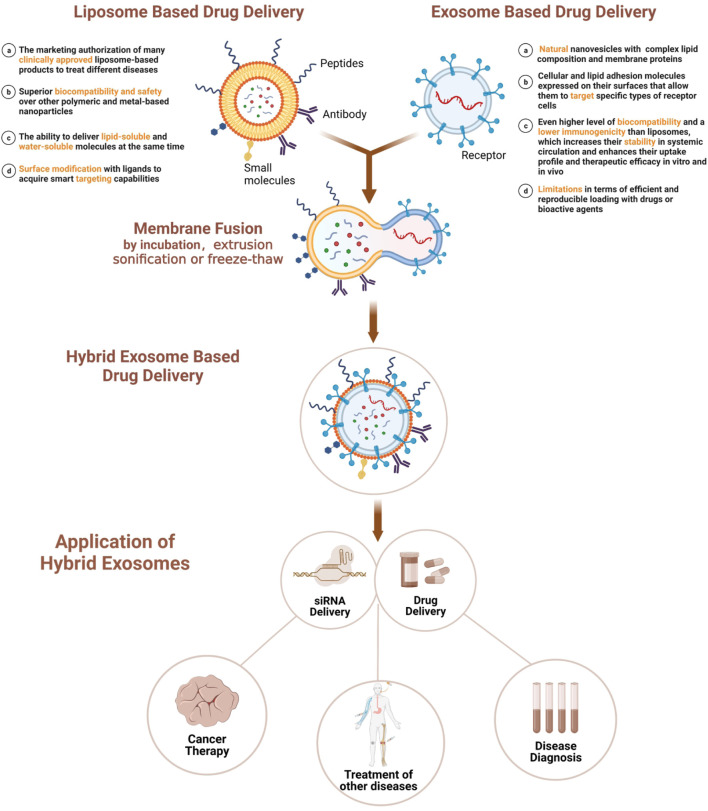
Liposomes are the earliest and most widely used nanoparticles for targeted drug delivery. Exosomes are nanosized membrane-bound particles and important mediators of intercellular communication. Combining liposomes and exosomes using various membrane fusion methods gives rise to a novel potential drug delivery system called membrane fusion-based hybrid exosomes (MFHE). These novel MFHEs not only exhibit potential advantageous features, such as high drug loading rate and targeted cellular uptake via surface modification, but are also endowed with high biocompatibility and low immunogenicity. Here, we provide an overview of MFHEs’ various preparation methods, characterization strategies, and their applications for disease treatment and scientific research.
Overview
The claims and statistics of this paper haven’t been checked yet.
Run the check — free, no account needed. It reads the open-access text and checks the sources it cites.
Integrity signals
Registry
Cites
Statistics
Figures
Verification
Claims the paper makes
The claims and statistics of this paper haven’t been checked yet.
Run the check — free, no account needed. It reads the open-access text and checks the sources it cites.
Claims other papers make about this one
Each is checked against this paper’s own text: does it say what the citing paper says it does?
In the citing paper
“Moreover, exosome-nanoparticle hybrids offer multifunctionality, as they can carry both hydrophilic and hydrophobic drugs, nucleic acids (e.g., siRNA, mRNA), imaging agents, and therapeutic proteins, enabling multi-modal therapies (such as drug delivery and imaging) within a single system [52].”
From Emerging role of exosomes in cancer therapy: progress and challenges (2025) · cites this paper as [52]
Self-check
Percentages, sums and reported differences re-computed from the paper’s own numbers.
The self-check needs the paper’s full text.
Citations
Cites
Doxil® — The first FDA-approved nano-drug: Lessons learned
Barenholz, Y. (. (2012) · Journal of Controlled Release · doi:10.1016/j.jconrel.2012.03.020 · Cited by 4,792
Gene therapy returns to centre stage
Naldini, L. (2015) · Nature · doi:10.1038/nature15818 · Cited by 1,184 · cited 1×
“Since most of the current reports on exosomes as drug carriers are related to small nucleic acids such as miRNA and siRNA or small-molecular-weight drugs, the expression plasmid of Cas9 is at least 5–6 kb (Naldini, 2015), which is much larger than the small nucleic acids.”
BackgroundEngineering hybrid exosomes by membrane fusion with liposomes
Sato, Y. T., Umezaki, K., Sawada, S., Mukai, S.-A., Sasaki, Y., Harada, N., Shiku, H., & Akiyoshi, K. (2016) · Scientific Reports · doi:10.1038/srep21933 · Cited by 744
Johnsen, K. B., Gudbergsson, J. M., Skov, M. N., Pilgaard, L., Moos, T., & Duroux, M. (2014) · Biochimica et Biophysica Acta (BBA) - Reviews on Cancer · doi:10.1016/j.bbcan.2014.04.005 · Cited by 704
Research works printed but not linked: 80
- Abri Aghdam, 2019, Recent advances on thermosensitive and pH-sensitive liposomes employed in controlled release, J. Control. Release, 315, 1, 10.1016/j.jconrel.2019.09.018 · DOI
- Allmang, 1999, Functions of the exosome in rRNA, snoRNA and snRNA synthesis, EMBO J., 18, 5399, 10.1093/emboj/18.19.5399 · DOI
- Alvarez-Erviti, 2011, Delivery of siRNA to the mouse brain by systemic injection of targeted exosomes, Nat. Biotechnol., 29, 341, 10.1038/nbt.1807 · DOI · Paper page
- Antimisiaris, 2018, Exosomes and exosome-inspired vesicles for targeted drug delivery, Pharmaceutics, 10, 218, 10.3390/pharmaceutics10040218 · DOI
- Armstrong, 2018, Strategic design of extracellular vesicle drug delivery systems, Adv. drug Deliv. Rev., 130, 12, 10.1016/j.addr.2018.06.017 · DOI · Paper page
- Balint, 2014, Conductive polymers: Towards a smart biomaterial for tissue engineering, Acta biomater., 10, 2341, 10.1016/j.actbio.2014.02.015 · DOI
- Cheng, 2021, Gene-engineered exosomes-thermosensitive liposomes hybrid nanovesicles by the blockade of CD47 signal for combined photothermal therapy and cancer immunotherapy, Biomaterials, 275, 120964, 10.1016/j.biomaterials.2021.120964 · DOI
- Conner, 2003, Regulated portals of entry into the cell, Nature, 422, 37, 10.1038/nature01451 · DOI
- Contreras-Naranjo, 2017, Microfluidics for exosome isolation and analysis: Enabling liquid biopsy for personalized medicine, Lab. Chip, 17, 3558, 10.1039/c7lc00592j · DOI
- Costa, 2014, Freeze-anneal-thaw cycling of unilamellar liposomes: Effect on encapsulation efficiency, Pharm. Res., 31, 97, 10.1007/s11095-013-1135-z · DOI
- de Jong, 2019, Drug delivery with extracellular vesicles: From imagination to innovation, Acc. Chem. Res., 52, 1761, 10.1021/acs.accounts.9b00109 · DOI
- Dissanayake, 2021, Measurement of the size and concentration and zeta potential of extracellular vesicles using nanoparticle tracking analyzer, Methods Mol. Biol. Clift. N.J.), 2273, 207, 10.1007/978-1-0716-1246-0_15 · DOI
- Dosio, 2016, Hyaluronic acid for anticancer drug and nucleic acid delivery, Adv. drug Deliv. Rev., 97, 204, 10.1016/j.addr.2015.11.011 · DOI
- Evers, 2021, Functional siRNA delivery by extracellular vesicle-liposome hybrid nanoparticles, Adv. Healthc. Mater., 11, 2101202, 10.1002/adhm.202101202 · DOI
- Farooqi, 2018, Exosome biogenesis, bioactivities and functions as new delivery systems of natural compounds, Biotechnol. Adv., 36, 328, 10.1016/j.biotechadv.2017.12.010 · DOI · Paper page
- Filipe, 2010, Critical evaluation of Nanoparticle Tracking Analysis (NTA) by NanoSight for the measurement of nanoparticles and protein aggregates, Pharm. Res., 27, 796, 10.1007/s11095-010-0073-2 · DOI · Paper page
- George, 2019, Lung transplantation for idiopathic pulmonary fibrosis, Lancet. Respir. Med., 7, 271, 10.1016/s2213-2600(18)30502-2 · DOI
- Guimarães, 2021, Design of liposomes as drug delivery system for therapeutic applications, Int. J. Pharm., 601, 120571, 10.1016/j.ijpharm.2021.120571 · DOI
- Gustafson, 2015, Nanoparticle uptake: The phagocyte problem, Nano today, 10, 487, 10.1016/j.nantod.2015.06.006 · DOI
- Hartjes, 2019, Extracellular vesicle quantification and characterization: Common methods and emerging approaches, Bioengineering, 6, 7, 10.3390/bioengineering6010007 · DOI
- Hu, 2021, Exosome-guided bone targeted delivery of Antagomir-188 as an anabolic therapy for bone loss, Bioact. Mater., 6, 2905, 10.1016/j.bioactmat.2021.02.014 · DOI
- Jhan, 2020, Engineered extracellular vesicles with synthetic lipids via membrane fusion to establish efficient gene delivery, Int. J. Pharm., 573, 118802, 10.1016/j.ijpharm.2019.118802 · DOI
- Ji, 2022, Clodronate-nintedanib-loaded exosome-liposome hybridization enhances the liver fibrosis therapy by inhibiting Kupffer cell activity, Biomater. Sci., 10, 702, 10.1039/d1bm01663f · DOI
- Jiang, 2018, Arginine, glycine, aspartic acid peptide-modified paclitaxel and curcumin co-loaded liposome for the treatment of lung cancer: In vitro/vivo evaluation, Ijn, 2561, 10.2147/ijn.S157746 · DOI
- Jiang, 2008, Nanoparticle-mediated cellular response is size-dependent, Nat. Nanotech, 3, 145, 10.1038/nnano.2008.30 · DOI
- Kannavou, 2021, Engineered versus hybrid cellular vesicles as efficient drug delivery systems: A comparative study with brain targeted vesicles, Drug Deliv. Transl. Res., 11, 547, 10.1007/s13346-021-00900-1 · DOI
- Kumar Pramanik, 2017, Physicochemical characterizations of functional hybrid liposomal nanocarriers formed using photo-sensitive lipids, Sci. Rep., 7, 46257, 10.1038/srep46257 · DOI
- Lentz, 2007, PEG as a tool to gain insight into membrane fusion, Eur. Biophys. J., 36, 315, 10.1007/s00249-006-0097-z · DOI
- Li, 2015, Folate-polydiacetylene-liposome for tumor targeted drug delivery and fluorescent tracing, Colloids Surfaces B Biointerfaces, 134, 235, 10.1016/j.colsurfb.2015.07.008 · DOI
- Li, 2022, Exosome-liposome hybrid nanoparticle codelivery of TP and miR497 conspicuously overcomes chemoresistant ovarian cancer, J. Nanobiotechnol, 20, 50, 10.1186/s12951-022-01264-5 · DOI · Paper page
- Li, 2019, A nuclear targeted Dox-aptamer loaded liposome delivery platform for the circumvention of drug resistance in breast cancer, Biomed. Pharmacother., 117, 109072, 10.1016/j.biopha.2019.109072 · DOI
- Li, 2021, Artificial exosomes for translational nanomedicine, J. Nanobiotechnol, 19, 242, 10.1186/s12951-021-00986-2 · DOI · Paper page
- Lin, 2018, Exosome-liposome hybrid nanoparticles deliver CRISPR/Cas9 system in MSCs, Adv. Sci., 5, 1700611, 10.1002/advs.201700611 · DOI · Paper page
- Liu, 2021, Targeted liposomal drug delivery: A nanoscience and biophysical perspective, Nanoscale Horiz., 6, 78, 10.1039/d0nh00605j · DOI
- Lu, 2020, Bioinspired exosome-like therapeutics and delivery nanoplatforms, Biomaterials, 242, 119925, 10.1016/j.biomaterials.2020.119925 · DOI
- Lu, 2010, Intraperitoneal therapy for peritoneal cancer, Future Oncol., 6, 1625, 10.2217/fon.10.100 · DOI
- Lv, 2020, Thermosensitive exosome-liposome hybrid nanoparticle‐mediated chemoimmunotherapy for improved treatment of metastatic peritoneal cancer, Adv. Sci., 7, 2000515, 10.1002/advs.202000515 · DOI
- Ma, 2022, A cascade synergetic strategy induced by photothermal effect based on platelet exosome nanoparticles for tumor therapy, Biomaterials, 282, 121384, 10.1016/j.biomaterials.2022.121384 · DOI
- Midekessa, 2020, Zeta potential of extracellular vesicles: Toward understanding the attributes that determine colloidal stability, ACS omega, 5, 16701, 10.1021/acsomega.0c01582 · DOI
- Millard, 2018, mTHPC-loaded extracellular vesicles outperform liposomal and free mTHPC formulations by an increased stability, drug delivery efficiency and cytotoxic effect in tridimensional model of tumors, Drug Deliv., 25, 1790, 10.1080/10717544.2018.1513609 · DOI
- Mitchell, 2021, Engineering precision nanoparticles for drug delivery, Nat. Rev. Drug DiscovDrug Discov., 20, 101, 10.1038/s41573-020-0090-8 · DOI · Paper page
- Moghimipour, 2018, Folic acid-modified liposomal drug delivery strategy for tumor targeting of 5-fluorouracil, Eur. J. Pharm. Sci., 114, 166, 10.1016/j.ejps.2017.12.011 · DOI
- Murphy, 2019, Extracellular vesicle-based therapeutics: Natural versus engineered targeting and trafficking, Exp. Mol. Med., 51, 1, 10.1038/s12276-019-0223-5 · DOI
- Ning, 2021, Liposome-mediated detection of SARS-CoV-2 RNA-positive extracellular vesicles in plasma, Nat. Nanotechnol., 16, 1039, 10.1038/s41565-021-00939-8 · DOI
- Ou, 2021, Extracellular Vesicle (EV) biohybrid systems for cancer therapy: Recent advances and future perspectives, Seminars cancer Biol., 74, 45, 10.1016/j.semcancer.2021.02.006 · DOI
- Owensiii, 2006, Opsonization, biodistribution, and pharmacokinetics of polymeric nanoparticles, Int. J. Pharm., 307, 93, 10.1016/j.ijpharm.2005.10.010 · DOI · Paper page
- Paliwal, 2015, A review of mechanistic insight and application of pH-sensitive liposomes in drug delivery, Drug Deliv., 22, 231, 10.3109/10717544.2014.882469 · DOI
- Panahi, 2017, Recent advances on liposomal nanoparticles: Synthesis, characterization and biomedical applications, Artif. cells, nanomedicine, Biotechnol., 45, 788, 10.1080/21691401.2017.1282496 · DOI
- Piffoux, 2018, Modification of extracellular vesicles by fusion with liposomes for the design of personalized biogenic drug delivery systems, ACS Nano, 12, 6830, 10.1021/acsnano.8b02053 · DOI
- Rayamajhi, 2019, Macrophage-derived exosome-mimetic hybrid vesicles for tumor targeted drug delivery, Acta biomater., 94, 482, 10.1016/j.actbio.2019.05.054 · DOI · Paper page
- Reshke, 2020, Reduction of the therapeutic dose of silencing RNA by packaging it in extracellular vesicles via a pre-microRNA backbone, Nat. Biomed. Eng., 4, 52, 10.1038/s41551-019-0502-4 · DOI
- Rozo, 2020, Biophysical analysis of lipidic nanoparticles, Methods, 180, 45, 10.1016/j.ymeth.2020.05.001 · DOI
- Schindler, 2019, Exosomal delivery of doxorubicin enables rapid cell entry and enhanced in vitro potency, PloS one, 14, e0214545, 10.1371/journal.pone.0214545 · DOI
- Sercombe, 2015, Advances and challenges of liposome assisted drug delivery, Front. Pharmacol., 6, 286, 10.3389/fphar.2015.00286 · DOI
- Shah, 2020, Liposomes: Advancements and innovation in the manufacturing process, Adv. drug Deliv. Rev., 102, 10.1016/j.addr.2020.07.002 · DOI
- Simons, 2009, Exosomes - vesicular carriers for intercellular communication, Curr. Opin. Cell Biol., 21, 575, 10.1016/j.ceb.2009.03.007 · DOI
- Singh, 2021, Transplantation of engineered exosomes derived from bone marrow mesenchymal stromal cells ameliorate diabetic peripheral neuropathy under electrical stimulation, Bioact. Mater., 6, 2231, 10.1016/j.bioactmat.2021.01.008 · DOI
- Skotland, 2020, An emerging focus on lipids in extracellular vesicles, Adv. drug Deliv. Rev., 159, 308, 10.1016/j.addr.2020.03.002 · DOI
- Storm, 1998, Doxorubicin entrapped in sterically stabilized liposomes: Effects on bacterial blood clearance capacity of the mononuclear phagocyte system, Clin. cancer Res. official J. Am. Assoc. Cancer Res., 4, 111
- Sun, 2021, Clodronate-loaded liposomal and fibroblast-derived exosomal hybrid system for enhanced drug delivery to pulmonary fibrosis, Biomaterials, 271, 120761, 10.1016/j.biomaterials.2021.120761 · DOI
- Sutaria, 2017, Achieving the promise of therapeutic extracellular vesicles: The devil is in details of therapeutic loading, Pharm. Res., 34, 1053, 10.1007/s11095-017-2123-5 · DOI · Paper page
- Szebeni, 2015, Complement activation as a bioequivalence issue relevant to the development of generic liposomes and other nanoparticulate drugs, Biochem. biophysical Res. Commun., 468, 490, 10.1016/j.bbrc.2015.06.177 · DOI
- Tang, 2018, PEGylated liposomes as delivery systems for Gambogenic acid: Characterization and in vitro/in vivo evaluation, Colloids Surfaces B Biointerfaces, 172, 26, 10.1016/j.colsurfb.2018.08.022 · DOI
- Thakral, 2013, Electrical stimulation as an adjunctive treatment of painful and sensory diabetic neuropathy, J. Diabetes Sci. Technol., 7, 1202, 10.1177/193229681300700510 · DOI
- Théry, 2015, Diagnosis by extracellular vesicles, Nature, 523, 161, 10.1038/nature14626 · DOI
- Thorsteinsson, 2020, FRET-based assay for the quantification of extracellular vesicles and other vesicles of complex composition, Anal. Chem., 92, 15336, 10.1021/acs.analchem.0c02271 · DOI
- Tran, 2020, Exosomes and nanoengineering: A match made for precision therapeutics, Adv. Mat., 32, 1904040, 10.1002/adma.201904040 · DOI
- Udugama, 2020, Diagnosing COVID-19: The disease and tools for detection, ACS Nano, 14, 3822, 10.1021/acsnano.0c02624 · DOI
- van der Koog, 2022, Liposomes and extracellular vesicles as drug delivery systems: A comparison of composition, pharmacokinetics, and functionalization, Adv. Healthc. Mater., 11, 2100639, 10.1002/adhm.202100639 · DOI
- Wang, 2021, Challenges in the development and establishment of exosome-based drug delivery systems, J. Control. Release, 329, 894, 10.1016/j.jconrel.2020.10.020 · DOI
- Wang, Fabrication of an aptamer-coated liposome complex for the detection and profiling of exosomes based on terminal deoxynucleotidyl transferase-mediated signal amplification, ACS Appl. Mat. Interfaces, 12, 322, 10.1021/acsami.9b18869 · DOI
- Wang, 2019, Bridging exosome and liposome through zirconium-phosphate coordination chemistry: A new method for exosome detection, Chem. Commun., 55, 2708, 10.1039/c9cc00220k · DOI
- Wang, Detection of SARS-CoV-2 in different types of clinical specimens, JAMA, 323, 1843, 10.1001/jama.2020.3786 · DOI
- Weber, 2019, Functionalization of liposomes with hydrophilic polymers results in macrophage uptake independent of the protein corona, Biomacromolecules, 20, 2989, 10.1021/acs.biomac.9b00539 · DOI
- Yang, 2018, Extracellular vesicles as a platform for membrane-associated therapeutic protein delivery, J. Extracell. vesicles, 7, 1440131, 10.1080/20013078.2018.1440131 · DOI
- Yang, 2021, Sorting sub-150-nm liposomes of distinct sizes by DNA-brick-assisted centrifugation, Nat. Chem., 13, 335, 10.1038/s41557-021-00667-5 · DOI
- Zahednezhad, 2019, Liposome and immune system interplay: Challenges and potentials, J. Control. Release, 305, 194, 10.1016/j.jconrel.2019.05.030 · DOI
- Zhang, 2017, Liposomes equipped with cell penetrating peptide BR2 enhances chemotherapeutic effects of cantharidin against hepatocellular carcinoma, Drug Deliv., 24, 986, 10.1080/10717544.2017.1340361 · DOI
- Zhao, 2015, Nanocarriers for delivery of siRNA and co-delivery of siRNA and other therapeutic agents, Nanomedicine, 10, 2199, 10.2217/nnm.15.61 · DOI
- Zhou, 2022, Tumour‐derived extracellular vesicle membrane hybrid lipid nanovesicles enhance siRNA delivery by tumour‐homing and intracellular freeway transportation, J Extracell. Vesicle, 11, e12198, 10.1002/jev2.12198 · DOI
Cited by
Sorted by citations
Emerging role of exosomes in cancer therapy: progress and challenges
Li, J., Wang, J., & Chen, Z. (2025) · Molecular Cancer · doi:10.1186/s12943-024-02215-4 · Cited by 297
Thermoresponsive M1 macrophage-derived hybrid nanovesicles for improved in vivo tumor targeting
Barone, A., Zimbo, A. M., d’Avanzo, N., Tolomeo, A. M., Ruga, S., Cardamone, A., Celia, C., Scalise, M., Torella, D., La Deda, M., et al. (2023) · Drug Delivery and Translational Research · doi:10.1007/s13346-023-01378-9 · Cited by 22
Metadata
- Authors
- Liu, A., Yang, G., Liu, Y., & Liu, T.
- Venue
- Frontiers in Bioengineering and Biotechnology
- Publisher
- Frontiers Media SA
- Published
- 2022-08-16
- Volume
- 10
- ISSN
- 2296-4185
- PMC
- PMC9424752
- Cited by
- 88
- References
- 4
- Funders
- National Natural Science Foundation of China
About these checks
Registry, retraction, Cites and statistics results are computed, not judged, with one exception: a printed reference that no index lists is read once by a model before it counts as a citation error. Claims are extracted by a model and kept only when their quote appears verbatim in the text; each cited source is then checked, with a model’s help, for whether it says what the claim relies on. Those verdicts can be wrong — read the claim’s quote and the cited source before relying on one.
Statistics and arithmetic are recomputed, not judged.
Confidence bands are shown only for fields calibrated on our annotated test set. None is calibrated yet, so no band is shown.
What counts as a claim ›How we measure confidence ›How we check this ›
Are you an author, or do you see a problem with this page? Request a review
