

The DOI matches its Crossref record; 50 of the 50 references it cites were found in a registry or an index; none of the 42 sources its claims cite is checked for support yet.
Performance Under Stress: An Eye-Tracking Investigation of the Iowa Gambling Task (IGT)
Open accessAbstract
Stress pervades everyday life and impedes risky decision making. The following experiment is the first to examine effects of stress on risky decision making in the Iowa Gambling Task (IGT), while measuring inspection time and conscious awareness of deck contingencies. This was original as it allowed a fine grained rigorous analysis of the way that stress impedes awareness of, and attention to maladaptive financial choices. The extended Cognitive Reflection Task (CRT) further afforded examination of the impact of impaired reflective thinking on risky decision making. Stressed participants were slower to avoid the disadvantageous decks and performed worse overall. They inspected disadvantageous decks for longer than the control condition and were slower in developing awareness of their poor deck quality compared to the control condition. Conversely, in the control condition greater inspection times for advantageous decks were observed earlier in the task, and better awareness of the deck contingencies was shown as early as the second block of trials than the stress condition. Path analysis suggested that stress reduced IGT performance by impeding reflective thinking and conscious awareness. Explicit cognitive processes, moreover, were important during the preliminary phase of IGT performance-a finding that has significant implications for the use of the IGT as a clinical diagnostic tool. It was concluded that stress impedes reflective thinking, attentional disengagement from poorer decks, and the development of conscious knowledge about choice quality that interferes with performance on the IGT. These data demonstrate that stress impairs risky decision making performance, by impeding attention to, and awareness of task characteristics in risky decision making.
Overview
AI snapshot
Written from the paper’s full text.
TL;DR
This eye-tracking study found that acute anticipatory stress impaired Iowa Gambling Task performance by reducing reflective thinking and conscious awareness of deck quality, while also increasing attention to disadvantageous decks. The authors conclude that stress undermines risky decision making through impaired Type II cognitive processes, challenging the view that the IGT primarily diagnoses emotional processing deficits.
Key findings
- Stressed participants performed worse overall on the IGT: total score −2.68 (31.15) vs. control 58.16 (37.47); main effect of stress condition F(1,74) = 58.80, p < 0.001, ηp² = 0.44, with lower scores in all blocks except Block 1.
- Stress increased inspection time for disadvantageous decks, especially Blocks 2–5; e.g., Block 4 stress 0.53 (0.20) vs. control 0.17 (0.17), p < 0.005. Control participants showed longer inspection of advantageous decks in Blocks 2–4.
- Stress reduced cognitive reflection: CRT median = 1 (IQR = 5) in stress vs. median = 4.5 (IQR = 7) in control, U = 128, p < 0.001, r = 0.72. Conscious awareness of deck quality was also lower in stress: total deck ratings 1.19 (6.90) vs. control 7.61 (8.32), F(1,73) = 12.90, p = 0.001, ηp² = 0.15.
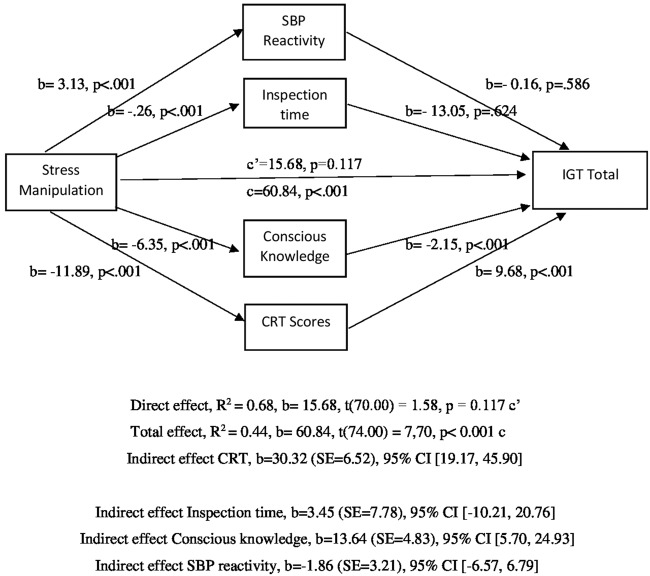
- Path analysis showed no significant direct effect of stress on IGT scores, b = 15.30 (SE = 12.15), p = 0.21, but significant indirect effects through CRT, b = 30.32 (SE = 7.40), p < 0.001, and conscious knowledge, b = 13.64 (SE = 4.67), p = 0.003; indirect paths through inspection time and SBP reactivity were not significant.
Methods
- Seventy-six undergraduate students (23 male, 53 female; aged 19–56) were randomly allocated to stress or control. Stress was induced with an anticipatory speech task involving a simulated video camera; control participants were not exposed to the stress manipulation. SBP and HR were measured with a Finometer.
- Participants completed the computerized IGT (140 trials, seven blocks of 20), the seven-item CRT, and Maia and McClelland’s conscious awareness test with deck ratings from −10 to +10 per block. Eye movements were recorded with a Tobii X2-30 eye tracker, and inspection time within deck areas of interest was calculated.
- Analyses included ANOVA manipulation checks, 2 (condition) × 7 (block) mixed ANOVAs for IGT scores, inspection times, and deck ratings, Mann–Whitney tests for CRT, bivariate correlations, and bootstrapped mediation/path analysis using the Process macro with 10,000 resamples and bias-corrected 95% CIs; alpha was adjusted to p < 0.005.
Limitations
- The authors state that cortisol was not measured, although they argue the stress induction was effective based on SBP/HR reactivity and that cortisol likely affected learning and performance.
- The authors note that Maia and McClelland’s awareness test may promote additional cognitive rather than intuitive processing because participants assess deck quality at regular intervals.
- The authors also report that path analysis revealed a weak relationship between the mediators and overall IGT scores, raising the possibility that the mediators are not strongly related to each other. An evident limitation is the sample: undergraduate students, mostly female, which may restrict generalizability.
Model-written summary. Check it against the paper before relying on it.
Integrity signals
Registry
Cites
Statistics
Figures
Verification
Claims the paper makes
56 Own result · 28 Own interpretation · 11 Check pending · 9 No full text of the sources · 6 Own method · 4 Not checked yet · 3 Sources not found · 2 No basis given
A result the paper reports from its own data — it cites no other source for it, so there is none to check. The quote shows it is in the paper.
In the paper
“The adjusted (p < 0.005) post hoc pairwise comparisons demonstrated that deck ratings in Block 1 was significantly lower than all Blocks (all p < 0.001).”
§ Performance Under Stress: An Eye-Tracking Investigation of the Iowa Gambling Task (IGT) > Results > Conscious Awareness of Deck Quality
boosted- Asserted: passes — The authors put it forward as true.
- Checkable: passes — It can be checked against evidence.
- Load-bearing: unclear — It is unclear whether the paper’s conclusions depend on it.
- Based: passes — The paper gives a reason why it holds.
A result the paper reports from its own data — it cites no other source for it, so there is none to check. The quote shows it is in the paper.
In the paper
“Further path analyses indicated that the direct effect of stress manipulation on IGT was not significant when controlling for indirect pathways, b = 15.30 (SE = 12.15), t = 1.26, p = 0.21.”
§ Performance Under Stress: An Eye-Tracking Investigation of the Iowa Gambling Task (IGT) > Results > Path Analyses of Determinants of IGT Performance
hedged- Asserted: passes — The authors put it forward as true.
- Checkable: passes — It can be checked against evidence.
- Load-bearing: passes — The paper’s conclusions depend on it.
- Based: passes — The paper gives a reason why it holds.
A result the paper reports from its own data — it cites no other source for it, so there is none to check. The quote shows it is in the paper.
In the paper
“and were slower in developing awareness of their poor deck quality compared to the control condition.”
§ Performance Under Stress: An Eye-Tracking Investigation of the Iowa Gambling Task (IGT) > Abstract
plaindirect- Asserted: passes — The authors put it forward as true.
- Checkable: passes — It can be checked against evidence.
- Load-bearing: passes — The paper’s conclusions depend on it.
- Based: passes — The paper gives a reason why it holds.
A result the paper reports from its own data — it cites no other source for it, so there is none to check. The quote shows it is in the paper.
In the paper
“There was a significant Block × stress manipulation interaction, F(3.78,280.19) = 10.88, p < 0.001, ηp² = 0.13, on inspection time.”
§ Performance Under Stress: An Eye-Tracking Investigation of the Iowa Gambling Task (IGT) > Results > Deck Inspection-Time Analyses
plaincorrelational- Asserted: passes — The authors put it forward as true.
- Checkable: passes — It can be checked against evidence.
- Load-bearing: passes — The paper’s conclusions depend on it.
- Based: passes — The paper gives a reason why it holds.
The paper states this without a source or data behind it here, so there is nothing to check it against. The quote shows it is in the paper.
In the paper
“However, reflective processing was not a reliable correlate with performance in the stress condition.”
§ Performance Under Stress: An Eye-Tracking Investigation of the Iowa Gambling Task (IGT) > Discussion > CRT Results
plain- Asserted: passes — The authors put it forward as true.
- Checkable: passes — It can be checked against evidence.
- Load-bearing: passes — The paper’s conclusions depend on it.
- Based: passes — The paper gives a reason why it holds.
A result the paper reports from its own data — it cites no other source for it, so there is none to check. The quote shows it is in the paper.
In the paper
“SBP reactivity | F(1,74) = 21.54, p < 0.001, R2 = 0.22 | b = −11.89 (SE = 2.56), t(74) = −4.64, p < 0.001”
§ Performance Under Stress: An Eye-Tracking Investigation of the Iowa Gambling Task (IGT) > Results > Path Analyses of Determinants of IGT Performance
plaindirect- Asserted: passes — The authors put it forward as true.
- Checkable: passes — It can be checked against evidence.
- Load-bearing: passes — The paper’s conclusions depend on it.
- Based: passes — The paper gives a reason why it holds.
A result the paper reports from its own data — it cites no other source for it, so there is none to check. The quote shows it is in the paper.
In the paper
“There was a significant Block × stress manipulation interaction, F(4.14,306.16) = 26.16, p < 0.001, ηp² = 0.26.”
§ Performance Under Stress: An Eye-Tracking Investigation of the Iowa Gambling Task (IGT) > Results > Deck Inspection-Time Analyses
plaincorrelational- Asserted: passes — The authors put it forward as true.
- Checkable: passes — It can be checked against evidence.
- Load-bearing: passes — The paper’s conclusions depend on it.
- Based: passes — The paper gives a reason why it holds.
A result the paper reports from its own data — it cites no other source for it, so there is none to check. The quote shows it is in the paper.
In the paper
“Participants in the control conditions had more accurate estimates of deck quality in all but Blocks 2 and 4.”
§ Performance Under Stress: An Eye-Tracking Investigation of the Iowa Gambling Task (IGT) > Discussion
plain- Asserted: passes — The authors put it forward as true.
- Checkable: passes — It can be checked against evidence.
- Load-bearing: unclear — It is unclear whether the paper’s conclusions depend on it.
- Based: passes — The paper gives a reason why it holds.
A result the paper reports from its own data — it cites no other source for it, so there is none to check. The quote shows it is in the paper.
In the paper
“There was a main effect of Block, F(4.14,306.16) = 21.81, p < 0.001, ηp² = 0.23, such that there was an increase in inspection time from Block 1 until Block 4 (all p < 0.001).”
§ Performance Under Stress: An Eye-Tracking Investigation of the Iowa Gambling Task (IGT) > Results > Deck Inspection-Time Analyses
plaindirect- Asserted: passes — The authors put it forward as true.
- Checkable: passes — It can be checked against evidence.
- Load-bearing: unclear — It is unclear whether the paper’s conclusions depend on it.
- Based: passes — The paper gives a reason why it holds.
A result the paper reports from its own data — it cites no other source for it, so there is none to check. The quote shows it is in the paper.
In the paper
“There was a main effect of stress condition F(1,74) = 58.80, p < 0.001, ηp² = 0.44, participants in the stress condition had lower IGT scores than the control group.”
§ Performance Under Stress: An Eye-Tracking Investigation of the Iowa Gambling Task (IGT) > Results > IGT Performance—Deck Selection Analysis
plaindirect- Asserted: passes — The authors put it forward as true.
- Checkable: passes — It can be checked against evidence.
- Load-bearing: passes — The paper’s conclusions depend on it.
- Based: passes — The paper gives a reason why it holds.
- It may state two separate claims as one. 22
- The quote only partly states this claim. 1
- Probably not a substantial claim. 15
A result the paper reports from its own data — it cites no other source for it, so there is none to check. The quote shows it is in the paper.
In the paper
“CRT scores and disadvantageous deck picks were correlated in Block 3, 5, 6 and 7 in the control condition but were not significant in the stress condition.”
§ Performance Under Stress: An Eye-Tracking Investigation of the Iowa Gambling Task (IGT) > Discussion
plaincorrelational- Asserted: passes — The authors put it forward as true.
- Checkable: passes — It can be checked against evidence.
- Load-bearing: passes — The paper’s conclusions depend on it.
- Based: passes — The paper gives a reason why it holds.
It may state two separate claims as one.
A result the paper reports from its own data — it cites no other source for it, so there is none to check. The quote shows it is in the paper.
In the paper
“and in Blocks 3, 5, 6 and 7 in the control condition.”
§ Performance Under Stress: An Eye-Tracking Investigation of the Iowa Gambling Task (IGT) > Results > Correlations Between CRT and IGT by Block
plaincorrelational- Asserted: passes — The authors put it forward as true.
- Checkable: passes — It can be checked against evidence.
- Load-bearing: unclear — It is unclear whether the paper’s conclusions depend on it.
- Based: passes — The paper gives a reason why it holds.
The quote only partly states this claim.
A result the paper reports from its own data — it cites no other source for it, so there is none to check. The quote shows it is in the paper.
In the paper
“Our data indicated that conscious awareness, attentional processing and analytic ability arise early in the task for the control group”
§ Performance Under Stress: An Eye-Tracking Investigation of the Iowa Gambling Task (IGT) > Discussion > Conscious Awareness
hedged- Asserted: passes — The authors put it forward as true.
- Checkable: passes — It can be checked against evidence.
- Load-bearing: passes — The paper’s conclusions depend on it.
- Based: passes — The paper gives a reason why it holds.
It may state two separate claims as one.
A result the paper reports from its own data — it cites no other source for it, so there is none to check. The quote shows it is in the paper.
In the paper
“Our findings show that deck selection in the stress condition improved after the fourth trial compared to the control condition where deck selection improved after the first trial.”
§ Performance Under Stress: An Eye-Tracking Investigation of the Iowa Gambling Task (IGT) > Discussion > Manipulation Check and IGT Performance
plaincorrelational- Asserted: passes — The authors put it forward as true.
- Checkable: passes — It can be checked against evidence.
- Load-bearing: passes — The paper’s conclusions depend on it.
- Based: passes — The paper gives a reason why it holds.
It may state two separate claims as one.
A conclusion the paper draws from its own results — it cites no other source for it, so there is none to check. The quote shows it is in the paper.
In the paper
“This indicated that the control group had gained sufficient knowledge about the deck contingences and was more focused on the good decks.”
§ Performance Under Stress: An Eye-Tracking Investigation of the Iowa Gambling Task (IGT) > Discussion > Conscious Awareness
hedgedcorrelational- Asserted: passes — The authors put it forward as true.
- Checkable: passes — It can be checked against evidence.
- Load-bearing: passes — The paper’s conclusions depend on it.
- Based: passes — The paper gives a reason why it holds.
It may state two separate claims as one.
In the paper
“Preston et al. (2007) suggested that anticipatory stress shifts cognitive processes away from deliberative processing towards automatic processing, and thus impairs differentiation between advantageous and disadvantageous choices”
§ Performance Under Stress: An Eye-Tracking Investigation of the Iowa Gambling Task (IGT) > Introduction > Stress
What the sources say
- Not checked — no full text of the sourcecites Preston et al., 2007 source
hedgeddirect- Asserted: fails — The authors may not put it forward as true.
- Checkable: passes — It can be checked against evidence.
- Load-bearing: passes — The paper’s conclusions depend on it.
- Based: passes — The paper gives a reason why it holds.
Probably not a substantial claim. The authors may not put it forward as true. It may state two separate claims as one.
In the paper
“Maia and McClelland (2004) challenged Bechara et al.’s (1994) view that conscious awareness and performance on the IGT are unrelated by showing that explicit knowledge about decks improved deck selection.”
§ Performance Under Stress: An Eye-Tracking Investigation of the Iowa Gambling Task (IGT) > Introduction > Stress
What the sources say
- Check pendingcites Maia and McClelland, 2004 source
plaindirect- Asserted: passes — The authors put it forward as true.
- Checkable: passes — It can be checked against evidence.
- Load-bearing: fails — The paper’s conclusions may not depend on it.
- Based: passes — The paper gives a reason why it holds.
Probably not a substantial claim. The paper’s conclusions may not depend on it.
What the paper did — it cites no source for this, so there is none to check. The quote shows it is in the paper.
In the paper
“To balance concerns related to Type I and Type II errors the alpha level for all analyses was adjusted to p < 0.005.”
§ Performance Under Stress: An Eye-Tracking Investigation of the Iowa Gambling Task (IGT) > Materials and Methods > Materials
plain- Asserted: passes — The authors put it forward as true.
- Checkable: passes — It can be checked against evidence.
- Load-bearing: passes — The paper’s conclusions depend on it.
- Based: passes — The paper gives a reason why it holds.
Probably not a substantial claim.
A claim is checked only against the cited paper’s full text, never its abstract, and none is available for its sources.
In the paper
“Stress interferes with the learning process in healthy controls, increases risk-taking behavior and leads to disadvantageous card selections on the IGT (Preston et al., 2007; Miu et al., 2008; van den Bos et al., 2009; Robinson et al., 2015; Simonovic et al., 2017a; Starcke et al., 2017).”
§ Performance Under Stress: An Eye-Tracking Investigation of the Iowa Gambling Task (IGT) > Introduction > Stress
What the sources say
plaindirect- Asserted: passes — The authors put it forward as true.
- Checkable: passes — It can be checked against evidence.
- Load-bearing: passes — The paper’s conclusions depend on it.
- Based: passes — The paper gives a reason why it holds.
It may state two separate claims as one.
What the paper did — it cites no source for this, so there is none to check. The quote shows it is in the paper.
In the paper
“All analyses were repeated with gender as either a covariate or a moderator; no outcomes were affected.”
§ Performance Under Stress: An Eye-Tracking Investigation of the Iowa Gambling Task (IGT) > Materials and Methods > Materials
plain- Asserted: passes — The authors put it forward as true.
- Checkable: passes — It can be checked against evidence.
- Load-bearing: fails — The paper’s conclusions may not depend on it.
- Based: passes — The paper gives a reason why it holds.
Probably not a substantial claim. The paper’s conclusions may not depend on it. It may state two separate claims as one.
In the paper
“stress may impair preconscious selective attention to avoid negative stimuli (e.g., Roelofs et al., 2007).”
§ Performance Under Stress: An Eye-Tracking Investigation of the Iowa Gambling Task (IGT) > Introduction > Stress
What the sources say
- Not checked yetcites Roelofs et al., 2007 source
hedgedconditional- Asserted: passes — The authors put it forward as true.
- Checkable: passes — It can be checked against evidence.
- Load-bearing: fails — The paper’s conclusions may not depend on it.
- Based: passes — The paper gives a reason why it holds.
Probably not a substantial claim. The paper’s conclusions may not depend on it.
What the paper did — it cites no source for this, so there is none to check. The quote shows it is in the paper.
In the paper
“were recruited and randomly allocated to stress and control groups.”
§ Performance Under Stress: An Eye-Tracking Investigation of the Iowa Gambling Task (IGT) > Materials and Methods > Participants
plain- Asserted: passes — The authors put it forward as true.
- Checkable: passes — It can be checked against evidence.
- Load-bearing: passes — The paper’s conclusions depend on it.
- Based: passes — The paper gives a reason why it holds.
Probably not a substantial claim.
A conclusion the paper draws from its own results — it cites no other source for it, so there is none to check. The quote shows it is in the paper.
In the paper
“This indicates that the importance of reflective thinking emerged after the second Block and persisted until the end of the task in the control condition”
§ Performance Under Stress: An Eye-Tracking Investigation of the Iowa Gambling Task (IGT) > Discussion > CRT Results
hedgedcorrelational- Asserted: passes — The authors put it forward as true.
- Checkable: passes — It can be checked against evidence.
- Load-bearing: unclear — It is unclear whether the paper’s conclusions depend on it.
- Based: unclear — It is unclear why the paper says it holds.
It may state two separate claims as one.
What the paper did — it cites no source for this, so there is none to check. The quote shows it is in the paper.
In the paper
“they were no differences in age or gender.”
§ Performance Under Stress: An Eye-Tracking Investigation of the Iowa Gambling Task (IGT) > Materials and Methods > Materials
plain- Asserted: passes — The authors put it forward as true.
- Checkable: passes — It can be checked against evidence.
- Load-bearing: fails — The paper’s conclusions may not depend on it.
- Based: passes — The paper gives a reason why it holds.
Probably not a substantial claim. The paper’s conclusions may not depend on it. It may state two separate claims as one.
What the paper did — it cites no source for this, so there is none to check. The quote shows it is in the paper.
In the paper
“The Cronbach alpha for correct CRT responses was α = 0.77.”
§ Performance Under Stress: An Eye-Tracking Investigation of the Iowa Gambling Task (IGT) > Materials and Methods > Materials
plain- Asserted: passes — The authors put it forward as true.
- Checkable: passes — It can be checked against evidence.
- Load-bearing: fails — The paper’s conclusions may not depend on it.
- Based: passes — The paper gives a reason why it holds.
Probably not a substantial claim. The paper’s conclusions may not depend on it.
In the paper
“Since neurochemicals released in response to stress (e.g., dopamine and glucocorticoids) have receptors in the PFC, decision making processes that depend on PFC can be directly affected by stress (e.g., Preston et al., 2007).”
§ Performance Under Stress: An Eye-Tracking Investigation of the Iowa Gambling Task (IGT) > Discussion > CRT Results
What the sources say
- Not checked — no full text of the sourcecites Preston et al., 2007 source
plaindirect- Asserted: passes — The authors put it forward as true.
- Checkable: passes — It can be checked against evidence.
- Load-bearing: passes — The paper’s conclusions depend on it.
- Based: passes — The paper gives a reason why it holds.
It may state two separate claims as one.
A conclusion the paper draws from its own results — it cites no other source for it, so there is none to check. The quote shows it is in the paper.
In the paper
“The results indicated that participants who were more reflective have greater awareness of deck contingences and are more focussed on good decks earlier in the task, implicating Type II processing throughout the task.”
§ Performance Under Stress: An Eye-Tracking Investigation of the Iowa Gambling Task (IGT) > Discussion > Conscious Awareness
hedgedcorrelational- Asserted: passes — The authors put it forward as true.
- Checkable: passes — It can be checked against evidence.
- Load-bearing: passes — The paper’s conclusions depend on it.
- Based: passes — The paper gives a reason why it holds.
It may state two separate claims as one.
A conclusion the paper draws from its own results — it cites no other source for it, so there is none to check. The quote shows it is in the paper.
In the paper
“It was concluded that stress impedes reflective thinking, attentional disengagement from poorer decks, and the development of conscious knowledge about choice quality that interferes with performance on the IGT.”
§ Performance Under Stress: An Eye-Tracking Investigation of the Iowa Gambling Task (IGT) > Abstract
boosteddirect- Asserted: passes — The authors put it forward as true.
- Checkable: passes — It can be checked against evidence.
- Load-bearing: passes — The paper’s conclusions depend on it.
- Based: passes — The paper gives a reason why it holds.
It may state two separate claims as one.
- The authors state this as an assumption: Participants develop a 'gut feeling' (or somatic marker) about the goodness or badness of decks and progressively acquire conceptual knowledge and awareness about task contingencies.
None of the sources cited for this claim have been checked yet.
In the paper
“This indicates that stress disrupts higher order control, mediated by Prefrontal Cortex (PFC; e.g., Arnsten, 2009; Schwabe and Wolf, 2011, 2013).”
§ Performance Under Stress: An Eye-Tracking Investigation of the Iowa Gambling Task (IGT) > Discussion > CRT Results
What the sources say
- Not checked yetcites Arnsten, 2009 source
- Not matchedcites Schwabe and Wolf, 2011, 2013
Couldn’t be matched to a paper in Crossref, so it can’t be checked.
hedgeddirect- Asserted: passes — The authors put it forward as true.
- Checkable: passes — It can be checked against evidence.
- Load-bearing: passes — The paper’s conclusions depend on it.
- Based: passes — The paper gives a reason why it holds.
It may state two separate claims as one.
In the paper
“These data support previous findings that stress impairs learning and leads to a slower elimination of disadvantageous deck selection (Preston et al., 2007; Starcke et al., 2017; Wemm and Wulfert, 2017).”
§ Performance Under Stress: An Eye-Tracking Investigation of the Iowa Gambling Task (IGT) > Discussion > Manipulation Check and IGT Performance
What the sources say
plaindirect- Asserted: passes — The authors put it forward as true.
- Checkable: passes — It can be checked against evidence.
- Load-bearing: passes — The paper’s conclusions depend on it.
- Based: passes — The paper gives a reason why it holds.
It may state two separate claims as one.
In the paper
“Maia and McClelland’s (2004) Test of Awareness measures the emergence of conceptual knowledge about deck contingencies.”
§ Performance Under Stress: An Eye-Tracking Investigation of the Iowa Gambling Task (IGT) > Materials and Methods > Materials
What the sources say
- Check pendingcites Maia and McClelland, 2004 source
plain- Asserted: passes — The authors put it forward as true.
- Checkable: passes — It can be checked against evidence.
- Load-bearing: fails — The paper’s conclusions may not depend on it.
- Based: passes — The paper gives a reason why it holds.
Probably not a substantial claim. The paper’s conclusions may not depend on it.
A conclusion the paper draws from its own results — it cites no other source for it, so there is none to check. The quote shows it is in the paper.
In the paper
“This analysis demonstrated the stress manipulation indirectly affected IGT scores by reducing cognitive reflection and conscious knowledge but did not have a direct effect.”
§ Performance Under Stress: An Eye-Tracking Investigation of the Iowa Gambling Task (IGT) > Discussion
boosteddirect- Asserted: passes — The authors put it forward as true.
- Checkable: passes — It can be checked against evidence.
- Load-bearing: passes — The paper’s conclusions depend on it.
- Based: passes — The paper gives a reason why it holds.
It may state two separate claims as one.
In the paper
“Thus, conscious awareness initiates executive attention that further prompts executive functioning and enhances decision making.”
§ Performance Under Stress: An Eye-Tracking Investigation of the Iowa Gambling Task (IGT) > Introduction > Stress
What the sources say
- Not checked yetcites Newell and Shanks, 2014 source
plaindirect- Asserted: passes — The authors put it forward as true.
- Checkable: passes — It can be checked against evidence.
- Load-bearing: fails — The paper’s conclusions may not depend on it.
- Based: passes — The paper gives a reason why it holds.
Probably not a substantial claim. The paper’s conclusions may not depend on it. It may state two separate claims as one.
In the paper
“Fernie and Tunney (2013) however, showed that not all participants attain conscious awareness of deck quality, and that conceptual knowledge was not essential for advantageous selections.”
§ Performance Under Stress: An Eye-Tracking Investigation of the Iowa Gambling Task (IGT) > Introduction > Stress
What the sources say
- Check pendingcites Fernie and Tunney, 2013 source
plain- Asserted: passes — The authors put it forward as true.
- Checkable: passes — It can be checked against evidence.
- Load-bearing: fails — The paper’s conclusions may not depend on it.
- Based: passes — The paper gives a reason why it holds.
Probably not a substantial claim. The paper’s conclusions may not depend on it. It may state two separate claims as one.
In the paper
“The seven-item CRT (Toplak et al., 2014) was used to measure analytic ability.”
§ Performance Under Stress: An Eye-Tracking Investigation of the Iowa Gambling Task (IGT) > Materials and Methods > Materials
What the sources say
- Not checked — no full text of the sourcecites Toplak et al., 2014 source
plain- Asserted: passes — The authors put it forward as true.
- Checkable: passes — It can be checked against evidence.
- Load-bearing: fails — The paper’s conclusions may not depend on it.
- Based: passes — The paper gives a reason why it holds.
Probably not a substantial claim. The paper’s conclusions may not depend on it.
What the paper did — it cites no source for this, so there is none to check. The quote shows it is in the paper.
In the paper
“The assumption of normality was met and there were no outliers.”
§ Performance Under Stress: An Eye-Tracking Investigation of the Iowa Gambling Task (IGT) > Results > Path Analyses of Determinants of IGT Performance
plain- Asserted: passes — The authors put it forward as true.
- Checkable: passes — It can be checked against evidence.
- Load-bearing: passes — The paper’s conclusions depend on it.
- Based: passes — The paper gives a reason why it holds.
Probably not a substantial claim. It may state two separate claims as one.
In the paper
“Their results showed that an increase in cortisol reduced reflective processing and increased intuitive processing.”
§ Performance Under Stress: An Eye-Tracking Investigation of the Iowa Gambling Task (IGT) > Introduction > Stress
What the sources say
- Not checked — no full text of the sourcecites Margittai et al., 2015 source
plaindirect- Asserted: passes — The authors put it forward as true.
- Checkable: passes — It can be checked against evidence.
- Load-bearing: passes — The paper’s conclusions depend on it.
- Based: passes — The paper gives a reason why it holds.
It may state two separate claims as one.
In the paper
“Unpacking this issue is complicated by the evidence that conflict between Type I and Type II processes can be physiologically arousing (e.g., Evans, 2003; De Neys and Glumicic, 2008; De Neys et al., 2010).”
§ Performance Under Stress: An Eye-Tracking Investigation of the Iowa Gambling Task (IGT) > Discussion > Path Analysis
What the sources say
plaindirect- Asserted: passes — The authors put it forward as true.
- Checkable: passes — It can be checked against evidence.
- Load-bearing: fails — The paper’s conclusions may not depend on it.
- Based: passes — The paper gives a reason why it holds.
Probably not a substantial claim. The paper’s conclusions may not depend on it.
A conclusion the paper draws from its own results — it cites no other source for it, so there is none to check. The quote shows it is in the paper.
In the paper
“The results of this experiment support a dual-process account of risky decision making as conscious and effortful processing is impaired in the presence of stress and implicated in its absence.”
§ Performance Under Stress: An Eye-Tracking Investigation of the Iowa Gambling Task (IGT) > Conclusion
plaindirect- Asserted: passes — The authors put it forward as true.
- Checkable: passes — It can be checked against evidence.
- Load-bearing: passes — The paper’s conclusions depend on it.
- Based: passes — The paper gives a reason why it holds.
It may state two separate claims as one.
A conclusion the paper draws from its own results — it cites no other source for it, so there is none to check. The quote shows it is in the paper.
In the paper
“The results of this experiment further clarify the findings from studies that demonstrate a link between stress and IGT performance.”
§ Performance Under Stress: An Eye-Tracking Investigation of the Iowa Gambling Task (IGT) > Conclusion
boostedcorrelational- Asserted: passes — The authors put it forward as true.
- Checkable: passes — It can be checked against evidence.
- Load-bearing: passes — The paper’s conclusions depend on it.
- Based: passes — The paper gives a reason why it holds.
Probably not a substantial claim.
A conclusion the paper draws from its own results — it cites no other source for it, so there is none to check. The quote shows it is in the paper.
In the paper
“Moreover, we demonstrated the importance of reflective cognition, attention and conscious knowledge in later trials but also in the earlier trials traditionally associated with learning rather than performing the task.”
§ Performance Under Stress: An Eye-Tracking Investigation of the Iowa Gambling Task (IGT) > Conclusion
boosteddirect- Asserted: passes — The authors put it forward as true.
- Checkable: passes — It can be checked against evidence.
- Load-bearing: passes — The paper’s conclusions depend on it.
- Based: passes — The paper gives a reason why it holds.
It may state two separate claims as one.
A conclusion the paper draws from its own results — it cites no other source for it, so there is none to check. The quote shows it is in the paper.
In the paper
“Induced stress not only impaired decision making performance, but also impeded attention to, and awareness of task characteristics in risky decision making.”
§ Performance Under Stress: An Eye-Tracking Investigation of the Iowa Gambling Task (IGT) > Conclusion
plaindirect- Asserted: passes — The authors put it forward as true.
- Checkable: passes — It can be checked against evidence.
- Load-bearing: passes — The paper’s conclusions depend on it.
- Based: passes — The paper gives a reason why it holds.
It may state two separate claims as one.
The authors state this as an assumption.
Participants develop a 'gut feeling' (or somatic marker) about the goodness or badness of decks and progressively acquire conceptual knowledge and awareness about task contingencies.
“It is assumed that participants develop a “gut feeling” (or somatic marker) about the “goodness” or “badness” of decks and progressively acquire conceptual knowledge and awareness about task contingencies.”
The paper relies on this without support.
Inspection time within each area of interest reflects attention to the corresponding deck.
“For each participant and each decision, the inspection time within each AOI was calculated.”
The paper relies on this without support.
The path analysis model's assumed causal ordering (stress manipulation → mediators → IGT performance) is correct.
“For the path analyses, stress manipulation was an independent variable and overall IGT score was the dependent variable. CRT scores, inspection time, conscious knowledge and SBP reactivity were indirect pathways.”
The paper relies on this without support.
SBP/HR reactivity is a valid index of the stress manipulation.
“The stress manipulation successfully increased SBP/HR reactivity.”
Statistics that don’t add up
Each reported p-value recomputed from its test statistic and degrees of freedom.
Rated minor: it would not touch a result — a value no result rests on, a p-value that stays on the same side of the significance level, or a conflict that is clerical, resolved elsewhere in the paper, or outside its own findings.
In the paper
“F(2.75,200.67) = 1.62, p = 0.13”
§ Performance Under Stress: An Eye-Tracking Investigation of the Iowa Gambling Task (IGT) > Results > Conscious Awareness of Deck Quality
Reported p = .13 · recomputed p = .190
Rated minor: it would not touch a result — a value no result rests on, a p-value that stays on the same side of the significance level, or a conflict that is clerical, resolved elsewhere in the paper, or outside its own findings.
In the paper
“Z = −0.53, p = 0.49”
§ Performance Under Stress: An Eye-Tracking Investigation of the Iowa Gambling Task (IGT) > Results > Path Analyses of Determinants of IGT Performance
Reported p = .49 · recomputed p = .596
Statistics recomputed
Every reported test result, recomputed from its test statistic and degrees of freedom. A result shows as not adding up only once an independent check has confirmed it.
- Doesn’t add upF(2.75, 200.67) = 1.62reported p = .13 · recomputed p = .190
“F(2.75,200.67) = 1.62, p = .13”
- Doesn’t add upz = -0.53reported p = .49 · recomputed p = .596
“Z = −0.53, p = .49”
- ConsistentF(1, 74) = 13.63reported p < .001 · recomputed p < .001
“F(1,74) = 13.63, p < .001”
- ConsistentF(1, 74) = 4.07reported p < .05 · recomputed p = .047
“F(1,74) = 4.07, p < .05”
- ConsistentF(1, 74) = 58.8reported p < .001 · recomputed p < .001
“F(1,74) = 58.80, p < .001”
- ConsistentF(4.25, 314.32) = 33.29reported p < .001 · recomputed p < .001
“F(4.25,314.32) = 33.29, p < .001”
- ConsistentF(4.25, 314.32) = 7.44reported p < .001 · recomputed p < .001
“F(4.25,314.32) = 7.44, p < .001”
- ConsistentF(1, 74) = 89.25reported p < .001 · recomputed p < .001
“F(1,74) = 89.25, p < .001”
- ConsistentF(4.14, 306.16) = 21.81reported p < .001 · recomputed p < .001
“F(4.14,306.16) = 21.81, p < .001”
- ConsistentF(4.14, 306.16) = 26.16reported p < .001 · recomputed p < .001
“F(4.14,306.16) = 26.16, p < .001”
- ConsistentF(1, 74) = 7.52reported p = .008 · recomputed p = .008
“F(1,74) = 7.52, p = .008”
- ConsistentF(3.78, 280.19) = 12.12reported p < .001 · recomputed p < .001
“F(3.78,280.19) = 12.12, p < .001”
- ConsistentF(3.78, 280.19) = 10.88reported p < .001 · recomputed p < .001
“F(3.78,280.19) = 10.88, p < .001”
- ConsistentF(1, 73) = 12.9reported p = .001 · recomputed p < .001
“F(1,73) = 12.90, p = .001”
- ConsistentF(2.75, 200.67) = 26.43reported p < .001 · recomputed p < .001
“F(2.75,200.67) = 26.43, p < .001”
- ConsistentF(1, 74) = 80.35reported p < .001 · recomputed p < .001
“F(1,74) = 80.35, p < .001”
- Consistentt(74) = 8.96reported p < .001 · recomputed p < .001
“t(74) = 8.96, p < .001”
- ConsistentF(1, 74) = 21.54reported p < .001 · recomputed p < .001
“F(1,74) = 21.54, p < .001”
- Consistentt(74) = -4.64reported p < .001 · recomputed p < .001
“t(74) = −4.64, p < .001”
- ConsistentF(1, 74) = 90.93reported p < .001 · recomputed p < .001
“F(1,74) = 90.93, p < .001”
- Consistentt(74) = -9.54reported p < .001 · recomputed p < .001
“t(74) = −9.54, p < .001”
- ConsistentF(1, 74) = 12.98reported p < .001 · recomputed p < .001
“F(1,74) = 12.98, p < .001”
- Consistentt(74) = -3.6reported p < .001 · recomputed p < .001
“t(74) = −3.60, p < .001”
- Consistentz = 4.09reported p < .001 · recomputed p < .001
“Z = 4.09, p < .001”
- Consistentz = 2.92reported p = .003 · recomputed p = .004
“Z = 2.92, p = .003”
- Consistentz = 0.49reported p = .63 · recomputed p = .624
“Z = 0.49, p = .63”
Self-check
Percentages, sums and reported differences re-computed from the paper’s own numbers.
Each contradiction between two passages listed here was confirmed by an independent check.
Rated minor: it would not touch a result — a value no result rests on, a p-value that stays on the same side of the significance level, or a conflict that is clerical, resolved elsewhere in the paper, or outside its own findings.
In the paper
§ Performance Under Stress: An Eye-Tracking Investigation of the Iowa Gambling Task (IGT) > Materials and Methods > Materials
“SBP and HR reactivity were calculated by subtracting the average of the performance SBP/HR measurements from the average of resting SBP/HR measurements.”
§ Performance Under Stress: An Eye-Tracking Investigation of the Iowa Gambling Task (IGT) > Results > Manipulation Checks
“reactivity was larger in the stress condition than in the control condition (Table 1).”
Rated minor: it would not touch a result — a value no result rests on, a p-value that stays on the same side of the significance level, or a conflict that is clerical, resolved elsewhere in the paper, or outside its own findings.
In the paper
§ Performance Under Stress: An Eye-Tracking Investigation of the Iowa Gambling Task (IGT) > Results > Manipulation Checks
“Stress induction—ANOVA revealed a condition (stress vs. control) effect for SBP reactivity, F(1,74) = 13.63, p < 0.001, ηp² = 0.16;”
§ Performance Under Stress: An Eye-Tracking Investigation of the Iowa Gambling Task (IGT) > Results > Path Analyses of Determinants of IGT Performance
“| SBP reactivity | F(1,74) = 21.54, p < 0.001, R2 = 0.22 | b = −11.89 (SE = 2.56), t(74) = −4.64, p < 0.001 |”
Rated minor: it would not touch a result — a value no result rests on, a p-value that stays on the same side of the significance level, or a conflict that is clerical, resolved elsewhere in the paper, or outside its own findings.
In the paper
§ Performance Under Stress: An Eye-Tracking Investigation of the Iowa Gambling Task (IGT) > Results > Deck Inspection-Time Analyses
“There was: a main effect of stress condition F(1,74) = 7.52, p = 0.008, ηp² = 0.09, such that longer inspection time was observed in the control group compared to the stress group.”
§ Performance Under Stress: An Eye-Tracking Investigation of the Iowa Gambling Task (IGT) > Materials and Methods > Materials
“To balance concerns related to Type I and Type II errors the alpha level for all analyses was adjusted to p < 0.005.”
Rated minor: it would not touch a result — a value no result rests on, a p-value that stays on the same side of the significance level, or a conflict that is clerical, resolved elsewhere in the paper, or outside its own findings.
In the paper
§ Performance Under Stress: An Eye-Tracking Investigation of the Iowa Gambling Task (IGT) > Results > Manipulation Checks
“Further, ANOVA revealed a condition (stress vs. control) effect for HR reactivity, F(1,74) = 4.07, p < 0.05, ηp² = 0.05;”
§ Performance Under Stress: An Eye-Tracking Investigation of the Iowa Gambling Task (IGT) > Materials and Methods > Materials
“To balance concerns related to Type I and Type II errors the alpha level for all analyses was adjusted to p < 0.005.”
Citations
Cites
Preacher, K. J., & Hayes, A. F. (2008) · Behavior Research Methods · doi:10.3758/brm.40.3.879 · Cited by 34,117
SPSS and SAS procedures for estimating indirect effects in simple mediation models
Preacher, K. J., & Hayes, A. F. (2004) · Behavior Research Methods, Instruments, & Computers · doi:10.3758/bf03206553 · Cited by 17,383
DESCARTES' ERROR: Emotion, Reason, and the Human Brain
Marg, E. (1995) · Optometry and Vision Science · doi:10.1002/j.1538-9235.1995.tb03988.x · Cited by 8,178
Insensitivity to future consequences following damage to human prefrontal cortex
Bechara, A., Damasio, A. R., Damasio, H., & Anderson, S. W. (1994) · Cognition · doi:10.1016/0010-0277(94)90018-3 · Cited by 6,128
Cognitive Reflection and Decision Making
Frederick, S. (2005) · Journal of Economic Perspectives · doi:10.1257/089533005775196732 · Cited by 5,256
Emotion, Decision Making and the Orbitofrontal Cortex
Bechara, A. (2000) · Cerebral Cortex · doi:10.1093/cercor/10.3.295 · Cited by 3,589
Stress signalling pathways that impair prefrontal cortex structure and function
Arnsten, A. F. T. (2009) · Nature Reviews Neuroscience · doi:10.1038/nrn2648 · Cited by 3,299
The somatic marker hypothesis and the possible functions of the prefrontal cortex
Damasio, A. R. (1996) · Philosophical Transactions of the Royal Society of London. Series B: Biological Sciences · doi:10.1098/rstb.1996.0125 · Cited by 2,847 · cited 1×
“The SMH postulates that emotion plays a pivotal role in complex decision making (Bechara and Damasio, 2005) and emotion-based learning (Damasio, 1996; Starcke et al., 2017).”
BackgroundThe somatic marker hypothesis: A neural theory of economic decision
Bechara, A., & Damasio, A. R. (2005) · Games and Economic Behavior · doi:10.1016/j.geb.2004.06.010 · Cited by 1,986
In two minds: dual-process accounts of reasoning
Evans, J. S. B. T. (2003) · Trends in Cognitive Sciences · doi:10.1016/j.tics.2003.08.012 · Cited by 1,569
Assessing miserly information processing: An expansion of the Cognitive Reflection Test
Toplak, M. E., West, R. F., & Stanovich, K. E. (2014) · Thinking & Reasoning · doi:10.1080/13546783.2013.844729 · Cited by 864
The Iowa Gambling Task and the somatic marker hypothesis: some questions and answers
Bechara, A., Damasio, H., Tranel, D., & Damasio, A. R. (2005) · Trends in Cognitive Sciences · doi:10.1016/j.tics.2005.02.002 · Cited by 798
The possibility of neurotoxicity in the hippocampus in major depression: a primer on neuron death
Sapolsky, R. M. (2000) · Biological Psychiatry · doi:10.1016/s0006-3223(00)00971-9 · Cited by 699
Unconscious influences on decision making: A critical review
Newell, B. R., & Shanks, D. R. (2014) · Behavioral and Brain Sciences · doi:10.1017/s0140525x12003214 · Cited by 652
Stress prompts habit behavior in humans
Schwabe, L., & Wolf, O. T. (2009) · The Journal of Neuroscience · doi:10.1523/jneurosci.0979-09.2009 · Cited by 606
Stress and Health: Biological and Psychological Interactions
Lovallo, W. R. (2016) · Sage eBooks · doi:10.4135/9781071801390 · Cited by 589
Brand, M., Recknor, E. C., Fabian Grabenhorst, B., & Bechara, A. (2006) · Journal of Clinical and Experimental Neuropsychology · doi:10.1080/13803390500507196 · Cited by 553
Glöckner, A., & Witteman, C. L. M. (2009) · Thinking & Reasoning · doi:10.1080/13546780903395748 · Cited by 434
Maia, T. V., & McClelland, J. L. (2004) · Proceedings of the National Academy of Sciences · doi:10.1073/pnas.0406666101 · Cited by 382
van den Bos, R., Harteveld, M., & Stoop, H. (2009) · Psychoneuroendocrinology · doi:10.1016/j.psyneuen.2009.04.016 · Cited by 369 · cited 1×
“Stress interferes with the learning process in healthy controls, increases risk-taking behavior and leads to disadvantageous card selections on the IGT (Preston et al., 2007; Miu et al., 2008; van den Bos et al., 2009; Robinson et al., 2015; Simonovic et al., 2017a; Starcke et al., 2017).”
BackgroundStress and multiple memory systems: from ‘thinking’ to ‘doing’
Schwabe, L., & Wolf, O. T. (2013) · Trends in Cognitive Sciences · doi:10.1016/j.tics.2012.12.001 · Cited by 355
Conflict monitoring in dual process theories of thinking
De Neys, W., & Glumicic, T. (2008) · Cognition · doi:10.1016/j.cognition.2007.06.002 · Cited by 346
Acute stress increases sex differences in risk seeking in the balloon analogue risk task.
Lighthall, N. R., Mather, M., & Gorlick, M. A. (2009) · PLoS ONE · doi:10.1371/journal.pone.0006002 · Cited by 300
Stress-induced modulation of instrumental behavior: From goal-directed to habitual control of action
Schwabe, L., & Wolf, O. T. (2011) · Behavioural Brain Research · doi:10.1016/j.bbr.2010.12.038 · Cited by 295
Anxiety impairs decision-making: psychophysiological evidence from an Iowa Gambling Task
Miu, A. C., Heilman, R. M., & Houser, D. (2008) · Biological Psychology · doi:10.1016/j.biopsycho.2007.11.010 · Cited by 249
Effects of anticipatory stress on decision making in a gambling task.
Preston, S. D., Buchanan, T. W., Stansfield, R. B., & Bechara, A. (2007) · Behavioral Neuroscience · doi:10.1037/0735-7044.121.2.257 · Cited by 224
Knowledge and conscious control of motor actions under stress
Hardy, L., Mullen, R., & Jones, G. (1996) · British Journal of Psychology · doi:10.1111/j.2044-8295.1996.tb02612.x · Cited by 187
Iowa Gambling Task (IGT): twenty years after—Gambling disorder and IGT
Brevers, D., Bechara, A., Cleeremans, A., & Noël, X. (2013) · Frontiers in Psychology · doi:10.3389/fpsyg.2013.00665 · Cited by 185
Somatic markers, working memory, and decision making
HINSON, J. M., JAMESON, T. L., & WHITNEY, P. (2002) · Cognitive, Affective, & Behavioral Neuroscience · doi:10.3758/cabn.2.4.341 · Cited by 168
Reimann, M., & Bechara, A. (2010) · Journal of Economic Psychology · doi:10.1016/j.joep.2010.03.002 · Cited by 136
Roelofs, K., Bakvis, P., Hermans, E. J., van Pelt, J., & van Honk, J. (2007) · Biological Psychology · doi:10.1016/j.biopsycho.2006.09.002 · Cited by 119
Fernie, G., & Tunney, R. J. (2005) · Brain and Cognition · doi:10.1016/j.bandc.2005.09.011 · Cited by 118
Effects of Acute Stress on Decision Making
Wemm, S. E., & Wulfert, E. (2017) · Applied Psychophysiology and Biofeedback · doi:10.1007/s10484-016-9347-8 · Cited by 115
Stress reduces use of negative feedback in a feedback-based learning task.
Petzold, A., Plessow, F., Goschke, T., & Kirschbaum, C. (2010) · Behavioral Neuroscience · doi:10.1037/a0018930 · Cited by 103
A friend in need: time-dependent effects of stress on social discounting in men
Margittai, Z., Strombach, T., van Wingerden, M., Joëls, M., Schwabe, L., & Kalenscher, T. (2015) · Hormones and Behavior · doi:10.1016/j.yhbeh.2015.05.019 · Cited by 102
Social stress reactivity alters reward and punishment learning
Cavanagh, J. F., Frank, M. J., & Allen, J. J. B. (2010) · Social Cognitive and Affective Neuroscience · doi:10.1093/scan/nsq041 · Cited by 97
Feeling we’re biased: autonomic arousal and reasoning conflict
De Neys, W., Moyens, E., & Vansteenwegen, D. (2010) · Cognitive, Affective, & Behavioral Neuroscience · doi:10.3758/cabn.10.2.208 · Cited by 94
Stupple, E. J. N., Pitchford, M., Ball, L. J., Hunt, T. E., & Steel, R. P. (2017) · PLoS ONE · doi:10.1371/journal.pone.0186404 · Cited by 71
Self-citationThe somatic marker hypothesis: still many questions but no answers
Maia, T. V., & McClelland, J. L. (2005) · Trends in Cognitive Sciences · doi:10.1016/j.tics.2005.02.006 · Cited by 70
Bowman, C. H., Evans, C. E. Y., & Turnbull, O. H. (2005) · Brain and Cognition · doi:10.1016/j.bandc.2004.08.015 · Cited by 66
Self-Knowledge Dim-Out: Stress Impairs Metacognitive Accuracy
Gabriel Reyes, M., Silva, J. R., Jaramillo, K., Rehbein, L., & Sackur, J. (2015) · PLoS ONE · doi:10.1371/journal.pone.0132320 · Cited by 60
Stress and Risky Decision Making: Cognitive Reflection, Emotional Learning or Both.
Simonovic, B., Stupple, E. J. N., Gale, M., & Sheffield, D. (2016) · Journal of Behavioral Decision Making · doi:10.1002/bdm.1980 · Cited by 56
Self-citationSposari, J. A., & Rapee, R. M. (2007) · Cognitive Therapy and Research · doi:10.1007/s10608-006-9073-2 · Cited by 48
Robinson, O. J., Bond, R. L., & Roiser, J. P. (2015) · Frontiers in Psychology · doi:10.3389/fpsyg.2015.01315 · Cited by 35
Don’t bet on it! Wagering as a measure of awareness in decision making under uncertainty.
Konstantinidis, E., & Shanks, D. R. (2014) · Journal of Experimental Psychology General · doi:10.1037/a0037977 · Cited by 32
Learning on the IGT follows emergence of knowledge but not differential somatic activity
Fernie, G., & Tunney, R. J. (2013) · Frontiers in Psychology · doi:10.3389/fpsyg.2013.00687 · Cited by 30
Attentional bias in social anxiety: manipulation of stimulus duration and social-evaluative anxiety
Ononaiye, M. S. P., Turpin, G., & Reidy, J. G. (2007) · Cognitive Therapy and Research · doi:10.1007/s10608-006-9096-8 · Cited by 26
Exposure to unsolvable anagrams impairs performance on the Iowa Gambling Task
Starcke, K., Agorku, J. D., & Brand, M. (2017) · Frontiers in Behavioral Neuroscience · doi:10.3389/fnbeh.2017.00114 · Cited by 22
Pupil dilation and cognitive reflection as predictors of performance on the Iowa Gambling Task
Simonovic, B., Stupple, E. J. N., Gale, M., & Sheffield, D. (2017) · University of Derby Online Research Archive. (University of Derby) · Cited by 16
Self-citationCorrection: Self-Knowledge Dim-Out: Stress Impairs Metacognitive Accuracy
Staff, T. P. O. (2015) · PLOS ONE · doi:10.1371/journal.pone.0138260 · Cited by 4
Research works printed but not linked: 1
- Kahneman, 2011, Thinking, Fast and Slow.
Cited by
Sorted by citations
Martinez‐Marquez, D., Pingali, S., Panuwatwanich, K., Stewart, R. A., & Mohamed, S. (2021) · Sensors · doi:10.3390/s21134289 · Cited by 140
Stupple, E. J. N., Pitchford, M., Ball, L. J., Hunt, T. E., & Steel, R. P. (2017) · PLoS ONE · doi:10.1371/journal.pone.0186404 · Cited by 71
Self-citationThe Role of Stress in Obsessive-Compulsive Disorder: A Narrative Review
Raposo-Lima, C., & Morgado, P. (2020) · Harvard Review of Psychiatry · doi:10.1097/hrp.0000000000000274 · Cited by 37
Alshanskaia, E. I., Portnova, G. V., Liaukovich, K. M., & Martynova, O. (2024) · Frontiers in Neuroscience · doi:10.3389/fnins.2024.1445697 · Cited by 31
Simonovic, B., Vione, K. C., Fido, D., Stupple, E. J. N., Martin, J., & Clarke, R. (2022) · Online Learning · doi:10.24059/olj.v26i2.2725 · Cited by 24
Self-citation
Metadata
- Authors
- Simonovic, B., Stupple, E. J. N., Gale, M., & Sheffield, D.
- Affiliations
- University of Derby (GB)
- Corresponding author
- Stupple, Edward J. N.
- Venue
- Frontiers in Behavioral Neuroscience
- Publisher
- Frontiers Media SA
- Published
- 2018-09-24
- Volume
- 12
- Pages
- 217-217
- ISSN
- 1662-5153 (ISSN-L)
- PMC
- PMC6166123
- OpenAlex
- W2892420021
- Semantic Scholar
- a90e8021358f256ae005a063e011a6f3152b04a9
- Cited by
- 61
- References
- 50
- Citations by year
- 2026: 3 · 2025: 5 · 2024: 11 · 2023: 9 · 2022: 21 · 2021: 5 · 2020: 1 · 2019: 3 · 2018: 2
- FWCI
- 2.09
- Type
- journal article
- Language
- en
- Open access
- gold
- doi.org
- Locations
- Frontiers in Behavioral Neuroscience (publishedVersion, cc-by)
- Europe PMC (PubMed Central) (publishedVersion, cc-by)
- PubMed (publishedVersion)
- PubMed Central (publishedVersion, cc-by)
- University of Derby Online Research Archive. (University of Derby) (submittedVersion)
- DOAJ (DOAJ: Directory of Open Access Journals) (submittedVersion, cc-by-sa)
- Topics
- Social Sciences › Decision Sciences › General Decision Sciences › Decision-Making and Behavioral Economics
- Life Sciences › Neuroscience › Cognitive Neuroscience › Neural and Behavioral Psychology Studies
- Social Sciences › Psychology › Experimental and Cognitive Psychology › Anxiety, Depression, Psychometrics, Treatment, Cognitive Processes
- Keywords
- stress, risky decision making, Iowa Gambling Task, inspection time, conscious awareness, cognitive reflection, reflective thinking, attentional disengagement, financial decision-making, clinical diagnostic tool
About these checks
Registry, retraction, Cites and statistics results are computed, not judged, with one exception: a printed reference that no index lists is read once by a model before it counts as a citation error. Claims are extracted by a model and kept only when their quote appears verbatim in the text; each cited source is then checked, with a model’s help, for whether it says what the claim relies on. Those verdicts can be wrong — read the claim’s quote and the cited source before relying on one.
A language model drew the claims from the paper on 2026-11-11, under version 3 of the claim definition (model deepseek-v4.1-flash, prompt extract-v3).
A second model labelled each claim on 2026-11-11 (model jev-1.13-20260917, definition revision gold-guideline-v0.2).
Statistics and arithmetic are recomputed, not judged.
Confidence bands are shown only for fields calibrated on our annotated test set. None is calibrated yet, so no band is shown.
What counts as a claim ›How we measure confidence ›How we check this ›
Are you an author, or do you see a problem with this page? Request a review
