

The DOI matches its Crossref record; 59 of the 59 references it cites were found in a registry or an index.
Role of Tryptophan in Microbiota-Induced Depressive-Like Behavior: Evidence From Tryptophan Depletion Study
Open accessAbstract
During the past decade, there has been a substantial rise in the knowledge about the effects of gut microbiota on host physiology and behavior, including depressive behavior. Initial studies determined that gut microbiota can regulate host tryptophan levels, which is a main serotonin precursor. A dysfunctional serotonergic system is considered to be one of the main factors contributing to the development of depression. Therefore, we hypothesized that regulation of brain tryptophan and serotonin can explain, at least partly, the effects of microbiota on depressive behavior. To test this hypothesis, we examined depressive-like behavior and brain levels of serotonin and tryptophan, of germ free (GF) and specific-pathogen free (SPF) mice under basal conditions, or after acute tryptophan depletion (ATD) procedure, which is a method to decrease tryptophan and serotonin levels in the brain. In basal conditions, GF mice exhibited less depressive-like behavior in sucrose preference, tail-suspension and forced swim tests, compared to SPF mice. In addition, in mice that were not subjected to ATD, GF mice displayed higher levels of tryptophan, serotonin and 5-hydroxyindoleacetic acid (the main degradation product of serotonin) in medial prefrontal cortex (mPFC) and hippocampus (HIPPO), compared to SPF mice. Interestingly, ATD increased depressive-like behavior of GF, but not of SPF mice. These behavioral changes were accompanied by a stronger reduction of tryptophan, serotonin and 5-hydroxyindoleacetic acid in mPFC and HIPPO in GF mice after ATD, when compared to SPF mice. Therefore, the serotonergic system of GF mice is more vulnerable to the acute challenge of tryptophan reduction, and GF mice after tryptophan reduction behave more similarly to SPF mice. These data provide functional evidence that microbiota affects depression-like behavior through influencing brain tryptophan accessibility and the serotonergic system.
Overview
The claims and statistics of this paper haven’t been checked yet.
Run the check — free, no account needed. It reads the open-access text and checks the sources it cites.
Integrity signals
Registry
Cites
Statistics
Figures
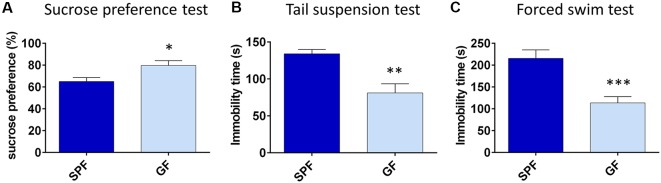
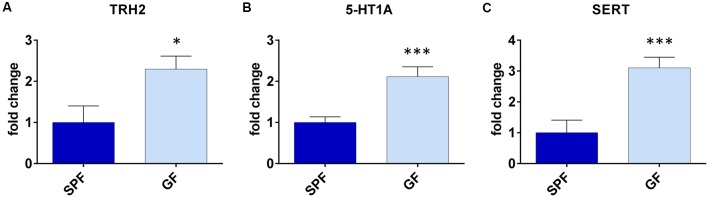
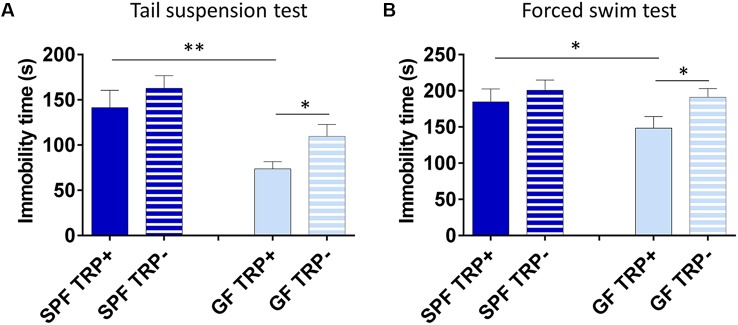
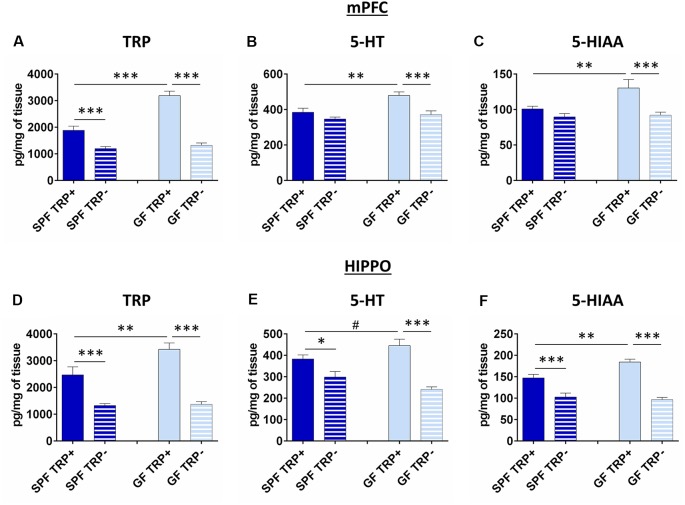
Verification
Claims the paper makes
The claims and statistics of this paper haven’t been checked yet.
Run the check — free, no account needed. It reads the open-access text and checks the sources it cites.
Claims other papers make about this one
Each is checked against this paper’s own text: does it say what the citing paper says it does?
The source backs part of the claim, not all of it — or backs it for a different population, condition or comparison.
In the citing paper
“These changes include increased hippocampal dopamine D1 receptor mRNA levels and decreased dopamine D1 receptor in the striatum and nucleus accumbens, as well as increased serotonin in the blood and hippocampus, with decreased serotonin receptor expression, respectively.”
From Signalling cognition: The gut microbiota and hypothalamic-pituitary-adrenal axis (2023) · cites this paper as [378]
Experimental — accuracy not yet measuredIn the citing paper
“Several metabolomic studies show alterations in the dopamine and serotonin systems (124, 189, 350, 378–380).”
From Signalling cognition: The gut microbiota and hypothalamic-pituitary-adrenal axis (2023) · cites this paper as [378]
In the citing paper
“Additionally, the production of 5-HT can affect peripheral tryptophan availability and, thus, indirectly affect brain 5-HT levels, suggesting that peripheral alterations in 5-HT can affect the central 5-HT signaling system (390, 391).”
From Diet and the Microbiota–Gut–Brain Axis: Sowing the Seeds of Good Mental Health (2021) · cites this paper as [391]
Self-check
Percentages, sums and reported differences re-computed from the paper’s own numbers.
The self-check needs the paper’s full text.
Citations
Cites
Stress and the brain: from adaptation to disease
de Kloet, E. R., Joëls, M., & Holsboer, F. (2005) · Nature Reviews Neuroscience · doi:10.1038/nrn1683 · Cited by 4,621
Indigenous bacteria from the gut microbiota regulate host serotonin biosynthesis
Yano, J. M., Yu, K., Donaldson, G. P., Shastri, G. G., Ann, P., Ma, L., Nagler, C. R., Ismagilov, R. F., Mazmanian, S. K., & Hsiao, E. Y. (2015) · Cell · doi:10.1016/j.cell.2015.02.047 · Cited by 3,614
Normal gut microbiota modulates brain development and behavior
Heijtz, R. D., Wang, S., Anuar, F., Qian, Y., Björkholm, B., Samuelsson, A., Hibberd, M. L., Forssberg, H., & Pettersson, S. (2011) · Proceedings of the National Academy of Sciences · doi:10.1073/pnas.1010529108 · Cited by 3,228
Gut Microbiota Regulation of Tryptophan Metabolism in Health and Disease
Agus, A., Planchais, J., & Sokol, H. (2018) · Cell Host & Microbe · doi:10.1016/j.chom.2018.05.003 · Cited by 3,180 · cited 2×
“TRP, which is an essential amino acid, is mainly supplied from ingested food and is a biosynthetic precursor of a large number of host as well as microbial metabolites (Milligan et al., 1978; Lee and Lee, 2010; Agus et al., 2018).”
BackgroundSudo, N., Chida, Y., Aiba, Y., Sonoda, J., Oyama, N., Yu, X., Kubo, C., & Koga, Y. (2004) · The Journal of Physiology · doi:10.1113/jphysiol.2004.063388 · Cited by 2,735
Metabolomics analysis reveals large effects of gut microflora on mammalian blood metabolites
Wikoff, W. R., Anfora, A. T., Liu, J., Schultz, P. G., Lesley, S. A., Peters, E. C., & Siuzdak, G. (2009) · Proceedings of the National Academy of Sciences · doi:10.1073/pnas.0812874106 · Cited by 2,677
The Epidemiology of Depression Across Cultures
Kessler, R. C., & Bromet, E. J. (2013) · Annual Review of Public Health · doi:10.1146/annurev-publhealth-031912-114409 · Cited by 2,657
Structure and function of the brain serotonin system
Jacobs, B. L., & Azmitia, E. C. (1992) · Physiological Reviews · doi:10.1152/physrev.1992.72.1.165 · Cited by 2,574
Altered fecal microbiota composition in patients with major depressive disorder
Jiang, H., Ling, Z., Zhang, Y., Mao, H., Ma, Z., Yin, Y., Wang, W., Tang, W., Tan, Z., Shi, J., et al. (2015) · Brain, Behavior, and Immunity · doi:10.1016/j.bbi.2015.03.016 · Cited by 2,275
Belmaker, R. H., & Agam, G. (2008) · New England Journal of Medicine · doi:10.1056/nejmra073096 · Cited by 2,166
Zheng, P., Zeng, B., Zhou, C., Liu, M., Fang, Z., Xu, X., Zeng, L., Chen, J., Fan, S., Du, X., et al. (2016) · Molecular Psychiatry · doi:10.1038/mp.2016.44 · Cited by 2,023
Serotonin, tryptophan metabolism and the brain-gut-microbiome axis
O’Mahony, S. M., Clarke, G., Borre, Y. E., Dinan, T. G., & Cryan, J. F. (2015) · Behavioural Brain Research · doi:10.1016/j.bbr.2014.07.027 · Cited by 2,012
The global burden of mental disorders: An update from the WHO World Mental Health (WMH) surveys
Kessler, R. C., Aguilar-Gaxiola, S., Alonso, J., Chatterji, S., Lee, S., Ormel, J., Üstün, T. B., & Wang, P. S. (2009) · Epidemiologia e Psichiatria Sociale · doi:10.1017/s1121189x00001421 · Cited by 1,895
Clarke, G., Grenham, S., Scully, P., Fitzgerald, P., Moloney, R. D., Shanahan, F., Dinan, T. G., & Cryan, J. F. (2013) · Molecular Psychiatry · doi:10.1038/mp.2012.77 · Cited by 1,893
Kelly, J. R., Borre, Y., O' Brien, C., Patterson, E., El Aidy, S., Deane, J., Kennedy, P. J., Beers, S., Scott, K., Moloney, G., et al. (2016) · Journal of Psychiatric Research · doi:10.1016/j.jpsychires.2016.07.019 · Cited by 1,683
Synthesis of Serotonin by a Second Tryptophan Hydroxylase Isoform
Walther, D. J., Peter, J., Bashammakh, S., Hörtnagl, H., Voits, M., Fink, H., & Bäder, M. (2003) · Science · doi:10.1126/science.1078197 · Cited by 1,576
Neufeld, K. M., Kang, N., Bienenstock, J., & Foster, J. A. (2011) · Neurogastroenterology & Motility · doi:10.1111/j.1365-2982.2010.01620.x · Cited by 1,392
Caspi, A., Hariri, A. R., Holmes, A., Uher, R., & Moffitt, T. E. (2010) · American Journal of Psychiatry · doi:10.1176/appi.ajp.2010.09101452 · Cited by 1,346
The Biochemistry of Affective Disorders
Coppen, A. (1967) · British Journal of Psychiatry · doi:10.1192/bjp.113.504.1237 · Cited by 1,230
Indole as an intercellular signal in microbial communities
Lee, J.-H., & Lee, J. (2010) · FEMS Microbiology Reviews · doi:10.1111/j.1574-6976.2009.00204.x · Cited by 1,059
The role of the hippocampus in the pathophysiology of major depression
Campbell, S., & MacQUEEN, G. M. (2004) · Journal of Psychiatry and Neuroscience · doi:10.1139/jpn.0441 · Cited by 891
Ruhé, H. G., Mason, N. S., & Schene, A. H. (2007) · Molecular Psychiatry · doi:10.1038/sj.mp.4001949 · Cited by 861
Lemonde, S., Turecki, G., Bakish, D., Du, L., Hrdina, P. D., Bown, C. D., Sequeira, A., Kushwaha, N., Morris, S. J., Basak, A., et al. (2003) · Journal of Neuroscience · doi:10.1523/jneurosci.23-25-08788.2003 · Cited by 738
Can, A., Dao, D. T., Terrillion, C. E., Piantadosi, S. C., Bhat, S., & Gould, T. D. (2011) · Journal of Visualized Experiments · doi:10.3791/3769 · Cited by 691
Effects of Chronic Fluoxetine in Animal Models of Anxiety and Depression
Dulawa, S. C., Holick, K. A., Gundersen, B., & Hen, R. (2004) · Neuropsychopharmacology · doi:10.1038/sj.npp.1300433 · Cited by 671
Functional anatomical abnormalities in limbic and prefrontal cortical structures in major depression
Drevets, W. C. (2000) · Progress in Brain Research · doi:10.1016/s0079-6123(00)26027-5 · Cited by 659
The Role of Neural Plasticity in Depression: From Hippocampus to Prefrontal Cortex
Liu, W., Ge, T., Leng, Y., Pan, Z., Fan, J., Yang, W., & Cui, R. (2017) · Neural Plasticity · doi:10.1155/2017/6871089 · Cited by 640
Can, A., Dao, D. T., Arad, M., Terrillion, C. E., Piantadosi, S. C., & Gould, T. D. (2011) · Journal of Visualized Experiments · doi:10.3791/3638 · Cited by 628
Tryptophan metabolism in the central nervous system: medical implications
Ruddick, J. P., Evans, A. K., Nutt, D. J., Lightman, S. L., Rook, G. A. W., & Lowry, C. A. (2006) · Expert Reviews in Molecular Medicine · doi:10.1017/s1462399406000068 · Cited by 519
Microbiota and host determinants of behavioural phenotype in maternally separated mice
De Palma, G., Blennerhassett, P., Lu, J., Deng, Y., Park, A. J., Green, W., Denou, E., Silva, M. A., Santacruz, A., Sanz, Y., et al. (2015) · Nature Communications · doi:10.1038/ncomms8735 · Cited by 517
Loss-of-Function Mutation in Tryptophan Hydroxylase-2 Identified in Unipolar Major Depression
Zhang, X., Gainetdinov, R. R., Beaulieu, J.-M., Sotnikova, T. D., Burch, L. H., Williams, R. B., Schwartz, D. A., Krishnan, K. R. R., & Caron, M. G. (2005) · Neuron · doi:10.1016/j.neuron.2004.12.014 · Cited by 473
Merikangas, K. R., Ames, M., Cui, L., Stang, P. E., Ustun, T. B., Von Korff, M., & Kessler, R. C. (2007) · Archives of General Psychiatry · doi:10.1001/archpsyc.64.10.1180 · Cited by 464
Lesch, K.-P., & Waider, J. (2012) · Neuron · doi:10.1016/j.neuron.2012.09.013 · Cited by 435
Serotonergic vulnerability and depression: assumptions, experimental evidence and implications
Jans, L. A. W., Riedel, W. J., Markus, C. R., & Blokland, A. (2006) · Molecular Psychiatry · doi:10.1038/sj.mp.4001920 · Cited by 382
Ashcroft, G. P., Crawford, T. B. B., ECCLESTON, D., Sharman, D. F., Macdougall, E., Stanton, J. B., & Binns, J. K. (1966) · The Lancet · doi:10.1016/s0140-6736(66)92028-9 · Cited by 373
Zill, P., Baghai, T. C., Zwanzger, P., Schüle, C., Eser, D., Rupprecht, R., Möller, H.-J., Bondy, B., & Ackenheil, M. (2004) · Molecular Psychiatry · doi:10.1038/sj.mp.4001525 · Cited by 323
The roles of peripheral serotonin in metabolic homeostasis
El‐Merahbi, R., Löffler, M. C., Mayer, A. E., & Sumara, G. (2015) · FEBS Letters · doi:10.1016/j.febslet.2015.05.054 · Cited by 284
Revisiting the Serotonin Hypothesis: Implications for Major Depressive Disorders
Fakhoury, M. (2015) · Molecular Neurobiology · doi:10.1007/s12035-015-9152-z · Cited by 258
Monoamine depletion in psychiatric and healthy populations: review
Booij, L., van der Does, W. A. J., & Riedel, W. J. (2003) · Molecular Psychiatry · doi:10.1038/sj.mp.4001423 · Cited by 241
Albert, P. R., Benkelfat, C., & Descarries, L. (2012) · Philosophical Transactions of the Royal Society B Biological Sciences · doi:10.1098/rstb.2012.0190 · Cited by 239
Regulation of serotonin synthesis
Boadle‐Biber, M. C. (1993) · Progress in Biophysics and Molecular Biology · doi:10.1016/0079-6107(93)90009-9 · Cited by 224
ACID MONOAMINE METABOLITES OF CEREBROSPINAL FLUID IN MENTAL DEPRESSION AND MANIA
Dencker, S. J., Malm, U., Roos, B. E., & Werdinius, B. (1966) · Journal of Neurochemistry · doi:10.1111/j.1471-4159.1966.tb04320.x · Cited by 218
Decreased plasma tryptophan levels in major depression
Cowen, P. J., Parry‐Billings, M., & Newsholme, E. A. (1989) · Journal of Affective Disorders · doi:10.1016/0165-0327(89)90051-7 · Cited by 160
Hoefgen, B., Schulze, T. G., Ohlraun, S., von Widdern, O., Höfels, S., Groß, M., Heidmann, V., Kovalenko, S., Eckermann, A., Kölsch, H., et al. (2005) · Biological Psychiatry · doi:10.1016/j.biopsych.2004.11.027 · Cited by 159
Excess risk of chronic physical conditions associated with depression and anxiety
Bhattacharya, R., Shen, C., & Sambamoorthi, U. (2014) · BMC Psychiatry · doi:10.1186/1471-244x-14-10 · Cited by 148
Roshchina, V. V. (2016) · Advances in Experimental Medicine and Biology · doi:10.1007/978-3-319-20215-0_2 · Cited by 143
Mechanism of acute tryptophan depletion: is it only serotonin?
van Donkelaar, E. L., Blokland, A., Ferrington, L., Kelly, P. A. T., Steinbusch, H. W. M., & Prickaerts, J. (2011) · Molecular Psychiatry · doi:10.1038/mp.2011.9 · Cited by 125
Blokland, A., Lieben, C. K. J., & Deutz, N. E. P. (2002) · Journal of Psychopharmacology · doi:10.1177/026988110201600112 · Cited by 114
Neurotransmitter Transporters: Molecular Biology, Function, and Regulation
Borowsky, B., & Hoffman, B. J. (1995) · International review of neurobiology · doi:10.1016/s0074-7742(08)60526-7 · Cited by 100
Localization of norepinephrine and serotonin transporter in mouse brain capillary endothelial cells
Wakayama, K., Ohtsuki, S., Takanaga, H., Hosoya, K., & Terasaki, T. (2002) · Neuroscience Research · doi:10.1016/s0168-0102(02)00120-7 · Cited by 88
Caspi, A., Hariri, A. R., Holmes, A., Uher, R., & Moffitt, T. E. (2010) · FOCUS The Journal of Lifelong Learning in Psychiatry · doi:10.1176/foc.8.3.foc398 · Cited by 79
Absence of gut microbiota influences lipopolysaccharide-induced behavioral changes in mice
Campos, A. C., Rocha, N. P., Nicoli, J. R., Vieira, L. Q., Teixeira, M. M., & Teixeira, A. L. (2016) · Behavioural Brain Research · doi:10.1016/j.bbr.2016.06.027 · Cited by 78
Biskup, C. S., Sánchez, C. L., Arrant, A. E., Swearingen, A. E. D. V., Kuhn, C. M., & Zepf, F. D. (2012) · PLoS ONE · doi:10.1371/journal.pone.0035916 · Cited by 72
Brust, P., Friedrich, A., Krizbai, I. A., Bergmann, R., Roux, F. S., Ganapathy, V., & Johannsen, B. (2000) · Journal of Neurochemistry · doi:10.1046/j.1471-4159.2000.741241.x · Cited by 55
Growth and Amino Acid Requirements of Various Strains of Group B Streptococci
Milligan, T. W., Doran, T., Straus, D. C., & Mattingly, S. J. (1978) · Journal of Clinical Microbiology · doi:10.1128/jcm.7.1.28-33.1978 · Cited by 50
Brain Serotonin Content: Physiological Regulation by Plasma Neutral Amino Acids
Fernstrom, J. D., & Wurtman, R. J. (1997) · Obesity Research · doi:10.1002/j.1550-8528.1997.tb00567.x · Cited by 49
Jans, L. A. W., Korte-Bouws, G. A. H., Korte, S. M., & Blokland, A. (2008) · Journal of Psychopharmacology · doi:10.1177/0269881108099424 · Cited by 45
van Donkelaar, E. L., Blokland, A., Lieben, C. K., Kenis, G., Ferrington, L., Kelly, P. A. T., Steinbusch, H. W. M., & Prickaerts, J. (2009) · Neurochemistry International · doi:10.1016/j.neuint.2009.08.010 · Cited by 29
Evolution of tryptophan biosynthetic pathway in microbial genomes: a comparative genetic study
Priya, V. K., Sarkar, S., & Sinha, S. (2013) · Systems and Synthetic Biology · doi:10.1007/s11693-013-9127-1 · Cited by 28
Research works printed but not linked: 1
- Yamaguchi, 1981, Demonstration of tryptophan 5-monooxygenase activity in human-brain by highly sensitive high-performance liquid-chromatography with fluorometric detection, Biochem. Int., 2, 295
Cited by
Sorted by citations
Tryptophan Metabolism: A Link Between the Gut Microbiota and Brain
Gao, K., Mu, C.-L., Farzi, A., & Zhu, W.-Y. (2020) · Advances in Nutrition · doi:10.1093/advances/nmz127 · Cited by 1,029
Diet and depression: Exploring the biological mechanisms of action
Marx, W., Lane, M., Hockey, M., Aslam, H., Berk, M., Walder, K., Borsini, A., Firth, J., Pariante, C. M., Berding, K., et al. (2021) · Molecular Psychiatry · doi:10.1038/s41380-020-00925-x · Cited by 685
Diet and the Microbiota–Gut–Brain Axis: Sowing the Seeds of Good Mental Health
Berding, K., Vlckova, K., Marx, W., Schellekens, H., Stanton, C., Clarke, G., Jacka, F., Dinan, T. G., & Cryan, J. F. (2021) · Advances in Nutrition · doi:10.1093/advances/nmaa181 · Cited by 451
Signalling cognition: The gut microbiota and hypothalamic-pituitary-adrenal axis
Rusch, J. A., Layden, B. T., & Dugas, L. R. (2023) · Frontiers in Endocrinology · doi:10.3389/fendo.2023.1130689 · Cited by 415
Gut microbial molecules in behavioural and neurodegenerative conditions
Needham, B. D., Kaddurah-Daouk, R., & Mazmanian, S. K. (2020) · Nature Reviews Neuroscience · doi:10.1038/s41583-020-00381-0 · Cited by 379
Metadata
- Authors
- Lukić, I., Getselter, D., Koren, O., & Elliott, E.
- Affiliations
- Bar-Ilan University (IL)
- Corresponding author
- Elliott, Evan
- Venue
- Frontiers in Behavioral Neuroscience
- Publisher
- Frontiers Media SA
- Published
- 2019-06-04
- Volume
- 13
- Pages
- 123-123
- ISSN
- 1662-5153 (ISSN-L)
- PMC
- PMC6558209
- OpenAlex
- W2948144072
- Cited by
- 102
- References
- 59
- Citations by year
- 2026: 4 · 2025: 11 · 2024: 29 · 2023: 16 · 2022: 15 · 2021: 12 · 2020: 11 · 2019: 4
- FWCI
- 3.44
- Type
- journal article
- Language
- en
- Open access
- gold
- doi.org
- Licence
- Locations
- Frontiers in Behavioral Neuroscience (publishedVersion, cc-by)
- Europe PMC (PubMed Central) (publishedVersion, cc-by)
- PubMed Central (publishedVersion, cc-by)
- PubMed (publishedVersion)
- DOAJ (DOAJ: Directory of Open Access Journals) (submittedVersion, cc-by-sa)
- Funders
- Israel Science Foundation
- Teva Pharmaceutical Industries
- Topics
- Life Sciences › Neuroscience › Biological Psychiatry › Tryptophan and brain disorders
- Life Sciences › Biochemistry, Genetics and Molecular Biology › Molecular Biology › Gut microbiota and health
- Life Sciences › Neuroscience › Cellular and Molecular Neuroscience › Neurotransmitter Receptor Influence on Behavior
- Keywords
- gut microbiota, depression-like behavior, tryptophan, serotonin, acute tryptophan depletion, germ-free mice, serotonergic system, 5-hydroxyindoleacetic acid, medial prefrontal cortex, hippocampus, depression
About these checks
Registry, retraction, Cites and statistics results are computed, not judged, with one exception: a printed reference that no index lists is read once by a model before it counts as a citation error. Claims are extracted by a model and kept only when their quote appears verbatim in the text; each cited source is then checked, with a model’s help, for whether it says what the claim relies on. Those verdicts can be wrong — read the claim’s quote and the cited source before relying on one.
Statistics and arithmetic are recomputed, not judged.
Confidence bands are shown only for fields calibrated on our annotated test set. None is calibrated yet, so no band is shown.
What counts as a claim ›How we measure confidence ›How we check this ›
Are you an author, or do you see a problem with this page? Request a review
