

The DOI matches its Crossref record; 152 of the 153 references it cites were found in a registry or an index.
Exploring Braak’s Hypothesis of Parkinson’s Disease
Open accessAbstract
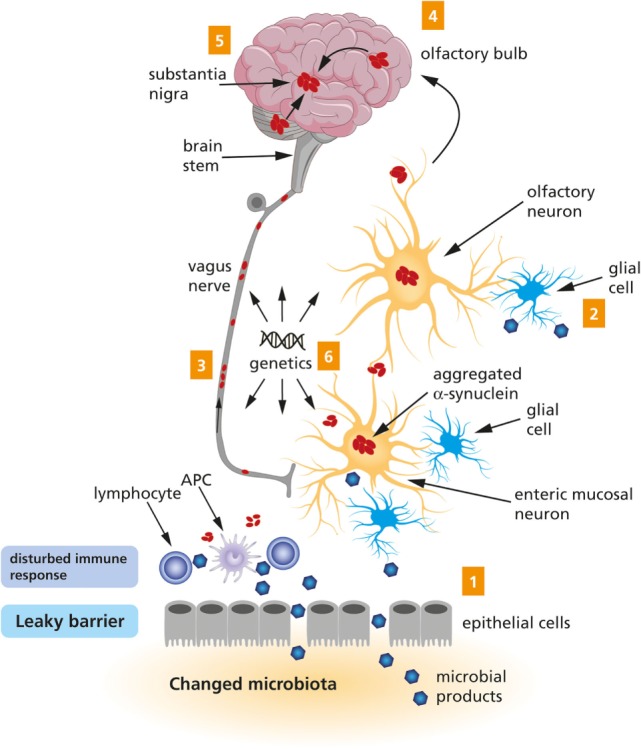
Parkinson’s disease (PD) is a neurodegenerative disorder for which there is no cure. Most patients suffer from sporadic PD, which is likely caused by a combination of genetic and environmental factors. Braak’s hypothesis states that sporadic PD is caused by a pathogen that enters the body via the nasal cavity, and subsequently is swallowed and reaches the gut, initiating Lewy pathology (LP) in the nose and the digestive tract. A staging system describing the spread of LP from the peripheral to the central nervous system was also postulated by the same research group. There has been criticism to the Braak’s hypothesis, in part because not all patients follow the proposed staging system. Here, we review literature that either supports or criticizes the Braak’s hypothesis, focused on the enteric route, digestive problems in patients, the spread of LP on a tissue and a cellular level, and the toxicity of the protein αSynuclein (αSyn), which is the major constituent of LP. We conclude that the Braak’s hypothesis is supported by in vitro, in vivo and clinical evidence. However, we also conclude that the staging system of Braak only describes a specific subset of patients with young onset and long duration of the disease.
Overview
The claims and statistics of this paper haven’t been checked yet.
Run the check — free, no account needed. It reads the open-access text and checks the sources it cites.
Integrity signals
Registry
Cites
Statistics
Figures
Verification
Claims the paper makes
The claims and statistics of this paper haven’t been checked yet.
Run the check — free, no account needed. It reads the open-access text and checks the sources it cites.
Claims other papers make about this one
Each is checked against this paper’s own text: does it say what the citing paper says it does?
The source backs part of the claim, not all of it — or backs it for a different population, condition or comparison.
In the citing paper
“GI symptoms may predate motor features by years, consistent with the concept that α-synuclein pathology can involve the ENS and vagal/brainstem autonomic nuclei early in disease (Rietdijk et al., 2017; Travagli et al., 2020).”
From Autonomic nervous system and gastrointestinal manifestations with an emphasis on gastric dysfunction (2026) · cites this paper as Rietdijk et al., 2017
Experimental — accuracy not yet measured
Self-check
Percentages, sums and reported differences re-computed from the paper’s own numbers.
The self-check needs the paper’s full text.
Citations
Cites
Staging of brain pathology related to sporadic Parkinson’s disease
Braak, H., Tredici, K. D., Rüb, U., de Vos, R. A. I., Jansen Steur, E. N. H., & Braak, E. (2003) · Neurobiology of Aging · doi:10.1016/s0197-4580(02)00065-9 · Cited by 10,777
Mutation in the α-Synuclein Gene Identified in Families with Parkinson's Disease
Polymeropoulos, M. H., Lavedan, C., Leroy, E., Ide, S. E., Dehejia, A., Dutra, A., Pike, B., Root, H., Rubenstein, J., Boyer, R., et al. (1997) · Science · doi:10.1126/science.276.5321.2045 · Cited by 8,240
De Filippo, C., Cavalieri, D., Di Paola, M., Ramazzotti, M., Poullet, J. B., Massart, S., Collini, S., Pieraccini, G., & Lionetti, P. (2010) · Proceedings of the National Academy of Sciences · doi:10.1073/pnas.1005963107 · Cited by 5,579
Chronic Parkinsonism in Humans Due to a Product of Meperidine-Analog Synthesis
Langston, J. W., Ballard, P., Tetrud, J. W., & Irwin, I. (1983) · Science · doi:10.1126/science.6823561 · Cited by 4,914
α-Synuclein Locus Triplication Causes Parkinson's Disease
Singleton, A. B., Farrer, M., Johnson, J., Singleton, A., Hague, S., Kachergus, J., Hulihan, M., Peuralinna, T., Dutra, A., Nussbaum, R., et al. (2003) · Science · doi:10.1126/science.1090278 · Cited by 4,383
AlaSOPro mutation in the gene encoding α-synuclein in Parkinson's disease
Krüger, R., Kuhn, W., Müller, T., Woitalla, D., Graeber, M., Kösel, S., Przuntek, H., Epplen, J. T., Schols, L., & Riess, O. (1998) · Nature Genetics · doi:10.1038/ng0298-106 · Cited by 3,836
The Effect of Diet on the Human Gut Microbiome: A Metagenomic Analysis in Humanized Gnotobiotic Mice
Turnbaugh, P. J., Ridaura, V. K., Faith, J. J., Rey, F. E., Knight, R., & Gordon, J. I. (2009) · Science Translational Medicine · doi:10.1126/scitranslmed.3000322 · Cited by 3,058 · cited 1×
“Dietary components and dietary patterns have a considerable effect on the composition of the gut microbiome (66).”
BackgroundThe new mutation, E46K, of α‐synuclein causes parkinson and Lewy body dementia
Zarranz, J. J., Alegre, J., Gómez‐Esteban, J. C., Lezcano, E., Ros, R., Ampuero, I., Vidal, L., Hoenicka, J., Rodriguez, O., Atarés, B., et al. (2004) · Annals of Neurology · doi:10.1002/ana.10795 · Cited by 2,737
Luk, K. C., Kehm, V., Carroll, J., Zhang, B., O’Brien, P., Trojanowski, J. Q., & Lee, V. M.-Y. (2012) · Science · doi:10.1126/science.1227157 · Cited by 2,563
Singh, N., Gurav, A., Sivaprakasam, S., Brady, E., Padia, R., Shi, H., Thangaraju, M., Prasad, P. D., Manicassamy, S., Munn, D. H., et al. (2014) · Immunity · doi:10.1016/j.immuni.2013.12.007 · Cited by 2,368
Research works printed but not linked: 1
- Piccini, 1999, The role of inheritance in sporadic Parkinson’s disease: evidence from a longitudinal study of dopaminergic function in twins, Ann Neurol, 45, 577, 10.1002/1531-8249(199905)45:5577::AID-ANA53.0.CO;2-O · DOI
Cited by
Sorted by citations
Microbiota-Brain-Gut Axis and Neurodegenerative Diseases
Quigley, E. M. M. (2017) · Current Neurology and Neuroscience Reports · doi:10.1007/s11910-017-0802-6 · Cited by 804
The anatomical basis for transcutaneous auricular vagus nerve stimulation
Butt, M. F., Albusoda, A., Farmer, A. D., & Aziz, Q. (2019) · Journal of Anatomy · doi:10.1111/joa.13122 · Cited by 616
“…are selectively vulnerable to the early pathophysiological processes of Alzheimer’s (Parvizi et al. 2001) and Parkinson’s diseases (Braak et al. 2003; Rietdijk et al. 2017), thus a method to assess the function of vagal nuclei, potentially by employing tVNS, may be used to detect these…”
MethodThe genetics of Parkinson disease
Deng, H., Wang, P., & Jankovic, J. (2018) · Ageing Research Reviews · doi:10.1016/j.arr.2017.12.007 · Cited by 530
“the Braak hypothesis has been criticized by some scientists (Rietdijk et al., 2017).”
BackgroundMaiti, P., Manna, J., & Dunbar, G. L. (2017) · Translational Neurodegeneration · doi:10.1186/s40035-017-0099-z · Cited by 557
“According to Braak’s hypothesis, SNCA, bacteria, or viruses can travel via the olfactory tract and into the Vegas nerve to the medala and spread throughout the CNS, which can responsible initiate sporadic PD [155].”
BackgroundMicrobiome–microglia connections via the gut–brain axis
Abdel-Haq, R., Schlachetzki, J. C. M., Glass, C. K., & Mazmanian, S. K. (2019) · Journal of Experimental Medicine · doi:10.1084/jem.20180794 · Cited by 471
Parkinson disease and the immune system - Associations, mechanisms and therapeutics
Tan, E.-K., Chao, Y.-X., West, A., Chan, L.-L., Poewe, W., & Jankovic, J. (2020) · Nature Reviews Neurology · doi:10.1038/s41582-020-0344-4 · Cited by 457
Microglia, Lifestyle Stress, and Neurodegeneration
Madore, C., Yin, Z., Leibowitz, J. A., & Butovsky, O. (2020) · Immunity · doi:10.1016/j.immuni.2019.12.003 · Cited by 313
“One hypothesis contends that sporadic PD begins in the gut by α-synuclein aggregation, spreading via the vagus nerve (Braak et al., 2004; Rietdijk et al., 2017).”
BackgroundThe Association Between the Gut Microbiota and Parkinson’s Disease, a Meta-Analysis
Shen, T., Yue, Y., He, T., Huang, C., Qu, B., Lv, W., & Lai, H.-Y. (2021) · Frontiers in Aging Neuroscience · doi:10.3389/fnagi.2021.636545 · Cited by 219
“, 2003), leading to the formation of LBs and spreading from the enteric nervous system (ENS) to the central nervous system (CNS) through the vagus nerve (Rietdijk et al., 2017).”
BackgroundGastrointestinal motility disorders in neurologic disease
Camilleri, M. (2021) · Journal of Clinical Investigation · doi:10.1172/jci143771 · Cited by 211
“In accordance with the Braak hypothesis (25) that a pathogen reaching the gut initiates pathology that spreads to the CNS in Parkinson disease, neuropathologic studies showed accumulation of abnormal inclusions containing α -sy- nuclein (Lewy neurites) in the ENS, dorsal motor nucleus of the vagus…”
Probiotic Bacillus subtilis protects against α-synuclein aggregation in C. elegans
Goya, M. E., Xue, F., Sampedro-Torres-Quevedo, C., Arnaouteli, S., Riquelme-Dominguez, L., Romanowski, A., Brydon, J., Ball, K. L., Stanley-Wall, N. R., & Doitsidou, M. (2020) · Cell Reports · doi:10.1016/j.celrep.2019.12.078 · Cited by 205
“This is supported by observations that PD symptoms and a-syn pathology begin in peripheral tissues, particularly the intestine, and as the disease progresses, a-syn aggregates gradually spread to multiple brain regions (Braak et al., 2003; Rietdijk et al., 2017).”
BackgroundWang, L., Zhao, Z., Zhao, L., Zhao, Y., Yang, G., Wang, C., Gao, L., Niu, C., & Li, S. (2022) · Journal of Agricultural and Food Chemistry · doi:10.1021/acs.jafc.1c07711 · Cited by 203
The microbiome-gut-brain axis in acute and chronic brain diseases
Benakis, C., Martin‐Gallausiaux, C., Trezzi, J., Melton, P., Liesz, A., & Wilmes, P. (2019) · Current Opinion in Neurobiology · doi:10.1016/j.conb.2019.11.009 · Cited by 189
“Braak et al. proposed the ‘dual-hit hypothesis’, postulating that a pathogen or a toxin may initiate PD pathogenesis by promoting SNCA aggregation [46].”
Effect of ultra-processed diet on gut microbiota and thus its role in neurodegenerative diseases
Leo, E. E. M., & Campos, M. R. S. (2019) · Nutrition · doi:10.1016/j.nut.2019.110609 · Cited by 196
Gut Microbiota: A Novel Therapeutic Target for Parkinson’s Disease
Zhu, M., Liu, X., Ye, Y., Yan, X., Cheng, Y., Zhao, L., Chen, F., & Ling, Z. (2022) · Frontiers in Immunology · doi:10.3389/fimmu.2022.937555 · Cited by 177
The emerging role of α-synuclein truncation in aggregation and disease
Sorrentino, Z. A., & Giasson, B. I. (2020) · Journal of Biological Chemistry · doi:10.1074/jbc.rev120.011743 · Cited by 184
“for truncated humana-synuclein(1-120): implications for Lewy body dis-”
BackgroundParkinson’s Disease and the Gastrointestinal Microbiome
Lubomski, M., Tan, A. H., Lim, S.-Y., Holmes, A. J., Davis, R. L., & Sue, C. M. (2020) · Journal of Neurology · doi:10.1007/s00415-019-09320-1 · Cited by 172
“It is predominantly associated with the irreversible degeneration of dopaminergic neurons in the substantia nigra and other brain regions [4], often characterised by widespread Lewy body (LB) formation in the central and peripheral nervous systems.”
BackgroundBiological links between traumatic brain injury and Parkinson’s disease
Delic, V., Beck, K. D., Pang, K. C. H., & Citron, B. A. (2020) · Acta Neuropathologica Communications · doi:10.1186/s40478-020-00924-7 · Cited by 165
Koszła, O., & Sołek, P. (2024) · Cell Communication and Signaling · doi:10.1186/s12964-024-01791-8 · Cited by 164
“Finally, in the sixth stage, the disease encompasses the entire neocortex, leading to the most severe manifestations of the disorder [54, 56].”
BackgroundLis, P., Burel, S., Steger, M., Mann, M., Brown, F., Diez, F., Tonelli, F., Holton, J. L., Ho, P. W., Ho, S.-L., et al. (2018) · Biochemical Journal · doi:10.1042/bcj20170802 · Cited by 151
“Furthermore, even though Parkinson ’ s disease is mainly characterised by degeneration of dopaminergic neurones in substantia nigra, other regions of the brain, including the cingulate cortex, are affected by the disease and are therefore interesting to study [31].”
BackgroundIs Braak staging valid for all types of Parkinson’s disease?
Jellinger, K. A. (2018) · Journal of Neural Transmission · doi:10.1007/s00702-018-1898-9 · Cited by 135
Effects of oligomer toxicity, fibril toxicity and fibril spreading in synucleinopathies
Cascella, R., Bigi, A., Cremades, N., & Cecchi, C. (2022) · Cellular and Molecular Life Sciences · doi:10.1007/s00018-022-04166-9 · Cited by 130
“Braak staging of PD is supported in vitro, in vivo, and by the vast majority of clinical cases, in particular those with early onset and longest disease duration [176].”
Backgroundα-Synuclein in Parkinson’s disease: causal or bystander?
Riederer, P. F., Berg, D., Casadei, N., Cheng, F., Claßen, J., Dresel, C., Jost, W. H., Krüger, R., Müller, T. H., Reichmann, H., et al. (2019) · Journal of Neural Transmission · doi:10.1007/s00702-019-02025-9 · Cited by 122
The Gut-Brain Axis: Two Ways Signaling in Parkinson’s Disease
Dogra, N., Mani, R. J., & Katare, D. P. (2021) · Cellular and Molecular Neurobiology · doi:10.1007/s10571-021-01066-7 · Cited by 121
Gut Vibes in Parkinson's Disease: The Microbiota‐Gut‐Brain Axis
Bullich‐Vilarrubias, C., Keshavarzian, A., Garssen, J., Kraneveld, A. D., & Perez‐Pardo, P. (2019) · Movement Disorders Clinical Practice · doi:10.1002/mdc3.12840 · Cited by 120
Self-citationGut microbiome and Parkinson's disease: Perspective on pathogenesis and treatment
Salim, S., Ahmad, F. A., Banu, A., & Mohammad, F. (2022) · Journal of Advanced Research · doi:10.1016/j.jare.2022.10.013 · Cited by 124
“Similarly, bilateral injection of 6-ODHA near SNpc in rats caused an elevation in the colonic and inflammatory markers levels and a decrease in acetylcholine levels, which normally enhances gut motility [45].”
InfluentialGlymphatic System as a Gateway to Connect Neurodegeneration From Periphery to CNS
Natale, G., Limanaqi, F., Busceti, C. L., Mastroiacovo, F., Nicoletti, F., Puglisi‐Allegra, S., & Fornai, F. (2021) · Frontiers in Neuroscience · doi:10.3389/fnins.2021.639140 · Cited by 116
Structural and Functional Insights into α-Synuclein Fibril Polymorphism
Mehra, S., Gadhe, L. G., Bera, R., Sawner, A. S., & Maji, S. K. (2021) · Biomolecules · doi:10.3390/biom11101419 · Cited by 111
Zhang, J. (2022) · npj Parkinson s Disease · doi:10.1038/s41531-021-00266-8 · Cited by 109
“It has been demonstrated that the performance of machine-learning-based computer-aided diagnostic (CAD) system generally exceeded that of semi-quantitative analysis on SPECT imaging in distinguishing PD patients from healthy controls 12,16 and improved PD diagnostic accuracy of radiologists 17 .”
BackgroundCurrent Treatments and New, Tentative Therapies for Parkinson’s Disease
Pardo-Moreno, T., García‐Morales, V., Suleiman‐Martos, N., Rivas-Domínguez, A., Mohamed-Mohamed, H., Ramos‐Rodríguez, J. J., Melguizo‐Rodríguez, L., & González‐Acedo, A. (2023) · Pharmaceutics · doi:10.3390/pharmaceutics15030770 · Cited by 116
Potential roles of gut microbiota and microbial metabolites in Parkinson’s disease
Zheng, S.-Y., Li, H.-X., Xu, R.-C., Miao, W.-T., Dai, M.-Y., Ding, S.-T., & Liu, H.-D. (2021) · Ageing Research Reviews · doi:10.1016/j.arr.2021.101347 · Cited by 101
Dumitrescu, L., Marta, D., Dănău, A., Lefter, A., Tulbă, D., Cozma, L., Manole, E., Gherghiceanu, M., Ceafalan, L. C., & Popescu, B. O. (2021) · Frontiers in Neuroscience · doi:10.3389/fnins.2021.689723 · Cited by 100
The Gut Microbiome Feelings of the Brain: A Perspective for Non-Microbiologists
Lerner, A., Neidhöfer, S., & Matthias, T. (2017) · Microorganisms · doi:10.3390/microorganisms5040066 · Cited by 97
Diagnostic biomarkers for Parkinson’s disease at a glance: where are we?
Cova, I., & Priori, A. (2018) · Journal of Neural Transmission · doi:10.1007/s00702-018-1910-4 · Cited by 97
Savitt, D., & Jankovic, J. J. (2019) · Drugs · doi:10.1007/s40265-019-01104-1 · Cited by 93
“Additionally, up to a third of PD patients do not show Lewy pathology in the gastrointestinal tract and the hypothesis also does not explain the early involvement of cardiac sympathetic nerves [62, 67].”
BackgroundUpdate on neurological manifestations of COVID-19
Yavarpour‐Bali, H., & Ghasemi‐Kasman, M. (2020) · Life Sciences · doi:10.1016/j.lfs.2020.118063 · Cited by 91
Sorrentino, Z. A., Goodwin, M. S., Riffe, C. J., Dhillon, J.-K. S., Xia, Y., Gorion, K.-M. M., Vijayaraghavan, N., McFarland, K. N., Golbe, L. I., Yachnis, A. T., et al. (2019) · Acta Neuropathologica Communications · doi:10.1186/s40478-019-0787-2 · Cited by 86
Neuroinflammation and Its Impact on the Pathogenesis of COVID-19
Almutairi, M. M., Sivandzade, F., Albekairi, T. H., Alqahtani, F., & Cucullo, L. (2021) · Frontiers in Medicine · doi:10.3389/fmed.2021.745789 · Cited by 92
“Other possibilities for the virus entry into the brain include trafficking through the BBB using leukocytes as carriers or viral neuroinvasion through the GI tract (165, 167, 168).”
BackgroundO’Donovan, S. M., Crowley, E. K., Brown, J. R. ‐., O’Sullivan, O., O’Leary, O. F., Timmons, S., Nolan, Y. M., Clarke, D. J., Hyland, N. P., Joyce, S. A., et al. (2020) · Neurogastroenterology & Motility · doi:10.1111/nmo.13726 · Cited by 86
Richards, P., Thornberry, N. A., & Pinto, S. (2021) · Molecular Metabolism · doi:10.1016/j.molmet.2021.101175 · Cited by 89
Proposal for a Biologic Staging System of Parkinson’s Disease
Chahine, L. M., Merchant, K., Siderowf, A. D., Sherer, T., Tanner, C. M., MAREK, K. L., & Simuni, T. (2023) · Journal of Parkinson s Disease · doi:10.3233/jpd-225111 · Cited by 86
Animal models of Parkinson’s disease: a guide to selecting the optimal model for your research
Lama, J., Buhidma, Y., Fletcher, E. J. R., & Duty, S. (2021) · Neuronal Signaling · doi:10.1042/ns20210026 · Cited by 93
SARS-CoV-2: is there neuroinvasion?
McQuaid, C., Brady, M., & Deane, R. (2021) · Fluids and Barriers of the CNS · doi:10.1186/s12987-021-00267-y · Cited by 72
Clinical implications of gastric complications on levodopa treatment in Parkinson’s disease
Pfeiffer, R. F., Isaacson, S. H., & Pahwa, R. (2020) · Parkinsonism & Related Disorders · doi:10.1016/j.parkreldis.2020.05.001 · Cited by 77
Epidemiology of Parkinson’s Disease: An Update
Deliz, J. R., Tanner, C. M., & González-Latapí, P. (2024) · Current Neurology and Neuroscience Reports · doi:10.1007/s11910-024-01339-w · Cited by 72
“Evidence demonstrating neuro-pathological changes in olfactory neurons and the vagus nerve have previously raised the hypothesis that the natural progression of PD may start from peripheral sites and from there spread to the CNS [162, 163].”
Gut, Microbiome, and Brain Regulatory Axis: Relevance to Neurodegenerative and Psychiatric Disorders
Stefano, G. B., Pilonis, N., Ptáček, R., Raboch, J., Vňuková, M., & Kream, R. M. (2018) · Cellular and Molecular Neurobiology · doi:10.1007/s10571-018-0589-2 · Cited by 74
“2011; Zhou and Foster 2015) and dysbiosis of the human gut microbiota has been functionally associated with central nervous system (CNS) degenerative disorders that include PD (Bedarf et al. 2017; Devos et al. 2013; Forsyth et al. 2011; Malkki 2017; Mulak and Bonaz 2015; Rietdijk et al. 2017; Scheperjans et al. 2015),…”
Descriptive Epidemiology of Neurodegenerative Diseases: What Are the Critical Questions?
Logroscino, G., Urso, D., & Savica, R. (2022) · Neuroepidemiology · doi:10.1159/000525639 · Cited by 79
Early constipation predicts faster dementia onset in Parkinson’s disease
Camacho, M., Macleod, A. D., Maple‐Grødem, J., Evans, J., Breen, D. P., Cummins, G. A., Wijeyekoon, R., Greenland, J. C., Alves, G. W., Tysnes, O., et al. (2021) · npj Parkinson s Disease · doi:10.1038/s41531-021-00191-w · Cited by 71
Riederer, P. F., Nagatsu, T., Youdim, M. B. H., Wulf, M., Dijkstra, J. M., & Sian‐Hülsmann, J. (2023) · Journal of Neural Transmission · doi:10.1007/s00702-023-02630-9 · Cited by 71
The Hidden Cell-to-Cell Trail of α-Synuclein Aggregates
Neupane, S., Cecco, E. D., & Aguzzi, A. (2022) · Journal of Molecular Biology · doi:10.1016/j.jmb.2022.167930 · Cited by 69
Serratos, I. N., Hernández‐Pérez, E., Campos, C., Aschner, M., & Santamarı́a, A. (2021) · Molecular Neurobiology · doi:10.1007/s12035-021-02596-3 · Cited by 70
Neuroinflammation in neurodegeneration via microbial infections
Tran, V. T. A., Lee, L. P., & Cho, H. (2022) · Frontiers in Immunology · doi:10.3389/fimmu.2022.907804 · Cited by 72
Cruz, B. G. S., Husch, A., & Hertel, F. (2023) · Frontiers in Aging Neuroscience · doi:10.3389/fnagi.2023.1216163 · Cited by 75
“One of the most widely accepted frameworks to describe the spread of sporadic PD is Braak’s hypothesis, which suggests that PD progresses through six different stages, gradually evolving from the lower brain stem to the neocortex (Rietdijk et al., 2017).”
BackgroundParkinson’s Disease and the Gut: Symptoms, Nutrition, and Microbiota
Yemula, N., Dietrich, C. M., Dostal, V., & Hornberger, M. (2021) · Journal of Parkinson s Disease · doi:10.3233/jpd-212707 · Cited by 71
“109 A fundamental aspect of Braak’s theory is the 110 movement of alpha-synuclein from the enteric ner111 vous system (ENS) to the CNS via the vagus nerve 112 and dorsal motor nucleus of vagus within the medulla 113 oblongata [17].”
BackgroundInflammation as common link to progressive neurological diseases
Dias-Carvalho, A., Sá, S. I., Carvalho, F., Fernandes, E., & Costa, V. M. (2024) · Archives of Toxicology · doi:10.1007/s00204-023-03628-8 · Cited by 60
“From there, the misfolded α-synuclein aggregates and spreads toward the CNS via the olfactory tract or the vagal nerve (Rietdijk et al. 2017).”
BackgroundAre We What We Eat? Impact of Diet on the Gut–Brain Axis in Parkinson’s Disease
Alfonsetti, M., Castelli, V., & d’Angelo, M. (2022) · Nutrients · doi:10.3390/nu14020380 · Cited by 61
Locus coeruleus neurons are most sensitive to chronic neuroinflammation-induced neurodegeneration
Wang, Q., Oyarzabal, E. A., Song, S., Wilson, B. C., Santos, J. H., & Hong, J. (2020) · Brain Behavior and Immunity · doi:10.1016/j.bbi.2020.01.003 · Cited by 59
“…stress; Mitochondria; Neuroinflammation; Vulnerability Introduction Progressive pathological staging and degeneration in Parkinson’s disease (PD) occur along a caudo-rostral axis, especially for patients with young onset and long duration of the disease (Braak et al., 2003; Rietdijk et al., 2017).”
BackgroundPathological and Therapeutic Advances in Parkinson’s Disease: Mitochondria in the Interplay
Naren, P., Cholkar, A., Kamble, S., Khan, S. S., Srivastava, S., Madan, J., Mehra, N. K., Tiwari, V., Singh, S. B., & Khatri, D. K. (2022) · Journal of Alzheimer s Disease · doi:10.3233/jad-220682 · Cited by 60
“The symptomatology-based staging of disease progression as per Braak’s observation states that at early stage (stages 1 and 2- involving lewy neurite formation in lower brain stem and medulla oblangata) the non-motor symptoms are noted in clinical cases while the motor symptoms are visible at intermediate stage (stage…”
MethodPark, J. M., Lee, S. C., Ham, C., & Kim, Y. W. (2023) · Gut Pathogens · doi:10.1186/s13099-023-00536-1 · Cited by 59
“According to Braak’s hypothesis, pathogens enter the oral and nasal cavities and initiate the formation of Lewy bodies, resulting in sporadic PD [39].”
BackgroundKarnik, M., Beeraka, N. M., Uthaiah, C. A., Nataraj, S. M., Bettadapura, A. D. S., Aliev, G., & Madhunapantula, S. V. (2021) · Molecular Neurobiology · doi:10.1007/s12035-021-02399-6 · Cited by 56
Dissecting the Relationship Between Neuropsychiatric and Neurodegenerative Disorders
Gupta, R. V., Advani, D., Yadav, D., Ambasta, R. K., & Kumar, P. (2023) · Molecular Neurobiology · doi:10.1007/s12035-023-03502-9 · Cited by 61
“Moreover, according to Braak’s hypothesis, sporadic PD is caused by a bunch of pathogens that enter the body through the nasal cavity and reaches the gut that ultimately initiates Lewy pathology in the nose and digestive tract, and thus, demonstrates the potential relationship between gut microbiota and PD progression…”
BackgroundJellinger, K. A. (2019) · Journal of Neural Transmission · doi:10.1007/s00702-019-02028-6 · Cited by 58
Deshayes, N., Arkan, S., & Hansen, C. (2019) · International Journal of Molecular Sciences · doi:10.3390/ijms20184495 · Cited by 54
Choudhury, S. P., Bano, S., Sen, S., Suchal, K., Kumar, S., Nikolajeff, F., Dey, S. K., & Sharma, V. (2022) · npj Parkinson's Disease · doi:10.1038/s41531-022-00324-9 · Cited by 52
Peña‐Díaz, S., García‐Pardo, J., & Ventura, S. (2023) · Pharmaceutics · doi:10.3390/pharmaceutics15030839 · Cited by 54
Microbes Tickling Your Tummy: the Importance of the Gut-Brain Axis in Parkinson’s Disease
Perez‐Pardo, P., Hartog, M., Garssen, J., & Kraneveld, A. D. (2017) · Current Behavioral Neuroscience Reports · doi:10.1007/s40473-017-0129-2 · Cited by 53
Self-citationBordoni, L., Gabbianelli, R., Fedeli, D., Fiorini, D., Bergheim, I., Jin, C. J., Marinelli, L., Stefano, A. D., & Nasuti, C. (2019) · PLoS ONE · doi:10.1371/journal.pone.0223238 · Cited by 48
Dolatshahi, M., Sabahi, M., & Aarabi, M. H. (2021) · Molecular Neurobiology · doi:10.1007/s12035-020-02236-2 · Cited by 51
Neuropathology of Nonmotor Symptoms of Parkinson's Disease
Jellinger, K. A. (2017) · International review of neurobiology · doi:10.1016/bs.irn.2017.05.005 · Cited by 50
Scholefield, M., Church, S. J., Xu, J., Patassini, S., Hooper, N. M., Unwin, R. D., & Cooper, G. J. S. (2021) · Metabolites · doi:10.3390/metabo11090569 · Cited by 47
Clinical and diagnostic implications of Alzheimer's disease copathology in Lewy body disease
Barba, L., Abu‐Rumeileh, S., Barthel, H., Massa, F., Foschi, M., Bellomo, G., Gaetani, L., Thal, D. R., Parnetti, L., & Otto, M. (2024) · Brain · doi:10.1093/brain/awae203 · Cited by 52
Pathogenesis‐targeted therapeutic strategies in Parkinson's disease
Jankovic, J. J. (2018) · Movement Disorders · doi:10.1002/mds.27534 · Cited by 47
Data-driven evolution of neurosurgical gene therapy delivery in Parkinson’s disease
Richardson, R. M., Bankiewicz, K. S., Christine, C. W., Laar, A. D. V., Gross, R. E., Lonser, R. R., Factor, S. A., Kostyk, S. K., Kells, A. P., Ravina, B. M., et al. (2020) · Journal of Neurology Neurosurgery & Psychiatry · doi:10.1136/jnnp-2020-322904 · Cited by 48
“1 Although PD pathology is known to be complex, 2 the idea of counteracting or reversing pathology in the nigrostriatal dopamine circuit has been a focus of the translational neuroscience field since the early 1980s.”
BackgroundRenner, H., Schöler, H. R., & Bruder, J. M. (2021) · Movement Disorders · doi:10.1002/mds.28775 · Cited by 47
“28,29 30-32 The long time spans of PD progression before diagnosis make it dif fi cult to understand and emulate the cumulative effects of age and environment in lab settings and to narrow down all the possible factors involved.”
BackgroundWhat Is the Evidence that Parkinson’s Disease Is a Prion Disorder, Which Originates in the Gut?
Kujawska, M., & Jodynis‐Liebert, J. (2018) · International Journal of Molecular Sciences · doi:10.3390/ijms19113573 · Cited by 48
Spreading of alpha‐synuclein – relevant or epiphenomenon?
Killinger, B. A., & Kordower, J. H. (2019) · Journal of Neurochemistry · doi:10.1111/jnc.14779 · Cited by 46
Laurencin, C., Lancelot, S., Brosse, S., Mérida, I., Redouté, J., Greusard, E., Lamberet, L., Liotier, V., Bars, D. L., Costes, N., et al. (2023) · Brain · doi:10.1093/brain/awad338 · Cited by 46
Jeon, H., Bae, C., Lee, Y., Kim, H.-Y., & Kim, S. (2021) · Brain Behavior and Immunity · doi:10.1016/j.bbi.2021.02.028 · Cited by 45
Yang, C., Wang, W., Deng, P., Li, C., Zhao, L., & Gao, H. (2021) · Frontiers in Aging Neuroscience · doi:10.3389/fnagi.2021.778527 · Cited by 43
The impact of device-assisted therapies on the gut microbiome in Parkinson’s disease
Lubomski, M., Xu, X., Holmes, A. J., Yang, J. Y. H., Sue, C. M., & Davis, R. L. (2021) · Journal of Neurology · doi:10.1007/s00415-021-10657-9 · Cited by 43
NLRP3 and Infections: β-Amyloid in Inflammasome beyond Neurodegeneration
Sita, G., Graziosi, A., Hrelia, P., & Morroni, F. (2021) · International Journal of Molecular Sciences · doi:10.3390/ijms22136984 · Cited by 43
Microbiome-based therapies for Parkinson’s disease
Alam, M., Abbas, K., Mustafa, M., Usmani, N., & Habib, S. (2024) · Frontiers in Nutrition · doi:10.3389/fnut.2024.1496616 · Cited by 46
Gray Matter Volume Loss in Proposed Brain‐First and Body‐First Parkinson's Disease Subtypes
Banwinkler, M., Dzialas, V., Initiative, T. P. P. M., Hoenig, M. C., & van Eimeren, T. (2022) · Movement Disorders · doi:10.1002/mds.29172 · Cited by 40
“Yet recent evidence suggested that this staging scheme may not sufficiently account for the observed interindividual heterogeneity in the pathophysiological progression of PD.(5,6) Interestingly, a recently introduced hypothesis postulates two contrasting subtypes of α-SN spread based on the anatomic location of initi…”
BackgroundInfluentialLópez‐Pingarrón, L., Almeida, H., Soria-Aznar, M., Reyes-Gonzales, M. C., Rodríguez-Moratinos, A. B., Muñoz‐Hoyos, A., & García, J. J. (2023) · Current Issues in Molecular Biology · doi:10.3390/cimb45040232 · Cited by 40
West, C. L., Mao, Y., Delungahawatta, T., Amin, J. Y., Farhin, S., McQuade, R. M., Diwakarla, S., Pustovit, R. V., Stanisz, A. M., Bienenstock, J., et al. (2020) · Journal of Parkinson s Disease · doi:10.3233/jpd-202076 · Cited by 42
“According to Braak’s hypothesis PD may begin peripherally with the development of misfolded (cid:2) - syn aggregates (Lewy bodies) in the olfactory nerves, submandibular gland and ENS [4, 5], then traffic to the CNS.”
Molecular and Cellular Interactions in Pathogenesis of Sporadic Parkinson Disease
Долгачева, Л. П., Зинченко, В. П., & Goncharov, N. V. (2022) · International Journal of Molecular Sciences · doi:10.3390/ijms232113043 · Cited by 43
Capelle, C., Ciré, S., Hedin, F., Hansen, M., Pavelka, L., Grzyb, K., Kyriakis, D., Hunewald, O. E., Konstantinou, M., Revets, D., et al. (2023) · Nature Communications · doi:10.1038/s41467-023-43053-0 · Cited by 46
“It has been postulated that PD pathology might arise in the periphery and migrate to the CNS via the vagus nerve 82,83 .”
BackgroundChiu, L. S., & Anderton, R. S. (2022) · European Journal of Neuroscience · doi:10.1111/ejn.15892 · Cited by 36
“Thus, dysbiosis of the gut microbiome and their metabolites can contribute to colonic pro-inflammatory cytokine production which may drive αSyn aggregation and influence PD progression and severity (Gorecki et al., 2020; Houser & Tansey, 2017; Rietdijk et al., 2017).”
BackgroundGut-brain axis: gut dysbiosis and psychiatric disorders in Alzheimer’s and Parkinson’s disease
Denman, C. R., Park, S. M., & Jo, J. (2023) · Frontiers in Neuroscience · doi:10.3389/fnins.2023.1268419 · Cited by 45
“Although tau may not align with Braak’s hypothesis in the same manner as Aβ and α-syn, the potential role of GBA in AD and PD has attracted significant attention (Rietdijk et al., 2017).”
BackgroundCOVID-19 and Parkinson’s Disease: Are We Dealing with Short-term Impacts or Something Worse?
Victorino, D. B., Guimarães‐Marques, M., Nejm, M. B., Scorza, F. A., & Scorza, C. A. (2020) · Journal of Parkinson s Disease · doi:10.3233/jpd-202073 · Cited by 37
A secret that underlies Parkinson's disease: The damaging cycle
Sun, F., Deng, Y., Han, X., Liu, Q., Zhang, P., Manzoor, R., & Ma, H. (2019) · Neurochemistry International · doi:10.1016/j.neuint.2019.104484 · Cited by 37
The neuromicrobiology of Parkinson’s disease: A unifying theory
Muñoz, M., Empadinhas, N., & Cardoso, S. M. (2021) · Ageing Research Reviews · doi:10.1016/j.arr.2021.101396 · Cited by 38
“Also, by excluding patients with LB pathology in higher brain regions but not in the DMV (Kalaitzakis et al., 2008; Rietdijk et al., 2017), a subset of PD patients was not included.”
BackgroundResultThangaleela, S., Sivamaruthi, B. S., Kesika, P., Bharathi, M., & Chaiyasut, C. (2022) · Microorganisms · doi:10.3390/microorganisms10081544 · Cited by 37
“Advanced” Parkinson's disease: A review
Aslam, S., Manfredsson, F. P., Stokes, A. M., & Shill, H. A. (2024) · Parkinsonism & Related Disorders · doi:10.1016/j.parkreldis.2024.106065 · Cited by 38
Potential Crosstalk Between Parkinson's Disease and Energy Metabolism
Liu, M., Jiao, Q., Du, X., Bi, M., Chen, X., & Jiang, H. F. (2021) · Aging and Disease · doi:10.14336/ad.2021.0422 · Cited by 34
The emerging role of microbiota derived SCFAs in neurodegenerative disorders
Wachamo, S., & Gaultier, A. (2025) · Brain Behavior & Immunity - Health · doi:10.1016/j.bbih.2025.101012 · Cited by 36
“Subsequent in vitro , in vivo , and clinical studies have corroborated Braak ’ s hypothesis (Rietdijk et al., 2017).”
Brain-gut-microbiota axis in Parkinson’s disease: A historical review and future perspective
Dong, S., Sun, M., He, C. H., & Cheng, H. (2022) · Brain Research Bulletin · doi:10.1016/j.brainresbull.2022.02.015 · Cited by 32
Good bacteria, oxidative stress and neurological disorders: Possible therapeutical considerations
Soheili, M., Alinaghipour, A., & Salami, M. (2022) · Life Sciences · doi:10.1016/j.lfs.2022.120605 · Cited by 33
Sex and Brain: The Role of Sex Chromosomes and Hormones in Brain Development and Parkinson’s Disease
Terrin, F., Tesoriere, A., Plotegher, N., & Valle, L. D. (2023) · Cells · doi:10.3390/cells12111486 · Cited by 32
“Finally, this protein, likely in its aggregated forms, is involved in the spreading of the pathology across the body and different brain regions according to the Braak hypothesis [127], which would explain disease progression.”
Uncoupling the roles of firing rates and spike bursts in shaping the STN-GPe beta band oscillations
Bahuguna, J., Sahasranamam, A., & Kumar, A. (2020) · PLoS Computational Biology · doi:10.1371/journal.pcbi.1007748 · Cited by 32
Pallàs, M., Vázquez, S., Sanfeliu, C., Galdeano, C., & Griñán‐Ferré, C. (2020) · Biomolecules · doi:10.3390/biom10050703 · Cited by 33
Metadata
- Authors
- Rietdijk, C. D., Perez-Pardo, P., Garssen, J., van Wezel, R. J. A., & Kraneveld, A. D.
- Affiliations
- Utrecht University (NL)
- Corresponding author
- Kraneveld, Aletta D.
- Venue
- Frontiers in Neurology
- Publisher
- Frontiers Media SA
- Published
- 2017-02-13
- Volume
- 8
- Pages
- 37-37
- ISSN
- 1664-2295 (ISSN-L)
- PMC
- PMC5304413
- OpenAlex
- W2588841770
- Cited by
- 395
- References
- 153
- Citations by year
- 2026: 41 · 2025: 56 · 2024: 65 · 2023: 43 · 2022: 50 · 2021: 50 · 2020: 30 · 2019: 32 · 2018: 18 · 2017: 10
- FWCI
- 3.27
- Type
- journal article
- Language
- en
- Open access
- gold
- doi.org
- Licence
- cc-by
- Locations
- Frontiers in Neurology (publishedVersion, cc-by)
- Europe PMC (PubMed Central) (publishedVersion, cc-by)
- PubMed Central (publishedVersion, cc-by)
- PubMed (publishedVersion)
- University of Twente Research Information (submittedVersion, other-oa)
- Radboud Repository (Radboud University) (submittedVersion, other-oa)
- Utrecht University Repository (Utrecht University) (submittedVersion, other-oa)
- Radboud Repository (Radboud University) (submittedVersion)
- Topics
- Health Sciences › Medicine › Clinical Neurology › Parkinson's Disease Mechanisms and Treatments
- Life Sciences › Biochemistry, Genetics and Molecular Biology › Molecular Biology › Nuclear Receptors and Signaling
- Life Sciences › Neuroscience › Neurology › Neuroinflammation and Neurodegeneration Mechanisms
- Keywords
- Parkinson's disease, Braak hypothesis, Lewy body pathology, sporadic Parkinson's disease, gut-brain axis, alpha-synuclein toxicity, Lewy bodies, neurodegeneration, early-onset Parkinson's disease
About these checks
Registry, retraction, Cites and statistics results are computed, not judged, with one exception: a printed reference that no index lists is read once by a model before it counts as a citation error. Claims are extracted by a model and kept only when their quote appears verbatim in the text; each cited source is then checked, with a model’s help, for whether it says what the claim relies on. Those verdicts can be wrong — read the claim’s quote and the cited source before relying on one.
Statistics and arithmetic are recomputed, not judged.
Confidence bands are shown only for fields calibrated on our annotated test set. None is calibrated yet, so no band is shown.
What counts as a claim ›How we measure confidence ›How we check this ›
Are you an author, or do you see a problem with this page? Request a review
