

The DOI matches its Crossref record; 56 of the 56 references it cites were found in a registry or an index; 4 of the 9 sources its claims cite were checked for support.
Stress-induced cognitive dysfunction: hormone-neurotransmitter interactions in the prefrontal cortex
Open accessAbstract
The mechanisms and neural circuits that drive emotion and cognition are inextricably linked. Activation of the hypothalamic-pituitary-adrenal (HPA) axis as a result of stress or other causes of arousal initiates a flood of hormone and neurotransmitter release throughout the brain, affecting the way we think, decide, and behave. This review will focus on factors that influence the function of the prefrontal cortex (PFC), a brain region that governs higher-level cognitive processes and executive function. The PFC becomes markedly impaired by stress, producing measurable deficits in working memory. These deficits arise from the interaction of multiple neuromodulators, including glucocorticoids, catecholamines, and gonadal hormones; here we will discuss the non-human primate and rodent literature that has furthered our understanding of the circuitry, receptors, and signaling cascades responsible for stress-induced prefrontal dysfunction.
Overview
AI snapshot
Written from the paper’s full text.
TL;DR
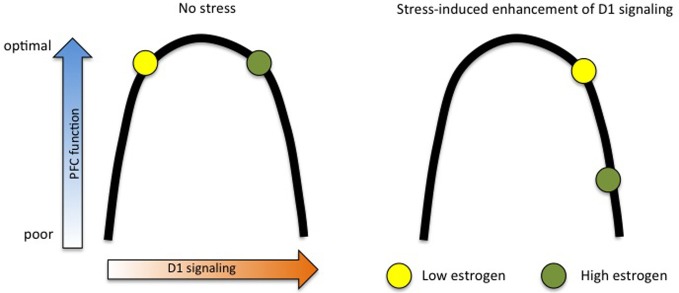
This review synthesizes non-human primate and rodent literature showing that stress impairs prefrontal cortex (PFC)-dependent working memory through interacting neuromodulators, principally catecholamines (dopamine and norepinephrine) acting via D1, alpha-1, and alpha-2 receptors, with glucocorticoids and estrogen modulating these effects. It proposes that stress pushes catecholamine signaling to the impairing end of inverted-U curves and that high estrogen may place females "ahead of the curve," increasing stress sensitivity.
Key findings
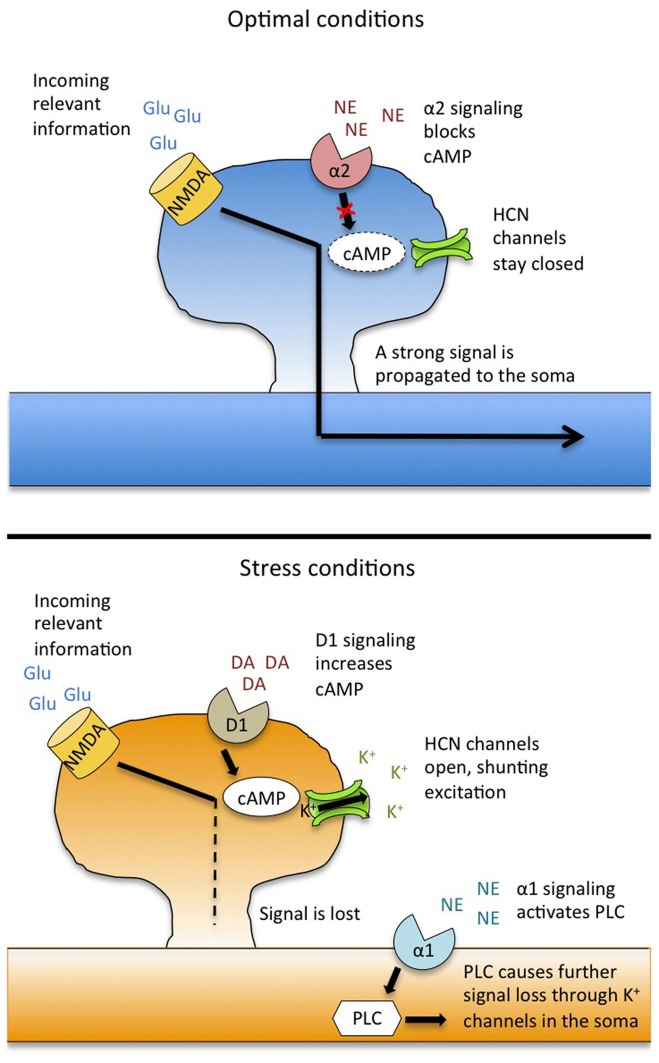
- Working memory depends on a balanced neurochemical milieu in the PFC; both insufficient and excessive D1 stimulation impair performance, producing the classic "inverted-U" relationship. Stress-induced HPA activation stimulates the VTA, causing excess DA release into the PFC, and these impairments can be reversed by intra-PFC D1 antagonist infusion or by cAMP and PKA inhibitors.
- Under stress, excess NE binds the lower-affinity alpha-1 receptor (rather than the high-affinity alpha-2 receptor active under non-stress conditions), impairing working memory and silencing PFC network activity; alpha-1 antagonists restore PFC function during stress, and PKC inhibition also reverses stress-related working memory impairments.
- Mechanistically, elevated D1 signaling opens HCN channels (via cAMP) on dendritic spines, shunting incoming excitation and suppressing both "noise" and "signal" neurons; alpha-2 receptor activation (Gi-coupled, lowering cAMP) slows HCN conductance and strengthens signal. Pharmacological HCN blockade restores working memory performance and PFC network tuning during stress.
- Glucocorticoids impair PFC working memory directly via GRs (systemic corticosterone reduces Delayed Alternation accuracy; intra-PFC RU 28362 impairs working memory; intra-PFC RU 38486 reverses stress-induced DSWS impairments) and indirectly by blocking extraneuronal catecholamine transporters and by locally driving stress-induced DA efflux in the PFC.
- In female rats, stress sensitivity is driven by high-estrogen phases: females became impaired after lower doses of FG7142 than males, driven by proestrus females; OVX + estrogen rats show impairments similar to proestrus females while OVX + blank-capsule rats perform more like males. A guanfacine dose that rescues stress-induced impairments in males and OVX females has no effect in OVX + estrogen rats.
Methods
- Narrative review of non-human primate and rodent literature on stress-induced PFC dysfunction, covering electrophysiology, pharmacology (receptor agonists/antagonists, cAMP/PKA/PKC inhibitors), microdialysis, lesion, and behavioral studies.
- Behavioral paradigms discussed: Delayed Response task (monkeys), Delayed Alternation and delayed spatial win-shift (DSWS) tasks (rodents); stressors include loud white noise, brief restraint stress, and the anxiogenic drug FG-7142.
- Sex-difference evidence drawn from dose-response studies with FG7142 and restraint stress in male and female rats, including ovariectomized rats with and without estrogen replacement.
Limitations
- The paper states that the vast majority of behavioral neuroscience research is conducted in male animals, so general understanding of stress effects in the PFC is within the context of the male brain, which is problematic from a translational standpoint given that stress-related illnesses like PTSD and major depressive disorder are twice as prevalent in women.
- The paper states that the mechanisms by which estrogen modulates stress-induced impairments are not known, and that estrogen-glucocorticoid interactions have not been investigated in the context of stress-induced working memory impairments.
- Evident from the text: the review is based entirely on animal (non-human primate and rodent) literature, and the estrogen "ahead of the curve" hypothesis is presented as a model (Figure 2) rather than a directly tested mechanism.
Model-written summary. Check it against the paper before relying on it.
Integrity signals
Registry
Cites
Statistics
Figures
Verification
Claims the paper makes
3 No full text of the sources · 2 Partly supported · 2 Own interpretation · 1 Supported · accuracy not yet measured
A conclusion the paper draws from its own results — it cites no other source for it, so there is none to check. The quote shows it is in the paper.
In the paper
“These deficits arise from the interaction of multiple neuromodulators, including glucocorticoids, catecholamines, and gonadal hormones; here we will discuss the non-human primate and rodent literature that has furthered our understanding of the circuitry, receptors, and signaling cascades responsible for stress-induced prefrontal dysfunction.”
§ Stress-induced cognitive dysfunction: hormone-neurotransmitter interactions in the prefrontal cortex > Abstract
plaindirect- Asserted: passes — The authors put it forward as true.
- Checkable: passes — It can be checked against evidence.
- Load-bearing: passes — The paper’s conclusions depend on it.
- Based: passes — The paper gives a reason why it holds.
- Rests on an assumption: Findings from non-human primate and rodent studies of stress-induced prefrontal dysfunction generalize to humans.
In the paper
“When the authors divided the females based on estrus cycle phase, they found that this stress sensitivity was driven by females in proestrus, when estrogen levels are highest.”
§ Stress-induced cognitive dysfunction: hormone-neurotransmitter interactions in the prefrontal cortex > Sex differences and estrogen effects
What the sources say
- Not checked — no full text of the sourcecites Shansky et al., 2004 source
plaindirect- Asserted: passes — The authors put it forward as true.
- Checkable: passes — It can be checked against evidence.
- Load-bearing: passes — The paper’s conclusions depend on it.
- Based: passes — The paper gives a reason why it holds.
- It may state two separate claims as one. 6
The cited sources support only part of this claim — read each source’s verdict below.
In the paper
“While a lack of D1 activity can impair working memory performance, high levels of D1 stimulation also produce cognitive deficits—the classic “inverted-U” relationship.”
- Also stated in: § Dopamine and norepinephrine · plain
“During stress, HPA axis activation leads to stimulation of the VTA, causing excess DA release into the PFC (Murphy et al., 1996). When this DA binds to the D1 receptor, its downstream signaling cascades lead to working memory impairment (Taylor et al., 1999).”
§ Stress-induced cognitive dysfunction: hormone-neurotransmitter interactions in the prefrontal cortex > Dopamine and norepinephrine
What the sources say
- Not checked — no full text of the sourcecites Murphy et al., 1996 source
- Partly supportedcites Taylor et al., 1999 sourceExperimental — accuracy not yet measured
The section “Possible relevance of PKA activation to stress-induced PFC dysfunction” reports that high D1 stimulation impairs working memory and contributes to stress-induced deficits. It does not establish that D1 blockade impairs working-memory performance, so it does not support both sides of the claimed inverted-U relationship. The section also does not explicitly say that stress causes excess dopamine release. (LLM, conf=0.84)
plaindirect- Asserted: passes — The authors put it forward as true.
- Checkable: passes — It can be checked against evidence.
- Load-bearing: passes — The paper’s conclusions depend on it.
- Based: passes — The paper gives a reason why it holds.
It may state two separate claims as one.
- Also stated in: § Dopamine and norepinephrine · plain
The cited sources support only part of this claim — read each source’s verdict below.
In the paper
“stress-related mental illnesses like post-traumatic stress disorder (PTSD) and major depressive disorder are twice as prevalent in women (Becker et al., 2007), suggesting a distinct neurobiology may underlie the stress response in female brains.”
§ Stress-induced cognitive dysfunction: hormone-neurotransmitter interactions in the prefrontal cortex > Sex differences and estrogen effects
What the sources say
- Partly supportedcites Becker et al., 2007 sourceExperimental — accuracy not yet measured
The “Stress and affective disorders” section says women experience depression at approximately twice the rate of men. The “Sex differences in clinical studies” section discusses sex differences in PTSD risk but does not give a twofold prevalence figure for PTSD. The citation therefore supports the depression figure, not its extension to both disorders. (LLM, conf=0.88)
hedgedconditional- Asserted: passes — The authors put it forward as true.
- Checkable: passes — It can be checked against evidence.
- Load-bearing: unclear — It is unclear whether the paper’s conclusions depend on it.
- Based: passes — The paper gives a reason why it holds.
It may state two separate claims as one.
- Partly supported
Every source the paper cites for this claim was checked and supports it.
In the paper
“Exposure to stress, however, can disrupt PFC function, markedly impairing working memory (Arnsten, 2009; Arnsten et al., 2012).”
- Also stated in: § Abstract · plain
“The PFC becomes markedly impaired by stress, producing measurable deficits in working memory.”
§ Stress-induced cognitive dysfunction: hormone-neurotransmitter interactions in the prefrontal cortex > Introduction
What the sources say
- Supportedcites Arnsten, 2009 source
The review states that stress rapidly disrupts PFC function and focuses on PFC working memory (passage 1). In its discussion of acute stress and PFC function, it reports that mild stress impaired spatial working-memory performance in rats and monkeys (passage 5). Page numbers are not supplied in our copy. (LLM, conf=0.94)
- Supportedcites Arnsten et al., 2012 source
In “Working memory vs. classic neuroplasticity” (page not provided), the paper says working-memory abilities are greatly impaired during stress. In “Relationship of neuromodulation in dlPFC to arousal states” (page not provided), it describes stress-related weakening of prefrontal network activity and reports that a mild stressor impairs working memory. (LLM, conf=0.94)
plaindirect- Asserted: passes — The authors put it forward as true.
- Checkable: passes — It can be checked against evidence.
- Load-bearing: passes — The paper’s conclusions depend on it.
- Based: passes — The paper gives a reason why it holds.
It may state two separate claims as one.
- Rests on an assumption: Findings from non-human primate and rodent studies of stress-induced prefrontal dysfunction generalize to humans.
- Also stated in: § Abstract · plain
A claim is checked only against the cited paper’s full text, never its abstract, and none is available for its sources.
In the paper
“Pharmacological stimulation of the alpha-2 receptor can increase firing in PFC neurons that code for relevant information, enhancing working memory in monkeys and rodents (Wang et al., 2007).”
- Also stated in: § Dopamine and norepinephrine · plain
“Stimulation of this receptor—either pharmacologically or because of stress-induced NE release—leads to working memory impairment and a silencing of PFC network activity (Arnsten et al., 1999).”
§ Stress-induced cognitive dysfunction: hormone-neurotransmitter interactions in the prefrontal cortex > Dopamine and norepinephrine
What the sources say
plaindirect- Asserted: passes — The authors put it forward as true.
- Checkable: passes — It can be checked against evidence.
- Load-bearing: passes — The paper’s conclusions depend on it.
- Based: passes — The paper gives a reason why it holds.
It may state two separate claims as one.
- Also stated in: § Dopamine and norepinephrine · plain
A conclusion the paper draws from its own results — it cites no other source for it, so there is none to check. The quote shows it is in the paper.
In the paper
“Research in non-human primates and rodents has shown that this impairment is driven by increased catecholamine signaling, which may be further modulated or exacerbated by changes in steroid hormone levels.”
§ Stress-induced cognitive dysfunction: hormone-neurotransmitter interactions in the prefrontal cortex > Conclusions
hedgedconditional- Asserted: passes — The authors put it forward as true.
- Checkable: passes — It can be checked against evidence.
- Load-bearing: passes — The paper’s conclusions depend on it.
- Based: passes — The paper gives a reason why it holds.
It may state two separate claims as one.
- Rests on an assumption: Findings from non-human primate and rodent studies of stress-induced prefrontal dysfunction generalize to humans.
In the paper
“While this release is critical to the enhancement of long term memories associated with the event (Rodrigues et al., 2009), glucocorticoid actions in the PFC impair working memory.”
- Also stated in: § Glucocorticoids · hedged
“These findings suggest that glucocorticoids can impair PFC function through direct actions at GRs, but glucocorticoids may also indirectly exacerbate working memory impairments through interactions with the catecholamine systems described above.”
§ Stress-induced cognitive dysfunction: hormone-neurotransmitter interactions in the prefrontal cortex > Glucocorticoids
What the sources say
- Not checked — no full text of the sourcecites Rodrigues et al., 2009 source
plainconditional- Asserted: passes — The authors put it forward as true.
- Checkable: passes — It can be checked against evidence.
- Load-bearing: passes — The paper’s conclusions depend on it.
- Based: passes — The paper gives a reason why it holds.
It may state two separate claims as one.
- Also stated in: § Glucocorticoids · hedged
The paper relies on this without support.
Findings from non-human primate and rodent studies of stress-induced prefrontal dysfunction generalize to humans.
“here we will discuss the non-human primate and rodent literature that has furthered our understanding of the circuitry, receptors, and signaling cascades responsible for stress-induced prefrontal dysfunction.”
The paper relies on this without support.
Working memory tasks in animals measure the same executive function as human working memory.
“Working memory in animals is assessed using delay-based tasks, which require an animal to keep a piece of information in mind over the course of a delay period, in order to make an accurate choice when the delay ends.”
The paper relies on this without support.
The prefrontal cortex helps to shut down the stress response.
“Because the PFC also helps to shut down the stress response, this loss of PFC function can lead to prolonged glucocorticoid release, which can exacerbate working memory impairments.”
Self-check
Percentages, sums and reported differences re-computed from the paper’s own numbers.
Each contradiction between two passages listed here was confirmed by an independent check.
Rated minor: it would not touch a result — a value no result rests on, a p-value that stays on the same side of the significance level, or a conflict that is clerical, resolved elsewhere in the paper, or outside its own findings.
In the paper
§ Stress-induced cognitive dysfunction: hormone-neurotransmitter interactions in the prefrontal cortex > Dopamine and norepinephrine
“Traditionally, HCN channels serve to normalize neuronal membrane potential, opening to allow positive ions into the cell to combat post-firing hyperpolarization (Wahl-Schott and Biel, 2009).”
§ Stress-induced cognitive dysfunction: hormone-neurotransmitter interactions in the prefrontal cortex > Dopamine and norepinephrine
“when cAMP increases (as happens when D1 receptors are over-activated), HCN channels open, letting Na+ and K+ flow out of the cell (Chen et al., 2007).”
Citations
Cites
Stress and the brain: from adaptation to disease
de Kloet, E. R., Joëls, M., & Holsboer, F. (2005) · Nature Reviews Neuroscience · doi:10.1038/nrn1683 · Cited by 4,621 · cited 1×
“During emotional and stressful situations, activation of the HPA axis causes the adrenal cortex to release glucocorticoids, which travel through the bloodstream and cross the blood-brain barrier to activate glucocorticoid receptors (GRs) throughout the brain (De Kloet et al., 2005).”
BackgroundStress signalling pathways that impair prefrontal cortex structure and function
Arnsten, A. F. T. (2009) · Nature Reviews Neuroscience · doi:10.1038/nrn2648 · Cited by 3,299 · cited 2×
“Adapted from Arnsten (2009) and Arnsten et al. (2012).”
BackgroundMnemonic coding of visual space in the monkey's dorsolateral prefrontal cortex
Funahashi, S., Bruce, C. J., & Goldman-Rakic, P. S. (1989) · Journal of Neurophysiology · doi:10.1152/jn.1989.61.2.331 · Cited by 2,685 · cited 1×
“Subsets of prefrontal neurons fire exclusively during the delay (Funahashi et al., 1989), suggesting a unique role for the PFC in this aspect of the task.”
BackgroundCellular basis of working memory
Goldman-Rakic, P. S. (1995) · Neuron · doi:10.1016/0896-6273(95)90304-6 · Cited by 2,663 · cited 1×
“Under optimal, stress-free conditions, microcircuits within the PFC work together to inhibit inappropriate responses and allow nuanced decision-making (Goldman-Rakic, 1995).”
Cognitive Deficit Caused by Regional Depletion of Dopamine in Prefrontal Cortex of Rhesus Monkey
Brozoski, T. J., Brown, R. M., Rosvold, H. E., & Goldman, P. S. (1979) · Science · doi:10.1126/science.112679 · Cited by 1,500 · cited 2×
“Selective lesions of these afferents Frontiers in Human Neuroscience www.frontiersin.org April 2013 | Volume 7 | Article 123 | 1 HUMAN NEUROSCIENCE impair working memory in monkeys, suggesting that baseline catecholamine signaling is required for optimal PFC function (Brozoski et al., 1979).”
BackgroundD1 Dopamine Receptors in Prefrontal Cortex: Involvement in Working Memory
Sawaguchi, T., & Goldman-Rakic, P. S. (1991) · Science · doi:10.1126/science.1825731 · Cited by 1,364 · cited 1×
“Pharmacological blockade of D1 receptors in both monkeys and rodents impairs performance on working memory tasks (Sawaguchi and Goldman-Rakic, 1991; Izquierdo et al., 1998), indicating a key role for D1 signaling in normal PFC function.”
BackgroundGoldman-Rakic, P. S. (1996) · Philosophical Transactions of the Royal Society of London. Series B: Biological Sciences · doi:10.1098/rstb.1996.0129 · Cited by 1,072 · cited 2×
“These processes depend on the structural and functional integrity of the prefrontal cortex (PFC) (Goldman-Rakic, 1996), a highly evolved brain region that guides emotion and behavior through projections to subcortical regions like the hypothalamus, amygdala, and brainstem nuclei (Price et al.”
BackgroundInverted-U dopamine D1 receptor actions on prefrontal neurons engaged in working memory
Vijayraghavan, S., Wang, M., Birnbaum, S. G., Williams, G. V., & Arnsten, A. F. T. (2007) · Nature Neuroscience · doi:10.1038/nn1846 · Cited by 1,013
Zahrt, J., Taylor, J. R., Mathew, R. G., & Arnsten, A. F. T. (1997) · The Journal of Neuroscience · doi:10.1523/jneurosci.17-21-08528.1997 · Cited by 796 · cited 2×
“Accordingly, these impairments can be reversed by intra-PFC infusions of a D1 antagonist (Zahrt et al., 1997), as well as by infusions of cAMP and PKA inhibitors (Taylor et al.”
BackgroundWang, M., Ramos, B. P., Paspalas, C. D., Shu, Y., Simen, A., Duque, A., Vijayraghavan, S., Brennan, A., Dudley, A., Nou, E., et al. (2007) · Cell · doi:10.1016/j.cell.2007.03.015 · Cited by 672
Cited by
Sorted by citations
Shields, G. S., Sazma, M. A., & Yonelinas, A. P. (2016) · Neuroscience & Biobehavioral Reviews · doi:10.1016/j.neubiorev.2016.06.038 · Cited by 818
The effects of acute stress on episodic memory: A meta-analysis and integrative review.
Shields, G. S., Sazma, M. A., McCullough, A. M., & Yonelinas, A. P. (2017) · Psychological Bulletin · doi:10.1037/bul0000100 · Cited by 450
“For example, stress first exerts rapid effects in the brain by producing a surge in both dopaminergic and noradrenergic activity within the prefrontal cortex (Arnsten, 2009; Shansky & Lipps, 2013).”
Gonadal steroid hormones and the hypothalamo–pituitary–adrenal axis
Handa, R. J., & Weiser, M. J. (2014) · Frontiers in Neuroendocrinology · doi:10.1016/j.yfrne.2013.11.001 · Cited by 408
“Moreover, the changes in glucocorticoids that arise following environmental perturbations can also impact numerous behaviors through actions at other brain regions (Weiser and Handa, 2009, for review see: (Shansky and Lipps, 2013)).”
BackgroundPatki, G., Solanki, N., Atrooz, F., Allam, F., & Salim, S. (2013) · Brain Research · doi:10.1016/j.brainres.2013.09.033 · Cited by 380
Sex differences in anxiety disorders: Interactions between fear, stress, and gonadal hormones
Maeng, L. Y., & Milad, M. R. (2015) · Hormones and Behavior · doi:10.1016/j.yhbeh.2015.04.002 · Cited by 406
James, K. A., Stromin, J., Steenkamp, N., & Combrinck, M. I. (2023) · Frontiers in Endocrinology · doi:10.3389/fendo.2023.1085950 · Cited by 479
Okon-Singer, H., Hendler, T., Pessoa, L., & Shackman, A. J. (2015) · Frontiers in Human Neuroscience · doi:10.3389/fnhum.2015.00058 · Cited by 371
“The molecular basis of emotion’s deleterious impact on working memory is reviewed by Shansky and Lipps (2013).”
BackgroundCortisol and DHEA in development and psychopathology
Kamin, H. S., & Kertes, D. A. (2016) · Hormones and Behavior · doi:10.1016/j.yhbeh.2016.11.018 · Cited by 329
“For instance, stress-induced cortisol release in the prefrontal cortex (PFC) leading to overstimulation of dopamine D1 and α1 noradrenergic receptors has been linked to impaired PFC function and deficits in working memory (Shansky and Lipps, 2013).”
BackgroundPsychotropic effects of Lactobacillus plantarum PS128 in early life-stressed and naïve adult mice
Liu, Y.-W., Liu, W., Wu, C.-C., Juan, Y.-C., Wu, Y.-C., Tsai, H.-P., Wang, S. Z., & Tsai, Y.-C. (2015) · Brain Research · doi:10.1016/j.brainres.2015.11.018 · Cited by 290
“PFC is known to be a highly evolved brain region that is responsible for regulating working memory, decision-making, and emotions, including stress response (Shansky and Lipps, 2013).”
Effect of acute hypoxia on cognition: A systematic review and meta-regression analysis
McMorris, T., Hale, B. J., Barwood, M. J., Costello, J. T., & Corbett, J. (2017) · Neuroscience & Biobehavioral Reviews · doi:10.1016/j.neubiorev.2017.01.019 · Cited by 280
“The activation of α1-adrenoceptors 313 reduces neuronal firing, while increased stimulation of D1-receptors and β-adrenoceptors induces 314 even greater activity of the second messenger, cyclic adenosine monophosphate, which dampens 315 all neuronal activity, thus weakening the signal to ‘noise’ ratio (Arnsten, 2011).”
Radley, J., Morilak, D., Viau, V., & Campeau, S. (2015) · Neuroscience & Biobehavioral Reviews · doi:10.1016/j.neubiorev.2015.06.018 · Cited by 339
“…length and branching, and decreases in spine density in the apical dendritic tree (Cook and Wellman, 2004; Liston et al., 2006; Liu and Aghajanian, 2008; Martin and Wellman, 2011; Radley et al., 2005; Radley et al., 2006b; Radley et al., 2008a; Radley et al., 2004; Shansky and Lipps, 2013).”
BackgroundNeural Circuit Motifs in Valence Processing
Tye, K. M. (2018) · Neuron · doi:10.1016/j.neuron.2018.10.001 · Cited by 268
McMorris, T. (2016) · Physiology & Behavior · doi:10.1016/j.physbeh.2016.08.011 · Cited by 188
“Furthermore, within the PFC, 329 glucocorticoids further stimulate activation of α1-adrenoceptors and D1-receptors [98].”
Calhoun, C. D., Stone, K. J., Cobb, A. R., Patterson, M. W., Danielson, C. K., & Bendezú, J. J. (2022) · Psychiatric Quarterly · doi:10.1007/s11126-022-10003-w · Cited by 230
“, ventromedial prefrontal cortex) [55].”
The neurobiology of alcohol consumption and alcoholism: An integrative history
Tabakoff, B., & Hoffman, P. L. (2013) · Pharmacology Biochemistry and Behavior · doi:10.1016/j.pbb.2013.10.009 · Cited by 135
McLaughlin, R. J., Hill, M. N., & Gorzalka, B. B. (2014) · Neuroscience & Biobehavioral Reviews · doi:10.1016/j.neubiorev.2014.02.006 · Cited by 142
Hwang, J., Brothers, R. M., Castelli, D. M., Glowacki, E. M., Chen, Y. T., Salinas, M. M., Kim, J., Jung, Y., & Calvert, H. G. (2016) · Neuroscience Letters · doi:10.1016/j.neulet.2016.07.033 · Cited by 126
“cerebral blood flow [18], arousal level [9], and neurotransmitters [23].”
BackgroundCognitive enhancement by transcranial laser stimulation and acute aerobic exercise
Hwang, J., Castelli, D. M., & Gonzalez-Lima, F. (2016) · Lasers in Medical Science · doi:10.1007/s10103-016-1962-3 · Cited by 121
Munshi, S., Loh, M. K., Ferrara, N., DeJoseph, M. R., Ritger, A., Padival, M., Record, M. J., Urban, J. H., & Rosenkranz, J. A. (2020) · Brain, Behavior, and Immunity · doi:10.1016/j.bbi.2019.11.023 · Cited by 117
“(ii) Stress causes cognitive impairment (Yuen et al., 2012; Shansky and Lipps, 2013).”
Age-dependent postoperative cognitive impairment and Alzheimer-related neuropathology in mice
Xu, Z., Dong, Y., Wang, H., Culley, D. J., Marcantonio, E. R., Crosby, G. J., Tanzi, R. E., Zhang, Y., & Xie, Z. (2014) · Scientific Reports · doi:10.1038/srep03766 · Cited by 106
Moser, J. S., Moran, T. P., Kneip, C., Schroder, H. S., & Larson, M. J. (2016) · Psychophysiology · doi:10.1111/psyp.12509 · Cited by 96
“Sex differences in cognition and emotion are particularly active areas of research (Bangasser & Valentino, 2014; Cahill, 2006, 2012, 2014; Ingalhalikar et al., 2014; Shansky & Lipps, 2013).”
Epperson, C. N., Sammel, M. D., Bale, T. L., Kim, D. R., Conlin, S. E., Scalice, S., Freeman, K., & Freeman, E. W. (2017) · The Journal of Clinical Psychiatry · doi:10.4088/jcp.16m10662 · Cited by 98
Acute stress impairs cognitive flexibility in men, not women
Shields, G. S., Trainor, B. C., Lam, J. C., & Yonelinas, A. P. (2016) · Stress · doi:10.1080/10253890.2016.1192603 · Cited by 102
“Similarly, sex differences in dopaminergic activity exist, and dopamine is important for executive functioning (Shansky & Lipps, 2013).”
BackgroundCorticotropin-Releasing Factor (CRF) circuit modulation of cognition and motivation
Hupalo, S., Bryce, C. A., Bangasser, D. A., Berridge, C. W., Valentino, R. J., & Floresco, S. (2019) · Neuroscience & Biobehavioral Reviews · doi:10.1016/j.neubiorev.2019.06.010 · Cited by 93
“fear conditioning and memory) dependent on subcortical regions (Wingard and Packard, 2008; Arnsten, 2009; Luethi et al., 2009; Roozendaal et al., 2009; Barsegyan et al., 2010; Shansky and Lipps, 2013).”
BackgroundWong, J. C., Scott, T. M., Wilde, P., Li, Y.-G., Tucker, K. L., & Gao, X. (2016) · Journal of Nutrition · doi:10.3945/jn.115.228700 · Cited by 84
Helpman, L., Zhu, X., Suarez-Jimenez, B., Lazarov, A., Monk, C., & Neria, Y. (2017) · Current Psychiatry Reports · doi:10.1007/s11920-017-0854-y · Cited by 82
“These sex differences appear not only to involve HPA response but also interaction with hypothalamic-pituitary-gonadal (HPG) axis activations, whereas estrogen, a gonadal steroid hormone, appears to modulate effects of both GC [104] and PAC1 [105].”
BackgroundCórdova, A., Caballero-García, A., Drobnic, F., Roche, E., & Noriega, D. C. (2023) · Healthcare · doi:10.3390/healthcare11121787 · Cited by 131
“It has rapid effects by producing an increase in dopaminergic and noradrenergic activity in the prefrontal cortex [44,45].”
BackgroundLucantonio, F., Caprioli, D., & Schoenbaum, G. M. (2013) · Neuropharmacology · doi:10.1016/j.neuropharm.2013.05.033 · Cited by 80
“Interestingly, similar to what we have shown with cocaine exposure, stress seems to modulate prefrontal cortex mechanisms and dorsolateral striatum processes in a way that biases towards model-free strategies (Shansky and Lipps, 2013).”
BackgroundDifferences in Coping Strategies Between Young and Older Adults: The Role of Executive Functions
Nieto, M., Ayuso, D. M. R., Ros, L., Zabala, C., Martínez, M., Ricarte, J. J., Serrano, J. P., & Latorre, J. M. (2019) · The International Journal of Aging and Human Development · doi:10.1177/0091415018822040 · Cited by 88
“Stress is generally thought to impair executive functioning (Diamond, 2013; Shansky & Lipps, 2013).”
BackgroundNegrón-Oyarzo, I., Aboitiz, F., & Fuentealba, P. (2016) · Neural Plasticity · doi:10.1155/2016/7539065 · Cited by 79
“Therefore, connecting this evidence, it has been suggested that chronic stress affects the accurate functioning of the PFC [33, 34], which is expressed as the maladaptive generation of behavioral responses observed in neuropsychiatric disorders.”
BackgroundStress and cognition: A user’s guide to designing and interpreting studies
Shields, G. S. (2020) · Psychoneuroendocrinology · doi:10.1016/j.psyneuen.2019.104475 · Cited by 80
Acute psychosocial stress effects on memory performance: Relevance of age and sex
Hidalgo, V., Pulopulos, M. M., & Salvador, A. (2018) · Neurobiology of Learning and Memory · doi:10.1016/j.nlm.2018.11.013 · Cited by 80
Glucocorticoids and cognitive function: a walkthrough in endogenous and exogenous alterations
Alcubierre, D. D., Ferrari, D., Mauro, G. C. D., Isidori, A. M., Tomlinson, J., & Pofi, R. (2023) · Journal of Endocrinological Investigation · doi:10.1007/s40618-023-02091-7 · Cited by 73
“This has to be taken into account both from a functional and structural point of view [129, 130], as degeneration of hippocampal neurons [131], and related impaired performance on declarative memory tasks [132] have been described in AI patients.”
BackgroundPatki, G., Solanki, N., Atrooz, F., Ansari, A., Allam, F., Jannise, B., Maturi, J., & Salim, S. (2014) · Physiology & Behavior · doi:10.1016/j.physbeh.2014.04.011 · Cited by 71
Corrêa, M. S., Vedovelli, K., Giacobbo, B. L., de Souza, C. E. B., Ferrari, P., Argimon, I. I. D. L., Walz, J. C., Kapczinski, F. P., & Bromberg, E. (2014) · Neuroscience · doi:10.1016/j.neuroscience.2014.11.052 · Cited by 73
Alcohol Effects on Stress Pathways
Blaine, S. K., Milivojevic, V., Fox, H. C., & Sinha, R. (2016) · The Canadian Journal of Psychiatry · doi:10.1177/0706743716632512 · Cited by 68
Solianik, R., Sujeta, A., Terentjevienė, A., & Skurvydas, A. (2016) · BioMed Research International · doi:10.1155/2016/1503956 · Cited by 58
“It is well established that the brain is a target of stress and that the prefrontal cortex is the brain area that is most sensitive to its effects [14, 15]; the prefrontal complex is responsible for highest-order cognitive abilities, such as executive functions [14, 16].”
BackgroundBrazaitis, M., Eimantas, N., Daniusevičiūtė, L., Mickevičienė, D., Steponavičiūtė, R., & Skurvydas, A. (2014) · PLoS ONE · doi:10.1371/journal.pone.0109020 · Cited by 60
“Stressful events can lead to immediate and marked impairments in working memory, which is an executive function [57].”
BackgroundAcute Stress Attenuates Cognitive Flexibility in Males Only: An fNIRS Examination
Kalia, V., Vishwanath, K., Knauft, K. M., Vellen, B. V. D., Luebbe, A. M., & Williams, A. L. (2018) · Frontiers in Psychology · doi:10.3389/fpsyg.2018.02084 · Cited by 56
Role of epigenetic factors in the development of mental illness throughout life
Guintivano, J., & Kaminsky, Z. A. (2014) · Neuroscience Research · doi:10.1016/j.neures.2014.08.003 · Cited by 62
Chauhan, N. R., Kumar, R., Gupta, A., Meena, R. C., Nanda, S., Mishra, K. P., & Singh, S. B. (2020) · Behavioural Brain Research · doi:10.1016/j.bbr.2020.112895 · Cited by 55
Tai, F., Wang, C., Xin, D., Li, R., Guo, Z., Quan, H., & Li, S. (2020) · Brain Research Bulletin · doi:10.1016/j.brainresbull.2020.08.025 · Cited by 55
Royer, M. F., Guerithault, N., Braden, B. B., Laska, M. N., & Bruening, M. M. (2021) · International Journal of Translational Medicine · doi:10.3390/ijtm1030015 · Cited by 55
Valros, A., Palander, P., Heinonen, M., Munsterhjelm, C., Brunberg, E., Keeling, L. J., & Piepponen, P. T. (2015) · Physiology & Behavior · doi:10.1016/j.physbeh.2015.02.049 · Cited by 47
“The function of the prefrontal cortex, which governs higher-level cognitive processes, can be negatively altered by stress, causing changes in behavior [40].”
Mizuki, D., Matsumoto, K., Tanaka, K., Le, X. T., Fujiwara, H., Ishikawa, T., & Higuchi, Y. (2014) · Journal of Ethnopharmacology · doi:10.1016/j.jep.2014.08.014 · Cited by 45
“…anti-depressant-like effect in UCMS animals, we first analyzed the serum corticosterone level as a biomarker of excess activation of the HPA axis (Shansky and Lipps, 2013) since it plays an important role not only in therapeutic mechanisms of antidepressant drugs (Kim et al., 2013) but also in…”
BackgroundRole of neuroinflammation and sex hormones in war-related PTSD.
Mendoza, C., Barreto, G., Avila-Rodriguez, M. F., & Echeverría, V. (2016) · Molecular and Cellular Endocrinology · doi:10.1016/j.mce.2016.05.016 · Cited by 43
Landau, A. M., Dyve, S., Jakobsen, S., Alstrup, A. K. O., GJEDDE, A. H., & Doudet, D. J. (2015) · Brain stimulation · doi:10.1016/j.brs.2015.02.003 · Cited by 43
Geissler, C. F., Friehs, M. A., Frings, C., & Domes, G. (2022) · Psychoneuroendocrinology · doi:10.1016/j.psyneuen.2022.105998 · Cited by 44
Sex-related differences in attention and memory
Solianik, R., Brazaitis, M., & Skurvydas, A. (2016) · Medicina · doi:10.1016/j.medici.2016.11.007 · Cited by 44
“Furthermore, it is known that sex hormones can affect neurotransmitter levels responsible for cognition [2,18,21], thus women were tested during the early follicular phase when estradiol and progesterone levels are low.”
Backgroundd-serine prevents cognitive deficits induced by acute stress
Guercio, G. D., Bevictori, L. E., Vargas-Lopes, C., Madeira, C., Oliveira, A. F., Carvalho, V. F., d’Avila, J. C., & Panizzutti, R. (2014) · Neuropharmacology · doi:10.1016/j.neuropharm.2014.06.021 · Cited by 41
“In fact, stress is a known regulator of many other pathways in the brain, including the dopaminergic and the endocannabinoid systems (Hill and McEwen 2010; Shansky and Lipps, 2013).”
Plieger, T., Felten, A., Splittgerber, H., Duke, É., & Reuter, M. (2017) · Psychoneuroendocrinology · doi:10.1016/j.psyneuen.2017.10.020 · Cited by 40
Acute stress and working memory in older people
Pulopulos, M. M., Hidalgo, V., Almela, M., Puig‐Pérez, S., Villada, C., & Salvador, A. (2015) · Stress · doi:10.3109/10253890.2015.1004538 · Cited by 44
Chanana, P., & Kumar, A. (2016) · Frontiers in Neuroscience · doi:10.3389/fnins.2016.00084 · Cited by 39
Effect of Cold Stress on Neurobehavioral and Physiological Parameters in Rats
Elmarzouki, H., Aboussaleh, Y., Najimi, M., Chigr, F., & Ahami, A. O. T. (2021) · Frontiers in Physiology · doi:10.3389/fphys.2021.660124 · Cited by 38
Successful voluntary recruitment of cognitive control under acute stress
Plessow, F., Schade, S., Kirschbaum, C., & Fischer, R. (2017) · Cognition · doi:10.1016/j.cognition.2017.06.016 · Cited by 36
“Currently, the most common view on how stress affects cognitive control converges on the assumption that acute uncontrollable stress impairs prefrontal cortex (PFC)-dependent cognitive functions, including cognitive control (Arnsten, 2009; Shansky & Lipps, 2013; Shields, Sazma, & Yonelinas, 2016).”
Corrêa, M. S., de Lima, D. B., Giacobbo, B. L., Vedovelli, K., Argimon, I. I. D. L., & Bromberg, E. (2018) · Stress · doi:10.1080/10253890.2018.1510485 · Cited by 40
“…and BDNF levels seem to play a key role on prefrontal and hippocampal dysfunctions, leading to the impairment of cognitive components such as attention, executive function and different memory types (Kim, Pellman, & Kim, 2015; Lu, Nagappan, & Lu, 2014; Pluchino et al., 2015; Shansky & Lipps, 2013).”
BackgroundSleep, cognition and cortisol in addison’s disease: a mechanistic relationship
Henry, M., Thomas, K. G. F., & Ross, I. L. (2021) · Frontiers in Endocrinology · doi:10.3389/fendo.2021.694046 · Cited by 34
Cognitive emotion regulation and stress: a multiple mediation approach
Miklósi, M., Martos, T., Szabó, M., Kocsis-Bogár, K., & Forintos, D. P. (2014) · Translational Neuroscience · doi:10.2478/s13380-014-0207-9 · Cited by 44
“Executive functions depend on the structural and functional integrity of the prefrontal cortex (PFC) [19], which guides emotions and behaviour through projections to subcortical regions like the hypothalamus and the amygdala [20].”
BackgroundBrazaitis, M., Eimantas, N., Daniusevičiūtė, L., Vitkauskienė, A., Paulauskas, H., & Skurvydas, A. (2015) · International Journal of Hyperthermia · doi:10.3109/02656736.2015.1004135 · Cited by 32
“High environmental temperature impairs neuromuscular [1–4], aerobic [5], and cognitive performance [1,6,7,8–10] and the ability to activate skeletal muscles [1,11].”
BackgroundA paradoxical switch: the implications of excitatory GABAergic signaling in neurological disorders
McArdle, C. J., Arnone, A. A., Heaney, C. F., & Raab‐Graham, K. F. (2024) · Frontiers in Psychiatry · doi:10.3389/fpsyt.2023.1296527 · Cited by 33
“For example, stress is associated with anxiety and substance use disorders (172, 173), cognitive dysfunction is present in both stress-related disorders and AD (174, 175), and epileptogenesis occurs in both autism spectrum disorders (ASD) and Alzheimer’s disease patients (176–178).”
BackgroundMualem, R., Morales-Quezada, L., Farraj, R. H., Shance, S., Bernshtein, D. H., Cohen, S., Mualem, L., Salem, N., Yehuda, R. R., Zbedat, Y., et al. (2024) · Frontiers in Public Health · doi:10.3389/fpubh.2024.1376075 · Cited by 59
Solianik, R., Skurvydas, A., Mickevičienė, D., & Brazaitis, M. (2014) · Cryobiology · doi:10.1016/j.cryobiol.2014.08.007 · Cited by 28
Episodic memory impairment in Addison’s disease: results from a telephonic cognitive assessment
Henry, M., & Thomas, K. G. F. (2014) · Metabolic Brain Disease · doi:10.1007/s11011-014-9511-x · Cited by 32
“The effects of cortisol on the hippocampus and PFC can affect memory processes because both of those regions play integral roles in memory processing, and both have dense concentrations of glucocorticoid receptors (Schacter and Wagner 1999; Alderson and Novack 2002; Kim and Diamond 2002; Shansky and Lipps 2013).”
Gargus, M., Ben‐Azu, B., Landwehr, A., Dunn, J., Errico, J. P., & Tremblay, M. (2025) · Frontiers in Neuroscience · doi:10.3389/fnins.2024.1527842 · Cited by 32
Solianik, R., Sujeta, A., & Čekanauskaitė, A. (2018) · Experimental Brain Research · doi:10.1007/s00221-018-5305-4 · Cited by 28
Empathy in pregnant women and new mothers: a systematic literature review
Boorman, R. J., Creedy, D. K., Fenwick, J., & Muurlink, O. T. (2018) · Journal of Reproductive and Infant Psychology · doi:10.1080/02646838.2018.1525695 · Cited by 29
“Cognitive deficits are apparent during periods of stress (Shansky & Lipps, 2013) as well as pregnancy and postpartum (Davies, Lum, Skouteris, Byrne, & Hayden, 2018).”
BackgroundPsychoneuroendocrinology of Stress
Gunnar, M. R., Doom, J. R., & Esposito, E. A. (2015) · Wiley eBooks · doi:10.1002/9781118963418.childpsy304 · Cited by 29
Missing expectations: Windlass tourniquet use without formal training yields poor results
Dennis, A. J., Bajani, F., Schlanser, V. L., et al. (2019) · The Journal of Trauma: Injury, Infection, and Critical Care · doi:10.1097/ta.0000000000002431 · Cited by 28
Albertini, G., Walrave, L., Demuyser, T., Massie, A., Bundel, D. D., & Smolders, I. J. (2017) · Epilepsia · doi:10.1111/epi.13943 · Cited by 28
Kim, B., Samuel, L. J., Thorpe, R. J., Crews, D. C., & Szanton, S. L. (2023) · JAMA Network Open · doi:10.1001/jamanetworkopen.2023.4674 · Cited by 27
Dopamine effects on stress-induced working memory deficits
Bahari, Z., Meftahi, G. H., & Meftahi, M. A. (2018) · Behavioural Pharmacology · doi:10.1097/fbp.0000000000000429 · Cited by 29
“Additional complexity is added by the fact that a subset of midbrain DA neurons may also corelease the excitatory neurotransmitter glutamate (Stuber et al., 2010; Hnasko et al., 2010, 2012) or GABA (Stamatakis et al., 2013).”
BackgroundRinwa, P., & Kumar, A. (2013) · Naunyn-Schmiedeberg s Archives of Pharmacology · doi:10.1007/s00210-013-0925-5 · Cited by 26
“Stress exposure induces several changes in the body, among which the most important is activation of the hypothalamo-pituitary-adrenal (HPA) axis (Shansky and Lipps 2013).”
BackgroundKromrey, S. A., Czoty, P. W., & Nader, M. A. (2015) · Hormones and Behavior · doi:10.1016/j.yhbeh.2015.04.017 · Cited by 27
“With regard to E2 concentrations and task specificity, one possibility is that E2 influences cognitive function involving tasks reliant on the PFC, through the DA system (Shansky and Lipps, 2013).”
BackgroundThe impact of stress on social behavior in adult zebrafish (Danio rerio)
Saszik, S. M., & Smith, C. M. (2017) · Behavioural Pharmacology · doi:10.1097/fbp.0000000000000338 · Cited by 26
“Dopamine and 5-HT transmitter systems interact in the brain (de Deurwaerdere and di Giovanni, 2017) and social behavior has been shown to alter 5-HT levels in the brain (Saif et al., 2013; Teles et al., 2013; Shams et al., 2015).”
BackgroundMethodNakamura, Y., Kato, H., Nojiri, K., Takahata, T., Yoshihara, H., Honda-Takahashi, K., Honda, T., Kubo, S., Sakatsume, K., & Maruta, T. (2014) · Journal of Orthopaedic Science · doi:10.1007/s00776-014-0534-2 · Cited by 25
“levels of mental activity, such as executive function, emotional control, and initiation of behavior, and it dysfunctions when facing the overwhelming stress [14].”
BackgroundThe discrepant effect of acute stress on cognitive inhibition and response inhibition
Kan, Y., Xue, W., Zhao, H., Wang, X., Guo, X., & Duan, H. (2021) · Consciousness and Cognition · doi:10.1016/j.concog.2021.103131 · Cited by 25
Mikneviciute, G., Ballhausen, N., Rimmele, U., & Kliegel, M. (2021) · Neuroscience & Biobehavioral Reviews · doi:10.1016/j.neubiorev.2021.12.009 · Cited by 31
Complex Dynamics in the Basal Ganglia: Health and Disease Beyond the Motor System
Andrés, D. S., & Darbin, O. (2017) · Journal of Neuropsychiatry · doi:10.1176/appi.neuropsych.17020039 · Cited by 27
Cheng, L., Sit, J. W. H., Leung, D. Y. P., & Li, X. (2016) · Worldviews on Evidence-Based Nursing · doi:10.1111/wvn.12159 · Cited by 25
“Such impairments debilitate individuals’ capability to acknowledge and overcome barriers (McEwen & Gianaros 2011; Shansky & Lipps 2013).”
BackgroundNeural underpinnings of fine motor skills under stress and anxiety: A review
Martins, L. A., Schiavo, A., Paz, L. V., Xavier, L. L., & Mestriner, R. G. (2024) · Physiology & Behavior · doi:10.1016/j.physbeh.2024.114593 · Cited by 30
Stress- and trauma-related blockade of episodic-autobiographical memory processing
Staniloiu, A., Kordon, A., & Markowitsch, H. J. (2020) · Neuropsychologia · doi:10.1016/j.neuropsychologia.2020.107364 · Cited by 22
Wang, Y., Zhang, J., Li, Y., Qi, S., Zhang, F., Ball, L. J., & Duan, H. (2023) · Cerebral Cortex · doi:10.1093/cercor/bhad301 · Cited by 25
A multiscale inflammatory map: linking individual stress to societal dysfunction
Yoram Vodovotz, B., Arciero, J. C., Verschure, P. F. M. J., & Katz, D. L. (2024) · Frontiers in Science · doi:10.3389/fsci.2023.1239462 · Cited by 22
Podvin, S., Bundey, R. A., Toneff, T., Ziegler, M. G., & HOOK, V. Y. H. (2015) · Molecular and Cellular Neuroscience · doi:10.1016/j.mcn.2015.06.008 · Cited by 22
“Epinephrine is a key stress neurotransmitter released from the adrenal medulla for the regulation of metabolic, cardiac, lung, and related physiological functions, as well as emotions, memory, and related behaviors (Joëls et al., 2011; Shansky and Lipps, 2013).”
BackgroundValderrama, J., Hansen, S. K., Pato, C. N., Phillips, K. A., Knowles, J. W., & Pato, M. T. (2020) · Psychiatry Research · doi:10.1016/j.psychres.2020.112962 · Cited by 24
Lustberg, D. J., Liu, J. Q., Iannitelli, A. F., Vanderhoof, S. O., Liles, L. C., McCann, K. E., & Weinshenker, D. (2022) · Hormones and Behavior · doi:10.1016/j.yhbeh.2022.105205 · Cited by 21
Saffari, F., Norouzi, K., Bruni, L. E., Zarei, S., & Ramsøy, T. Z. (2023) · Biomedical Signal Processing and Control · doi:10.1016/j.bspc.2023.105236 · Cited by 21
Corrêa, M. S., Giacobbo, B. L., Vedovelli, K., de Lima, D. B., Ferrari, P., Argimon, I. I. D. L., Walz, J. C., & Bromberg, E. (2016) · PLoS ONE · doi:10.1371/journal.pone.0162619 · Cited by 24
Bendezú, J. J., Howland, M. A., Thai, M., Marceau, K., Shirtcliff, E. A., Hastings, P. D., Zahn‐Waxler, C., & Klimes‐Dougan, B. (2021) · Psychoneuroendocrinology · doi:10.1016/j.psyneuen.2021.105365 · Cited by 19
Toufexis, D. J., King, S. B., & Michopoulos, V. (2017) · Current Psychiatry Reports · doi:10.1007/s11920-017-0833-3 · Cited by 20
Lanshakov, D. A., Sukhareva, E. V., Bulygina, V. V., Bannova, A. V., Shaburova, E. V., & Kalinina, T. S. (2021) · Scientific Reports · doi:10.1038/s41598-021-87652-7 · Cited by 19
High prolactin levels are associated with more delirium in septic patients
Nguyen, D. N., Huyghens, L., Schiettecatte, J., Smitz, J. E. J., & Vincent, J. (2016) · Journal of Critical Care · doi:10.1016/j.jcrc.2015.12.021 · Cited by 19
“It has been reported that excessive cortisol or catecholamine release is involved in the development of delirium in severe sepsis, Cushing’s disease, psychosis and schizophrenia [6, 8, 23].”
Backgroundd-Arginine as a neuroprotective amino acid: promising outcomes for neurological diseases
Canteros, M. G. (2013) · Drug Discovery Today · doi:10.1016/j.drudis.2013.11.010 · Cited by 19
Behavioral Neuroadaptation to Alcohol: From Glucocorticoids to Histone Acetylation
Mons, N. E., & Béracochéa, D. (2016) · Frontiers in Psychiatry · doi:10.3389/fpsyt.2016.00165 · Cited by 20
Kato, T. (2021) · Journal of Clinical Medicine · doi:10.3390/jcm10143122 · Cited by 18
Examining the contribution of histone modification to sex differences in learning and memoryPreprint
Keiser, A. A., & Wood, M. A. (2019) · Learning & Memory · doi:10.1101/lm.048850.118 · Cited by 17
Wang, Y., Guo, X., Wang, M., Kan, Y., Zhang, H., Zhao, H., Wu, M., & Duan, H. (2021) · International Journal of Psychophysiology · doi:10.1016/j.ijpsycho.2021.11.001 · Cited by 17
Food Insecurity across the Life-Course and Cognitive Function among Older Mexican Adults
Saenz, J. L., Kessler, J., & Nelson, E. (2022) · Nutrients · doi:10.3390/nu14071462 · Cited by 18
Pinizzotto, C. C., Patwardhan, A., Aldarondo, D., & Kritzer, M. F. (2022) · Hormones and Behavior · doi:10.1016/j.yhbeh.2022.105206 · Cited by 15
Katembu, S., Zahedi, A., & Sommer, W. (2023) · Frontiers in Public Health · doi:10.3389/fpubh.2023.1001132 · Cited by 19
Metadata
- Authors
- Shansky, R. M., & Lipps, J.
- Affiliations
- Northeastern University (US)
- Corresponding author
- Shansky, Rebecca M.
- ORCID
- Shansky, Rebecca M.
- Venue
- Frontiers in Human Neuroscience
- Publisher
- Frontiers Media SA
- Published
- 2013
- Volume
- 7
- Pages
- 123-123
- ISSN
- 1662-5161 (ISSN-L)
- PMC
- PMC3617365
- OpenAlex
- W1977773662
- Semantic Scholar
- c29a390e82744bcb70b04e0c370134134cc8802f
- Cited by
- 205
- References
- 55
- Citations by year
- 2026: 12 · 2025: 18 · 2024: 12 · 2023: 25 · 2022: 14 · 2021: 17 · 2020: 11 · 2019: 8 · 2018: 13 · 2017: 17 · 2016: 20 · 2015: 17 · 2014: 14 · 2013: 7
- FWCI
- 8.72
- Type
- journal article
- Language
- en
- Open access
- gold
- doi.org
- Licence
- cc-by
- Locations
- Frontiers in Human Neuroscience (publishedVersion, cc-by)
- Europe PMC (PubMed Central) (publishedVersion, cc-by)
- PubMed Central (publishedVersion, cc-by)
- PubMed (publishedVersion)
- DOAJ (DOAJ: Directory of Open Access Journals) (submittedVersion, cc-by-sa)
- Topics
- Life Sciences › Neuroscience › Behavioral Neuroscience › Stress Responses and Cortisol
- Life Sciences › Neuroscience › Cellular and Molecular Neuroscience › Neurotransmitter Receptor Influence on Behavior
- Life Sciences › Neuroscience › Cognitive Neuroscience › Neural and Behavioral Psychology Studies
- Keywords
- stress, cognitive impairment, prefrontal cortex, hypothalamic-pituitary-adrenal axis, glucocorticoids, catecholamines, gonadal hormones, working memory, executive function, neuromodulation, stress-induced neuroplasticity, receptor signaling
About these checks
Registry, retraction, Cites and statistics results are computed, not judged, with one exception: a printed reference that no index lists is read once by a model before it counts as a citation error. Claims are extracted by a model and kept only when their quote appears verbatim in the text; each cited source is then checked, with a model’s help, for whether it says what the claim relies on. Those verdicts can be wrong — read the claim’s quote and the cited source before relying on one.
A language model drew the claims from the paper on 2026-10-28, under version 3 of the claim definition (model deepseek-v4.1-flash, prompt extract-v3).
A second model labelled each claim on 2026-10-28 (model jev-1.13-20260917, definition revision gold-guideline-v0.2).
Cited sources are checked with a language model’s help (gpt-6-sol).
Statistics and arithmetic are recomputed, not judged.
Confidence bands are shown only for fields calibrated on our annotated test set. None is calibrated yet, so no band is shown.
What counts as a claim ›How we measure confidence ›How we check this ›
Are you an author, or do you see a problem with this page? Request a review
