

Comparative analysis of energy transfer mechanisms for neural implants
Open accessThe DOI matches its Crossref record; 197 of the 197 references it cites were found in a registry or an index; 132 of the 305 sources its claims cite were checked for support.
Abstract
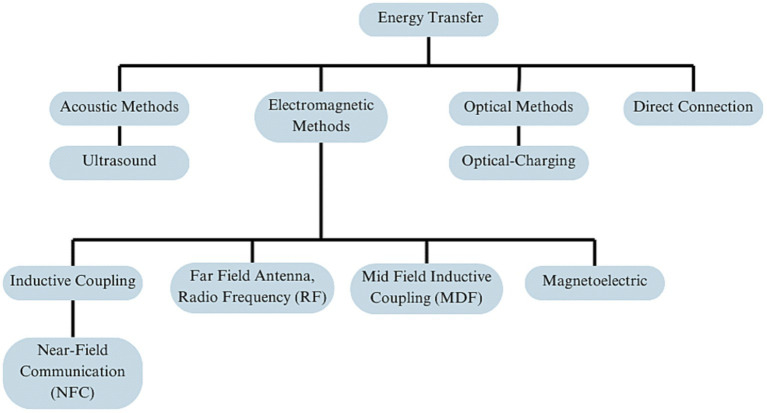
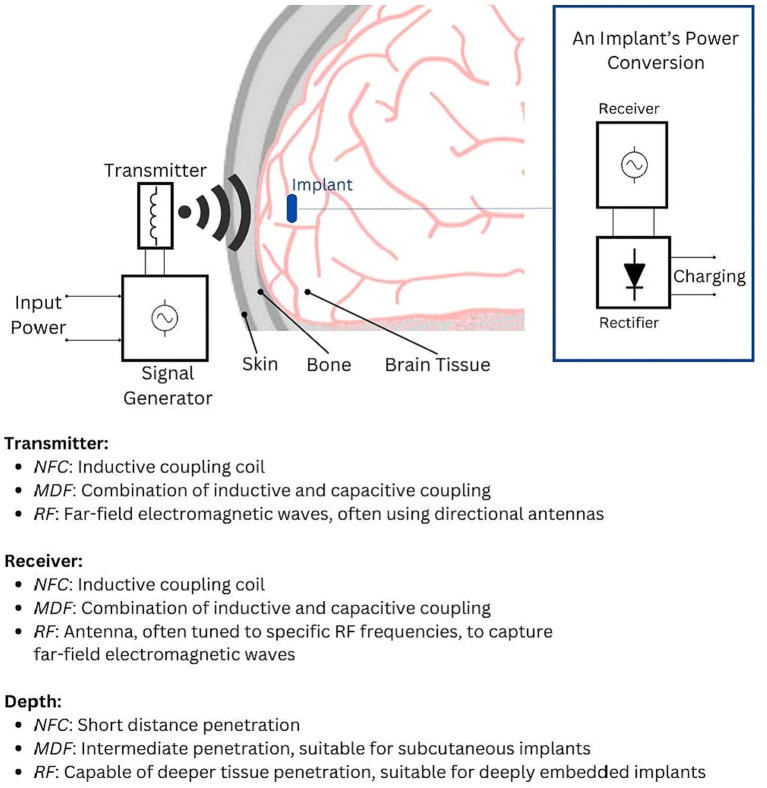
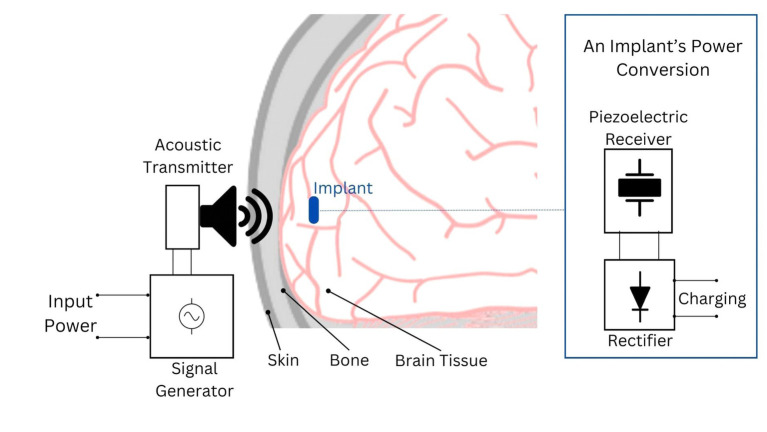
As neural implant technologies advance rapidly, a nuanced understanding of their powering mechanisms becomes indispensable, especially given the long-term biocompatibility risks like oxidative stress and inflammation, which can be aggravated by recurrent surgeries, including battery replacements. This review delves into a comprehensive analysis, starting with biocompatibility considerations for both energy storage units and transfer methods. The review focuses on four main mechanisms for powering neural implants: Electromagnetic, Acoustic, Optical, and Direct Connection to the Body. Among these, Electromagnetic Methods include techniques such as Near-Field Communication (RF). Acoustic methods using high-frequency ultrasound offer advantages in power transmission efficiency and multi-node interrogation capabilities. Optical methods, although still in early development, show promising energy transmission efficiencies using Near-Infrared (NIR) light while avoiding electromagnetic interference. Direct connections, while efficient, pose substantial safety risks, including infection and micromotion disturbances within neural tissue. The review employs key metrics such as specific absorption rate (SAR) and energy transfer efficiency for a nuanced evaluation of these methods. It also discusses recent innovations like the Sectored-Multi Ring Ultrasonic Transducer (S-MRUT), Stentrode, and Neural Dust. Ultimately, this review aims to help researchers, clinicians, and engineers better understand the challenges of and potentially create new solutions for powering neural implants.
Overview
CoChat Summary
## TL;DR
This review compares power-delivery options for neural implants and argues that no single method solves the combined constraints of biocompatibility, heat, miniaturization, and reliable data transfer. It concludes that inductive/capacitive wireless methods are the most studied, ultrasound is promising for deep and small implants, optical power is still early-stage, and direct wired connections are efficient but risky.
## Key findings
- The paper identifies four main powering approaches for neural implants: electromagnetic, acoustic, optical, and direct connection to the body; it evaluates them using metrics such as specific absorption rate (SAR) and energy transfer efficiency.
- It states that current implants often rely on wireless-inductively rechargeable batteries, and gives typical battery lifetimes for DBS systems of 3–5 years for fixed-life batteries, 6–7 years or beyond for some non-rechargeable batteries, and up to 15 years for rechargeable neurostimulators.
- For inductive coupling, the paper reports example efficiencies of 72.2% in air, 51.8% in saline, and 30.8% in muscle tissue at a 10 mm face-to-face distance, and another array system reaching 68% power efficiency at 4 cm.
- For ultrasound, it reports a study where a 1.1 mm³ receiver achieved 0.65% PTE at 1.1 MHz, outperforming an inductive link at 0.05% PTE at 30 MHz; another implant reached 10.5 cm depth in a tissue phantom and supported stimulation amplitudes from 22 to 5,000 μA.
- For optical charging, it reports an energy transfer efficiency above 0.7 over 650 cm with a reflector, and a case where 17 min of NIR light at 22 mW/cm powered a commercial pacemaker for 24 h; another 60-min laser charge sustained a 150 mAh LiPo battery for 85 h.
- For direct connection, the paper emphasizes efficiency but highlights safety risks including infection and micromotion disturbances in neural tissue.
## Methods
- Narrative review/comparative analysis of neural-implant energy transfer mechanisms, with emphasis on current powering approaches and their trade-offs.
- The discussion is organized around biocompatibility, energy constraints, physical constraints, power/data interference, and the specific methods of delivery.
- The comparison draws on published studies and reports, using reported values such as PTE, SAR, implant depth, device size, and battery life.
## Limitations
- The authors explicitly state that they do not review non-rechargeable fully implanted devices in depth and that they do not review self-powering/battery-free devices’ mechanisms and applications; they focus on energy transfer mechanisms for implants using traditional power sources.
- The paper is a review, so its conclusions depend on previously published studies rather than new experimental data from one standardized experiment.
- The text makes evident that many comparisons are not directly comparable across methods because the cited studies use different implant types, sizes, tissues, frequencies, and test conditions.
Model-written summary. Check it against the paper before relying on it.
Integrity signals
Registry
Cites
Statistics
Figures
Verification
Claims the paper makes
92 Valid · 9 Not valid · 104 Not checked · 39 Own results and interpretations
At least one cited source doesn’t support this claim or points to a different paper, and none confirmed it — see the verdicts below.
In the paper
“or supercapacitors, often fabricated from materials such as carbon aerogels with densities ranging from 0.182 to 0.052 g/cm3 (Feng et al., 2011) or according to new studies even as low as 0.16 g/cm3 (Yanagi et al., 2021)”
§ Comparative analysis of energy transfer mechanisms for neural implants > Complexities and challenges in powering brain implants > Biocompatibility
What the sources say
- Not checked — no full text of the sourcecites Feng et al., 2011 matched to “Thermal conductivity of low density carbon aerogels” (2012) source
- Disputedcites Yanagi et al., 2021 matched to “Light-induced levitation of ultralight carbon aerogels via temperature control” (2021) sourceExperimental — accuracy not yet measured
The Introduction reports a density of 0.16 mg/cm³, not 0.16 g/cm³—a thousandfold difference—and attributes that aerogel to Sun et al. (2013). The Methods likewise report this paper’s fabricated aerogels in mg/cm³. The 0.182–0.052 g/cm³ range is cited to Feng et al., not to Yanagi et al., so it is not judged here. (LLM, conf=0.90)
Checked by a reasoning model — may be wrong.
plain- Asserted: passes — The authors put it forward as true.
- Checkable: passes — It can be checked against evidence.
- Load-bearing: unclear — It is unclear whether the paper’s conclusions depend on it.
- Based: passes — The paper gives a reason why it holds.
Every source the paper cites for this claim was checked and supports it.
In the paper
“The limitation in available power supply options poses a significant challenge in powering brain implants, often restricting the device’s key features such as power density, including its diagnostic and therapeutic capabilities, operational lifespan, and duty cycle (Yang et al., 2021).”
§ Comparative analysis of energy transfer mechanisms for neural implants > Complexities and challenges in powering brain implants > Energy constraints
What the sources say
- Supportedcites Yang et al., 2021 matched to “Powering implantable and ingestible electronics” (2021) source
The Introduction (Motivation; page not provided) states that available power constrains diagnostic and therapeutic functions, duty cycle, and operational lifetime. The Introduction (Structure and Power Consumptions; page not provided) specifically identifies brain implants as unable to accommodate enough batteries because of size constraints, while the Outlook discusses power output and energy density as challenges. (LLM, conf=0.89)
plainstates a cause- Asserted: passes — The authors put it forward as true.
- Checkable: passes — It can be checked against evidence.
- Load-bearing: passes — The paper’s conclusions depend on it.
- Based: passes — The paper gives a reason why it holds.
- Supported
The cited sources that could be checked couldn’t confirm or dispute this claim.
In the paper
“Energy constraints are a significant hurdle, especially in fully-implantable systems where the energy source must be compact yet capable of sustaining the implant’s functions over extended periods (Rosidi et al., 2011).”
§ Comparative analysis of energy transfer mechanisms for neural implants > Complexities and challenges in powering brain implants
What the sources say
- Could not verifycites Rosidi et al., 2011 matched to “Cortical microhemorrhages cause local inflammation but do not trigger widespread dendrite degeneration” (2011) sourceExperimental — accuracy not yet measured
The Methods passages discuss laser energy used to induce microhemorrhages and a cranial window implanted for imaging; they do not discuss powering fully implantable systems. Searches for compact energy sources, batteries, and long-term implant operation found no passage addressing the claim. Page numbers were not provided in our copy. (LLM, conf=0.78)
plainstates a cause- Asserted: passes — The authors put it forward as true.
- Checkable: passes — It can be checked against evidence.
- Load-bearing: passes — The paper’s conclusions depend on it.
- Based: passes — The paper gives a reason why it holds.
- Could not verify
The cited sources that could be checked couldn’t confirm or dispute this claim.
In the paper
“Furthermore, the inter-relationship between power transfer and data communication in these implants introduces additional layers of difficulty.”
§ Comparative analysis of energy transfer mechanisms for neural implants > Complexities and challenges in powering brain implants
What the sources say
- Not checked — no full text of the sourcecites Santiago and Westerink, 1990 matched to “Characterization of the in vivo release of dopamine as recorded by different types of intracerebral microdialysis probes” (1990) source
- Not checked — no full text of the sourcecites Deboer and Abercrombie, 1996 matched to “Physiological release of striatal acetylcholine in vivo: modulation by D1 and D2 dopamine receptor subtypes.” (1996) source
- Could not verifycites Jaquins-Gerstl and Michael, 2009 matched to “Comparison of the brain penetration injury associated with microdialysis and voltammetry” (2009) sourceExperimental — accuracy not yet measured
The Discussion (page unavailable) compares tissue injury from microdialysis probes and carbon-fiber microelectrodes; the Voltammetry Procedures section (page unavailable) describes electrode operation. Neither addresses an inter-relationship between power transfer and data communication in neural implants. Searches for those terms and for wireless power, telemetry, and transmission found no relevant passage. (LLM, conf=0.76)
plainstates a cause- Asserted: passes — The authors put it forward as true.
- Checkable: passes — It can be checked against evidence.
- Load-bearing: unclear — It is unclear whether the paper’s conclusions depend on it.
- Based: passes — The paper gives a reason why it holds.
The cited sources support only part of this claim — read each source’s verdict below.
In the paper
“High power density, constrained by size, is essential to avoid tissue damage and foreign body responses, which can further affect the signal quality across all central nervous system sensors over both acute and chronic time frames (Bazaka and Jacob, 2012; Kozai et al., 2015).”
§ Comparative analysis of energy transfer mechanisms for neural implants > Complexities and challenges in powering brain implants > Physical constraints in power supply components
What the sources say
- Partly supportedcites Bazaka and Jacob, 2012 matched to “Implantable devices: issues and challenges” (2012) sourceExperimental — accuracy not yet measured
Section 3 ('Typical Requirements of Implant Systems') supports the second half of the attribution: it states that acute mechanical trauma at insertion and chronic contact/micro-movement induce the foreign body response, and that glial encapsulation raises impedance, increases electrode–neuron distance and is 'detrimental to the ability of the electrode to sense signals', with impedance rising over the length of implantation so that designs adequate acutely may not perform chronically. However, the paper does not support 'high power density, constrained by size, is essential to avoid tissue damage': the same section argues the opposite — that lower power consumption matters for patient safety, that proximity to tissue places 'firm restrictions on the amount of dissipation' because 'extensive dissipation may inflict damage onto these soft tissues' (hedged as 'may'), and that more electrodes demanding more power risks greater thermal dissipation. 'Power density' appears in our copy only as a figure-of-merit for glucose biofuel cells (Section 4), never as a requirement that prevents tissue damage or foreign body response, and the paper ties tissue damage/FBR to mechanical and electrochemical causes rather than to power density; the generalisation to 'all central nervous system sensors' also exceeds the neural-electrode discussion it rests on. (LLM, conf=0.72)
- Partly supportedcites Kozai et al., 2015 matched to “Brain Tissue Responses to Neural Implants Impact Signal Sensitivity and Intervention Strategies” (2015) sourceExperimental — accuracy not yet measured
The Size section says smaller implants can reduce tissue strain and inflammatory responses, while the Introduction says insertion injury and tissue responses can impair signal quality. The paper also describes effects over acute and chronic periods. It does not say that high power density is essential to prevent those effects; the size discussion concerns the implant’s physical dimensions, not its power density. Page numbers are not available in our copy. (LLM, conf=0.88)
plainstates a cause- Asserted: passes — The authors put it forward as true.
- Checkable: passes — It can be checked against evidence.
- Load-bearing: passes — The paper’s conclusions depend on it.
- Based: passes — The paper gives a reason why it holds.
- Partly supported
122 more claims · 48 with their cited sources checked
Create a free account to see all 244 claims and to verify the 32 references still open.
- Probably not a substantial claim. 38
- It may state two separate claims as one. 99
Citations
Cites
Reviving the lithium metal anode for high-energy batteries
Lin, D., Liu, Y., & Cui, Y. (2017) · Nature Nanotechnology · doi:10.1038/nnano.2017.16 · Cited by 6,763
Neuronal ensemble control of prosthetic devices by a human with tetraplegia
Hochberg, L. R., Serruya, M. D., Friehs, G. M., Mukand, J. A., Saleh, M., Caplan, A. H., Branner, A., Chen, D., Penn, R. D., & Donoghue, J. P. (2006) · Nature · doi:10.1038/nature04970 · Cited by 3,295
A review of lithium-ion battery safety concerns: The issues, strategies, and testing standards
Chen, Y., Kang, Y., Zhao, Y., Wang, L., Liu, J., Li, Y., Liang, Z., He, X., Li, X., Tavajohi, N., et al. (2021) · Journal of Energy Chemistry · doi:10.1016/j.jechem.2020.10.017 · Cited by 2,178
Dalgleish, T. (2004) · Nature Reviews Neuroscience · doi:10.1038/nrn1432 · Cited by 1,849
The global burden of neurological disorders: translating evidence into policy
Feigin, V. L., Vos, T., Nichols, E., Owolabi, M. O., Carroll, W. M., Dichgans, M., Deuschl, G., Parmar, P., Brainin, M., & Murray, C. (2020) · The Lancet Neurology · doi:10.1016/s1474-4422(19)30411-9 · Cited by 1,303 · cited 1×
“The escalating incidence of neurological conditions, which have become the top contributor to global disability and the second most common reason for mortality, is fueling significant expansion in the market for brain implants (Dumurgier and Tzourio, 2020; Feigin et al., 2020).”
BackgroundAn Integrated Brain-Machine Interface Platform With Thousands of Channels
Musk, E., & Neuralink (2019) · Journal of Medical Internet Research · doi:10.2196/16194 · Cited by 1,206
Biofuel cells and their development
Bullen, R. A., Arnot, T. C., Lakeman, J. B., & Walsh, F. C. (2006) · Biosensors and Bioelectronics · doi:10.1016/j.bios.2006.01.030 · Cited by 1,011
Implant biomaterials: A comprehensive review
Saini, M. (2015) · World Journal of Clinical Cases · doi:10.12998/wjcc.v3.i1.52 · Cited by 844
Soft, stretchable, fully implantable miniaturized optoelectronic systems for wireless optogenetics
Park, S. I., Brenner, D. S., Shin, G., Morgan, C. D., Copits, B. A., Chung, H. U., Pullen, M. Y., Noh, K. N., Davidson, S., Oh, S. J., et al. (2015) · Nature Biotechnology · doi:10.1038/nbt.3415 · Cited by 794
Brain Tissue Responses to Neural Implants Impact Signal Sensitivity and Intervention Strategies
Kozai, T. D. Y., Jaquins-Gerstl, A. S., Vazquez, A. L., Michael, A. C., & Cui, X. T. (2015) · ACS Chemical Neuroscience · doi:10.1021/cn500256e · Cited by 622 · cited 2×
“…advances in speech-to-text with ALS patients (Willett et al., 2023), allowing primates to play pong (Play Studio, n.d.) to clinical trials for motor deficit treatments (Gilja et al., 2015) face a decline in recording quality over time (Chestek et al., 2011; Jorfi et al., 2014; Kozai et al., 2015).”
Background
Research works printed but not linked: 8
- Åkesson B. Minaeva A. Sucha P. Nelson A. Hanzálek Z. (2015) An efficient configuration methodology for time-division multiplexed single resources. IEEE [Preprint].
- Al-Saadi M. Al-Bahrani L. Al-Qaisi M. Al-Chlaihawi S. Crăciunescu A. (2018). Capacitive power transfer for wireless batteries charging. ResearchGate [preprint] Available at: https://www.researchgate.net/publication/330183455_Capacitive_Power_Transfer_for_Wireless_Batteries_Charging
- Bullard A. (2019) Feasibility of using the Utah array for long-term fully implantable neuroprosthesis systems. PhD dissertation. University of Michigan.
- Center for Devices and Radiological Health (2021). Implanted brain-computer Interface (BCI) devices for patients with paralysis or amputation - non-clinical testing and clinical considerations. U.S. Food And Drug Administration [Preprint]. Available at: https://www.fda.gov/regulatory-information/search-fda-guidance-documents/implanted-brain-computer-interface-bci-devices-patients-paralysis-or-amputation-non-clinical-testing
- Center for Devices and Radiological Health (2023). Basics of biocompatibility: information needed for assessment by the FDA. U.S. Food And Drug Administration [Preprint]. Available at: https://www.fda.gov/medical-devices/biocompatibility-assessment-resource-center/basics-biocompatibility-information-needed-assessment-fda
- Mahn (2013). Wireless medical technologies: Navigating government regulation in the new medical age. Fishs Regulatory & Government Affairs Group [Preprint] Available at: https://scholar.google.com/scholar_lookup?title=Wireless+Medical+Technologies:+Navigating+Government+Regulation+in+the+New+Medical+Age&publication_year=2017
- Review of published literature between 2008 and 2018 of relevance to radiofrequency radiation and cancer (2020) FDA [Preprint]. Available at: https://www.fda.gov/media/135043/download
- World Health Organization: WHO (2023). Lead poisoning. www.who.int [Preprint]. Available at: https://www.who.int/news-room/fact-sheets/detail/lead-poisoning-and-health.
Cited by
Mariello, M., & Proctor, C. M. (2024) · Advanced Materials Technologies · doi:10.1002/admt.202400797 · Cited by 58
Magnetically driven triboelectric nanogenerator for a wireless, versatile energy transfer system
Kim, J., Yoo, J., Seo, H., Avila, R. O., Chung, G., Shin, G., Gwak, S., Han, Y., Lee, J., Yoon, H., et al. (2025) · Science Advances · doi:10.1126/sciadv.adu5919 · Cited by 24
Electrospinning for Mimicking Bioelectric Microenvironment in Tissue Regeneration
Hao, Z., Wang, Z., Wang, Y., Dong, M., Zhang, Z., Chen, J., Shi, G., Wang, J., Chen, R., Li, Z., et al. (2025) · Research · doi:10.34133/research.0959 · Cited by 29
Embracing Remote Fields as the Fourth Dimension of Tissue Biofabrication
Anand, S., Müller, C., Jensen, B. N., & Chen, M. (2024) · Advanced Functional Materials · doi:10.1002/adfm.202401654 · Cited by 14
Wireless technologies in stretchable bioelectronics
Feng, M., Lu, G., Wang, Z., & Jiang, Y. (2025) · Journal of Materials Chemistry C · doi:10.1039/d5tc02191j · Cited by 10
Neuromorphic algorithms for brain implants: a review
Pawlak, W. A., & Howard, N. (2025) · Frontiers in Neuroscience · doi:10.3389/fnins.2025.1570104 · Cited by 18
Self-citationIsik, M., Howard, N., Miziev, S., & Pawlak, W. A. (2024) · International Joint Conference on Neural Networks (IJCNN) · doi:10.1109/ijcnn60899.2024.10650231 · Cited by 9
Self-citationKim, M., López‐Cano, M., Zhang, K., Wang, Y., Gómez‐Santacana, X., Flores, Á., Wu, M., Li, S., Zhang, H., Wei, Y., et al. (2025) · Biosensors and Bioelectronics · doi:10.1016/j.bios.2025.117440 · Cited by 11
Fossi, J. T., Kuate, P. D. K., Signing, V. R. F., Njitacke, Z. T., Zhao, M., Fozin, T. F., Valdes-Sosa, P. A., Gaiardo, A., Ito, H., Buscarino, A., et al. (2025) · Nonlinear Dynamics · doi:10.1007/s11071-025-11654-7 · Cited by 5
Fuada, S., Särestöniemi, M., & Katz, M. D. (2025) · IntechOpen eBooks · doi:10.5772/intechopen.1008464 · Cited by 6
Shukla, G., Awasthi, V., Goswami, P., & Singh, S. (2024) · IEEE International Conference on Sustainable Energy and Future Electric Transportation (SEFET) · doi:10.1109/sefet61574.2024.10718219 · Cited by 2
Advancing Prosthetic Hand Capabilities Through Biomimicry and Neural Interfaces
Dogahe, M. H., Mahan, M. A., Zhang, M., Aliabadi, S. B., Rouhafza, A., Karimzadhagh, S., Feizkhah, A., Monsef, A., & Roudkenar, M. H. (2025) · Neurorehabilitation and neural repair · doi:10.1177/15459683251331593 · Cited by 3
Palanivelu, L., Chen, Y.-Y., Liang, Y., Li, S., Chang, C.-W., Huang, Y.-T., & Lo, Y. (2025) · NeuroImage · doi:10.1016/j.neuroimage.2025.121344 · Cited by 4
Adaptively Pruned Spiking Neural Networks for Energy-Efficient Intracortical Neural Decoding
Rivelli, F., Popov, M., Kouzinopoulos, C. S., & Tang, G. (2025) · Annual International Conference of the IEEE Engineering in Medicine and Biology Society (EMBC) · doi:10.1109/embc58623.2025.11254088 · Cited by 4
Full‐Stack Architectures for Intelligent Brain‐Computer Interfaces
Lee, H. K., Kim, H. B., Park, S. U., Joo, J., Min, J., Lee, G., Kang, J. Y., Jeong, H., Yoo, J., & Won, S. M. (2026) · Advanced Science · doi:10.1002/advs.75838 · Cited by 2
Impact of bending deformation on a capacitive power transfer system
Peirens, K., Minnaert, B., & Chevalier, A. (2025) · Scientific Reports · doi:10.1038/s41598-025-29265-y · Cited by 1
Engineering aspects and materials for next generation neural implants
Mahato, K. (2025) · Progress in molecular biology and translational science · doi:10.1016/bs.pmbts.2025.07.001 · Cited by 2
Metal-Ion Batteries in Bioelectrical Signal Simulation: Applications and Challenges
Pan, X., Zhao, Y., Liu, Q., Peng, P., & Wang, J. (2026) · JOM · doi:10.1007/s11837-026-08417-z
Energy Solutions for Implantable and Ingestible Electronics
Abdigazy, A., & Khan, Y. (2026) · Royal Society of Chemistry eBooks · doi:10.1039/9781837679850-00064
Metadata
- Authors
- Miziev, S., Pawlak, W. A., & Howard, N.
- Corresponding author
- Miziev, Sols
- Pawlak, Wiktoria Agata
- Howard, Newton
- Venue
- Frontiers in Neuroscience
- Publisher
- Frontiers Media SA
- Published
- 2024-01-16
- Volume
- 17
- Pages
- 1320441-1320441
- ISSN
- 1662-453X (ISSN-L)
- PMC
- PMC10825050
- OpenAlex
- W4390917629
- Semantic Scholar
- 181d782882447cde080cb612734966ecfafa6d5d
- Cited by
- 21
- References
- 197
- Citations by year
- 2026: 4 · 2025: 13 · 2024: 4
- FWCI
- 0.48
- Type
- journal article
- Language
- en
- Open access
- gold
- doi.org
- Licence
- Locations
- Frontiers in Neuroscience (publishedVersion, cc-by)
- PubMed Central (publishedVersion, cc-by)
- PubMed (publishedVersion)
- DOAJ (DOAJ: Directory of Open Access Journals) (submittedVersion, cc-by-sa)
- Topics
- Physical Sciences › Engineering › Electrical and Electronic Engineering › Wireless Power Transfer Systems
- Life Sciences › Neuroscience › Cellular and Molecular Neuroscience › Neuroscience and Neural Engineering
- Physical Sciences › Engineering › Biomedical Engineering › Wireless Body Area Networks
- Keywords
- neural implants, energy transfer mechanism, acoustic power transfer, ultrasound, optical power transfer, near-infrared, RF power transmission, biocompatibility, specific absorption rate, energy transfer efficiency, battery replacement
About these checks
Registry, retraction, Cites and statistics results are computed, not judged, with one exception: a printed reference that no index lists is read once by a model before it counts as a citation error. Claims are extracted by a model and kept only when their quote appears verbatim in the text; each cited source is then checked, with a model’s help, for whether it says what the claim relies on. Those verdicts can be wrong — read the claim’s quote and the cited source before relying on one.
The claim verdicts this report counts are experimental: their accuracy is not yet measured.
A language model drew the claims from the paper on 2026-10-10, under version 3 of the claim definition (model deepseek-v4.1-flash, prompt extract-v3).
A second model labelled each claim on 2026-10-10 (model jev-1.13-20260917, definition revision gold-guideline-v0.2).
Cited sources are checked with a language model’s help (gpt-6-sol and qwen3.8-omni-flash).
Statistics and arithmetic are recomputed, not judged.
Confidence bands are shown only for fields calibrated on our annotated test set. None is calibrated yet, so no band is shown.
What counts as a claim ›How we measure confidence ›How we check this ›
Are you an author, or do you see a problem with this page? Request a review
Data sources
Bibliographic data: Semantic Scholar, OpenAlex, Crossref.
Contains information from the Semantic Scholar Academic Graph Datasets, made available under the ODC Attribution License (ODC-BY 1.0).
Semantic Scholar’s data is described in: Kinney, R., et al. (2023). The Semantic Scholar Open Data Platform. arXiv:2301.10140.
