

Potential therapeutic effects of an ayahuasca-inspired N,N-DMT and harmine formulation: a controlled trial in healthy subjects
Open accessThe DOI matches its Crossref record; 89 of the 89 references it cites were found in a registry or an index; 36 of the 59 sources its claims cite were checked for support.
Abstract
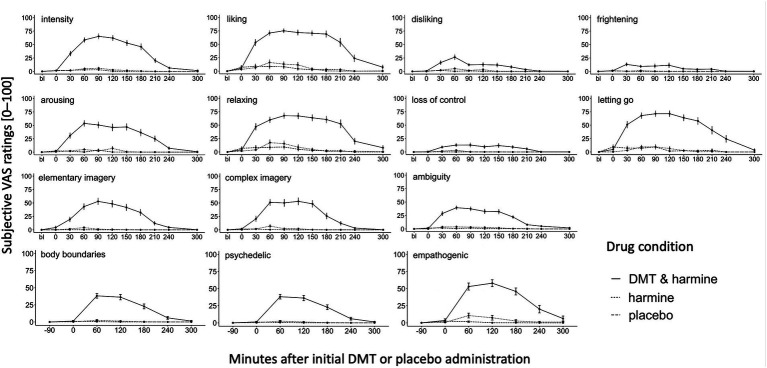
Background: There is growing scientific evidence for the therapeutic benefits of the Amazonian plant-based psychedelic “ayahuasca” for neuropsychiatric disorders such as depression and anxiety. However, there are certain challenges when incorporating botanical ayahuasca into biomedical research and clinical therapy environments. Formulations inspired by ayahuasca, which contain specific and standardized active components, are a potential remedy. Methods: We investigated subjective acute and persisting effects of a novel formulation containing the reversible monoamine oxidase inhibitor harmine (orodispersible tablet containing 100 mg MAO-I) and N,N-dimethyltryptamine (incremental intranasal dosing of up to 100 mg DMT), compared with two other conditions, namely harmine alone and placebo, in a crossover RCT in 31 healthy male subjects. Results: DMT + harmine, but not harmine alone, induced a psychedelic experience assessed with the 5D-ASC rating scale [global score: F(2,60) = 80.21, p < 0.001] and acute experience sampling items over time, characterized by psychological insights [PIQ, F(2,58.5) = 28.514, p < 0.001], emotional breakthroughs [EBI, F(2,60) = 26.509, p < 0.001], and low scores on the challenging experience questionnaire [CEQ, F(2,60) = 12.84, p < 0.001]. Participants attributed personal and spiritual significance to the experience (GSR) with mainly positive persisting effects (PEQ) at 1- and 4-months follow-up. Acute drug effects correlated positively with persisting effects. We found no changes in trait measures of personality, psychological flexibility, or general well-being, and no increases in psychopathology (SCL-90-R) were reported. Discussion and Conclusion: Our results suggest that the experience induced by the standardized DMT + harmine formulation induces a phenomenologically rich psychedelic experience, demonstrates good psychological safety and tolerability, is well tolerated, and induces beneficial psychological processes that could possibly support psychotherapy. Further studies are required to investigate the psychotherapeutic potential in patients. Copyright © 2024 Aicher, Mueller, Dornbierer, Suay, Elsner, Wicki, Meling, Caflisch, Hempe, Steinhart, Mueller, Von Rotz, Kleim and Scheidegger.
Overview
CoChat Summary
## TL;DR
This randomized controlled crossover trial in 31 healthy men found that the combined DMT + harmine formulation, but not harmine alone, produced a psychedelic experience with psychological insights, emotional breakthroughs, and mainly positive persisting effects at 1 and 4 months. The study suggests potential psychotherapy-relevant effects and good psychological tolerability, but it was conducted in a non-therapeutic setting and did not show trait changes or increased well-being.
## Key findings
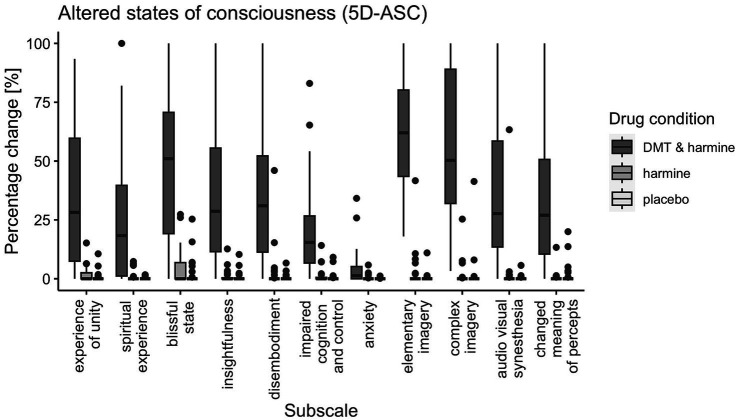
- In 31 healthy male participants, DMT + harmine induced strong acute psychedelic effects on the 5D-ASC global score compared with both harmine and placebo: F(2,60) = 80.21, p < 0.001; all 11 5D-ASC subscales were significantly increased.
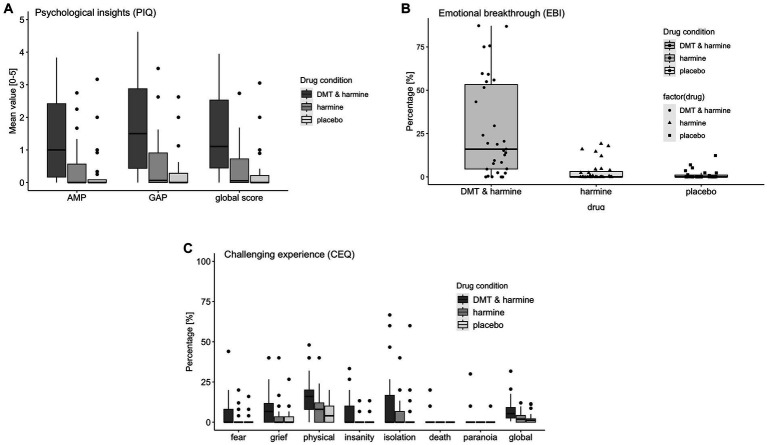
- DMT + harmine increased psychological insight and emotional breakthrough: PIQ global score F(2,58.5) = 28.51, p < 0.001; EBI F(2,60) = 26.51, p < 0.001. It also increased challenging experiences relative to the other conditions, but CEQ scores remained low overall.
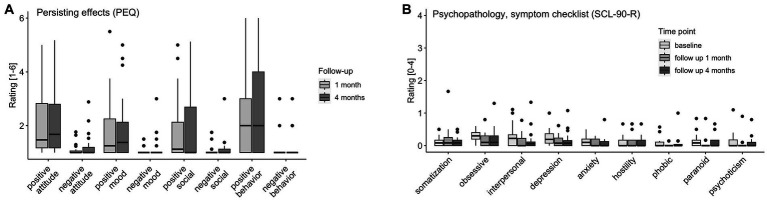
- Persisting effects at 1 and 4 months were mainly positive across PEQ domains, with significant positive vs negative effects in attitude toward life, mood, social effects, and behavior change (combined follow-up timepoints: r = 0.83, 0.57, 0.46, and 0.78, all p < 0.001).
- No increases were found in trait measures of acceptance/action, cognitive flexibility, nature relatedness, well-being, or openness, and no decreases in neuroticism were found; no increases in psychopathology on the SCL-90-R were reported.
## Methods
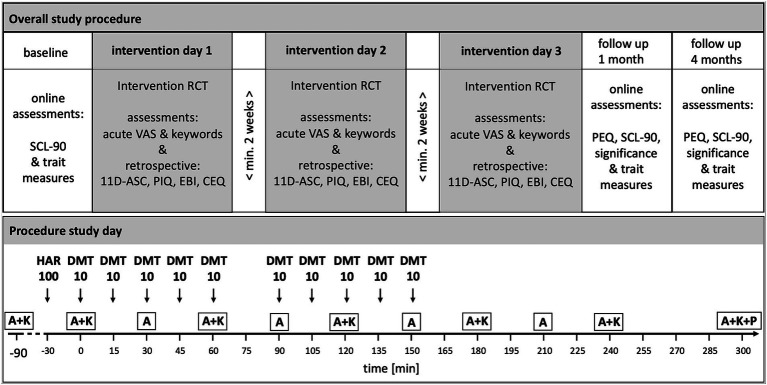
- Randomized, double-blind, placebo-controlled crossover trial with three conditions: DMT + harmine (DMT/HAR), harmine only (HAR), and placebo (PLA), separated by at least 2 weeks.
- Sample: 31 healthy male subjects completed all 3 intervention days; 37 were recruited and 6 dropped out. Mean age was 25.39 ± 4.21 years.
- Main analysis used mixed-model ANOVAs for acute/retrospective outcomes, Wilcoxon tests for 2 timepoints, Friedman tests with post-hoc Dunn-Bonferroni tests for 3 timepoints, and correlations between acute and persisting effects.
## Limitations
- The paper states that it did not assess intranasal DMT alone, so the specific pharmacological effects of intranasal DMT remain unclear.
- The authors note that blinding may have been weakened by the psychedelic effects, expectations may have influenced outcomes, and the sample was WEIRD and all male, limiting generalizability.
- The study setting was pharmacologically and neurobehaviorally oriented rather than therapeutic or integration-focused, which the paper says may have reduced introspection and attenuated subjective effects; additionally, only 22 of 31 participants completed all follow-up trait assessments.
Model-written summary. Check it against the paper before relying on it.
Integrity signals
Registry
Cites
Statistics
Figures
Verification
Claims the paper makes
22 Valid · 2 Not valid · 7 Not checked · 99 Own results and interpretations
The sources with a verdict support this claim; the rest weren’t checked yet, have no full text we could read, or their verdicts aren’t rated yet.
In the paper
“There is growing scientific evidence for the therapeutic benefits of the Amazonian plant-based psychedelic “ayahuasca” for neuropsychiatric disorders such as depression and anxiety.”
§ Potential therapeutic effects of an ayahuasca-inspired N,N-DMT and harmine formulation: a controlled trial in healthy subjects > Abstract > Background
What the sources say
- Supportedcites [1] Frecska E Bokor P Winkelman M. The therapeutic potentials of Ayahuasca: possible effects against various diseases of civilization. Front Pharmacol. (2016) 7: 35. doi: 10.3389/fphar.2016.00035, PMID: 26973523 PMC4773875 source
The section on mechanisms reports an observed antidepressant effect of ayahuasca. The Psychological and Psychosocial Effects section reports studies finding fewer signs of anxiety among adolescent users and less anxiety in responses to panic-like states, though state- and trait-anxiety measures were unchanged. These findings support the broad claim of growing evidence for potential benefits, not a claim that treatment efficacy for depression or anxiety is established. (LLM, conf=0.86)
- Not checked — no full text of the sourcecites [2] Palhano-Fontes F Alchieri JC Oliveira JPM Soares BL Hallak JEC Calvao-Coelho N. The therapeutic potentials of Ayahuasca in the treatment of depression In: Labate BC Cavnar C, editors. The therapeutic use of Ayahuasca. Berlin: Springer (2014). 23– 39. source
- Supportedcites [3] Palhano-Fontes F Barreto D Onias H Andrade KC Novaes MM Pessoa JA. Rapid antidepressant effects of the psychedelic ayahuasca in treatment-resistant depression: a randomized placebo-controlled trial. Psychol Med. (2019) 49: 655– 63. doi: 10.1017/S0033291718001356, PMID: 29903051 PMC6378413 source
The Discussion reports that evaluations of regular ayahuasca consumers found reduced anxiety and depressive symptoms compared with non-consumers. The Introduction also describes a prior trial finding reduced depression severity and explains that this paper further tests ayahuasca’s antidepressant effects. Together, these passages support the broad claim of growing evidence, without establishing ayahuasca as a proven treatment for anxiety. (LLM, conf=0.86)
plainstates a cause- Asserted: passes — The authors put it forward as true.
- Checkable: passes — It can be checked against evidence.
- Load-bearing: passes — The paper’s conclusions depend on it.
- Based: passes — The paper gives a reason why it holds.
- Supported
Every source the paper cites for this claim was checked and supports it.
In the paper
“In small clinical pilot studies, ayahuasca has been shown to alleviate symptoms of depression and anxiety (30).”
§ Potential therapeutic effects of an ayahuasca-inspired N,N-DMT and harmine formulation: a controlled trial in healthy subjects > Introduction
What the sources say
- Supportedcites [30] De Osório FL Sanches RF Macedo LR dos Santos RG Maia-De-Oliveira JP Wichert-Ana L. Antidepressant effects of a single dose of ayahuasca in patients with recurrent depression: a preliminary report. Rev Bras Psiquiatr. (2015) 37: 13– 20. doi: 10.1590/1516-4446-2014-1496, PMID: 25806551 source
The Results report significant reductions in depressive scores and in symptoms on the Anxious-Depression subscale after ayahuasca administration. The Discussion describes the findings as preliminary evidence of antidepressant and anxiolytic effects from a small, uncontrolled study. (LLM, conf=0.90)
boostedstates a cause- Asserted: passes — The authors put it forward as true.
- Checkable: passes — It can be checked against evidence.
- Load-bearing: passes — The paper’s conclusions depend on it.
- Based: passes — The paper gives a reason why it holds.
- Supported
The cited sources support only part of this claim — read each source’s verdict below.
In the paper
“Indeed, converging evidence from preclinical and human studies suggest that oral formulations of DMT such as ayahuasca show potential in reducing anxiety, depressive symptoms, addictive behaviors, and posttraumatic distress (1–3, 30–35).”
§ Potential therapeutic effects of an ayahuasca-inspired N,N-DMT and harmine formulation: a controlled trial in healthy subjects > Introduction
What the sources say
- Partly supportedcites [1] Frecska E Bokor P Winkelman M. The therapeutic potentials of Ayahuasca: possible effects against various diseases of civilization. Front Pharmacol. (2016) 7: 35. doi: 10.3389/fphar.2016.00035, PMID: 26973523 PMC4773875 sourceExperimental — accuracy not yet measured
The Psychological and Psychosocial Effects section reports human observations of less anxiety in some circumstances and possible anti-addictive effects; the addiction-mechanisms section also cites animal experiments on alcohol-related behavior (pages unavailable). But the Discussion presents benefit for PTSD as a hypothesis, not a demonstrated reduction in posttraumatic distress. The copy discusses depression as a possible mechanistic target without reporting reduced depressive symptoms, so the claimed convergence across all four outcomes is not supported. (LLM, conf=0.87)
- Not checked — no full text of the sourcecites [2] Palhano-Fontes F Alchieri JC Oliveira JPM Soares BL Hallak JEC Calvao-Coelho N. The therapeutic potentials of Ayahuasca in the treatment of depression In: Labate BC Cavnar C, editors. The therapeutic use of Ayahuasca. Berlin: Springer (2014). 23– 39. source
- Partly supportedcites [3] Palhano-Fontes F Barreto D Onias H Andrade KC Novaes MM Pessoa JA. Rapid antidepressant effects of the psychedelic ayahuasca in treatment-resistant depression: a randomized placebo-controlled trial. Psychol Med. (2019) 49: 655– 63. doi: 10.1017/S0033291718001356, PMID: 29903051 PMC6378413 sourceExperimental — accuracy not yet measured
The Results (page unavailable) report lower depression severity after ayahuasca than placebo, and the Discussion reports reduced anxiety and depressive symptoms among regular consumers, alongside animal evidence relevant to antidepressant effects. Our copy does not report evidence that ayahuasca reduces addictive behaviors or posttraumatic distress; its mention of addiction treatment concerns psilocybin, not ayahuasca. (LLM, conf=0.88)
- Partly supportedcites [30] De Osório FL Sanches RF Macedo LR dos Santos RG Maia-De-Oliveira JP Wichert-Ana L. Antidepressant effects of a single dose of ayahuasca in patients with recurrent depression: a preliminary report. Rev Bras Psiquiatr. (2015) 37: 13– 20. doi: 10.1590/1516-4446-2014-1496, PMID: 25806551 sourceExperimental — accuracy not yet measured
The Introduction (page not supplied) describes preclinical evidence of antidepressant potential and reduced panic-related signs, alongside preliminary human evidence for antidepressant effects. The Discussion (page not supplied) also reports antidepressant potential in animals and humans. Our copy does not support the attributed potential to reduce addictive behaviors or posttraumatic distress. (LLM, conf=0.86)
- Not checked — no full text of the sourcecites [31] Domínguez-Clavé E Soler J Elices M Pascual JC Álvarez E de la Fuente Revenga M. Ayahuasca: pharmacology, neuroscience and therapeutic potential. Brain Res Bull. (2016) 126: 89– 101. doi: 10.1016/j.brainresbull.2016.03.002, PMID: 26976063 source
- Not checked — no full text of the sourcecites [32] Dos Santos RG Balthazar FM Bouso JC Hallak JEC. The current state of research on ayahuasca: a systematic review of human studies assessing psychiatric symptoms, neuropsychological functioning, and neuroimaging. J Psychopharmacol. (2016) 30: 1230– 47. doi: 10.1177/0269881116652578, PMID: 27287824 source
- Partly supportedcites [33] Sarris J Perkins D Cribb L Schubert V Opaleye E Bouso JC. Ayahuasca use and reported effects on depression and anxiety symptoms: an international cross-sectional study of 11,912 consumers. J Affect Disord Rep. (2021) 4: 100098. doi: 10.1016/j.jadr.2021.100098 sourceExperimental — accuracy not yet measured
The Introduction describes human studies reporting antidepressant and anti-addictive effects of ayahuasca, and the Discussion reports self-perceived improvements in anxiety and depression. Our copy does not report a reduction in posttraumatic distress, so it supports only part of the cited sentence. (LLM, conf=0.86)
- Partly supportedcites [34] Van Oorsouw K Toennes SW Ramaekers JG. Therapeutic effect of an ayahuasca analogue in clinically depressed patients: a longitudinal observational study. Psychopharmacology. (2022) 239: 1839– 52. doi: 10.1007/s00213-021-06046-9, PMID: 35072760 PMC8785027 sourceExperimental — accuracy not yet measured
The Introduction (page unavailable) reports reduced anxiety, depression, and substance use disorder after ayahuasca intake, and the Discussion says this study suggests potential relief of depression and anxiety. Our copy does not report reduced posttraumatic distress, so it does not support that part of the attributed claim. It cites a review of animal and human studies, but does not itself describe converging preclinical findings across all four outcomes. (LLM, conf=0.87)
- Partly supportedcites [35] Zeifman RJ Palhano-Fontes F Hallak J Arcoverde E Maia-Oliveira JP Araujo DB. The impact of Ayahuasca on suicidality: results from a randomized controlled trial. Front Pharmacol. (2019) 10: 1325. doi: 10.3389/fphar.2019.01325, PMID: 31798447 PMC6878725 sourceExperimental — accuracy not yet measured
The Discussion (page unavailable) reports decreases in non-suicide-related depressive symptoms after ayahuasca and cites prior research on improvements in depression. The paper does not establish the full attributed range of benefits: its trial assessed suicidality in people with treatment-resistant depression, not reductions in anxiety, addictive behaviors, or posttraumatic distress. (LLM, conf=0.86)
hedgedstates a possible cause- Asserted: passes — The authors put it forward as true.
- Checkable: passes — It can be checked against evidence.
- Load-bearing: passes — The paper’s conclusions depend on it.
- Based: passes — The paper gives a reason why it holds.
- Partly supported
The cited sources support only part of this claim — read each source’s verdict below.
In the paper
“Additionally, ayahuasca brew batches have varying levels and ratios of alkaloids due to different recipes including differences in plant combinations and ratios, variations in cooking duration and method, and naturally varying alkaloid levels in the plants used, which complicates the creation of standardized dosing protocols (6, 50).”
§ Potential therapeutic effects of an ayahuasca-inspired N,N-DMT and harmine formulation: a controlled trial in healthy subjects > Introduction
What the sources say
- Not checked — no full text of the sourcecites [6] Kaasik H Souza RCZ Zandonadi FS Tófoli LF Sussulini A. Chemical composition of traditional and analog Ayahuasca. J Psychoactive Drugs. (2021) 53: 65– 75. doi: 10.1080/02791072.2020.1815911, PMID: 32896230 source
- Partly supportedcites [50] Rodríguez L López A Moyna G Seoane GA Davyt D Vázquez Á. New insights into the chemical composition of Ayahuasca. ACS Omega. (2022) 7: 12307– 17. doi: 10.1021/acsomega.2c00795, PMID: 35449956 PMC9016809 sourceExperimental — accuracy not yet measured
The Introduction says alkaloid quantities vary with the plant varieties and species used, and Results and Discussion (Quantitative Analysis of Alkaloids; page unavailable) reports differing concentrations and ratios across samples, possibly reflecting different amounts of plants in the preparations. The cited paper does not establish that cooking duration or method causes this variation, or explicitly connect the variation to difficulties creating standardized dosing protocols. (LLM, conf=0.85)
plainstates a cause- Asserted: passes — The authors put it forward as true.
- Checkable: passes — It can be checked against evidence.
- Load-bearing: passes — The paper’s conclusions depend on it.
- Based: passes — The paper gives a reason why it holds.
The sources with a verdict support this claim; the rest weren’t checked yet, have no full text we could read, or their verdicts aren’t rated yet.
In the paper
“The MAO-Is prevent the degradation of the N,N-dimethyltryptamine (DMT) contained in the Psychotria viridis leaves or other additional plants, thereby DMT becomes orally bioavailable (7–9).”
§ Potential therapeutic effects of an ayahuasca-inspired N,N-DMT and harmine formulation: a controlled trial in healthy subjects > Introduction
What the sources say
- Not checked — no full text of the sourcecites [7] Callaway JC Raymon LP Hearn WL McKenna DJ Grob CS Brito GS. Quantitation of N,N-dimethyltryptamine and Harmala alkaloids in human plasma after Oral dosing with Ayahuasca. J Anal Toxicol. (1996) 20: 492– 7. doi: 10.1093/jat/20.6.492 8889686 source
- Supportedcites [8] Barker SA. Administration of NN-dimethyltryptamine (DMT) in psychedelic therapeutics and research and the study of endogenous DMT. Psychopharmacology. (2022) 239: 1749– 63. doi: 10.1007/s00213-022-06065-0, PMID: 35064294 PMC8782705 source
In “Ayahuasca as a source of DMT in psychedelic therapeutics” (page unavailable), the paper says DMT from Psychotria leaves is not orally active alone but becomes active when combined with harmala MAO inhibitors. The same section says those inhibitors protect DMT from metabolic degradation. (LLM, conf=0.95)
- Supportedcites [9] Carbonaro TM Gatch MB. Neuropharmacology of N,N-dimethyltryptamine. Brain Res Bull. (2016) 126: 74– 88. doi: 10.1016/j.brainresbull.2016.04.016, PMID: 27126737 PMC5048497 source
Section 2.3, “Bioavailability of exogenous DMT,” says that DMT is not orally active because peripheral MAO rapidly degrades it, and that oral formulations contain MAO inhibitors to make DMT bioavailable. This supports the mechanism attributed to the source. (LLM, conf=0.94)
plainstates a cause- Asserted: passes — The authors put it forward as true.
- Checkable: passes — It can be checked against evidence.
- Load-bearing: passes — The paper’s conclusions depend on it.
- Based: passes — The paper gives a reason why it holds.
46 more claims · 3 with their cited sources checked
Create a free account to see all 130 claims and to verify the 1 reference still open.
- It may state two separate claims as one. 58
- Probably not a substantial claim. 28
Statistics that don’t add up
Each reported p-value recomputed from its test statistic and degrees of freedom, each partial η² from its F, and each ratio, mean difference or B printed with a p checked against its own confidence interval.
Rated minor: it would not touch a result — a value no result rests on, a p-value that stays on the same side of the significance level, or a conflict that is clerical, resolved elsewhere in the paper, or outside its own findings.
In the paper
“F(2, 60) = 3.94, p = 0.023”
§ Potential therapeutic effects of an ayahuasca-inspired N,N-DMT and harmine formulation: a controlled trial in healthy subjects > Results > Post-acute retrospective description of the acute subjective drug effects
Reported p = .023 · recomputed p = .025
Statistics recomputed
Every reported test result, recomputed from its test statistic and degrees of freedom. A result shows as not adding up only once an independent check has confirmed it.
- Doesn’t add upF(2, 60) = 3.94reported p = .023 · recomputed p = .025
“F(2, 60) = 3.94, p = .023”
- ConsistentF(2, 60) = 80.21reported p < .001 · recomputed p < .001
“F(2,60) = 80.21, p < .001”
- ConsistentF(2, 58.5) = 28.514reported p < .001 · recomputed p < .001
“F(2,58.5) = 28.514, p < .001”
- ConsistentF(2, 60) = 26.509reported p < .001 · recomputed p < .001
“F(2,60) = 26.509, p < .001”
- ConsistentF(2, 60) = 12.84reported p < .001 · recomputed p < .001
“F(2,60) = 12.84, p < .001”
27 more recomputed tests
Create a free account to see every test the Stats check recomputed.
Self-check
Percentages, sums and reported differences re-computed from the paper’s own numbers.
Each contradiction between two passages listed here was confirmed by an independent check.
Rated minor: it would not touch a result — a value no result rests on, a p-value that stays on the same side of the significance level, or a conflict that is clerical, resolved elsewhere in the paper, or outside its own findings.
In the paper
§ Potential therapeutic effects of an ayahuasca-inspired N,N-DMT and harmine formulation: a controlled trial in healthy subjects > Materials and methods > Outcome measures
“Its global score consists of 26-items forming seven subscales: Fear, grief, physical distress, insanity, isolation, death, paranoia; and a global score.”
§ Potential therapeutic effects of an ayahuasca-inspired N,N-DMT and harmine formulation: a controlled trial in healthy subjects > Results > Post-acute retrospective description of the acute subjective drug effects
“There was a significant drug effect on the CEQ global score [F(2, 60) = 12.84, p < 0.001] and most subscales [fear: F(2, 60) = 5.09, p = 0.009; grief: F(2, 60) = 4.28, p = 0.018; physical distress: F(2, 60) = 14.01, p < 0.001; insanity: F(2, 60) = 7.86, p < 0.001; death: F(2, 60) = 3.94, p = 0.023], but not for the subscales insolation [F(2, 60) = 1.86, p = 0.165] and paranoia [F(2, 60) = 1.97, p = 0.15].”
Citations
Cites
The weirdest people in the world?
Henrich, J., Heine, S. J., & Norenzayan, A. (2010) · Behavioral and Brain Sciences · doi:10.1017/s0140525x0999152x · Cited by 12,641
The WHO-5 well-being index: A systematic review of the literature
Topp, C. W., Østergaard, S. D., Søndergaard, S., & Bech, P. (2015) · Psychotherapy and Psychosomatics · doi:10.1159/000376585 · Cited by 4,708
Bond, F. W., Hayes, S. C., Baer, R. A., Carpenter, K. M., Guenole, N., Orcutt, H. K., Waltz, T., & Zettle, R. D. (2011) · Behavior Therapy · doi:10.1016/j.beth.2011.03.007 · Cited by 3,950
The international personality item pool and the future of public-domain personality measures
Goldberg, L. R., Johnson, J. A., Eber, H. W., Hogan, R., Ashton, M. C., Cloninger, C. R., & Gough, H. G. (2006) · Journal of Research in Personality · doi:10.1016/j.jrp.2005.08.007 · Cited by 3,185
Garnefski, N., Kraaij, V., Schroevers, M. J., & Somsen, G. A. (2008) · Journal of Clinical Psychology in Medical Settings · doi:10.1007/s10880-008-9136-5 · Cited by 2,479
Kirsch, I., Deacon, B. J., Huedo-Medina, T. B., Scoboria, A., Moore, T. J., & Johnson, B. T. (2008) · PLoS Medicine · doi:10.1371/journal.pmed.0050045 · Cited by 2,442
The SCL-90 and the MMPI: A Step in the Validation of a New Self-Report Scale
Derogatis, L. R., Rickels, K., & Rock, A. F. (1976) · British Journal of Psychiatry · doi:10.1192/bjp.128.3.280 · Cited by 2,298 · cited 1×
“The Symptom Check-List-90-Revised [SCL-90-R (58, 59)”
Nisbet, E. K., Zelenski, J. M., & Murphy, S. A. (2009) · Environment and Behavior · doi:10.1177/0013916508318748 · Cited by 1,963
Nichols, D. E. (2016) · Pharmacological Reviews · doi:10.1124/pr.115.011478 · Cited by 1,762
Griffiths, R. R., Richards, W. A., McCann, U., & Jesse, R. (2006) · Psychopharmacology · doi:10.1007/s00213-006-0457-5 · Cited by 1,684
Research works printed but not linked: 3
- Franke GH. SCL-90-R: Symptom-Checkliste von L.R. Derogatis: Deutsche Version. Germany: Beltz Test GmbH (2002).
- R Core Team. R: A language and environment for statistical computing. Vienna, Austria: R Foundation for Statistical Computing (2021).
- WHO. World mental health report. Geneva: WHO (2022).
Cited by
Psychedelics in neuroinflammation: Mechanisms and therapeutic potential
de Deus, J. L., Maia, J. M., Soriano, R. N., Amorim, M. R., & Branco, L. G. S. (2025) · Progress in Neuro-Psychopharmacology and Biological Psychiatry · doi:10.1016/j.pnpbp.2025.111278 · Cited by 40
Benefits and Challenges of Ultra-Fast, Short-Acting Psychedelics in the Treatment of Depression
Ramaekers, J. G., Reckweg, J. T., & Mason, N. L. (2025) · American Journal of Psychiatry · doi:10.1176/appi.ajp.20230890 · Cited by 39
Insights on psychedelics: A systematic review of therapeutic effects
Kugel, J., Laukkonen, R., Yaden, D. B., Yücel, M., & Liknaitzky, P. (2025) · Neuroscience & Biobehavioral Reviews · doi:10.1016/j.neubiorev.2025.106117 · Cited by 32
A Phase 1 single ascending dose study of pure oral harmine in healthy volunteers
Ables, J. L., Israel, L., Wood, O., Govindarajulu, U., Fremont, R., Banerjee, R., Liu, H.-T., Cohen, J., Wang, P., Kumar, K., et al. (2024) · Journal of Psychopharmacology · doi:10.1177/02698811241273772 · Cited by 18
Meling, D., Egger, K., Aicher, H., Redondo, J. J., Mueller, J., Dornbierer, J., Temperli, E., Vasella, E. A., Caflisch, L., Pfeiffer, D., et al. (2024) · Journal of Psychopharmacology · doi:10.1177/02698811241282637 · Cited by 24
“…the previous evidence of emotional breakthrough experiences occasioned by a variety of psyche-delics (Roseman et al., 2019), including DMT-harmine (Aicher et al., 2024), our results represent a direct demonstration of a significantly greater increase in emotional breakthrough in meditation…”
BackgroundResultSelf-citationErne, L., Vogt, S. B., Müller, L., Nuraj, A., Becker, A., Klaiber, A., Zuparic, M., Varghese, N., Eckert, A., Rudin, D., et al. (2024) · Neuropsychopharmacology · doi:10.1038/s41386-024-02041-8 · Cited by 20
“Therefore, when DMT is administered orally, it is combined with an MAO inhibitor, such as in Ayahuasca or in a synthetic combination [4].”
Further education in psychedelic-assisted therapy – experiences from Switzerland
Aicher, H., Müller, F., & Gasser, P. (2025) · BMC Medical Education · doi:10.1186/s12909-025-06871-y · Cited by 20
“They can include the actualiza-tion of biographical experiences (often perceived as very real), regressive phenomena [8], becoming aware of one’s own relationship and behavioral patterns, and other psychological insights [1, 13].”
Self-citationEgger, K., Redondo, J. J., Müller, J., Dornbierer, J., Smallridge, J. W., Aicher, H., Meling, D., Müller, P., Kost, J., Puchkov, M., et al. (2025) · Biomedicine & Pharmacotherapy · doi:10.1016/j.biopha.2025.117908 · Cited by 15
Self-citationChaves, C., SANTOS, R. G. D., Dursun, S. M., Tusconi, M., Carta, M. G., Brietzke, E. M., & Hallak, J. E. C. (2024) · Frontiers in Psychiatry · doi:10.3389/fpsyt.2024.1485337 · Cited by 15
Mueller, M. J., Aicher, H., Dornbierer, D., Marten, L., Suay, D., Meling, D., Elsner, C., Wicki, I. A., Müller, J., Poetzsch, S. N., et al. (2024) · The International Journal of Neuropsychopharmacology · doi:10.1093/ijnp/pyaf001 · Cited by 14
Self-citationAyahuasca-inspired DMT/HAR formulation reduces brain differentiation between self and other faces
Suay, D., Aicher, H., Kometer, M., Mueller, M. J., Caflisch, L., Hempe, A., Steinhart, C. P., Elsner, C., Wicki, I. A., Müller, J., et al. (2025) · NeuroImage · doi:10.1016/j.neuroimage.2025.121247 · Cited by 6
Self-citationKim, S., Yang, S., Jung, J., Choi, J., Kang, M., & Joo, J. (2025) · Advanced Science · doi:10.1002/advs.202413786 · Cited by 10
The Therapeutic Effects of Classic Psychedelics in Alcohol Use Disorder
Pagni, B. A., Wong, J. M., & Bogenschutz, M. P. (2024) · Current Addiction Reports · doi:10.1007/s40429-024-00581-z · Cited by 8
“Psychedelics have reliably been shown to elicit cognitive insights and emotional breakthroughs, which are predictive of outcomes in non-addicted populations, and are thought to depend on changes in attention and emotional awareness [70, 71, 72, 73, 74, 75, 76].”
Tavares, V. D. D. O., Gonçalves, K. T. D. C., Barros, M. L. D. M., de Brito, A. J. C., Cavalcanti-Ribeiro, P., Palhano-Fontes, F., Falchi-Carvalho, M., Nunes, E. A., Sarris, J. J., Perkins, D., et al. (2024) · Journal of Clinical Psychopharmacology · doi:10.1097/jcp.0000000000001946 · Cited by 5
Clinical pharmacology of ayahuasca: potential applications and future considerations
Guerra, L. T. L., Dias, I. C. D. S., Hallak, J. E. C., & SANTOS, R. G. D. (2025) · Expert Review of Clinical Pharmacology · doi:10.1080/17512433.2025.2577726 · Cited by 3
“Novel pharmaceutical formulations combining DMT and harmine are being developed in order to provide tools for studying AYA-like effects in more controlled ways and to understand component-specific contributions, since natural formulations can vary significantly in composition [49,52,57].”
InfluentialRached, G., Campana, A. M., Fiani, D., Nguyen, C. Y., den Eynde, V. V., Gillman, P. K., & Barnett, B. S. (2026) · CNS Drugs · doi:10.1007/s40263-025-01256-7 · Cited by 3
Molecular brain imaging of psychedelic action
Cumming, P. D., Egger, K., & Knudsen, G. M. (2025) · International review of neurobiology · doi:10.1016/bs.irn.2025.02.005 · Cited by 3
Äbelö, A., Smallridge, J. W., von Rotz, R., Dornbierer, D., Egger, K., Ashton, M., & Scheidegger, M. (2025) · Biomedicine & Pharmacotherapy · doi:10.1016/j.biopha.2025.118329 · Cited by 6
Self-citationEffects of ayahuasca on fear and anxiety: cross-talk between 5HT1A and 5HT2A receptors
Guerra, L. T. L., SANTOS, R. G. D., & Hallak, J. E. C. (2024) · Psychedelics. · doi:10.61373/pp024i.0037 · Cited by 3
Aicher, H., Wicki, I. A., Meling, D., Mueller, M. J., Dornbierer, D., & Scheidegger, M. (2025) · Journal of Psychopharmacology · doi:10.1177/02698811251344689 · Cited by 3
“Overall, this was experienced as a moderate dose (Aicher et al., 2024).”
Self-citationVogt, S. B., & Liechti, M. E. (2025) · International review of neurobiology · doi:10.1016/bs.irn.2025.02.003 · Cited by 2
Suay, D., Aicher, H., Singer, B., Mueller, M. J., Jelusic, A., Calzaferri, L., Springfeld, P., Dornbierer, D., & Scheidegger, M. (2025) · Journal of Psychopharmacology · doi:10.1177/02698811251353256 · Cited by 1
“The incremental dosing approach showed that participants who received doses at frequent intervals were able to manage the drug experience effectively in the experimental environment (Aicher et al., 2024).”
Self-citationHosie, W. C., Banerjee, A., Egbuta, M. A., Razmkhah, K., Bolandi, B., Dehvari, K., Homon, A. A., Kappadakunnel, A., Simone, J. J., & Trant, J. F. (2025) · Advanced Therapeutics · doi:10.1002/adtp.202500333 · Cited by 1
Camargos, G. S., de Faria, G. M., Lourenço, M., & Filho, G. M. D. A. (2026) · Frontiers in Psychiatry · doi:10.3389/fpsyt.2026.1726909 · Cited by 4
Egger, K., Bozsak, R., Aicher, H., Sari, H., Poetzsch, S. N., Rominger, A., Martin-Soelch, C., Smallridge, J. W., Dornbierer, D., Quednow, B. B., et al. (2026) · Journal of Cerebral Blood Flow & Metabolism · doi:10.1177/0271678x261454172 · Cited by 2
“12,13,35 Based on the prior findings with psilocybin and the known pharmacodynamic profile of DMT + harmine, we hypothesized a global increase in CMRglc under the active drug condition compared to placebo.”
Self-citationBonomo, Y. A., Norman, A. F., Collins, L., Ross, M., Dwyer, J. L., Perkins, D., & Sarris, J. J. (2025) · Frontiers in Psychiatry · doi:10.3389/fpsyt.2025.1545915 · Cited by 4
N, N-Dimethyltryptamine and harmine formulation shifts metastable topography sequences in the cortexPreprint
Niedernhuber, M., Suay, D., Mueller, M., Scheidegger, M., Dornbierer, D., & Aicher, H. (2025) · bioRxiv (Cold Spring Harbor Laboratory) · doi:10.64898/2025.12.04.692302 · Cited by 1
“Using EEG data recorded in 25 participants (Aicher et al., 2024), we tested whether neural metastability increases during a psychedelic state.”
InfluentialSelf-citationHendriks, J., & Chernoloz, O. (2025) · Biomedicine & Pharmacotherapy · doi:10.1016/j.biopha.2025.118284
Chande, K., Nirmal, R., Varpe, N., Doke, R. R., Vinchurkar, K., & Singh, S. K. (2025) · 3 Biotech · doi:10.1007/s13205-025-04527-8 · Cited by 3
“Clinical trials have tested harmine combined with dimethyltryptamine to assess its effects on emotional mood and cognitive functions (Aicher et al. 2023).”
Classic psychedelics and personality: An updated systematic review
Vicentini, A. B., de Paula, C. C., Reis, J. A. S., Bouso, J. C., Hallak, J. E. C., & SANTOS, R. G. D. (2026) · Journal of Psychopharmacology · doi:10.1177/02698811261449386
“Upon thorough evaluation, 46 citations met the criteria for inclusion (Aicher et al., 2024; Anderson et al., 2019; Apud Peláez, 2020, 2023a, 2023b; Barrett et al., 2017, 2020; Bright et al., 2021; Dash et al., 2023; David et al., 2023; Dressler et al., 2021; Erritzoe et al., 2018, 2019; Forstmann…”
InfluentialProliferative Effects of the Psychedelic N,N -Dimethyltryptamine (DMT) in Human Neural Stem Cells
Salerno, J. A., Dominguez, E. R., Karmirian, K., Arrais, B. A. B. M. S., Alves, J., Erjautz, G., Kroening, K., Souza, L. R. Q., Ornelas, I. M., & Rehen, S. K. (2026) · ACS Chemical Neuroscience · doi:10.1021/acschemneuro.6c00209
Aicher, H., Dornbierer, J., Caflisch, L., Suay, D., Mueller, M., Landolt, H., Quednow, B. B., Scheidegger, M., & Dornbierer, D. (2026) · Psychopharmacology · doi:10.1007/s00213-026-07118-4
Self-citationNiedernhuber, M., Suay, D., Lenggenhager, B., Müller, M., Scheidegger, M., Dornbierer, D., & Aicher, H. (2026) · Journal of Psychopharmacology · doi:10.1177/02698811261481062
Self-citation
Metadata
- Authors
- Aicher, H. D., Mueller, M. J., Dornbierer, D. A., Suay, D., Elsner, C., Wicki, I., Meling, D., Caflisch, L., Hempe, A., Steinhart, C., Mueller, J., Von Rotz, R., Kleim, B., & Scheidegger, M.
- Affiliations
- University of Zurich (CH)
- IMT School for Advanced Studies Lucca (IT)
- University of Freiburg (DE)
- Corresponding author
- Aicher, Helena D.
- ORCID
- Venue
- Frontiers in Psychiatry
- Publisher
- Frontiers Media SA
- Published
- 2024-01-08
- Volume
- 14
- Pages
- 1302559-1302559
- ISSN
- 1664-0640 (ISSN-L)
- PMC
- PMC10804806
- OpenAlex
- W4390825728
- Cited by
- 33
- References
- 89
- Citations by year
- 2026: 7 · 2025: 18 · 2024: 8
- FWCI
- 16.48
- Type
- journal article
- Language
- en
- Open access
- gold
- doi.org
- Licence
- Locations
- Frontiers in Psychiatry (publishedVersion, cc-by)
- PubMed Central (publishedVersion, cc-by)
- PubMed (publishedVersion)
- Zurich Open Repository and Archive (University of Zurich) (acceptedVersion, cc-by)
- DOAJ (DOAJ: Directory of Open Access Journals) (submittedVersion, cc-by-sa)
- OSF Preprints (OSF Preprints) (submittedVersion)
- Repository for Publications and Research Data (ETH Zurich) (submittedVersion, cc-by)
- Zurich Open Repository and Archive (University of Zurich) (submittedVersion, cc-by)
- ETH Zürich Research Collection
- Zurich Open Repository and Archive (University of Zurich)
- Funders
- Schweizerischer Nationalfonds zur Förderung der Wissenschaftlichen Forschung (191935)
- Topics
- Social Sciences › Psychology › Clinical Psychology › Psychedelics and Drug Studies
- Physical Sciences › Chemistry › Organic Chemistry › Synthesis and bioactivity of alkaloids
- Life Sciences › Pharmacology, Toxicology and Pharmaceutics › Pharmacology › Alkaloids: synthesis and pharmacology
- Keywords
- N,N-dimethyltryptamine, harmine, monoamine oxidase inhibitors, psychedelic experience, psychological safety, psychological flexibility, psychological well-being, psychological insight, spiritual meaning, depression, anxiety
About these checks
Registry, retraction, Cites and statistics results are computed, not judged, with one exception: a printed reference that no index lists is read once by a model before it counts as a citation error. Claims are extracted by a model and kept only when their quote appears verbatim in the text; each cited source is then checked, with a model’s help, for whether it says what the claim relies on. Those verdicts can be wrong — read the claim’s quote and the cited source before relying on one.
The claim verdicts this report counts are experimental: their accuracy is not yet measured.
A language model drew the claims from the paper on 2026-10-11, under version 3 of the claim definition (model deepseek-v4.1-flash, prompt extract-v3).
A second model labelled each claim on 2026-10-11 (model jev-1.13-20260917, definition revision gold-guideline-v0.2).
Cited sources are checked with a language model’s help (gpt-6-sol).
Statistics and arithmetic are recomputed, not judged.
Confidence bands are shown only for fields calibrated on our annotated test set. None is calibrated yet, so no band is shown.
What counts as a claim ›How we measure confidence ›How we check this ›
Are you an author, or do you see a problem with this page? Request a review
Data sources
Bibliographic data: Semantic Scholar, OpenAlex, Crossref.
Contains information from the Semantic Scholar Academic Graph Datasets, made available under the ODC Attribution License (ODC-BY 1.0).
Semantic Scholar’s data is described in: Kinney, R., et al. (2023). The Semantic Scholar Open Data Platform. arXiv:2301.10140.
