

Exploring the role of agentic AI in fostering self-efficacy, autonomy support, and self-learning motivation in higher education
Open accessThe DOI matches its Crossref record; 128 of the 128 references it cites were found in a registry or an index; 1 of the 77 sources its claims cite were checked for support.
Abstract
Introduction: Rapid adoption of Artificial Intelligence (AI) in learning has revolutionized learners’ engagement but comprehension of psychological and technological drivers of successful AI-enabled learning remains scarce. This research investigates how students’ perceived agency of AI, usefulness, ease of use, trust, autonomy supporting, and self-efficacy collectively impact students’ self-learning behavior and motivation. Based on Technology Acceptance Model (TAM), Social Cognitive Theory (SCT), and Self-Determination Theory (SDT) theories, our research model predicts an integrated model of motivational and behavioral processes underlying AI adoption in learning settings. Methods: We adopted and followed a quantitative research design with a structured questionnaire administered among 280 higher education students in Saudi Arabia. We applied Structural Equation Modeling (SEM) using SmartPLS 4 to analyze data. Results: Findings indicate that students’ perceived agency of AI significantly predicts usefulness, ease of use, and autonomy supporting, while ease of use significantly enhances AI-enabled self-efficacy. Self-efficacy and autonomy supporting significantly impact self-learning motivation, driving self-learning behavior positively. But usefulness and trust in AI failed to influence self-efficacy directly, which reveals cultural and contextual settings. Discussion: This research adds richness to the fusion of TAM, SCT, and SDT theories in illustrating how AI’s perceived autonomy and usability collectively promote self-directed learning motivation. This research also provides guidelines to educators and system designers to design AI tools that promote learner autonomous settings, usability, and confidence. Future research ought to perform longitudinal and cross-cultural validations to fine-tune theoretically.
Overview
CoChat Summary
TL;DR
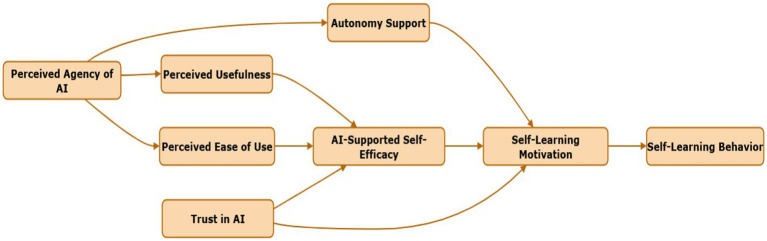
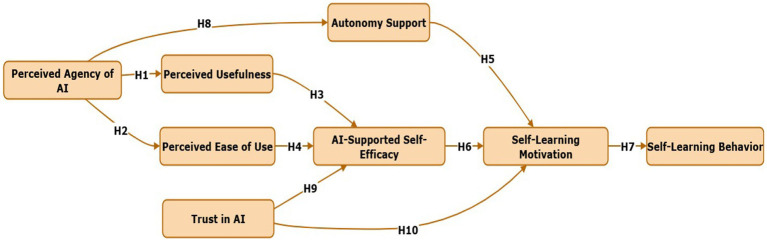
This study integrates TAM, SCT, and SDT to test how perceived agency of AI, usefulness, ease of use, trust, autonomy support, and AI-supported self-efficacy shape self-learning motivation and behavior among higher education students in Saudi Arabia. Perceived AI agency strongly predicted usefulness, ease of use, and autonomy support; ease of use, autonomy support, self-efficacy, and trust predicted motivation, and motivation predicted self-learning behavior, while usefulness and trust did not directly predict self-efficacy.
Key findings
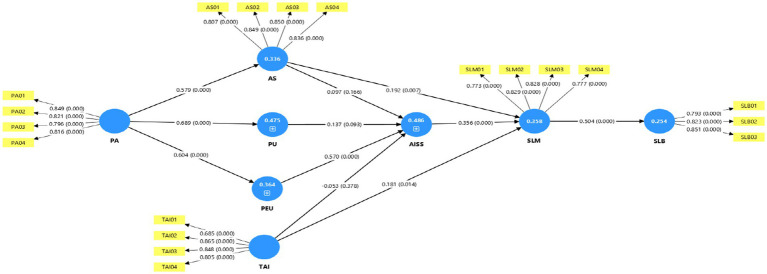
- Perceived agency of AI significantly predicted perceived usefulness (β = 0.689, p < 0.001), perceived ease of use (β = 0.604, p < 0.001), and autonomy support (β = 0.579, p < 0.001).
- Perceived ease of use significantly predicted AI-supported self-efficacy (β = 0.570, p < 0.001), but perceived usefulness (β = 0.137, p = 0.093) and trust in AI (β = −0.053, p = 0.378) did not.
- Autonomy support (β = 0.192, p = 0.007), AI-supported self-efficacy (β = 0.356, p < 0.001), and trust in AI (β = 0.181, p = 0.014) significantly predicted self-learning motivation; self-learning motivation significantly predicted self-learning behavior (β = 0.504, p < 0.001).
- Reported R² values were AISS = 0.486, AS = 0.336, PEU = 0.364, PU = 0.475, SLM = 0.358, and SLB = 0.254.
Methods
- Quantitative cross-sectional survey using a structured Google Forms questionnaire with higher education participants in Saudi Arabia; the abstract reports 280 higher education students, the methods report 320 questionnaires distributed and 280 valid responses, while the results demographic table reports N = 256 and the discussion/conclusion mention 260.
- Non-probability purposive sampling targeted respondents with experience using AI-enabled learning tools; a pilot study with 40 respondents was conducted, and the methods describe respondents as teaching staff/faculties, whereas the results describe students.
- Data were analyzed with PLS-SEM in SmartPLS 4, including measurement model assessment (loadings, VIF, Cronbach’s alpha, CR, AVE, HTMT, Fornell–Larcker) and structural model assessment with bootstrapping (5,000 resamples), R², f², and Q².
Limitations
- Stated by the paper: cross-sectional self-report data from a small, single-nation sample of 280 students in Saudi Arabia limits generalizability; only TAM, SCT, and SDT were integrated; SEM-PLS may miss dynamic or nonlinear interactions; AI literacy, ethics, and cultural context were not explicitly examined.
- Evident in the text: sample size and participant descriptions are inconsistent across sections (280 vs. 256 vs. 260; students vs. teaching staff/faculties), and several reliability/validity threshold statements are internally contradictory (e.g., values described as “below” thresholds when the reported values are above conventional cut-offs).
Model-written summary. Check it against the paper before relying on it.
Integrity signals
Registry
Cites
Statistics
Figures
Verification
Claims the paper makes
1 Valid · 2 Not valid · 51 Not checked · 74 Own results and interpretations
Every source the paper cites for this claim was checked and supports it.
In the paper
“Table 7 shows the results, which reveal that all values for HTMT are strongly below the conservative cut-off value of 0.85 (Henseler et al., 2015), thus ensuring satisfactory discriminant validity.”
§ Exploring the role of agentic AI in fostering self-efficacy, autonomy support, and self-learning motivation in higher education > Results > Measurement model results
What the sources say
- Supportedcites Henseler et al., 2015 matched to “A new criterion for assessing discriminant validity in variance-based structural equation modeling” (2015) source
The citation is attached only to the 0.85 HTMT cut-off, not to the citing authors' own Table 7 values. Our copy supports that characterization twice: in 'Key findings and recommendations' the authors state that 'Of the three approaches, HTMT .85 is the most conservative criterion, as it achieves the lowest specificity rates of all the simulation conditions,' and that 'if the strictest standards are followed, this requires HTMT .85 to assess discriminant validity.' The same section's criterion logic ('if the value of the HTMT is higher than this threshold, one can conclude that there is a lack of discriminant validity') underwrites the inference that values below 0.85 indicate satisfactory discriminant validity; the paper notes the 0.85 figure originates with Clark and Watson (1995) and Kline (2011) but adopts and analyses it as HTMT .85 itself. (LLM, conf=0.87)
boosted- Asserted: passes — The authors put it forward as true.
- Checkable: passes — It can be checked against evidence.
- Load-bearing: passes — The paper’s conclusions depend on it.
- Based: passes — The paper gives a reason why it holds.
- Supported
A result the paper reports from its own data — it cites no other source for it, so there is none to check. The quote shows it is in the paper.
In the paper
“But usefulness and trust in AI failed to influence self-efficacy directly”
§ Exploring the role of agentic AI in fostering self-efficacy, autonomy support, and self-learning motivation in higher education > Abstract > Results
plain- Asserted: passes — The authors put it forward as true.
- Checkable: passes — It can be checked against evidence.
- Load-bearing: passes — The paper’s conclusions depend on it.
- Based: passes — The paper gives a reason why it holds.
- Rests on 4 assumptions not shown here.
A result the paper reports from its own data — it cites no other source for it, so there is none to check. The quote shows it is in the paper.
In the paper
“Self-efficacy and autonomy supporting significantly impact self-learning motivation”
§ Exploring the role of agentic AI in fostering self-efficacy, autonomy support, and self-learning motivation in higher education > Abstract > Results
plainstates a cause- Asserted: passes — The authors put it forward as true.
- Checkable: passes — It can be checked against evidence.
- Load-bearing: passes — The paper’s conclusions depend on it.
- Based: passes — The paper gives a reason why it holds.
- Rests on 4 assumptions not shown here.
A result the paper reports from its own data — it cites no other source for it, so there is none to check. The quote shows it is in the paper.
In the paper
“while ease of use significantly enhances AI-enabled self-efficacy.”
§ Exploring the role of agentic AI in fostering self-efficacy, autonomy support, and self-learning motivation in higher education > Abstract > Results
plainstates a cause- Asserted: passes — The authors put it forward as true.
- Checkable: passes — It can be checked against evidence.
- Load-bearing: passes — The paper’s conclusions depend on it.
- Based: passes — The paper gives a reason why it holds.
- Rests on 4 assumptions not shown here.
A result the paper reports from its own data — it cites no other source for it, so there is none to check. The quote shows it is in the paper.
In the paper
“But usefulness and trust in AI failed to influence self-efficacy directly”
§ Exploring the role of agentic AI in fostering self-efficacy, autonomy support, and self-learning motivation in higher education > Abstract > Results
plain- Asserted: passes — The authors put it forward as true.
- Checkable: passes — It can be checked against evidence.
- Load-bearing: passes — The paper’s conclusions depend on it.
- Based: passes — The paper gives a reason why it holds.
- Rests on 4 assumptions not shown here.
63 more claims
Create a free account to see all 128 claims and to verify the 63 references still open.
- The quote only partly states this claim. 3
- Probably not a substantial claim. 26
- It may state two separate claims as one. 36
Self-check
Percentages, sums and reported differences re-computed from the paper’s own numbers.
Each contradiction between two passages listed here was confirmed by an independent check.
Rated major: it would touch a result — a value a result rests on, reported and recomputed p-values on opposite sides of the significance level, two passages that conflict with no sign which is right, or a cited work retracted before this paper was published.
In the paper
§ Exploring the role of agentic AI in fostering self-efficacy, autonomy support, and self-learning motivation in higher education > Discussion
“According to data from 260 university students in Saudi Arabia and structural equation modeling (SmartPLS 4)”
§ Exploring the role of agentic AI in fostering self-efficacy, autonomy support, and self-learning motivation in higher education > Results > Demographic information of respondents
“Table: Table 3 Demographic profile of participants (N = 256).”
Rated major: it would touch a result — a value a result rests on, reported and recomputed p-values on opposite sides of the significance level, two passages that conflict with no sign which is right, or a cited work retracted before this paper was published.
In the paper
§ Exploring the role of agentic AI in fostering self-efficacy, autonomy support, and self-learning motivation in higher education > Methodology > Data collection and sample
“all the respondents had previous exposure to learning settings with AI assistance.”
§ Exploring the role of agentic AI in fostering self-efficacy, autonomy support, and self-learning motivation in higher education > Results > Demographic information of respondents
“69 respondents (n = 27.0%) who self-identified that they had been first-time users of these tools.”
Rated major: it would touch a result — a value a result rests on, reported and recomputed p-values on opposite sides of the significance level, two passages that conflict with no sign which is right, or a cited work retracted before this paper was published.
In the paper
§ Exploring the role of agentic AI in fostering self-efficacy, autonomy support, and self-learning motivation in higher education > Methodology > Data analysis procedure
“every one of the hypothesized paths under consideration was found to be significant”
§ Exploring the role of agentic AI in fostering self-efficacy, autonomy support, and self-learning motivation in higher education > Results > Structural model results
“| PU→AISS | 0.1370 | 1.6830 | 0.0930 | No |”
Rated major: it would touch a result — a value a result rests on, reported and recomputed p-values on opposite sides of the significance level, two passages that conflict with no sign which is right, or a cited work retracted before this paper was published.
In the paper
§ Exploring the role of agentic AI in fostering self-efficacy, autonomy support, and self-learning motivation in higher education > Methodology > Data analysis procedure
“AI-supported self-efficacy, support for autonomy, and self-learning behavior, all of which were reported to be above 0.60.”
§ Exploring the role of agentic AI in fostering self-efficacy, autonomy support, and self-learning motivation in higher education > Results > Structural model results
“| AISS | 0.486 | 0.478 | 0.151 | | AS | 0.336 | 0.333 | 0.318 |”
Rated major: it would touch a result — a value a result rests on, reported and recomputed p-values on opposite sides of the significance level, two passages that conflict with no sign which is right, or a cited work retracted before this paper was published.
In the paper
§ Exploring the role of agentic AI in fostering self-efficacy, autonomy support, and self-learning motivation in higher education > Results > Measurement model results
“In all the constructs, the square root of the AVE (the diagonal values) was more than the respective inter-construct correlations (off-diagonal values)”
§ Exploring the role of agentic AI in fostering self-efficacy, autonomy support, and self-learning motivation in higher education > Results > Measurement model results
“| SLB | 0.969 | 0.453 | 0.446 | 0.652 | 0.504 | 0.823 | | |”
3 more findings
Create a free account to see every finding of this check.
Cited works that were retracted
Works this paper cites that were later retracted, from the retraction notices publishers deposit. Major when the notice came out before this paper was published.
A note, not an issue: for example, a cited work that was retracted only after this paper was published, which its authors could not have known.
In the paper
“Zhao, 2025, Performance motivation and emotion regulation as drivers of academic competence and problem-solving skills in AI-enhanced preschool education: a SEM study, Br. Educ. Res. J., 10.1002/berj.4196”
Cited work 10.1002/berj.4196 · retracted 2026-04-24 · notice 10.1002/berj.70184 · this paper published 2026-01-22
A note, not an issue: for example, a cited work that was retracted only after this paper was published, which its authors could not have known.
In the paper
“Yao, 2024, Factors influencing pre-service special education teachers’ intention toward AI in education: digital literacy, teacher self-efficacy, perceived ease of use, and perceived usefulness, Heliyon, 10, 22, 10.1016/j.heliyon.2024.e34894”
Cited work 10.1016/j.heliyon.2024.e34894 · retracted 2026-01-22 · notice 10.1016/j.heliyon.2026.e44554 · this paper published 2026-01-22
Citations
Cites
2 retracted
Yao, N., & Wang, Q. (2024) · Heliyon · doi:10.1016/j.heliyon.2024.e34894 · Cited by 150 · cited 1×
“Similarly, investigations among pre-service special education teachers in China have revealed that perceived usefulness and ease of use influence their intention to adopt AI tools, mediated by self-efficacy (Yao and Wang, 2024).”
RetractedZhao, H., Zhang, H., Li, J., & Liu, H. (2026) · British Educational Research Journal · doi:10.1002/berj.4196 · Cited by 8
RetractedPodsakoff, P. M., MacKenzie, S. B., Lee, J.-Y., & Podsakoff, N. P. (2003) · Journal of Applied Psychology · doi:10.1037/0021-9010.88.5.879 · Cited by 82,194
Perceived usefulness, perceived ease of use, and user acceptance of information technology
Davis, F. D. (1989) · MIS Quarterly · doi:10.2307/249008 · Cited by 68,483 · cited 4×
“Items from perceived usefulness and perceived ease of use were drawn from (Davis, 1989; Venkatesh and Davis, 2000).”
InfluentialA new criterion for assessing discriminant validity in variance-based structural equation modeling
Henseler, J., Ringle, C. M., & Sarstedt, M. (2015) · Journal of the Academy of Marketing Science · doi:10.1007/s11747-014-0403-8 · Cited by 38,459
The "what" and "why" of goal pursuits: Human needs and the self-determination of behavior
Deci, E. L., & Ryan, R. M. (2000) · Psychological Inquiry · doi:10.1207/s15327965pli1104_01 · Cited by 34,210
When to Use and How to Report the Results of PLS-SEM
Hair, J. F., Risher, J. J., Sarstedt, M., & Ringle, C. M. (2019) · European Business Review · doi:10.1108/ebr-11-2018-0203 · Cited by 27,541
User Acceptance of Computer Technology: A Comparison of Two Theoretical Models
Davis, F. D., Bagozzi, R. P., & Warshaw, P. R. (1989) · Management Science · doi:10.1287/mnsc.35.8.982 · Cited by 25,709 · cited 5×
“Perceived ease of use (PEU), another foundational TAM construct, denotes how effortless or free of effort the user expects interacting with the system will be (Davis, 1989).”
InfluentialA Theoretical Extension of the Technology Acceptance Model: Four Longitudinal Field Studies
Venkatesh, V., & Davis, F. D. (2000) · Management Science · doi:10.1287/mnsc.46.2.186.11926 · Cited by 23,066
(1985) · Medical Entomology and Zoology · Cited by 19,180
Venkatesh, V., Thong, J. Y. L., & Xu, X. (2012) · MIS Quarterly · doi:10.2307/41410412 · Cited by 15,756
Structural equation models with unobservable variables and measurement error: Algebra and statistics
Fornell, C., & Larcker, D. F. (1981) · Journal of Marketing Research · doi:10.1177/002224378101800313 · Cited by 13,287 · cited 2×
“In all the constructs, the square root of the AVE (the diagonal values) was more than the respective inter-construct correlations (off-diagonal values), thus verifying the fact that each construct shares more variance with its indications than with other constructs (Fornell and Larcker, 1981).”
InfluentialPartial Least Squares Structural Equation Modeling (PLS-SEM) Using R: A Workbook
Hair, J. F., Hult, G. T. M., Ringle, C. M., Sarstedt, M., Danks, N. P., & Ray, S. (2021) · Classroom Companion: Business · doi:10.1007/978-3-030-80519-7 · Cited by 10,343 · cited 7×
“As can be illustrated, all loadings for the items are in the range from 0.755 up to 0.885, which are all above the threshold of 0.70 (Hair Jr et al., 2021), meaning each item sufficiently represents its respective latent construct.”
InfluentialCommon Method Bias in PLS-SEM: A Full Collinearity Assessment Approach
Kock, N. (2015) · International Journal of e-Collaboration · doi:10.4018/ijec.2015100101 · Cited by 10,215
Social Foundations of Thought and Action
Bandura, A. (2002) · The Health Psychology Reader · doi:10.4135/9781446221129.n6 · Cited by 9,902
An assessment of the use of partial least squares structural equation modeling in marketing research
Hair, J. F., Sarstedt, M., Ringle, C. M., & Mena, J. A. (2012) · Journal of the Academy of Marketing Science · doi:10.1007/s11747-011-0261-6 · Cited by 8,088
Venkatesh, V. (2000) · Information Systems Research · doi:10.1287/isre.11.4.342.11872 · Cited by 6,664
Computer Self-Efficacy: Development of a Measure and Initial Test
Compeau, D. R., & Higgins, C. A. (1995) · MIS Quarterly · doi:10.2307/249688 · Cited by 6,553
Zimmerman, B. J. (2000) · Handbook of Self-Regulation · doi:10.1016/b978-012109890-2/50031-7 · Cited by 6,069 · cited 1×
“Self-learning behavior and self-learning motivation were drawn from (Zimmerman, 2000).”
Ryan, R. M., & Deci, E. L. (2020) · Contemporary Educational Psychology · doi:10.1016/j.cedpsych.2020.101860 · Cited by 6,037
Diamantopoulos, A., & Siguaw, J. A. (2006) · British Journal of Management · doi:10.1111/j.1467-8551.2006.00500.x · Cited by 3,410
Hair, J., & Alamer, A. (2022) · Research Methods in Applied Linguistics · doi:10.1016/j.rmal.2022.100027 · Cited by 2,833
Cultivating competence, self-efficacy, and intrinsic interest through proximal self-motivation.
Bandura, A., & Schunk, D. H. (1981) · Journal of Personality and Social Psychology · doi:10.1037/0022-3514.41.3.586 · Cited by 2,675 · cited 1×
“From theory, self-efficacy promotes intrinsic motivation because learners who have confidence see tasks as manageable, set ambitious goals, and understand setbacks as temporary setbacks that allow them to rebound, and so maintain interest and effort (Bandura and Schunk, 1981).”
Reeve, J. (2013) · Journal of Educational Psychology · doi:10.1037/a0032690 · Cited by 1,157 · cited 1×
“Empirical work demonstrates that autonomy support—whether provided by teachers, instructional design, or adaptive technologies— predicts agentic engagement and increases students’ willingness to take initiative in learning (Reeve, 2013; Reeve and Shin, 2020).”
Yi, M. Y., Jackson, J. D., Park, J. S., & Probst, J. C. (2006) · Information & Management · doi:10.1016/j.im.2005.08.006 · Cited by 1,139 · cited 1×
“…of users’ attitudes toward adopting and using technology, which then lead to behavioural intention and actual use (Tam, 2024; Dahri et al., 2024; Mun et al., 2006; Pan and Jordan-Marsh, 2010) defined PU as the degree to which an individual believes that using a specific technology enhances…”
The effects of self-efficacy on computer usage
Igbaria, M. (1995) · Omega · doi:10.1016/0305-0483(95)00035-6 · Cited by 1,030
Promoting reflection in professional courses: The challenge of context
Boud, D., & Walker, D. (1998) · Studies in Higher Education · doi:10.1080/03075079812331380384 · Cited by 980
Trust in AI and Its Role in the Acceptance of AI Technologies
Choung, H., David, P., & Ross, A. (2023) · International Journal of Human–Computer Interaction · doi:10.1080/10447318.2022.2050543 · Cited by 963 · cited 1×
“Trust in AI used items drawn from (Choung et al., 2023).”
Partial Least Squares Structural Equation Modeling
Sarstedt, M., Ringle, C. M., & Hair, J. F. (2021) · Handbook of Market Research · doi:10.1007/978-3-319-05542-8_15-2 · Cited by 876
Consumer trust, perceived security and privacy policy: Three basic elements of loyalty to a web site
Flavián, C., & Guinalíu, M. (2006) · Industrial Management & Data Systems · doi:10.1108/02635570610666403 · Cited by 770
Stajkovic, A. D., & Luthans, F. (1998) · Organizational Dynamics · doi:10.1016/s0090-2616(98)90006-7 · Cited by 758
Lin, C.-C., Huang, A. Y. Q., & Lu, O. H. T. (2023) · Smart Learning Environments · doi:10.1186/s40561-023-00260-y · Cited by 669 · cited 1×
“However, the positive influence of trust on self-learning motivation was in line with from Cui et al. (2025) and Lin et al. (2023), who mentioned that motivated learners to utilize the AI-based systems have been triggered by emotional trust—perceiving that AI will improve fairness, personalization,…”
AI‐driven adaptive learning for sustainable educational transformation
Strielkowski, W., Grebennikova, V., Lisovskiy, A., Rakhimova, G., & Vasileva, T. (2025) · Sustainable Development · doi:10.1002/sd.3221 · Cited by 581
Calisir, F., & Calisir, F. (2004) · Computers in Human Behavior · doi:10.1016/j.chb.2003.10.004 · Cited by 474 · cited 1×
“On the other hand, the strong influence of perceived ease of use confirms the TAM hypothesis that user confidence and satisfaction result from the forming influence of usability (Amin et al., 2014; Calisir and Calisir, 2004).”
Acceptance of artificial intelligence among pre-service teachers: A multigroup analysis
Zhang, C., Schießl, J., Plößl, L., Hofmann, F., & Gläser-Zikuda, M. (2023) · International Journal of Educational Technology in Higher Education · doi:10.1186/s41239-023-00420-7 · Cited by 413
Amin, M., Rezaei, S., & Abolghasemi, M. (2014) · Nankai Business Review International · doi:10.1108/nbri-01-2014-0005 · Cited by 412
Self-Determination Theory in Human Resource Development: New Directions and Practical Considerations
Rigby, C. S., & Ryan, R. M. (2018) · Advances in Developing Human Resources · doi:10.1177/1523422318756954 · Cited by 393
Wang, C., Wang, H., Li, Y., Dai, J., Gu, X., & Yu, T. (2025) · International Journal of Human–Computer Interaction · doi:10.1080/10447318.2024.2383033 · Cited by 353
Bedué, P., & Fritzsche, A. (2022) · Journal of Enterprise Information Management · doi:10.1108/jeim-06-2020-0233 · Cited by 349
Acceptance of artificial intelligence in teaching science: Science teachers' perspective
Al Darayseh, A. (2023) · Computers and Education: Artificial Intelligence · doi:10.1016/j.caeai.2023.100132 · Cited by 323
Yen, D. C., Wu, C.-S., Cheng, F.-F., & Huang, Y.-W. (2010) · Computers in Human Behavior · doi:10.1016/j.chb.2010.02.005 · Cited by 319 · cited 2×
“…are robust predictors of attitudes/intentions/usage in educational contexts involving AI or other technologies; that self-efficacy is a critical mediator, especially under SCT; that autonomy and psychological need satisfaction (from SDT) matter for motivation and self-regulated/ Yen et al., 2010).”
Pan, S., & Jordan-Marsh, M. (2010) · Computers in Human Behavior · doi:10.1016/j.chb.2010.03.015 · Cited by 300
Roth, A., Ogrin, S., & Schmitz, B. (2016) · Educational Assessment, Evaluation and Accountability · doi:10.1007/s11092-015-9229-2 · Cited by 294 · cited 1×
“…increasingly challenged in research on education, due to the inhibitions that they create on students’ motivation and learning of self-regulated behaviors, which are critically needed in higher education and in life continuing learning contexts (de Bruijn-Smolrs et al., 2016; Roth et al., 2016).”
The role of agentic AI in shaping a smart future: A systematic review
Hosseini, S., & Seilani, H. (2025) · Array · doi:10.1016/j.array.2025.100399 · Cited by 280 · cited 2×
“…systems have the potential to magnify that translation from motivation to behavior by suggesting resources, stimulating reflection, and easing friction on exploratory behaviors—thus converting motivation to tangible learning behaviors (Bandi et al., 2025; Hosseini and Seilani, 2025) (Figure 2).”
Vansteenkiste, M., Aelterman, N., De Muynck, G.-J., Haerens, L., Patall, E., & Reeve, J. (2018) · The Journal of Experimental Education · doi:10.1080/00220973.2017.1381067 · Cited by 280
Lin, H., & Chen, Q. (2024) · BMC Psychology · doi:10.1186/s40359-024-01979-0 · Cited by 269
Schunk, D. H. (2012) · APA educational psychology handbook, Vol 1: Theories, constructs, and critical issues. · doi:10.1037/13273-005 · Cited by 250
Mixed methods and survey research in family medicine and community health
Creswell, J. W., & Hirose, M. (2019) · Family Medicine and Community Health · doi:10.1136/fmch-2018-000086 · Cited by 241
Dahri, N. A., Yahaya, N., Al-Rahmi, W. M., Aldraiweesh, A., Alturki, U., Almutairy, S., Shutaleva, A., & Soomro, R. B. (2024) · Heliyon · doi:10.1016/j.heliyon.2024.e29317 · Cited by 239
Getenet, S., Cantle, R., Redmond, P., & Albion, P. (2024) · International Journal of Educational Technology in Higher Education · doi:10.1186/s41239-023-00437-y · Cited by 235
Hu, P. J.-H., & Hui, W. (2012) · Decision Support Systems · doi:10.1016/j.dss.2012.05.014 · Cited by 234
How teachers can support students’ agentic engagement
Reeve, J., & Shin, S. H. (2020) · Theory Into Practice · doi:10.1080/00405841.2019.1702451 · Cited by 213
Chang, P.-C., Zhang, W., Cai, Q., & Guo, H. (2024) · Psychology Research and Behavior Management · doi:10.2147/prbm.s441444 · Cited by 211
Student Interaction with ChatGPT Can Promote Complex Critical Thinking Skills
Suriano, R., Plebe, A., Acciai, A., & Fabio, R. A. (2025) · Learning and Instruction · doi:10.1016/j.learninstruc.2024.102011 · Cited by 208
Bandi, A., Kongari, B., Naguru, R., Pasnoor, S., & Vilipala, S. V. (2025) · Future Internet · doi:10.3390/fi17090404 · Cited by 207 · cited 2×
“Prior studies have predominantly focused on China, Europe, and Western contexts, with limited empirical evidence from Middle Eastern higher education systems (Dahri et al., 2025; Dahri et al., 2025; Bandi et al., 2025).”
Shahzad, M. F., Xu, S., Lim, W. M., Yang, X., & Khan, Q. R. (2024) · Heliyon · doi:10.1016/j.heliyon.2024.e29523 · Cited by 205
Almogren, A. S., Al-Rahmi, W. M., & Dahri, N. A. (2024) · Heliyon · doi:10.1016/j.heliyon.2024.e31887 · Cited by 190
What Explains Teachers’ Trust in AI in Education Across Six Countries?
Viberg, O., Cukurova, M., Feldman-Maggor, Y., Alexandron, G., Shirai, S., Kanemune, S., Wasson, B., Tømte, C., Spikol, D., Milrad, M., et al. (2025) · International Journal of Artificial Intelligence in Education · doi:10.1007/s40593-024-00433-x · Cited by 179
AI agents and agentic systems: a multi-expert analysis
Hughes, L., Dwivedi, Y. K., Malik, T., Shawosh, M., Albashrawi, M. A., Jeon, I., Dutot, V., Appanderanda, M., Crick, T., De’, R., et al. (2025) · Journal of Computer Information Systems · doi:10.1080/08874417.2025.2483832 · Cited by 168 · cited 2×
“In technology-enhanced learning, AI-enabled self-efficacy refers to learners’ beliefs in achieving academic intentions with the help of AI tools (Hughes et al., 2025; Saleh, 2025).”
Building online trust through privacy practices
Lauer, T. W., & Deng, X. (2007) · International Journal of Information Security · doi:10.1007/s10207-007-0028-8 · Cited by 160
Autonomy Support in the Classroom: A Review From Self-Determination Theory
Núñez, J. L., & León, J. (2015) · European Psychologist · doi:10.1027/1016-9040/a000234 · Cited by 159
Xia, Q., Chiu, T. K. F., & Chai, C. S. (2022) · Education and Information Technologies · doi:10.1007/s10639-022-11547-x · Cited by 155
Artificial Intelligence, Trust, and Perceptions of Agency
Vanneste, B. S., & Puranam, P. (2025) · Academy of Management Review · doi:10.5465/amr.2022.0041 · Cited by 149
Dahri, N. A., Yahaya, N., Al-Rahmi, W. M., Vighio, M. S., Alblehai, F., Soomro, R. B., & Shutaleva, A. (2024) · Education and Information Technologies · doi:10.1007/s10639-024-12599-x · Cited by 144
Xu, Z., Zhao, Y., Zhang, B., Liew, J., & Kogut, A. (2023) · Behaviour & Information Technology · doi:10.1080/0144929x.2022.2151935 · Cited by 128
What Determines AI Adoption in Companies? Mixed-Method Evidence
Polisetty, A., Chakraborty, D., G, S., Kar, A. K., & Pahari, S. (2024) · Journal of Computer Information Systems · doi:10.1080/08874417.2023.2219668 · Cited by 128
Al-Abdullatif, A. M., & Alsubaie, M. A. (2024) · Behavioral Sciences · doi:10.3390/bs14090845 · Cited by 126
The Rise of Agentic AI: Implications, Concerns, and the Path Forward
Murugesan, S. (2025) · IEEE Intelligent Systems · doi:10.1109/mis.2025.3544940 · Cited by 126
Howard, J. L., Slemp, G. R., & Wang, X. (2025) · Personality and Social Psychology Bulletin · doi:10.1177/01461672231225364 · Cited by 114
How does HCI Understand Human Agency and Autonomy?
Bennett, D., Metatla, O., Roudaut, A., & Mekler, E. D. (2023) · Proceedings of the 2023 CHI Conference on Human Factors in Computing Systems · doi:10.1145/3544548.3580651 · Cited by 111
The role of institutional and self in the formation of trust in artificial intelligence technologies
Wong, L.-W., Tan, G. W.-H., Ooi, K.-B., & Dwivedi, Y. (2024) · Internet Research · doi:10.1108/intr-07-2021-0446 · Cited by 105
Falebita, O. S., & Kok, P. J. (2025) · Journal for STEM Education Research · doi:10.1007/s41979-024-00132-1 · Cited by 103
Aldraiweesh, A., & Alturki, U. (2025) · IEEE Access · doi:10.1109/access.2025.3534099 · Cited by 98
Hidayat-ur-Rehman, I. (2024) · Journal of Research in Innovative Teaching & Learning · doi:10.1108/jrit-05-2024-0136 · Cited by 95
Shao, C., Nah, S., Makady, H., & McNealy, J. (2024) · International Journal of Human–Computer Interaction · doi:10.1080/10447318.2024.2331858 · Cited by 94 · cited 2×
“This result, however, corresponds with new AI-related research that indicates that usefulness perceptions do not necessarily construct self-efficacy in the absence of experiential engagement and faith (Chang et al., 2024; Shao et al., 2025).”
Wu, D., Zhang, S., Ma, Z., Yue, X.-G., & Dong, R. K. (2024) · Systems · doi:10.3390/systems12090332 · Cited by 91
Attitudes, perceptions and AI self-efficacy in K-12 education
Bergdahl, N., & Sjöberg, J. (2025) · Computers and Education: Artificial Intelligence · doi:10.1016/j.caeai.2024.100358 · Cited by 86
Şimşek, A. S., Cengiz, G. Ş. T., & Bal, M. (2025) · Education and Information Technologies · doi:10.1007/s10639-025-13591-9 · Cited by 81
Xu, Q., Liu, Y., & Li, X. (2025) · Learning and Motivation · doi:10.1016/j.lmot.2025.102138 · Cited by 79
Chen, X., Jiang, L., Zhou, Z., & Li, D. (2025) · Acta Psychologica · doi:10.1016/j.actpsy.2025.105217 · Cited by 78
Interacting with ChatGPT for internal feedback and factors affecting feedback quality
Tam, A. C. F. (2025) · Assessment & Evaluation in Higher Education · doi:10.1080/02602938.2024.2374485 · Cited by 77
Digital Education Revolution: Evaluating LMS-based Learning and Traditional Approaches
Munna, M. S. H., Hossain, M. R., & Saylo, K. R. (2024) · Journal of Innovative Technology Convergence · doi:10.69478/jitc2024v6n002a03 · Cited by 74
de Bruijn-Smolders, M., Timmers, C. F., Gawke, J. C. L., Schoonman, W., & Born, M. P. (2016) · Studies in Higher Education · doi:10.1080/03075079.2014.915302 · Cited by 71
The effects of autonomy support on student engagement in peer assessment
Yuan, J., & Kim, C. (2017) · Educational Technology Research and Development · doi:10.1007/s11423-017-9538-x · Cited by 69
Thabet, Z., Albashtawi, S., Ansari, H., Al‐Emran, M., Al-Sharafi, M. A., & AlQudah, A. A. (2023) · IEEE Transactions on Engineering Management · doi:10.1109/tem.2023.3296132 · Cited by 69
Jeilani, A., & Abubakar, S. (2025) · Frontiers in Education · doi:10.3389/feduc.2025.1548900 · Cited by 64
Moore, M. E., Vega, D. M., Wiens, K. M., & Caporale, N. (2020) · Journal of Microbiology and Biology Education · doi:10.1128/jmbe.v21i1.1955 · Cited by 64
The language-minority student and special education: issues, trends, and paradoxes
Gersten, R., & Woodward, J. (1994) · Exceptional Children · doi:10.1177/001440299406000403 · Cited by 63
He, T., Huang, J., Li, Y., Wang, L., Liu, J., Zhang, F., Fu, S., & Gong, S. (2025) · Nurse Education in Practice · doi:10.1016/j.nepr.2025.104499 · Cited by 63
Rasheed, H. M. W., Chen, Y., Khizar, H. M. U., & Safeer, A. A. (2023) · Heliyon · doi:10.1016/j.heliyon.2023.e16968 · Cited by 61
Jia, D., Bhatti, A., & Nahavandi, S. (2012) · Behaviour and Information Technology · doi:10.1080/0144929x.2012.681067 · Cited by 56
Musyaffi, A. M., Adha, M. A., Mukhibad, H., & Oli, M. C. (2024) · Social Sciences & Humanities Open · doi:10.1016/j.ssaho.2024.101168 · Cited by 56
Liu, L. (2025) · Education and Information Technologies · doi:10.1007/s10639-024-13296-5 · Cited by 54
Cultural and linguistic diversity and the special education workforce: a critical overview
Tyler, N. C., Yzquierdo, Z., Lopez-Reyna, N., & Saunders Flippin, S. (2004) · The Journal of Special Education · doi:10.1177/00224669040380010301 · Cited by 53
Han, J., & Ko, D. (2025) · Behavioral Sciences · doi:10.3390/bs15040534 · Cited by 53
Chen, J. (2022) · Frontiers in Psychology · doi:10.3389/fpsyg.2022.1021101 · Cited by 51
Miao, J., & Ma, L. (2023) · Sage Open · doi:10.1177/21582440231217737 · Cited by 51
Alwakid, W. N., & Dahri, N. A. (2025) · Technology in Society · doi:10.1016/j.techsoc.2025.103007 · Cited by 51
Fan, J., & Zhang, Q. (2024) · Heliyon · doi:10.1016/j.heliyon.2024.e37158 · Cited by 47
Kalantzis, M., & Cope, B. (2004) · E-Learning and Digital Media · doi:10.2304/elea.2004.1.1.7 · Cited by 44
Shi, S., & Zhang, H. (2025) · Learning and Motivation · doi:10.1016/j.lmot.2025.102151 · Cited by 44
Beyond assistance: embracing AI as a collaborative co-agent in education
Katsenou, R., Kotsidis, K., Papadopoulou, A., Anastasiadis, P., & Deliyannis, I. (2025) · Education Sciences · doi:10.3390/educsci15081006 · Cited by 43
Lyu, W., & Salam, Z. A. (2025) · Learning and Motivation · doi:10.1016/j.lmot.2025.102129 · Cited by 42
Pathak, A., & Bansal, V. (2024) · Computers in Human Behavior: Artificial Humans · doi:10.1016/j.chbah.2024.100094 · Cited by 40 · cited 2×
“Empirical research in human-AI interaction finds that increasing perceived autonomy or adaptiveness raises user expectations of usefulness (e.g., AI as decision aid; Pathak et al.’s work on AI agents) (Pathak and Bansal, 2024).”
Almogren, A. S., Al-Rahmi, W. M., & Dahri, N. A. (2024) · IEEE Access · doi:10.1109/access.2024.3498047 · Cited by 36
Dahri, N. A., Al-Rahmi, W. M., Alhashmi, K. A., & Shaikh, F. B. (2025) · International Journal of Interactive Mobile Technologies (iJIM) · doi:10.3991/ijim.v19i11.54643 · Cited by 34
Dahri, N. A., Yahaya, N., Vighio, M. S., & Jumaat, N. F. (2025) · Education and Information Technologies · doi:10.1007/s10639-025-13539-z · Cited by 32
Zhou, C., Ren, T., & Lang, L. (2025) · Education and Information Technologies · doi:10.1007/s10639-025-13646-x · Cited by 31
Khan, N. A., Maialeh, R., Akhtar, M., & Ramzan, M. (2024) · Public Organization Review · doi:10.1007/s11115-024-00770-4 · Cited by 29
Patall, E. A., Kennedy, A. A. U., Yates, N., Zambrano, J., Lee, D., & Vite, A. (2022) · Contemporary Educational Psychology · doi:10.1016/j.cedpsych.2022.102097 · Cited by 27
Tuffahati, N. N., & Nugraha, J. (2021) · Jurnal TAM (Technology Acceptance Model) · doi:10.56327/jurnaltam.v12i1.1005 · Cited by 17
Amoozegar, A., Abdelmagid, M., & Anjum, T. (2024) · Open Learning: The Journal of Open, Distance and e-Learning · doi:10.1080/02680513.2022.2102417 · Cited by 17
Han, Y., Yang, S., Han, S., He, W., Bao, S., & Kong, J. (2025) · Education and Information Technologies · doi:10.1007/s10639-025-13375-1 · Cited by 16
Almusharraf, A., & Bailey, D. (2025) · Computer Assisted Language Learning · doi:10.1080/09588221.2023.2275141 · Cited by 15
Wang, M. (2024) · Perceptual and Motor Skills · doi:10.1177/00315125241272672 · Cited by 14
Dahri, N. A., Dahri, F. H., Laghari, A. A., & Javed, M. (2025) · Complex Engineering Systems · doi:10.20517/ces.2025.07 · Cited by 14
Massaty, M. H., Fahrurozi, S. K., & Budiyanto, C. W. (2024) · IJIE (Indonesian Journal of Informatics Education) · doi:10.20961/ijie.v8i1.89596 · Cited by 13
Xia, L., An, X., Li, X., & Dong, Y. (2026) · Journal of Educational Computing Research · doi:10.1177/07356331251382853 · Cited by 13
What shapes learners’ trust in AI? A meta-analytic review of its antecedents and consequences
Cui, Y. L., Lin Zeng, M., Ke Du, X., & Miao He, W. (2025) · IEEE Access · doi:10.1109/access.2025.3611367 · Cited by 12
Saleh, E. (2025) · East Journal of Human Science · doi:10.63496/ejhs.vol1.iss6.182 · Cited by 11
Hu, Y.-H., Yu, H.-Y., & Hsieh, C.-L. (2025) · Education and Information Technologies · doi:10.1007/s10639-025-13784-2 · Cited by 10
Gkanatsiou, M. A., Triantari, S., Tzartzas, G., Kotopoulos, T., & Gkanatsios, S. (2025) · Technologies · doi:10.3390/technologies13090396 · Cited by 8
The Role of Self-efficacy in Self-regulation Learning in Online College Courses
Glenn, I. (2018) · ProQuest Demo Repository · Cited by 7
Gu, F., Xu, H., & He, D. (2024) · Proceedings of the Human Factors and Ergonomics Society Annual Meeting · doi:10.1177/10711813241274423 · Cited by 6
Salatino, A., Prével, A., Caspar, É. A., & Bue, S. L. (2025) · Acta Psychologica · doi:10.1016/j.actpsy.2025.105350 · Cited by 6
Yang, M., Lovett, N., Li, B., & Hou, Z. (2025) · Education Sciences · doi:10.3390/educsci15081004 · Cited by 4
The motivational paths to self-regulated language learning: a structural equation modeling approach
ZabihiAtergeleh, N., Ahmadian, M., & Najafi Karimi, S. (2025) · Studies in Self-Access Learning Journal · doi:10.37237/202501 · Cited by 2
(1994)
Research works printed but not linked: 6
- Aldegether R. (2020). Saudi Arabia’s vision 2030: approaches to multicultural education and training. Int. J. Innov. Creat. Chang. 12, 92– 102.
- Bryman A. (2016). Social research methods. New York, USA: Oxford University Press.
- Faas C. Bergs R. Sterz S. Langer M. Feit A. M. (2024). Give me a choice: the consequences of restricting choices through AI-support for perceived autonomy, motivational variables, and decision performance. arXiv Prepr. arXiv2410.07728. doi: 10.1016/j.heliyon.2024.e31887 · doi:10.1016/j.heliyon.2024.e31887 · Paper page
- Hair J. F. Jr. Hult G. T. M. Ringle C. M. Sarstedt M. (2021). A primer on partial least squares structural equation modelling (PLS-SEM). London: Sage Publications. · DOI · Paper page
- Hair J. Jr. Hair J. F. Jr. Hult G. T. M. Ringle C. M. Sarstedt M. (2021). A primer on partial least squares structural equation modeling (PLS-SEM). Los Angeles, CA: Sage publications. · DOI · Paper page
- Ok E. An evaluation of the learning management system for increasing student engagement in higher education a review 2025
Cited by
Sampah, S. N. A., Nabang, M., Krampa, E. K., Issah, M., Koduah, F., Essel, H. B., & Adu-Agyem, J. (2026) · Journal of Interdisciplinary Studies in Education · doi:10.32674/3s3cx241 · Cited by 20
From Self-Learners to System-Dependents: The Negative Effects of AI on EFL Autonomy in Jordan
Rababah, L. M., Al-Namarneh, S. I., Rababah, H. A., & Ismail, I. A. (2026) · Digital Technologies Research and Applications · doi:10.54963/dtra.v5i2.2081 · Cited by 7
Salah, M., Al-Busaidi, R. S., Al-Ghawi, A. S., & Shawky, W. M. (2026) · Frontiers in Education · doi:10.3389/feduc.2026.1902833 · Cited by 7
From disengaged to self-determined: A latent transition analysis of students’ AI learning motivation
Liang, S., Yau, K. W., Meng, H. M. L., Chiu, T. K. F., King, I., Yam, Y., & Chai, C. S. (2026) · Education and Information Technologies · doi:10.1007/s10639-026-13998-y · Cited by 5
When AI enables and undermines: dual mechanisms linking AI usage to task performance
Zhang, W., Chang, P., & Geng, X. (2026) · Humanities and Social Sciences Communications · doi:10.1057/s41599-026-08454-8 · Cited by 3
Metadata
- Authors
- Alqurni, J.
- Affiliations
- Imam Abdulrahman Bin Faisal University (SA)
- Corresponding author
- Alqurni, Jehad
- ORCID
- Alqurni, Jehad
- Venue
- Frontiers in Artificial Intelligence
- Publisher
- Frontiers Media SA
- Published
- 2026-01-22
- Volume
- 9
- Pages
- 1738774-1738774
- ISSN
- 2624-8212 (ISSN-L)
- PMC
- PMC12872872
- OpenAlex
- W7125411310
- Cited by
- 58
- References
- 126
- Citations by year
- 2026: 58
- FWCI
- 228.31
- Type
- journal article
- Language
- en
- Open access
- gold
- doi.org
- Licence
- Locations
- Frontiers in Artificial Intelligence (publishedVersion, cc-by)
- Europe PMC (PubMed Central) (publishedVersion, cc-by)
- PubMed (publishedVersion)
- PubMed Central (publishedVersion, cc-by)
- DOAJ (DOAJ: Directory of Open Access Journals) (submittedVersion, cc-by-sa)
- Topics
- Social Sciences › Education › Artificial Intelligence in Education
- Social Sciences › Decision Sciences › Information Systems and Management › Technology Adoption and User Behaviour
- Physical Sciences › Computer Science › Artificial Intelligence › Intelligent Tutoring Systems and Adaptive Learning
- Keywords
- agentic AI, self-efficacy, autonomy support, self-directed learning, university students, perceived usefulness, perceived ease of use, trust in AI, technology acceptance, self-determination theory, social cognitive theory
About these checks
Registry, retraction, Cites and statistics results are computed, not judged, with one exception: a printed reference that no index lists is read once by a model before it counts as a citation error. Claims are extracted by a model and kept only when their quote appears verbatim in the text; each cited source is then checked, with a model’s help, for whether it says what the claim relies on. Those verdicts can be wrong — read the claim’s quote and the cited source before relying on one.
A language model drew the claims from the paper on 2026-11-18, under version 3 of the claim definition (model deepseek-v4.1-flash, prompt extract-v3).
A second model labelled each claim on 2026-11-18 (model jev-1.13-20260917, definition revision gold-guideline-v0.2).
Cited sources are checked with a language model’s help (qwen3.8-omni-flash).
Statistics and arithmetic are recomputed, not judged.
Confidence bands are shown only for fields calibrated on our annotated test set. None is calibrated yet, so no band is shown.
What counts as a claim ›How we measure confidence ›How we check this ›
Are you an author, or do you see a problem with this page? Request a review
Data sources
Bibliographic data: Semantic Scholar, OpenAlex, Crossref.
Contains information from the Semantic Scholar Academic Graph Datasets, made available under the ODC Attribution License (ODC-BY 1.0).
Semantic Scholar’s data is described in: Kinney, R., et al. (2023). The Semantic Scholar Open Data Platform. arXiv:2301.10140.
