

Risk Calculators in Bipolar Disorder: A Systematic Review
Open accessThe DOI matches its Crossref record; 40 of the 40 references it cites were found in a registry or an index.
Abstract
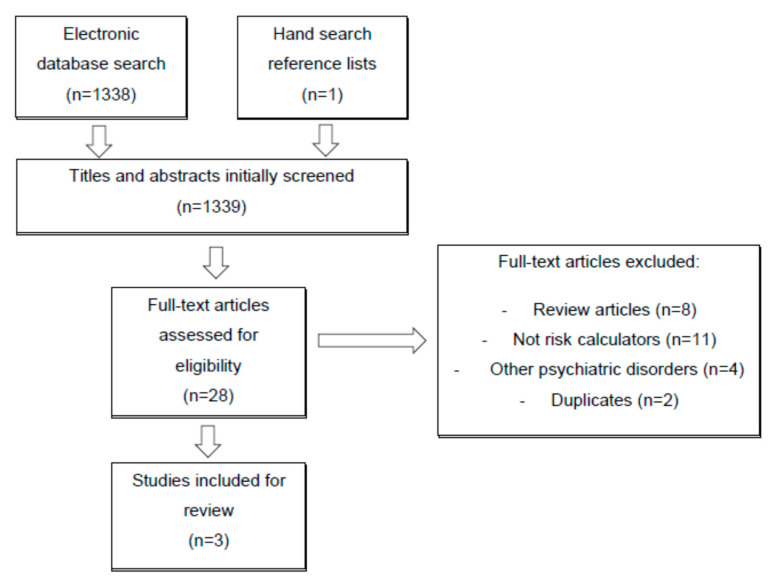
Introduction: Early recognition of bipolar disorder improves the prognosis and decreases the burden of the disease. However, there is a significant delay in diagnosis. Multiple risk factors for bipolar disorder have been identified and a population at high-risk for the disorder has been more precisely defined. These advances have allowed the development of risk calculators to predict individual risk of conversion to bipolar disorder. This review aims to identify the risk calculators for bipolar disorder and assess their clinical applicability. Methods: A systematic review of original studies on the development of risk calculators in bipolar disorder was performed. The studies’ quality was evaluated with the Newcastle-Ottawa Quality Assessment Form for Cohort Studies and according to recommendations of the Transparent Reporting of a multivariable prediction model for Individual Prognosis or Diagnosis Initiative. Results: Three studies met the inclusion criteria; one developed a risk calculator of conversion from major depressive episode to bipolar disorder; one of conversion to new-onset bipolar spectrum disorders in offspring of parents with bipolar disorder; and the last one of conversion in youths with bipolar disorder not-otherwise-specified. Conclusions: The calculators reviewed in this article present good discrimination power for bipolar disorder, although future replication and validation of the models is needed.
Overview
The claims and statistics of this paper haven’t been checked yet.
Free: it reads the open-access text and checks the first 5 claims that cite a source we can check. Create a free account to check every claim.
Integrity signals
Registry
Cites
Statistics
Figures
Verification
Claims the paper makes
The claims and statistics of this paper haven’t been checked yet.
Free: it reads the open-access text and checks the first 5 claims that cite a source we can check. Create a free account to check every claim.
Self-check
Percentages, sums and reported differences re-computed from the paper’s own numbers.
The self-check needs the paper’s full text.
Citations
Cites
Preferred Reporting Items for Systematic Reviews and Meta-Analyses: the PRISMA statement
Moher, D., Liberati, A., Tetzlaff, J., Altman, D. G., & for the PRISMA Group (2009) · BMJ · doi:10.1136/bmj.b2535 · Cited by 83,823
Preferred Reporting Items for Systematic Reviews and Meta-Analyses: The PRISMA Statement
Moher, D., Liberati, A., Tetzlaff, J., Altman, D. G., & The PRISMA Group (2009) · PLoS Medicine · doi:10.1371/journal.pmed.1000097 · Cited by 64,042 · cited 1×
“We performed a systematic review according to Preferred Reporting Items for Systematic Review and Meta-Analysis (PRISMA) guidelines [24].”
Wang, G., Ma, R., Qiao, G., Wada, K., Aizawa, Y., & Satoh, T. (2015) · Integrative Medicine International · doi:10.1159/000368408 · Cited by 18,657
Moons, K. G. M., Altman, D. G., Reitsma, J. B., Ioannidis, J. P. A., Macaskill, P., Steyerberg, E. W., Vickers, A. J., Ransohoff, D. F., & Collins, G. S. (2015) · Annals of Internal Medicine · doi:10.7326/m14-0698 · Cited by 5,147 · cited 1×
“The quality of the risk models’ development and validation was assessed in accordance with the recommendations of the Transparent Reporting of a multivariable prediction model for Individual Prognosis Or Diagnosis (TRIPOD) Initiative [26].”
MethodYatham, L., & Malhi, G. (2011) · Oxford University Press eBooks · doi:10.1093/med/9780199562305.001.0001 · Cited by 3,506
Estimating the true global burden of mental illness
Vigo, D., Thornicroft, G., & Atun, R. (2016) · The Lancet Psychiatry · doi:10.1016/s2215-0366(15)00505-2 · Cited by 2,494
Grande, I., Berk, M., Birmaher, B., & Vieta, E. (2016) · The Lancet · doi:10.1016/s0140-6736(15)00241-x · Cited by 1,710
Self-citationRisk prediction models: II. External validation, model updating, and impact assessment
Moons, K. G. M., Kengne, A. P., Grobbee, D. E., Royston, P., Vergouwe, Y., Altman, D. G., & Woodward, M. (2012) · Heart · doi:10.1136/heartjnl-2011-301247 · Cited by 1,195 · cited 2×
“the risk to develop a certain medical condition and its individual management [29].”
BackgroundMethodVieta, E., Berk, M., Schulze, T. G., Carvalho, A. F., Suppes, T., Calabrese, J. R., Gao, K., Miskowiak, K. W., & Grande, I. (2018) · Nature Reviews Disease Primers · doi:10.1038/nrdp.2018.8 · Cited by 891
Self-citationMoons, K. G. M., Kengne, A. P., Woodward, M., Royston, P., Vergouwe, Y., Altman, D. G., & Grobbee, D. E. (2012) · Heart · doi:10.1136/heartjnl-2011-301246 · Cited by 889 · cited 1×
“Risk calculators estimate the probability of an individual to develop a particular outcome based on different predictors, such as demographic variables, clinical evaluation, and complementary diagnostic exam results [30].”
BackgroundBipolar disorder diagnosis: challenges and future directions
Phillips, M. L., & Kupfer, D. J. (2013) · The Lancet · doi:10.1016/s0140-6736(13)60989-7 · Cited by 665 · cited 1×
“Different clinical and sociodemographic factors also have been pointed out as predictors of a higher risk of progression to BP in depressed patients, the most consistent being a family history of BP, earlier age at onset, presence of psychotic symptoms, atypical depressive symptoms, and subthreshold manic symptoms [7,…”
BackgroundAn Individualized Risk Calculator for Research in Prodromal Psychosis
Cannon, T. D., Yu, C., Addington, J., Bearden, C. E., Cadenhead, K. S., Cornblatt, B. A., Heinssen, R., Jeffries, C. D., Mathalon, D. H., McGlashan, T. H., et al. (2016) · American Journal of Psychiatry · doi:10.1176/appi.ajp.2016.15070890 · Cited by 574
Carvalho, A. F., Firth, J., & Vieta, E. (2020) · New England Journal of Medicine · doi:10.1056/nejmra1906193 · Cited by 562
Self-citationEarly Intervention in Bipolar Disorder
Vieta, E., Salagre, E., Grande, I., Carvalho, A. F., Fernandes, B. S., Berk, M., Birmaher, B., Tohen, M., & Suppes, T. (2018) · American Journal of Psychiatry · doi:10.1176/appi.ajp.2017.17090972 · Cited by 354 · cited 2×
“treatments that minimize the consequences of the disease than on prevention and early intervention [33].”
BackgroundSelf-citationKapczinski, F., Magalhães, P. V. S., Balanzá‐Martinez, V., Dias, V. V., Frangou, S., Gama, C. S., Gonzalez‐Pinto, A., Grande, I., Ha, K., Kauer‐Sant'Anna, M., et al. (2014) · Acta Psychiatrica Scandinavica · doi:10.1111/acps.12305 · Cited by 217
Self-citationThe Science of Prognosis in Psychiatry: A Review
Fusar-Poli, P., Hijazi, Z., Stahl, D., & Steyerberg, E. W. (2018) · JAMA Psychiatry · doi:10.1001/jamapsychiatry.2018.2530 · Cited by 197
Rowland, T., Perry, B. I., Upthegrove, R., Barnes, N., Chatterjee, J., Gallacher, D., & Marwaha, S. (2018) · The British Journal of Psychiatry · doi:10.1192/bjp.2018.144 · Cited by 196
Meta-analysis of the Interval between the Onset and Management of Bipolar Disorder
Dagani, J., Signorini, G., Nielssen, O., Bani, M., Pastore, A., Girolamo, G. D., & Large, M. (2017) · The Canadian Journal of Psychiatry · doi:10.1177/0706743716656607 · Cited by 183 · cited 2×
“mood variations during childhood and adolescence, as well as the greater frequency of a depressive onset in those patients [2,3,5].”
BackgroundVan Meter, A. R., Burke, C., Youngstrom, E. A., Faedda, G. L., & Correll, C. U. (2016) · Journal of the American Academy of Child & Adolescent Psychiatry · doi:10.1016/j.jaac.2016.04.017 · Cited by 174 · cited 1×
“A recent meta-analysis, of early manifestations of BP in youth, however, found a variety of prodromal symptoms in this population, the most frequent being increased energy, diminished ability to think, indecision, pressured speech, talkativeness, elated mood, academic or work difficulties, insomnia, depressed mood, an…”
BackgroundHafeman, D. M., Merranko, J., Goldstein, T. R., Axelson, D., Goldstein, B. I., Monk, K., Hickey, M. B., Sakolsky, D., Diler, R., Iyengar, S., et al. (2017) · JAMA Psychiatry · doi:10.1001/jamapsychiatry.2017.1763 · Cited by 173 · cited 7×
“Hafeman et al. (2017) N = 412 Bipolar at-risk (offspring of BP I and II) completing 5-year follow-up Mania Depression Anxiety Emotional lability Functioning Offspring age at visit Parental age at mood disorder onset 1.”
BackgroundMethodInfluentialAltamura, A. C., Buoli, M., Caldiroli, A., Caron, L., Cumerlato Melter, C., Dobrea, C., Cigliobianco, M., & Zanelli Quarantini, F. (2015) · Journal of Affective Disorders · doi:10.1016/j.jad.2015.04.024 · Cited by 162 · cited 1×
“Sometimes patients with bipolar disorder may also be misdiagnosed with other psychiatric disorders, such as psychotic or substance use disorders, whenever psychotic symptoms or substance misuse prevail and mask affective symptoms [10,11].”
BackgroundAreas of uncertainties and unmet needs in bipolar disorders: clinical and research perspectives
Bauer, M., Andreassen, O. A., Geddes, J. R., Kessing, L. V., Lewitzka, U., Schulze, T. G., & Vieta, E. (2018) · The Lancet Psychiatry · doi:10.1016/s2215-0366(18)30253-0 · Cited by 157 · cited 3×
“mood variations during childhood and adolescence, as well as the greater frequency of a depressive onset in those patients [2,3,5].”
BackgroundSelf-citationMisdiagnosis of bipolar disorder.
Singh, T., & Rajput, M. I. (2006) · PubMed · Cited by 150
Ratheesh, A., Davey, C., Hetrick, S., Alvarez‐Jimenez, M., Voutier, C., Bechdolf, A., McGorry, P. D., Scott, J., Berk, M., & Cotton, S. M. (2017) · Acta Psychiatrica Scandinavica · doi:10.1111/acps.12686 · Cited by 142 · cited 1×
“Different clinical and sociodemographic factors also have been pointed out as predictors of a higher risk of progression to BP in depressed patients, the most consistent being a family history of BP, earlier age at onset, presence of psychotic symptoms, atypical depressive symptoms, and subthreshold manic symptoms [7,…”
BackgroundFaedda, G. L., Baldessarini, R. J., Marangoni, C., Bechdolf, A., Berk, M., Birmaher, B., Conus, P., DelBello, M. P., Duffy, A. C., Hillegers, M. H. J., et al. (2019) · Bipolar Disorders · doi:10.1111/bdi.12831 · Cited by 124 · cited 1×
“Evidence suggests the existence of a period of subthreshold and nonspecific symptoms (prodrome) before the full manifestation of the illness [14].”
BackgroundSelf-citationToward Precision Psychiatry in Bipolar Disorder: Staging 2.0
Salagre, E., Dodd, S., Aedo, A., Rosa, A., Amoretti, S., Pinzon, J., Reinares, M., Berk, M., Kapczinski, F. P., Vieta, E., et al. (2018) · Frontiers in Psychiatry · doi:10.3389/fpsyt.2018.00641 · Cited by 106 · cited 2×
“tools cannot be used in isolation, since the individual pattern of symptoms, as well as their temporal evolution, are essential for proper and truly personalized diagnosis and intervention [31].”
BackgroundSelf-citationStaging bipolar disorder: clinical, biochemical, and functional correlates
Grande, I., Magalhães, P. V., Chendo, I., Stertz, L., Panizutti, B., Colpo, G. D., Rosa, A. R., Gama, C. S., Kapczinski, F., & Vieta, E. (2014) · Acta Psychiatrica Scandinavica · doi:10.1111/acps.12268 · Cited by 99
Self-citationFusar-Poli, P., Werbeloff, N., Rutigliano, G., Oliver, D., Davies, C., Stahl, D., McGuire, P., & Osborn, D. (2019) · Schizophrenia Bulletin · doi:10.1093/schbul/sby070 · Cited by 95
Birmaher, B., Merranko, J. A., Goldstein, T. R., Gill, M. K., Goldstein, B. I., Hower, H., Yen, S., Hafeman, D., Strober, M., Diler, R. S., et al. (2018) · Journal of the American Academy of Child & Adolescent Psychiatry · doi:10.1016/j.jaac.2018.05.023 · Cited by 81 · cited 10×
“recruited youths with BP Not-OtherwiseSpecified (BP-NOS) from the Cou s and Outcome of Bipolar Youth (COBY) study and developed a risk calculator of conv rsion to BP-I or II [18].”
BackgroundMethodInfluentialHartmann, J. A., Nelson, B., Ratheesh, A., Treen, D., & McGorry, P. D. (2019) · Psychological Medicine · doi:10.1017/s0033291718001435 · Cited by 80 · cited 1×
“or early adult years (mean age ~20 years old), that is, before or during the most productive period of adulthood [3,4].”
BackgroundRisk Prediction Models in Psychiatry: Toward a New Frontier for the Prevention of Mental Illnesses
Bernardini, F., Attademo, L., Cleary, S. D., Luther, C., Shim, R. S., Quartesan, R., & Compton, M. T. (2017) · The Journal of Clinical Psychiatry · doi:10.4088/jcp.15r10003 · Cited by 70
Woo, Y. S., Shim, I. H., Wang, H.-R., Song, H. R., Jun, T., & Bahk, W. (2014) · Journal of Affective Disorders · doi:10.1016/j.jad.2014.11.034 · Cited by 55
Serum uric acid as a predictor of bipolarity in individuals with a major depressive episode
Oliveira, P., Santos, V., Coroa, M., Ribeiro, J. S., & Madeira, N. G. G. F. (2018) · Bipolar Disorders · doi:10.1111/bdi.12708 · Cited by 52
Self-citationMalhi, G. S., Bargh, D. M., Coulston, C. M., Das, P., & Berk, M. (2014) · Bipolar Disorders · doi:10.1111/bdi.12133 · Cited by 51
Gan, Z., Diao, F., Wei, Q., Wu, X., Cheng, M., Guan, N., Zhang, M., & Zhang, J. (2011) · Journal of Affective Disorders · doi:10.1016/j.jad.2011.05.054 · Cited by 38 · cited 7×
“Article SampleCharacteristics Variables Included in the Model Variables Assessment Risk Prediction Statistics Classification Statistics Main Conclusions/Outcomes Limitations Gan et al. (2011) N = 344 patients with major depressive episodes; 268 completing 1-year follow-up Proportion of the outcome = 63% (n = 169) Age…”
BackgroundInfluentialThe role of comorbidities in duration of untreated illness for bipolar spectrum disorders
Murru, A., Primavera, D., Oliva, M., Meloni, M., Vieta, E., & Carpiniello, B. (2015) · Journal of Affective Disorders · doi:10.1016/j.jad.2015.09.009 · Cited by 36
Self-citationIs there a clinical prodrome of bipolar disorder? A review of the evidence
Martin, D. J., & Smıth, D. J. (2013) · Expert Review of Neurotherapeutics · doi:10.1586/ern.12.149 · Cited by 33
DelBello, M. P. (2018) · Journal of the American Academy of Child & Adolescent Psychiatry · doi:10.1016/j.jaac.2018.07.871 · Cited by 11
Pinna, M., & Manchia, M. (2014) · Biomarkers in Medicine · doi:10.2217/bmm.13.153 · Cited by 2 · cited 2×
“Although many risk factors for conversion to BP have been identified, there is a need to develop tools that are easy to access and use, such as risk calculators, that allow clinicians to quantify the individual risk of conversion to BP and support them in choosing more specific therapeutic approaches [13].”
BackgroundHarrell, F., Jr. (1996) · doi:10.1002/(sici)1097-0258(19960229)15:4<361::aid-sim168>3.0.co;2-4
Cited by
Meehan, A. J., Lewis, S. J., Fazel, S., Fusar-Poli, P., Steyerberg, E. W., Stahl, D., & Danese, A. (2022) · Molecular Psychiatry · doi:10.1038/s41380-022-01528-4 · Cited by 219
Fusar-Poli, L., Natale, A., Amerio, A., Cimpoesu, P., Grimaldi Filioli, P., Aguglia, E., Amore, M., Serafini, G., & Aguglia, A. (2021) · Brain Sciences · doi:10.3390/brainsci11010058 · Cited by 93
“BD affects 2–3% of the general population worldwide and its onset typically occurs during adolescence or early adulthood [1].”
BackgroundDadouli, K., Janho, M. B., Hatziefthimiou, A., Voulgaridi, I., Piaha, K., Anagnostopoulos, L., Ntellas, P., Mouchtouri, V. A., Bonotis, K., Christodoulou, N., et al. (2022) · Brain Sciences · doi:10.3390/brainsci12081034 · Cited by 57
Bipolar disorder cohort studies: Crucial, but underfunded
Vieta, E., & Angst, J. (2021) · European Neuropsychopharmacology · doi:10.1016/j.euroneuro.2021.03.008 · Cited by 30
Self-citationGhafori, S. S., Yousefi, Z., Bakhtiari, E., hasani, M. H. M. M., & Hassanzadeh, G. (2024) · Brain Behavior & Immunity - Health · doi:10.1016/j.bbih.2024.100734 · Cited by 28
“Around the world, BD affects 2 – 3% of the general population, and its beginning usually happens in adolescence or early adulthood (Silva Ribeiro et al., 2020).”
Background
Metadata
- Authors
- Silva Ribeiro, J., Pereira, D., Salagre, E., Coroa, M., Santos Oliveira, P., Santos, V., Madeira, N., Grande, I., & Vieta, E.
- Affiliations
- Psychiatry Department, Centro Hospitalar Vila Nova de Gaia/Espinho, 4434-502 Vila Nova de Gaia, Portugal
- University of Coimbra (PT)
- Centro de Investigación Biomédica en Red de Salud Mental (ES)
- Faculty of Medicine, Institute of Psychological Medicine, University of Coimbra, 3004-504 Coimbra, Portugal
- Bipolar and Depressive Disorders Unit, Institute of Neurosciences, Hospital Clinic, University of Barcelona, IDIBAPS, CIBERSAM, Barcelona, 08035 Catalonia, Spain
- ORCID
- Venue
- Brain Sciences
- Publisher
- MDPI AG
- Published
- 2020-08-06
- Volume
- 10
- Issue
- 8
- Pages
- 525
- ISSN
- 2076-3425 (ISSN-L)
- PMC
- PMC7465101
- OpenAlex
- W3047291208
- Cited by
- 26
- References
- 40
- Citations by year
- 2026: 1 · 2025: 5 · 2024: 3 · 2023: 4 · 2022: 6 · 2021: 6 · 2020: 1
- FWCI
- 0.70
- Type
- journal article
- Language
- en
- Open access
- gold
- doi.org
- Licence
- Locations
- Brain Sciences (publishedVersion, cc-by)
- PubMed Central (publishedVersion, cc-by)
- PubMed (publishedVersion)
- Portuguese National Funding Agency for Science, Research and Technology (RCAAP Project by FCT) (submittedVersion, cc-by)
- Portuguese National Funding Agency for Science, Research and Technology (RCAAP Project by FCT) (submittedVersion, other-oa)
- Dipòsit Digital de la Universitat de Barcelona (Universitat de Barcelona) (submittedVersion, cc-by)
- DOAJ (DOAJ: Directory of Open Access Journals) (submittedVersion, cc-by-sa)
- Estudo Geral (Universidad de Coimbra) (submittedVersion, cc-by)
- Funders
- Centres de Recerca de Catalunya
- Generalitat de Catalunya (2017 SGR 1365, SLT006/17/00357, 2017-SGR)
- Ministerio de Economía y Competitividad (PI15/00283, PI16/, PI16/00187)
- Ministerio de Ciencia e Innovación (PI15/00283, PI18/00805, PI19/00954, PI15/)
- Centro de Investigación Biomédica en Red de Salud Mental (SLT006/17/00357, 2017 SGR 1365)
- Fundação para a Ciência e a Tecnologia (01-0145, POCI-01-0145, PTDC/MEC-PSQ/30943/2017, CENTRO-01-0145-FEDER-028214, CENTRO-01-0145-FEDER, POCI-01-0145-FEDER-, POCI-01-, /2017, POCI-01-0145-FEDER-30943)
- Instituto de Salud Carlos III (PI16/, PI15/00283, PI18/00805, PI19/00954, PI16/00187)
- European Regional Development Fund (POCI-01, POCI-01-0145- FEDER)
- European Social Fund
- Topics
- Health Sciences › Medicine › Psychiatry and Mental health › Bipolar Disorder and Treatment
- Health Sciences › Medicine › Psychiatry and Mental health › Schizophrenia research and treatment
- Health Sciences › Medicine › Public Health, Environmental and Occupational Health › Maternal Mental Health During Pregnancy and Postpartum
- Keywords
- bipolar disorder, risk calculator, prediction model, conversion to bipolar disorder, major depressive episode, offspring of bipolar parents, bipolar spectrum disorders, delayed diagnosis, risk factors
About these checks
Registry, retraction, Cites and statistics results are computed, not judged, with one exception: a printed reference that no index lists is read once by a model before it counts as a citation error. Claims are extracted by a model and kept only when their quote appears verbatim in the text; each cited source is then checked, with a model’s help, for whether it says what the claim relies on. Those verdicts can be wrong — read the claim’s quote and the cited source before relying on one.
Statistics and arithmetic are recomputed, not judged.
Confidence bands are shown only for fields calibrated on our annotated test set. None is calibrated yet, so no band is shown.
What counts as a claim ›How we measure confidence ›How we check this ›
Are you an author, or do you see a problem with this page? Request a review
Data sources
Bibliographic data: Semantic Scholar, OpenAlex, Crossref.
Contains information from the Semantic Scholar Academic Graph Datasets, made available under the ODC Attribution License (ODC-BY 1.0).
Semantic Scholar’s data is described in: Kinney, R., et al. (2023). The Semantic Scholar Open Data Platform. arXiv:2301.10140.
