

Challenging Cognitive Load Theory: The Role of Educational Neuroscience and Artificial Intelligence in Redefining Learning Efficacy
Open accessThe DOI matches its Crossref record; 255 of the 259 references it cites were found in a registry or an index, and 1 are not checked yet.
Abstract
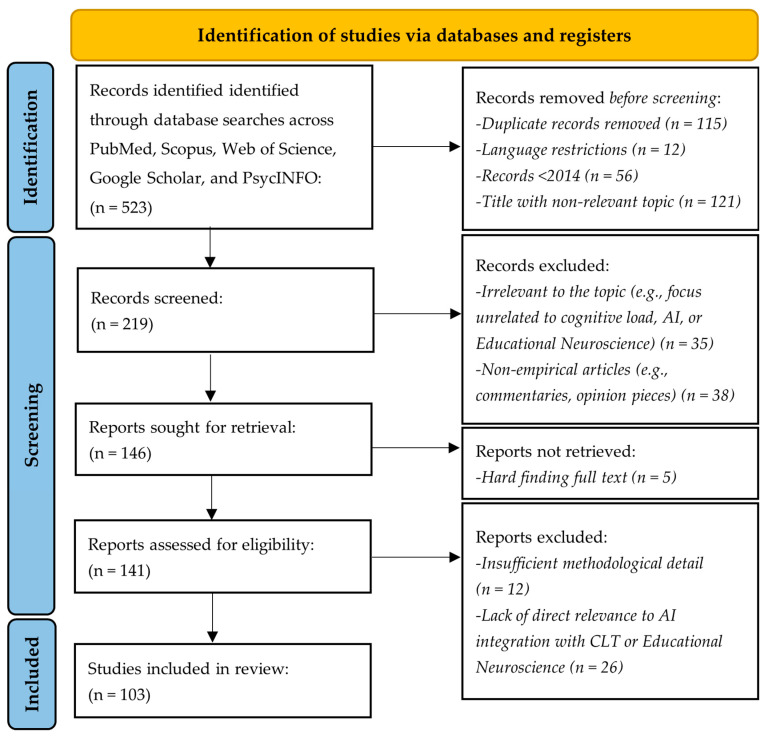
Background/Objectives: This systematic review integrates Cognitive Load Theory (CLT), Educational Neuroscience (EdNeuro), Artificial Intelligence (AI), and Machine Learning (ML) to examine their combined impact on optimizing learning environments. It explores how AI-driven adaptive learning systems, informed by neurophysiological insights, enhance personalized education for K-12 students and adult learners. This study emphasizes the role of Electroencephalography (EEG), Functional Near-Infrared Spectroscopy (fNIRS), and other neurophysiological tools in assessing cognitive states and guiding AI-powered interventions to refine instructional strategies dynamically. Methods: This study reviews n = 103 papers related to the integration of principles of CLT with AI and ML in educational settings. It evaluates the progress made in neuroadaptive learning technologies, especially the real-time management of cognitive load, personalized feedback systems, and the multimodal applications of AI. Besides that, this research examines key hurdles such as data privacy, ethical concerns, algorithmic bias, and scalability issues while pinpointing best practices for robust and effective implementation. Results: The results show that AI and ML significantly improve Learning Efficacy due to managing cognitive load automatically, providing personalized instruction, and adapting learning pathways dynamically based on real-time neurophysiological data. Deep Learning models such as Convolutional Neural Networks (CNNs), Recurrent Neural Networks (RNNs), and Support Vector Machines (SVMs) improve classification accuracy, making AI-powered adaptive learning systems more efficient and scalable. Multimodal approaches enhance system robustness by mitigating signal variability and noise-related limitations by combining EEG with fMRI, Electrocardiography (ECG), and Galvanic Skin Response (GSR). Despite these advances, practical implementation challenges remain, including ethical considerations, data security risks, and accessibility disparities across learner demographics. Conclusions: AI and ML are epitomes of redefinition potentials that solid ethical frameworks, inclusive design, and scalable methodologies must inform. Future studies will be necessary for refining pre-processing techniques, expanding the variety of datasets, and advancing multimodal neuroadaptive learning for developing high-accuracy, affordable, and ethically responsible AI-driven educational systems. The future of AI-enhanced education should be inclusive, equitable, and effective across various learning populations that would surmount technological limitations and ethical dilemmas.
Overview
The claims and statistics of this paper haven’t been checked yet.
Free: it reads the open-access text and checks the first 5 claims that cite a source we can check. Create a free account to check every claim.
Integrity signals
Registry
Cites
Statistics
Figures
Verification
Claims the paper makes
The claims and statistics of this paper haven’t been checked yet.
Free: it reads the open-access text and checks the first 5 claims that cite a source we can check. Create a free account to check every claim.
Claims other papers make about this one
Each is checked against this paper’s own text: does it say what the citing paper says it does?
The cited source doesn’t support the claim as written.
In the citing paper
“In the language of Cognitive Load Theory, uncritical AI use minimizes the germane cognitive load -the productive mental effort required for deep learning-while often increasing the extraneous cognitive load -the unproductive effort spent navigating a tool's interface or correcting its flawed output (Gkintoni et al., 2025).”
From Paying the Cognitive Debt: An Experiential Learning Framework for Integrating AI in Social Work Education (2025) · cites this paper as Gkintoni et al., 2025
Checked by a reasoning model — may be wrong.
Experimental — accuracy not yet measuredThe cited source says what the claim attributes to it.
In the citing paper
“The educational form of cognitive debt, in contrast, is an opportunity cost accrued through the absence of a beneficial internal process-namely, the effortful thinking, deep processing, and schema-building that constitute genuine learning (Gkintoni et al., 2025; Sweller, 1988).”
From Paying the Cognitive Debt: An Experiential Learning Framework for Integrating AI in Social Work Education (2025) · cites this paper as Gkintoni et al., 2025
The cited source says what the claim attributes to it.
In the citing paper
“In CLT terms, this pattern is consistent with reduced extraneous effort (less syntax/search churn) while retaining or increasing germane processing (reasoning about structure and tests) (Debue & Van De Leemput, 2014; Gkintoni et al., 2025).”
From Tool, tutor, or crutch?: A grounded theory of cognitive scaffolding and offloading in AI-assisted programming education (2026) · cites this paper as Gkintoni et al., 2025
Self-check
Percentages, sums and reported differences re-computed from the paper’s own numbers.
The self-check needs the paper’s full text.
Citations
Cites
ChatGPT for good? On opportunities and challenges of large language models for education
Kasneci, E., Sessler, K., Küchemann, S., Bannert, M., Dementieva, D., Fischer, F., Gasser, U., Groh, G., Günnemann, S., Hüllermeier, E., et al. (2023) · Learning and Individual Differences · doi:10.1016/j.lindif.2023.102274 · Cited by 15,365
ChatGPT for Good? On Opportunities and Challenges of Large Language Models for Education
Kasneci, E., Seßler, K., Küchemann, S., Bannert, M., Dementieva, D., Fischer, F., Gasser, U., Groh, G., Günnemann, S., Hüllermeier, E., et al. (2023) · doi:10.35542/osf.io/5er8f · Cited by 7,552
Haddaway, N. R., Page, M. J., Pritchard, C. C., & McGuinness, L. A. (2022) · Campbell Systematic Reviews · doi:10.1002/cl2.1230 · Cited by 3,486
Implications for educational practice of the science of learning and development
Darling-Hammond, L., Flook, L., Cook-Harvey, C., Barron, B., & Osher, D. (2020) · Applied Developmental Science · doi:10.1080/10888691.2018.1537791 · Cited by 2,733
Cognitive load theory and educational technology
Sweller, J. (2020) · Educational Technology Research and Development · doi:10.1007/s11423-019-09701-3 · Cited by 1,688
Makransky, G., & Petersen, G. B. (2021) · Educational Psychology Review · doi:10.1007/s10648-020-09586-2 · Cited by 1,438
State of the art and practice in AI in education
Holmes, W., & Tuomi, I. (2022) · European Journal of Education · doi:10.1111/ejed.12533 · Cited by 1,093
Grassini, S. (2023) · Education Sciences · doi:10.3390/educsci13070692 · Cited by 1,048
Revolutionizing education with AI: Exploring the transformative potential of ChatGPT
Adiguzel, T., Kaya, M. H., & Cansu, F. K. (2023) · Contemporary Educational Technology · doi:10.30935/cedtech/13152 · Cited by 975
Szymkowiak, A., Melović, B., Dabić, M., Jeganathan, K., & Kundi, G. S. (2021) · Technology in Society · doi:10.1016/j.techsoc.2021.101565 · Cited by 893
Research works printed but not linked: 1
- Lovell O. Sherrington T. Sweller’s Cognitive Load Theory in Action John Catt Woodbridge, UK 2020 10.4324/9781003023715 · DOI
Cited by
Items 101–200 of 485
Aljadani, A., Alnomsi, A. S., Alswaida, M. I., & Abouzed, M. A. (2025) · Cogent Psychology · doi:10.1080/23311908.2025.2596287 · Cited by 3
“…multitasking behaviors commonly associated with social media use, their working memory systems can become overwhelmed. such cognitive strain can significantly impair an individual’s ability to maintain focus on important tasks and achieve intended goals (Brown et al., 2019; gkintoni et al., 2025).”
Emotional Intelligence and Empathy in Human-GenAI Interactions
Evangeline, S. I. (2025) · Advances in computational intelligence and robotics book series · doi:10.4018/979-8-3373-1195-1.ch009 · Cited by 3
An, G. K., & Ngo, T. T. A. (2025) · Journal of Information Technology Education Research · doi:10.28945/5668 · Cited by 6
“As Gkintoni et al. (2025) argue, access to trustworthy and high - quality material reduces cognitive burden, enabling students to devote more attention to comprehension and skill acquisition rather than verifying the reliability of the content.”
Sze, S., Rai, J. S., Almugren, I., Quacquarelli, B., & Germon, R. (2026) · Journal of Knowledge Management · doi:10.1108/jkm-10-2025-1461 · Cited by 3
Castillo-Salazar, D. R., Thirumuruganandham, S. P., González, W. D. L., & ORTEGA, H. K. C. (2026) · Frontiers in Education · doi:10.3389/feduc.2025.1729099 · Cited by 5
Almugren, I., Rai, J. S., Chotia, V., Szabó-Szentgróti, G., & Mohanty, J. (2026) · Journal of Knowledge Management · doi:10.1108/jkm-08-2025-1132 · Cited by 4
Development of a Microlearning-Based Instructional Model for Higher Education: The MICROS Framework
Widyaningrum, R., Situmorang, R., & Sukardjo, M. (2026) · Tadris Jurnal Keguruan dan Ilmu Tarbiyah · doi:10.24042/tadris.v11i1.28947 · Cited by 3
Research on Interactive Interface Adaptive Design Model Based on Dynamic Cognitive Load Evaluation
Yang, M. (2026) · International Scientific Technical and Economic Research · doi:10.71451/istaer2611 · Cited by 3
“Therefore, building a complete model framework that can not only accurately perceive cognitive load but also drive interface adaptation in a stable and interpretable manner has important theoretical research value and practical application significance [11] , [12] .”
Ghimire, A., & Qiu, Y. (2026) · Nurse Education Today · doi:10.1016/j.nedt.2026.107111 · Cited by 3
Rai, J. S., Kathuria, S., Kaur, H., Singh, A., & Itani, M. N. (2026) · Computers and Education Artificial Intelligence · doi:10.1016/j.caeai.2026.100596 · Cited by 5
Effectiveness of using video tutorial-based learning media in the SMAW welding techniques course
Gunawan, F., Rahim, B., Aspar, F., & Yuvenda, D. (2026) · Jurnal Pendidikan Teknologi Kejuruan · doi:10.24036/jptk.v9i1.48823 · Cited by 3
“The large improvement observed in this study supports the idea that well-structured video media can reduce unnecessary cognitive burden and help learners build procedural understanding through repeated viewing and guided practice (Barman & Jena, 2023; Gkintoni et al., 2025; Kuhlmann et al., 2024).”
Zhu, W., Yang, Y. P., & Yang, Y. (2026) · Computers and Education Artificial Intelligence · doi:10.1016/j.caeai.2026.100669 · Cited by 3
Broda, M., Kovalova, K., Bezugla, I., Stoika, O., & Mulyk, K. (2025) · Premier journal of science. · doi:10.70389/pjs.100100 · Cited by 3
Ayeoribe, A. E., & Ayeoribe, O. P. (2026) · Journal of Smart Computing and Quantum Technologies · doi:10.63456/jscqt-2-1-126 · Cited by 4
“Such capabilities have been associated with improved academic achievement, learner engagement, self-regulated learning, and educational inclusiveness (Gkintoni et al., 2025).”
Alipour, M., & Alipour, A. (2025) · InfoScience Trends · doi:10.61186/ist.202502.05.04 · Cited by 4
A Delay-Driven Dynamic Learning Model with Cognitive Transitions and Technological InfluencesPreprint
Elfouly, M. A., Abouelenien, R., & Elghawy, Z. F. (2025) · Research Square · doi:10.21203/rs.3.rs-7173551/v2 · Cited by 3
Kochetkova, N. P. (2025) · Педагогика и просвещение · doi:10.7256/2454-0676.2025.2.74068 · Cited by 2
Ramaila, S. M., & Mngomezulu, H. (2025) · International Journal of Learning Teaching and Educational Research · doi:10.26803/ijlter.24.4.12 · Cited by 4
-, J. P. A. (2025) · International Journal on Science and Technology · doi:10.71097/ijsat.v16.i2.5259 · Cited by 2
Ramadhani, R. R., & Trimurtini, T. (2025) · Jurnal Pendidikan MIPA · doi:10.23960/jpmipa.v26i2.pp873-892 · Cited by 2
An Experimental Evaluation of Worked Example Strategies for Efficient Programming Instruction
Tepgeç, M., & Demiraslan Çevik, Y. (2025) · Technology, Knowledge and Learning · doi:10.1007/s10758-025-09901-2 · Cited by 1
MIIAM: An Algorithmic Model for Predicting Multimedia Effectiveness in eLearning Systems
Chikasha, S., Petegem, W. V., & Revesai, Z. (2025) · Digital · doi:10.3390/digital5040058 · Cited by 2
“We hypothesize that systems capable of real-time adaptation based on learner feedback will achieve superior outcomes compared to static presentation approaches, particularly in terms of efficiency and learner satisfaction [46].”
InfluentialZheng, F. (2025) · Frontiers in Psychology · doi:10.3389/fpsyg.2025.1729306 · Cited by 2
Design improvements and clinical evaluation of an adjustable clubfoot splint
Beldar, M. K., Ahuja, B. B., Chougule, N. K., Sahoo, K., & Mohite, D. D. (2025) · Scientific Reports · doi:10.1038/s41598-025-25876-7 · Cited by 2
Kouam, A. W. F. (2025) · Discover Education · doi:10.1007/s44217-025-00981-x · Cited by 3
“For instance, AI tutoring can decrease extraneous load by providing tailored guidance, while VR simulations may increase intrinsic load but promote germane load through active engagement [25, 49].”
Design and Validation of Guidelines for Creating Mathematical Applets for Students With Autism
Vaerenbergh, S. V., Polo-Blanco, I., & Gómez, Á. G. (2025) · IEEE Revista Iberoamericana de Tecnologias del Aprendizaje · doi:10.1109/rita.2025.3636607 · Cited by 2
“In particular, in order to reduce cognitive load, designers might inadvertently remove the cognitive struggle that benefits deep learning [46].”
Shannaq, B., & Ali, O. (2025) · International Conference on Business Analytics for Technology and Security (ICBATS) · doi:10.1109/icbats66542.2025.11258136 · Cited by 2
Spilbergs, A., Dzērve, B., Ozoliņa, S., Innuse-Breidaka, G., Mavrenko, T., Čable, L., Vincēviča, A., Sloka, B., Tora, G., & Liepiņa, K. (2025) · Highlights of Sustainability · doi:10.54175/hsustain4040017 · Cited by 2
Tan, S., Deng, Q., Wei, Q., Zhu, X., & Li, S. (2025) · Journal of Cancer Education · doi:10.1007/s13187-025-02801-0 · Cited by 2
EDISON, A., Dwijayanti, I., & Purwosetiyono, F. D. (2025) · Journal of Advanced Sciences and Mathematics Education · doi:10.58524/jasme.v5i2.779 · Cited by 2
Bu, L., Zhang, Y., Pan, W., Chen, H., Hua, C., & Li, H. (2025) · Universal Access in the Information Society · doi:10.1007/s10209-025-01292-6 · Cited by 2
Redacción Académica Asistida por IA: Límites, potencial y responsabilidad
Guillén, S. R. G. R., Alcívar-Chávez, A. C., Sánchez, E. J. S., & Jácome-Gómez, J. R. (2026) · doi:10.70171/bjt3g968 · Cited by 2
Kelly, J., Gielstra, D. A., Oberding, T. J., Bruno, J., & Cosentino, S. (2026) · Industry and Higher Education · doi:10.1177/09504222261417843 · Cited by 3
Trajectory Patterns of Hygiene Training Effectiveness Across Three Instructional Modes
Limon, M. R., Adviento, S. V. M. G., Basamot, C. M. B., Reyes, J. B., Gumsat, K. L. E., Amano, A. G. D., Ramirez, J. C. B., Pungtilan, C. J. P., Soriano, M. D. R., Baclagan, L. B., et al. (2026) · Hygiene · doi:10.3390/hygiene6010005 · Cited by 2
“These results align with prior studies highlighting the efficacy of online, self-paced learning for promoting long-term retention, due to the ability of learners to revisit content and reinforce knowledge repeatedly [30,51,65,69–74].”
Нейромаркетинг у рекламі: огляд показників уваги, залучення та переконання
Дарвіду, К. (2025) · Економіка управління та адміністрування · doi:10.26642/ema-2025-4(114)-70-83 · Cited by 2
Navigating the Future of OT Education: Student Insights on Integrating Course-Specific AI Chatbots
Landon, L. E., Grames, N., Gannon, M., Jarus, A., & Trezza, A. (2025) · Journal of Occupational Therapy Education · doi:10.26681/jote.2025.090408 · Cited by 2
An AI-Powered Adaptive Learning Framework for Personalized Education
Sendeku, H. A., Daniel, R., & Gopa, G. V. (2025) · Information Dynamics and Applications · doi:10.56578/ida040403 · Cited by 3
Kokkonesi, E., Antonopoulou, H., Igoumenakis, G., & Halkiopoulos, C. (2026) · Administrative Sciences · doi:10.3390/admsci16020101 · Cited by 3
“…symptoms (Salihu et al., 2022; Cruchinho et al., 2024; Askarizad et al., 2025; Fischer et al., 2025; Soames & Willis, 2024; Han et al., 2025; Gkintoni et al., 2025b, Finally, studies must investigate positive deviates—those educators who endure low levels of burnout despite various risk…”
InfluentialSelf-citationMunenakoppa, M., Rane, N. L., Rane, J., & Heggond, S. B. (2026) · International Journal of Applied Resilience and Sustainability · doi:10.70593/deepsci.0202011 · Cited by 8
“The assessment of dynamic scaffolding identifies the current support requirements based on the performance and understanding signs [84,85].”
Artificial intelligence-driven green education for sustainable development goals: A review
Chaudhary, A. (2026) · International Journal of Applied Resilience and Sustainability · doi:10.70593/deepsci.0202001 · Cited by 4
Olugboyega, O., Victor, A. I., Temitope, O. R., Olabayo, O. O., & Daniel, O. O. (2026) · International Journal of Construction Management · doi:10.1080/15623599.2026.2636009 · Cited by 2
“Gkintoni et al. (2025) extend this by integrating neurophysiological data with AI systems to manage learners’ cognitive load in real time, showing how adaptive technologies can optimise mental effort and personalise instruction.”
Tang, Q., & Zhang, H. (2026) · Interactive Learning Environments · doi:10.1080/10494820.2026.2641762 · Cited by 4
“In addition, constructivist theory suggests that adaptive feedback can reinforce active knowledge construction, which may partially account for the observed performance differences (Gkintoni et al., 2025).”
NEUROCIÊNCIA E EDUCAÇÃO COM A MEDIAÇÃO DAS TECNOLOGIAS
Batista, L. S., Batista, D. C. S., Tirello, D. D. C., de Sá, R. A., Oliveira, G. B. D., Silva, J. D. V. D., Feitosa, A. A., & Dias, M. A. N. (2026) · LUMEN ET VIRTUS · doi:10.56238/levv17n58-046 · Cited by 2
Balıkcı, Ş., Terzioğlu, N. K., & Rakap, S. (2026) · Future Internet · doi:10.3390/fi18030158 · Cited by 2
Omeh, C. B. (2026) · Education Sciences · doi:10.3390/educsci16040501 · Cited by 2
Burgos, D. (2026) · RIED Revista Iberoamericana de Educación a Distancia · doi:10.5944/ried.47294 · Cited by 2
Sarkar, P. (2026) · International Journal of Multidisciplinary Research and Growth Evaluation · doi:10.54660/.ijmrge.2026.7.2.382-394 · Cited by 2
Scaffold or shortcut? Postgraduate IT students’ use of generative AI and self-regulated learning
Atif, A., & Dickson-Deane, C. (2026) · Learning Letters · doi:10.20851/ll.v8.63 · Cited by 2
Nayak, A. K., Prakash, Y., Jayarathna, S., Lee, H.-N., & Ashok, V. G. (2026) · CHI Conference on Human Factors in Computing Systems · doi:10.1145/3772318.3791509 · Cited by 2
Ratniyom, J., Boonphadung, S., Intaraprasit, M., & Chumkaeo, P. (2026) · Chemistry Teacher International · doi:10.1515/cti-2025-0097 · Cited by 2
“55,56 This allows students to devote more cognitive resources toward more productive SRL processes, such as analyzing their errors, monitoring their comprehension, and adjusting their learning strategies.”
Visual and Auditory Learning Styles in Mathematics Learning in the Digital Era for College Students
Takdirmin, T., & Juhari, A. (2026) · ETDC Indonesian Journal of Research and Educational Review · doi:10.51574/ijrer.v5i3.5003 · Cited by 2
“If digital input is not aligned with students' learning styles, information will simply pass through without becoming deeply understood (Gkintoni et al., 2025; Skulmowski & Xu, 2022; Xiang et al., 2025).”
Karlıdağ, B. A., MALKOÇ, T., & Küçüktepe, S. E. (2026) · Applied Sciences · doi:10.3390/app16115383 · Cited by 2
Abrams, M. B., Eke, D., Passecker, J., Poline, J.-B., Horn, J. D. V., & Marín, M. (2026) · Frontiers in Psychology · doi:10.3389/fpsyg.2026.1849742 · Cited by 2
“Standardized tutorials often pres-ent information in a static, linear fashion, which benefits advanced learners but overwhelms novices who require gradual scaffolding (Gkintoni et al., 2025).”
Pham, T., & Ngo, T. T. A. (2026) · Telematics and Informatics Reports · doi:10.1016/j.teler.2026.100344 · Cited by 2
Do Flashcards Improve Biology Learning? A Systematic Review of Cognitive Learning Outcomes
Kenya, P. B. M., Degeng, M. D. K., & Aulia, F. (2026) · Edcomtech Jurnal Kajian Teknologi Pendidikan · doi:10.17977/um039v11i12026p1-13 · Cited by 2
Khalil, A. I., & Alqhtani, S. S. (2025) · Journal of Medicine and Life · doi:10.25122/jml-2024-0383 · Cited by 3
“[44] caution that combining different simulation methods may overwhelm some students, suggesting a phased integration approach to ensure thorough understanding before incorporating multiple methods.”
Cognitive Load Theory-Informed Curriculum Design in Health Sciences Education
Rana, K., Alford, S., Moore, A., & Chimoriya, R. (2026) · Encyclopedia · doi:10.3390/encyclopedia6050102 · Cited by 2
“These platforms, often powered by artificial intelligence (AI), can assess learners’ performance in real time and dynamically adjust the difficulty, complexity, or presentation style of instructional content [29,30].”
Cognitivism, Constructivism, and the Classroom: The Impact of AI on Teaching and Learning
Tabor, J. (2025) · Advances in computational intelligence and robotics book series · doi:10.4018/979-8-3373-6007-2.ch007 · Cited by 1
Mapping Cognitive Load and Thinking Zones in Understanding Function Limits
Oktaviyanthi, R., & Agus, R. N. (2025) · Plusminus Jurnal Pendidikan Matematika · doi:10.31980/plusminus.v5i2.3018 · Cited by 1
Hidayati, N., & Andriyanti, E. (2025) · Al-Lisan · doi:10.30603/al.v10i2.6708 · Cited by 1
An Intelligent Tutoring System for Quote Generation Training in the Industry
Pashev, G., & Gaftandzhieva, S. N. (2025) · International Conference on Information Technologies (InfoTech) · doi:10.1109/infotech67177.2025.11175943 · Cited by 1
“AI-driven AI-driven systems adjust materials and scaffold complex concepts for optimal cognitive engagement [13].”
Economics of avoidance: Threshold-activated decision-making
Lehner, S. (2025) · Global Economics Research · doi:10.1016/j.ecores.2025.100013 · Cited by 1
Development and validation of the AI-enhanced Self-Regulated Learning (AI-SRL) scale
Ayaz, M., Karataş, F., & Yüce, E. (2025) · RIED Revista Iberoamericana de Educación a Distancia · doi:10.5944/ried.45452 · Cited by 4
Ramdiah, S., Mayasari, R., Abidinsyah, A., & Arini, D. (2025) · JPBI (Jurnal Pendidikan Biologi Indonesia) · doi:10.22219/jpbi.v11i3.42512 · Cited by 1
Minimizing Cognitive Load in EFL Writing Students: A Multi-Faceted Approach
Thaha, S. (2025) · doi:10.60149/kbvs2577 · Cited by 1
Khan, M. T. (2025) · Psychology · doi:10.4236/psych.2025.169061 · Cited by 2
Affective Computing and Neuro-Symbolic Intelligence in the Protection of Digital Learning Ecologies
Alam, A. (2025) · Advances in computational intelligence and robotics book series · doi:10.4018/979-8-3373-5012-7.ch003 · Cited by 1
Volkotrubova, A. V., Liu, J., Andrusenko, O., Проворова, Є. М., & Внукова, О. М. (2025) · Journal of Educational Technology and Learning Creativity · doi:10.37251/jetlc.v3i2.2448 · Cited by 1
“Furthermore, advances in educational neuroscience and artificial intelligence indicate that adaptive digital systems can further enhance personalization and self-regulation [57]-[60].”
Exploring Elementary School Readiness for Implementing Deep Learning Technology in Digital Education
Yuliandari, R. N. (2025) · International Journal of Elementary Education · doi:10.23887/ijee.v9i3.100529 · Cited by 5
Alam, A. (2026) · IGI Global eBooks · doi:10.4018/979-8-3373-6831-3.ch010 · Cited by 2
Boundary conditions for foreign language talent public service output
Yang, F., Chen, C., & Li, H. (2026) · Frontiers in Psychology · doi:10.3389/fpsyg.2026.1748812 · Cited by 1
Spyropoulos, N. I., Antonopoulou, H., Rafailidis, A., & Halkiopoulos, C. (2026) · Administrative Sciences · doi:10.3390/admsci16020072 · Cited by 2
Self-citationExtending Skinner: A Multi-label Approach to Scalp Disease Detection with Explainable AI
Fortino, L., Lodato, G., Trò, R., & Francese, R. (2026) · Lecture notes in networks and systems · doi:10.1007/978-3-032-14160-6_7 · Cited by 1
Li, H., Pan, W., & Bu, L. (2026) · Behaviour and Information Technology · doi:10.1080/0144929x.2026.2614040 · Cited by 2
“Studies have shown that AI virtual agents help reduce users’ information processing burden in complex situations by simplifying task instructions, integrating information channels, and providing context-relevant feedback (Feng 2025; Gkintoni et al. 2025).”
Umbrella Review on Advanced Instructional Design in Distance Higher Education
Sánchez-Romero, C., Vacas, C. G., Levterova, D., & Lazarov, A. (2026) · Journal of Cultural Analysis and Social Change · doi:10.64753/jcasc.v11i1.4422 · Cited by 1
AI-Based Application for Task Management and Scheduling Student Activity
Nuralamsyah, B., Yuhana, U. L., Yuniarti, A., Ma'Ruf, M. R., Harsanti, F. P., Kautsar, F., & Wati, P. M. (2025) · International Conference on Information & Communication Technology and System (ICTS) · doi:10.1109/icts67612.2025.11369721 · Cited by 3
“Efficacy [17] Systematic review of AI-driven adaptive learning for cognitive load optimization, but limited to instruction materials.”
Bădicu, G., & Silva, R. M. (2025) · AI and Tech in Behavioral and Social Sciences · doi:10.61838/kman.aitech.3.3.8 · Cited by 1
Sami, A., Asad, M., Moin, H., Syed, H., & Javed, M. A. (2026) · BMC Medical Education · doi:10.1186/s12909-026-08740-8 · Cited by 1
“In this context leveraging LLMs and generative AI (GAI) tools, can help students by generating content relevant and personalized to their unique learning style and context [5].”
Robby, S. K. I., Hakam, K. A., Hidayat, M., & Warlim, W. (2026) · Journal La Edusci · doi:10.37899/journallaedusci.v7i1.2857 · Cited by 1
AI Literacy and Academic Performance: A Cross-Sectional Analysis of Senior High School Students
Co, S. J., Dabu, J. P., & Sanchez, P. J. (2026) · International Journal of Technology in Education · doi:10.46328/ijte.5335 · Cited by 3
FermBench: A new benchmark for measuring the capabilities of LLMs on fermentation knowledge
Caccavale, F., Aouichaoui, A. R. N., Krühne, U., Gernaey, K. V., & Gargalo, C. L. (2026) · Computers and Education Artificial Intelligence · doi:10.1016/j.caeai.2026.100577 · Cited by 1
Wang, Y., & Luo, X. (2026) · Proceedings of the AAAI Conference on Artificial Intelligence · doi:10.1609/aaai.v40i48.42122 · Cited by 3
Zhao, Z., Wang, B., Chen, L., & Qi, J. (2025) · International Conference on Sports Technology and Performance Analysis (ICSTPA) · doi:10.1145/3796028.3796101 · Cited by 1
Integrating AI into educational game design: an AI-enhanced MDA framework
Wen, Z., & Chu, S. K. W. (2026) · Research in Learning Technology · doi:10.25304/rlt.v34.3746 · Cited by 3
Sahu, S. K. (2026) · International Journal of Applied Resilience and Sustainability · doi:10.70593/deepsci.0202029 · Cited by 1
“Using AI systems enable students to get immediate feedback, learning resources can be accessed at any time, and practice writing more often which facilitates flexible and inclusive learning [77-79].”
AI AS A COGNITIVE PROSTHESIS: DOES EDUCATIONAL AI REDUCE INTELLECTUAL AUTONOMY?
Kumara, K. A. S. C., Arjaya, I. B. A., Budiningsih, D. N., & Agustina, V. A. (2026) · Jurnal Santiaji Pendidikan (JSP) · doi:10.36733/jsp.v16i1.13599 · Cited by 2
“Implementing AI can reduce students' cognitive load, thereby increasing their focus on learning (Gkintoni et al., 2025).”
An, R., Zhu, W., Zhao, Q., Laaksonen, A., & Lan, S. (2026) · Computers and Education Artificial Intelligence · doi:10.1016/j.caeai.2026.100591 · Cited by 2
Harefa, E., & Zega, N. A. (2026) · Jurnal Penelitian dan Pengkajian Ilmu Pendidikan e-Saintika · doi:10.36312/e-saintika.v10i1.3602 · Cited by 2
Alshwiah, A. A. (2026) · Cogent Education · doi:10.1080/2331186x.2026.2652076 · Cited by 1
Rosyid, H., Rochmawati, L., Sylvia, T., Rossydi, A., & Bhakti, H. D. (2025) · International Journal of Artificial Intelligence Research · doi:10.29099/ijair.v9i1.1.1620 · Cited by 1
Adewale, O. A. (2026) · International Journal of Applied Resilience and Sustainability · doi:10.70593/deepsci.0202048 · Cited by 2
MUSAH, E. (2026) · International Journal of Applied Resilience and Sustainability · doi:10.70593/deepsci.0202054 · Cited by 2
“Languages NLP technologies are used with intelligent tutoring tu, automated essay grading, plagiarism detector, chatbot, virtual teacher assistant, and large language models like ChatGPT [6-8].”
Yuanfen, W. (2026) · International Journal of Inclusive Education · doi:10.1080/13603116.2026.2663098 · Cited by 1
Hiner, A. (2026) · Inquiry Critical Thinking Across the Disciplines · doi:10.5840/inquiryct202641342 · Cited by 2
Rad, N. R., Mahdavi, M., & Rabaniebrahimipour, K. (2026) · LLT Journal A Journal on Language and Language Teaching · doi:10.24071/llt.v29i1.325 · Cited by 1
Dou, D., Huang, B., Chen, Q., Zhou, X., & Wang, C. (2026) · Frontiers in Psychology · doi:10.3389/fpsyg.2026.1811374 · Cited by 1
“Similarly, GCL strengthens BI primarily by enhancing PEU and other positive system evaluations, thereby facilitating adoption through indirect cognitive pathways (Gkintoni et al., 2025).”
Abou-Eid, N. F. S. A. (2026) · Journal of Radiation Research and Applied Sciences · doi:10.1016/j.jrras.2026.102436 · Cited by 1
Zhou, W., Ozturk, P., Hartzel, K. S., & Salazar-Betancourth, C. (2026) · Information Systems Education Journal · doi:10.62273/lazq5486 · Cited by 1
Ghanamah, R. (2026) · Early Childhood Education Journal · doi:10.1007/s10643-026-02224-6 · Cited by 1
“Retention, defined as the ability to maintain learned skills beyond the initial learning period, is a core indicator of instructional effective - ness (Cepeda et al., 2006; Farr, 2012; Ghanamah, 2025a; Ghanamah et al., 2020, 2023a, b; Gkintoni et al., 2025 ).”
Almutairi, A. F., Baderelden, M., Muhammad, N., & Khan, S. (2026) · Frontiers in Education · doi:10.3389/feduc.2026.1763878 · Cited by 1
Metadata
- Authors
- Gkintoni, E., Antonopoulou, H., Sortwell, A., & Halkiopoulos, C.
- Affiliations
- University of Patras (GR)
- University of Beira Interior (PT)
- Corresponding author
- Gkintoni, Evgenia
- Venue
- Brain Sciences
- Publisher
- MDPI AG
- Published
- 2025-02-15
- Volume
- 15
- Issue
- 2
- Pages
- 203
- ISSN
- 2076-3425 (ISSN-L)
- PMC
- PMC11852728
- OpenAlex
- W4407657137
- Semantic Scholar
- 3813deab1d3cdfe24fc0daeda81f0df5dda9f7bc
- Cited by
- 309
- References
- 251
- Citations by year
- 2026: 203 · 2025: 106
- FWCI
- 51.50
- Type
- journal article
- Language
- en
- Open access
- gold
- doi.org
- Licence
- Locations
- Brain Sciences (publishedVersion, cc-by)
- PubMed Central (publishedVersion, cc-by)
- PubMed (publishedVersion)
- DOAJ (DOAJ: Directory of Open Access Journals) (submittedVersion, cc-by-sa)
- Funders
- Research Council of the University of Patras, Greece
- Topics
- Life Sciences › Neuroscience › Cognitive Neuroscience › Neuroscience, Education and Cognitive Function
- Physical Sciences › Computer Science › Artificial Intelligence › Intelligent Tutoring Systems and Adaptive Learning
- Social Sciences › Education › Artificial Intelligence in Education
- Keywords
- cognitive load theory, neuroeducation, artificial intelligence in education, adaptive learning systems, personalized learning, EEG, functional near-infrared spectroscopy, personalized feedback, algorithmic bias, data privacy, K-12 education, adult learners, learning effectiveness
About these checks
Registry, retraction, Cites and statistics results are computed, not judged, with one exception: a printed reference that no index lists is read once by a model before it counts as a citation error. Claims are extracted by a model and kept only when their quote appears verbatim in the text; each cited source is then checked, with a model’s help, for whether it says what the claim relies on. Those verdicts can be wrong — read the claim’s quote and the cited source before relying on one.
Statistics and arithmetic are recomputed, not judged.
Confidence bands are shown only for fields calibrated on our annotated test set. None is calibrated yet, so no band is shown.
What counts as a claim ›How we measure confidence ›How we check this ›
Are you an author, or do you see a problem with this page? Request a review
Data sources
Bibliographic data: Semantic Scholar, OpenAlex, Crossref.
Contains information from the Semantic Scholar Academic Graph Datasets, made available under the ODC Attribution License (ODC-BY 1.0).
Semantic Scholar’s data is described in: Kinney, R., et al. (2023). The Semantic Scholar Open Data Platform. arXiv:2301.10140.
