

Challenging Cognitive Load Theory: The Role of Educational Neuroscience and Artificial Intelligence in Redefining Learning Efficacy
Open accessThe DOI matches its Crossref record; 255 of the 259 references it cites were found in a registry or an index, and 1 are not checked yet.
Abstract
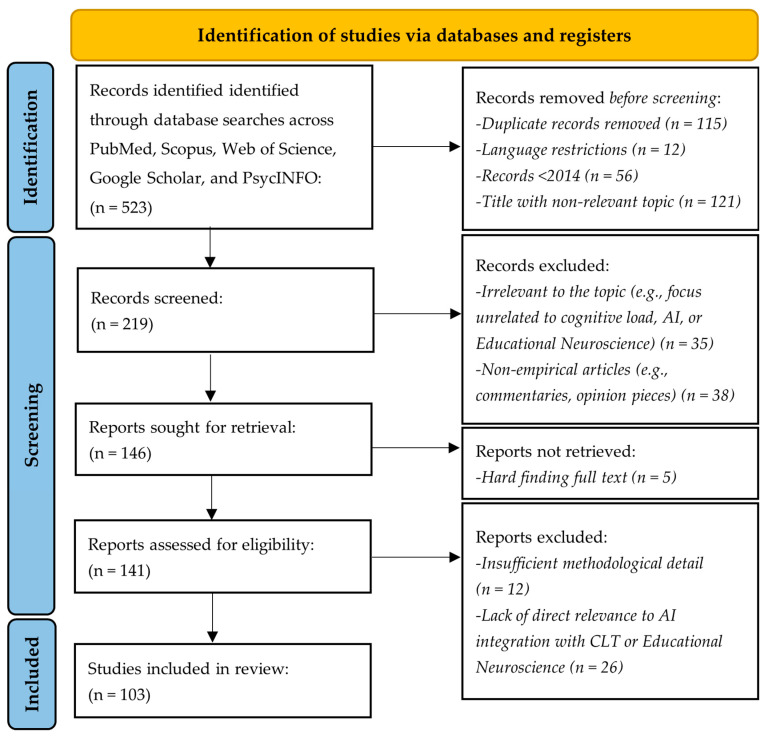
Background/Objectives: This systematic review integrates Cognitive Load Theory (CLT), Educational Neuroscience (EdNeuro), Artificial Intelligence (AI), and Machine Learning (ML) to examine their combined impact on optimizing learning environments. It explores how AI-driven adaptive learning systems, informed by neurophysiological insights, enhance personalized education for K-12 students and adult learners. This study emphasizes the role of Electroencephalography (EEG), Functional Near-Infrared Spectroscopy (fNIRS), and other neurophysiological tools in assessing cognitive states and guiding AI-powered interventions to refine instructional strategies dynamically. Methods: This study reviews n = 103 papers related to the integration of principles of CLT with AI and ML in educational settings. It evaluates the progress made in neuroadaptive learning technologies, especially the real-time management of cognitive load, personalized feedback systems, and the multimodal applications of AI. Besides that, this research examines key hurdles such as data privacy, ethical concerns, algorithmic bias, and scalability issues while pinpointing best practices for robust and effective implementation. Results: The results show that AI and ML significantly improve Learning Efficacy due to managing cognitive load automatically, providing personalized instruction, and adapting learning pathways dynamically based on real-time neurophysiological data. Deep Learning models such as Convolutional Neural Networks (CNNs), Recurrent Neural Networks (RNNs), and Support Vector Machines (SVMs) improve classification accuracy, making AI-powered adaptive learning systems more efficient and scalable. Multimodal approaches enhance system robustness by mitigating signal variability and noise-related limitations by combining EEG with fMRI, Electrocardiography (ECG), and Galvanic Skin Response (GSR). Despite these advances, practical implementation challenges remain, including ethical considerations, data security risks, and accessibility disparities across learner demographics. Conclusions: AI and ML are epitomes of redefinition potentials that solid ethical frameworks, inclusive design, and scalable methodologies must inform. Future studies will be necessary for refining pre-processing techniques, expanding the variety of datasets, and advancing multimodal neuroadaptive learning for developing high-accuracy, affordable, and ethically responsible AI-driven educational systems. The future of AI-enhanced education should be inclusive, equitable, and effective across various learning populations that would surmount technological limitations and ethical dilemmas.
Overview
The claims and statistics of this paper haven’t been checked yet.
Free: it reads the open-access text and checks the first 5 claims that cite a source we can check. Create a free account to check every claim.
Integrity signals
Registry
Cites
Statistics
Figures
Verification
Claims the paper makes
The claims and statistics of this paper haven’t been checked yet.
Free: it reads the open-access text and checks the first 5 claims that cite a source we can check. Create a free account to check every claim.
Claims other papers make about this one
Each is checked against this paper’s own text: does it say what the citing paper says it does?
The cited source doesn’t support the claim as written.
In the citing paper
“In the language of Cognitive Load Theory, uncritical AI use minimizes the germane cognitive load -the productive mental effort required for deep learning-while often increasing the extraneous cognitive load -the unproductive effort spent navigating a tool's interface or correcting its flawed output (Gkintoni et al., 2025).”
From Paying the Cognitive Debt: An Experiential Learning Framework for Integrating AI in Social Work Education (2025) · cites this paper as Gkintoni et al., 2025
Checked by a reasoning model — may be wrong.
Experimental — accuracy not yet measuredThe cited source says what the claim attributes to it.
In the citing paper
“The educational form of cognitive debt, in contrast, is an opportunity cost accrued through the absence of a beneficial internal process-namely, the effortful thinking, deep processing, and schema-building that constitute genuine learning (Gkintoni et al., 2025; Sweller, 1988).”
From Paying the Cognitive Debt: An Experiential Learning Framework for Integrating AI in Social Work Education (2025) · cites this paper as Gkintoni et al., 2025
The cited source says what the claim attributes to it.
In the citing paper
“In CLT terms, this pattern is consistent with reduced extraneous effort (less syntax/search churn) while retaining or increasing germane processing (reasoning about structure and tests) (Debue & Van De Leemput, 2014; Gkintoni et al., 2025).”
From Tool, tutor, or crutch?: A grounded theory of cognitive scaffolding and offloading in AI-assisted programming education (2026) · cites this paper as Gkintoni et al., 2025
Self-check
Percentages, sums and reported differences re-computed from the paper’s own numbers.
The self-check needs the paper’s full text.
Citations
Cites
ChatGPT for good? On opportunities and challenges of large language models for education
Kasneci, E., Sessler, K., Küchemann, S., Bannert, M., Dementieva, D., Fischer, F., Gasser, U., Groh, G., Günnemann, S., Hüllermeier, E., et al. (2023) · Learning and Individual Differences · doi:10.1016/j.lindif.2023.102274 · Cited by 15,365
ChatGPT for Good? On Opportunities and Challenges of Large Language Models for Education
Kasneci, E., Seßler, K., Küchemann, S., Bannert, M., Dementieva, D., Fischer, F., Gasser, U., Groh, G., Günnemann, S., Hüllermeier, E., et al. (2023) · doi:10.35542/osf.io/5er8f · Cited by 7,552
Haddaway, N. R., Page, M. J., Pritchard, C. C., & McGuinness, L. A. (2022) · Campbell Systematic Reviews · doi:10.1002/cl2.1230 · Cited by 3,486
Implications for educational practice of the science of learning and development
Darling-Hammond, L., Flook, L., Cook-Harvey, C., Barron, B., & Osher, D. (2020) · Applied Developmental Science · doi:10.1080/10888691.2018.1537791 · Cited by 2,733
Cognitive load theory and educational technology
Sweller, J. (2020) · Educational Technology Research and Development · doi:10.1007/s11423-019-09701-3 · Cited by 1,688
Makransky, G., & Petersen, G. B. (2021) · Educational Psychology Review · doi:10.1007/s10648-020-09586-2 · Cited by 1,438
State of the art and practice in AI in education
Holmes, W., & Tuomi, I. (2022) · European Journal of Education · doi:10.1111/ejed.12533 · Cited by 1,093
Grassini, S. (2023) · Education Sciences · doi:10.3390/educsci13070692 · Cited by 1,048
Revolutionizing education with AI: Exploring the transformative potential of ChatGPT
Adiguzel, T., Kaya, M. H., & Cansu, F. K. (2023) · Contemporary Educational Technology · doi:10.30935/cedtech/13152 · Cited by 975
Szymkowiak, A., Melović, B., Dabić, M., Jeganathan, K., & Kundi, G. S. (2021) · Technology in Society · doi:10.1016/j.techsoc.2021.101565 · Cited by 893
Research works printed but not linked: 1
- Lovell O. Sherrington T. Sweller’s Cognitive Load Theory in Action John Catt Woodbridge, UK 2020 10.4324/9781003023715 · DOI
Cited by
Items 301–400 of 485
Grade Expectations: Generative AI Use Does Not (Yet) Alter Student AchievementPreprint
Mueller, M., Arnold, R. C. G., & Wagenpfeil, S. (2026) · Research Square · doi:10.21203/rs.3.rs-9053629/v1
Salah, Z., & Mohamed, A. A. (2026) · Research Square · doi:10.21203/rs.3.rs-9247251/v1
Možgani v dobi umetne inteligence: vpliv generativnih modelov na kognitivne procese
Mesarec, M. (2026) · Revija Inovativna pedagogika · doi:10.63069/zarfew64
Ibrahem, U. M., Alrosaa, T. M., Diab, H. M., Alrashood, J. S., Hagar, H. M., Alotaibi, S. M., & Moussa, M. A. (2026) · Frontiers in Psychology · doi:10.3389/fpsyg.2026.1704162
Explainable artificial intelligence in cognitive learning psychology: A psychometric meta-analysis
Daovisan, H. (2026) · Acta Psychologica · doi:10.1016/j.actpsy.2026.106899
Слухенська, Р., Бірюк, І., Іванушко, Я. Г., & Пилипюк, В. (2026) · Наука і техніка сьогодні · doi:10.52058/2786-6025-2026-3(57)-1615-1625
Munene, M., & Kirui, A. K. (2026) · Research Journal of Education Teaching and Curriculum Studies · doi:10.58721/rjetcs.v4i1.1737
(2026) · International Journal of Education Learning and Pedagogical Sciences (INJELPS) · doi:10.63498/injelps58
Khor, E. T., & Kapoor, A. (2026) · AI in Education · doi:10.3390/aieduc2020015
“Cognitive Load Theory focuses on working memory limits during learning by differentiating between intrinsic load (complexity inherent in the task), extraneous load (unnecessary difficulty due to poor design), and germane load (mental effort devoted to understanding) (Gkintoni et al., 2025).”
AI-based Cognitive Load and Drowsiness Detection using Eye Images
Telrandhe, A. V., Puri, C., & Katade, R. (2026) · International Conference on Inventive Computation Technologies (ICICT) · doi:10.1109/icict68280.2026.11511010
“Moreover, CLT is becoming more and more connected with virtual reality (VR) to achieve optimal immersive learning [9], educational neuroscience to adapt neuroadaptive systems [15], and artificial intelligence to monitor cognitive states in real-time and in a multimodal way [10], [11], [15].”
InfluentialFan, X., Han, W., & Wang, D. (2026) · Data & Metadata · doi:10.56294/dm2026813
Beringuel, R., Cuachon, R. A., Calape, C. A., Fantonial, R. B., Jo, E. I., & Cabiao, G. (2026) · EIKI Journal of Effective Teaching Methods · doi:10.59652/z7pkw333
“Gkintoni et al. (2025) note that in engineering and electronics laboratories, well-designed physical interfaces minimize operational confusion, allowing learners to focus their cognitive resources on conceptual problem-solving rather than struggling with device operation.”
Liesdiana, N., Syaifuddin, M., & Kusnaini (2026) · Women Education and Social Welfare · doi:10.70211/wesw.v3i1.475
“The reflective and collaborative process in deep learning can train students to manage time, obey rules, and be consistent in completing tasks aspects that are the tangible manifestations of disciplined character [6], [11], [12], [13], [14], [15].”
Motivating Learners Through Psychology-Informed Language Models
Vieira, E. T., & Li, Y. (2026) · Review of Artificial Intelligence in Education · doi:10.37497/rev.artif.intell.educ.v7ii.99
Cognitwin: A Neuro-Digital Synthesis for Predictive Decision Intelligence in Smart Ecosystems
Helen, F. R., Sudhakar, K., Kodamanchili, R., Bansal, M., Sanku, N. K., & Maguluri, L. P. (2026) · International Conference on Artificial Intelligence and Machine Learning Applications Theme: Healthcare and Internet of Things (AIMLA) · doi:10.1109/aimla67915.2026.11522513
“By integrating them into digital twins, it is possible to create intelligent and decision making cognitive twins [9].”
Nuaim, A. A., & Qayyum, J. (2026) · Scientific Reports · doi:10.1038/s41598-026-54349-8 · Cited by 1
“The development of neuromorphic processing has boosted the rate at which biologically inspired computational models that can support learning in low-latency and adaptive decision making in conditions of resource constraint are adopted 4 .”
Onyefu, D. J., & Toedat, D. E. (2026) · International Journal of Applied Resilience and Sustainability · doi:10.70593/deepsci.0203008
Balancing AI ‐Driven Efficiency and Human Expertise in Higher Education
Albannai, N. A. A., Raziq, M. M., Scott‐Kennel, J., Rice, J. L., & Nusairi, A. M. A. (2026) · Knowledge and Process Management · doi:10.1002/kpm.70110
Cahyani, A., & Firdaus, R. (2026) · DWIJA CENDEKIA Jurnal Riset Pedagogik · doi:10.20961/jdc.v10i1.112544 · Cited by 1
Du, F., Yi, J., Wang, H., Lv, Y., Zhou, X., Chen, J., Li, G., & Hou, X. (2026) · International Journal of Human-Computer Interaction · doi:10.1080/10447318.2026.2675394
Computational Models for Reducing Cognitive Overload in Business Administration Students
Gomez, K. R. C., Marquez, S. C. C., Fernandez, E. P. B., Juárez, A. E., & Allison, C. H. C. (2026) · Athenea · doi:10.47460/athenea.v7i24.139
Neeta, R. A. N. I., & Sridevi, K. V. (2026) · Asian Journal of Human Services · doi:10.14391/ajhs.e3003.1.002
Júnior, H. C. P. (2026) · Revista de Estudos Interdisciplinares · doi:10.56579/rei.v8i3.3644
Zhou, H., Li, S., Chen, X. Y., Chong, D., & Liao, S. (2026) · Buildings · doi:10.3390/buildings16112210
Al‐Beltagi, M. (2026) · World Journal of Clinical Pediatrics · doi:10.5409/wjcp.120091
Petryk, K., & Skliar, I. (2026) · Academic Notes Series Pedagogical Science · doi:10.36550/2415-7988-2026-1-223-646-653
Yang, L., & Gu, Y. (2026) · GeroScience · doi:10.1007/s11357-026-02347-z
Peshko, S. V., & Lysenko, D. P. (2026) · Habitus · doi:10.32782/hbts.84.25
Santhosh Kumar, S., Khan, A. K., & Shinde, S. (2026) · Education and Information Technologies · doi:10.1007/s10639-026-14046-5 · Cited by 1
“By simplifying complex tasks and offering personalized support, AI can free up cognitive resources for deeper learning and critical thinking (Gkintoni et al., 2025 ).”
Ningjian, H., & Li, X. (2026) · Journal of Visualized Experiments · doi:10.3791/71684
Rusmana, D., Wardoyo, C., Wahjoedi, & Sumarsono, H. (2026) · Multidisciplinary Reviews · doi:10.31893/multirev.2026551
Gamified Interface Design Enhances Student Engagement in Synchronous Video Conferencing Learning
Jun, M., & Lucas, T. (2026) · WSEAS TRANSACTIONS on SYSTEMS archive · doi:10.21203/rs.3.rs-9600928/v1
Xie, J., & Xu, R. (2026) · Journal of Health Psychology · doi:10.1177/13591053261452077 · Cited by 1
Arkiang, F., & Halimatussakdiah, H. (2026) · International Journal of Educational Qualitative Quantitative Research · doi:10.58418/ijeqqr.v5i1.199
“This computational friction is validated by Yang et al. (2024), Gkintoni et al. (2025), Sun (2025), and Bu et al. (2026), who emphasize that navigating advanced artificial intelligence interfaces creates an immediate cognitive load and a steep technological learning curve for users before long-term…”
Differences in Reading Habits Among Higher Education Students in Portugal: A Comparative Analysis
Barqueira, A., Oliveira, A. P., Esteves, S., & Leite, S. D. A. (2026) · Education Sciences · doi:10.3390/educsci16060946 · Cited by 1
The Effect of Brainstorming and Recall-Based Learning on Eleventh-Grade Students’ Learning Outcomes
Nisa, S., Mashuri, I., & Firdaus, R. (2026) · Ainara Journal (Jurnal Penelitian dan PKM Bidang Ilmu Pendidikan) · doi:10.54371/ainj.v7i2.1368
“Secara empiris, kondisi ini memperkuat pandangan bahwa proses pembelajaran yang dirancang secara sistematis dan berbasis aktivitas mental siswa akan menghasilkan capaian belajar yang lebih baik dibandingkan pembelajaran yang berorientasi pada penyampaian materi semata (Gkintoni et al., 2025).”
Hussain, F. N., Al-Hajri, M., Jawad, S., Magdy, N., Soltani, A., Maayah, Z. H., & ElGeed, H. A. (2026) · Currents in Pharmacy Teaching and Learning · doi:10.1016/j.cptl.2026.102723
Herzallah, M., Jalad, A. K., Aljaber, H., Ujjainwala, H., & Herzallah, J. (2026) · International Conference on Integrated Intelligence and Cognitive Engineering (ICIICE) · doi:10.1109/iciice69672.2026.11565397
“By synthesizing Sweller’s Cognitive Load Theory, the system optimizes the user’s working memory by reducing extraneous mental effort [4].”
There was an AI in the Classroom: A Silent Shift in English Language Learning
Derinalp, P., & BUDAK, B. (2026) · Journal of Learning and Teaching in Digital Age · doi:10.53850/joltida.1805113
Zaib, F. (2026) · International Linguistics Research · doi:10.30560/ilr.v9n1p43
“As a result, the ability to design automated systems that dynamically adjust linguistic difficulty and balance mental fatigue has emerged as a crucial requirement within contemporary instructional design frameworks (Gkintoni et al., 2025; Förster et al., 2024).”
Jha, N. K., Akcayli, J., Menezes, G., Shetty, D. P., Scott, B., & Jack-Edwards, F. (2026) · IOSR Journal of Dental and Medical Sciences · doi:10.9790/0853-2504033148
Xin, Y., Weina, H., Deng, S., Yan, D., & Liuheng, L. (2026) · Studies In Educational Evaluation · doi:10.1016/j.stueduc.2026.101639 · Cited by 1
Chiang, Y.-T., Hong, J., & Tu, Y.-T. (2026) · Frontiers in Psychology · doi:10.3389/fpsyg.2026.1838395
“…for explaining cognitive demands, its traditional load categories may require refinement in dynamic IVR environments, where learners must simultaneously process instructional content, operate controllers, navigate interfaces, and complete interactive task sequences (Gkintoni et al., 2025).”
Adaptive nano-learning improves working memory quality in high school students
Alwazzan, M. S. (2026) · Frontiers in Education · doi:10.3389/feduc.2026.1812472 · Cited by 1
Alessi, C. (2026) · International Conference of the Immersive Learning Research Network (iLRN) · doi:10.56198/s7usieujg
Lamsiyah, S. (2026) · Lecture notes in computer science · doi:10.1007/978-3-032-29770-9_60
SELF-EFFICACY AND COGNITIVE LOAD OF GRADE 11 LEARNERS IN SCIENCE
Gasapo, H. R. M., Linaugo, J. D., & Ong, K. C. G. (2026) · European Journal of Education Studies · doi:10.46827/ejes.v13i7.6805
Prasetyo, A. S. J., & Cahya, Y. F. (2026) · Jurnal Ilmiah Manajemen Ekonomi & Akuntansi (MEA) · doi:10.31955/mea.v10i2.7554
“…proses penelitian, baik dalam pencarian data ataupun pengungkapan fenomena yang ada (Zulkarnaen, W., et al., 2020 kondisi cuaca yang kurang baik sehingga mengurangi kemampuan dalam menganalisis data intelijen yang didapatkan dalam hal ini disebut dengan cognitive overload (Gkintoni et al., 2025).”
Oppelt, M. P., Lang-Richter, N. R., & Eskofier, B. M. (2026) · Lecture notes in computer science · doi:10.1007/978-3-032-30015-7_7
Reimagining Classroom Control through Bertrand Russell and Behaviorist Theories in ELT
Pagolu, P. B., & Kudale, K. M. (2026) · Rupkatha Journal on Interdisciplinary Studies in Humanities · doi:10.21659/rupkatha.v18n2.08
Wang, W., & Zhang, Q. (2026) · Frontiers in Psychology · doi:10.3389/fpsyg.2026.1848291
“However, generative AI often provides instant answers, optimized learning paths, and highly structured support (Gkintoni et al., 2025).”
Lyndardi, M. A., Riyanto, & Yusainy, C. (2026) · Buletin Riset Psikologi dan Kesehatan Mental (BRPKM) · doi:10.20473/brpkm.v6i1.90239
Dong, Q., He, J., Wang, B., & Chen, M. (2026) · Journal of Educational Sciences & Psychology · doi:10.51865/jesp.2026.1.08
“It indirectly conforms to the core requirement of "long-term ability cultivation" in education (Anna et al., 2022; Gkintoni et al., 2025).”
InfluentialConclusion: Reclaiming Human Purpose in AI-Driven Higher Education
Adoui, A. (2026) · Springer eBooks · doi:10.1007/978-3-032-19585-2_18
AI Assist System Acceptance and its impact on Call-handling efficiency in BPO Operations
(2026) · International Journal of Information and Communication Technology Artificial Intelligence and Digital Innovation (IJICTAIDI) · doi:10.63498/ijictaidi5
Cabrera, D. (2026) · International Journal of Transformative Multidisciplinary Studies · doi:10.66074/n7p3w5c2
The future of professional capital in the age of AI: policy and practice in teacher education
Yıldız, S., & Karagöl, İ. (2026) · Journal of Professional Capital and Community · doi:10.1108/jpcc-02-2026-0061
A Multi-objective Adaptive Learning Algorithm: A Synthesis of Pedagogical Models
Komolafe, O. O. (2026) · Lecture notes in networks and systems · doi:10.1007/978-3-032-24807-7_30
Dawood, H. A., & Walczak, J. (2026) · Lecture notes in networks and systems · doi:10.1007/978-3-032-26214-1_20
Ridlo, A., Suryadi, D., & Farisi, M. Z. A. (2026) · DINAMIKA ILMU · doi:10.21093/di.v26i1.12670 · Cited by 1
Laksono, B. A., Bachri, B. S., & Mariono, A. (2026) · International Research Journal of Multidisciplinary Scope · doi:10.47857/irjms.2026.v07i03.010715
“Findings were organized around AIGC integration patterns, analytical skill outcomes, explanatory mechanisms and moderators and governance and sustainability considerations, with effect direction and magnitude descriptors reported where appropriate (13, 27, 28).”
Venda, A. M. H., da Costa, R. D. D., Rêga, B., & Jardim-Goncalves, R. (2026) · International Young Engineers Forum (YEF-ECE) · doi:10.1109/yef-ece70590.2026.11614656
“This dependency generates severe latency in the operational workflow and increased cognitive load [2], turning responses that should be immediate into processes that can take hours or even days, thereby delaying critical decision-making.”
An AI-Driven Student Skill Evaluation Framework Using an Intelligent Event Management System
Nayudu, P. P., Kumar, J. D. S., Kumar, A. S., Naidu, B. Y., Kumar, S. V., & Kumar, B. P. (2026) · International Conference on Intelligent Technologies (CONIT) · doi:10.1109/conit69683.2026.11621380
Saputri, R. M., Ladja, M. G., Salidar, N., Suwarinah, S., Supriatno, B., Diana, S., & Saefudin, S. (2026) · JPBI (Jurnal Pendidikan Biologi Indonesia) · doi:10.22219/jpbi.v12i2.45032
Fraud Aware Student Performance Prediction using CNN-GRU-Attention model
Sowmitha, V., Sivasundaram, M., Deebika, R., M.Nithyasri, M.Nivetha, & R.Sabarisan (2026) · International Conference on Computing Methodologies and Communication (ICCMC) · doi:10.1109/iccmc69250.2026.11624903
“The literature which considers efficiency, optimizing, or predictive accuracy provide avg of accuracy of 80-89% [12].”
Adlan, A. Z. H., Badawi, K. O. M., & Chikopela, R. (2026) · Journal of Early Childhood Development and Education · doi:10.58723/junior.v3i2.694
“In addition, modern neuroscience recognizes the ability of language diversification to reduce cognitive burden through diverse communication techniques (Gkintoni et al., 2025).”
Ivanov, M., & Belozerov, G. (2026) · Future Internet · doi:10.3390/fi18080403
Lumbantoruan, J. H. (2026) · International Journal of Mathematics and Science Education · doi:10.62951/ijmse.v3i2.404
Bai, Y. (2026) · Frontiers in Psychology · doi:10.3389/fpsyg.2026.1864163 · Cited by 1
“Cognitive load theory posits that individuals possess limited processing capacity, and when informational demands exceed this capacity, learning and judgment quality deterio-rate (Gkintoni et al., 2025; Huang and Xu, 2025).”
Fan, W., Fang, J., Sun, Y., Xie, X., & Li, Y. (2026) · PLoS ONE · doi:10.1371/journal.pone.0355490 · Cited by 1
“By providing immediate feed-back as well as support for concept clarification, idea generation, and problem decomposition, AI helps lower the initial cognitive load of learning tasks, thereby helping students to engage in a higher level of cognitive processing [33,34].”
Sivasankar, A. (2026) · International Journal of Latest Technology in Engineering Management & Applied Science · doi:10.51583/ijltemas.2026.150600285
Benites-Rodriguez, J., Benites-Angulo, L., Benites-Angulo, C., Tabacchi-Murillo, J., Rodriguez-Terrones, J., Amaro-Guzman, C., & Torres-Quiroz, A. (2026) · LACCEI International Multi-Conference for Engineering, Education and Technology (LACCEI) · doi:10.18687/laccei2026.1.1.2421
Ethics in the Use of Artificial Intelligence in Education: A Systematic Review
Huamani, G. M. P. (2026) · LACCEI International Multi-Conference for Engineering, Education and Technology (LACCEI) · doi:10.18687/laccei2026.1.1.2281
Nugroho, R. A., Taufik, I. N., Puspita, Y., & Noh, N. M. (2026) · IJORER International Journal of Recent Educational Research · doi:10.46245/ijorer.v7i4.1241
“However, multimedia that is poorly designed, such as misuse of animations or unnecessary text, might raise cognitive load rather than reduce it (Gkintoni, 2025; Harp & Mayer, 1998).”
Britel, I., Moummou, H., Aghdou, Z., Bouzidi, H. E., & El‐Mansoury, B. (2026) · Advances in computational intelligence and robotics book series · doi:10.4018/979-8-3373-9484-8.ch011
Mansoor, A., Mansoor, E., Mansoor, E., Mansoor, E., Afzal, A., Akbar, N., Usman, M., Kharl, H. A. A., Arif, M. N., Arif, A., et al. (2026) · Advances in computational intelligence and robotics book series · doi:10.4018/979-8-3373-8904-2.ch015
From Brain to Machine: Cognitive Mechanisms Driving AI-Enhanced Decision Intelligence
Boopathi Raja, G. (2026) · Advances in computational intelligence and robotics book series · doi:10.4018/979-8-3373-8988-2.ch003
Adaptive Learning Intervention and Student Performance Prediction Using AI and Machine Learning
Usha, M. S., Priya, S. S., Banu, A., & Kumar, B. Y. (2026) · Lecture notes in networks and systems · doi:10.1007/978-3-032-23314-1_32
¿Usar ChatGPT perjudica al cerebro? Lo que sabemos, y lo que no, sobre la ‘deuda cognitiva’
Dumitru, M., & Bordón, P. (2026) · The Conversation · doi:10.64628/aao.3jtgwv7fg
Tulebekova, A., Aldungarova, A. K., Ryvkina, N., & Bakirova, D. (2026) · Frontiers in Education · doi:10.3389/feduc.2026.1915493
Usar o ChatGPT prejudica o cérebro? O que sabemos, e o que não sabemos, sobre a “dívida cognitiva”
Dumitru, M., & Bordón, P. (2026) · The Conversation · doi:10.64628/ade.mytmeyjuw
Chen, C. M. (2026) · Frontiers in Education · doi:10.3389/feduc.2026.1876214
Theodorakopoulos, L., Theodoropoulou, A., & Halkiopoulos, C. (2026) · Springer proceedings in business and economics · doi:10.1007/978-3-032-17545-8_23
Self-citationYakin, A. M. A., Muthmainnah, M., Matari, A. S. A., Cardoso, L., & Obaid, A. J. (2026) · Elsevier eBooks · doi:10.1016/b978-0-443-41632-3.00016-3
Alam, A. (2026) · Advances in computational intelligence and robotics book series · doi:10.4018/979-8-3373-7225-9.ch003
Papadopoulos, D., Giotopoulos, K. C., & Halkiopoulos, C. (2026) · Springer proceedings in business and economics · doi:10.1007/978-3-032-17545-8_19
Self-citationGomase, V. S., DHANDE, S. B., & NATU, P. R. (2026) · International Journal of Computer Information Systems and Industrial Management Applications · doi:10.70917/ijcisim-2026-4616
Giotopoulos, K. C., Papadopoulos, D., & Halkiopoulos, C. (2026) · Springer proceedings in business and economics · doi:10.1007/978-3-032-17545-8_15
Self-citationLiu, Y., Qin, Y., Zhao, M., & Qian, B. (2026) · Scientific Reports · doi:10.1038/s41598-026-67367-3
Hartanto, A., Jatisunda, M. G., Taufik, A., & Aligaya, D. C. (2026) · Riemann Research of Mathematics and Mathematics Education · doi:10.38114/riemann.v8i2.219
Zhu, Z., Zhu, C., Zhang, X., Shi, M., Tang, T., & Yao, S. (2026) · International Journal of Human-Computer Interaction · doi:10.1080/10447318.2026.2718629
Aref, E., Aljabr, B., Aljasem, M., & Kluse, C. J. (2026) · ASEE Annual Conference & Exposition · doi:10.18260/1-2--58700
Sofiyanita, S. (2026) · JPGI (Jurnal Penelitian Guru Indonesia) · doi:10.29210/027178jpgi0005
“Neuroscience highlights fundamental characteristics and constraints of human cognition, including memory capacity, attentional processes, and the relationship between cognitive mechanisms and task demands (Gkintoni et al., 2025; Nau et al., 2024; Sridhar et al., 2023).”
InfluentialMittal, A., Bhadana, P., Pathak, A., Paramanick, D., Gadewar, M. M., & Chaudhary, H. (2026) · Next Nanotechnology · doi:10.1016/j.nxnano.2026.100707
Leveraging ChatGPT to Reduce Cognitive Load in Second Language Writing
Roselan, S. S., Zulkifli, N. A., Afnizul, A. N., Rahmat, N. H., Johari, N. L., & Rosli, H. (2026) · International journal of research and scientific innovation · doi:10.51244/ijrsi.2026.1307000398
Šimić, G. (2026) · International review of neurobiology · doi:10.1016/bs.irn.2026.08.004
Development and Usability Evaluation of an AI-Powered English Vocabulary Learning Application
Marchel, J., Kurniawan, D., & Nihayah, A. Y. D. (2026) · Journal of Technology Informatics and Engineering · doi:10.51903/jtie.v5i2.383
Liang, Z., Shen, J., & Zhang, D. (2026) · Creativity Research Journal · doi:10.1080/10400419.2026.2721513
Metadata
- Authors
- Gkintoni, E., Antonopoulou, H., Sortwell, A., & Halkiopoulos, C.
- Affiliations
- University of Patras (GR)
- University of Beira Interior (PT)
- Corresponding author
- Gkintoni, Evgenia
- Venue
- Brain Sciences
- Publisher
- MDPI AG
- Published
- 2025-02-15
- Volume
- 15
- Issue
- 2
- Pages
- 203
- ISSN
- 2076-3425 (ISSN-L)
- PMC
- PMC11852728
- OpenAlex
- W4407657137
- Semantic Scholar
- 3813deab1d3cdfe24fc0daeda81f0df5dda9f7bc
- Cited by
- 309
- References
- 251
- Citations by year
- 2026: 203 · 2025: 106
- FWCI
- 51.50
- Type
- journal article
- Language
- en
- Open access
- gold
- doi.org
- Licence
- Locations
- Brain Sciences (publishedVersion, cc-by)
- PubMed Central (publishedVersion, cc-by)
- PubMed (publishedVersion)
- DOAJ (DOAJ: Directory of Open Access Journals) (submittedVersion, cc-by-sa)
- Funders
- Research Council of the University of Patras, Greece
- Topics
- Life Sciences › Neuroscience › Cognitive Neuroscience › Neuroscience, Education and Cognitive Function
- Physical Sciences › Computer Science › Artificial Intelligence › Intelligent Tutoring Systems and Adaptive Learning
- Social Sciences › Education › Artificial Intelligence in Education
- Keywords
- cognitive load theory, neuroeducation, artificial intelligence in education, adaptive learning systems, personalized learning, EEG, functional near-infrared spectroscopy, personalized feedback, algorithmic bias, data privacy, K-12 education, adult learners, learning effectiveness
About these checks
Registry, retraction, Cites and statistics results are computed, not judged, with one exception: a printed reference that no index lists is read once by a model before it counts as a citation error. Claims are extracted by a model and kept only when their quote appears verbatim in the text; each cited source is then checked, with a model’s help, for whether it says what the claim relies on. Those verdicts can be wrong — read the claim’s quote and the cited source before relying on one.
Statistics and arithmetic are recomputed, not judged.
Confidence bands are shown only for fields calibrated on our annotated test set. None is calibrated yet, so no band is shown.
What counts as a claim ›How we measure confidence ›How we check this ›
Are you an author, or do you see a problem with this page? Request a review
Data sources
Bibliographic data: Semantic Scholar, OpenAlex, Crossref.
Contains information from the Semantic Scholar Academic Graph Datasets, made available under the ODC Attribution License (ODC-BY 1.0).
Semantic Scholar’s data is described in: Kinney, R., et al. (2023). The Semantic Scholar Open Data Platform. arXiv:2301.10140.
