

Quantum-Inspired and Non-Classical Approaches to Consciousness: Models, Evidence and Constraints
Open accessThe DOI matches its Crossref record; 51 of the 54 references it cites were found in a registry or an index, and 3 are not checked yet; 32 of the 53 sources its claims cite were checked for support.
Abstract
Consciousness presents a structural puzzle: a unified, context-sensitive, globally integrated mode of experience emerging from distributed neural dynamics. While classical neuroscience has mapped synaptic, oscillatory, and network-level mechanisms with increasing precision, debate persists as to whether classical formalisms fully capture the integrative and contextual features of conscious processing. This review examines whether quantum principles offer explanatory leverage in two distinct senses: as formal mathematical frameworks for modeling contextual cognition, and as mechanistic hypotheses proposing biologically instantiated non-classical states. We surveyed empirical and theoretical developments spanning zero-quantum-coherence in MRI signals, entanglement-structured learning paradigms, quantum-inspired computational models, and proposed neural substrates, including microtubules, nuclear spins, and photonic architectures. Although certain findings have been interpreted as consistent with a non-classical structure, no study to date has demonstrated entanglement, long-lived coherence, or collapse dynamics in neural tissue under operational criteria comparable to those used in controlled quantum systems. Replication remains limited, biological entanglement witnesses are not yet established, and nonlinear classical dynamics can reproduce many putative quantum signatures. Accordingly, the decisive question is not whether the brain is quantum, but whether its dynamics exceed the explanatory reach of rigorously defined classical models. Progress hinges on replication, adversarial scrutiny, and operational criteria precise enough to discriminate genuine non-classical correlations from classical complexity. Whether quantum mechanisms ultimately prove necessary or refined classical models remain sufficient, this inquiry compels a deeper understanding of integration, contextuality, and the physical constraints shaping conscious experience.
Verified 2026-11-22 · 3 references not checked yet
Overview
CoChat Summary
## TL;DR
This review argues that quantum formalism is useful for modeling cognition and consciousness, but current evidence does not show that the brain instantiates quantum states such as entanglement or long-lived coherence. The authors conclude that future progress depends on rigorous experiments that can separate genuine non-classical physical correlations from complex classical dynamics.
## Key findings
- The review surveyed literature from 1990–2025 across PubMed, Scopus, and Google Scholar, spanning MRI, EEG, quantum biology, stochastic reduction, and quantum-inspired computation.
- No study to date has demonstrated entanglement, long-lived coherence, or collapse dynamics in neural tissue under operational criteria comparable to controlled quantum systems.
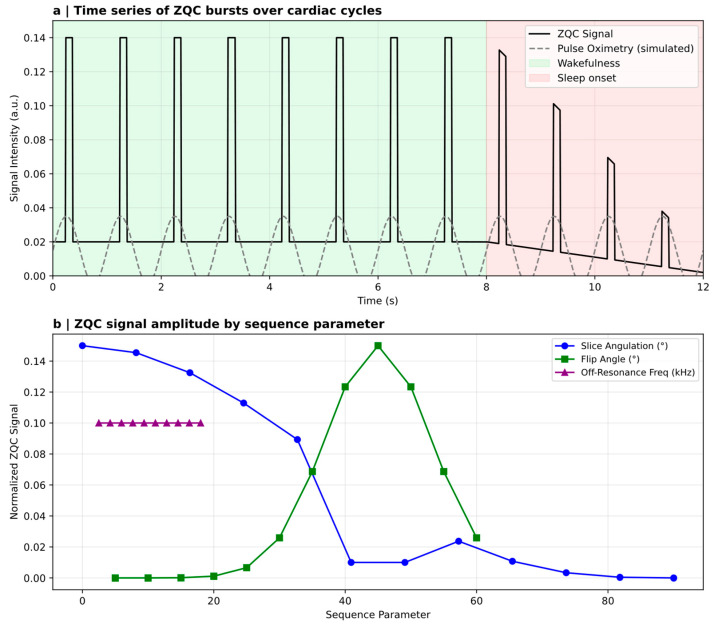
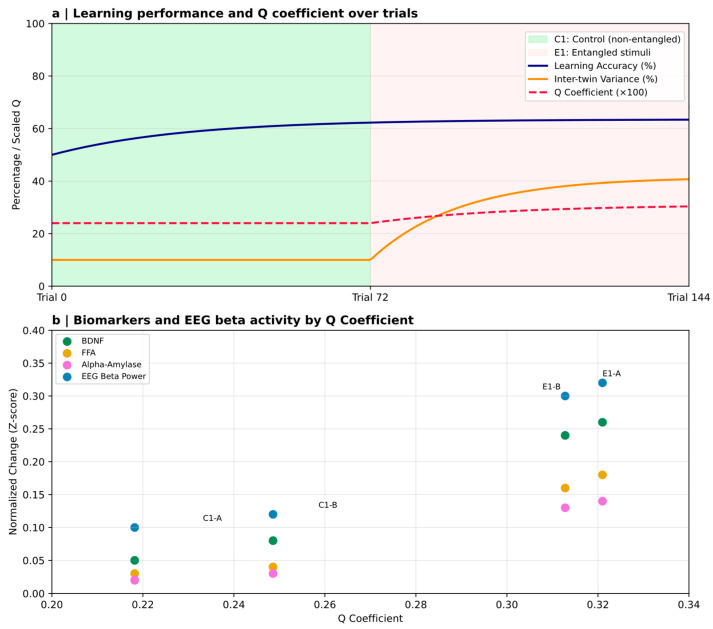
- Reported empirical signals remain preliminary: ZQC MRI studies found heartbeat-locked bursts that varied with vigilance and sleep onset in a subset of participants, and an entanglement-structured learning study reported 13.5% of variance in accuracy and up to 31.6% of variance in twin response divergence.
- The paper emphasizes that many “quantum-like” behavioral or neural patterns can be explained by contextuality, nonlinear classical dynamics, or other classical alternatives.
## Methods
- Structured, semi-systematic literature search across PubMed, Scopus, and Google Scholar covering 1990–2025.
- Included empirical studies of quantum-like or non-classical neural dynamics, theoretical/biophysical models of coherence or entanglement in cognition, and methodological papers with sensitivity to coherence or entanglement.
- Synthesis and critical review of the evidence, with explicit distinction between quantum-like formal models and claims of physically instantiated quantum states in the brain.
## Limitations
- The paper states that replication remains limited, and many findings have not been reproduced under blinded, preregistered, or multicenter conditions.
- It also states that biological entanglement witnesses are not yet established and that no in vivo evidence yet demonstrates long-lived coherence or entanglement in neural tissue.
- Evident from the text: much of the evidence is preliminary, controversial, and interpretively ambiguous, with several findings potentially compatible with classical explanations.
Model-written summary. Check it against the paper before relying on it.
Integrity signals
Registry
Cites
Statistics
Figures
Verification
Claims the paper makes
23 Valid · 15 Not valid · 15 Not checked · 113 Own results and interpretations
The cited sources support only part of this claim — read each source’s verdict below.
In the paper
“Without stringent null models, permutation controls, and transparent preregistration, classical complexity can be easily misinterpreted as quantum coherence [20,24].”
§ Quantum-Inspired and Non-Classical Approaches to Consciousness: Models, Evidence and Constraints > 4. The Technological Landscape for Investigating Quantum Brain Processes
What the sources say
- Could not verifycites [20] Escolà-Gascón Á. Evidence of quantum-entangled higher states of consciousness Comput. Struct. Biotechnol. J. 2025 30 21 40 10.1016/j.csbj.2025.03.001 40171221 PMC11960655 sourceExperimental — accuracy not yet measured
The Results section on density matrices and nonlocal correlations describes control circuits and simulations used to check hardware noise, but does not make the claimed warning about classical complexity being mistaken for quantum coherence. Searches for null models, permutation controls, and preregistration found no passage addressing those requirements; the Discussion section on quantum limitations raises different concerns. (LLM, conf=0.70)
- Partly supportedcites [24] Silberstein R.B. Bigelow F.J. Brain functional connectivity correlates of anomalous interaction between sensorily isolated monozygotic twins Front. Hum. Neurosci. 2024 18 1388049 10.3389/fnhum.2024.1388049 38660011 PMC11039847 sourceExperimental — accuracy not yet measured
The Materials and methods section (page not provided) describes a null hypothesis tested with 10,000 surrogate datasets and a permutation-test threshold. The Discussion takes an agnostic position on quantum entanglement. Neither passage says that classical complexity can be mistaken for quantum coherence or calls for transparent preregistration. (LLM, conf=0.82)
plainstates a possible cause- Asserted: passes — The authors put it forward as true.
- Checkable: passes — It can be checked against evidence.
- Load-bearing: passes — The paper’s conclusions depend on it.
- Based: passes — The paper gives a reason why it holds.
- Could not verify
The cited sources that could be checked couldn’t confirm or dispute this claim.
In the paper
“Analytical approaches such as multifractal detrended fluctuation analysis (MF-DFA) and cross-recurrence quantification analysis (CRQA), which are frequently deployed to detect putative quantum signatures, are exquisitely sensitive to chaos, multiscale feedback, and fractal structure.”
§ Quantum-Inspired and Non-Classical Approaches to Consciousness: Models, Evidence and Constraints > 4. The Technological Landscape for Investigating Quantum Brain Processes
What the sources say
- Could not verifycites [20] Escolà-Gascón Á. Evidence of quantum-entangled higher states of consciousness Comput. Struct. Biotechnol. J. 2025 30 21 40 10.1016/j.csbj.2025.03.001 40171221 PMC11960655 sourceExperimental — accuracy not yet measured
The Methods section on quantum entanglement configuration describes tetracoric correlations and factorization to identify non-random patterns, not MF-DFA or CRQA. Searches for both methods and for chaos, multiscale feedback, and fractal structure found no passage assessing their sensitivity to those features. (LLM, conf=0.76)
- Could not verifycites [24] Silberstein R.B. Bigelow F.J. Brain functional connectivity correlates of anomalous interaction between sensorily isolated monozygotic twins Front. Hum. Neurosci. 2024 18 1388049 10.3389/fnhum.2024.1388049 38660011 PMC11039847 sourceExperimental — accuracy not yet measured
The Materials and methods sections describe SSVEP-based functional-connectivity analysis and statistical tests, not MF-DFA or CRQA. Searches for those methods and for chaos, multiscale feedback, and fractal structure found no passage in our copy addressing their claimed sensitivity. (LLM, conf=0.72)
boostedstates an association- Asserted: passes — The authors put it forward as true.
- Checkable: passes — It can be checked against evidence.
- Load-bearing: passes — The paper’s conclusions depend on it.
- Based: passes — The paper gives a reason why it holds.
- Could not verify
The cited sources support only part of this claim — read each source’s verdict below.
In the paper
“Rather, they illustrate that quantum algebra provides a natural mathematical language for modelling cognitive phenomena such as rapid adaptation, contextual reframing, and flexible decision-making—phenomena that classical neural networks often struggle to reproduce with fidelity [8].”
§ Quantum-Inspired and Non-Classical Approaches to Consciousness: Models, Evidence and Constraints > 6. Insights from Quantum Computing and Neural Networks > 6.1. Quantum Neural Networks: Computation in a Higher Algebra
What the sources say
- Partly supportedcites [8] Bruza P.D. Wang Z. Busemeyer J.R. Quantum cognition: A new theoretical approach to psychology Trends Cogn. Sci. 2015 19 383 393 10.1016/j.tics.2015.05.001 26058709 sourceExperimental — accuracy not yet measured
Split into 2 atoms — 0 confirmed, 2 partially supported, 0 disputed, 0 misattributed, 0 unverifiable. Expand the claim to see per-atom verdicts.
plainstates a cause- Asserted: passes — The authors put it forward as true.
- Checkable: passes — It can be checked against evidence.
- Load-bearing: passes — The paper’s conclusions depend on it.
- Based: passes — The paper gives a reason why it holds.
- Partly supported
The cited sources support only part of this claim — read each source’s verdict below.
In the paper
“Importantly, these paradigms incorporate biomarkers of neuroplasticity—BDNF, salivary alpha-amylase—within preregistered designs, reflecting the methodological maturation of the field.”
§ Quantum-Inspired and Non-Classical Approaches to Consciousness: Models, Evidence and Constraints > 4. The Technological Landscape for Investigating Quantum Brain Processes
What the sources say
- Not checked yetcites [19] Escolà-Gascón Á. Our brains sense the future through a new quantum-like implicit learning mechanism Brain Res. Bull. 2024 216 111048 10.1016/j.brainresbull.2024.111048 39128676 source
Checked before — its earlier verdict is held back until a new check runs.
- Partly supportedcites [20] Escolà-Gascón Á. Evidence of quantum-entangled higher states of consciousness Comput. Struct. Biotechnol. J. 2025 30 21 40 10.1016/j.csbj.2025.03.001 40171221 PMC11960655 sourceExperimental — accuracy not yet measured
The Methods > Biomarkers section (page unavailable) confirms that the study measured BDNF and alpha-amylase. It identifies BDNF as a marker of plasticity, but alpha-amylase as a marker of sympathetic activation and stress, measured from capillary samples rather than saliva. The available passages do not establish that the design was preregistered. (LLM, conf=0.88)
plain- Asserted: passes — The authors put it forward as true.
- Checkable: passes — It can be checked against evidence.
- Load-bearing: unclear — It is unclear whether the paper’s conclusions depend on it.
- Based: passes — The paper gives a reason why it holds.
- Not checked yet
Every source the paper cites for this claim was checked and supports it.
In the paper
“Abramov et al. [25] demonstrated that q-statistics derived from EEG event-interval distributions can differentiate global from local neural complexity, with functional states selectively modulating local complexity at specific scalp sites.”
§ Quantum-Inspired and Non-Classical Approaches to Consciousness: Models, Evidence and Constraints > 4. The Technological Landscape for Investigating Quantum Brain Processes
What the sources say
- Supportedcites [25] Abramov D.M. Quintanilha D.d.F. Lima H.S. Costa R.P. Kamil-Leite C. Lazarev V.V. Tsallis C. Neurophysiological correlates to the human brain complexity through q-statistical analysis of electroencephalogram Sci. Rep. 2025 15 36502 10.1038/s41598-025-21156-6 41115983 PMC12537874 source
The Methodology describes fitting q-statistics to EEG event-interval distributions. The Discussion (pages not provided) reports different behavior for global complexity measured across all channels and local complexity measured in single channels; it also reports that functional states significantly affected single-channel complexity, including at particular scalp sites. (LLM, conf=0.92)
boostedstates an association- Asserted: passes — The authors put it forward as true.
- Checkable: passes — It can be checked against evidence.
- Load-bearing: unclear — It is unclear whether the paper’s conclusions depend on it.
- Based: passes — The paper gives a reason why it holds.
- Supported
74 more claims · 9 with their cited sources checked
Create a free account to see all 166 claims and to verify the 5 references still open.
- It may state two separate claims as one. 43
- Probably not a substantial claim. 60
- Borderline: one of the tests for a substantial claim is unclear. 1
Citations
Cites
Facing up to the problem of consciousness
Chalmers, D. J. (1996) · Toward a Science of Consciousness · doi:10.7551/mitpress/6860.003.0003 · Cited by 1,966
Hameroff, S., & Penrose, R. (2014) · Physics of Life Reviews · doi:10.1016/j.plrev.2013.08.002 · Cited by 983 · cited 2×
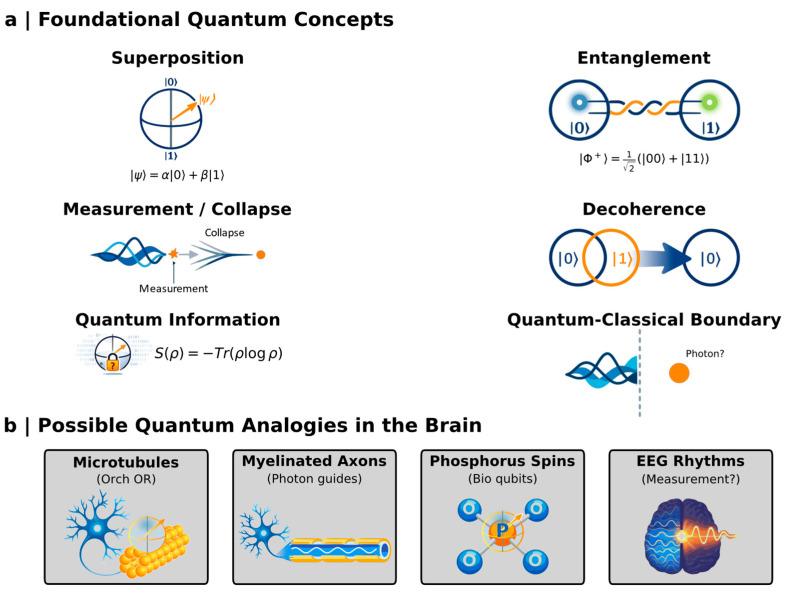
“Inspired by these precedents, theorists have proposed that phosphorus nuclear spins residing in phosphate groups within neural environments could form relatively long-lived spin states under specific biochemical conditions, in principle enabling qubit-like behavior [13,18].”
Lambert, N., Chen, Y.-N., Cheng, Y.-C., Li, C.-M., Chen, G.-Y., & Nori, F. (2013) · Nature Physics · doi:10.1038/nphys2474 · Cited by 948 · cited 1×
“…physiological environment [10,11], research in quantum biology demonstrates that certain quantum effects (for example, coherence or spin-dependent reaction dynamics) can persist under conditions once deemed prohibitive, as in photosynthetic energy transfer and avian magnetoreception [12].”
Importance of quantum decoherence in brain processes
Tegmark, M. (2000) · Physical Review E · doi:10.1103/physreve.61.4194 · Cited by 776 · cited 1×
“Although the brain operates in a warm, decoherence-prone physiological environment [10,11], research in quantum biology demonstrates that certain quantum effects (for example, coherence or spin-dependent reaction dynamics) can persist under conditions once deemed prohibitive, as in photosynthetic…”
Orchestrated reduction of quantum coherence in brain microtubules: a model for consciousness
Hameroff, S., & Penrose, R. (1996) · Mathematics and Computers in Simulation · doi:10.1016/0378-4754(96)80476-9 · Cited by 641 · cited 1×
“At the cellular scale, the Orch OR theory posits that quantum-coherent states form within neuronal microtubules and undergo objective reduction, thereby generating discrete conscious moments [42].”
Quantum cognition: A new theoretical approach to psychology
Bruza, P. D., Wang, Z., & Busemeyer, J. R. (2015) · Trends in Cognitive Sciences · doi:10.1016/j.tics.2015.05.001 · Cited by 273 · cited 4×
“Rather, they illustrate that quantum algebra provides a natural mathematical language for modelling cognitive phenomena such as rapid adaptation, contextual reframing, and flexible decision-making—phenomena that classical neural networks often struggle to reproduce with fidelity [8].”
InfluentialA Quantum Question Order Model Supported by Empirical Tests of an A Priori and Precise Prediction
Wang, Z., & Busemeyer, J. R. (2013) · Topics in Cognitive Science · doi:10.1111/tops.12040 · Cited by 220 · cited 1×
“Several models have been proposed to explain cognition using quantum formalism [4–9].”
Quantum Entanglement in Deep Learning Architectures
Levine, Y., Sharir, O., Cohen, N., & Shashua, A. (2019) · Physical Review Letters · doi:10.1103/physrevlett.122.065301 · Cited by 206 · cited 1×
“Here, the emphasis is not on qubits per se but on representing complex interactions across hierarchical scales with remarkable computational efficiency [34].”
Quantum mechanics, interference, and the brain
Acacio de Barros, J., & Suppes, P. (2009) · Journal of Mathematical Psychology · doi:10.1016/j.jmp.2009.03.005 · Cited by 119 · cited 3×
“As Acacio de Barros and Suppes [7] argue, contextuality—rather than entanglement or superposition—may be the true driver of quantum-like cognitive effects, including apparent violations of classical probability axioms in behavioral modelling, where such claims depend on the specific experimental…”
Revisiting the Quantum Brain Hypothesis: Toward Quantum (Neuro)biology?
Jedlicka, P. (2017) · Frontiers in Molecular Neuroscience · doi:10.3389/fnmol.2017.00366 · Cited by 97 · cited 1×
“Inspired by these precedents, theorists have proposed that phosphorus nuclear spins residing in phosphate groups within neural environments could form relatively long-lived spin states under specific biochemical conditions, in principle enabling qubit-like behavior [13,18].”
Quantum probability in decision making from quantum information representation of neuronal states
Khrennikov, A., Basieva, I., Pothos, E. M., & Yamato, I. (2018) · Scientific Reports · doi:10.1038/s41598-018-34531-3 · Cited by 93 · cited 2×
“Models based on a quantum information representation of neuronal states suggest that the intrinsic uncertainty in electrochemical processes—such as stochastic ion-channel dynamics and variability in action potential generation—can be mapped onto superposition-like informational states [47].”
Consciousness, biology and quantum hypotheses
Baars, B. J., & Edelman, D. B. (2012) · Physics of Life Reviews · doi:10.1016/j.plrev.2012.07.001 · Cited by 92 · cited 1×
“A strong classical counterposition was articulated by Baars and Edelman [48], who argued that while all biological processes are reducible to quantum events in principle, quantum mechanics does not necessarily provide the appropriate level of explanation for consciousness.”
Quantum-like modeling of cognition
Khrennikov, A. (2015) · Frontiers in Physics · doi:10.3389/fphy.2015.00077 · Cited by 91 · cited 3×
“In contrast, quantum-like approaches adopt the mathematical structure of quantum theory—particularly Hilbert space representations and quantum probability—to model cognitive phenomena without assuming that the brain operates as a quantum physical system [45].”
InfluentialExperimental indications of non-classical brain functions
Kerskens, C. M., & López Pérez, D. (2022) · Journal of Physics Communications · doi:10.1088/2399-6528/ac94be · Cited by 88 · cited 4×
“The difficulty arises from scale: quantum states typically evolve on femtosecond timescales and nanometer spatial resolutions—orders of magnitude finer than the temporal and spatial windows accessible to macroscopic neuroimaging tools such as EEG, MEG, or fMRI [17].”
InfluentialA case for applying an abstracted quantum formalism to cognition
Aerts, D., Broekaert, J., & Gabora, L. M. (2010) · New Ideas in Psychology · doi:10.1016/j.newideapsych.2010.06.002 · Cited by 80 · cited 2×
“Nevertheless, Aerts et al. [33] argue that the contextual nature of conscious experience aligns structurally with quantum mechanics.”
Quantum Neural Network for Quantum Neural Computing
Zhou, M.-G., Liu, Z.-P., Yin, H.-L., Li, C.-L., Xu, T.-K., & Chen, Z.-B. (2023) · Research · doi:10.34133/research.0134 · Cited by 79 · cited 2×
“Quantum neural networks (QNNs) incorporate the principles of superposition, entanglement, and interference into computational architectures designed to capture forms of reasoning and adaptation that defy classical formalisms [23].”
Gunji, Y.-P., Shinohara, S., Haruna, T., & Basios, V. (2016) · Biosystems · doi:10.1016/j.biosystems.2016.12.003 · Cited by 63 · cited 1×
“A complementary line of work develops quantum-like cognition from rough-set theory and ambiguous representations, showing that paired Bayesian and inverse-Bayesian inference processes can generate logical structures corresponding to orthomodular lattices rather than classical Boolean algebras [36].”
Entangled biphoton generation in the myelin sheath
Liu, Z., Chen, Y.-C., & Ao, P. (2024) · Physical review. E · doi:10.1103/physreve.110.024402 · Cited by 61 · cited 4×
“Endogenous biophotonic processes within myelinated axons may produce entangled biphotons, facilitating long-range correlations that transcend synaptic connectivity [14,15].”
InfluentialQuantum models of the mind: Are they compatible with environment decoherence?
Rosa, L. P., & Faber, J. (2004) · Physical Review E · doi:10.1103/physreve.70.031902 · Cited by 45 · cited 1×
“Although the brain operates in a warm, decoherence-prone physiological environment [10,11], research in quantum biology demonstrates that certain quantum effects (for example, coherence or spin-dependent reaction dynamics) can persist under conditions once deemed prohibitive, as in photosynthetic…”
Quantum cognition based on an ambiguous representation derived from a rough set approximation
Gunji, Y.-P., Sonoda, K., & Basios, V. (2016) · Biosystems · doi:10.1016/j.biosystems.2015.12.003 · Cited by 41 · cited 1×
“Several models have been proposed to explain cognition using quantum formalism as a mathematical and probabilistic framework, rather than as a biological substrate (Table 1) [4,5,7,8].”
Freitas da Rocha, A., Pereira, A., & Bezerra Coutinho, F. A. (2001) · Progress in Neurobiology · doi:10.1016/s0301-0082(00)00069-1 · Cited by 41 · cited 1×
“Recent theoretical work has proposed that conscious processing may arise at classical-quantum interfaces within neural tissue, particularly in calcium-dependent synaptic mechanisms [51], astrocytic hydro-ionic waves, and ion–water interactions in the extracellular milieu [52].”
Photons guided by axons may enable backpropagation-based learning in the brain
Zarkeshian, P., Kergan, T., Ghobadi, R., Nicola, W., & Simon, C. (2022) · Scientific Reports · doi:10.1038/s41598-022-24871-6 · Cited by 35 · cited 3×
“Endogenous biophotonic processes within myelinated axons may produce entangled biphotons, facilitating long-range correlations that transcend synaptic connectivity [14,15].”
Quantum noise and stochastic reduction
Brody, D. C., & Hughston, L. P. (2006) · Journal of Physics A Mathematical and General · doi:10.1088/0305-4470/39/4/008 · Cited by 35 · cited 1×
“Brody and Hughston [40] describe how nonlinear stochastic dynamics can induce spontaneous state reduction, offering a continuous, physically motivated alternative to the instantaneous collapse postulate.”
Wiest, M. C. (2025) · Neuroscience of Consciousness · doi:10.1093/nc/niaf011 · Cited by 34 · cited 1×
“A conceptual review by Wiest [50] argues that microtubules constitute a quantum substrate of consciousness and that Orch OR provides a unified solution to the binding problem and the epiphenomenalism problem.”
Testing the Conjecture That Quantum Processes Create Conscious Experience
Neven, H., Read, P., Kosik, K. S., Van der Molen, T., Bouwmeester, D., Bodnia, E., Turin, L., & Koch, C. (2024) · doi:10.20944/preprints202402.1751.v1 · Cited by 33 · cited 6×
“Neven et al. [16] further propose that quantum entanglement naturally resolves the binding problem and the unity of phenomenal experience without additional assumptions, with the number of entangled degrees of freedom bounding the content and richness of consciousness.”
InfluentialQuantum concepts in Psychology: Exploring the interplay of physics and the human psyche
Kyriazos, T. A., & Poga, M. (2023) · Biosystems · doi:10.1016/j.biosystems.2023.105070 · Cited by 28 · cited 1×
“…psychology has advanced formal analogies between quantum principles and emotional or cognitive dynamics, proposing that superposition, entanglement, tunneling, and decoherence provide structurally rich frameworks for modeling ambiguity, emotional complexity, and contextual decision-making [35].”
A quantum cognition model for bridging stated and revealed preference
Yu, J., & Jayakrishnan, R. (2018) · Transportation Research Part B Methodological · doi:10.1016/j.trb.2018.10.014 · Cited by 19 · cited 1×
“A formal application of Hilbert-space modeling to decision behavior is provided by Yu and Jayakrishnan [29], who developed a quantum cognition model to bridge stated and revealed preferences in travel behavior.”
Lattice physics approaches for neural networks
Bardella, G., Franchini, S., Pani, P., & Ferraina, S. (2024) · iScience · doi:10.1016/j.isci.2024.111390 · Cited by 17 · cited 3×
“This representation allows the construction of effective theories through coarse-graining procedures, in which macroscopic neural dynamics emerge from underlying discrete interactions, conceptually paralleling renormalisation approaches in statistical and quantum field theory [44].”
InfluentialCoupling quantum-like cognition with the neuronal networks within generalized probability theory
Khrennikov, A., Ozawa, M., Benninger, F., & Shor, O. (2025) · Journal of Mathematical Psychology · doi:10.1016/j.jmp.2025.102923 · Cited by 17 · cited 1×
“Khrennikov et al. [6] propose embedding weighted directed graphs representing communicating neurons into an operational measurement framework based on ordered linear spaces.”
Swan, M., dos Santos, R. P., & Witte, F. (2022) · Quantum Reports · doi:10.3390/quantum4010008 · Cited by 16 · cited 1×
“Through this inherently parallel structure, QNNs simulate probabilistic reasoning, associative generalization, and context-dependent updating with an efficiency that resonates with biological cognition [31,32].”
Quantum Models of Consciousness from a Quantum Information Science Perspective
Gassab, L., Pusuluk, O., Cattaneo, M., & Müstecaplıoğlu, Ö. E. (2025) · Entropy · doi:10.3390/e27030243 · Cited by 14 · cited 1×
“The development of the Quantum-Multilinear Integrated Coefficient (Q) [21] or the Posner model [22] provides a mathematically principled measure for quantifying variance aligned with entanglement-structured task design.”
Quantum formalism for the dynamics of cognitive psychology
Brody, D. C. (2023) · Scientific Reports · doi:10.1038/s41598-023-43403-4 · Cited by 13 · cited 2×
“Several models have been proposed to explain cognition using quantum formalism [4–9].”
Quantum information theoretic approach to the hard problem of consciousness
Georgiev, D. D. (2025) · Biosystems · doi:10.1016/j.biosystems.2025.105458 · Cited by 13 · cited 2×
“Georgiev [26] argues that collapse-based functionalist models, including Orch OR, render consciousness a causally impotent epiphenomenon, a product of objective reductions rather than their agent.”
Keppler, J. (2025) · Frontiers in Human Neuroscience · doi:10.3389/fnhum.2025.1676585 · Cited by 13 · cited 1×
“Interest has increasingly turned toward whether principles from quantum physics might contribute conceptually or mechanistically to this challenge [2,3].”
The role of quantum mechanics in cognition-based evolution
Marshall, P. (2023) · Progress in Biophysics and Molecular Biology · doi:10.1016/j.pbiomolbio.2023.04.007 · Cited by 11 · cited 3×
“If substantiated, this would position consciousness not as an emergent epiphenomenon but as integral to the physical fabric of biological reality, though empirical validation of cells acting as quantum observers remains an open challenge [28].”
InfluentialEvidence of quantum-entangled higher states of consciousness
Escolà-Gascón, Á. (2025) · Computational and Structural Biotechnology Journal · doi:10.1016/j.csbj.2025.03.001 · Cited by 11 · cited 6×
“Without stringent null models, permutation controls, and transparent preregistration, classical complexity can be easily misinterpreted as quantum coherence [20,24].”
InfluentialQuantum Computing for the Brain
Swan, M., dos Santos, R. P., Lebedev, M., & Witte, F. M. C. (2021) · Between science and economics · doi:10.1142/q0313 · Cited by 10
Towards a Possible Definition of Consciousness
Vitas, M. (2025) · BioSystems · doi:10.1016/j.biosystems.2025.105526 · Cited by 9 · cited 1×
“A recent conceptual proposal by Vitas [43] advances a definitional reformulation of consciousness as “an emergent property of a far-from-equilibrium system of quantum particles sustained by an autopoietic system and capable of processing, transforming, and accumulating information acquired from the…”
Temporal Bell inequalities in cognition
Waddup, O. J., Yearsley, J. M., Blasiak, P., & Pothos, E. M. (2023) · Psychonomic Bulletin & Review · doi:10.3758/s13423-023-02275-5 · Cited by 8 · cited 1×
“Applying this framework to cognition, Waddup et al. [41] tested a Temporal Bell inequality in a memory paradigm using change judgments across sequential time points.”
Wiest, M. C., & Puniani, A. S. (2025) · Computational and Structural Biotechnology Journal · doi:10.1016/j.csbj.2025.09.016 · Cited by 7 · cited 1×
“In a companion article, Wiest and Puniani [39] extend this argument by proposing that Orchestrated Objective Reduction (Orch OR) in intraneuronal microtubules provides a mechanistic basis for the empirically observed discreteness of perceptual cycles.”
Wiest, M. C., & Puniani, A. S. (2025) · Computational and Structural Biotechnology Journal · doi:10.1016/j.csbj.2025.09.017 · Cited by 6 · cited 1×
“A recent theoretical development by Wiest and Puniani [38] argues that temporally deep active inference, particularly the requirement to evaluate multiple future trajectories, may be mathematically equivalent to the quantum path integral formalism.”
Classical-quantum interfaces in living neural tissue supporting conscious functions
(2020) · Advances in Quantum Chemistry · doi:10.1016/bs.aiq.2020.08.002 · Cited by 6 · cited 1×
“Recent theoretical work has proposed that conscious processing may arise at classical-quantum interfaces within neural tissue, particularly in calcium-dependent synaptic mechanisms [51], astrocytic hydro-ionic waves, and ion–water interactions in the extracellular milieu [52].”
Silberstein, R. B., & Bigelow, F. J. (2024) · Frontiers in Human Neuroscience · doi:10.3389/fnhum.2024.1388049 · Cited by 5 · cited 1×
“Without stringent null models, permutation controls, and transparent preregistration, classical complexity can be easily misinterpreted as quantum coherence [20,24].”
Schiffer, F. (2025) · Medical Hypotheses · doi:10.1016/j.mehy.2025.111738 · Cited by 5 · cited 3×
“Although this four-field framework lacks direct empirical validation at the quantum level, it illustrates the growing interest in testable, field-based models of consciousness [27].”
InfluentialNon-linearity, complexity, and quantization concepts in biology
Theise, N. D., & Tuszyński, J. A. (2026) · Frontiers in Human Neuroscience · doi:10.3389/fnhum.2025.1695510 · Cited by 5 · cited 1×
“Interest has increasingly turned toward whether principles from quantum physics might contribute conceptually or mechanistically to this challenge [2,3].”
Mathematical proof of the Fisher-Escolà Q statistical distribution in quantum consciousness modeling
Escolà-Gascón, Á., & Benito-León, J. (2025) · Computational and Structural Biotechnology Journal · doi:10.1016/j.csbj.2025.04.025 · Cited by 4 · cited 1×
“The development of the Quantum-Multilinear Integrated Coefficient (Q) [21] or the Posner model [22] provides a mathematically principled measure for quantifying variance aligned with entanglement-structured task design.”
Our brains sense the future through a new quantum-like implicit learning mechanism
Escolà-Gascón, Á. (2024) · Brain Research Bulletin · doi:10.1016/j.brainresbull.2024.111048 · Cited by 3 · cited 2×
“EEG studies using quantum-randomized or entanglement-structured stimulus generation show anticipatory activity patterns and behavioral signatures that some authors argue are not readily captured by standard classical conditioning models [19,20].”
Abramov, D. M., Quintanilha, D. D. F., Lima, H. S., Costa, R. P., Kamil-Leite, C., Lazarev, V. V., & Tsallis, C. (2025) · Scientific Reports · doi:10.1038/s41598-025-21156-6 · Cited by 2 · cited 2×
“Additionally, Abramov et al. [25] demonstrated that q-statistics derived from EEG event-interval distributions can differentiate global from local neural complexity, with functional states selectively modulating local complexity at specific scalp sites.”
Quantum-enhanced decision-making in ACT-R
Pathak, P., Innan, N., Marchisio, A., & Shafique, M. (2025) · Elsevier eBooks · doi:10.1016/b978-0-44-330259-6.00021-9 · Cited by 2
Schrödinger’s cat and mouse: An adapted thought experiment for the context of consciousness
Eeles, E. M., Pourzinal, D., Jalal, B., & Ray, J. (2025) · Behavioural Brain Research · doi:10.1016/j.bbr.2025.115459 · Cited by 1
The collapse of the wave function as the mediator of free will in prime neurons
Loboguerrero, D. A. (2025) · Frontiers in Neuroscience · doi:10.3389/fnins.2025.1637217 · cited 1×
“A recent hypothesis extends collapse-based interpretations of quantum mechanics to propose that wavefunction reduction within specific “prime neurons” mediates free will through the action of a hypothetical “soul/spirit particle” [49].”
Pothos, E. M., & Yearsley, J. M. (2023) · Springer eBooks · doi:10.1007/978-3-031-12986-5_14
Cheng, L., Saurabh, N., and Mao, Y. (2026). Quantum-enhanced decision-making in ACT-R: Cognitive architectures, decision-making, and quantum optimization. Quantum Computational AI, Morgan Kaufmann.
(n.d.)
Unresolved
Cited by
Focusing on Artificial Intelligence Through an Academic Lens
Hurlburt, G. F., & Keshavarz, H. (2026) · IT Professional · doi:10.1109/mitp.2026.3710901
“19 One mathematical analysis argues that increasing scale may not be the appropriate objective of AI.”
Metadata
- Authors
- Arias-Carrión, O., Ortega-Robles, E., & Manjarrez, E.
- Affiliations
- División de Neurociencias Clínica, Instituto Nacional de Rehabilitación Luis Guillermo Ibarra Ibarra, Mexico City 14389, Mexico
- Instituto de Fisiología, Benemérita Universidad Autónoma de Puebla, Puebla 72570, Mexico
- Venue
- Brain Sciences
- Publisher
- MDPI AG
- Published
- 2026-03-31
- Volume
- 16
- Issue
- 4
- Pages
- 386
- ISSN
- 2076-3425 (ISSN-L)
- PMC
- PMC13114211
- OpenAlex
- W7147478475
- Semantic Scholar
- 2b59898fa52f4eecc958968ed1b7188baaddf13d
- Cited by
- 1
- References
- 52
- Citations by year
- 2026: 1
- FWCI
- 1.67
- Type
- journal article
- Language
- en
- Open access
- gold
- doi.org
- Licence
- Locations
- Brain Sciences (publishedVersion, cc-by)
- Preprints.org (acceptedVersion, cc-by)
- PubMed Central (publishedVersion, cc-by)
- PubMed (publishedVersion)
- DOAJ (DOAJ: Directory of Open Access Journals) (submittedVersion, cc-by-sa)
- Topics
- Social Sciences › Arts and Humanities › Philosophy › Philosophy and Theoretical Science
- Health Sciences › Medicine › Complementary and alternative medicine › Biofield Effects and Biophysics
- Physical Sciences › Physics and Astronomy › Atomic and Molecular Physics, and Optics › Quantum Mechanics and Applications
- Keywords
- consciousness, quantum consciousness, zero-quantum coherence, microtubules, nuclear spin, photonic architectures, contextuality, neural integration, nonclassical correlations
About these checks
Registry, retraction, Cites and statistics results are computed, not judged, with one exception: a printed reference that no index lists is read once by a model before it counts as a citation error. Claims are extracted by a model and kept only when their quote appears verbatim in the text; each cited source is then checked, with a model’s help, for whether it says what the claim relies on. Those verdicts can be wrong — read the claim’s quote and the cited source before relying on one.
The claim verdicts this report counts are experimental: their accuracy is not yet measured.
A language model drew the claims from the paper on 2026-10-10, under version 3 of the claim definition (model deepseek-v4.1-flash, prompt extract-v3).
A second model labelled each claim on 2026-10-10 (model jev-1.13-20260917, definition revision gold-guideline-v0.2).
Cited sources are checked with a language model’s help (gpt-6-sol).
Statistics and arithmetic are recomputed, not judged.
Confidence bands are shown only for fields calibrated on our annotated test set. None is calibrated yet, so no band is shown.
What counts as a claim ›How we measure confidence ›How we check this ›
Are you an author, or do you see a problem with this page? Request a review
Data sources
Bibliographic data: Semantic Scholar, OpenAlex, Crossref.
Contains information from the Semantic Scholar Academic Graph Datasets, made available under the ODC Attribution License (ODC-BY 1.0).
Semantic Scholar’s data is described in: Kinney, R., et al. (2023). The Semantic Scholar Open Data Platform. arXiv:2301.10140.
