

Epistemic Communities under Active Inference
Open accessThe DOI matches its Crossref record; 165 of the 165 references it cites were found in a registry or an index; 7 of the 18 sources its claims cite were checked for support.
Abstract
The spread of ideas is a fundamental concern of today’s news ecology. Understanding the dynamics of the spread of information and its co-option by interested parties is of critical importance. Research on this topic has shown that individuals tend to cluster in echo-chambers and are driven by confirmation bias. In this paper, we leverage the active inference framework to provide an in silico model of confirmation bias and its effect on echo-chamber formation. We build a model based on active inference, where agents tend to sample information in order to justify their own view of reality, which eventually leads to them to have a high degree of certainty about their own beliefs. We show that, once agents have reached a certain level of certainty about their beliefs, it becomes very difficult to get them to change their views. This system of self-confirming beliefs is upheld and reinforced by the evolving relationship between an agent’s beliefs and observations, which over time will continue to provide evidence for their ingrained ideas about the world. The epistemic communities that are consolidated by these shared beliefs, in turn, tend to produce perceptions of reality that reinforce those shared beliefs. We provide an active inference account of this community formation mechanism. We postulate that agents are driven by the epistemic value that they obtain from sampling or observing the behaviours of other agents. Inspired by digital social networks like Twitter, we build a generative model in which agents generate observable social claims or posts (e.g., ‘tweets’) while reading the socially observable claims of other agents that lend support to one of two mutually exclusive abstract topics. Agents can choose which other agent they pay attention to at each timestep, and crucially who they attend to and what they choose to read influences their beliefs about the world. Agents also assess their local network’s perspective, influencing which kinds of posts they expect to see other agents making. The model was built and simulated using the freely available Python package pymdp. The proposed active inference model can reproduce the formation of echo-chambers over social networks, and gives us insight into the cognitive processes that lead to this phenomenon.
Overview
CoChat Summary
## TL;DR
This paper presents a multi-agent active inference model of opinion dynamics in which agents infer both an abstract binary “Idea” and other agents’ beliefs from observable “Hashtags,” and use those inferences to choose whom to attend to and what to tweet. Simulations show that epistemic confirmation bias, network connectivity, inverse social volatility, and habit learning jointly shape whether groups polarize into echo-chambers or converge toward consensus.
## Key findings
- The model reproduces confirmation-bias-like dynamics: higher epistemic confirmation bias \(\gamma\) makes agents preferentially sample like-minded neighbours and can drive echo-chamber formation.
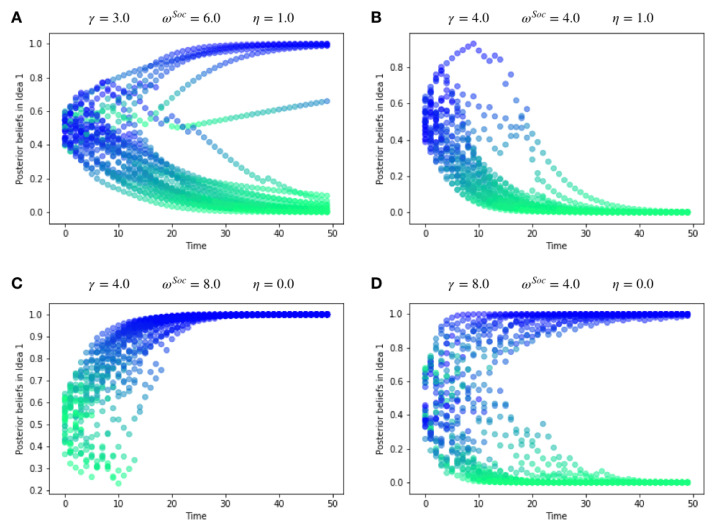
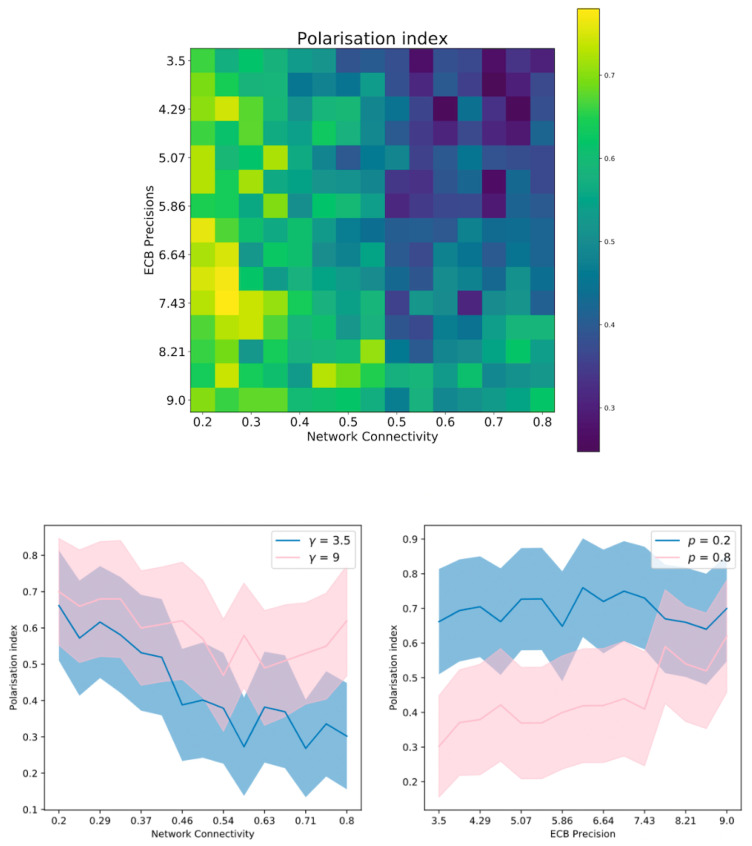
- In the network experiments, increasing connectivity \(p\) generally reduced polarisation, but high \(\gamma\) could counteract this: even at \(p=0.8\), many trials still ended in polarised dynamics.
- For the \(\gamma\)–\(\omega_{\mathrm{Soc}}\) sweep, the authors report 15 values of \(\gamma\) over \((3,9)\), 15 values of \(\omega_{\mathrm{Soc}}\) over \((0.05,1.0)\), \(N=15\) agents, and \(p=0.4\); low inverse social volatility led to more re-attendance to neighbours.
- In the habit-formation experiment, higher learning rate \(\eta\) increased polarisation; the average re-attendance rate was “seemingly maximised” when \(\eta \approx 0.3\), and the effect was strongest at high \(\gamma\) and \(\eta\).
## Methods
- Multi-agent simulations were built under a discrete active inference/POMDP framework, with agents inferring an abstract binary hidden state (“Idea 1” vs “Idea 2”), neighbours’ meta-beliefs, and their own actions from observed tweets/hashtags.
- The simulations used Erdős–Rényi networks and the freely available Python package `pymdp`; network size ranged from \(N=12\)–30 in general, and the main quantitative experiments used \(N=15\) agents with 100 independent realisations per condition and \(T=100\) timesteps.
- Main analyses were parameter sweeps over epistemic confirmation bias \(\gamma\), inverse social volatility \(\omega_{\mathrm{Soc}}\), habit-learning rate \(\eta\), and connectivity \(p\), with outcomes summarized using polarisation index \(\rho\) and re-attendance rate \(r\).
## Limitations
- The paper states that the parameter search “was not exhaustive,” and that large regions of parameter space remain unexplored.
- It states that network size was largely fixed/small for computational reasons: simulations mainly used \(N=30\) or \(N=15\), \(\omega_{\mathrm{Idea}}=9.0\) was fixed, and the authors say results are not guaranteed to generalise to larger networks.
- It also says the outcome measures were relatively simple: the polarisation metric is one-dimensional and does not distinguish different belief-network configurations. Evidence from the text also makes clear that the model omits any true environmental signal and only models two mutually exclusive Ideas; this is a modeling simplification the authors themselves acknowledge as needing future extension.
Model-written summary. Check it against the paper before relying on it.
Integrity signals
Registry
Cites
Statistics
Figures




Verification
Claims the paper makes
5 Valid · 2 Not valid · 5 Not checked · 112 Own results and interpretations
The cited sources support only part of this claim — read each source’s verdict below.
In the paper
“However, clearly defined clusters and group boundaries can sometimes act as buffers [132,133,134,135,136].”
§ Epistemic Communities under Active Inference > 5. Discussion
What the sources say
- Not checked — no full text of the sourcecites [132] Almogren, 2019, An efficient networking protocol for internet of things to handle multimedia big data, Multimed. Tools Appl. source
- Not checked — no full text of the sourcecites [133] 2005, Gated communities: Sprawl and social segregation in Southern California, Hous. Stud. source
- Not checked — no full text of the sourcecites [134] Aldrich, 1977, Boundary spanning roles and organization structure, Acad. Manag. Rev. source
- Partly supportedcites [135] Jaemthaworn, 2021, Topological clustering of regulatory genes confers pathogenic tolerance to cassava brown streak virus (CBSV) in cassava, Sci. Rep. sourceExperimental — accuracy not yet measured
The Results section on microscopic-scale clustered topology says that a highly connected gene-cluster structure buffered network disruption during simulated perturbation. It does not show that clearly defined group boundaries themselves act as buffers; the protective feature studied was connectivity within gene clusters. (LLM, conf=0.85)
- Not checked — no full text of the sourcecites [136] Richter, 2006, Boundary spanners’ identification, intergroup contact, and effective intergroup relations, Acad. Manag. J. source
boostedstates a possible cause- Asserted: passes — The authors put it forward as true.
- Checkable: passes — It can be checked against evidence.
- Load-bearing: passes — The paper’s conclusions depend on it.
- Based: passes — The paper gives a reason why it holds.
A result the paper reports from its own data — it cites no other source for it, so there is none to check. The quote shows it is in the paper.
In the paper
“With high enough γ or high enough ωSoc, the focal agent’s beliefs, faced with these two conflicting sources of information, converge to one Idea.”
§ Epistemic Communities under Active Inference > 4. Results > 4.1. Opinion Formation in a Single Agent
plainstates a cause- Asserted: passes — The authors put it forward as true.
- Checkable: passes — It can be checked against evidence.
- Load-bearing: passes — The paper’s conclusions depend on it.
- Based: passes — The paper gives a reason why it holds.
- Rests on 3 assumptions not shown here.
A result the paper reports from its own data — it cites no other source for it, so there is none to check. The quote shows it is in the paper.
In the paper
“In general, Figure 2 shows that beliefs in more meta-belief volatility (lower ωSoc) lead to higher posterior uncertainty about the sIdea hidden state, as is shown by the red lines in subplots (a) and (c).”
§ Epistemic Communities under Active Inference > 4. Results > 4.1. Opinion Formation in a Single Agent
plainstates a cause- Asserted: passes — The authors put it forward as true.
- Checkable: passes — It can be checked against evidence.
- Load-bearing: unclear — It is unclear whether the paper’s conclusions depend on it.
- Based: passes — The paper gives a reason why it holds.
- Rests on 3 assumptions not shown here.
A result the paper reports from its own data — it cites no other source for it, so there is none to check. The quote shows it is in the paper.
In the paper
“The proposed active inference model can reproduce the formation of echo-chambers over social networks, and gives us insight into the cognitive processes that lead to this phenomenon.”
§ Epistemic Communities under Active Inference > Abstract
plainstates a cause- Asserted: passes — The authors put it forward as true.
- Checkable: passes — It can be checked against evidence.
- Load-bearing: passes — The paper’s conclusions depend on it.
- Based: passes — The paper gives a reason why it holds.
A result the paper states — it cites no source for it, so there is none to check. The quote shows it is in the paper.
In the paper
“We show that, once agents have reached a certain level of certainty about their beliefs, it becomes very difficult to get them to change their views.”
§ Epistemic Communities under Active Inference > Abstract
plainstates a cause- Asserted: passes — The authors put it forward as true.
- Checkable: passes — It can be checked against evidence.
- Load-bearing: passes — The paper’s conclusions depend on it.
- Based: passes — The paper gives a reason why it holds.
82 more claims
Create a free account to see all 124 claims and to verify the 1 reference still open.
- Probably not a substantial claim. 21
- It may state two separate claims as one. 19
Citations
Cites
The need to belong: Desire for interpersonal attachments as a fundamental human motivation.
Baumeister, R. F., & Leary, M. R. (1995) · Psychological Bulletin · doi:10.1037//0033-2909.117.3.497 · Cited by 23,245 · cited 1×
“The spread of ideas and behaviors from one agent to another serves 77 both local and larger-scale coordination [28,29].”
BackgroundThe Proceedings of the National Academy of Sciences
Richards, J. W. (1915) · Science · doi:10.1126/science.42.1074.161 · Cited by 13,983
Markov decision processes: Discrete stochastic dynamic programming
Hazeghi, K., & Puterman, M. L. (1995) · Journal of the American Statistical Association · doi:10.2307/2291177 · Cited by 8,037
International Journal of Environmental Research and Public Health
(2013) · International Journal of Environmental Research and Public Health · doi:10.3390/ijerph · Cited by 7,753
Social Influence: Compliance and Conformity
Cialdini, R. B., & Goldstein, N. J. (2004) · Annual Review of Psychology · doi:10.1146/annurev.psych.55.090902.142015 · Cited by 6,077 · cited 1×
“This is partly due to the fact that members of an in-group can be most precisely predicted: their behaviours are normed, and expected by the members of the group, in ways that generally benefit its members [18,19].”
BackgroundTaking the Human Out of the Loop: A Review of Bayesian Optimization
Shahriari, B., Swersky, K., Wang, Z., Adams, R. P., & de Freitas, N. (2016) · Proceedings of the IEEE · doi:10.1109/jproc.2015.2494218 · Cited by 6,049
Markov Decision Processes: Discrete Stochastic Dynamic Programming
Puterman, M. L. (1994) · Wiley Series in Probability and Statistics · doi:10.1002/9780470316887 · Cited by 6,024
Journal of the American Statistical Association
Koehler, A. B. (1995) · International Journal of Forecasting · doi:10.1016/0169-2070(95)90067-5 · Cited by 5,337
MacKay, D. J. C. (1992) · Neural Computation · doi:10.1162/neco.1992.4.3.415 · Cited by 4,388 · cited 1×
“The remaining (negative) surprise can be 371 itself used as a score for model averaging and model selection [118,119].”
Motivated Skepticism in the Evaluation of Political Beliefs
Taber, C. S., & Lodge, M. (2006) · American Journal of Political Science · doi:10.1111/j.1540-5907.2006.00214.x · Cited by 4,344
Planning and acting in partially observable stochastic domains
Kaelbling, L. P., Littman, M. L., & Cassandra, A. R. (1998) · Artificial Intelligence · doi:10.1016/s0004-3702(98)00023-x · Cited by 4,149
Degroot, M. H. (1974) · Journal of the American Statistical Association · doi:10.1080/01621459.1974.10480137 · Cited by 4,004
The Bayesian brain: The role of uncertainty in neural coding and computation
Knill, D. C., & Pouget, A. (2004) · Trends in Neurosciences · doi:10.1016/j.tins.2004.10.007 · Cited by 2,588
Markov Decision Processes: Discrete Stochastic Dynamic Programming
Baxter, L. A. (1995) · Technometrics · doi:10.1080/00401706.1995.10484354 · Cited by 2,415
Opinion Dynamics and Bounded Confidence Models, Analysis and Simulation
Hegselmann, R., & Krause, U. (2002) · RePEc: Research Papers in Economics · Cited by 2,362
Mixing beliefs among interacting agents
Deffuant, G., Neau, D., Amblard, F., & Weisbuch, G. (2000) · Advances in Complex Systems · doi:10.1142/s0219525900000078 · Cited by 2,165
The echo chamber effect on social media
Cinelli, M., De Francisci Morales, G., Galeazzi, A., Quattrociocchi, W., & Starnini, M. (2021) · Proceedings of the National Academy of Sciences · doi:10.1073/pnas.2023301118 · Cited by 2,092
How are habits formed: modelling habit formation in the real world
Lally, P., van Jaarsveld, C. H. M., Potts, H. W. W., & Wardle, J. (2010) · European Journal of Social Psychology · doi:10.1002/ejsp.674 · Cited by 2,036 · cited 1×
“After an agent has engaged in a given behavior enough, even if that be- 149 havior is initially pursued in a goal-driven manner, a habit can then be formed and become 150 hard to ‘unlearn’ [78].”
Background(2015) · Cross-Cultural Explorations · doi:10.4324/9781315664446-7 · Cited by 2,005
Boundary Spanning Roles and Organization Structure
Aldrich, H. E., & Herker, D. (1977) · Academy of Management Review · doi:10.5465/amr.1977.4409044 · Cited by 1,880
European Journal of Social Psychology
(2006) · European Journal of Social Psychology · doi:10.1002/(issn)1099-0992 · Cited by 1,811
Fake news on Twitter during the 2016 U.S. presidential election
Grinberg, N., Joseph, K., Friedland, L., Swire-Thompson, B., & Lazer, D. (2019) · Science · doi:10.1126/science.aau2706 · Cited by 1,803
On the evolution of random graphs
Erdös, P., & Rényi, A. (2011) · The Structure and Dynamics of Networks · doi:10.1515/9781400841356.38 · Cited by 1,757
(2003) · Cited by 1,680
Boundary spanning roles and organization structure
Aldrich, H., & Herker, D. (1977) · The Academy of Management Review · doi:10.2307/257905 · Cited by 1,518
IEEE Transactions on Signal Processing
(2023) · IEEE Transactions on Signal Processing · doi:10.1109/tsp.78 · Cited by 1,455
Wood, W., & Rünger, D. (2016) · Annual Review of Psychology · doi:10.1146/annurev-psych-122414-033417 · Cited by 1,445
Advantages and Disadvantages of Cognitive Heuristics in Political Decision Making
Lau, R. R., & Redlawsk, D. P. (2001) · American Journal of Political Science · doi:10.2307/2669334 · Cited by 1,421 · cited 1×
“There is evidence that humans process information by reasoning heuristically, which is hypothesised to limit the consumption of energy and facilitate rapid decision-making [4,5].”
BackgroundELLICKSON, R. C. (1991) · Harvard University Press eBooks · doi:10.4159/9780674036437 · Cited by 1,413
Models of ecological rationality: The recognition heuristic.
Goldstein, D. G., & Gigerenzer, G. (2002) · Psychological Review · doi:10.1037/0033-295x.109.1.75 · Cited by 1,352 · cited 1×
“There is evidence that humans process information by reasoning heuristically, which is hypothesised to limit the consumption of energy and facilitate rapid decision-making [4,5].”
BackgroundSocial Psychiatry and Psychiatric Epidemiology
(2013) · Social Psychiatry and Psychiatric Epidemiology · doi:10.1007/127.1433-9285 · Cited by 1,307
IEEE TRANSACTIONS ON AUTOMATIC CONTROL
Antsaklis, P. J., Kovács, E., Chong, E., Grizzle, J. W., Krstić, M., Spall, J. C., Amamoto, Y. Y., Arzelier, D., Astolfi, A., Braslavsky, J. H., et al. (2006) · Cited by 1,251
Active inference: a process theory
Friston, K., FitzGerald, T., Rigoli, F., Schwartenbeck, P., & Pezzulo, G. (2017) · Neural Computation · doi:10.1162/neco_a_00912 · Cited by 1,156
Stock Market Volatility and Macroeconomic Fundamentals
Engle, R. F., Ghysels, E., & Sohn, B. (2013) · Review of Economics and Statistics · doi:10.1162/rest_a_00300 · Cited by 1,117
ECHO CHAMBERS AND EPISTEMIC BUBBLES
Nguyen, C. T. (2020) · Episteme · doi:10.1017/epi.2018.32 · Cited by 1,115 · cited 2×
“Echo-chambers can become epistemically vulnerable when members can no longer assess whether a piece of information is true or not [48,51].”
BackgroundErgodic Theorems for Weakly Interacting Infinite Systems and the Voter Model
Holley, R. A., & Liggett, T. M. (1975) · The Annals of Probability · doi:10.1214/aop/1176996306 · Cited by 1,109
Attitude Change: Persuasion and Social Influence
Wood, W. (2000) · Annual Review of Psychology · doi:10.1146/annurev.psych.51.1.539 · Cited by 1,055
Pathological Outcomes of Observational Learning
Smith, L., & Sorensen, P. (2000) · Econometrica · doi:10.1111/1468-0262.00113 · Cited by 785 · cited 1×
“Bayesian variants of opinion dynamics models explicitly take into account the uncer- 316 tainty associated with the observations and decisions of agents, where now, the updates 317 to opinion variables become (exact or approximate) Bayesian updates [96,97,113,114].”
BackgroundActive inference and epistemic value
Friston, K., Rigoli, F., Ognibene, D., Mathys, C., Fitzgerald, T., & Pezzulo, G. (2015) · Cognitive Neuroscience · doi:10.1080/17588928.2015.1020053 · Cited by 731 · cited 5×
“This drive is known as the ‘epistemic value’ or ‘salience’ [86].”
BackgroundMethodInfluentialOpinion Dynamics and Learning in Social Networks
Acemoglu, D., & Ozdaglar, A. (2011) · Dynamic Games and Applications · doi:10.1007/s13235-010-0004-1 · Cited by 705 · cited 1×
“Bayesian variants of opinion dynamics models explicitly take into account the uncertainty associated with the observations and decisions of agents, where now the updates to opinion variables become (exact or approximate) Bayesian updates [95,96,112,113].”
BackgroundAmerican Journal of Political Science
(1982) · Electoral Studies · doi:10.1016/0261-3794(82)90185-8 · Cited by 690
Friston, K., FitzGerald, T., Rigoli, F., Schwartenbeck, P., O⿿Doherty, J., & Pezzulo, G. (2016) · Neuroscience & Biobehavioral Reviews · doi:10.1016/j.neubiorev.2016.06.022 · Cited by 674
Active Inference, homeostatic regulation and adaptive behavioural control
Pezzulo, G., Rigoli, F., & Friston, K. (2015) · Progress in Neurobiology · doi:10.1016/j.pneurobio.2015.09.001 · Cited by 650
Neural computations underlying arbitration between model-based and model-free learning
Lee, S. W., Shimojo, S., & O’Doherty, J. P. (2014) · Neuron · doi:10.1016/j.neuron.2013.11.028 · Cited by 642 · cited 2×
“145 If behavior is initially goal- or information-driven, habit-learning can then ‘zero-in’ and 146 isolate the invariant features of such (initially) goal-directed behavior [75], mirroring the 147 so-called transition from ‘model-based‘ to ‘model-free‘ decision-making in reinforcement 148 learning [76,77].”
BackgroundMethodAn aberrant precision account of autism
Lawson, R. P., Rees, G., & Friston, K. J. (2014) · Frontiers in Human Neuroscience · doi:10.3389/fnhum.2014.00302 · Cited by 641
Stress prompts habit behavior in humans
Schwabe, L., & Wolf, O. T. (2009) · The Journal of Neuroscience · doi:10.1523/jneurosci.0979-09.2009 · Cited by 606
Markov Decision Processes: Discrete Stochastic Dynamic Programming
Puterman, M. L. (2005) · Cited by 588
Rettie, H., & Daniels, J. (2021) · American Psychologist · doi:10.1037/amp0000710 · Cited by 526 · cited 1×
“The gravity of the affliction, and the strength of the governmental response, 135 also made any information on the topic vitally important, and worth one’s attention [61].”
BackgroundReinforcement learning or active inference?
Friston, K. J., Daunizeau, J., & Kiebel, S. J. (2009) · PLoS ONE · doi:10.1371/journal.pone.0006421 · Cited by 443 · cited 3×
“By performing inference with respect to both hidden environment states of the world and the consequences of their own actions, active inference agents can evince behaviour that both (1) achieves their goals or fulfils preferences and (2) actively reduces uncertainty in the agent’s world model [86,97,115].”
BackgroundSynchronization on small-world networks
Hong, H., Choi, M. Y., & Kim, B. J. (2002) · Physical Review E · doi:10.1103/physreve.65.026139 · Cited by 438
Modeling echo chambers and polarization dynamics in social networks
Baumann, F., Lorenz-Spreen, P., Sokolov, I. M., & Starnini, M. (2020) · Physical Review Letters · doi:10.1103/physrevlett.124.048301 · Cited by 427
On Krause's Multi-Agent Consensus Model With State-Dependent Connectivity
Blondel, V. D., Hendrickx, J. M., & Tsitsiklis, J. N. (2009) · IEEE Transactions on Automatic Control · doi:10.1109/tac.2009.2031211 · Cited by 426 · cited 1×
“Second, in the traditional approaches, agents can directly 197 perceive the ‘belief state’ of other agents, and are thus the opinion of one agent directly 198 influences that of another [88,90].”
BackgroundRamstead, M. J. D., Veissière, S. P. L., & Kirmayer, L. J. (2016) · Frontiers in Psychology · doi:10.3389/fpsyg.2016.01090 · Cited by 422 · cited 1×
“Instead, through inference, they come to hold beliefs about each others’ 203 beliefs, in addition to a belief about some agent-independent ‘world states’ [20,92].”
BackgroundSelf-citationNovel Multidimensional Models of Opinion Dynamics in Social Networks
Parsegov, S. E., Proskurnikov, A. V., Tempo, R., & Friedkin, N. E. (2017) · IEEE Transactions on Automatic Control · doi:10.1109/tac.2016.2613905 · Cited by 396
Confirmation bias, ingroup bias, and negativity bias in selective exposure to political information
Knobloch-Westerwick, S., Mothes, C., & Polavin, N. (2020) · Communication Research · doi:10.1177/0093650217719596 · Cited by 391 · cited 6×
“We swept over γ (15 values tiling the range [3, 9]) and η (15 1241 values tiling the range [0.”
BackgroundInfluentialBoundary spanners’ identification, intergroup contact, and effective intergroup relations
Richter, A. W., West, M. A., van Dick, R., & Dawson, J. F. (2006) · Academy of Management Journal · doi:10.5465/amj.2006.23478720 · Cited by 376
Network science on belief system dynamics under logic constraints
Friedkin, N. E., Proskurnikov, A. V., Tempo, R., & Parsegov, S. E. (2016) · Science · doi:10.1126/science.aag2624 · Cited by 372 · cited 1×
“The opinion variables can take scalar or vector-values [107,108], and have either 314 discrete or continuous support [109–112].”
BackgroundNatural myside bias is independent of cognitive ability
Stanovich, K. E., & West, R. F. (2007) · Thinking & Reasoning · doi:10.1080/13546780600780796 · Cited by 356
The history of the future of the Bayesian brain
Friston, K. (2012) · NeuroImage · doi:10.1016/j.neuroimage.2011.10.004 · Cited by 350
Thinking through other minds: A variational approach to cognition and culture
Veissière, S. P. L., Constant, A., Ramstead, M. J. D., Friston, K. J., & Kirmayer, L. J. (2020) · Behavioral and Brain Sciences · doi:10.1017/s0140525x19001213 · Cited by 348 · cited 3×
“This is partly due to the fact that members of an in-group can be most precisely predicted: their behaviours are normed, and expected by the members of the group, in ways that generally benefit its members [18,19].”
BackgroundSelf-citationRosenberg, H., Syed, S., & Rezaie, S. (2020) · CJEM · doi:10.1017/cem.2020.361 · Cited by 342
Political Discourse on Social Media: Echo Chambers, Gatekeepers, and the Price of Bipartisanship
Garimella, K., De Francisci Morales, G., Gionis, A., & Mathioudakis, M. (2018) · Proceedings of the 2018 World Wide Web Conference on World Wide Web - WWW '18 · doi:10.1145/3178876.3186139 · Cited by 335 · cited 1×
“, information provided by members of the outgroup) [42,48].”
BackgroundPains and Pleasures of Social Life
Lieberman, M. D., & Eisenberger, N. I. (2009) · Science · doi:10.1126/science.1170008 · Cited by 307 · cited 1×
“, food and shelter), as the group generally provides for its members [20,21].”
BackgroundBayesian approaches to autism: Towards volatility, action, and behavior.
Palmer, C. J., Lawson, R. P., & Hohwy, J. (2017) · Psychological Bulletin · doi:10.1037/bul0000097 · Cited by 307
Botvinick, M., & Toussaint, M. (2012) · Trends in Cognitive Sciences · doi:10.1016/j.tics.2012.08.006 · Cited by 292 · cited 1×
“However, as sketched above, a crucial point that distinguishes approaches like active inference and planning as inference from the general Bayesian approach is the notion that actions themselves are inferred [97,98] While there have been models that use Bayesian inference for the inference of opinions (i.”
BackgroundThe ubiquity of habits and rules
Hodgson, G. M. (1997) · Cambridge Journal of Economics · doi:10.1093/oxfordjournals.cje.a013692 · Cited by 279
Gated communities: Sprawl and social segregation in Southern California
Le Goix, R. (2005) · Housing Studies · doi:10.1080/026730303042000331808 · Cited by 259
Computational mechanisms of curiosity and goal-directed exploration
Schwartenbeck, P., Passecker, J., Hauser, T. U., FitzGerald, T. H., Kronbichler, M., & Friston, K. J. (2019) · eLife · doi:10.7554/elife.41703 · Cited by 254 · cited 1×
“in [73,126]) and update the 882 posterior habit vector ε at every timestep, i.”
BackgroundUncertainty, epistemics and active inference
Parr, T., & Friston, K. J. (2017) · Journal of The Royal Society Interface · doi:10.1098/rsif.2017.0376 · Cited by 252 · cited 1×
“parameters ωSoc (following the notation used in [84]).”
MethodHenrich, J. (2015) · Current Opinion in Behavioral Sciences · doi:10.1016/j.cobeha.2015.02.001 · Cited by 239 · cited 1×
“Humans are compulsory cooperators [1]: human survival itself is predicated on the ability to access and leverage bodies of accumulated cultural knowledge.”
BackgroundGeneralised free energy and active inference
Parr, T., & Friston, K. J. (2019) · Biological Cybernetics · doi:10.1007/s00422-019-00805-w · Cited by 236
Active inference on discrete state-spaces: A synthesis
Da Costa, L., Parr, T., Sajid, N., Veselic, S., Neacsu, V., & Friston, K. (2020) · Journal of Mathematical Psychology · doi:10.1016/j.jmp.2020.102447 · Cited by 226
MacKay, D. J. C. (1992) · Maximum Entropy and Bayesian Methods · doi:10.1007/978-94-017-2219-3_3 · Cited by 223
Dezfouli, A., & Balleine, B. W. (2013) · PLoS Computational Biology · doi:10.1371/journal.pcbi.1003364 · Cited by 220 · cited 1×
“In this paper, we model habit formation as a form of behavioral reinforcement, 144 where behaviors become more probable as a function of how often they are engaged [73,74].”
MethodSocial influence and unfollowing accelerate the emergence of echo chambers
Sasahara, K., Chen, W., Peng, H., Ciampaglia, G. L., Flammini, A., & Menczer, F. (2021) · Journal of Computational Social Science · doi:10.1007/s42001-020-00084-7 · Cited by 211 · cited 1×
“They 1338 are generally sheltered from other opinions since they cut ties to other agents which are 1339 not part of their group, and have been selected out [140].”
BackgroundActive inference on discrete state-spaces: A synthesis
Costa, L. D., Parr, T., Sajid, N., Veselic, S., Neacsu, V., & Friston, K. J. (2020) · UCL Discovery (University College London) · Cited by 204
Fu, J. H.-Y., Morris, M. W., Lee, S.-L., Chao, M., Chiu, C.-Y., & Hong, Y.-Y. (2007) · Journal of Personality and Social Psychology · doi:10.1037/0022-3514.92.2.191 · Cited by 201 · cited 1×
“Conformity limits how much information any one agent has to gather to act 61 appropriately, and the sources sampled from their ingroup are generally trusted [18].”
BackgroundCookson, J. A., Engelberg, J. E., & Mullins, W. (2023) · The Review of Financial Studies · doi:10.1093/rfs/hhac058 · Cited by 200
Persuasion, Influence, and Value: Perspectives from Communication and Social Neuroscience
Falk, E., & Scholz, C. (2018) · Annual Review of Psychology · doi:10.1146/annurev-psych-122216-011821 · Cited by 197 · cited 1×
“79 Individuals are more likely to adopt ideas that they believe will have a positive effect on 80 them, especially if the outcome of sharing that information will be positive [30].”
BackgroundModelling Habit Formation and Its Determinants
Gardner, B., & Lally, P. (2018) · The Psychology of Habit · doi:10.1007/978-3-319-97529-0_12 · Cited by 187
Sentience and the Origins of Consciousness: From Cartesian Duality to Markovian Monism
Friston, K. J., Wiese, W., & Hobson, J. A. (2020) · Entropy · doi:10.3390/e22050516 · Cited by 186 · cited 1×
“Intuitively, one can think of the generative model as the 388 agent’s ‘representation’ of its environment, and specifically how that environment elicits 389 observations [120].”
BackgroundSocial Capital: Dealing with Community Emergencies
Dynes, R. R. (2006) · Calhoun: The Naval Postgraduate School Institutional Archive (Naval Postgraduate School) · Cited by 185
Recent Advances in the Modelling and Analysis of Opinion Dynamics on Influence Networks
Anderson, B. D. O., & Ye, M. (2019) · Machine Intelligence Research · doi:10.1007/s11633-019-1169-8 · Cited by 183 · cited 1×
“Second, in the traditional approaches, agents can directly perceive the ‘belief state’ of other agents, and thus, the opinion of one agent directly influences that of another [87,89].”
BackgroundNonlinear Opinion Dynamics With Tunable Sensitivity
Bizyaeva, A., Franci, A., & Leonard, N. E. (2022) · IEEE Transactions on Automatic Control · doi:10.1109/tac.2022.3159527 · Cited by 178
A Long-Term Analysis of Polarization on Twitter
Garimella, V. R. K., & Weber, I. (2017) · Proceedings of the International AAAI Conference on Web and Social Media · doi:10.1609/icwsm.v11i1.14918 · Cited by 176 · cited 1×
“The spread of information is optimised through hashtags as pseudo-meta-linguistic categorisation makers [39].”
Understanding Complex Social Dynamics: a Plea for Cellular Automata Based Modelling
Hegselmann, R., & Flache, A. (1998) · RePEc: Research Papers in Economics · Cited by 172
SOCIAL IMPACT MODELS OF OPINION DYNAMICS
HOŁYST, J. A., KACPERSKI, K., & SCHWEITZER, F. (2001) · Annual Reviews Of Computational PhysicsIX · doi:10.1142/9789812811578_0005 · Cited by 171
Regimes of Expectations: An Active Inference Model of Social Conformity and Human Decision Making
Constant, A., Ramstead, M. J. D., Veissière, S. P. L., & Friston, K. (2019) · Frontiers in Psychology · doi:10.3389/fpsyg.2019.00679 · Cited by 171 · cited 1×
“This phenomenon of confirmation bias is echoed in another heuristic: conformity, 58 the need to cohere with the beliefs of one’s in-group [15,16].”
BackgroundSelf-citationCognitive islands and runaway echo chambers: problems for epistemic dependence on experts
Nguyen, C. T. (2018) · Synthese · doi:10.1007/s11229-018-1692-0 · Cited by 169 · cited 1×
“Echo-chambers 111 can become epistemically vulnerable when members can no longer assess whether an 112 information is true or not [49,52].”
BackgroundPezzulo, G., Rigoli, F., & Chersi, F. (2013) · Frontiers in Psychology · doi:10.3389/fpsyg.2013.00092 · Cited by 163 · cited 1×
“145 If behavior is initially goal- or information-driven, habit-learning can then ‘zero-in’ and 146 isolate the invariant features of such (initially) goal-directed behavior [75], mirroring the 147 so-called transition from ‘model-based‘ to ‘model-free‘ decision-making in reinforcement 148 learning [76,77].”
BackgroundFristad, M. A., Gavazzi, S. M., & Mackinaw-Koons, B. (2003) · Biological Psychiatry · doi:10.1016/s0006-3223(03)00186-0 · Cited by 154
A neural model of valuation and information virality
Scholz, C., Baek, E. C., O’Donnell, M. B., Kim, H. S., Cappella, J. N., & Falk, E. B. (2017) · Proceedings of the National Academy of Sciences · doi:10.1073/pnas.1615259114 · Cited by 148 · cited 1×
“Naturally, similar individuals within a given group who share values will be more likely to spread ideas [30,31].”
BackgroundInternational journal of philosophical studies
(2003) · International Journal of Philosophical Studies · doi:10.1080/738552739 · Cited by 145
Global and local synchrony of coupled neurons in small-world networks
Masuda, N., & Aihara, K. (2004) · Biological Cybernetics · doi:10.1007/s00422-004-0471-9 · Cited by 140 · cited 1×
“Synchronisation across network nodes lowers the cost of information flow [32], and increases the certainty of the message being spread, as well as the quality of its reception, even if the message itself may be prone to errors [33,34].”
BackgroundEngaged listeners: shared neural processing of powerful political speeches
Schmälzle, R., Häcker, F. E. K., Honey, C. J., & Hasson, U. (2015) · Social Cognitive and Affective Neuroscience · doi:10.1093/scan/nsu168 · Cited by 135
A Mechanism for Value-Sensitive Decision-Making
Pais, D., Hogan, P. M., Schlegel, T., Franks, N. R., Leonard, N. E., & Marshall, J. A. R. (2013) · PLoS ONE · doi:10.1371/journal.pone.0073216 · Cited by 134
Interacting Agents and Continuous Opinions Dynamics
Weisbuch, G., Deffuant, G., Amblard, F., & Nadal, J. (2003) · Lecture notes in economics and mathematical systems · doi:10.1007/978-3-642-55651-7_14 · Cited by 130
Falling into the Echo Chamber: The Italian Vaccination Debate on Twitter
Cossard, A., De Francisci Morales, G., Kalimeri, K., Mejova, Y., Paolotti, D., & Starnini, M. (2020) · Proceedings of the International AAAI Conference on Web and Social Media · doi:10.1609/icwsm.v14i1.7285 · Cited by 126
Research in Science & Technological Education
(2017) · Research in Science & Technological Education · doi:10.1080/02635143.2017.1378501 · Cited by 125
Learning action-oriented models through active inference
Tschantz, A., Seth, A. K., & Buckley, C. L. (2020) · PLOS Computational Biology · doi:10.1371/journal.pcbi.1007805 · Cited by 121 · cited 1×
“This unique formulation of confirma- 1322 tion bias as an epistemic phenomenon helps explain how individuals continuously forage 1323 their environment for information, but may become stuck in a so-called ‘bad bootstrap’ that 1324 simply reinforces existing beliefs about the world, which in the face of new information…”
BackgroundThe geometry of decision-making in individuals and collectives
Sridhar, V. H., Li, L., Gorbonos, D., Nagy, M., Schell, B. R., Sorochkin, T., Gov, N. S., & Couzin, I. D. (2021) · Proceedings of the National Academy of Sciences · doi:10.1073/pnas.2102157118 · Cited by 120 · cited 1×
“Previous research into 1393 opinion or collective dynamics has shown that such binarity may strongly determine the 1394 dynamics of the system [105,143].”
BackgroundBrain and Social Networks: Fundamental Building Blocks of Human Experience
Falk, E. B., & Bassett, D. S. (2017) · Trends in Cognitive Sciences · doi:10.1016/j.tics.2017.06.009 · Cited by 116 · cited 2×
“75 Agents spread information through media and through connections to one another, given a 76 network structure [28].”
BackgroundBouizegarene, N., Ramstead, M. J. D., Constant, A., Friston, K. J., & Kirmayer, L. J. (2024) · Frontiers in Psychology · doi:10.3389/fpsyg.2024.1345480 · Cited by 102
Self-citationTandoc, E. C., & Lee, J. C. B. (2022) · New Media & Society · doi:10.1177/1461444820968212 · Cited by 101 · cited 1×
“, 133 anti-vaccine conspiracies) had become more prevalent and more influential in some social 134 networks [60].”
BackgroundEvolution of Social Power in Social Networks With Dynamic Topology
Ye, M., Liu, J., Anderson, B. D. O., Yu, C. B., & Başar, T. (2018) · IEEE Transactions on Automatic Control · doi:10.1109/tac.2018.2805261 · Cited by 97
Whence the Expected Free Energy?
Millidge, B., Tschantz, A., & Buckley, C. L. (2021) · Neural Computation · doi:10.1162/neco_a_01354 · Cited by 94 · cited 1×
“1 But see alternative derivations as in [123] and [124] Preprints (www.”
BackgroundA World Unto Itself: Human Communication as Active Inference
Vasil, J., Badcock, P. B., Constant, A., Friston, K., & Ramstead, M. J. D. (2020) · Frontiers in Psychology · doi:10.3389/fpsyg.2020.00417 · Cited by 94 · cited 4×
“We systematically 1128 varied both epistemic confirmation bias (15 values of γ tiling the range [3, 9]) and network 1129 connectivity (15 values of p tiling the range [0.”
BackgroundInfluentialSelf-citationCollective decision making by rational individuals
Mann, R. P. (2018) · Proceedings of the National Academy of Sciences · doi:10.1073/pnas.1811964115 · Cited by 93 · cited 1×
“Bayesian variants of opinion dynamics models explicitly take into account the uncer- 316 tainty associated with the observations and decisions of agents, where now, the updates 317 to opinion variables become (exact or approximate) Bayesian updates [96,97,113,114].”
BackgroundWang, X., & Song, Y. (2020) · Internet Research · doi:10.1108/intr-11-2019-0491 · Cited by 92
Jonas, E., Graupmann, V., & Frey, D. (2006) · Personality and Social Psychology Bulletin · doi:10.1177/0146167205276118 · Cited by 88
The Value of Sharing Information: A Neural Account of Information Transmission
Baek, E. C., Scholz, C., O’Donnell, M. B., & Falk, E. B. (2017) · Psychological Science · doi:10.1177/0956797617695073 · Cited by 83 · cited 1×
“Naturally, similar individuals within a given group, who share values, will 86 be more likely to spread ideas [31,32].”
BackgroundThe network structure of paranoia in the general population
Bell, V., & O’Driscoll, C. (2018) · Social Psychiatry and Psychiatric Epidemiology · doi:10.1007/s00127-018-1487-0 · Cited by 83
Martin, G. P., Hanna, E. S., McCartney, M., & Dingwall, R. W. J. (2020) · Critical Public Health · doi:10.1080/09581596.2020.1797997 · Cited by 81 · cited 1×
“For instance, during the COVID-19 pandemic, 131 the certainty around knowledge was very low, as information about the pandemic and the 132 biology of the virus was limited [58,59].”
BackgroundA normative explanation of antisocial punishment
Irwin, K., & Horne, C. (2012) · Social Science Research · doi:10.1016/j.ssresearch.2012.10.004 · Cited by 78 · cited 1×
“Group members can be sanctioned if they fail to conform to the norms, including epistemic norms [24,25].”
BackgroundCooperative Synchronization in Wireless Networks
Etzlinger, B., Wymeersch, H., & Springer, A. (2014) · IEEE Transactions on Signal Processing · doi:10.1109/tsp.2014.2313531 · Cited by 74 · cited 1×
“Synchronisation across 88 network nodes lowers the cost of information flow [33], and increases the certainty of the 89 message being spread, as well as the quality of its reception, even if the message itself 90 may be prone to errors [34,35].”
BackgroundFast hierarchical clustering of local density peaks via an association degree transfer method
Guan, J., Li, S., He, X., Zhu, J., & Chen, J. (2021) · Neurocomputing · doi:10.1016/j.neucom.2021.05.071 · Cited by 73
pymdp: A Python library for active inference in discrete state spaces
Heins, C., Millidge, B., Demekas, D., Klein, B., Friston, K., Couzin, I. D., & Tschantz, A. (2022) · Journal of Open Source Software · doi:10.21105/joss.04098 · Cited by 70
Self-citationWhich Is the Driver, the Obsessions or the Compulsions, in OCD?
Gillan, C. M., & Sahakian, B. J. (2014) · Neuropsychopharmacology · doi:10.1038/npp.2014.201 · Cited by 67
Large networks of rational agents form persistent echo chambers
Madsen, J. K., Bailey, R. M., & Pilditch, T. D. (2018) · Scientific Reports · doi:10.1038/s41598-018-25558-7 · Cited by 66 · cited 1×
“’ In general, it is 1147 known in the literature that clusters are more easily formed in sparsely connected networks, 1148 but less so in densely connected networks where all agents communicate with each other 1149 [95].”
BackgroundBayesian mechanics for stationary processes
Da Costa, L., Friston, K., Heins, C., & Pavliotis, G. A. (2021) · Proceedings of the Royal Society A: Mathematical, Physical and Engineering Sciences · doi:10.1098/rspa.2021.0518 · Cited by 63 · cited 1×
“Active inference is a biologically motivated framework that rests on first principles of 324 self-organization in complex, adaptive systems [87,98,115].”
BackgroundSelf-citationThe effects of information and social conformity on opinion change
Mallinson, D. J., & Hatemi, P. K. (2018) · PLOS ONE · doi:10.1371/journal.pone.0196600 · Cited by 62 · cited 1×
“In-group delivery of information influences how strongly this information is integrated, especially if group membership is important for the individual [13].”
BackgroundGroups as Adaptive Devices: Human Docility and Group Aggregation Mechanisms in Evolutionary Context
Schaller, M., Simpson, J. A., & Kenrick, D. T. (2013) · doi:10.4324/9780203782965-20 · Cited by 60
Dunlop, C. A. (2015) · Routledge eBooks · doi:10.4324/9780203097571.ch18 · Cited by 57
Emergence of metapopulations and echo chambers in mobile agents
Starnini, M., Frasca, M., & Baronchelli, A. (2016) · Scientific Reports · doi:10.1038/srep31834 · Cited by 56
Echo Chambers, Ignorance and Domination
Santos, B. R. G. (2020) · Social Epistemology · doi:10.1080/02691728.2020.1839590 · Cited by 54 · cited 1×
“Similarly, only having access to a few sources limits how much information can be gathered, and relevant sources of evidence may fall through the gaps [49,52].”
BackgroundVulnerability in Social Epistemic Networks
Sullivan, E., Sondag, M., Rutter, I., Meulemans, W., Cunningham, S. W., Speckmann, B., & Alfano, M. (2020) · International Journal of Philosophical Studies · doi:10.1080/09672559.2020.1782562 · Cited by 53 · cited 2×
“Similarly, only having access to a few sources limits how much information can be gathered, and relevant sources of evidence may fall through the gaps [49,52].”
BackgroundCanright, G., & Engø-Monsen, K. (2004) · Science of Computer Programming · doi:10.1016/j.scico.2003.12.008 · Cited by 51
Active Inference and Abduction
Pietarinen, A., & Beni, M. D. (2021) · Biosemiotics · doi:10.1007/s12304-021-09432-0 · Cited by 41
Ohata, W., & Tani, J. (2020) · Frontiers in Neurorobotics · doi:10.3389/fnbot.2020.00061 · Cited by 39
Hayes, M. A. (2012) · Routledge eBooks · doi:10.4324/9780203097571-28 · Cited by 39
A social inference model of idealization and devaluation.
Story, G. W., Smith, R. S., Moutoussis, M., Berwian, I. M., Nolte, T., Bilek, E., Siegel, J. Z., & Dolan, R. J. (2023) · Psychological Review · doi:10.1037/rev0000430 · Cited by 36
An Active Inference Model of Collective Intelligence
Kaufmann, R., Gupta, P., & Taylor, J. (2021) · Entropy · doi:10.3390/e23070830 · Cited by 35
A Variational Approach to Scripts
Albarracin, M., Constant, A., Friston, K. J., & Ramstead, M. J. D. (2021) · Frontiers in Psychology · doi:10.3389/fpsyg.2021.585493 · Cited by 35 · cited 1×
“Starting 1402 from there, we can begin to envisage a specific semantic embedding which leads us to social 1403 scripts [144].”
BackgroundSelf-citationNarrative as active inferencePreprint
Bouizegarene, N., Ramstead, M. J. D., Constant, A., Friston, K. J., & Kirmayer, L. J. (2020) · doi:10.31234/osf.io/47ub6 · Cited by 34
Self-citationDeep Active Inference and Scene Construction
Heins, R. C., Mirza, M. B., Parr, T., Friston, K. J., Kagan, I., & Pooresmaeili, A. (2020) · Frontiers in Artificial Intelligence · doi:10.3389/frai.2020.509354 · Cited by 31
Conformity to the descriptive norms of people with opposing political or social beliefs
Pryor, C., Perfors, A., & Howe, P. D. L. (2019) · PLoS ONE · doi:10.1371/journal.pone.0219464 · Cited by 28 · cited 1×
“This phenomenon of confirmation bias is echoed in another heuristic: conformity, 58 the need to cohere with the beliefs of one’s in-group [15,16].”
BackgroundCollective conflict resolution in groups on the move
Pinkoviezky, I., Couzin, I. D., & Gov, N. S. (2018) · Physical review. E · doi:10.1103/physreve.97.032304 · Cited by 27 · cited 1×
“The nature of the inter-agent interactions varies across 311 different models, ranging from homogeneous, ‘mean-field’-like global potentials [103,104] 312 to structured, heterogeneous networks with fixed or dynamic weights between agents 313 [105,106].”
BackgroundSimple Habits for Complex Times
Berger, J. G., & Johnston, K. (2020) · Stanford University Press eBooks · doi:10.1515/9780804794251 · Cited by 25
Echo Chambers and Audio Signal Processing
Elzinga, B. (2020) · Episteme · doi:10.1017/epi.2020.33 · Cited by 24
Tison, R., & Poirier, P. (2021) · Ecological Psychology · doi:10.1080/10407413.2021.1965480 · Cited by 23
Bounded Confidence under Preferential Flip: A Coupled Dynamics of Structural Balance and Opinions
Parravano, A., Andina‐Díaz, A., & Meléndez-Jímenez, M. A. (2016) · PLoS ONE · doi:10.1371/journal.pone.0164323 · Cited by 21
A Sociolinguistic Study of Online Echo Chambers on Twitter
Duseja, N., & Jhamtani, H. (2019) · Workshop on Natural Language Processing and Computational Social Science (NLP+CSS) · doi:10.18653/v1/w19-2109 · Cited by 20
An efficient networking protocol for internet of things to handle multimedia big data
Al-Qarni, B. H., Almogren, A., & Hassan, M. M. (2019) · Multimedia Tools and Applications · doi:10.1007/s11042-018-6883-7 · Cited by 19
Uncertainty around the Long-Term Implications of COVID-19
Desforges, M., Gurdasani, D., Hamdy, A., & Leonardi, A. J. (2021) · Pathogens · doi:10.3390/pathogens10101267 · Cited by 19 · cited 1×
“For instance, during the COVID-19 pandemic, the certainty around knowledge was very low, as information about the pandemic and the biology of the virus was limited [57,58].”
BackgroundOptimal design of experiments to identify latent behavioral types
Balietti, S., Klein, B., & Riedl, C. (2021) · Experimental Economics · doi:10.1007/s10683-020-09680-w · Cited by 18
Donsbach, W. (2008) · Wiley eBooks · doi:10.1002/9781405186407.wbiecc044 · Cited by 16
Users’ Activity in Online Social Networks and the Formation of Echo Chambers
Kozitsin, I., & Chkhartishvili, A. G. (2020) · International Conference Management of Large-Scale System Development (MLSD) · doi:10.1109/mlsd49919.2020.9247720 · Cited by 16
Ohata, W., & Tani, J. (2020) · Institutional Repositories DataBase (IRDB) · Cited by 15
Trust in Habit: A Way of Coping in Unsettled Times
Misztal, B. A. (2019) · BRILL eBooks · doi:10.1163/9789004390430_005 · Cited by 15
Opinion Dynamics with Bayesian Learning
Fang, A., Yuan, K., Geng, J., & Wei, X. (2020) · Complexity · doi:10.1155/2020/8261392 · Cited by 15 · cited 2×
“Action selection is often cast as a noisy signal of the true belief state, such as in [96], which is then used to update neighbouring agents’ beliefs through Bayesian inference.”
BackgroundCan Approaching Anxiety Like a Habit Lead to Novel Treatments?
Brewer, J. A., & Roy, A. (2021) · American Journal of Lifestyle Medicine · doi:10.1177/15598276211008144 · Cited by 14
Perceiving Social-Emotional Volatility and Triggered Causes of COVID-19
Jiang, S., Zhang, H., Qi, J., Fang, B., & Xu, T. (2021) · International Journal of Environmental Research and Public Health · doi:10.3390/ijerph18094591 · Cited by 11 · cited 1×
“[62] measured emotional volatility on social 139 media in China during the pandemic, and explored the social dynamics underlying the 140 emotional volatility.”
BackgroundTheory‐led confirmation bias and experimental persona
Allen, M. J. (2011) · Research in Science & Technological Education · doi:10.1080/02635143.2010.539973 · Cited by 10 · cited 1×
“Specifically, to save energy, confirmation bias leads to agents’ being drawn to groups that validate their opinion, and thus increases the probability of behavioural and epistemic conformity [26].”
BackgroundA Social Inference Model of Idealization and DevaluationPreprint
Story, G. W., Smith, R. S., Moutoussis, M., Berwian, I. M., Nolte, T., Bilek, E., & Dolan, R. J. (2021) · doi:10.31234/osf.io/yvu2b · Cited by 10 · cited 1×
“Story, G.W.; Smith, R.; Moutoussis, M.; Berwian, I.M.; Nolte, T.; Bilek, E.; Dolan, R.J. Story et al. 2021 A Social Inference Model of Idealization and Devaluation.”
Bodrunova, S. S., Blekanov, I. S., & Kukarkin, M. (2018) · Communications in computer and information science · doi:10.1007/978-3-319-92270-6_56 · Cited by 9
A variational approach to scriptsPreprint
Albarracin, M., Constant, A., Friston, K. J., & Ramstead, M. J. D. (2020) · PsyArXiv (OSF Preprints) · doi:10.31234/osf.io/67zy4 · Cited by 8
Self-citationJaemthaworn, T., Kalapanulak, S., & Saithong, T. (2021) · Scientific Reports · doi:10.1038/s41598-021-86806-x · Cited by 7
A variational approach to scriptsPreprint
Albarracin, M., Constant, A., Friston, K. J., & Ramstead, M. J. D. (2020) · OSF Preprints (OSF Preprints) · doi:10.31219/osf.io/x45ha · Cited by 7
Self-citationThe Behavioural and Psychological Effects of Ostracism In Adolescence and Emerging-Adulthood.
Pharo, H. (2012) · Otago University Research Archive (University of Otago) · Cited by 5
Echo ChambersPreprint
Cookson, J. A., Engelberg, J. E., & Mullins, W. (2020) · SocArXiv (OSF Preprints) · doi:10.31235/osf.io/n2q9h · Cited by 2
Tang, H. H. Y. (2011) · UNSWorks (UNSW Sydney) · doi:10.26190/unsworks/15036 · Cited by 1
How active inference can facilitate belief coordination in multi-agent interaction
Kahl, S., & Kopp, S. (2019) · PUB – Publications at Bielefeld University (Bielefeld University) · Cited by 1
(2020) · arXiv (Cornell University)
Research works printed but not linked: 5
- Heerwagen, 1995, Humans, habitats, Biophilia Hypothesis, 138, 138
- Oswald, M.E., and Grosjean, S. (2004). Confirmation bias. Cognitive Illusions: A Handbook on Fallacies and Biases in Thinking, Judgement and Memory, Psychology Press.
- Ladegard, 2006, Accessing Social Capital through Conformity: Investigating Network Cultures, Adv. Organ. Stud., 20, 153
- Gumperz, 2009, The speech community, Linguist. Anthropol. A Read., 1, 66
- Sutton, R.S., and Barto, A.G. (2018). Reinforcement Learning: An Introduction, MIT Press.
Cited by
Collective behavior from surprise minimization
Heins, C., Millidge, B., Da Costa, L., Mann, R. P., Friston, K. J., & Couzin, I. D. (2024) · Proceedings of the National Academy of Sciences · doi:10.1073/pnas.2320239121 · Cited by 55
Self-citationCognition as Morphological/Morphogenetic Embodied Computation In Vivo
Dodig-Crnković, G. (2022) · Entropy · doi:10.3390/e24111576 · Cited by 48
“These lines of inquiry range from the nature of dyadic interactions to the spread of ideas over communities, [110,111].”
BackgroundDesigning ecosystems of intelligence from first principles
Friston, K. J., Ramstead, M. J. D., Kiefer, A. B., Tschantz, A., Buckley, C. L., Albarracin, M., Pitliya, R. J., Heins, C., Klein, B., Millidge, B., et al. (2024) · Collective Intelligence · doi:10.1177/26339137231222481 · Cited by 94
“Heuristically, maximizing model evidence means making the world as predictable as possible (Albarracin et al., 2022; Kastel and Hesp, 2021).”
BackgroundSelf-citationNarrative as active inferencePreprint
Bouizegarene, N., Ramstead, M. J. D., Constant, A., Friston, K. J., & Kirmayer, L. J. (2020) · doi:10.31234/osf.io/47ub6 · Cited by 34
Self-citationAesthetics and predictive processing: grounds and prospects of a fruitful encounter
Frascaroli, J., Leder, H., Brattico, E., & de Cruys, S. V. (2023) · Philosophical Transactions of the Royal Society B Biological Sciences · doi:10.1098/rstb.2022.0410 · Cited by 54
Metadata
- Authors
- Albarracin, M., Demekas, D., Ramstead, M. J. D., & Heins, C.
- Affiliations
- Université du Québec à Montréal (CA)
- Imperial College London (GB)
- Wellcome Centre for Human Neuroimaging (GB)
- University of Konstanz (DE)
- Corresponding author
- Albarracin, Mahault
- Heins, Conor
- Venue
- Entropy
- Publisher
- MDPI AG
- Published
- 2022-03-29
- Volume
- 24
- Issue
- 4
- Pages
- 476
- ISSN
- 1099-4300 (ISSN-L)
- PMC
- PMC9027706
- OpenAlex
- W4220746083
- Cited by
- 60
- References
- 157
- Citations by year
- 2026: 15 · 2025: 10 · 2024: 14 · 2023: 15 · 2022: 6
- FWCI
- 5.00
- Type
- journal article
- Language
- en
- Open access
- gold
- doi.org
- Licence
- Locations
- Entropy (publishedVersion, cc-by)
- Preprints.org (submittedVersion, cc-by)
- PubMed Central (publishedVersion, cc-by)
- PubMed (publishedVersion)
- KOPS (University of Konstanz) (submittedVersion, cc-by)
- DOAJ (DOAJ: Directory of Open Access Journals) (submittedVersion, cc-by-sa)
- Funders
- U.S. Office of Naval Research (N00014-19-1-2556)
- Topics
- Life Sciences › Neuroscience › Cognitive Neuroscience › Embodied and Extended Cognition
- Social Sciences › Sociology and Political Science › Misinformation and Its Impacts
- Physical Sciences › Physics and Astronomy › Statistical and Nonlinear Physics › Opinion Dynamics and Social Influence
- Keywords
- active inference, confirmation bias, echo chambers, epistemic communities, belief updating, information dissemination, social networks, in silico models, belief certainty, generative models
About these checks
Registry, retraction, Cites and statistics results are computed, not judged, with one exception: a printed reference that no index lists is read once by a model before it counts as a citation error. Claims are extracted by a model and kept only when their quote appears verbatim in the text; each cited source is then checked, with a model’s help, for whether it says what the claim relies on. Those verdicts can be wrong — read the claim’s quote and the cited source before relying on one.
The claim verdicts this report counts are experimental: their accuracy is not yet measured.
A language model drew the claims from the paper on 2026-10-06, under version 3 of the claim definition (model deepseek-v4.1-flash, prompt extract-v3).
A second model labelled each claim on 2026-10-06 (model jev-1.13-20260917, definition revision gold-guideline-v0.2).
Cited sources are checked with a language model’s help (gpt-6-sol).
Statistics and arithmetic are recomputed, not judged.
Confidence bands are shown only for fields calibrated on our annotated test set. None is calibrated yet, so no band is shown.
What counts as a claim ›How we measure confidence ›How we check this ›
Are you an author, or do you see a problem with this page? Request a review
Data sources
Bibliographic data: Semantic Scholar, OpenAlex, Crossref.
Contains information from the Semantic Scholar Academic Graph Datasets, made available under the ODC Attribution License (ODC-BY 1.0).
Semantic Scholar’s data is described in: Kinney, R., et al. (2023). The Semantic Scholar Open Data Platform. arXiv:2301.10140.
