

Online Health Information Seeking Behavior: A Systematic Review
Open accessThe DOI matches its Crossref record; 40 of the 40 references it cites were found in a registry or an index.
Abstract
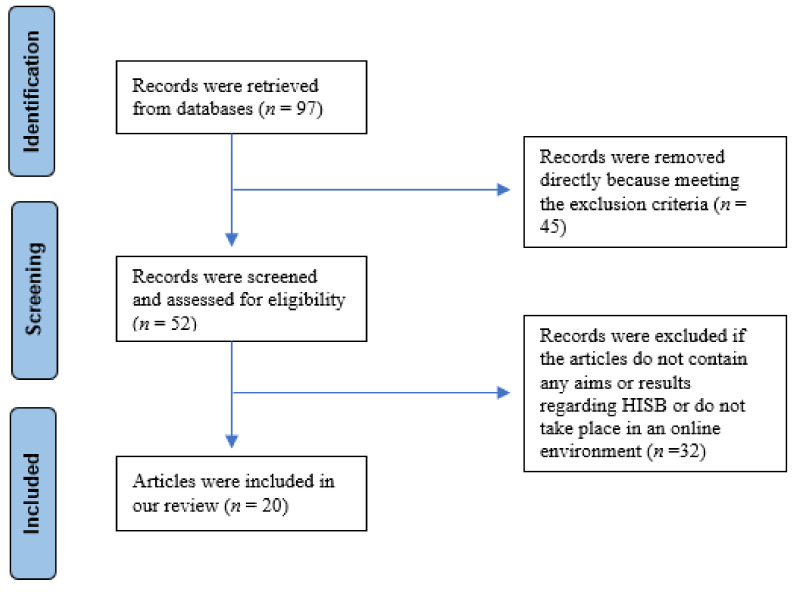
The last five years have seen a leap in the development of information technology and social media. Seeking health information online has become popular. It has been widely accepted that online health information seeking behavior has a positive impact on health information consumers. Due to its importance, online health information seeking behavior has been investigated from different aspects. However, there is lacking a systematic review that can integrate the findings of the most recent research work in online health information seeking, and provide guidance to governments, health organizations, and social media platforms on how to support and promote this seeking behavior, and improve the services of online health information access and provision. We therefore conduct this systematic review. The Google Scholar database was searched for existing research on online health information seeking behavior between 2016 and 2021 to obtain the most recent findings. Within the 97 papers searched, 20 met our inclusion criteria. Through a systematic review, this paper identifies general behavioral patterns, and influencing factors such as age, gender, income, employment status, literacy (or education) level, country of origin and places of residence, and caregiving role. Facilitators (i.e., the existence of online communities, the privacy feature, real-time interaction, and archived health information format), and barriers (i.e., low health literacy, limited accessibility and information retrieval skills, low reliable, deficient and elusive health information, platform censorship, and lack of misinformation checks) to online health information seeking behavior are also discovered.
Overview
The claims and statistics of this paper haven’t been checked yet.
Free: it reads the open-access text and checks the first 5 claims that cite a source we can check. Create a free account to check every claim.
Integrity signals
Registry
Cites
Statistics
Figures

Verification
Claims the paper makes
The claims and statistics of this paper haven’t been checked yet.
Free: it reads the open-access text and checks the first 5 claims that cite a source we can check. Create a free account to check every claim.
Claims other papers make about this one
Each is checked against this paper’s own text: does it say what the citing paper says it does?
The cited source says what the claim attributes to it.
In the citing paper
“This finding is consistent with current evidence demonstrating age-dependent differences in health information-seeking behavior [44].”
From Sociodemographic differences in dementia prevention knowledge in Germany: Implications for targeted health communication (2026) · cites this paper as [44]
In the citing paper
“Caregivers for whom English is not the first language, or who have lower levels of education or health literacy, may experience particularly high barriers [98].”
Self-check
Percentages, sums and reported differences re-computed from the paper’s own numbers.
The self-check needs the paper’s full text.
Citations
Cites
Internet Health Information Seeking and the Patient-Physician Relationship: A Systematic Review
Tan, S. S.-L., & Goonawardene, N. (2017) · Journal of Medical Internet Research · doi:10.2196/jmir.5729 · Cited by 1,101
Health Information—Seeking Behavior
Lambert, S. D., & Loiselle, C. G. (2007) · Qualitative Health Research · doi:10.1177/1049732307305199 · Cited by 894 · cited 1×
“Seeking health information online allows health information consumers to obtain knowledge about their health issues, deal with health problems, and make health decisions, and have behavior change [11,12].”
BackgroundConsumer health information seeking in social media: a literature review
Zhao, Y., & Zhang, J. (2017) · Health Information & Libraries Journal · doi:10.1111/hir.12192 · Cited by 607 · cited 1×
“On the one hand, only involving papers published recently ensures that the findings integrated into our systematic review are up to date; on the other hand, it could avoid repetitive review work on online HISB [18,20].”
BackgroundPowell, J., Inglis, N., Ronnie, J., & Large, S. (2011) · Journal of Medical Internet Research · doi:10.2196/jmir.1600 · Cited by 493
Finney Rutten, L. J., Blake, K. D., Greenberg-Worisek, A. J., Allen, S. V., Moser, R. P., & Hesse, B. W. (2019) · Public Health Reports® · doi:10.1177/0033354919874074 · Cited by 426 · cited 1×
“A recent study indicated that in 2008, 61.2% of the population sought health information online first for their most recent search, while in 2017, the percentage had reached 74.4% [15].”
BackgroundInfluentialA Comprehensive Model of Cancer-Related Information Seeking Applied to Magazines
JOHNSON, J. D., & MEISCHKE, H. (1993) · Human Communication Research · doi:10.1111/j.1468-2958.1993.tb00305.x · Cited by 406 · cited 1×
“Four relevant models have been identified as follows: Comprehensive model of information seeking (CMIS) has been widely used to investigate factors determining individuals’ information seeking behavior [36–38].”
MethodOnline Health Information Seeking: A Review and Meta-Analysis
Wang, X., Shi, J., & Kong, H. (2021) · Health Communication · doi:10.1080/10410236.2020.1748829 · Cited by 370 · cited 1×
“For example, the percentages in mainland China, Philippines, Hong Kong, Indonesia and Vietnam are 79%, 80%, 85%, 85% and 86%, respectively [6,16].”
BackgroundWho Searches the Internet for Health Information?
Bundorf, M. K., Wagner, T. H., Singer, S. J., & Baker, L. C. (2006) · Health Services Research · doi:10.1111/j.1475-6773.2006.00510.x · Cited by 313
How, When and Why People Seek Health Information Online: Qualitative Study in Hong Kong
Chu, J. T., Wang, M. P., Shen, C., Viswanath, K., Lam, T. H., & Chan, S. S. C. (2017) · Interactive Journal of Medical Research · doi:10.2196/ijmr.7000 · Cited by 181 · cited 2×
“There has been a continuous increase in online health information seeking activities lately [6].”
BackgroundLongo, D. R. (2005) · Health Expectations · doi:10.1111/j.1369-7625.2005.00339.x · Cited by 180 · cited 1×
“Four relevant models have been identified as follows: Comprehensive model of information seeking (CMIS) has been widely used to investigate factors determining individuals’ information seeking behavior [36–38].”
Method
Research works printed but not linked: 1
- Wei X. Du Z. Zhang S. Analysis of barriers to health information seeking and utilizing in patients with diabetes Cross-Cult. Commun. 2016 12 48 51
Cited by
Items 401–500 of 698
Anand, R., Semple, C. J., Strutt, L., Paul, S., & Hanna, J. R. (2026) · PLOS Digital Health · doi:10.1371/journal.pdig.0001493 · Cited by 1
“[ 64] This can lead to a risk of widening inequalities in cancer care.”
Pang, Y., & Zhao, Y. (2026) · The Electronic Library · doi:10.1108/el-12-2025-0474 · Cited by 1
Self-citationGong, Z., Shao, J., Rahman, N., Su, L. Y.-F., & Wang, Y. (2026) · Internet Research · doi:10.1108/intr-07-2025-1004 · Cited by 1
Cyberchondria severity in multiple sclerosis: the role of sociodemographic and clinical factors
Ertürk, F. A., Güven, B., Dinç, P. B., & Güven, H. (2026) · Multiple Sclerosis and Related Disorders · doi:10.1016/j.msard.2026.107427 · Cited by 1
Hack, S., Attal, R., & Karni, R. J. (2026) · Digital Health · doi:10.1177/20552076261477201 · Cited by 1
The Evidence Base of Fluoride Videos on TikTok
Lueth, A., & Young, L. B. (2026) · International Journal of Dental Hygiene · doi:10.1111/idh.70151 · Cited by 1
Timurkaan, E. S., Timurkaan, M., & Yıldız, S. (2026) · Medicina · doi:10.3390/medicina62091621 · Cited by 1
“Poorer psychological well-being may be associated with both the experience of the disease and online health information-seeking behaviors [41].”
Tang, Z., He, G., & Pan, X. (2026) · BMC Health Services Research · doi:10.1186/s12913-026-15613-9 · Cited by 1
Associations of Generative AI Use for Health Issues With Anxiety and Depression
Zhai, Y., Song, J., Jun, E., Lemberger‐Truelove, M. E., Lin, Y.-W. D., Xiong, Y., Kim, I., Shannonhouse, L., & Du, X. (2026) · Journal of Counseling & Development · doi:10.1002/jcad.70064 · Cited by 1
Eling, C., Stinson, J., Rosenberg, A. M., Kerr, T., Mehtar, M., Bhawra, J., Goodridge, D., & Sinha, R. (2026) · Children · doi:10.3390/children13091271 · Cited by 2
“Ineffective search strategies that fail to locate useful OHI is a symptom of lower levels of DHL [17,18].”
InfluentialOnline health information and pediatric treatment decisions: a study of generation Y parents
Vieira, D. M., Rondina, J. M., Iorino, L. R. A., dos Santos, E. R., Menezes, J. D. D. S., Souza, D. R. D. S., Caldas, H. C., Lima, A. R. D. A., Brienze, V. M. S., Werneck, A. L., et al. (2024) · Acta bio-medica dell'Ateneo parmense/Acta biomedica · doi:10.23750/abm.v95i4.16024 · Cited by 1
Low, L. X. T., Wijaya, D. J., Shorey, R., Ng, J. Q. X., Aw, M., Ng, N. B. H., & Shorey, S. (2026) · Journal of Family Nursing · doi:10.1177/10748407261492176 · Cited by 1
Lost in print: difficulty in reading online information pertaining to phenylketonuria
Samuel, L., Fera, J., & Basch, C. H. (2022) · Journal of Community Genetics · doi:10.1007/s12687-022-00626-8 · Cited by 1
“Patients and caregivers pursue online information regarding healthy lifestyle as well as specific concerns such as symptoms, diagnoses, treatment and management of a particular medical condition (Jia et al. 2021).”
BackgroundKhazaee, E., & FREELAND-GRAVES, J. H. (2023) · Journal of Food and Nutrition Research · doi:10.12691/jfnr-11-4-1 · Cited by 1
Singh, S., & Balhara, Y. P. S. (2024) · Indian Journal of Psychiatry · doi:10.4103/indianjpsychiatry.indianjpsychiatry_473_23 · Cited by 1
Alanizi, M. A., & Alanizi, M. R. (2024) · Journal of Pioneering Medical Science · doi:10.61091/jpms202413114 · Cited by 1
Shalihin, S. A. S., Ilias, K., Amin, N. A., Daud, A. Z. C., & Al-Sabbah, S. (2023) · Journal of Health and Translational Medicine · doi:10.22452/jummec.sp2023no2.8 · Cited by 1
“Online access to health information enables participants to learn more about their health issues, address them, make health decisions, and modify their behavior ( 33 ).”
BackgroundFadda, A. T., & Hassem, T. (2024) · South African Journal of Psychology · doi:10.1177/00812463241287126 · Cited by 1
“(Participant 6, Clinical psychologist) As Participant 6 suggested, many people use the internet to seek out mental health-related information (Jia et al., 2021).”
Identifying and Evaluating Online Kidney Stone Pain Resources: A Cross-Sectional Study
Hernandez, C. J., Lim, J., Takele, R. A., Escobedo, F., Dominique, G., Ojeaburu, L., & Scotland, K. B. (2024) · Cureus · doi:10.7759/cureus.73140 · Cited by 1
Parpoula, C., & Anagnostopoulos, F. (2024) · Psychology the Journal of the Hellenic Psychological Society · doi:10.12681/psy_hps.39612 · Cited by 2
“…imply that these individuals were also less likely to receive mental health care and support, as there is evidence that changes in search behavior reflect broader patterns and correlate with actual changes in health care utilization (Jia et al., 2021; Shneyderman et al., 2016; Wei et al., 2016).”
Alruwailli, A. N., Abuyabis, R. G., & Kofi, M. A. (2025) · Scientia. Technology, science and society. · doi:10.59324/stss.2025.2(1).06 · Cited by 1
Educação em saúde no Instagram: Experiência de um projeto de extensão universitária
Silva, M. M., de Oliveira, A. R., da Silva, E. S. B., do Nascimento, C. J. N., de Farias, D. J. L., Ferreira, J. R., Rocha, K. D. S., & da Silva, A. F. (2024) · Revista Brasileira de Extensão Universitária · doi:10.29327/2303474.15.3-17 · Cited by 1
Ullauri, A., Kramer, T., & Shafiro, V. (2025) · Cochlear Implants International · doi:10.1080/14670100.2025.2500830 · Cited by 1
“Past research suggests that those seeking information about healthcare including CI (Benaim et al., 2025), turn to the Internet (Fox & Duggan, 2013; Manchaiah et al., 2020), and Spanish speakers in the U.S. do it even more (Jia et al., 2021).”
Digital Dialogs on Rhesus Incompatibility: A Thematic Analysis of Web-Based Parental Narratives
Çeri, A., & Gültekin, N. D. (2025) · Transfusion Medicine and Hemotherapy · doi:10.1159/000547554 · Cited by 1
“Without clear, accessible, and repeated communication from trusted providers, patients with lower health literacy may default to unverified sources [20, 26].”
Teixeira, A. R., & Lopes, C. T. (2025) · Lecture notes in networks and systems · doi:10.1007/978-3-031-97119-8_27 · Cited by 1
Teixeira, A. R., & Lopes, C. T. (2025) · Lecture notes in networks and systems · doi:10.1007/978-3-032-01130-5_11 · Cited by 1
Nardino, F., dos Santos, A. T. C., Chaves, G. V., & de Lima, F. L. T. (2025) · Revista Tecnologia e Sociedade · doi:10.3895/rts.v21n64.18802 · Cited by 1
(2023) · Studies in information · doi:10.1108/s2055-53772023010 · Cited by 1
Systematic review of health research using internet search dataPreprint
Thompson, M., Chan, C., Daniels, E., Obana, K., Taylor, J. A., Grailey, K., Schneider, R. A., Flatley, J., Sounderajah, V., & Darzi, A. W. (2024) · Research Square · doi:10.21203/rs.3.rs-4456499/v1 · Cited by 1
Caregivers of children with rare diseases: experiences and needs in a Canadian population
Truong, V. (2024) · Mspace (University of Manitoba) · Cited by 1
Rouvinen, H. (2024) · UEF eRepo (University of Eastern Finland) · Cited by 1
Methodology of Baidu Index for Infodemiology and Infoveillance (Preprint)Preprint
Ma, M., Li, H., Zhu, M., Lin, T., & Song, T. (2022) · doi:10.2196/preprints.37995
Radoja, K. K., Radoja, I., & Papić, A. (2023) · Education for Information · doi:10.3233/efi-230040
“Health information seeking behavior online includes anything regarding the symptoms, diagnoses, and treatments of different diseases or simply general information about weight loss, healthy diets or wellness tips (Jia et al., 2021).”
Implementation of Web-Based Patient Education in Newly Transplanted Kidney Recipients
Mwikisa-Kelly, T. (2023) · San José State University ScholarWorks (San Jose State University) · doi:10.31979/etd.d6y5-c5dz
The impact of article title on the interpretation of scientific research: a randomized trial
Barać, M., & Buljan, I. (2023) · St open · doi:10.48188/so.4.8
“Consumers who seek health information online are more familiar with the online environment and pre - sentation of health information online [27 - 29].”
Jin, S. W., Yoon, Y. J., & Hirschi, M. (2023) · Journal of Human Behavior in the Social Environment · doi:10.1080/10911359.2023.2271546
“…by multifaceted factors, including individual characteristics (e.g., age, gender, income, employment status, education level, nationality, and residency), emotional response, source credibility, and interactions with social media (Chang & Huang, 2020; Jia et al., 2021; Mirzaei et al., 2021).”
BackgroundAre the Testicular Self-examination Videos on YouTube Misleading?
Gökalp, F., & Akarken, İ. (2023) · Bulletin of Urooncology · doi:10.4274/uob.galenos.2023.2022.12.2
Listening to patients with suspected genetic diagnoses: A narrative perspective
Slocum, R. B., Hurst, A., Shelley, E. M., Berry, L., Hopkin, R. J., Rippert, A. L., Bhoj, E. J. K., Graham, J. M., Grand, K., Garcia, A. G., et al. (2023) · American Journal of Medical Genetics Part C Seminars in Medical Genetics · doi:10.1002/ajmg.c.32079
“The internet (and now social media) has been a source of information about medical conditions and their treatments for some time (Bouwman et al., 2010; Dragusin et al., 2013; Finney Rutten et al., 2019; Jia et al., 2021; Wallace et al., 2022).”
Aleryani, A. Y. (2023) · European Modern Studies Journal · doi:10.59573/emsj.7(5).2023.7
Dugan, M. J., Stein, G. S., Carney, J. K., & Clifford-Bova, S. C.-B. (2024) · Critical Reviews in Eukaryotic Gene Expression · doi:10.1615/critreveukaryotgeneexpr.2024052382
Vargas, A. M., & Arnibal, S. P. (2024) · Technium Social Sciences Journal · doi:10.47577/tssj.v54i1.10567
Les réseaux sociaux en dermatologie
Samaran, R., Samaran, Q., & Kluger, N. (2024) · Annales de Dermatologie et de Vénéréologie - FMC · doi:10.1016/j.fander.2024.01.007
Chavan, N. W. P. D., & Joseph, T. M. K. D. J. (2024) · European Economic Letters (EEL) · doi:10.52783/eel.v14i1.1231
A Study on the Influencing Factors of Individual Internet Behavior in China
Yuan, P., Liu, J., & Yuan, D. (2023) · Asian Conference on Artificial Intelligence Technology (ACAIT) · doi:10.1109/acait60137.2023.10528571
“Jia [13] et al. used the method of Systematic review to explore the factors that affect the online health information search behavior of Chinese individuals.”
MethodGou, Y., Li, R., & Zhuang, Z.-H. (2024) · Library Hi Tech · doi:10.1108/lht-12-2023-0610
Ojo, S. A., Ilori, E. O., Wiredu, B., Okobi, O. E., Kanu, E., & Igbadumhe, R. (2024) · Cureus · doi:10.7759/cureus.62173
Chen, J., Chen, H., Zhou, S., & Lu, Q. (2024) · Data and Information Management · doi:10.1016/j.dim.2024.100074
Evaluation of the Quality of Online Information About Perinatal Depression in China
Li, M., Abas, W. A. W., Ma’rof, A. A., Wang, P., & Wang, X. (2024) · Studies in Media and Communication · doi:10.11114/smc.v12i3.6908
“The search for health information allows health information consumers to gain a deeper understanding of their health issues, manage health problems, make informed decisions, and even change behaviors (Jia et al., 2021).”
BackgroundEvaluation of the reliability and information quality of YouTube videos on implant overdenture
Park, S.-W., Lee, S.-K., Lee, J., & Lee, J.-I. (2024) · The Journal of Korean Academy of Prosthodontics · doi:10.4047/jkap.2024.62.3.183
Pavića, Ž. (2024) · Journal of Community Positive Practices · doi:10.35782/jcpp.2024.2.03
Experiences of Non-Nursing College Students in Accessing Health Information Online
Orias, J. B., Muksan, D. J. B., Sialana, C. V., Poblete, M.-L. O., Seno, R. T., & Santillana, L. (2024) · The Malaysian Journal of Nursing · doi:10.31674/mjn.2024.v16i01.001
Measles and Pertussis outbreaks in England and Wales: a time-series analysis
Shepherd, T. A., & Mallen, C. D. (2024) · NIHR Open Research · doi:10.3310/nihropenres.13607.1
“This is likely attributable firstly to increasing cases over time and secondly, as those receiving diagnoses begin to search for disease-related or symptom management information 37 .”
District Heating System: Interactive Website Project for Weilheim, Germany
Feigl, A., & Utesch, M. C. (2024) · International Journal of Engineering Pedagogy (iJEP) · doi:10.3991/ijep.v14i7.51695
Latin America’s Digital Media Ecosystem: An Analysis of Prescription Drug Coverage and Diffusion
Flynn, M., Lombana-Bermúdez, A., & Palacios, A. M. (2024) · Journalism and Media · doi:10.3390/journalmedia5040108
“As consumers increasingly use digital technologies to seek information about symptoms, novel treatments, and general health advice (Jia et al. 2021), drug companies have adapted.”
Using a Popular Video Platform to Assess Patient Perceptions of Clubfoot Deformity
Ramlawi, A. A., Over, D. J., Assayag, M. J., & McClure, P. K. (2024) · Journal of Pediatric Orthopaedics · doi:10.1097/bpo.0000000000002871
“Jia et al 7 found in a literature review of the topic that a majority of information consumers consider online health information important, and 75% considered it to have a positive impact on their health.”
HIV/AIDS narratives: representing Indonesian women in the online information landscape
Firliani, A. (2024) · Jurnal Studi Komunikasi (Indonesian Journal of Communications Studies) · doi:10.25139/jsk.v8i3.8303
“This is especially relevant as evidence shows that women are more likely to access online health information (Jia et al., 2021).”
Yiğit, M. S., & Başal, M. (2024) · Akademik Hassasiyetler · doi:10.58884/akademik-hassasiyetler.1479532
Helsekompetanse – en utfordring og en mulighet for bedre tannhelse
Stein, L. M. (2025) · Aktuel nordisk odontologi · doi:10.18261/ano.50.1.2
Austin, R. R., Jantraporn, R., Schulz, C. A., & Zhang, R. (2025) · Topics in Pain Management · doi:10.1097/01.tpm.0001097436.36556.1c
A digitális nudge-ok hatása a szolgáltatott szoftverek felhasználói döntésére
Gyulai, Z. (2024) · SZTE Repository of Dissertations (University of Szeged) · doi:10.14232/phd.12124
Miller, M., DiCiurcio, W. T., Meade, M., Buchan, L. J., Gleimer, J., Woods, B. I., & Kepler, C. K. (2025) · Clinical Spine Surgery A Spine Publication · doi:10.1097/bsd.0000000000001768
Open access to pathology reports: potential harms and proposed solutions
Tannenbaum, A. P., Weisman, P. S., & Harter, T. D. (2025) · Journal of Communications In Healthcare · doi:10.1080/17538068.2025.2462426
“Recent studies have shown an increase in online health information seeking behavior [22], as well as the existing barriers of abundant health misinformation and lack of misinformation checks inherent to this practice [23,24].”
Gianfredi, V., Santangelo, O. E., Nucci, D., Romano, N., Passeri, C., Ferranti, R., Veronese, N., & Provenzano, S. (2025) · Journal of Public Health · doi:10.1007/s10389-025-02435-y
“Our assumption is grounded in the belief that those who have received a diagnosis are probably aware of the scientific name of the disease and, based on this awareness, express an interest in seeking health-related information online (Jia et al. 2021).”
Characterizing users and intention to use online health information resources: A comprehensive study
Michaud, A., Blanchette, V., Boudreau, F., Lafontaine, S., Leroux, D., Miquelon, P., Vallée, M., Rousseau-Bédard, J., & Cloutier, L. (2025) · Informatics in Medicine Unlocked · doi:10.1016/j.imu.2025.101640
Evaluating Clarity and Quality of Sinus Augmentation Information Online
Dogan, Y., & Şirin, Y. (2025) · European Annals of Dental Sciences · doi:10.52037/eads.2025.0004
Sheoti, I. H., & Alam, M. Z. (2026) · PLOS mental health. · doi:10.1371/journal.pmen.0000620
Michaud, A., Blanchette, V., Boudreau, F., Lafontaine, S., Leroux, D., Miquelon, P., Vallée, M., Rousseau-Bédard, J., & Cloutier, L. (2025) · Studies in health technology and informatics · doi:10.3233/shti250372
The intelligent ear: AI and hearing aids information seeking and users’ discussion on social media
Ferland, J., Blouin, A., Guitton, M. J., & Sharp, A. (2026) · Patient Education and Counseling · doi:10.1016/j.pec.2026.109703
Utilization of Structured Data to Improve Visibility of Digital Health Websites
Mitragotri, S., Chen, D., & Lee, J. (2025) · ConductScience Journal · doi:10.55157/csj.v1i1.05
Dijital Çağda Adölesan Üreme Sağlığı El Kitabı
Koyuncu, S. B., Öksüz, Z. K., Erdemoğlu, Ç., Ülgül, S., Şahin, T., Çiftçi, M., Cengizhan, S. Ö., Gür, S., Güven, M. G., Özkan, T. K., et al. (2025) · Akademisyen Kitabevi eBooks · doi:10.37609/akya.3670
Gohari, S. S., Ike, C., Weber, V., Lai, K., & Cheong, R. C. T. (2025) · doi:10.22541/au.175074855.53963407/v1
Tarantino, A., Buharaja, R., Aureli, A., Basile, A., & Tornatore, I. (2025) · Cureus · doi:10.7759/cureus.87045
“In the absence of counterbalancing perspectives, such materials may lead to unrealistic expectations or misinformed choices, considering that obtaining information about medical techniques and technologies is becoming increasingly common among patients nowadays [8].”
Karakısla, F. S., Demirci, A. D., & Kabukçuoğlu, K. (2025) · CIN Computers Informatics Nursing · doi:10.1097/cin.0000000000001344
The impact of online information on health-related decisions – a review of findings
Wójta-Kempa, M., & Jarynowski, A. K. (2025) · E-methodology · doi:10.15503/emet2024.29.48
Health Literacy of Hypertensive Patients in a Burkinabe Cardiology Outpatient Clinic
Kaboré, A., Benon, L., Yaméogo, R. A., Soubyabiga, R. J. R., Hoseto, G. –. A. E. B. G. –., Kaboré, F. A., Méda, N., & Yaméogo, N. V. (2025) · Journal of Education and Community Health · doi:10.34172/jech.3369
Çapar, H. (2025) · Bandırma Onyedi Eylül Üniversitesi Sağlık Bilimleri ve Araştırmaları Dergisi · doi:10.46413/boneyusbad.1618408
Hashtag Stay Healthy: Digitale Medien für die Gesundheitskommunikation
Werder, O. (2025) · Springer eBooks · doi:10.1007/978-981-95-0851-8_8
Yanuar, N. (2025) · MEC-J (Management and Economics Journal) · doi:10.18860/mec-j.v9i2.32782
“; Jia et al., 2021).”
InfluentialeHealth Literacy among Adult Dental Patients Attending the University of Rwanda Polyclinic
Nikuze, P., Asifiwe, H. J. B., Xavier, S. F., Marara, A. A., & Rushingabigwi, G. (2025) · Rwanda Journal of Medicine and Health Sciences · doi:10.4314/rjmhs.v8i2.12
“[3] Globally, as the number of internet users increases, so does the number of online health information seekers .”
THE ACCESSIBILITY OF INFORMATION AND ITS INFLUENCE ON SELF-MEDICATION
Shashiashvili, N. S. N., KVIZHINADZE, N., & DUGHASHVILI, N. (2025) · EXPERIMENTAL & CLINICAL MEDICINE GEORGIA · doi:10.52340/jecm.2025.05.06
Medical Education in the Digital Age - Benefits and Risks
Curis, C., & Curis, S. M. (2025) · doi:10.63467/alls15.art7
Pomeroy, E., Sheridan, G. A., Curtin, M., & Murphy, E. P. (2025) · Irish Journal of Medical Science (1971 -) · doi:10.1007/s11845-025-04076-2
“The Internet has become an important source of health-care information, and online health information seeking behaviour continues to rise in Europe and the USA [20, 21].”
Andriessen, A. S., & Saulsberry, L. (2025) · JMIR Cancer · doi:10.2196/76549
“The websites of these centers are critical access points for the public, communicating the centers’ goals and accomplishments along with providing a digital footprint of their community-serving and research activities [42,43].”
Impact of Internet Medical Information on Patient-Doctor Relationship in Al-Hilla City
Hameed, H. G., & Farhod, M. A. (2025) · Medical Science Journal for Advance Research · doi:10.46966/msjar.v6i3.312
Health Conditions and Risk Factors in TROVAILMIOVACCINO Users: A Study Promoting Adult Vaccination
Salvati, C., Riccio, M. D., Settembrini, M., Radi, A., Bonanni, P., Boccalini, S., & Bechini, A. (2025) · Vaccines · doi:10.3390/vaccines13101025
Farmer, A., Kumar, S., Truong, H., & Brinsley, J. (2025) · Musculoskeletal Science and Practice · doi:10.1016/j.msksp.2025.103424
Costa, J. J., Sobral, N. V., da Silva, M. L., & Cruz, T. L. (2025) · Logeion Filosofia da Informação · doi:10.21728/logeion.2025v12n1e-7713
Variation in Quality of Women’s Health Topic Information from Systematic Internet Searches
Wanamaker, B. K., Tomlinson, A. N., Abernathy, A. R., Cordova, V., Baloun, A., & Duval, B. D. (2025) · Healthcare · doi:10.3390/healthcare13192537
“However, there is massive variation in individuals’ facility with searching for information, which may cause undue harm when search topics are of a perceived sensitive nature [3,4].”
ANÁLISE DO INTERESSE DA POPULAÇÃO BRASILEIRA PELA DOENÇA DE HAFF: UM ESTUDO DE TENDÊNCIAS ONLINE
Ferreira, B. R., de Queiroz, B. T. C., Curuaia, A. C. S., dos Santos, G. C., Ribeiro, Y. P., & Aarão, T. L. D. S. (2025) · Revista Ibero-Americana de Humanidades, Ciências e Educação · doi:10.51891/rease.v11i10.21354
Гаазе, Ж. (2025) · ATU Design Science · doi:10.63464/3079-3394-2025-3-5-13
Agarwal, S., & Sinha, B. (2025) · International Journal of Research in Marketing Management and Sales · doi:10.33545/26633329.2025.v7.i2d.302
Raza, W., Hassan, A., Peng, B., Mohamed, A., Kijpaisalratana, N., Ariss, A.-B., Mitragotri, S., Poritsanos, N. J., Goff, A., Safari, P., et al. (2025) · Preprints.org · doi:10.20944/preprints202510.2493.v1
Haraguchi, T. (2025) · Psychiatry and Clinical Neurosciences Reports · doi:10.1002/pcn5.70240
Perceived Quality of Health Information on Wikipedia: A Sociodemographic Perspective
Ju, B., Park, S., Stewart, B. J., & Jin, T. (2025) · Libri · doi:10.1515/libri-2025-0087
Knowledge of Clinical Trials Among US Cancer Survivors: Cross-Sectional Study of HINTS-SEER Data
Langford, A. T., Ellis, K. R., Buderer, N. M. F., & Singh, N. (2025) · JMIR Cancer · doi:10.2196/76187
“General information seeking and health-spe-cific information-seeking models posit that sociodemographic characteristics (eg, education) shape both the motivation to seek information and the skills required to evaluate and apply it [39,45-47].”
BUSCA DE INFORMAÇÃO ON-LINE EM SEXUALIDADE POR ADOLESCENTES: UMA REVISÃO DE ESCOPO
Furlanetto, M. F., & Finotelli, Í. (2025) · Revista Brasileira de Sexualidade Humana · doi:10.35919/rbsh.v36.1303
Walton, T. O., Rouvere, J., Lee, A. K., Nguyen, T., Marion, J., Rushton, K., & Hallgren, K. A. (2025) · doi:10.2196/preprints.89218
Metadata
- Authors
- Jia, X., Pang, Y., & Liu, L. S.
- Affiliations
- Foshan University (CN)
- Central South University of Forestry and Technology (CN)
- Massey University (NZ)
- Corresponding author
- Pang, Yan
- Venue
- Healthcare
- Publisher
- MDPI AG
- Published
- 2021-12-16
- Volume
- 9
- Issue
- 12
- Pages
- 1740
- ISSN
- 2227-9032 (ISSN-L)
- PMC
- PMC8701665
- OpenAlex
- W4200535791
- Semantic Scholar
- 2eb338e185dfb1bf2d2c74039276802a0932097a
- Cited by
- 547
- References
- 40
- Citations by year
- 2026: 149 · 2025: 162 · 2024: 140 · 2023: 74 · 2022: 22
- FWCI
- 12.20
- Type
- journal article
- Language
- en
- Open access
- gold
- doi.org
- Licence
- Locations
- Healthcare (publishedVersion, cc-by)
- PubMed Central (publishedVersion, cc-by)
- PubMed (publishedVersion)
- DOAJ (DOAJ: Directory of Open Access Journals) (submittedVersion)
- Massey Research Online (Massey University) (submittedVersion, cc-by)
- Funders
- Hunan Key Laboratory of Intelligent Logistics Technology (2019TP1015)
- Topics
- Health Sciences › Health Professions › General Health Professions › Health Literacy and Information Accessibility
- Physical Sciences › Computer Science › Information Systems › Information Retrieval and Search Behavior
- Social Sciences › Health › Social Media in Health Education
- Keywords
- online health information seeking, health information behavior, social media, health literacy, online communities, health misinformation, information search skills, caregiver role, online health information quality
About these checks
Registry, retraction, Cites and statistics results are computed, not judged, with one exception: a printed reference that no index lists is read once by a model before it counts as a citation error. Claims are extracted by a model and kept only when their quote appears verbatim in the text; each cited source is then checked, with a model’s help, for whether it says what the claim relies on. Those verdicts can be wrong — read the claim’s quote and the cited source before relying on one.
Statistics and arithmetic are recomputed, not judged.
Confidence bands are shown only for fields calibrated on our annotated test set. None is calibrated yet, so no band is shown.
What counts as a claim ›How we measure confidence ›How we check this ›
Are you an author, or do you see a problem with this page? Request a review
Data sources
Bibliographic data: Semantic Scholar, OpenAlex, Crossref.
Contains information from the Semantic Scholar Academic Graph Datasets, made available under the ODC Attribution License (ODC-BY 1.0).
Semantic Scholar’s data is described in: Kinney, R., et al. (2023). The Semantic Scholar Open Data Platform. arXiv:2301.10140.
