

Online Health Information Seeking Behavior: A Systematic Review
Open accessThe DOI matches its Crossref record; 40 of the 40 references it cites were found in a registry or an index.
Abstract
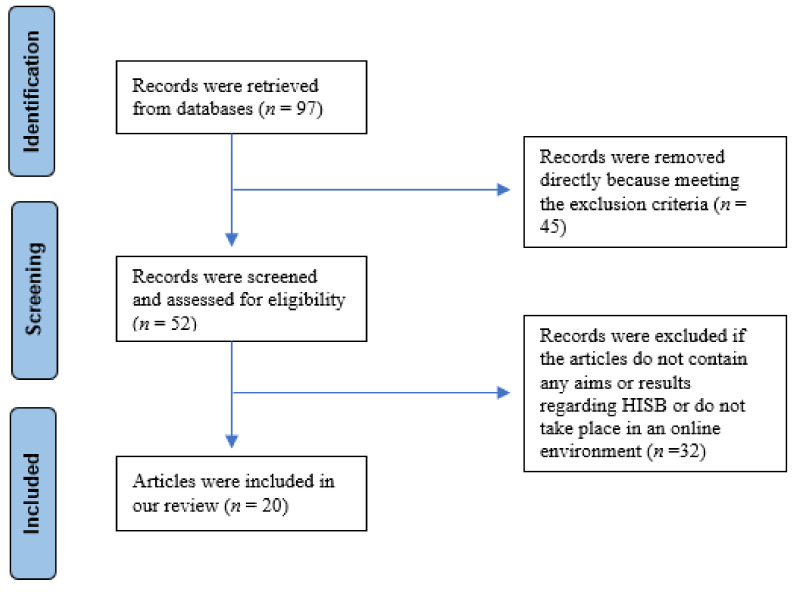
The last five years have seen a leap in the development of information technology and social media. Seeking health information online has become popular. It has been widely accepted that online health information seeking behavior has a positive impact on health information consumers. Due to its importance, online health information seeking behavior has been investigated from different aspects. However, there is lacking a systematic review that can integrate the findings of the most recent research work in online health information seeking, and provide guidance to governments, health organizations, and social media platforms on how to support and promote this seeking behavior, and improve the services of online health information access and provision. We therefore conduct this systematic review. The Google Scholar database was searched for existing research on online health information seeking behavior between 2016 and 2021 to obtain the most recent findings. Within the 97 papers searched, 20 met our inclusion criteria. Through a systematic review, this paper identifies general behavioral patterns, and influencing factors such as age, gender, income, employment status, literacy (or education) level, country of origin and places of residence, and caregiving role. Facilitators (i.e., the existence of online communities, the privacy feature, real-time interaction, and archived health information format), and barriers (i.e., low health literacy, limited accessibility and information retrieval skills, low reliable, deficient and elusive health information, platform censorship, and lack of misinformation checks) to online health information seeking behavior are also discovered.
Overview
The claims and statistics of this paper haven’t been checked yet.
Free: it reads the open-access text and checks the first 5 claims that cite a source we can check. Create a free account to check every claim.
Integrity signals
Registry
Cites
Statistics
Figures

Verification
Claims the paper makes
The claims and statistics of this paper haven’t been checked yet.
Free: it reads the open-access text and checks the first 5 claims that cite a source we can check. Create a free account to check every claim.
Claims other papers make about this one
Each is checked against this paper’s own text: does it say what the citing paper says it does?
The cited source says what the claim attributes to it.
In the citing paper
“This finding is consistent with current evidence demonstrating age-dependent differences in health information-seeking behavior [44].”
From Sociodemographic differences in dementia prevention knowledge in Germany: Implications for targeted health communication (2026) · cites this paper as [44]
In the citing paper
“Caregivers for whom English is not the first language, or who have lower levels of education or health literacy, may experience particularly high barriers [98].”
Self-check
Percentages, sums and reported differences re-computed from the paper’s own numbers.
The self-check needs the paper’s full text.
Citations
Cites
Internet Health Information Seeking and the Patient-Physician Relationship: A Systematic Review
Tan, S. S.-L., & Goonawardene, N. (2017) · Journal of Medical Internet Research · doi:10.2196/jmir.5729 · Cited by 1,101
Health Information—Seeking Behavior
Lambert, S. D., & Loiselle, C. G. (2007) · Qualitative Health Research · doi:10.1177/1049732307305199 · Cited by 894 · cited 1×
“Seeking health information online allows health information consumers to obtain knowledge about their health issues, deal with health problems, and make health decisions, and have behavior change [11,12].”
BackgroundConsumer health information seeking in social media: a literature review
Zhao, Y., & Zhang, J. (2017) · Health Information & Libraries Journal · doi:10.1111/hir.12192 · Cited by 607 · cited 1×
“On the one hand, only involving papers published recently ensures that the findings integrated into our systematic review are up to date; on the other hand, it could avoid repetitive review work on online HISB [18,20].”
BackgroundPowell, J., Inglis, N., Ronnie, J., & Large, S. (2011) · Journal of Medical Internet Research · doi:10.2196/jmir.1600 · Cited by 493
Finney Rutten, L. J., Blake, K. D., Greenberg-Worisek, A. J., Allen, S. V., Moser, R. P., & Hesse, B. W. (2019) · Public Health Reports® · doi:10.1177/0033354919874074 · Cited by 426 · cited 1×
“A recent study indicated that in 2008, 61.2% of the population sought health information online first for their most recent search, while in 2017, the percentage had reached 74.4% [15].”
BackgroundInfluentialA Comprehensive Model of Cancer-Related Information Seeking Applied to Magazines
JOHNSON, J. D., & MEISCHKE, H. (1993) · Human Communication Research · doi:10.1111/j.1468-2958.1993.tb00305.x · Cited by 406 · cited 1×
“Four relevant models have been identified as follows: Comprehensive model of information seeking (CMIS) has been widely used to investigate factors determining individuals’ information seeking behavior [36–38].”
MethodOnline Health Information Seeking: A Review and Meta-Analysis
Wang, X., Shi, J., & Kong, H. (2021) · Health Communication · doi:10.1080/10410236.2020.1748829 · Cited by 370 · cited 1×
“For example, the percentages in mainland China, Philippines, Hong Kong, Indonesia and Vietnam are 79%, 80%, 85%, 85% and 86%, respectively [6,16].”
BackgroundWho Searches the Internet for Health Information?
Bundorf, M. K., Wagner, T. H., Singer, S. J., & Baker, L. C. (2006) · Health Services Research · doi:10.1111/j.1475-6773.2006.00510.x · Cited by 313
How, When and Why People Seek Health Information Online: Qualitative Study in Hong Kong
Chu, J. T., Wang, M. P., Shen, C., Viswanath, K., Lam, T. H., & Chan, S. S. C. (2017) · Interactive Journal of Medical Research · doi:10.2196/ijmr.7000 · Cited by 181 · cited 2×
“There has been a continuous increase in online health information seeking activities lately [6].”
BackgroundLongo, D. R. (2005) · Health Expectations · doi:10.1111/j.1369-7625.2005.00339.x · Cited by 180 · cited 1×
“Four relevant models have been identified as follows: Comprehensive model of information seeking (CMIS) has been widely used to investigate factors determining individuals’ information seeking behavior [36–38].”
Method
Research works printed but not linked: 1
- Wei X. Du Z. Zhang S. Analysis of barriers to health information seeking and utilizing in patients with diabetes Cross-Cult. Commun. 2016 12 48 51
Cited by
Items 501–600 of 698
Müller, R., Klemmt, M., Koch, R., Ehni, H.-J., Henking, T., Langmann, E., Wiesing, U., & Ranisch, R. (2024) · Figshare · doi:10.6084/m9.figshare.26681908
Heaton‐Shrestha, C., Hanson, K., Quirke‐McFarlane, S., Delaney, N., Vandrevala, T., & Bearne, L. (2024) · Figshare · doi:10.6084/m9.figshare.26636706
Heaton‐Shrestha, C., Hanson, K., Quirke‐McFarlane, S., Delaney, N., Vandrevala, T., & Bearne, L. (2024) · Figshare · doi:10.6084/m9.figshare.26636709
Chan, F. H. F., Lin, X., Griva, K., Subramaniam, M., Ćelić, I., & Car, L. T. (2022) · Figshare · doi:10.6084/m9.figshare.20390945
Almalki, S. A. (2023) · Aston Publications Explorer (Aston University) · doi:10.48780/publications.aston.ac.uk.00047227
Additional file 1 of Users’ experience with health-related content on YouTube: an exploratory study
Mohamed, F., & Shoufan, A. (2024) · Figshare · doi:10.6084/m9.figshare.26660575
Exploring the role of TikTok in youth health information behaviour
Nelson, M. (2024) · cIRcle (University of British Columbia) · doi:10.14288/1.0447485
Hopper, H. (2024) · PEARL (University of Plymouth) · doi:10.24382/5180
Heaton‐Shrestha, C., Hanson, K., Quirke‐McFarlane, S., Delaney, N., Vandrevala, T., & Bearne, L. (2024) · Figshare · doi:10.6084/m9.figshare.26636712
Sjukt sökt : en studie om hälsoinformation på internet
Spjuth, E. (2024) · Lund University Publications Student Papers (Lund University)
An Evaluation of the Cultural Usability of Australian eGovernment
Logie, S. (2023) · Victoria University Research Repository (Victoria University)
Crocker, B. (2025) · eScholarship@McGill (McGill) · doi:10.82308/20935
Use of social media by people living with lupus to address unmet health needs: A scoping review
McCaffrey, N. (2024) · D-Scholarship@Pitt (University of Pittsburgh)
Factors That Predict Online Health Seeking
Jones, L. (2024) · ScholarWorks (Walden University)
Patientenbefragung: Welche Forschungsfragen sind HNO-Patienten wichtig?
Horn, J. (2023) · Common Library Network (Der Gemeinsame Bibliotheksverbund)
Psomiadi, M. E., & Kostagiolas, P. A. (2025) · Journal of Documentation · doi:10.1108/jd-03-2025-0070
Therapeutic patient education: a paired vision
Bobbo, N., & Marcolongo, R. (2024) · Padua Research Archive (University of Padova) · doi:10.25430/pupj-jhcep-2024-2-6
Erbas, M. E., Zink, A., & München, T. U. (2024)
The Role of Infoboxes in Health Information Access on Wikipedia: An Eye-Tracking Study
Magalhães, M. D. A. (2025) · Portuguese National Funding Agency for Science, Research and Technology (RCAAP Project by FCT)
Privacy considerations when seeking health information online
Nguyen, L. V. (2025) · eScholarship@McGill (McGill) · doi:10.82308/47488
Varmazyar, R., & Cardama, S. M. (2025) · Transinformação · doi:10.1590/2318-0889202537e2514890
Xu, F., Zhang, H., Wang, Y., & Pan, S. (2025) · Health Information & Libraries Journal · doi:10.1111/hir.70008
Das, A., & Dhillon, P. (2025) · Archives of Gerontology and Geriatrics Plus · doi:10.1016/j.aggp.2025.100241
Role of Cyberchondriasis in Predicting Psychological Well-Being among Women
Bumra, K., Sharma, T., Singh, V. V., Pandey, R. P., & Yadav, V. N. (2025) · Mind and Society · doi:10.56011/mind-mri-143-20254
“seeking behaviours including constant use of internet resources for medical information (Jia et al., 2021).”
A study on information search for mental health treatment after the COVID-19 pandemic
Lim, S. (2025) · Mental Health and Social Inclusion · doi:10.1108/mhsi-10-2025-0272
Gandhi, S., Buranpuri, J., Balas, M., & Curtis, R. (2026) · AJO International · doi:10.1016/j.ajoint.2026.100224
Hahn, J., Stewart, M. P., Towne, S. D. C., Jr., Zhong, Y., Sherwin, N., & Ng, B. P. (2026) · Diabetology · doi:10.3390/diabetology7010015
“More generally, recommendations also included social media platforms providing discussion pages where health information seekers can post questions for health professionals to answer, having a focus on privacy and security, among other items [10].”
InfluentialPurnat, T. D., & Wilhelm, E. (2026) · Springer eBooks · doi:10.1007/978-3-032-00480-2_16
How Users Consider Web Tracking When Seeking Health Information OnlinePreprint
Robillard, M. P., Nguyen, L. V., Arya, D. M., & Guo, J. L. C. (2026) · arXiv (Cornell University) · doi:10.48550/arxiv.2601.04485
“Searches for health-related information can be compared to general information seeking behavior [26, 32].”
Facebook as a resource for cochlear implant information: a thematic content analysis
Dawood, E., Saeedi, A., & Coelho, D. H. (2026) · Cochlear Implants International · doi:10.1080/14670100.2026.2614844
“These findings align with prior studies showing that CI users and patients in general use Facebook and other social media to seek health information (Jia et al., 2021; Mohamad Shakir et al., 2020; Saxena et al., 2015; Zhao et al., 2022).”
Mediatisation of health discourse: A focus group study in Hungary
Hegedűs, A., & Pusztai, B. (2025) · Social Communication Ethics · doi:10.15633/sce.01401
Hermansson, O., Dümig, P., Witzel, B., Weinreich, L., Volkmer, S., Schulte‐Körne, G., & Moll, K. (2026) · doi:10.2196/preprints.91824
Brill, J., Karnowski, V., Hryhorovych, D., & Cheban, O. (2026) · European Journal of Health Communication · doi:10.47368/ejhc.2026.202
Online Discourse of Deep Brain Stimulation for Movement Disorders: A Content Analysis of Reddit
Grafton, P., Spinelli, R., Morris, D. R., & Pilitsis, J. G. (2026) · Neuromodulation Technology at the Neural Interface · doi:10.1016/j.neurom.2025.12.003
Ziskoven, P. C., Walter, C., Bani, P., Müller-Heupt, L. K., Geyer, A. M., Kiramira, D., Haag, D., & Deschner, J. (2026) · Frontiers in Digital Health · doi:10.3389/fdgth.2026.1746444
“Compared to recent decades, the internet is an easily accessible and low-threshold source of medical information for the vast majority of people, in addition to conventional visits to the doctor (15).”
Zhao, L., & Sui, F. (2026) · Acta Psychologica · doi:10.1016/j.actpsy.2026.106361
Shao, X., Sun, Y., Ju, X., & Cui, J. (2026) · Journal of Medical Systems · doi:10.1007/s10916-026-02344-x
“More like a drug cartel than a baby plan”: A multimodal analysis of infertility GIFs on Reddit
Chaif, R. H. (2026) · Health An Interdisciplinary Journal for the Social Study of Health Illness and Medicine · doi:10.1177/13634593251409222
Yan, K., Lai, M., Zhao, Q., Dai, S., Wang, K., & Wang, Y. (2026) · Research Square · doi:10.21203/rs.3.rs-8676309/v1
Antonio, F., Veronica, V., & Giovani, S. (2026) · doi:10.2196/preprints.93111
Quality Assessment of YouTube Videos as Educational Resources on Colorectal Cancer
Magwesela, F. M., Mbelwa, J., Mwang’onda, B., Olodi, L., & Babu, E. (2025) · Parul University Journal of Health Sciences and Research · doi:10.4103/pujhsr.pujhsr_23_25
Kohari, J., Okuhara, T., & Shirabe, R. (2026) · PEC Innovation · doi:10.1016/j.pecinn.2026.100462
“Currently, approximately 50 – 80% of internet users seek health information online [8-11].”
Chen, J., & Tian, H. (2026) · Revista da Escola de Enfermagem da USP · doi:10.1590/1980-220x-reeusp-2025-0253es
Chen, J., & Tian, H. (2026) · Revista da Escola de Enfermagem da USP · doi:10.1590/1980-220x-reeusp-2025-0253en
“Online health information (OHI) has become one of the most important sources of information (5) for people of all ages seeking health information (6) .”
Kut, M. (2023) · Hitit University Institutional Repository
The Relationships Between Coping Strategies and Perceived Anxiety with Health Decision-making
Jautakas, R. (2025) · Lithuanian University of Health Sciences
Basralian, G., Posner, K. M., Chester, G., Zeiman, M., Kissin, Y., SILVER, S. G., & Merchant, A. Y. (2026) · Journal of Orthopaedic Experience & Innovation · doi:10.60118/001c.145736
Chen, K. (2026) · Journal of Risk Research · doi:10.1080/13669877.2026.2636958
“Yet in rapidly evolving, unpredictable risk environments, informational voids frequently emerge, leading to delayed, fragmented, or absent official communication, while individuals increasingly rely on private and informal sources (Jia, Pang, and Liu 2021).”
Jeong, E., & Lee, D. (2026) · Service Business · doi:10.1007/s11628-026-00610-z
Rahman, M. I., Hossain, M. R., Emdad, F. B., Alam, S. M. Z., Sayem, S. M., Alam, A., & Islam, K. S. (2025) · IEEE ... International Conference on Data Mining workshops · doi:10.1109/icdmw69685.2025.00065
“By modeling the system’s response policy explicitly, the framework captures the dependency between queries and responses, allowing the User Strategy Optimizer to account for how each query will elicit a specific system response [31].”
Health Information Seeking as a Cognitive Coping Mechanism in Stunting Prevention among Mothers
Husodo, B. T., Widjanarko, B., Prabawani, B., & Nugraha, H. S. (2026) · Journal of Educational Health and Community Psychology · doi:10.12928/jehcp.vi.31912
Tkachenko, N. A., & Мисюра, С. С. (2026) · Current issues in pharmacy and medicine science and practice · doi:10.14739/2409-2932.2026.1.340454
Superusers’ Engagement in Online Mental Health Forums
Liberty, C. (2026) · Lancaster EPrints (Lancaster University) · doi:10.17635/lancaster/thesis/3174
Impact of health information prescription in thyroid cancer
Bianchini, M., Puliani, G., Scarinci, V., Cognetti, G., Lauretta, R., Mormando, M., Servoli, F., & Appetecchia, M. (2026) · Journal of the Medical Library Association JMLA · doi:10.5195/jmla.2026.2191
“Another possible explanation is the growing spread of Internet usage in recent decades, [54, 55] including among the elderly, which could reduce interest in seeking other forms of information.”
Sawunyavisuth, B., Jongudomkarn, D., & Sawanyawisuth, K. (2026) · Asian/Pacific Island Nursing Journal · doi:10.2196/84098
“A systematic review also reported findings from qualitative studies showing that online health information was reliable in only 40% and 60% of health information consumers searched at least 3 different websites [33].”
Ren, R., Wang, J., Chen, T., Zonies, M., Sideris, A., Liu, J., Memtsoudis, S. G., & Poeran, J. (2026) · British Journal of Anaesthesia · doi:10.1016/j.bja.2026.03.002
Song, J. (2026) · The Korean Journal of Health Service Management · doi:10.12811/kshsm.2026.20.1.065
The Evolution of Blood Pressure Thresholds and Targets over Time: A Historical Review
Flacco, M. E., Minoia, F., Brunini, G., Rosticci, M., Fiore, M., Cicolini, G., Martellucci, C. A., Borghi, C., & Manzoli, L. (2026) · Medical Sciences · doi:10.3390/medsci14020203
“Additionally, in the current scenario of health literacy, where many patients seek health advice online [61], the availability of contrasting recommendations is likely to generate some confusion and distrust towards divergent clinicians’ judgments [9].”
FITRI, K. (2026) · Digilib Repository Unila (Lampung University)
Almutairi, K. M., Almutairi, R. M., Alshahrani, A. H., & Almogbil, I. H. (2026) · Journal of Pioneering Medical Science · doi:10.47310/jpms202515s0130
“The internet has become a widely used resource for obtaining health-related information, driven by factors such as accessibility, convenience, affordability and the ability to search anonymously [1].”
Chan, J., Han, Y., Chen, J., Fang, S., Gryboski, L., Lee, A., Tanna, S., Zhu, Q., Lu, Z., Wang, L. L., et al. (2026) · arXiv (Cornell University) · doi:10.48550/arxiv.2605.00468
“Participants primarily sought health information through websites (97.92%), consistent with prior work showing the dominance of online sources in health information seeking (Jia et al., 2021), while a substantial proportion also reported using AI tools such as ChatGPT (43.75%).”
InfluentialVera, A. N. (2025) · Scholar Commons (University of South Carolina)
Link, E., & Bachl, M. (2026) · Health Communication · doi:10.1080/10410236.2026.2670540
Jiang, Y., You, Y., Li, Y., Xi, X., & Wang, J. (2026) · BMC Geriatrics · doi:10.1186/s12877-026-07514-7
Wang, H., Zheng, B., Chen, Z., Wang, Y., & Chen, J. (2026) · Cyberpsychology Behavior and Social Networking · doi:10.1177/21522715261449052
Health literacy related to climate change: a communıty-based cross-sectional study
Ekici, E., Sezerol, M. A., & Özkol, O. (2026) · Frontiers in Public Health · doi:10.3389/fpubh.2026.1779499
Chukwuocha, U. M., Nzeoma, P. I., Chukwuocha, A. N., & Ogboeze, J. C. (2026) · Research Square · doi:10.21203/rs.3.rs-9378158/v1
Gur, M., gür, C., & Karataş, A. (2026) · Clinical Rheumatology · doi:10.1007/s10067-026-08178-9
“With the widespread adoption of information and communication technologies, using the internet to search for health information has become common [1].”
Sackitey, D., Sheth, S., & Vardoulakis, L. (2026) · doi:10.2196/preprints.101790
Akkor, B. B., Kütük, N., Sumer, T., Dogan, E., & Sipahioglu, U. E. (2026) · CRANIO® · doi:10.1080/08869634.2026.2670637
Ventura, J. K., Son, N., Scanlon, B., Chow, I., Tafa, S., & Durham, J. (2026) · Critical Public Health · doi:10.1080/09581596.2026.2679307
INTRODUCING A USER-CENTERED GEOHEALTH WEB TOOL OPERATIONALIZING THE DIGITAL HEALTH INDEX
Geracitano, J. (2026) · Carolina Digital Repository (University of North Carolina at Chapel Hill) · doi:10.17615/v3hs-xv29
He, N., Zhao, B., Bai, J., Wang, Y., Zhang, Y., & Gao, X. (2026) · Medicine · doi:10.1097/md.0000000000049080
“[7] Users increasingly turn to social media for health guidance.”
Kim, M., Kim, H., Heo, J.-I., Lee, S., Lahcine, O. F., Lee, S., Kim, H., & Jung, D. (2026) · Journal of Medical Internet Research · doi:10.2196/78930
“Self-directed online exploration can increase accessibility, but it may also expose students to unverified, inconsistent, or low-quality content [65].”
The Validity and Reliability of Artificial Intelligence Chatbots in the Self-management of Diabetes
Dereli, F., & Yıldırım, J. G. (2026) · CIN Computers Informatics Nursing · doi:10.1097/cin.0000000000001573
YAO, R., Ye, J., Zhu, Z., & Li, C. (2026) · Digital Health · doi:10.1177/20552076261458906
SymptomAI: Toward a Conversational AI Agent for Everyday Symptom AssessmentPreprint
McDuff, D., Breda, J., Yousif, F., Hawkins, B., Cotoi, M., Liu, M., Luo, R., Chen, P.-H., Schaekermann, M., Schmidgall, S., et al. (2026) · Research Square · doi:10.21203/rs.3.rs-9684240/v1
Srinivasan, S., Baskaran, R., Mukhopadhyay, S., & Patel, M. A. (2026) · JMIR Diabetes · doi:10.2196/93822
“Population-based studies indicate that online health information–seeking behavior rose from approximately 61% in 2008 to 74% in 2017 [7].”
Knapp, P., Sridhar, P., & Wilkinson, C. (2026) · British Journal of Cardiology · doi:10.5837/bjc.2026.032
Forced agency: The price of being an engaged patient managing chronic illness
Koren, N., Guzmen-Carmeli, S., & Rier, D. A. (2026) · SSM - Qualitative Research in Health · doi:10.1016/j.ssmqr.2026.100799
Chen, J., & Zhang, J. (2026) · Journal of the Association for Information Science and Technology · doi:10.1002/asi.70098
Zwischen Zugehörigkeit und Zugang
Brill, J. (2025) · Qucosa - Monarch (Chemnitz University of Technology) · doi:10.60687/2026-0096
The role of social media in the purchase of over-the-counter drugs
Šabić, S. (2026) · Repository of the University of Ljubljana (University of Ljubljana)
Alharbi, E. M. (2026) · Cureus · doi:10.7759/cureus.111272
“Social media platforms provide unprecedented access to health information, enabling users to learn about medications, share experiences, and seek advice outside traditional healthcare settings [2].”
Named Entity Recognition in Arabic Mental Health Using Large Language Models
Alfaifi, A., Alhuzali, H., & Alasmari, A. (2026) · ACM Transactions on Asian and Low-Resource Language Information Processing · doi:10.1145/3811876
Kaur, G., & Chhabra, D. (2026) · International Journal of Clinical and Health Psychology · doi:10.1016/j.ijchp.2026.100703
“Related constructs like Concern about Health (Ahadzadeh et al., 2018), Health literacy, etc., are linked with greater OHIS (Jia et al., 2021), but were not explicitly captured in this scale, which may potentially account for part of the residual variance.”
Putri, I., & Azizah, I. N. (2026) · Palimpsest Jurnal Ilmu Informasi dan Perpustakaan · doi:10.20473/pjil.v17i1.87359
Anaya, A., Wardi, Y., Evanita, S., & Sandi, H. H. (2026) · JURNAL INFO KESEHATAN · doi:10.31965/infokes.vol24.iss2.2563
Muscat, D. M., Mustapha-Khodragha, N., Wong, M., Trisnasari, S., Talla, G., Rizkyanti, F., Ng, S. K., Kapoor, G., Khalid, S., Rigby, L., et al. (2026) · SSM - Qualitative Research in Health · doi:10.1016/j.ssmqr.2026.100901
Brady, M., Cowey, A. E., Botterill, S., Stoica, S., Baker, E., & Malin, R. (2026) · BMJ Innovations · doi:10.1136/bmjinnov-2025-001499
Gorla, L., Rothenberg, W. A., Lansford, J. E., Ghazanfar, A., He, E., Alban, C., & Aref, A. (2026) · Marriage & Family Review · doi:10.1080/01494929.2026.2687017
Zhang, X., Yang, X., Ba, L., & Chen, R. (2026) · Journal of Technology in Behavioral Science · doi:10.1007/s41347-026-00673-9
Evaluation of orthodontic treatment need awareness in individuals with different malocclusions
Cengiz, S. M., Çarpar, K. A., & Terler, M. (2026) · BMC Oral Health · doi:10.1186/s12903-026-09165-x
“The predominance of the internet as a primary information source among self-referred individuals reflects broader trends in online health information-seeking behavior [37].”
Ijinu, T. P., Sasidharan, S. P., Tukhtaev, F., Krishnakumar, N. M., Akhilesh, V. P., Varghese, V., Pasupuleti, N., Deepthi, D. C., Ma, Z., Hua, Y., et al. (2026) · Animal Science Papers and Reports · doi:10.2478/aspr-2026-0010
MARCHI, G., Gambini, G., Guglielmi, G., Pistelli, F., & Carrozzi, L. (2026) · Minerva Respiratory Medicine · doi:10.23736/s2784-8477.26.02245-x
Yılmaz, S., İnel, M. E., Işık, I., & Kırık, B. (2026) · International Journal of Digital Health & Patient Care · doi:10.67015/ijdhpc.289
Alzghaibi, H., Mughal, Y. H., Ahmad, K., & Jamal, Q. M. S. (2026) · Frontiers in Public Health · doi:10.3389/fpubh.2026.1837642
“Saudi Vision 2030 and the associated Health Sector Transformation Program explicitly prioritize preventive care, non-communicable disease control, and life expectancy gains through digitally enabled, value-based healthcare (22–24).”
Wen, L., & Lim, S. (2026) · PLoS ONE · doi:10.1371/journal.pone.0352142
“Recently, healthcare consumers have begun to actively search for medical information and share their experiences online to select appropriate providers [9].”
Metadata
- Authors
- Jia, X., Pang, Y., & Liu, L. S.
- Affiliations
- Foshan University (CN)
- Central South University of Forestry and Technology (CN)
- Massey University (NZ)
- Corresponding author
- Pang, Yan
- Venue
- Healthcare
- Publisher
- MDPI AG
- Published
- 2021-12-16
- Volume
- 9
- Issue
- 12
- Pages
- 1740
- ISSN
- 2227-9032 (ISSN-L)
- PMC
- PMC8701665
- OpenAlex
- W4200535791
- Semantic Scholar
- 2eb338e185dfb1bf2d2c74039276802a0932097a
- Cited by
- 547
- References
- 40
- Citations by year
- 2026: 149 · 2025: 162 · 2024: 140 · 2023: 74 · 2022: 22
- FWCI
- 12.20
- Type
- journal article
- Language
- en
- Open access
- gold
- doi.org
- Licence
- Locations
- Healthcare (publishedVersion, cc-by)
- PubMed Central (publishedVersion, cc-by)
- PubMed (publishedVersion)
- DOAJ (DOAJ: Directory of Open Access Journals) (submittedVersion)
- Massey Research Online (Massey University) (submittedVersion, cc-by)
- Funders
- Hunan Key Laboratory of Intelligent Logistics Technology (2019TP1015)
- Topics
- Health Sciences › Health Professions › General Health Professions › Health Literacy and Information Accessibility
- Physical Sciences › Computer Science › Information Systems › Information Retrieval and Search Behavior
- Social Sciences › Health › Social Media in Health Education
- Keywords
- online health information seeking, health information behavior, social media, health literacy, online communities, health misinformation, information search skills, caregiver role, online health information quality
About these checks
Registry, retraction, Cites and statistics results are computed, not judged, with one exception: a printed reference that no index lists is read once by a model before it counts as a citation error. Claims are extracted by a model and kept only when their quote appears verbatim in the text; each cited source is then checked, with a model’s help, for whether it says what the claim relies on. Those verdicts can be wrong — read the claim’s quote and the cited source before relying on one.
Statistics and arithmetic are recomputed, not judged.
Confidence bands are shown only for fields calibrated on our annotated test set. None is calibrated yet, so no band is shown.
What counts as a claim ›How we measure confidence ›How we check this ›
Are you an author, or do you see a problem with this page? Request a review
Data sources
Bibliographic data: Semantic Scholar, OpenAlex, Crossref.
Contains information from the Semantic Scholar Academic Graph Datasets, made available under the ODC Attribution License (ODC-BY 1.0).
Semantic Scholar’s data is described in: Kinney, R., et al. (2023). The Semantic Scholar Open Data Platform. arXiv:2301.10140.
