

The DOI matches its Crossref record; 60 of the 60 references it cites were found in a registry or an index.
Cyberbullying and Psychological Well-being in Young Adolescence: The Potential Protective Mediation Effects of Social Support from Family, Friends, and Teachers
Open accessAbstract
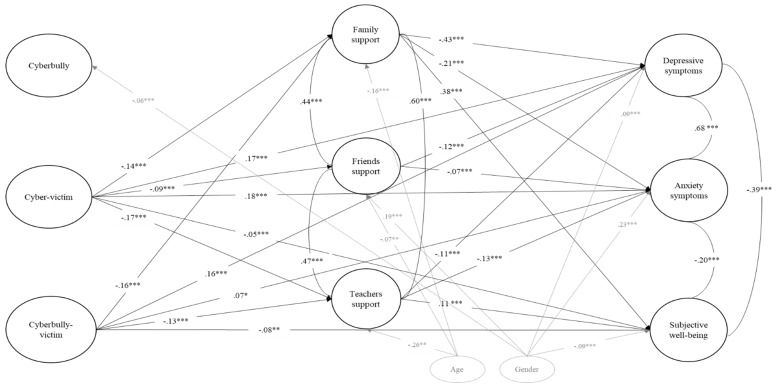
In the current study, we tested the relations between cyberbullying roles and several psychological well-being outcomes, as well as the potential mediation effect of perceived social support from family, friends, and teachers in school. This was investigated in a cross-sectional sample of 1707 young adolescents (47.5% girls, aged 10-13 years, self-reporting via a web questionnaire) attending community and private schools in a mid-sized municipality in Sweden. We concluded from our results that the Cyberbully-victim group has the highest levels of depressive symptoms, and the lowest of subjective well-being and family support. We also observed higher levels of anxiety symptoms in both the Cyber-victims and the Cyberbully-victims. Moreover, we conclude that some types of social support seem protective in the way that it mediates the relationship between cyberbullying and psychological well-being. More specifically, perceived social support from family and from teachers reduce the probability of depressive and anxiety symptoms, and higher levels of social support from the family increase the probability of higher levels of subjective well-being among youths being a victim of cyberbullying (i.e., cyber-victim) and being both a perpetrator and a victim of cyber bullying (i.e., cyberbully-victim). Potential implications for prevention strategies are discussed.
Overview
The claims and statistics of this paper haven’t been checked yet.
Run the check — free, no account needed. It reads the open-access text and checks the sources it cites.
Integrity signals
Registry
Cites
Statistics
Figures
Verification
Claims the paper makes
The claims and statistics of this paper haven’t been checked yet.
Run the check — free, no account needed. It reads the open-access text and checks the sources it cites.
Claims other papers make about this one
Each is checked against this paper’s own text: does it say what the citing paper says it does?
The cited source says what the claim attributes to it.
In the citing paper
“Given that social support can act as a protective factor against adverse psychological outcomes linked to cyberbullying (122), addressing these tendencies is critical.”
From A thematic analysis of adolescents’ perceptions of cyberbullying and cyberaggression: definitional distinctions and educational gaps (2026) · cites this paper as [122]
Self-check
Percentages, sums and reported differences re-computed from the paper’s own numbers.
The self-check needs the paper’s full text.
Citations
Cites
Hu, L., & Bentler, P. M. (1999) · Structural Equation Modeling A Multidisciplinary Journal · doi:10.1080/10705519909540118 · Cited by 108,788
The Multidimensional Scale of Perceived Social Support
Zimet, G. D., Dahlem, N. W., Zimet, S. G., & Farley, G. K. (1988) · Journal of Personality Assessment · doi:10.1207/s15327752jpa5201_2 · Cited by 13,339
Kowalski, R. M., Giumetti, G. W., Schroeder, A. N., & Lattanner, M. R. (2014) · Psychological Bulletin · doi:10.1037/a0035618 · Cited by 3,266 · cited 5×
“A substantial amount of research has found associations between cyber-victimization and depressive symptoms ([13–16]; for reviews and meta-analyses, see Reference [17]).”
BackgroundInfluentialStructures And Processes Of Social Support
House, J. S., Umberson, D., & Landis, K. R. (1988) · Annual Review of Sociology · doi:10.1146/annurev.so.14.080188.001453 · Cited by 2,041
A measure of anxiety symptoms among children
Spence, S. H. (1998) · Behaviour Research and Therapy · doi:10.1016/s0005-7967(98)00034-5 · Cited by 1,928
Prevalence estimation of school bullying with the Olweus Bully/Victim Questionnaire
Solberg, M. E., & Olweus, D. (2003) · Aggressive Behavior · doi:10.1002/ab.10047 · Cited by 1,912
Social Support Measurement and Intervention
(2000) · Oxford University Press eBooks · doi:10.1093/med:psych/9780195126709.001.0001 · Cited by 1,887
Cyberbullying: Another main type of bullying?
SLONJE, R., & SMITH, P. K. (2008) · Scandinavian Journal of Psychology · doi:10.1111/j.1467-9450.2007.00611.x · Cited by 1,844
Bullies Move Beyond the Schoolyard: A Preliminary Look at Cyberbullying
Patchin, J. W., & Hinduja, S. (2006) · Youth Violence and Juvenile Justice · doi:10.1177/1541204006286288 · Cited by 1,701
Moore, S. E., Norman, R. E., Suetani, S., Thomas, H. J., Sly, P. D., & Scott, J. G. (2017) · World Journal of Psychiatry · doi:10.5498/wjp.v7.i1.60 · Cited by 1,320
Online aggressor/targets, aggressors, and targets: a comparison of associated youth characteristics
Ybarra, M. L., & Mitchell, K. J. (2004) · Journal of Child Psychology and Psychiatry · doi:10.1111/j.1469-7610.2004.00328.x · Cited by 1,313
Psychological, Physical, and Academic Correlates of Cyberbullying and Traditional Bullying
Kowalski, R. M., & Limber, S. P. (2013) · Journal of Adolescent Health · doi:10.1016/j.jadohealth.2012.09.018 · Cited by 1,295
Bullying Among Young Adolescents: The Strong, the Weak, and the Troubled
Juvonen, J., Graham, S., & Schuster, M. A. (2003) · PEDIATRICS · doi:10.1542/peds.112.6.1231 · Cited by 1,038
Association Between Bullying and Psychosomatic Problems: A Meta-analysis
Gini, G., & Pozzoli, T. (2009) · PEDIATRICS · doi:10.1542/peds.2008-1215 · Cited by 928
Malecki, C. K., & Demaray, M. K. (2003) · School Psychology Quarterly · doi:10.1521/scpq.18.3.231.22576 · Cited by 746
Malecki, C. K., & Demaray, M. K. (2001) · Psychology in the Schools · doi:10.1002/pits.10004 · Cited by 734
Personal and interpersonal antecedents and consequences of victimization by peers.
Hodges, E. V. E., & Perry, D. G. (1999) · Journal of Personality and Social Psychology · doi:10.1037//0022-3514.76.4.677 · Cited by 726
Personal and interpersonal antecedents and consequences of victimization by peers.
Hodges, E. V. E., & Perry, D. G. (1999) · Journal of Personality and Social Psychology · doi:10.1037/0022-3514.76.4.677 · Cited by 628
Current perspectives: the impact of cyberbullying on adolescent health
Nixon, C. (2014) · Adolescent Health, Medicine and Therapeutics · doi:10.2147/ahmt.s36456 · Cited by 623
Psychometric properties of the Spence Children’s Anxiety Scale with young adolescents
Spence, S. H., Barrett, P. M., & Turner, C. M. (2002) · Journal of Anxiety Disorders · doi:10.1016/s0887-6185(02)00236-0 · Cited by 617
DSM-Oriented and empirically based approaches to constructing scales from the same item pools
Achenbach, T. M., Dumenci, L., & Rescorla, L. A. (2003) · Journal of Clinical Child & Adolescent Psychology · doi:10.1207/s15374424jccp3203_02 · Cited by 615
Bonanno, R. A., & Hymel, S. (2013) · Journal of Youth and Adolescence · doi:10.1007/s10964-013-9937-1 · Cited by 546
Gámez-Guadix, M., Orue, I., Smith, P. K., & Calvete, E. (2013) · Journal of Adolescent Health · doi:10.1016/j.jadohealth.2013.03.030 · Cited by 532
A longitudinal study of cyberbullying: Examining riskand protective factors
Fanti, K. A., Δημητρίου, Α., & Hawa, V. V. (2012) · European Journal of Developmental Psychology · doi:10.1080/17405629.2011.643169 · Cited by 514
Cyberbullying among Turkish Adolescents
Arıcak, O. T., Siyahhan, S., Uzunhasanoglu, A., Saribeyoglu, S., Ciplak, S., Yilmaz, N., & Memmedov, C. (2008) · CyberPsychology & Behavior · doi:10.1089/cpb.2007.0016 · Cited by 498
Effects of peer victimization in schools and perceived social support on adolescent well-being
Rigby, K. (2000) · Journal of Adolescence · doi:10.1006/jado.1999.0289 · Cited by 497
Children's coping strategies: Moderators of the effects of peer victimization?
Ladd, G. W., & Skinner, K. (2002) · Developmental Psychology · doi:10.1037/0012-1649.38.2.267 · Cited by 469
Longitudinal associations between cyberbullying involvement and adolescent mental health
Fahy, A. E., Stansfeld, S. A., Smuk, M., Smith, N. R., Cummins, S., & Clark, C. (2016) · Journal of Adolescent Health · doi:10.1016/j.jadohealth.2016.06.006 · Cited by 457
Perceived Social Support among Bullies, Victims, and Bully-Victims
Holt, M. K., & Espelage, D. L. (2006) · Journal of Youth and Adolescence · doi:10.1007/s10964-006-9153-3 · Cited by 455
Perren, S., Dooley, J. J., Shaw, T., & CROSS, D. S. (2010) · Child and Adolescent Psychiatry and Mental Health · doi:10.1186/1753-2000-4-28 · Cited by 443
Cyber and Traditional Bullying: Differential Association with Depression
Wang, J., Nansel, T. R., & Iannotti, R. J. (2011) · Journal of Adolescent Health · doi:10.1016/j.jadohealth.2010.07.012 · Cited by 436
Mitchell, K. J., Ybarra, M. L., & David Finkelhor, B. (2007) · Child Maltreatment · doi:10.1177/1077559507305996 · Cited by 417
Davidson, L. M., & Demaray, M. K. (2007) · School Psychology Review · doi:10.1080/02796015.2007.12087930 · Cited by 406
Campbell, M. A., Spears, B. A., Slee, P. T., Butler, D., & Kift, S. (2012) · Emotional and Behavioural Difficulties · doi:10.1080/13632752.2012.704316 · Cited by 389
Maydeu‐Olivares, A. (2017) · Structural Equation Modeling A Multidisciplinary Journal · doi:10.1080/10705511.2016.1269606 · Cited by 386
Cyberbullying: causes, effects, and remedies
Hoff, D. L., & Mitchell, S. N. (2009) · Journal of Educational Administration · doi:10.1108/09578230910981107 · Cited by 385
Flaspohler, P. D., Elfstrom, J. L., Vanderzee, K. L., Sink, H. E., & Birchmeier, Z. (2009) · Psychology in the Schools · doi:10.1002/pits.20404 · Cited by 381
Marini, Z. A., Dane, A. V., Bosacki, S., & YLC‐CURA (2006) · Aggressive Behavior · doi:10.1002/ab.20155 · Cited by 347
Rothon, C., Head, J. A., Klineberg, E., & Stansfeld, S. A. (2010) · Journal of Adolescence · doi:10.1016/j.adolescence.2010.02.007 · Cited by 313
Wang, J., Iannotti, R. J., Luk, J. W., & Nansel, T. R. (2010) · Journal of Pediatric Psychology · doi:10.1093/jpepsy/jsq048 · Cited by 309
A scoping review on studies of cyberbullying prevalence among adolescents
Brochado, S., Soares, S., & Fraga, S. (2017) · Trauma, Violence, & Abuse · doi:10.1177/1524838016641668 · Cited by 307
Thomas, H. J., Connor, J. P., & Scott, J. G. (2015) · Educational Psychology Review · doi:10.1007/s10648-014-9261-7 · Cited by 305
Machmutow, K., Perren, S., Sticca, F., & Alsaker, F. D. (2012) · Emotional and Behavioural Difficulties · doi:10.1080/13632752.2012.704310 · Cited by 281
Felix, E. D., Sharkey, J. D., Green, J. G., Furlong, M. J., & Tanigawa, D. (2011) · Aggressive Behavior · doi:10.1002/ab.20389 · Cited by 253
(2010) · Youth studies Australia · Cited by 252
Cyberbullying assessment instruments: A systematic review
Berne, S., Frisén, A., Schultze-Krumbholz, A., Scheithauer, H., Naruskov, K., Luik, P., Katzer, C., Erentaite, R., & Zukauskiene, R. (2013) · Aggression and Violent Behavior · doi:10.1016/j.avb.2012.11.022 · Cited by 241
Isolation and the stress of being bullied
Newman, M. L., Holden, G. W., & Delville, Y. (2005) · Journal of Adolescence · doi:10.1016/j.adolescence.2004.08.002 · Cited by 231
Yeung, R. S., & Leadbeater, B. J. R. (2009) · Journal of Community Psychology · doi:10.1002/jcop.20353 · Cited by 223
Protective Factors as Moderators of Risk Factors in Adolescence Bullying
Baldry, A. C., & Farrington, D. P. (2005) · Social Psychology of Education · doi:10.1007/s11218-005-5866-5 · Cited by 218
A New Measure to Assess Psychopathic Personality in Children: The Child Problematic Traits Inventory
Colins, O. F., Andershed, H., Frogner, L., López‐Romero, L., Veen, V. C., & Andershed, A. (2013) · Journal of Psychopathology and Behavioral Assessment · doi:10.1007/s10862-013-9385-y · Cited by 193
Self-citationPerren, S., Dooley, J. J., Shaw, T., & CROSS, D. S. (2010) · Zurich Open Repository and Archive (University of Zurich) · doi:10.5167/uzh-40250 · Cited by 184
Ttofi, M. M., Bowes, L., Farrington, D. P., & Lösel, F. A. (2013) · Journal of School Violence · doi:10.1080/15388220.2013.857345 · Cited by 172
Identification of Bullies and Victims
Cornell, D. G., & Brockenbrough, K. K. (2004) · Journal of School Violence · doi:10.1300/j202v03n02_05 · Cited by 167
Beckman, L. J., Hagquist, C., & Hellström, L. (2012) · Emotional and Behavioural Difficulties · doi:10.1080/13632752.2012.704228 · Cited by 153
Coelho, V. A., & Romão, A. M. (2018) · Computers in Human Behavior · doi:10.1016/j.chb.2018.04.048 · Cited by 135
(2013) · Routledge eBooks · doi:10.4324/9781315656694-20 · Cited by 102
Cyberbullying: the nature and extent of a new kind of bullying, in and out of school
Smith, P. K., & Slonje, R. (2010) · Routledge eBooks · Cited by 100
Yeung, R. S., & Leadbeater, B. J. R. (2012) · Journal of Research on Adolescence · doi:10.1111/j.1532-7795.2012.00827.x · Cited by 90
Perceived reasons for the negative impact of cyberbullying and traditional bullying
Slonje, R., Smith, P. K., & Frisén, A. (2016) · European Journal of Developmental Psychology · doi:10.1080/17405629.2016.1200461 · Cited by 46
Heiman, T., Olenik‐Shemesh, D., & Liberman, G. (2017) · Journal of Youth Studies · doi:10.1080/13676261.2017.1366650 · Cited by 22
Cited by
Sorted by citations
Cyberbullying detection for low-resource languages and dialects: Review of the state of the art
Mahmud, T., Ptaszynski, M. E., Eronen, J., & Masui, F. (2023) · Information Processing & Management · doi:10.1016/j.ipm.2023.103454 · Cited by 181
Educational Research and Innovation
OECD, & Centre for Educational Research and Innovation (2009) · Educational research and innovation · doi:10.1787/20769679 · Cited by 129
Problematic Internet use (PIU) in youth: a brief literature review of selected topics
Ruckwongpatr, K., Paratthakonkun, C., Ghavifekr, S., Gan, W. Y., Tung, S. E. H., Nurmala, I., Nadhiroh, S. R., Pramukti, I., & Lin, C. (2022) · Current Opinion in Behavioral Sciences · doi:10.1016/j.cobeha.2022.101150 · Cited by 131
Arató, N., Zsidó, A. N., Rivnyák, A., Péley, B., & Lábadi, B. (2022) · International Journal of Bullying Prevention · doi:10.1007/s42380-021-00097-4 · Cited by 124
Cyberbullying victimization and depression among adolescents: A meta-analysis
Hu, Y., Bai, Y., Pan, Y., & Li, S. (2021) · Psychiatry Research · doi:10.1016/j.psychres.2021.114198 · Cited by 112
Metadata
- Authors
- Hellfeldt, K., López-Romero, L., & Andershed, H.
- Affiliations
- Örebro University (SE)
- Department of Clinical Psychology and Psychobiology, Universidade de Santiago de Compostela, 15782 Santiago de Compostela, Spain
- Corresponding author
- Hellfeldt, Karin
- Venue
- International Journal of Environmental Research and Public Health
- Publisher
- MDPI AG
- Published
- 2019-12-19
- Volume
- 17
- Issue
- 1
- Pages
- 45
- ISSN
- 1660-4601 (ISSN-L)
- PMC
- PMC6981789
- OpenAlex
- W2995484715
- Cited by
- 278
- References
- 59
- Citations by year
- 2026: 29 · 2025: 57 · 2024: 59 · 2023: 53 · 2022: 40 · 2021: 29 · 2020: 10
- FWCI
- 24.82
- Type
- journal article
- Language
- en
- Open access
- gold
- dx.doi.org
- Licence
- Locations
- International Journal of Environmental Research and Public Health (publishedVersion, cc-by)
- Europe PMC (PubMed Central) (publishedVersion, cc-by)
- PubMed Central (publishedVersion, cc-by)
- PubMed (publishedVersion)
- RePEc: Research Papers in Economics (submittedVersion)
- Hispana (submittedVersion, cc-by)
- Repositorio institucional da Universidade de Santiago de Compostela (University of Santiago de Compostela) (submittedVersion, other-oa)
- Funders
- Karlstads universitet
- Xunta de Galicia
- Topics
- Social Sciences › Psychology › Social Psychology › Bullying, Victimization, and Aggression
- Social Sciences › Sociology and Political Science › Impact of Technology on Adolescents
- Social Sciences › Psychology › Developmental and Educational Psychology › Student Stress and Coping
- Keywords
- cyberbullying, psychological well-being, adolescents, social support, family support, teacher support, peer support, depressive symptoms, anxiety symptoms, subjective well-being, mediation, cyberbullying prevention
- MeSH terms
- Educational Personnel, Cyberbullying, Adolescent, Adolescent Behavior, Anxiety, Child, Cross-Sectional Studies, Depression, Female, Humans, Male, Surveys and Questionnaires, Schools, Social Support, Sweden, Crime Victims, Friends
About these checks
Registry, retraction, Cites and statistics results are computed, not judged, with one exception: a printed reference that no index lists is read once by a model before it counts as a citation error. Claims are extracted by a model and kept only when their quote appears verbatim in the text; each cited source is then checked, with a model’s help, for whether it says what the claim relies on. Those verdicts can be wrong — read the claim’s quote and the cited source before relying on one.
Statistics and arithmetic are recomputed, not judged.
Confidence bands are shown only for fields calibrated on our annotated test set. None is calibrated yet, so no band is shown.
What counts as a claim ›How we measure confidence ›How we check this ›
Are you an author, or do you see a problem with this page? Request a review
