

The DOI matches its Crossref record; 38 of the 39 references it cites were found in a registry or an index, and 1 are not checked yet; none of the 63 sources its claims cite is checked for support yet.
Protein Intake, Physical Performance and Body Composition in Master Athletes—A Short Scoping Review
Open accessAbstract
Sufficient protein intake has been shown to be advantageous for developing muscle mass, muscle strength, muscle quality, as well as for improving recovery from strenuous exercise, all of which are essential for athletic performance. Aging athletes, so-called master athletes, would benefit from evidence-based recommendations; however, studies investigating the role of their protein intake on muscle quality or performance are diverse and rare. Consequently, existing recommendations for this subpopulation of aging athletes are non-existent or speculative in nature. The aim of this short scoping review is to summarize available reports, identify common outcomes, and suggest future research directions. Literature research was carried out in PubMedMedline, SPORTDiscuss, and ScienceDirect without any restrictions regarding year of publication, type of research or sports discipline. Only observational and interventional studies with data on protein intake linked with body composition or performance outcomes were included for further analyses. We identified 12 suitable reports on master athletes with very diverse age-ranges, a broad variety of sports, and very heterogeneous outcome parameters. Seven studies investigated endurance athletes, four studies investigated multi-sports athletes, and only one study reported on strength-trained athletes. Average protein intake ranged between 1.0 and 1.9 g/kg/d. Within the few available studies, evidence tends to point towards a benefit of higher protein intakes for muscle mass and function; however, the low number of studies, combined with heterogeneity in study design and methods, limits their generalizability. Future studies are needed to build the evidence base for clear dietary recommendations respecting the specific needs of aging athletes.
Checked 2026-11-14 · 1 reference not checked yet
Overview
CoChat Summary
TL;DR
This short scoping review identified 12 studies on protein intake, body composition, and performance in master athletes, with average intakes of 1.0–1.9 g/kg/d across mostly endurance and multi-sport athletes. Evidence tended to favor higher protein intakes for muscle mass and function, but the small number and heterogeneity of studies preclude clear dietary recommendations.
Key findings
- The review included 12 reports with 476 master athletes; ages ranged from 26 to 75 years, with seven endurance studies, four multi-sport studies, and only one strength-trained study. Of 139 participants, only 29% were female master athletes.
- Average protein intake ranged between 1.0 and 1.9 g/kg/d, which the authors describe as at or slightly below recommendations for sports nutrition (1.4–2.0 g/kg/d) or aging populations (1.0–1.5 g/kg/d).
- In 50 elite master athletes, higher protein intake was associated with greater muscle strength and quality (r = 0.36; p = 0.01); in another study, master athletes had higher protein intake than age- and BMI-matched controls (1.5 ± 0.11 vs. 1.2 ± 0.05 g/kg, p < 0.05) and lower body fat (22.1 ± 1.4% vs. 26.4 ± 0.6%, p < 0.05).
- Doubling post-exercise protein intake from 0.3 to 0.6 g/kg did not improve recovery measured by knee extension peak torque or cycling time trial, but it had beneficial effects on subjectively perceived fatigue recovery in master triathletes.
Methods
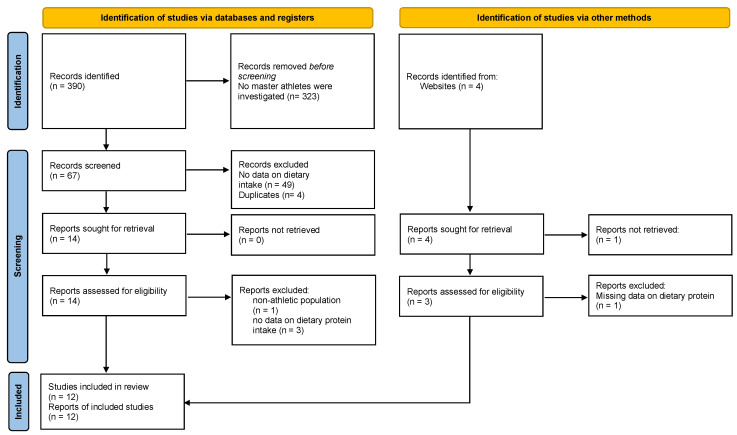
- This short scoping review followed PRISMA-ScR; literature was searched until 13 January 2025 in PubMed–Medline, SPORTDiscuss/EBSCO, and ScienceDirect/Elsevier, plus ResearchGate and reference-list screening, using search terms (‘master athletes’ OR ‘senior athletes’) AND (‘protein intake’). The database search identified 390 records, with 4 additional records from ResearchGate.
- Included studies were original human observational or interventional studies on master/senior athletes that reported dietary protein intake and body composition or performance outcomes; reviews and meta-analyses were excluded. Twelve studies met the criteria and were summarized narratively in Table 1.
Limitations
- Stated: the 12 studies were very diverse in age ranges (26–75 years), design (eight cross-sectional, three before–after, one crossover), participant numbers (5–176), body composition methods (dual-energy X-ray absorptiometry, hydrodensitometry, bioimpedance, caliper), and dietary assessment (24 h, 3-day, or 7-day food records, dietary recalls, food frequency questionnaire). Female athletes were heavily underrepresented at 29%, and the low number of studies combined with heterogeneity severely limits generalizability; the databases used may not have identified all gray literature.
- Stated: no evidence-based protein intake recommendations exist for master athletes, and inferences are consequently speculative.
- Evident from the text/Table 1: only one included study focused on strength-trained athletes, several studies did not report available protein intake (n.a. in Table 1), and beyond the 1.0–1.9 g/kg/d range, no clear pattern could be observed.
Model-written summary. Check it against the paper before relying on it.
Integrity signals
Registry
Cites
Statistics
Figures
Verification
Claims the paper makes
0 Valid · 0 Not valid · 38 Not checked · 21 Own results and interpretations
A check of a cited source is scheduled, or we don’t hold its full text yet; the claim is checked once it runs.
In the paper
“Doering et al. [20] reported similar post-exercise protein intakes between older (58 ± 7 years) and younger (24 ± 4 years) triathletes.”
§ Protein Intake, Physical Performance and Body Composition in Master Athletes—A Short Scoping Review > 3. Results
What the sources say
- Not checked yetcites [20] Tricco, 2018, PRISMA Extension for Scoping Reviews (PRISMA-ScR): Checklist and Explanation, Ann. Intern. Med. source
A check is scheduled.
plain- Asserted: passes — The authors put it forward as true.
- Checkable: passes — It can be checked against evidence.
- Load-bearing: unclear — It is unclear whether the paper’s conclusions depend on it.
- Based: passes — The paper gives a reason why it holds.
- Not checked yet
A check of a cited source is scheduled, or we don’t hold its full text yet; the claim is checked once it runs.
In the paper
“Although there are reports summarizing the general dietary habits of master athletes [18] as well as the benefit of higher protein intakes than the current RDA for physical function in the general aging population [19], current literature does not provide sufficient evidence to develop dietary guidelines, specifically for the crucial nutrient protein for aging athletes.”
§ Protein Intake, Physical Performance and Body Composition in Master Athletes—A Short Scoping Review > 1. Introduction
What the sources say
- Not checked yetcites [18] Guo, S., Shaoni, G.L.L., Stuart-Smith, W.A., Davies, A.J., and Gifford, J.A. (2023). Dietary Intake of Masters Athletes: A Systematic Review. Nutrients, 15. source
A check is scheduled.
- Not checked yetcites [19] Coelho-Junior, H.J., Calvani, R., Picca, A., Tosato, M., Landi, F., and Marzetti, E. (2022). Protein Intake and Frailty in Older Adults: A Systematic Review and Meta-Analysis of Observational Studies. Nutrients, 14. source
A check is scheduled.
plain- Asserted: passes — The authors put it forward as true.
- Checkable: passes — It can be checked against evidence.
- Load-bearing: passes — The paper’s conclusions depend on it.
- Based: passes — The paper gives a reason why it holds.
- Not checked yet
A result the paper reports from its own data — it cites no other source for it, so there is none to check. The quote shows it is in the paper.
In the paper
“Currently, data on protein intake in master athletes is rare; see Table 1.”
§ Protein Intake, Physical Performance and Body Composition in Master Athletes—A Short Scoping Review > 4. Discussion
plain- Asserted: passes — The authors put it forward as true.
- Checkable: passes — It can be checked against evidence.
- Load-bearing: passes — The paper’s conclusions depend on it.
- Based: passes — The paper gives a reason why it holds.
A result the paper states — it cites no source for it, so there is none to check. The quote shows it is in the paper.
In the paper
“Based on these criteria, 12 studies were included for further analysis.”
- Also stated in: § 3. Results · plain
“For this short scoping review, we were able to identify 12 reports suitable for further analyses.”
§ Protein Intake, Physical Performance and Body Composition in Master Athletes—A Short Scoping Review > 2. Materials and Methods
plain- Asserted: passes — The authors put it forward as true.
- Checkable: passes — It can be checked against evidence.
- Load-bearing: passes — The paper’s conclusions depend on it.
- Based: passes — The paper gives a reason why it holds.
- Also stated in: § 3. Results · plain
In the paper
“In 58 master marathon athletes, Methenitis et al. [26] found that a higher protein intake was linked to favorable changes in body composition and metabolic blood biomarkers after a marathon race.”
§ Protein Intake, Physical Performance and Body Composition in Master Athletes—A Short Scoping Review > 3. Results
What the sources say
- Not checked yetcites [26] Methenitis, 2021, The importance of protein intake in master marathon runners, Nutrition source
plainstates an association- Asserted: passes — The authors put it forward as true.
- Checkable: passes — It can be checked against evidence.
- Load-bearing: unclear — It is unclear whether the paper’s conclusions depend on it.
- Based: passes — The paper gives a reason why it holds.
23 more claims
Create a free account to see all 59 claims and to verify the 63 references still open.
- Probably not a substantial claim. 21
- It may state two separate claims as one. 12
Self-check
Percentages, sums and reported differences re-computed from the paper’s own numbers.
Each contradiction between two passages listed here was confirmed by an independent check.
Rated minor: it would not touch a result — a value no result rests on, a p-value that stays on the same side of the significance level, or a conflict that is clerical, resolved elsewhere in the paper, or outside its own findings.
In the paper
§ Protein Intake, Physical Performance and Body Composition in Master Athletes—A Short Scoping Review > 3. Results
“Of 139 participants, only 29% were female master athletes.”
§ Protein Intake, Physical Performance and Body Composition in Master Athletes—A Short Scoping Review > 3. Results
“In total, 476 master athletes were part of the 12 studies identified for this short scoping review.”
Rated minor: it would not touch a result — a value no result rests on, a p-value that stays on the same side of the significance level, or a conflict that is clerical, resolved elsewhere in the paper, or outside its own findings.
In the paper
§ Protein Intake, Physical Performance and Body Composition in Master Athletes—A Short Scoping Review > 3. Results
“Doering et al. [20] reported similar post-exercise protein intakes between older (58 ± 7 years) and younger (24 ± 4 years) triathletes.”
§ Protein Intake, Physical Performance and Body Composition in Master Athletes—A Short Scoping Review > 3. Results
“Doering et al. (2016) [24] | Cross-sectional | Compare typical post-exercise intakes of carbohydrates and protein between masters and younger triathletes”
Citations
Cites
The PRISMA 2020 statement: An updated guideline for reporting systematic reviews
Page, M. J., McKenzie, J. E., Bossuyt, P. M., Boutron, I., Hoffmann, T. C., Mulrow, C. D., Shamseer, L., Tetzlaff, J. M., Akl, E. A., Brennan, S. E., et al. (2021) · BMJ · doi:10.1136/bmj.n71 · Cited by 108,283
PRISMA Extension for Scoping Reviews (PRISMA-ScR): Checklist and Explanation
Tricco, A. C., Lillie, E., Zarin, W., O'Brien, K. K., Colquhoun, H., Levac, D., Moher, D., Peters, M. D. J., Horsley, T., Weeks, L., et al. (2018) · Annals of Internal Medicine · doi:10.7326/m18-0850 · Cited by 43,565
Sarcopenia: revised European consensus on definition and diagnosis
Cruz-Jentoft, A. J., Bahat, G., Bauer, J., Boirie, Y., Bruyère, O., Cederholm, T., Cooper, C., Landi, F., Rolland, Y., Sayer, A. A., et al. (2019) · Age and Ageing · doi:10.1093/ageing/afy169 · Cited by 13,818
Sarcopenia: revised European consensus on definition and diagnosis
Cruz-Jentoft, A. J., Bahat, G., Bauer, J., Boirie, Y., Bruyère, O., Cederholm, T., Cooper, C., Landi, F., Rolland, Y., Sayer, A. A., et al. (2019) · Age and Ageing · doi:10.1093/ageing/afz046 · Cited by 3,803
Morton, R. W., Murphy, K. T., McKellar, S. R., Schoenfeld, B. J., Henselmans, M., Helms, E., Aragon, A. A., Devries, M. C., Banfield, L., Krieger, J. W., et al. (2018) · British Journal of Sports Medicine · doi:10.1136/bjsports-2017-097608 · Cited by 1,269 · cited 1×
“In their meta-regression, Morton et al. [36] conducted research on changes in lean body mass when combining resistance training and varying protein intakes.”
International Society of Sports Nutrition Position Stand: protein and exercise
Jäger, R., Kerksick, C. M., Campbell, B. I., Cribb, P. J., Wells, S. D., Skwiat, T. M., Purpura, M., Ziegenfuss, T. N., Ferrando, A. A., Arent, S. M., et al. (2017) · Journal of the International Society of Sports Nutrition · doi:10.1186/s12970-017-0177-8 · Cited by 873
International society of sports nutrition position stand: nutrient timing
Kerksick, C. M., Arent, S., Schoenfeld, B. J., Stout, J. R., Campbell, B., Wilborn, C. D., Taylor, L., Kalman, D., Smith-Ryan, A. E., Kreider, R. B., et al. (2017) · Journal of the International Society of Sports Nutrition · doi:10.1186/s12970-017-0189-4 · Cited by 622
Protein Intake and Sarcopenia in Older Adults: A Systematic Review and Meta-Analysis
Coelho-Junior, H., Calvani, R., Azzolino, D., Picca, A., Tosato, M., Landi, F., Cesari, M., & Marzetti, E. (2022) · International Journal of Environmental Research and Public Health · doi:10.3390/ijerph19148718 · Cited by 149
Gregorio, L., Brindisi, J., Kleppinger, A., Sullivan, R., Mangano, K. M., Bihuniak, J. D., Kenny, R. A., Kerstetter, J. E., & Insogn, K. L. (2013) · The journal of nutrition health & aging · doi:10.1007/s12603-013-0391-2 · Cited by 146
Tagawa, R., Watanabe, D., Ito, K., Ueda, K., Nakayama, K., Sanbongi, C., & Miyachi, M. (2021) · Nutrition Reviews · doi:10.1093/nutrit/nuaa104 · Cited by 118
Anabolic Resistance of Muscle Protein Turnover Comes in Various Shapes and Sizes
Paulussen, K. J. M., McKenna, C. F., Beals, J. W., Wilund, K. R., Salvador, A. F., & Burd, N. A. (2021) · Frontiers in Nutrition · doi:10.3389/fnut.2021.615849 · Cited by 107
Nutrition for Special Populations: Young, Female, and Masters Athletes
Desbrow, B., Burd, N. A., Tarnopolsky, M., Moore, D. R., & Elliott-Sale, K. J. (2019) · International Journal of Sport Nutrition and Exercise Metabolism · doi:10.1123/ijsnem.2018-0269 · Cited by 100
Protein intake and physical function in older adults: A systematic review and meta-analysis
Coelho-Júnior, H. J., Calvani, R., Tosato, M., Landi, F., Picca, A., & Marzetti, E. (2022) · Ageing Research Reviews · doi:10.1016/j.arr.2022.101731 · Cited by 86
Trommelen, J., van Lieshout, G. A. A., Nyakayiru, J., Holwerda, A. M., Smeets, J. S. J., Hendriks, F. K., van Kranenburg, J. M. X., Zorenc, A. H., Senden, J. M., Goessens, J. P. B., et al. (2023) · Cell Reports Medicine · doi:10.1016/j.xcrm.2023.101324 · Cited by 82
Dietary Protein, Muscle and Physical Function in the Very Old
Franzke, B., Neubauer, O., Cameron-Smith, D., & Wagner, K.-H. (2018) · Nutrients · doi:10.3390/nu10070935 · Cited by 68
Self-citationSuper DNAging—New insights into DNA integrity, genome stability and telomeres in the oldest old
Franzke, B., Neubauer, O., & Wagner, K. (2015) · Mutation Research/Reviews in Mutation Research · doi:10.1016/j.mrrev.2015.08.001 · Cited by 56
Self-citationProtein Intake and Cognitive Function in Older Adults: A Systematic Review and Meta-Analysis
Coelho-Júnior, H. J., Calvani, R., Landi, F., Picca, A., & Marzetti, E. (2021) · Nutrition and Metabolic Insights · doi:10.1177/11786388211022373 · Cited by 54
McKendry, J., Joanisse, S., Baig, S., Liu, B., Parise, G., Greig, C. A., & Breen, L. (2019) · The Journals of Gerontology Series A · doi:10.1093/gerona/glz142 · Cited by 47
Coelho‐Júnior, H. J., Calvani, R., Picca, A., Tosato, M., Landi, F., & Marzetti, E. (2022) · Nutrients · doi:10.3390/nu14132767 · Cited by 44
Protein Requirements for Master Athletes: Just Older Versions of Their Younger Selves
Moore, D. R. (2021) · Sports Medicine · doi:10.1007/s40279-021-01510-0 · Cited by 33
Lower Integrated Muscle Protein Synthesis in Masters Compared with Younger Athletes
DOERING, T. M., JENKINS, D. G., REABURN, P. R., BORGES, N. R., HOHMANN, E., & PHILLIPS, S. M. (2016) · Medicine & Science in Sports & Exercise · doi:10.1249/mss.0000000000000935 · Cited by 29
McKendry, J., Shad, B. J., Smeuninx, B., Oikawa, S. Y., Wallis, G., Greig, C., Phillips, S. M., & Breen, L. (2019) · Frontiers in Physiology · doi:10.3389/fphys.2019.01084 · Cited by 27
Coaching Masters Athletes: Advancing Research and Practice in Adult Sport
(2021) · Routledge eBooks · doi:10.4324/9781003025368 · Cited by 27
Kopiczko, A., Adamczyk, J. G., Gryko, K., & Popowczak, M. (2021) · European Review of Aging and Physical Activity · doi:10.1186/s11556-021-00262-0 · Cited by 24
Doering, T. M., Reaburn, P. R., Cox, G., & Jenkins, D. G. (2016) · International Journal of Sport Nutrition and Exercise Metabolism · doi:10.1123/ijsnem.2015-0289 · Cited by 22
Higher protein intake is associated with improved muscle strength in elite senior athletes
Di Girolamo, F. G., Situlin, R., Fiotti, N., Tence, M., De Colle, P., Mearelli, F., Minetto, M. A., Ghigo, E., Pagani, M., Lucini, D., et al. (2017) · Nutrition · doi:10.1016/j.nut.2017.05.003 · Cited by 22
Franzke, B., Bileck, A., Unterberger, S., Aschauer, R., Zöhrer, P. A., Draxler, A., Strasser, E.-M., Wessner, B., Gerner, C., & Wagner, K.-H. (2022) · Frontiers in Nutrition · doi:10.3389/fnut.2022.925450 · Cited by 22
Self-citationDietary Intake of Masters Athletes: A Systematic Review
Guo, S., Shaoni, G. L. L., Stuart-Smith, W. A., Davies, A. J., & Gifford, J. A. (2023) · Nutrients · doi:10.3390/nu15234973 · Cited by 21
Suominen, T. H., Alén, M., Törmäkangas, T., Degens, H., Rittweger, J., Heinonen, A., Suominen, H., & Korhonen, M. T. (2021) · JBMR Plus · doi:10.1002/jbm4.10513 · Cited by 17
Doering, T. M., Reaburn, P. R., Borges, N. R., Cox, G. R., & Jenkins, D. G. (2017) · International Journal of Sport Nutrition and Exercise Metabolism · doi:10.1123/ijsnem.2016-0079 · Cited by 14
Effects of Supplementation with Beef or Whey Protein Versus Carbohydrate in Master Triathletes
Naclerio, F., Seijo, M., Larumbe-Zabala, E., Ashrafi, N., Christides, T., Karsten, B., & Nielsen, B. V. (2017) · Journal of the American College of Nutrition · doi:10.1080/07315724.2017.1335248 · Cited by 12
The importance of protein intake in master marathon runners
Methenitis, S., Mouratidis, A., Manga, K., Chalari, E., Feidantsis, K., Arnaoutis, G., Arailoudi-Alexiadou, X., Skepastianos, P., Hatzitolios, A., Mourouglakis, A., et al. (2021) · Nutrition · doi:10.1016/j.nut.2021.111154 · Cited by 12
Physical conditioning status and diet intake in active and sedentary older men
Hallfrisch, J., Drinkwater, D. T., Muller, D. C., Fleg, J., Janette^Busby-Whitehead, M., Andres, R., & Goldberg, A. (1994) · Nutrition Research · doi:10.1016/s0271-5317(05)80483-x · Cited by 9
Coelho‐Júnior, H. J., Calvani, R., Picca, A., Tosato, M., Landi, F., & Marzetti, E. (2022) · Nutrients · doi:10.3390/nu14224881 · Cited by 8
Leonhardt, T. P. M., Bristol, A., McLaurin, N., Forbes, S. C., Tanaka, H., Frings-Meuthen, P., Pesta, D., Rittweger, J., & Chilibeck, P. D. (2024) · Nutrients · doi:10.3390/nu16040564 · Cited by 8
Exercise entrainment of musculoskeletal connective tissue clocks
Steffen, D., Kjaer, M., & Yeung, C. C. (2024) · American Journal of Physiology-Cell Physiology · doi:10.1152/ajpcell.00285.2024 · Cited by 7
Association between protein intake and lean body mass in a group of Masters Athletes
Stanzione, J. R., Boullata, J. I., Bruneau, M. L., & Volpe, S. L. (2022) · Journal of Nutritional Science · doi:10.1017/jns.2022.10 · Cited by 5
Santos de Souza, M., Zaleski Trindade, C. D., Castro, F. A. D. S., Buss, C., & Schneider, C. D. (2025) · Nutrition and Health · doi:10.1177/02601060241276918 · Cited by 2
(2008) · PubMed
Cited by
Jahan-Mihan, A., Khoury, D. T. D. E., Brewer, G. J., & Chapleau, A. (2025) · Nutrients · doi:10.3390/nu17223528 · Cited by 12
Kaczmarek, K., Zawada, W., Leszczyńska, Z. J., Romaniuk, V., Szuleta, U., Benecka, A., Pietrończyk, J., Benecka, A., Dąbrowska, M., Wieczorek, Z., et al. (2026) · International Journal of Innovative Technologies in Social Science · doi:10.31435/ijitss.3(51).2026.6323
KORELASI ASUPAN PROTEIN DAN LATIHAN FISIK TERHADAP PROFIL UREUM - KREATININ MEMBER GYM BEKASI
Lestari, D., Dini, T. M., Hardianto, N., & Inderiati, D. (2026) · Jurnal Kesehatan Tambusai · doi:10.31004/jkt.v7i3.62676
Metadata
- Authors
- Franzke, B., Maierhofer, R., & Putz, P.
- Affiliations
- Hochschule Campus Wien (AT)
- Research Center Health Sciences, FH Campus Wien University of Applied Sciences, 1100 Vienna, Austria
- Corresponding author
- Franzke, Bernhard
- Venue
- Nutrients
- Publisher
- MDPI AG
- Published
- 2025-01-29
- Volume
- 17
- Issue
- 3
- Pages
- 498
- ISSN
- 2072-6643 (ISSN-L)
- PMC
- PMC11820402
- OpenAlex
- W4406957625
- Semantic Scholar
- 68bdcf56823481c7ccbfd59cef03acaed23674bc
- Cited by
- 3
- References
- 39
- Citations by year
- 2026: 2 · 2025: 1
- FWCI
- 0.30
- Type
- journal article
- Language
- en
- Open access
- gold
- doi.org
- Licence
- Locations
- Nutrients (publishedVersion, cc-by)
- PubMed Central (publishedVersion, cc-by)
- PubMed (publishedVersion)
- Topics
- Health Sciences › Nursing › Nutrition and Dietetics › Muscle metabolism and nutrition
- Health Sciences › Medicine › Physiology (medical) › Nutrition and Health in Aging
- Health Sciences › Medicine › Orthopedics and Sports Medicine › Sports Performance and Training
- Keywords
- protein intake, master athletes, older athletes, physical performance, body composition, muscle mass, muscle function, endurance athletes, multi-sport athletes, strength-trained athletes, dietary recommendations, post-exercise recovery
- MeSH terms
- Physical Functional Performance, Aged, Aging, Body Composition, Dietary Proteins, Female, Humans, Male, Middle Aged, Muscle, Skeletal, Muscle Strength, Athletic Performance, Athletes, Sports Nutritional Physiological Phenomena
About these checks
Registry, retraction, Cites and statistics results are computed, not judged, with one exception: a printed reference that no index lists is read once by a model before it counts as a citation error. Claims are extracted by a model and kept only when their quote appears verbatim in the text; each cited source is then checked, with a model’s help, for whether it says what the claim relies on. Those verdicts can be wrong — read the claim’s quote and the cited source before relying on one.
A language model drew the claims from the paper on 2026-11-14, under version 3 of the claim definition (model deepseek-v4.1-flash, prompt extract-v3).
A second model labelled each claim on 2026-11-14 (model jev-1.13-20260917, definition revision gold-guideline-v0.2).
Statistics and arithmetic are recomputed, not judged.
Confidence bands are shown only for fields calibrated on our annotated test set. None is calibrated yet, so no band is shown.
What counts as a claim ›How we measure confidence ›How we check this ›
Are you an author, or do you see a problem with this page? Request a review
Data sources
Bibliographic data: Semantic Scholar, OpenAlex, Crossref.
Contains information from the Semantic Scholar Academic Graph Datasets, made available under the ODC Attribution License (ODC-BY 1.0).
Semantic Scholar’s data is described in: Kinney, R., et al. (2023). The Semantic Scholar Open Data Platform. arXiv:2301.10140.
