

Cognitive Effects of Pharmacotherapy for Major Depressive Disorder: A Systematic Review
Open accessThe DOI matches its Crossref record; 60 of the 64 references it cites were found in a registry or an index; 11 of the 30 sources its claims cite were checked for support.
Abstract
OBJECTIVE: Cognitive impairment frequently accompanies major depressive disorder (MDD) and can persist during remission. This review examined pharmacotherapy effects on cognitive function in MDD. DATA SOURCES: PubMed and EMBASE searches were conducted on July 30, 2013, for English language reports of cognitive assessments following pharmacologic monotherapy or augmentation therapy in MDD. STUDY SELECTION: A total of 43 research reports were identified (31 monotherapy [8 placebo-controlled, 11 active-comparator, 12 open-label], 12 augmentation therapy [7 placebo-controlled, 5 open-label]). DATA EXTRACTION: Results reported in each publication were examined for open-label and placebo- or active comparator-controlled studies. RESULTS: Studies varied widely in terms of size (median, 50 participants; interquartile range, 21-143 participants), populations examined, duration (median, 8 weeks; interquartile range, 6-12 weeks), and neurocognitive assessments used. Most individual studies reported some benefit to cognition with pharmacotherapy, but there was no pattern of response in specific domains and only 12% of individually analyzed changes favored active treatment over placebo or untreated healthy controls. Sample weighted mean effect sizes revealed that verbal memory improved with monotherapy, while the largest treatment effect with augmentation therapy was for visual memory. CONCLUSIONS: Pharmacotherapy may have benefit in reducing cognitive impairment in MDD, with augmentation therapy being a potential approach for addressing cognitive deficits that persist after monotherapy has brought about clinical response or remission. However, given the wide variability in study design and treatment duration across studies, these findings should be interpreted cautiously. More definitive research is required before firm conclusions can be reached.
Overview
CoChat Summary
TL;DR
This systematic review of 43 reports found that antidepressant monotherapy and augmentation therapy may improve cognition in major depressive disorder, but only 12% of individually analyzed cognitive changes favored active treatment over placebo or untreated healthy controls. The authors conclude that wide variability in study design and treatment duration warrants cautious interpretation and that more definitive research is needed.
Key findings
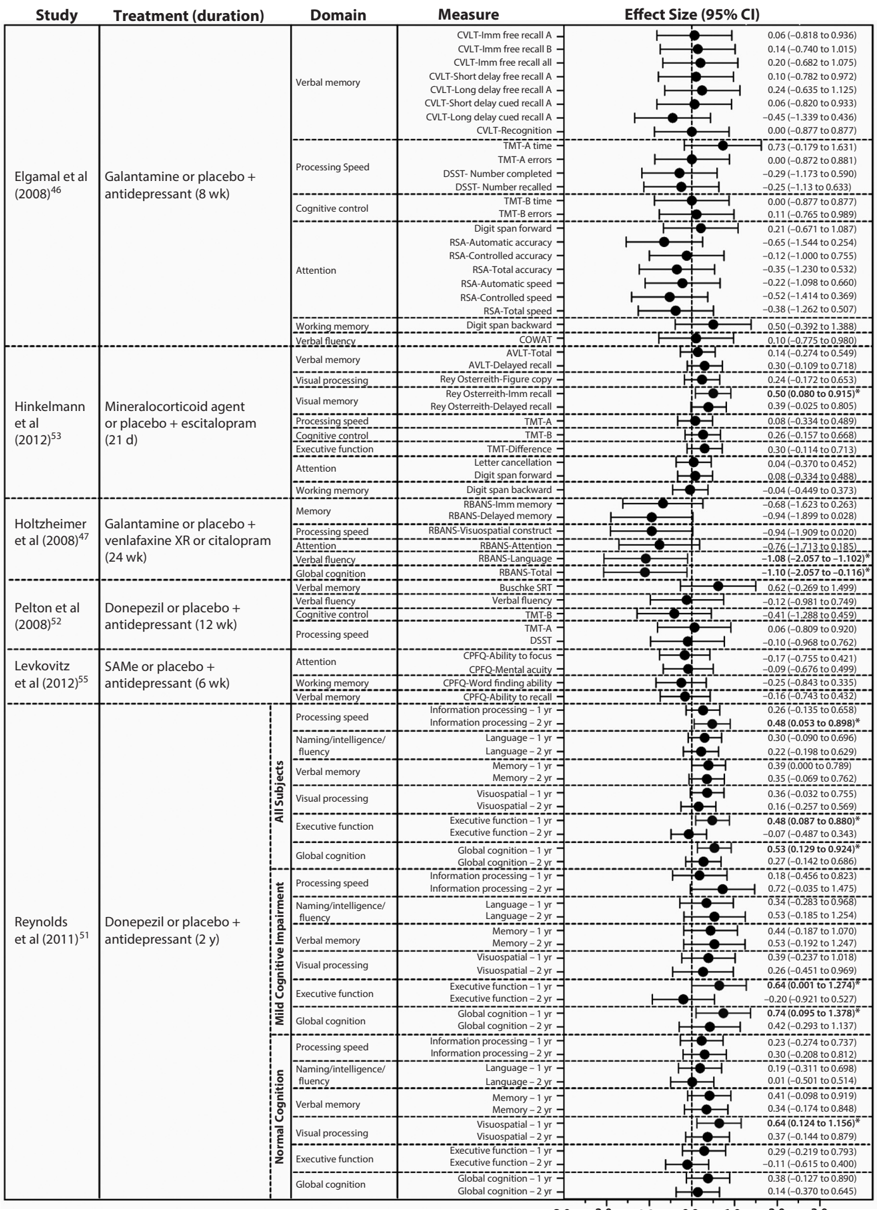
- Across 43 reports (4,828 participants total), most individual studies reported some cognitive benefit with pharmacotherapy, but there was no consistent pattern across specific cognitive domains; only 12% of individually analyzed changes (20/168) favored active treatment over placebo or untreated healthy controls, while 4% (7/168) favored the control condition.
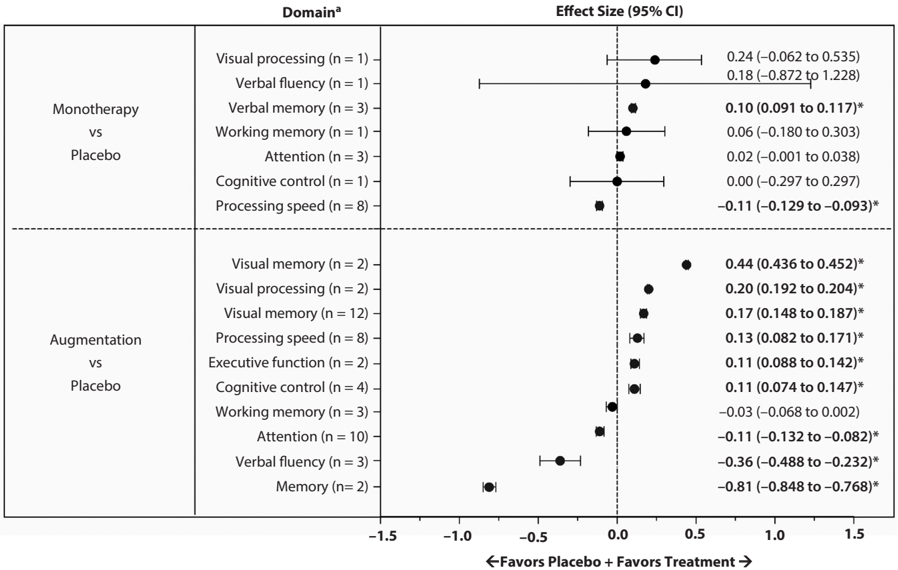
- Sample-weighted mean effect sizes showed a small effect favoring active treatment for verbal memory with monotherapy, and a small effect favoring placebo for processing speed; with augmentation therapy, the largest treatment effect was for visual memory (moderate), with small effects favoring active treatment for visual processing, verbal memory, processing speed, executive function, and cognitive control, and large effects favoring placebo for memory.
- Significant benefit was reported in 7 of 8 placebo-controlled monotherapy studies and 5 of 7 placebo-controlled augmentation studies; in 10 of 11 active-comparator trials, sertraline was consistently superior to nortriptyline in 3 studies and to fluoxetine in 2.
- Studies were highly heterogeneous: median 50 participants (IQR 21–143), median duration 8 weeks (IQR 6–12), and inconsistent domain categorization (eg, the Stroop test was labeled as executive function, processing speed, or attention in different studies).
Methods
- Systematic review with PubMed and EMBASE searches conducted July 30, 2013, for English-language reports of cognitive assessments following pharmacologic monotherapy or augmentation therapy in MDD; 4 searches yielded 1,032 hits (PubMed n = 759; EMBASE n = 273), yielding 43 research reports (31 monotherapy [8 placebo-controlled, 11 active-comparator, 12 open-label]; 12 augmentation [7 placebo-controlled, 5 open-label]).
- Effect sizes (Cohen d) were calculated for treatment differences in change from baseline for cognitive endpoints from trials with a placebo, healthy control, or active comparator that adequately reported data; sample-weighted mean effect sizes with 95% CIs were computed per cognitive domain. Published abstracts were excluded from effect size assessment.
- Effect sizes were calculable for 168 cognitive measures from 15 of the 43 publications (8 monotherapy, 4 augmentation, plus data requested from authors of 3 more).
Limitations
- Stated by the authors: effect sizes were estimated using the pooled standard deviation at end of study, which may over- or underestimate the true effect size; the number of measures per sample-weighted mean effect size was ≤ 3 for all but 1 monotherapy domain and ≤ 4 in 7 of 9 augmentation domains; high variability in study design and data presentation; many studies were small or assessed selected subgroups (eg, elderly, specific comorbidities), limiting generalizability; studies were generally short, leaving long-term effects uncertain; statistical methodology was inconsistent, with only 7 reports describing correction for multiple comparisons; several studies relied solely on the MMSE, which has ceiling effects and no alternate form; domain categorization was inconsistent; the review was restricted to PubMed and EMBASE; inclusion of abstracts (less rigorous peer review) is a limitation, though abstract data were excluded from effect size analyses; publication bias could influence findings.
- Evident from the text: with the exception of one report (Madhoo et al) in a partially or fully remitted population, studies assessed cognition in the presence of mild to severe depressive symptoms, making it difficult to establish whether cognitive improvement was independent of clinical response; studies in elderly individuals generally did not distinguish cognitive decline due to aging from depression-related impairment; comorbid medical conditions were generally not addressed (except Wise et al).
Model-written summary. Check it against the paper before relying on it.
Integrity signals
Registry
Cites
Statistics
Figures
Verification
Claims the paper makes
10 Valid · 0 Not valid · 22 Not checked · 61 Own results and interpretations
The sources with a verdict support this claim; the rest weren’t checked yet, have no full text we could read, or their verdicts aren’t rated yet.
In the paper
“The common occurrence of cognitive impairment in individuals with MDD may be related to the shared neurobiologic systems and processes that can modulate cognitive function and mood.”
What the sources say
- Not checked — no full text of the sourcecites [60] 60. Femen×a T, Gómez-Galán M, Lindskog M, et al. Dysfunctional hippocampal activity affects emotion and cognition in mood disorders. Brain Res. 2012;1476:58-70. PubMed doi:10.1016/j.brainres.2012.03.053 source
- Supportedcites [61] 61. Duman RS, Aghajanian GK. Synaptic dysfunction in depression: potential therapeutic targets. Science. 2012;338(6103):68-72. PubMed doi:10.1126/science.1222939 About the Authors Richard S. E. Keefe, PhD View full profile Manisha Madhoo, MD View full profile Shawn M. McClintock, PhD, MSCS View full profile P. Murali Doraiswamy, MD View full profile Robert M. Roth, MD View full profile Steven Tiger, PA View full profile Download Free PDF This PDF is free for all visitors! The Journal of Clinical Psychiatry September 2026 cover featuring key articles on depression therapy Vol 87 • 2026 • Number source
The Abstract describes decreased cognition and memory as features of MDD. The Neuronal Atrophy and Synaptic Loss in Depression section identifies the prefrontal cortex and hippocampus as regions that control both mood and cognition, supporting the proposed link through shared neurobiology. (LLM, conf=0.90)
hedgedstates a possible cause- Asserted: passes — The authors put it forward as true.
- Checkable: passes — It can be checked against evidence.
- Load-bearing: unclear — It is unclear whether the paper’s conclusions depend on it.
- Based: passes — The paper gives a reason why it holds.
The sources with a verdict support this claim; the rest weren’t checked yet, have no full text we could read, or their verdicts aren’t rated yet.
In the paper
“6 reports24,25,30,31,41,55 stated or described the analyses in such a manner as to indicate that corrections were not made.”
What the sources say
- Not checked — no full text of the sourcecites [24] 24. Nickel T, Sonntag A, Schill J, et al. Clinical and neurobiological effects of tianeptine and paroxetine in major depression. J Clin Psychopharmacol. 2003;23(2):155-168. PubMed doi:10.1097/00004714-200304000-00008 source
- Not checked — no full text of the sourcecites [25] 25. Raskin J, Wiltse CG, Siegal A, et al. Efficacy of duloxetine on cognition, depression, and pain in elderly patients with major depressive disorder: an 8-week, double-blind, placebo-controlled trial. Am J Psychiatry. 2007;164(6):900-909. PubMed doi:10.1176/appi.ajp.164.6.900 source
- Supportedcites [30] 30. Wise TN, Wiltse CG, Iosifescu DV, et al. The safety and tolerability of duloxetine in depressed elderly patients with and without medical comorbidity. Int J Clin Pract. 2007;61(8):1283-1293. PubMed doi:10.1111/j.1742-1241.2007.01476.x source
The Methods > Statistical analysis section explicitly states that no adjustments for multiple comparisons were made. This supports including this paper among the six reports counted by the citing authors; the paper itself does not establish that count. (LLM, conf=0.95)
plain- Asserted: passes — The authors put it forward as true.
- Checkable: passes — It can be checked against evidence.
- Load-bearing: unclear — It is unclear whether the paper’s conclusions depend on it.
- Based: passes — The paper gives a reason why it holds.
The cited sources support only part of this claim — read each source’s verdict below.
In the paper
“Examples include outcomes reported as interaction statistics without data on within-group changes from baseline and between-group differences at study end24,27,51”
What the sources say
- Not checked — no full text of the sourcecites [24] 24. Nickel T, Sonntag A, Schill J, et al. Clinical and neurobiological effects of tianeptine and paroxetine in major depression. J Clin Psychopharmacol. 2003;23(2):155-168. PubMed doi:10.1097/00004714-200304000-00008 source
- Supportedcites [27] 27. Sato S, Yamakawa Y, Terashima Y, et al. Efficacy of milnacipran on cognitive dysfunction with post-stroke depression: preliminary open-label study. Psychiatry Clin Neurosci. 2006;60(5):584-589. PubMed doi:10.1111/j.1440-1819.2006.01562.x source
The Results report the MMSE outcome as a time-by-group interaction (F = 5.35, P = 0.034). The Results and Figure 2 caption provide no numerical within-group changes from baseline or between-group difference at discharge. Page numbers are unavailable in our copy. (LLM, conf=0.88)
- Partly supportedcites [51] 51. Reynolds CF 3rd, Butters MA, Lopez O, et al. Maintenance treatment of depression in old age: a randomized, double-blind, placebo-controlled evaluation of the efficacy and safety of donepezil combined with antidepressant pharmacotherapy. Arch Gen Psychiatry. 2011;68(1):51-60. PubMed doi:10.1001/archgenpsychiatry.2010.184 sourceExperimental — accuracy not yet measured
The Results (A. Primary Analyses; page not available) report treatment-by-time interaction statistics, supporting the first part of the claim. They also report between-group effect sizes at one and two years, so the statement that no between-group differences were reported is too broad. The passages do not provide within-group changes from baseline. (LLM, conf=0.82)
plain- Asserted: passes — The authors put it forward as true.
- Checkable: passes — It can be checked against evidence.
- Load-bearing: unclear — It is unclear whether the paper’s conclusions depend on it.
- Based: passes — The paper gives a reason why it holds.
The cited sources support only part of this claim — read each source’s verdict below.
In the paper
“Both publications suggest that MDD is associated with deficits across a wide range of cognitive domains”
What the sources say
- Partly supportedcites [59] 59. Snyder HR. Major depressive disorder is associated with broad impairments on neuropsychological measures of executive function: a meta-analysis and review. Psychol Bull. 2013;139(1):81-132. PubMed doi:10.1037/a0028727 sourceExperimental — accuracy not yet measured
The Discussion section, “MDD is Associated with Broad Impairments on Neuropsychological Measures of EF” (page unavailable), reports impairments across all executive-function domains studied. The Results section, “Processing Speed and Vocabulary” (page unavailable), also reports slower processing speed, but only a very small vocabulary difference. The meta-analysis therefore supports deficits across executive-function domains and in processing speed, but does not establish deficits across a wide range of cognitive domains generally. (LLM, conf=0.84)
hedgedstates an association- Asserted: passes — The authors put it forward as true.
- Checkable: passes — It can be checked against evidence.
- Load-bearing: unclear — It is unclear whether the paper’s conclusions depend on it.
- Based: passes — The paper gives a reason why it holds.
- Partly supported
Every source the paper cites for this claim was checked and supports it.
In the paper
“except for the report by Wise et al,30 the potential impact of comorbid medical conditions on cognitive function were generally not addressed.”
What the sources say
- Supportedcites [30] 30. Wise TN, Wiltse CG, Iosifescu DV, et al. The safety and tolerability of duloxetine in depressed elderly patients with and without medical comorbidity. Int J Clin Pract. 2007;61(8):1283-1293. PubMed doi:10.1111/j.1742-1241.2007.01476.x source
The Aim and methods section says Wise et al. compared cognitive outcomes in patients with and without medical comorbidity. The Results section, ‘Efficacy in cognitive measures,’ reports those subgroup findings. The statement about what other reports generally addressed is the citing authors’ comparison, not a finding attributed to Wise et al. (LLM, conf=0.93)
plain- Asserted: passes — The authors put it forward as true.
- Checkable: passes — It can be checked against evidence.
- Load-bearing: unclear — It is unclear whether the paper’s conclusions depend on it.
- Based: passes — The paper gives a reason why it holds.
- Supported
51 more claims · 1 with their cited sources checked
Create a free account to see all 93 claims and every source verdict.
- It may state two separate claims as one. 32
- Probably not a substantial claim. 12
Claims other papers make about this one
Each is checked against this paper’s own text: does it say what the citing paper says it does?
The cited source doesn’t support the claim as written.
In the citing paper
“Notably, Keefe et al. (2014) conducted a systematic review on the cognitive effects of pharmacotherapy in MDD, in which they calculated the effect size for all studies reviewed; however, they did not meta-analytically quantify pooled effect sizes of the cognitive effects of antidepressants.”
From The Cognitive Effects of Antidepressants in Major Depressive Disorder: A Systematic Review and Meta-Analysis of Randomized Clinical Trials (2016) · cites this paper as Keefe et al., 2014
Checked by a reasoning model — may be wrong.
Experimental — accuracy not yet measuredThe source backs part of the claim, not all of it — or backs it for a different population, condition or comparison.
In the citing paper
“Thus, these factors might represent trait-like markers of MDD [72].”
From Cognitive remission: a novel objective for the treatment of major depression? (2016) · cites this paper as [72]
Experimental — accuracy not yet measuredThe source backs part of the claim, not all of it — or backs it for a different population, condition or comparison.
In the citing paper
“however, the majority of these studies were limited by small sample sizes, absence of placebo controls, a lack of pre-specification of cognition as a primary outcome, and insufficient statistical analytic approaches to parse direct versus indirect effects (e.g. path analysis; McIntyre et al., 2013).”
From The Cognitive Effects of Antidepressants in Major Depressive Disorder: A Systematic Review and Meta-Analysis of Randomized Clinical Trials (2016) · cites this paper as Keefe et al., 2014
Experimental — accuracy not yet measuredThe source backs part of the claim, not all of it — or backs it for a different population, condition or comparison.
In the citing paper
“cognitive dysfunction secondary to TCA use has long been suggested secondary to the anti-cholinergic effects of TCAs (Baune and Renger, 2014; Bortolato et al., 2014; Keefe et al., 2014).”
From The Cognitive Effects of Antidepressants in Major Depressive Disorder: A Systematic Review and Meta-Analysis of Randomized Clinical Trials (2016) · cites this paper as Keefe et al., 2014
Experimental — accuracy not yet measuredThe source backs part of the claim, not all of it — or backs it for a different population, condition or comparison.
In the citing paper
“Evidence suggests that pharmacotherapy may improve neurocognitive function; however, the degree of improvement appears modest and efficacy varies by medication class and neurocognitive domain (Baune and Renger, 2014;Keefe et al., 2014).”
From Neurocognitive effects of theta burst stimulation for treatment-resistant depression in adults: A systematic review and recommendations for future research (2025) · cites this paper as Keefe et al., 2014
Experimental — accuracy not yet measured
3 more claims about this paper
Create a free account to see every claim other papers make about this one.
Self-check
Percentages, sums and reported differences re-computed from the paper’s own numbers.
Each contradiction between two passages listed here was confirmed by an independent check.
Rated major: it would touch a result — a value a result rests on, reported and recomputed p-values on opposite sides of the significance level, two passages that conflict with no sign which is right, or a cited work retracted before this paper was published.
In the paper
§ RESULTS
“20 favored an active treatment (12% of all analyses [20/168]) over placebo or untreated healthy controls”
§ RESULTS
“In 3 monotherapy trials that included active comparators,17,24,35 5 effect sizes had 95% CIs that did not cross 0 (Figure 2).”
Citations
Cites
A compendium of neuropsychological tests: administration, norms, and commentary
(1991) · Choice Reviews Online · doi:10.5860/choice.29-2400 · Cited by 6,120
A Compendium of Neuropsychological Tests: Administration, Norms, and Commentary
Levin, H. S. (1993) · Archives of Neurology · doi:10.1001/archneur.1993.00540050007005 · Cited by 4,766
Trivedi, M. H., Rush, A. J., Wisniewski, S. R., Nierenberg, A. A., Warden, D., Ritz, L., Norquist, G., Howland, R. H., Lebowitz, B., McGrath, P. J., et al. (2006) · American Journal of Psychiatry · doi:10.1176/appi.ajp.163.1.28 · Cited by 3,879
J Neuropsychiatry Clin Neurosci
Yudofsky, S. C., & Hales, R. E. (1992) · The Journal of Neuropsychiatry and Clinical Neurosciences · doi:10.1176/jnp.4.4.359 · Cited by 3,818
Snyder, H. R. (2013) · Psychological Bulletin · doi:10.1037/a0028727 · Cited by 1,667
Synaptic Dysfunction in Depression: Potential Therapeutic Targets
Duman, R. S., & Aghajanian, G. K. (2012) · Science · doi:10.1126/science.1222939 · Cited by 1,651
DIAGNOSTIC AND STATISTICAL MANUAL OF MENTAL DISORDERS, FIFTH EDITION
Abbas, A., & Aminoroaia, M. (2013) · Cited by 1,479
Green, M. F., Nuechterlein, K. H., Gold, J. M., Barch, D. M., Cohen, J., Essock, S., Fenton, W. S., Frese, F., Goldberg, T. E., Heaton, R. K., et al. (2004) · Biological Psychiatry · doi:10.1016/j.biopsych.2004.06.023 · Cited by 919
Self-citationCognitive impairment in major depression
Marazziti, D., Consoli, G., Picchetti, M., Carlini, M., & Faravelli, L. (2010) · European Journal of Pharmacology · doi:10.1016/j.ejphar.2009.08.046 · Cited by 448
Raskin, J., Wiltse, C. G., Siegal, A., Sheikh, J., Xu, J., Dinkel, J. J., Rotz, B. T., & Mohs, R. C. (2007) · American Journal of Psychiatry · doi:10.1176/appi.ajp.164.6.900 · Cited by 336
Research works printed but not linked: 3
- [36]36. Alev L, Altin M, Ozbek K, et al. Effect of duloxetine on functional outcomes in patients with major depressive disorder. Klinik Psikofarmakoloji Bulteni. 2011;21:S115.
- [38]38. Hashemian F, Tabatabayi MS, Sharifi A, et al. Comparison of the effects of bupropion and fluoxetine on reaction time in adults with major depressive disorder in a 4-week, single-blind study. Klinik Psikofarmakoloji Bulteni. 2011;21:S113.
- [40]40. Murrough JW, Wan LB, Glicksberg B, et al. Ketamine and neurocognition in depression: the modulating effects of lamotrigine. Neuropsychopharmacology. 2012;38:S375.
Cited by
Cognitive function following a major depressive episode: a systematic review and meta-analysis
Semkovska, M., Quinlivan, L., O'Grady, T., Johnson, R., Collins, A., O'Connor, J., Knittle, H., Ahern, E., & Gload, T. (2019) · The Lancet Psychiatry · doi:10.1016/s2215-0366(19)30291-3 · Cited by 631
Rosenblat, J. D., Kakar, R., & McIntyre, R. S. (2016) · International Journal of Neuropsychopharmacology · doi:10.1093/ijnp/pyv082 · Cited by 315
“Of note, after removal of vortioxetine from the analysis, statistical significance was lost for psychomotor speed.”
BackgroundMethodCognitive Impairment in Bipolar Disorder: Treatment and Prevention Strategies
Solé, B., Jiménez, E., Torrent, C., Reinares, M., Bonnin, C. D. M., Torres, I., Varo, C., Grande, I., Valls, E., Salagre, E., et al. (2017) · International Journal of Neuropsychopharmacology · doi:10.1093/ijnp/pyx032 · Cited by 299
“Lastly, as a whole, antidepressants seem to have beneficial effects in reducing cognitive impairment, especially with a positive effect on psychomotor speed and delayed recall, with no significant differences between different antidepressant classes (Keefe et al., 2014; Rosenblat et al., 2016).”
BackgroundCognitive remission: a novel objective for the treatment of major depression?
Bortolato, B., Miskowiak, K. W., Köhler, C. A., Maes, M., Fernandes, B. S., Berk, M., & Carvalho, A. F. (2016) · BMC Medicine · doi:10.1186/s12916-016-0560-3 · Cited by 252
“might represent trait-like markers of MDD [72].”
BackgroundShilyansky, C., Williams, L. M., Gyurak, A., Harris, A., Usherwood, T., & Etkin, A. (2016) · The Lancet Psychiatry · doi:10.1016/s2215-0366(16)00012-2 · Cited by 249
Prado, C. E., Watt, S., & Crowe, S. F. (2018) · Neuropsychology Review · doi:10.1007/s11065-018-9369-5 · Cited by 188
Depression and Cognition in the Elderly
Wang, S., & Blazer, D. G. (2015) · Annual Review of Clinical Psychology · doi:10.1146/annurev-clinpsy-032814-112828 · Cited by 178
Restoring function in major depressive disorder: A systematic review
Sheehan, D. V., Nakagome, K., Asami, Y., Pappadopulos, E. A., & Boucher, M. (2017) · Journal of Affective Disorders · doi:10.1016/j.jad.2017.02.029 · Cited by 182
Cognitive dysfunction in major depression and bipolar disorder: Assessment and treatment options
MacQueen, G. M., & Memedovich, K. A. (2017) · Psychiatry and Clinical Neurosciences · doi:10.1111/pcn.12463 · Cited by 172
“A recent meta-analysis reported that in general, pharmacological therapies for MDD show some evidence for enhancing cognitive function.(53) There is, however, inconsistent support for this notion.”
BackgroundKandola, A., Hendrikse, J., Lucassen, P. J., & Yücel, M. (2016) · Frontiers in Human Neuroscience · doi:10.3389/fnhum.2016.00373 · Cited by 155
“…suggested that the effectiveness of antipsychotic and antidepressant medications is only marginally different from that of a placebo (Leucht et al., 2009; Rief et al., 2009), and neither have been able to successfully remediate cognitive dysfunction (Keefe et al., 2013, 2014; Solé et al., 2015).”
InfluentialMultifactorial Determinants of the Neurocognitive Effects of Electroconvulsive Therapy
McClintock, S. M., Choi, J., Deng, Z.-D., Appelbaum, L. G., Krystal, A. D., & Lisanby, S. H. (2014) · The Journal of ECT · doi:10.1097/yct.0000000000000137 · Cited by 141
Self-citationGallagher, D., Fischer, C. E., & Iaboni, A. (2017) · The Canadian Journal of Psychiatry · doi:10.1177/0706743716648296 · Cited by 157
“In major depression, effective treatment may, in the short term at least, result in partial, if not complete, improvement in cognitive function and certain behavioural and physiological risk factors, such as physical inactivity or inflammation.(83,84) What is less clear is whether addressing milder symptoms of anxiety…”
BackgroundBaune, B. T., Brignone, M., & Larsen, K. G. (2018) · International Journal of Neuropsychopharmacology · doi:10.1093/ijnp/pyx070 · Cited by 140
The neurocognitive profile of mood disorders – a review of the evidence and methodological issues
Porter, R. J., Robinson, L. J., Malhi, G. S., & Gallagher, P. (2015) · Bipolar Disorders · doi:10.1111/bdi.12342 · Cited by 124
“These have been recently systematically reviewed (118).”
Cognition as a treatment target in depression
Kaser, M., Zaman, R., & Sahakian, B. J. (2017) · Psychological Medicine · doi:10.1017/s0033291716003123 · Cited by 96
“Overall, conventional antidepressants have very limited, if any effects at all on cognition in depression (Keefe et al. 2014).”
BackgroundVortioxetine: A Review in Cognitive Dysfunction in Depression
Frampton, J. E. (2016) · Drugs · doi:10.1007/s40265-016-0655-3 · Cited by 90
Cognitive Dysfunction in Major Depressive Disorder: Assessment, Impact, and Management
Chakrabarty, T., Hadjipavlou, G., & Lam, R. W. (2016) · Focus · doi:10.1176/appi.focus.20150043 · Cited by 84
Longitudinal Cognitive Changes in Young Individuals at Ultrahigh Risk for Psychosis
Lam, M., Lee, J., Rapisarda, A., See, Y. M., Yang, Z., Lee, S.-A., Rashid, N. A. A., Kraus, M., Subramaniam, M., Chong, S., et al. (2018) · JAMA Psychiatry · doi:10.1001/jamapsychiatry.2018.1668 · Cited by 78
Self-citationMartin, D. M., Moffa, A. H., Nikolin, S., Bennabi, D., Brunoni, A. R., Flannery, W., Haffen, É., McClintock, S. M., Moreno, M., Padberg, F., et al. (2018) · Neuroscience & Biobehavioral Reviews · doi:10.1016/j.neubiorev.2018.04.008 · Cited by 78
“Interestingly, a similar finding with regards to reduced improvement in processing speed following antidepressant treatment was observed in a systematic review of RCTs that examined effect sizes of cognitive changes with pharmacotherapy (monotherapy) compared to placebo (Keefe et al., 2014).”
ResultSelf-citationCognitive dysfunction in major depression: From assessment to novel therapies
Atique-Ur-Rehman, H., & Neill, J. C. (2019) · Pharmacology & Therapeutics · doi:10.1016/j.pharmthera.2019.05.013 · Cited by 72
“…the tool may be ideally suited for uncovering signs of potential cognitive dysfunction in high-risk patients before symptoms appear, although conclusive evidence has yet to be found regarding whether cognitive deficits occur before a diagnosis of depression as for psychosis (Keefe, 2014).”
MethodMiskowiak, K. W., Ott, C. V., Petersen, J. Z., & Kessing, L. V. (2016) · European Neuropsychopharmacology · doi:10.1016/j.euroneuro.2016.09.641 · Cited by 77
“Importantly, however, ‘pseudospecificity’ of the observed cognitive improvements (i.e., unspecific cognitive improvement due to reduced depression severity) cannot be ruled out given patients’ concomitant treatment-related reduction in depressive symptoms (Keefe et al., 2014).”
BackgroundCognition as a target in major depression: new developments.
Solé, B., Jiménez, E., Martinez-Aran, A., & Vieta, E. (2015) · European Neuropsychopharmacology · doi:10.1016/j.euroneuro.2014.12.004 · Cited by 68
Dodd, S., Mitchell, P. B., Bauer, M., Yatham, L., Young, A. H., Kennedy, S. H., Williams, L., Suppes, T., Lopez Jaramillo, C., Trivedi, M. H., et al. (2018) · The World Journal of Biological Psychiatry · doi:10.1080/15622975.2017.1379609 · Cited by 68
Colwell, M., Tagomori, H., Chapman, S., Gillespie, A. L., Cowen, P. J., Harmer, C. J., & Murphy, S. E. (2022) · Translational Psychiatry · doi:10.1038/s41398-022-02249-6 · Cited by 74
Pu, S., Noda, T., Setoyama, S., & Nakagome, K. (2018) · Psychological Medicine · doi:10.1017/s003329171800034x · Cited by 60
“As the BACS was initially designed to assess cognition in patients with schizophrenia, the use of a more comprehensive neurocognitive battery for patients with affective disorders (e.g. Keefe et al. 2014a) may have resulted in the emergence of different subgroups.”
Kaser, M., Deakin, J. B., Michael, A., Zapata, C., Bansal, R., Ryan, D., Cormack, F., Rowe, J. B., & Sahakian, B. J. (2017) · Biological Psychiatry: Cognitive Neuroscience and Neuroimaging · doi:10.1016/j.bpsc.2016.11.009 · Cited by 56
“Second, when measured, the effects on cognition of most currently available treatments for depression are relatively small (6).”
BackgroundMcClintock, S. M., Martin, D. M., Lisanby, S. H., Alonzo, A., McDonald, W. M., Aaronson, S. T., Husain, M. M., O’Reardon, J. P., Weickert, C. S., Mohan, A., et al. (2020) · Depression and Anxiety · doi:10.1002/da.22988 · Cited by 54
“Unfortunately, with the exception of one antidepressant medication that was found to improve psychomotor processing speed (Mahableshwarkar, Zajecka, Jacobson, Chen, & Keefe, 2015), most current antidepressant treatments rarely remedy such cognitive inefficiencies and impairments (Keefe et al., 2014; McClintock et al.,…”
BackgroundSelf-citationPopovic, D., Vieta, E., Fornaro, M., & Perugi, G. (2015) · Journal of Affective Disorders · doi:10.1016/j.jad.2014.11.008 · Cited by 51
“Although antidepressants are suggested to improve cognitive function to some degree in patients with MDD (Keefe et al., 2014), there is a lack of adequate and well-controlled studies to investigate this issue (McIntyre et al., 2014).”
BackgroundLisanby, S. H., McClintock, S. M., Alexopoulos, G. S., Bailine, S. H., Bernhardt, E. R., Briggs, M. C., Cullum, C. M., Deng, Z., Dooley, M. J., Geduldig, E. T., et al. (2019) · American Journal of Geriatric Psychiatry · doi:10.1016/j.jagp.2019.10.003 · Cited by 51
“%) had recurrent MDD and a family history of psychiatric illness (68.7”
BackgroundInfluentialSelf-citationLongitudinal course of cognitive function across treatment in patients with MDD: A meta-analysis
Bernhardt, M., Klauke, S., & Schröder, A. (2019) · Journal of Affective Disorders · doi:10.1016/j.jad.2019.02.021 · Cited by 46
Ahern, E., White, J., & Slattery, E. J. (2024) · Neuropsychology Review · doi:10.1007/s11065-023-09629-9 · Cited by 51
Keefe, R. S. E., Cañadas, E., Farlow, D., & Etkin, A. (2022) · American Journal of Psychiatry · doi:10.1176/appi.ajp.21020125 · Cited by 37
Self-citationLiu, L., Lv, X., Zhou, S., Liu, Q., Wang, J., Tian, H., Zhang, K., Wei, J., Wang, C., Chen, Q., et al. (2021) · Journal of Psychiatric Research · doi:10.1016/j.jpsychires.2021.06.020 · Cited by 32
Ronold, E. H., Schmid, M. T., Oedegaard, K. J., & Hammar, Å. (2020) · Frontiers in Psychiatry · doi:10.3389/fpsyt.2020.575867 · Cited by 39
“In conclusion, results indicated persisting, stable deficits in both EFs and processing speed.”
BackgroundResultInfluentialSouza‐Marques, B., Santos‐Lima, C., Araújo-de-Freitas, L., Vieira, F., Jesus‐Nunes, A. P., Quarantini, L. C., & Sampaio, A. S. (2021) · Harvard Review of Psychiatry · doi:10.1097/hrp.0000000000000312 · Cited by 43
Understanding and Managing Cognition in the Depressed Patient
Papakostas, G. I., & Culpepper, L. (2015) · The Journal of Clinical Psychiatry · doi:10.4088/jcp.13086ah1c · Cited by 40
Chakrabarty, T., Harkness, K. L., McInerney, S. J., Quilty, L. C., Milev, R. V., Kennedy, S. H., Frey, B. N., MacQUEEN, G. M., Müller, D. J., Rotzinger, S., et al. (2019) · Psychological Medicine · doi:10.1017/s003329171900268x · Cited by 39
Cognitive Deficits in Patients With Depression
Richardson, L. G., & Adams, S. M. (2018) · The Journal for Nurse Practitioners · doi:10.1016/j.nurpra.2018.03.006 · Cited by 45
“Cognitive deficits can occur before, during, or after a depressive episode and may serve in older adults as a precipitating factor to subsequent depression.(5) Repeated episodes of depression may increase vulnerability to further cognitive deficits, leading to a “kindling” effect, secondary only to that of repeated in…”
BackgroundMethodChen, C., Jiang, W., Wang, W., Ma, X., Li, Y., Wu, J., Hashimoto, K., & Gao, C. (2018) · PLoS ONE · doi:10.1371/journal.pone.0196023 · Cited by 37
Moreno, M., Goerigk, S. A., Bertola, L., Suemoto, C. K., Razza, L. B., Moffa, A. H., Veronezi, B. P., Tort, L. C., Nogueira, B. S., Gattaz, W. F., et al. (2019) · Journal of Affective Disorders · doi:10.1016/j.jad.2019.12.009 · Cited by 36
Cognitive functioning and lifetime major depressive disorder in UK Biobank
de Nooij, L., Harris, M. A., Adams, M. J., Clarke, T., Shen, X., Cox, S. R., McIntosh, A. M., & Whalley, H. C. (2020) · European Psychiatry · doi:10.1192/j.eurpsy.2020.24 · Cited by 36
Distinct and Shared Endophenotypes of Neural Substrates in Bipolar and Major Depressive Disorders
Matsubara, T., Matsuo, K., Harada, K., Nakano, M., Nakashima, M., Watanuki, T., Egashira, K., Furukawa, M., Matsunaga, N., & Watanabe, Y. (2016) · PLoS ONE · doi:10.1371/journal.pone.0168493 · Cited by 30
López-Solà, C., Subirà, M., Serra-Blasco, M., Vicent-Gil, M., Navarra-Ventura, G., Aguilar, E., Acebillo, S., Palao, D. J., & Cardoner, N. (2020) · European Psychiatry · doi:10.1192/j.eurpsy.2020.65 · Cited by 31
Hossain, R., Al-Khafaji, K., Khan, R. A., Sarkar, C. K., Islam, M. S., Dey, D., Jain, D., Faria, F., Akbor, R., Atolanı, O., et al. (2021) · Pharmaceuticals · doi:10.3390/ph14080721 · Cited by 31
Decreased reward circuit connectivity during reward anticipation in major depression
Geugies, H., Groenewold, N. A., Meurs, M., Doornbos, B., de Klerk‐Sluis, J. M., van Eijndhoven, P., Roest, A. M., & Ruhé, H. G. (2022) · NeuroImage Clinical · doi:10.1016/j.nicl.2022.103226 · Cited by 38
“Because of two recent meta-analyses that indicate that some types of antidepressants may have a small positive effect on cognitive functioning (Keefe et al., 2014; Rosenblat et al., 2015), we chose to do an exploratory analysis by splitting up the patient group into a medication free group (MDDmed-, N = 14) and an ant…”
Cléry-Melin, M.-L., & Gorwood, P. A. P. M. (2016) · Depression and Anxiety · doi:10.1002/da.22575 · Cited by 27
“Although no current pharmacotherapy is approved for treating cognitive dysfunction inMDD (Keefe, 2014), it is tempting to propose that techniques that enhance attentional skills in depressed patients, such as tDCS (transcranial direct-current stimulation) (Benwell, 2015), rTMS (repetitive…”
BackgroundDugre, J. R., Dumais, A., Tikàsz, A., Mendrek, A., & Potvin, S. (2021) · Schizophrenia · doi:10.1038/s41537-021-00147-2 · Cited by 27
The impact of cognitive challenges in major depression: the role of the primary care physician
Mattingly, G., Anderson, R. H., Mattingly, S. G., & Anderson, E. Q. (2016) · Postgraduate Medicine · doi:10.1080/00325481.2016.1221318 · Cited by 24
“methylphenidates, amphetamines, amphetamine salts, and lisdexamphetamine, have been evaluated with regards to residual depressive symptoms and cognitive symptoms in major depression [7,45].”
BackgroundHuang, S., Hung, J., Hu, L., Huang, M., Lee, S.-C., & Shen, C. (2018) · Medicine · doi:10.1097/md.0000000000012539 · Cited by 26
Wang, G. H.-M., Li, P., Wang, Y., Guo, J., Wilson, D. L., & Lo-Ciganic, W.-H. (2023) · Journal of Clinical Medicine · doi:10.3390/jcm12196342 · Cited by 23
“For example, Keefe et al. conducted a systematic review of 43 RCTs to examine the effects of SSRIs, SNRIs, TCAs, and other psychotropic agents on cognitive function with a median follow-up duration of 8 weeks [44].”
BackgroundDriving performance of stable outpatients with depression undergoing real‐world treatment
Miyata, A., Iwamoto, K., Kawano, N., Aleksić, B., Ando, M., Ebe, K., Fujita, K., Yokoyama, M., Akiyama, T., Igarashi, Y., et al. (2018) · Psychiatry and Clinical Neurosciences · doi:10.1111/pcn.12648 · Cited by 25
“On the other hand, a recent systematic review showed that pharmacotherapy, including augmentation therapy with antipsychotics, may reduce cognitive impairment in depressed patients.(14) Antidepressants can improve driving performance in untreated patients with depression(29,30) and administration of psychotropics, inc…”
BackgroundCarrière, I., Norton, J. L., Farré, A., Wyart, M., Tzourio, C., Noïze, P., Pérès, K., Fourrier‐Réglat, A., Ritchie, K. A., & Ancelin, M. (2017) · BMC Medicine · doi:10.1186/s12916-017-0847-z · Cited by 26
“In a systematic review of 43 clinical trials with a median follow-up of 8 weeks, a small effect size favouring active monotherapy was observed for verbal memory while a small effect size favouring placebo was observed for processing speed [16].”
BackgroundIs cognitive performance associated with anxiety and depression in first-episode psychosis?
Lindgren, M., Birling, H., Kieseppä, T., & Tuulio‐Henriksson, A. (2019) · Journal of Affective Disorders · doi:10.1016/j.jad.2019.11.161 · Cited by 24
Brunnauer, A., & Laux, G. (2017) · Pharmacopsychiatry · doi:10.1055/s-0043-113572 · Cited by 24
“However, there is also evidence that treatment with antidepressants may help improve psychomotor and cognitive dysfunction in depressive patients [13, 14].”
BackgroundTournier, M., Pambrun, É., Maumus‐Robert, S., Pariente, A., & Verdoux, H. (2021) · Acta Psychiatrica Scandinavica · doi:10.1111/acps.13380 · Cited by 21
Averill, I. R. E., Beaglehole, B., Douglas, K. M., Jordan, J., Crowe, M., Inder, M., Lacey, C. J., FRAMPTON, C. M. A., Bowie, C. R., & Porter, R. (2019) · BMC Psychiatry · doi:10.1186/s12888-019-2038-2 · Cited by 22
Hammar, Å., Neto, E., Clemo, L., Hjetland, G. J., Hugdahl, K., & Elliott, R. (2016) · PsyCh Journal · doi:10.1002/pchj.134 · Cited by 19
“For example, two recent meta-analyses indicate that some types of antidepressants may have a small positive effect on cognitive function (Keefe et al., 2014; Rosenblat, Kakar, & McIntyre, 2015).”
BackgroundTovar-Perdomo, S., McGirr, A., Van den Eynde, F., Rodrigues dos Santos, N., & Berlim, M. T. (2017) · Journal of Affective Disorders · doi:10.1016/j.jad.2017.03.075 · Cited by 18
“…in conjunction with pharmacological management of MDD. Pharmacotherapy seems to be associated with improvements in cognition, however the effect sizes are small (Keefe et al., 2014; Rosenblat et al., 2015) and cognitive dysfunction can persist after clinical remission (Shilyansky et al., 2016).”
BackgroundRonold, E. H., Joormann, J., & Hammar, Å. (2022) · Frontiers in Behavioral Neuroscience · doi:10.3389/fnbeh.2022.887596 · Cited by 17
“Evidence-based treatments such as psycho- and pharmacotherapy do not normalize cognitive deficits in remission (Keefe et al., 2014; Rosenblat et al., 2015; Bernhardt et al., 2019; Groves et al., 2021), and deficits can reduce the effects of treatments (McLennan and Mathias, 2010; Groves et al.”
BackgroundBiedermann, S. V., Bumb, J. M., Demirakça, T., Ende, G., & Sartorius, A. (2016) · Acta Psychiatrica Scandinavica · doi:10.1111/acps.12652 · Cited by 19
“It has been demonstrated that cognitive impairments associated with affective disorders might ameliorate in patients treated with antidepressants (21, 22) [for review, refer (23)].”
BackgroundWang, Y., Zhang, A., Yang, C., Li, G., Sun, N., Liu, P., Wang, Y., & Zhang, K. (2021) · Frontiers in Psychiatry · doi:10.3389/fpsyt.2020.538333 · Cited by 18
Reeta, K. H., Prabhakar, P., & Gupta, Y. K. (2016) · Behavioural Pharmacology · doi:10.1097/fbp.0000000000000257 · Cited by 22
“In addition, individuals with major depressive disorder have been reported to show deficits in cognition (Keefe et al., 2014).”
BackgroundBatinić, B., Ristić, I., Žugić, M., & Baldwin, D. S. (2021) · Frontiers in Psychiatry · doi:10.3389/fpsyt.2021.784370 · Cited by 19
Yang, T., Zhao, G., Mao, R., Huang, J., Xu, X., Su, Y., Zhu, N., Zhou, R., Lin, X. J., Xia, W., et al. (2018) · Journal of Affective Disorders · doi:10.1016/j.jad.2018.05.051 · Cited by 23
Brunnauer, A., Herpich, F., Zwanzger, P., & Laux, G. (2021) · The International Journal of Neuropsychopharmacology · doi:10.1093/ijnp/pyab031 · Cited by 25
Wang, J., Yao, X., Ji, Y., & Li, H. (2024) · Frontiers in Human Neuroscience · doi:10.3389/fnhum.2024.1458295 · Cited by 16
Hutson, P. H., Heins, M., & Folgering, J. H. A. (2015) · Journal of Neurochemistry · doi:10.1111/jnc.13157 · Cited by 12
Groves, S. J., Douglas, K. M., Milanovic, M., Bowie, C. R., & Porter, R. (2021) · Australian & New Zealand Journal of Psychiatry · doi:10.1177/00048674211031479 · Cited by 16
“Indeed, the effects of pharmacotherapy on these areas have been the subject of several reviews (Keefe et al., 2014; Rosenblat et al., 2016; Wagner et al., 2012).”
BackgroundSerum level of venlafaxine is associated with better memory in psychotic disorders
Steen, N. E., Aas, M., Simonsen, C., Dieset, I., Tesli, M., Nerhus, M., Gardsjord, E. S., Mørch, R. H., Agartz, I., Melle, I. S., et al. (2015) · Schizophrenia Research · doi:10.1016/j.schres.2015.10.021 · Cited by 15
“, 2006) and tentatively of verbal learning, verbal memory, attention, executive functioning and processing speed (Baune and Renger, 2014; Keefe et al., 2014; Vernon et al., 2014).”
BackgroundTreating cognitive impairment in depression: an unmet need
Keefe, R. S. E. (2016) · The Lancet Psychiatry · doi:10.1016/s2215-0366(16)00095-x · Cited by 18
Self-citationDoes gender influence cognitive function in non-psychotic depression?
Caldirola, D., Sangiorgio, E., Riva, A., Grassi, M., Alciati, A., Scialò, C., & Perna, G. (2017) · Personalized Medicine in Psychiatry · doi:10.1016/j.pmip.2017.10.002 · Cited by 13
Wesnes, K. A., Gommoll, C., Chen, C., Sambunaris, A., McIntyre, R. S., & Harvey, P. D. (2016) · International Clinical Psychopharmacology · doi:10.1097/yic.0000000000000157 · Cited by 14
“…Health, Inc. DOI: 10.1097/YIC.0000000000000157 evidence for some medications over placebo in certain cognitive domains, such as the effects of duloxetine on processing speed and verbal memory or reboxetine on processing speed and continuity of attention (Keefe et al., 2014; Rosenblat et al., 2015).”
BackgroundInfluentialHerniman, S. E., Cotton, S., Killackey, E. J., Hester, R., & Allott, K. (2018) · Journal of Affective Disorders · doi:10.1016/j.jad.2017.12.088 · Cited by 12
Opinion paper: poor response to treatment of depression in people in high occupational levels
Mandelli, L., Serretti, A., Porcelli, S., Souery, D., Mendlewicz, J., Kasper, S. F., Montgomery, S., & Zohar, J. (2018) · Psychological Medicine · doi:10.1017/s003329171800288x · Cited by 10
“Effective treatments for depression can restore these functions (Keefe et al., 2014) although some can impact negatively, especially at the start of treatment, on cognitive functions, causing, for example, drowsiness (e.g. mirtazapine, amitriptyline), agitation or irritability [e.g. bupropion,…”
BackgroundShin, C., Ko, Y., Shim, S.-H., Kim, J. S., Na, K., Hahn, S., & Lee, S. (2020) · Psychiatry Investigation · doi:10.30773/pi.2020.0017 · Cited by 12
Ronold, E. H., Myklebost, S. B., & Hammar, Å. (2023) · Frontiers in Psychiatry · doi:10.3389/fpsyt.2023.1163073 · Cited by 11
Harvey, P. D. (2022) · American Journal of Psychiatry · doi:10.1176/appi.ajp.20220441 · Cited by 7
Chakrabarty, T., McInerney, S. J., Torres, I. J., Frey, B. N., Milev, R. V., Müller, D. J., Rotzinger, S., Kennedy, S. H., Lam, R. W. M., & the CAN-BIND Investigator Team (2021) · CNS Drugs · doi:10.1007/s40263-021-00793-1 · Cited by 9
Exploring the Complex Relationship Between Antidepressants, Depression and Neurocognitive Disorders
Neațu, M., Ioniță, I., Jugurt, A., Davidescu, E. I., & Popescu, B. O. (2024) · Biomedicines · doi:10.3390/biomedicines12122747 · Cited by 8
Cognitive Dysfunction in Psychiatric Illness: A Neglected Domain
Masand, P. S., & Pae, C. (2015) · The Journal of Clinical Psychiatry · doi:10.4088/jcp.15com09780 · Cited by 7
Lee, J., Kim, J., Kang, H.-J., Hong, J.-P., & Kim, J. (2018) · Clinical Psychopharmacology and Neuroscience · doi:10.9758/cpn.2018.16.4.461 · Cited by 7
Анатольевич, А. А., Lisitsyna, T. A., Veltishchev, D. Y., Seravina, O., Kovalevskaya, O. B., & Nasonov, E. L. (2017) · Rheumatology Science and Practice · doi:10.14412/1995-4484-2017-393-402 · Cited by 5
Aydın, E. F., Güleç, M., Oral, E., & Daloğlu, A. G. (2024) · Psychiatry and Clinical Psychopharmacology · doi:10.5152/pcp.2024.22498 · Cited by 5
Allen, J. D., Elliott, M., Ronold, E. H., Mason, L., Rajgopal, N. A., Hammar, Å., & Johnson, S. L. (2024) · JMIR Research Protocols · doi:10.2196/54221 · Cited by 6
“However, traditional psychotherapeutic interventions have limited effects on cognitive control; for example, meta-analyses indicate little to modest changes in cognitive control capacities after psychological [26] or pharmacological treatment for depression [27].”
Dotson, V. M., Szymkowicz, S. M., Kim, J. U., & McClintock, S. M. (2018) · Current Behavioral Neuroscience Reports · doi:10.1007/s40473-018-0159-4 · Cited by 4
Self-citationNafilyan, V., de Coulon, A., & Avendaño, M. (2025) · American Journal of Epidemiology · doi:10.1093/aje/kwaf187 · Cited by 4
Palva, J. M., Juvonen, J. J., Lukka, L., Vesterinen, M., Salonen, A., Bergman, V.-R., Partanen, P., Pohjola, L., Kolehmainen, J., Meimer, M., et al. (2025) · SSRN Electronic Journal · doi:10.2139/ssrn.5409098 · Cited by 2
Increased Odds of Cognitive Impairment in Adults with Depressive Symptoms and Antidepressant Use
Meshkat, S., Wu, M., Tassone, V. K., Janssen‐Aguilar, R., Pang, H. Y. M., Jung, H. J., Lou, W. Y. W., & Bhat, V. (2024) · Pharmacopsychiatry · doi:10.1055/a-2381-2061 · Cited by 2
“In addition to depression, the commonly prescribed antidepressants employed for treating this condition may also influence cog - nitive function [13].”
Hutnyan, M., & McClintock, S. M. (2025) · Transcranial Magnetic Stimulation · doi:10.1016/j.transm.2025.100088 · Cited by 2
Self-citationNeuropsychological Impairment of Patients with Depression
Beblo, T. (2016) · Springer eBooks · doi:10.1007/978-3-319-32480-7_9 · Cited by 2
Latest Developments in Cognitive Functioning in Mood and Anxiety Disorders
Gould, F., Kaplan, S., & Harvey, P. D. (2015) · Current Behavioral Neuroscience Reports · doi:10.1007/s40473-015-0045-2 · Cited by 1
“[1] brought to light several points worth mentioning about the characteristics of cognitive abnor-”
BackgroundInfluentialDonegan, K. R., Hossein, S., Panny, B., Brown, V. M., Lee, C. T., Harty, S., Lynch, K., Fox, C. A., Hanlon, A. K., O’Keane, V., et al. (2025) · Translational Psychiatry · doi:10.1038/s41398-025-03722-8 · Cited by 4
“For example, some studies showed procognitive effects of antidepressant medications such as improvement in verbal memory [24], delayed recall [25] and working memory [26, 27]; others have shown no changes in domains such as executive functioning and cognitive control [25].”
Umarudeen, A. M., Magaji, M. G., Khan, F., & Abubakar, A. (2023) · European Journal of Pharmaceutical Research · doi:10.24018/ejpharma.2023.3.5.66 · Cited by 1
Dølven, S., Moroń, M., Eriksen, I., Toft, J. E. G., & Semkovska, M. (2025) · Neuropsychology Review · doi:10.1007/s11065-025-09686-2 · Cited by 2
Contemporary approaches to correction of cognitive impairment in endogenous depression
Oleichik, I. V., Shishkovskaia, T. I., & Баранов, П. А. (2020) · V M BEKHTEREV REVIEW OF PSYCHIATRY AND MEDICAL PSYCHOLOGY · doi:10.31363/2313-7053-2020-4-82-93 · Cited by 1
“По результатам крупного мета-анализа [32] большинство исследований свидетельствует о наличии прокогнитивного эффекта у этих препаратов, однако, при обобщении данных, оказалось, что уровень эффективности различных антидепрессантов статистически не отличается.”
Zhuang, Y., Song, W., Kuang, S., Li, W., Pan, S., Wang, Z., Qu, W., Chen, J., Tan, Y., Wang, C., et al. (2025) · Depression and Anxiety · doi:10.1155/da/7376934 · Cited by 1
“These inconsistencies in previous fi ndings may be due to the fact that the depressive populations studied were at different stages of the illness, combined with the effects of medication [16].”
Depression in Alzheimer's disease : biomarkers and treatment
Enache, D. (2015) · Figshare · Cited by 2
Effects of Ketamine and Esketamine on Cognitive Functions in Treatment-Resistant Depression
Mutlu, M., Öven, Ç., Kurt, B. S., & SUNAY, E. (2025) · Psikiyatride Guncel Yaklasimlar - Current Approaches in Psychiatry · doi:10.18863/pgy.1524106
Validation of Smartphone-Based Cognitive Assessments for Individuals with Major Depressive Disorder
Thérond, A. (2021) · Carleton University's Institutional Repository (MacOdrum Library, Carleton University) · doi:10.22215/etd/2021-14740
Metadata
- Authors
- Keefe, R. S. E., McClintock, S. M., Roth, R. M., Doraiswamy, P. M., Tiger, S., & Madhoo, M.
- Affiliations
- Duke University (US)
- Duke Medical Center (US)
- Dartmouth College (US)
- Corresponding author
- Keefe, Richard S. E.
- Venue
- The Journal of Clinical Psychiatry
- Publisher
- Physicians Postgraduate Press, Inc
- Published
- 2014-07-08
- Volume
- 75
- Issue
- 08
- Pages
- 864-876
- ISSN
- 0160-6689 (ISSN-L)
- OpenAlex
- W2030109188
- Cited by
- 107
- References
- 64
- Citations by year
- 2026: 2 · 2025: 8 · 2024: 7 · 2023: 3 · 2022: 5 · 2021: 13 · 2020: 7 · 2019: 8 · 2018: 14 · 2017: 10 · 2016: 18 · 2015: 10 · 2014: 2
- FWCI
- 1.71
- Type
- journal article
- Language
- en
- Open access
- bronze
- doi.org
- Locations
- The Journal of Clinical Psychiatry (publishedVersion)
- PubMed (publishedVersion)
- Topics
- Health Sciences › Medicine › Pharmacology (medical) › Treatment of Major Depression
- Social Sciences › Psychology › Experimental and Cognitive Psychology › Anxiety, Depression, Psychometrics, Treatment, Cognitive Processes
- Health Sciences › Medicine › Psychiatry and Mental health › Schizophrenia research and treatment
- Keywords
- major depressive disorder, cognitive impairment, pharmacotherapy, antidepressants, augmentation therapy, verbal memory, visual memory, cognitive function, remission
- MeSH terms
- Antidepressive Agents, Cognition Disorders, Major Depressive Disorder, Drug Therapy, Combination, Humans, Neuropsychological Tests, Psychotropic Drugs
About these checks
Registry, retraction, Cites and statistics results are computed, not judged, with one exception: a printed reference that no index lists is read once by a model before it counts as a citation error. Claims are extracted by a model and kept only when their quote appears verbatim in the text; each cited source is then checked, with a model’s help, for whether it says what the claim relies on. Those verdicts can be wrong — read the claim’s quote and the cited source before relying on one.
The claim verdicts this report counts are experimental: their accuracy is not yet measured.
A language model drew the claims from the paper on 2026-10-12, under version 3 of the claim definition (model deepseek-v4.1-flash, prompt extract-v3).
A second model labelled each claim on 2026-10-12 (model jev-1.13-20260917, definition revision gold-guideline-v0.2).
Cited sources are checked with a language model’s help (gpt-6-sol).
Statistics and arithmetic are recomputed, not judged.
Confidence bands are shown only for fields calibrated on our annotated test set. None is calibrated yet, so no band is shown.
What counts as a claim ›How we measure confidence ›How we check this ›
Are you an author, or do you see a problem with this page? Request a review
Data sources
Bibliographic data: Semantic Scholar, OpenAlex, Crossref.
Contains information from the Semantic Scholar Academic Graph Datasets, made available under the ODC Attribution License (ODC-BY 1.0).
Semantic Scholar’s data is described in: Kinney, R., et al. (2023). The Semantic Scholar Open Data Platform. arXiv:2301.10140.
