

Chronos: Learning the Language of Time Series
Open accessThe DOI matches its DataCite record; 95 of the 95 references it cites were found in a registry or an index; none of the 21 sources its claims cite is checked for support yet.
Abstract
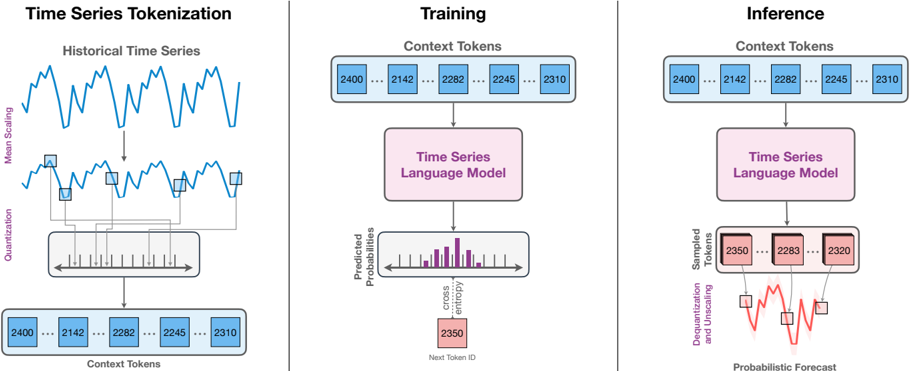
We introduce Chronos, a simple yet effective framework for pretrained probabilistic time series models. Chronos tokenizes time series values using scaling and quantization into a fixed vocabulary and trains existing transformer-based language model architectures on these tokenized time series via the cross-entropy loss. We pretrained Chronos models based on the T5 family (ranging from 20M to 710M parameters) on a large collection of publicly available datasets, complemented by a synthetic dataset that we generated via Gaussian processes to improve generalization. In a comprehensive benchmark consisting of 42 datasets, and comprising both classical local models and deep learning methods, we show that Chronos models: (a) significantly outperform other methods on datasets that were part of the training corpus; and (b) have comparable and occasionally superior zero-shot performance on new datasets, relative to methods that were trained specifically on them. Our results demonstrate that Chronos models can leverage time series data from diverse domains to improve zero-shot accuracy on unseen forecasting tasks, positioning pretrained models as a viable tool to greatly simplify forecasting pipelines.
Overview
CoChat Summary
TL;DR
Chronos adapts language-model architectures to probabilistic time series forecasting by scaling and quantizing values into tokens and training T5/GPT-2 models with cross-entropy. Across 42 benchmark datasets, it achieves strong in-domain and zero-shot forecasting, often matching or beating task-specific models.
Key findings
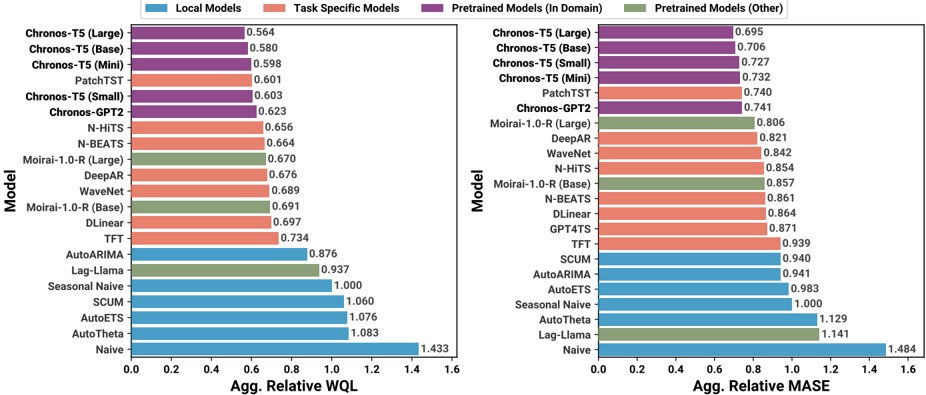
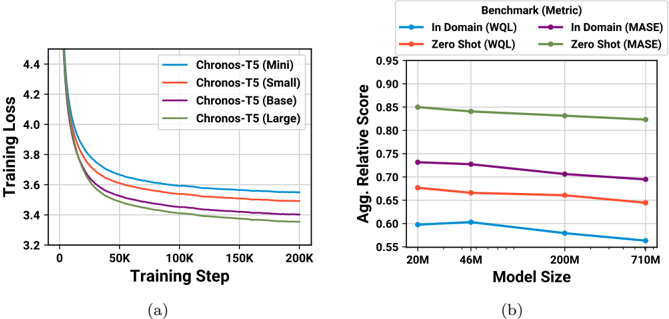
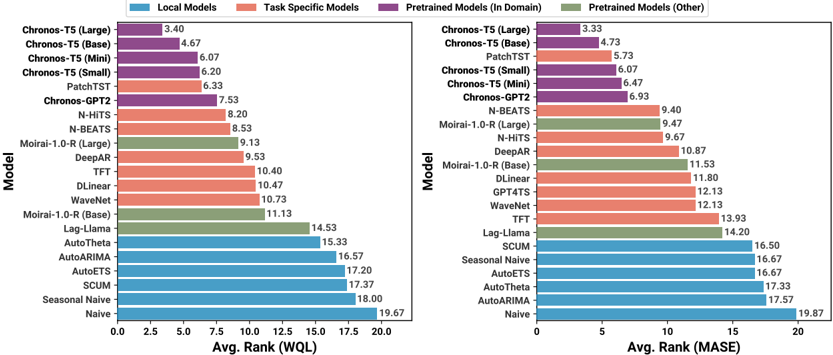
- On in-domain Benchmark I (15 datasets), Chronos-T5 Base/Large obtain the best aggregated relative scores: WQL 0.580/0.564 and MASE 0.706/0.695 versus Seasonal Naive 1.000, outperforming local, task-specific, and other pretrained baselines.
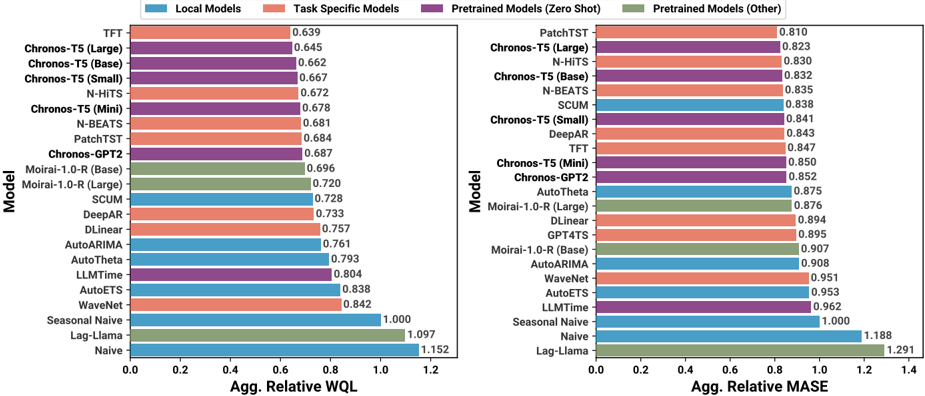
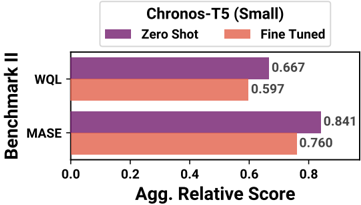
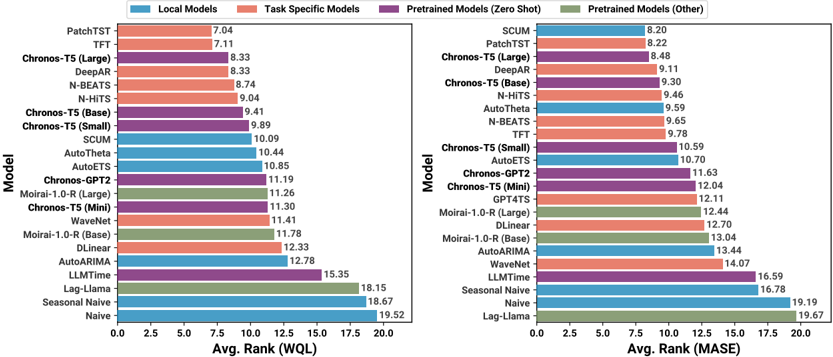
- On zero-shot Benchmark II (27 datasets), Chronos models rank 2nd–4th on WQL and Chronos-T5 Large ranks 2nd on MASE; aggregated relative WQL is 0.645 (Large), 0.662 (Base), 0.667 (Small), 0.678 (Mini), and MASE is 0.823, 0.832, 0.841, 0.850 versus Seasonal Naive 1.000. Fine-tuned Chronos-T5 Small becomes the best model on Benchmark II.
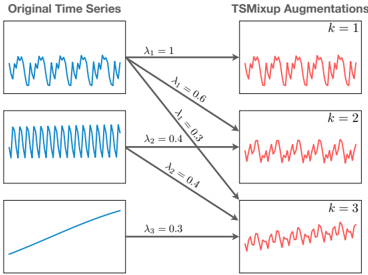
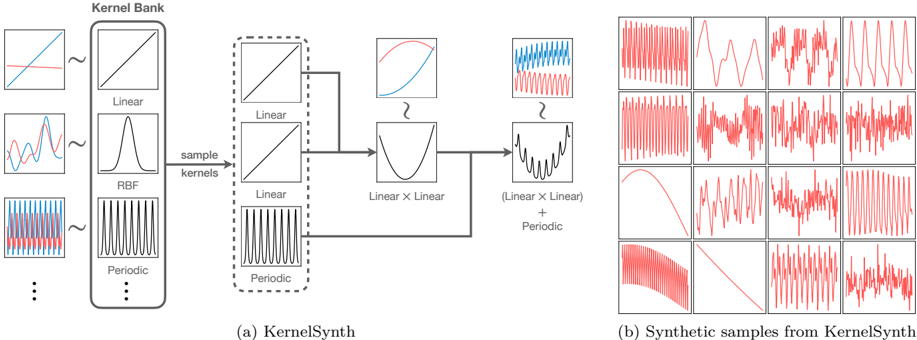
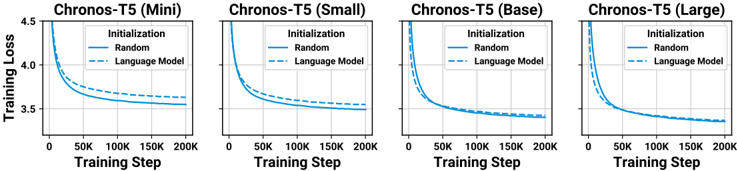
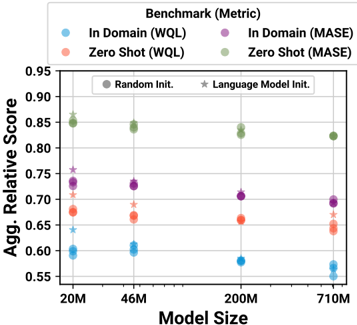
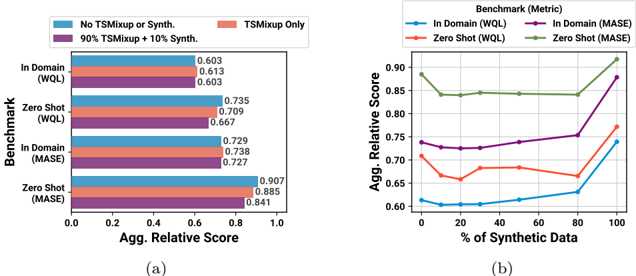
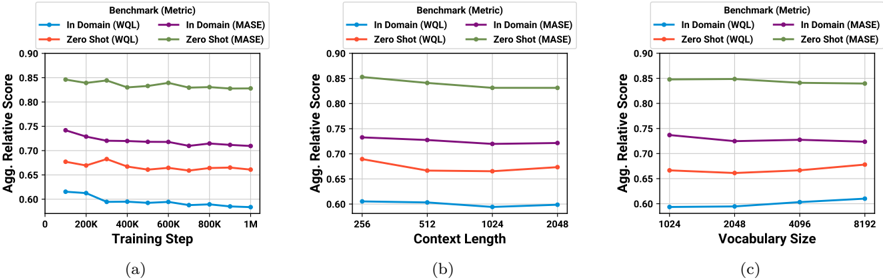
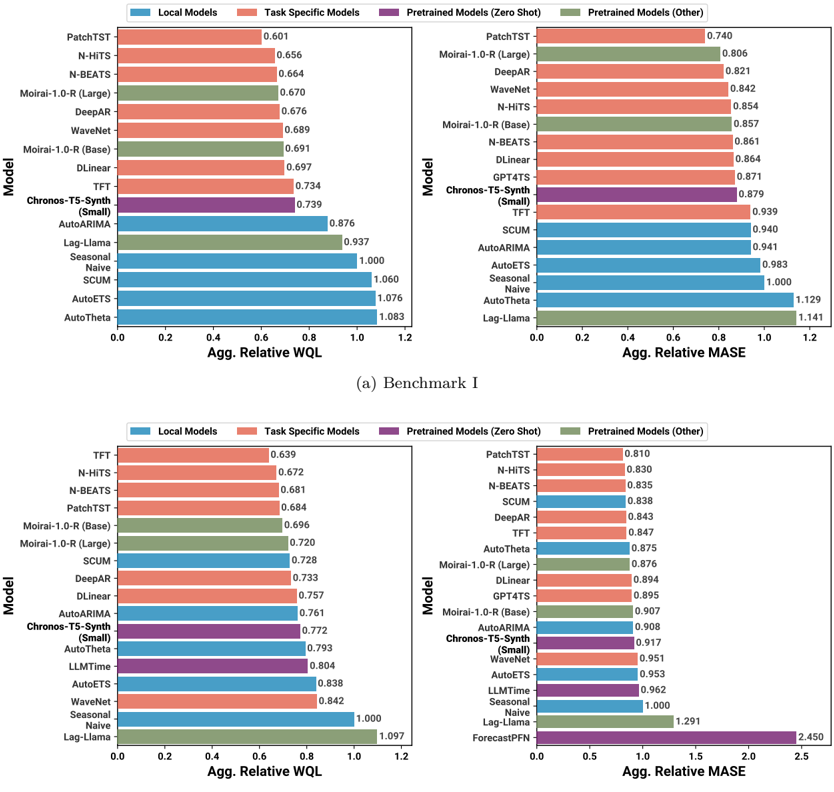
- Ablations show performance improves with model size; language-model-weight initialization offers little/no advantage over random initialization; TSMixup improves zero-shot performance; about 10% KernelSynth synthetic data is best; context length up to 1024 helps; larger vocabulary improves MASE but WQL deteriorates.
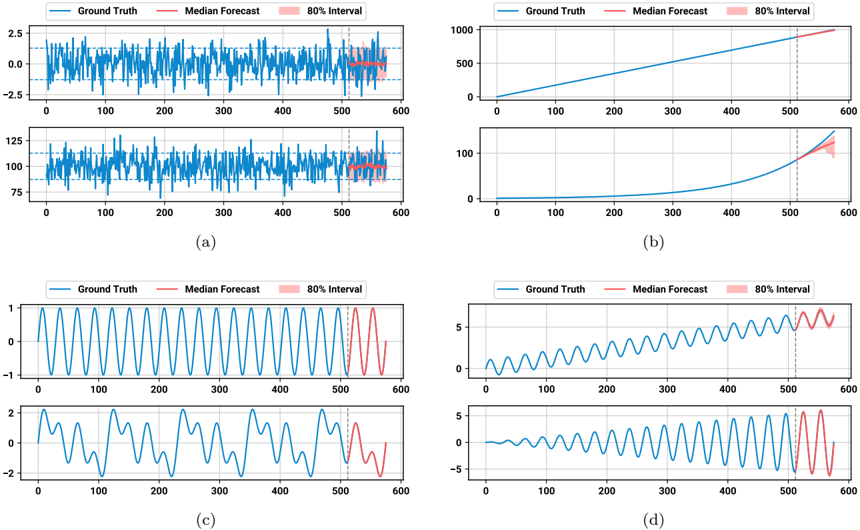
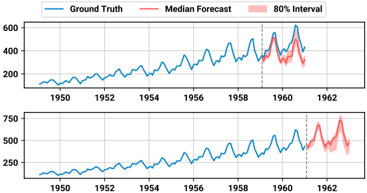
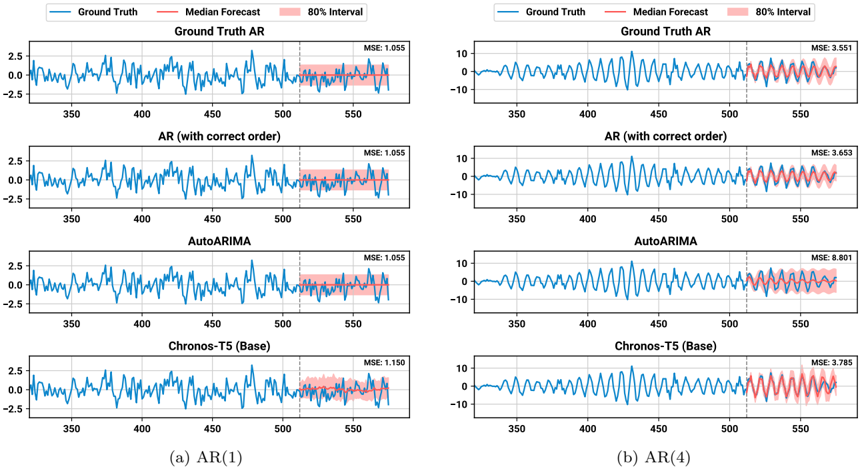
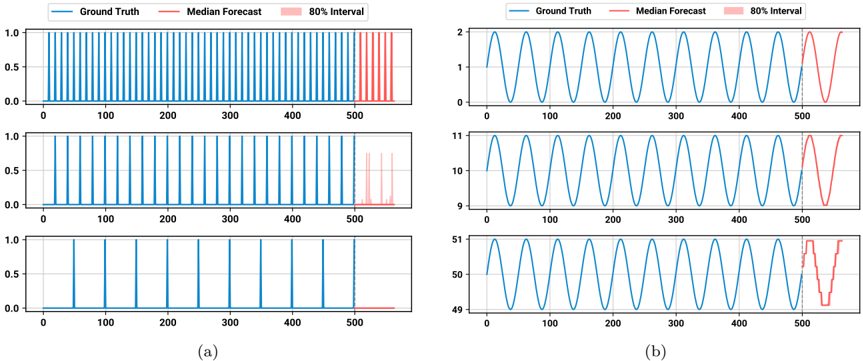
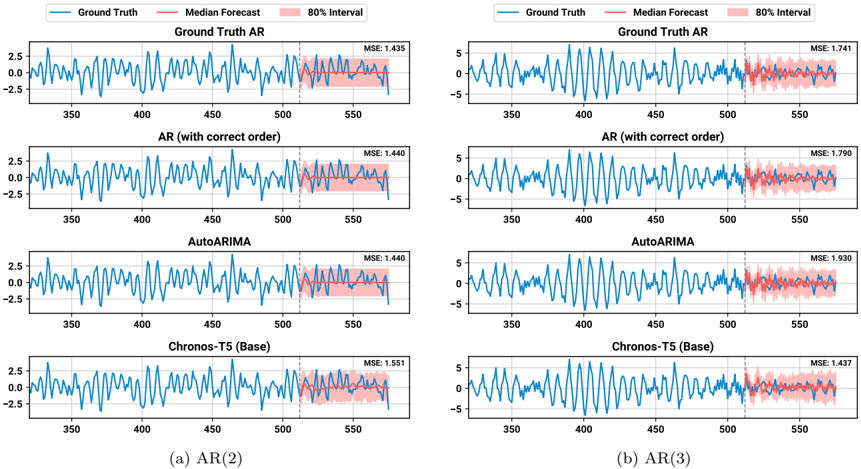
- Qualitatively, Chronos handles Gaussian noise, seasonality, additive/multiplicative trend+seasonality, and AR processes, but struggles with exponential trends and underestimates trend when context is short.
Methods
- Chronos mean-scales time series, uniformly quantizes values into B=4094 bins plus PAD/EOS (V_ts=4096), and trains off-the-shelf transformer language models with categorical cross-entropy; forecasts are produced by autoregressively sampling token paths and dequantizing/unscaling them.
- Training used 55 datasets total: 13 pretraining-only, 15 Benchmark I in-domain, and 27 Benchmark II zero-shot; 28 training datasets comprised about 890K univariate series and approximately 84B observations/tokens. Models included T5 Mini 20M, Small 46M, Base 200M, Large 710M, and GPT-2 90M, trained with 10M TSMixup augmentations plus 1M KernelSynth GP synthetic series, context length 512, prediction length 64, and 200K AdamW steps.
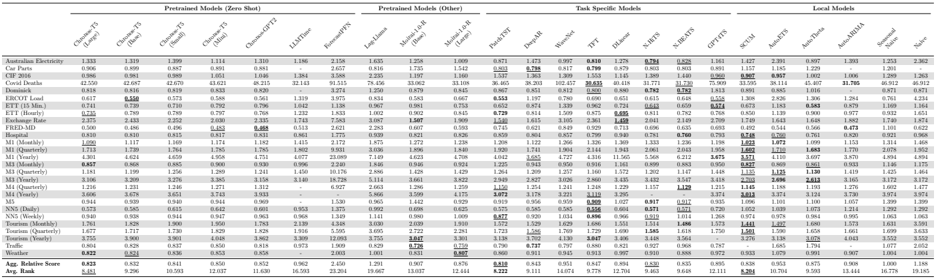
- Evaluation used 42 benchmark datasets with WQL (9 quantiles) and MASE; relative scores versus Seasonal Naive were aggregated by geometric mean and compared against local, task-specific, and pretrained baselines, plus a fine-tuning experiment on Benchmark II.
Limitations
- The paper states tokenization limits: representable values are in [-15s, 15s] where s is the mean absolute scale; small s relative to range causes overflow, while large s relative to variance causes precision loss. It also notes poor exponential-trend forecasts, trend underestimation with short context, and that categorical cross-entropy is not distance-aware; ordinal modeling is left as future work.
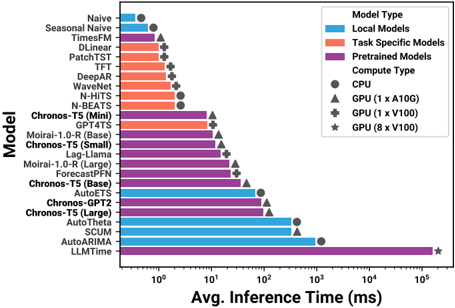
- The paper states scope limits: only univariate, uniformly spaced forecasting is studied; exogenous covariates, multivariate forecasting, and irregular sampling are not handled. Larger models were not explored due to slow inference, inference is slower than task-specific models, evaluation lacks enough high-frequency datasets to study long contexts, and public time series data remain limited.
- Text-evident: the zero-shot comparison may favor Moirai-1.0-R because many Benchmark II datasets were part of its pretraining corpus, as the paper notes; Chronos also ignores time and frequency information by design.
Model-written summary. Check it against the paper before relying on it.
Integrity signals
Registry
Cites
Statistics
Figures

Verification
Claims the paper makes
0 Valid · 4 Not valid · 14 Not checked · 146 Own results and interpretations
A result the paper reports from its own data — it cites no other source for it, so there is none to check. The quote shows it is in the paper.
In the paper
“Between the two baseline pretrained models studied in this experiment, Moirai-1.0-Rclearly outperforms Lag-Llama.”
§ Chronos: Learning the Language of Time Series > 5.5 Main Results
boosted- Asserted: passes — The authors put it forward as true.
- Checkable: passes — It can be checked against evidence.
- Load-bearing: unclear — It is unclear whether the paper’s conclusions depend on it.
- Based: passes — The paper gives a reason why it holds.
A result the paper reports from its own data — it cites no other source for it, so there is none to check. The quote shows it is in the paper.
In the paper
“Unsurprisingly, the training loss improves with the model capacity, as shown in Figure 7a.”
§ Chronos: Learning the Language of Time Series > Model size.
plainstates a cause- Asserted: passes — The authors put it forward as true.
- Checkable: passes — It can be checked against evidence.
- Load-bearing: unclear — It is unclear whether the paper’s conclusions depend on it.
- Based: passes — The paper gives a reason why it holds.
A result the paper reports from its own data — it cites no other source for it, so there is none to check. The quote shows it is in the paper.
In the paper
“Our comprehensive evaluation across 42 datasets establishes Chronos as a benchmark for both in-domain and zero-shot forecasting, surpassing both traditional models and task-specific deep learning approaches.”
§ Chronos: Learning the Language of Time Series > Time Series Tokenization Training Inference
plain- Asserted: passes — The authors put it forward as true.
- Checkable: passes — It can be checked against evidence.
- Load-bearing: passes — The paper’s conclusions depend on it.
- Based: passes — The paper gives a reason why it holds.
A result the paper reports from its own data — it cites no other source for it, so there is none to check. The quote shows it is in the paper.
In the paper
“consistent improvement is observed around the 10% synthetic data proportion.”
§ Chronos: Learning the Language of Time Series > Model size.
plainstates an association- Asserted: passes — The authors put it forward as true.
- Checkable: passes — It can be checked against evidence.
- Load-bearing: unclear — It is unclear whether the paper’s conclusions depend on it.
- Based: passes — The paper gives a reason why it holds.
A result the paper states — it cites no source for it, so there is none to check. The quote shows it is in the paper.
In the paper
“Further increasing the proportion of synthetic data tends to worsen performance.”
§ Chronos: Learning the Language of Time Series > Model size.
hedgedstates a possible cause- Asserted: passes — The authors put it forward as true.
- Checkable: passes — It can be checked against evidence.
- Load-bearing: unclear — It is unclear whether the paper’s conclusions depend on it.
- Based: passes — The paper gives a reason why it holds.
- Rests on an assumption not shown here.
94 more claims
Create a free account to see all 164 claims and to verify the 17 references still open.
- It may state two separate claims as one. 42
- Probably not a substantial claim. 30
Self-check
Percentages, sums and reported differences re-computed from the paper’s own numbers.
Each contradiction between two passages listed here was confirmed by an independent check.
Rated minor: it would not touch a result — a value no result rests on, a p-value that stays on the same side of the significance level, or a conflict that is clerical, resolved elsewhere in the paper, or outside its own findings.
In the paper
§ Chronos: Learning the Language of Time Series > Additional information
“Dominick (Godahewa et al., 2021) contains weekly time series representing the profit of individual stock keeping units from a retailer.”
§ Chronos: Learning the Language of Time Series > Covid Deaths
“Dominick retail 1D 100014 201 296 399 8”
Rated minor: it would not touch a result — a value no result rests on, a p-value that stays on the same side of the significance level, or a conflict that is clerical, resolved elsewhere in the paper, or outside its own findings.
In the paper
§ Chronos: Learning the Language of Time Series > C Baselines
“We considered a total of 17 baseline methods for benchmarking Chronos.”
§ Chronos: Learning the Language of Time Series > Chronos-GPT2 Chronos-T5 (Mini)
“Figure: Naive, SeasonalNaive, AutoETS, Auto-Theta, SCUM, AutoARIMA, DeepAR, TFT, PatchTST, DLinear, WaveNet, N-BEATS, N-HiTS, GPT4TS, Lag-Llama, Moirai-1.evaluationAll the above, LLMTime and ForecastPFN”
Citations
Cites
Exploring the Limits of Transfer Learning with a Unified Text-to-Text Transformer
Raffel, C., Shazeer, N., Roberts, A., Lee, K., Narang, S., Matena, M., Zhou, Y., Li, W., & Liu, P. J. (2019) · arXiv · doi:10.48550/arxiv.1910.10683 · Cited by 31,859
LoRA: Low-Rank Adaptation of Large Language Models
Hu, E. J., Shen, Y., Wallis, P., Allen-Zhu, Z., Li, Y., Wang, S., Wang, L., & Chen, W. (2021) · arXiv · doi:10.48550/arxiv.2106.09685 · Cited by 13,453
LightGBM: A Highly Efficient Gradient Boosting Decision Tree
(2017) · HAL · Cited by 10,512
Lewis, M., Liu, Y., Goyal, N., Ghazvininejad, M., Mohamed, A., Levy, O., Stoyanov, V., & Zettlemoyer, L. (2020) · Proceedings of the 58th Annual Meeting of the Association for Computational Linguistics · doi:10.18653/v1/2020.acl-main.703 · Cited by 8,821
Lewis, M., Liu, Y., Goyal, N., Ghazvininejad, M., Mohamed, A., Levy, O., Stoyanov, V., & Zettlemoyer, L. (2019) · arXiv · doi:10.48550/arxiv.1910.13461 · Cited by 8,816
Transformers: State-of-the-Art Natural Language Processing
Wolf, T., Debut, L., Sanh, V., Chaumond, J., Delangue, C., Moi, A., Cistac, P., Rault, T., Louf, R., Funtowicz, M., et al. (2020) · Proceedings of the 2020 Conference on Empirical Methods in Natural Language Processing: System Demonstrations · doi:10.18653/v1/2020.emnlp-demos.6 · Cited by 8,741
Informer: Beyond Efficient Transformer for Long Sequence Time-Series Forecasting
Zhou, H., Zhang, S., Peng, J., Zhang, S., Li, J., Xiong, H., & Zhang, W. (2021) · Proceedings of the AAAI Conference on Artificial Intelligence · doi:10.1609/aaai.v35i12.17325 · Cited by 7,752
mixup: Beyond Empirical Risk Minimization
Zhang, H., Cisse, M., Dauphin, Y. N., & Lopez-Paz, D. (2017) · arXiv · doi:10.48550/arxiv.1710.09412 · Cited by 5,831
Strictly Proper Scoring Rules, Prediction, and Estimation
Gneiting, T., & Raftery, A. E. (2007) · Journal of the American Statistical Association · doi:10.1198/016214506000001437 · Cited by 5,793
Another look at measures of forecast accuracy
Hyndman, R. J., & Koehler, A. B. (2006) · International Journal of Forecasting · doi:10.1016/j.ijforecast.2006.03.001 · Cited by 5,757
Research works printed but not linked: 8
- George Athanasopoulos, Rob J. Hyndman, Haiyan Song, and Doris C. Wu. The tourism forecasting compe- tition. International Journal of Forecasting, 27(3):822-844, 2011.
- Tom B. Brown, Benjamin Mann, Nick Ryder, Melanie Subbiah, Jared Kaplan, Prafulla Dhariwal, Arvind Neelakantan, Pranav Shyam, Girish Sastry, Amanda Askell, Sandhini Agarwal, Ariel Herbert-Voss, Gretchen Krueger, Tom Henighan, Rewon Child, Aditya Ramesh, Daniel M. Ziegler, Jeffrey Wu, Clemens Winter, Christopher Hesse, Mark Chen, Eric Sigler, Mateusz Litwin, Scott Gray, Benjamin Chess, Jack Clark, Christopher Berner, Sam McCandlish, Alec Radford, Ilya Sutskever, and Dario Amodei. Language models are few-shot learners. In Advances in Neural Information Processing Systems, 2020. 2, 3, 4
- Rob Hyndman, Anne B Koehler, J Keith Ord, and Ralph D Snyder. Forecasting with exponential smoothing: the state space approach. Springer Science & Business Media, 2008. 3, 9
- Alec Radford, Jeffrey Wu, Rewon Child, David Luan, Dario Amodei, Ilya Sutskever, et al. Language models are unsupervised multitask learners. OpenAI blog, 1(8):9, 2019. 4, 6
- Yaniv Romano, Evan Patterson, and Emmanuel Candes. Conformalized quantile regression. Advances in neural information processing systems, 32, 2019.
- Kai Ming Ting and Ian H Witten. Stacking bagged and dagged models. In Proceedings of the Fourteenth International Conference on Machine Learning, 1997. 20
- Ashish Vaswani, Noam Shazeer, Niki Parmar, Jakob Uszkoreit, Llion Jones, Aidan N. Gomez, Lukasz Kaiser, and Illia Polosukhin. Attention Is All You Need. In Advances in Neural Information Processing Systems, 2017.
- Yun Zhou, Liwen You, Wenzhen Zhu, and Panpan Xu. Improving time series forecasting with mixup data augmentation. In ECML PKDD 2023 International Workshop on Machine Learning for Irregular Time Series, 2023b. 7
Cited by
Items 1,701–1,800 of 2,048
Accurate and Explainable Electrical Load Forecasting Using Time-Series Transformers
Hertel, M. (2026) · Repository KITopen (Karlsruhe Institute of Technology) · doi:10.5445/ir/1000197399
Self-Evolving Time-Series Forecasting Agents with Episodic Memory and Online Policy LearningPreprint
Wang, J., Wang, Y., Wu, W., & Zhang, C. (2026) · arXiv · doi:10.48550/arxiv.2609.32689
“…Chronos, TimesFM, Moirai, TimeGPT, Timer, MOMENT, and Time-MoE, which explore diverse architectures and pretraining strategies for scalable time-series modelling (Ansari et al., 2024; Das et al., 2024; Woo et al., 2024; Garza et al., 2023; Liu et al., 2024; Goswami et al., 2024; Shi et al., 2025).”
Self-citationTime-series Foundation Models for Predictive Control: The Role of ExcitationPreprint
Amria, M., Hoffmann, J., Bordne, P., Rothenhäusler, A., Frison, L., Walnum, H. T., Gros, S., & Bödecker, J. (2026) · arXiv · doi:10.48550/arxiv.2610.06447
“This enables zero-shot forecasting on unseen univariate and multivariate time-series prediction tasks, as demonstrated by models such as TimeGPT [4], Time-LLM [5], Lag-Llama [6], TimesFM [7], and Chronos [1].”
A Stronger Univariate Benchmark for Foundational Time-series Model EvaluationPreprint
Cotton, P. (2026) · SSRN Electronic Journal · doi:10.2139/ssrn.7583618
Ballouch, M., Souissi, O., & Fenni, M. R. E. (2026) · International Conference on Nuclear and Renewable Energy Resources (NURER) · doi:10.3390/engproc2026160012
Zero-Shot Forecasting of In-Situ Soil Moisture and Temperature with a Time-Series Foundation ModelPreprint
Talaei, M., Goudarzi, M., Todd, M., Wong, V. N. L., & Chadès, I. (2026) · arXiv · doi:10.48550/arxiv.2610.30971
Liu, D., Xu, S., Jin, Y., Honglei, Y. A. O., & Liu, Q. (2026) · PLoS ONE · doi:10.1371/journal.pone.0359953
“Generic time-series foundation models such as Chronos [5], TimesFM [6], Moirai [7], Lag-Llama [8], UniTS [9], and TimeGPT [10] provide useful background for temporal representation learning, but they do not expose the topology-aware states, feasibility interfaces, or dual-variable outputs required…”
Language-Guided Time-Series Event Detection with Zero-Shot Cross-Modal Grounding
Hou, T., Chang, X., & Wan, S. C. (2026) · Findings of the Association for Computational Linguistics: EMNLP (Findings of EMNLP) · doi:10.18653/2026.findings-emnlp.229
Anomaly-Regularized Foundation Models for Robust Electricity Market Forecasting
Karimadini, K., Zhang, X., & Beheshti, A. (2026) · ACM International Conference on Information and Knowledge Management (CIKM) · doi:10.1145/3799682.3840807
Self-citationBenchmarking Chronos-2 as a Foundation Model for Traffic Forecasting
Moreu, P. M., Neches-Vilá, A., Martínez-Ballesteros, M., & Riquelme, J. C. (2026) · Lecture notes in computer science · doi:10.1007/978-3-032-43170-7_9
SWIFT: Sample-Wise Instance Fine-Tuning of Time-Series Foundation Models for ForecastingPreprint
Chen, Y., Tian, F., Wang, C., Feng, C., Li, W., & Gao, Y. (2026) · arXiv · doi:10.48550/arxiv.2611.17915
“Under this criterion, we select six long-history tasks from Chronos Benchmark II [3]: Tra ffi c, Electricity, Exchange, ETTm, ETTh, and ERCOT.”
Bark, B., & Kim, Y. K. (2026) · International Conference on Learning Representations
LLM-ARFL: Explainable raw material price prediction in new energy power markets
Peng, Z., Li, X., Zhu, X., Kang, Y., & Wang, Z. (2026) · Information Processing & Management · doi:10.1016/j.ipm.2026.105314
Foundation Models for Trajectory-based UAV Location Integrity Checks
Alegbeleye, I., Kim, S., Chang, S., & Kim, J. (2026) · doi:10.1145/3847193.3847994
VLT: A Vision-Language-Time Series Multimodal Foundation Model for Industrial IntelligencePreprint
Wang, H., Yan, J., Wang, X., & Ren, L. (2026) · arXiv · doi:10.48550/arxiv.2607.14510
“In parallel, native time-series foundation models such as Chronos [32], Timer [33], Sundial [34], and [35] showed strong zero-shot and transfer ability after large-scale pretraining.”
Self-citationModeling Manufacturing Observations
Marti, S. (2026) · Chalmers Research (Chalmers University of Technology)
Perceive, Route and Modulate: Dynamic Pattern Recalibration for Time Series ForecastingPreprint
Zhong, S., Meng, Z., Fu, H., Li, H., Wen, Q., & Liang, Y. (2026) · arXiv · doi:10.48550/arxiv.2605.06310
“Despite rapid advancements in deep forecasting architectures [14, 15] and the recent push toward massive horizontal scaling via dense foundation models [16, 17] or sparse Mixture-of-Experts (MoE) [18, 19], a critical microscopic constraint remains unresolved.”
Market-Informed Multi-Step Forecasting of Intraday Net Load with Operational Risk Screening
Weiping, Z., Jiang, Z., Haiqing, H., Wu, H., Zhu, J., Li, J., & Ji, Z. (2026) · Processes · doi:10.3390/pr14213613
Deviation-Aware Pretraining for Cardiovascular Disease Detection from ElectrocardiogramsPreprint
Yan, S., Zheng, H., Lu, F., & Li, W. (2026) · arXiv · doi:10.48550/arxiv.2611.14141
“The compared models in frozen-feature evaluation include DINOv2 [16], TimesFM [17], Chronos [19], and MOIRAI [18].”
Agentic4PDM: Host-Governed Evidence Admissibility for Industrial Fault DiagnosisPreprint
Nguyen, N. V., Truong, H., D., H. D., Nguyen, D. K., Pham, Q., & Kieu, T. (2026) · arXiv · doi:10.48550/arxiv.2610.17786
Pandiarajan, R., Shalini, V. B., Sunder, K. S., Krishna, G. M., Nithin, A. D. S., & Babu, M. M. (2026) · International Conference on Sustainable Computing and Smart Systems (ICSCSS) · doi:10.1109/icscss69635.2026.11645779
“At the cutting edge of research in this area lies the foundation models such as Chronos created by Ansari et al. [8], which treats time series data as language and allows pre-training of large amounts of data to make accurate predictions with little fine-tuning.”
Calibrated Residual Modeling for Explainable Anomaly Detection in Multivariate Sensor StreamsPreprint
Shi, R. (2026) · Research Square · doi:10.21203/rs.3.rs-10167314/v1
DrafTS: Time-Aware Decomposition with Residual Correction for Time Series ModelingPreprint
Liu, Y., Zhong, S., Wang, Z., Wen, Q., & Liang, Y. (2026) · arXiv · doi:10.48550/arxiv.2609.33368
“More recently, TimeFilter and L-Drive (Hu et al., 2025; Zhang et al., 2026) refine dependency and change modeling, while large time series models extend pre-training (Ansari et al., 2024; Woo et al., 2024), long contexts (Liu et al., 2025), and sparse experts (Shi et al., 2025).”
ChronoScribe: Semantic-Numerical Specialization for Instruction-Driven Time Series ForecastingPreprint
Jiao, Y., Zhang, M., Liu, Y., & Li, C. (2026) · arXiv · doi:10.48550/arxiv.2610.16345
TENET: Time-point Encoding Network for Multivariate Time Series Anomaly DetectionPreprint
조동찬, Hwang, J., Kang, K., Han, J., & Jung, N. (2026) · arXiv · doi:10.48550/arxiv.2610.32337
“Observation-space discrepancy has therefore become a natural and often effective anomaly signal in unsupervised MTSAD, as reflected in methods based on reconstruction residuals [7, 22, 25, 35, 42, 44], forecasting errors [3, 6, 9, 23], or local temporal inconsistencies [52].”
Point-wise Anomaly Detection via Fold-bifurcation ODE
Jhin, S., & Park, N. (2026) · International Conference on Learning Representations
Auditable Context-Aware HFMD Forecasting with Structured LLM AgentsPreprint
Chae, J., Wang, R., Xiong, C., Yunhan, G., Zhang, L., Jiansong, J., Yu, D., & Qin, P. (2025) · arXiv · doi:10.48550/arxiv.2511.23276
孔德轮, Ling, W., Liu, C., & Li, Z. (2026) · doi:10.1145/3806096.3844831
When Copying Is Hard to Beat: A Negative Result in Clinical Assessment ForecastingPreprint
Fracarolli, M., & Riezler, S. (2026) · arXiv · doi:10.48550/arxiv.2611.18142
“Chronos-Bolt [1], Chronos-2 [2] and the evaluated MIRA checkpoint [4, 6], given up to seven days of history, all fall below persistence (0.9599/0.8542 down to 0.9500/0.8231), agreeing with it on 98.4–99.7% of cells.”
InfluentialSügavõppe treeningkao joondamine hindamismõõdikutega
Komisarenko, V. (2025) · DSpace repository (University of Tartu)
Forecasting base metals prices with foundation models
Oikonomou, K., Τσιούτσιος, Α., & Dimitriou, D. (2026) · Mineral Economics · doi:10.1007/s13563-026-00661-8
PAC-Bayesian Reconstruction Guarantees for Time Series Variational AutoencodersPreprint
Hashimoto-Cullen, C., Agoua, G., Guedj, B., & Corff, S. L. (2026) · arXiv · doi:10.48550/arxiv.2609.05212
“…2024), to deep learning such as recurrent neural networks and variants thereof (Rumelhart et al., 1986; Hochreiter & Schmidhuber, 1997; Cho et al., 2014), and, more recently, to tabular and time series foundation models such as those of Nie et al. (2023); Ansari et al. (2024); Qu et al. (2025).”
Leveraging Exogenous Signals for Hydrology Time Series ForecastingPreprint
He, J., Fox, J., Jafari, A., Chen, Y.-J., & Fox, G. (2025) · arXiv · doi:10.48550/arxiv.2511.11849
“We benchmark our model against two general-purpose time series foundation models 1 : Chronos [18] and Sundial [19].”
TailDART: Compute-Efficient Foundation Models for Financial Time-Series ForecastingPreprint
Zhi, C. Q., Satapathy, R., Cambria, E., & Chattoraj, J. (2026) · arXiv · doi:10.48550/arxiv.2611.09176
“Thezero-shotcomparisonincludesLag-Llama[22], Chronos-T5-tiny [7], Sundial-base-128M [23], Moirai [8], and Moirai-MoE [24].”
FUSE: Factor Learning with Uncertainty-Aware Selection and Estimation
Engel, R. E., & Polak, P. (2026) · ACM International Conference on AI in Finance (ICAIF) · doi:10.1145/3858063.3858859
Auditing Frozen Time-Series Foundation Models Under Informative Context MissingnessPreprint
Erdem, M. (2026) · Research Square · doi:10.21203/rs.3.rs-10871922/v1
Yen, Y.-C., Wu, C., Chen, S.-H., & Chen, K.-F. (2025) · The American Journal of Emergency Medicine · doi:10.1016/j.ajem.2025.09.008
Καθόλικες Μέθοδοι Πρόβλεψης Χρονοσειρών σε Έξυπνα Δίκτυα Ηλεκτρικής Ενέργειας
Brakis, N. (2026) · DSpace - NTUA (National Technical University of Athens) · doi:10.26240/heal.ntua.33329
Bartz–Beielstein, T., Klimm, M. S., Hinterleitner, A., & Prediger, A. (2026) · Cologne Open Science (RFH - University of Applied Sciences Cologne) · doi:10.57684/cos-1513
Campagne, E., Amara-Ouali, Y., Goude, Y., Zehavi, I., & Kalogeratos, A. (2026) · arXiv · doi:10.48550/arxiv.2610.35074
Hybrid Retail Demand Forecasting with Pretrained Time-Series Models and Business Signals
Nguyen, T. T., & Tran, H.-N. (2026) · Communications in computer and information science · doi:10.1007/978-981-92-8107-7_42
From Forecast to Action: Uncertainty-Aware UAV Deployment for Ocean Drifter RecoveryPreprint
Kim, J., Kim, Y.-H., & Yoon, Y. (2025) · arXiv · doi:10.48550/arxiv.2512.09260
STEP: Scientific Time-Series Encoder Pretraining via Cross-Domain DistillationPreprint
Zhang, C., Liu, L., Tao, J., Yang, X., Xu, X., Chen, K., Zhou, B., Wu, W., & Zhang, C. (2026) · arXiv · doi:10.48550/arxiv.2603.18688
“They are commonly pre-trained on datasets containing tens to hundreds of billions of time points (Woo et al., 2024; Ansari et al., 2024; Shi et al., 2025).”
BOUKOFTANE, B., Pita, A., & Navarro, J. M. (2026) · Sustainability · doi:10.3390/su182111431
TUBO: A Tailored ML Framework for Reliable Network Traffic ForecastingPreprint
Yuan, Z., Xue, L., Ahsan, W., & Marina, M. K. (2026) · arXiv · doi:10.48550/arxiv.2602.11759
“Additionally, more recent works [11], [13], [19], [20] claim superiority in their respective domains.”
Falsifiable Compositional Reasoning in Time Series ForecastingPreprint
Xue, H. (2026) · arXiv · doi:10.48550/arxiv.2611.25388
“…deep sequence models and pre-trained TSFMs parameterise the primitive encoders ˆ m k = g θ k ( x ( k ) ≤ t ) that extract structured latent signals from noisy sensor streams, clinical vitals, or grid series (Nie et al., 2023; Ansari et al., 2024; Gu & Dao, 2024; De Felice et al., 2026).”
Tabular Foundation Models: A Systematic SurveyPreprint
Archetti, A., Mastroleo, M., Sabella, M., Cappiello, C., & Matteucci, M. (2026) · SSRN Electronic Journal · doi:10.2139/ssrn.7531718
Montero‐Manso, P., & Scharth, M. (2026) · arXiv · doi:10.48550/arxiv.2606.27711
Predictive Feature Engineering for Stress Detection using Physiological Signals, A Comparative StudyPreprint
Nunez, J. G. G., Sabri, S., Kebria, P. M., Crook, J., & Brattain, L. J. (2026) · bioRxiv (Cold Spring Harbor Laboratory) · doi:10.64898/2026.07.24.740621
“Amazon Chronos [9] is a foundation model for time series forecasting that treats continuous time series values as sequences of discrete tokens via quantization into approximately 4096 bins.”
Zambrano-Martínez, J. L., Orellana, M., Cecilia, J. M., & Calafate, C. T. (2026) · SSRN Electronic Journal · doi:10.2139/ssrn.7411768
Training-Free Continual Learning for Multimodal Forecasting via Prompt EvolutionPreprint
Mombaerts, L., Taws, J., Gargano, J., Gaddam, D., George, K., Tiwari, S., & Rajesh, S. (2026) · arXiv · doi:10.48550/arxiv.2610.27468
Manero, J., Upadhyay, D., & Sampalli, S. (2026) · Machine Learning with Applications · doi:10.1016/j.mlwa.2026.101054
Versatile Graph Foundation Models from Frozen Time-Series Foundation Models via Parallel FlowsPreprint
Yang, J., & Ji, F. (2026) · arXiv · doi:10.48550/arxiv.2611.00670
“TimesFM [18], Moirai [19], Chronos [20], Time-MoE [21], Moirai-MoE [23], and Sundial [22] are pre-trained on large forecasting corpora and transfer without fine-tuning across domains and frequencies.”
Tabular Foundation Models as Emulators for Forecasting Terrestrial Ecosystem DynamicsPreprint
Wang, Z., Li, R., Ma, L., Hurtt, G. C., Jia, X., & Xie, Y. (2026) · arXiv · doi:10.48550/arxiv.2611.20468
“Pretrained models for the atmosphere and Earth system [Nguyen et al., 2023, Bodnar et al., 2025] and for time series [Ansari et al., 2024, Das et al., 2024, Woo et al., 2024] transfer to new tasks with little training.”
Rebull-Saucedo, J. A., Pérez-Nava, J. C., Sánchez-Salazar, L. G., Barceló-Alonso, G., & Pérez-Hernández, R. (2026) · Lecture notes in computer science · doi:10.1007/978-3-032-44176-8_3
Universal Infectious Disease Forecasting with Mantis 2Preprint
Dudley, C., Magdaleno, R., Bi, Y., Valencia, A., Liu, X., & Eisenberg, M. C. (2026) · arXiv · doi:10.48550/arxiv.2611.16935
“Models such as Chronos, TimesFM, and Moirai learn from large collections of time series and transfer that knowledge to new forecasting targets without task-specific retraining [6, 7, 8].”
Xu, Z., Chen, Y., Xiong, T., Wang, Y., & Zhai, Z. (2026) · Measurement Science and Technology · doi:10.1088/1361-6501/ae989d
“The first paradigm is tokenization-based modeling, represented by Chronos [44].”
Self-citationSong, J., Chen, C., Wang, S., Zhang, L., Yao, H., & Liu, T. (2026) · Computers · doi:10.3390/computers15090634
AI-driven power system transient simulation and angular stabilisation
Wei, Y. (2025) · Spiral (Imperial College London) · doi:10.25560/127506
Data Quality Enhancement for Weather-Coupled Power System Operation: A Review
Yao, H., Jin, Y., Xu, K., Zhao, F., Zhang, H., Xu, S., & Liu, H. (2026) · Energy Engineering · doi:10.32604/ee.2026.093783
Time Series Energy Data Forecasting using Spatio-Temporal Deep Learning
Miraki, A. (2026) · NVA (Nasjonalt vitenarkiv)
Investigation of generative artificial intelligence for sustainable smart grids
Sun, X. (2025) · eScholarship@McGill (McGill) · doi:10.82308/3215
Discrete Tokenization Unlocks Transformers for Calibrated Tabular ForecastingPreprint
Elmatad, Y. S. (2026) · arXiv · doi:10.48550/arxiv.2603.07448
“These design decisions build on prior work demonstrating the effectiveness of discretization for forecasting [3, 4, 5], extending the discretized training philosophy from regular time series to irregular, tabular trajectories with entity-level splits and adaptive Gaussian smoothing.”
Almihbash, M. A. (2026) · Journal of risk and financial management · doi:10.3390/jrfm19100757
Beyond Binning: Soft Task Reformulation for Deep Regression
Stewart, L., Bach, F., & Berthet, Q. (2026) · International Conference on Artificial Intelligence and Statistics
Dogru, A. O., & İmece, S. (2025) · Lecture notes in networks and systems · doi:10.1007/978-3-031-98565-2_86
Outsmarting Time: Foundation Models for Zero-Shot Forecasting
Altenborg, T. N., & Ertresvåg, K. (2024) · NVA (Nasjonalt vitenarkiv)
Time Series Foundation Model for Electricity Load Forecasting
Kuang, W., Zhang, Q., Yang, B., Jiang, W., Li, H., Yang, Y., Hu, Y., & Han, B. (2026) · International Conference on Energy, Electrical and Power Engineering (CEEPE) · doi:10.1109/ceepe69795.2026.11552163
“Notable works include TimesFM [17] by Google, Chronos [18] by Amazon, MOIRAI [19] by Salesforce, and Timer [20] series models (include Timer-XL [21] and Sundial [22] ) by Tsinghua University's team in China.”
Zero-Shot Building Energy Forecasting Using Chronos-2 Foundation Models
Fu, C., Cheng, L., Chuang, T.-H., Kazmi, H., & Miller, C. (2026) · ACM Sustainability Week · doi:10.1145/3765611.3815488
“Chronos-2 [2] addresses these context limitations with an over 8000-token context window (approximately 12 months of hourly data), native support for future covariates such as weather fore-casts, and zero-shot inference requiring no per-building training.”
Bridging Raw Sensor Data and BI Systems: An AI-Driven Metadata-Aware Mapping Approach
Kaimakis, K., Georgaras, S., Kouletou, E., Flokas, Z., Siokas, G., Balomenos, A., & Kopsinis, Y. (2026) · International Conference on Electrical, Computer and Energy Technologies (ICECET) · doi:10.1109/icecet65726.2026.11633285
“Feature extraction: To capture time-series patterns, two complementary encoders were employed: ROCKET [17] and Chronos-T5 [18].”
Khuzwayo, M. (2026) · SSRN Electronic Journal · doi:10.2139/ssrn.7539038
Nie, P., Xu, C., Chen, Y., Ren, C., Hu, W., Yang, C., & Zhang, J. (2026) · arXiv · doi:10.48550/arxiv.2609.40117
RACE: Residual-Aware Test-Time Adaptation for Neighbor-Rich Time-Series Foundation Model ForecastingPreprint
Shi, H.-N., Wu, T., Sun, C.-C., Jiang, Y., Ye, H.-J., & Zhan, D. (2026) · arXiv · doi:10.48550/arxiv.2610.00405
Cross-Market Meta-Learning for Electricity Price ForecastingPreprint
Pirhayatifard, D., & Alsup, T. (2026) · arXiv · doi:10.48550/arxiv.2610.17387
“Price formation across ISOs is governed by the same physics and largely common market design, so history from other markets isn’t out-of-distribution data to be discarded but a pretraining corpus, the premise underlying time-series foundation models [1, 21].”
InfluentialFoundation-Style Pretraining for Scalable and Transferable Distributed PV ForecastingPreprint
Chen, D., Shi, X., Xu, X., Su, Z., Zhu, S., Deng, R., Zhang, D., Chen, Y., & Yan, J. (2026) · arXiv · doi:10.48550/arxiv.2610.27763
“Chronos and Chronos-MV are classic foundation-model baselines retrained on the development dataset, whereas TimesFM-3 uses large-scale pretrained parameters learned from a broad collection of real-world and synthetic time series.”
InfluentialParameter-Efficient Adaptation of Time Series Foundation Models for Electrical Load ForecastingPreprint
Aliullah, Oelhaf, J., Fouché, E., Deuschel, J., Bergler, C., Maier, A., & Bayer, S. (2026) · arXiv · doi:10.48550/arxiv.2610.28200
“Chronos formulates forecasting as token prediction [6], and Chronos-2 extends this model family to univariate, multivariate, and covariate-informed forecasting [7].”
Akyol, M. A. (2026) · Innovations in Intelligent Systems and Applications Conference (ASYU) · doi:10.1109/asyu71790.2026.11772179
“Time-series foundation models such as Chronos and TimesFM train directly on time series and report zero-shot performance [15], [16].”
Lyu, Y., Liu, K., Wang, W., Zhang, Q., Yin, L., & Bai, Y. (2026) · arXiv · doi:10.48550/arxiv.2611.22133
Khan, N., Bakht, M. P., Rahman, A. A.-H. A., Pallonetto, F., Fahy, A., Hassan, M. K., Stynes, P., Aslam, M. A., Donnell, T. O., & Riadh, M. (2026) · arXiv · doi:10.48550/arxiv.2611.25894
“Large models pre-trained on many time series, such as Chronos [44] and TimesFM [45], can forecast a new series without any training on it (“zero-shot”).”
Singh, K., & Tewari, A. (2026) · Cureus Journal of Computer Science. · doi:10.7759/s44389-026-00383-6
Yesudhas, A. A., Jeong, J. H., & Seong, J.-H. (2026) · Ocean Engineering · doi:10.1016/j.oceaneng.2026.129602
Vocabulary-Free Next-Event Prediction on Temporal GraphsPreprint
Luo, Z., Tammali, V. M., Weerasinghe, A., Vahabzadeh, O., Boz, O., Hao, X., & Wang, Y. (2026) · arXiv · doi:10.48550/arxiv.2611.16063
“Next-token prediction has driven advances in language models [Radford et al., 2018, Brown et al., 2020] and recently time-series models [Ansari et al., 2024, Liu et al., 2024].”
Self-citationA Verifier from the Past: Test-Time Compute for Time Series Foundation ModelsPreprint
Choudhry, A., Narayanan, A., Mallampalli, R., Li, P.-H., Narasimhan, S. S., Shah, R., Prakash, B. A., & Agarwal, S. (2026) · arXiv · doi:10.48550/arxiv.2611.25171
Kairos: Redefining Event and Time Prediction with Language Modeling
Gupta, A., Verma, S., Bisht, S., Verma, N., Aggarwal, P., Grandhi, V. P. K., & Persad, A. (2025) · Asian Conference on Machine Learning
Guo, Y., Zheng, S., & Peng, P. (2026) · IEEE Access · doi:10.1109/access.2026.3734361
Yudistira, N., Chandra, L., & Widodo, A. W. (2026) · SSRN Electronic Journal · doi:10.2139/ssrn.7611835
Primal-Spectral Generative Modeling: Fast Analytical Generation via Pseudoinverse Lévy Inversion
Ouyang, Z., Huang, S., Wen, Z., Zhang, X., & Yan, J. (2026) · International Conference on Machine Learning
Self-citationMa, X., Zhang, H., Li, W., & Lu, S. (2025) · arXiv · doi:10.48550/arxiv.2511.19856
“For temporal inputs, we adhere to the benchmarking protocol established by Chronos [2], utilizing 28 datasets comprising 890K uni-variate time series with a total of 84B observed tokens as train set.”
The Unused Input: The Initial State as a Conditioning Interface for Recurrent TSFMsPreprint
Voggenberger, B., Ganhör, C., Zólyomi, L., Böck, S., & Hochreiter, S. (2026) · arXiv · doi:10.48550/arxiv.2611.14357
“Time series foundation models, pretrained once and applied across many forecasting tasks without further training, have become a standard tool for zero-shot forecasting (Das et al., 2024; Ansari et al., 2024; Woo et al., 2024; Cohen et al., 2024).”
Li, M., Zhang, Z., jin, C., & Gu, Y. (2026) · arXiv · doi:10.48550/arxiv.2605.28866
Deep Temporal Deaggregation: Large-Scale Spatio-Temporal Generative ModelsPreprint
Bergström, D., Tiger, M., & Heintz, F. (2024) · arXiv · doi:10.48550/arxiv.2406.12423
Rasti, M., Ataeebojd, E., Taskou, S. K., Monemi, M., Razmi, S., & Latva‐aho, M. (2025) · arXiv · doi:10.48550/arxiv.2502.13891
An Efficient Timer-Expanded Multi-variate Time Series Forecasting Foundation Model
Lu, C., Chang, Y., Liang, A., Luo, H., & Sun, Y. (2025) · International Wireless Communications and Mobile Computing Conference (IWCMC) · doi:10.1109/iwcmc65282.2025.11059684
Assessing the Limits of Global, Local and Hybrid Forecast Methodologies for Short Term Load ForecastPreprint
Sainz, N., Juan, A. S., Loinaz, A., & Borges, C. E. (2025) · SSRN Electronic Journal · doi:10.2139/ssrn.5361648
Wei, A., & Fink, O. (2025) · Annual Conference of the PHM Society · doi:10.36001/phmconf.2025.v17i1.4590
“While deep learning models such as transformers (Ansari et al., 2024; Gu & Dao, 2023) offer state-of-the-art performance for forecasting and classification, their predictions remain opaque, hindering trust and deployment in safety-critical PHM applications.”
Shetty, P. K., Lam, T., Songchitruksa, P., Kohar, A., Benslimane, S., Roychoudhury, I., Gupta, N., Abinader, A., & Celaya, J. ́. R. (2025) · Abu Dhabi International Petroleum Exhibition & Conference (ADIPEC) · doi:10.2118/229309-ms
Salazar, C. J., Manohar, K., & Banerjee, A. G. (2025) · arXiv · doi:10.48550/arxiv.2510.15404
“Deep learning approaches, including recurrent networks (Salinas et al. 2020), transformer-based models (Zhou et al. 2021), and recent foundation models (Ansari et al. 2024, Woo et al. 2024), have demonstrated impressive forecasting capabilities in various domains.”
Cross-device Zero-shot Label Transfer via Alignment of Time Series Foundation Model EmbeddingsPreprint
Ravindra, N. G., & Sehanobish, A. (2025) · arXiv · doi:10.48550/arxiv.2509.06966
“Second, rather than using a model pre-trained only on physiological signals, we leverage general-purpose TSFMs pre-trained on a vast and heterogeneous corpus of time series from many fields [Anas et al., 2024].”
Metadata
- Authors
- Ansari, A. F., Stella, L., Turkmen, C., Zhang, X., Mercado, P., Shen, H., Shchur, O., Rangapuram, S. S., Arango, S. P., Kapoor, S., Zschiegner, J., Maddix, D. C., Wang, H., Mahoney, M. W., Torkkola, K., Wilson, A. G., Bohlke-Schneider, M., & Wang, Y.
- Affiliations
- Amazon (United States) (US)
- University of California San Diego (US)
- University of Freiburg (DE)
- Rutgers, The State University of New Jersey (US)
- ORCID
- Venue
- arXiv
- Publisher
- arXiv
- Published
- 2024
- ISSN
- 2835-8856 (ISSN-L)
- arXiv
- 2403.07815
- OpenAlex
- W4392781393
- Cited by
- 2,046
- References
- 92
- Citations by year
- 2026: 1398 · 2025: 520 · 2024: 126
- FWCI
- 245.30
- Type
- journal article
- Language
- en
- Open access
- diamond
- openreview.net
- Licence
- Locations
- Transactions on machine learning research (publishedVersion, cc-by)
- arXiv (submittedVersion, public-domain)
- Topics
- Physical Sciences › Computer Science › Signal Processing › Time Series Analysis and Forecasting
- Social Sciences › Decision Sciences › Management Science and Operations Research › Forecasting Techniques and Applications
- Social Sciences › Decision Sciences › Management Science and Operations Research › Stock Market Forecasting Methods
- Keywords
- time series forecasting, transformer language models, T5, zero-shot forecasting, Chronos
About these checks
Registry, retraction, Cites and statistics results are computed, not judged, with one exception: a printed reference that no index lists is read once by a model before it counts as a citation error. Claims are extracted by a model and kept only when their quote appears verbatim in the text; each cited source is then checked, with a model’s help, for whether it says what the claim relies on. Those verdicts can be wrong — read the claim’s quote and the cited source before relying on one.
A language model drew the claims from the paper on 2026-11-28, under version 3 of the claim definition (model deepseek-v4.1-flash, prompt extract-v3).
A second model labelled each claim on 2026-11-28 (model jev-1.13-20260917, definition revision gold-guideline-v0.2).
Statistics and arithmetic are recomputed, not judged.
Confidence bands are shown only for fields calibrated on our annotated test set. None is calibrated yet, so no band is shown.
What counts as a claim ›How we measure confidence ›How we check this ›
Are you an author, or do you see a problem with this page? Request a review
Data sources
Bibliographic data: Semantic Scholar, OpenAlex, Crossref.
Contains information from the Semantic Scholar Academic Graph Datasets, made available under the ODC Attribution License (ODC-BY 1.0).
Semantic Scholar’s data is described in: Kinney, R., et al. (2023). The Semantic Scholar Open Data Platform. arXiv:2301.10140.
