

Chronos: Learning the Language of Time Series
Open accessThe DOI matches its DataCite record; 95 of the 95 references it cites were found in a registry or an index; none of the 21 sources its claims cite is checked for support yet.
Abstract
We introduce Chronos, a simple yet effective framework for pretrained probabilistic time series models. Chronos tokenizes time series values using scaling and quantization into a fixed vocabulary and trains existing transformer-based language model architectures on these tokenized time series via the cross-entropy loss. We pretrained Chronos models based on the T5 family (ranging from 20M to 710M parameters) on a large collection of publicly available datasets, complemented by a synthetic dataset that we generated via Gaussian processes to improve generalization. In a comprehensive benchmark consisting of 42 datasets, and comprising both classical local models and deep learning methods, we show that Chronos models: (a) significantly outperform other methods on datasets that were part of the training corpus; and (b) have comparable and occasionally superior zero-shot performance on new datasets, relative to methods that were trained specifically on them. Our results demonstrate that Chronos models can leverage time series data from diverse domains to improve zero-shot accuracy on unseen forecasting tasks, positioning pretrained models as a viable tool to greatly simplify forecasting pipelines.
Overview
CoChat Summary
TL;DR
Chronos adapts language-model architectures to probabilistic time series forecasting by scaling and quantizing values into tokens and training T5/GPT-2 models with cross-entropy. Across 42 benchmark datasets, it achieves strong in-domain and zero-shot forecasting, often matching or beating task-specific models.
Key findings
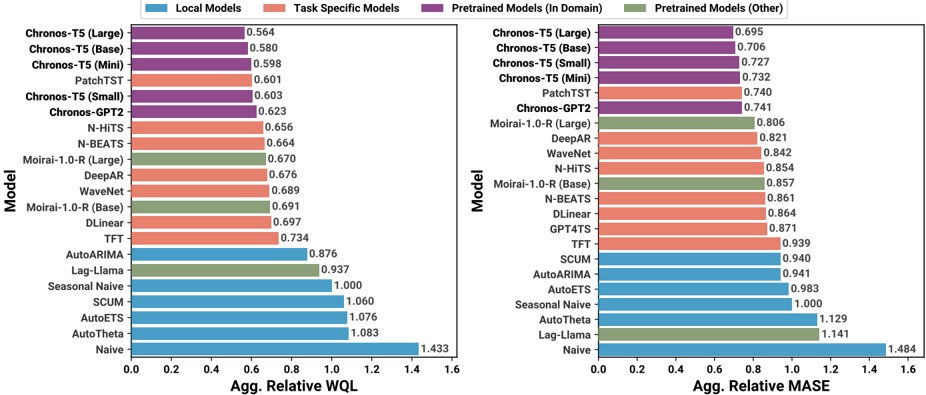
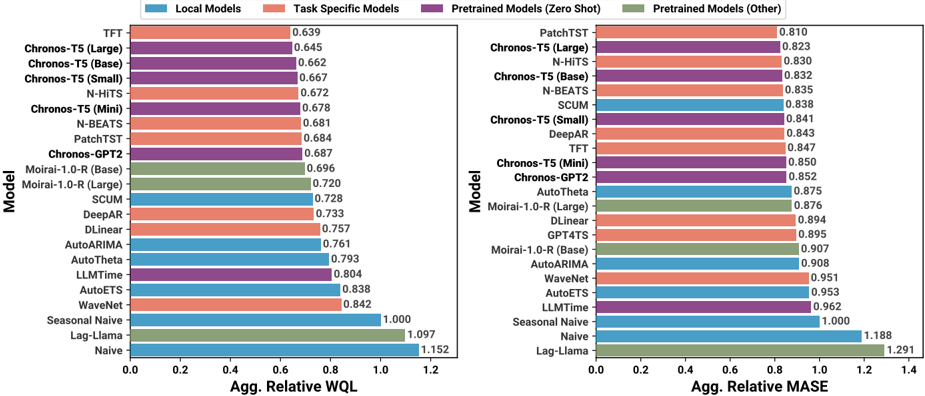
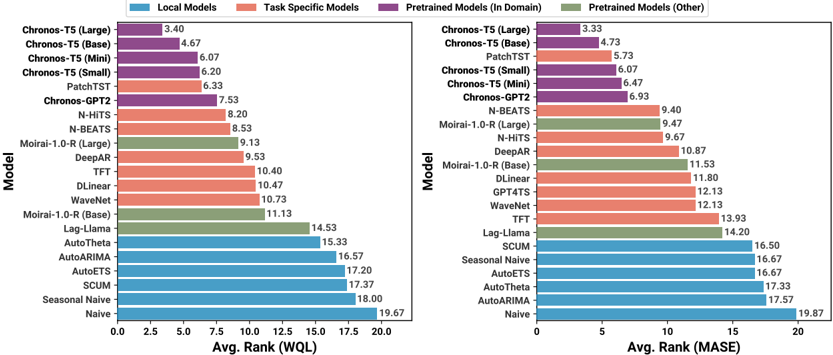
- On in-domain Benchmark I (15 datasets), Chronos-T5 Base/Large obtain the best aggregated relative scores: WQL 0.580/0.564 and MASE 0.706/0.695 versus Seasonal Naive 1.000, outperforming local, task-specific, and other pretrained baselines.
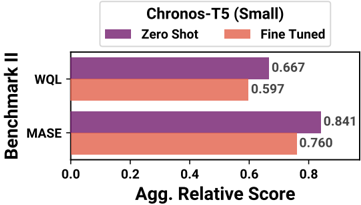
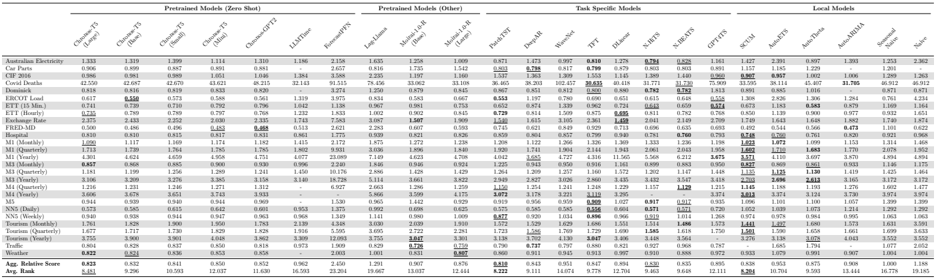
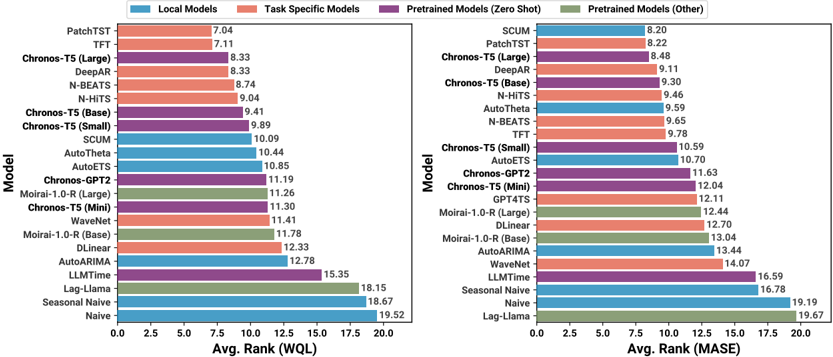
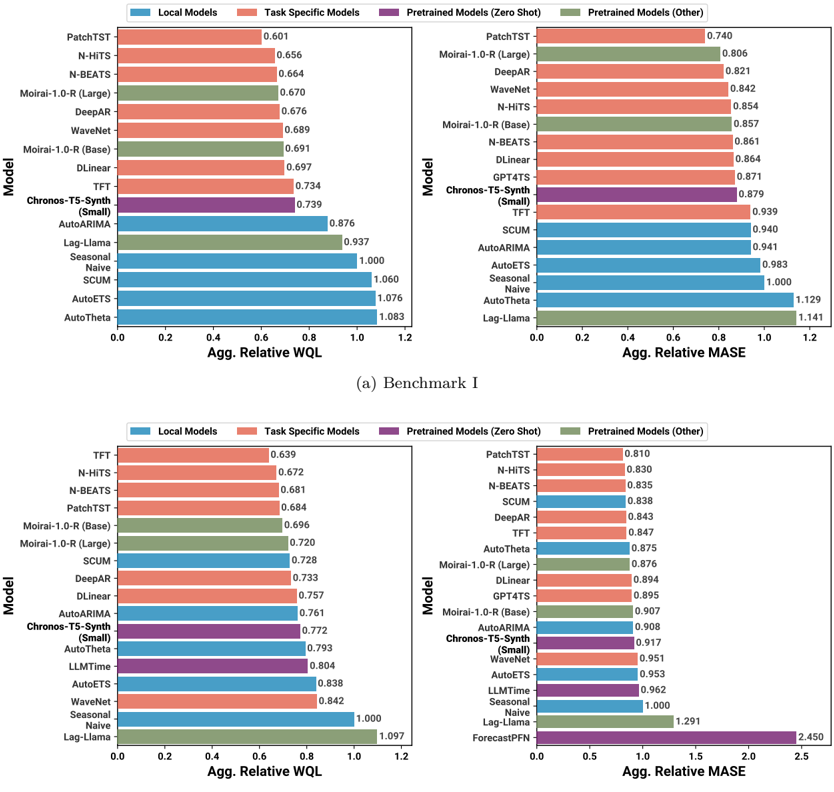
- On zero-shot Benchmark II (27 datasets), Chronos models rank 2nd–4th on WQL and Chronos-T5 Large ranks 2nd on MASE; aggregated relative WQL is 0.645 (Large), 0.662 (Base), 0.667 (Small), 0.678 (Mini), and MASE is 0.823, 0.832, 0.841, 0.850 versus Seasonal Naive 1.000. Fine-tuned Chronos-T5 Small becomes the best model on Benchmark II.
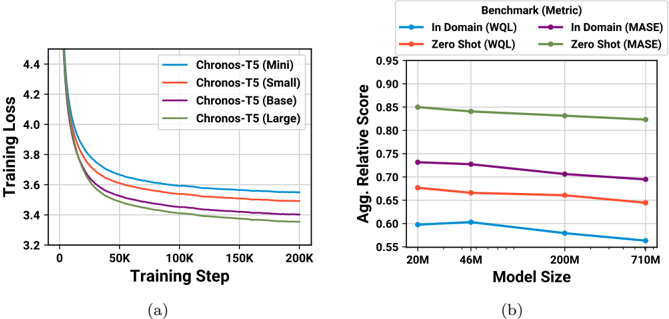
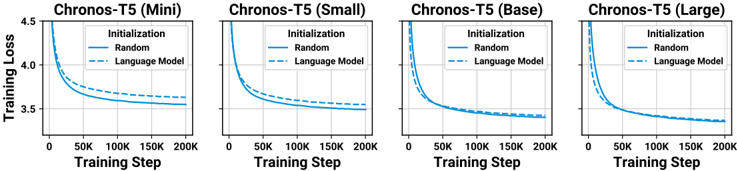
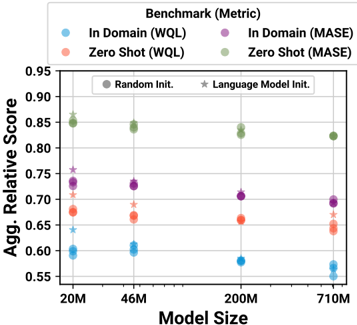
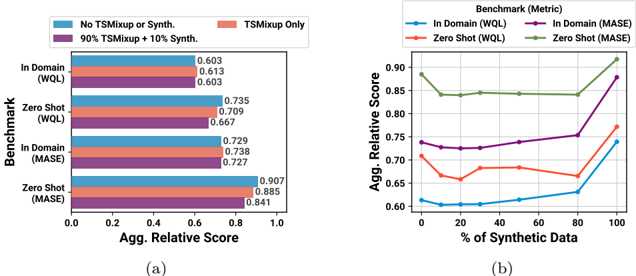
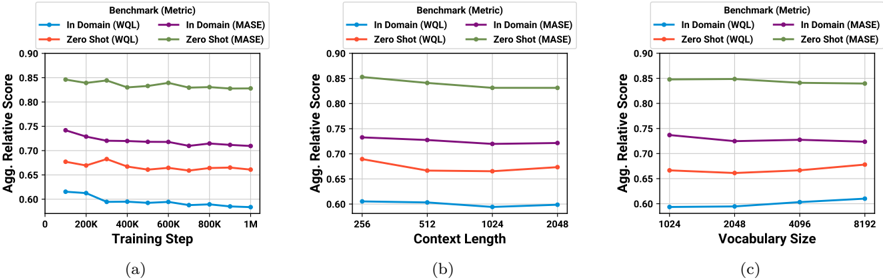
- Ablations show performance improves with model size; language-model-weight initialization offers little/no advantage over random initialization; TSMixup improves zero-shot performance; about 10% KernelSynth synthetic data is best; context length up to 1024 helps; larger vocabulary improves MASE but WQL deteriorates.
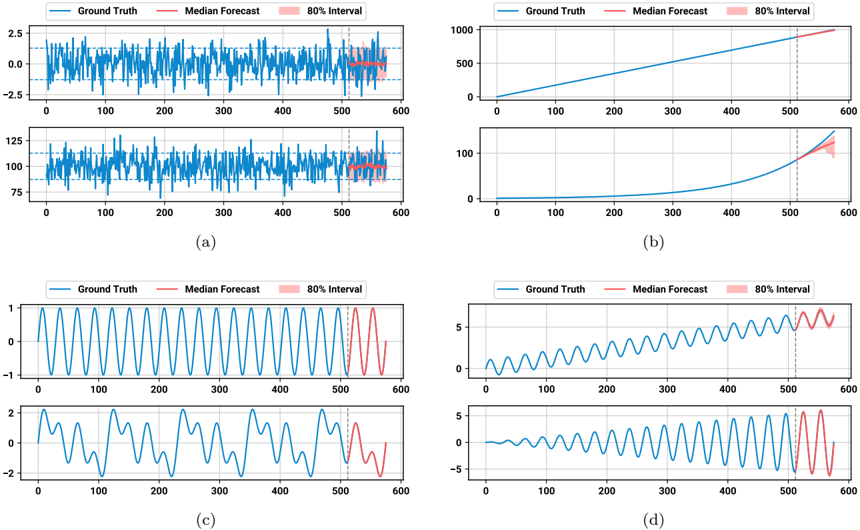
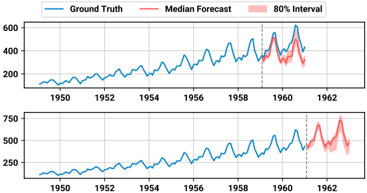
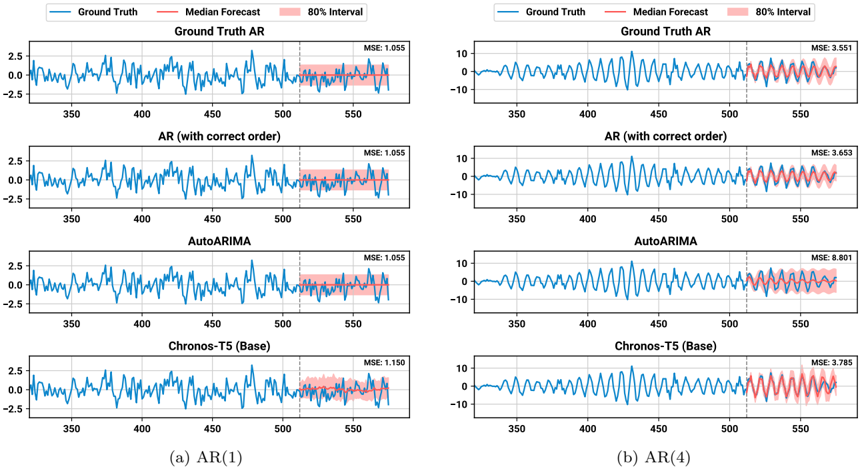
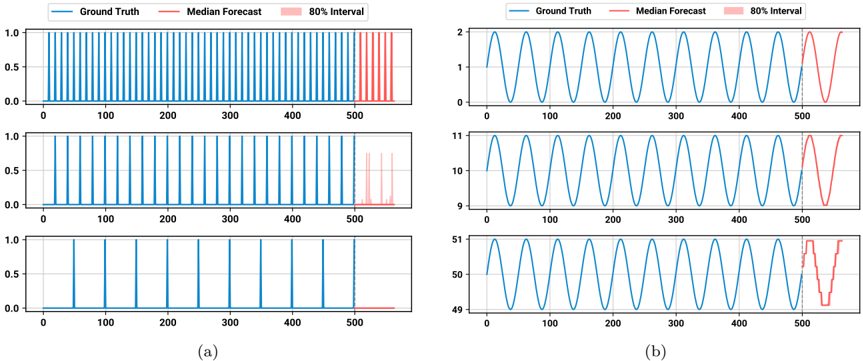
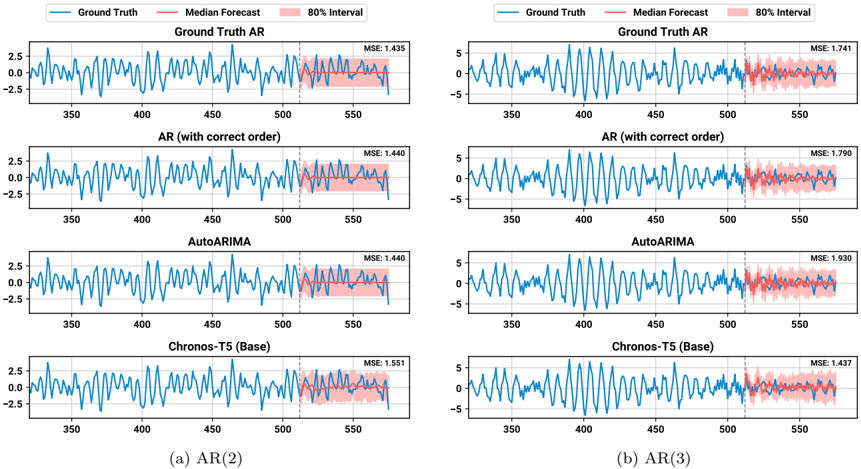
- Qualitatively, Chronos handles Gaussian noise, seasonality, additive/multiplicative trend+seasonality, and AR processes, but struggles with exponential trends and underestimates trend when context is short.
Methods
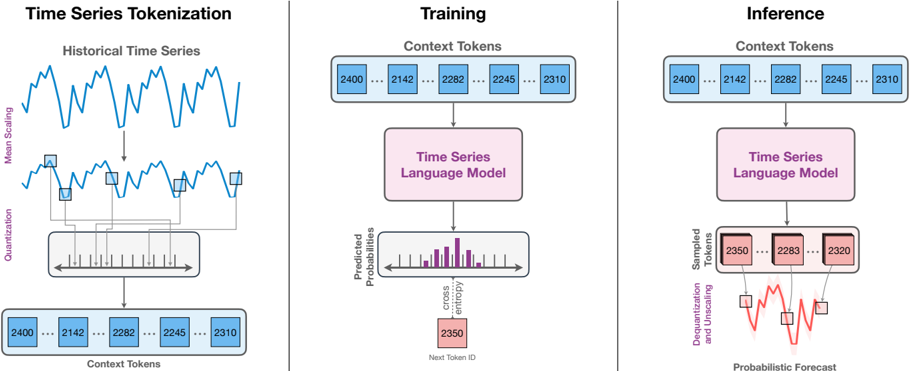
- Chronos mean-scales time series, uniformly quantizes values into B=4094 bins plus PAD/EOS (V_ts=4096), and trains off-the-shelf transformer language models with categorical cross-entropy; forecasts are produced by autoregressively sampling token paths and dequantizing/unscaling them.
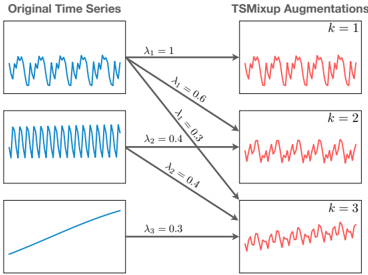
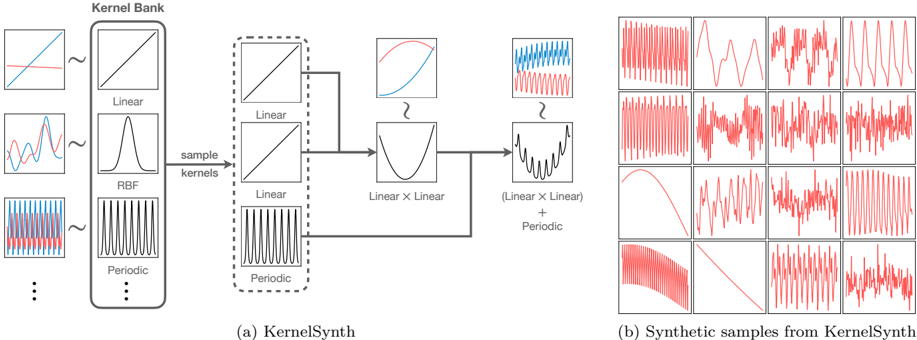
- Training used 55 datasets total: 13 pretraining-only, 15 Benchmark I in-domain, and 27 Benchmark II zero-shot; 28 training datasets comprised about 890K univariate series and approximately 84B observations/tokens. Models included T5 Mini 20M, Small 46M, Base 200M, Large 710M, and GPT-2 90M, trained with 10M TSMixup augmentations plus 1M KernelSynth GP synthetic series, context length 512, prediction length 64, and 200K AdamW steps.
- Evaluation used 42 benchmark datasets with WQL (9 quantiles) and MASE; relative scores versus Seasonal Naive were aggregated by geometric mean and compared against local, task-specific, and pretrained baselines, plus a fine-tuning experiment on Benchmark II.
Limitations
- The paper states tokenization limits: representable values are in [-15s, 15s] where s is the mean absolute scale; small s relative to range causes overflow, while large s relative to variance causes precision loss. It also notes poor exponential-trend forecasts, trend underestimation with short context, and that categorical cross-entropy is not distance-aware; ordinal modeling is left as future work.
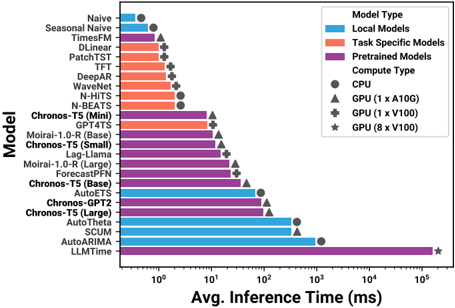
- The paper states scope limits: only univariate, uniformly spaced forecasting is studied; exogenous covariates, multivariate forecasting, and irregular sampling are not handled. Larger models were not explored due to slow inference, inference is slower than task-specific models, evaluation lacks enough high-frequency datasets to study long contexts, and public time series data remain limited.
- Text-evident: the zero-shot comparison may favor Moirai-1.0-R because many Benchmark II datasets were part of its pretraining corpus, as the paper notes; Chronos also ignores time and frequency information by design.
Model-written summary. Check it against the paper before relying on it.
Integrity signals
Registry
Cites
Statistics
Figures

Verification
Claims the paper makes
0 Valid · 4 Not valid · 14 Not checked · 146 Own results and interpretations
A result the paper reports from its own data — it cites no other source for it, so there is none to check. The quote shows it is in the paper.
In the paper
“Between the two baseline pretrained models studied in this experiment, Moirai-1.0-Rclearly outperforms Lag-Llama.”
§ Chronos: Learning the Language of Time Series > 5.5 Main Results
boosted- Asserted: passes — The authors put it forward as true.
- Checkable: passes — It can be checked against evidence.
- Load-bearing: unclear — It is unclear whether the paper’s conclusions depend on it.
- Based: passes — The paper gives a reason why it holds.
A result the paper reports from its own data — it cites no other source for it, so there is none to check. The quote shows it is in the paper.
In the paper
“Unsurprisingly, the training loss improves with the model capacity, as shown in Figure 7a.”
§ Chronos: Learning the Language of Time Series > Model size.
plainstates a cause- Asserted: passes — The authors put it forward as true.
- Checkable: passes — It can be checked against evidence.
- Load-bearing: unclear — It is unclear whether the paper’s conclusions depend on it.
- Based: passes — The paper gives a reason why it holds.
A result the paper reports from its own data — it cites no other source for it, so there is none to check. The quote shows it is in the paper.
In the paper
“Our comprehensive evaluation across 42 datasets establishes Chronos as a benchmark for both in-domain and zero-shot forecasting, surpassing both traditional models and task-specific deep learning approaches.”
§ Chronos: Learning the Language of Time Series > Time Series Tokenization Training Inference
plain- Asserted: passes — The authors put it forward as true.
- Checkable: passes — It can be checked against evidence.
- Load-bearing: passes — The paper’s conclusions depend on it.
- Based: passes — The paper gives a reason why it holds.
A result the paper reports from its own data — it cites no other source for it, so there is none to check. The quote shows it is in the paper.
In the paper
“consistent improvement is observed around the 10% synthetic data proportion.”
§ Chronos: Learning the Language of Time Series > Model size.
plainstates an association- Asserted: passes — The authors put it forward as true.
- Checkable: passes — It can be checked against evidence.
- Load-bearing: unclear — It is unclear whether the paper’s conclusions depend on it.
- Based: passes — The paper gives a reason why it holds.
A result the paper states — it cites no source for it, so there is none to check. The quote shows it is in the paper.
In the paper
“Further increasing the proportion of synthetic data tends to worsen performance.”
§ Chronos: Learning the Language of Time Series > Model size.
hedgedstates a possible cause- Asserted: passes — The authors put it forward as true.
- Checkable: passes — It can be checked against evidence.
- Load-bearing: unclear — It is unclear whether the paper’s conclusions depend on it.
- Based: passes — The paper gives a reason why it holds.
- Rests on an assumption not shown here.
94 more claims
Create a free account to see all 164 claims and to verify the 17 references still open.
- It may state two separate claims as one. 42
- Probably not a substantial claim. 30
Self-check
Percentages, sums and reported differences re-computed from the paper’s own numbers.
Each contradiction between two passages listed here was confirmed by an independent check.
Rated minor: it would not touch a result — a value no result rests on, a p-value that stays on the same side of the significance level, or a conflict that is clerical, resolved elsewhere in the paper, or outside its own findings.
In the paper
§ Chronos: Learning the Language of Time Series > Additional information
“Dominick (Godahewa et al., 2021) contains weekly time series representing the profit of individual stock keeping units from a retailer.”
§ Chronos: Learning the Language of Time Series > Covid Deaths
“Dominick retail 1D 100014 201 296 399 8”
Rated minor: it would not touch a result — a value no result rests on, a p-value that stays on the same side of the significance level, or a conflict that is clerical, resolved elsewhere in the paper, or outside its own findings.
In the paper
§ Chronos: Learning the Language of Time Series > C Baselines
“We considered a total of 17 baseline methods for benchmarking Chronos.”
§ Chronos: Learning the Language of Time Series > Chronos-GPT2 Chronos-T5 (Mini)
“Figure: Naive, SeasonalNaive, AutoETS, Auto-Theta, SCUM, AutoARIMA, DeepAR, TFT, PatchTST, DLinear, WaveNet, N-BEATS, N-HiTS, GPT4TS, Lag-Llama, Moirai-1.evaluationAll the above, LLMTime and ForecastPFN”
Citations
Cites
Exploring the Limits of Transfer Learning with a Unified Text-to-Text Transformer
Raffel, C., Shazeer, N., Roberts, A., Lee, K., Narang, S., Matena, M., Zhou, Y., Li, W., & Liu, P. J. (2019) · arXiv · doi:10.48550/arxiv.1910.10683 · Cited by 31,859
LoRA: Low-Rank Adaptation of Large Language Models
Hu, E. J., Shen, Y., Wallis, P., Allen-Zhu, Z., Li, Y., Wang, S., Wang, L., & Chen, W. (2021) · arXiv · doi:10.48550/arxiv.2106.09685 · Cited by 13,453
LightGBM: A Highly Efficient Gradient Boosting Decision Tree
(2017) · HAL · Cited by 10,512
Lewis, M., Liu, Y., Goyal, N., Ghazvininejad, M., Mohamed, A., Levy, O., Stoyanov, V., & Zettlemoyer, L. (2020) · Proceedings of the 58th Annual Meeting of the Association for Computational Linguistics · doi:10.18653/v1/2020.acl-main.703 · Cited by 8,821
Lewis, M., Liu, Y., Goyal, N., Ghazvininejad, M., Mohamed, A., Levy, O., Stoyanov, V., & Zettlemoyer, L. (2019) · arXiv · doi:10.48550/arxiv.1910.13461 · Cited by 8,816
Transformers: State-of-the-Art Natural Language Processing
Wolf, T., Debut, L., Sanh, V., Chaumond, J., Delangue, C., Moi, A., Cistac, P., Rault, T., Louf, R., Funtowicz, M., et al. (2020) · Proceedings of the 2020 Conference on Empirical Methods in Natural Language Processing: System Demonstrations · doi:10.18653/v1/2020.emnlp-demos.6 · Cited by 8,741
Informer: Beyond Efficient Transformer for Long Sequence Time-Series Forecasting
Zhou, H., Zhang, S., Peng, J., Zhang, S., Li, J., Xiong, H., & Zhang, W. (2021) · Proceedings of the AAAI Conference on Artificial Intelligence · doi:10.1609/aaai.v35i12.17325 · Cited by 7,752
mixup: Beyond Empirical Risk Minimization
Zhang, H., Cisse, M., Dauphin, Y. N., & Lopez-Paz, D. (2017) · arXiv · doi:10.48550/arxiv.1710.09412 · Cited by 5,831
Strictly Proper Scoring Rules, Prediction, and Estimation
Gneiting, T., & Raftery, A. E. (2007) · Journal of the American Statistical Association · doi:10.1198/016214506000001437 · Cited by 5,793
Another look at measures of forecast accuracy
Hyndman, R. J., & Koehler, A. B. (2006) · International Journal of Forecasting · doi:10.1016/j.ijforecast.2006.03.001 · Cited by 5,757
Research works printed but not linked: 8
- George Athanasopoulos, Rob J. Hyndman, Haiyan Song, and Doris C. Wu. The tourism forecasting compe- tition. International Journal of Forecasting, 27(3):822-844, 2011.
- Tom B. Brown, Benjamin Mann, Nick Ryder, Melanie Subbiah, Jared Kaplan, Prafulla Dhariwal, Arvind Neelakantan, Pranav Shyam, Girish Sastry, Amanda Askell, Sandhini Agarwal, Ariel Herbert-Voss, Gretchen Krueger, Tom Henighan, Rewon Child, Aditya Ramesh, Daniel M. Ziegler, Jeffrey Wu, Clemens Winter, Christopher Hesse, Mark Chen, Eric Sigler, Mateusz Litwin, Scott Gray, Benjamin Chess, Jack Clark, Christopher Berner, Sam McCandlish, Alec Radford, Ilya Sutskever, and Dario Amodei. Language models are few-shot learners. In Advances in Neural Information Processing Systems, 2020. 2, 3, 4
- Rob Hyndman, Anne B Koehler, J Keith Ord, and Ralph D Snyder. Forecasting with exponential smoothing: the state space approach. Springer Science & Business Media, 2008. 3, 9
- Alec Radford, Jeffrey Wu, Rewon Child, David Luan, Dario Amodei, Ilya Sutskever, et al. Language models are unsupervised multitask learners. OpenAI blog, 1(8):9, 2019. 4, 6
- Yaniv Romano, Evan Patterson, and Emmanuel Candes. Conformalized quantile regression. Advances in neural information processing systems, 32, 2019.
- Kai Ming Ting and Ian H Witten. Stacking bagged and dagged models. In Proceedings of the Fourteenth International Conference on Machine Learning, 1997. 20
- Ashish Vaswani, Noam Shazeer, Niki Parmar, Jakob Uszkoreit, Llion Jones, Aidan N. Gomez, Lukasz Kaiser, and Illia Polosukhin. Attention Is All You Need. In Advances in Neural Information Processing Systems, 2017.
- Yun Zhou, Liwen You, Wenzhen Zhu, and Panpan Xu. Improving time series forecasting with mixup data augmentation. In ECML PKDD 2023 International Workshop on Machine Learning for Irregular Time Series, 2023b. 7
Cited by
Items 1,801–1,900 of 2,048
Gupta, R., Raina, N., Chen, B., Chen, L., Danilov, C. B., Eckhardt, J., Bernard, K., & Nahrstedt, K. (2025) · ACM International Conference on Systems for Energy-Efficient Buildings, Cities, and Transportation (BuildSys) · doi:10.1145/3736425.3771958
ReCast: Reliability-aware Codebook Assisted Lightweight Time Series ForecastingPreprint
Ma, X., Chen, T., Wang, P., Li, X., & Zhang, C. (2025) · AAAI Publications (The Association for the Advancement of Artificial Intelligence (AAAI)) · doi:10.48550/arxiv.2511.11991
NEOL: Multiscale Adaptation of Large Language Models for Network Energy Optimization
Rajesh, R., Kowsik Nandagopan, D., & Krishnaswamy, D. (2025) · IEEE Networking Letters · doi:10.1109/lnet.2025.3635176
There is No "apple" in Timeseries: Rethinking TSFM through the Lens of InvariancePreprint
Prabowo, A., & Salim, F. D. (2025) · arXiv · doi:10.48550/arxiv.2510.20119
Yang, Z.-X., Gu, J., & Wen, H. (2025) · SSRN Electronic Journal · doi:10.2139/ssrn.5824816
Zhao, P., Cai, X., Nan, X., Gao, B., Huang, C., & Liu, H. (2025) · CAA Symposium on Fault Detection, Supervision and Safety for Technical Processes (SAFEPROCESS) · doi:10.1109/safeprocess67117.2025.11268131
Mitigating Exposure Bias in Risk-Aware Time Series Forecasting with Soft TokensPreprint
Namazi, A., Fathkouhi, A. D., & Shakeri, H. (2025) · arXiv · doi:10.48550/arxiv.2512.10056
“Finally, Chronos (Ansari et al., 2024) is a foundation model trained on large-scale time series data that supports zero-shot probabilistic forecasting.”
InfluentialBinConv: A Neural Architecture for Ordinal Encoding in Time-Series ForecastingPreprint
Chernov, A., Pozdnyakov, V., & Makarov, I. (2025) · arXiv · doi:10.48550/arxiv.2505.24595
Time Series Forecasting of Truck Driving Data
Börjesson, S., & Ersmark, E. (2025) · Lund University Publications Student Papers (Lund University)
Takemoto, Y. (2025) · arXiv · doi:10.48550/arxiv.2509.04921
“Notable examples include Chronos [1] and Mamba4Cast [2].”
Tan, J. (2025) · Deep Blue (University of Michigan) · doi:10.7302/27396
Track prediction and attribute identification algorithm based on large spatiotemporal model
Peng, S., Ji, X., Wang, Y., & Liu, X. (2025) · International Conference on Electronic Information Technology (EIT) · doi:10.1109/eit67313.2025.11232193
Self-citationFerrador, E. F. B. (2025) · Portuguese National Funding Agency for Science, Research and Technology (RCAAP Project by FCT)
Machine Learning For Enhanced Robotic-Assisted Stroke Assessment
Akbarifar, F. (2025) · QSpace (Queen's University Library)
Αναγνωστόπουλος, Σ. Κ. (2025) · University of Thessaly Institutional Repository (University of Thessaly)
Gumbel-Based Active Sparse Mobile Crowd Sensing with Time Series Transformer
Li, V., Lam, C., & Li, T. (2025) · IEEE International Performance, Computing, and Communications Conference · doi:10.1109/ipccc66453.2025.11304689
Patil, A., & Kulkarni, K. (2025) · International Conference on AI-ML Systems (AIMLSystems) · doi:10.1109/aimlsystems67835.2025.11330481
“…GHI forecasting, including physics-based Numerical Weather Prediction (NWP) models [3, 22], statistical and machine learning (ML) techniques [1, 4, 22], hybrid approaches combining NWP and ML [4], and more recently, foundation models for time series forecasting such as TimesFM and Chronos [5, 6].”
CryptoGpt: An LLM-Driven Transfer Learning Approach to Cryptocurrencies Time Series Forecasting
Batsi, A., Biniz, M., Khattabi, I., Chouklati, I., & Boukil, S. (2026) · Communications in computer and information science · doi:10.1007/978-3-032-16281-6_5
LiQSS: Post-Transformer Linear Quantum-Inspired State-Space Tensor Networks for Real-Time 6GPreprint
Rezazadeh, F., Chergui, H., Bennis, M., Song, H. H., Liu, L., Niyato, D. T., & Debbah, M. A. (2026) · arXiv · doi:10.13016/m20ykf-ugqq
Failure and anomaly detection for automatic meter reading network in intelligent water system
Saganowski, Ł., & Andrysiak, T. (2026) · Logic Journal of IGPL · doi:10.1093/jigpal/jzaf025
Comparison of Time-Series Foundation Models on power plant emission data
Lee, S., & Ko, S. K. (2025) · International Conference on Information and Communication Technology Convergence (ICTC) · doi:10.1109/ictc66702.2025.11388166
“Since then, many TSFMs have been introduced, including TimesFM [5] by Google, Chronos [6] by Amazon, and Moirai [7] by Salesforce.”
Multi-Scale Dual-VAE with Extreme-Aware Optimization for Flood Early Warning
Kim, D., & Kwon, Y. (2025) · IEEE International Conference on Big Data (BigData) · doi:10.1109/bigdata66926.2025.11401722
“Recent advances in deep learning [8], LSTM-based rainfall-runoff models [2], time series foundation models [3], [4], and anomaly detection methods [5] show promise.”
MulTiCast: A Multimodal Time Series Forecasting System
Park, S., Han, C. G., & Chung, H. (2026) · Proceedings of the AAAI Conference on Artificial Intelligence · doi:10.1609/aaai.v40i48.42371
Manevich, V. A., & Ignatov, D. I. (2026) · Applied Soft Computing · doi:10.1016/j.asoc.2026.115089
Wafer-Level Etch Spatial Profiling for Process Monitoring from Time-Series with Time-LLMPreprint
Kim, H., Lee, M., Jeon, S. H., & Lee, K. S. (2026) · arXiv · doi:10.48550/arxiv.2603.23576
“Recent time-series research has demonstrated that frozen LLMs can serve as effective temporal feature extractors and enable few-shot forecasting [7], [11]–[14].”
Chibout, E., Camal, S., & Kariniotakis, G. (2026) · IET conference proceedings. · doi:10.1049/icp.2026.3808
Dynamic Linear Coregionalization for Realistic Synthetic Multivariate Time SeriesPreprint
Vapsi, A., Liu, P., Obitayo, S., Aakriti, Cherukumalli, M., Patil, P., Varshney, A., Marchesotti, N., Fons, E., Potluru, V. K., et al. (2026) · arXiv · doi:10.48550/arxiv.2604.05064
“Concretely, they warm-started training by fully fine-tuning on KernelSynth, a dataset derived from the Chronos Ansari et al. (2024) univariate generation pipeline and adapted to the multivariate setting by concatenating independent time series into tensors of shape ( N × T ) , where N denotes the…”
Time Series Forecasting in the Presence of Explosive Bubbles
Peignon, J., Rossi, F., & Thomas, A. (2026) · European Symposium on Artificial Neural Networks, Computational Intelligence and Machine Learning (ESANN) · doi:10.14428/esann/2026.es2026-206
DecompKAN: Decomposed Patch-KAN for Long-Term Time Series ForecastingPreprint
Mysore, N. (2026) · arXiv · doi:10.48550/arxiv.2604.23968
“Chronos [Ansari et al., 2024] tokenizes time series values and fine-tunes a T5-based language model.”
Stock Market Forecasting Technology Driven by Artificial Intelligence
Deng, J. (2026) · Advances in Economics Management and Political Sciences · doi:10.54254/2754-1169/2026.ld32987
Rauhala, M. (2026) · Tampere University Institutional Repository (Tampere University)
PALM: Physically-Anchored Latent-timescale Mamba for Stable Representations under Distribution ShiftPreprint
Bae, S., Yoo, S., & Cha, J. (2026) · arXiv · doi:10.48550/arxiv.2605.16351
“Beyond the parameter-matched trained baselines, we compare against three pretrained time-series forecasting foundation models — Chronos-Bolt (Ansari et al., 2024), TimesFM-2.”
InfluentialTeger: Spatiotemporal Covariance for Probabilistic Traffic ForecastingPreprint
Moghadas, S. M., Bonet, E. R., Cornelis, B., & Munteanu, A. (2026) · arXiv · doi:10.48550/arxiv.2605.18068
DAD4TS: Data-Augmentation-Oriented Diffusion Model for Time-Series Forecasting with Small-Scale DataPreprint
Suzuki, M., Xia, B., Yamamoto, H., & Miyahara, M. (2026) · arXiv · doi:10.48550/arxiv.2605.17866
“The conditioning variable (c) consists of embeddings extracted from time-series foundation models—specifically, Chronos-Tiny and Chronos-Base based on Chronos-Bolt [34], as well as Tirex [35]—which encode representations of the input time-series data.”
Innecco, H., & Barreto, G. A. (2025) · Anais do ... Simpósio Brasileiro de Sistemas Elétricos · doi:10.29327/1842969.1-383
Liang, S., Hou, C., Yao, X., Wang, S., Huang, H., Han, S., & Jiang, M. (2026) · ACM SIGKDD Conference on Knowledge Discovery and Data Mining (KDD) · doi:10.1145/3770855.3817551
EvoMD-LLM: Learning the Language of Species Evolution in Reactive Molecular DynamicsPreprint
Tang, Z., Dang, Z., Chen, Y., Wu, J., Li, H., & Wang, Y. (2026) · arXiv · doi:10.48550/arxiv.2605.29394
“Emerging time-series foundation models (Ansari et al., 2024) remain inapplicable to this challenge, as their numerical quantization schemes destroy the compositional semantics and discrete identity intrinsic to chemical species.”
Self-citationKURYSHEV, R. E., & AGEEV, R. A. (2026) · Финансовая аналитика: проблемы и решения · doi:10.24891/dtxvot
Feature to Dynamics: Feature-space to Autoregression strategy for Zero-shot Time Series ForecastingPreprint
Wu, Y., Wu, J., Wu, K., Zhang, X., & Lou, J. (2026) · arXiv · doi:10.48550/arxiv.2606.01289
“At H = 96 , while sequence-to-sequence models like TimesFM and Chronos suffer from severe performance decay—exceeding an MSE of 0.7—FSA maintains high predictive fidelity with an MSE of 0.372.”
InfluentialSelf-citationREGAIN: REconciliation GAIN ‐Driven Auxiliary Direction Learning
Li, W., Hu, S., & Kang, Y. (2026) · Statistical Analysis and Data Mining The ASA Data Science Journal · doi:10.1002/sam.70119
Gravity-Aware Hierarchical Routing for Lightweight SensorLLM on Human Activity RecognitionPreprint
Li, H., Zheng, M., Tahara, Y., & Sei, Y. (2026) · arXiv · doi:10.48550/arxiv.2606.04019
“1B [5] as the compact language backbone and Chronos-T5-Large [16] as the time-series encoder.”
VZCrash: A Large-Scale IMU Dataset of Ego-Vehicle CrashesPreprint
Bianconcini, T., Monteagudo, H. P., Pjetri, A., Trinci, T., & Taccari, L. (2026) · arXiv · doi:10.48550/arxiv.2606.06074
“We leverage a foundational model approach by fine-tuning the encoder of Chronos-Bolt [13], originally designed for time-series forecasting.”
A Human-in-the-Loop Autonomous Agent for Industry Time Series ForecastingPreprint
Tao, X., Cheng, M., Gao, T., Guo, Z., 潘柏凱, Liu, Q., & Wang, S. (2026) · Preprints.org · doi:10.20944/preprints202606.0713.v2
Wu, Y., Nguyen, H. S., Nguyen, T., & Le, H. (2026) · arXiv · doi:10.48550/arxiv.2606.18986
“As a result, it merges digits according to textual co-occurrence rather than place value: a value such as 182.62 may be split into fragments like [18], [2.]”
InfluentialYang, K. E. (2026) · Applied Soft Computing · doi:10.1016/j.asoc.2026.116360
Use of Chronos-2 Foundational Model for Trajectory Prediction
Veytsman, B., Simon, D., Ivey, J., Verma, A., & Wong, J. (2026) · Integrated Communications, Navigation and Surveillance Conference (ICNS) · doi:10.1109/icns69853.2026.11570338
“For Chronos we used the Chronos-2 model [22] as implemented and showcased in [29], [30].”
Zhang, T., Shen, Z., & Zhou, X. (2026) · Energies · doi:10.3390/en19132962
Exploring the role of transformer neural networks in forecasting IBR-dominant power system dynamics
Strebl, F. T., Gavriluţă, C., & Xu, Q. (2026) · Cyber-Physical Energy Systems · doi:10.1016/j.cpes.2026.04.001
MacroLens: A Multi-Task Benchmark for Contextual Financial Reasoning under Macroeconomic ScenariosPreprint
Trirat, P., Kwak, J. M., Heo, J., Lee, H., & Hwang, S. J. (2026) · arXiv · doi:10.48550/arxiv.2606.24950
Wang, Z., & Pi, D. (2026) · Expert Systems with Applications · doi:10.1016/j.eswa.2026.133430
EvoMD-LLM: Learning the Language of Species Evolution in Reactive Molecular Dynamics
Tang, Z., Dang, Z., Chen, Y., Wu, J., Li, H., & Wang, Y. (2026) · Findings of the Association for Computational Linguistics: ACL (Findings of ACL) · doi:10.18653/v1/2026.findings-acl.1947
“Emerging time-series foundation models (Ansari et al., 2024) remain inapplicable to this challenge, as their numerical quantization schemes destroy the compositional semantics and discrete identity intrinsic to chemical species.”
Self-citationDiffusion informed model predictive control for portfolio management
Leventis, Y. (2026) · DSpace - NTUA (National Technical University of Athens) · doi:10.26240/heal.ntua.33016
TimeSRD: Efficient Time Series Forecasting via Synchronous Relation Distillation
Liu, B. M., Duan, P., Shi, X., & Chang, Y. (2026) · International Conference on Computer Supported Cooperative Work in Design (CSCWD) · doi:10.1109/cscwd68734.2026.11581706
“…to this trend, some studies utilize reprogramming or tokenization techniques to map time series into textual features, leveraging the powerful reasoning and generalization capabilities of existing Large Language Models (LLMs) for forecasting, such as Time-LLM [9], Lag-Llama [10], and Chronos [11].”
QuantFlow: A Federated Mamba-Based Post-Transformer Foundation Model for Time-Series ForecastingPreprint
Haider, S. N., Austin, S., Barua, A., Shawon, S. M., & Ullah, H. (2026) · arXiv · doi:10.48550/arxiv.2607.02632
“Chronos treats time-series forecasting as token generation by a decoder-only model, and multiple FM offer universal interfaces that reduce reliance on retraining (Ansari et al. 2024; Das et al. 2024; Woo et al. 2024).”
Chen, J., Ouyang, X., Liu, J., Zhang, P., & Huang, W. X. (2026) · Lecture notes in computer science · doi:10.1007/978-981-92-2497-5_10
TopoBrick: Agentic Topology Sampling of Exogenous Variables for Zero-Shot Building IoT ForecastingPreprint
Lin, X., Yin, D., Prabowo, A., Xue, H., Hu, W., Razzak, I., Amos, M., Behrens, S., & Salim, F. D. (2026) · arXiv · doi:10.48550/arxiv.2607.06349
Liang, Z., Chen, Y., Zhang, Q., Yin, R., Li, W., & Wu, B. (2026) · IEEE International Conference on Electrical Power Systems and Intelligent Control (EPSIC) · doi:10.1109/epsic70071.2026.11590466
Scientific Machine Learning in Local Energy Systems
Bose, S., Santana, J., Tzscheutschler, P., & Tonkoski, R. (2026) · International Conference on the European Energy Market (EEM) · doi:10.1109/eem68581.2026.11589597
“1) Forecasting Model Architecture: The forecasting component employs Chronos 2 [31], a pre-trained Transformer-based foundation model for time-series prediction, fine-tuned on the community’s historical energy-meter data using the AutoGluon-TimeSeries framework [32].”
Coulter, N. (2026) · SSRN Electronic Journal · doi:10.2139/ssrn.6934938
The Spectrum Is Not Enough: When Context Helps Time-Series ForecastingPreprint
Cakiroglu, M. O., Dalkilic, M. M., & Kurban, H. (2026) · arXiv · doi:10.48550/arxiv.2607.13006
Revisiting Day-Ahead Electricity Load Forecasting: The Effectiveness of Chronos Zero-Shot Models
Kaptan, İ., Aksu, İ. Ö., Ghaemi, S., & Anvari‐Moghaddam, A. (2026) · Cognitive Models and Artificial Intelligence Conference (AICCONF) · doi:10.1109/aicconf69182.2026.11600748
“Chronos is an innovative model developed for time series analysis and first introduced by Amazon in their paper [16] under the phrase “Learning the Language of Time Series” Similar to LLM (Large Language Model) approaches, the Chronos model treats raw numerical values in time series as discrete…”
Anticipating Data Demand in HEP: A Transformer Approach
Grigorieva, M. A., Popova, N. N., & Shubin, M. V. (2026) · Physics of Particles and Nuclei · doi:10.1134/s1063779626700450
“• Chronos T5 [6]—a pretrained model family from Amazon based on the T5 language architecture.”
Cui, W., Zou, W., Li, J., Shen, J., Yang, S., Yang, Q., & Han, S. (2026) · Applied Thermal Engineering · doi:10.1016/j.applthermaleng.2026.134008
Peräkylä, L., Sohrab, F., Hautamäki, V., Heinäniemi, M., Huang, S., & Abrahamsson, P. (2026) · arXiv · doi:10.48550/arxiv.2607.20027
“0-200m [12], Chronos-bolt-base [13], and MOIRAI-1.”
Bharadwaj, R., Gupta, M., & Arjunan, P. (2026) · arXiv · doi:10.48550/arxiv.2607.19381
“Seasonal Naive (Hyndman & Athanasopoulos, 2018) and AutoETS (Hyndman et al., 2008) TSFMs such as Chronos, Moirai, and TimesFM (Ansari et al., 2024; Woo et al., 2024; Das et al., 2024) To assess potential pretraining contamination, we inspected the publicly available corpora of the evaluated TSFMs. Overlap with AQA-Dat…”
Comparison of Chronos and Conventional Models: Predicting Machine Downtime using Time Series
Mardani, H., Adiwisastra, M. F., & Mulyani, Y. S. (2026) · SinkrOn · doi:10.33395/sinkron.v10i3.16257
SeT-Diff: Towards Semantic Foundation Models for HPC Telemetry and Time-SeriesPreprint
Esposito, G. B., Antici, F., Cesarini, D., & Bartolini, A. (2026) · arXiv · doi:10.48550/arxiv.2607.22548
“To move beyond single-task models, recent works on Time Series Foundation Models, such as Time-LLM [7] and Chronos [1], adapt Transformer backbones for broad generalization.”
LiFT-MPC: Language-in-the-Loop Feedback Tuning of Cost Previews for MPCPreprint
Yi, X., & Lestas, I. (2026) · arXiv · doi:10.48550/arxiv.2607.23832
“Among the candidates, AR(48) [3] and Chronos-T5 [4] are used as representative baselines, achieving the worst and best preview accuracy, respectively, on the 2018– 2022 evaluation period.”
Karakaya, A., Şengül, E., & Kaplan, A. (2026) · arXiv · doi:10.48550/arxiv.2607.26503
“The most immediate direction is to evaluate the Chronos-2 foundation forecaster [8], which has been fine-tuned and integrated at the architecture level but not yet tested on a live cluster; a direct comparison against Holt-Winters on identical workloads under production conditions is the natural…”
Shukla, I., Panja, M., Chakraborty, T., & Hens, C. (2026) · arXiv · doi:10.48550/arxiv.2607.26854
侯建秀 (2026) · SSRN Electronic Journal · doi:10.2139/ssrn.7157498
RAMA: Retrieval-Augmented Forecasting With Multimodal Agent for Venue Crowd Under Special Events
Guo, Z., Dong, Z., Yang, X., Su, Y., Bian, Z., Chang, C., Wang, S., Li, Z., Li, Y., & Li, L. (2026) · IEEE Intelligent Transportation Systems Magazine · doi:10.1109/mits.2026.3714646
A Data-driven Route Segmentation Framework for Time-of-Arrival Estimation Service
Fang, J. H., Chen, L., Xiang, Y., Sun, X., Zhong, H., & Wang, L. (2026) · ACM SIGKDD Conference on Knowledge Discovery and Data Mining (KDD) · doi:10.1145/3770855.3818309
When Do Corrective Features Help? An Agent for Corrective Feature Discovery on Black-Box ForecastersPreprint
Wang, F., Zhang, Z., Zhuang, D., He, L., Wang, S., Mo, B., & Yu, P. S. (2026) · arXiv · doi:10.48550/arxiv.2608.05207
“Pretrained time-series models are often deployed zero-shot, with a single backbone served frozen across many series (Ansari et al., 2024; Liu et al., 2024, 2025a).”
InfluentialTempoPFN-morph: generating data for a foundational forecasting model using time series morphing
Nogueira, M. Â. A. E. (2026) · Portuguese National Funding Agency for Science, Research and Technology (RCAAP Project by FCT)
Geometric Log-Space Ensembling for MAPE-Optimal Retail Revenue Forecasting: A Large-Scale Case Study
Dragonevskiy, D. (2026) · International Journal of Computer Information Systems and Industrial Management Applications · doi:10.70917/ijcisim-2026-4333
TSDS-Toolbox: A Toolbox for Measuring Time-Series Dataset SimilarityPreprint
Liu, Y.-K., Chen, H., Rossi, R. A., & Dernoncourt, F. (2026) · arXiv · doi:10.48550/arxiv.2608.08119
Kim, D., Lee, S., & Lee, I.-H. (2026) · Forecasting · doi:10.3390/forecast8040071
“The derivative d T θ /d t is obtained by automatic differentiation, q src and T amb are the (known or inferred) forcing and ambient inputs, and the coefficients ( a , b , c ) come from the offline distillation (11).”
Model-Agnostic Retrieval-Augmented Extended Forecasting For Time Series
Serna, J. P. V., Asthana, R., & Belagiannis, V. (2026) · Machine learning for signal processing ... · doi:10.1109/mlsp68619.2026.11772573
Cong, D. N., Tran, L., & Kieu, T. (2026) · arXiv · doi:10.48550/arxiv.2608.14067
FETERS: Few-Shot Early Time-Series Classification via Effective Ratio SelectionPreprint
Tai, C.-A., Wu, Y., & Tseng, V. S. M. (2026) · arXiv · doi:10.48550/arxiv.2608.16385
Time Series Forecasting based on Solana Digital Asset DatasetPreprint
Xiao, Y., Wang, M., Braslavski, P., & Ignatov, D. I. (2026) · arXiv · doi:10.48550/arxiv.2608.19521
“• Computational Efficiency : Chronos achieves 100 × faster inference than traditional models (0.6ms/series)[36], critical for real-time DEX trading, while TimeGPT’s unified architecture minimizes preprocessing for heterogeneous on-chain data.”
Smaller is Better: Rethinking Chronos-Bolt for Day-Ahead Electricity Price Forecasting
Ruan, Y., He, Y., Wang, S., Chen, X., & Fan, H. (2026) · International Conference on Energy and Electrical Power Systems (ICEEPS) · doi:10.1109/iceeps70377.2026.11662886
“…this paper investigates a decoupled architecture and demonstrates that lightweight fine-tuning on the target market significantly enhances specialized pricing alignment, while the integration of a decoupled covariate regressor prevents representation distortion in highly volatile trading hubs[6].”
InfluentialAli, M. L., Abid, M., Abdullah, M., & Zameer, A. (2026) · arXiv · doi:10.48550/arxiv.2608.29024
Zero-Shot Conditional Forecasting and the Information Content of Central Bank Paths
Larsen, V. H., & Thorsrud, L. A. (2026) · CESifo · doi:10.65864/xnul8j3cg7
Multientity Time Series Forecasting in IoT Systems via Regime and Entity Conditioning
Huang, J., Xie, X., Zhou, X., Tan, H., Wei, T., & Li, J. (2026) · IEEE Internet of Things Journal · doi:10.1109/jiot.2026.3731635
“In zero-shot forecasting, the source-trained model is directly applied to target entities without any target-entity parameter updates [27].”
Zhu, B., Gao, X., Liu, C., Lang, X., & Chen, H. (2026) · IEEE International Conference on Web Services (ICWS) · doi:10.1109/icws72778.2026.00117
“Representative models include Chronos [30], which formulates forecasting in a language-model-style framework by tokenizing time series sequences; TiRex [31], which improves zero-shot performance across multiple forecasting horizons via enhanced in-context learning; and Flow-State [32], which adapts…”
Cadence: Error-Bounded Lossy Compression of Demand Time Series with a Time-Series Foundation ModelPreprint
Formatting), R. T. (. T. E. A. (2026) · arXiv · doi:10.48550/arxiv.2609.06008
“Chronos [3] and Moirai [29] are contemporaneous.”
A Snapshot-conditioned CVAE Limit Order Book Simulator: Evidence from Canadian EquitiesPreprint
Zegbeh, F., & Bastin, F. (2026) · SSRN Electronic Journal · doi:10.2139/ssrn.7438262
Lin, Z., Cai, W., Li, H., Zhu, L., Li, B., & Yuan, F. (2026) · Sustainable Energy Technologies and Assessments · doi:10.1016/j.seta.2026.105366
AI-Powered Method for Shift Scheduling to Achieve Forecast Sales Targets Using ReMIP MCP
Arai, K. (2026) · Lecture notes in networks and systems · doi:10.1007/978-3-032-32729-1_23
Bennette, S. (2026) · SSRN Electronic Journal · doi:10.2139/ssrn.7451038
Lee, S. (2026) · SSRN Electronic Journal · doi:10.2139/ssrn.7460378
LLaTSA: Large Language Model-Aligned General-Purpose Transient Stability AnalysisPreprint
Shen, C., Zhen, H., Shao, J., Yang, Z., Zhang, Y., & Sun, M. (2026) · arXiv · doi:10.48550/arxiv.2609.14374
“Chronos [25] and Timer [26] are general-purpose time-series foundation models, whereas Uni-TSA [3] is a general-purpose TSA baseline.”
Li, W., & Qiao, L. (2026) · Measurement Science and Technology · doi:10.1088/1361-6501/aea880
“Ansari et al [26] proposed Chronos, which scales and quantizes time-series values into discrete tokens and trains language-model architectures for probabilistic forecasting.”
Adaptive Conformal Prediction with Foundation ModelsPreprint
Okita, T. (2026) · SSRN Electronic Journal · doi:10.2139/ssrn.7457798
StreamTimer: Efficient Inference for Long-Context Time Series Transformers
Meng, X., Wu, Y., Xiao, C., Dong, Y., & Xu, D. (2026) · International Joint Conference on Artificial Intelligence · doi:10.24963/ijcai.2026/327
“…deep learning models [Wu et al. , 2025; Lin et al. , 2024; Wu et al. , 2024; Zeng et al. , 2023 ] to Large Time Series Models (LTSMs) [Zhou et al. , 2023; Jin et al. , 2024; Liu et al. , 2024a; Woo et al. , 2024; Ansari and Stella, 2024] powered by unsupervised pre-training on massive datasets.”
Bennette, S. (2026) · SSRN Electronic Journal · doi:10.2139/ssrn.7472058
Principled Koopman Representations with Kalman Inference for Efficient Time-Series PredictionPreprint
Li, R., & Bu, Y. (2026) · arXiv · doi:10.48550/arxiv.2609.17815
Time-series foundation modeling enables accurate lake ecosystem forecastingPreprint
Matsushita, A., & Doi, H. (2026) · bioRxiv (Cold Spring Harbor Laboratory) · doi:10.64898/2026.09.13.751332
Metadata
- Authors
- Ansari, A. F., Stella, L., Turkmen, C., Zhang, X., Mercado, P., Shen, H., Shchur, O., Rangapuram, S. S., Arango, S. P., Kapoor, S., Zschiegner, J., Maddix, D. C., Wang, H., Mahoney, M. W., Torkkola, K., Wilson, A. G., Bohlke-Schneider, M., & Wang, Y.
- Affiliations
- Amazon (United States) (US)
- University of California San Diego (US)
- University of Freiburg (DE)
- Rutgers, The State University of New Jersey (US)
- ORCID
- Venue
- arXiv
- Publisher
- arXiv
- Published
- 2024
- ISSN
- 2835-8856 (ISSN-L)
- arXiv
- 2403.07815
- OpenAlex
- W4392781393
- Cited by
- 2,046
- References
- 92
- Citations by year
- 2026: 1398 · 2025: 520 · 2024: 126
- FWCI
- 245.30
- Type
- journal article
- Language
- en
- Open access
- diamond
- openreview.net
- Licence
- Locations
- Transactions on machine learning research (publishedVersion, cc-by)
- arXiv (submittedVersion, public-domain)
- Topics
- Physical Sciences › Computer Science › Signal Processing › Time Series Analysis and Forecasting
- Social Sciences › Decision Sciences › Management Science and Operations Research › Forecasting Techniques and Applications
- Social Sciences › Decision Sciences › Management Science and Operations Research › Stock Market Forecasting Methods
- Keywords
- time series forecasting, transformer language models, T5, zero-shot forecasting, Chronos
About these checks
Registry, retraction, Cites and statistics results are computed, not judged, with one exception: a printed reference that no index lists is read once by a model before it counts as a citation error. Claims are extracted by a model and kept only when their quote appears verbatim in the text; each cited source is then checked, with a model’s help, for whether it says what the claim relies on. Those verdicts can be wrong — read the claim’s quote and the cited source before relying on one.
A language model drew the claims from the paper on 2026-11-28, under version 3 of the claim definition (model deepseek-v4.1-flash, prompt extract-v3).
A second model labelled each claim on 2026-11-28 (model jev-1.13-20260917, definition revision gold-guideline-v0.2).
Statistics and arithmetic are recomputed, not judged.
Confidence bands are shown only for fields calibrated on our annotated test set. None is calibrated yet, so no band is shown.
What counts as a claim ›How we measure confidence ›How we check this ›
Are you an author, or do you see a problem with this page? Request a review
Data sources
Bibliographic data: Semantic Scholar, OpenAlex, Crossref.
Contains information from the Semantic Scholar Academic Graph Datasets, made available under the ODC Attribution License (ODC-BY 1.0).
Semantic Scholar’s data is described in: Kinney, R., et al. (2023). The Semantic Scholar Open Data Platform. arXiv:2301.10140.
