

Chronos: Learning the Language of Time Series
Open accessThe DOI matches its DataCite record; 95 of the 95 references it cites were found in a registry or an index; none of the 21 sources its claims cite is checked for support yet.
Abstract
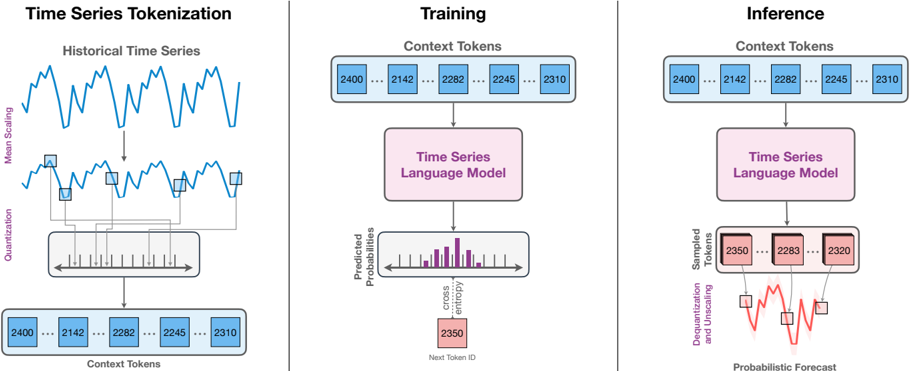
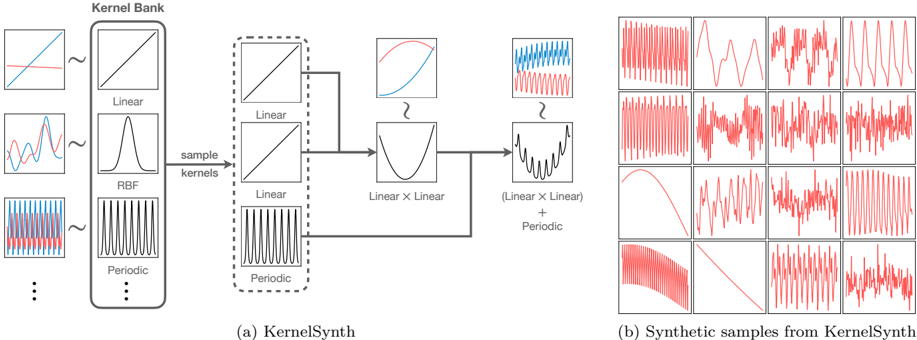
We introduce Chronos, a simple yet effective framework for pretrained probabilistic time series models. Chronos tokenizes time series values using scaling and quantization into a fixed vocabulary and trains existing transformer-based language model architectures on these tokenized time series via the cross-entropy loss. We pretrained Chronos models based on the T5 family (ranging from 20M to 710M parameters) on a large collection of publicly available datasets, complemented by a synthetic dataset that we generated via Gaussian processes to improve generalization. In a comprehensive benchmark consisting of 42 datasets, and comprising both classical local models and deep learning methods, we show that Chronos models: (a) significantly outperform other methods on datasets that were part of the training corpus; and (b) have comparable and occasionally superior zero-shot performance on new datasets, relative to methods that were trained specifically on them. Our results demonstrate that Chronos models can leverage time series data from diverse domains to improve zero-shot accuracy on unseen forecasting tasks, positioning pretrained models as a viable tool to greatly simplify forecasting pipelines.
Overview
CoChat Summary
TL;DR
Chronos adapts language-model architectures to probabilistic time series forecasting by scaling and quantizing values into tokens and training T5/GPT-2 models with cross-entropy. Across 42 benchmark datasets, it achieves strong in-domain and zero-shot forecasting, often matching or beating task-specific models.
Key findings
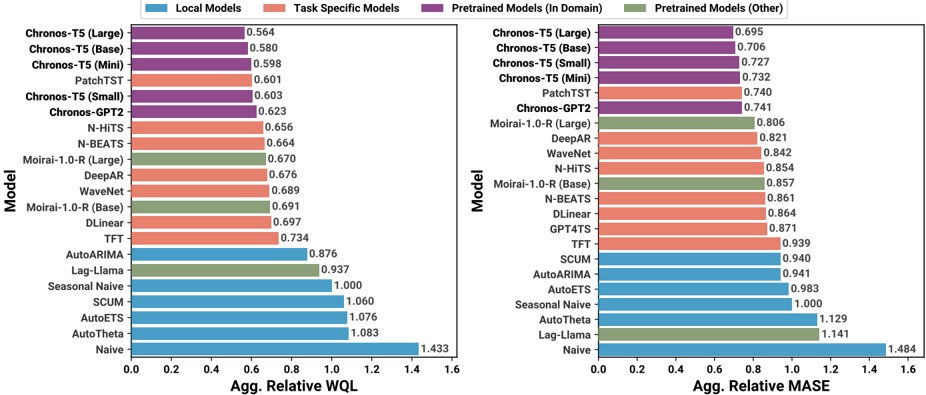
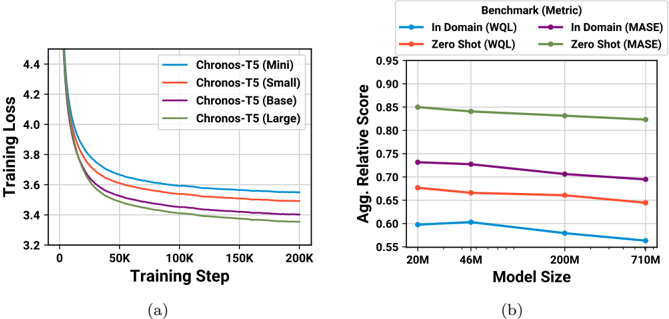
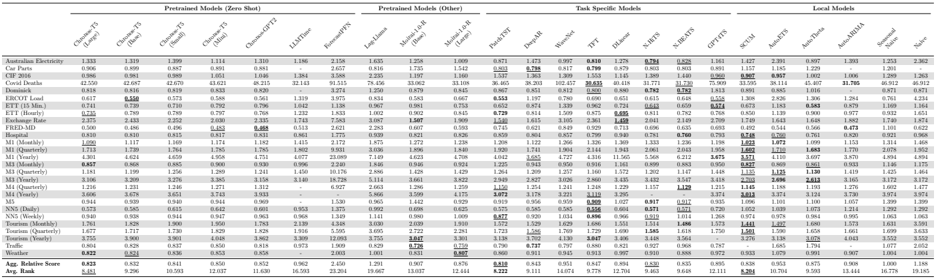
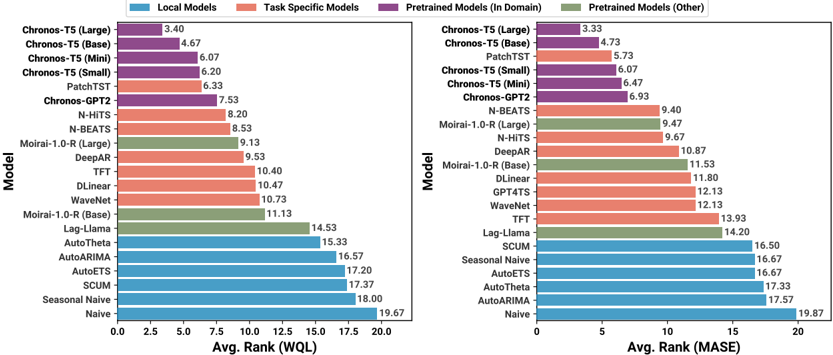
- On in-domain Benchmark I (15 datasets), Chronos-T5 Base/Large obtain the best aggregated relative scores: WQL 0.580/0.564 and MASE 0.706/0.695 versus Seasonal Naive 1.000, outperforming local, task-specific, and other pretrained baselines.
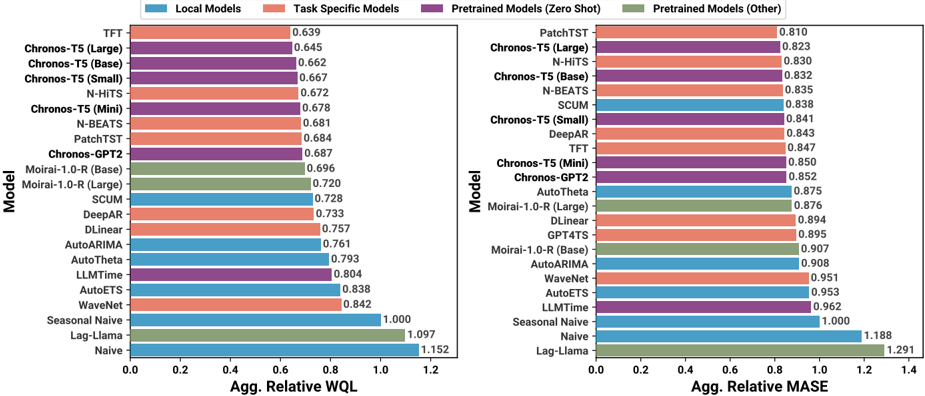
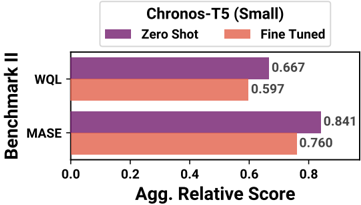
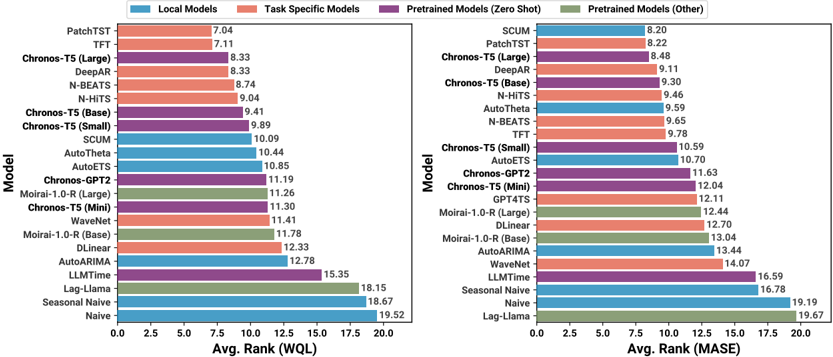
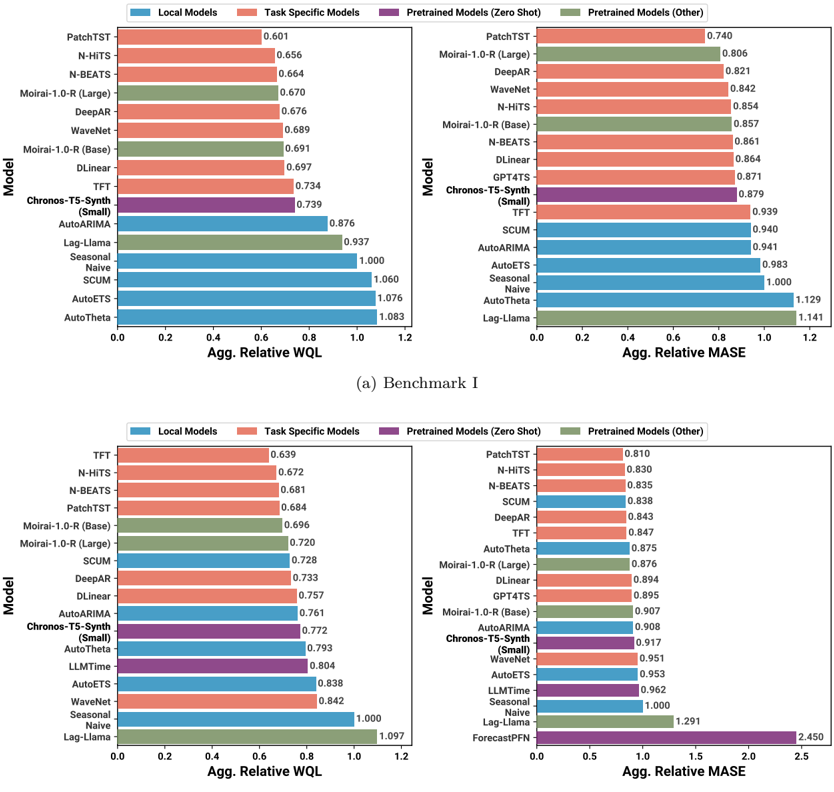
- On zero-shot Benchmark II (27 datasets), Chronos models rank 2nd–4th on WQL and Chronos-T5 Large ranks 2nd on MASE; aggregated relative WQL is 0.645 (Large), 0.662 (Base), 0.667 (Small), 0.678 (Mini), and MASE is 0.823, 0.832, 0.841, 0.850 versus Seasonal Naive 1.000. Fine-tuned Chronos-T5 Small becomes the best model on Benchmark II.
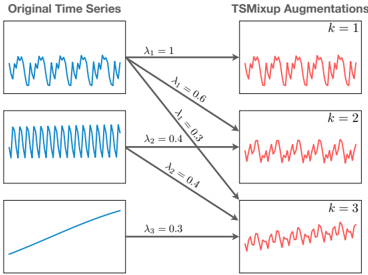
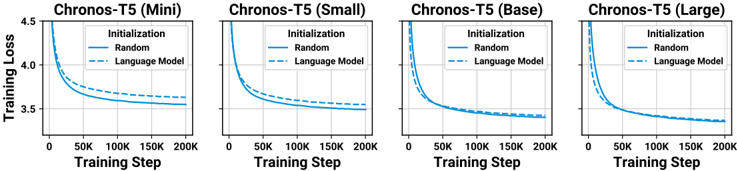
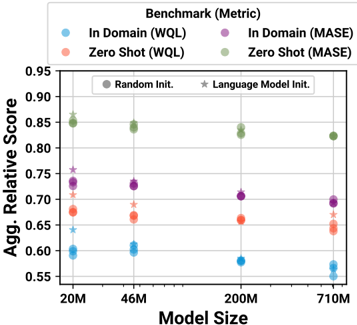
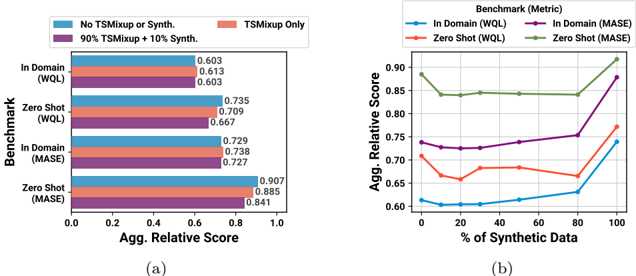
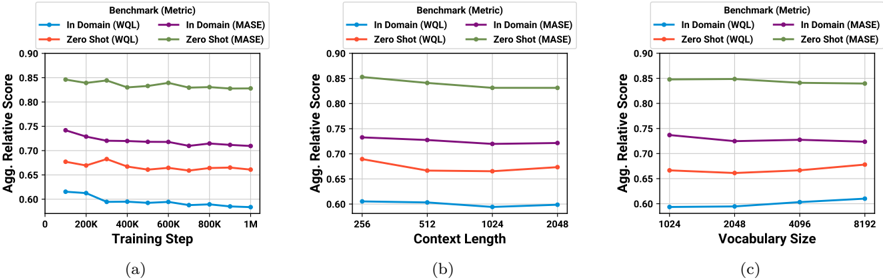
- Ablations show performance improves with model size; language-model-weight initialization offers little/no advantage over random initialization; TSMixup improves zero-shot performance; about 10% KernelSynth synthetic data is best; context length up to 1024 helps; larger vocabulary improves MASE but WQL deteriorates.
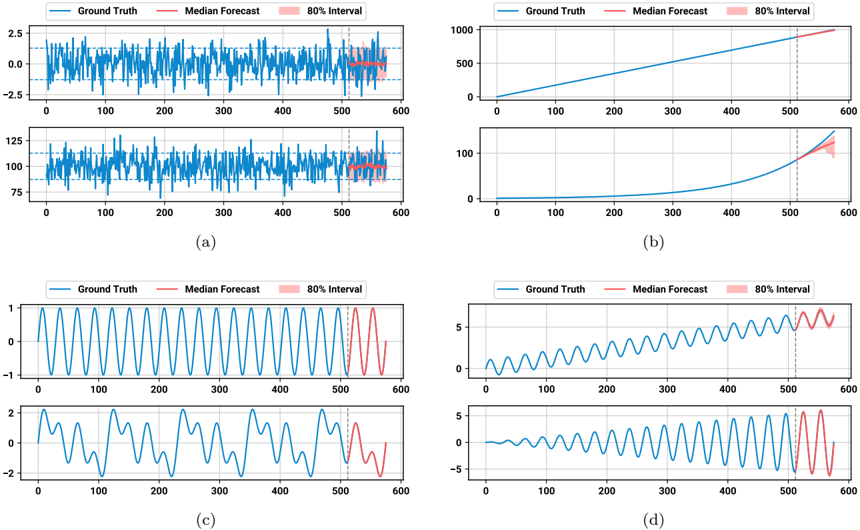
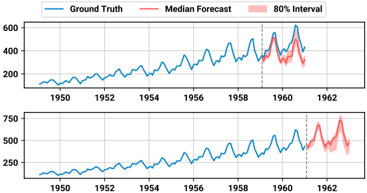
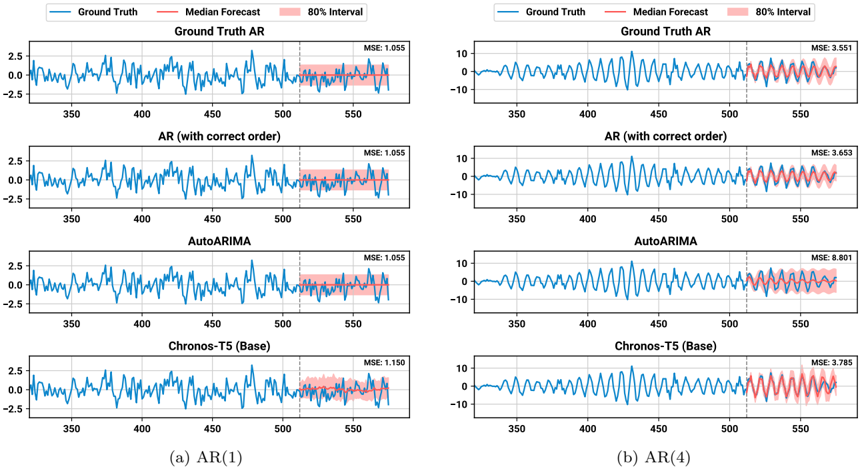
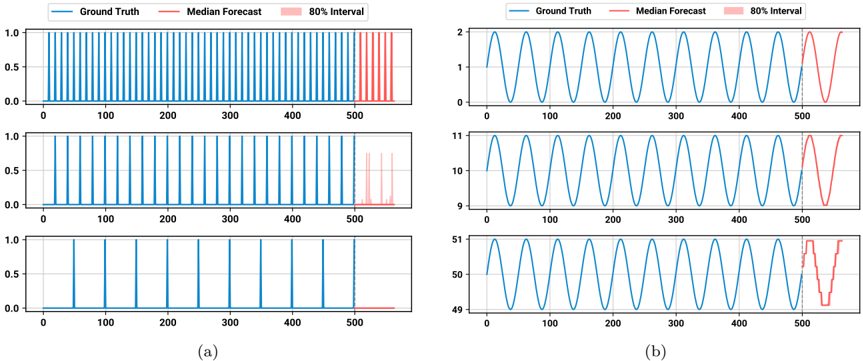
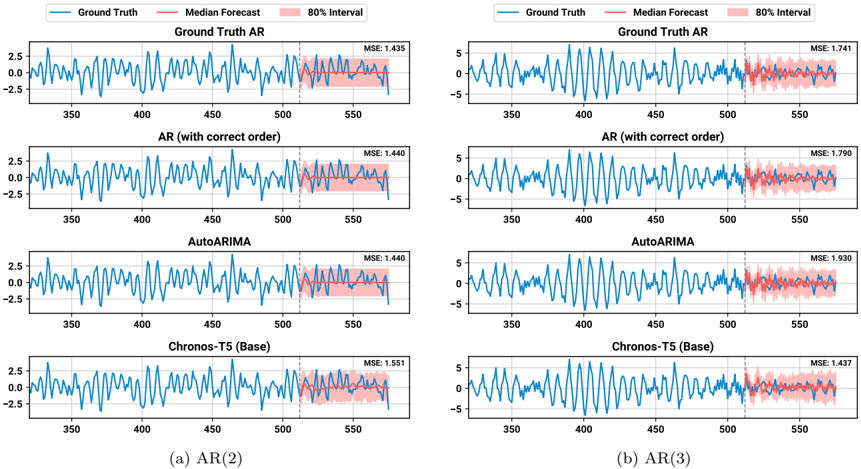
- Qualitatively, Chronos handles Gaussian noise, seasonality, additive/multiplicative trend+seasonality, and AR processes, but struggles with exponential trends and underestimates trend when context is short.
Methods
- Chronos mean-scales time series, uniformly quantizes values into B=4094 bins plus PAD/EOS (V_ts=4096), and trains off-the-shelf transformer language models with categorical cross-entropy; forecasts are produced by autoregressively sampling token paths and dequantizing/unscaling them.
- Training used 55 datasets total: 13 pretraining-only, 15 Benchmark I in-domain, and 27 Benchmark II zero-shot; 28 training datasets comprised about 890K univariate series and approximately 84B observations/tokens. Models included T5 Mini 20M, Small 46M, Base 200M, Large 710M, and GPT-2 90M, trained with 10M TSMixup augmentations plus 1M KernelSynth GP synthetic series, context length 512, prediction length 64, and 200K AdamW steps.
- Evaluation used 42 benchmark datasets with WQL (9 quantiles) and MASE; relative scores versus Seasonal Naive were aggregated by geometric mean and compared against local, task-specific, and pretrained baselines, plus a fine-tuning experiment on Benchmark II.
Limitations
- The paper states tokenization limits: representable values are in [-15s, 15s] where s is the mean absolute scale; small s relative to range causes overflow, while large s relative to variance causes precision loss. It also notes poor exponential-trend forecasts, trend underestimation with short context, and that categorical cross-entropy is not distance-aware; ordinal modeling is left as future work.
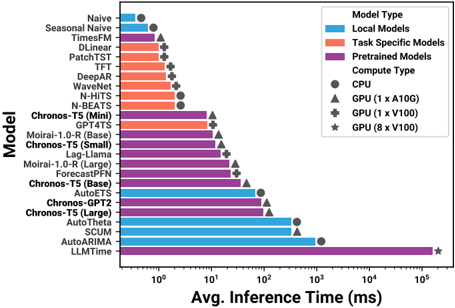
- The paper states scope limits: only univariate, uniformly spaced forecasting is studied; exogenous covariates, multivariate forecasting, and irregular sampling are not handled. Larger models were not explored due to slow inference, inference is slower than task-specific models, evaluation lacks enough high-frequency datasets to study long contexts, and public time series data remain limited.
- Text-evident: the zero-shot comparison may favor Moirai-1.0-R because many Benchmark II datasets were part of its pretraining corpus, as the paper notes; Chronos also ignores time and frequency information by design.
Model-written summary. Check it against the paper before relying on it.
Integrity signals
Registry
Cites
Statistics
Figures

Verification
Claims the paper makes
0 Valid · 4 Not valid · 14 Not checked · 146 Own results and interpretations
A result the paper reports from its own data — it cites no other source for it, so there is none to check. The quote shows it is in the paper.
In the paper
“Between the two baseline pretrained models studied in this experiment, Moirai-1.0-Rclearly outperforms Lag-Llama.”
§ Chronos: Learning the Language of Time Series > 5.5 Main Results
boosted- Asserted: passes — The authors put it forward as true.
- Checkable: passes — It can be checked against evidence.
- Load-bearing: unclear — It is unclear whether the paper’s conclusions depend on it.
- Based: passes — The paper gives a reason why it holds.
A result the paper reports from its own data — it cites no other source for it, so there is none to check. The quote shows it is in the paper.
In the paper
“Unsurprisingly, the training loss improves with the model capacity, as shown in Figure 7a.”
§ Chronos: Learning the Language of Time Series > Model size.
plainstates a cause- Asserted: passes — The authors put it forward as true.
- Checkable: passes — It can be checked against evidence.
- Load-bearing: unclear — It is unclear whether the paper’s conclusions depend on it.
- Based: passes — The paper gives a reason why it holds.
A result the paper reports from its own data — it cites no other source for it, so there is none to check. The quote shows it is in the paper.
In the paper
“Our comprehensive evaluation across 42 datasets establishes Chronos as a benchmark for both in-domain and zero-shot forecasting, surpassing both traditional models and task-specific deep learning approaches.”
§ Chronos: Learning the Language of Time Series > Time Series Tokenization Training Inference
plain- Asserted: passes — The authors put it forward as true.
- Checkable: passes — It can be checked against evidence.
- Load-bearing: passes — The paper’s conclusions depend on it.
- Based: passes — The paper gives a reason why it holds.
A result the paper reports from its own data — it cites no other source for it, so there is none to check. The quote shows it is in the paper.
In the paper
“consistent improvement is observed around the 10% synthetic data proportion.”
§ Chronos: Learning the Language of Time Series > Model size.
plainstates an association- Asserted: passes — The authors put it forward as true.
- Checkable: passes — It can be checked against evidence.
- Load-bearing: unclear — It is unclear whether the paper’s conclusions depend on it.
- Based: passes — The paper gives a reason why it holds.
A result the paper states — it cites no source for it, so there is none to check. The quote shows it is in the paper.
In the paper
“Further increasing the proportion of synthetic data tends to worsen performance.”
§ Chronos: Learning the Language of Time Series > Model size.
hedgedstates a possible cause- Asserted: passes — The authors put it forward as true.
- Checkable: passes — It can be checked against evidence.
- Load-bearing: unclear — It is unclear whether the paper’s conclusions depend on it.
- Based: passes — The paper gives a reason why it holds.
- Rests on an assumption not shown here.
94 more claims
Create a free account to see all 164 claims and to verify the 17 references still open.
- It may state two separate claims as one. 42
- Probably not a substantial claim. 30
Self-check
Percentages, sums and reported differences re-computed from the paper’s own numbers.
Each contradiction between two passages listed here was confirmed by an independent check.
Rated minor: it would not touch a result — a value no result rests on, a p-value that stays on the same side of the significance level, or a conflict that is clerical, resolved elsewhere in the paper, or outside its own findings.
In the paper
§ Chronos: Learning the Language of Time Series > Additional information
“Dominick (Godahewa et al., 2021) contains weekly time series representing the profit of individual stock keeping units from a retailer.”
§ Chronos: Learning the Language of Time Series > Covid Deaths
“Dominick retail 1D 100014 201 296 399 8”
Rated minor: it would not touch a result — a value no result rests on, a p-value that stays on the same side of the significance level, or a conflict that is clerical, resolved elsewhere in the paper, or outside its own findings.
In the paper
§ Chronos: Learning the Language of Time Series > C Baselines
“We considered a total of 17 baseline methods for benchmarking Chronos.”
§ Chronos: Learning the Language of Time Series > Chronos-GPT2 Chronos-T5 (Mini)
“Figure: Naive, SeasonalNaive, AutoETS, Auto-Theta, SCUM, AutoARIMA, DeepAR, TFT, PatchTST, DLinear, WaveNet, N-BEATS, N-HiTS, GPT4TS, Lag-Llama, Moirai-1.evaluationAll the above, LLMTime and ForecastPFN”
Citations
Cites
Exploring the Limits of Transfer Learning with a Unified Text-to-Text Transformer
Raffel, C., Shazeer, N., Roberts, A., Lee, K., Narang, S., Matena, M., Zhou, Y., Li, W., & Liu, P. J. (2019) · arXiv · doi:10.48550/arxiv.1910.10683 · Cited by 31,859
LoRA: Low-Rank Adaptation of Large Language Models
Hu, E. J., Shen, Y., Wallis, P., Allen-Zhu, Z., Li, Y., Wang, S., Wang, L., & Chen, W. (2021) · arXiv · doi:10.48550/arxiv.2106.09685 · Cited by 13,453
LightGBM: A Highly Efficient Gradient Boosting Decision Tree
(2017) · HAL · Cited by 10,512
Lewis, M., Liu, Y., Goyal, N., Ghazvininejad, M., Mohamed, A., Levy, O., Stoyanov, V., & Zettlemoyer, L. (2020) · Proceedings of the 58th Annual Meeting of the Association for Computational Linguistics · doi:10.18653/v1/2020.acl-main.703 · Cited by 8,821
Lewis, M., Liu, Y., Goyal, N., Ghazvininejad, M., Mohamed, A., Levy, O., Stoyanov, V., & Zettlemoyer, L. (2019) · arXiv · doi:10.48550/arxiv.1910.13461 · Cited by 8,816
Transformers: State-of-the-Art Natural Language Processing
Wolf, T., Debut, L., Sanh, V., Chaumond, J., Delangue, C., Moi, A., Cistac, P., Rault, T., Louf, R., Funtowicz, M., et al. (2020) · Proceedings of the 2020 Conference on Empirical Methods in Natural Language Processing: System Demonstrations · doi:10.18653/v1/2020.emnlp-demos.6 · Cited by 8,741
Informer: Beyond Efficient Transformer for Long Sequence Time-Series Forecasting
Zhou, H., Zhang, S., Peng, J., Zhang, S., Li, J., Xiong, H., & Zhang, W. (2021) · Proceedings of the AAAI Conference on Artificial Intelligence · doi:10.1609/aaai.v35i12.17325 · Cited by 7,752
mixup: Beyond Empirical Risk Minimization
Zhang, H., Cisse, M., Dauphin, Y. N., & Lopez-Paz, D. (2017) · arXiv · doi:10.48550/arxiv.1710.09412 · Cited by 5,831
Strictly Proper Scoring Rules, Prediction, and Estimation
Gneiting, T., & Raftery, A. E. (2007) · Journal of the American Statistical Association · doi:10.1198/016214506000001437 · Cited by 5,793
Another look at measures of forecast accuracy
Hyndman, R. J., & Koehler, A. B. (2006) · International Journal of Forecasting · doi:10.1016/j.ijforecast.2006.03.001 · Cited by 5,757
Research works printed but not linked: 8
- George Athanasopoulos, Rob J. Hyndman, Haiyan Song, and Doris C. Wu. The tourism forecasting compe- tition. International Journal of Forecasting, 27(3):822-844, 2011.
- Tom B. Brown, Benjamin Mann, Nick Ryder, Melanie Subbiah, Jared Kaplan, Prafulla Dhariwal, Arvind Neelakantan, Pranav Shyam, Girish Sastry, Amanda Askell, Sandhini Agarwal, Ariel Herbert-Voss, Gretchen Krueger, Tom Henighan, Rewon Child, Aditya Ramesh, Daniel M. Ziegler, Jeffrey Wu, Clemens Winter, Christopher Hesse, Mark Chen, Eric Sigler, Mateusz Litwin, Scott Gray, Benjamin Chess, Jack Clark, Christopher Berner, Sam McCandlish, Alec Radford, Ilya Sutskever, and Dario Amodei. Language models are few-shot learners. In Advances in Neural Information Processing Systems, 2020. 2, 3, 4
- Rob Hyndman, Anne B Koehler, J Keith Ord, and Ralph D Snyder. Forecasting with exponential smoothing: the state space approach. Springer Science & Business Media, 2008. 3, 9
- Alec Radford, Jeffrey Wu, Rewon Child, David Luan, Dario Amodei, Ilya Sutskever, et al. Language models are unsupervised multitask learners. OpenAI blog, 1(8):9, 2019. 4, 6
- Yaniv Romano, Evan Patterson, and Emmanuel Candes. Conformalized quantile regression. Advances in neural information processing systems, 32, 2019.
- Kai Ming Ting and Ian H Witten. Stacking bagged and dagged models. In Proceedings of the Fourteenth International Conference on Machine Learning, 1997. 20
- Ashish Vaswani, Noam Shazeer, Niki Parmar, Jakob Uszkoreit, Llion Jones, Aidan N. Gomez, Lukasz Kaiser, and Illia Polosukhin. Attention Is All You Need. In Advances in Neural Information Processing Systems, 2017.
- Yun Zhou, Liwen You, Wenzhen Zhu, and Panpan Xu. Improving time series forecasting with mixup data augmentation. In ECML PKDD 2023 International Workshop on Machine Learning for Irregular Time Series, 2023b. 7
Cited by
Items 1,901–2,000 of 2,048
When Does Retrieval Help Time-Series Forecasting?Preprint
Cakiroglu, M. O., Buxton, E. K., Dalkilic, M. M., & Kurban, H. (2026) · arXiv · doi:10.48550/arxiv.2609.20193
“Pretraining on large corpora serves a related role (Ansari et al., 2024) and can itself be combined with retrieval (Ning et al., 2025).”
Decision-Centric Virtual Metrology for Geometric Deviation via Foundation-Embedding Retrieval
Hoang, D., Matthiessen, R., Miller, C., Mannan, N., ElKharboutly, R., Gorsich, D., Castanier, M. P., & Imani, F. (2026) · SAE technical papers on CD-ROM/SAE technical paper series · doi:10.4271/2026-01-7554
When Tomorrow Becomes Today: Self-Evolving Policies for Agentic Time-Series ForecastingPreprint
Hu, Y., Dai, X., Qu, Z., Liu, Y., Dong, Z., Yang, J.-M., & Xu, Q. (2026) · arXiv · doi:10.48550/arxiv.2609.24862
Li, X., Geng, C., & Sun, Y. (2026) · arXiv · doi:10.48550/arxiv.2609.22192
Wei, S., Gao, J., Fan, M., Xie, S., Wang, X., & Dong, Y. (2026) · arXiv · doi:10.48550/arxiv.2609.24003
Puli, R., & Nagashima, S. (2026) · arXiv · doi:10.48550/arxiv.2609.27473
“A conditioning rule that serves both is what a general time-series model needs to accept physiological waveforms as inputs, which current foundation models such as Chronos [4], trained on scalar series, do not.”
Time-Series Foundation Models That Understand Data RevisionsPreprint
Ahmad, T. (2026) · arXiv · doi:10.48550/arxiv.2609.28576
“Published work on Chronos, TimesFM, and Moirai further establishes pretrained and universal forecasting as an active research direction [8, 21, 37, 12].”
Thierry, N., & Rochet, A.-L. (2026) · arXiv · doi:10.48550/arxiv.2609.28506
“TimesFM (Das et al., 2024; Google Research, 2025) and a public LoRA of Chronos-2 (Verm1ion, 2026) complete the tournament pool.”
InfluentialDownside-Controlled Online Forecast Combination under Delayed and Revised OutcomesPreprint
Kim, M., Byun, H., Lee, Y., & Jang, B. (2026) · arXiv · doi:10.48550/arxiv.2609.29096
“Pretrained foundation models such as Chronos (Ansari et al., 2024) and TimesFM (Das et al., 2024) are served behind interfaces that expose forecasts but not weights.”
InfluentialZheng, X., Niu, T., Tan, J., Guan, Q., Dong, X., Xue, S., & Cao, H. (2026) · Electric Power Systems Research · doi:10.1016/j.epsr.2026.114258
LTV-CTDNet: Compositional Turning Decomposition for Short-Term Turning-Movement ForecastingPreprint
Mallick, M. A. R., Hasan, K., & White, R. T. (2026) · arXiv · doi:10.48550/arxiv.2609.34014
NanoForecast v0.5: Competitive Time Series Forecasting Through Training Pipeline OptimizationPreprint
Kishore, G. (2026) · arXiv · doi:10.48550/arxiv.2609.31669
JudgeCast: Time Series Forecasting with Experience-Informed Covariate JudgementsPreprint
Kwon, D., Jeong, W., & Lee, D. (2026) · arXiv · doi:10.48550/arxiv.2609.36966
“This task has advanced rapidly with time series foundation models (TSFMs), which are pretrained on large collections of series and produce strong zero-shot forecasts for unseen targets (Das et al., 2024; Ansari et al., 2024; Woo et al., 2024; Ansari et al., 2025).”
Hai, S. O., & Ardakanian, O. (2026) · ACM Transactions on Sensor Networks · doi:10.1145/3849708
The Nixtlaverse: An Open-Source Ecosystem for ForecastingPreprint
Sprangers, O., Mergenthaler, M., Peixeiro, M., Ramirez, S. C., Menchero, M., Goh, J.-Q., Wang, H., Gupta, N., Melo, R., Gee, S., et al. (2026) · arXiv · doi:10.48550/arxiv.2609.39741
Self-citationWhen, Not How Much: Evaluating Time-Series Foundation Models on Sparse EventsPreprint
Schoess, D., & von Wangenheim, F. (2026) · arXiv · doi:10.48550/arxiv.2609.39386
“Chronos-2, Chronos-Bolt, Sundial, and TimeMoE are ahead in all ten comparisons, and Toto-2.”
InfluentialChen, Z., Mei, Q., Song, Z., Zhu, X., & He, X. (2026) · Asian Control Conference (ASCC) · doi:10.1109/ascc70886.2026.11702021
“Pre-trained temporal foundation models (TSFMs) like Chronos [10] and TimeGPT [11] achieve strong zero-shot generalization via cross-domain pre-training, but suffer from significant domain shift in EV charging scenarios due to unique pricing and user behaviors.”
Li, R., Xie, H., Wang, M., Liu, H., Fang, K., Chen, C., Tang, Z., & Li, K. (2026) · arXiv · doi:10.48550/arxiv.2610.00377
Pace, D., Jr. (2026) · ScholarWorks - UNO (University of New Orleans)
Transparent forecasting with XAI: Improving accuracy and trust in electricity demand prediction
Bansal, S., Baldeva, V., Cajla, A., Vashitha, P., Kansal, P., Kansal, S., Shaukat, K., & Alam, T. M. (2026) · Knowledge-Based Systems · doi:10.1016/j.knosys.2026.117131
Forecasting from Counterfactual Simulator Rollouts: A Sim2Real EvaluationPreprint
Wang, A., Perrault-Joncas, D., Maggiar, A., Foster, D., & Eisenach, C. (2026) · arXiv · doi:10.48550/arxiv.2610.03662
“Synthetic data have been used before to train forecasting models for broad generalization, including pretraining on simulated time series [12, 13].”
Conformal Prediction for Time Series with Deep Sequence ModelsPreprint
Lee, J., Lee, J., & Xie, Y. (2026) · arXiv · doi:10.48550/arxiv.2610.02357
Kniazev, A. M., Grechanikov, N. D., & Тынченко, В. С. (2026) · International Russian Automation Conference (RusAutoCon) · doi:10.1109/rusautocon69876.2026.11707369
“On ETTh1, Chronos‑Bolt and TimesFM achieve accuracy within a few percent of the best supervised model without any task‑specific t raining [9, 10].”
InfluentialTMAML: Temporal Model-Agnostic Meta-Learning for Cold-Start Time Series ForecastingPreprint
Janssens, W., Bogaert, M., & den Poel, D. V. (2026) · arXiv · doi:10.48550/arxiv.2610.04547
Shi, X., Liu, Q., Heshmati, S., & Abraham, Z. (2026) · arXiv · doi:10.48550/arxiv.2610.04786
“…a natural image implicitly embeds the trends, periodic textures and abrupt changes a forecaster must model, and masked-autoencoder inpainting [6] is itself forecasting in pixel space, whereas language-model routes [2, 14] must first discretize values, coarsening the continuous structure they carry.”
AI-Enhanced Grouped Time-Series Forecasting with Weather and Holiday Effects
Ho, D. T., Nguyen, M. D., & Bérczes, T. M. (2026) · IEEE Conference on Information Technology and Data Science (CITDS) · doi:10.1109/citds70571.2026.11706926
“The Time-series Dense Encoder (TiDE) [7] is a feed-forward encoder–decoder integrating covariates without recurrence or attention, and foundation models such as Chronos [18] target zero-shot transfer.”
Multi-Paradigm Machine Learning for Opportunistic Rainfall Estimation from Satellite Microwave Links
Marini, L., Sciortino, E. M., Giannetti, F., Scognamiglio, G., & Vaccaro, A. (2026) · Remote Sensing · doi:10.3390/rs18193414
“The Chronos family of models [27] employs a tokenization process that bridges the gap between continuous signals and discrete language models.”
Zero-Shot Time-Series Question Answering via Decoupled Perception and ReasoningPreprint
Xie, J., Yuan, H., & Wang, Y. (2026) · arXiv · doi:10.48550/arxiv.2610.04942
“Language-based forecasting (Gruver et al., 2023; Jin et al., 2024; Liu et al., 2024) and pretrained forecasters (Ansari et al., 2024; Woo et al., 2024) support transfer of numerical prediction capabilities.”
Self-citationERP Event Logs: A Canonical Form for KPI Time-Series Extraction and CharacterizationPreprint
Hadian, S., Rebmann, A., Korkmaz, A., Berg, G., & Brackmann, U. (2026) · arXiv · doi:10.48550/arxiv.2610.09903
“…trend [7]; ARIMA [8] ( p, q ≤ 3 , d ∈ { 0 , 1 } by an ADF test, order by AIC on the first training window); the same ARIMA order with K = 3 Fourier terms at m = 52 [9]; seasonal na¨ıve ( m = 52 ); and Chronos ( chronos-t5-small ) [10], applied zero-shot with the per-horizon median of 20 samples.”
Fraile, F., Baviera, C., Ortiz, Á., & Poler, R. (2026) · IFIP advances in information and communication technology · doi:10.1007/978-3-032-41234-8_23
Probabilistic Streamflow Forecasts for Mississippi River Navigation Risk and Parametric InsurancePreprint
Nakamura, J., Nakamura, X., & Lall, U. (2026) · EarthArXiv (California Digital Library) · doi:10.31223/x5g51v
Physical feasibility and soft physical information in probabilistic photovoltaic forecastingPreprint
Siwek, K. (2026) · SSRN Electronic Journal · doi:10.2139/ssrn.7601153
Probabilistic Residual Correction of Issued Photovoltaic Forecast Profiles Without Plant Metadata
Siwek, K. (2026) · Photovoltaics · doi:10.3390/photovoltaics1010003
TStruct: Learning Shared Temporal Structures for Long-Term Time Series ForecastingPreprint
Li, Y., Zhou, Z., Huang, Q., Wang, P., Wang, B., & Wang, Y. (2026) · arXiv · doi:10.48550/arxiv.2610.17864
“In recent years, deep learning methods have driven significant progress in long-term time series forecasting [46, 39, 47, 44, 28, 45, 11, 10, 17, 1, 18, 33, 24, 12, 27, 14, 26].”
Self-citationLotus: Learning to Understand Time-series by Learning to ForecastPreprint
Do, V. D., Nguyen, H. H., Nguyen, M. H., Nguyen, M., & Le, H. (2026) · arXiv · doi:10.48550/arxiv.2610.18877
“Time-series foundation models exploit this structure through objectives such as forecasting and reconstruction to learn transferable numerical representations (Ansari et al., 2024; Das et al., 2024; Woo et al., 2024; Nie et al., 2023).”
PathFM: Fast Generative Forecasting of Multivariate TrajectoriesPreprint
Yao, J., Zhang, X., Yu, A., Han, B., Ansari, A. F., Zhang, S., Bohlke‐Schneider, M., & Wang, B. (2026) · arXiv · doi:10.48550/arxiv.2610.22358
“Time series foundation models (TSFMs) are a hot topic (Ansari et al., 2024; Das et al., 2023; Ansari et al., 2025; Jain & Sen, 2026; Cohen et al., 2025).”
Self-citationFine-Tuning TimesFM for Operational Mobile Traffic Forecasting
Sanvi, G., Birregah, B., & Atchonouglo, K. (2027) · Lecture notes in networks and systems · doi:10.1007/978-3-032-34434-2_27
Kean, J., & O'Sullivan, A. (2026) · arXiv · doi:10.48550/arxiv.2610.25370
Zhang, H., 项明义, Rongzhao, C., Wang, Y., Qiao, J., Huang, X., Ding, X., Wang, C., Pei, Z., & Wang, J. (2026) · arXiv · doi:10.48550/arxiv.2610.26251
“Time series foundation models (TSFMs), pretrained on large and diverse data corpora, are increasingly used for forecasting across domains such as energy, transportation, finance, and cloud operations (Ansari et al., 2024; Das et al., 2024; Woo et al., 2024).”
Self-citationWu, R., Jamaludin, J., & Selvaraj, J. A.-L. (2026) · Energies · doi:10.3390/en19204999
Holst, C., Pfeifer, A., Ehlenbröker, J., & Lohweg, V. (2026) · Intelligente Technische Systeme, Lösungen aus dem Spitzencluster it’s OWL · doi:10.1007/978-3-662-73053-9_6
Vercellino, G. (2026) · arXiv · doi:10.48550/arxiv.2610.29991
“At the same time, models such as Chronos illustrate rapid advances in probabilistic time-series forecasting [12].”
Raszka, L., & Grycz, O. (2026) · SSRN Electronic Journal · doi:10.2139/ssrn.7661699
Rethinking Agentic Model Orchestration for Time Series ForecastingPreprint
Guan, T., Zhan, T., Pan, S., & Jin, M. (2026) · arXiv · doi:10.48550/arxiv.2610.29504
“Chronos [Ansari et al., 2024] captures distinct seasonality in short univariate series.”
Random Initialization as a Baseline for Time Series Foundation ModelsPreprint
Isiacik, P. S., & Ifrim, G. (2026) · arXiv · doi:10.48550/arxiv.2610.30950
“Other foundation models primarily target forecasting (Ansari et al., 2024; Das et al., 2024; Woo et al., 2024), whereas we focus on multivariate time series classification.”
TC-MoE: temporal-coherent mixture-of-experts for time series forecasting
Tang, J., Chen, W., Wang, N., Luo, Y., & Xiao, C. (2026) · Big Data Research · doi:10.1016/j.bdr.2026.100654
С., С. А. (2025) · Символ науки
DBCM: Dual-Branch Calibration Module for Test-Time Adaptation in Time Series ForecastingPreprint
Jeon, J., Kang, K., Lee, S. Y., & Lee, K. (2026) · arXiv · doi:10.48550/arxiv.2610.32071
“In addition, we further validate our method on recent TSFMs, including Moirai (Woo et al., 2024), Chronos (Ansari et al., 2024), and Chronos-2 (Ansari et al., 2025).”
InfluentialGür, K. B. D. A. R., Yazıcı, P., Erkaya, P., Türkmen, Y., Baytak, B., Güzel, İ., Karagöz, P., & Yozgatlıgil, C. (2026) · International Conference on Time Series and Forecasting (ITISE) · doi:10.3390/cmsf2026016024
Luc, C., Lemonnier, N., & Redko, I. (2026) · arXiv · doi:10.48550/arxiv.2610.32859
“We evaluate using 27 zero-shot forecasting tasks spanning diverse domains and frequencies (30 min to yearly) from Chronos Benchmark II [Ansari et al., 2024].”
Analyzing the Potential of Foundation Models in Flotation Process Forecasting
Basilio, R. D. S., Ribeiro, L. M., Diniz, I. D. S., Guimarães, A. J., Segundo, A. K. R., Gertrudes, J. C., & Silva, R. C. P. (2026) · IEEE Sensors Applications Symposium (SAS) · doi:10.1109/sas70013.2026.11744106
“The landscape of time series forecasting has recently shifted from task-specific statistical methods to general-purpose Foundation Models (FMs), inspired by the success of Large Language Models (LLMs) in Natural Language Processing [13].”
MetaARIMA: Configuration-Level Transfer Learning for ARIMA ModelsPreprint
Cerqueira, V., Inácio, R., & Soares, C. (2026) · arXiv · doi:10.48550/arxiv.2610.34171
“Time Series Foundation Models (TSFMs) such as Chronos [2], TimesFM [12], and Moirai [22] demonstrate that knowledge acquired during pretraining on diverse datasets can transfer effectively to new forecasting tasks, achieving strong zero-shot performance without task-specific fine-tuning.”
Dynamic Multi-Step Decoding for Time-Series Foundation ModelsPreprint
Kim, B., 이형주, & Song, H. O. (2026) · arXiv · doi:10.48550/arxiv.2610.34409
“…2023); Moirai introduces multiple patch-projection heads for different sampling frequencies (Woo et al., 2024); Chronos quantizes scaled values into a fixed bin vocabulary (Ansari et al., 2024); and WaveToken (Masserano et al., 2025) replaces bin-based tokenization with a wavelet-domain vocabulary.”
Wei, Y., Naharudi, M. N., Zhang, J., Li, J., Zhang, J., & Wang, D. (2026) · Research Square · doi:10.21203/rs.3.rs-11320605/v1
STFD-ETA: Spatio-Temporal Frequency Disentanglement for Estimated Time of Arrival
Thai, D. T., & Minh, Q. T. (2026) · Knowledge-Based Systems · doi:10.1016/j.knosys.2026.117260
Polpanumas, C. (2026) · arXiv · doi:10.48550/arxiv.2610.38292
“…are cited and used under their licenses: the M5 dataset [Makri-dakis et al., 2022] and the open-source forecasting models and libraries—Chronos [Ansari et al., 2024], TimesFM [Das et al., 2023], N-HiTS [Challu et al., 2023], PatchTST [Nie et al., 2022], and DeepAR [Salinas et al., 2020]; the…”
Kaan, A. R. I. K., AĞGÜL, B., & Erol, B. (2026) · International Conference on Computer Science and Engineering (UBMK) · doi:10.1109/ubmk71847.2026.11745413
“Alternative approaches encompass survival modeling for dealing with censored time-to-event problems [12], sequential models for handling more informative temporal data [13], and label-efficient methods when failures are hard to annotate [14].”
Learning-Based Approaches for Rapid Flow Detection in Inter-Datacentre Traffic
Orme, A. D. (2026) · University of Surrey Open Research repository · doi:10.15126/thesis.902304
Mari, S., Negri, V., Fioravanti, A., Mingotti, A., Ciancetta, F., & Fiorucci, E. (2026) · IEEE International Workshop on Applied Measurements for Power Systems (AMPS) · doi:10.1109/amps70695.2026.11739011
“2) Chronos: Chronos [6] is a family of time-series foundation models developed by Amazon.”
Measuring the Predictability of Beam-Level 5G Traffic: How Far Can Zero-Shot Foundation Models Go?
Baena, E., Dinh, P., Wang, S., & Koutsonikolas, D. (2026) · ACM International Symposium on Theory, Algorithmic Foundations, and Protocol Design for Mobile Networks and Mobile Computing (MobiHoc) · doi:10.1145/3842721.3849689
Chen, J., Ren, Y., Wang, Y., Han, Y., & Ma, Y. (2026) · ACM International Conference on Information and Knowledge Management (CIKM) · doi:10.1145/3799682.3840903
Self-citationQUAL: Quantile Alignment Improves Zero-Shot Time-Series Foundation ModelsPreprint
Kang, J., Han, S., Seo, J., Lee, S., Lee, J., Kang, D., Kim, M., Yoo, S., Lim, T. Y., Choi, H., et al. (2026) · arXiv · doi:10.48550/arxiv.2610.41100
“Zero-shot TSFMs span diverse architectures, including decoder-only transformers [9, 24], tokenized language modeling [2], group attention across related series [3], cross-frequency universal designs [30], and long-context in-context learning [4], motivating model coordination rather than…”
Multi-Mode Interest Diffusion for Online Activity Tensor Forecasting
Yamaguchi, M. (2026) · ACM International Conference on Information and Knowledge Management (CIKM) · doi:10.1145/3799682.3840234
RCSP-Net: Relation-aware Community Shared Prediction for Traffic Matrix Forecasting
Wang, K., & Dong, B. (2026) · IEEE International Conference on Computer and Communication Engineering Technology (CCET) · doi:10.1109/ccet71000.2026.11747981
“Foundation-style forecasting models such as Chronos and Timer further show that large pretrained time-series models can learn transferable temporal representations from broad sequence corpora [5], [6].”
Yang, H. (2026) · Computers and artificial intelligence. · doi:10.70267/cai.v3n6.0120
“Group E uses title searches and forward citation tracking from eight seed papers: Chronos [1], TimesFM [2], Moirai [3], MOMENT [4], Lag-Llama [5], Time-LLM [6], GIFT-Eval [17], and the ablation study by Tan et al. [10].”
Nadi, F., Mehmood, T., Samieiyeganeh, M., & Rahmat, R. F. (2026) · IEEE Access · doi:10.1109/access.2026.3749651
Investigating the effects of the patch size in Time Series Foundation ModelsPreprint
Yehya, J., Pantea, A.-T., Dieuleveut, A., Kowalski, M., & Moreau, T. (2026) · arXiv · doi:10.48550/arxiv.2611.02750
“The pretraining corpus consists of GIFT-Eval Pretrain, 1 million KernelSynth [Ansari et al., 2024] and synthetically generated time series using our RandomPatterns pipeline.”
SynForecast: Controlled Synthetic Time Series for Forecasting ResearchPreprint
Sprangers, O., Challú, C., Rathfelder, J., Wang, H., & Canseco, M. M. (2026) · arXiv · doi:10.48550/arxiv.2611.02802
“Chronos augments public datasets with series sampled from Gaussian-process priors (Ansari et al., 2024), while TimesFM assigns synthetic series a 20% sampling weight during pretraining (Das et al., 2024).”
InfluentialSelf-citationOkamoto, Y., Hoshino, K., & Inoue, M. (2026) · arXiv · doi:10.48550/arxiv.2611.02900
“Time-series foundation models have been developed as a framework in which a predictor is pretrained on diverse series and applied to unseen series without additional training (Das et al., 2024; Ansari et al., 2024; Woo et al., 2024).”
TEMPO: Time Series Understanding via Discrete TokenizationPreprint
Maggioni, R. (2026) · arXiv · doi:10.48550/arxiv.2611.04482
“Chronos quantizes scalar values for token-based forecasting (Ansari et al., 2024); TimesFM and Moirai develop pretrained forecasting models (Das et al., 2024; Woo et al., 2024).”
Bae, S., & Cha, J. (2026) · arXiv · doi:10.48550/arxiv.2611.04106
“Chronos, a second backbone with a different tokenizer, tests the principle on another architecture (Section 4.5).”
InfluentialEnergyBench: a live, gate-aligned benchmark of day-ahead forecasts for European power marketsPreprint
Genov, E., Alonso, A. M., & Bergmeir, C. (2026) · arXiv · doi:10.48550/arxiv.2611.07784
“…it, so tso_cutoff has wind and solar only for BE and NL. Classical univariate models (ARIMA, ETS, Theta, Foundation models, zero-shot c Chronos-2 [30] 120M native Amazon Chronos-Bolt base [30] 205M Amazon TimesFM 2.5 [31] 231M ridge Google TimesFM 3.0 [31] 331M native Google Moirai 2 small [32]…”
InfluentialZhang, Y., Zheng, Y., Li, B., Zhang, M., & Sun, Q. (2026) · arXiv · doi:10.48550/arxiv.2611.07870
“Large-scale pretraining offers another direction, as illustrated by Chronos [15], TimesFM [16], and Time-MoE [17]; DistilTS transfers forecasting capabilities to smaller models [18].”
Short-Term Forecasting of Lightning Strike Frequency in Surabaya City Using TimeGPT
Rachmanda, C. R., Suhermi, N., & Suffaturrachman, Z. A. (2026) · International Conference on Technology and Policy in Energy and Electric Power (ICT-PEP) · doi:10.1109/ict-pep71341.2026.11762164
“Pretrained time-series foundation models offer an alternative, generalizing across domains without task-specific development [15], including reprogrammed LLMs [16] and models such as TimesFM [17], Lag-Llama [18], and Chronos [19].”
Beyond the Grid: Continuous Dictionary Pursuit for Interpretable Signal DecompositionPreprint
Janßen, N., Schaller, M., & Rosenhahn, B. (2026) · arXiv · doi:10.48550/arxiv.2611.09163
“Transformer and state-space architectures [60, 65, 29, 24] and pre-trained foundation models [15, 3] achieve strong forecasting accuracy, yet the underlying signal structure remains distributed across millions of parameters with no compact mathematical description.”
Suhermi, N., & Amalia, R. N. (2026) · IEEE Access · doi:10.1109/access.2026.3751533
Learning Evidence-Grounded Reasoning for Context-Aware Time Series ForecastingPreprint
Gao, X., Cheng, M., Wang, D., Zhang, H., & Tao, X. (2026) · arXiv · doi:10.48550/arxiv.2611.12285
Han, Z., Shi, Z., 陈, 坤., Huang, X., Huang, Y., Zhang, A., Lin, X., Chen, Z., Yu, X., Liu, Y., et al. (2026) · arXiv · doi:10.48550/arxiv.2611.10521
CHORD: Multi-resolution Compression for Multimodal Time SeriesPreprint
Luitel, B., Mohapatra, P., Biswas, S., Poudel, E., Kim, S., Zhu, Q., & Islam, B. (2026) · arXiv · doi:10.48550/arxiv.2611.11913
“…are evaluated: multimodal classification with MAESTRO (Mohapatra et al. 2025) on WESAD, DaliaHAR, and UCI-HAR; sensor foundation-model evaluation with LIMU-BERT (Xu et al. 2025) on HHAR, MotionSense, UCI-HAR, and SHOAIB; and forecasting with AutoARIMA and Chronos (Ansari et al. 2024) on ETTh1.”
Zhang, Z., Li, S., Wu, W., & Zhang, C. (2026) · arXiv · doi:10.48550/arxiv.2611.12902
WINTER: Adaptive Serverless Prewarming With Limited Invocation History
Kim, G., Jung, J., & Kwon, G. (2026) · IEEE Access · doi:10.1109/access.2026.3753023
Deep learning for cryptocurrency price forecasting: A taxonomy, benchmark, and gap analysis
(2026) · Herald of Advanced Information Technology · doi:10.15276/hait.09.2026.35
Fine-Tuning an Order-Flow Foundation Model for Sub-Second ForecastingPreprint
Shabashev, F. (2026) · arXiv · doi:10.48550/arxiv.2611.14117
“Chronos [Ansari et al., 2024], TimesFM [Das et al., 2024], and Moirai [Woo et al., 2024] pretrain on broad corpora of sampled time series and transfer zero-shot or with light fine-tuning.”
Restoring Attention in Financial LLMs: Diagnosis and Reconstruction
Dai, S., Wang, Q., & Jin, T. (2026) · Communications in computer and information science · doi:10.1007/978-981-92-7922-7_2
He, Y., 许明杰, & Hou, C. (2027) · Lecture notes in networks and systems · doi:10.1007/978-3-032-31995-1_50
Data Representations for Air Pollution Forecasting and Modelling: A Systematic Literature Review
Agozie, E. H., Musa, I. A., Bakpo, F. S., & Markus, C. (2026) · FUDMA Journal of Sciences · doi:10.33003/fjs-2026-1024-6330
Jeong, W., Khanal, S., Lee, J., Lee, S., & Jeon, J. (2026) · Reliability Engineering & System Safety · doi:10.1016/j.ress.2026.113783
MORA: Correcting Time Series Forecasts with Coarse Future SignalsPreprint
Li, H., Li, K., Xu, H., longlong, Gao, S., Zhang, Y., & Dai, F. (2026) · arXiv · doi:10.48550/arxiv.2611.15413
“Chronos (Ansari et al., 2024) formulates forecasting as language modeling over quantized time-series values, whereas TimesFM (Das et al., 2024) adopts a patched decoder-only architecture.”
CastWorld: Benchmarking Context-Aware Agentic Time Series Forecasting Beyond Predictive AccuracyPreprint
Pan, B., Yang, R., Cheng, M., Wang, J., & Tao, X. (2026) · arXiv · doi:10.48550/arxiv.2611.15262
“Time series foundation models leverage large-scale pretraining across diverse datasets to support generalization across forecasting tasks [2, 7].”
Projective Generator Networks for Zero-Refit Multi-Horizon Financial Forecasting
Zhang, J., Yuan, R., & Ji, H. (2026) · ACM International Conference on AI in Finance (ICAIF) · doi:10.1145/3858063.3858784
Cao, M., Zhang, G., Wang, D., You, L., Wu, F.-Y., & Fu, L. (2026) · arXiv · doi:10.48550/arxiv.2611.14592
“The backbone is the encoder of Chronos-T5-small [35], a model pretrained for time-series modeling that provides a suitable sequence prior for numerical temporal patterns.”
Learning Temporal Dynamics with Derivative Representations for Time Series ForecastingPreprint
Duan, S., Puah, J. H., Wu, H., Mao, Y., Zhou, H., Li, C., Fang, Z., Lu, Y., & Goh, S. K. (2026) · arXiv · doi:10.48550/arxiv.2611.16514
“Moreover, several studies explore approaches beyond task-specific models, including time-series foundation models pretrained on large-scale and heterogeneous temporal data [13], as well as multi-modal large language models with time-series understanding and forecasting capabilities [14].”
From Simulator Labels to Real Markets: Crumble-Aware Reinforcement Learning for Trade Execution
Xu, H., Bohne, J., Polak, P., Kazantsev, G., Rosenberg, D. S., Alva, A., & Baransky, Y. (2026) · ACM International Conference on AI in Finance (ICAIF) · doi:10.1145/3858063.3858874
“Attention [40] applies whenever data can be cast as a token sequence, and a growing body of work tokenizes financial and time-series data to reuse the architecture: generic series transformers [34, 45, 48], foundation models over quantized series [3], and order-book encoders [27, 36, 43, 49].”
A predictive model for effective data synchronization between systems with different object models
Petrova, A. (2026) · Repository of the University of Ljubljana (University of Ljubljana)
Traffic Pattern Modelling for 5G Base Stations
Bengtsson, E., & Larsson, L. (2026) · Lund University Publications Student Papers (Lund University)
Large language models for time series forecasting via dynamic gating and semantic guidance
Wu, X., Chen, L., Chen, Y., Pu, Z., Liao, J., & Chen, H. (2026) · Computers & Electrical Engineering · doi:10.1016/j.compeleceng.2026.111654
Which Model, For Which Variable? Per-Variable Forecast Combination in Sparse ICU Time SeriesPreprint
Fracarolli, M., & Riezler, S. (2026) · arXiv · doi:10.48550/arxiv.2611.18149
“Their evidence base is 50 univariate , general-purpose datasets (Ansari et al., 2024; Woo et al., 2024) with no clinical application, filtered so that enough data exists to train base and stacker models, and their unit of prediction is the series itself, so there is no feature axis along which…”
FlexCast: Flexible Context Learning for Time Series Foundation ModelsPreprint
Shen, Z.-Y., Gong, L.-Q., Fan, F.-D., Wang, B.-S., Ao, X., Wei, Y.-H., Liu, M.-H., Luo, C.-J., & Zhan, J.-F. (2026) · arXiv · doi:10.48550/arxiv.2611.17862
“Recent Non-AR TSFMs relax this restriction in different ways: MOIRAI samples forecasting configurations, Chronos-2 supports variable-length prediction, and PatchTST-FM learns from masked patch patterns.”
Influential
Metadata
- Authors
- Ansari, A. F., Stella, L., Turkmen, C., Zhang, X., Mercado, P., Shen, H., Shchur, O., Rangapuram, S. S., Arango, S. P., Kapoor, S., Zschiegner, J., Maddix, D. C., Wang, H., Mahoney, M. W., Torkkola, K., Wilson, A. G., Bohlke-Schneider, M., & Wang, Y.
- Affiliations
- Amazon (United States) (US)
- University of California San Diego (US)
- University of Freiburg (DE)
- Rutgers, The State University of New Jersey (US)
- ORCID
- Venue
- arXiv
- Publisher
- arXiv
- Published
- 2024
- ISSN
- 2835-8856 (ISSN-L)
- arXiv
- 2403.07815
- OpenAlex
- W4392781393
- Cited by
- 2,046
- References
- 92
- Citations by year
- 2026: 1398 · 2025: 520 · 2024: 126
- FWCI
- 245.30
- Type
- journal article
- Language
- en
- Open access
- diamond
- openreview.net
- Licence
- Locations
- Transactions on machine learning research (publishedVersion, cc-by)
- arXiv (submittedVersion, public-domain)
- Topics
- Physical Sciences › Computer Science › Signal Processing › Time Series Analysis and Forecasting
- Social Sciences › Decision Sciences › Management Science and Operations Research › Forecasting Techniques and Applications
- Social Sciences › Decision Sciences › Management Science and Operations Research › Stock Market Forecasting Methods
- Keywords
- time series forecasting, transformer language models, T5, zero-shot forecasting, Chronos
About these checks
Registry, retraction, Cites and statistics results are computed, not judged, with one exception: a printed reference that no index lists is read once by a model before it counts as a citation error. Claims are extracted by a model and kept only when their quote appears verbatim in the text; each cited source is then checked, with a model’s help, for whether it says what the claim relies on. Those verdicts can be wrong — read the claim’s quote and the cited source before relying on one.
A language model drew the claims from the paper on 2026-11-28, under version 3 of the claim definition (model deepseek-v4.1-flash, prompt extract-v3).
A second model labelled each claim on 2026-11-28 (model jev-1.13-20260917, definition revision gold-guideline-v0.2).
Statistics and arithmetic are recomputed, not judged.
Confidence bands are shown only for fields calibrated on our annotated test set. None is calibrated yet, so no band is shown.
What counts as a claim ›How we measure confidence ›How we check this ›
Are you an author, or do you see a problem with this page? Request a review
Data sources
Bibliographic data: Semantic Scholar, OpenAlex, Crossref.
Contains information from the Semantic Scholar Academic Graph Datasets, made available under the ODC Attribution License (ODC-BY 1.0).
Semantic Scholar’s data is described in: Kinney, R., et al. (2023). The Semantic Scholar Open Data Platform. arXiv:2301.10140.
