

The DOI matches its DataCite record.
Quantum mechanics and observers for gravity in a closed universe
Abstract
Recent arguments based on the quantum extremal surface formula or the gravitational path integral have given fairly compelling evidence that the Hilbert space of quantum gravity in a closed universe is one-dimensional and real. How can this be consistent with the complexity of our own experiences? In this paper we propose that the experiences of any observer $Ob$ in a closed universe can be approximately described by a quantum mechanical theory with a Hilbert space whose dimension is roughly $e^{S_{Ob}}$, where $S_{Ob}$ is the number of degrees of freedom of $Ob$. Moreover we argue that the errors in this description are exponentially small in $S_{Ob}$. We give evidence for this proposal using the gravitational path integral and the coding interpretation of holography, and we explain how similar effects arise in black hole physics in appropriate circumstances.
Overview
The claims and statistics of this paper haven’t been checked yet.
Run the check — free, no account needed. It reads the open-access text and checks the sources it cites.
Integrity signals
Registry
Cites
Statistics
Figures
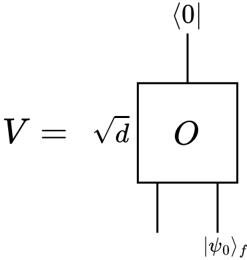
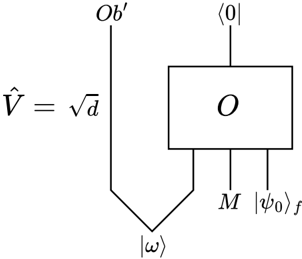
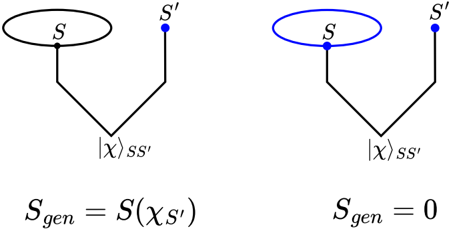
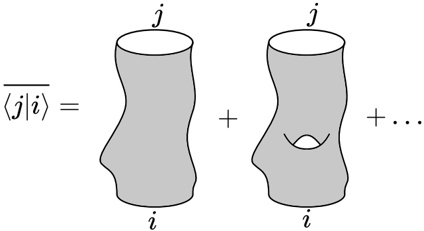
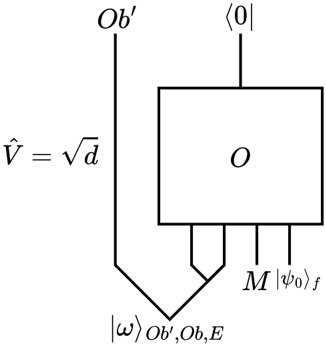
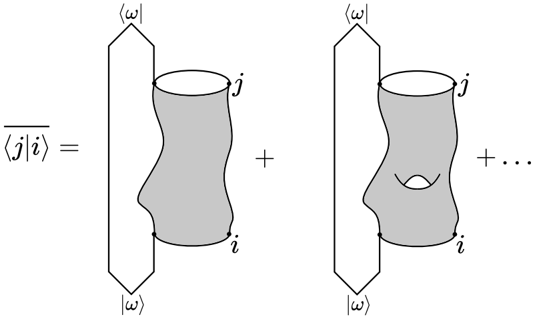
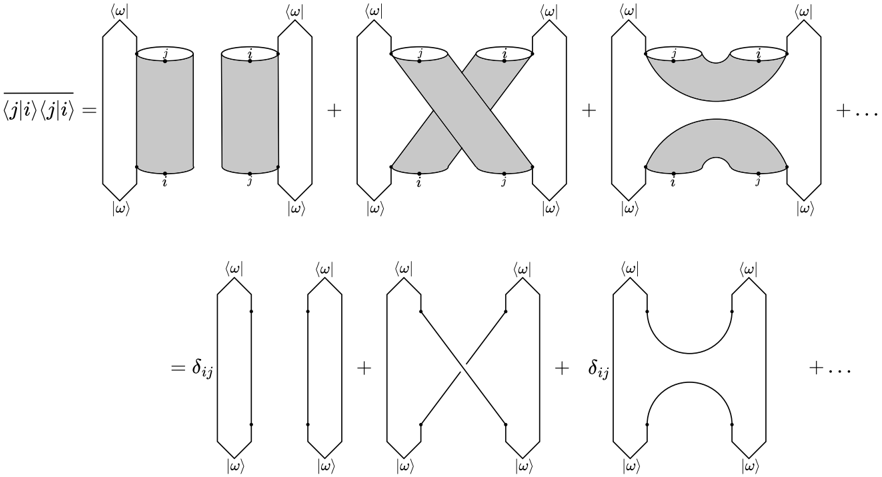
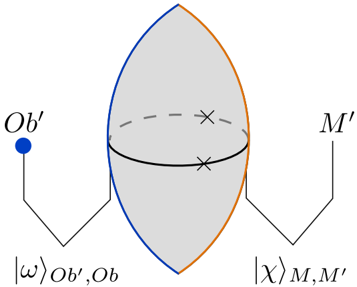

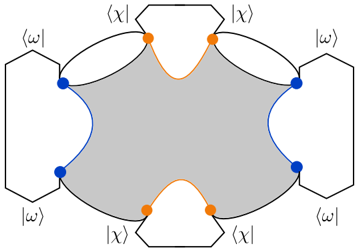
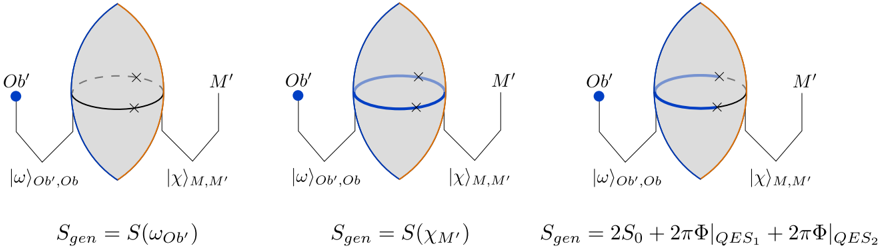
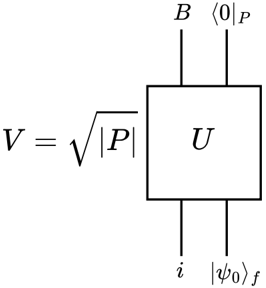
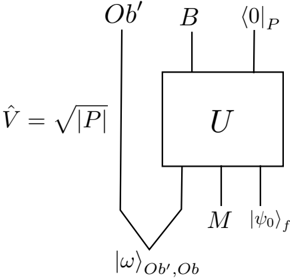
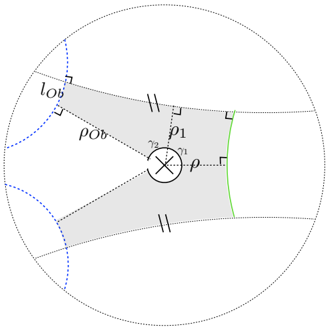
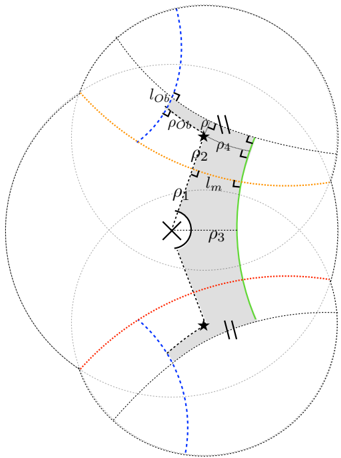
Verification
Claims the paper makes
The claims and statistics of this paper haven’t been checked yet.
Run the check — free, no account needed. It reads the open-access text and checks the sources it cites.
Claims other papers make about this one
Each is checked against this paper’s own text: does it say what the citing paper says it does?
In the citing paper
“In this sense, the setup of [6] and discussed here is equivalent to considering the setup of [52] after the cloning procedure has been carried out.”
From The baby universe is fine and the CFT knows it: on holography for closed universes (2025) · cites this paper as [52]
Self-check
Percentages, sums and reported differences re-computed from the paper’s own numbers.
The self-check needs the paper’s full text.
Citations
Cites
No references could be resolved yet.
Research works printed but not linked: 72
- G. Penington, Entanglement Wedge Reconstruction and the Information Paradox, JHEP 09 (2020) 002 [arXiv:1905.08255] [INSPIRE]. · DOI · Paper page
- A. Almheiri, N. Engelhardt, D. Marolf and H. Maxfield, The entropy of bulk quantum fields and the entanglement wedge of an evaporating black hole, JHEP 12 (2019) 063 [arXiv:1905.08762] [INSPIRE]. · DOI
- A. Almheiri, R. Mahajan, J. Maldacena and Y. Zhao, The Page curve of Hawking radiation from semiclassical geometry, JHEP 03 (2020) 149 [arXiv:1908.10996] [INSPIRE]. · DOI · Paper page
- A. Almheiri, R. Mahajan and J. Maldacena, Islands outside the horizon, arXiv:1910.11077 [INSPIRE]. · DOI · Paper page
- G. Penington, S.H. Shenker, D. Stanford and Z. Yang, Replica wormholes and the black hole interior, JHEP 03 (2022) 205 [arXiv:1911.11977] [INSPIRE]. · DOI · Paper page
- A. Almheiri et al., Replica Wormholes and the Entropy of Hawking Radiation, JHEP 05 (2020) 013 [arXiv:1911.12333] [INSPIRE]. · DOI · Paper page
- A. Almheiri et al., The entropy of Hawking radiation, Rev. Mod. Phys. 93 (2021) 035002 [arXiv:2006.06872] [INSPIRE]. · DOI · Paper page
- C. Akers and G. Penington, Quantum minimal surfaces from quantum error correction, SciPost Phys. 12 (2022) 157 [arXiv:2109.14618] [INSPIRE]. · DOI
- C. Akers et al., The black hole interior from non-isometric codes and complexity, JHEP 06 (2024) 155 [arXiv:2207.06536] [INSPIRE]. · DOI
- I.H. Kim and J. Preskill, Complementarity and the unitarity of the black hole S-matrix, JHEP 02 (2023) 233 [arXiv:2212.00194] [INSPIRE]. · DOI
- A. Kar, Non-isometric quantum error correction in gravity, JHEP 02 (2023) 195 [arXiv:2210.13476] [INSPIRE]. · DOI
- J. Chandra and T. Hartman, Toward random tensor networks and holographic codes in CFT, JHEP 05 (2023) 109 [arXiv:2302.02446] [INSPIRE]. · DOI
- D. Marolf and A.C. Wall, Eternal Black Holes and Superselection in AdS/CFT, Class. Quant. Grav. 30 (2013) 025001 [arXiv:1210.3590] [INSPIRE]. · DOI
- A. Almheiri et al., An Apologia for Firewalls, JHEP 09 (2013) 018 [arXiv:1304.6483] [INSPIRE]. · DOI · Paper page
- K. Papadodimas and S. Raju, Remarks on the necessity and implications of state-dependence in the black hole interior, Phys. Rev. D 93 (2016) 084049 [arXiv:1503.08825] [INSPIRE]. JHEP02(2026)108 · DOI
- I. Kourkoulou and J. Maldacena, Pure states in the SYK model and nearly-AdS 2 gravity, arXiv:1707.02325 [INSPIRE]. · DOI · Paper page
- A. Almheiri, Holographic Quantum Error Correction and the Projected Black Hole Interior, arXiv:1810.02055 [INSPIRE]. · DOI
- D. Marolf and H. Maxfield, Transcending the ensemble: baby universes, spacetime wormholes, and the order and disorder of black hole information, JHEP 08 (2020) 044 [arXiv:2002.08950] [INSPIRE]. · DOI
- J. McNamara and C. Vafa, Baby Universes, Holography, and the Swampland, arXiv:2004.06738 [INSPIRE]. · DOI · Paper page
- M. Usatyuk, Z.-Y. Wang and Y. Zhao, Closed universes in two dimensional gravity, SciPost Phys. 17 (2024) 051 [arXiv:2402.00098] [INSPIRE]. · DOI
- J.A. Wheeler, Beyond the black hole, in Some strangeness in the proportion, Harry Woolf ed., Addison Wesley Publishing Company (1980) 341-375.
- J. Hartle and T. Hertog, The Observer Strikes Back, in the proceedings of the Philosophy of Cosmology UK/US Conference, Tenerife, Spain, September 12-16 (2014) [DOI:10.1017/9781316535783.010] [arXiv:1503.07205] [INSPIRE]. · DOI
- V. Chandrasekaran, R. Longo, G. Penington and E. Witten, An algebra of observables for de Sitter space, JHEP 02 (2023) 082 [arXiv:2206.10780] [INSPIRE]. · DOI
- E. Witten, Algebras, regions, and observers, Proc. Symp. Pure Math. 107 (2024) 247 [arXiv:2303.02837] [INSPIRE]. · DOI
- E. Shaghoulian, Quantum gravity and the measurement problem in quantum mechanics, arXiv:2305.10635 [INSPIRE]. · DOI
- J. Maldacena, Real observers solving imaginary problems, arXiv:2412.14014 [INSPIRE]. · DOI
- K. Jensen, S. Raju and A.J. Speranza, Holographic observers for time-band algebras, JHEP 06 (2025) 242 [arXiv:2412.21185] [INSPIRE]. · DOI
- A. Almheiri, X. Dong and D. Harlow, Bulk Locality and Quantum Error Correction in AdS/CFT, JHEP 04 (2015) 163 [arXiv:1411.7041] [INSPIRE]. · DOI · Paper page
- D. Harlow, The Ryu-Takayanagi Formula from Quantum Error Correction, Commun. Math. Phys. 354 (2017) 865 [arXiv:1607.03901] [INSPIRE]. · DOI
- D. Harlow and T. Numasawa, Gauging spacetime inversions in quantum gravity, arXiv:2311.09978 [INSPIRE]. · DOI
- D. Harlow and L. Susskind, Crunches, Hats, and a Conjecture, arXiv:1012.5302 [INSPIRE]. · DOI
- T. Banks, W. Fischler and S. Paban, Recurrent nightmares? Measurement theory in de Sitter space, JHEP 12 (2002) 062 [hep-th/0210160] [INSPIRE]. · DOI
- X. Dong, X.-L. Qi, Z. Shangnan and Z. Yang, Effective entropy of quantum fields coupled with gravity, JHEP 10 (2020) 052 [arXiv:2007.02987] [INSPIRE]. · DOI
- A. Sahu and M. Van Raamsdonk, Holographic black hole cosmologies, JHEP 05 (2025) 233 [arXiv:2411.14673] [INSPIRE]. JHEP02(2026)108 · DOI
- S. Antonini, P. Simidzija, B. Swingle and M. Van Raamsdonk, Cosmology from the vacuum, Class. Quant. Grav. 41 (2024) 045008 [arXiv:2203.11220] [INSPIRE]. · DOI
- S. Antonini, M. Sasieta and B. Swingle, Cosmology from random entanglement, JHEP 11 (2023) 188 [arXiv:2307.14416] [INSPIRE]. · DOI
- S. Antonini and P. Rath, Do holographic CFT states have unique semiclassical bulk duals?, Int. J. Mod. Phys. D 34 (2025) 2544025 [arXiv:2408.02720] [INSPIRE]. · DOI
- V. Balasubramanian, Y. Nomura and T. Ugajin, De Sitter space is sometimes not empty, JHEP 02 (2024) 135 [arXiv:2308.09748] [INSPIRE]. · DOI
- D. Marolf, On the nature of ensembles from gravitational path integrals, J. Phys. A 58 (2025) 035204 [arXiv:2407.04625] [INSPIRE]. · DOI
- N. Engelhardt and A.C. Wall, Quantum Extremal Surfaces: Holographic Entanglement Entropy beyond the Classical Regime, JHEP 01 (2015) 073 [arXiv:1408.3203] [INSPIRE]. · DOI
- V. Balasubramanian, A. Lawrence, J.M. Magan and M. Sasieta, Microscopic Origin of the Entropy of Black Holes in General Relativity, Phys. Rev. X 14 (2024) 011024 [arXiv:2212.02447] [INSPIRE]. · DOI
- P. Saad, S.H. Shenker and D. Stanford, JT gravity as a matrix integral, arXiv:1903.11115 [INSPIRE]. · DOI · Paper page
- J.M. Maldacena and L. Maoz, Wormholes in AdS, JHEP 02 (2004) 053 [hep-th/0401024] [INSPIRE]. · DOI
- B. McInnes, Quintessential Maldacena-Maoz cosmologies, JHEP 04 (2004) 036 [hep-th/0403104] [INSPIRE]. · DOI
- M. Van Raamsdonk, Comments on wormholes, ensembles, and cosmology, JHEP 12 (2021) 156 [arXiv:2008.02259] [INSPIRE]. · DOI
- S.R. Coleman, Black holes as red herrings: Topological fluctuations and the loss of quantum coherence, Nucl. Phys. B 307 (1988) 867 [INSPIRE]. · DOI · Paper page
- E. Gesteau and M.J. Kang, Holographic baby universes: an observable story, arXiv:2006.14620 [INSPIRE]. · DOI
- W.H. Zurek, Decoherence, einselection, and the quantum origins of the classical, Rev. Mod. Phys. 75 (2003) 715 [quant-ph/0105127] [INSPIRE]. · DOI
- J. Watrous, The Theory of Quantum Information, Cambridge University Press (2018).
- D.L. Danielson, G. Satishchandran and R.M. Wald, Gravitationally mediated entanglement: Newtonian field versus gravitons, Phys. Rev. D 105 (2022) 086001 [arXiv:2112.10798] [INSPIRE]. · DOI
- D.L. Danielson, G. Satishchandran and R.M. Wald, Black holes decohere quantum superpositions, Int. J. Mod. Phys. D 31 (2022) 2241003 [arXiv:2205.06279] [INSPIRE]. · DOI
- A. Biggs and J. Maldacena, Comparing the decoherence effects due to black holes versus ordinary matter, arXiv:2405.02227 [INSPIRE]. · DOI
- W.K. Wootters and W.H. Zurek, A single quantum cannot be cloned, Nature 299 (1982) 802 [INSPIRE]. · DOI · Paper page
- R. Jackiw, Lower Dimensional Gravity, Nucl. Phys. B 252 (1985) 343 [INSPIRE]. · DOI · Paper page
- C. Teitelboim, Gravitation and Hamiltonian Structure in Two Space-Time Dimensions, Phys. Lett. B 126 (1983) 41 [INSPIRE]. JHEP02(2026)108 · DOI · Paper page
- M. Srednicki, Chaos and Quantum Thermalization, Phys. Rev. E 50 (1994) 888 [cond-mat/9403051] [INSPIRE]. · DOI
- D.L. Jafferis, D.K. Kolchmeyer, B. Mukhametzhanov and J. Sonner, Jackiw-Teitelboim gravity with matter, generalized eigenstate thermalization hypothesis, and random matrices, Phys. Rev. D 108 (2023) 066015 [arXiv:2209.02131] [INSPIRE]. · DOI
- J. Pollack, M. Rozali, J. Sully and D. Wakeham, Eigenstate Thermalization and Disorder Averaging in Gravity, Phys. Rev. Lett. 125 (2020) 021601 [arXiv:2002.02971] [INSPIRE]. · DOI
- A. Belin and J. de Boer, Random statistics of OPE coefficients and Euclidean wormholes, Class. Quant. Grav. 38 (2021) 164001 [arXiv:2006.05499] [INSPIRE]. · DOI
- C. Akers and P. Rath, Holographic Renyi Entropy from Quantum Error Correction, JHEP 05 (2019) 052 [arXiv:1811.05171] [INSPIRE]. · DOI
- X. Dong, D. Harlow and D. Marolf, Flat entanglement spectra in fixed-area states of quantum gravity, JHEP 10 (2019) 240 [arXiv:1811.05382] [INSPIRE]. · DOI
- A. Goel, H.T. Lam, G.J. Turiaci and H. Verlinde, Expanding the Black Hole Interior: Partially Entangled Thermal States in SYK, JHEP 02 (2019) 156 [arXiv:1807.03916] [INSPIRE]. · DOI
- P. Hayden and G. Penington, Learning the Alpha-bits of Black Holes, JHEP 12 (2019) 007 [arXiv:1807.06041] [INSPIRE]. · DOI
- J.D. Bekenstein, A Universal Upper Bound on the Entropy to Energy Ratio for Bounded Systems, Phys. Rev. D 23 (1981) 287 [INSPIRE]. · DOI · Paper page
- H. Casini, Relative entropy and the Bekenstein bound, Class. Quant. Grav. 25 (2008) 205021 [arXiv:0804.2182] [INSPIRE]. · DOI
- M. Usatyuk and Y. Zhao, Closed universes, factorization, and ensemble averaging, JHEP 02 (2025) 052 [arXiv:2403.13047] [INSPIRE]. · DOI
- D.K. Kolchmeyer and H. Liu, Chaos and the Emergence of the Cosmological Horizon, arXiv:2411.08090 [INSPIRE]. · DOI
- B. Collins and P. Śniady, Integration with Respect to the Haar Measure on Unitary, Orthogonal and Symplectic Group, Commun. Math. Phys. 264 (2006) 773 [INSPIRE]. · DOI
- Z. Yang, The Quantum Gravity Dynamics of Near Extremal Black Holes, JHEP 05 (2019) 205 [arXiv:1809.08647] [INSPIRE]. · DOI
- P. Saad, Late Time Correlation Functions, Baby Universes, and ETH in JT Gravity, arXiv:1910.10311 [INSPIRE]. · DOI · Paper page
- D. Stanford, More quantum noise from wormholes, arXiv:2008.08570 [INSPIRE]. · DOI
- P.-S. Hsin, L.V. Iliesiu and Z. Yang, A violation of global symmetries from replica wormholes and the fate of black hole remnants, Class. Quant. Grav. 38 (2021) 194004 [arXiv:2011.09444] · DOI
Cited by
Sorted by citations
The baby universe is fine and the CFT knows it: on holography for closed universes
Antonini, S., Rath, P., Sasieta, M., Swingle, B., & Vilar López, A. (2025) · Journal of High Energy Physics · doi:10.1007/jhep12(2025)159 · Cited by 35
Further Evidence Against a Semiclassical Baby Universe in AdS/CFT
Engelhardt, N., & Gesteau, E. (2025) · arXiv · doi:10.48550/arxiv.2504.14586 · Cited by 28
Metadata
- Authors
- Harlow, D., Usatyuk, M., & Zhao, Y.
- Venue
- arXiv
- Publisher
- arXiv
- Published
- 2025
- arXiv
- 2501.02359
- References
- 0
- Type
- Preprint
About these checks
Registry, retraction, Cites and statistics results are computed, not judged, with one exception: a printed reference that no index lists is read once by a model before it counts as a citation error. Claims are extracted by a model and kept only when their quote appears verbatim in the text; each cited source is then checked, with a model’s help, for whether it says what the claim relies on. Those verdicts can be wrong — read the claim’s quote and the cited source before relying on one.
Statistics and arithmetic are recomputed, not judged.
Confidence bands are shown only for fields calibrated on our annotated test set. None is calibrated yet, so no band is shown.
What counts as a claim ›How we measure confidence ›How we check this ›
Are you an author, or do you see a problem with this page? Request a review
