

Surfing Online Safety: Assertiveness and Parental Involvement in Adolescents’ Attitudes Toward Cyber Grooming
Open accessThe DOI matches its Crossref record; 65 of the 73 references it cites were found in a registry or an index, and 3 are not checked yet; 19 of the 43 sources its claims cite were checked for support.
Abstract
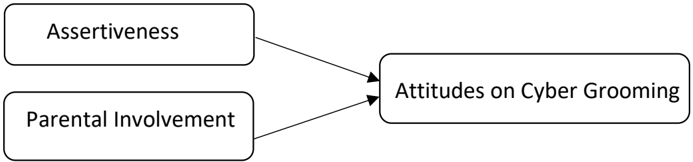
The development of digital technology presents serious challenges for adolescents, one of which is cyber grooming. Cyber grooming refers to manipulative attempts by perpetrators on social media to exploit victims emotionally or sexually. This study aims to examine the role of assertiveness and parental involvement in shaping adolescents’ attitudes toward cyber grooming. A quantitative approach was employed with a sample of 394 female adolescents aged 13–18 years who accessed social media for at least five hours per day. Multiple linear regression analysis revealed that assertiveness and parental involvement had a highly significant role in adolescents’ attitudes toward cyber grooming. The regression model accounted for 55.1% of the variance in attitudes toward cyber grooming. These findings highlight that the combination of individual skills (assertiveness) and family factors (parental involvement) serves as a key protective factor in fostering adolescents’ resilience against the risk of online exploitation.
Verified 2026-11-22 · 3 references not checked yet
Overview
CoChat Summary
TL;DR
In a sample of 394 female adolescents aged 13–18 who used social media at least five hours per day, assertiveness and parental involvement together explained 55.1% of the variance in attitudes toward cyber grooming, with both predictors significant at p < 0.01. The authors conclude that strengthening individual assertiveness and family-based parental involvement can support adolescents’ protection against online exploitation.
Key findings
- Multiple linear regression showed assertiveness and parental involvement had a highly significant simultaneous role in adolescents’ attitudes toward cyber grooming: F = 239.782, p = 0.000, with 55.1% of variance explained and 44.9% attributed to other variables not examined.
- Assertiveness had a positive and highly significant effect: B = 0.462, SE = 0.048, β = 0.379, t = 9.543, p = 0.000.
- Parental involvement also had a positive and highly significant effect: B = 0.291, SE = 0.025, β = 0.470, t = 11.811, p = 0.000.
- Categorization results showed most respondents were in the medium category for assertiveness (300/394, 76.14%), parental involvement (267/394, 67.77%), and attitude toward cyber grooming (338/394, 85.80%).
Methods
- Quantitative explanatory study using non-probability purposive sampling; 394 female adolescents aged 13–18 who accessed social media for at least five hours per day, recruited from junior and senior high schools in Pringsewu Regency.
- Researcher-constructed scales were piloted with 130 respondents outside the main sample: Assertiveness Scale (13 items, Cronbach’s α = 0.772), Parental Involvement Scale (25 items, α = 0.908), and Attitude Toward Cyber Grooming Scale (17 items, α = 0.791).
- Data were analyzed with multiple linear regression after classical assumption tests (normality, linearity, multicollinearity, heteroscedasticity) using IBM SPSS Statistics 25.
Limitations
- The paper states that respondents came from an adolescent group with specific demographic characteristics, so findings cannot yet be generalized to all age groups or socio-cultural backgrounds.
- The paper states that data were obtained through self-report scales, which are prone to social desirability bias, so respondents may have given socially acceptable answers rather than reflecting actual conditions.
- The paper states that only two independent variables were examined—assertiveness and parental involvement—and suggests future research on digital literacy, peer support, religiosity, and self-control. Evident from the text: the sample is restricted to female adolescents aged 13–18 in Pringsewu Regency who used social media at least five hours daily, limiting generalizability across genders, ages, and contexts.
Model-written summary. Check it against the paper before relying on it.
Integrity signals
Registry
Cites
Statistics
Figures
Verification
Claims the paper makes
11 Valid · 8 Not valid · 22 Not checked · 41 Own results and interpretations
At least one cited source doesn’t support this claim or points to a different paper, and none confirmed it — see the verdicts below.
In the paper
“Research by Livingstone and Helsper (2008) found that active mediation is more effective in preventing exposure to risky content than restrictive mediation that is purely technical.”
§ Surfing Online Safety: Assertiveness and Parental Involvement in Adolescents' Attitudes Toward Cyber Grooming > Discussion
What the sources say
- Disputedcites Livingstone and Helsper, 2008 matched to “Parental Mediation of Children's Internet Use” (2008) sourceExperimental — accuracy not yet measured
The Conclusions (page unavailable in our copy) say that neither active co-use nor software-based filtering and monitoring was effective in reducing online risk. The RQ 2 findings instead associate lower overall risk with restrictions on user-user interaction. The paper therefore does not find active mediation more effective than technical restrictions at preventing exposure to risky content. (LLM, conf=0.92)
Checked by a reasoning model — may be wrong.
plainstates a cause- Asserted: passes — The authors put it forward as true.
- Checkable: passes — It can be checked against evidence.
- Load-bearing: passes — The paper’s conclusions depend on it.
- Based: passes — The paper gives a reason why it holds.
- Disputed
Every source the paper cites for this claim was checked and supports it.
In the paper
“In facing this challenge, parental involvement plays a crucial protective role in safeguarding adolescents from the risks and threats of online grooming behavior (Dorasamy et al., 2021).”
§ Surfing Online Safety: Assertiveness and Parental Involvement in Adolescents' Attitudes Toward Cyber Grooming > INTRODUCTION
What the sources say
- Supportedcites Dorasamy et al., 2021 matched to “Parents’ Awareness on Online Predators: Cyber Grooming Deterrence” (2021) source
The Parental Factors section states that parental factors are crucial determinants of cyber grooming deterrence and describes parental monitoring and restrictions. The paper also recommends ways for parents to help adolescents avoid online predators. (LLM, conf=0.93)
plainstates a cause- Asserted: passes — The authors put it forward as true.
- Checkable: passes — It can be checked against evidence.
- Load-bearing: passes — The paper’s conclusions depend on it.
- Based: passes — The paper gives a reason why it holds.
- Supported
The cited sources that could be checked couldn’t confirm or dispute this claim.
In the paper
“Wefers et al. (2024) found that adolescents who hold negative attitudes toward inappropriate online communication tend to take preventive measures more promptly, such as blocking perpetrators, avoiding contact, or seeking assistance from adults.”
§ Surfing Online Safety: Assertiveness and Parental Involvement in Adolescents' Attitudes Toward Cyber Grooming > Discussion
What the sources say
- Could not verifycites Wefers et al., 2024 matched to “Understanding and deterring online child grooming: A qualitative study” (2024) sourceExperimental — accuracy not yet measured
The Results (Overview of Results and Social Aspects; page not provided) discuss adults who engaged in online grooming and factors that might deter their offending. Searches for adolescents’ attitudes, blocking perpetrators, avoiding contact, and seeking adult help found no passage linking those attitudes to adolescents’ preventive actions or their timing. (LLM, conf=0.76)
plainstates an association- Asserted: passes — The authors put it forward as true.
- Checkable: passes — It can be checked against evidence.
- Load-bearing: passes — The paper’s conclusions depend on it.
- Based: passes — The paper gives a reason why it holds.
- Could not verify
The cited sources support only part of this claim — read each source’s verdict below.
In the paper
“Female adolescents are significantly more at risk of becoming victims of cyber grooming compared to males (Schittenhelm et al., 2025).”
§ Surfing Online Safety: Assertiveness and Parental Involvement in Adolescents' Attitudes Toward Cyber Grooming > INTRODUCTION
What the sources say
- Partly supportedcites Schittenhelm et al., 2025 matched to “Cybergrooming Victimization Among Young People: A Systematic Review of Prevalence Rates, Risk Factors, and Outcomes” (2025) sourceExperimental — accuracy not yet measured
The Socio-Demographic Variables section (p. 18) reports that 16 of 25 studies examining gender found girls generally at higher risk than boys, or more vulnerable to certain aspects of cybergrooming. But six studies found no gender difference, and the review does not establish a uniformly statistically significant difference for female adolescents across cybergrooming victimization as a whole. (LLM, conf=0.85)
plainstates an association- Asserted: passes — The authors put it forward as true.
- Checkable: passes — It can be checked against evidence.
- Load-bearing: unclear — It is unclear whether the paper’s conclusions depend on it.
- Based: passes — The paper gives a reason why it holds.
- Partly supported
The cited sources that could be checked couldn’t confirm or dispute this claim.
In the paper
“Malandraki (2023) found that assertiveness is negatively correlated with vulnerability to online sexual abuse.”
§ Surfing Online Safety: Assertiveness and Parental Involvement in Adolescents' Attitudes Toward Cyber Grooming > INTRODUCTION
What the sources say
- Could not verifycites Malandraki, 2023 matched to “Training Students to Handle Emotional Load: Resilience Outcomes from a Graduate-Level Counseling Course – A Pilot study” (2023) sourceExperimental — accuracy not yet measured
The Introduction discusses assertive communication in professional practice, while the Results report a correlation between pre- and post-course resilience scores; neither addresses vulnerability to online sexual abuse. Searches for online sexual abuse and for an assertiveness–vulnerability correlation found no relevant passage in our copy. Page numbers were not provided. (LLM, conf=0.78)
plainstates an association- Asserted: passes — The authors put it forward as true.
- Checkable: passes — It can be checked against evidence.
- Load-bearing: passes — The paper’s conclusions depend on it.
- Based: passes — The paper gives a reason why it holds.
- Could not verify
49 more claims · 8 with their cited sources checked
Create a free account to see all 82 claims and to verify the 8 references still open.
- Probably not a substantial claim. 14
- It may state two separate claims as one. 17
- The quote only partly states this claim. 1
Citations
Cites
The theory of planned behavior
Ajzen, I. (1991) · Organizational Behavior and Human Decision Processes · doi:10.1016/0749-5978(91)90020-t · Cited by 134,657
The Ecology of Human Development: Experiments by Nature and Design
Bronfenbrenner, U. (1979) · Harvard University Press eBooks · doi:10.4159/9780674028845 · Cited by 26,084
Livingstone, S. (2008) · New Media & Society · doi:10.1177/1461444808089415 · Cited by 1,780
Parental Mediation of Children's Internet Use
Livingstone, S., & Helsper, E. J. (2008) · Journal of Broadcasting & Electronic Media · doi:10.1080/08838150802437396 · Cited by 1,352
Journal of Multidisciplinary Healthcare
(2020) · doi:10.2147/jmdh · Cited by 644
Khurana, A., Bleakley, A., Jordan, A. B., & Romer, D. (2015) · Journal of Youth and Adolescence · doi:10.1007/s10964-014-0242-4 · Cited by 192
Schoeps, K., Mónaco, E., Cotolí, A., & Montoya‐Castilla, I. (2020) · PLoS ONE · doi:10.1371/journal.pone.0227627 · Cited by 167
Social media: A digital social mirror for identity development during adolescence
Pérez-Torres, V. (2024) · Current Psychology · doi:10.1007/s12144-024-05980-z · Cited by 147
Parental Mediation and Adolescents’ Internet Use: The Moderating Role of Parenting Style
Ren, W., & Zhu, X. (2022) · Journal of Youth and Adolescence · doi:10.1007/s10964-022-01600-w · Cited by 116
Papalia, N., Mann, E., & Ogloff, J. R. P. (2021) · Child Maltreatment · doi:10.1177/1077559520932665 · Cited by 113
Adolescent connectedness: cornerstone for health and wellbeing
Blum, R. W., Lai, J., Martinez, M., & Jessee, C. (2022) · BMJ · doi:10.1136/bmj-2021-069213 · Cited by 113
Parental mediation in the age of mobile technology
Nagy, B., Kutrovátz, K., Király, G., & Rakovics, M. (2022) · Children & Society · doi:10.1111/chso.12599 · Cited by 91
Helsper, E. J., Veltri, G., & Livingstone, S. (2024) · New Media & Society · doi:10.1177/14614448241261945 · Cited by 85
A scoping review of child grooming strategies: pre- and post-internet
Ringenberg, T. R., Seigfried-Spellar, K. C., Rayz, J. M., & Rogers, M. K. (2022) · Child Abuse & Neglect · doi:10.1016/j.chiabu.2021.105392 · Cited by 83
Ruben, M. A., Stosic, M. D., Correale, J., & Blanch‐Hartigan, D. (2021) · Frontiers in Psychology · doi:10.3389/fpsyg.2020.611670 · Cited by 77
Varona, M. N., Muela, A., & Machimbarrena, J. M. (2022) · Addictive Behaviors · doi:10.1016/j.addbeh.2022.107400 · Cited by 77
Parenting and Problematic Social Media Use: A Systematic Review
Vossen, H. G. M., van den Eijnden, R. J. J. M., Visser, I., & Koning, I. M. (2024) · Current Addiction Reports · doi:10.1007/s40429-024-00559-x · Cited by 76
Validity of a measure of assertiveness.
Galassi, J. P., & Galassi, M. D. (1974) · Journal of Counseling Psychology · doi:10.1037/h0036313 · Cited by 75
Wachs, S., Jiskrova, G. K., Vazsonyi, A. T., Wolf, K. D., & Junger, M. (2016) · Psicología Educativa · doi:10.1016/j.pse.2016.01.002 · Cited by 72
Espelage, D. L., Leemis, R. W., Niolon, P. H., Kearns, M. C., Basile, K. C., & Davis, J. P. (2019) · Journal of Research on Adolescence · doi:10.1111/jora.12510 · Cited by 60
Rogers, C. R., Chen, X., Kwon, S., McElwain, N. L., & Telzer, E. H. (2021) · Developmental Cognitive Neuroscience · doi:10.1016/j.dcn.2021.101046 · Cited by 58
Adolescent Social Media Use and Emotional Intelligence: A Systematic Review
Piccerillo, L., & Digennaro, S. (2025) · Adolescent Research Review · doi:10.1007/s40894-024-00245-z · Cited by 55
Pan, Q., Lan, M., Tan, C. Y., Tao, S., Liang, Q., & Law, N. (2024) · Computers in Human Behavior · doi:10.1016/j.chb.2024.108164 · Cited by 52
Adolescents’ experiences in nature: Sources of everyday well-being
Puhakka, R., & Hakoköngäs, E. J. (2023) · Journal of Leisure Research · doi:10.1080/00222216.2023.2204346 · Cited by 50
Avşar, F., & Ayaz Alkaya, S. (2017) · Journal of Pediatric Nursing · doi:10.1016/j.pedn.2017.06.020 · Cited by 49
Zhu, X., Deng, C., & Bai, W. (2023) · Frontiers in Public Health · doi:10.3389/fpubh.2023.1190534 · Cited by 49
Adolescent Attachment Profiles Are Associated With Mental Health and Risk-Taking Behavior
Flykt, M., Vänskä, M., Punamäki, R.-L., Heikkilä, L., Tiitinen, A., Poikkeus, P., & Lindblom, J. (2021) · Frontiers in Psychology · doi:10.3389/fpsyg.2021.761864 · Cited by 39
The role of self-efficacy beliefs in dealing with misinformation among adolescents
Paciello, M., Corbelli, G., & D’Errico, F. (2023) · Frontiers in Psychology · doi:10.3389/fpsyg.2023.1155280 · Cited by 38
Shin, W., & Lwin, M. O. (2022) · Asian Journal of Communication · doi:10.1080/01292986.2022.2026992 · Cited by 38
Social Skills and Creativity as Elements That Enhance Resilience in Adolescence
Moreno, A. G., & Jurado, M. D. M. M. (2024) · Behavioral Sciences · doi:10.3390/bs14121158 · Cited by 35
Effects of a Brief Preventive Intervention in Cyberbullying and Grooming in Adolescents
Calvete, E., Cortazar, N., Fernández-González, L., Echezarraga, A., Beranuy, M., León, A., González-Cabrera, J., & Orue, I. (2021) · Psychosocial Intervention · doi:10.5093/pi2020a22 · Cited by 31
Chiu, J., & Quayle, E. (2022) · Child Abuse & Neglect · doi:10.1016/j.chiabu.2022.105600 · Cited by 30
A Preventive Intervention to Reduce Risk of Online Grooming Among Adolescents
Calvete, E., Orue, I., & Gámez-Guadi, M. (2022) · Psychosocial Intervention · doi:10.5093/pi2022a14 · Cited by 29
Achuthan, K., Muthupalani, S., Kolil, V. K., & Madathil, K. C. (2022) · Heliyon · doi:10.1016/j.heliyon.2022.e11813 · Cited by 25
Schittenhelm, C., Kops, M., Moosburner, M., Fischer, S. M., & Wachs, S. (2025) · Adolescent Research Review · doi:10.1007/s40894-024-00248-w · Cited by 25
Angelini, F., & Gini, G. (2025) · Frontiers in Digital Health · doi:10.3389/fdgth.2025.1497222 · Cited by 25
Yosep, I., Suryani, S., Mediani, H., Mardhiyah, A., Maulana, I., Hernawaty, T., & Hazmi, H. (2024) · Journal of Multidisciplinary Healthcare · doi:10.2147/jmdh.s460343 · Cited by 22
Forni (2021) · PubMed · doi:10.7416/ai.2020.2353 · Cited by 20
Throuvala, M. A., Griffiths, M. D., Rennoldson, M., & Kuss, D. J. (2021) · Frontiers in Education · doi:10.3389/feduc.2021.648512 · Cited by 19
Parents’ Awareness on Online Predators: Cyber Grooming Deterrence
Dorasamy, M., Kaliannan, M., Jambulingam, M., Ramadhan, I., & Sivaji, A. (2021) · The Qualitative Report · doi:10.46743/2160-3715/2021.4914 · Cited by 18
Sexting Among Australian Adolescents: Risk and Protective Factors
Howard, D., Jarman, H. K., Clancy, E. M., Renner, H. M., Smith, R., Rowland, B., Toumbourou, J. W., Fuller‐Tyszkiewicz, M., & Klettke, B. (2023) · Journal of Youth and Adolescence · doi:10.1007/s10964-023-01827-1 · Cited by 17
The Case for Addressing Emotional Resilience in Graduate Student Training
Malandraki, J. B. (2022) · Perspectives of the ASHA Special Interest Groups · doi:10.1044/2021_persp-21-00116 · Cited by 16
Relational Aspects of Parental Involvement to Support Educational Outcomes
Jeynes, W. H. (2022) · Routledge eBooks · doi:10.4324/9781003128434 · Cited by 16
Anikiej-Wiczenbach, P., Kaźmierczak, M., & Czerwiński, S. (2024) · Health Psychology Report · doi:10.5114/hpr/181511 · Cited by 12
Online Delinquent Behaviors of Adolescents: Parents as Potential “Influencers”?
Wissink, I. B., Asscher, J. J., & Stams, G. J. J. M. (2023) · International Journal of Offender Therapy and Comparative Criminology · doi:10.1177/0306624x231206521 · Cited by 11
Willems, R. A., Smith, P. K., Culbert, C., Purdy, N., Hamilton, J., Völlink, T., Scheithauer, H., Fiedler, N., Brighi, A., Menin, D., et al. (2023) · Children · doi:10.3390/children10111780 · Cited by 9
Understanding and deterring online child grooming: A qualitative study
Wefers, S., Dieseth, T., George, E., Øverland, I., Jolapara, J., McAree, C., & Findlater, D. (2024) · Sexual Offending: Theory, Research, and Prevention · doi:10.5964/sotrap.13147 · Cited by 8
Allison, K., Dawson, R., Messias, D. K. H. F. N., Culley, J., & Brown, N. K. (2023) · Journal of Early Adolescence · doi:10.1177/02724316231212560 · Cited by 7
Aktu, Y. (2024) · Child Abuse Review · doi:10.1002/car.70007 · Cited by 7
Cyberbullying and its protective and risk factors among Polish adolescents
Łosiak-Pilch, J., Grygiel, P., Ostafińska-Molik, B., & Wysocka, E. (2022) · Current Issues in Personality Psychology · doi:10.5114/cipp.2021.111404 · Cited by 6
Adolescent Roles and Reactions to Online Sexual Harassment: Insights from a Croatian deSHAME Study
Ramljak, T., Vejmelka, L., & Matković, R. (2025) · Psychology International · doi:10.3390/psycholint7010026 · Cited by 6
Fakkel, M., Branje, S., Vollebergh, W. A. M., Stevens, G., & Peeters, M. (2024) · Emerging Adulthood · doi:10.1177/21676968241257585 · Cited by 6
Nikel, Ł. (2025) · International Journal of Environmental Research and Public Health · doi:10.3390/ijerph22050760 · Cited by 5
Hanifah, R., Saikhoni, S., Wigati, M., Wilantika, R., & Syaifussalam, M. L. (2024) · Jurnal Psikologi Perseptual · doi:10.24176/perseptual.v9i1.12380 · Cited by 5
Self-citationUnderstanding facilitators for assertiveness among college students in India – a qualitative study
Goel, A., Padickaparambil, S., Sreelakshmi, E. S., & Pothiyil, D. I. (2024) · Current Psychology · doi:10.1007/s12144-024-05763-6 · Cited by 4
Morales-Álvarez, A., Valdés-Cuervo, A. A., & Parra-Pérez, L. G. (2025) · Cyberpsychology: Journal of Psychosocial Research on Cyberspace · doi:10.5817/cp2025-1-2 · Cited by 4
A Theory of Parental Involvement Based on the Results of Meta-Analyses1
Jeynes, W. H. (2022) · Routledge eBooks · doi:10.4324/9781003128434-2 · Cited by 4
Dinamika Psikologis Anak Remaja Awal Pengguna Media Sosial
Suminta, R. R., & Sa’adati, T. I. (2024) · Jurnal Penelitian Psikologi · doi:10.29080/jpp.v15i1.1197 · Cited by 4
Связи зависимости от смартфона с личностными качествами и свойствами белорусов и россиян
Шейнов, В. П., Аркадьевна, Н. Н., Викторовна, Б. Т., & Девицын, А. С. (2022) · Российский психологический журнал · doi:10.21702/rpj.2022.2.5 · Cited by 3
The Multidimensional Online Grooming Questionnaire
Gámez‐Guadix, M., Martínez‐Bacaicoa, J., & Almendros, C. (2022) · Springer eBooks · doi:10.1007/978-3-030-98711-4_121-1 · Cited by 3
Oghounu, E. (2025) · DELSU Journal of Educational Research and Development · doi:10.61448/djerd22140 · Cited by 2
Bauer Malandraki, J. (2023) · Teaching and Learning in Communication Sciences & Disorders · doi:10.61403/2689-6443.1291 · Cited by 2
Sulistiawati, S., Razak, A., & Alwi, A. (2024) · Jurnal Psikologi Terapan dan Pendidikan · doi:10.26555/jptp.v6i2.28819 · Cited by 1
Karmakar, N., Arora, S., & Franky, S. (2020) · Journal of Nursing Science & Practice · doi:10.37591/jonsp.v10i2.1978 · Cited by 1
Bandura, A. (1968). Social foundations of thought and action. Englewood Cliffs, NJ. https://books.google.co.id/books?hl=id&lr=&id=PdY9o3l5vpYC&oi=fnd&pg=PA94&dq=Bandura,+A.+(1986).+Social+foundations+of+thought+and+action.+Englewood+Cliffs,+NJ,+1986(23-28),+2.&ots=uHfWwQ3gfS&sig=Hdt5E7_W2LozkALhPmIu
(n.d.)
UnresolvedForni, G., Pietronigro, A., Tiwana, N., Gandolfi, C. E., Del Castillo, G., Mosillo, M., & Pellai, A. (2020). Little red riding hood in the social forest. Online grooming as a public health issue: a narrative review. Annali Di Igiene, Medicina Preventiva e Di Comunità,. https://doi.org/10.7416/ai.202
(n.d.)
UnresolvedIndonesia, K. P. A. (2002). PEDOMAN PERLINDUNGAN ANAK PEMBELA HAM. https://www.kpai.go.id/profil#:~:text=Tugas KPAI,kebijakan tentang penyelenggaraan Perlindungan Anak.
(n.d.)
UnresolvedKarmakar, N., Arora, S., & Franky, S. (2020). Effectiveness of assertiveness training programme on knowledge and attitude of adolescent girls regarding prevention of sexual abuse. Journal of Nursing Science & Practice, 10(2), 57–61. https://doi.org/10.37591/jonsp.v10i2.1978
(n.d.)
UnresolvedKumar, D., & Ramadass, S. . (2019). Relationship between Birth Order, Emotional Maturity and Communication Competence.
(n.d.)
UnresolvedMisrohatun, H. (2025). Remaja Enggan Berdiskusi dengan Orang Tua Tentang Pengalaman Digital. https://www.idntimes.com/tech/trend/remaja-enggan-berdiskusi-dengan-orang-tua-tentang-pengalaman-digital-00-h7csw-x956pd
(n.d.)
UnresolvedOdgers, C. L. (2021). Adolescent Development and Depression in the Digital Age : Frequently Asked Questions with Fact- Versus Fear-Based Answers Table of Contents. November.
(n.d.)
UnresolvedPasaribu, W., Apriliyanti, M. I., Santoso, A. T., Delu, A. R., Sos, S., Yuli Laraeni, S. K. M., ... & Rahma Saiyed, S. S. (2025). Pengaruh komunikasi dalam membentuk sikap dan perilaku. Cendikia Mulia Mandiri. Yayasan Cendekia Mulia Mandiri. https://books.google.co.id/books?hl=id&lr=&id=2hdJEQAAQBAJ
(n.d.)
UnresolvedShouhani, Fatemeh; Mihandoost, Zeinab; Mami, S. (2022). Department of Psychology, Ilam Branch, Islamic Azad University of Ilam, Ilam, Iran *. 9(2), 43–51.
(n.d.)
Unresolved
Cited by
Handayani, A., Yulianti, P. D., & Rakhmawati, E. (2026) · Bulletin of Counseling and Psychotherapy · doi:10.51214/002026081756000 · Cited by 1
Beyond Defence: Conceptualising Adolescents’ Digital Resilience in Cybersecurity Ecosystem
Radebe, F. M. (2026) · Communications in computer and information science · doi:10.1007/978-3-032-33997-3_38
Metadata
- Authors
- Hanifah, R., & Wigati, M.
- Affiliations
- Aisyah University (ID)
- Venue
- Bulletin of Counseling and Psychotherapy
- Publisher
- Kuras Institute
- Published
- 2025-09-21
- Volume
- 7
- Issue
- 2
- ISSN
- 2656-1050 (ISSN-L)
- OpenAlex
- W7084122684
- Cited by
- 2
- References
- 69
- Citations by year
- 2026: 2
- FWCI
- 1.98
- Type
- journal article
- Language
- en
- Open access
- gold
- doi.org
- Locations
- Bulletin of Counseling and Psychotherapy (publishedVersion, cc-by)
- DOAJ (DOAJ: Directory of Open Access Journals) (submittedVersion, cc-by-sa)
- Topics
- Social Sciences › Sociology and Political Science › Impact of Technology on Adolescents
- Social Sciences › Psychology › Social Psychology › Bullying, Victimization, and Aggression
- Social Sciences › Law › Cybercrime and Law Enforcement Studies
- Keywords
- online grooming, online safety, assertiveness, parental involvement, adolescents, social media use, online sexual exploitation, adolescent girls, protective factors, resilience
About these checks
Registry, retraction, Cites and statistics results are computed, not judged, with one exception: a printed reference that no index lists is read once by a model before it counts as a citation error. Claims are extracted by a model and kept only when their quote appears verbatim in the text; each cited source is then checked, with a model’s help, for whether it says what the claim relies on. Those verdicts can be wrong — read the claim’s quote and the cited source before relying on one.
The claim verdicts this report counts are experimental: their accuracy is not yet measured.
A language model drew the claims from the paper on 2026-10-10, under version 3 of the claim definition (model deepseek-v4.1-flash, prompt extract-v3).
A second model labelled each claim on 2026-10-10 (model jev-1.13-20260917, definition revision gold-guideline-v0.2).
Cited sources are checked with a language model’s help (gpt-6-sol).
Statistics and arithmetic are recomputed, not judged.
Confidence bands are shown only for fields calibrated on our annotated test set. None is calibrated yet, so no band is shown.
What counts as a claim ›How we measure confidence ›How we check this ›
Are you an author, or do you see a problem with this page? Request a review
Data sources
Bibliographic data: Semantic Scholar, OpenAlex, Crossref.
Contains information from the Semantic Scholar Academic Graph Datasets, made available under the ODC Attribution License (ODC-BY 1.0).
Semantic Scholar’s data is described in: Kinney, R., et al. (2023). The Semantic Scholar Open Data Platform. arXiv:2301.10140.
