

A statistical test suite for random and pseudorandom number generators for cryptographic applications
Open accessThe DOI matches its Crossref record; 33 of the 34 references it cites were found in a registry or an index; none of the 14 sources its claims cite is checked for support yet.
Abstract
The Information Technology Laboratory (ITL) at the National Institute of Standards and Technology (NIST) promotes the U.S. economy and public welfare by providing technical leadership for the nation's measurement and standards infrastructure. ITL develops tests, test methods, reference data, proof of concept implementations, and technical analysis to advance the development and productive use of information technology. ITL's responsibilities include the development of technical, physical, administrative, and management standards and guidelines for the cost-effective security and privacy of sensitive unclassified information in Federal computer systems.
Overview
CoChat Summary
TL;DR
This NIST Special Publication 800-22 Revision 1a presents a suite of 15 statistical tests for evaluating whether binary sequences produced by random or pseudorandom number generators are suitable for cryptographic applications. It provides test purposes, mathematical descriptions, examples, and guidance for interpreting P-values, while cautioning that statistical testing is only a first step and cannot replace cryptanalysis.
Key findings
- The suite consists of 15 tests: Frequency (Monobit), Frequency within a Block, Runs, Longest Run of Ones, Binary Matrix Rank, Discrete Fourier Transform (Spectral), Non-overlapping Template Matching, Overlapping Template Matching, Maurer’s “Universal Statistical,” Linear Complexity, Serial, Approximate Entropy, Cumulative Sums, Random Excursions, and Random Excursions Variant. The Frequency test is recommended first because it supplies the most basic evidence of non-randomness.
- Each test uses the null hypothesis \(H_0\) that the sequence is random; if P-value \(\ge \alpha\), the sequence is accepted as random, and if P-value \(<\alpha\), it is rejected. Examples use \(\alpha=0.01\), and NIST recommends \(\alpha\) in the range [0.001, 0.01].
- The document states that no finite set of statistical tests is “complete,” that statistical testing cannot absolutely certify a generator, and that statistical testing cannot serve as a substitute for cryptanalysis.
- Sample data files are 1,000,000 bits (binary expansions of \(e\), \(\pi\), \(\sqrt{2}\), \(\sqrt{3}\), and a G-SHA-1 sequence); reported example P-values include Frequency for \(\pi\) = 0.578211, for \(e\) = 0.953749, and for G-SHA-1 = 0.604458.
Methods
- Design: The NIST Statistical Test Suite is an ANSI C reference implementation of 15 tests; each test defines a test statistic, a reference distribution (e.g., normal, half-normal, chi-square), a P-value, and a decision rule at the 1% level.
- Data or sample: Tests apply to binary sequences from hardware or software RNGs/PRNGs; sample files are 1,000,000 bits, while many worked examples use small illustrative lengths such as \(n=100\).
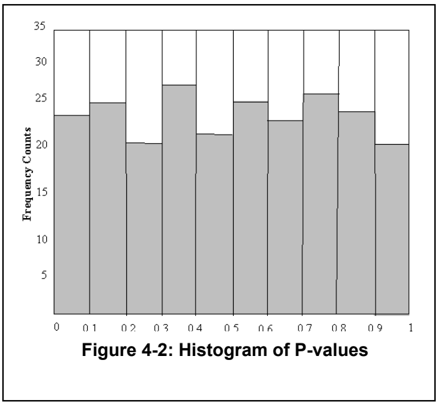
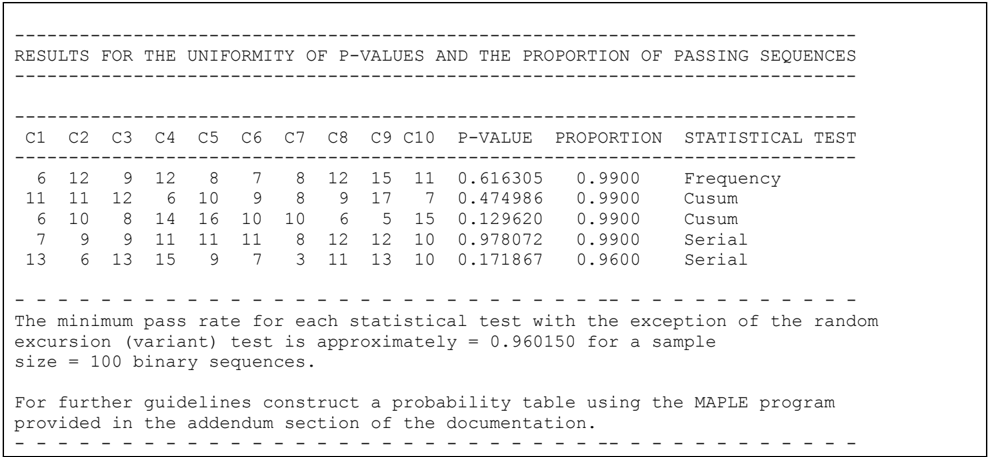
- Main analysis: For each sequence, P-values are computed and compared to \(\alpha\); empirical interpretation examines the proportion of sequences passing a test and the uniformity of P-values. A multiple-test dependence study applied 161 test P-values to Blum-Blum-Shub sequences of length 1,000,000 and used principal components/factor analysis, concluding there was no large redundancy among tests.
Limitations
- The paper states that no set of statistical tests can absolutely certify a generator as appropriate, that statistical testing cannot substitute for cryptanalysis, and that generator design and cryptanalysis are outside its scope.
- The paper states that many examples use small sample sizes for illustration only, e.g., \(n=10\), where the normal approximation is not really applicable; many tests rely on asymptotic reference distributions for large \(n\) (order \(10^3\) to \(10^7\)), and input parameter constraints apply.
- The text makes evident additional limitations: numerical precision can degrade for large incomplete gamma parameter \(a\); Maurer’s variance approximation can make the test 2.67 times more permissive than theoretically admitted; Random Excursions is discontinued if \(J<500\); and multiple tests can yield contradictory conclusions, as in the Random Excursions example where one state gave a non-random result while seven states gave random results.
Model-written summary. Check it against the paper before relying on it.
Integrity signals
Registry
Cites
Statistics
Figures

Verification
Claims the paper makes
0 Valid · 1 Not valid · 11 Not checked · 13 Own results and interpretations
A result the paper reports from its own data — it cites no other source for it, so there is none to check. The quote shows it is in the paper.
In the paper
“The asymptotic distribution of ( Ln -µ n ) / σ n along the sequence of even or odd values of n is that of a discrete random variable obtained via a mixture of two geometric random variables (one of them taking only negative values). Strictly speaking, the asymptotic distribution as such does not exist.”
A result the paper reports from its own data — it cites no other source for it, so there is none to check. The quote shows it is in the paper.
In the paper
“However, no set of statistical tests can absolutely certify a generator as appropriate for usage in a particular application, i.e., statistical testing cannot serve as a substitute for cryptanalysis.”
A result the paper reports from its own data — it cites no other source for it, so there is none to check. The quote shows it is in the paper.
In the paper
“This graph showed that there is no large redundancy among our tests.”
In the paper
“Ueli Maurer of the Department of Computer Science at Princeton University introduced this test in 1992. Maurer's test statistic relates closely to the per-bit entropy of the stream, which its author asserts is 'the correct quality measure for a secret-key source in a cryptographic application.'”
What the sources say
- Not matchedcites Maurer
This doesn’t read as a citation we can look up.
- Not matched
What the paper did — it cites no source for this, so there is none to check. The quote shows it is in the paper.
In the paper
“The test rejects the randomness hypothesis immediately if J is too small, i.e., if the following P-value is small:”
20 more claims
Create a free account to see all 25 claims and every source verdict.
Claims other papers make about this one
Each is checked against this paper’s own text: does it say what the citing paper says it does?
The source backs part of the claim, not all of it — or backs it for a different population, condition or comparison.
In the citing paper
“However, the latest version 2.1.2 [1], released in 2014, does not incorporate several modifications.”
From Checking the quality of approximation of p-values in statistical tests for random number generators by using a three-level test (2019) · cites this paper as [1]
Experimental — accuracy not yet measuredThe source backs part of the claim, not all of it — or backs it for a different population, condition or comparison.
In the citing paper
“The NIST test suite consists of 15 statistical tests for randomness of bit sequences, and its result is a list of 188 p -values.”
From Checking the quality of approximation of p-values in statistical tests for random number generators by using a three-level test (2019) · cites this paper as [1]
Experimental — accuracy not yet measuredThe cited source says what the claim attributes to it.
In the citing paper
“Note that the current implementation of the NIST test suite uses one-level or two-level tests, differently from the above experiments”
From Checking the quality of approximation of p-values in statistical tests for random number generators by using a three-level test (2019) · cites this paper as [1]
The cited source says what the claim attributes to it.
In the citing paper
“NIST SP-800.22 statistical test suite [90] and Die-hard test suite [91] and Test U01 [92] and AIS31 [93] are most common statistical test suites to evaluate their RNGs by researchers.”
From True Random Number Generators Using Electrical Noise (2019) · cites this paper as [90]
Self-check
Percentages, sums and reported differences re-computed from the paper’s own numbers.
Each contradiction between two passages listed here was confirmed by an independent check.
Rated minor: it would not touch a result — a value no result rests on, a p-value that stays on the same side of the significance level, or a conflict that is clerical, resolved elsewhere in the paper, or outside its own findings.
In the paper
§ 2.3.8 Example
“(input) τ = 0.02 (processing) π = 0.42 (processing) Vn(obs) = 52 (output) P-value = 0.500798 (conclusion) Since P-value ≥ 0.01 , accept the sequence as random.”
§ 2.3.4 Test Description
“If it can be shown that π -1 ≥τ , then the 2 Runs test need not be performed (i.e., the test should not have been run because of a failure to pass test 1, the Frequency (Monobit) test). If the test is not applicable, then the P-value is set to 0.0000.”
Rated minor: it would not touch a result — a value no result rests on, a p-value that stays on the same side of the significance level, or a conflict that is clerical, resolved elsewhere in the paper, or outside its own findings.
In the paper
§ 2.7.4 Test Description
“| 8-10 | 010 (hit) | 2 | 110 | 1 |”
§ 2.7.4 Test Description
“For the above example, if m = 3 and the template B = 001, then the examination proceeds as follows:”
Rated minor: it would not touch a result — a value no result rests on, a p-value that stays on the same side of the significance level, or a conflict that is clerical, resolved elsewhere in the paper, or outside its own findings.
In the paper
§ 2.9.3 Test Statistic and Reference Distribution
“f n : The sum of the log2 distances between matching Lbit templates, i.e., the sum of the number of digits in the distance between Lbit templates.”
§ 3.9 Maurer's 'Universal Statistical' Test
“Then it averages over all the expansion lengths by the number of test blocks.”
Rated minor: it would not touch a result — a value no result rests on, a p-value that stays on the same side of the significance level, or a conflict that is clerical, resolved elsewhere in the paper, or outside its own findings.
In the paper
§ Input Parameters:
“The parameters p , q and s are not fixed in code; thus, the user will not be able to reconstruct the original sequence because these values will vary (i.e., they are dependent on the system time).”
§ Input Parameters:
“The input parameters have been fixed so the code will reproduce the same results.”
Rated minor: it would not touch a result — a value no result rests on, a p-value that stays on the same side of the significance level, or a conflict that is clerical, resolved elsewhere in the paper, or outside its own findings.
In the paper
§ 5.5.2 Global Parameters
“| MAXNUMOFTEMPLATES | 40 | Non-overlapping Templates Test | | NUMOFTESTS | 16 | Max number of tests | | NUMOFGENERATORS | 12 | Max number of PRNGs |”
§ A.2 Configuration Information
“| 2. | #define MAXNUMOFTEMPLATES | 148 | | 3. | #define NUMOFTESTS | 15 | | 4. | #define NUMOFGENERATORS | 10 |”
2 more findings
Create a free account to see every finding of this check.
Citations
Cites
Handbook of Mathematical Functions
McQuarrie, D. A. (1966) · American Journal of Physics · doi:10.1119/1.1972842 · Cited by 40,433
Numerical recipes in C: the art of scientific computing
(1993) · Choice Reviews Online · doi:10.5860/choice.30-5638 · Cited by 17,933
Rayward-Smith, V. J. (1991) · Journal of the Operational Research Society · doi:10.1057/jors.1991.155 · Cited by 16,821
Handbook of applied cryptography
(1997) · Choice Reviews Online · doi:10.5860/choice.34-4512 · Cited by 10,357
Handbook of Mathematical Functions
(2018) · A Century of Excellence in MEASUREMENTS, STANDARDS, and TECHNOLOGY · doi:10.1201/9781351069397-39 · Cited by 9,062
A universal algorithm for sequential data compression
Ziv, J., & Lempel, A. (1977) · IEEE Transactions on Information Theory · doi:10.1109/tit.1977.1055714 · Cited by 5,456
The Art of Computer Programming
Worlton, W. J. (1968) · Nuclear Science and Engineering · doi:10.13182/nse68-a19548 · Cited by 2,251
Handbook of Applied Cryptography
Menezes, A. J., van Oorschot, P. C., & Vanstone, S. A. (2018) · CRC Press eBooks · doi:10.1201/9780429466335 · Cited by 1,770
Numerical Recipes in C-The Art of Scientific Computing.
G., W., Press, W. H., Flannery, B. P., Teukolsky, S. A., & Vetterling, W. T. (1989) · Mathematics of Computation · doi:10.2307/2008673 · Cited by 1,513
The Fourier Transform and its Applications
Cattermole, K. W. (1965) · Electronics and Power · doi:10.1049/ep.1965.0268 · Cited by 1,417
Cited by
Items 501–600 of 3,620
Luengo, E. A., & Villaizán, J. R. (2023) · Mathematics · doi:10.3390/math11234812 · Cited by 48
Wang, Y., & Nicol, T. (2015) · Computers & Security · doi:10.1016/j.cose.2015.05.005 · Cited by 40
A proposal for improving AES S-box with rotation and key-dependent
Juremi, J. B., Mahmod, R., & Sulaiman, S. (2012) · International Conference on Cyber Security, Cyber Warfare and Digital Forensic (CyberSec) · doi:10.1109/cybersec.2012.6246172 · Cited by 37
“Although AES uses the same three key size alternatives, it limits the block length to 128 bits [11].”
MethodEfficient neural chaotic generator for image encryption
Kassem, A., Hassan, H. A. H., Harkouss, Y., & Assaf, R. (2013) · Digital Signal Processing · doi:10.1016/j.dsp.2013.11.004 · Cited by 37
“Statistical analysis of the proposed neural chaotic generator Among the numerous standard tests for pseudo randomness, the most important one is the NIST test [26].”
A Physical Approach for Stochastic Modeling of TERO-Based TRNG
Haddad, P., Fischer, V., Bernard, F., & Nicolai, J. (2015) · Lecture notes in computer science · doi:10.1007/978-3-662-48324-4_18 · Cited by 42
Echeloned IJTAG data protection
Kan, S., Dworak, J., & Dunham, J. G. (2016) · doi:10.1109/asianhost.2016.7835558 · Cited by 37
Design and analysis of two stream ciphers based on chaotic coupling and multiplexing techniques
Jallouli, O., Assad, S. E., Chetto, M., & Lozi, R. (2017) · Multimedia Tools and Applications · doi:10.1007/s11042-017-4953-x · Cited by 37
Low-Latency Approach for Secure ECG Feature Based Cryptographic Key Generation
Moosavi, S. R., Nigussie, E., Levorato, M., et al. (2017) · IEEE Access · doi:10.1109/access.2017.2766523 · Cited by 37
“According to the authors, the generated physiological parameters pass the randomness measurement tests presented by the NIST test benchmark [26].”
BackgroundSpin-torque devices with hard axis initialization as Stochastic Binary Neurons
Ostwal, V., Debashis, P., Faria, R., Chen, Z., & Appenzeller, J. (2018) · Scientific Reports · doi:10.1038/s41598-018-34996-2 · Cited by 43
A Wide-Range Variation-Resilient Physically Unclonable Function in 28 nm
Liang, Z.-Y., Wei, H.-H., & Liu, T.-T. (2019) · IEEE Journal of Solid-State Circuits · doi:10.1109/jssc.2019.2942374 · Cited by 37
“In addition, the proposed PUF passes all the relevant NIST-applicable random tests [23].”
MethodJeon, D., Baek, J. H., Kim, Y., et al. (2019) · IEEE Journal of Solid-State Circuits · doi:10.1109/jssc.2019.2951415 · Cited by 37
“The proposed contact PUF is also evaluated based on the National Institute of Standards and Technology (NIST) SP 800-22 randomness tests, from which nine tests are possible with the number of PUF bits from 405 chips [40].”
BackgroundMethodPseudo Random Number Generation: a Reinforcement Learning approach
Pasqualini, L., & Parton, M. (2020) · Procedia Computer Science · doi:10.1016/j.procs.2020.03.057 · Cited by 49
Efficient physical layer key generation technique in wireless communications
Lin, R., Xu, L., Fang, H., & Huang, C. Z. (2020) · EURASIP Journal on Wireless Communications and Networking · doi:10.1186/s13638-019-1634-7 · Cited by 43
“16 Impact of α and σ on the bit disagreement rate this work, according to the bit size generated from our experiments, we exploit 5 NIST tests to evaluate the secret key.”
BackgroundMethodInfluentialCryptographically Secure Pseudo-Random Number Generator IP-Core Based on SHA2 Algorithm
Baldanzi, L., Crocetti, L., Falaschi, F., Bertolucci, M., Belli, J., Fanucci, L., & Saponara, S. (2020) · Sensors · doi:10.3390/s20071869 · Cited by 48
MobiKey: Mobility-Based Secret Key Generation in Smart Home
Wang, L., An, H., Zhu, H., et al. (2020) · IEEE Internet of Things Journal · doi:10.1109/jiot.2020.2986399 · Cited by 37
A hybrid algorithm for robust image steganography
Kaur, R., & Singh, B. (2020) · Multidimensional Systems and Signal Processing · doi:10.1007/s11045-020-00725-0 · Cited by 42
“The NIST consists of 15 empirical tests that are designed to analyse the randomness of binary sequence (0,1).”
MethodInfluentialUnified Analog PUF and TRNG Based on Current-Steering DAC and VCO
Danesh, M., Venkatasubramaniyan, A. B., Kapoor, G., Ramesh, N., Sadasivuni, S., Chandrasekaran, S. T., & Sanyal, A. (2020) · IEEE Transactions on Very Large Scale Integration (VLSI) Systems · doi:10.1109/tvlsi.2020.3011648 · Cited by 43
Differential cryptanalysis of image cipher using block-based scrambling and image filtering
Yu, F. Q., Gong, X., Li, H., & Wang, S. (2021) · Information Sciences · doi:10.1016/j.ins.2020.12.037 · Cited by 38
“Test Suite [28, 15].”
A new efficient permutation-diffusion encryption algorithm based on a chaotic map
Moreira Bezerra, J. I., Valduga de Almeida Camargo, V., & Molter, A. (2021) · Chaos, Solitons & Fractals · doi:10.1016/j.chaos.2021.111235 · Cited by 37
Generation of Tunable Stochastic Sequences Using the Insulator–Metal Transition
del Valle, J., Salev, P., Gariglio, S., Kalcheim, Y., Schuller, I. K., & Triscone, J. (2022) · Nano Letters · doi:10.1021/acs.nanolett.1c04404 · Cited by 46
GPUs and chaos: a new true random number generator
Teh, J. S., Samsudin, A., Almazrooie, M., & Akhavan, A. (2015) · Nonlinear Dynamics · doi:10.1007/s11071-015-2287-7 · Cited by 41
“These suites include the NIST SP 800-22 test suite [46], DIEHARD battery of tests [47] and the ENT test [48].”
MethodFast nondeterministic random bit generator based on weakly correlated physical events
Stipčević, M. (2004) · Review of Scientific Instruments · doi:10.1063/1.1809295 · Cited by 42
Efficient Image Chaotic Encryption Algorithm with No Propagation Error
Awad, A. (2010) · ETRI Journal · doi:10.4218/etrij.10.1510.0063 · Cited by 37
Observing the Randomness in RO-Based TRNG
Bochard, N., Bernard, F., & Fischer, V. (2009) · International Conference on ReConFigurable Computing and FPGAs (ReConFig) · doi:10.1109/reconfig.2009.57 · Cited by 42
“We have preferred the FIPS tests before the NIST test suite [7], because of the speed of execution and the size of files.”
BackgroundMethodInfluentialPseudorandom Bit Generation Using Coupled Congruential Generators
Katti, R., Kavasseri, R., & Sai, V. (2010) · IEEE Transactions on Circuits & Systems II Express Briefs · doi:10.1109/tcsii.2010.2041813 · Cited by 37
Sensor-Based Random Number Generator Seeding
Hong, S. L., & Liu, C. (2015) · IEEE Access · doi:10.1109/access.2015.2432140 · Cited by 43
“To evaluate the strength of the wash-rinse-spin generated accelerometer seeds against a known standard, the seeds are tested using the suite provided by NIST (National Institute of Standards and Technology) [12].”
MethodInfluentialMulti-valued Arbiters for quality enhancement of PUF responses on FPGA implementation
Zalivaka, S. S., Puchkov, A. V., Klybik, V. P., et al. (2016) · Asia and South Pacific Design Automation Conference (ASP-DAC) · doi:10.1109/aspdac.2016.7428066 · Cited by 36
“The randomness of a sequence of numbers can be assessed by the statistical test package NIST [15].”
MethodChaotic hash function based on circular shifts with variable parameters
Li, Y., & Li, X. (2016) · Chaos Solitons & Fractals · doi:10.1016/j.chaos.2016.08.014 · Cited by 38
Sayed, W. S., Radwan, A. G., Rezk, A. A., & Fahmy, H. A. H. (2017) · Complexity · doi:10.1155/2017/8692046 · Cited by 38
“The randomness of the PRNG is usually tested by the standard NIST suite [34] in order to ensure high security performance.”
MethodImpact of Aging on the Reliability of Delay PUFs
Karimi, N., Danger, J., & Guilley, S. (2018) · Journal of Electronic Testing · doi:10.1007/s10836-018-5745-6 · Cited by 36
“The amount of change can be extracted easily by finding Hamming distances of responses over time to evaluate the uniqueness and by evaluating the avalanche effect using statistical tests to evaluate the randomness [39].”
MethodEfficient and secure substitution box and random number generators over Mordell elliptic curves
Ullah, I., Azam, N. A., & Hayat, U. (2020) · Journal of Information Security and Applications · doi:10.1016/j.jisa.2020.102619 · Cited by 46
“The histogram test is a generalization of the Monobit test included in NIST STS [45].”
MethodA Low Power Circuit Design for Chaos-Key Based Data Encryption
Nguyen, N., Pham-Nguyen, L., Nguyen, B. M., & Kaddoum, G. (2020) · IEEE Access · doi:10.1109/access.2020.2998395 · Cited by 39
“When multiple sequences are available from the same generator, it is also possible to compute all the associated P-values and check the uniformity (χ2) of their distribution which is known as the second-level test [49].”
BackgroundPhysical-Layer-Security Box: a concept for time-frequency channel-reciprocity key generation
Zoli, M., Barreto, A. N., Köpsell, S., Sen, P., & Fettweis, G. P. (2020) · EURASIP Journal on Wireless Communications and Networking · doi:10.1186/s13638-020-01712-6 · Cited by 45
A 108 F2/Bit Fully Reconfigurable RRAM PUF Based on Truly Random Dynamic Entropy of Jitter Noise
Zhao, Q., Zheng, W., Zhao, X., Cao, Y., Zhang, F., & Law, M. K. (2020) · IEEE Transactions on Circuits and Systems I Regular Papers · doi:10.1109/tcsi.2020.3008407 · Cited by 42
Kordov, K., & Zhelezov, S. (2021) · PeerJ Computer Science · doi:10.7717/peerj-cs.380 · Cited by 44
“The fi rst software for randomness evaluation is NIST — Statistical Test Suite ( Bassham et al., 2010 ) and includes 17 base tests.”
Method2.7 Gb/s Secure Key Generation and Distribution Using Bidirectional Polarization Scrambler in Fiber
Zhang, L., Hajomer, A. A. E., Hu, W., & Yang, X. (2021) · IEEE Photonics Technology Letters · doi:10.1109/lpt.2021.3058118 · Cited by 36
A Novel Parallelizable Chaotic Image Encryption Scheme Based on Elliptic Curves
Abbas, A. M., Alharbi, A. A., & Ibrahim, S. (2021) · IEEE Access · doi:10.1109/access.2021.3068931 · Cited by 39
Jessa, M., & Matuszewski, Ł. (2011) · International Conference on ReConFigurable Computing and FPGAs (ReConFig) · doi:10.1109/reconfig.2011.35 · Cited by 36
An Integrated Dual Entropy Core True Random Number Generator
Çiçek, İ., Pusane, A. E., & Dündar, G. (2016) · IEEE Transactions on Circuits & Systems II Express Briefs · doi:10.1109/tcsii.2016.2568181 · Cited by 39
“22 statistical test suite was used for the statistical testing of the acquired bitstream [17].”
MethodSecurity analysis and new models on the intelligent symmetric key encryption
Zhou, L. Q., Chen, J., Zhang, Y., Su, C., & James, M. A. (2018) · Computers & Security · doi:10.1016/j.cose.2018.07.018 · Cited by 41
Boesgaard, M., Vesterager, M., Christensen, T., & Zenner, E. (2005) · Cited by 36
Towards accurate keyspace analysis of chaos-based image ciphers
Abba, A., Teh, J. S., & Alawida, M. (2024) · Multimedia Tools and Applications · doi:10.1007/s11042-024-18628-8 · Cited by 48
Som, S., Dutta, S., Singha, R., Kotal, A., & Palit, S. (2015) · Nonlinear Dynamics · doi:10.1007/s11071-015-1893-8 · Cited by 36
Sunada, S., Harayama, T., Davis, P., Tsuzuki, K., Arai, K., Yoshimura, K., & Uchida, A. (2012) · Chaos An Interdisciplinary Journal of Nonlinear Science · doi:10.1063/1.4754872 · Cited by 39
Inherent stochasticity in phase-change memory devices
Le Gallo, M., Tuma, T., Zipoli, F., Sebastian, A., & Eleftheriou, E. (2016) · 2016 46th European Solid-State Device Research Conference (ESSDERC) · doi:10.1109/essderc.2016.7599664 · Cited by 35
An ultra-low voltage chaos-based true random number generator for IoT applications
Hsueh, J.-C., & Chen, V. H.-C. (2019) · Microelectronics Journal · doi:10.1016/j.mejo.2019.03.013 · Cited by 38
Trustworthy Target Key Alteration Helping Counting-Based Secret Sharing Applicability
Alkhodaidi, T. M., & Gutub, A. (2020) · Arabian Journal for Science and Engineering · doi:10.1007/s13369-020-04422-9 · Cited by 35
“The p value is defined as the probability (under the null assumption of randomness) that the selected test statistic will assume values that are equal to or worse than the noted test statistic value when considering the null assumption, this p value is often called the “tail probability” [60].”
BackgroundMethodGonzález-Zapata, A. M., Tlelo‐Cuautle, E., Cruz-Vega, I., & Leon-Salas, W. D. (2021) · Nonlinear Dynamics · doi:10.1007/s11071-021-06532-x · Cited by 35
“To verify the randomness of the binary sequences, 15 different NIST SP 800-22 [44] tests are performed herein to a set of 1000 binary strings of 1,000,000 bits.”
MethodLouzzani, N., Boukabou, A., Bahi, H., & Boussayoud, A. (2021) · Chaos Solitons & Fractals · doi:10.1016/j.chaos.2021.111315 · Cited by 39
A 4T/Cell Amplifier-Chain-Based XOR PUF With Strong Machine Learning Attack Resilience
Zhang, J., Xu, C., Law, M. K., Jiang, Y., Zhao, X., Mak, P., & Martins, R. P. (2021) · IEEE Transactions on Circuits and Systems I Regular Papers · doi:10.1109/tcsi.2021.3114084 · Cited by 36
Design and geometric control of polynomial chaotic maps with any desired positive Lyapunov exponents
Fan, C., & Ding, Q. (2023) · Chaos Solitons & Fractals · doi:10.1016/j.chaos.2023.113258 · Cited by 38
Approaches to the classification of high entropy file fragments
Penrose, P., Macfarlane, R., & Buchanan, W. J. (2013) · Digital Investigation · doi:10.1016/j.diin.2013.08.004 · Cited by 44
“The NIST Statistical Test Suite (Rukhin et al., 2010) was used.”
MethodAES-Based BIST: Self-Test, Test Pattern Generation and Signature Analysis
Doulcier, M., Flottes, M.-L., & Rouzeyre, B. (2008) · IEEE International Workshop on Electronic Design, Test and Applications (DELTA) · doi:10.1109/delta.2008.86 · Cited by 35
Exploiting the Physical Environment for Securing the Internet of Things
Zenger, C., Zimmer, J., Pietersz, M., et al. (2015) · New Security Paradigms Workshop · doi:10.1145/2841113.2841117 · Cited by 35
Efficient and secure image encryption algorithm using 2D LIM map and Latin square matrix
Huang, X., Tang, J., & Zhang, Z. (2024) · Nonlinear Dynamics · doi:10.1007/s11071-024-10191-z · Cited by 35
“It can be demonstrated that the target sequence exhibits good randomness, when all the p-values of the sub-tests outweigh 0.01 [47].”
InfluentialThe Distribution of the Spectrum for the Discrete Fourier Transform Test Included in SP800-22
HAMANO, K. (2005) · IEICE Transactions on Fundamentals of Electronics, Communications and Computer Sciences · doi:10.1093/ietfec/e88-a.1.67 · Cited by 34
A dynamic block image encryption using variable-length secret key and modified Henon map
Zhao, H., Xie, S.-C., Zhang, J., & Wu, T. (2021) · Optik · doi:10.1016/j.ijleo.2021.166307 · Cited by 41
A digital IC Random Number Generator with logic gates only
Guler, U., Ergun, S., & Dundar, G. (2010) · 2010 17th IEEE International Conference on Electronics, Circuits and Systems · doi:10.1109/icecs.2010.5724498 · Cited by 34
Secure key generation from OFDM subcarriers' channel responses
Zhang, J., Marshall, A., Woods, R., et al. (2014) · IEEE Globecom Workshops (GC Wkshps) · doi:10.1109/glocomw.2014.7063613 · Cited by 34
“We use a statistical test suite provided by National Institute of Standards and Technology (NIST) [21] to evaluate the randomness of the key sequence generated from the subcar-rier’s channel response, which is a popular randomness test technique employed in key generation [2], [3], [9], [11], [22].”
MethodSecuring First-Hop Data Provenance for Bodyworn Devices Using Wireless Link Fingerprints
Ali, S. T., Sivaraman, V., Ostry, D., et al. (2014) · IEEE Transactions on Information Forensics and Security · doi:10.1109/tifs.2014.2357998 · Cited by 34
ENHANCING ADVANCED ENCRYPTION STANDARD S-BOX GENERATION BASED ON ROUND KEY
Juremi, J. B., & Sulaiman, S. (2012) · International Journal of Cyber-Security and Digital Forensics · Cited by 43
Entropy Evaluation for Oscillator-Based True Random Number Generators
Ma, Y., Lin, J., Chen, T., Xu, C., Liu, Z., & Jing, J. (2014) · Lecture notes in computer science · doi:10.1007/978-3-662-44709-3_30 · Cited by 43
Chaotic cellular neural network‐based true random number generator
Karakaya, B., Çelik, V., & Gülten, A. (2017) · International Journal of Circuit Theory and Applications · doi:10.1002/cta.2374 · Cited by 34
Chen, H., Bayani, A., Akgül, A., et al. (2018) · Nonlinear Dynamics · doi:10.1007/s11071-018-4162-9 · Cited by 34
Designing a pseudorandom bit generator based on LFSRs and a discrete chaotic map
Alhadawi, H. S., Zolkipli, M. F., Ismail, S. M., & Lambić, D. (2019) · Cryptologia · doi:10.1080/01611194.2018.1548390 · Cited by 42
“These tests — namely, NIST 800-22, DIEHARD, and TestU01 — are performed to verify the randomness of the generated sequences (Rukhin et al. 2001; Marsaglia 1998; L ’ Ecuyer and Simard 2007).”
MethodMondal, B., & Mandal, T. (2020) · Multimedia Tools and Applications · doi:10.1007/s11042-019-08352-z · Cited by 35
From Chaos to Pseudorandomness: A Case Study on the 2-D Coupled Map Lattice
Wang, Y., Liu, Z., Zhang, L. Y., Pareschi, F., Setti, G., & Chen, G. (2021) · IEEE Transactions on Cybernetics · doi:10.1109/tcyb.2021.3129808 · Cited by 43
“NIST SP800-22: This is a statistical randomness test suite for binary sequences.”
MethodDesign and Analysis of FPGA-based PUFs with Enhanced Performance for Hardware-oriented Security
Anandakumar, N. N., Hashmi, M., & Sanadhya, S. K. (2022) · ACM Journal on Emerging Technologies in Computing Systems · doi:10.1145/3517813 · Cited by 43
Encrypting Multiple Images With an Enhanced Chaotic Map
Singh, L. D., Thingbaijam, R., Singh, K. M., & Alawida, M. (2022) · IEEE Access · doi:10.1109/access.2022.3199738 · Cited by 45
“The NIST test is proposed by Andrew et al. [41] and it consists of 15 different tests.”
MethodFang, X., Wetzel, B., Mérolla, J.-M., Dudley, J. M., Larger, L., Guyeux, C., & Bahi, J. M. (2014) · IEEE Transactions on Circuits and Systems I Regular Papers · doi:10.1109/tcsi.2013.2284001 · Cited by 41
A Sketching Interface for Sitting Pose Design in the Virtual Environment
Lin, J., Igarashi, T., Mitani, J., Liao, M., & He, Y. (2012) · IEEE Transactions on Visualization and Computer Graphics · doi:10.1109/tvcg.2012.61 · Cited by 36
“We evaluate the randomness of the pseudorandom number generator using the NIST test suites [22].”
MethodImage Encryption Algorithm Based on a Chaotic Iterative Process
François, M., Grosges, T., Barchiesi, D., & Erra, R. (2012) · Applied Mathematics · doi:10.4236/am.2012.312262 · Cited by 37
An ultra-low power, reconfigurable, aging resilient RO PUF for IoT applications
Khan, S., Shah, A. P., Gupta, N., et al. (2019) · Microelectronics Journal · doi:10.1016/j.mejo.2019.104605 · Cited by 34
“To evaluate the randomness of the proposed PUF we have used the PUF responses as input to the NIST randomness test suite [27].”
MethodCorrections of the NIST Statistical Test Suite for Randomness.
Kim, S.-J., Umeno, K., & Hasegawa, A. (2004) · Cited by 34
A novel method to improve the performance of chaos based evolutionary algorithms
Özkaynak, F. (2015) · Optik · doi:10.1016/j.ijleo.2015.09.098 · Cited by 34
Secret Key Generation Via Localization and Mobility
Güngör, O., Chen, F., & Koksal, C. E. (2014) · IEEE Transactions on Vehicular Technology · doi:10.1109/tvt.2014.2342714 · Cited by 33
Unique file identification in the National Software Reference Library
Mead, S. (2006) · Digital Investigation · doi:10.1016/j.diin.2006.08.010 · Cited by 42
Extracting random numbers from quantum tunnelling through a single diode
Bernardo-Gavito, R., Bagci, I. E., Roberts, J., Sexton, J., Astbury, B., Shokeir, H., McGrath, T., Noori, Y. J., Woodhead, C. S., Missous, M., et al. (2017) · Scientific Reports · doi:10.1038/s41598-017-18161-9 · Cited by 42
Lai, Q., Zhao, X., Rajagopal, K., Xu, G., Akgül, A., & Güleryüz, E. (2017) · Pramana · doi:10.1007/s12043-017-1493-x · Cited by 33
Flores-Vergara, A., Inzunza-González, E., García-Guerrero, E. E., López-Bonilla, O. R., Rodríguez-Orozco, E., Hernández-Ontiveros, J. M., Cárdenas-Valdez, J. R., & Tlelo‐Cuautle, E. (2019) · Entropy · doi:10.3390/e21030268 · Cited by 35
“01, the binary sequence is accepted as random with a confidence of 99%; otherwise, it is considered to be non-random [4,86,101].”
BackgroundMethodInfluentialDesign of an Efficient OFDMA-Based Multi-User Key Generation Protocol
Zhang, J., Ding, M., López‐Pérez, D., et al. (2019) · IEEE Transactions on Vehicular Technology · doi:10.1109/tvt.2019.2929362 · Cited by 33
“The National Institute of Standards and Technology (NIST) randomness test suite [31] is a popular tool for evaluating the randomness of the output of the random number generator (RNG) and pseudo random number generator (PRNG).”
MethodAn Asynchronous and Low-Power True Random Number Generator Using STT-MTJ
Perach, B., & Kvatinsky, S. (2019) · IEEE Transactions on Very Large Scale Integration (VLSI) Systems · doi:10.1109/tvlsi.2019.2927816 · Cited by 41
“Determining whether a sequence of numbers is random is considered difficult [42].”
BackgroundMethodInfluentialA Low-Cost Highly Reliable Spintronic True Random Number Generator Circuit for Secure Cryptography
Alibeigi, I., Amirany, A., Rajaei, R., Tabandeh, M., & Shouraki, S. B. (2019) · SPIN · doi:10.1142/s2010324720500034 · Cited by 36
Kubba, Z. M. J., & Hoomod, H. K. (2019) · International Conference of Computer and Applied Sciences (CAS) · doi:10.1109/cas47993.2019.9075488 · Cited by 32
“Moreover, keys generated and pseudorandom numbers for cryptosystems should be unpredictable[4].”
BackgroundJi, Z., Zhang, Y., He, Z., Yeoh, P. L., Li, B., Yin, H., Li, Y., & Vucetic, B. S. (2021) · IEEE Internet of Things Journal · doi:10.1109/jiot.2021.3084361 · Cited by 33
Fuzzy Elliptic Curve Cryptography for Authentication in Internet of Things
Abdaoui, A., Erbad, A., Al-Ali, A. K., Mohamed, A. M. S., & Guizani, M. (2021) · IEEE Internet of Things Journal · doi:10.1109/jiot.2021.3121350 · Cited by 34
A 2.92μW Hardware Random Number Generator
Holleman, J. H., Otis, B. P., Bridges, S., Mitros, A., & Diorio, C. (2006) · European Solid-State Circuits Conference (ESSCIRC) · doi:10.1109/esscir.2006.307549 · Cited by 42
“We tested the processed bits using the NIST test suite [7] and the proportion of sequences passing each test is shown in Table I.”
MethodFeedback image encryption algorithm with compound chaotic stream cipher based on perturbation
Tong, X., & Cui, M. (2010) · Science China Information Sciences · doi:10.1007/s11432-010-0010-3 · Cited by 34
“In the paper, NIST SP 800-22 standard tests [ 21 ] are used for testing the cipher’s randomness.”
MethodSecure pseudo-random bit sequence generation using coupled linear congruential generators
Katti, R. S., & Kavasseri, R. (2008) · IEEE International Symposium on Circuits and Systems proceedings · doi:10.1109/iscas.2008.4542071 · Cited by 32
CHAOS-BASED TRUE RANDOM NUMBER GENERATOR EMBEDDED IN A MIXED-SIGNAL RECONFIGURABLE HARDWARE
Galajda, P. (2006) · Cited by 37
Correction of Overlapping Template Matching Test Included in NIST Randomness Test Suite
HAMANO, K., & KANEKO, T. (2007) · IEICE Transactions on Fundamentals of Electronics, Communications and Computer Sciences · doi:10.1093/ietfec/e90-a.9.1788 · Cited by 31
Lightweight Stream Ciphers for Green IT Engineering
Kuznetsov, A. A., Potii, O., Perepelitsyn, A., et al. (2018) · Studies in systems, decision and control · doi:10.1007/978-3-030-00253-4_6 · Cited by 32
Al-Hyari, A. Y., Obimbo, C., Abu-Faraj, M. M., & AL-Taharwa, I. A. (2024) · IEEE Access · doi:10.1109/access.2024.3349470 · Cited by 39
“Besides this baseline test, 11 randomness tests proposed by NIST [53], and in [59] were examined too.”
BackgroundMethodInfluentialImproving the Robustness of Ring Oscillator TRNGs
Yoo, S.-K., Karakoyunlu, D., Birand, B., & Sunar, B. (2010) · ACM Transactions on Reconfigurable Technology and Systems · doi:10.1145/1754386.1754390 · Cited by 40
“The preferred approach thus far in evaluating the quality of a random stream has been the application of the DieHard Battery of Tests [Marsaglia 1995] and the NIST test suite [Rukhin et al. 2001].”
MethodInfluentialOn the Security of Chaos Based “True” Random Number Generators
Ergün, S. (2015) · IEICE Transactions on Fundamentals of Electronics Communications and Computer Sciences · doi:10.1587/transfun.e99.a.363 · Cited by 34
A new lightweight hybrid cryptographic algorithm for the internet of things
Shemaili, M. A. B., Yeun, C. Y., Mubarak, K. A. H., & Zemerly, M. J. (2012) · International Conference for Internet Technology and Secured Transactions · Cited by 34
Bottarelli, M., Epiphaniou, G., Ismail, D. K. B., et al. (2018) · Computers & Security · doi:10.1016/j.cose.2018.08.001 · Cited by 32
Soni, A. K., Upadhyay, R., & Kumar, A. (2019) · Physical Communication · doi:10.1016/j.phycom.2019.01.013 · Cited by 32
Image encryption based on Fisher‐Yates shuffling and three dimensional chaotic economic map
Karawia, A. A. (2019) · IET Image Processing · doi:10.1049/iet-ipr.2018.5142 · Cited by 34
A 124 fJ/Bit Cascode Current Mirror Array Based PUF With 1.50% Native Unstable Bit Ratio
Zhao, X., Gan, P., Zhao, Q., Liang, D., Cao, Y., Pan, X., & Bermak, A. (2019) · IEEE Transactions on Circuits and Systems I Regular Papers · doi:10.1109/tcsi.2019.2927758 · Cited by 34
Metadata
- Authors
- Bassham, L. E., Rukhin, A. L., Soto, J., Nechvatal, J. R., Smid, M. E., Barker, E. B., Leigh, S. D., Levenson, M., Vangel, M., Banks, D. L., Heckert, N. A., Dray, J. F., & Vo, S.
- Affiliations
- National Institute of Standards and Technology (US)
- Venue
- NIST Special Publication 800-22 Revision 1a
- Published
- 2010
- OpenAlex
- W1517403092
- Semantic Scholar
- 961fc0f6c68303cde94a28fdb24e6eaf3ef040b4
- Cited by
- 3,617
- References
- 34
- Citations by year
- 2026: 128 · 2025: 205 · 2024: 192 · 2023: 208 · 2022: 166 · 2021: 291 · 2020: 290 · 2019: 250 · 2018: 254 · 2017: 207 · 2016: 183 · 2015: 184 · 2014: 201 · 2013: 155 · 2012: 139
- Type
- report
- Language
- en
- Open access
- gold
- doi.org
- Topics
- Physical Sciences › Computer Science › Artificial Intelligence › Cryptographic Implementations and Security
- Physical Sciences › Mathematics › Discrete Mathematics and Combinatorics › Coding theory and cryptography
- Physical Sciences › Computer Science › Computer Vision and Pattern Recognition › Chaos-based Image/Signal Encryption
- Keywords
- random number generators, pseudorandom number generators, cryptographic randomness, NIST SP 800-22, randomness testing
About these checks
Registry, retraction, Cites and statistics results are computed, not judged, with one exception: a printed reference that no index lists is read once by a model before it counts as a citation error. Claims are extracted by a model and kept only when their quote appears verbatim in the text; each cited source is then checked, with a model’s help, for whether it says what the claim relies on. Those verdicts can be wrong — read the claim’s quote and the cited source before relying on one.
A language model drew the claims from the paper on 2026-09-27 (prompt extract-v2).
Statistics and arithmetic are recomputed, not judged.
Confidence bands are shown only for fields calibrated on our annotated test set. None is calibrated yet, so no band is shown.
What counts as a claim ›How we measure confidence ›How we check this ›
Are you an author, or do you see a problem with this page? Request a review
Data sources
Bibliographic data: Semantic Scholar, OpenAlex, Crossref.
Contains information from the Semantic Scholar Academic Graph Datasets, made available under the ODC Attribution License (ODC-BY 1.0).
Semantic Scholar’s data is described in: Kinney, R., et al. (2023). The Semantic Scholar Open Data Platform. arXiv:2301.10140.
