

A statistical test suite for random and pseudorandom number generators for cryptographic applications
Open accessThe DOI matches its Crossref record; 33 of the 34 references it cites were found in a registry or an index; none of the 14 sources its claims cite is checked for support yet.
Abstract
The Information Technology Laboratory (ITL) at the National Institute of Standards and Technology (NIST) promotes the U.S. economy and public welfare by providing technical leadership for the nation's measurement and standards infrastructure. ITL develops tests, test methods, reference data, proof of concept implementations, and technical analysis to advance the development and productive use of information technology. ITL's responsibilities include the development of technical, physical, administrative, and management standards and guidelines for the cost-effective security and privacy of sensitive unclassified information in Federal computer systems.
Overview
CoChat Summary
TL;DR
This NIST Special Publication 800-22 Revision 1a presents a suite of 15 statistical tests for evaluating whether binary sequences produced by random or pseudorandom number generators are suitable for cryptographic applications. It provides test purposes, mathematical descriptions, examples, and guidance for interpreting P-values, while cautioning that statistical testing is only a first step and cannot replace cryptanalysis.
Key findings
- The suite consists of 15 tests: Frequency (Monobit), Frequency within a Block, Runs, Longest Run of Ones, Binary Matrix Rank, Discrete Fourier Transform (Spectral), Non-overlapping Template Matching, Overlapping Template Matching, Maurer’s “Universal Statistical,” Linear Complexity, Serial, Approximate Entropy, Cumulative Sums, Random Excursions, and Random Excursions Variant. The Frequency test is recommended first because it supplies the most basic evidence of non-randomness.
- Each test uses the null hypothesis \(H_0\) that the sequence is random; if P-value \(\ge \alpha\), the sequence is accepted as random, and if P-value \(<\alpha\), it is rejected. Examples use \(\alpha=0.01\), and NIST recommends \(\alpha\) in the range [0.001, 0.01].
- The document states that no finite set of statistical tests is “complete,” that statistical testing cannot absolutely certify a generator, and that statistical testing cannot serve as a substitute for cryptanalysis.
- Sample data files are 1,000,000 bits (binary expansions of \(e\), \(\pi\), \(\sqrt{2}\), \(\sqrt{3}\), and a G-SHA-1 sequence); reported example P-values include Frequency for \(\pi\) = 0.578211, for \(e\) = 0.953749, and for G-SHA-1 = 0.604458.
Methods
- Design: The NIST Statistical Test Suite is an ANSI C reference implementation of 15 tests; each test defines a test statistic, a reference distribution (e.g., normal, half-normal, chi-square), a P-value, and a decision rule at the 1% level.
- Data or sample: Tests apply to binary sequences from hardware or software RNGs/PRNGs; sample files are 1,000,000 bits, while many worked examples use small illustrative lengths such as \(n=100\).
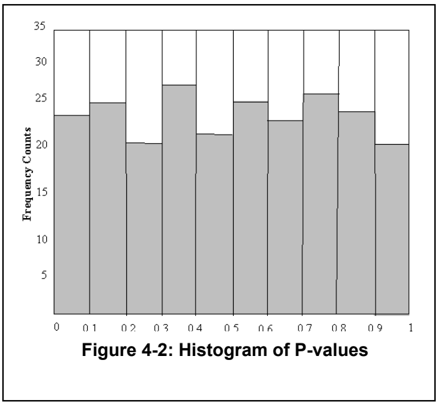
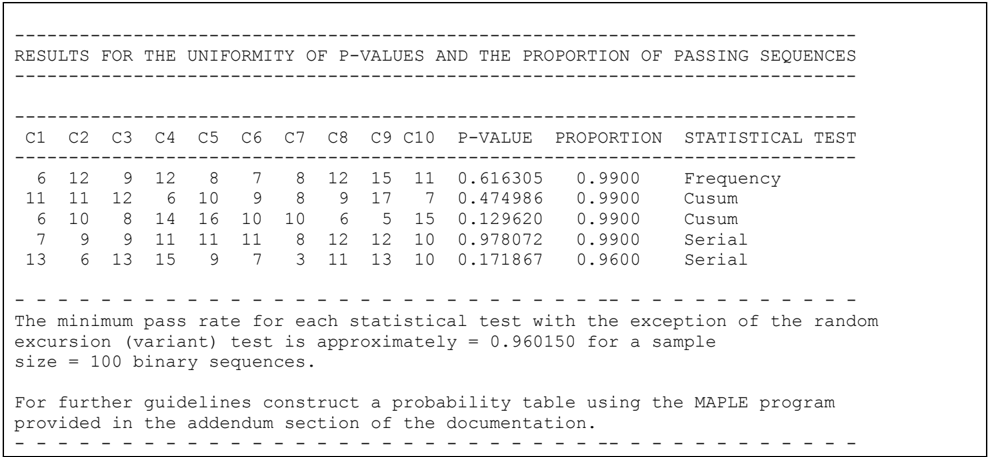
- Main analysis: For each sequence, P-values are computed and compared to \(\alpha\); empirical interpretation examines the proportion of sequences passing a test and the uniformity of P-values. A multiple-test dependence study applied 161 test P-values to Blum-Blum-Shub sequences of length 1,000,000 and used principal components/factor analysis, concluding there was no large redundancy among tests.
Limitations
- The paper states that no set of statistical tests can absolutely certify a generator as appropriate, that statistical testing cannot substitute for cryptanalysis, and that generator design and cryptanalysis are outside its scope.
- The paper states that many examples use small sample sizes for illustration only, e.g., \(n=10\), where the normal approximation is not really applicable; many tests rely on asymptotic reference distributions for large \(n\) (order \(10^3\) to \(10^7\)), and input parameter constraints apply.
- The text makes evident additional limitations: numerical precision can degrade for large incomplete gamma parameter \(a\); Maurer’s variance approximation can make the test 2.67 times more permissive than theoretically admitted; Random Excursions is discontinued if \(J<500\); and multiple tests can yield contradictory conclusions, as in the Random Excursions example where one state gave a non-random result while seven states gave random results.
Model-written summary. Check it against the paper before relying on it.
Integrity signals
Registry
Cites
Statistics
Figures

Verification
Claims the paper makes
0 Valid · 1 Not valid · 11 Not checked · 13 Own results and interpretations
A result the paper reports from its own data — it cites no other source for it, so there is none to check. The quote shows it is in the paper.
In the paper
“The asymptotic distribution of ( Ln -µ n ) / σ n along the sequence of even or odd values of n is that of a discrete random variable obtained via a mixture of two geometric random variables (one of them taking only negative values). Strictly speaking, the asymptotic distribution as such does not exist.”
A result the paper reports from its own data — it cites no other source for it, so there is none to check. The quote shows it is in the paper.
In the paper
“However, no set of statistical tests can absolutely certify a generator as appropriate for usage in a particular application, i.e., statistical testing cannot serve as a substitute for cryptanalysis.”
A result the paper reports from its own data — it cites no other source for it, so there is none to check. The quote shows it is in the paper.
In the paper
“This graph showed that there is no large redundancy among our tests.”
In the paper
“Ueli Maurer of the Department of Computer Science at Princeton University introduced this test in 1992. Maurer's test statistic relates closely to the per-bit entropy of the stream, which its author asserts is 'the correct quality measure for a secret-key source in a cryptographic application.'”
What the sources say
- Not matchedcites Maurer
This doesn’t read as a citation we can look up.
- Not matched
What the paper did — it cites no source for this, so there is none to check. The quote shows it is in the paper.
In the paper
“The test rejects the randomness hypothesis immediately if J is too small, i.e., if the following P-value is small:”
20 more claims
Create a free account to see all 25 claims and every source verdict.
Claims other papers make about this one
Each is checked against this paper’s own text: does it say what the citing paper says it does?
The source backs part of the claim, not all of it — or backs it for a different population, condition or comparison.
In the citing paper
“However, the latest version 2.1.2 [1], released in 2014, does not incorporate several modifications.”
From Checking the quality of approximation of p-values in statistical tests for random number generators by using a three-level test (2019) · cites this paper as [1]
Experimental — accuracy not yet measuredThe source backs part of the claim, not all of it — or backs it for a different population, condition or comparison.
In the citing paper
“The NIST test suite consists of 15 statistical tests for randomness of bit sequences, and its result is a list of 188 p -values.”
From Checking the quality of approximation of p-values in statistical tests for random number generators by using a three-level test (2019) · cites this paper as [1]
Experimental — accuracy not yet measuredThe cited source says what the claim attributes to it.
In the citing paper
“Note that the current implementation of the NIST test suite uses one-level or two-level tests, differently from the above experiments”
From Checking the quality of approximation of p-values in statistical tests for random number generators by using a three-level test (2019) · cites this paper as [1]
The cited source says what the claim attributes to it.
In the citing paper
“NIST SP-800.22 statistical test suite [90] and Die-hard test suite [91] and Test U01 [92] and AIS31 [93] are most common statistical test suites to evaluate their RNGs by researchers.”
From True Random Number Generators Using Electrical Noise (2019) · cites this paper as [90]
Self-check
Percentages, sums and reported differences re-computed from the paper’s own numbers.
Each contradiction between two passages listed here was confirmed by an independent check.
Rated minor: it would not touch a result — a value no result rests on, a p-value that stays on the same side of the significance level, or a conflict that is clerical, resolved elsewhere in the paper, or outside its own findings.
In the paper
§ 2.3.8 Example
“(input) τ = 0.02 (processing) π = 0.42 (processing) Vn(obs) = 52 (output) P-value = 0.500798 (conclusion) Since P-value ≥ 0.01 , accept the sequence as random.”
§ 2.3.4 Test Description
“If it can be shown that π -1 ≥τ , then the 2 Runs test need not be performed (i.e., the test should not have been run because of a failure to pass test 1, the Frequency (Monobit) test). If the test is not applicable, then the P-value is set to 0.0000.”
Rated minor: it would not touch a result — a value no result rests on, a p-value that stays on the same side of the significance level, or a conflict that is clerical, resolved elsewhere in the paper, or outside its own findings.
In the paper
§ 2.7.4 Test Description
“| 8-10 | 010 (hit) | 2 | 110 | 1 |”
§ 2.7.4 Test Description
“For the above example, if m = 3 and the template B = 001, then the examination proceeds as follows:”
Rated minor: it would not touch a result — a value no result rests on, a p-value that stays on the same side of the significance level, or a conflict that is clerical, resolved elsewhere in the paper, or outside its own findings.
In the paper
§ 2.9.3 Test Statistic and Reference Distribution
“f n : The sum of the log2 distances between matching Lbit templates, i.e., the sum of the number of digits in the distance between Lbit templates.”
§ 3.9 Maurer's 'Universal Statistical' Test
“Then it averages over all the expansion lengths by the number of test blocks.”
Rated minor: it would not touch a result — a value no result rests on, a p-value that stays on the same side of the significance level, or a conflict that is clerical, resolved elsewhere in the paper, or outside its own findings.
In the paper
§ Input Parameters:
“The parameters p , q and s are not fixed in code; thus, the user will not be able to reconstruct the original sequence because these values will vary (i.e., they are dependent on the system time).”
§ Input Parameters:
“The input parameters have been fixed so the code will reproduce the same results.”
Rated minor: it would not touch a result — a value no result rests on, a p-value that stays on the same side of the significance level, or a conflict that is clerical, resolved elsewhere in the paper, or outside its own findings.
In the paper
§ 5.5.2 Global Parameters
“| MAXNUMOFTEMPLATES | 40 | Non-overlapping Templates Test | | NUMOFTESTS | 16 | Max number of tests | | NUMOFGENERATORS | 12 | Max number of PRNGs |”
§ A.2 Configuration Information
“| 2. | #define MAXNUMOFTEMPLATES | 148 | | 3. | #define NUMOFTESTS | 15 | | 4. | #define NUMOFGENERATORS | 10 |”
2 more findings
Create a free account to see every finding of this check.
Citations
Cites
Handbook of Mathematical Functions
McQuarrie, D. A. (1966) · American Journal of Physics · doi:10.1119/1.1972842 · Cited by 40,433
Numerical recipes in C: the art of scientific computing
(1993) · Choice Reviews Online · doi:10.5860/choice.30-5638 · Cited by 17,933
Rayward-Smith, V. J. (1991) · Journal of the Operational Research Society · doi:10.1057/jors.1991.155 · Cited by 16,821
Handbook of applied cryptography
(1997) · Choice Reviews Online · doi:10.5860/choice.34-4512 · Cited by 10,357
Handbook of Mathematical Functions
(2018) · A Century of Excellence in MEASUREMENTS, STANDARDS, and TECHNOLOGY · doi:10.1201/9781351069397-39 · Cited by 9,062
A universal algorithm for sequential data compression
Ziv, J., & Lempel, A. (1977) · IEEE Transactions on Information Theory · doi:10.1109/tit.1977.1055714 · Cited by 5,456
The Art of Computer Programming
Worlton, W. J. (1968) · Nuclear Science and Engineering · doi:10.13182/nse68-a19548 · Cited by 2,251
Handbook of Applied Cryptography
Menezes, A. J., van Oorschot, P. C., & Vanstone, S. A. (2018) · CRC Press eBooks · doi:10.1201/9780429466335 · Cited by 1,770
Numerical Recipes in C-The Art of Scientific Computing.
G., W., Press, W. H., Flannery, B. P., Teukolsky, S. A., & Vetterling, W. T. (1989) · Mathematics of Computation · doi:10.2307/2008673 · Cited by 1,513
The Fourier Transform and its Applications
Cattermole, K. W. (1965) · Electronics and Power · doi:10.1049/ep.1965.0268 · Cited by 1,417
Cited by
Items 201–300 of 3,620
A new pseudo-random number generator based on CML and chaotic iteration
Wang, X., & Qin, X. (2012) · Nonlinear Dynamics · doi:10.1007/s11071-012-0558-0 · Cited by 82
“And we do several experiments as NIST 800-22 statistical test suit [15], draw the autocorrelation and histogram figures, and we use the new algorithm in the image encryption.”
MethodF-FCSR: Design of a New Class of Stream Ciphers
Arnault, F., & Berger, T. P. (2005) · Lecture notes in computer science · doi:10.1007/11502760_6 · Cited by 91
Mahmood Malik, M. S., Ali, M. A., Khan, M. A., Ehatisham-Ul-Haq, M., Shah, S. N. M., Rehman, M., & Ahmad, W. (2020) · IEEE Access · doi:10.1109/access.2020.2973679 · Cited by 78
“To validate the randomness of a bitstream generated by any RNG, NIST statistical test suite (STS) 800-22 [59] is used.”
MethodKeyed hash function based on a chaotic map
Kanso, A. A., Yahyaoui, H., & Almulla, M. (2011) · Information Sciences · doi:10.1016/j.ins.2011.09.008 · Cited by 79
Argyris, A., Pikasis, E., Deligiannidis, S., & Syvridis, D. (2012) · Journal of Lightwave Technology · doi:10.1109/jlt.2012.2188377 · Cited by 84
“randomness NIST tests (15 tests in total) [29] is shown, when incorporating in the final bit-stream generation a different number”
MethodRandomness Extraction from Bell Violation with Continuous Parametric Down-Conversion
Shen, L., Lee, J., Le, T. P., Bancal, J.-D., Ceré, A., Lamas-Linares, A., Lita, A. E., Gerrits, T., Nam, S. W., Scarani, V., et al. (2018) · Physical Review Letters · doi:10.1103/physrevlett.121.150402 · Cited by 90
A new design of cryptosystem based on S-box and chaotic permutation
Farah, M. A. B., Guesmi, R., Kachouri, A., & Samet, M. (2020) · Multimedia Tools and Applications · doi:10.1007/s11042-020-08718-8 · Cited by 78
ReLU-type Hopfield neural network with analog hardware implementation
Chen, C., Min, F., Zhang, Y., & Bao, H. (2023) · Chaos Solitons & Fractals · doi:10.1016/j.chaos.2022.113068 · Cited by 88
Efficient Implementation of True Random Number Generator Based on SRAM PUFs
van der Leest, V., van der Sluis, E., Schrijen, G.-J., Tuyls, P., & Handschuh, H. (2012) · Lecture notes in computer science · doi:10.1007/978-3-642-28368-0_20 · Cited by 89
True Random Number Generators Using Electrical Noise
Gong, L., Zhang, J., Liu, H., Sang, L., & Wang, Y. (2019) · IEEE Access · doi:10.1109/access.2019.2939027 · Cited by 77
“22 statistical test suite [90] and Die-hard test suite [91] and Test U01 [92] and AIS31 [93] are most common statistical test suites to evaluate their RNGs by researchers.”
BackgroundImage encryption using block cipher and chaotic sequences
Artiles, J. A. P., Chaves, D. P. B., & Pimentel, C. (2019) · Signal Processing: Image Communication · doi:10.1016/j.image.2019.08.014 · Cited by 85
Secure OFDM-PON System Based on Chaos and Fractional Fourier Transform Techniques
Deng, L., Cheng, M., Wang, X., Li, H., Tang, M., Fu, S., Shum, P. P., & Liu, D. (2014) · Journal of Lightwave Technology · doi:10.1109/jlt.2014.2331066 · Cited by 77
A PUF-Enabled Secure Architecture for FPGA-Based IoT Applications
Johnson, A. P., Chakraborty, R. S., & Mukhopadhyay, D. (2015) · IEEE Transactions on Multi-Scale Computing Systems · doi:10.1109/tmscs.2015.2494014 · Cited by 88
Zheng, G., Fang, G., Shankaran, R., Orgun, M. A., Zhou, J., Qiao, L., & Saleem, K. (2016) · IEEE Journal of Biomedical and Health Informatics · doi:10.1109/jbhi.2016.2546300 · Cited by 85
“Therefore, in this experiment, we generated x-bit BSes from captured ECG features (RR, RQ, RS, RP, and RT), and then analyzed the randomness by calculating their entropy and running an NIST randomness test suite [24].”
MethodLiu, X., Ma, Q., Wu, X., Hu, T., Liu, Z., Liu, L., Guo, Q., & Su, Y. (2022) · Remote Sensing of Environment · doi:10.1016/j.rse.2022.113280 · Cited by 94
Secure chaotic system with application to chaotic ciphers
Wang, X., Zhang, W., Guo, W. M., & Zhang, J. (2012) · Information Sciences · doi:10.1016/j.ins.2012.09.037 · Cited by 78
Heterodyne Random Bit Generation Using an Optically Injected Semiconductor Laser in Chaos
Li, X., & Chan, S.-C. (2013) · IEEE Journal of Quantum Electronics · doi:10.1109/jqe.2013.2279261 · Cited by 83
“For randomness verifications, the NIST Special Publication 800-22 statistical tests are employed [58], which collect the statistics of 1000 1-Mbit sequences.”
MethodAn ROI Privacy Protection Scheme for H.264 Video Based on FMO and Chaos
Peng, F., Zhu, X.-W., & Long, M. (2013) · IEEE Transactions on Information Forensics and Security · doi:10.1109/tifs.2013.2259819 · Cited by 81
A Fast Chaos-based True Random Number Generator for Cryptographic Applications
Pareschi, F., Setti, G., & Rovatti, R. (2006) · 2006 Proceedings of the 32nd European Solid-State Circuits Conference · doi:10.1109/esscir.2006.307548 · Cited by 75
Digital Cosine Chaotic Map for Cryptographic Applications
Alawida, M., Samsudin, A., Teh, J. S., & Alshoura, W. H. (2019) · IEEE Access · doi:10.1109/access.2019.2947561 · Cited by 82
45 Gbps high-speed real-time physical random bit generator
Wang, A., Li, P., Zhang, J., Zhang, J., Li, L., & Wang, Y. (2013) · Optics Express · doi:10.1364/oe.21.020452 · Cited by 82
Empirical evidence concerning AES
Hellekalek, P., & Wegenkittl, S. (2003) · ACM Transactions on Modeling and Computer Simulation · doi:10.1145/945511.945515 · Cited by 76
Application of Resistive Random Access Memory in Hardware Security: A Review
Rajendran, G., Banerjee, W., Chattopadhyay, A., & Aly, M. M. S. (2021) · Advanced Electronic Materials · doi:10.1002/aelm.202100536 · Cited by 84
A Double Chaotic Layer Encryption Algorithm for Clinical Signals in Telemedicine
Murillo-Escobar, M. A., Cardoza-Avendaño, L., López-Gutiérrez, R. M., & Cruz-Hernández, C. (2017) · Journal of Medical Systems · doi:10.1007/s10916-017-0698-3 · Cited by 79
A secure image encryption scheme based on a novel 2D sine–cosine cross-chaotic (SC3) map
Mondal, B., Behera, P. K., & Gangopadhyay, S. (2020) · Journal of Real-Time Image Processing · doi:10.1007/s11554-019-00940-4 · Cited by 82
“For binary matrix rank test and Maurer’s universal statistical test, the minimum length of the bit string sequence must be 38912 bits and 387840 bits, respectively, as per NIST recommendation [16, 39].”
MethodPrivacy Protection Based on Stream Cipher for Spatiotemporal Data in IoT
Liu, T., Wang, Y., Li, Y., Tong, X., Qi, L., & Jiang, N. (2020) · IEEE Internet of Things Journal · doi:10.1109/jiot.2020.2990428 · Cited by 76
“The explanation of 15 tests has been further explained in [50].”
BackgroundMethodZhang, J., Marshall, A., & Hanzo, L. (2018) · IEEE Transactions on Vehicular Technology · doi:10.1109/tvt.2018.2877201 · Cited by 74
“The National Institute of Standards and Technology (NIST) randomness test suite is the most popular tool for evaluating the randomness of the true/pseudo random number generator [17].”
MethodTiming Violation Induced Faults in Multi-Tenant FPGAs
Mahmoud, D. G., & Stojilović, M. (2019) · Design, Automation, and Test in Europe · doi:10.23919/date.2019.8715263 · Cited by 73
“• Other tests included the runs test, to check the number of uninterrupted sequences of identical bits, and the template matching, to check the number of occurrences of specified templates in the bitstream [12].”
BackgroundMethodInfluentialImage Encryption Using Chaos and Block Cipher
Jolfaei, A., & Mirghadri, A. (2010) · Computer and Information Science · doi:10.5539/cis.v4n1p172 · Cited by 73
A novel pseudo random sequence generator for image-cryptographic applications
Hamza, R. (2017) · Journal of Information Security and Applications · doi:10.1016/j.jisa.2017.06.005 · Cited by 97
Real time hybrid medical image encryption algorithm combining memristor-based chaos with DNA coding
Demirkol, A. S., Sahin, M. E., Karakaya, B., Ulutas, H., Ascoli, A., & Tetzlaff, R. (2024) · Chaos, Solitons & Fractals · doi:10.1016/j.chaos.2024.114923 · Cited by 73
Infinitely many coexisting conservative flows in a 4D conservative system inspired by LC circuit
Wang, N., Zhang, G., & Bao, H. (2020) · Nonlinear Dynamics · doi:10.1007/s11071-020-05465-1 · Cited by 73
Saracevic, M. H., Adamović, S., Miškovic, V., Elhoseny, M., Maček, N., Selim, M. M., & Shankar, K. (2020) · IEEE Transactions on Reliability · doi:10.1109/tr.2020.3010973 · Cited by 87
“In this subsection, we introduce two overlapping templates, which in this case will examine the frequency of occurrence of all possible nonoverlapping n-bit samples (or, in the overlapping) in the all examined sequences [47].”
MethodSteganalysis of HUGO steganography based on parameter recognition of syndrome-trellis-codes
Luo, X., Song, X., Li, X., Zhang, W., Lu, J., Yang, C., & Liu, F. (2015) · Multimedia Tools and Applications · doi:10.1007/s11042-015-2759-2 · Cited by 72
“For binary sequence, there are many methods [18] can be used for randomness examination, and the run test is selected in this paper.”
MethodA chaotic permutation and diffusion based image encryption algorithm for secure communications
Mondal, B., Kumar, P., & Singh, S. (2018) · Multimedia Tools and Applications · doi:10.1007/s11042-018-6214-z · Cited by 71
“To analyze the randomness, we have used NIST SP 800-22 test suit [12].”
MethodA PUF-Based Modeling-Attack Resilient Authentication Protocol for IoT Devices
Ebrahimabadi, M., Younis, M., & Karimi, N. (2021) · IEEE Internet of Things Journal · doi:10.1109/jiot.2021.3098496 · Cited by 75
Lessons Learnt from the Cryptanalysis of Chaos-Based Ciphers
Álvarez, G., Amigó, J. M., Arroyo, D., & Li, S. (2011) · Studies in computational intelligence · doi:10.1007/978-3-642-20542-2_8 · Cited by 85
“Upon this consideration, evaluation can be fulfilled using the battery of statistical tests of the National Institute of Standard & Technology (NIST) [84].”
MethodGait-Key: A Gait-Based Shared Secret Key Generation Protocol for Wearable Devices
Xu, W., Javali, C., Revadigar, G., Luo, C., Bergmann, N. W., & Hu, W. S. (2017) · ACM Transactions on Sensor Networks · doi:10.1145/3023954 · Cited by 75
“To validate the randomness of the final key, we apply the NIST suite of statistical tests [Rukhin et al. 2001] to all the keys generated from our dataset.”
MethodEncryption key distribution via chaos synchronization
Keuninckx, L., Soriano, M. C., Fischer, I., Mirasso, C. R., Nguimdo, R. M., & der Sande, G. V. (2017) · Scientific Reports · doi:10.1038/srep43428 · Cited by 76
“We tested these sequences with the National Institute of standards test suite for random bit streams 25 sample size of 23 binary sequences.”
MethodA new Pseudo random number generator based on generalized Newton complex map with dynamic key
Barani, M. J., Ayubi, P., Valandar, M. Y., & Irani, B. Y. (2020) · Journal of Information Security and Applications · doi:10.1016/j.jisa.2020.102509 · Cited by 86
A survey of reversible data hiding in encrypted images – The first 12 years
Puteaux, P., Ong, S., Wong, K., & Puech, W. (2021) · Journal of Visual Communication and Image Representation · doi:10.1016/j.jvcir.2021.103085 · Cited by 80
Zhang, H., Wang, X., Sun, Y.-J., & Wang, X. (2020) · Signal Processing Image Communication · doi:10.1016/j.image.2020.115829 · Cited by 83
Gupta, M. D., & Chauhan, R. K. (2021) · Integration · doi:10.1016/j.vlsi.2021.07.002 · Cited by 72
A Static, Packer-Agnostic Filter to Detect Similar Malware Samples
Jacob, G., Comparetti, P. M., Neugschwandtner, M., Kruegel, C., & Vigna, G. (2013) · Lecture notes in computer science · doi:10.1007/978-3-642-37300-8_6 · Cited by 75
“These tests were originally designed for assessing random number generators [23].”
Mobility Assisted Secret Key Generation Using Wireless Link Signatures
Zhang, J., Kasera, S. K., & Patwari, N. (2010) · IEEE Conference on Computer Communications (INFOCOM) · doi:10.1109/infcom.2010.5462231 · Cited by 75
Using information theory approach to randomness testing
Ryabko, B. Y., & Александрович, М. В. (2004) · Journal of Statistical Planning and Inference · doi:10.1016/j.jspi.2004.02.010 · Cited by 76
Arwini, K., & Dodson, C. T. J. (2008) · Lecture notes in mathematics · doi:10.1007/978-3-540-69393-2 · Cited by 96
A perturbation method to the tent map based on Lyapunov exponent and its application
Cao, L.-C., Luo, Y.-L., Qiu, S.-H., & Liu, J.-X. (2015) · Chinese Physics B · doi:10.1088/1674-1056/24/10/100501 · Cited by 69
Rajagopal, K., Akgül, A., Jafari, S., & Arıcıoğlu, B. (2017) · Nonlinear Dynamics · doi:10.1007/s11071-017-3921-3 · Cited by 68
Image encryption scheme based on a new secure variant of Hill cipher and 1D chaotic maps
Essaid, M., Akharraz, I., Saaidi, A., & Mouhib, E. A. (2019) · Journal of Information Security and Applications · doi:10.1016/j.jisa.2019.05.006 · Cited by 89
Grujić, M., & Verbauwhede, I. M. R. (2022) · IEEE Transactions on Circuits and Systems I Regular Papers · doi:10.1109/tcsi.2022.3158022 · Cited by 87
A family of image encryption schemes based on hyperchaotic system and cellular automata neighborhood
Lai, Q., & Liu, Y. (2025) · Science China Technological Sciences · doi:10.1007/s11431-024-2678-7 · Cited by 77
A fast and efficient chaos-based keyed hash function
Kanso, A. A., & Ghebleh, M. (2012) · Communications in Nonlinear Science and Numerical Simulation · doi:10.1016/j.cnsns.2012.06.019 · Cited by 69
Peng, L., Li, G., Zhang, J., et al. (2018) · IEEE Transactions on Mobile Computing · doi:10.1109/tmc.2018.2842215 · Cited by 68
“The National Institute of Standards and Technology (NIST) random test suite [57] is widely adopted to evaluate the Fig.”
A Chaos Based Image Encryption Scheme Using Digit-Level Permutation and Block Diffusion
Ping, P., Fan, J., Mao, Y., Xu, F., & Gao, J. (2018) · IEEE Access · doi:10.1109/access.2018.2879565 · Cited by 67
“The SP800-22 provided a statistical test suite (STS) consisting of 15 tests.”
BackgroundSecure video summarization framework for personalized wireless capsule endoscopy
Hamza, R., Muhammad, K., Lv, Z., & Titouna, F. (2017) · Pervasive and Mobile Computing · doi:10.1016/j.pmcj.2017.03.011 · Cited by 68
“We have used the default values of the NIST suits tests [45].”
MethodA fractal‐based image encryption system
Abd–El–Hafiz, S. K., Radwan, A. G., AbdElHaleem, S. H., & Barakat, M. L. (2014) · IET Image Processing · doi:10.1049/iet-ipr.2013.0570 · Cited by 72
Sadoudi, S., Tanougast, C., Azzaz, M. S., & Dandache, A. (2013) · EURASIP Journal on Image and Video Processing · doi:10.1186/1687-5281-2013-43 · Cited by 68
“972766 for a sample size equal to 300 binary sequences (for more details, see the reference [43]).”
BackgroundMethodChaos-based medical image encryption scheme using special nonlinear filtering function based LFSR
Deb, S., & Bhuyan, B. (2021) · Multimedia Tools and Applications · doi:10.1007/s11042-020-10308-7 · Cited by 74
“National Institute of Standards and Technology (NIST) designed NIST SP 800-22a test suite for the randomness test [36].”
MethodRandom Number Generators for Cryptographic Applications
Schindler, W. (2008) · Springer eBooks · doi:10.1007/978-0-387-71817-0_2 · Cited by 86
A Closer Look at Security in Random Number Generators Design
Fischer, V. (2012) · Lecture notes in computer science · doi:10.1007/978-3-642-29912-4_13 · Cited by 79
“In order to validate the final quality of the generated bitstream, the designer tested the generated data using standard statistical test suites like NIST SP 800-22 [20] or DIEHARD [19].”
MethodHardware stream cipher with controllable chaos generator for colour image encryption
Barakat, M. L., Mansingka, A. S., Radwan, A. G., & Salama, K. N. (2013) · IET Image Processing · doi:10.1049/iet-ipr.2012.0586 · Cited by 68
“The randomness of the CB-PRNG utilised in addition to the ciphered image are assessed using NIST SP. 800-22 statistical test suite [39].”
MethodSurvey on security in intra-body area network communication
Kompara, M., & Hölbl, M. (2017) · Ad Hoc Networks · doi:10.1016/j.adhoc.2017.11.006 · Cited by 74
Experimental Investigation on Wireless Key Generation for Low-Power Wide-Area Networks
Ruotsalainen, H., Zhang, J., & Grebeniuk, S. (2019) · IEEE Internet of Things Journal · doi:10.1109/jiot.2019.2946919 · Cited by 65
Machine Learning Cryptanalysis of a Quantum Random Number Generator
Truong, N. D., Haw, J. Y., Assad, S. M., Lam, P. K., & Kavehei, O. (2018) · IEEE Transactions on Information Forensics and Security · doi:10.1109/tifs.2018.2850770 · Cited by 77
“RANDOM number generators play an important role in cryptographic applications where secure unpredictable keys are necessary [1].”
BackgroundMethodInfluentialIntelligent Reflecting Surface-Assisted Wireless Key Generation for Low-Entropy Environments
Staat, P., Elders-Boll, H., Heinrichs, M., Kronberger, R., Zenger, C., & Paar, C. (2021) · IEEE International Symposium on Personal, Indoor and Mobile Radio Communications (PIMRC) · doi:10.1109/pimrc50174.2021.9569556 · Cited by 75
An Image Encryption Scheme Based on Lorenz Hyperchaotic System and RSA Algorithm
Lin, R., & Li, S. (2021) · Security and Communication Networks · doi:10.1155/2021/5586959 · Cited by 90
“If the P value is higher than a preset threshold α, it means that the chaotic sequence passes the test [53].”
BackgroundTwin physically unclonable functions based on aligned carbon nanotube arrays
Zhong, D., Liu, J., Xiao, M., Xie, Y., Shi, H., Liu, L., Zhao, C., Ding, L., Peng, L., & Zhang, Z. (2022) · Nature Electronics · doi:10.1038/s41928-022-00787-x · Cited by 80
Tong, X., Wang, Z., Zhang, M., & Liu, Y. (2013) · Nonlinear Dynamics · doi:10.1007/s11071-012-0707-5 · Cited by 67
True-Randomness and Pseudo-Randomness in Ring Oscillator-Based True Random Number Generators
Bochard, N., Bernard, F., Fischer, V., & Valtchanov, B. (2010) · International Journal of Reconfigurable Computing · doi:10.1155/2010/879281 · Cited by 73
“The fact that the tests (FIPS and NIST) pass for a few ROs without Gaussian jitter means that both Sunar’s and Wold’s architectures produce a great amount of pseudo-randomness.”
BackgroundMethodInfluentialYamazaki, T., & Uchida, A. (2013) · IEEE Journal of Selected Topics in Quantum Electronics · doi:10.1109/jstqe.2013.2246777 · Cited by 71
Cherkaoui, A., Bossuet, L., & Marchand, C. (2016) · IEEE Transactions on Information Forensics and Security · doi:10.1109/tifs.2016.2524666 · Cited by 71
“However, a few statistical tests from NIST SP 800-22 [14] can be adapted to a small amount of data, although these tests will have a low confidence level.”
True Random Number Generation Using Read Noise of Flash Memory Cells
Ray, B., & Milenković, A. (2018) · IEEE Transactions on Electron Devices · doi:10.1109/ted.2018.2792436 · Cited by 70
“0001, then the sequence can be considered as uniformly distributed [29].”
BackgroundReal-time selective video encryption based on the chaos system in scalable HEVC extension
Hamidouche, W., Farajallah, M., Sidaty, N., Assad, S. E., & Déforges, O. (2017) · Signal Processing Image Communication · doi:10.1016/j.image.2017.06.007 · Cited by 66
A 3 $\mu$W CMOS True Random Number Generator With Adaptive Floating-Gate Offset Cancellation
Holleman, J., Bridges, S., Otis, B. P., & Diorio, C. (2008) · IEEE Journal of Solid-State Circuits · doi:10.1109/jssc.2008.920327 · Cited by 63
“We tested the processed bits using the NIST test suite [30] and the proportion of sequences passing each test is shown in Table I.”
MethodScalable RFID security framework and protocol supporting Internet of Things
Ray, B. R., Abawajy, J., & Chowdhury, M. U. (2014) · Computer Networks · doi:10.1016/j.comnet.2014.03.023 · Cited by 66
Providing Root of Trust for ARM TrustZone using On-Chip SRAM
Zhao, S., Zhang, Q., Hu, G., Qin, Y., & Feng, D. (2014) · Workshop on Trustworthy Embedded Devices · doi:10.1145/2666141.2666145 · Cited by 66
“We then perform the complete set of randomness tests from NIST 800-22 [53] on our implementation of the secure RNG.”
MethodXiang, S., Wang, B., Wang, Y., Han, Y., Wen, A., & Hao, Y. (2019) · Journal of Lightwave Technology · doi:10.1109/jlt.2019.2920476 · Cited by 71
An encryption scheme for securing multiple medical images
Banik, A., Shamsi, Z., & Laiphrakpam, D. S. (2019) · Journal of Information Security and Applications · doi:10.1016/j.jisa.2019.102398 · Cited by 79
High-Throughput FPGA-Compatible TRNG Architecture Exploiting Multistimuli Metastable Cells
Sala, R. D., Bellizia, D., & Scotti, G. (2022) · IEEE Transactions on Circuits and Systems I Regular Papers · doi:10.1109/tcsi.2022.3199218 · Cited by 71
“5 as required by many cryptographic applications [25], [26], [27].”
BackgroundMethodA New TRNG Based on Coherent Sampling With Self-Timed Rings
Martín, H., Lopez, P. P., Tapiador, J., & Millán, E. S. (2015) · IEEE Transactions on Industrial Informatics · doi:10.1109/tii.2015.2502183 · Cited by 66
“ENT [26], DIEHARD [27], NIST [24], and AIS31 [28] suites have been used for analyzing the randomness quality.”
MethodA novel keyed parallel hashing scheme based on a new chaotic system
Asgari-Chenaghlu, M., Jamali, S., & Nikzad-Khasmakhi, N. (2016) · Chaos Solitons & Fractals · doi:10.1016/j.chaos.2016.04.007 · Cited by 62
A Simple Chaotic Model With Complex Chaotic Behaviors and Its Hardware Implementation
Tang, J., Zhang, Z., Chen, P., Huang, Z., & Huang, T. (2023) · IEEE Transactions on Circuits and Systems I Regular Papers · doi:10.1109/tcsi.2023.3283877 · Cited by 64
“2) Performance Analysis: The National Institute of Standards and Technology (NIST) SP800-22 test tool [50], Shannon entropy [51], and TestU01 [52] are used to verify the performance of the generated random sequences.”
BackgroundMethodThe novel bilateral – Diffusion image encryption algorithm with dynamical compound chaos
Tong, X. (2011) · Journal of Systems and Software · doi:10.1016/j.jss.2011.10.051 · Cited by 59
Truly random number generators based on non‐autonomous continuous‐time chaos
Ergün, S., & Özog̃uz, S. (2010) · International Journal of Circuit Theory and Applications · doi:10.1002/cta.520 · Cited by 61
True Random Number Generators for Cryptography
Sunar, B. (2008) · Springer eBooks · doi:10.1007/978-0-387-71817-0_4 · Cited by 76
An image encryption algorithm based on Baker map with varying parameter
Liu, L., & Miao, S. (2016) · Multimedia Tools and Applications · doi:10.1007/s11042-016-3925-x · Cited by 61
History of uniform random number generation
L’Ecuyer, P. (2017) · Winter Simulation Conference · doi:10.1109/wsc.2017.8247790 · Cited by 87
A New S-Box Generation Algorithm Based on Multistability Behavior of a Plasma Perturbation Model
Farhan, A. K., Ali, R. S., Natiq, H., & Al-Saidi, N. M. G. (2019) · IEEE Access · doi:10.1109/access.2019.2938513 · Cited by 63
“Table 1 lists the NIST-800-22 results of the TCS(1), TCS(2),TCS(3), and TCS(4) when the generated binary sequences are of the length 1, 000, 000 bits.”
MethodInfluentialHyperchaotic encryption based on multi-scroll piecewise linear systems
García-Martínez, M., Ontañón-García, L. J., Campos-Cantón, E., & Čelikovský, S. (2015) · Applied Mathematics and Computation · doi:10.1016/j.amc.2015.08.037 · Cited by 59
Increasing average period lengths by switching of robust chaos maps in finite precision
Nagaraj, N., Shastry, M. C., & Vaidya, P. G. (2008) · The European Physical Journal Special Topics · doi:10.1140/epjst/e2008-00850-4 · Cited by 61
“To statistically confirm this, we tested using 3 standard test suites – The National Institute of Standards in Technology’s Statistical Test Suite (NIST) [17, 18 ], George Marsaglia’s Diehard Battery of tests [19], and the ENT test [20].”
MethodA novel parallel hash function based on 3D chaotic map
Akhavan, A., Samsudin, A., & Akhshani, A. (2013) · EURASIP Journal on Advances in Signal Processing · doi:10.1186/1687-6180-2013-126 · Cited by 59
“These tests include DIEHARD [52], NIST statistical test suite [53], and ENT test suite [54].”
MethodA novel fractional order chaos-based image encryption using Fisher Yates algorithm and 3-D cat map
Musanna, F., & Kumar, S. (2018) · Multimedia Tools and Applications · doi:10.1007/s11042-018-6827-2 · Cited by 62
“These are various standard test, but the most commonly used is the NIST test suite [31].”
MethodA Design for a Physical RNG with Robust Entropy Estimators
Killmann, W., & Schindler, W. (2008) · Lecture notes in computer science · doi:10.1007/978-3-540-85053-3_10 · Cited by 69
“In particular, entropy cannot be guaranteed by passing a collection of statistical blackbox tests [14, 16 ] since typically even weak pseudorandom sequences pass these tests [19, 21, 22].”
BackgroundRandom Number Generation and Quasi‐ M onte C arlo
L’Ecuyer, P. (2015) · Wiley eBooks · doi:10.1002/9781118445112.stat04386.pub2 · Cited by 59
Zero reconciliation secret key generation for body-worn health monitoring devices
Ali, S. T., Sivaraman, V., & Ostry, D. (2012) · ACM Conference on Security and Privacy in Wireless and Mobile Networks (WiSec) · doi:10.1145/2185448.2185455 · Cited by 58
Embedding Compression in Chaos-Based Cryptography
Wong, K., & Yuen, C.-H. (2008) · IEEE Transactions on Circuits & Systems II Express Briefs · doi:10.1109/tcsii.2008.2002565 · Cited by 57
Wen, H., & Yu, S. (2019) · The European Physical Journal Plus · doi:10.1140/epjp/i2019-12797-4 · Cited by 65
Optimized Fuzzy Commitment Based Key Agreement Protocol for Wireless Body Area Network
Jiang, Q. G., Chen, Z., Ma, J., Ma, X., Shen, J., & Wu, D. (2019) · IEEE Transactions on Emerging Topics in Computing · doi:10.1109/tetc.2019.2949137 · Cited by 59
“ated physiological parameters pass the first 9 randomness evaluation tests provided by the NIST test suit [27].”
MethodAccelerometers and randomness: perfect together
Voris, J., Saxena, N., & Halevi, T. (2011) · Wireless Network Security · doi:10.1145/1998412.1998433 · Cited by 69
“The movement samples were run through the National Institute of Standards and Technology (NIST) “Statistical Test Suite for the Validation of Random Number Generators and Pseudo Random Number Generators for Cryptographic Applications” [32] both prior to and following extraction.”
Method
Metadata
- Authors
- Bassham, L. E., Rukhin, A. L., Soto, J., Nechvatal, J. R., Smid, M. E., Barker, E. B., Leigh, S. D., Levenson, M., Vangel, M., Banks, D. L., Heckert, N. A., Dray, J. F., & Vo, S.
- Affiliations
- National Institute of Standards and Technology (US)
- Venue
- NIST Special Publication 800-22 Revision 1a
- Published
- 2010
- OpenAlex
- W1517403092
- Semantic Scholar
- 961fc0f6c68303cde94a28fdb24e6eaf3ef040b4
- Cited by
- 3,617
- References
- 34
- Citations by year
- 2026: 128 · 2025: 205 · 2024: 192 · 2023: 208 · 2022: 166 · 2021: 291 · 2020: 290 · 2019: 250 · 2018: 254 · 2017: 207 · 2016: 183 · 2015: 184 · 2014: 201 · 2013: 155 · 2012: 139
- Type
- report
- Language
- en
- Open access
- gold
- doi.org
- Topics
- Physical Sciences › Computer Science › Artificial Intelligence › Cryptographic Implementations and Security
- Physical Sciences › Mathematics › Discrete Mathematics and Combinatorics › Coding theory and cryptography
- Physical Sciences › Computer Science › Computer Vision and Pattern Recognition › Chaos-based Image/Signal Encryption
- Keywords
- random number generators, pseudorandom number generators, cryptographic randomness, NIST SP 800-22, randomness testing
About these checks
Registry, retraction, Cites and statistics results are computed, not judged, with one exception: a printed reference that no index lists is read once by a model before it counts as a citation error. Claims are extracted by a model and kept only when their quote appears verbatim in the text; each cited source is then checked, with a model’s help, for whether it says what the claim relies on. Those verdicts can be wrong — read the claim’s quote and the cited source before relying on one.
A language model drew the claims from the paper on 2026-09-27 (prompt extract-v2).
Statistics and arithmetic are recomputed, not judged.
Confidence bands are shown only for fields calibrated on our annotated test set. None is calibrated yet, so no band is shown.
What counts as a claim ›How we measure confidence ›How we check this ›
Are you an author, or do you see a problem with this page? Request a review
Data sources
Bibliographic data: Semantic Scholar, OpenAlex, Crossref.
Contains information from the Semantic Scholar Academic Graph Datasets, made available under the ODC Attribution License (ODC-BY 1.0).
Semantic Scholar’s data is described in: Kinney, R., et al. (2023). The Semantic Scholar Open Data Platform. arXiv:2301.10140.
